
1 Timothy 6:18

Greek (Tischendorf 8th ed.) 1 Timothy 6:18 appears in the Greek New Testament. The text above is from the Tischendorf 8th edition. Each word links to its Strong’s number and a concise gloss. Click any word for its full Thayer’s Greek Lexicon entry.
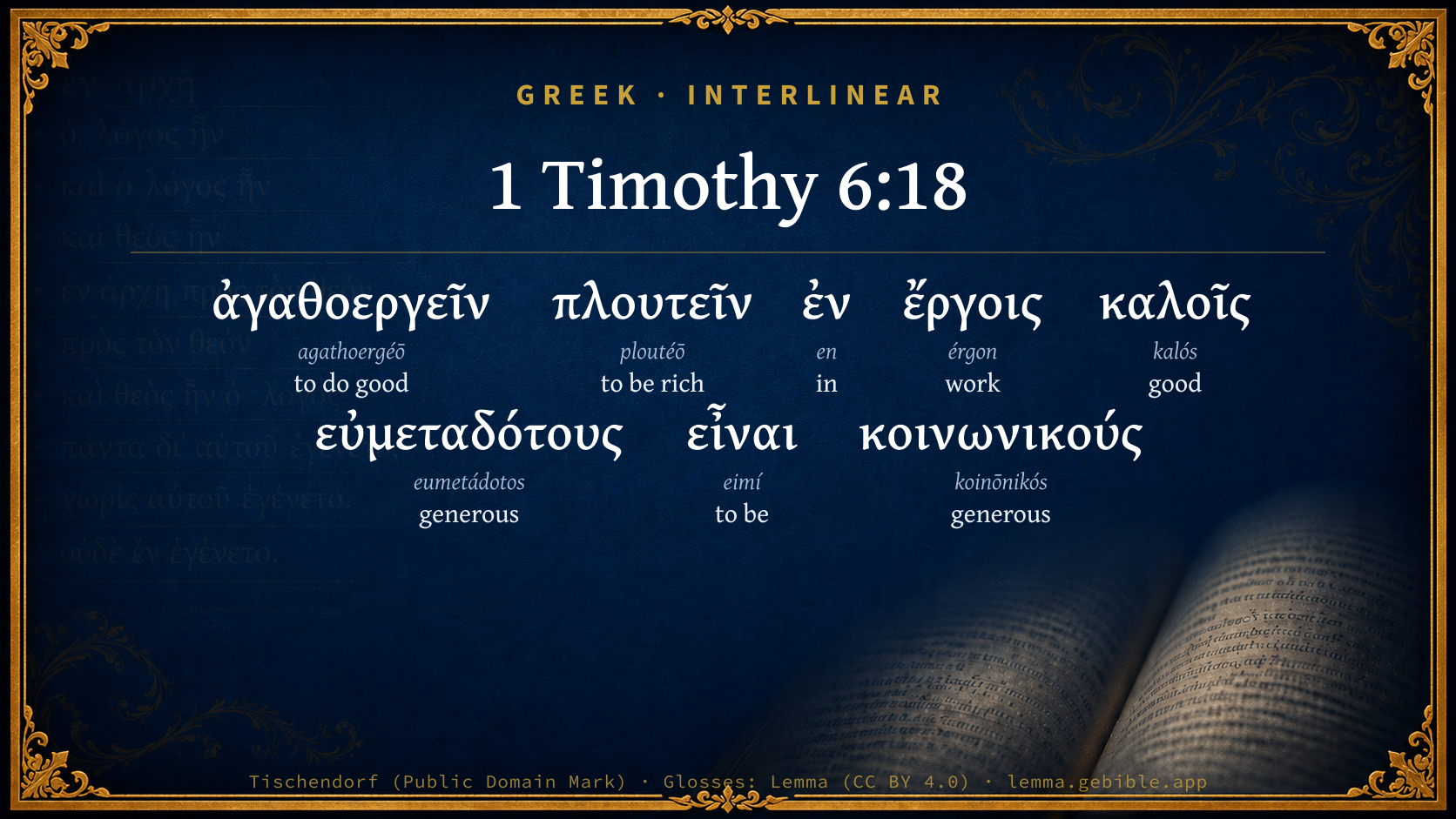
Download image
Cite this verse

1 Timothy 6:18 (World English Bible). Public Domain. Lemma interlinear Bible study tool, https://lemma.gebible.app/v/1-timothy/6/18.

Show BibTeX & RIS
BibTeX
RIS
English Translation
that they do good, that they be rich in good works, that they be ready to distribute, willing to communicate;
World English Bible · Public Domain
Highlights
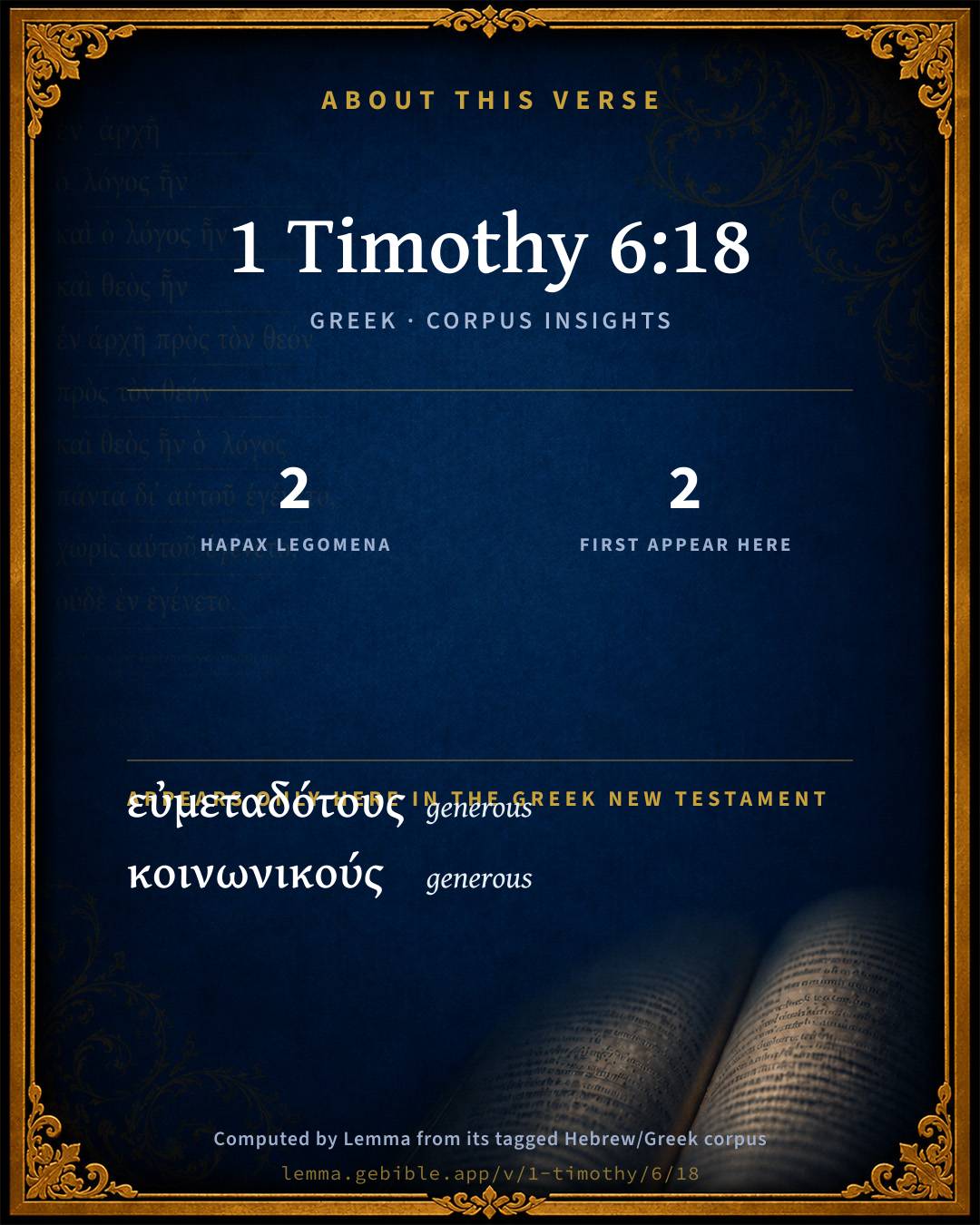
  • 2 hapax legomena — only here in the Greek New Testament
  • 2 first appearances in the Greek New Testament
Full analysis ↓
Download a study sheet

One document with this verse’s original text, its word-by-word gloss line, the meaning frame, cross-references with their text, attributed commentary, and full source and license credits — printable, and it pastes into notes with its structure intact.

This verse Autodidact and up

Study sheet (.html) Plain text (.txt)

A passage Seminary Student

Up to 50 verses in one chapter. A passage sheet keeps up to 6 commentary sources and 12 cross-references per verse, in the order this page ranks them, and says so on the sheet whenever that leaves anything out. Ask for a single verse and you get the Autodidact verse sheet above.

Everything on this page stays free to read, with no account — the sheet is a download of what is already on screen, not access to it.

Want to remove ads? Support Godless Engineer
Compare translations 3

The same verse in 3 English versions, stacked beneath the original-language interlinear above. Click any original word for its lexicon entry.

Each is an independent rendering of the whole verse — the interlinear is not word-aligned to these translations.

Highlighted words mark where these versions differ — a whole-verse word diff, not a word-by-word alignment.

  • World English Bible Public Domain
    that they do good, that they be rich in good works, that they be ready to distribute, willing to communicate;
  • King James Version Public Domain
    That they do good, that they be rich in good works, ready to distribute, willing to communicate;
  • unfoldingWord Literal Text CC BY-SA 4.0
    to do good, to be rich in good works, to be generous, willing to share,

unfoldingWord Literal Text — © unfoldingWord, licensed CC BY-SA 4.0. Word-aligned USFM3 via Door43 (git.door43.org/unfoldingWord/en_ult).

Versions to compare (up to 4)

3 of 4 selected

Show all 19 translations

Every available English version of this verse, each an independent rendering of the whole verse.

  • World English Bible Public Domain
    that they do good, that they be rich in good works, that they be ready to distribute, willing to communicate;
  • Berean Standard Bible Public Domain
    Instruct them to do good, to be rich in good works, and to be generous and ready to share,
  • Majority Standard Bible Public Domain
    Instruct them to do good, to be rich in good works, and to be generous and ready to share,
  • King James Version Public Domain
    That they do good, that they be rich in good works, ready to distribute, willing to communicate;
  • American Standard Version (1901) Public Domain
    that they do good, that they be rich in good works, that they be ready to distribute, willing to communicate;
  • Revised Version (1885) Public Domain
    that they do good, that they be rich in good works, that they be ready to distribute, willing to communicate;
  • Geneva Bible (1599) Public Domain
    That they doe good, and be riche in good woorkes, and readie to distribute, and comunicate,
  • Douay-Rheims (1899) Public Domain
    To do good, to be rich in good works, to give easily, to communicate to others,
  • Young's Literal Translation Public Domain
    to do good, to be rich in good works, to be ready to impart, willing to communicate,
  • Literal Standard Version CC BY-SA 4.0
    to do good, to be rich in good works, to be ready to impart, willing to communicate,
  • Unlocked Literal Bible CC BY-SA 4.0
    Tell them to do good, to be rich in good works, to be generous, and willing to share.
  • unfoldingWord Literal Text CC BY-SA 4.0
    to do good, to be rich in good works, to be generous, willing to share,
  • Darby Bible Public Domain
    to do good, to be rich in good works, to be liberal in distributing, disposed to communicate [of their substance],
  • World Messianic Bible Public Domain
    that they do good, that they be rich in good works, that they be ready to distribute, willing to share;
  • Webster's Bible Public Domain
    That they do good, that they be rich in good works, ready to distribute, willing to communicate;
  • Free Bible Version CC BY-SA 4.0
    Tell them to do good, and to become rich in doing good things, ready to share what they have, and to be generous.
  • Bible in Basic English Public Domain
    And to do good, having wealth in good works, being quick to give, taking part with one another;
  • Text-Critical English NT CC BY 4.0
    Command them to do good, to be rich in good works, and to be generous and willing to share,
  • Tyndale New Testament (1534) Public Domain
    and that they do good and be ryche in good workes and redy to geve and to distribute

Literal Standard Version (2020), Covenant Press — licensed CC BY-SA 4.0. Text via the HelloAO Bible API (eBible.org). Unlocked Literal Bible (unfoldingWord) — licensed CC BY-SA 4.0. Text via the HelloAO Bible API (eBible.org). unfoldingWord Literal Text — © unfoldingWord, licensed CC BY-SA 4.0. Word-aligned USFM3 via Door43 (git.door43.org/unfoldingWord/en_ult). Free Bible Version, Dr. Jonathan Gallagher — licensed CC BY-SA 4.0. Text via the HelloAO Bible API (eBible.org).

Word by word

More ways to search: Search by grammar → Find every occurrence → Compare this word →

Practice this passage: Drill this verse → Learn its vocabulary →

About this verse

These counts appear in no published source. They are computed here, from the morphology-tagged text and Lemma’s own curated glosses. What Lemma adds →

8
words
8
distinct lemmas
Pauline Epistles
section

Notable vocabulary

2 hapax legomena — words that appear only here in the entire Greek New Testament:

  • εὐμεταδότους generous G2130
  • κοινωνικούς generous G2843

First appearance in Scripture

These words make their first canonical appearance in the Greek New Testament here:

  • εὐμεταδότους generous G2130
  • κοινωνικούς generous G2843

Shared distinctive vocabulary

ἀγαθοεργεῖν to do good G14 occurs in 2 verses of the Greek New Testament. Also found in:
Cross-references

35

Topical passages linked to 1 Timothy 6:18 in the Treasury of Scripture Knowledge — connected by theme and wording, ordered by reader-vote popularity; previews shown in the World English Bible.

  • Hebrews 13:16 But don't forget to be doing good and sharing, for with such sacrifices God is well pleased.
  • 1 John 3:17 But whoever has the world's goods, and sees his brother in need, and closes his heart of compassion against him, how does the love of God remain in him?
  • Psalms 37:3 Trust in Yahweh, and do good. Dwell in the land, and enjoy safe pasture.
  • Romans 12:8 or he who exhorts, to his exhorting: he who gives, let him do it with liberality; he who rules, with diligence; he who shows mercy, with cheerfulness.
  • Proverbs 11:24–25 There is one who scatters, and increases yet more. There is one who withholds more than is appropriate, but gains poverty.
  • Luke 12:21 So is he who lays up treasure for himself, and is not rich toward God."
  • Galatians 6:10 So then, as we have opportunity, let's do what is good toward all men, and especially toward those who are of the household of the faith.
  • Titus 2:14 who gave himself for us, that he might redeem us from all iniquity, and purify for himself a people for his own possession, zealous for good works.
  • Titus 3:8 This saying is faithful, and concerning these things I desire that you affirm confidently, so that those who have believed God may be careful to maintain good works. These things are good and profitable to men;
  • Romans 12:13 contributing to the needs of the saints; given to hospitality.
  • Philippians 4:18–19 But I have all things, and abound. I am filled, having received from Epaphroditus the things that came from you, a sweet-smelling fragrance, an acceptable and well-pleasing sacrifice to God.
  • 2 Corinthians 8:9 For you know the grace of our Lord Jesus Christ, that, though he was rich, yet for your sakes he became poor, that you through his poverty might become rich.
  • 1 Timothy 5:10 being approved by good works, if she has brought up children, if she has been hospitable to strangers, if she has washed the saints' feet, if she has relieved the afflicted, and if she has diligently followed every good work.
  • Psalms 112:9 He has dispersed, he has given to the poor. His righteousness endures forever. His horn will be exalted with honor.
  • Ecclesiastes 11:1–2 Cast your bread on the waters; For you shall find it after many days.
  • Ecclesiastes 11:6 In the morning sow your seed, And in the evening don't withhold your hand; For you don't know which will prosper, whether this or that, Or whether they both will be equally good.
  • Isaiah 58:7 Isn't it to deal your bread to the hungry, and that you bring the poor who are cast out to your house? when you see the naked, that you cover him; and that you not hide yourself from your own flesh?
  • 1 Corinthians 16:2 On the first day of the week, let each one of you save, as he may prosper, that no collections be made when I come.
  • 2 Corinthians 8:12 For if the readiness is there, it is acceptable according to what you have, not according to what you don't have.
  • 2 Corinthians 9:6–15 Remember this: he who sows sparingly will also reap sparingly. He who sows bountifully will also reap bountifully.
  • 3 John 1:11 Beloved, don't imitate that which is evil, but that which is good. He who does good is of God. He who does evil hasn't seen God.
  • Deuteronomy 15:7–11 If there be with you a poor man, one of your brothers, within any of your gates in your land which Yahweh your God gives you, you shall not harden your heart, nor shut your hand from your poor brother;
  • 2 Chronicles 24:16 They buried him in the city of David among the kings, because he had done good in Israel, and toward God and his house.
  • Ecclesiastes 3:12 I know that there is nothing better for them than to rejoice, and to do good as long as they live.
  • Isaiah 32:8 But the noble devises noble things; and in noble things shall he continue.
  • Luke 6:33–35 If you do good to those who do good to you, what credit is that to you? For even sinners do the same.
  • Luke 14:12–14 He also said to the one who had invited him, "When you make a dinner or a supper, don't call your friends, nor your brothers, nor your kinsmen, nor rich neighbors, or perhaps they might also return the favor, and pay you back.
  • Acts 2:44–45 All who believed were together, and had all things in common.
  • Acts 9:36 Now there was at Joppa a certain disciple named Tabitha, which when translated, means Dorcas. This woman was full of good works and acts of mercy which she did.
  • 2 Corinthians 8:1–2 Moreover, brothers, we make known to you the grace of God which has been given in the assemblies of Macedonia;
  • James 2:5 Listen, my beloved brothers. Didn't God choose those who are poor in this world to be rich in faith, and heirs of the Kingdom which he promised to those who love him?
  • 1 Peter 3:11 Let him turn away from evil, and do good. Let him seek peace, and pursue it.
  • Acts 4:34–37 For neither was there among them any who lacked, for as many as were owners of lands or houses sold them, and brought the proceeds of the things that were sold,
  • Acts 10:38 even Jesus of Nazareth, how God anointed him with the Holy Spirit and with power, who went about doing good and healing all who were oppressed by the devil, for God was with him.
  • Acts 11:29 As any of the disciples had plenty, each determined to send relief to the brothers who lived in Judea;

Cross-references courtesy of OpenBible.info (CC BY 4.0).

Commentary

Notes on 1 Timothy 6:18 from classic Christian and Jewish commentators (each source and its license shown beneath its notes). The classic Christian expositions comment on the surrounding passage and are grouped to its opening verse, so a note may address several verses; the Jewish commentaries on the Tanakh (Rashi and others) are per-verse, so they appear only where the commentator wrote on this verse.

Lemma curates 59 commentaries, every one of them public domain or Creative Commons licensed, each selected and text-cleaned for this edition rather than reprinted as found. About our sources →

Bengel's Gnomon

Johann Albrecht Bengel

1Ti 6:18. Ἀγαθοεργεῖν) to aim to do good. To be rich in good works follows as the consequence of this diligence: ἀγαθὸν and καλὸν differ; ἀγαθὸς involves at the sametime the idea of (divine) blessedness (comp. Mar 10:18, note): καλὸς includes in its notion, beauty.—εὐμεταδότους, [“ready to distribute”] liberal) in imparting, viz. individually.—κοινωνικοὺς, willing to communicate) by lending, by contributing for the common good, viz. along with many. In ordinary cases i.e. where the grace of God does not change them], the rich are chiefly delighted with a division [i.e. individual monopoly, as opposed to communicating] in proceedings, plans, and properties, and are imperious and insolent.

Bengel's Gnomon of the New Testament — English translation (T&T Clark, Edinburgh, 1860) — public domain. Text from a community e-Sword module.

Meyer's Critical & Exegetical Commentary

Heinrich August Wilhelm Meyer

1Ti_6:18. The negative ideas of the previous verse are followed by four positive, joined two and two.

ἀγαθοεργεῖν, πλουτεῖν ἐν ἔργοις καλοῖς] These ideas are synonymous, the second, however, being stronger than the first. It is not probable that we are to think only of the practice of benevolence; that is brought out in the next two expressions. On ἀγαθοεργεῖν, comp. Act_14:17, where, however, the Rec. has ἀγαθοπιῶν; the word ἀγαθοποιεῖν in Num_10:32, LXX.; 1Ma_11:33.

πλουτεῖν ἐν ἐργ. ἀγ. hints at τοῖς πλουσίοις ἐν τ. νῦν αἰῶνι (Wiesinger).

εὐμεταδότους εἶναι, κοινωνικούς] The two expressions occur only here in the N. T.: μεταδίδωμι is, however, used specially of giving to the poor in Luk_3:11; Rom_12:8; Eph_4:28. Some expositors wrongly find in κοινωνικούς an express contrast to ὑψηλοφρονεῖν; Chrysostom: = ὁμιλητικοί, προσηνεῖς. It stands here like κοινωνεῖν, Gal_6:6; κοινωνία (joined with εὐποιΐα), Heb_13:16.

Meyer — Critical and Exegetical Commentary on the New Testament — English translation by Peter Christie, edited by Frederick Crombie (T&T Clark, 1880) — public domain. Text from a community e-Sword module.

Expositor's Greek Testament

ed. W. Robertson Nicoll

1Ti 6:18 . ἀγαθοεργεῖν : corrects any possible misunderstanding of εἰς ἀπόλαυσιν . πλουτεῖν ἐν ἔργοις καλοῖς : see note on 1Ti 3:1 . Cf. εἰς θεὸν πλουτῶν , Luk 12:21 .

εὐμεταδότους : facile tribuere (Vulg.), ready to impart ( cf. the use of μεταδίδωμι in Luk 3:11 ; Rom 1:11 ; Rom 12:8 ; Eph 4:28 ; 1Th 2:8 ).

κοινωνικούς : This does not mean sociable (A.V. m.), ready to sympathise (R.V. m.), as Chrys., and Thdrt. explain it, but ταῖς χρείαις τῶν ἁγίων κοινωνοῦντες . Rom 12:13 ( cf. Gal 6:6 ; Phi 4:15 ). A good illustration of the general sentiment is Heb 13:16 , τῆς δὲ εὐποιΐας καὶ κοινωνίας μὴ ἐπιλανθάνεσθε . Von Soden notes that the thought in εὐμεταδ . is of the needs of others, in κοινων . of the imparting of one’s own.

The Expositor's Greek Testament, edited by W. Robertson Nicoll (1897–1910) — public domain. Text from a community e-Sword module.

Jamieson, Fausset & Brown

Robert Jamieson, A. R. Fausset & David Brown

do good--like God Himself (Psa 119:68; Act 14:17) and Christ (Act 10:38). TITTMANN translates, "to do," or "act well"; as the Greek for "to be beneficent" is a distinct word, agathopoiein.

rich in good works--so "rich in faith," which produces good works (Jam 2:5). Contrasted with "rich in this world," Ti1 6:17. Literally, it is "rich in honorable (right) works." Greek, "kalois," "ergois," are works good or right in themselves: "agathois," good to another.

ready to distribute--free givers [ALFORD]; the heart not cleaving to possessions, but ready to impart to others.

willing to communicate--ready contributors [ALFORD]: liberal in admitting others to share our goods in common with ourselves (Gal 6:6; Heb 13:16).

Jamieson, Fausset & Brown — Commentary Critical and Explanatory on the Whole Bible (1871) — public domain (CC PDM 1.0). Text via the HelloAO Bible API.

Adam Clarke's Commentary

Verse 18. That they do good] That they relieve the wants of their fellow creatures, according to the abundance which God has given them. The highest luxury a human being can enjoy on this side of the grave.

Rich in good works] That their good works may be as abundant as their riches.

Ready to distribute] ευμεταδοτους ειναι. That they give nothing through partiality or favour, but be guided in their distribution by the necessities of the objects presented to them; and that they confine not their charity at home, but scatter it abroad.

Willing to communicate] κοινωνικους. Bringing every poor person into a state of fellowship with themselves.

Adam Clarke's Commentary on the Bible (1810–1826) — public domain. Text from a community e-Sword/MySword module.

John Calvin's Commentaries

18 To do good He adds another remedy to the former, for correcting the sinful dispositions of rich men, by stating authoritatively what is the lawful use of riches; for the richer any man is, the more abundant are his means of doing good to others; and because we are always more tardy than we ought to be in giving to the poor, he employs many words in commendation of that virtue.

John Calvin's Commentaries (1540-1563) — public domain. Text from the Calvin Translation Society English edition (1840s-50s) via the Christian Classics Ethereal Library (ccel.org). Calvin's coverage is partial (roughly two-thirds of the Bible); uncommented books and verses are honest gaps, never fabricated. The 19th-century editor's footnotes and remarks are omitted so the notes are faithfully Calvin's own voice.

Ellicott's Commentary for English Readers

(18) That they do good, that they be rich in good works.—These words—coming directly after the statement that the good and pleasant things of this world, which are possessed in so large a share by the “rich,” are, after all, the gifts of God, who means them for our enjoyment—these words seem to point to the highest enjoyment procurable by these “rich”—the luxury of doing good, of helping others to be happy the only enjoyment that never fails, never disappoints.

Ready to distribute, willing to communicate.—In distinguishing between these words, which are nearly synonymous, the first points rather to the hand which generously gives, and the second to the heart which lovingly sympathises.

The first obeys willingly the Master’s charge—“Give to him that asketh;” the second follows that loving command which bids His own to rejoice with those that rejoice, and to mourn with those that mourn.

A Bible Commentary for English Readers, edited by Charles John Ellicott (1878–1897) — public domain. Text from a community e-Sword module.

The Cambridge Bible for Schools and Colleges

gen. ed. J. J. S. Perowne

18. that they do good] Another of the many compound words; used however (according to the right reading) of God in providence, Act_14:17, ‘in that He did good;’ stronger than the ordinary word (e.g. Luk_6:9), and taken up in the next clause; render that they work at doing good.

rich in good works] The riches are jewels of God’s giving, and can be best seen and best enjoyed ‘in a setting of fair works.’ The two adjectives for ‘good’ here have a distinction, but not that given by Alford; the first according to a probable derivation signifying what is ‘kind and good’ in its inner character in a man’s conduct towards others, the second what is ‘fair and gracious’ in outer expression and bearing. The two together came to be used at Athens as one phrase to denote ‘a gentleman.’ And so such a use of wealth marks ‘the Christian gentleman.’ For the second word is the one used Mat_5:16, ‘let your light shine … that they may see your good works,’ and 1Pe_2:12, ‘your good works which they behold. Compare Bp. Westcott’s definition, Heb_10:24 ‘works which by their generous and attractive character win the natural admiration of men,’ and his synonym Heb_6:5, ‘tasted the goodness—the beauty—of the Word of God.’ See notes on Tit_1:16; Tit_2:7; Tit_3:8.

ready to distribute, willing to communicate] Again two peculiar compound adjectives. Cranmer’s version followed in the Offertory Sentences of the Prayer-Book has ‘ready to give and glad to distribute,’ giving also the same rendering to the second of our two words in the text from Heb_13:16, ‘to do good and to distribute forget not,’ where A.V. and R.V. ‘to do good and to communicate.’ Possibly ‘communicate’ in such a connexion would have been misunderstood. The corresponding noun is rendered ‘distribution’ by A.V. in 2Co_9:13, by R.V. ‘contribution.’ The ‘sympathy’ suggested by the margin here of R.V. is certainly implied in the word, which may be said to sum up, in itself, the unity, generosity, and practical piety of the Church, as it worked out, under St Paul (see esp. 2Co_8:9), that problem of ‘rich and poor together’ which the earliest impulses of ‘the faith’ had solved for the moment only by the short rule of Act_2:44-45, ‘all that believed were together and had all things common,’—the same word from which our ‘willing to communicate’ comes. The root principle remains the same (2Co_8:13-15), and this our word conveys, though the practice was not workable for long of selling all into a common stock. G. Herbert seems to express both of the present adjectives in

‘Joyn hands with God to make a man to live,

Give to all something; to a good poore man,

Till thou change names, and be where he began.’

The Church Porch.

The Christian wealth of England is still far below such a principle; else why the ‘weariness and painfulness’ known to so many of our clergy in begging appeals for ‘good works’ of piety and charity?

The Cambridge Bible for Schools and Colleges (gen. ed. J. J. S. Perowne; Cambridge University Press, 1878–1918) — public domain. Text from a community e-Sword module.

John Gill's Exposition

That they do good,.... Rich men sometimes do much ill to themselves, to the hurt of their bodies, by luxury, intemperance, and debauchery, and to their souls, to the ruin of them; and to others by fraud, oppression, and violence; for it is in the power of their hands to do much evil, and also to do much good, as they should; and much is required of them, since much is given them to do good with, and for which they are accountable: it becomes them, and especially such as believe in Christ, to do every good work in general, and to do acts of beneficence in particular, both to all men, and to the household of faith.

That they be rich in good works; or abound in the performance of them, as Dorcas is said to be full of good works and alms deeds; and to reckon that their true riches lie more in the exercise of grace, and in the fruits of it, doing good works, than in their worldly enjoyments. The phrase seems to be Rabbinical. Frequent mention is made of , "rich in the law", and , "rich in the commandments" (t); and it is said (u), no man is poor but he that is without the law, and good works, for the riches of a man are the law, and good works.

Ready to distribute; unasked; and when they are asked, do not turn away, and put off, but give at once, and without grief, and with cheerfulness; want no arguments to press them to it, nor use any against it.

Willing to communicate; of their good things to the necessities of the poor, making them common to them, and them partakers of them. Some render the word "sociable", in opposition to that moroseness, stillness, and those haughty and forbidding airs, with which rich men are apt to treat the poor, when they should be affable and courteous to them, and admit them to a free conversation with them.

(t) Zohar in Numb. fol. 91. 3. Vajikra Rabba, sect. 34. fol. 173. 4. & Tzeror Hammaor, fol. 15. 2. (u) Raya Mehimna in Exod. fol 48. 3. Vid. T. Bab. Megilia, fol. 11. 1.

John Gill's Exposition of the Whole Bible (1746–1763) — public domain (CC PDM 1.0). Text via the HelloAO Bible API.

Trapp's Complete Commentary

John Trapp

18 That they do good, that they be rich in good works, ready to distribute, willing to communicate;

Ver. 18. That they do good] Not the richer the harder; as the sun moveth slowest when it is at the highest in the zodiac, or as the moon when it is fullest of light gets farthest off from the sun.

Rich in good works] This is to be rich in God, Luk 12:21, when our works are good, Quoad fontem et quoad finem. As from the source until the end.

Ready to distribute] A virtue much commended in the kings of Egypt (Diod. Sic. i.); practised by the Pythagoreans, Essenes, but especially by those primitive Christians, Act 4:34-35. See my Common Place of Alms, and to those many examples there set forth of Christian bounty, add that of Mr Fox, who never denied any that asked him aught for Jesus’ sake. And being once so asked by a poor man, he questioned him whether he knew Jesus Christ? And finding signs that the man was a believer, he gave him his horse, when he had no money. I commend not his discretion, but his zeal and charity were admirable. The like is reported of Aidanus, as hath been said before. Queen Anne Boleyn gave in alms fourteen or fifteen thousand pounds in three-quarters of a year, as Mr Fox reporteth; accounting that she had nothing of her own but what she had given away. Hoc habeo quodcunque dedi. (Seneca.)

John Trapp, A Commentary or Exposition upon All the Books of the Old and New Testament (1647–1656) — public domain. Text from a community e-Sword module.

Albert Barnes' Notes on the Bible

That they do good - On the duty enjoined in this verse, see Gal 6:10 note; Heb 13:10 note.

That they be rich in good works - “That their good works may be as abundant as their riches.”

Ready to distribute - To divide with others; compare Act 4:34. The meaning is, that they should be liberal, or bountiful.

Willing to communicate - Margin, or “sociable.” The translation in the text is a more correct rendering of the Greek. The idea is, that they should be willing to share their blessings with others, so as to make others comfortable; see the notes on Heb 13:16; compare the argument of Paul in 2Co 8:13-15, and the notes on that passage.

Albert Barnes' Notes on the Bible (1834–1885) — public domain. Text from a community e-Sword/MySword module.

Matthew Poole's English Annotations

That they do good; that is, to others, as they have opportunity.

That they be rich in good works; be plentiful in alms-deeds, or more generally in all good works of piety or charity.

Ready to distribute; that they be not backward to distribute that of which God hath made them stewards, to those that want.

Willing to communicate; but give freely and without grudging, according to their Master’s order, as becometh those who are but stewards as to the riches which they have.

Matthew Poole's English Annotations on the Holy Bible (1683–1685) — public domain. Text from a community e-Sword/MySword module.

Whedon's Commentary on the Bible

Daniel D. Whedon

18. They do good—Wealth may exist without sin; but not hoarded, illiberal wealth. It would be well for every rich man to take a concordance, find the words rich and riches, and read with solemn appreciation what things the Bible says upon that subject. Men as they grow rich should increase their benefactions faster than they increase their personal expenses.

Rich in good works—A double richness. The possessor has all the happiness of wealth, and the infinitely higher happiness of living in the benefactions he bestows.

Distribute—To adjust the donation to the various proper objects.

To communicate—To share with others the blessings that belong to you.

Daniel D. Whedon (gen. ed.), Commentary on the Old and New Testaments (1874–1909) — public domain. Text from a community e-Sword module.

The Pulpit Commentary

That they be ready for ready, A.V Do good (ajgaqoergein; here only, for the more common ajgaqopoiein). That they be rich in good works; (1Ti_5:10, note) not merely in the perishing riches of this present world the same sentiment as Mat_6:19-21; Luk_12:33 and 21. Ready to distribute (eujmetadotouv); here only in the New Testament, and rarely in later classical Greek. The opposite, "dose-handed," is dusmetadotov The verb metadidwmi means "to give to others a share or portion of what one has". (Luk_3:11; Rom_1:11 Rom_12:8; Eph_4:28; 1Th_2:8) Willing to communicate (koinwnikouv); here only in the New Testament, but found in classical Greek in a slightly different sense. "Communicative" is the exact equivalent, though in this wider use it is obsolete. We have the same precept in Heb_13:16, "To do good and to communicate forget not." (For koinwnein in the sense of "giving," see Rom_12:13; Gal_6:6; Php_4:15; and for koinwni in the same sense, see Rom_15:26; 2Co_9:13; Heb_13:16)

The Pulpit Commentary (1880–1919), ed. H.D.M. Spence-Jones & Joseph S. Exell — public domain. Text from a community e-Sword module.

John Wesley's Explanatory Notes

To do good - To make this their daily employ, that they may be rich - May abound in all good works. Ready to distribute - Singly to particular persons. Willing to communicate - To join in all public works of charity.

John Wesley, Explanatory Notes Upon the Whole Bible (1754–1765) — public domain. Text via the GEBible commentary corpus.

Fairbairn on Ezekiel, Jonah & the Pastoral Epistles

Patrick Fairbairn

Ver. 18. Here we have in one or two particulars the positive aspect of rich men’s duties: that they do good (ἀγαθοεργεῖν), that they he rich in excellent deeds (ἐν ἔργοις καλοῖς, deeds inherently noble and praiseworthy), free in distributing, ready to communicate (or, as Alford puts it, free-givers, ready-contributors), not merely imparting of their substance to the relief of the needy and the promotion of good objects, but doing it with a frank generosity and a liberal hand. To act thus is nobly to realize the stewardship of wealth, and, according to the word of our Lord, to make to oneself friends of what, taken merely by itself, is the mammon of unrighteousness (Luk 16:9).

Patrick Fairbairn — An Exposition of Ezekiel (1851), Jonah (1849), and The Pastoral Epistles (1874) — public domain. Text from a community e-Sword module.

The People's New Testament

B. W. Johnson

18. That they do good. The right use of wealth is given. Let it be a means of doing good so that they may be rich in good works.

B. W. Johnson's The People's New Testament with Notes (1889–1891) — public domain. Electronic text from the Christian Classics Ethereal Library (CCEL) ThML edition.

Cambridge Greek Testament for Schools and Colleges

18. ἀγαθοεργεῖν. We have ἀγαθουργεῖν, the contracted form, at Act 14:17 (in St Paul’s speech at Lystra); elsewhere in the Greek Bible the word is not found.

πλουτεῖν ἐν ἔργοις καλοῖς, to be rich in good works, a play on the meaning of πλουτεῖν. “Men must not compute their riches so much from what they have, as from what they give” (Bp Beveridge). See the note on 1Ti 2:10 above, on ἔργα καλά in the Pastoral Epistles.

εὐμεταδότους εἶναι, κοινωνικούς, ready to impart and to communicate. Neither εὐμετάδοτος nor κοινωνικός occurs elsewhere in the Greek Bible, although cognate forms of the latter word are common. κοινωνικός seems to express a wider idea than εὐμετάδοτος, which is concerned only with the giving or sharing of worldly goods; there may, however, be a κοινωνία of sympathy which sometimes the rich have peculiar opportunities of shewing. He who is κοινωνικός in the fullest sense will be quick to recognise all the claims of human, and especially of Christian, fellowship. As is often the case, the larger word is placed second, by way of explanation; a kind heart as well as a generous hand is demanded of the rich. This κοινωνία is again directly connected with the doing of good works in Heb 13:16, τῆς δὲ εὐποιΐας καὶ κοινωνίας μὴ ἐπιλανθάνεσθε.

Cambridge Greek Testament for Schools and Colleges (Cambridge University Press, 1896; 21 vols, various authors incl. Carr, Maclear, Plummer, Farrar, Lumby, Moule, M. R. James, Simcox) — public domain. Text from a community e-Sword module.

International Critical Commentary

18. ἀγαθοεργεῖν] like God Himself, Act 14:17 ἀγαφουργῶν . . . ὑετοὺς διδοὺς καὶ καιροὺς καρποφόρους.

εὐμεταδότους, κοινωνικούς] The distinction is not clear; either, quick to give away to others in charity (singulatim, Bengel), cf. Rom 12:8, Eph 4:28, 1Co 13:3, and ready to share with one’s friends that which is one’s own (cum multis, Bengel), e.g. at the ἀγάπη, cf. Gal 6:6, Heb 13:16; or, εὐμεταδ., of action, “open-handed,” cf. εὐμ. εἰς τὴν ἀδελφότητα, Apost. K.O. § 19; κοινωνικούς, of demeanour and temper, “gracious,” with true sense of human fellowship, the antithesis of ὑψηλοφρονεῖν, cf. Rom 12:16; so Chrys. προσηνεῖς Thdt. τοὺς ἄτυφον ἦθος ἔχοντας, and so frequently in Plutarch, who couples it with πολιτικός and φιλάνθρωπος. For the Church’s use of money, cf. Harnack, Expansion of Christianity, Eng. tr. 1. ii. c. 3.

International Critical Commentary — older volumes (1896–1929), various authors — public domain. Text from a community e-Sword module.

Vincent's Word Studies in the New Testament

Marvin R. Vincent

Do good [αγαθοεργειν] . In this uncontracted form, N. T. o. o LXX, o Class. Comp. Act 14:17. The usual word is ajgaqopoiein, see Mr 3:4; Luk 6:9, 33, 35; 1Pe 2:15. o P. who has ejrgazesqai to ajgaqon to work that which is good, Rom 2:10; Gal 6:10; Eph 4:28. Good works [εργοις καλοις] . For kalov see on ch. 1ti 3:7, and Joh 10:11 : for ajgaqov on Rom 5:7.

Ready to distribute [ευμεταδοτους] . N. T. o. o LXX, o Class. For the verb metadidonai to impart to the poor, see Luk 3:11; Eph 4:28. Willing to communicate [κοινωνικους] . N. T. o. o LXX See on fellowship, Act 2:48, and comp. koinwnein to partake, 1Ti 5:22, and koinov common, Tit 1:14. Stronger than the preceding word, as implying a personal share in the pleasure imparted by the gift.

Marvin R. Vincent, Word Studies in the New Testament (1887–1900) — public domain. Text from a community e-Sword/MySword module.

Lesson kit

Teaching starters — assembled from the data on this page, not authored interpretation. Every prompt links to the verse data it draws on. Edit before teaching.

1 Timothy, in the Pauline Epistles, opens this verse with 8 words (8 distinct Greek lemmas). Its most distinctive word is eumetádotos (“generous”). A historical commentator’s framing appears above. Read the whole chapter for the surrounding context.

Discussion questions

  1. How does “generous” (eumetádotos) shape what this verse is saying?
  2. This verse holds 2 words here found nowhere else in the Greek New Testament. What might the rare words draw attention to?
  3. 2 words here appear for the first time in Scripture. What is being introduced at this debut?
  4. Acts 14:17 shares the word «to do good» with this verse. How do the two illuminate each other?
  5. These translations render this verse differently; the difference is in the English rendering, not the original. What questions does that raise?
  6. Reading how Bengel's Gnomon and Meyer's Critical & Exegetical Commentary read this verse, where do the two commentators agree and where do they part?

Things to notice

  • 2 words in this verse appear nowhere else in the Greek New Testament.
  • 2 words make their first canonical appearance in Scripture here.
  • These translations choose different wording for 5 words in this verse.
  • 8 distinct Greek lemmas span 8 words in this verse.

Reading settings

Reading text

Shown beneath each verse's original-language words.

Old Testament
Old Testament edition

Read the OT as the Masoretic Hebrew (MT) or the Greek Septuagint (LXX).

English shown for the Greek Septuagint (in the Hebrew ↔ Greek comparison).

Comparing translations? Open the Compare panel on any verse page to stack up to four side by side.