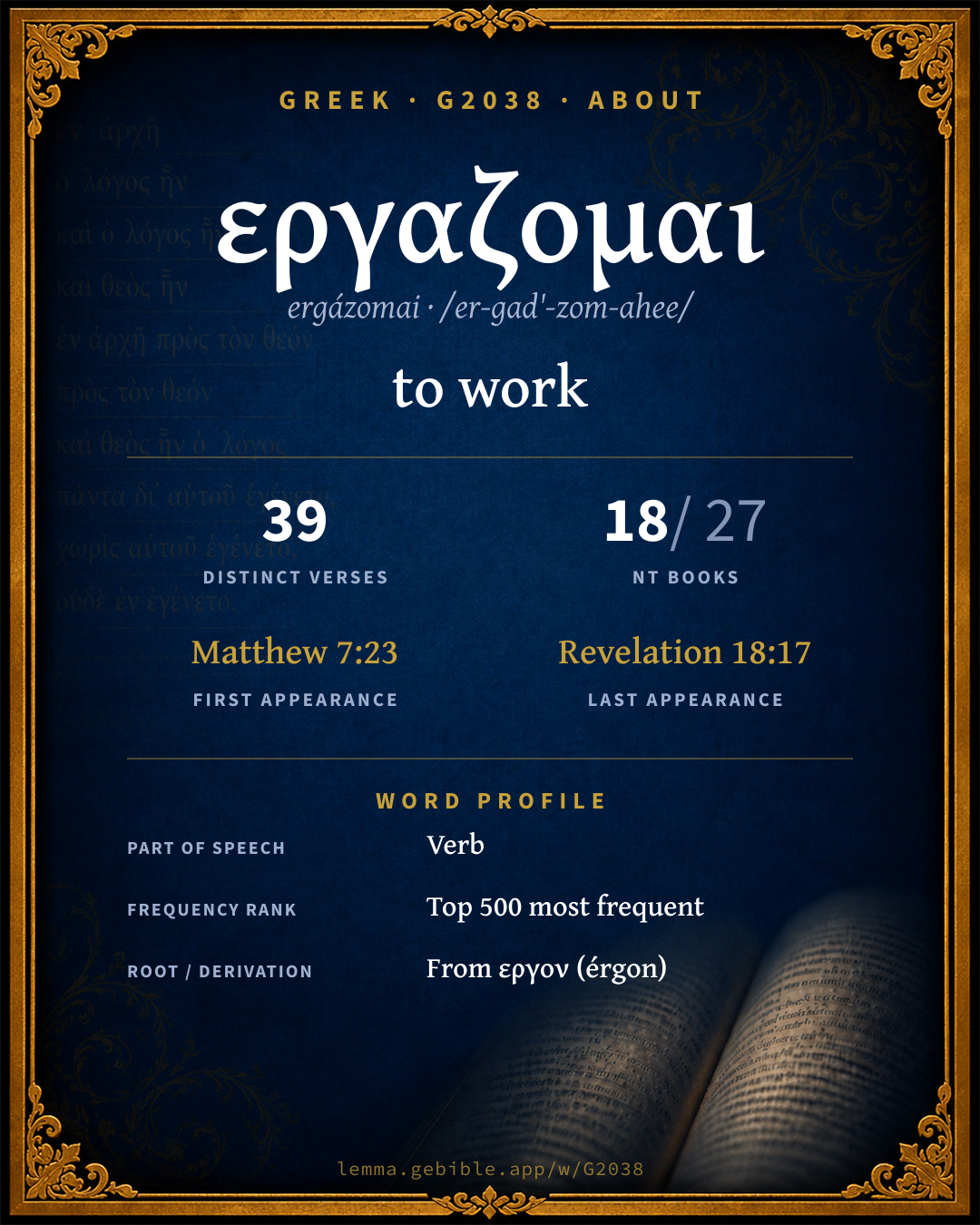
ἐργάζομαι
to work
also: labour, do work fuller range ↓
Full lexicon entry — Thayer's Greek Lexicon
From Thayer's Greek Lexicon
Where this word appears
See every Present-tense verb in the Greek New Testament →
Grammar key — what these labels mean
Part of speech
- Verb
- An action or state-of-being word.
Tense
- Present
- Ongoing or general action in present time (imperfective aspect).
- Aorist
- Action viewed as a simple whole, without regard to duration — often past (perfective aspect).
- Imperfect
- Continuous or repeated action in past time (“was writing”).
- Perfect
- A completed past action with continuing present results.
Voice
- Middle or Passive deponent
- Middle/passive in form but active in meaning.
- Middle deponent
- Middle in form but active in meaning.
- Passive
- The subject receives the action.
Mood
- Infinitive
- A verbal noun (“to write”), unmarked for person or number.
- Participle
- A verbal adjective (“writing,” “having written”).
- Indicative
- States a fact or asks a factual question (the mood of reality).
- Imperative
- Expresses a command or request.
- Subjunctive
- Expresses probability, purpose, or possibility (the mood of contingency).
Case
- Nominative
- The case of the subject (and the predicate nominative).
- Dative
- The case of the indirect object, means, or location — “to / for / with / in.”
- Accusative
- The case of the direct object and of extent.
Person
- 3rd person
- The one spoken about (“he / she / it / they”).
- 1st person
- The speaker (“I / we”).
- 2nd person
- The one addressed (“you”).
Gender
- Masculine
- Grammatically masculine.
- Neuter
- Grammatically neuter.
Number
- Plural
- More than one.
- Singular
- One.
Grammatical forms 19 distinct
- Verb, Present, Middle or Passive deponent, Infinitive 6 times (15%)
- Verb, Present, Middle or Passive deponent, Participle, Nominative, Plural, Masculine 6 times (15%)
- Verb, Present, Middle or Passive deponent, Indicative, 3rd person, Singular 5 times (12%)
- Verb, Aorist, Middle deponent, Indicative, 3rd person, Singular 3 times (7%)
- Verb, Present, Middle or Passive deponent, Participle, Dative, Singular, Masculine 3 times (7%)
- Verb, Present, Middle or Passive deponent, Indicative, 1st person, Singular 2 times (5%)
- Verb, Present, Middle or Passive deponent, Imperative, 2nd person, Plural 2 times (5%)
- Verb, Present, Middle or Passive deponent, Participle, Nominative, Singular, Masculine 2 times (5%)
+11 more forms (12 occurrences)
Parsed forms decoded from the imported morphology (Robinson–Tischendorf, public domain), counted across 41 parsed occurrences — not distinct verses.
Every verse where G2038 appears — 39 distinct verses across 18 books. Click any verse to open its interlinear word-by-word view. Verse text shown in the World English Bible for context — . Each verse’s Greek form is shown with its reference; the English is not keyword-highlighted, since the data carries no word-level English alignment. Use “Compare translations” on any verse to read it across multiple English versions. This concordance covers the Greek New Testament; Septuagint (Greek Old Testament) occurrences of this word are not indexed here.
Matthew 4 verses
- Matthew 7:23 ἐργαζόμενοι pres mid/pass.dep ptcp nom pl masc Then I will tell them, 'I never knew you. Depart from me, you who work iniquity.'
- Matthew 21:28 ἐργάζου pres mid/pass.dep impv 2sg But what do you think? A man had two sons, and he came to the first, and said, 'Son, go work today in my vineyard.'
- Matthew 25:16 ἠργάσατο aor mid.dep ind 3sg Immediately he who received the five talents went and traded with them, and made another five talents.
- Matthew 26:10 ἠργάσατο aor mid.dep ind 3sg But Jesus, knowing this, said to them, "Why do you trouble the woman? Because she has done a good work for me.
Mark 1 verse
Luke 1 verse
John 6 verses
- John 3:21 εἰργασμένα perf pass ptcp nom pl neut But he who does the truth comes to the light, that his works may be revealed, that they have been done in God."
- John 5:17 ἐργάζεται ἐργάζομαι pres mid/pass.dep ind 3sg pres mid/pass.dep ind 1sg But Jesus answered them, "My Father is still working, so I am working, too."
- John 6:27 ἐργάζεσθε pres mid/pass.dep impv 2pl Don't work for the food which perishes, but for the food which remains to eternal life, which the Son of Man will give to you. For God the Father has sealed him."
- John 6:28 ἐργαζώμεθα pres mid/pass.dep subj 1pl They said therefore to him, "What must we do, that we may work the works of God?"
- John 6:30 ἐργάζῃ pres mid/pass.dep ind 2sg They said therefore to him, "What then do you do for a sign, that we may see, and believe you? What work do you do?
- John 9:4 ἐργάζεσθαι ἐργάζεσθαι pres mid/pass.dep inf pres mid/pass.dep inf I must work the works of him who sent me, while it is day. The night is coming, when no one can work.
Acts 3 verses
- Acts 10:35 ἐργαζόμενος pres mid/pass.dep ptcp nom sg masc but in every nation he who fears him and works righteousness is acceptable to him.
- Acts 13:41 ἐργάζομαι pres mid/pass.dep ind 1sg 'Behold, you scoffers, and wonder, and perish; For I work a work in your days, A work which you will in no way believe, if one declares it to you.'"
- Acts 18:3 ἠργάζοντο impf mid/pass.dep ind 3pl and because he practiced the same trade, he lived with them and worked, for by trade they were tent makers.
Romans 4 verses
- Romans 2:10 ἐργαζομένῳ pres mid/pass.dep ptcp dat sg masc But glory and honor and peace to every man who works good, to the Jew first, and also to the Greek.
- Romans 4:4 ἐργαζομένῳ pres mid/pass.dep ptcp dat sg masc Now to him who works, the reward is not counted as grace, but as debt.
- Romans 4:5 ἐργαζομένῳ pres mid/pass.dep ptcp dat sg masc But to him who doesn't work, but believes in him who justifies the ungodly, his faith is accounted for righteousness.
- Romans 13:10 ἐργάζεται pres mid/pass.dep ind 3sg Love doesn't harm a neighbor. Love therefore is the fulfillment of the law.
1 Corinthians 4 verses
- 1 Corinthians 4:12 ἐργαζόμενοι pres mid/pass.dep ptcp nom pl masc We toil, working with our own hands. When people curse us, we bless. Being persecuted, we endure.
- 1 Corinthians 9:6 ἐργάζεσθαι pres mid/pass.dep inf Or have only Barnabas and I no right to not work?
- 1 Corinthians 9:13 ἐργαζόμενοι pres mid/pass.dep ptcp nom pl masc Don't you know that those who serve around sacred things eat from the things of the temple, and those who wait on the altar have their portion with the altar?
- 1 Corinthians 16:10 ἐργάζεται pres mid/pass.dep ind 3sg Now if Timothy comes, see that he is with you without fear, for he does the work of the Lord, as I also do.
2 Corinthians 1 verse
Galatians 1 verse
Ephesians 1 verse
Colossians 1 verse
1 Thessalonians 2 verses
- 1 Thessalonians 2:9 ἐργαζόμενοι pres mid/pass.dep ptcp nom pl masc For you remember, brothers, our labor and travail; for working night and day, that we might not burden any of you, we preached to you the Gospel of God.
- 1 Thessalonians 4:11 ἐργάζεσθαι pres mid/pass.dep inf and that you make it your ambition to lead a quiet life, and to do your own business, and to work with your own hands, even as we charged you;
2 Thessalonians 4 verses
- 2 Thessalonians 3:8 ἐργαζόμενοι pres mid/pass.dep ptcp nom pl masc neither did we eat bread from anyone's hand without paying for it, but in labor and travail worked night and day, that we might not burden any of you;
- 2 Thessalonians 3:10 ἐργάζεσθαι pres mid/pass.dep inf For even when we were with you, we commanded you this: "If anyone will not work, neither let him eat."
- 2 Thessalonians 3:11 ἐργαζομένους pres mid/pass.dep ptcp acc pl masc For we hear of some who walk among you in rebellion, who don't work at all, but are busybodies.
- 2 Thessalonians 3:12 ἐργαζόμενοι pres mid/pass.dep ptcp nom pl masc Now those who are that way, we command and exhort in the Lord Jesus Christ, that with quietness they work, and eat their own bread.
Hebrews 1 verse
James 2 verses
2 John 1 verse
3 John 1 verse
Revelation 1 verse
About this entry
At a glance — auto-summarized from this page’s data, not written by a person. Every figure links to its source below. This summary describes the numbers; it doesn’t interpret them.
εργαζομαι — transliterated ergázomai — is a Greek verb carrying the sense “to work.” Thayer's distinguishes 5 senses; alongside “to work” it spans “labour” and “do work”. Spanning 39 verses in 18 books, it ranks among the moderately common words of the Greek New Testament. Its earliest occurrence is Matthew 7:23. Sharing its root, it stands alongside εργον, εργατης and ραδιουργημα. Each statement above links to its evidence; the full detail follows below.
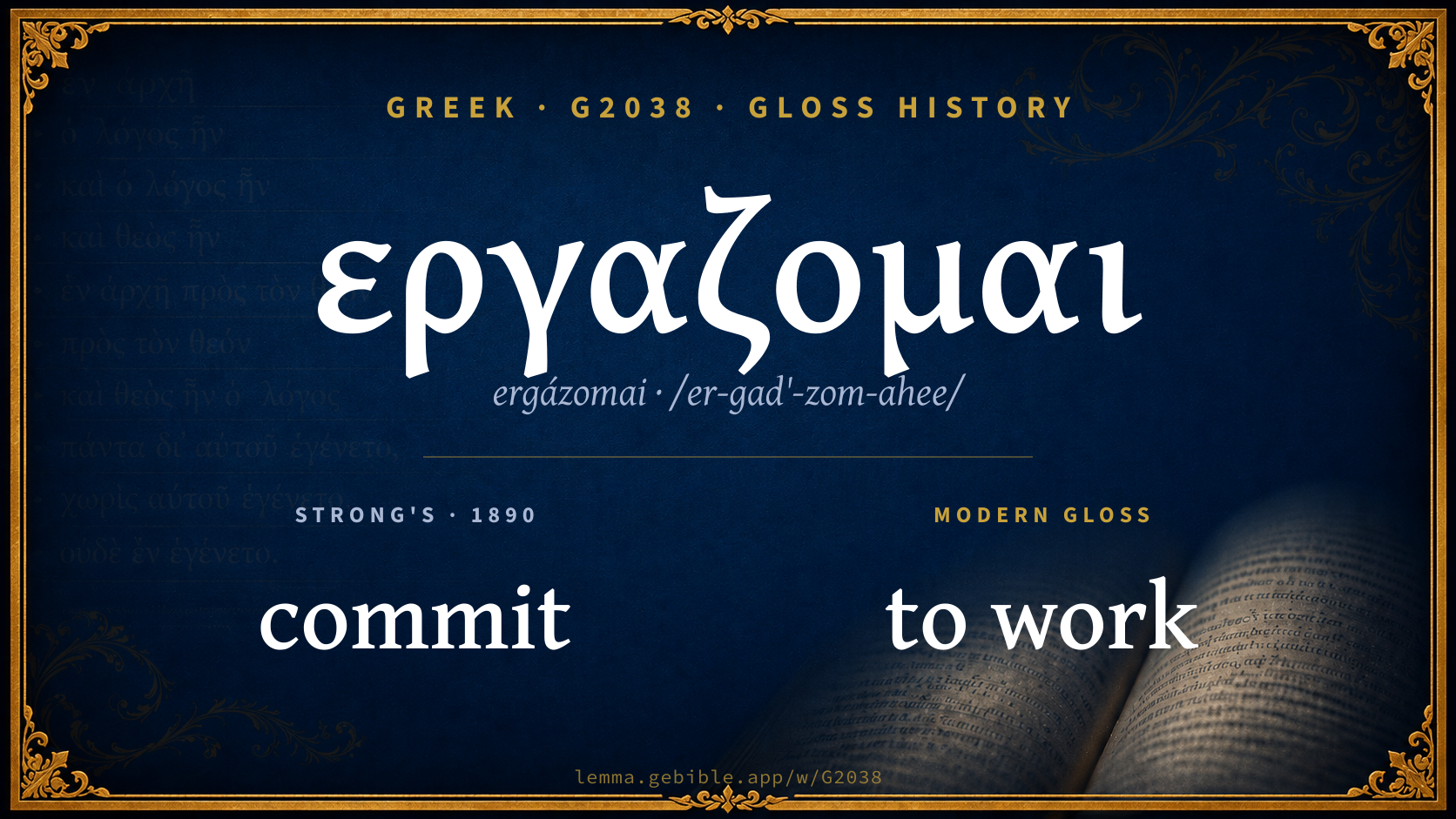
Gloss history
Strong's 1890 vs modern scholarship
About this word
Strong's G2038 catalogs a Greek word from the Greek New Testament.
These counts are not copied from any lexicon or concordance. They are computed here, from the morphology-tagged Greek New Testament. What Lemma adds →
- 39
- distinct verses
- The word appears in 39 distinct verses.
- 18 / 27
- NT books
- The word appears in 18 of 27 New Testament books.
- #364
- by frequency
- Top 500 most frequent Greek words (rank 364 of 5,347 Greek words by occurrence).
View all 39 occurrences in the concordance →
By section of the New Testament
By traditional corpus
Conventional, traditional groupings — biblical authorship is debated, so this is a traditional corpus grouping, not an authorship claim. Some books belong to more than one corpus (Luke is in both the Gospels and the Lukan corpus, and so on), so these shares overlap and need not total 100%. Each figure is a share of the word’s 39 distinct verses.
- Pauline corpus 18 verses · 46%
- Gospels 12 verses · 31%
- Johannine 9 verses · 23%
- Lukan (Luke–Acts) 4 verses · 10%
- General (Catholic) Epistles 4 verses · 10%
- Hebrews 1 verse · 3%
- Revelation 1 verse · 3%
How translations render this word
Counts come from each version’s own published word-to-Strong’s tagging or interlinear alignment — an approximate guide to how each version renders this word, not a word-level alignment the data otherwise carries. Because each total is that version’s own tagged count, the per-version totals vary from one another and need not match the appearance or distinct-verse counts above. These counts may also differ from a printed concordance because Lemma counts each distinctly tagged rendering and does not collapse phrase taggings into a single head-word total. This is a fixed set of word-tagged versions (KJV, ASV, BSB, ULT) and does not change with the reading translation you choose elsewhere. Each version’s license is shown beside its name below (and on Sources).
- King James Version: Work 7×, Worketh 6×, Working 4×
- American Standard Version: Work 10×, Worketh 6×, Working 4×
- Berean Standard Bible: Work 6×, Do 2×, She has done 2×
- unfoldingWord Literal Text: Work 12×, Working 11×, Does 2×
King James Version Public Domain
Renders G2038 across 39 tagged occurrences — most commonly:
Plus 16 renderings that appear only once — usually multi-word phrases or single function words the recovered tagging swept in, not distinct renderings.
American Standard Version Public Domain
Renders G2038 across 39 tagged occurrences — most commonly:
Plus 17 renderings that appear only once — usually multi-word phrases or single function words the recovered tagging swept in, not distinct renderings.
Berean Standard Bible Public Domain
Renders G2038 across 39 tagged occurrences — most commonly:
Plus 27 renderings that appear only once — usually multi-word phrases or single function words the recovered tagging swept in, not distinct renderings. Not rendered by a distinct English word in 1 further occurrence.
unfoldingWord Literal Text CC BY-SA 4.0
Renders G2038 across 44 tagged occurrences — most commonly:
Plus 17 renderings that appear only once — usually multi-word phrases or single function words the recovered tagging swept in, not distinct renderings.
Senses in Thayer's
The 5 senses Thayer's distinguishes for this word, in lexicon order (not ranked by frequency or importance). The full entry — with sub-senses — is in the Lexicon Entry tab.
- to work, labour, do work
- to trade, to make gains by trading, "do business"
- exercise, perform, commit
- to cause to exist, produce
- to work for, earn by working, to acquire
Word origin
Derived from εργον (érgon) (G2041) — work.
Middle voice from G2041 ; to toil (as a task occupation etc.) (by implication) effect be engaged in or with etc. : - commit do labor for minister about trade (by) work.
— Strong’s Exhaustive Concordance (1890), public domain.
Forms in the corpus
The 18 distinct written forms G2038 takes in the Greek New Testament, most frequent first — each parse links to that tense’s occurrences in the concordance.
Same root — word family
Other Thayer's entries built from the same root as G2038, grouped by Strong’s listed origin. These share a root / origin per the lexicon — not necessarily a shared meaning. Each links to that word’s own entry.
Derives from
Shares the same root
Compare all same-root words → They share a root, not necessarily a meaning.
Septuagint usage
The same Greek word εργαζομαι appears 94 times in the Greek Old Testament (Septuagint), across 90 verses in 20 books.
- 94
- LXX occurrences
- Tagged occurrences of this Greek word in the Septuagint.
- 90
- verses
- Distinct Septuagint verses containing this word.
- 20 / 39
- OT books
- The word appears in 20 of the 39 Old Testament books.
Sample Septuagint occurrences
- Genesis 2:5 ἐργάζομαι
- Exodus 5:18 ἐργάζομαι
- Leviticus 25:40 ἐργάζομαι
- Numbers 3:7 ἐργάζομαι
- Deuteronomy 5:13 ἐργάζομαι
- 2 Samuel 9:10 ἐργάζομαι
- 1 Chronicles 25:1 ἐργάζομαι
- 2 Chronicles 2:9 ἐργάζομαι
- Job 24:6 ἐργάζομαι
- Psalms 5:6 ἐργάζομαι
- Proverbs 3:30 ἐργάζομαι
- Ecclesiastes 5:8 ἐργάζομαι
Septuagint occurrences (same lexeme)
Every verse where the same Strong’s number (G2038) appears in the Greek Septuagint — showing the first 50 of 90. Verse text shown in the World English Bible for context; the Greek form is the matched word — the English is not keyword-highlighted.
- Genesis 2:5 ἐργάζομαι No plant of the field was yet in the earth, and no herb of the field had yet sprung up; for Yahweh God had not caused it to rain on the earth. There was not a man to till the ground,
- Genesis 2:15 ἐργάζομαι Yahweh God took the man, and put him into the garden of Eden to dress it and to keep it.
- Genesis 3:23 ἐργάζομαι Therefore Yahweh God sent him forth from the garden of Eden, to till the ground from whence he was taken.
- Genesis 4:2 ἐργάζομαι Again she gave birth, to Cain's brother Abel. Abel was a keeper of sheep, but Cain was a tiller of the ground.
- Genesis 4:12 ἐργάζομαι From now on, when you till the ground, it won't yield its strength to you. You shall be a fugitive and a wanderer in the earth."
- Genesis 29:27 ἐργάζομαι Fulfill the week of this one, and we will give you the other also for the service which you will serve with me yet seven other years."
- Exodus 5:18 ἐργάζομαι Go therefore now, and work, for no straw shall be given to you, yet shall you deliver the same number of bricks!"
- Exodus 20:9 ἐργάζομαι You shall labor six days, and do all your work,
- Exodus 31:4 ἐργάζομαι to devise skillful works, to work in gold, and in silver, and in brass,
- Exodus 31:5 ἐργάζομαι and in cutting of stones for setting, and in carving of wood, to work in all manner of workmanship.
- Exodus 34:21 ἐργάζομαι Six days you shall work, but on the seventh day you shall rest: in plowing time and in harvest you shall rest.
- Exodus 35:10 ἐργάζομαι "Let every wise-hearted man among you come, and make all that Yahweh has commanded:
- Exodus 36:4 ἐργάζομαι All the wise men, who performed all the work of the sanctuary, each came from his work which they did.
- Exodus 36:6 ἐργάζομαι Moses gave commandment, and they caused it to be proclaimed throughout the camp, saying, "Let neither man nor woman make anything else for the offering for the sanctuary." So the people were restrained from bringing.
- Exodus 36:8 ἐργάζομαι All the wise-hearted men among those who did the work made the tent with ten curtains; of fine twined linen, blue, purple, and scarlet, with cherubim, the work of the skillful workman, they made them.
- Leviticus 25:40 ἐργάζομαι As a hired servant, and as a sojourner, he shall be with you; he shall serve with you until the Year of Jubilee:
- Numbers 3:7 ἐργάζομαι They shall keep his charge, and the charge of the whole congregation before the Tent of Meeting, to do the service of the tabernacle.
- Numbers 8:11 ἐργάζομαι and Aaron shall offer the Levites before Yahweh for a wave offering, on the behalf of the children of Israel, that it may be theirs to do the service of Yahweh.
- Numbers 8:15 ἐργάζομαι "After that, the Levites shall go in to do the service of the Tent of Meeting: and you shall cleanse them, and offer them as a wave offering.
- Numbers 8:19 ἐργάζομαι I have given the Levites as a gift to Aaron and to his sons from among the children of Israel, to do the service of the children of Israel in the Tent of Meeting, and to make atonement for the children of Israel; that there be no plague among the children of Israel, when the children of Israel come near to the sanctuary."
- Numbers 8:25 ἐργάζομαι and from the age of fifty years they shall cease waiting on the work, and shall serve no more,
- Numbers 8:26 ἐργάζομαι but shall minister with their brothers in the Tent of Meeting, to keep the charge, and shall do no service. Thus shall you do to the Levites concerning their duties."
- Numbers 31:51 ἐργάζομαι Moses and Eleazar the priest took the gold of them, even all worked jewels.
- Deuteronomy 5:13 ἐργάζομαι Six days shall you labor, and do all your work;
- Deuteronomy 15:19 ἐργάζομαι All the firstborn males that are born of your herd and of your flock you shall sanctify to Yahweh your God: you shall do no work with the firstborn of your herd, nor shear the firstborn of your flock.
- Deuteronomy 21:3 ἐργάζομαι and it shall be, that the city which is nearest to the slain man, even the elders of that city shall take a heifer of the herd, which hasn't been worked with, and which has not drawn in the yoke;
- Deuteronomy 21:4 ἐργάζομαι and the elders of that city shall bring down the heifer to a valley with running water, which is neither plowed nor sown, and shall break the heifer's neck there in the valley.
- 2 Samuel 9:10 ἐργάζομαι You shall till the land for him, you, and your sons, and your servants; and you shall bring in [the fruits], that your master's son may have bread to eat: but Mephibosheth your master's son shall eat bread always at my table." Now Ziba had fifteen sons and twenty servants.
- 1 Chronicles 25:1 ἐργάζομαι Moreover, David and the captains of the host set apart for the service certain of the sons of Asaph, and of Heman, and of Jeduthun, who should prophesy with harps, with psalteries, and with cymbals: and the number of those who did the work according to their service was:
- 1 Chronicles 27:26 ἐργάζομαι Over those who did the work of the field for tillage of the ground was Ezri the son of Chelub:
- 2 Chronicles 2:9 ἐργάζομαι even to prepare me timber in abundance; for the house which I am about to build shall be great and wonderful.
- Job 24:6 ἐργάζομαι They cut their provender in the field. They glean the vineyard of the wicked.
- Job 33:29 ἐργάζομαι "Behold, God works all these things, Twice, yes three times, with a man,
- Job 34:32 ἐργάζομαι Teach me that which I don't see. If I have done iniquity, I will do it no more'?
- Psalms 5:6 ἐργάζομαι You will destroy those who speak lies. Yahweh abhors the blood-thirsty and deceitful man.
- Psalms 6:9 ἐργάζομαι Yahweh has heard my supplication. Yahweh accepts my prayer.
- Psalms 7:16 ἐργάζομαι The trouble he causes shall return to his own head. His violence shall come down on the crown of his own head.
- Psalms 13:4 ἐργάζομαι Lest my enemy say, "I have prevailed against him;" Lest my adversaries rejoice when I fall.
- Psalms 14:2 ἐργάζομαι Yahweh looked down from heaven on the children of men, To see if there were any who did understand, Who did seek after God.
- Psalms 27:3 ἐργάζομαι Though a host should encamp against me, My heart shall not fear. Though war should rise against me, Even then I will be confident.
- Psalms 35:13 ἐργάζομαι But as for me, when they were sick, my clothing was sackcloth. I afflicted my soul with fasting. My prayer returned into my own bosom.
- Psalms 43:2 ἐργάζομαι For you are the God of my strength. Why have you rejected me? Why do I go mourning because of the oppression of the enemy?
- Psalms 52:5 ἐργάζομαι God will likewise destroy you forever. He will take you up, and pluck you out of your tent, And root you out of the land of the living. Selah.
- Psalms 57:3 ἐργάζομαι He will send from heaven, and save me, He rebukes the one who is pursuing me. Selah. God will send out his loving kindness and his truth.
- Psalms 58:3 ἐργάζομαι The wicked go astray from the womb. They are wayward as soon as they are born, speaking lies.
- Psalms 58:6 ἐργάζομαι Break their teeth, God, in their mouth. Break out the great teeth of the young lions, Yahweh.
- Psalms 63:3 ἐργάζομαι Because your loving kindness is better than life, My lips shall praise you.
- Psalms 73:12 ἐργάζομαι Behold, these are the wicked. Being always at ease, they increase in riches.
- Psalms 91:8 ἐργάζομαι You will only look with your eyes, And see the recompense of the wicked.
- Psalms 91:10 ἐργάζομαι No evil shall happen to you, Neither shall any plague come near your dwelling.
These are occurrences of the same Greek lexeme (G2038) in the Septuagint — not a translation of any one Hebrew word. The store carries no word-level Hebrew↔Greek alignment, so no Hebrew original is asserted here. Counts come from the recovered LXX Strong's tagging — high-frequency vocabulary is well covered, while rare or late forms may be untagged — so they reflect tagged occurrences and may slightly undercount.