

2 Corinthians 11:15
Greek (Tischendorf 8th ed.) 2 Corinthians 11:15 appears in the Greek New Testament. The text above is from the Tischendorf 8th edition. Each word links to its Strong’s number and a concise gloss. Click any word for its full Thayer’s Greek Lexicon entry.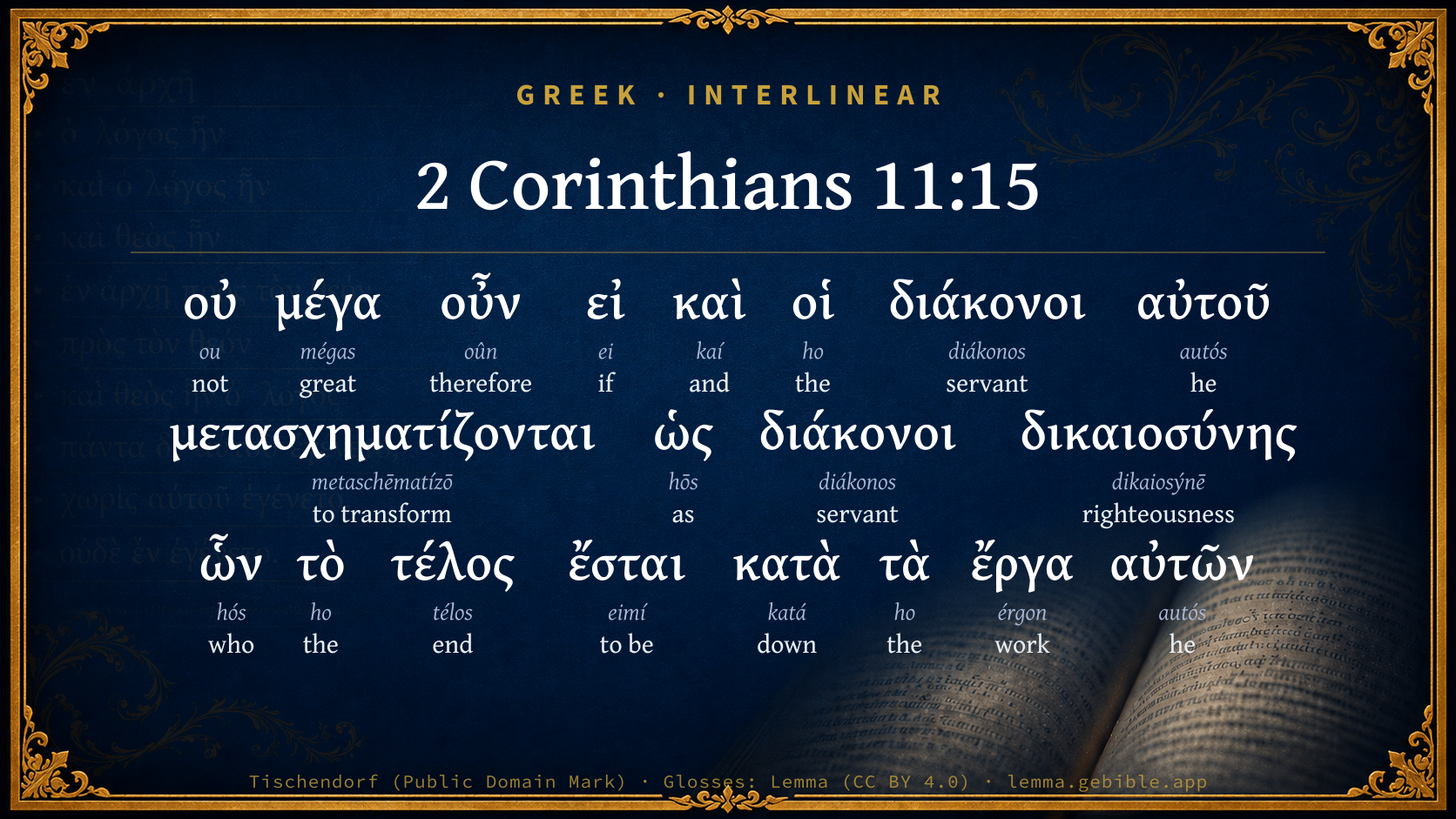
It is no great thing therefore if his ministers also masquerade as servants of righteousness, whose end will be according to their works.
Download a study sheet
One document with this verse’s original text, its word-by-word gloss line, the meaning frame, cross-references with their text, attributed commentary, and full source and license credits — printable, and it pastes into notes with its structure intact.
This verse Autodidact and up
A passage Seminary Student
Up to 50 verses in one chapter. A passage sheet keeps up to 6 commentary sources and 12 cross-references per verse, in the order this page ranks them, and says so on the sheet whenever that leaves anything out. Ask for a single verse and you get the Autodidact verse sheet above.
Everything on this page stays free to read, with no account — the sheet is a download of what is already on screen, not access to it.
Compare translations 3
The same verse in 3 English versions, stacked beneath the original-language interlinear above. Click any original word for its lexicon entry.
Each is an independent rendering of the whole verse — the interlinear is not word-aligned to these translations.
Highlighted words mark where these versions differ — a whole-verse word diff, not a word-by-word alignment.
-
World English Bible Public Domain
It is no great thing therefore if his ministers also masquerade as servants of righteousness, whose end will be according to their works.
-
King James Version Public Domain
Therefore it is no great thing if his ministers also be transformed as the ministers of righteousness; whose end shall be according to their works.
-
unfoldingWord Literal Text CC BY-SA 4.0
Therefore, no great thing if his servants also disguise themselves as servants of righteousness, whose end will be according to their works.
unfoldingWord Literal Text — © unfoldingWord, licensed CC BY-SA 4.0. Word-aligned USFM3 via Door43 (git.door43.org/unfoldingWord/en_ult).
Show all 19 translations
Every available English version of this verse, each an independent rendering of the whole verse.
-
World English Bible Public Domain
It is no great thing therefore if his ministers also masquerade as servants of righteousness, whose end will be according to their works.
-
Berean Standard Bible Public Domain
It is not surprising, then, if his servants masquerade as servants of righteousness. Their end will correspond to their actions.
-
Majority Standard Bible Public Domain
It is not surprising, then, if his servants masquerade as servants of righteousness. Their end will correspond to their actions.
-
King James Version Public Domain
Therefore it is no great thing if his ministers also be transformed as the ministers of righteousness; whose end shall be according to their works.
-
American Standard Version (1901) Public Domain
It is no great thing therefore if his ministers also fashion themselves as ministers of righteousness, whose end shall be according to their works.
-
Revised Version (1885) Public Domain
It is no great thing therefore if his ministers also fashion themselves as ministers of righteousness; whose end shall be according to their works.
-
Geneva Bible (1599) Public Domain
Therefore it is no great thing, though his ministers transforme themselues, as though they were the ministers of righteousnes, whose end shall be according to their workes.
-
Douay-Rheims (1899) Public Domain
Therefore it is no great thing if his ministers be transformed as the ministers of justice, whose end shall be according to their works.
-
Young's Literal Translation Public Domain
no great thing, then, if also his ministrants do transform themselves as ministrants of righteousness -- whose end shall be according to their works.
-
Literal Standard Version CC BY-SA 4.0
[it is] no great thing, then, if his servants also transform themselves as servants of righteousness—whose end will be according to their works.
-
Unlocked Literal Bible CC BY-SA 4.0
It is no great surprise if his servants also disguise themselves as servants of righteousness. Their fate will be what their deeds deserve.
-
unfoldingWord Literal Text CC BY-SA 4.0
Therefore, no great thing if his servants also disguise themselves as servants of righteousness, whose end will be according to their works.
-
Darby Bible Public Domain
It is no great thing therefore if his ministers also transform themselves as ministers of righteousness; whose end shall be according to their works.
-
World Messianic Bible Public Domain
It is no great thing therefore if his servants also masquerade as servants of righteousness, whose end will be according to their works.
-
Webster's Bible Public Domain
Therefore it is no great thing if his ministers also are transformed as the ministers of righteousness; whose end shall be according to their works.
-
Free Bible Version CC BY-SA 4.0
So it's no wonder then if those who serve him pretend to be agents of good. But their final end will be in accordance with what they've done.
-
Bible in Basic English Public Domain
So it is no great thing if his servants make themselves seem to be servants of righteousness; whose end will be the reward of their works.
-
Text-Critical English NT CC BY 4.0
Therefore it is no great surprise if his servants also disguise themselves as servants of righteousness. Their end will be according to their works.
-
Tyndale New Testament (1534) Public Domain
Therfore it is no great thynge though his ministers fassion them selves as though they were the ministers of rightewesnes: whose ende shalbe acordynge to their dedes.
Literal Standard Version (2020), Covenant Press — licensed CC BY-SA 4.0. Text via the HelloAO Bible API (eBible.org). Unlocked Literal Bible (unfoldingWord) — licensed CC BY-SA 4.0. Text via the HelloAO Bible API (eBible.org). unfoldingWord Literal Text — © unfoldingWord, licensed CC BY-SA 4.0. Word-aligned USFM3 via Door43 (git.door43.org/unfoldingWord/en_ult). Free Bible Version, Dr. Jonathan Gallagher — licensed CC BY-SA 4.0. Text via the HelloAO Bible API (eBible.org).
Word by word
More ways to search: Search by grammar → Find every occurrence → Compare this word →
Practice this passage: Drill this verse → Learn its vocabulary →
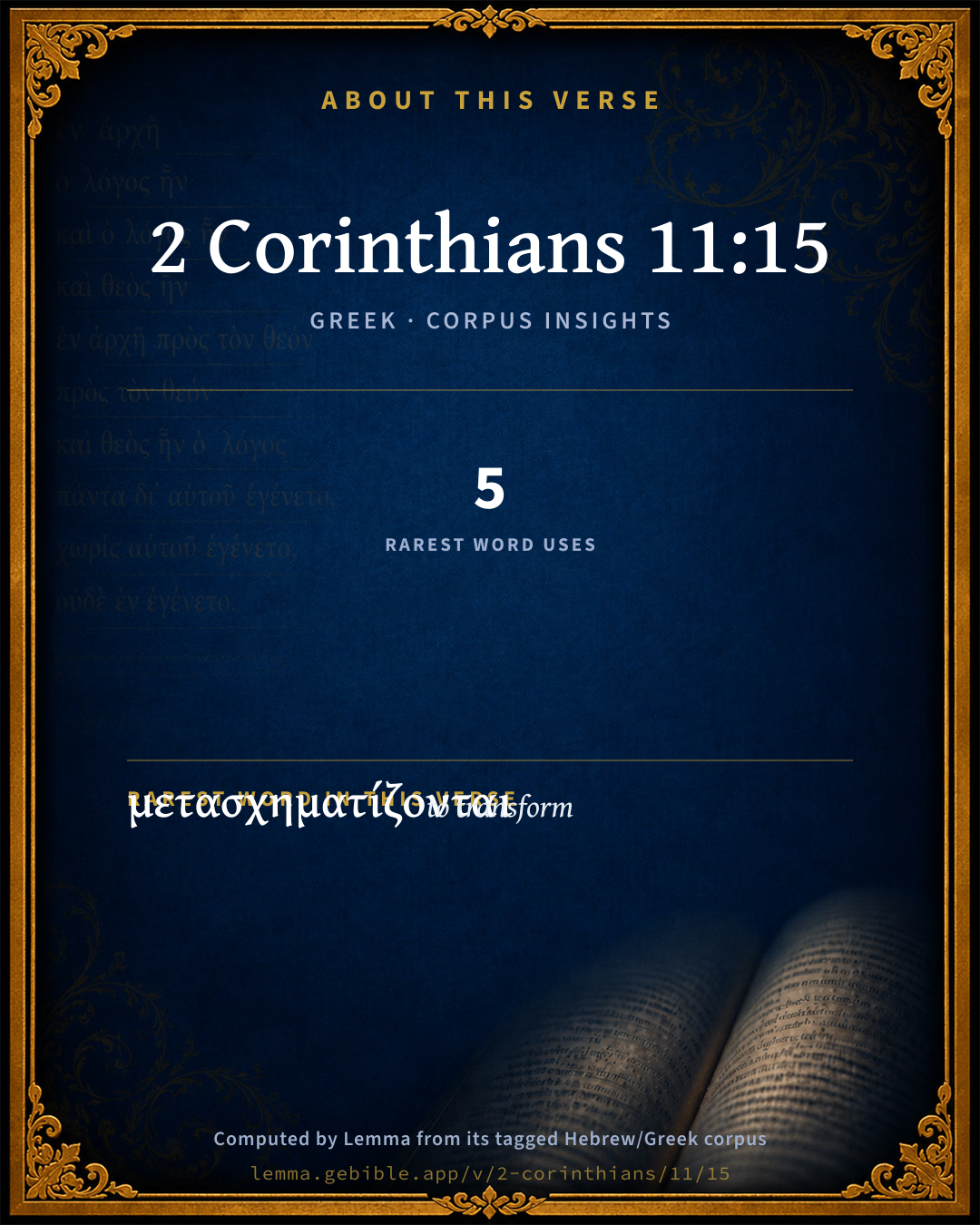
- Appears 5× in the Greek New Testament
- First appears at 1 Corinthians 4:6
- Part of Speech
- Verb
- Tense
- Present
- Voice
- Passive
- Mood
- Indicative
- Person
- 3rd person
- Number
- Plural
Full Thayer's Definition
- οὐ ou G3756 “not” Particle, Negative
- μέγα mégas G3173 “great” Adjective, Nominative, Singular, Neuter
- οὖν oûn G3767 “therefore” Conjunction
- εἰ ei G1487 “if” Conditional
- καὶ kaí G2532 “and” Conjunction
- οἱ ho G3588 “the” Article, Nominative, Plural, Masculine
- διάκονοι diákonos G1249 “servant” Noun, Nominative, Plural, Masculine
- αὐτοῦ autós G846 “he” Personal pronoun, Genitive, Singular, Masculine
- μετασχηματίζονται metaschēmatízō G3345 “to transform” Verb, Present, Passive, Indicative, 3rd person, Plural
- ὡς hōs G5613 “as” Adverb
- διάκονοι diákonos G1249 “servant” Noun, Nominative, Plural, Masculine
- δικαιοσύνης dikaiosýnē G1343 “righteousness” Noun, Genitive, Singular, Feminine
- ὧν hós G3739 “who” Relative pronoun, Genitive, Plural, Masculine
- τὸ ho G3588 “the” Article, Nominative, Singular, Neuter
- τέλος télos G5056 “end” Noun, Nominative, Singular, Neuter
- ἔσται eimí G1510 “to be” Verb, Future, Middle deponent, Indicative, 3rd person, Singular
- κατὰ katá G2596 “down” Preposition
- τὰ ho G3588 “the” Article, Accusative, Plural, Neuter
- ἔργα érgon G2041 “work” Noun, Accusative, Plural, Neuter
- αὐτῶν autós G846 “he” Personal pronoun, Genitive, Plural, Masculine
About this verse
These counts appear in no published source. They are computed here, from the morphology-tagged text and Lemma’s own curated glosses. What Lemma adds →
- 20
- words
- 16
- distinct lemmas
- Pauline Epistles
- section
Cross-references
28Topical passages linked to 2 Corinthians 11:15 in the Treasury of Scripture Knowledge — connected by theme and wording, ordered by reader-vote popularity; previews shown in the World English Bible.
- Philippians 3:19 whose end is destruction, whose god is the belly, and whose glory is in their shame, who think about earthly things.
- 2 Corinthians 3:9 For if the service of condemnation has glory, the service of righteousness exceeds much more in glory.
- Revelation 9:11 They have over them as king the angel of the abyss. His name in Hebrew is "Abaddon," but in Greek, he has the name "Apollyon."
- Isaiah 9:14–15 Therefore Yahweh will cut off from Israel head and tail, palm-branch and rush, in one day.
- Jeremiah 23:14–15 In the prophets of Jerusalem also I have seen a horrible thing: they commit adultery, and walk in lies; and they strengthen the hands of evil-doers, so that none does return from his wickedness: they are all of them become to me as Sodom, and the inhabitants of it as Gomorrah.
- Matthew 7:15–16 "Beware of false prophets, who come to you in sheep's clothing, but inwardly are ravening wolves.
- Acts 13:10 and said, "Full of all deceit and all cunning, you son of the devil, you enemy of all righteousness, will you not cease to pervert the right ways of the Lord?
- 2 Corinthians 11:23 Are they servants of Christ? (I speak as one beside himself) I am more so; in labors more abundantly, in prisons more abundantly, in stripes above measure, in deaths often.
- 2 Peter 2:3 In covetousness they will exploit you with deceptive words: whose sentence now from of old doesn't linger, and their destruction will not slumber.
- 2 Peter 2:13–22 receiving the wages of unrighteousness; people who count it pleasure to revel in the day-time, spots and blemishes, reveling in their deceit while they feast with you;
- Jude 1:4 For there are certain men who crept in secretly, even those who were long ago written about for this condemnation: ungodly men, turning the grace of our God into lasciviousness, and denying our only Master, God, and Lord, Jesus Christ.
- 2 Kings 5:13 His servants came near, and spoke to him, and said, My father, if the prophet had bid you do some great thing, wouldn't you have done it? how much rather then, when he says to you, Wash, and be clean?
- Jeremiah 5:31 the prophets prophesy falsely, and the priests bear rule by their means; and my people love to have it so: and what will you do in the end of it?
- Jeremiah 28:15–17 Then said the prophet Jeremiah to Hananiah the prophet, Hear now, Hananiah: Yahweh has not sent you; but you make this people to trust in a lie.
- Jeremiah 29:32 therefore thus says Yahweh, Behold, I will punish Shemaiah the Nehelamite, and his seed; he shall not have a man to dwell among this people, neither shall he see the good that I will do to my people, says Yahweh, because he has spoken rebellion against Yahweh.
- Ezekiel 13:10–15 Because, even because they have seduced my people, saying, Peace; and there is no peace; and when one builds up a wall, behold, they daub it with whitewash:
- Ezekiel 13:22 Because with lies you have grieved the heart of the righteous, whom I have not made sad; and strengthened the hands of the wicked, that he should not return from his wicked way, and be saved alive:
- 1 Corinthians 9:11 If we sowed to you spiritual things, is it a great thing if we reap your fleshly things?
- 2 Corinthians 11:13 For such men are false apostles, deceitful workers, masquerading as Christ's apostles.
- Galatians 1:8–9 But even though we, or an angel from heaven, should preach to you any gospel other than that which we preached to you, let him be cursed.
- Ephesians 6:12 For our wrestling is not against flesh and blood, but against the principalities, against the powers, against the world's rulers of the darkness of this age, and against the spiritual hosts of wickedness in the heavenly places.
- 2 Thessalonians 2:8–12 Then the lawless one will be revealed, whom the Lord will kill with the breath of his mouth, and bring to nothing by the brightness of his coming;
- Jude 1:10–13 But these speak evil of whatever things they don't know. What they understand naturally, like the creatures without reason, in these things are they destroyed.
- Revelation 13:2 The beast which I saw was like a leopard, and his feet were like those of a bear, and his mouth like the mouth of a lion. The dragon gave him his power, his throne, and great authority.
- Revelation 13:14 He deceives my own people who dwell on the earth because of the signs he was granted to do in front of the beast; saying to those who dwell on the earth, that they should make an image to the beast who had the sword wound and lived.
- Revelation 19:19–21 I saw the beast, and the kings of the earth, and their armies, gathered together to make war against him who sat on the horse, and against his army.
- Revelation 20:2–3 He seized the dragon, the old serpent, which is the devil and Satan, who deceives the whole inhabited earth, and bound him for a thousand years,
- Revelation 20:7–10 And after the thousand years, Satan will be released from his prison,
Cross-references courtesy of OpenBible.info (CC BY 4.0).
Lesson kit
Teaching starters — assembled from the data on this page, not authored interpretation. Every prompt links to the verse data it draws on. Edit before teaching.
2 Corinthians, in the Pauline Epistles, opens this verse with 20 words (16 distinct Greek lemmas). Its most distinctive word is metaschēmatízō (“to transform”). A historical commentator’s framing appears above. Read the whole chapter for the surrounding context.
Discussion questions
- The word metaschēmatízō carries the sense “to transform.” How does it shape the verse?
- 1 Corinthians 4:6 shares the word «to transform» with this verse. How do the two illuminate each other?
- “servant” occurs 2× in this one verse. What is the effect of the repetition?
- These translations render this verse differently. What is at stake in choosing one wording over another?
- Reading how Bengel's Gnomon and Meyer's Critical & Exegetical Commentary read this verse, where do the two commentators agree and where do they part?
Things to notice
- These translations choose different wording for 8 words in this verse.
- “servant” occurs 2× in this single verse.
- 16 distinct Greek lemmas span 20 words in this verse.
Commentary
Notes on 2 Corinthians 11:15 from classic Christian and Jewish commentators (each source and its license shown beneath its notes). The classic Christian expositions comment on the surrounding passage and are grouped to its opening verse, so a note may address several verses; the Jewish commentaries on the Tanakh (Rashi and others) are per-verse, so they appear only where the commentator wrote on this verse.
Lemma curates 59 commentaries, every one of them public domain or Creative Commons licensed, each selected and text-cleaned for this edition rather than reprinted as found. About our sources →
Bengel's Gnomon
Johann Albrecht Bengel
Bengel's Gnomon of the New Testament — English translation (T&T Clark, Edinburgh, 1860) — public domain. Text from a community e-Sword module.
Meyer's Critical & Exegetical Commentary
Heinrich August Wilhelm Meyer
Meyer — Critical and Exegetical Commentary on the New Testament — English translation by Peter Christie, edited by Frederick Crombie (T&T Clark, 1880) — public domain. Text from a community e-Sword module.
Expositor's Greek Testament
ed. W. Robertson Nicoll
The Expositor's Greek Testament, edited by W. Robertson Nicoll (1897–1910) — public domain. Text from a community e-Sword module.
Jamieson, Fausset & Brown
Robert Jamieson, A. R. Fausset & David Brown
Jamieson, Fausset & Brown — Commentary Critical and Explanatory on the Whole Bible (1871) — public domain (CC PDM 1.0). Text via the HelloAO Bible API.
Adam Clarke's Commentary
Adam Clarke's Commentary on the Bible (1810–1826) — public domain. Text from a community e-Sword/MySword module.
John Calvin's Commentaries
John Calvin's Commentaries (1540-1563) — public domain. Text from the Calvin Translation Society English edition (1840s-50s) via the Christian Classics Ethereal Library (ccel.org). Calvin's coverage is partial (roughly two-thirds of the Bible); uncommented books and verses are honest gaps, never fabricated. The 19th-century editor's footnotes and remarks are omitted so the notes are faithfully Calvin's own voice.
Ellicott's Commentary for English Readers
A Bible Commentary for English Readers, edited by Charles John Ellicott (1878–1897) — public domain. Text from a community e-Sword module.
The Cambridge Bible for Schools and Colleges
gen. ed. J. J. S. Perowne
The Cambridge Bible for Schools and Colleges (gen. ed. J. J. S. Perowne; Cambridge University Press, 1878–1918) — public domain. Text from a community e-Sword module.
John Gill's Exposition
John Gill's Exposition of the Whole Bible (1746–1763) — public domain (CC PDM 1.0). Text via the HelloAO Bible API.
Trapp's Complete Commentary
John Trapp
John Trapp, A Commentary or Exposition upon All the Books of the Old and New Testament (1647–1656) — public domain. Text from a community e-Sword module.
Albert Barnes' Notes on the Bible
Albert Barnes' Notes on the Bible (1834–1885) — public domain. Text from a community e-Sword/MySword module.
Matthew Poole's English Annotations
Matthew Poole's English Annotations on the Holy Bible (1683–1685) — public domain. Text from a community e-Sword/MySword module.
Whedon's Commentary on the Bible
Daniel D. Whedon
Daniel D. Whedon (gen. ed.), Commentary on the Old and New Testaments (1874–1909) — public domain. Text from a community e-Sword module.
The Pulpit Commentary
The Pulpit Commentary (1880–1919), ed. H.D.M. Spence-Jones & Joseph S. Exell — public domain. Text from a community e-Sword module.
John Wesley's Explanatory Notes
John Wesley, Explanatory Notes Upon the Whole Bible (1754–1765) — public domain. Text via the GEBible commentary corpus.
Scofield Reference Notes
C. I. Scofield
The Scofield Reference Bible (1917 edition), notes by C. I. Scofield — public domain. Text from a community e-Sword module.
McGarvey & Pendleton's Commentaries
J. W. McGarvey
J. W. McGarvey (with Philip Y. Pendleton), Commentaries on the New Testament (The Fourfold Gospel, 1914; Acts; and the epistles) — public domain. Text from a community e-Sword/MySword module.
The People's New Testament
B. W. Johnson
B. W. Johnson's The People's New Testament with Notes (1889–1891) — public domain. Electronic text from the Christian Classics Ethereal Library (CCEL) ThML edition.
Cambridge Greek Testament for Schools and Colleges
Cambridge Greek Testament for Schools and Colleges (Cambridge University Press, 1896; 21 vols, various authors incl. Carr, Maclear, Plummer, Farrar, Lumby, Moule, M. R. James, Simcox) — public domain. Text from a community e-Sword module.
Alford’s Greek Testament
Henry Alford
Henry Alford, The Greek Testament (1849–1861) — public domain. Text from a community e-Sword module.
International Critical Commentary
International Critical Commentary — older volumes (1896–1929), various authors — public domain. Text from a community e-Sword module.