

1 John 3:12
Greek (Tischendorf 8th ed.) 1 John 3:12 appears in the Greek New Testament. The text above is from the Tischendorf 8th edition. Each word links to its Strong’s number and a concise gloss. Click any word for its full Thayer’s Greek Lexicon entry.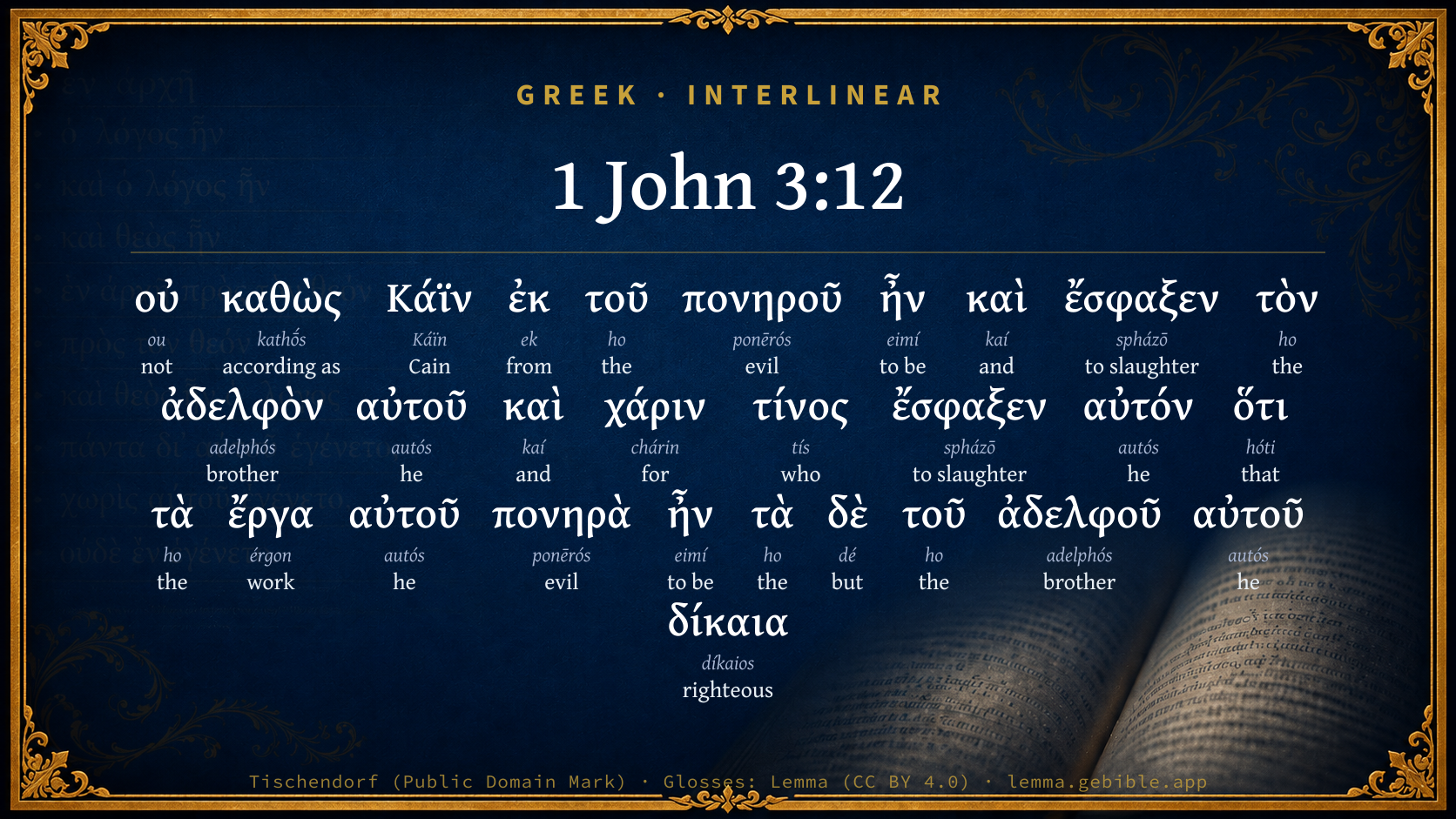
unlike Cain, who was of the evil one, and killed his brother. Why did he kill him? Because his works were evil, and his brother's righteous.
Download a study sheet
One document with this verse’s original text, its word-by-word gloss line, the meaning frame, cross-references with their text, attributed commentary, and full source and license credits — printable, and it pastes into notes with its structure intact.
This verse Autodidact and up
A passage Seminary Student
Up to 50 verses in one chapter. A passage sheet keeps up to 6 commentary sources and 12 cross-references per verse, in the order this page ranks them, and says so on the sheet whenever that leaves anything out. Ask for a single verse and you get the Autodidact verse sheet above.
Everything on this page stays free to read, with no account — the sheet is a download of what is already on screen, not access to it.
Compare translations 3
The same verse in 3 English versions, stacked beneath the original-language interlinear above. Click any original word for its lexicon entry.
Each is an independent rendering of the whole verse — the interlinear is not word-aligned to these translations.
Highlighted words mark where these versions differ — a whole-verse word diff, not a word-by-word alignment.
-
World English Bible Public Domain
unlike Cain, who was of the evil one, and killed his brother. Why did he kill him? Because his works were evil, and his brother's righteous.
-
King James Version Public Domain
Not as Cain, who was of that wicked one, and slew his brother. And wherefore slew he him? Because his own works were evil, and his brother's righteous.
-
unfoldingWord Literal Text CC BY-SA 4.0
not like Cain—he was from the evil one and killed his brother. And on account of what did he kill him? Because his works were evil, but those of his brother, righteous.
unfoldingWord Literal Text — © unfoldingWord, licensed CC BY-SA 4.0. Word-aligned USFM3 via Door43 (git.door43.org/unfoldingWord/en_ult).
Show all 19 translations
Every available English version of this verse, each an independent rendering of the whole verse.
-
World English Bible Public Domain
unlike Cain, who was of the evil one, and killed his brother. Why did he kill him? Because his works were evil, and his brother's righteous.
-
Berean Standard Bible Public Domain
Do not be like Cain, who belonged to the evil one and murdered his brother. And why did Cain slay him? Because his own deeds were evil, while those of his brother were righteous.
-
Majority Standard Bible Public Domain
Do not be like Cain, who belonged to the evil one and murdered his brother. And why did Cain slay him? Because his own deeds were evil, while those of his brother were righteous.
-
King James Version Public Domain
Not as Cain, who was of that wicked one, and slew his brother. And wherefore slew he him? Because his own works were evil, and his brother's righteous.
-
American Standard Version (1901) Public Domain
not as Cain was of the evil one, and slew his brother. And wherefore slew he him? Because his works were evil, and his brother's righteous.
-
Revised Version (1885) Public Domain
not as Cain was of the evil one, and slew his brother. And wherefore slew he him? Because his works were evil, and his brother’s righteous.
-
Geneva Bible (1599) Public Domain
Not as Cain which was of that wicked one, and slewe his brother: and wherefore slewe he him? because his owne workes were euill, and his brothers good.
-
Douay-Rheims (1899) Public Domain
Not as Cain, who was of the wicked one, and killed his brother. And wherefore did he kill him? Because his own works were wicked: and his brother's just.
-
Young's Literal Translation Public Domain
not as Cain -- of the evil one he was, and he did slay his brother, and wherefore did he slay him? because his works were evil, and those of his brother righteous.
-
Literal Standard Version CC BY-SA 4.0
not as Cain—he was of the evil one, and he slew his brother. And for [what] reason did he slay him? Because his works were evil, and those of his brother [were] righteous.
-
Unlocked Literal Bible CC BY-SA 4.0
We should not be like Cain, who was from the evil one and murdered his brother. Why did he kill him? Because his works were evil and his brother's righteous.
-
unfoldingWord Literal Text CC BY-SA 4.0
not like Cain—he was from the evil one and killed his brother. And on account of what did he kill him? Because his works were evil, but those of his brother, righteous.
-
Darby Bible Public Domain
not as Cain was of the wicked one, and slew his brother; and on account of what slew he him? because his works were wicked, and those of his brother righteous.
-
World Messianic Bible Public Domain
unlike Cain, who was of the evil one and killed his brother. Why did he kill him? Because his deeds were evil, and his brother’s righteous.
-
Webster's Bible Public Domain
Not as Cain, who was of that wicked one, and slew his brother. And why did he slay him? Because his own works were evil, and his brother's righteous.
-
Free Bible Version CC BY-SA 4.0
We cannot be like Cain, who belonged to the evil one, and murdered his brother. Why did he murder him? Because Cain did what was evil, while his brother did what was right.
-
Bible in Basic English Public Domain
Not being of the Evil One like Cain, who put his brother to death. And why did he put him to death? Because his works were evil and his brother's works were good.
-
Text-Critical English NT CC BY 4.0
We should not be like Cain, who was of the evil one and murdered his brother. And why did he murder him? Because his own deeds were evil, but the deeds of his brother were righteous.
-
Tyndale New Testament (1534) Public Domain
not as Cayn which was of the wicked and slewe his brother. And wherfore slewe he him? Because his awne workes were evyll and his brothers good.
Literal Standard Version (2020), Covenant Press — licensed CC BY-SA 4.0. Text via the HelloAO Bible API (eBible.org). Unlocked Literal Bible (unfoldingWord) — licensed CC BY-SA 4.0. Text via the HelloAO Bible API (eBible.org). unfoldingWord Literal Text — © unfoldingWord, licensed CC BY-SA 4.0. Word-aligned USFM3 via Door43 (git.door43.org/unfoldingWord/en_ult). Free Bible Version, Dr. Jonathan Gallagher — licensed CC BY-SA 4.0. Text via the HelloAO Bible API (eBible.org).
Word by word
More ways to search: Search by grammar → Find every occurrence → Compare this word →
Practice this passage: Drill this verse → Learn its vocabulary →
- Appears 3× in the Greek New Testament
- First appears at Hebrews 11:4
- Part of Speech
- Noun · Proper, indeclinable
Full Thayer's Definition
- οὐ ou G3756 “not” Particle, Negative
- καθὼς kathṓs G2531 “according as” Adverb
- Κάϊν Káïn G2535 “Cain” Noun, Proper, indeclinable
- ἐκ ek G1537 “from” Preposition
- τοῦ ho G3588 “the” Article, Genitive, Singular, Masculine
- πονηροῦ ponērós G4190 “evil” Adjective, Genitive, Singular, Masculine
- ἦν eimí G1510 “to be” Verb, Imperfect, Active, Indicative, 3rd person, Singular
- καὶ kaí G2532 “and” Conjunction
- ἔσφαξεν spházō G4969 “to slaughter” Verb, Aorist, Active, Indicative, 3rd person, Singular
- τὸν ho G3588 “the” Article, Accusative, Singular, Masculine
- ἀδελφὸν adelphós G80 “brother” Noun, Accusative, Singular, Masculine
- αὐτοῦ autós G846 “he” Personal pronoun, Genitive, Singular, Masculine
- καὶ kaí G2532 “and” Conjunction
- χάριν chárin G5484 “for” Adverb
- τίνος tís G5101 “who” Interrogative pronoun, Genitive, Singular, Neuter
- ἔσφαξεν spházō G4969 “to slaughter” Verb, Aorist, Active, Indicative, 3rd person, Singular
- αὐτόν autós G846 “he” Personal pronoun, Accusative, Singular, Masculine
- ὅτι hóti G3754 “that” Conjunction
- τὰ ho G3588 “the” Article, Nominative, Plural, Neuter
- ἔργα érgon G2041 “work” Noun, Nominative, Plural, Neuter
- αὐτοῦ autós G846 “he” Personal pronoun, Genitive, Singular, Masculine
- πονηρὰ ponērós G4190 “evil” Adjective, Nominative, Plural, Neuter
- ἦν eimí G1510 “to be” Verb, Imperfect, Active, Indicative, 3rd person, Singular
- τὰ ho G3588 “the” Article, Nominative, Plural, Neuter
- δὲ dé G1161 “but” Conjunction
- τοῦ ho G3588 “the” Article, Genitive, Singular, Masculine
- ἀδελφοῦ adelphós G80 “brother” Noun, Genitive, Singular, Masculine
- αὐτοῦ autós G846 “he” Personal pronoun, Genitive, Singular, Masculine
- δίκαια díkaios G1342 “righteous” Adjective, Nominative, Plural, Neuter
About this verse
These counts appear in no published source. They are computed here, from the morphology-tagged text and Lemma’s own curated glosses. What Lemma adds →
- 29
- words
- 17
- distinct lemmas
- General Epistles
- section
Notable vocabulary
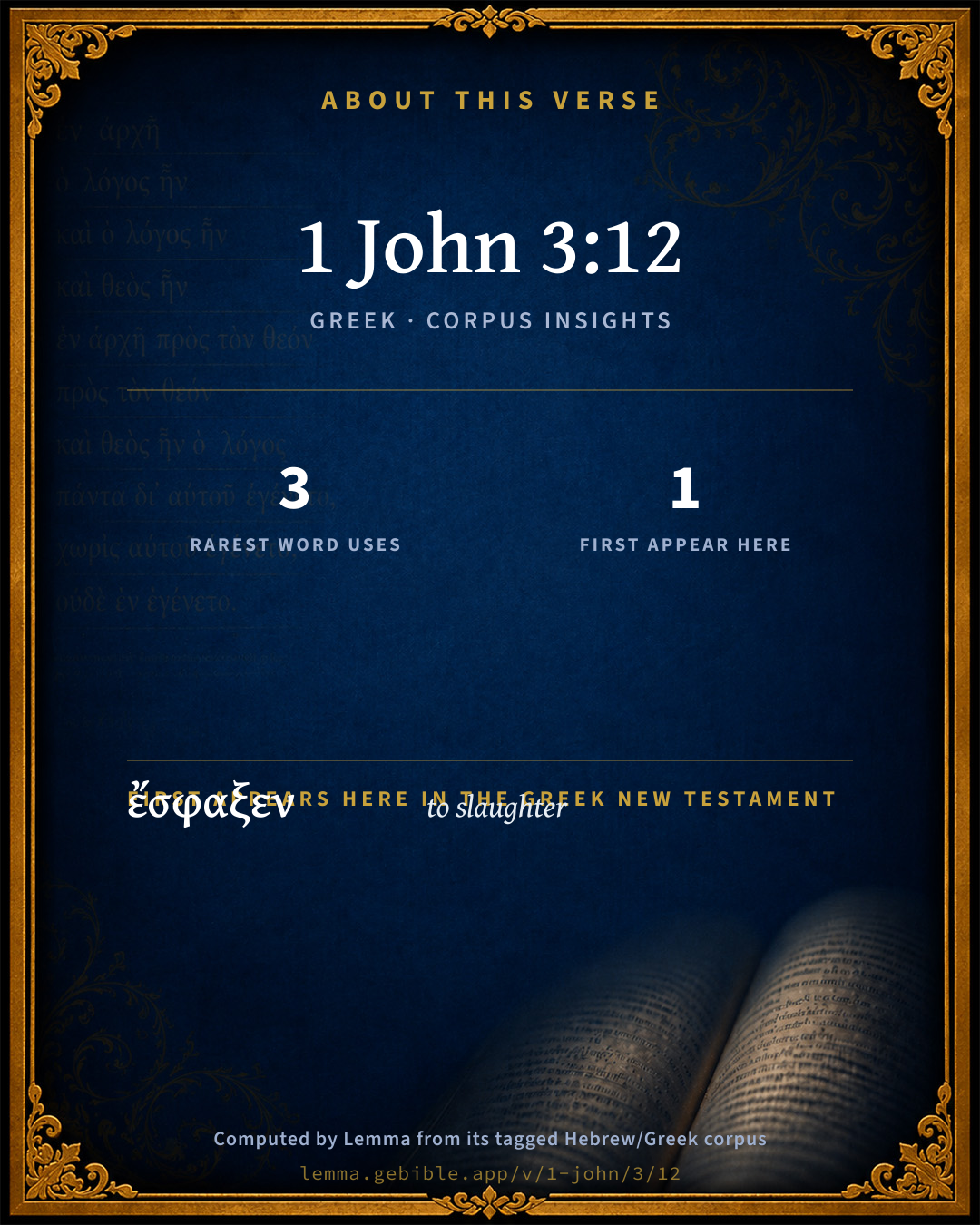
The rarest word here is Κάϊν Cain G2535 — appearing just 3 times in the whole Greek New Testament.
First appearance in Scripture
This word makes its first canonical appearance in the Greek New Testament here:
- ἔσφαξεν to slaughter G4969
Shared distinctive vocabulary
Κάϊν Cain G2535 occurs in 3 verses of the Greek New Testament. Also found in:
Cross-references
25Topical passages linked to 1 John 3:12 in the Treasury of Scripture Knowledge — connected by theme and wording, ordered by reader-vote popularity; previews shown in the World English Bible.
- Hebrews 11:4 By faith, Abel offered to God a more excellent sacrifice than Cain, through which he had testimony given to him that he was righteous, God bearing witness with respect to his gifts; and through it he, being dead, still speaks.
- Genesis 4:4–15 Abel also brought some of the firstborn of his flock and of the fat of it. Yahweh respected Abel and his offering,
- Proverbs 29:27 A dishonest man detests the righteous, And the upright in their ways detest the wicked.
- Genesis 4:25 Adam knew his wife again. She gave birth to a son, and named him Seth. For, she said, "God has appointed me another child instead of Abel, for Cain killed him."
- Jude 1:11 Woe to them! For they went in the way of Cain, and ran riotously in the error of Balaam for hire, and perished in Korah's rebellion.
- Proverbs 29:10 The bloodthirsty hate a man of integrity; And they seek the life of the upright.
- Luke 11:51 from the blood of Abel to the blood of Zachariah, who perished between the altar and the sanctuary.' Yes, I tell you, it will be required of this generation.
- Psalms 37:12 The wicked plots against the just, And gnashes at him with his teeth.
- Psalms 38:20 They who also render evil for good are adversaries to me, Because I follow what is good.
- Matthew 23:35 that on you may come all the righteous blood shed on the earth, from the blood of righteous Abel to the blood of Zachariah son of Barachiah, whom you killed between the sanctuary and the altar.
- John 15:19–25 If you were of the world, the world would love its own. But because you are not of the world, since I chose you out of the world, therefore the world hates you.
- 1 John 2:13–14 I write to you, fathers, because you know him who is from the beginning. I write to you, young men, because you have overcome the evil one. I write to you, little children, because you know the Father.
- 1 Samuel 19:4–5 Jonathan spoke good of David to Saul his father, and said to him, Don't let the king sin against his servant, against David; because he has not sinned against you, and because his works have been very good toward you:
- Matthew 13:19 When anyone hears the word of the Kingdom, and doesn't understand it, the evil one comes, and snatches away that which has been sown in his heart. This is what was sown by the roadside.
- Matthew 13:38 the field is the world; and the good seed, these are the children of the Kingdom; and the darnel are the children of the evil one.
- John 10:32 Jesus answered them, "I have shown you many good works from my Father. For which of those works do you stone me?"
- Hebrews 12:24 to Jesus, the mediator of a new covenant, and to the blood of sprinkling that speaks better than that of Abel.
- 1 Peter 4:4 They think it is strange that you don't run with them into the same excess of riot, blaspheming:
- 1 John 3:8 He who sins is of the devil, for the devil has been sinning from the beginning. To this end the Son of God was revealed, that he might destroy the works of the devil.
- 1 Samuel 18:14–15 David behaved himself wisely in all his ways; and Yahweh was with him.
- 1 Samuel 22:14–16 Then Ahimelech answered the king, and said, Who among all your servants is so faithful as David, who is the king's son-in-law, and is taken into your council, and is honorable in your house?
- Matthew 27:23 But the governor said, "Why? What evil has he done?" But they cried out exceedingly, saying, "Let him be crucified!"
- Acts 7:52 Which of the prophets didn't your fathers persecute? They killed those who foretold the coming of the Righteous One, of whom you have now become betrayers and murderers.
- John 18:38–40 Pilate said to him, "What is truth?" When he had said this, he went out again to the Jews, and said to them, "I find no basis for a charge against him.
- Revelation 17:6 I saw the woman drunken with the blood of the saints, and with the blood of the martyrs of Jesus. When I saw her, I wondered with great amazement.
Cross-references courtesy of OpenBible.info (CC BY 4.0).
Lesson kit
Teaching starters — assembled from the data on this page, not authored interpretation. Every prompt links to the verse data it draws on. Edit before teaching.
1 John, in the General Epistles, opens this verse with 29 words (17 distinct Greek lemmas). Its most distinctive word is Káïn (“Cain”). A historical commentator’s framing appears above. Read the whole chapter for the surrounding context.
Discussion questions
- What does “Cain” (Káïn) contribute to the verse as a whole?
- The word “to slaughter” first appears here in Scripture. What is being introduced at this debut?
- Hebrews 11:4 shares the word «Cain» with this verse. How do the two illuminate each other?
- “evil” occurs 2× in this one verse. What is the effect of the repetition?
- The translations on this page render this verse differently — a whole-verse word diff, not a word-by-word alignment. What might account for the different wordings?
- Reading how The Cambridge Bible for Schools and Colleges and The Biblical Illustrator read this verse, where do the two commentators agree and where do they part?
Things to notice
- 1 word makes its first canonical appearance in Scripture here.
- These translations choose different wording for 16 words in this verse.
- “evil” occurs 2× in this single verse.
- 17 distinct Greek lemmas span 29 words in this verse.
Commentary
Notes on 1 John 3:12 from classic Christian and Jewish commentators (each source and its license shown beneath its notes). The classic Christian expositions comment on the surrounding passage and are grouped to its opening verse, so a note may address several verses; the Jewish commentaries on the Tanakh (Rashi and others) are per-verse, so they appear only where the commentator wrote on this verse.
Lemma curates 59 commentaries, every one of them public domain or Creative Commons licensed, each selected and text-cleaned for this edition rather than reprinted as found. About our sources →
The Cambridge Bible for Schools and Colleges
gen. ed. J. J. S. Perowne
The Cambridge Bible for Schools and Colleges (gen. ed. J. J. S. Perowne; Cambridge University Press, 1878–1918) — public domain. Text from a community e-Sword module.
The Biblical Illustrator
Joseph S. Exell
The Biblical Illustrator, edited by Joseph S. Exell (c. 1880s–1900s) — public domain. Text from a community e-Sword module.
Tyndale Open Study Notes
Tyndale Open Resources
Tyndale Open Study Notes — © Tyndale Open Resources, licensed CC BY-SA 4.0. Text via the HelloAO Bible API.
Bengel's Gnomon
Johann Albrecht Bengel
Bengel's Gnomon of the New Testament — English translation (T&T Clark, Edinburgh, 1860) — public domain. Text from a community e-Sword module.
Meyer's Critical & Exegetical Commentary
Heinrich August Wilhelm Meyer
Meyer — Critical and Exegetical Commentary on the New Testament — English translation by Peter Christie, edited by Frederick Crombie (T&T Clark, 1880) — public domain. Text from a community e-Sword module.
Expositor's Greek Testament
ed. W. Robertson Nicoll
The Expositor's Greek Testament, edited by W. Robertson Nicoll (1897–1910) — public domain. Text from a community e-Sword module.
Cambridge Greek Testament for Schools and Colleges
Cambridge Greek Testament for Schools and Colleges (Cambridge University Press, 1896; 21 vols, various authors incl. Carr, Maclear, Plummer, Farrar, Lumby, Moule, M. R. James, Simcox) — public domain. Text from a community e-Sword module.
Geneva Bible (1599)
Geneva Bible translators
Geneva Bible (1599) marginal notes — public domain. Text via Bolls.life.
Jamieson, Fausset & Brown
Robert Jamieson, A. R. Fausset & David Brown
Jamieson, Fausset & Brown — Commentary Critical and Explanatory on the Whole Bible (1871) — public domain (CC PDM 1.0). Text via the HelloAO Bible API.
Adam Clarke's Commentary
Adam Clarke's Commentary on the Bible (1810–1826) — public domain. Text from a community e-Sword/MySword module.
John Calvin's Commentaries
John Calvin's Commentaries (1540-1563) — public domain. Text from the Calvin Translation Society English edition (1840s-50s) via the Christian Classics Ethereal Library (ccel.org). Calvin's coverage is partial (roughly two-thirds of the Bible); uncommented books and verses are honest gaps, never fabricated. The 19th-century editor's footnotes and remarks are omitted so the notes are faithfully Calvin's own voice.
John Gill's Exposition
John Gill's Exposition of the Whole Bible (1746–1763) — public domain (CC PDM 1.0). Text via the HelloAO Bible API.
Trapp's Complete Commentary
John Trapp
John Trapp, A Commentary or Exposition upon All the Books of the Old and New Testament (1647–1656) — public domain. Text from a community e-Sword module.
Albert Barnes' Notes on the Bible
Albert Barnes' Notes on the Bible (1834–1885) — public domain. Text from a community e-Sword/MySword module.
Matthew Poole's English Annotations
Matthew Poole's English Annotations on the Holy Bible (1683–1685) — public domain. Text from a community e-Sword/MySword module.
Whedon's Commentary on the Bible
Daniel D. Whedon
Daniel D. Whedon (gen. ed.), Commentary on the Old and New Testaments (1874–1909) — public domain. Text from a community e-Sword module.
The Pulpit Commentary
The Pulpit Commentary (1880–1919), ed. H.D.M. Spence-Jones & Joseph S. Exell — public domain. Text from a community e-Sword module.
John Wesley's Explanatory Notes
John Wesley, Explanatory Notes Upon the Whole Bible (1754–1765) — public domain. Text via the GEBible commentary corpus.
The People's New Testament
B. W. Johnson
B. W. Johnson's The People's New Testament with Notes (1889–1891) — public domain. Electronic text from the Christian Classics Ethereal Library (CCEL) ThML edition.
Alford’s Greek Testament
Henry Alford
Henry Alford, The Greek Testament (1849–1861) — public domain. Text from a community e-Sword module.
International Critical Commentary
International Critical Commentary — older volumes (1896–1929), various authors — public domain. Text from a community e-Sword module.
Vincent's Word Studies in the New Testament
Marvin R. Vincent
Marvin R. Vincent, Word Studies in the New Testament (1887–1900) — public domain. Text from a community e-Sword/MySword module.
Westcott on Hebrews & the Epistles of John
Brooke Foss Westcott
Brooke Foss Westcott (1825–1901), The Epistle to the Hebrews (1889) and The Epistles of St John (1883) — public domain (pre-1929). Text recovered from Internet Archive / Google Books OCR scans. Westcott’s Gospel of John commentary is not included (its OCR lost the chapter running-heads required for reliable verse-keying). Some Greek quoted in the Hebrews volume is imperfectly rendered by the OCR.