
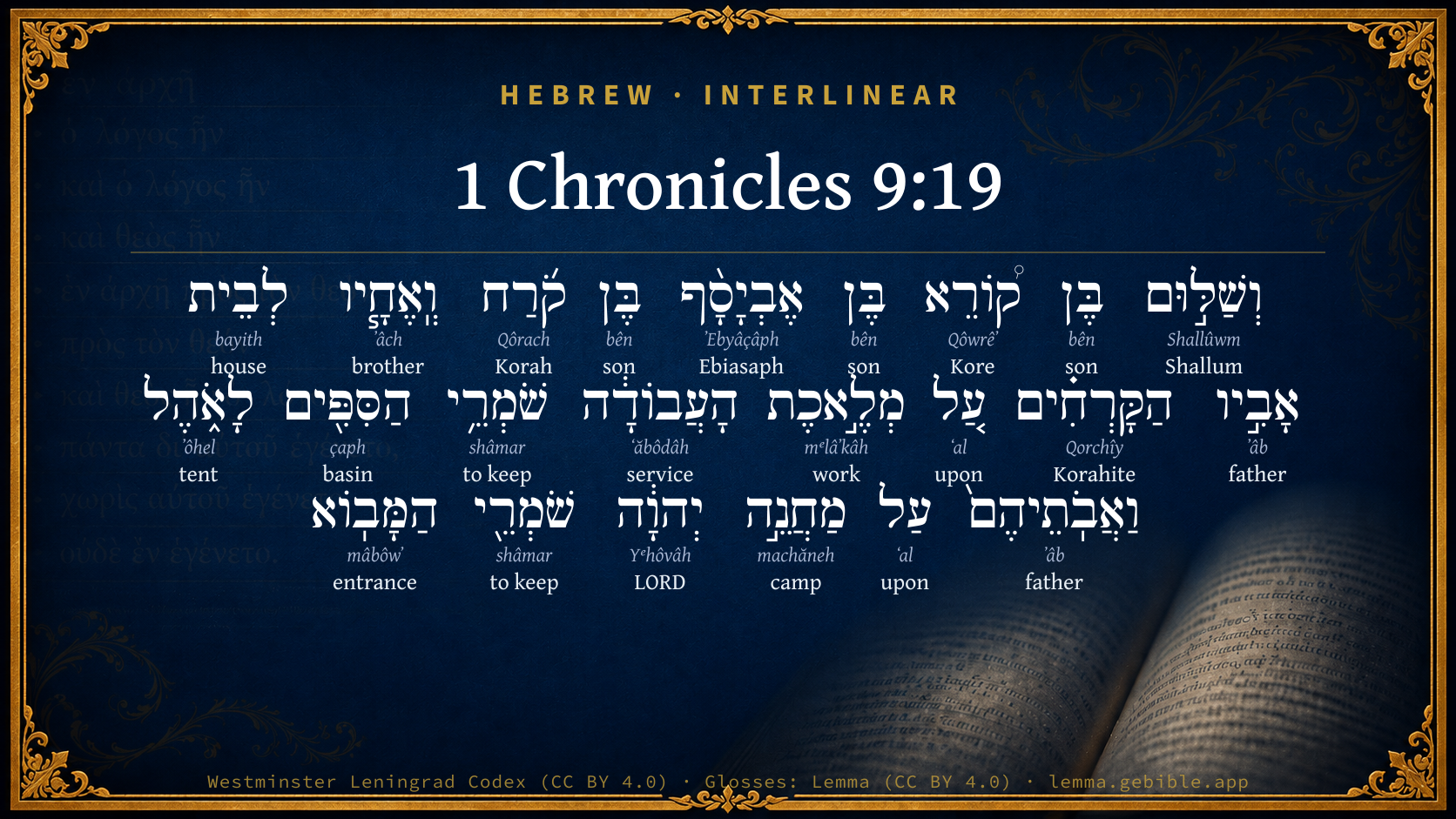
1 Chronicles 9:19

Hebrew (Westminster Leningrad Codex) 1 Chronicles 9:19 appears in the Hebrew Old Testament. The text above is from the Westminster Leningrad Codex. Each word links to its Strong’s number, a concise gloss, and parsing drawn from the Open Scriptures Hebrew Bible morphology. Click any word for its full Brown-Driver-Briggs (BDB) entry.
Download image
Cite this verse

1 Chronicles 9:19 (World English Bible). Public Domain. Lemma interlinear Bible study tool, https://lemma.gebible.app/v/1-chronicles/9/19.

Show BibTeX & RIS
BibTeX
RIS
English Translation
Shallum the son of Kore, the son of Ebiasaph, the son of Korah, and his brothers, of his father's house, the Korahites, were over the work of the service, keepers of the thresholds of the tent: and their fathers had been over the camp of Yahweh, keepers of the entry.
World English Bible · Public Domain
Highlights
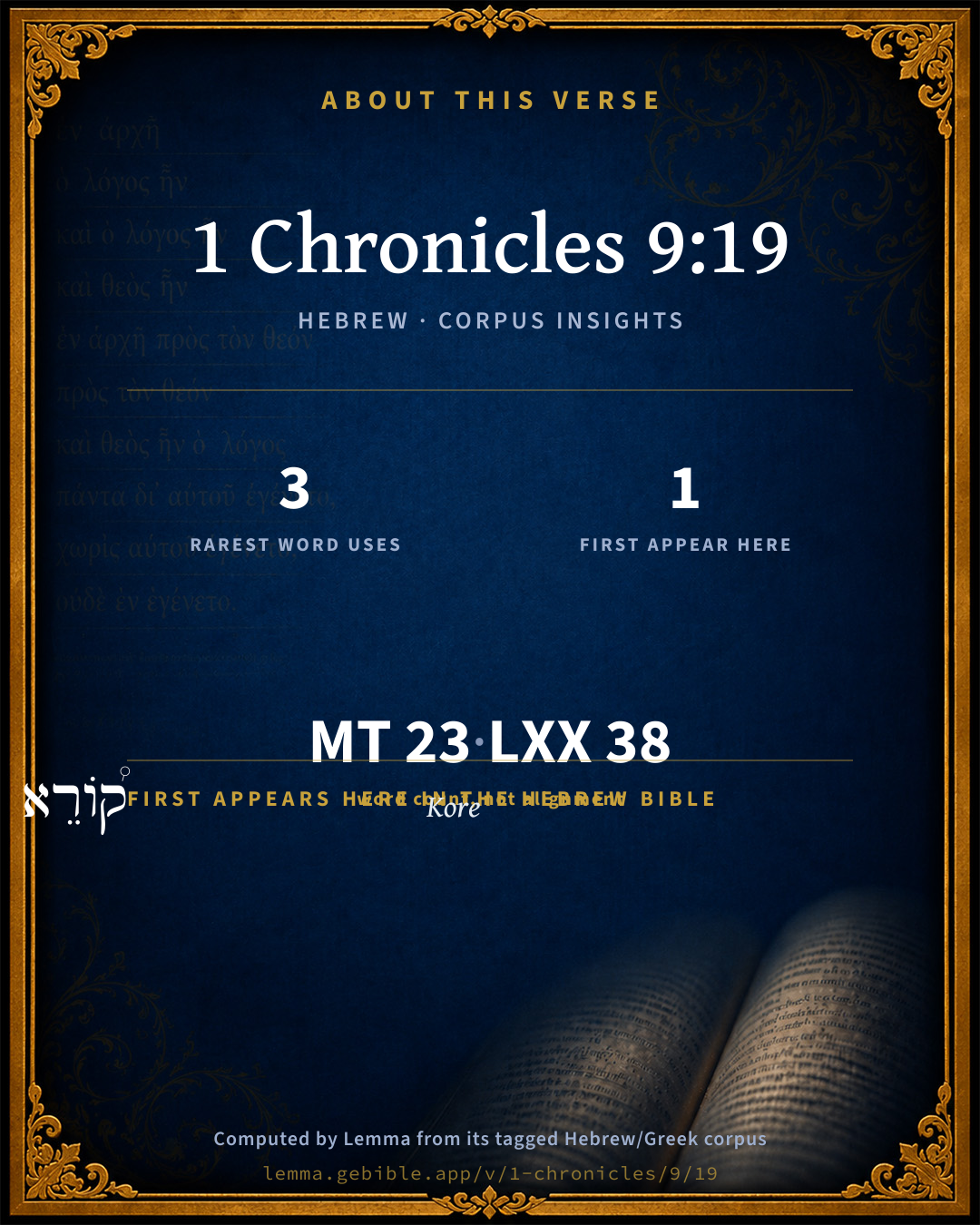
  • 1 first appearance in the Hebrew Bible
Full analysis ↓
Download a study sheet

One document with this verse’s original text, its word-by-word gloss line, the meaning frame, cross-references with their text, attributed commentary, and full source and license credits — printable, and it pastes into notes with its structure intact.

This verse Autodidact and up

Study sheet (.html) Plain text (.txt)

A passage Seminary Student

Up to 50 verses in one chapter. A passage sheet keeps up to 6 commentary sources and 12 cross-references per verse, in the order this page ranks them, and says so on the sheet whenever that leaves anything out. Ask for a single verse and you get the Autodidact verse sheet above.

Everything on this page stays free to read, with no account — the sheet is a download of what is already on screen, not access to it.

Want to remove ads? Support Godless Engineer
Compare translations 3

The same verse in 3 English versions, stacked beneath the original-language interlinear above. Click any original word for its lexicon entry.

Each is an independent rendering of the whole verse — the interlinear is not word-aligned to these translations.

Highlighted words mark where these versions differ — a whole-verse word diff, not a word-by-word alignment.

  • World English Bible Public Domain
    Shallum the son of Kore, the son of Ebiasaph, the son of Korah, and his brothers, of his father's house, the Korahites, were over the work of the service, keepers of the thresholds of the tent: and their fathers had been over the camp of Yahweh, keepers of the entry.
  • King James Version Public Domain
    And Shallum the son of Kore, the son of Ebiasaph, the son of Korah, and his brethren, of the house of his father, the Korahites, were over the work of the service, keepers of the gates of the tabernacle: and their fathers, being over the host of the LORD, were keepers of the entry.
  • unfoldingWord Literal Text CC BY-SA 4.0
    And Shallum, the son of Kore, the son of Ebiasaph, the son of Korah, and his brothers of the house of his father, the Korahites, over the work of the service, keepers of the thresholds of the tent, and their fathers over the camp of Yahweh, keepers of the entrance.

unfoldingWord Literal Text — © unfoldingWord, licensed CC BY-SA 4.0. Word-aligned USFM3 via Door43 (git.door43.org/unfoldingWord/en_ult).

Versions to compare (up to 4)

3 of 4 selected

Show all 18 translations

Every available English version of this verse, each an independent rendering of the whole verse.

  • World English Bible Public Domain
    Shallum the son of Kore, the son of Ebiasaph, the son of Korah, and his brothers, of his father's house, the Korahites, were over the work of the service, keepers of the thresholds of the tent: and their fathers had been over the camp of Yahweh, keepers of the entry.
  • Berean Standard Bible Public Domain
    Shallum son of Kore, the son of Ebiasaph, the son of Korah, and his relatives from the Korahites were assigned to guard the thresholds of the Tent, just as their fathers had been assigned to guard the entrance to the dwelling of the LORD.
  • Majority Standard Bible Public Domain
    Shallum son of Kore, the son of Ebiasaph, the son of Korah, and his relatives from the Korahites were assigned to guard the thresholds of the Tent, just as their fathers had been assigned to guard the entrance to the dwelling of the LORD.
  • King James Version Public Domain
    And Shallum the son of Kore, the son of Ebiasaph, the son of Korah, and his brethren, of the house of his father, the Korahites, were over the work of the service, keepers of the gates of the tabernacle: and their fathers, being over the host of the LORD, were keepers of the entry.
  • American Standard Version (1901) Public Domain
    And Shallum the son of Kore, the son of Ebiasaph, the son of Korah, and his brethren, of his father's house, the Korahites, were over the work of the service, keepers of the thresholds of the tent: and their fathers had been over the camp of Jehovah, keepers of the entry.
  • Revised Version (1885) Public Domain
    And Shallum the son of Kore, the son of Ebiasaph, the son of Korah, and his brethren, of his father’s house, the Korahites, were over the work of the service, keepers of the gates of the tabernacle: and their fathers had been over the camp of the LORD, keepers of the entry;
  • Geneva Bible (1599) Public Domain
    And Shallum the sonne of Kore the sonne of Ebiasaph the sonne of Korah, and his brethren the Korathites (of the house of their father) were ouer the worke, and office to keepe the gates of the Tabernacle: so their families were ouer the hoste of the Lord, keeping the entrie.
  • Douay-Rheims (1899) Public Domain
    But Sellum the son of Core, the son of Abiasaph, the son of Core, with his brethren and his father's house, the Corites were over the works of the service, keepers of the gates of the tabernacle: and their families in turns were keepers of the entrance of the camp of the Lord.
  • Young's Literal Translation Public Domain
    And Shallum son of Kore, son of Ebiasaph, son of Korah, and his brethren, of the house of his father, the Korahites, `are' over the work of the service, keepers of the thresholds of the tent, and their fathers `are' over the camp of Jehovah, keepers of the entrance;
  • Literal Standard Version CC BY-SA 4.0
    And Shallum son of Kore, son of Ebiasaph, son of Korah, and his brothers, of the house of his father, the Korahites, [are] over the work of the service, keepers of the thresholds of the tent, and their fathers [are] over the camp of YHWH, keepers of the entrance;
  • Unlocked Literal Bible CC BY-SA 4.0
    Shallum son of Kore son of Ebiasaph, son of Korah, and his relatives from the house of his father, the Korahites, were in charge of the work of the guard service. They guarded the door to the tent, as their ancestors had guarded the camp of Yahweh, and they also had guarded the entrance.
  • unfoldingWord Literal Text CC BY-SA 4.0
    And Shallum, the son of Kore, the son of Ebiasaph, the son of Korah, and his brothers of the house of his father, the Korahites, over the work of the service, keepers of the thresholds of the tent, and their fathers over the camp of Yahweh, keepers of the entrance.
  • Darby Bible Public Domain
    And Shallum the son of Kore, the son of Ebiasaph, the son of Korah, and his brethren, of the house of his father, the Korahites, were over the work of the service, keepers of the thresholds of the tent, and their fathers, set over the camp of Jehovah, were keepers of the entrance.
  • World Messianic Bible Public Domain
    Shallum was the son of Kore, the son of Ebiasaph, the son of Korah, and his brothers, of his father’s house, the Korahites, were over the work of the service, keepers of the thresholds of the tent. Their fathers had been over the LORD’s camp, keepers of the entry.
  • Webster's Bible Public Domain
    And Shallum the son of Kore, the son of Ebiasaph, the son of Korah, and his brethren of the house of his father, the Korahites, were over the work of the service, keepers of the gates of the tabernacle: and their fathers, being over the host of the LORD, were keepers of the entry.
  • Free Bible Version CC BY-SA 4.0
    Shallum was the son of Kore, son of Ebiasaph, son of Korah. He and his relatives, the Korahites, were responsible for guarding the entrances to the sanctuary in the same way their fathers had been responsible for guarding the entrance to the tented house of the Lord.
  • Bible in Basic English Public Domain
    And Shallum, the son of Kore, the son of Ebiasaph, the son of Korah, and his brothers, of his family, the Korahites, were responsible for everything which had to be done in connection with the order of worship, keepers of the doors of the Tent; their fathers had had the care of the tents of the Lord, being keepers of the doorway.
  • JPS Tanakh (1917) Public Domain
    And Shallum the son of Kore, the son of Ebiasaph, the son of Korah, and his brethren, of his father's house, the Korahites, were over the work of the service, keepers of the gates of the Tent; and their fathers had been over the camp of the LORD, keepers of the entry;

Literal Standard Version (2020), Covenant Press — licensed CC BY-SA 4.0. Text via the HelloAO Bible API (eBible.org). Unlocked Literal Bible (unfoldingWord) — licensed CC BY-SA 4.0. Text via the HelloAO Bible API (eBible.org). unfoldingWord Literal Text — © unfoldingWord, licensed CC BY-SA 4.0. Word-aligned USFM3 via Door43 (git.door43.org/unfoldingWord/en_ult). Free Bible Version, Dr. Jonathan Gallagher — licensed CC BY-SA 4.0. Text via the HelloAO Bible API (eBible.org).

Word by word

More ways to search: Search by grammar → Find every occurrence → Compare this word →

Practice this passage: Drill this verse → Learn its vocabulary →

ק֠וֹרֵא
Qôwrêʼ
H6981
“Kore”
Noun, Proper
Part of Speech
Noun
Type
Proper
Full BDB Definition

Origin: act part of H7121

TWOT: None

Kore = "crier" - a Korahite Levite, ancestor of Shallum and Meshelemiah, chief porters in the reign of David - a Levite, son of Imnah, in the reign of king Hezekiah of Judah
  1. וְשַׁלּ֣וּם Shallûwm H7967 “and · Shallum” Conjunction + Noun, Proper
  2. בֶּן bên H1121 “son of” Noun, Common, Masculine, Singular, Construct
  3. בֶּן bên H1121 “son of” Noun, Common, Masculine, Singular, Construct
  4. אֶבְיָסָ֨ף ʼEbyâçâph H43 “Ebiasaph” Noun, Proper
  5. בֶּן bên H1121 “son of” Noun, Common, Masculine, Singular, Construct
  6. קֹ֜רַח Qôrach H7141 “Korah” Noun, Proper
  7. וְֽאֶחָ֧יו ʼâch H251 “and · brothers · his” Conjunction + Noun, Common, Masculine, Plural, Construct + Suffix, Personal, 3rd Person, Masculine, Singular
  8. לְבֵית bayith H1004 “to/for · house of” Preposition + Noun, Common, Masculine, Singular, Construct
  9. אָבִ֣יו ʼâb H1 “father · his” Noun, Common, Masculine, Singular, Construct + Suffix, Personal, 3rd Person, Masculine, Singular
  10. הַקָּרְחִ֗ים Qorchîy H7145 “the · Korahites” Particle, Definite Article + Noun, Gentilic, Masculine, Plural, Absolute
  11. עַ֚ל ʻal H5921 “upon” Preposition
  12. מְלֶ֣אכֶת mᵉlâʼkâh H4399 “work of” Noun, Common, Feminine, Singular, Construct
  13. הָעֲבוֹדָ֔ה ʻăbôdâh H5656 “the · service” Particle, Definite Article + Noun, Common, Feminine, Singular, Absolute
  14. שֹׁמְרֵ֥י shâmar H8104 “keeping” Verb, Qal, Participle Active, Masculine, Plural, Construct
  15. הַסִּפִּ֖ים çaph H5592 “the · basins” Particle, Definite Article + Noun, Common, Masculine, Plural, Absolute
  16. לָאֹ֑הֶל ʼôhel H168 “to/for the · tent” Preposition, Determined + Noun, Common, Masculine, Singular, Absolute
  17. וַאֲבֹֽתֵיהֶם֙ ʼâb H1 “and · fathers · their” Conjunction + Noun, Common, Masculine, Plural, Construct + Suffix, Personal, 3rd Person, Masculine, Plural
  18. עַל ʻal H5921 “upon” Preposition
  19. מַחֲנֵ֣ה machăneh H4264 “camp of” Noun, Common, Both, Singular, Construct
  20. יְהוָ֔ה Yᵉhôvâh H3068 “LORD” Noun, Proper
  21. שֹׁמְרֵ֖י shâmar H8104 “keeping” Verb, Qal, Participle Active, Masculine, Plural, Construct
  22. הַמָּבֽוֹא mâbôwʼ H3996 “the · entrance” Particle, Definite Article + Noun, Common, Masculine, Singular, Absolute

About this verse

These counts appear in no published source. They are computed here, from the morphology-tagged text and Lemma’s own curated glosses. What Lemma adds →

23
words
18
distinct lemmas
Historical
section

Notable vocabulary

The rarest word here is ק֠וֹרֵא Kore H6981 — appearing just 3 times in the whole Hebrew Bible.

First appearance in Scripture

This word makes its first canonical appearance in the Hebrew Bible here:

  • ק֠וֹרֵא Kore H6981

Shared distinctive vocabulary

ק֠וֹרֵא Kore H6981 occurs in 3 verses of the Hebrew Bible. Also found in:

Grammatical profile

  • 2 verbs
  • 19 nouns
  • 2 prepositions

Verb forms

  • שֹׁמְרֵ֥י Qal · Participle Active
  • שֹׁמְרֵ֖י Qal · Participle Active

Repetition

Words recur within this verse — often emphatic in Hebrew:

  • בֶּן son H1121 ×3
  • אָבִ֣יו father H1 ×2
  • עַ֚ל upon H5921 ×2
  • שֹׁמְרֵ֥י to keep H8104 ×2

Hebrew & Septuagint length

In English translation the verse runs 50 words from the Hebrew and 51 from the Septuagint (LXX English) — closely comparable.

A rough comparison of the two English renderings, which tokenize alike — not a word-level alignment.

Word counts can differ between the Hebrew and the Greek without any difference in meaning — e.g. the Hebrew direct-object marker אֵת has no separate Greek word, and Greek often adds the article ὁ.

In the original languages it is 23 Hebrew tokens and 38 Greek tokens — but the two are counted differently (Hebrew bundles its prefixes and suffixes into one token; the Greek is in lemma form), so that isn’t a like-for-like length.

Cross-references

11

Topical passages linked to 1 Chronicles 9:19 in the Treasury of Scripture Knowledge — connected by theme and wording, ordered by reader-vote popularity; previews shown in the World English Bible.

  • Numbers 26:9–11 The sons of Eliab: Nemuel, and Dathan, and Abiram. These are that Dathan and Abiram, who were called of the congregation, who strove against Moses and against Aaron in the company of Korah, when they strove against Yahweh,
  • 2 Kings 11:9 The captains over hundreds did according to all that Jehoiada the priest commanded; and they took every man his men, those who were to come in on the Sabbath, with those who were to go out on the Sabbath, and came to Jehoiada the priest.
  • 2 Kings 11:15 Jehoiada the priest commanded the captains of hundreds who were set over the host, and said to them, Have her forth between the ranks; and him who follows her kill with the sword. For the priest said, Don't let her be slain in the house of Yahweh.
  • 1 Chronicles 6:22–23 The sons of Kohath: Amminadab his son, Korah his son, Assir his son,
  • 1 Chronicles 26:7–8 The sons of Shemaiah: Othni, and Rephael, and Obed, Elzabad, whose brothers were valiant men, Elihu, and Semachiah.
  • 1 Chronicles 26:13–19 They cast lots, the small as well as the great, according to their fathers' houses, for every gate.
  • 2 Chronicles 23:4–10 This is the thing that you shall do: a third part of you, who come in on the Sabbath, of the priests and of the Levites, shall be porters of the thresholds;
  • Psalms 42:1 As the deer pants for the water brooks, So my soul pants after you, God.
  • Psalms 44:1 We have heard with our ears, God; Our fathers have told us, What work you did in their days, In the days of old.
  • Psalms 49:1 Hear this, all you peoples. Listen, all you inhabitants of the world,
  • Psalms 84:10 For a day in your courts is better than a thousand. I would rather be a doorkeeper in the house of my God, Than to dwell in the tents of wickedness.

Cross-references courtesy of OpenBible.info (CC BY 4.0).

Hebrew and Greek witnesses Masoretic Hebrew ↔ Greek Septuagint

The same verse in the two great witnesses to the Old Testament, shown verse-for-verse.

These are two independent witnesses, not word-aligned to each other, and the Septuagint is shown in lemma (dictionary) form.

Hebrew 1 Chronicles 9:19 Masoretic · Westminster Leningrad Codex

וְשַׁלּ֣וּם בֶּן ק֠וֹרֵא בֶּן אֶבְיָסָ֨ף בֶּן קֹ֜רַח וְֽאֶחָ֧יו לְבֵית אָבִ֣יו הַקָּרְחִ֗ים עַ֚ל מְלֶ֣אכֶת הָעֲבוֹדָ֔ה שֹׁמְרֵ֥י הַסִּפִּ֖ים לָאֹ֑הֶל וַאֲבֹֽתֵיהֶם֙ עַל מַחֲנֵ֣ה יְהוָ֔ה שֹׁמְרֵ֖י הַמָּבֽוֹא

Shallum the son of Kore, the son of Ebiasaph, the son of Korah, and his brothers, of his father's house, the Korahites, were over the work of the service, keepers of the thresholds of the tent: and their fathers had been over the camp of Yahweh, keepers of the entry.

World English Bible · Public Domain

Greek LXX 1 Chronicles 9:19 Septuagint · lemma form

καί σαλωμ υἱός κωρη υἱός αβιασαφ υἱός κορε καί ὁ ἀδελφός αὐτός εἰς οἶκος πατήρ αὐτός ὁ κορίτης ἐπί ὁ ἔργον ὁ λειτουργία φυλάσσω ὁ φυλακή ὁ σκηνή καί πατήρ αὐτός ἐπί ὁ παρεμβολή κύριος φυλάσσω ὁ εἴσοδος

And Sellum the son of Core, the son of Abiasaph, the son of Core, and his brethren belonging to the house of his father, the Corites were over the works of the service, keeping the watches of the tabernacle, and their fathers over the camp of the Lord, keeping the entrance.

LXX2012 (modern English Septuagint) · Public Domain

Hebrew: Westminster Leningrad Codex (CC BY 4.0). Greek: Septuagint (public domain); English from LXX2012 (modern English Septuagint) (Public Domain). How the Septuagint differs from the Hebrew →

Commentary

Notes on 1 Chronicles 9:19 from classic Christian and Jewish commentators (each source and its license shown beneath its notes). The classic Christian expositions comment on the surrounding passage and are grouped to its opening verse, so a note may address several verses; the Jewish commentaries on the Tanakh (Rashi and others) are per-verse, so they appear only where the commentator wrote on this verse.

Lemma curates 59 commentaries, every one of them public domain or Creative Commons licensed, each selected and text-cleaned for this edition rather than reprinted as found. About our sources →

Trapp's Complete Commentary

John Trapp

1Ch 9:19 And Shallum the son of Kore, the son of Ebiasaph, the son of Korah, and his brethren, of the house of his father, the Korahites, [were] over the work of the service, keepers of the gates of the tabernacle: and their fathers, [being] over the host of the LORD, [were] keepers of the entry.

Ver. 19. Being over the host of the Lord,] viz, When they of old encamped round about the tabernacle, in the wilderness.

John Trapp, A Commentary or Exposition upon All the Books of the Old and New Testament (1647–1656) — public domain. Text from a community e-Sword module.

Joseph Benson's Commentary

1Ch 9:19. Tabernacle — Namely, in time past, when the tabernacle was standing, before the temple was built. Their fathers — The Kohathites. Being over the host of the Lord — When the Israelites were in the wilderness, encamped in a military manner round about the tabernacle, with whom these were then placed. Keepers of the entry — Of the veil by which they entered into the tabernacle; which he calls the entry, because then there were no gates. The meaning is, that all things were now restored to their primitive order; and the several persons took those offices upon them, which their ancestors had before them.

Joseph Benson's Commentary on the Old and New Testaments (1811–1818) — public domain. Text from a community e-Sword module.

Geneva Bible (1599)

Geneva Bible translators

Their charge was that none should enter into those places, which were only appointed for the Priests to minister in.

Geneva Bible (1599) marginal notes — public domain. Text via Bolls.life.

Adam Clarke's Commentary

Verse 19. Keepers of the entry.] Whose business it was to suffer no person to come to the tabernacle but the priests, during the performance of the sacred service; see Jarchi.

Adam Clarke's Commentary on the Bible (1810–1826) — public domain. Text from a community e-Sword/MySword module.

Ellicott's Commentary for English Readers

(19) And Shallum the son of Kore, the son of Ebiasaph, the son of Koran.—Comp. 1Ch_26:1, which makes “Meshelemiah son of Kore, of the sons of Asaph” a guild of warders under David.

Ebiasaph—“The Father (i.e., God) gathered,” is a fuller form of Asaph, “He gathered.”

And his brethren, of the house of his father.—That is, the Korahites, as is immediately explained: his kinsmen belonging to his father-house or clan.

The work of the service (of Shallum),—That is, of the guild so called, is defined as that of “wardens of the thresholds of the tent,” that is, of the Temple, which had taken the place of the old Tent of Meeting.

And their fathers, being over the host of the Lord, were keepers of the entry.—“Their fathers” are the ancestors of the Korahite clan of Shallura.

The host of the Lord.—Or, rather, the encampment of Jehovah, means the tabernacle, or Tent of Tryst, which had only one entrance, over which, according to this passage—the Pentateuch is silent—the house of Shallum stood guard. 2Ch_31:2 applies the same archaic nomenclature to the Temple in Hezekiah’s reign, speaking of “the gates of the camps of Iahweh.”

A Bible Commentary for English Readers, edited by Charles John Ellicott (1878–1897) — public domain. Text from a community e-Sword module.

The Cambridge Bible for Schools and Colleges

gen. ed. J. J. S. Perowne

19. son of Ebiasaph] By a misreading Shallum (= Meshelemiah; see above) is said to be “of the sons of Asaph” (read “Ebiasaph”) in 1Ch_26:1.

of the house of his father] R.V. of his father’s house.

being over the host of the Lord, were keepers] R.V. had been over the camp of the LORD, keepers. Nothing is said in the Pentateuch of “keepers of the entry to the tabernacle,” and probably in the present passage the entry to the camp, not to the tabernacle, is meant. With this view agrees the mention of Phinehas (1Ch_9:20), for it was the profanation of the camp, not of the tabernacle, which Phinehas avenged (Num_25:6-8), thus earning a blessing (Num_25:11-13).

The Cambridge Bible for Schools and Colleges (gen. ed. J. J. S. Perowne; Cambridge University Press, 1878–1918) — public domain. Text from a community e-Sword module.

John Gill's Exposition

And Zechariah the son of Meshelemiah,.... Some think this refers to one that was in the times of David; but it seems rather to respect one that was after the Babylonish captivity, see Ch1 26:1 though he and his brethren were in an office established in the times of David, and the order of which was now, as then, observed:

was porter of the door of the tabernacle of the congregation: who was the chief porter, and kept the door; either that led into the outer court, and kept out all unclean persons from entering there; or that which led into the court of the priests, that none but priests might enter there.

John Gill's Exposition of the Whole Bible (1746–1763) — public domain (CC PDM 1.0). Text via the HelloAO Bible API.

Albert Barnes' Notes on the Bible

Shallum the son of Kore - A different person from the Shallum of 1Ch 9:17, and with a different office, namely, the guarding the inner doors of the temple. The original Shallum, Shelemaiah, or Meshelemaiah, was a Levite of the time of David 1Ch 26:14. His descendants were still called by his name, but had now a more important charge assigned to them.

Albert Barnes' Notes on the Bible (1834–1885) — public domain. Text from a community e-Sword/MySword module.

Haydock's Catholic Bible Commentary

Service, to keep watch. (Calmet) --- Families. Hebrew, "fathers over the host, (Haydock) or camp of the Lord: keepers of the entry." The Corites, though not perhaps alone, performed what their fathers had done before the tabernacle, in the desert, and in the temple of Solomon; which were considered as the camp of the great king.

George Leo Haydock (1774–1849), Haydock's Catholic Family Bible and Commentary, 1859 edition — public domain. Excludes Psalms (Douay-Rheims chapter numbering differs from Protestant) and Deuterocanonical books (Catholic canon only).

Matthew Poole's English Annotations

Keepers of the gates of the tabernacle; or, who were, to wit, in time past, which is expressed in a like case, 1Ch 9:20, when the tabernacle was standing, before the temple was built. Their fathers; the Kohathites, of whom see on Num 4:4. Over the host of the Lord, or, with (as this Hebrew particle is oft used) the host, &c., i.e. when the Israelites were in the wilderness, encamped in a military manner round about the tabernacle, with or among whom these were then placed.

Keepers of the entry, i.e. of the veil by which they entered into the tabernacle; which he calls the entry distinctively, because then there were no gates. The meaning is, that all things were now restored to their primitive order and institution; and the several persons took those places and offices upon them, which their ancestors had before them.

Matthew Poole's English Annotations on the Holy Bible (1683–1685) — public domain. Text from a community e-Sword/MySword module.

The Pulpit Commentary

Shallum. Marked as a different person from the former of the same name, by the description son of Kore, etc. The pedigree here given enables us to identify the person intended as Shelemiah or Moshelemiah. (1Ch_6:23, 27 26:1, 14) Keepers of the gates of the tabernacle; of the entry. These are descriptions of "service," not synonymous with those of vers. 17 and 18, where the words and rvB are found, in place of those used here, viz. ljaol and awObMh yremvo. They designate the care of the inner entrances of the sacred building. Their fathers were keepers of the entrance to the tabernacle, as these to the inner doors (margin, "thresholds") of the temple. So the following verse points the times of "the fathers.

Ver. 19, etc.

God"s door-keepers.

Some were appointed to serve as keepers of the gates," and some as "keepers of the entry," and one man was "porter of the door of the tabernacle of the congregation." David recognized an attractiveness in such offices because they secured constant presence in the holy courts. He says, "I had rather be a door-keeper in the house of my God, than to dwell in the tents of wickedness.

I LOWLY SERVICES ARE ASKED AT OUR HANDS. Common life in the family, the business, and society has its many lowly services and its few great ones. And in religious life the same is true. Of most of us God asks that we will do little things for him well. What a gracious lesson in doing cheerfully lowly work our Lord gave us when he laid aside his garments, took a towel, girded himself, and began to wash the disciples" feet! "He that would he greatest among you let him be your servant.

II LOWLY SERVICES ARE NECESSARY TO THE GENERAL WELL-BEING. Illustrate from church offices. The organ-blower"s is a very humble office, but most necessary and useful. The verger, doorkeeper, cleaner, etc., are but in humble places and duties, and yet the comfort of "priest and people" depend on their lowly work. So in all good enterprises there is a great deal of mechanical and insignificant work demanded, but the efficient doing of them bears directly on the entire success. Standing quite alone, the humble duty seems scarce worth the doing, but when it is seen fitting into its place in the great whole, its real importance and dignity are recognized. Illustrations may be found in the importance of the lesser parts of a great machine or work of mechanical construction. A fine tower once fell in ruins to the surprise of all, until the builder confessed that he had neglected the little iron ties insignificant things that held the stones together. No man ever gains a worthy apprehension of life until he fully and finally settles with himself that he will think nothing small, and treat nothing as small, since "all things have their necessary uses," and God asks for "faithfulness in that which is least.

III LOWLY SERVICES FIND SPHERES FOR THE EXPRESSION OF CHARACTER. And the best; for men are less sophisticated, more simple and more genuine in them. If we would know what a man really is, we must not watch him merely on "show days," but rather see him in the private scenes of home and business. We put on character-garments for public scenes, just as we do outer coats for the streets. When "taken at unawares" we express what our character really is.

IV LOWLY SERVICES OFTEN BECOME THE MOST EFFICIENT TESTS OF CHARACTER. The necessity for personal attentions to the poor wounded man on the road to Jericho, tested and proved the selfishness of priest and Levite, as a call for some high and honourable service would not have done. And similar calls are made on us. We want to do the great things, and show off the blossoms of fine character which we have carefully stuck on. And God, in his providences, only provides humble spheres, unobserved places, and lowly work, which will let the fine pretences alone to wither and fall off, and only test and culture the real and the worthy and the true. Who of us can review our lives, and fail to see the places where, again and again, we were "weighed in the balances and found wanting" when we were asked to take some humble place of service or do some little thing for Jesus" sake? Still we are so unwilling to take the lowest rooms, even though Christ taught us that he looks among the people there to find the right-hearted, the worthy, whom he may hid "Go up higher." In respect of the power to hold and exhibit character, the little things often have more capacity than the big.

V LOWLY SERVICES FIT IN WITH GREATER ONES TO PERFECT THE WHOLE OF SERVICE, Door-keepers fit in with porters, and sacrificers, and singers, and priests, to make the whole of temple service. And the least piece lost from the whole mars the beauty of the perfect service. What God asks is faithfulness, and he can find it in the "least things." Remember George Herbert"s familiar verse, "Who sweeps a room," etc. R.T.

The Pulpit Commentary (1880–1919), ed. H.D.M. Spence-Jones & Joseph S. Exell — public domain. Text from a community e-Sword module.

John Wesley's Explanatory Notes

Tabernacle - Namely, in time past, when the tabernacle was standing, before the temple was built. Fathers - The Kohathites. Host - When the Israelites were in the wilderness, encamped in a military manner round about the tabernacle, with whom these were then placed. Entry - Of the veil by which they entered into the tabernacle; which he calls the entry because then there were no gates. The meaning is, that all things were now restored to their primitive order; and the several persons took those offices upon them, which their ancestors had before them.

John Wesley, Explanatory Notes Upon the Whole Bible (1754–1765) — public domain. Text via the GEBible commentary corpus.

Keil & Delitzsch

C. F. Keil & F. Delitzsch

And Zechariah the son of Meshelemiah,.... Some think this refers to one that was in the times of David; but it seems rather to respect one that was after the Babylonish captivity, see Ch1 26:1 though he and his brethren were in an office established in the times of David, and the order of which was now, as then, observed:

was porter of the door of the tabernacle of the congregation: who was the chief porter, and kept the door; either that led into the outer court, and kept out all unclean persons from entering there; or that which led into the court of the priests, that none but priests might enter there.

Keil & Delitzsch — Biblical Commentary on the Old Testament (1861–1891) — public domain (CC PDM 1.0). Text via the HelloAO Bible API. (Old Testament only.)

Rashi

Rabbi Shlomo Yitzchaki (Rashi)

the guards of the thresholds of the Tent Shallum the son of Kore and his brethren of his father’s house, the Korahites, were the guards of the thresholds of the Tent of Meeting and did not allow any person to enter the Tent of Meeting, except the priests in their service

Rashi on the Tanakh — English translations: “The Judaica Press complete Tanach with Rashi, translated by A. J. Rosenberg” (CC BY 4.0); “Pentateuch with Rashi's commentary by M. Rosenbaum and A.M. Silbermann, 1929-1934” (public domain); “The Metsudah Tanach series, Lakewood, N.J” (CC BY 4.0); and “The Book of Joshua, Metsudah Publications, 1997” (CC BY 4.0). Text via Sefaria.

Lesson kit

Teaching starters — assembled from the data on this page, not authored interpretation. Every prompt links to the verse data it draws on. Edit before teaching.

1 Chronicles, in the Historical, opens this verse with 23 words (18 distinct Hebrew lemmas). Its most distinctive word is Qôwrêʼ (“Kore”). A historical commentator’s framing appears above. Read the whole chapter for the surrounding context.

Discussion questions

  1. How does “Kore” (Qôwrêʼ) shape what this verse is saying?
  2. The word “Kore” first appears here in Scripture. What is being introduced at this debut?
  3. 1 Chronicles 26:1 shares the word «Kore» with this verse. How do the two illuminate each other?
  4. “son” occurs 3× in this one verse. What is the effect of the repetition?
  5. The translations on this page render this verse differently — a whole-verse word diff, not a word-by-word alignment. What might account for the different wordings?
  6. The verb «שֹׁמְרֵ֥י» is Qal Participle Active. How does its form color the action?
  7. Reading how Trapp's Complete Commentary and Joseph Benson's Commentary read this verse, where do the two commentators agree and where do they part?

Things to notice

Reading settings

Reading text

Shown beneath each verse's original-language words.

Old Testament
Old Testament edition

Read the OT as the Masoretic Hebrew (MT) or the Greek Septuagint (LXX).

English shown for the Greek Septuagint (in the Hebrew ↔ Greek comparison).

Comparing translations? Open the Compare panel on any verse page to stack up to four side by side.