Hebrews 9:14

Greek (Tischendorf 8th ed.) Hebrews 9:14 appears in the Greek New Testament. The text above is from the Tischendorf 8th edition. Each word links to its Strong’s number and a concise gloss. Click any word for its full Thayer’s Greek Lexicon entry.
Download image
Cite this verse

Hebrews 9:14 (World English Bible). Public Domain. Lemma interlinear Bible study tool, https://lemma.gebible.app/v/hebrews/9/14.

Show BibTeX & RIS
BibTeX
RIS
English Translation
how much more will the blood of Christ, who through the eternal Spirit offered himself without blemish to God, cleanse your conscience from dead works to serve the living God?
World English Bible · Public Domain
Download a study sheet

One document with this verse’s original text, its word-by-word gloss line, the meaning frame, cross-references with their text, attributed commentary, and full source and license credits — printable, and it pastes into notes with its structure intact.

This verse Autodidact and up

Study sheet (.html) Plain text (.txt)

A passage Seminary Student

Up to 50 verses in one chapter. A passage sheet keeps up to 6 commentary sources and 12 cross-references per verse, in the order this page ranks them, and says so on the sheet whenever that leaves anything out. Ask for a single verse and you get the Autodidact verse sheet above.

Everything on this page stays free to read, with no account — the sheet is a download of what is already on screen, not access to it.

Want to remove ads? Support Godless Engineer
Compare translations 3

The same verse in 3 English versions, stacked beneath the original-language interlinear above. Click any original word for its lexicon entry.

Each is an independent rendering of the whole verse — the interlinear is not word-aligned to these translations.

Highlighted words mark where these versions differ — a whole-verse word diff, not a word-by-word alignment.

  • World English Bible Public Domain
    how much more will the blood of Christ, who through the eternal Spirit offered himself without blemish to God, cleanse your conscience from dead works to serve the living God?
  • King James Version Public Domain
    How much more shall the blood of Christ, who through the eternal Spirit offered himself without spot to God, purge your conscience from dead works to serve the living God?
  • unfoldingWord Literal Text CC BY-SA 4.0
    how much more will the blood of Christ, who through the eternal Spirit offered himself without blemish to God, cleanse your conscience from dead works to serve the living God!

unfoldingWord Literal Text — © unfoldingWord, licensed CC BY-SA 4.0. Word-aligned USFM3 via Door43 (git.door43.org/unfoldingWord/en_ult).

Versions to compare (up to 4)

3 of 4 selected

Show all 19 translations

Every available English version of this verse, each an independent rendering of the whole verse.

  • World English Bible Public Domain
    how much more will the blood of Christ, who through the eternal Spirit offered himself without blemish to God, cleanse your conscience from dead works to serve the living God?
  • Berean Standard Bible Public Domain
    how much more will the blood of Christ, who through the eternal Spirit offered Himself unblemished to God, purify our consciences from works of death, so that we may serve the living God!
  • Majority Standard Bible Public Domain
    how much more will the blood of Christ, who through the eternal Spirit offered Himself unblemished to God, purify your consciences from works of death, so that we may serve the living God!
  • King James Version Public Domain
    How much more shall the blood of Christ, who through the eternal Spirit offered himself without spot to God, purge your conscience from dead works to serve the living God?
  • American Standard Version (1901) Public Domain
    how much more shall the blood of Christ, who through the eternal Spirit offered himself without blemish unto God, cleanse your conscience from dead works to serve the living God?
  • Revised Version (1885) Public Domain
    how much more shall the blood of Christ, who through the eternal Spirit offered himself without blemish unto God, cleanse your conscience from dead works to serve the living God?
  • Geneva Bible (1599) Public Domain
    How much more shall the blood of Christ which through the eternall Spirit offered himselfe without fault to God, purge your conscience from dead workes, to serue the liuing God?
  • Douay-Rheims (1899) Public Domain
    How much more shall the blood of Christ, who by the Holy Ghost offered himself unspotted unto God, cleanse our conscience from dead works, to serve the living God?
  • Young's Literal Translation Public Domain
    how much more shall the blood of the Christ (who through the age-during Spirit did offer himself unblemished to God) purify your conscience from dead works to serve the living God?
  • Literal Standard Version CC BY-SA 4.0
    how much more will the blood of the Christ (who through the perpetual Spirit offered Himself unblemished to God) purify your conscience from dead works to serve the living God?
  • Unlocked Literal Bible CC BY-SA 4.0
    how much more will the blood of Christ, who through the eternal Spirit offered himself without blemish to God, cleanse our conscience from dead works to serve the living God?
  • unfoldingWord Literal Text CC BY-SA 4.0
    how much more will the blood of Christ, who through the eternal Spirit offered himself without blemish to God, cleanse your conscience from dead works to serve the living God!
  • Darby Bible Public Domain
    how much rather shall the blood of the Christ, who by the eternal Spirit offered himself spotless to God, purify your conscience from dead works to worship [the] living God?
  • World Messianic Bible Public Domain
    how much more will the blood of Messiah, who through the eternal Spirit offered himself without defect to God, cleanse your conscience from dead works to serve the living God?
  • Webster's Bible Public Domain
    How much more shall the blood of Christ, who through the eternal Spirit offered himself without spot to God, cleanse your conscience from dead works to serve the living God?
  • Free Bible Version CC BY-SA 4.0
    how much more does the blood of Christ—who offered himself in his sinless life to God through the eternal Spirit—clean your consciences from your past sinful lives so you can serve the living God?
  • Bible in Basic English Public Domain
    How much more will the blood of Christ, who, being without sin, made an offering of himself to God through the Holy Spirit, make your hearts clean from dead works to be servants of the living God?
  • Text-Critical English NT CC BY 4.0
    how much more will the blood of Christ, who through the eternal Spirit offered himself without blemish to God, purify your consciences from dead works to serve the living God?
  • Tyndale New Testament (1534) Public Domain
    How moche more shall the bloud of Christ (which thorow the eternall sprete offered him silfe with out spot to God) pourdge youre consciences from deed workes for to serve the livynge god?

Literal Standard Version (2020), Covenant Press — licensed CC BY-SA 4.0. Text via the HelloAO Bible API (eBible.org). Unlocked Literal Bible (unfoldingWord) — licensed CC BY-SA 4.0. Text via the HelloAO Bible API (eBible.org). unfoldingWord Literal Text — © unfoldingWord, licensed CC BY-SA 4.0. Word-aligned USFM3 via Door43 (git.door43.org/unfoldingWord/en_ult). Free Bible Version, Dr. Jonathan Gallagher — licensed CC BY-SA 4.0. Text via the HelloAO Bible API (eBible.org).

Word by word

More ways to search: Search by grammar → Find every occurrence → Compare this word →

Practice this passage: Drill this verse → Learn its vocabulary →

ἄμωμον
ámōmos
G299
“blameless”
Adjective, Accusative, Singular, Masculine
Part of Speech
Adjective
Case
Accusative
Number
Singular
Gender
Masculine
Full Thayer's Definition

Origin: from G1 (as a negative particle) and G3470

TDNT: 17:50,6

1. without blemish a. as a sacrifice without spot or blemish 2. morally: without blemish, faultless, unblameable
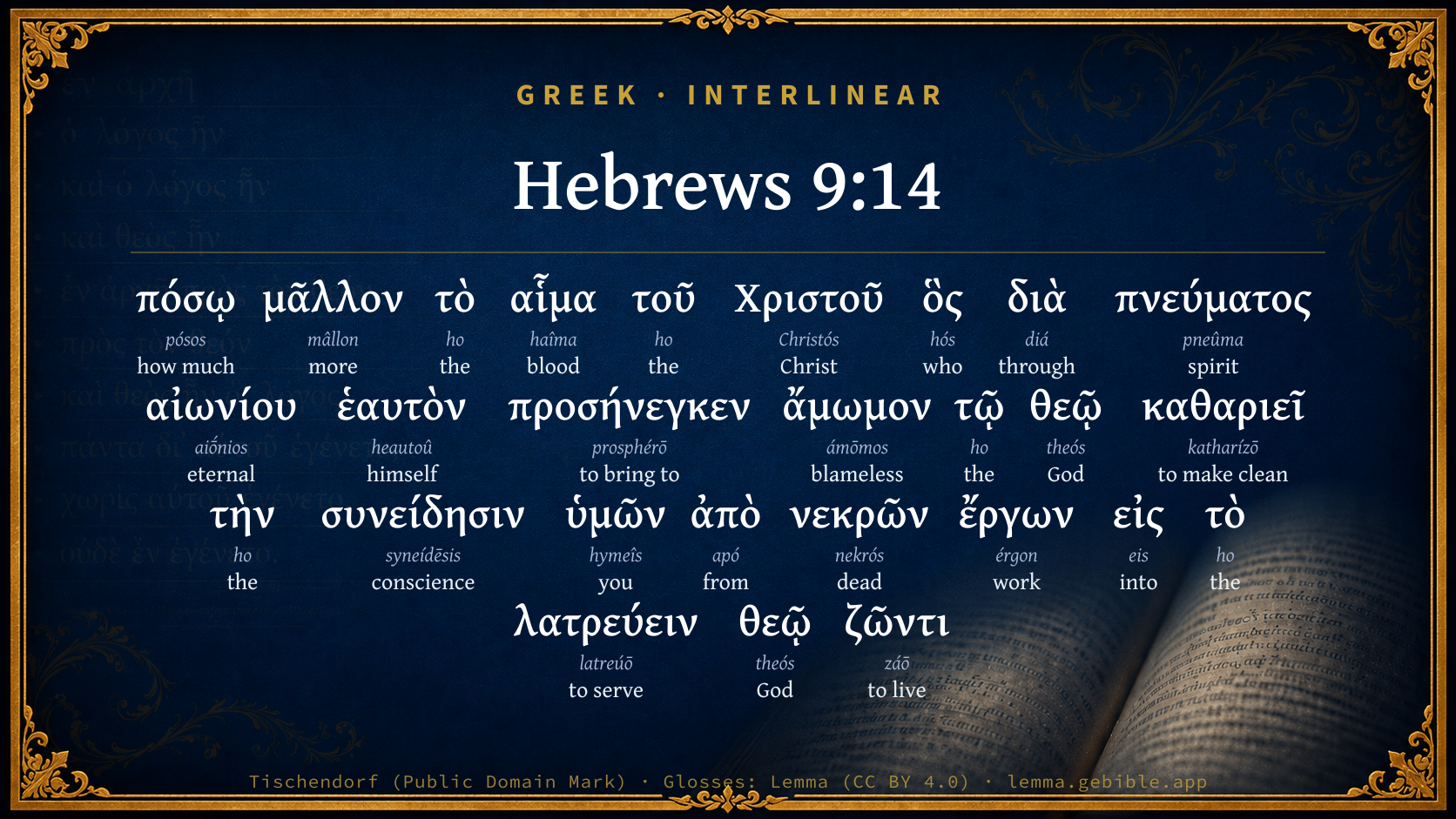
  1. πόσῳ pósos G4214 “how much” Correlative/interrogative pronoun, Dative, Singular, Neuter
  2. μᾶλλον mâllon G3123 “more” Adverb
  3. τὸ ho G3588 “the” Article, Nominative, Singular, Neuter
  4. αἷμα haîma G129 “blood” Noun, Nominative, Singular, Neuter
  5. τοῦ ho G3588 “the” Article, Genitive, Singular, Masculine
  6. Χριστοῦ Christós G5547 “Christ” Noun, Genitive, Singular, Masculine
  7. ὃς hós G3739 “who” Relative pronoun, Nominative, Singular, Masculine
  8. διὰ diá G1223 “through” Preposition
  9. πνεύματος pneûma G4151 “spirit” Noun, Genitive, Singular, Neuter
  10. αἰωνίου aiṓnios G166 “eternal” Adjective, Genitive, Singular, Neuter
  11. ἑαυτὸν heautoû G1438 “himself” Reflexive pronoun, 3rd person, Accusative, Singular, Masculine
  12. προσήνεγκεν prosphérō G4374 “to bring to” Verb, Aorist, Active, Indicative, 3rd person, Singular
  13. τῷ ho G3588 “the” Article, Dative, Singular, Masculine
  14. θεῷ theós G2316 “God” Noun, Dative, Singular, Masculine
  15. καθαριεῖ katharízō G2511 “to make clean” Verb, Future, Active, Indicative, 3rd person, Singular, Attic form
  16. τὴν ho G3588 “the” Article, Accusative, Singular, Feminine
  17. συνείδησιν syneídēsis G4893 “conscience” Noun, Accusative, Singular, Feminine
  18. ὑμῶν hymeîs G5210 “you” Personal pronoun, 2nd person, Genitive, Plural
  19. ἀπὸ apó G575 “from” Preposition
  20. νεκρῶν nekrós G3498 “dead” Adjective, Genitive, Plural, Neuter
  21. ἔργων érgon G2041 “work” Noun, Genitive, Plural, Neuter
  22. εἰς eis G1519 “into” Preposition
  23. τὸ ho G3588 “the” Article, Accusative, Singular, Neuter
  24. λατρεύειν latreúō G3000 “to serve” Verb, Present, Active, Infinitive
  25. θεῷ theós G2316 “God” Noun, Dative, Singular, Masculine
  26. ζῶντι záō G2198 “to live” Verb, Present, Active, Participle, Dative, Singular, Masculine

About this verse

These counts appear in no published source. They are computed here, from the morphology-tagged text and Lemma’s own curated glosses. What Lemma adds →

27
words
22
distinct lemmas
General Epistles
section

Notable vocabulary

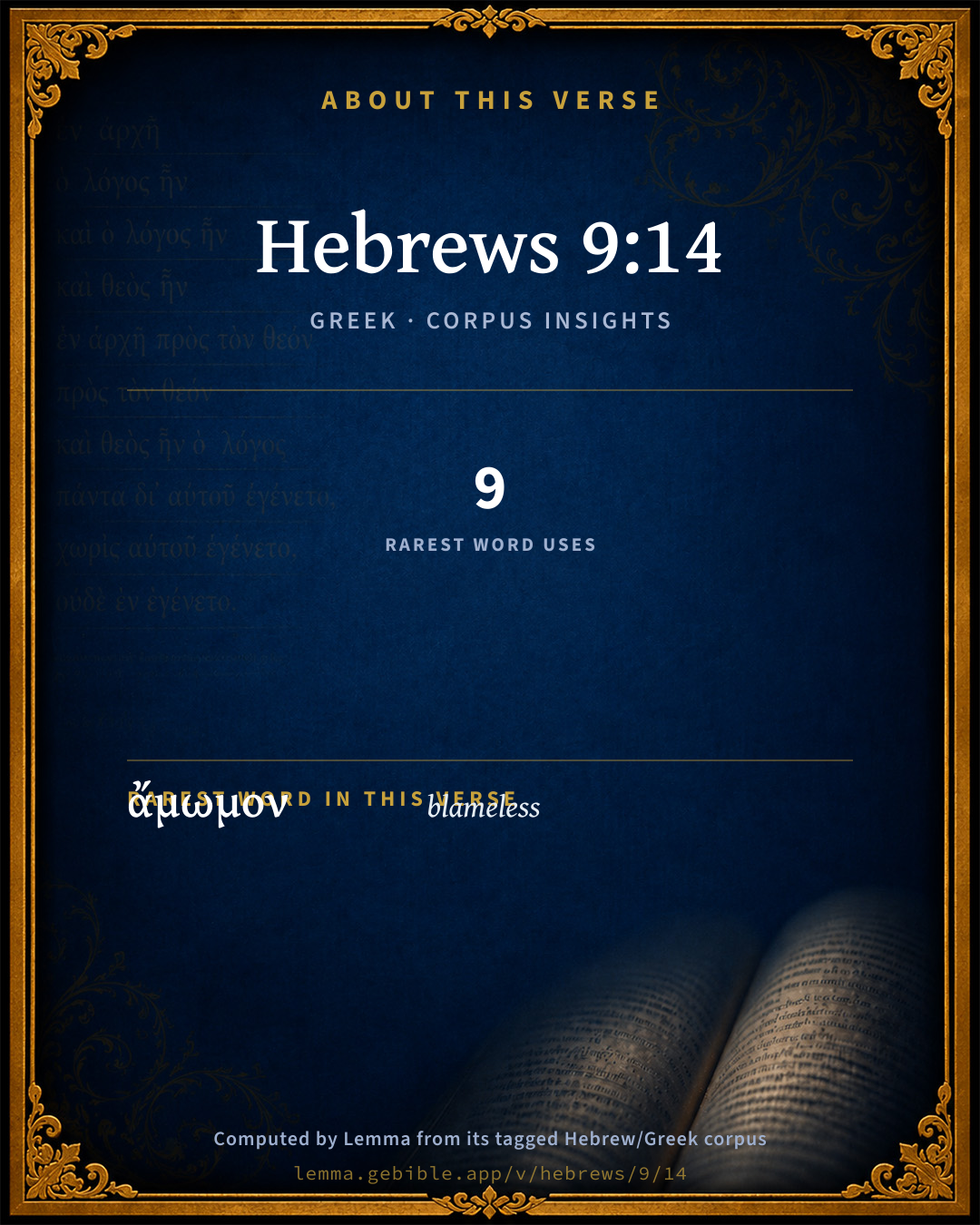
The rarest word here is ἄμωμον blameless G299 — appearing just 9 times in the whole Greek New Testament.

Shared distinctive vocabulary

ἄμωμον blameless G299 occurs in 9 verses of the Greek New Testament. Also found in:

Repetition

Words recur within this verse:

Cross-references

62

Topical passages linked to Hebrews 9:14 in the Treasury of Scripture Knowledge — connected by theme and wording, ordered by reader-vote popularity; previews shown in the World English Bible.

  • Hebrews 10:22 let's draw near with a true heart in fullness of faith, having our hearts sprinkled from an evil conscience, and having our body washed with pure water,
  • 1 Peter 1:19 but with precious blood, as of a lamb without spot, the blood of Christ;
  • 1 John 1:7 But if we walk in the light, as he is in the light, we have fellowship with one another, and the blood of Jesus Christ, his Son, cleanses us from all sin.
  • Hebrews 9:12 nor yet through the blood of goats and calves, but through his own blood, entered in once for all into the Holy Place, having obtained eternal redemption.
  • 1 Peter 2:24 who his own self bore our sins in his body on the tree, that we, having died to sins, might live to righteousness; by whose stripes you were healed.
  • 1 Peter 3:18 Because Christ also suffered for sins once, the righteous for the unrighteous, that he might bring you to God; being put to death in the flesh, but made alive in the spirit;
  • Titus 2:14 who gave himself for us, that he might redeem us from all iniquity, and purify for himself a people for his own possession, zealous for good works.
  • Hebrews 1:3 His Son is the radiance of his glory, the very image of his substance, and upholding all things by the word of his power, when he had by himself made purification for our sins, sat down on the right hand of the Majesty on high;
  • Hebrews 7:27 who doesn't need, like those high priests, to daily offer up sacrifices, first for his own sins, and then for the sins of the people. For this he did once for all, when he offered up himself.
  • 1 Peter 4:2 that you no longer should live the rest of your time in the flesh for the lusts of men, but for the will of God.
  • Revelation 1:5 and from Jesus Christ, the faithful witness, the firstborn of the dead, and the ruler of the kings of the earth. To him who loves us, and washed us from our sins by his blood;
  • Hebrews 6:1 Therefore leaving the doctrine of the first principles of Christ, let us press on to perfection--not laying again a foundation of repentance from dead works, of faith toward God,
  • Romans 6:13 Neither present your members to sin as instruments of unrighteousness, but present yourselves to God, as alive from the dead, and your members as instruments of righteousness to God.
  • 1 John 3:5 You know that he was revealed to take away our sins, and in him is no sin.
  • Jeremiah 10:10 But Yahweh is the true God; he is the living God, and an everlasting King: at his wrath the earth trembles, and the nations are not able to abide his indignation.
  • Romans 6:22 But now, being made free from sin, and having become servants of God, you have your fruit of sanctification, and the result of eternal life.
  • Luke 1:74 To grant to us that we, being delivered out of the hand of our enemies, should serve him without fear,
  • Romans 11:12 Now if their fall is the riches of the world, and their loss the riches of the Gentiles; how much more their fullness?
  • 2 Corinthians 5:21 For him who knew no sin he made to be sin on our behalf; so that in him we might become the righteousness of God.
  • Ephesians 2:5 even when we were dead through our trespasses, made us alive together with Christ (by grace you have been saved),
  • Ephesians 5:2 Walk in love, even as Christ also loved you, and gave himself up for us, an offering and a sacrifice to God for a sweet-smelling fragrance.
  • Hebrews 10:2 Or else wouldn't they have ceased to be offered, because the worshippers, having been once cleansed, would have had no more consciousness of sins?
  • Leviticus 22:20 But whatever has a blemish, that you shall not offer: for it shall not be acceptable for you.
  • Daniel 6:26 I make a decree, that in all the dominion of my kingdom men tremble and fear before the God of Daniel; for he is the living God, and steadfast forever, His kingdom that which shall not be destroyed; and his dominion shall be even to the end.
  • Matthew 20:28 even as the Son of Man came not to be served, but to serve, and to give his life as a ransom for many."
  • Luke 4:18 "The Spirit of the Lord is on me, Because he has anointed me to preach good news to the poor. He has sent me to heal the brokenhearted, To proclaim release to the captives, Recovering of sight to the blind, To deliver those who are crushed,
  • John 3:34 For he whom God has sent speaks the words of God; for God gives the Spirit without measure.
  • Romans 1:20 For the invisible things of him since the creation of the world are clearly seen, being perceived through the things that are made, even his everlasting power and divinity; that they may be without excuse.
  • Romans 11:24 For if you were cut out of that which is by nature a wild olive tree, and were grafted contrary to nature into a good olive tree, how much more will these, which are the natural branches, be grafted into their own olive tree?
  • 2 Corinthians 6:16 What agreement has a temple of God with idols? For you are a temple of the living God. Even as God said, "I will dwell in them, and walk in them; and I will be their God, and they will be my people."
  • Galatians 2:19 For I, through the law, died to the law, that I might live to God.
  • 1 Timothy 1:17 Now to the King eternal, immortal, invisible, to God who alone is wise, be honor and glory forever and ever. Amen.
  • 1 Peter 2:22 who did not sin, "neither was deceit found in his mouth."
  • Deuteronomy 17:1 You shall not sacrifice to Yahweh your God an ox, or a sheep, in which is a blemish, [or] anything evil; for that is an abomination to Yahweh your God.
  • Acts 10:38 even Jesus of Nazareth, how God anointed him with the Holy Spirit and with power, who went about doing good and healing all who were oppressed by the devil, for God was with him.
  • Acts 14:15 "Men, why are you doing these things? We also are men of like passions with you, and bring you good news, that you should turn from these vain things to the living God, who made the sky and the earth and the sea, and all that is in them;
  • Hebrews 9:9 which is a symbol of the present age, where gifts and sacrifices are offered that are incapable, concerning the conscience, of making the worshipper perfect;
  • Hebrews 11:21 By faith, Jacob, when he was dying, blessed each of the sons of Joseph, and worshiped, leaning on the top of his staff.
  • Numbers 19:2–21 This is the statute of the law which Yahweh has commanded, saying, Speak to the children of Israel, that they bring you a red heifer without spot, in which is no blemish, [and] on which never came yoke.
  • Numbers 28:11 In the beginnings of your months you shall offer a burnt offering to Yahweh: two young bulls, and one ram, seven he-lambs a year old without blemish;
  • Deuteronomy 33:27 The eternal God is [your] dwelling-place, Underneath are the everlasting arms. He thrust out the enemy from before you, Said, Destroy.
  • 2 Samuel 4:11 How much more, when wicked men have slain a righteous person in his own house on his bed, shall I not now require his blood of your hand, and take you away from the earth?
  • Daniel 9:24–26 Seventy weeks are decreed on your people and on your holy city, to finish disobedience, and to make an end of sins, and to make reconciliation for iniquity, and to bring in everlasting righteousness, and to seal up vision and prophecy, and to anoint the most holy.
  • Matthew 7:11 If you then, being evil, know how to give good gifts to your children, how much more will your Father who is in heaven give good things to those who ask him!
  • Matthew 12:28 But if I by the Spirit of God cast out demons, then the Kingdom of God has come upon you.
  • Luke 12:24 Consider the ravens: they don't sow, they don't reap, they have no warehouse or barn, and God feeds them. How much more valuable are you than birds!
  • Luke 12:28 But if this is how God clothes the grass in the field, which today exists, and tomorrow is cast into the oven, how much more will he clothe you, O you of little faith?
  • Acts 1:2 until the day in which he was received up, after he had given commandment through the Holy Spirit to the apostles whom he had chosen.
  • 1 Thessalonians 1:9 For they themselves report concerning us what kind of a reception we had from you; and how you turned to God from idols, to serve a living and true God,
  • 1 Timothy 3:15 but if I wait long, that you may know how men ought to behave themselves in the house of God, which is the assembly of the living God, the pillar and ground of the truth.
  • Hebrews 9:7 but into the second the high priest alone, once in the year, not without blood, which he offers for himself, and for the errors of the people.
  • Numbers 28:3 You shall tell them, This is the offering made by fire which you shall offer to Yahweh: he-lambs a year old without blemish, two day by day, for a continual burnt offering.
  • Deuteronomy 15:21 If it have any blemish, [as if it be] lame or blind, any ill blemish whatever, you shall not sacrifice it to Yahweh your God.
  • Isaiah 57:15 For thus says the high and lofty One who inhabits eternity, whose name is Holy: I dwell in the high and holy place, with him also who is of a contrite and humble spirit, to revive the spirit of the humble, and to revive the heart of the contrite.
  • Romans 1:4 who was declared to be the Son of God with power, according to the Spirit of holiness, by the resurrection from the dead, Jesus Christ our Lord,
  • Numbers 28:9 On the Sabbath day two he-lambs a year old without blemish, and two tenth parts [of an ephah] of fine flour for a meal-offering, mixed with oil, and the drink-offering of it:
  • Deuteronomy 5:26 For who is there of all flesh, that has heard the voice of the living God speaking out of the midst of the fire, as we have, and lived?
  • 1 Samuel 17:26 David spoke to the men who stood by him, saying, What shall be done to the man who kills this Philistine, and takes away the reproach from Israel? for who is this uncircumcised Philistine, that he should defy the armies of the living God?
  • 2 Kings 19:16 Incline your ear, Yahweh, and hear; open your eyes, Yahweh, and see; and hear the words of Sennacherib, with which he has sent him to defy the living God.
  • Job 15:16 How much less one who is abominable and corrupt, A man who drinks iniquity like water!
  • Isaiah 42:1 Behold, my servant, whom I uphold; my chosen, in whom my soul delights: I have put my Spirit on him; he will bring forth justice to the Gentiles.
  • Isaiah 53:9 They made his grave with the wicked, and with a rich man in his death; although he had done no violence, neither was any deceit in his mouth.

Cross-references courtesy of OpenBible.info (CC BY 4.0).

Where the printed editions differ

1 variant

Places in this verse where the major printed Greek editions disagree on the wording in a way that affects the translation — a comparison of editions, not a manuscript-by-manuscript collation. The editions are the modern critical texts (Nestlé-Aland 28/27, SBL, Westcott-Hort, Tregelles, Tyndale House) and the traditional texts behind the KJV (the Textus Receptus and the Byzantine/Majority text). It is not a claim about which reading is original.

  1. Different wording
    ἡμῶν

    “of us”

    In NA28NA27SBLWH Not in TynTregTRByz

    ὑμῶν (humōn) 'of you' occurs in traditional manuscripts (Tyn+Treg+TR+Byz) instead of ἡμῶν (hēmōn) 'of us' in older manuscripts (NA28+NA27+SBL+WH)

Textual data: Translators Amalgamated Greek New Testament (STEPBible TAGNT) · CC BY 4.0.

Commentary

Notes on Hebrews 9:14 from classic Christian and Jewish commentators (each source and its license shown beneath its notes). The classic Christian expositions comment on the surrounding passage and are grouped to its opening verse, so a note may address several verses; the Jewish commentaries on the Tanakh (Rashi and others) are per-verse, so they appear only where the commentator wrote on this verse.

Lemma curates 59 commentaries, every one of them public domain or Creative Commons licensed, each selected and text-cleaned for this edition rather than reprinted as found. About our sources →

Tyndale Open Study Notes

Tyndale Open Resources

9:14 how much more: This is an argument from lesser to greater, a traditional Jewish rhetorical strategy; the logic is that if something is true in a lesser situation, it will be even more true in a greater situation (see also 2:1-4; 12:25-29). If the blood of animals had some effect in cleansing, the blood of Christ will be much more effective. • will purify our consciences: Christ’s sacrifice, unlike the sacrifices of the old covenant, removes the paralyzing guilt that keeps us from God by decisively cleansing us from sinful deeds.

Tyndale Open Study Notes — © Tyndale Open Resources, licensed CC BY-SA 4.0. Text via the HelloAO Bible API.

Bengel's Gnomon

Johann Albrecht Bengel

Heb 9:14. Τὸ αἷμα) The blood, and death: see the following verses.—διὰ Πνεύματος αἰωνίου, by the eternal Spirit) See Luk 4:18: and comp. Rom 1:4; Rom 15:16. The Spirit is opposed to the condition of irrational animals, Heb 9:13. The epithet eternal is understood from Heb 9:12; Heb 9:15, ch. Heb 7:16, and is opposed to the heifer reduced to ashes [ashes of a heifer].—ἄμωμον, without spot) Superior as contrasted with every Levitical victim.—καθαριεῖ, shall purge) It corresponds to καθαρότητα, purifying, Heb 9:13. So Heb 9:22-23, ch. Heb 10:23, Heb 1:3. It is put in the future as an antithesis to the present, ἁγιάζει, sanctifies, Levitically, Heb 9:13.—ἀπὸ) ἀπὸ, εἰς, from, to, denote things contrary.—νεκρῶν ἔργων, from dead works) Things dead most of all defile. The antithesis is ζῶντι, living. The power of sin and death was abolished by the blood of Christ.—εἰς τὸ λατρεύειν, to serve) for ever, in a manner most blessed and truly sacerdotal, [Heb 9:12; Rev 22:3.—V. g.]

Bengel's Gnomon of the New Testament — English translation (T&T Clark, Edinburgh, 1860) — public domain. Text from a community e-Sword module.

Meyer's Critical & Exegetical Commentary

Heinrich August Wilhelm Meyer

Heb_9:14.[91] Incomparably more efficacious must the sacrifice of Christ be. For(1) Christ offered Himself, i.e. He gave up His own body to the death of a sacrifice, while the Levitical high priest derives his material of sacrifice from a domain foreign to himself personally; then: He offered Himself from a free resolve of will, while the Levitical high priest is placed under the necessity of sacrificing, by the command of an external ordinance, and the sacrificial victim whose blood he offers is an irrational animal, which consequently knows nothing of the end to which it is applied. The Levitical act of sacrifice is then an external one wrought in accordance with ordinance, a sensuous one; Christs act of sacrifice, on the other hand, one arising out of the disposition of the heart, thus a moral one. From this it is already evident how it could be said (2) that Christ offered Himself διὰ πνεύματος αἰωνίου. The ethical belongs to the province of the spirit. Christ accordingly offered Himself by virtue of spirit, because His act of sacrifice was, in relation to God, an act of the highest spiritual obedience (Php_2:8), in relation to the human brethren an act of the highest spiritual love (2Co_5:14-15). ΔΙᾺ ΠΝΕΎΜΑΤΟς ΑἸΩΝΊΟΥ, however, by virtue of eternal spirit did Christ offer Himself, inasmuch as the notion of the eternal belongs inseparably and essentially to the notion of spirit, in opposition to σάρξ, which has the notion of the transitory as its essential presupposition. The adjective ΑἸΩΝΊΟΥ is added in natural correspondence with ΑἸΩΝΊΑΝ ΛΎΤΡΩΣΙΝ, Heb_9:12. For only by virtue of eternal spirit could a redemption which is to be eternal, or of ever-enduring validity, be accomplished.

The majority have interpreted ΔΙᾺ ΠΝΕΎΜΑΤΟς ΑἸΩΝΊΟΥ of the Holy Spirit; then thinking either, as Clarius, Estius, Whitby, and others, of the third person in the divine trias, or as Bleek, de Wette, and others, of the Spirit of God which dwelt in Christ in all its fulness, and was the principle which animated Him at every moment. But this application is too special. For, in accordance with the force of the words and the connection of the thoughts, there can stand as a tacit antithesis to the expression: διὰ πνεύματος αἰωνίου, only the general formula: ΔΙᾺ ΣΑΡΚῸς ΠΡΟΣΚΑΊΡΟΥ, whereby the mode of accomplishing the Levitical acts of sacrifice would be characterized. Moreover, if the Holy Spirit had been intended, the choice of the adjective ΑἸΩΝΊΟΥ instead of ἉΓΊΟΥ must have appeared strange, because indistinct and liable to being misunderstood; finally, the absence of the article also is best explained on the supposition that the formula is to be understood generically. Too special, likewise, is the explanation of the words adopted by Aretius, Beza, Jac. Cappellus, Gomarus, Calov, Wolf, Peirce, MLean, Bisping, and many others, in part coinciding with the second form of the first main interpretation, according to which, by πνεῦμα αἰώνιον, the divine nature of Christ, or the principle of the eternal Sonship of God indwelling in Christ (Kurtz), is designated. This view already finds its refutation in the fact that πνεῦμα has its opposite in ΣΆΡΞ, and ΠΝΕῦΜΑ and ΣΆΡΞ are contrasted as spirit and body, not as divine and human. To be rejected farther is the procedure of Faustus Socinus, Schlichting, Grotius, Limborch, Carpzov, Riehm (Lehrbegr. des Hebräerbr. p. 525 ff.), Reuss,[92] Kurtz, Woerner, and others, in making the ΠΝΕῦΜΑ ΑἸΏΝΙΟΝ, as regards the thing intended, equivalent to the ΔΎΝΑΜΙς ΖΩῆς ἈΚΑΤΑΛΎΤΟΥ, Heb_7:16, whereby the essentially ethical import of the expression in our passage is lost sight of; entirely false and arbitrary, however, is the interpretation of Döderlein, Storr, and Stuart, who refer πνεῦμα αἰώνιον to Christs state of glorification after His exaltation; of Nösselt (Opusc. ad interpret. sacr. scripturr. fascic. I. ed. 2, p. 334),as also van der Boon Mesch, l.c. p. 100,who espouse the opinion: πνεῦμα esse victimam, quam Christus se immolando Deo obtulit, eamque ΑἸΩΝΊΑΝ dici propterea, quod istius victimae vis ad homines salvandos perpetua atque perennis futura sit; of Michaelis, ad Peirc., who finds the sense, that Christ presented Himself not according to the letter of the Mosaic law, but yet certainly according to its spirit; and of Planck (Commentatt. a Rosenm. etc., edd. I. 1, p. 189), who even maintains that the spirit of prophecy in the prophets of the Old Covenant is thought of. Strangely also Oecumenius, Theophylact, Clarius, and others (comp. already Chrysostom): διὰ πνεύματος αἰωνίου stands in opposition to the fire, by which the Levitical sacrifices were offered to God. Similarly Hofmann (Schriftbew. II. 1, p. 420, 2 Aufl.), who is followed by Delitzsch and Riehm (Lehrbegr. des Hebräerbr. p. 527, Obs.): the spirit by which Christ offered Himself is called an eternal spirit, in opposition to the fleeting spirit of the animals which the O. T. high priest presented. Of a spirit of the animals the author (cf. Heb_4:12) can hardly have thought, inasmuch as, though in the O. T. a πνεῦμα is often ascribed to animals, this is understood only in the lower sense of the ΨΥΧΉ. Needlessly, in the last place, does Reiske conjecture ἉΓΝΕΎΜΑΤΟς instead of ΠΝΕΎΜΑΤΟς.

ΔΙΆ] denotes not the mere impulse or impelling motive (Vatablus, Ribera, Estius, al.), nor yet the condition or sphere (Stengel, Tholuck, al.), but the higher power, by virtue of which the offering was accomplished and made effective.

ἑαυτὸν προσήνεγκεν] is understood by Bleek, with whom Kurtz concurs, after the precedent of Faustus Socinus, Schlichting, Grotius, Limborch, and others, in the sense that Christ offered to God, in the heavenly Holy of Holies, His blood which was shed upon earth; which, however, is violent on account of διὰ πνεύματος αἰωνίου, since these words appertain to the whole relative clause, and are not to be referred, with Bleek, as a nearer definition merely to ἌΜΩΜΟΝ. The undergoing upon earth of the death of the cross is that which is meant.

ἌΜΩΜΟΝ] as a spotless sacrifice, yielding full satisfaction to God. The Levitical victim must be ἄμωμος (תָּמִים), physically free from blemish. Here ἌΜΩΜΟς is used of the higher, ethical spotlessness, and has reference to the sinlessness of character manifested by Christ during His earthly life. Erroneously Bleek: the expression has respect to the condition of Christ after death and the resurrection, in which, raised above even the infirmities to which as very man He was subject upon earth, He could in particular no more fall a victim to death.

Τῷ ΘΕῷ] is to be taken along with the whole relative clause, not merely with ἌΜΩΜΟΝ.

ἈΠῸ ΝΕΚΡῶΝ ἜΡΓΩΝ] forth from dead (legal) works, so that we free ourselves from them as from something that is unfruitful and useless, rise above them. The notion of the ΝΕΚΡᾺ ἜΡΓΑ here the same as at Heb_6:1.

[91] A. L. van der Boon Mesch, Specimen Hermeneuticum in locum ad Hebr. ix. 14, Lugd. Bat. 1819, 8vo.

[92] Lauteur a voulu dire ici, par une tournure nouvelle, justement ce quil a déjà dit deux fois en dautres termes (Heb_7:16; Heb_7:25). La nature de Christ lui assure une vie éternelle, non sujette à la mort et par cela même seule capable de nous assurer un bienfait durable et éternel aussi.

Meyer — Critical and Exegetical Commentary on the New Testament — English translation by Peter Christie, edited by Frederick Crombie (T&T Clark, 1880) — public domain. Text from a community e-Sword module.

Expositor's Greek Testament

ed. W. Robertson Nicoll

Heb 9:14 . πόσῳ μᾶλλον τὸ αἷμα τοῦ Χριστοῦ .… The Levitical sacrifices had their congruous effect, the sacrifice of Christ must also have its appropriate result. The blood offered was not of bulls and goats but of “the Christ;” it was not with another’s blood (vicarious, Heb 9:25 ) but with His own He entered God’s presence. His was not a bodily sacrifice but διὰ πνεύματος αἰωνίου . ὃς δς διὰ πνεύματος αἰωνίου … Θεῷ . This clause is inserted to justify the efficacy of the blood of Christ in cleansing the conscience. It had virtue to cleanse the conscience because it was the blood of one “who through eternal spirit offered Himself blameless to God”. How are we to understand διὰ πν . αἰωνίου ? Riehm considers it a parellel expression to that of Heb 7:16 , κατὰ δύναμιν ζωῆς ἀκαταλύτου , and that it is here used to bring out the idea that Christ having an eternal spirit was thereby able to perform the whole work of atonement, not merely dying on the cross but passing through that death to present Himself before God. So too Davidson, Weiss and others. This involves that προσήνεγκεν refers not to the cross but to the appearance before God, subsequently to the death. And it does not account for the absence of the article. It seems more relevant to the passage and more consistent with the purpose of the clause (to show the ground of the efficacy of the blood of Christ) to understand the words as expressing the spiritual nature of the sacrifice which gave it eternal validity. It had superior efficacy to the blood of bulls and goats because it was not of the flesh merely, but was expressive of the spirit. It is the spirit prompting the sacrifice and giving it efficacy, which the writer seeks to indicate. Over against the “ordinances of the flesh” which made the slaughter of animals compulsory and a mere matter of letting material blood, he sets this wholly different sacrifice which was prompted and inspired by spirit and belonged wholly to the sphere of spiritual and eternal things. [ Spiritus opponitur conditioni animantum ratione carentium (Heb 9:13 , Bengel); “bezeichnet das Lebensprinzip, in dessen Kraft, von dem beseelt und angetrieben Christus sich opferte” (Kübel)]. It was the spirit underlying and expressed in the sacrifice which gave it all its potency. Spirit is eternal and can alone be efficacious in eternal things. ἑαυτὸν . The Levitical High Priest, as stated in Heb 9:25 , entered the holy place ἐν ἅματι ἀλλοτρίῳ , but Christ διὰ τοῦ ἰδίου αἵματος . Also goats and calves were of no great value, but what Christ offered was of infinite value. Two points are brought out by ἑαυτόν . (1) He offered not a vicarious victim; but, as Priest, offered the only true sacrifice, Himself. Therefore His blood had cleansing efficacy. (2) He offered not a cheap animal, but the most precious of sacrifices. προσήνεγκεν , i.e. , on the cross; for the clause is an explanation of the value of the blood. Cf. Heb 9:28 . ἄμωμον without blemish, perfect, as required in the Levitical sacrifices, but now with an ethical significance, and therefore possessing an ethical validity. This explains how the blood of Christ should not merely furnish ceremonial cleanness but καθαριεῖ τὴν συνείδησιν ὑμῶν ἀπὸ νεκρῶν ἔργων , a characterisation of sins suggested by the context. Works that defile; as the touching of a dead body defiled the worshipper. Works from which a man must be cleansed before he can enter God’s presence. A pause might be made before ἔργων , from dead (not bodies but) works. [ καθαρίζω , Hellenistic; see Anz. Subsidia , 374. In class. καθαίρω is used, as in Herod. i, 44, τὸν αὐτὸς φόνου ἐκάθῃρε , and Æsch. Choeph . 72.] This cleansing is preparatory to the worship of the living God εἰς τὸ λατρεύειν θεῷ ζῶντι . The living God, who is all life, can suffer no taint of death in His worshippers. Death moral and physical cannot exist in His presence. λατρεύειν , “ad serviendum, in perpetuum, modo beatissimo et vere sacerdotali” (Bengel).

The Expositor's Greek Testament, edited by W. Robertson Nicoll (1897–1910) — public domain. Text from a community e-Sword module.

Geneva Bible (1599)

Geneva Bible translators

From sins which proceed from death, and bring forth nothing but death.

Geneva Bible (1599) marginal notes — public domain. Text via Bolls.life.

Jamieson, Fausset & Brown

Robert Jamieson, A. R. Fausset & David Brown

offered himself--The voluntary nature of the offering gives it especial efficacy. He "through the eternal Spirit," that is, His divine Spirit (Rom 1:4, in contrast to His "flesh," Heb 9:3; His Godhead, Ti1 3:16; Pe1 3:18), "His inner personality" [ALFORD], which gave a free consent to the act, offered Himself. The animals offered had no spirit or will to consent in the act of sacrifice; they were offered according to the law; they had a life neither enduring, nor of any intrinsic efficacy. But He from eternity, with His divine and everlasting Spirit, concurred with the Father's will of redemption by Him. His offering began on the altar of the cross, and was completed in His entering the holiest place with His blood. The eternity and infinitude of His divine Spirit (compare Heb 7:16) gives eternal ("eternal redemption," Heb 9:12, also compare Heb 9:15) and infinite merit to His offering, so that not even the infinite justice of God has any exception to take against it. It was "through His most burning love, flowing from His eternal Spirit," that He offered Himself [OECOLAMPADIUS].

without spot--The animal victims had to be without outward blemish; Christ on the cross was a victim inwardly and essentially stainless (Pe1 1:19).

purge--purify from fear, guilt, alienation from Him, and selfishness, the source of dead works (Heb 9:22-23).

your--The oldest manuscripts read "our." The Vulgate, however, supports English Version reading.

conscience--moral religious consciousness.

dead works--All works done in the natural state, which is a state of sin, are dead; for they come not from living faith in, and love to, "the living God" (Heb 11:6). As contact with a dead body defiled ceremonially (compare the allusion, "ashes of an heifer," Heb 9:13), so dead works defile the inner consciousness spiritually.

to serve--so as to serve. The ceremonially unclean could not serve God in the outward communion of His people; so the unrenewed cannot serve God in spiritual communion. Man's works before justification, however lifelike they look, are dead, and cannot therefore be accepted before the living God. To have offered a dead animal to God would have been an insult (compare Mal 1:8); much more for a man not justified by Christ's blood to offer dead works. But those purified by Christ's blood in living faith do serve (Rom 12:1), and shall more fully serve God (Rev 22:3).

living God--therefore requiring living spiritual service (Joh 4:24).

Jamieson, Fausset & Brown — Commentary Critical and Explanatory on the Whole Bible (1871) — public domain (CC PDM 1.0). Text via the HelloAO Bible API.

Adam Clarke's Commentary

Verse 14. Who through the eternal Spirit] This expression is understood two ways:

1. Of the Holy Ghost himself. As Christ's miraculous conception was by the Holy Spirit, and he wrought all his miracles by the Spirit of God, so his death or final offering was made through or by the eternal Spirit; and by that Spirit he was raised from the dead, 1Pe 3:18. Indeed, through the whole of his life be was justified by the Spirit; and we find that in this great work of human redemption, the Father, the Son, and the Holy Spirit were continually employed: therefore the words may be understood of the Holy Spirit properly.

2. Of the eternal Logos or Deity which dwelt in the man Christ Jesus, through the energy of which the offering of his humanity became an infinitely meritorious victim; therefore the Deity of Christ is here intended.

But we cannot well consider one of these distinct from the other; and hence probably arose the various readings in the MSS. and versions on this article. Instead of διαπνευματος αιωνιου, by the ETERNAL Spirit, διαπνευματοςαγιου, by the HOLY Spirit, is the reading of D*, and more than twenty others of good note, besides the Coptic, Slavonic, Vulgate, two copies of the Itala, Cyril, Athanasius sometimes, Damascenus, Chrysostom, and some others. But the common reading is supported by ABD**, and others, besides the Syriac, all the Arabic, Armenian, AEthiopic, Athanasius generally, Theodoret, Theophylact, and Ambrosius. This, therefore, is the reading that should he preferred, as it is probable that the Holy Ghost, not the Logos, is what the apostle had more immediately in view. But still we must say, that the Holy Spirit, with the eternal Logos, and the almighty Father, equally concurred in offering up the sacrifice of the human nature of Christ, in order to make atonement for the sin of the world.

Purge your conscience] καθαριει την συνειδησιν. Purify your conscience. The term purify should be everywhere, both in the translation of the Scriptures, and in preaching the Gospel, preferred to the word purge, which, at present, is scarcely ever used in the sense in which our translators have employed it.

Dead works] Sin in general, or acts to which the penalty of death is annexed by the law. See the phrase explained, "Heb 6:1".

Adam Clarke's Commentary on the Bible (1810–1826) — public domain. Text from a community e-Sword/MySword module.

John Calvin's Commentaries

14. Who through the eternal Spirit, etc. He now clearly shows how Christ’s death is to be estimated, not by the external act, but by the power of the Spirit. For Christ suffered as man; but that death becomes saving to us through the efficacious power of the Spirit; for a sacrifice, which was to be an eternal expiation, was a work more than human. And he calls the Spirit eternal for this reason, that we may know that the reconciliation, of which he is the worker or effecter, is eternal. By saying, without spot, or unblamable, though he alludes to the victims under the Law, which were not to have a blemish or defect, he yet means, that Christ alone was the lawful victim and capable of appeasing God; for there was always in others something that might be justly deemed wanting; and hence he said before that the covenant of the Law was not ἀμεμπτον, blameless.

From dead works, etc. Understand by these either such works as produce death, or such as are the fruits or effects of death; for as the life of the soul is our union with God, so they who are alienated from him through sin may be justly deemed to be dead.

To serve the living God. This, we must observe, is the end of our purgation; for we are not washed by Christ, that we may plunge ourselves again into new filth, but that our purity may serve to glorify God. Besides, he teaches us, that nothing can proceed from us that can be pleasing to God until we are purified by the blood of Christ; for as we are all enemies to God before our reconciliation, so he regards as abominable all our works; hence the beginning of acceptable service is reconciliation. And then, as no work is so pure and so free from stains, that it can of itself please God, it is necessary that the purgation through the blood of Christ should intervene, which alone can efface all stains. And there is a striking contrast between the living God and dead works.

John Calvin's Commentaries (1540-1563) — public domain. Text from the Calvin Translation Society English edition (1840s-50s) via the Christian Classics Ethereal Library (ccel.org). Calvin's coverage is partial (roughly two-thirds of the Bible); uncommented books and verses are honest gaps, never fabricated. The 19th-century editor's footnotes and remarks are omitted so the notes are faithfully Calvin's own voice.

Ellicott's Commentary for English Readers

(14) Through the eternal Spirit.—Better, through an eternal Spirit; for in a passage of so much difficulty it is important to preserve the exact rendering of the Greek, and the arguments usually adduced seem insufficient to justify the ordinary translation. By most readers of the Authorised version, probably, these words are understood as referring to the Holy Spirit, whose influence continually rested on “the Anointed One of God” (Act_10:38). For this opinion there seems to be no foundation in the usage of the New Testament, and it is not indicated by anything in the context. The explanation of the words must rather be sought in the nature of our Lord, or in some attribute of that nature. There are a few passages, mainly in the Epistles of St. Paul, in which language somewhat similar is employed in regard to the spirit (pneuma) of our Lord. The most remarkable of these are Rom_1:4, where “spirit of holiness” is placed in contrast with “flesh;” and 1Ti_3:16, “in spirit.” On the latter Bishop Ellicott writes: “in spirit, in the higher sphere of His divine life: the pneuma of Christ is not here the Holy Spirit, but the higher principle of spiritual life, which was not the Divinity (this would be an Apollinarian assertion), but especially and intimately united with it.” (Another passage of great interest is 1Pe_3:18.) The attribute “eternal” is explained by Heb_7:18-19, “according to power of indissoluble life (He hath become priest), for of Him it is testified, Thou art a priest for ever.” Through this spirit, a spirit of holiness, a spirit of indissoluble life, He offered Himself to God. This made such a self-offering possible; this gave to the offering infinite worth. In the words which stand in contrast with these (Heb_9:13) we read of the death of animals which had no power over their own transient life: He who was typified in every high priest and in every victim, “through an eternal spirit,” of Himself laid down His life (Joh_10:18), offering Himself to God in the moment and article of death,—offered Himself in His constant presence in the Holiest Place (Heb_9:24).

Without spot.—The word here used is frequently applied in the LXX. to the victims “without blemish” that were offered in sacrifice. The sinlessness of Jesus is expressed under the same metaphor in 1Pe_1:19.

Purge your conscience from dead works to serve the living God.—Better, cleanse our conscience from dead works to serve a Living God. The word “cleanse” is akin to “cleanness” in Heb_9:13. Authorities are divided between “our” and “your”; but the former is probably the better reading. Once before, in Heb_6:1, the writer has spoken of “dead works.” (See the Note.) It is here, however, that the significance most fully appears; for we cannot doubt that there exists a reference to the purification made necessary by all contact with death. (See Heb_9:13.) Since the works are dead because they had no share in true life, which is the life of God, the last words bring before us the thought of a Living God (Heb_3:12). This thought also stands connected with “eternal Spirit,” for those who are cleansed through the offering of Christ shall share His relation to the Living God. The contrast is in every respect complete. From the whole number of Jewish rites had been selected (Heb_9:13) the two which most fully represented the purification from sin and from pollution through death, in order that this completeness of antithesis might be attained. It is not necessary to trace the details of the contrast. In each and in all we read the “How much more!”

A Bible Commentary for English Readers, edited by Charles John Ellicott (1878–1897) — public domain. Text from a community e-Sword module.

The Cambridge Bible for Schools and Colleges

gen. ed. J. J. S. Perowne

14. how much more] Again we have the characteristic word—the key-note as it were—of the Epistle.

the blood of Christ] which is typified by “the fountain opened for sin and for uncleanness” (Zec_13:1).

who through the eternal Spirit] If this be the right rendering the reference must be to the fact that Christ was “quickened by the Spirit” (1Pe_3:18); that “God gave not the Spirit by measure unto Him” (Joh_3:34); that “the Spirit of the Lord was upon Him” (Luk_4:18); that He “by the Spirit of God” cast out devils (Mat_12:28). For this view of the meaning see Pearson on the Creed, Art. iii., and it is represented by the reading “Holy” for Eternal in some cursive mss. and some versions. It may however be rendered “by an Eternal Spirit,” namely by His own Spirit—by that burning love which proceeded from His own Spirit—and not by a mere “ordinance of the flesh” (Heb_9:10). In the Levitic sacrifices involuntary victims bled; but Christ’s sacrifice was offered by the will of His own Eternal Spirit.

without spot] Christ had that sinless perfection which was dimly foreshadowed by the unblemished victims which could alone be offered under the Levitic law (1Pe_1:19).

from dead works] See Heb_6:1. If sinful works are meant, they are represented as affixing a stain to the conscience; they pollute as the touching of a dead thing polluted ceremonially under the Old Law (Num_19:11-16). But all works are “dead” which are done without love. It is to be observed that the writer—true to the Alexandrian training which instilled an awful reverence respecting Divine things—attempts even less than St Paul to explain the modus operandi. He tells us that the Blood of Christ redeems and purifies us as the old sacrifices could not do. Sacrifices removed ceremonial defilement—they thus “purified the flesh:” but the Blood of Christ perfects and purifies the conscience (Heb_10:22) and so admits us into the Presence of God. The “how can this be?” belongs to the secret things which God has not revealed; we only know and believe that so it is.

to serve the living God] Not to serve “dead works” or a mere material tabernacle, or fleshly ordinances, but to serve the Living God who can only be truly served by those who are “alive from the dead” (Rom_6:13).

The Cambridge Bible for Schools and Colleges (gen. ed. J. J. S. Perowne; Cambridge University Press, 1878–1918) — public domain. Text from a community e-Sword module.

John Gill's Exposition

How much more shall the blood of Christ,.... Which is not the blood of a mere man, but the blood of the Son of God; and the argument is from the lesser to the greater; that if the ashes of the burnt heifer, which was a type of Christ in his sufferings, mixed with water, typically sanctified to the purifying of men externally, in a ceremonial way, then much more virtue must there be in the blood of Christ, to cleanse the soul inwardly:

who through the eternal Spirit offered himself without spot to God; Christ is a priest, and the sacrifice he has offend up is "himself"; not his divine nature, but his human nature, soul and body, as in union with his divine person; which gives his sacrifice the preference to all others; and is the reason of its virtue and efficacy, and is expressive of his great love to man: and this sacrifice was offered up "to God", against whom his people had sinned, and whose justice must be satisfied, and which is of a sweet smelling savour to him; besides, he called him to this work, and engaged him in it, and is well pleased with this offering, as he must needs be, since it is offered up "without spot"; which expresses the purity of Christ's nature and sacrifice, and the perfection of it, which is such, that no fault can be found in it by the justice of God; and hence, the saints, for whom it is offered, are unblamable and irreprovable, There is an allusion in the clause, both to the priests and to their sacrifices, which were neither of them to have any spot or blemish on them; and this unblemished sacrifice was offered unto God by Christ,

through the eternal Spirit; not the human soul of Christ; for though that is a spirit, yet not eternal, and besides, was a part of the sacrifice; but rather the divine nature of Christ, which is a spirit, and may be so called in distinction from the flesh, or human nature, as it sometimes is, and this is eternal; it was from everlasting, as well as is to everlasting; and this supported him under all his sufferings, and carried him through them, and put virtue unto them; and Christ was a priest, in the divine, as well as human nature: though by it may be better understood "the Holy Ghost"; and so the Vulgate Latin version reads, and also several copies; since the divine nature rather acts by the human nature, than the human nature by the divine; and Christ is often said to do such and such things by the Holy Spirit; and as the Holy Ghost formed and filled the human nature of Christ, so he assisted and supported it under sufferings. This whole clause is inserted by way of parenthesis, showing the efficacy of Christ's blood, and from whence it is:

to purge your conscience from dead works; that is, "from the works of sin", as the Ethiopic version renders it; which are performed by dead men, separate and alienated from the life of God, are the cause of the death of the soul, and expose to eternal death, and are like dead carcasses, nauseous and infectious; and even duties themselves, performed without faith and love, are dead works; nor can they procure life, and being depended on, issue in death; and even the works of believers themselves are sometimes performed in a very lifeless manner, and are attended with sin and pollution, and need purging: the allusion is to the pollution by the touch of dead bodies; and there may be some respect to the sacrifices of slain beasts, after the sacrifice and death of Christ, by believing Jews, who were sticklers for the ceremonies of the law, and thereby contracted guilt; but immoralities are chiefly designed, and with these the conscience of man is defiled; and nothing short of the blood of Christ can remove the pollution of sin; as that being shed procures atonement, and so purges away the guilt of sin, or makes reconciliation for it, so being sprinkled on the conscience by the Spirit of God, it speaks peace and pardon, and pacifies and purges it, and removes every incumbrance from it: the Alexandrian copy, the Vulgate Latin, and Syriac versions, read, "our conscience". The end and use of such purgation is, "to serve the living God"; so called to distinguish him from the idols of the Gentiles, and in opposition to dead works; and because he has life in himself, essentially and independently, and is the author and giver of life to others; and it is but the reasonable service of his people, to present their souls and bodies as a living sacrifice to him; and who ought to serve him in a lively manner, in faith, and with fervency, and not with a slavish, but a godly filial fear; and one that has his conscience purged by the blood of Christ, and is sensibly impressed with a discovery of pardoning grace, is in the best capacity for such service. The Alexandrian copy reads, "the living and true God".

John Gill's Exposition of the Whole Bible (1746–1763) — public domain (CC PDM 1.0). Text via the HelloAO Bible API.

Trapp's Complete Commentary

John Trapp

14 How much more shall the blood of Christ, who through the eternal Spirit offered himself without spot to God, purge your conscience from dead works to serve the living God?

Ver. 14. By the eternal Spirit] That is, by his Deity, called the Spirit of holiness, Rom 1:4, and the Spirit, 1Ti 3:16, that gave both value and virtue to his death, both to satisfy and to sanctify.

Purge your conscience] This is that eternal redemption, Heb 9:12.

From dead works] The most specious performances of unregenerate persons are but dead works, because they proceed not from a principle of life, and have death for their wages, Rom 6:23. A will written with a dead man’s hand can hold no law. God will be served like himself.

John Trapp, A Commentary or Exposition upon All the Books of the Old and New Testament (1647–1656) — public domain. Text from a community e-Sword module.

Albert Barnes' Notes on the Bible

How much more shall the blood of Christ - As being infinitely more precious than the blood of an animal could possibly be. If the blood of an animal had any efficacy at all, even in removing ceremonial pollutions, how much more is it reasonable to suppose may be effected by the blood of the Son of God!

Who through the eternal Spirit - This expression is very difficult, and has given rise to a great variety of interpretation. - Some mss. instead of “eternal” here, read “holy,” making it refer directly to the Holy Spirit; see “Wetstein.” These various readings, however, are not regarded as of sufficient authority to lead to a change in the text, and are of importance only as showing that it was an early opinion that the Holy Spirit is here referred to. The principal opinions which have been entertained of the meaning of this phrase, are the following.

(1) That which regards it as referring to the Holy Spirit, the third person of the Trinity. This was the opinion of Owen, Doddridge, and archbishop Tillotson.

(2) That which refers it to the “divine nature” of Christ. Among those who have maintained this opinion, are Beza, Ernesti, Wolf, Vitringa, Storr, and the late Dr. John P. Wilson. mss. Notes.

(3) Others, as Grotius, Rosenmuller, Koppe, understand it as meaning “endless” or “immortal life,” in contradistinction from the Jewish sacrifices which were of a perishable nature, and which needed so often to be repeated.

(4) Others regard it as referring to the glorified person of the Saviour, meaning that in his exalted, or spiritual station in heaven, he presents the efficacy of his blood.

(5) Others suppose that it means “divine influence,” and that the idea is, that Christ was actuated and filled with a divine influence when he offered up himself as a sacrifice; an influence which was not of a temporal and fleeting nature, but which was eternal in its efficacy. This is the interpretation preferred by Prof. Stuart.

For an examination of these various opinions, see his “Excursus, xviii.” on this Epistle. It is difficult, if not impossible, to decide what is the true meaning of the passage amidst this diversity of opinion; but there are some reasons which seem to me to make it probable that the Holy Spirit is intended, and that the idea is, that Christ made his great sacrifice under “the extraordinary influences of that Eternal Spirit.” The reasons which lead me to this opinion, are the following:

It is what would occur to the great mass of the readers of the New Testament. It is presumed that the great body of sober, plain, and intelligent readers of the Bible, on perusing the passage, suppose that it refers to the Holy Spirit, the third person of the Trinity. There are few better and safer rules for the interpretation of a volume designed like the Bible for the mass of mankind, than to abide by the sense in which they understand it.

(2)This interpretation is one which is most naturally conveyed by the language of the original. The phrase “the spirit” - τὸ πνέυμα to pneuma - has so far a technical and established meaning in the New Testament as to denote the Holy Spirit, unless there is something in the connection which renders such an application improper. In this case there is nothing certainly which “necessarily” forbids such an application. The high names and Classical authority of those who have held this opinion, are a sufficient guarantee of this.

(3)This interpretation accords with the fact that the Lord Jesus is represented as having been eminently endowed with the influences of the Holy Spirit; compare notes on Joh 3:34. Though he was divine, yet he was also a man, and as such was under influences similar to those of other pious people. The Holy Spirit is the source and sustainer of all piety in the soul, and it is not improper to suppose that the man Christ Jesus was in a remarkable manner influenced by the Holy Spirit in his readiness to obey God and to suffer according to his will.

(4)If there was ever any occasion on which we may suppose he was influenced by the Holy Spirit, that of his sufferings and death here referred to may be supposed eminently to have been such an one. It was expressive of the highest state of piety - of the purest love to God and man - which has ever existed in the human bosom; it was the most trying time of his own life; it was the period when there would be the most strong temptation to abandon his work; and as the redemption of the whole world was dependent on that act, it is reasonable to suppose that the richest heavenly grace would be there imparted to him, and that he would then be eminently under the influence of that Spirit which was granted not “by measure unto him.” notes, Joh 3:34.

(5)This representation is not inconsistent with the belief that the sufferings and death of the Redeemer were “voluntary,” and had all the merit which belongs to a voluntary transaction. Piety in the heart of a Christian now is not less voluntary because it is produced and cherished by the Holy Spirit, nor is there less excellence in it because the Holy Spirit imparts strong faith in the time of temptation and trial. It seems to me, therefore, that the meaning of this expression is, that the Lord Jesus was led by the strong influences of the Spirit of God to devote himself as a sacrifice for sin. It was not by any temporary influence; not by mere excitement; it was by the influence of the “Eternal” Spirit of God, and the sacrifice thus offered could, therefore, accomplish effects which would be eternal in their character. It was not like the offering made by the Jewish high priest which was necessarily renewed every year, but it was under the influence of one who was “eternal,” and the effects of whose influence might be everlasting. It may be added, that if this is a correct exposition, it follows that the Holy Spirit is eternal, and must, therefore, be divine.

Offered himself - That is, as a sacrifice. He did not offer a bullock or a goat, but he offered “himself.” The sacrifice of oneself is the highest offering which he can make; in this case it was the highest which the universe had to make.

Without spot - Margin, “Or fault.” The animal that was offered in the Jewish sacrifices was to be without blemish; see Lev 1:10; Lev 22:17-22. It was not to be lame, or blind, or diseased. The word which is used here and rendered “without spot” ἄμωμος amōmos - refers to this fact - that there was no defect or blemish. The idea is, that the Lord Jesus, the great sacrifice, was “perfect;” see Heb 7:26.

Purge your conscience - That is, cleanse, purify, or sanctify your conscience. The idea is, that this offering would take away whatever rendered the conscience defiled or sinful. The offerings of the Jews related in the main to external purification, and were not adapted to give peace to a troubled conscience. They could render the worshipper externally pure so that he might draw near to God and not be excluded by any ceremonial pollution or defilement; but the mind, the heart, the conscience, they could not make pure. They could not remove what troubles a man when he recollects that he has violated a holy law and has offended God, and when he looks forward to an awful judgment-bar. The word “conscience” here is not to be understood as a distinct and independent faculty of the soul, but as the soul or mind itself reflecting and pronouncing on its own acts. The whole expression refers to a mind alarmed by the recollection of guilt - for it is guilt only that disturbs a man’s conscience.

Guilt originates in the soul remorse and despair; guilt makes a man troubled when he thinks of death and the judgment; it is guilt only which alarms a man when he thinks of a holy God; and it is nothing but guilt that makes the entrance into another world terrible and awful. If a man had no guilt he would never dread his Maker, nor would the presence of his God be ever painful to him (compare Gen 3:6-10); if a man had no guilt he would not fear to die - for what have the innocent to fear anywhere? The universe is under the government of a God of goodness and truth, and, under such a government, how can those who have done no wrong have anything to dread? The fear of death, the apprehension of the judgment to come, and “the dread of God,” are strong and irrefragable proofs that every man is a sinner. The only thing, therefore, which ever disturbs the conscience, and makes death dreadful, and God an object of aversion, and eternity awful, is guilt. If that is removed, man is calm and peaceful; if not, he is the victim of wretchedness and despair.

From dead works - From works that are deadly in their nature, or that lead to death. Or it may mean from works that have no spirituality and no life. By “works” here the apostle does not refer to their outward religious acts particularly, but to the conduct of the life, to what people do; and the idea is, that their acts are not spiritual and saving but such as lead to death; see note, Heb 6:1.

To serve the living God - Not in outward form, but in sincerity and in truth; to be his true friends and worshippers. The phrase “the living God” is commonly used in the Scriptures to describe the true God as distinguished from idols, which are represented as “dead,” or without life; Psa 115:4-7. The idea in this verse is, that it is only the sacrifice made by Christ which can remove the stain of guilt from the soul. It could not be done by the blood of bulls and of goats - for that did not furnish relief to a guilty conscience, but it could be done by the blood of Christ. The sacrifice which he made for sin was so pure and of such value, that God can consistently pardon the offender and restore him to his favor. That blood too can give peace - for Christ poured it out in behalf of the guilty. It is not that he took part with the sinner against God; it is not that he endeavors to convince him who has a troubled conscience that he is needlessly alarmed, or that sin is not as bad as it is represented to be, or that it does not expose the soul to danger. Christ never took the part of the sinner against God; he never taught that sin was a small matter, or that it did not expose to danger. He admitted all that is said of its evil. But he provides for giving peace to the guilty conscience by shedding his blood that it may be forgiven, and by revealing a God of mercy who is willing to receive the offender into favor, and to treat him as though he had never sinned. Thus, the troubled conscience may find peace; and thus, though guilty, man may be delivered from the dread of the wrath to come.

Albert Barnes' Notes on the Bible (1834–1885) — public domain. Text from a community e-Sword/MySword module.

Matthew Poole's English Annotations

How much more shall the blood of Christ? The question supposeth an unexpressible difference between Christ’s purifying and the legal sacrifices. The blood with which he pierced within the veil to the throne in the highest heavens, on which sat the just God, the proper, precious, powerful blood of God the Son incarnate.

Who through the eternal Spirit; who in his immortal soul obeying all God’s will in suffering, did, through his own eternal God-head, to which both body and soul were united, and which sanctified the body offered, as the altar the sacrifice, Mat 23:19, which is called the spirit of holiness, Rom 1:4, and gave value and virtue to the sacrifice, offered up his body a sacrifice for sin, when he died on the cross. Not sheep, bulls, goats, turtles, pigeons, &c., not man, nor the life of angels, were his sacrifice; but himself, pure, holy, and unpolluted, an innocent, harmless person, 2Co 5:21. How much beyond his types for innocency and purity! Lev 22:20,21; Num 19:2.

Offered himself without spot to God: the offended, injured Creator and Judge of sinners, who constituted him to this whole work; and was by this most perfect sacrifice propitiated; his justice was satisfied, his law obeyed, and himself set fully free to pardon and forgive sinners without injustice; and to be just, as well as gracious and merciful, in doing of it, Rom 3:25,26; and they might be put in possession of his favour, presence, and person again, as their own God, 1Pe 3:18.

Purge your conscience; though the sacrifice be over, the virtue and excellent causality of it doth abide, purging now as ever, not only justifying and absolving of a penitent believing sinner, but purifying and sanctifying the soul, procuring the Holy Spirit to renew it, and take away inherent corruption and infuse holiness into it, Eph 4:24, and making willing in the beauties of it, Psa 110:3; 1Co 6:11; Tit 3:5,6; making body, soul, and spirit one frame of holiness to God, 1Th 5:23. So as the most quick, lively, and sensible part of the immortal soul, conscious of sin, is freed from the guilt, filth, and fears of sin that did cleave to it; this thus purged, no consciousness of guilt remains, nor fear of punishment, but it is filled, from the interest it hath in this blood, and the work on it of this Spirit, full of joy and peace and righteousness by believing, Rom 5:1,2,5,11.

From dead works; all operations of sin, which come from spiritually dead souls, and work eternal death, Eph 2:1, of which they are as insensible as dead men; all sorts of sin which do taint, pollute, and defile the soul, much more contagious, pestilent, and polluting the soul, than any of those things forbidden to be touched by Moses’s law could the flesh, Num 19:18; they are as offensive to God, and more, than carcasses are to us, and pestilential things, though themselves keeping souls from any communion with him.

To serve the living God; as under the law there was no coming to the congregation of the tabernacle without legal purifying, Num 19:13,20; so by this purifying correspondent to the type, souls are quickened, have boldness and confidence God-ward in point of duty, present themselves living sacrifices, Rom 12:1, aim at him through their whole life; that he delights to keep up communion with them proportioned to himself, till he fit them for their complete serving and enjoying of him in the holy of holiest in heaven.

Matthew Poole's English Annotations on the Holy Bible (1683–1685) — public domain. Text from a community e-Sword/MySword module.

Whedon's Commentary on the Bible

Daniel D. Whedon

14. Through the eternal Spirit—Lunemann enumerates some eight different interpretations of this unusual phrase. A large majority of commentators understand it to mean either the divine second person of the Trinity in Jesus incarnated, or the third person, the Holy Spirit, indwelling and inspiring him. For this last Stuart assigns the following texts:

Mat_4:1; Mar_1:12; Luk_4:1; Mat_12:28; Luk_4:18; Mat_3:16; Mat_3:11; Luk_3:22; Joh_1:32-33; Joh_3:34. This makes, certainly, a genuinely biblical meaning. It assumes that Christ went through the scenes of the atonement in full cooperative accordance with, and under actuation by, the blessed Spirit. Nevertheless, our own view will appear from our threefold parallel given above. And our process brings out a result quite coincident with the view of Delitzsch, (which is treated by Lunemann with almost contempt,) namely, that the eternal personal spirit of Christ himself, his divine nature, stands in antithesis to the perishing life of the animal sacrifice. So, rightly, Delitzsch says: “This eternal spirit answers to the animal soul (נפשׁ) in the expiatory victims of the Old Testament.” The animal becomes a sacrifice through an animal soul; Jesus makes himself a sacrifice through an eternal spirit. And the phrase is without the definite article in the Greek. Christ is, though rarely, styled a spirit in Scripture, and by Paul alone. 1Co_15:45; 2Co_3:17, and onward. Hereby the divine nature of the Son of God is brought in, upbearing and giving divine superiority and merit to his atonement.

Without spot—The usual phrase by which the spotlessness of the victim was expressed in the law; prefiguring the sinlessness of Him who atones for the sins of others.

To God—And not as a few of the Church fathers taught, to Satan; as if he possessed a conceded authority over all held under penalty of sin. We hold that the sacrifice of himself by Jesus was a divine concession paid to the divine governmental justice. It was offered to God, not as a payment or gift to him, but as a presentation manifesting that the concession was truly made by which sin is forgiven and government verified.

Your conscience—Your, carries home the direct appeal to the moral consciousness of those (our Hebrews) addressed.

Conscience—Our moral nature, which feels the claim of moral obligation, the sense of guilt at its violation, and the sense of purity upon forgiveness and sanctification. And how great that feeling when assured at such a cost and from such a source!

From dead works—Suggested by the image above detailed of the moral taint from the death-touch. Dead works are our corrupting dealings and contact with sin and death, sending a death-taint through our soul. And in contrast with this is the living God, whom sin and death would love to kill, but who ever lives, and sends immortal life through soul and body of all who serve him.

Daniel D. Whedon (gen. ed.), Commentary on the Old and New Testaments (1874–1909) — public domain. Text from a community e-Sword module.

The Pulpit Commentary

How much more shall the blood of Christ, who through the eternal Spirit offered himself without spot to God, purify your (al. our) conscience from dead works to serve the living God? As in vers. 11, 12 Christ"s entrance was contrasted with that of the high priest, so here is the sacrifice itself, in virtue of which he entered, similarly contrasted. The points of contrast to which attention is drawn are these:

(1) It was the blood, not of beasts that perish, but of Christ himselfthe Christ, the Hope of Israel, whose Divine prerogatives have been set forth in the preceding chapters.

(2) He offered himself. His offering was a voluntary self-oblation, not the blood-shedding of passive victims.

(3) His offering was realty "spotless" (amwmov) in the sense of sinless the only sense that can satisfy Divine justice symbolized only by the absence of material blemish in the ancient sacrifices.

(4) And this he did "through the eternal Spirit." This expression, which comes first in order, has an important bearing on the meaning of the whole passage, and calls for especial consideration. Be it observed, first, that the words are "the eternal Spirit," not "the Holy Spirit." It is not the usual designation of the Third Person of the Holy Trinity. (The reading agiou for aiwniou has not much authority in its favor, and is, besides, much more likely to have been substituted than the other.) What, then, is meant by "the eternal Spirit," through which Christ offered himself spotless? There are three notable texts in which the Spirit in Christ is opposed to the Rom_1:3, Tou genomenou ek spermatov Dabi sarka tou orisyentov uiou Yeou en dunamei kata Pneuma agiwsunhv ex anastasewv nekrwn 1Ti_3:16, Efanerwyh ek sarki edekaiwwyh en pneumati : 1Pe_3:18, Yanatwyei zwopoihyei tw pneumati . In all these passages the Spirit is that Divine element of life in Christ, distinct from the human nature which he assumed of the seed of David, in virtue of which he rose from the dead. In us men, too, according to St. Paul, there is the pneuma , as well as sarx and quch (sometimes pneuma and sarx alone are spoken of) the higher principle of life within us, in virtue of which we can have communion with God and be influenced by his Holy Spirit. Any act of acceptable sell oblation that we might be capable of would be done through the spirit that is in us, to which the flesh is subdued. Corresponding to this in Christ was "the eternal Spirit a truly Divine spiritual Personality, conjoined with his assumed humanity. Through this he overcame death, it being impossible that he should be holden of it; through this, too he offered himself a willing sacrifice, submitting to the full penalty of human sin in obedience to the Father"s will. Thus is prominently brought to view the spiritual aspect of the atonement. Its especial virtue is said to lie, not in the mere suffering or the mere physical blood-shedding and death upon the cross, but in its being a voluntary act of perfect obedience on the part of him who was the Representative of man, and in whom the eternal Spirit" triumphed over the weakness of humanity. The agony in the garden (see under ver. 7, etc.) is illustrative of this view of the virtue of the atonement. There we perceive "the eternal Spirit" in the Savior completely victorious over natural human shrinking. The same view appears in the reference to Ps 40 in Heb 10, where Lo , I come to do thy will, O God" expresses the essential principle of the availing sacrifice. (see below on Heb_10:5, etc.) Hence follows what is said next of the effect of such a sacrifice as this was to purify, not the flesh, but the conscience (suneidhsin), meaning "man"s inner consciousness" with regard to God and our relations to him. It belonged essentially to the spiritual sphere of things, and in that sphere (as was not the case with the old sacrifices) must be, and is felt to be, its availing power. It was, in fact, just such a sacrifice as man"s conscience, if enlightened, feels to be due to God. Man, as he is now, cannot make it; but in the "Son of man" he sees it made, and thus finds at last the idea of a true atonement fulfilled. In the expression, "dead works," there may be an intended allusion to the dead bodies from the pollution of which especially the "ashes of a heifer" purified; and in "to serve" (eiv to latreuein) there is an evident reference to the legal type. As the legal sin offering purified the flesh from the contamination of contact with the dead, so that the Israelites, thus cleansed, might offer acceptable worship, so Christ"s offering of himself fulfils what was thus typified; it purifies the "conscience" from the contamination of "dead works," so that we may offer our bodies a living sacrifice, holy, acceptable unto God, which is our logikh latreia . (Rom_12:1) On nekrwn ergwn , see under Heb_6:1. Here, the idea of general pollution pervading the whole congregation having been prominent in what precedes, we may, perhaps, take the expression as denoting all human works whatever "done before the grace of Christ and the inspiration of his Spirit," all being regarded as tainted with sin, and so dead for the purpose of justification. The purification from them which is spoken of involves (be it further observed) both justification through atonement and sanctification through grace: the first, since, otherwise, the very meaning of the old sin offerings would not be fulfilled; the second, as denoted by the concluding clause, "to serve," etc. The second is the necessary sequence of the first. Believers are not only "cleansed from their former sins," but also put into a position for offering an acceptable service. In the life of Christ in whom they live, and who ever liveth to make intercession for them, they can henceforth "serve the living God." There is involved, in fact, (to return to the account of the new covenant in Jer 31) both oblivion of past sins and a writing of the Law upon the heart.

The Pulpit Commentary (1880–1919), ed. H.D.M. Spence-Jones & Joseph S. Exell — public domain. Text from a community e-Sword module.

John Wesley's Explanatory Notes

How much more shall the blood of Christ. - The merit of all his sufferings. Who through the eternal Spirit - The work of redemption being the work of the whole Trinity. Neither is the Second Person alone concerned even in the amazing condescension that was needful to complete it. The Father delivers up the kingdom to the Son; and the Holy Ghost becomes the gift of the Messiah, being, as it were, sent according to his good pleasure. Offered himself - Infinitely more precious than any created victim, and that without spot to God. Purge our conscience - Our inmost soul. From dead works - From all the inward and outward works of the devil, which spring from spiritual death in the soul, and lead to death everlasting. To serve the living God - In the life of faith, in perfect love and spotless holiness.

John Wesley, Explanatory Notes Upon the Whole Bible (1754–1765) — public domain. Text via the GEBible commentary corpus.

The People's New Testament

B. W. Johnson

14. How much more shall the blood of Christ. If the blood of animals had any efficacy to purify, how much more the blood of Christ? Through the eternal Spirit. Led by the Divine Spirit. He was dragged to the sacrifice like the victims, but laid down his own life to take it up again. This he did as God's Anointed, anointed with the Spirit, acting by its power. Your conscience from dead works. Cleanse it from the guilt of works which deserve death. To serve the living God? If the sacrifices of the tabernacle cleansed from ceremonial pollution so that men could engage in its service, will not the blood of Christ cleanse you so that you can join in the acceptable service of the living God?

B. W. Johnson's The People's New Testament with Notes (1889–1891) — public domain. Electronic text from the Christian Classics Ethereal Library (CCEL) ThML edition.

Cambridge Greek Testament for Schools and Colleges

14. πόσῳ μᾶλλον. Again we have the characteristic word—the keynote as it were—of the Epistle.

τὸ αἷμα τοῦ Χριστοῦ. Which is typified by “the fountain opened for sin and for uncleanness” (Zec 13:1).

διὰ πνεύματος αἰωνίου. If “through the Eternal Spirit” be the right rendering the reference must be to the fact that Christ was “quickened by the Spirit” (1Pe 3:18); that “God gave not the Spirit by measure unto Him” (Joh 3:34); that “the Spirit of the Lord was upon Him” (Luk 4:18); that He “by the Spirit of God” cast out devils (Mat 12:28). For this view of the meaning see Pearson on the Creed, Art. III., and it is represented by the reading “Holy” for Eternal in some cursive MSS. and some versions. It may however be rendered “by an Eternal Spirit,” namely by His own Spirit—by that burning love which proceeded from His own Spirit—and not by a mere “ordinance of the flesh” (Heb 9:10). In the Levitic sacrifices involuntary victims bled; but Christ’s sacrifice was offered by the will of His own Eternal Spirit.

ἄμωμον. Christ had that sinless perfection which was dimly foreshadowed by the unblemished victims which could alone be offered under the Levitic law.

ἀπὸ νεκρῶν ἔργων. See Heb 6:1. If sinful works are meant, they are represented as affixing a stain to the conscience; they pollute as the touching of a dead thing polluted ceremonially under the Old Law (Num 19:11-16). But all works are “dead” which are done without love. This seems to be the meaning, for the Writer speaks of the conscience as cleansed. It is the conscience which impels a man to work, but all works done in slavish obedience even to conscience uncleansed are dead. It is to be observed that the writer—true to the Alexandrian training which instilled an awful reverence respecting Divine things … attempts even less than St Paul to explain the modus operandi. He tells us that the Blood of Christ redeems and purifies us as the old sacrifices could not do. Sacrifices removed ceremonial defilement—they thus “purified the flesh”: but the Blood of Christ perfects and purifies the conscience (Heb 10:22) and so admits us into the Presence of God, because the Blood of Christ means the Life of Christ which vivifies the soul. The “how can this be?” belongs to the secret things which God has not revealed; we only know and believe that so it is.

εἰς τὸ λατρεύειν θεῷ ζῶντι. Not to serve “dead works” or a mere material tabernacle, or fleshly ordinances, but to serve the Living God who can only be truly served by those who are “alive from the dead” (Rom 6:13).

Cambridge Greek Testament for Schools and Colleges (Cambridge University Press, 1896; 21 vols, various authors incl. Carr, Maclear, Plummer, Farrar, Lumby, Moule, M. R. James, Simcox) — public domain. Text from a community e-Sword module.

Alford’s Greek Testament

Henry Alford

14.] Argument, ‘a minori ad majus,’ to shew the cleansing power of Christ’s blood. For (rendering a reason for αἰων. λύτρ. εὑράμενος) if (with indic.,—‘as we know it does’) the blood (τὸ αἷμα, compared with τὸ αἷμα below, because it is not the one blood compared with the other in its quality, but the shedding of the one blood compared with the shedding of the other: the articles then distribute the subject in each case) of goats and bulls (viz. the yearly offering on the day of atonement, Lev_16s ταύρων this time, both as more precise, males alone being offered, and as forming an alliteration with τράγων) and ashes of an heifer (see the whole ordinance, full of significance, in Num 19:1-22. σποδός has no art. because the ashes were to be laid up, and a portion used as wanted) sprinkling (= ῥαντιζομένη ἐπί. ῥαντίζειν is a Hellenistic form: ῥαίνειν is the pure Greek, and also the commoner form in the LXX (14 times: the other 3 only. See reff.): who however in Num_19 call the water in which were ashes of the red heifer, ὕδωρ ῥαντισμοῦ) those who have been defiled (D-lat., vulg., Luth., Calv., De Wette in his version, al. make this accus. depend on ἁγιάζει. But to this there are two objections: 1. it is much less likely that ῥαντίζουσα should be absolute, than that ἁγιάζει should: 2. on this hypothesis, those who were the subjects of the virtue of the blood of the goats and bulls would also be described as κεκοινωμένοι, which they were not in the same sense as those who were sprinkled with the water of separation containing the ashes of the heifer. This latter objection is to me decisive. The word κοινόω, in this usage of to make unclean, to defile, as the opposite of ἁγιάζω, as κοινός itself over against ἅγιος, is Hellenistic, and first found in the N. T.: the LXX have for it μιαίνω and βεβηλόω, and for the person defiled, ἀκάθαρτος. In 1 Macc. 1:47, 62 only, is κοινός found in the sense of unclean) sanctifieth to (so as to bring about) the purity (not “purifying,” as E. V.) of the flesh (it is evident, that the Writer speaks only of the Levitical rites in their matter-of-fact results as ‘opera operata,’ not of any divine grace which might accrue to the soul of the faithful Israelite from a spiritual partaking in them. The outward effect of the sacrifices of the day of atonement, as well as of the sprinkling of the ashes of the heifer, was, to render ceremonially pure before God, in the one case from the imputation of the defilement of sin on the whole people, in the other, from the defilement actually contracted by contact with death or uncleanness. These effects they had in themselves: what others they had, out of themselves, belonged not so much to them, as to that great Sacrifice which they represented), how much more (see the logical connexion at the end) shall the blood of (the) Christ, who through the eternal Spirit offered himself (emphatic) without fault to God (first, when did He offer Himself? Clearly not, as Socinus, Schlichting, Grot., which last says, “Oblatio autem Christi hic intelligitur ea, quæ oblationi legali in adyto factæ respondet, ea autem est non oblatio in altari crucis facta, sed facta in adyto cælesti:” with whom Bleek agrees. For, as Delitzsch rightly observes, when Christ is anti-typically or by way of contrast compared with the victims of the O. T. sacrifices, as the ritual word ἄμωμον here shews that He is, then beyond question the offering on the cross is intended, which corresponds to the slaying the victim and offering him on the altar. Besides which, the “oblatio in adyto” was but the completion of the “oblatio in altari,” and, when Christ’s self-offering is spoken of generally, we are to take the whole from the beginning, not merely that which was the last act of it. This will guide us to the meaning of the somewhat difficult words διὰ πνεύματος αἰωνίου: for thus do we read, and not ἁγίου, which appears to have originated in a mistaken view of the words. The animals which were offered, had no will, no πνεῦμα of their own, which could concur with the act of sacrifice. Theirs was a transitory life, of no potency or virtue. They were offered διὰ νόμου rather than διὰ any consent, or agency, or counteragency, of their own. But Christ offered Himself, with His own consent assisting and empowering the sacrifice. And what was that consent? the consent of what? of the spirit of a man? such a consent as yours or mine, given in and through our finite spirit whose acts are bounded by its own allotted space in time and its own responsibilities? No: but the consenting act of His divine Personality—His πνεῦμα αἰώνιον, His Godhead, which from before time acquiesced in, and wrought with, the redemption-purpose of the Father. Thus we have πνεῦμα contrasted with σάρξ in speaking of our Lord, in several places: cf. Rom 1:3, Rom 1:4: 1Ti 3:16: 1Pe 3:18. This divine Personality it was, which in the Resurrection so completely ruled and absorbed His σάρξ: this, which causes Him to be spoken of by St. Paul in 1Co 15:45 as a πνεῦμα ζωοποιοῦν, and in 2Co 3:17 f. as absolutely τὸ πνεῦμα. Not however that any confusion hence arises in the distinction of the divine Persons: πνεῦμα αἰώνιον is not the Spirit of the Father dwelling in Christ, nor is it the Holy Spirit given without measure to Christ, but it is the divine Spirit of the Godhead which Christ Himself had and was in His inner Personality. And I conclude with Delitzsch as to the relevancy of such a clause here: the eternal spirit is absolute spirit, divine spirit, and thus self-conscious, laying down its own course purely of itself unbound by conditions, simply and entirely free: so that Christ’s offering of Himself διὰ πνεύματος αἰωνίου is, as such, a moral act of absolute worth, as Baumg., Von Gerlach, Ebrard, Lünem., al. “Jam vero,” says Seb. Schmidt, “cum hic Spiritus æternus adeoque infinitus sit, utique pondus meriti et satisfactionis, quod ab eodem spiritu est, æternum et infinitum est. Quod si æternum et infinitum sit, ne quidem infinita Dei justitia in eo aliquid desiderari potuit.” The διὰ is beautifully paraphrased by Œcolampadius, “per ardentissimam caritatem a Spiritu ejus æterno profectam.” See for the prep., in this connexion, Act 1:2; Act 11:28; Act 21:4. It is by virtue of—so that His divine Spirit was the agent in the προσφορά, penetrating and acting on the Humanity.

ἄμωμος, as above observed, is (reff.) the regular word of the ritual in reference to the victims which must be without spot when offered. Therefore to understand it of the perfection of the glorified human nature of the ascended Saviour, as Schlichting and the Socinian interpreters, is clearly beside the meaning, and contrary to analogy.

See many further details on this difficult passage in Bleek and Delitzsch), purify our (the question of reading, ἡμῶν or ὑμῶν, is one not easy to settle. At the word καθαριεῖ we unfortunately lose the evidence of B, the ms. terminating there, and being completed by a later hand. From all analogy it would seem that we must infer ἡμῶν to have been its reading here. It is true, as Bl. and Delitzsch assert, that ὑμῶν has a more lively and emphatic aspect: “habet aliquid inexpectatum,” as Böhme: but I cannot bring myself for this purely subjective reason to desert the guidance of the best and oldest mss., though their company is now weakened by the defect of its most important member) conscience (our English word conscience does not reach the fulness of συνείδησις, the self-consciousness as regards God, the inner consciousness of relation to Him. This is, by the blood of Christ, shed in the power of the divine Spirit, thoroughly purified, freed from the terror of guilt, cleared from alienation from Him and from all selfish regards and carnal pretences, and rendered living and real as He is living and real) from dead works (just as death was under the old law the fountain of ceremonial pollution, and any one by touching a dead body became unclean, so carnal works, having their origin in sin, with which death is bound up, pollute the conscience. They are like the touching of the dead body, rendering the man unclean in God’s sight, as not springing from life in Him: inducing decay and corruption in the spirit. See on ch. 6:1, and Chrys. there quoted. Here, the reference to the dead body can hardly be set aside, being more pointed than there, where I have rather advocated the general sense of νεκρός.

The Writer does not here set forth how this blood of Christ acts in purifying the conscience: it is not his aim now to speak of our way of participation of its benefits, but merely of its cleansing power itself) in order to the serving (ministering to, which the unclean might not do in the ceremonial sanctuary, nor can the unclean do in heart and life) the living God (God in His spiritual reality and absolute holiness: not a God concealed by veils and signs, but approached in His verity by the sanctified soul)?

Henry Alford, The Greek Testament (1849–1861) — public domain. Text from a community e-Sword module.

Vincent's Word Studies in the New Testament

Marvin R. Vincent

Through the eternal spirit [δια πνευματος αιωνιου] . For the rend. an. Dia through = by virtue of. Not the Holy Spirit, who is never so designated, but Christ 's own human spirit : the higher element of Christ 's being in his human life, which was charged with the eternal principle of the divine life. Comp. Rom 1:4; 1Co 14:45; 1Pe 3:18; Heb 7:16. This is the key to the doctrine of Christ 's sacrifice. The significance and value of his atonement lie in the personal quality and motive of Christ himself which are back of the sacrificial act. The offering was the offering of Christ 's deepest self - his inmost personality. Therein consists the attraction of the cross, not to the shedding of blood, but to Christ himself. This is Christ 's own declaration, Joh 12:32. "I will draw all men unto me." Therein consists its potency for men : not in Christ 's satisfaction of justice by suffering a legal penalty, but in that the cross is the supreme expression of a divine spirit of love, truth, mercy, brotherhood, faith, ministry, unselfishness, holiness, - a spirit which goes out to men with divine intensity of purpose and yearning to draw them into its own sphere, and to make them partakers of its own eternal quality. This was a fact before the foundation of the world, is a fact today, and will be a fact so long as any life remains unreconciled to God. Atonement is eternal in virtue of the eternal spirit of Christ through which he offered himself to God.

Offered himself without spot [εαυτον προσηνεγκεν αμωμον] . The two other elements which give superior validity to Christ 's sacrifice. It was voluntary, a self - offering, unlike that of brute beasts who had no volition and no sense of the reason why they were offered. It was spotless. He was a perfectly righteous, sinless being, perfectly and voluntarily obedient to the Father 's will, even unto the suffering of death. The legal victims were only physically unblemished according to ceremonial standards. Amwmov in LXX, technically, of victims, Exo 29:1; Lev 1:3, 10, etc.

Purge your conscience [καθαριει την συνειδησιν ημων] For your rend. our. The superior nature of Christ 's sacrifice appears in its deeper effect. While the Levitical sacrifice accomplished only formal, ritual expiation, leaving the inner man unaffected, while it wrought externally and dealt with specific sins the effect of Christ 's sacrifice goes to the center of the moral and spiritual life, and cleanses the very fountainhead of being, thus doing its work where only an eternal spirit can do it. Kaqarizein to purge is not a classical word. In Class. kaqairein (also in LXX) : but kaqarizein appears in inscriptions in a ritual sense, and with ajpo from, as here, 211 thus showing that the word was not confined to biblical and ecclesiastical Greek.

From dead works [απο νεκρων εργων] . The effect of Christ 's sacrifice upon the conscience transmits itself to the works, and fills them with the living energy of the eternal spirit. It changes the character of works by purging them of the element of death. This element belongs not only to works which are acknowledged as sinful and are committed by sinful men, but to works which go under the name of religious, yet are performed in a merely legal spirit. None the less, because it is preeminently the religion of faith, does Christianity apply the severest and most radical of tests to works. Professor Bruce truthfully says that "the severest test of Christ 's power to redeem is his ability to loose the bonds springing out of a legal religion, by which many are bound who have escaped the dominion of gross, sinful habits."

Marvin R. Vincent, Word Studies in the New Testament (1887–1900) — public domain. Text from a community e-Sword/MySword module.

Lesson kit

Teaching starters — assembled from the data on this page, not authored interpretation. Every prompt links to the verse data it draws on. Edit before teaching.

Hebrews, in the General Epistles, opens this verse with 27 words (22 distinct Greek lemmas). Its most distinctive word is ámōmos (“blameless”). A historical commentator’s framing appears above. Read the whole chapter for the surrounding context.

Discussion questions

  1. How does “blameless” (ámōmos) shape what this verse is saying?
  2. Ephesians 1:4 shares the word «blameless» with this verse. How do the two illuminate each other?
  3. “God” occurs 2× in this one verse. What is the effect of the repetition?
  4. The translations on this page render this verse differently — a whole-verse word diff, not a word-by-word alignment. What might account for the different wordings?
  5. Reading how Tyndale Open Study Notes and Bengel's Gnomon read this verse, where do the two commentators agree and where do they part?

Things to notice

Reading settings

Reading text

Shown beneath each verse's original-language words.

Old Testament
Old Testament edition

Read the OT as the Masoretic Hebrew (MT) or the Greek Septuagint (LXX).

English shown for the Greek Septuagint (in the Hebrew ↔ Greek comparison).

Comparing translations? Open the Compare panel on any verse page to stack up to four side by side.