1 John 3:18

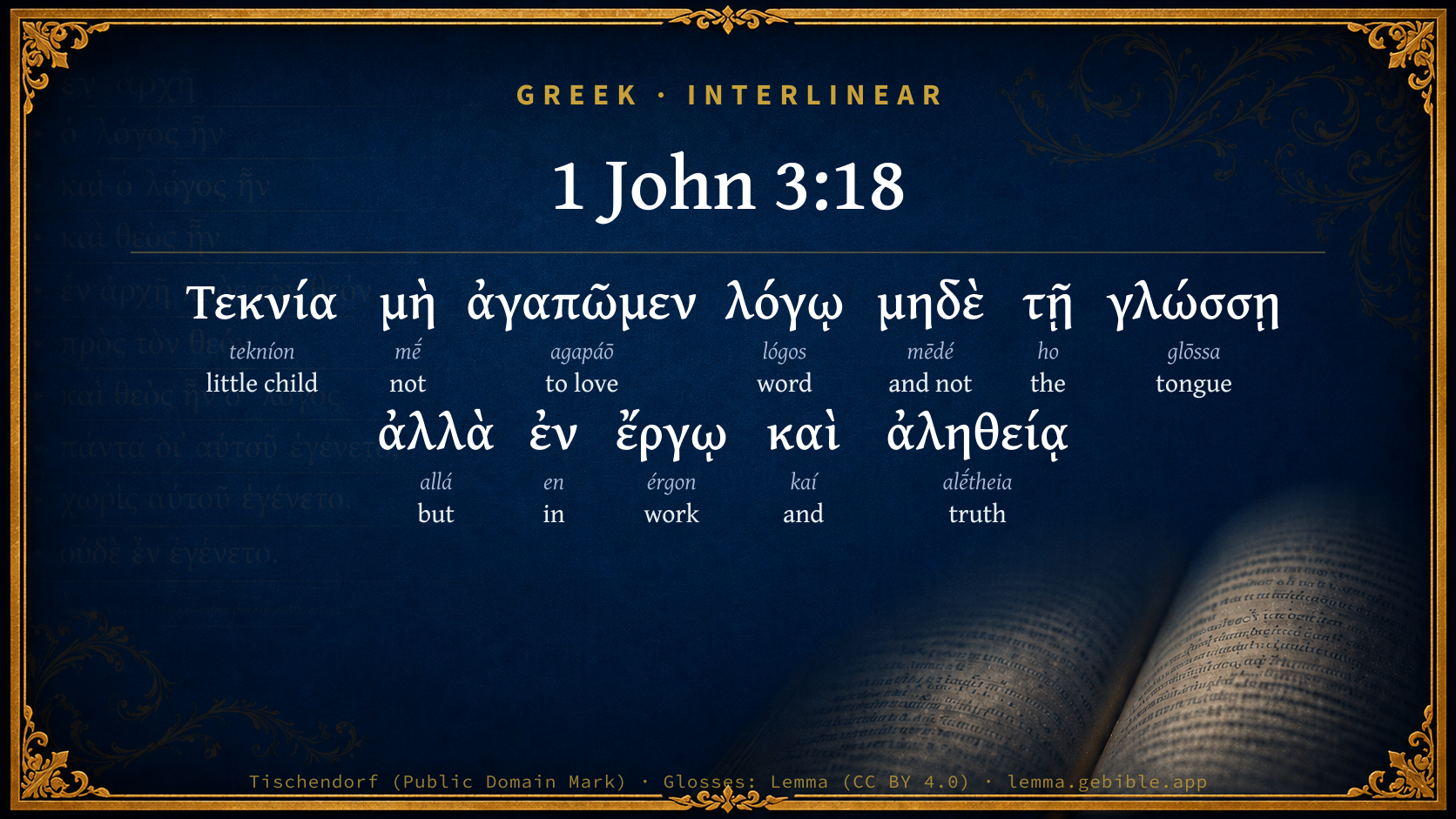
Greek (Tischendorf 8th ed.) 1 John 3:18 appears in the Greek New Testament. The text above is from the Tischendorf 8th edition. Each word links to its Strong’s number and a concise gloss. Click any word for its full Thayer’s Greek Lexicon entry.
Download image
Cite this verse

1 John 3:18 (World English Bible). Public Domain. Lemma interlinear Bible study tool, https://lemma.gebible.app/v/1-john/3/18.

Show BibTeX & RIS
BibTeX
RIS
English Translation
My little children, let's not love in word only, neither with the tongue only, but in deed and truth.
World English Bible · Public Domain
Download a study sheet

One document with this verse’s original text, its word-by-word gloss line, the meaning frame, cross-references with their text, attributed commentary, and full source and license credits — printable, and it pastes into notes with its structure intact.

This verse Autodidact and up

Study sheet (.html) Plain text (.txt)

A passage Seminary Student

Up to 50 verses in one chapter. A passage sheet keeps up to 6 commentary sources and 12 cross-references per verse, in the order this page ranks them, and says so on the sheet whenever that leaves anything out. Ask for a single verse and you get the Autodidact verse sheet above.

Everything on this page stays free to read, with no account — the sheet is a download of what is already on screen, not access to it.

Want to remove ads? Support Godless Engineer
Compare translations 3

The same verse in 3 English versions, stacked beneath the original-language interlinear above. Click any original word for its lexicon entry.

Each is an independent rendering of the whole verse — the interlinear is not word-aligned to these translations.

Highlighted words mark where these versions differ — a whole-verse word diff, not a word-by-word alignment.

  • World English Bible Public Domain
    My little children, let's not love in word only, neither with the tongue only, but in deed and truth.
  • King James Version Public Domain
    My little children, let us not love in word, neither in tongue; but in deed and in truth.
  • unfoldingWord Literal Text CC BY-SA 4.0
    Little children, let us not love in word nor in tongue, but in deed and truth.

unfoldingWord Literal Text — © unfoldingWord, licensed CC BY-SA 4.0. Word-aligned USFM3 via Door43 (git.door43.org/unfoldingWord/en_ult).

Versions to compare (up to 4)

3 of 4 selected

Show all 19 translations

Every available English version of this verse, each an independent rendering of the whole verse.

  • World English Bible Public Domain
    My little children, let's not love in word only, neither with the tongue only, but in deed and truth.
  • Berean Standard Bible Public Domain
    Little children, let us love not in word and speech, but in action and truth.
  • Majority Standard Bible Public Domain
    My little children, let us love not in word and speech, but in action and truth.
  • King James Version Public Domain
    My little children, let us not love in word, neither in tongue; but in deed and in truth.
  • American Standard Version (1901) Public Domain
    `My' Little children, let us not love in word, neither with the tongue; but in deed and truth.
  • Revised Version (1885) Public Domain
    My little children, let us not love in word, neither with the tongue; but in deed and truth.
  • Geneva Bible (1599) Public Domain
    My litle children, let vs not loue in worde, neither in tongue onely, but in deede and in trueth.
  • Douay-Rheims (1899) Public Domain
    My little children, let us not love in word, nor in tongue, but in deed, and in truth.
  • Young's Literal Translation Public Domain
    My little children, may we not love in word nor in tongue, but in word and in truth!
  • Literal Standard Version CC BY-SA 4.0
    My little children, may we not love in word nor in tongue, but in work and in truth!
  • Unlocked Literal Bible CC BY-SA 4.0
    My dear children, let us not love in word nor in tongue, but in actions and truth.
  • unfoldingWord Literal Text CC BY-SA 4.0
    Little children, let us not love in word nor in tongue, but in deed and truth.
  • Darby Bible Public Domain
    Children, let us not love with word, nor with tongue, but in deed and in truth.
  • World Messianic Bible Public Domain
    My little children, let’s not love in word only, or with the tongue only, but in deed and truth.
  • Webster's Bible Public Domain
    My little children, let us not love in word, neither in tongue, but in deed and in truth.
  • Free Bible Version CC BY-SA 4.0
    Dear friends, let's not just say we love with words, but show our love in what we do and how we demonstrate the truth.
  • Bible in Basic English Public Domain
    My little children, do not let our love be in word and in tongue, but let it be in act and in good faith.
  • Text-Critical English NT CC BY 4.0
    My little children, let us not love in word or speech, but in deed and truth.
  • Tyndale New Testament (1534) Public Domain
    My babes let vs not love in worde nether in tonge: but with dede and in veritie:

Literal Standard Version (2020), Covenant Press — licensed CC BY-SA 4.0. Text via the HelloAO Bible API (eBible.org). Unlocked Literal Bible (unfoldingWord) — licensed CC BY-SA 4.0. Text via the HelloAO Bible API (eBible.org). unfoldingWord Literal Text — © unfoldingWord, licensed CC BY-SA 4.0. Word-aligned USFM3 via Door43 (git.door43.org/unfoldingWord/en_ult). Free Bible Version, Dr. Jonathan Gallagher — licensed CC BY-SA 4.0. Text via the HelloAO Bible API (eBible.org).

Word by word

More ways to search: Search by grammar → Find every occurrence → Compare this word →

Practice this passage: Drill this verse → Learn its vocabulary →

About this verse

These counts appear in no published source. They are computed here, from the morphology-tagged text and Lemma’s own curated glosses. What Lemma adds →

12
words
12
distinct lemmas
General Epistles
section

Notable vocabulary

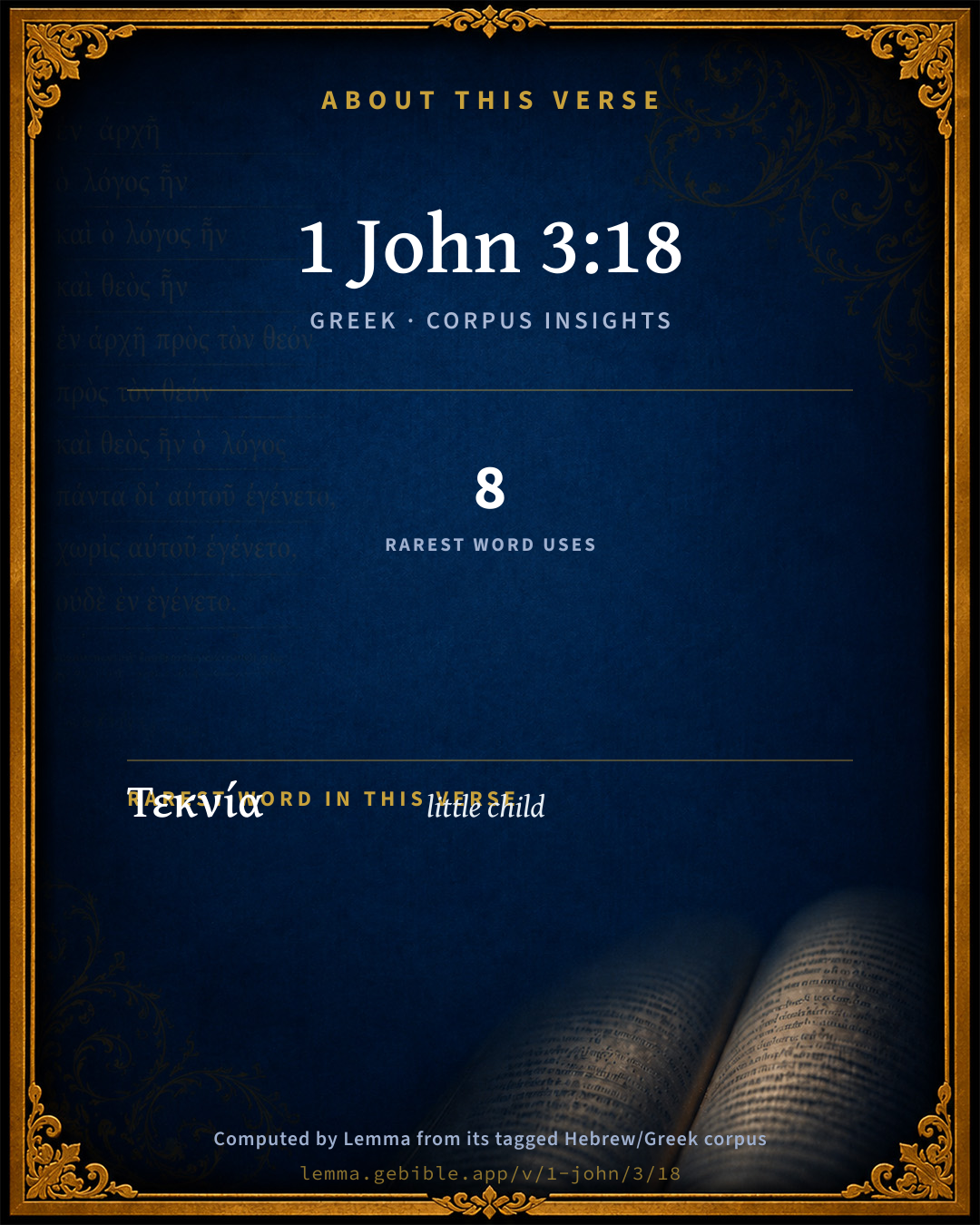
The rarest word here is Τεκνία little child G5040 — appearing just 8 times in the whole Greek New Testament.

Shared distinctive vocabulary

Τεκνία little child G5040 occurs in 8 verses of the Greek New Testament. Also found in:

Cross-references

13

Topical passages linked to 1 John 3:18 in the Treasury of Scripture Knowledge — connected by theme and wording, ordered by reader-vote popularity; previews shown in the World English Bible.

  • James 2:15–16 And if a brother or sister is naked and in lack of daily food,
  • Romans 12:9 Let love be without hypocrisy. Abhor that which is evil. Cling to that which is good.
  • 1 Peter 1:22 Seeing you have purified your souls in your obedience to the truth through the Spirit in sincere brotherly affection, love one another from the heart fervently:
  • Galatians 5:13 For you, brothers, were called for freedom. Only don't use your freedom for gain to the flesh, but through love be servants to one another.
  • 1 Corinthians 13:4–7 Love is patient and is kind; love doesn't envy. Love doesn't brag, is not proud,
  • Galatians 6:1–2 Brothers, even if a man is caught in some fault, you who are spiritual must restore such a one in a spirit of gentleness; looking to yourself so that you also aren't tempted.
  • Ephesians 4:1–3 I therefore, the prisoner in the Lord, beg you to walk worthily of the calling with which you were called,
  • Matthew 25:41–45 Then he will say also to those on the left hand, 'Depart from me, you cursed, into the eternal fire which is prepared for the devil and his angels;
  • Ephesians 4:15 but speaking truth in love, we may grow up in all things into him, who is the head, Christ;
  • 1 Thessalonians 1:3 remembering without ceasing your work of faith and labor of love and patience of hope in our Lord Jesus Christ, before our God and Father.
  • 1 John 2:1 My little children, I write these things to you so that you may not sin. If anyone sins, we have a Counselor with the Father, Jesus Christ, the righteous.
  • 2 John 1:1 The elder, to the chosen lady and her children, whom I love in truth; and not I only, but also all those who know the truth;
  • Ezekiel 33:31 They come to you as the people comes, and they sit before you as my people, and they hear your words, but don't do them; for with their mouth they show much love, but their heart goes after their gain.

Cross-references courtesy of OpenBible.info (CC BY 4.0).

Where the printed editions differ

1 variant

Places in this verse where the major printed Greek editions disagree on the wording in a way that affects the translation — a comparison of editions, not a manuscript-by-manuscript collation. The editions are the modern critical texts (Nestlé-Aland 28/27, SBL, Westcott-Hort, Tregelles, Tyndale House) and the traditional texts behind the KJV (the Textus Receptus and the Byzantine/Majority text). It is not a claim about which reading is original.

  1. Extra text
    μου,

    “of mine”

    In TRByz Not in NA28NA27TynSBLWHTreg

    μου, (mou) 'of mine' is only in traditional manuscripts (TR+Byz)

Textual data: Translators Amalgamated Greek New Testament (STEPBible TAGNT) · CC BY 4.0.

Commentary

Notes on 1 John 3:18 from classic Christian and Jewish commentators (each source and its license shown beneath its notes). The classic Christian expositions comment on the surrounding passage and are grouped to its opening verse, so a note may address several verses; the Jewish commentaries on the Tanakh (Rashi and others) are per-verse, so they appear only where the commentator wrote on this verse.

Lemma curates 59 commentaries, every one of them public domain or Creative Commons licensed, each selected and text-cleaned for this edition rather than reprinted as found. About our sources →

Joseph Benson's Commentary

1Jn 3:18-20. My beloved children, let us not love merely in word or in tongue — Contenting ourselves with complimental expressions of regard, or with giving our Christian brethren nothing but fair speeches; but in deed and in truth — Let our actions approve the sincerity of our professions, and, by relieving them in their necessities and straits, let us show that we sincerely love them. And hereby — Εν τουτω, in this, by being compassionate, kind, and bountiful, according to our ability; we know — We have a satisfactory evidence by this real, operative love; that we are of the truth — That we have true faith, and are the genuine disciples of Christ and children of God; and shall assure our hearts before him — Shall enjoy an assurance of his favour, and the testimony of a good conscience toward God. The heart, in St. John’s language, is the conscience. The word conscience is not used in his writings. For if we have not this testimony; if in any thing our heart — Our conscience, condemn us, much more does God, who is greater than our heart — An infinitely more holy and impartial Judge; and knoweth all things — So that there is no hope of hiding it from him.

Joseph Benson's Commentary on the Old and New Testaments (1811–1818) — public domain. Text from a community e-Sword module.

The Preacher's Complete Homiletical Commentary

Joseph S. Exell (gen. ed.)

CRITICAL AND EXEGETICAL NOTES

1Jn_3:18. In word.—Profession, mere boasting. True love finds expression in service. “St. John hints that there is some danger of this conventionality amongst his friends, and earnestly exhorts them to genuineness.”

1Jn_3:20. Heart condemn.—There are always sensitive souls, who are much too ready to think evil of themselves, and distress themselves with their evil-thinking. Better never attempt to appraise our own spiritual life and progress; leave it with God, and bend all attention on further progressing.

1Jn_3:22. Whatsoever we ask.—Not whatsoever anybody asks. The promise is limited to those who are in the full privilege, power, and holiness of sonship. We receive because we are the Father’s children.

1Jn_3:23. His commandment.—One but inclusive, so as to appear as two. Believe.—Not by a mere act of faith, but by a continuous daily trusting, which kept up vital relations. Love one another.—The certain outward sign of our loving and trusting Christ.

1Jn_3:24. Dwelleth in Him.—Better use St. John’s favourite word “abideth.” Spirit.—Which St. Paul represents as the “earnest” and the “seal.” “The Spirit Himself beareth witness with our spirit, that we are children of God.”

MAIN HOMILETICS OF THE PARAGRAPH.—1Jn_3:18-24

Assuring our Hearts.—Christian assurance, the confidence that we have passed from death unto life, the restfulness of knowing that we are reconciled to God, and are in a gracious standing with Him, is not only desirable, it is even necessary, if we are to live earnest Christian lives, free from the fret and worry of a continual uncertainty. It is not “a point we should long to know”; it ought not to “cost us anxious thought.” It should be a settled thing; the evidences should be clear and sufficient. It should keep a settled thing, for the evidences should be maintained, and should be effectively persuasive upon us day by day. And it must be fully understood that assurance is attainable. It is often sought in wrong ways, through some particular setting of belief, on some minor point of Christian truth, or through some definite phase of religious feeling. St. John delivers us from these mistaken ideas when he sets before us the true grounds on which our hearts may be assured before God.

I. We know that we have passed from death unto life, if we are living a life of active charity and service to others. Then there must have come a change over us; we must be other than our old selves. Everybody looks after his own interests first. Everybody except the man with the new life in Christ; and he looks after Christ’s interests first, other people’s interests next, and his own interests last. “He is not his own.” “To Him to live is Christ.” Or to put it in another form, the service of brotherhood is the satisfying proof of the sonship.

II. We know, by our inner life of soul-culture. “If our heart condemn us not, we have boldness towards God.” It is true that the witness of our heart is not always reliable, and we sometimes have to appeal to God against our own hearts. We often have to when by our hearts we mean only our feelings. But understand that our soul-culture is meant, the growth, under all holy influences, of the spiritual life that has been quickened, and then we may see that our hearts can bring us assurance. Their growth in trust, joy, love, hope, says continually that we must be standing in the full saving relations.

III. We know, through our experiences of answer to prayer. The psalmist persuaded himself that he must be standing in the love of God, for he says, “This poor man cried, and the Lord heard him, and saved him out of all his troubles.” This is a way of regarding our answers to prayer, of which sufficient is not made. We think too much of what we get in such answers. We think too little of what is involved in our being answered at all. Our Lord Jesus said to His Father, “I know that Thou hearest Me always.” His assurance rested on His being in such full acceptance with the Father. And if God hears us always, we also may be quite sure that we stand in full acceptance with Him.

IV. We know, by the sense we have of God’s relationship to us. He hath “sent forth the Spirit of His Son into our hearts,” and we feel His Fatherhood. We “abide in Him,” as sons do in the father. He “abides in us,” as fathers do in their sons. The supreme fact concerning us is, that we are “sons of God.” And the assurance that we are is found in our peculiar and characteristic apprehension of God.

V. We know, by the inward impulse of the Spirit. “Hereby we know that He abideth in us, by the Spirit which He gave us.” God is never anywhere as an inactive Being. The quiescent Brahm is man’s conception, not God’s revelation, of Himself. Wherever He is, He is active. If He is in the soul of man, if He is in our soul, then He is active; and the movings and the impulses of the Spirit are His activity; and through those impulses we are assured that He is abiding in us. Assurances based on such grounds as these are altogether healthy, ennobling, and inspiring; and thus we may all “assure our hearts.”

SUGGESTIVE NOTES AND SERMON SKETCHES

1Jn_3:18. Profession and Practice.—“My little children, let us not love in word, neither with the tongue; but in deed and truth.” St. John is so full of the family feeling, and uses so constantly the family figures, that we are tempted to think he must have been a family man, centre of a happy family circle. It may, however, only be that he was saturated with the idea of Christ’s Sonship, and that gave tone and colour to every setting of truth and persuasion of duty. The term “little children” here is used in a general sense of the believers, but it suggests the simplicity, humility, and receptiveness which ought to be their characteristics. In the teaching of this text, as in so many other cases, St. John shows how he had been influenced by the teachings of his Divine Master, and did but reproduce them, bearing a certain impress from his own thought and experience. The best illustrations of our text, and of the duty enjoined in it, may be gained by showing how much our Lord made of doing His will—not knowing it merely, not talking about it only, but really doing it in the energetic endeavour of a life of service and charity.

I. The connection of “doing” with “knowing” is characteristic of Christ’s teachings.—We find it constantly made the topic of His parables. In that of the “ten talents,” the Master is represented as expecting, and properly expecting, that the servants who know His will shall be doing, and multiply their talent-trusts by wise trading. In that of the “husbandman,” we find the Lord of the vineyard sending yearly for his proportion of the fruits of the husbandman’s toils. In that of the “sower and the seed,” the farmer looks for a return of his labour and expenditure, hoping to reap thirty, sixty, or a hundred-fold of what the soil has done. The “barren fig tree” is represented as reasonably cut down, because it did nothing in response to all the efforts made to urge it to well-doing. In the parable of the “judgment,” the Divine approval is given to those who did something, who did “visit the fatherless and widows in their affliction”; and the Divine indignation rests on those who knew, who could, yet who did nothing that was merciful and unselfish. Our Lord even exhibits this necessity for doing in His own life and conduct. Anticipating the life, as a twelve-year-old boy, He said, “Wist ye not that I must be about My Father’s business?” Of Him it could be said, “He went about doing good.” At Jacob’s well, though weary with His journey, He roused Himself to talk to the Samaritan woman, when the opportunity for doing His Father’s will was presented to Him. He could not be satisfied with only talking about the Father, though that was so often the duty of the hour. He could say, “My meat and My drink is to do the will of My Father.” And at the close of His life, He could cherish no nobler thought of the life He had lived than this, “I have finished the work which Thou gavest Me to do.” His direct teachings bore on the same subject—the supreme importance of doing as well as knowing, doing as well as feeling. “He that heareth these sayings of Mine, and doeth them.” “If any man will do His will, he shall know of the doctrine.” “He that doeth the will of God … the same is My brother, and and sister, and mother.” “Yea, blessed are they that hear the word, and do it.” “Why call ye Me Lord, Lord, and do not the things which I say?” He told us that we can always judge things and persons by their “fruits”—that is, by what they do. He likened His disciples to “salt,” which does something, savours and seasons; to a “light,” which does something, shines in the room, and enables those present to see their work; to a “city set on a hill,” which does something, acts as a beacon to guide pilgrims on their journey across the broad plain. As if to leave a last impression on those disciples, our Lord rose from His place at the last meal with them, took a towel, girded Himself, and reaching the ewer and basin, did the servant’s work, pouring water over the feet of those disciples, and wiping them with the towel wherewith He was girded. And then, returning to His seat, He solemnly said, “Know ye what I have done unto you? Ye call Me Master and Lord; and ye say well, for so I am. If I then, your Lord and Master, have washed your feet, ye ought also to wash one another’s feet. For I have given you an example, that ye also should do as I have done to you. If ye know these things, blessed are ye if ye do them.” Our Lord showed no sort of fear that doing would nourish a legal spirit, or tempt men to make their good works a ground of acceptance with God. His earnestness shows His sense of our graver danger. We are all much more likely to satisfy ourselves with professions, and to become only good-looking, leafy fig trees, on which, when He draweth nigh in His hunger, He can find no figs. Our peril is, that we may be induced to sever asunder what God has joined together, “knowing” and “doing,” and so be like the foolish man who built his house upon the sand. Doing put in place of Christ is always wrong. Doing for Christ’s sake is always right.

II. The connection of “doing” with “knowing” which both Christ and His apostles taught, is still absolutely necessary.—

1. It is needed to satisfy us, and others, of the reality of our piety. For that piety is like a seed; and if it be not a worthless seed, if there be any real germ of life in that seed, it will do something; it will crack the soil; it will send a green blade forth; it will show itself to the light. A seed that does nothing is worth nothing. A Christian who does nothing is worth nothing before God or men. Indeed, nobody can see anything that is gained by his calling himself a Christian. Let us be quite sure of this, and let us keep the thought ever present before us—men expect to see our religion influencing our conduct. We expect this in others, and are hard upon them if we cannot find their piety in their every-day relations. We may well be reminded, that the people about us are looking at our doings, and will speak dishonouring things of our Lord Christ, if they cannot see His spirit in all our relationships. Solemnly let us say to one another—No creed, however correct it may be, will ever make up, before God, or before men, for unsubdued tempers, unrestrained habits, tyranny at home, offences given abroad, self-indulgences, or neglect of the sick whom we might visit, the poor whom we might feed, or the naked whom we might clothe. Search and see what personal satisfactions you can gain as you compare your “knowing” with your “doing,” your “profession” with your “practice.” Inquire and see whether there is abroad, among those whom you have to do with day by day, an impression which leads them to say concerning you, “Well reported of for good works.” Would the widows and the poor folk come about your house, if you lay dead, showing the coats and garments which you made, as they came crowding round the house of Dorcas, that early Christian woman, who was full of good works and alms-deeds that she did?

2. It is necessary in order to prove the truth of Christianity itself. This system of religion makes marvellous pretensions. It is the last and highest revelation of God to men: it is the supreme remedy for the deepest human sorrows. It is God’s own sunshine to bring spring-time life to an earth lying cold and dead in the long winter of sin. But how shall it support the pretensions? Only by living examples of its power—only as the men and women who profess to have received the life in Christ do something. Experiment tests everything. Constantly fresh experiments are needed. Select a few professsing Christians. See what they are doing. Do not fear to apply the test—judge Christianity by its fruits. In every age it has stood this test. When all the great arguments and evidences have wearied us, we may say—See what Christianity has done. The spirit-possessed, the blind, the lame, the drunkard, the strong-tempered, the selfish, all have been changed; and the charity of the world is to-day in the hands of those who are constrained by the love of Christ. If you would prove to all around you the truth of Christianity, use argument and evidence with all wisdom, as far as ever you can; but this, above everything else, we would say to you—Show men what it can do. Men may resist eloquence; they may even refute reasoning; they may deny your evidences; but they cannot resist the power of goodness. It is like leaven, and, unbeknown, it leavens. It is like the morning light. It peeps above the eastern ridge, flinging great lines of glory up the sky. The night darkness does not like it, but it must feel it. That darkness will have to fly; for the morning light will grow in power until it makes the shadowless noonday.

1Jn_3:22-23. Keeping God’s Commandments.—This position taken by St. John is but putting in Christian form the universal condition on which Divine favour must rest. It is declared in the most general way that “the Lord is far from the wicked, but He heareth the prayer of the righteous” (Pro_15:29). And in his gospel St. John represents the people as arguing about Christ on the basis of commonly received principles and opinions: “We know that God heareth not sinners: but if a man be a worshipper of God, and do His will [keep His commandments], him He heareth” (Joh_9:31).

I. Keeping commandments may be regarded as acts of obedience. It is seldom seen with sufficient clearness that moral training, for the child or the child-nation, must necessarily begin with formal acts of obedience. The child must do what it is told to do. Israel must obey the elaborate ten laws of Sinai in the actual details of every-day life and relationship. And even Christian life properly begins in formal acts of obedience.

II. Keeping commandments may be regarded as the expression of sonship.—The true child in a home never tries to obey; he obeys without trying, because obedience is the natural and proper spirit of sonship. Some alien force must be influencing a child if he does not obey. Let a man be born of God, his new life will certainly express itself in keeping God’s commandments.

III. Keeping commandments may be tested by the obedience of two commandments (1Jn_3:23).—

1. Our belief in the Son-name of Jesus. There is no point of persuasion if St. John is assumed to be referring to saving faith in Christ, or to faith in Him as Messiah. It must never be lost from view that he is writing to professing Christians, to those who have the life in Christ. He is writing to them about the higher life. What Christians are called by God to do is to believe in the Sonship of Christ, in Him as the Son of God, and in all that such belief involves concerning the actual Fatherly relations of God. If this be the test commandment, how sinful is the hesitation of Christians to receive the full revelation of the Sonship!

2. Our love for those who are our brothers because they are with us sons, through the Son-name of Jesus.

1Jn_3:24. The Spirit’s Inward Witness.—“And hereby we know that He abideth in us, by the Spirit which He gave us.” There are two witnesses to our standing before God, to our son-ship in Christ with the eternal Father. There is the witness of our own spirit, and there is the witness of the Holy Ghost; but the testimony of the Holy Ghost is an inward witness, given through the spirit of the man.

I. The witness of our own spirit to our having the Father, and being sons.—It may be asked, Whence comes the assurance of our sonship to our human parents? Whence that spirit of restfulness and satisfaction in our relationship which we felt so strongly when we dwelt at home, and which we have even now, though far away from home, or though even the old home has been broken up, and those who made it so dear have passed away? There is a witness of our own spirit. That spirit tells us it holds cherished memories of home life and joys. Our spirit reminds us that, when utterly helpless, a mother’s bosom was our resting-place; broken rest was thought but little of by her; daily trouble seemed no weight to her, for the greatness of the mother-love she bore us. Our spirit tells us that the love which testified itself in such ways then has been a growing love, ever finding new, tender, and wonderful ways of expression. The testimony of our own spirit about the past is one great assurance of our sonship. But the inward witness tells of more than this; it speaks of our own views, ideas, affections, and emotions. Our spirit bids us see, that towards our father we feel a kind of respect and reverence, and towards our mother we have affections and emotions, which we need some new, and almost heaven-born, word to express. Our spirit testifies to a deference to their opinion, a desire to please them, a willingness to obey them, and a confidence in them, which is the most certain inward witness of our sonship. We are quite satisfied and happy; it is the testimony of our own spirit that we are the children of these parents, and that we are preserving our relationship. So we might ask, What is our assurance that we are children of this beloved England? Do we need to appeal to Magna Charta? or must we anxiously collect and examine the birth, marriage, and death certificates of our ancestry? Surely not. We are abundantly satisfied with the testimony of our own spirit that we have the English thought, and the English ways and habits; and that, in the temper of the child, we are obeying England’s laws, and glorying in her dignities and privileges. This seems to be very plain. And in this way there is a testimony of our own spirit to the reality of sonship with God. Inquire of your own spirit. Is there not cherished in it a memory, a thought—cherished in its very holiest place—of the wonderful love of God in Christ to you: a memory of a great gift, the offering of saving love and pity, once made for you? Does not your spirit tell you it has a most hallowed, inner shrine, and in that shrine you keep the memory of that ever-blessed One, whose beautiful life of heavenly, divine charities closed so sadly, so shamefully, in a death that won life and heaven for you? Does not your spirit tell how that shrine has been opened in the hours of silent meditation, and sweetest odours of infinite love have streamed forth, making fragrant all the temple of your soul? Does not your spirit tell that the memory and the thought of Christ exercise continual power upon you, swaying your nature as with the might of some great principle? If then your spirit has such things as these to tell you, may you not be sure that this is like the child’s memory of parental love?—it is the pledge of your sonship; it is the witness of your own spirit that you are the child of God. But beyond this witness of a cherished memory, our spirit gives testimony to our sonship with God in our views, feelings, dispositions, and in the spirit and conduct of our life. Our spirit renders witness to us of the reality of the great spiritual change that has been wrought in us. Our hearts will tell us whether we are the same now that we were some ten or twenty years ago, or it may be even a few months since. As we set our old life, in its principle and in its spirit, over against our present life, in its principle and in its spirit, we are sensible of a most decided contrast, which cannot possibly be explained by the mere fact of our having grown older. As we compare the things which we loved and sought in those old days with the things we are loving and seeking now, we say—Our present life is not indeed what we would have it to be; still it is different, most manifestly different. “We were sometime darkness, now are we light in the Lord.” Our own spirit testifies within us to the change. Our own spirit witnesses also to a new view of God, and of the relation in which we stand to Him. Our own spirit witnesses to our thinking differently now of goodness and of holiness. Goodness was the highest conception we once could reach, and we meant by it, ordering our life within certain prescribed limits. That has given place to a conception of the claims of holiness; by which we mean a life in conformity with the will of God—a life informed and possessed with the spirit of allegiance, devotion, and love to Him.

II. The witness of the Holy Spirit to our sonship with God.—That Spirit works through the testimony that is given by our spirit. The Holy Ghost does not give oral testimony; He does not speak even by “a still small voice,” caught only by the attentive ear. He does not come with observation, in extraordinary and overwhelming manifestation. He comes as a silent, secret, inward, Divine force of life, strengthening and renewing those who are good and pure in heart and purpose; He comes purifying, perfecting, guiding the witness of our own spirit. In two ways we may recognise the concurring witness of the Holy Spirit and our spirit. We, with our whole powers of spirit, seek to know the mind and will of God, as they have been revealed to us in His word. It is the Holy Spirit who enables us to gain true apprehensions, and to lay personal hold of the truths and promises it contains. He leads into all truth. And we, with our whole power of spirit, seek to cherish all godly emotions, and, in bringing forth good fruit, to live the godly life. It is the Holy Spirit who quickens those emotions, and all the fruits we can produce are but varieties of the “love, joy, peace, long-suffering, gentleness, meekness, and patience,” which we know are the immediate fruits of the Spirit. We might with truth say, “I live, yet not I, the Holy Ghost liveth in me.” It is the recognition of this inner life, the consciousness of this Divine indwelling, which brings rest and peace, and the impulse to nobler things, to the Christian.

CHAPTER 4

The Preacher's Complete Homiletical Commentary (gen. ed. Joseph S. Exell; Funk & Wagnalls, c. 1892) — public domain (pre-1929). A full-Bible homiletical/sermon-outline anthology covering 65 of 66 books (2 John is absent from the source module). Text from a community e-Sword module.

Bengel's Gnomon

Johann Albrecht Bengel

1Jn 3:18. Λόγῳ) in idle word: it is opposed to in deed.—γλώσσῃ) by a pretending tongue: it is opposed to in truth.

Bengel's Gnomon of the New Testament — English translation (T&T Clark, Edinburgh, 1860) — public domain. Text from a community e-Sword module.

Meyer's Critical & Exegetical Commentary

Heinrich August Wilhelm Meyer

1Jn_3:18. True love proves itself by deed. The exhortation contained in this verse is, on the one hand, a deduction from the foregoing (especially from 1Jn_3:16-17); but, on the other hand, it forms the basis of the further development.

τεκνία] Impressive address before the exhortation.

μὴ ἀγαπῶμεν λόγῳ μηδὲ τῇ γλώσσῃ] i.e. let us not so love that the proof of our love is the outward word or the tongue; μηδὲ τῇ γλώσσῃ is epexegetically added, in order to mark the externality of the love indicated by λόγῳ ἀγαπᾷν, inasmuch as it points out that by λόγος here only the outward word is meant; it is erroneous to regard γλῶσσα as a climax in so far as one may love with words (without deeds), but in such a way that the words are nevertheless really and sincerely meant (Ebrard), for John would not in the very least consider as truly and sincerely meant words of love which remain without corresponding deed. The article serves to vivify the expression (Lücke): the tongue as the particular member for expression of the word. It is unnecessary, nay, contrary to the text (Düsterdieck), with Beza, Lange, Sander, etc., to supply μόνον with ἀγαπῶμεν κ.τ.λ.; for ἀγαπᾷν λόγῳ κ.τ.λ. in itself expresses the mere apparent love.

ἀλλʼ ἐν ἔργῳ καὶ ἀληθεία] Instead of the Rec. ἔργῳ, we must read ἐν ἔργῳ; according to de Wette, the two readings are synonymous; according to Lücke, ἐν ἔργῳ κ. ἀλ. has more of adverbial nature than ἔργῳ καὶ ἀληθείᾳ; in τῷ λόγῳ the apostle is considering more the way in which love expresses itself, in ἐν ἔργῳ κ. ἀλ. he is considering more the form and fashion of it; the preposition suggested itself to the apostle because the work, as being the realization of love, stands in an inner relationship to it, is the element in which love moves (Düsterdieck).[231] λόγος and ἔργον are frequently in the N. T. connected with one another, so Luk_24:19; Act_7:22, and many other passages; in order to bring out the insufficiency of λόγος in 1Co_4:19-20, 1Th_1:5, δύναμις is contrasted with it. By καὶ ἀληθείᾳ the apostle does not mean to add a second element of love, but to characterize the ἀγαπᾷν ἐν ἔργῳ as the true love (so also Myrberg); a love which does not show itself ἐν ἔργῳ is only an apparent love.[232] The relationship of (ἘΝ) ἈΛΗΘΕΊᾼ to ἘΝ ἜΡΓῼ is just the same as that of Τῇ ΓΛΏΣΣῌ to ΛΌΓῼ. The two words of each clause express together one idea, and these two ideas are contrasted with one another, so that it is not to be asked whether λόγῳ corresponds with ἜΡΓῼ, and ΓΛΏΣΣῌ with ἈΛΗΘΕΊᾼ, or ΓΛΏΣΣῌ with ἜΡΓῼ, and ΛΌΓῼ with ἈΛΗΘΕΊᾼ (against Düsterdieck and Braune). With the thought of this verse compare especially Jam_2:15-16; only here the thought is more comprehensive than there.[233]

[231] Braune: It is to be observed that the first pair in the dative only states the means by which love operates; the preposition ἐν states the clement in which it moves.

[232] Comp. Joh_4:24, where also καὶ ἀληθείᾳ is added to ἐν πνεύματι, not to bring out a second element of true worship (contrary to Meyer on this passage), but to describe the προσκυνεῖν ἐν πνεύματι as true worship in contrast to every apparent worship.

[233] Wolf quotes the corresponding statement of Picke, Avoth, chap. 1 John 5 : omnis dilectio, quae dependet a verbo, verbo cessante, ipsa quoque cessat: at quae non dependet a verbo, nunquam cessat.In Theognis 979 it is put thus: μὴ μοι ἀσηρ εἴη γλώσσῃ φίλος, ἀλλὰ καὶ ἔργῳ.

Meyer — Critical and Exegetical Commentary on the New Testament — English translation by Peter Christie, edited by Frederick Crombie (T&T Clark, 1880) — public domain. Text from a community e-Sword module.

Expositor's Greek Testament

ed. W. Robertson Nicoll

1Jn 3:18 . Observe the transition from instrumental dative to preposition ἐν : “not with word and the tongue but in the midst of deed and truth” not in empty air but amid tangible realities. Cf. Bunyan, Good News : “Practical love is best. Many love Christ with nothing but the lick of the tongue.” Sheridan, Sch. for Scand. v. i.: “He appears to have as much speculative benevolence as any private gentleman in the kingdom, though he is seldom so sensual as to indulge himself in the exercise of it”.

The Expositor's Greek Testament, edited by W. Robertson Nicoll (1897–1910) — public domain. Text from a community e-Sword module.

Geneva Bible (1599)

Geneva Bible translators

Christian charity standeth not in words, but in deed, and proceedeth from a sincere affection.

Geneva Bible (1599) marginal notes — public domain. Text via Bolls.life.

Jamieson, Fausset & Brown

Robert Jamieson, A. R. Fausset & David Brown

When the venerable John could no longer walk to the meetings of the Church but was borne thither by his disciples, he always uttered the same address to the Church; he reminded them of that one commandment which he had received from Christ Himself, as comprising all the rest, and forming the distinction of the new covenant, "My little children, love one another." When the brethren present, wearied of hearing the same thing so often, asked why he always repeated the same thing, he replied, "Because it is the commandment of the Lord, and if this one thing be attained, it is enough" [JEROME].

in word--Greek, "with word . . . with tongue, but in deed and truth."

Jamieson, Fausset & Brown — Commentary Critical and Explanatory on the Whole Bible (1871) — public domain (CC PDM 1.0). Text via the HelloAO Bible API.

Adam Clarke's Commentary

Verse 18. My little children] τεκνιαμου, My beloved children, let us not love in word-in merely allowing the general doctrine of love to God and man to be just and right;

Neither in tongue] In making professions of love, and of a charitable and humane disposition, and resting there; but in deed- by humane and merciful acts;

And in truth.] Feeling the disposition of which we speak. There is a good saying in Yalcut Rubeni, fol. 145, 4, on this point: "If love consisted in word only, then love ceaseth as soon as the word is pronounced. Such was the love between Balak and Balaam. But if love consisteth not in word, it cannot be dissolved; such was the love of Abraham, Isaac, Jacob, and the rest of the patriarchs which were before them."

Adam Clarke's Commentary on the Bible (1810–1826) — public domain. Text from a community e-Sword/MySword module.

John Calvin's Commentaries

18. Let us not love in word There is a concession in this first clause; for we cannot love in tongue only; but as many falsely pretend this, the Apostle concedes, according to what is often done, the name of the thing to their dissimulation, though, in the second clause, he reproves their vanity, when he denies that there is reality except in the deed. For thus ought the words to be explained, — Let us not profess by the tongue that we love, but prove it by the deed; for this is the only true way of shewing love.

John Calvin's Commentaries (1540-1563) — public domain. Text from the Calvin Translation Society English edition (1840s-50s) via the Christian Classics Ethereal Library (ccel.org). Calvin's coverage is partial (roughly two-thirds of the Bible); uncommented books and verses are honest gaps, never fabricated. The 19th-century editor's footnotes and remarks are omitted so the notes are faithfully Calvin's own voice.

The Cambridge Bible for Schools and Colleges

gen. ed. J. J. S. Perowne

18. My little children, let us not love in word] S. John, as in 1Jn_2:28, 1Jn_3:13, 1Jn_4:1; 1Jn_4:7, hastens on to a practical application of what he has been stating as the principles of Christian Ethics; and in each case he prefaces his gentle exhortation with a word of tender address. ‘Dear children, do not think that I am giving you a series of philosophical truisms; I am telling of the principles which must govern your conduct and mine, if we are children of the God who is Light and Love.’

let us not love in word, neither in tongue] Or, as R. V., neither with the tongue. This is more accurate, for in the Greek ‘word’ has no article and ‘tongue’ has: both are datives of the instrument, and the article marks the tongue as the special instrument of the hypocritical love. Is there any difference between loving in word and loving with the tongue? And is there any difference between loving in deed and loving in truth? The answer must be the same to both questions. The oppositions between ‘word’ and ‘deed’ and between ‘tongue’ and ‘truth’ are so exact as to lead us to believe that there is a difference. To love in word is to have that affection which is genuine as far as it goes, but which is so weak that it never gets further than affectionate words: such love is opposed, not to truth, but to loving acts. To love with the tongue is to profess an affection which one does not feel, which is sheer hypocrisy: it is opposed, not to deeds, but to truth. It may shew itself also in hypocritical acts, done (as Bede points out) not with the wish to do good, but to win praise, or to injure others.

in deed and in truth] Omit the second ‘in’: the preposition is not repeated in the Greek. Tyndale and the Rhemish Version have no second ‘in’. Comp. Jas_2:15; Rom_12:9. What follows, though intimately connected with the first part of the section (see next note), almost amounts to a fresh departure. The subject of love and its opposite is transformed into the security and serenity of conscience which genuine and active love is able to produce.

The Cambridge Bible for Schools and Colleges (gen. ed. J. J. S. Perowne; Cambridge University Press, 1878–1918) — public domain. Text from a community e-Sword module.

John Gill's Exposition

And hereby we know that we are of the truth,.... By the saints loving one another in deed and in truth, they know, as the cause is known by the effect, that they are of God, who is the true God, the God of truth, and cannot lie, and is truth itself; that they are the children of God, and are born of him, since they love those that are, and every like loves its like; and that they are of Jesus Christ, who is the way, the truth, and the life; that they belong to him, are his, since they have his Spirit, as appears by his fruits in them, and this, among the rest, love to the brethren; and that they are his disciples, which others, even all men know, as well as themselves, by their mutual brotherly love; and that they are of the Gospel, which is truth, and the word of truth; that they are begotten, and born again, according to the will and grace of God by it, and are on the side of it, and can do nothing against, but all for it; and that they are true, sincere, and upright persons, true believers in Christ, whose faith works by love, and are real lovers of him, and his, since they love not in word only, but in deed and in truth.

And shall assure our hearts before him; or "persuade our hearts": arrive to a full assurance of faith, hope, and understanding, that we are of the truth, do belong to God, are loved by him with an everlasting love, are chosen by him unto salvation, and are his adopted and regenerated ones, having passed from death to life, of which brotherly love is a sure evidence, Jo1 3:14. Some render the words "shall pacify", or "make our hearts tranquil": or "quiet"; this only the blood of Christ can do, and does, being sprinkled on the conscience: he only has a quiet mind, or true peace of conscience, that looks to the righteousness of Christ for justification, and deals with his blood for the full and free remission of his sins: it is true indeed, that one that loves his brother heartily and sincerely, has peace of mind in it, though not for it; when, on the other hand, there is no peace to the wicked man, that hates his brother; for where there is envying, malice, hatred, and strife, there is no true peace, pleasure, and comfort, but confusion, uneasiness, distraction, and every evil work. Or this passage may refer to that holy confidence before God, which true believers in Christ, and cordial lovers of the brethren, have; both now at the throne of grace, where they can come with boldness, intrepidity, and freedom, to ask for what they want, and confidently believe they shall receive what is proper and needful for them; and also hereafter, at the throne of judgment, and in the day of judgment, when they shall have boldness, and not be ashamed before the Judge at his coming; who will particularly take notice of their love in feeding, clothing, and visiting the least of his brethren, which he takes as done to himself.

John Gill's Exposition of the Whole Bible (1746–1763) — public domain (CC PDM 1.0). Text via the HelloAO Bible API.

Trapp's Complete Commentary

John Trapp

18 My little children, let us not love in word, neither in tongue; but in deed and in truth.

Ver. 18. Let us not love in word] Words are light and cheap; and there is a great deal of mouth mercy abroad. Julian the Apostate is not presently a friend to Basil, though he write unto him, φιλος φιλω, και αδελφος αδελφω, Thou art my friend and beloved brother. The Roman legions loved Otho the emperor, saith Dio the historian, and gave him all respect, ουκ απο της γλωττης, αλλα και απο της ψυχης, not from the teeth outward but from the heart root. {See Trapp on "Jas 2:14"} {See Trapp on "Jas 2:15"} {See Trapp on "Jas 2:16"}

John Trapp, A Commentary or Exposition upon All the Books of the Old and New Testament (1647–1656) — public domain. Text from a community e-Sword module.

Albert Barnes' Notes on the Bible

My little children, let us not love in word, neither in tongue - By mere profession; by merely sayinG that we love each other. See 1Pe 1:22.

But in deed and in truth - In such acts as shall show that our professed love is sincere and real. Let us do the deed of love, whether anything is said about it or not. See the notes at Mat 6:3.

Albert Barnes' Notes on the Bible (1834–1885) — public domain. Text from a community e-Sword/MySword module.

Matthew Poole's English Annotations

q.d. It is a vain thing to make verbal pretences of love, without any real proof of it.

Matthew Poole's English Annotations on the Holy Bible (1683–1685) — public domain. Text from a community e-Sword/MySword module.

Whedon's Commentary on the Bible

Daniel D. Whedon

18. The man who thus withholds the alms may have a theory of benevolence in his head, and in word, and in tongue; but there is none in heart or hand.

Daniel D. Whedon (gen. ed.), Commentary on the Old and New Testaments (1874–1909) — public domain. Text from a community e-Sword module.

The Pulpit Commentary

Vers. 18-24. As in chapter 2:28, St. John bursts out into personal exhortation (comp. verse 13; chapter 4:1, 7), based upon the preceding statements. He then restates the motive in a new form both positively and negatively.

Little children (teknia, the mou being spurious). This address, as ingw 1Jn_2:28, introduces the summing up of the section. It may be doubted whether the absence of ejn with the first pair lo mhdessh and its presence with the second ejn e]rgw kaia indicates any marked difference, as if logw expressed the instrument, and ejn e]rgw the element or sphere. This introduces a false antithesis, like "Do not dig with a stick, but dig in the earth." (For the Hebraic ejn to express the instrument, comp. Rev_13:10) "Nor yet with the tongue" is not a tautological addition. One may love in word only, and yet the affectionate words may be quite sincere; and this is a common case. People say kind things which they mean at the moment, but afterwards they do not take the trouble to act kindly. But to love with the tongue only is far worse. This is to say kind things which one does not mean, and which one knows to be unreal. Deeds are needed to complete the kind word; truth is needed to correct the insincere tongue.

The Pulpit Commentary (1880–1919), ed. H.D.M. Spence-Jones & Joseph S. Exell — public domain. Text from a community e-Sword module.

John Wesley's Explanatory Notes

Not in word - Only. But in deed - In action: not in tongue by empty professions, but in truth.

John Wesley, Explanatory Notes Upon the Whole Bible (1754–1765) — public domain. Text via the GEBible commentary corpus.

Burkitt's Expository Notes on the New Testament

William Burkitt

Having laid down several motives to brotherly love before, by way of excitation, as an help to their affections, he comes now to propound some directions to them as an help to their endeavours.

And the first is this, to take special care that their love be sincere, and not hypocritical. Let us not love in word, that is, in word only, but in deed, and in truth. As if he had said, "Let our deeds speak the truth of our love; sincere love is fruitful; true affection will put forth itself into action; it doth not rest at the tongue’s end, but will be seen at the finger’s end, rendering us laborious in works and offices of friendship; as faith, so love without works is dead; and as faith is justified by works, so is our love also.

Observe next, The encouragement which our apostle gives to the exercise of this true love, hereby we shall know that we are of the truth, and shall assure our hearts before him: That is, "By such efficacy and real fruits of our love we shall know that we are true Christians, who live by, and walk according to the rule of the gospel, which is emphatically stiled the truth, and shall have the assured testimony of our consciences, that we are sincere in the sight of God."

Learn hence, 1. That the love of Christians one to another ought not to be verbal, or in word only, but in deed, and in truth.

2. That the sincerity of our love to our brethren is the security of our consciences and estates before God. A Christian may be assured of his good estate, and may build his assurance upon the sincerity of his love to God and Christians.

William Burkitt's Expository Notes on the New Testament (1700–1703) — public domain. Text from a community e-Sword module.

The People's New Testament

B. W. Johnson

18. Let us love not in word. Our love must not show itself in empty professions.

B. W. Johnson's The People's New Testament with Notes (1889–1891) — public domain. Electronic text from the Christian Classics Ethereal Library (CCEL) ThML edition.

Cambridge Greek Testament for Schools and Colleges

18. After τεκνία omit μου with [641][642][643][644] against [645][646]. Before γλώσσῃ insert τῇ with [647][648][649][650][651] against [652], and before ἔργῳ insert ἐν with [653][654][655][656][657] against [658].

[641] 4th century. Discovered by Tischendorf in 1859 at the monastery of S. Catherine on Mount Sinai, and now at Petersburg. All three Epistles.

[642] 5th century. Brought by Cyril Lucar, Patriarch of Constantinople, from Alexandria, and afterwards presented by him to Charles I. in 1628. In the British Museum. All three Epistles.

[643] 4th century. Brought to Rome about 1460. It is entered in the earliest catalogue of the Vatican Library, 1475. All three Epistles.

[644] 5th century. A palimpsest: the original writing has been partially rubbed out and the works of Ephraem the Syrian have been written over it. In the National Library at Paris. Part of the First and Third Epistles; 1Jn 1:1 to 1Jn 4:2; 3Jn 1:3-14. Of the whole N.T. the only Books entirely missing are 2 John and 2 Thessalonians.

[645] 9th century. All three Epistles.

[646] 9th century. All three Epistles.

[647] 5th century. Brought by Cyril Lucar, Patriarch of Constantinople, from Alexandria, and afterwards presented by him to Charles I. in 1628. In the British Museum. All three Epistles.

[648] 4th century. Brought to Rome about 1460. It is entered in the earliest catalogue of the Vatican Library, 1475. All three Epistles.

[649] 5th century. A palimpsest: the original writing has been partially rubbed out and the works of Ephraem the Syrian have been written over it. In the National Library at Paris. Part of the First and Third Epistles; 1Jn 1:1 to 1Jn 4:2; 3Jn 1:3-14. Of the whole N.T. the only Books entirely missing are 2 John and 2 Thessalonians.

[650] 9th century. All three Epistles.

[651] 9th century. All three Epistles.

[652] 4th century. Discovered by Tischendorf in 1859 at the monastery of S. Catherine on Mount Sinai, and now at Petersburg. All three Epistles.

[653] 4th century. Discovered by Tischendorf in 1859 at the monastery of S. Catherine on Mount Sinai, and now at Petersburg. All three Epistles.

[654] 5th century. Brought by Cyril Lucar, Patriarch of Constantinople, from Alexandria, and afterwards presented by him to Charles I. in 1628. In the British Museum. All three Epistles.

[655] 4th century. Brought to Rome about 1460. It is entered in the earliest catalogue of the Vatican Library, 1475. All three Epistles.

[656] 5th century. A palimpsest: the original writing has been partially rubbed out and the works of Ephraem the Syrian have been written over it. In the National Library at Paris. Part of the First and Third Epistles; 1Jn 1:1 to 1Jn 4:2; 3Jn 1:3-14. Of the whole N.T. the only Books entirely missing are 2 John and 2 Thessalonians.

[657] 9th century. All three Epistles.

[658] 9th century. All three Epistles.

18. τεκνία, μὴ ἀγ. λόγῳ. The Apostle, as in 1Jn 2:28; 1Jn 3:13; 1Jn 4:1; 1Jn 4:7, hastens on to a practical application of what he has been stating as the principles of Christian Ethics; and in each case he prefaces his gentle exhortation with a word of tender address. ‘Dear children, do not think that I am giving you a series of philosophical truisms; I am telling of the principles which must govern your conduct and mine, if we are children of the God who is Light and Love.’ Note the present subjunctive after μή, indicating a continuous feeling, somewhere in existence, which is to be discontinued or avoided: ‘Do not let us go on loving in word, as some people do.’ In N.T. when μή prohibitive is joined with the third person, the verb is always in the imperative (Mat 6:3; Mat 24:17-18; Rom 6:12; Rom 14:16; &c.): when it is joined with the first person, as here, the verb is in the subjunctive (Joh 19:24; 1Co 10:8; Gal 5:26; Gal 6:9; &c). Winer, 629. The above examples shew that both present and aorist are used frequently in both moods.

μηδὲ τῇ γλώσσῃ. As R.V. (emended reading), neither with the tongue; “the tongue as the particular member for the expression of the word” (Huther). Perhaps ‘with word’ would be better than ‘in word,’ if ‘in word’ were not the usual idiom. The simple datives, λόγῳ and τῇ γλώσσῃ, seem to indicate the instruments with which the false love is shewn, the preposition, ἐν. λ. καὶ ἀλ., the sphere in which it is shewn. For the contrast between λόγος and ἔργον, so common in Thucydides, comp. Luk 24:19; Act 7:22; Rom 15:18; 2Co 10:11; Col 3:17. Is there any difference between loving in word and loving with the tongue? And is there any difference between loving in deed and loving in truth? The answer must be the same to both questions. The oppositions between ‘word’ and ‘deed’ and between ‘tongue’ and ‘truth’ are so exact as to lead us to believe that there is a difference. To love in word is to have that affection which is genuine as far as it goes, but which is so weak that it never gets further than affectionate words: such love is opposed, not to truth, but to loving acts. To love with the tongue is to profess an affection which one does not feel, which is sheer hypocrisy: it is opposed, not to deeds, but to truth. It may shew itself also in hypocritical acts, done (as Bede points out) not with the wish to do good, but to win praise, or to injure others. Tyndale and the Rhemish Version have no second ‘in’ before ‘truth’: it should of course be omitted, as in R.V. Comp. Jas 2:15; Rom 12:9.

What follows, though intimately connected with the first part of the section (see next note), almost amounts to a fresh departure. The subject of love and its opposite is transformed into the security and serenity of conscience which genuine and active love is able to produce.

Cambridge Greek Testament for Schools and Colleges (Cambridge University Press, 1896; 21 vols, various authors incl. Carr, Maclear, Plummer, Farrar, Lumby, Moule, M. R. James, Simcox) — public domain. Text from a community e-Sword module.

Alford’s Greek Testament

Henry Alford

18.] Exhortation to true brotherly love: following naturally on the example of the want of it given in the last verse. Little children, let us not love with word nor yet with tongue, but (let us love) in deed and truth (there is some little difficulty in assigning these words their several places in the contrast. We may notice first, that the two former, λόγῳ and γλώσσῃ, are simple datives of the instrument, whereas the two latter are introduced by the preposition ἐν, denoting the element in which. The true account of the arrangement seems to be, that the usual contrast of λόγῳ and ἐν ἔργῳ is more sharply defined by the epexegetic τῇ γλώσσῃ and ἐν ἀληθείᾳ: τῇ γλώσσῃ giving, by making the mere bodily member the instrument, more precisely the idea of absence of truth than even λόγῳ, and (ἐν) ἀληθείᾳ more definitely the idea of its presence than even ἐν ἔργῳ. Similar contrasts are adduced by the Commentators from the classics: especially from Theognis; e. g. 973 f., μή μοι ἀνὴρ εἴη γλώσσῃ φίλος, ἀλλὰ καὶ ἔργῳ· χερσίν τε σπεύδοι χρήμασί τʼ ἀμφότερα: 63, ἀλλὰ δοκεῖ μὲν πᾶσιν ἀπὸ γλώσσης φίλος εἶναι: 96, ὃς κ. εἴπῃ γλώσσῃ λῷστα, φρονῇ δʼ ἕτερα. As connected with the exhortation in this verse, I may cite the tradition reported by Jerome in his Commentary on Gal 6:10, vol. vii. p. 528 f.: “Beatus Joannes Evangelista cum Ephesi moraretur usque ad extremam senectutem, et vix inter discipulorum manus ad ecclesiam deferretur, nec posset in plura vocem verba contexere, nihil aliud per singulas solebat proferre collectas, nisi hoc: ‘Filioli, diligite alterutrum.’ Tandem discipuli et fratres qui aderant, tædio affecti, quod eadem semper audirent, dixerunt: Magister, quare semper hoc loqueris? Qui respondit dignam Joanne sententiam: Quia præceptum Domini est, et si solum fiat, sufficit”).

Henry Alford, The Greek Testament (1849–1861) — public domain. Text from a community e-Sword module.

International Critical Commentary

18. τεκνία] The appeal is made, as usual, on the ground of the common spiritual nature which they all share.

ἐν ἔργῳ καὶ ἀληθείᾳ] The phrase is contrasted with λόγῳ and γλώσσῃ. Practical love corresponds to inward truth. Much protestation is a mere exercise of the tongue.

τεκνια א A B C P Rev_15 cat. m am. syr. arm. Clem. Dam. Aug.] + μου K L al. longe. plur. vg. (fu. demid. etc.) syr. sah. cop. aeth. Thphyl. Oec.

αγαπωμεν] αγαπατεH δ6 (Ψ).

λογω] pr. ενH δ6 (Ψ)Ia 101. 264. 65 (40): pr. τωIa 175, 502 (319).

μηδε]και א syr. aeth.τη γλωσση A B C K L al. plu. Dam. Thphyl.] om. τη א P al. sat. mu. cat. arm. Clem. Oec

εν] om. K al. permu. cat. Dam. Oec.

αληθεια] + quia sumus ex ueritate sahd.

19 f. The consciousness that their love for God is true and active, assures men of their fellowship with God, that they are “of the truth.” The choice of phrase is determined by the language of ver. 18. Practically it is equivalent to εἶναι ἐκ τοῦ θεοῦ. And the consciousness of this fellowship brings assurance, in spite of what the conscience has to tell of thoughts and deeds which mar its realization. Even before God, in whose presence no falsehood can stand, the Christian can “still” his heart: for the all-knowing God is greater than the accusing conscience. Knowing all, He knows that the love is true, and is the determining element of the character, notwithstanding the many failures which interrupt its complete realization. His knowledge is absolute. He can see the whole, and He has accepted the love which is real and active as sufficient ground for admitting the man to His fellowship. Cf. Joh 21:17, πάντα σὺ οἶδας, σὺ γινώσκεις ὅτι φιλῶ σε. The accusations of conscience are stilled in the presence of omniscient holiness, which is perfect love.

At first sight the omniscience of God may seem a strange ground for the confidence of men, who are conscious of sins that interrupt their fellowship with God. “If as natural men we shrink from allowing our neighbours to see into our heart, much more are we terrified at the thought that the holy God penetrates to the depth of our hearts” (Rothe). But in the case of Christians, who are conscious of the relationship to God in which they stand, it is otherwise. Their security lies in the fact that this relationship has been establislhed by one who knows all the circumstances of the case. There is no fear of alteration in the light of fuller knowledge.

But how can such confidence be said to be derived from the practice of love, in the sphere in which it is first possible, i.e. in love of the brethren? The answer is that in such activities they have learned to know of a love, other than that based on physical kinship, which is not merely the “cloak of self-seeking”; and the more clearly its true character is recognized, the more clearly it is seen that such love is of the very Being of God. So the all-knowing “were the all-loving too.” The surest ground of our confidence is the knowledge that “our help standeth in the name of the Lord,” who is love.Thus the general meaning of these verses is fairly plain. They have always been recognized as touching the very heart of the Christian faith. The exact interpretation, however, of each clause is a matter of considerable difficulty. The meaning of πείσομεν is disputed, as also of the first and second ὅτι. The difficulties caused by the sequence of two clauses introduced by ὅτι have led to the removal of the second ὅτι from some texts.

(1) If πείσομεν is taken in its usual sense of “persuade,” (α) the fact of which we “persuade our heart” may be left unstated, to be gathered from the context. If so, we must supply “that we are of the truth” from the preceding verse. This is grammatically unobjectionable, and gives an adequate sense. Even though our heart (conscience) convicts us of sins which separate us from God, we can nevertheless persuade ourselves that we are really of the truth, because God is greater than our hearts, in knowledge and in love, and has recognized our position, in spite of, or perhaps we should say in consequence of, the fact that He knows all, and so is qualified to judge. (β) The fact may be found in the second clause, “that God is greater than our heart.” Against this the objection is hardly valid that the fact is too obvious to be disputed. The question is not of the objective truth of the fact, but of our subjective apprehension of it, under circumstances which make its realization peculiarly difficult (ἐὰν καταγινώσκῃ κ.τ.λ.). On the other hand, Dr. Westcott’s objection would seem to hold good, that “the consciousness of a sincere love of the brethren does not furnish the basis of the conviction of the sovereign greatness of God.” (γ) If the first suggestion (α) is felt to be unsatisfactory, there is some authority for the absolute use of πείθειν in the sense of “still, ” assure, appease, tranquillize. Cf. Mat 28:14, καὶ ἐὰν ἀκουσθῇ τοῦτο ἐπὶ τοῦ ἡγεμόνος, ἡμεῖς πείσομεν καὶ ὑμᾶς ἀμερίμνους ποιήσομεν (where, however, the reference may be to the contents of ver. 13, the asserted theft of the body by the disciples); 2 Mac. 4:45, ἐπηγγείλατο χρήματα… πρὸς τὸ πεῖσαι τὸν βασιλέα. We can appease our heart, can still the qualms of conscience, with the knowledge that God who knows all has admitted us to His fellowship and love, a fact of which we are assured by the active love for others which His love has kindled in our hearts. This is perhaps the simplest interpretation, though as an explanation of πείσομεν it is less natural than (α).(2) The exact meaning of ὅτι in each clause and their mutual relations are of less moment. The meanings “that” or “because” have to some extent come under consideration in connection with πείθειν. But the relation of the first clause to the second is doubtful. (α) The second ὅτι may be regarded as resumptive, either in the sense of “that,” or “because.” The resumptive is more natural in the former than in the latter case. It is possible in either case. But the use of the resumptive ὅτι after so short a clause is not really natural, and is not in accord with the style of the writer. (β) The first ὅτι may be relative, “Whereinsoever our heart condemns us,” the second ὅτι being taken in the sense of either “that” or “because.” This interpretation relieves the sentence of an awkward and unnecessary resumptive particle, and it may be paralleled by instances of the use of ὅ τι ἄν in the Gospel, which are not indeed identical, but are sufficiently similar to justify its adoption here. Cf. Joh 2:5, Joh 14:13, Joh 15:16. If we take into consideration the author’s habit of throwing forward for the sake of emphasis a word or words which stand outside the general construction of his sentence, we may feel justified in assuming that he has here made use of an accusatival clause (of respect) in rather loose connection with the rest of the verse. For the use of ὅ τι ἄν (ἐάν), cf. Mar 6:23; Luk 10:35.

In what has been said, it has, of course, been assumed that the omniscience of God is alleged as a ground for confidence not for fear (if our own heart condemn us, the judgment of omniscient justice must be far more severe). The opposite view has been stoutly maintained by Wohlenberg in the series of articles referred to above (Neue Kirkliche Zeitschrift, 1902, p. 636 ff.), and also by Findlay (Expositor, November, 1905). Cf. also the comment of the Catena (Cramer, viii. 128), ἐάν,φησίν, ἁμάρτωμεν οὐ λανθάνομεν, οὐδὲ διαφευξόμεθα· εἰ γὰρ ἁμαρτάνοντες τὴν καρδίαν ἑαυτῶν λαθεῖν (? ins. οὐ) δυνάμεθα, ἀλλὰ νυττόμεθα ὑπὸ τοῦ συνειδότος, πόσῳ μᾶλλον τὸν θεὸν πράττοντές τιτῶν φαύλων (? μὴ) δυνηθῶμεν λαθεῖν;

It makes the connection between vv. 19 and 20 almost impossible to explain. It can only be done by interposing a thought which is left altogether without expression in the passage. “We shall assure our heart—and we shall have great need to do so; for if our conscience condemn us, how much more severe must necessarily be the verdict of the omniscient God!” If this is what the writer meant, he has severely taxed the powers of his readers to follow his argument. And the aim of the whole passage is surely to give assurance, and not to strike terror into their hearts. There is nothing in the passage to indicate that vv. 20 and 21 are intended to meet the circumstances of two different classes of people, the self-confident and the self-distrustful.

In the explanation given of this passage it has been assumed that ἐν τούτῳ refers back to the previous verse, which is contrary to the common usage of the writer, though perhaps not unparalleled. It is, however, possible to find the test of knowledge, and consequent assurance, in the sentence ὅτι μείζων—πάντα. The thought of God’s power and omniscience may give us assurance that we are “of the truth.” We have been accepted by one who knows all the circumstances. In view of the writer’s usage there is much to be said for this interpretation. The general meaning of the passage is not affected by it. Windisch is inclined to regard the passage as corrupt, and suggests that we should read οὐ πείσομεν, and cut out the clause ὅτι ἐάν… καρδία as an interpolation based on ver. 21. Thus amended, the passage would certainly contain a warning to the self-confident, against which no exception could be taken. But the best criticism on the suggestion is his own next sentence, “Das beste ist freilich man bleibt bei der Konstatierung: der Text is verderbt.” The writer knows how to use the irony of the commonplace, but he did not use it here.

εν τουτω A B 40 dscr Rev_5 vg. cop. syr. Clem.] pr. et sah. boh-cod.: om. א C K L P al. longe. plu. cat. syr. aeth. Dam. Thphyl. Oec. Aug.: αλλ εκ τουτου69 ascr.

γνωσομεθα א A B C P 6. 7. 15. 18. 22. 27. 29. 33. 36. 40. 66**. 68. 69. 137 ascr jscr cat. sah. cop. arm. Clem. Dam.] γινωσκομεν K L al. pler. vg. syr. Thphyl. Oec. Aug.

εσμεν] εστιIa 158 (395).

πεισομεν] πεισωμεν 5. 27. 29. 69 ascr al. fere.10 Thphyl.

την καρδιαν] A* B 66** sah. boh. syr. aeth. Aug.] τας καρδιας א A2 C K L P al. fere. omn. cat. vg. arm. syr. Thphyl. Oec.

εαν] αν A al. pauc.

καταγινωσκη ημων] post καρδια Ib 469 (215).

καταγινωσκη] καταγινωσκει L 13 100. 106. 107*. Rev_5.

οτι2o א B C K L al. plu. cat. syr.] om. A 13 33. 34. 63 dscr (vg. sahbw cop. arm. aeth. Oec. Aug. non exprimunt).

μειζων] μειζον K.

εστιν] om. Ia 252-δ 459 55 (391) Ib 209f (386).

θεος] κυριος C.

ημων 2o] om. arm-ed.

παντα] pr. τα Ia 261. 106. 216 (142).

21 ff. If our conscience acquits us, the result is a feeling of joyful confidence in the sight of God, and the consciousness that our prayers are answered, because of our obedience and willing service.

ἀγαπητοί] Cf. 2:7, 3:2, one of the writer’s favourite forms of address, and frequent in this second part of the Epistle, in which the main topic is love (4:1, 7, 11).

ἐὰν κ.τ.λ.] The clause is most naturally interpreted in its widest sense, regarded neither as an antithesis to ver. 20 nor as a continuation of it. It includes all cases in which the verdict of the conscience is favourable, both those in which there has been no condemnation, and those in which assurance has been gained in spite of the condemnation of the heart, from the thought of the greatness and omniscience of God.ἡ καρδία μὴ καταγινώσκῃ] Contrast the order of ver. 20. The stress is here laid on the faculty which passes judgment. The writer follows his usual custom of stating a principle absolutely, without considering the modifications which become necessary when it is applied to the individual case. In so far as the conscience passes a verdict of acquittal, the results stated necessarily follow. And the statement is made in the most absolute form, “if the heart do not condemn,” though ἡμῶν has naturally been supplied in many texts, after καρδία and again after καταγινώσκῃ. The reading of B (ἔχει for ἔχομεν), which makes the heart the subject of the apodosis as well as of the protasis, is interesting. The form of ver. 20, however, makes it improbable that this is the original text.

παρρησίαν] Cf. ver. 14 and note. Boldness and confidence are the ideas which the word generally suggests, while here that of freedom of intercourse in “speaking with God” in prayer is prominent. The phrase denotes, of course, the boldness and freedom from restraint with which the children can approach their Father always, rather than the clear conscience and confidence with which they can await the verdict of the Judge on the Last Day.

αγαπητοι] αδελφοι א.

εαν] αν A.

η καρδια A B 13 27. 30. 66**. 113 fu. Or. Dam. Aug.]+ ημων א C K L al. pler. cat. vg. (am. demid. harl. tol.) arm. syr. sah. cop. aeth. Or. Dam. Thphyl. Oec. cat. Cyp. Did.

μη] om. Ia 397 (96) Ib δ206* (242).

καταγινωσκη B C 68. Or.] καταγινωσκει Α L 13. 100. 106 Rev_3 scr al. aliq. Dam.: + ημων א A K L al. pler. cat. vg. sah. cop. syr. arm. aeth. Or. Dam. Did.

εχομεν] εχωνεν13 al. pauc. Dam.: εχει B 29.

International Critical Commentary — older volumes (1896–1929), various authors — public domain. Text from a community e-Sword module.

Westcott on Hebrews & the Epistles of John

Brooke Foss Westcott

18, Τεκνία) Filioli V., Little children. The word of address is changed (v. 13). The father now pleads with those who draw their being from him.

μὴ..«λόγῳ μηδὲ τῇ yA.) not...with word, neither with the tongue, in theory as opposed to action; with

mere outward expression as opposed to the genuine movement of our whole being.

λόγῳ...ἐν ἔργῳ... with word...in deed... The slight change of construction marks the difference between the instrument and the sphere of themanifestation of love. It must find scope in our true and full life. For ἐν ἔργῳ καὶ aA. compare John iv. 23 f. ἐν πνεύματι καὶ ἀληθείᾳ.

‘If love depends on a word, when the word ceaseth the love ceaseth. Such was the love of Balak and Balaam’ (Jalkut Reub. 145. 4: Schoettgen). The passage quoted from Aboth v. 22 is wholly different in sense.

3 The fruit of love (vv. 19—24).

As St John has spoken of the necessity and of the pattern of love so now he goes on to speak of its fruit. The fruit of love is confidence. Such confidence stills the condemnation which the heart pronounces against the believer (vv. 19, 20). It finds its expression in prayers, which are necessarily answered, because they are the voice of obedient love (vv. 21—23). It issues in the fulness of sympathy (©. 24).

19 In this we shall know that we. are of the truth, and shall assure our heart before him, » whereinsoever our heart may condemn us; because God ts greater than our heart and knoweth all things. 5: Beloved, if our heart condemn us not, we have boldness towards God, “and whatsoever we ask we receive from him, because we observe his commandments and do the things that are pleasing in his sight. 73 And this is his commandment, that we should beliece the name

3 " δ 93 ’ ἐν ἔργῳ καὶ ἀληθείᾳ.

x. NA**C vg me syrhl.

Of his Son Jesus Christ and love one another, even as he gave us commandment, 4 And he that observeth his commandments abideth in him and hein him ; and in this we know that he abideth in us, from the Spirit which he gave us.

Brooke Foss Westcott (1825–1901), The Epistle to the Hebrews (1889) and The Epistles of St John (1883) — public domain (pre-1929). Text recovered from Internet Archive / Google Books OCR scans. Westcott’s Gospel of John commentary is not included (its OCR lost the chapter running-heads required for reliable verse-keying). Some Greek quoted in the Hebrews volume is imperfectly rendered by the OCR.

Lesson kit

Teaching starters — assembled from the data on this page, not authored interpretation. Every prompt links to the verse data it draws on. Edit before teaching.

1 John, in the General Epistles, opens this verse with 12 words (12 distinct Greek lemmas). Its most distinctive word is tekníon (“little child”). A historical commentator’s framing appears above. Read the whole chapter for the surrounding context.

Discussion questions

  1. The word tekníon carries the sense “little child.” How does it shape the verse?
  2. John 13:33 shares the word «little child» with this verse. How do the two illuminate each other?
  3. The translations on this page render this verse differently — a whole-verse word diff, not a word-by-word alignment. What might account for the different wordings?
  4. Reading how Joseph Benson's Commentary and The Preacher's Complete Homiletical Commentary read this verse, where do the two commentators agree and where do they part?

Things to notice

Reading settings

Reading text

Shown beneath each verse's original-language words.

Old Testament
Old Testament edition

Read the OT as the Masoretic Hebrew (MT) or the Greek Septuagint (LXX).

English shown for the Greek Septuagint (in the Hebrew ↔ Greek comparison).

Comparing translations? Open the Compare panel on any verse page to stack up to four side by side.