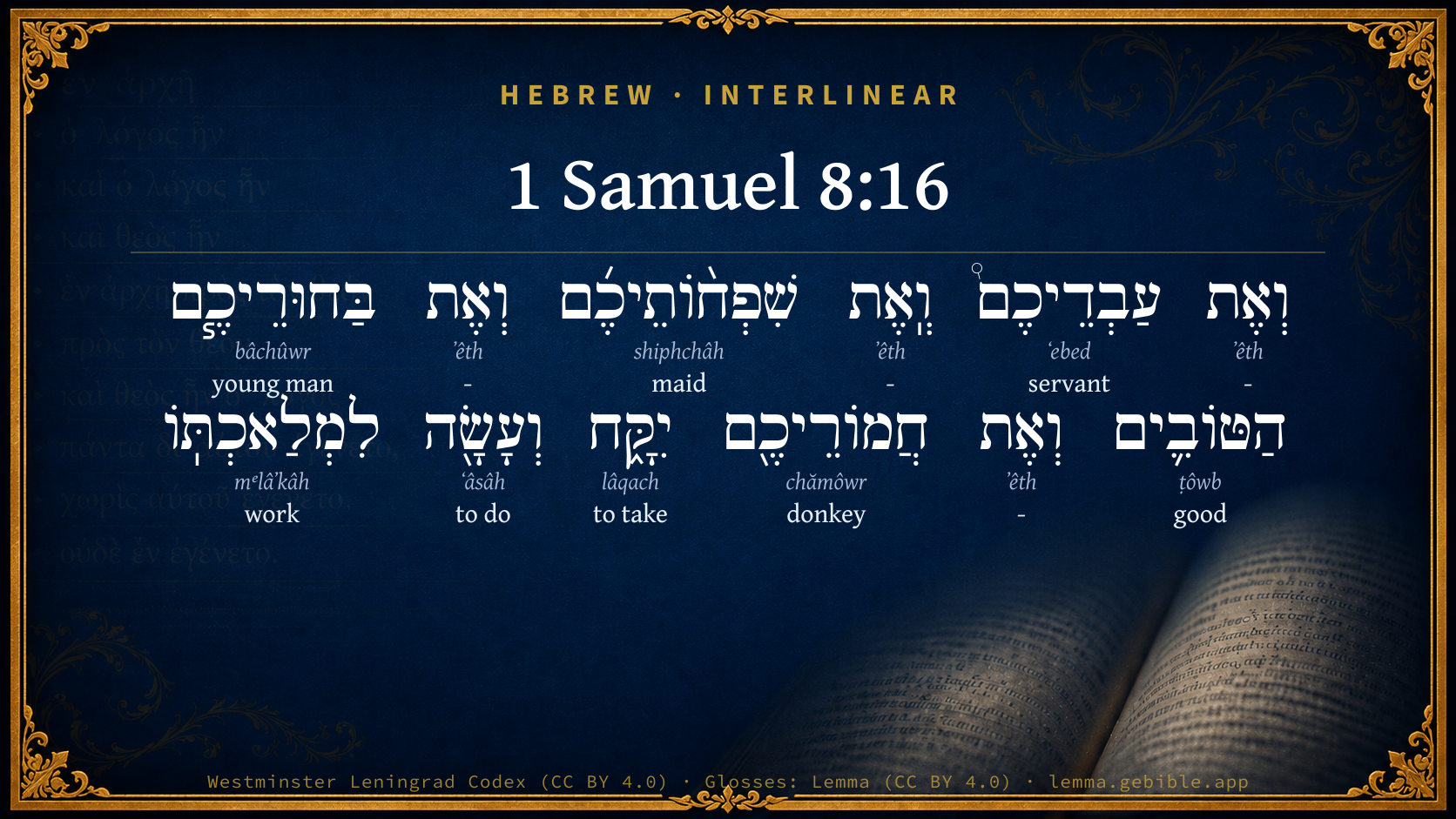
1 Samuel 8:16

Hebrew (Westminster Leningrad Codex) 1 Samuel 8:16 appears in the Hebrew Old Testament. The text above is from the Westminster Leningrad Codex. Each word links to its Strong’s number, a concise gloss, and parsing drawn from the Open Scriptures Hebrew Bible morphology. Click any word for its full Brown-Driver-Briggs (BDB) entry.
Download image
Cite this verse

1 Samuel 8:16 (World English Bible). Public Domain. Lemma interlinear Bible study tool, https://lemma.gebible.app/v/1-samuel/8/16.

Show BibTeX & RIS
BibTeX
RIS
English Translation
He will take your men-servants, and your maid-servants, and your best young men, and your donkeys, and put them to his work.
World English Bible · Public Domain
Download a study sheet

One document with this verse’s original text, its word-by-word gloss line, the meaning frame, cross-references with their text, attributed commentary, and full source and license credits — printable, and it pastes into notes with its structure intact.

This verse Autodidact and up

Study sheet (.html) Plain text (.txt)

A passage Seminary Student

Up to 50 verses in one chapter. A passage sheet keeps up to 6 commentary sources and 12 cross-references per verse, in the order this page ranks them, and says so on the sheet whenever that leaves anything out. Ask for a single verse and you get the Autodidact verse sheet above.

Everything on this page stays free to read, with no account — the sheet is a download of what is already on screen, not access to it.

Want to remove ads? Support Godless Engineer
Compare translations 3

The same verse in 3 English versions, stacked beneath the original-language interlinear above. Click any original word for its lexicon entry.

Each is an independent rendering of the whole verse — the interlinear is not word-aligned to these translations.

Highlighted words mark where these versions differ — a whole-verse word diff, not a word-by-word alignment.

  • World English Bible Public Domain
    He will take your men-servants, and your maid-servants, and your best young men, and your donkeys, and put them to his work.
  • King James Version Public Domain
    And he will take your menservants, and your maidservants, and your goodliest young men, and your asses, and put them to his work.
  • unfoldingWord Literal Text CC BY-SA 4.0
    And your servants and your maidservants and your young men, the best, and your donkeys, he will take and use for his work.

unfoldingWord Literal Text — © unfoldingWord, licensed CC BY-SA 4.0. Word-aligned USFM3 via Door43 (git.door43.org/unfoldingWord/en_ult).

Versions to compare (up to 4)

3 of 4 selected

Show all 18 translations

Every available English version of this verse, each an independent rendering of the whole verse.

  • World English Bible Public Domain
    He will take your men-servants, and your maid-servants, and your best young men, and your donkeys, and put them to his work.
  • Berean Standard Bible Public Domain
    And he will take your menservants and maidservants and your best cattle and donkeys and put them to his own use.
  • Majority Standard Bible Public Domain
    And he will take your menservants and maidservants and your best cattle and donkeys and put them to his own use.
  • King James Version Public Domain
    And he will take your menservants, and your maidservants, and your goodliest young men, and your asses, and put them to his work.
  • American Standard Version (1901) Public Domain
    And he will take your men-servants, and your maid-servants, and your goodliest young men, and your asses, and put them to his work.
  • Revised Version (1885) Public Domain
    And he will take your menservants, and your maidservants, and your goodliest young men, and your asses, and put them to his work.
  • Geneva Bible (1599) Public Domain
    And he will take your men seruants, and your maide seruants, and the chiefe of your yong men, and your asses, and put them to his worke.
  • Douay-Rheims (1899) Public Domain
    Your servants also and handmaids, and your goodliest young men, and your asses he will take away, and put them to his work.
  • Young's Literal Translation Public Domain
    And your men-servants, and your maid-servants, and your young men -- the best, and your asses, he doth take, and hath prepared for his own work;
  • Literal Standard Version CC BY-SA 4.0
    And your menservants and your maidservants, and the best of your young men and your donkeys, he takes, and has prepared for his own work;
  • Unlocked Literal Bible CC BY-SA 4.0
    He will take your male servants and your female servants and the best of your young men and your donkeys; he will put them all to work for him.
  • unfoldingWord Literal Text CC BY-SA 4.0
    And your servants and your maidservants and your young men, the best, and your donkeys, he will take and use for his work.
  • Darby Bible Public Domain
    And he will take your bondmen, and your bondwomen, and your comeliest young men, and your asses, and use them for his work.
  • World Messianic Bible Public Domain
    He will take your male servants, your female servants, your best young men, and your donkeys, and assign them to his own work.
  • Webster's Bible Public Domain
    And he will take your men-servants, and your maid-servants, and your most choice young men, and your asses, and put them to his work.
  • Free Bible Version CC BY-SA 4.0
    He will take your male servants and your female servants, and your best young men and your donkeys, and make them work for him.
  • Bible in Basic English Public Domain
    He will take your men-servants and your servant-girls, and the best of your oxen and your asses and put them to his work.
  • JPS Tanakh (1917) Public Domain
    And he will take your men-servants, and your maid-servants, and your goodliest young men, and your asses, and put them to his work.

Literal Standard Version (2020), Covenant Press — licensed CC BY-SA 4.0. Text via the HelloAO Bible API (eBible.org). Unlocked Literal Bible (unfoldingWord) — licensed CC BY-SA 4.0. Text via the HelloAO Bible API (eBible.org). unfoldingWord Literal Text — © unfoldingWord, licensed CC BY-SA 4.0. Word-aligned USFM3 via Door43 (git.door43.org/unfoldingWord/en_ult). Free Bible Version, Dr. Jonathan Gallagher — licensed CC BY-SA 4.0. Text via the HelloAO Bible API (eBible.org).

Word by word

More ways to search: Search by grammar → Find every occurrence → Compare this word →

Practice this passage: Drill this verse → Learn its vocabulary →

בַּחוּרֵיכֶ֧ם
bâchûwr
H970
“young men · your”
Noun, Common, Masculine, Plural, Construct + Suffix, Personal, 2nd Person, Masculine, Plural
Part of Speech
Noun
Type
Common
Gender
Masculine
Number
Plural
State
Construct
Full BDB Definition

Origin: participle passive of H977

TWOT: 231a

youth, young man
  1. וְאֶת ʼêth H853 “and · -” Conjunction + Particle, Direct Object
  2. עַבְדֵיכֶם֩ ʻebed H5650 “servants · your” Noun, Common, Masculine, Plural, Construct + Suffix, Personal, 2nd Person, Masculine, Plural
  3. וְֽאֶת ʼêth H853 “and · -” Conjunction + Particle, Direct Object
  4. שִׁפְח֨וֹתֵיכֶ֜ם shiphchâh H8198 “maids · your” Noun, Common, Feminine, Plural, Construct + Suffix, Personal, 2nd Person, Masculine, Plural
  5. וְאֶת ʼêth H853 “and · -” Conjunction + Particle, Direct Object
  6. הַטּוֹבִ֛ים ṭôwb H2896 “the · good” Particle, Definite Article + Adjective, Adjective, Masculine, Plural, Absolute
  7. וְאֶת ʼêth H853 “and · -” Conjunction + Particle, Direct Object
  8. חֲמוֹרֵיכֶ֖ם chămôwr H2543 “donkeys · your” Noun, Common, Both, Plural, Construct + Suffix, Personal, 2nd Person, Masculine, Plural
  9. יִקָּ֑ח lâqach H3947 “to take” Verb, Qal, Imperfect, 3rd Person, Masculine, Singular
  10. וְעָשָׂ֖ה ʻâsâh H6213 “and · to do” Conjunction + Verb, Qal, Sequential Perfect, 3rd Person, Masculine, Singular
  11. לִמְלַאכְתּֽוֹ mᵉlâʼkâh H4399 “to/for · work · his” Preposition + Noun, Common, Feminine, Singular, Construct + Suffix, Personal, 3rd Person, Masculine, Singular

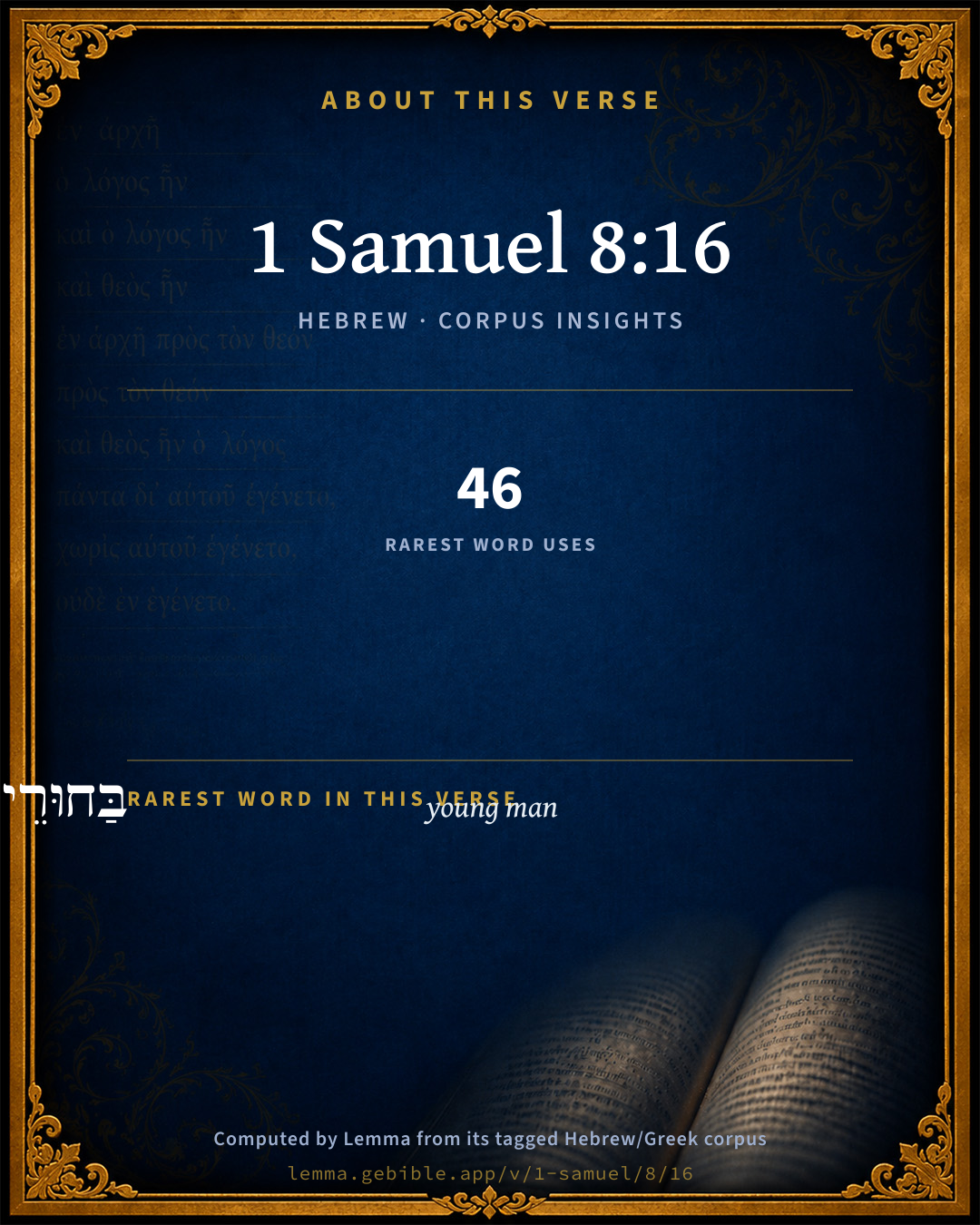
About this verse

These counts appear in no published source. They are computed here, from the morphology-tagged text and Lemma’s own curated glosses. What Lemma adds →

12
words
9
distinct lemmas
Historical
section

Shared distinctive vocabulary

בַּחוּרֵיכֶ֧ם young man H970 occurs in 45 verses of the Hebrew Bible. Also found in:

Grammatical profile

  • 2 verbs
  • 5 nouns
  • 1 adjective
  • 4 particles

Verb forms

  • יִקָּ֑ח Qal · Imperfect
  • וְעָשָׂ֖ה Qal · Sequential Perfect

Hebrew & Septuagint length

In English translation the verse runs 22 words from the Hebrew and 26 from the Septuagint (LXX English) — closely comparable.

A rough comparison of the two English renderings, which tokenize alike — not a word-level alignment.

Word counts can differ between the Hebrew and the Greek without any difference in meaning — e.g. the Hebrew direct-object marker אֵת has no separate Greek word, and Greek often adds the article ὁ.

Hebrew and Greek witnesses Masoretic Hebrew ↔ Greek Septuagint

The same verse in the two great witnesses to the Old Testament, shown verse-for-verse.

These are two independent witnesses, not word-aligned to each other, and the Septuagint is shown in lemma (dictionary) form.

Hebrew 1 Samuel 8:16 Masoretic · Westminster Leningrad Codex

וְאֶת עַבְדֵיכֶם֩ וְֽאֶת שִׁפְח֨וֹתֵיכֶ֜ם וְאֶת בַּחוּרֵיכֶ֧ם הַטּוֹבִ֛ים וְאֶת חֲמוֹרֵיכֶ֖ם יִקָּ֑ח וְעָשָׂ֖ה לִמְלַאכְתּֽוֹ

He will take your men-servants, and your maid-servants, and your best young men, and your donkeys, and put them to his work.

World English Bible · Public Domain

Greek LXX 1 Samuel 8:16 Septuagint · lemma form

καί ὁ δοῦλος σύ καί ὁ δούλη σύ καί ὁ βουκόλιον σύ ὁ ἀγαθός καί ὁ ὄνος σύ λαμβάνω καί ἀποδεκατόω εἰς ὁ ἔργον αὐτός

And he will take your servants, and your handmaids, and your good herds and your asses, and will take the tenth of them for his works.

LXX2012 (modern English Septuagint) · Public Domain

On this verse, Ellicott's Commentary for English Readers discusses the Septuagint’s reading. Read the note in Commentary ↓

Hebrew: Westminster Leningrad Codex (CC BY 4.0). Greek: Septuagint (public domain); English from LXX2012 (modern English Septuagint) (Public Domain). How the Septuagint differs from the Hebrew →

Targum (Aramaic paraphrase)

1

The Targum is the ancient Jewish Aramaic paraphrase of the Hebrew Scriptures — an interpretive translation, not the Hebrew text itself. Onkelos (literal) and Pseudo-Jonathan (expansive) render the Torah, and Jonathan the Prophets. Coverage is partial: where no permissively-licensed English translation exists for a verse, only the Aramaic is shown. This is verse-level text, not a word-by-word alignment to the Hebrew.

  1. Targum Jonathan Prophets (Joshua–Malachi)
    וְיַת עַבְדֵיכוֹן וְיַת אַמְהַתְכוֹן וְיַת עוּלֵימְכוֹן שַׁפִּירַיָא וְיַת חֲמָרֵיכוֹן יְדַבֵּר לְמֶהֱוֵי עָבְדִין עֲבִידְתָּא:

    (no public-domain English translation for this verse)

    Targum Jonathan — Aramaic: “Mikraot Gedolot” (public domain). English: “Sefaria Community Translation” (CC0 1.0 (public-domain dedication)); “London "Chaldee Paraphrase," 1871” (public domain). Text via Sefaria.

Commentary

Notes on 1 Samuel 8:16 from classic Christian and Jewish commentators (each source and its license shown beneath its notes). The classic Christian expositions comment on the surrounding passage and are grouped to its opening verse, so a note may address several verses; the Jewish commentaries on the Tanakh (Rashi and others) are per-verse, so they appear only where the commentator wrote on this verse.

Lemma curates 59 commentaries, every one of them public domain or Creative Commons licensed, each selected and text-cleaned for this edition rather than reprinted as found. About our sources →

Trapp's Complete Commentary

John Trapp

1Sa 8:16 And he will take your menservants, and your maidservants, and your goodliest young men, and your asses, and put [them] to his work.

Ver. 16. And he will take your men-servants.] Nero’s word to his officers was, Hoc agamus nequis quicquam habebat. {a} Make the slaves know that they can call nothing at all their own.

{a} Sueton.

John Trapp, A Commentary or Exposition upon All the Books of the Old and New Testament (1647–1656) — public domain. Text from a community e-Sword module.

Joseph Benson's Commentary

1Sa 8:16-18. He will take your men-servants — By constraint, and without sufficient recompense. Your goodliest young men — The most beautiful and proper person she can find; and your asses, and put them to his work — Either at the plough, or for carriage, or any other employment wherein he shall think they will be useful. And ye shall be his servants — So subject to him, that if he please ye shall be no better than slaves, deprived of that liberty which you now enjoy. And ye shall cry out in that day — Ye shall bitterly mourn for the sad effects of this inordinate desire of a king. This shows that in the foregoing verses Samuel describes the uncontrollable power which the eastern princes exercised over their subjects, who were obliged patiently to bear whatever their kings imposed upon them, without any power to help themselves. The Lord will not hear you in that day — Because you will not hear nor obey his counsel in this day; but he will leave you under this heavy yoke.

Joseph Benson's Commentary on the Old and New Testaments (1811–1818) — public domain. Text from a community e-Sword module.

Ellicott's Commentary for English Readers

(16) And your goodliest young men.—The LXX. Greek Version here reads, “your best oxen,” which required only the change of one letter of similar sound in the Hebrew word here. This was, no doubt,. the reading of the original text, as the young men seem included among the sons in 1Sa_8:11-12, and oxen would naturally precede the asses mentioned in the next clause of this verse.

A Bible Commentary for English Readers, edited by Charles John Ellicott (1878–1897) — public domain. Text from a community e-Sword module.

The Cambridge Bible for Schools and Colleges

gen. ed. J. J. S. Perowne

16. your goodliest young men] “Young men” in the Heb. appears to be a copyist’s error, and we should probably adopt the Sept. reading “cattle.” Men-servants and maid-servants, cattle and asses, are then coupled together naturally. Cp. Exo_20:17.

The Cambridge Bible for Schools and Colleges (gen. ed. J. J. S. Perowne; Cambridge University Press, 1878–1918) — public domain. Text from a community e-Sword module.

John Gill's Exposition

And he will take your manservants, and your maidservants,.... Into his own family, for his own use and service, if he wants them, or likes them better than what he has:

and your goodliest young men: that are tall and lusty, comely and beautiful, of a proper stature and good aspect; and such in all countries used to be chosen for officers in courts, or attendants there; and so the Turks to this day pitch upon young men to attend on great personages, who are of a comely form, have admirable features, and are well shaped; see Gill on Dan 1:4,

and your asses, and put them to his work; employ them in ploughing his fields, drawing his carriages, or bearing his burdens; and so any other cattle that would serve the same purposes, as oxen, camels, &c.

John Gill's Exposition of the Whole Bible (1746–1763) — public domain (CC PDM 1.0). Text via the HelloAO Bible API.

Haydock's Catholic Bible Commentary

Goodliest, in strength (Calmet) and beauty. (Menochius) --- Solomon made his people work at his buildings, and David employed an officer in the fields, 1 Paralipomenon xxvii. 26. Septuagint have read in a different manner, "He will tithe....your excellent droves of oxen." (Calmet) --- They also specify, "the tithe of asses for his work." (Haydock)

George Leo Haydock (1774–1849), Haydock's Catholic Family Bible and Commentary, 1859 edition — public domain. Excludes Psalms (Douay-Rheims chapter numbering differs from Protestant) and Deuterocanonical books (Catholic canon only).

Matthew Poole's English Annotations

By constraint, and without sufficient recompense

Matthew Poole's English Annotations on the Holy Bible (1683–1685) — public domain. Text from a community e-Sword/MySword module.

The Pulpit Commentary

He will put them to his work. Again the hateful forced service, but here not, as in ver. 12, of themselves, but of their households. Instead of your goodliest young men the Septuagint reads, "your best oxen," which requires only the change of one letter, and is in agreement with the rest of the verse. Samuel would scarcely place their choicest young men between the female slaves and the asses. But while the ass was used chiefly for riding, the ox was, as he still continues to be upon the Continent, man"s most faithful and valued friend and fellow labourer.

The Pulpit Commentary (1880–1919), ed. H.D.M. Spence-Jones & Joseph S. Exell — public domain. Text from a community e-Sword module.

John Wesley's Explanatory Notes

Will take - By constraint, and without sufficient recompense.

John Wesley, Explanatory Notes Upon the Whole Bible (1754–1765) — public domain. Text via the GEBible commentary corpus.

unfoldingWord translationNotes

Door43 World Missions Community

Connecting Statement:

Samuel continues to tell what things the king will take.

the tenth of your flocks

They will have to divide their flocks into ten equal parts and give one of those parts to the king's officers and servants. See how you translated "tenth" in 1 Samuel 8:15. (See: Fractions)

you will be his slaves

"you will feel as if you are his slaves"

you will cry out

Possible meanings are 1) the people will ask Yahweh to rescue them from the king or 2) the people will ask the king to stop treating them so badly .

translationWords

servant

donkey

works

tenth

flocks

cry

unfoldingWord translationNotes — © Distant Shores Media and the Door43 World Missions Community, licensed CC BY-SA 4.0. Source: git.door43.org/Door43/en_tn.

Lesson kit

Teaching starters — assembled from the data on this page, not authored interpretation. Every prompt links to the verse data it draws on. Edit before teaching.

1 Samuel, in the Historical, opens this verse with 12 words (9 distinct Hebrew lemmas). Its most distinctive word is bâchûwr (“young man”). A historical commentator’s framing appears above. Read the whole chapter for the surrounding context.

Discussion questions

  1. How does “young man” (bâchûwr) shape what this verse is saying?
  2. How does Deuteronomy 32:25, which shares the word «young man», read alongside this verse?
  3. These translations render this verse differently. What is at stake in choosing one wording over another?
  4. «יִקָּ֑ח» is a Qal Imperfect verb. How does that grammatical form shape the action described?
  5. Compare how Trapp's Complete Commentary and Joseph Benson's Commentary read this verse. Where do they agree or differ?

Things to notice

Reading settings

Reading text

Shown beneath each verse's original-language words.

Old Testament
Old Testament edition

Read the OT as the Masoretic Hebrew (MT) or the Greek Septuagint (LXX).

English shown for the Greek Septuagint (in the Hebrew ↔ Greek comparison).

Comparing translations? Open the Compare panel on any verse page to stack up to four side by side.