2 Thessalonians 2:17

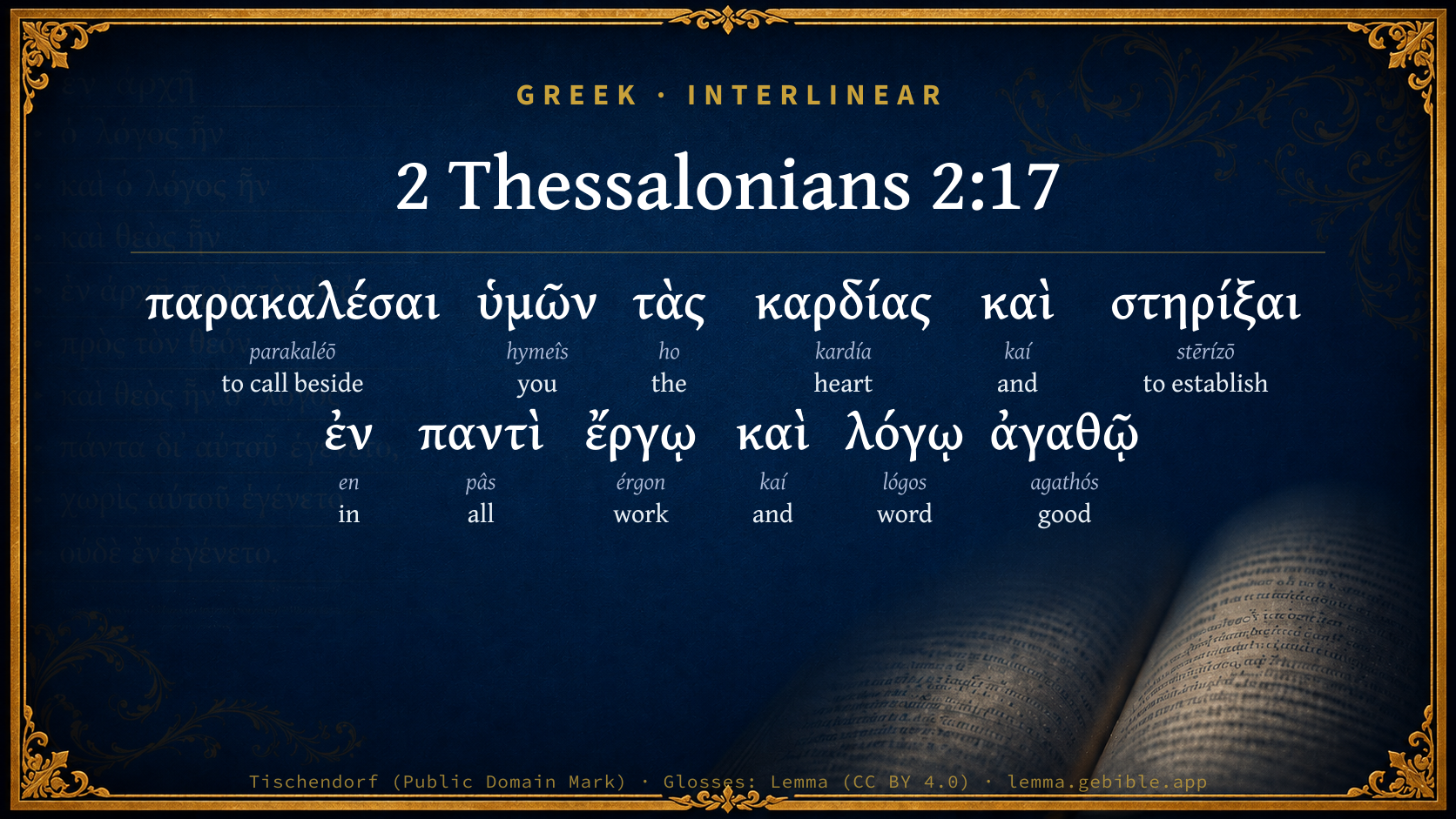
Greek (Tischendorf 8th ed.) 2 Thessalonians 2:17 appears in the Greek New Testament. The text above is from the Tischendorf 8th edition. Each word links to its Strong’s number and a concise gloss. Click any word for its full Thayer’s Greek Lexicon entry.
Download image
Cite this verse

2 Thessalonians 2:17 (World English Bible). Public Domain. Lemma interlinear Bible study tool, https://lemma.gebible.app/v/2-thessalonians/2/17.

Show BibTeX & RIS
BibTeX
RIS
English Translation
comfort your hearts and establish you in every good work and word.
World English Bible · Public Domain
Download a study sheet

One document with this verse’s original text, its word-by-word gloss line, the meaning frame, cross-references with their text, attributed commentary, and full source and license credits — printable, and it pastes into notes with its structure intact.

This verse Autodidact and up

Study sheet (.html) Plain text (.txt)

A passage Seminary Student

Up to 50 verses in one chapter. A passage sheet keeps up to 6 commentary sources and 12 cross-references per verse, in the order this page ranks them, and says so on the sheet whenever that leaves anything out. Ask for a single verse and you get the Autodidact verse sheet above.

Everything on this page stays free to read, with no account — the sheet is a download of what is already on screen, not access to it.

Want to remove ads? Support Godless Engineer
Compare translations 3

The same verse in 3 English versions, stacked beneath the original-language interlinear above. Click any original word for its lexicon entry.

Each is an independent rendering of the whole verse — the interlinear is not word-aligned to these translations.

Highlighted words mark where these versions differ — a whole-verse word diff, not a word-by-word alignment.

  • World English Bible Public Domain
    comfort your hearts and establish you in every good work and word.
  • King James Version Public Domain
    Comfort your hearts, and stablish you in every good word and work.
  • unfoldingWord Literal Text CC BY-SA 4.0
    may he comfort and strengthen your hearts in every good work and word.

unfoldingWord Literal Text — © unfoldingWord, licensed CC BY-SA 4.0. Word-aligned USFM3 via Door43 (git.door43.org/unfoldingWord/en_ult).

Versions to compare (up to 4)

3 of 4 selected

Show all 18 translations

Every available English version of this verse, each an independent rendering of the whole verse.

  • World English Bible Public Domain
    comfort your hearts and establish you in every good work and word.
  • Berean Standard Bible Public Domain
    encourage your hearts and strengthen you in every good word and deed.
  • Majority Standard Bible Public Domain
    encourage your hearts and strengthen you in every good word and deed.
  • King James Version Public Domain
    Comfort your hearts, and stablish you in every good word and work.
  • American Standard Version (1901) Public Domain
    comfort your hearts and establish them in every good work and word.
  • Revised Version (1885) Public Domain
    comfort your hearts and stablish them in every good work and word.
  • Geneva Bible (1599) Public Domain
    Comfort your hearts, and stablish you in euery word and good worke.
  • Young's Literal Translation Public Domain
    comfort your hearts, and establish you in every good word and work.
  • Literal Standard Version CC BY-SA 4.0
    comfort your hearts, and establish you in every good word and work.
  • Unlocked Literal Bible CC BY-SA 4.0
    comfort and establish your hearts in every good work and word.
  • unfoldingWord Literal Text CC BY-SA 4.0
    may he comfort and strengthen your hearts in every good work and word.
  • Darby Bible Public Domain
    encourage your hearts, and establish you in every good work and word.
  • World Messianic Bible Public Domain
    comfort your hearts and establish you in every good work and word.
  • Webster's Bible Public Domain
    Comfort your hearts, and establish you in every good word and work.
  • Free Bible Version CC BY-SA 4.0
    encourage you and strengthen you so you can say and do everything that is good.
  • Bible in Basic English Public Domain
    Give you comfort and strength in every good work and word.
  • Text-Critical English NT CC BY 4.0
    comfort your hearts and establish you in every good word and work.
  • Tyndale New Testament (1534) Public Domain
    comforte youre hertes and stablysshe you in all doctrine and good doynge.

Literal Standard Version (2020), Covenant Press — licensed CC BY-SA 4.0. Text via the HelloAO Bible API (eBible.org). Unlocked Literal Bible (unfoldingWord) — licensed CC BY-SA 4.0. Text via the HelloAO Bible API (eBible.org). unfoldingWord Literal Text — © unfoldingWord, licensed CC BY-SA 4.0. Word-aligned USFM3 via Door43 (git.door43.org/unfoldingWord/en_ult). Free Bible Version, Dr. Jonathan Gallagher — licensed CC BY-SA 4.0. Text via the HelloAO Bible API (eBible.org).

Word by word

More ways to search: Search by grammar → Find every occurrence → Compare this word →

Practice this passage: Drill this verse → Learn its vocabulary →

About this verse

These counts appear in no published source. They are computed here, from the morphology-tagged text and Lemma’s own curated glosses. What Lemma adds →

12
words
11
distinct lemmas
Pauline Epistles
section

Notable vocabulary

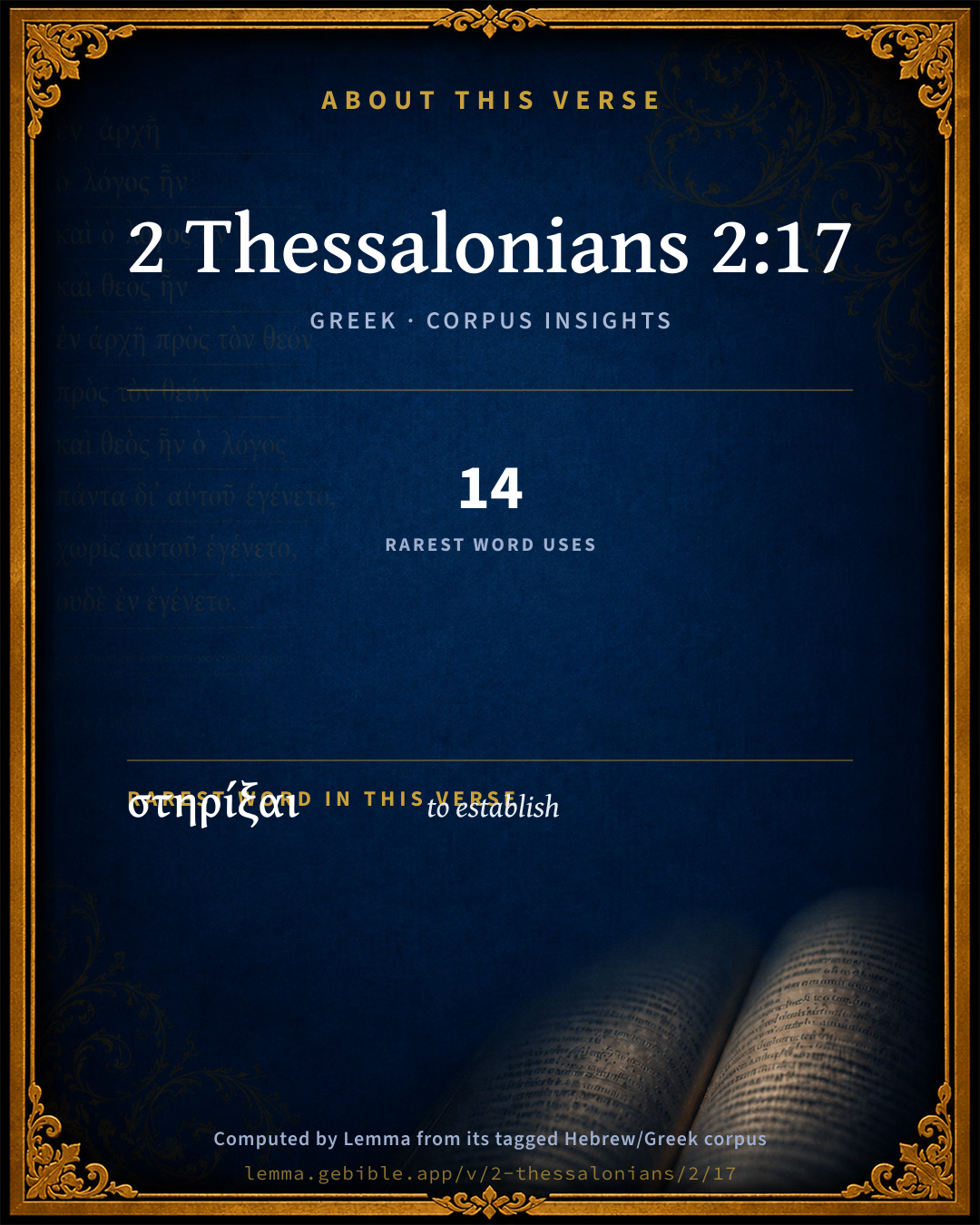
The rarest word here is στηρίξαι to establish G4741 — appearing just 14 times in the whole Greek New Testament.

Shared distinctive vocabulary

στηρίξαι to establish G4741 occurs in 14 verses of the Greek New Testament. Also found in:

Repetition

A word recurs within this verse:

Cross-references

20

Topical passages linked to 2 Thessalonians 2:17 in the Treasury of Scripture Knowledge — connected by theme and wording, ordered by reader-vote popularity; previews shown in the World English Bible.

  • 2 Thessalonians 3:3 But the Lord is faithful, who will establish you, and guard you from the evil one.
  • 1 Thessalonians 3:13 to the end he may establish your hearts blameless in holiness before our God and Father, at the coming of our Lord Jesus with all his saints.
  • 1 Thessalonians 3:2 and sent Timothy, our brother and God's servant in the Gospel of Christ, to establish you, and to comfort you concerning your faith;
  • 1 Corinthians 1:8 who will also confirm you until the end, blameless in the day of our Lord Jesus Christ.
  • Colossians 2:7 rooted and built up in him, and established in the faith, even as you were taught, abounding in it in thanksgiving.
  • Hebrews 13:9 Don't be carried away by various and strange teachings, for it is good that the heart be established by grace, not by food, through which those who were so occupied were not benefited.
  • Jude 1:24 Now to him who is able to keep them from stumbling, and to present you faultless before the presence of his glory in great joy,
  • Romans 15:13 Now may the God of hope fill you with all joy and peace in believing, that you may abound in hope, in the power of the Holy Spirit.
  • Isaiah 57:15 For thus says the high and lofty One who inhabits eternity, whose name is Holy: I dwell in the high and holy place, with him also who is of a contrite and humble spirit, to revive the spirit of the humble, and to revive the heart of the contrite.
  • Isaiah 66:13 As one whom his mother comforts, so will I comfort you; and you shall be comforted in Jerusalem.
  • Romans 16:25
  • 2 Corinthians 1:3–6 Blessed be the God and Father of our Lord Jesus Christ, the Father of mercies and God of all comfort;
  • 2 Corinthians 1:21 Now he who establishes us with you in Christ, and anointed us, is God;
  • 2 Thessalonians 2:16 Now our Lord Jesus Christ himself, and God our Father, who loved us and gave us eternal comfort and good hope through grace,
  • James 1:21–22 Therefore, putting away all filthiness and overflowing of wickedness, receive with humility the implanted word, which is able to save your souls.
  • 1 Peter 5:10 But may the God of all grace, who called you to his eternal glory by Christ Jesus, after you have suffered a little while, perfect, establish, strengthen, and settle you.
  • 1 John 3:18 My little children, let's not love in word only, neither with the tongue only, but in deed and truth.
  • Isaiah 51:3 For Yahweh has comforted Zion; he has comforted all her waste places, and has made her wilderness like Eden, and her desert like the garden of Yahweh; joy and gladness shall be found therein, thanksgiving, and the voice of melody.
  • Isaiah 61:1–2 The Spirit of the Lord Yahweh is on me; because Yahweh has anointed me to preach good news to the humble; he has sent me to bind up the broken-hearted, to proclaim liberty to the captives, and the opening [of the prison] to those who are bound;
  • Isaiah 62:7 and give him no rest, until he establish, and until he make Jerusalem a praise in the earth.

Cross-references courtesy of OpenBible.info (CC BY 4.0).

Commentary

Notes on 2 Thessalonians 2:17 from classic Christian and Jewish commentators (each source and its license shown beneath its notes). The classic Christian expositions comment on the surrounding passage and are grouped to its opening verse, so a note may address several verses; the Jewish commentaries on the Tanakh (Rashi and others) are per-verse, so they appear only where the commentator wrote on this verse.

Lemma curates 59 commentaries, every one of them public domain or Creative Commons licensed, each selected and text-cleaned for this edition rather than reprinted as found. About our sources →

The Biblical Illustrator

Joseph S. Exell

2Th_2:17

Comfort your hearts and stablish you in every good word and work

Divine comfort

I.

Comfort.

1. What it is.

(1) Our natural refreshment. We cannot enjoy our temporal mercies with any delight without Gods blessing (Ecc_2:24; Ecc_3:13; Act_14:17).

(2) Our support in troubles (Psa_119:50; 2Co_1:4; Act_9:31).

(a) God can give His people comfort in the greatest tribulation (Isa_12:1-6). As long as we have God to stand by us and the promise of eternal life trouble will be counterbalanced (Rom_5:2-3; 2Co_4:17; Isa_40:1-2; Mat_9:2).

(b) There is special allowance of comfort for Gods people in affliction (1Pe_4:14). As the mother keeps most with the sick child, so God looks to the afflicted. This is the difference between God and the world; the world ever runs after those that are prosperous, as rivers into the sea, where there are waters enough.

(c) Our comforts carry proportion with our sorrows (2Co_1:5; 1Co_10:13).

2. What it is to have our hearts comforted. The heart is the proper seat of spiritual comfort (Psa_4:7). Gods comfort is like a soaking shower that goes to the root, whereas the dew only wets the surface. Other comforts refresh the outward man. The joy of the world makes a great noise but leaves the heart sorrowful. God in dealing with the heart uses means, but His Spirit works immediately by--

(1) Opening the understanding to see the grounds of comfort (Rom_15:13).

(2) By raising the heart to the lively act of joy (Act_13:52).

3. In what sense it is of God.

(1) When it is allowed by Him (Ecc_5:18).

(2) When the matter is provided by Him (Joh_14:1).

(3) When by these means He worketh comfort (Rom_14:17).

II. Why this is of God.

1. Because God challenges as His own the right to comfort the heart (Job_34:29).

2. Though the grounds of comfort be never so clear, yet if God concur not, we find not the effect.

3. Because of the advantages springing from this source. Our comforts--

(1) Come with more authority, and silence all our doubts and fears (Psa_94:19). If comfort be made of our own fancy it will be like a spiders web that is weaved out of its own bowels, but is easily swept away.

(2) Are full and strong. For God works like Himself, and therefore can and will support His people in the greatest difficulties.

(a) They are full (Act_13:52; 2Co_7:4; Joh_15:11).

(b) Strong (Heb_6:18).

III. The uses.

1. To reprove Christians for over-much dejection and fainting in troubles. Why are we so much cast down? Is there no balm in Gilead or comfort in God?

2. If all comfort be of God, let us go to Him for it.

(1) See that you are qualified for it. Comfort follows holiness, as heat fire. The Spirit is first a Sanctifier and then a Comforter (Eph_1:13-14).

(2) Expect not a singular way of comfort besides the Word, prayer, Lords supper, etc.

3. Consider the ends for which God gives comfort--to fortify us against the enemies of our salvation. (T. Manton, D. D.)

Divine comfort

When a man walketh in the sun, if his face be towards it, he hath nothing before him but bright shining light and comfortable heat; but let him once tram his back to the sun what hath he before him but a shadow? And what is a shadow but the privation of light and heat of the sun? Yea: it is but to behold his own shadow, defrauding himself of the other. Thus there is no true wisdom, happiness, comfort, but in beholding the countenance of God; look from that and we lose these blessings. And what shall we gain? A shadow, an empty image of ourselves instead of the reconciled face of God. (J. Spencer.)

Establishment

I. What it is. Confirmation in the grace we have received. It must be distinguished--

1. With respect to the power wherewith we are assisted. There is--

(1) Habitual confirmation, when habits of grace are more settled and increased.

(a) Faith: for we stand by faith (Rom_11:20; 1Pe_1:5 : Luk_22:32).

(b) Love (Son_8:6-7).

(c) Hope (Heb_6:19).

(2) Actual establishment, when these habits are fortified and quickened by the actual influence, of God; otherwise neither stability of resolutions (Psa_73:2), nor of gracious habits (Rev_3:2) will support us.

2. With respect to the matter about which it is conversant--stability.

(1) In the doctrine of faith (1Th_5:21; Jer_6:16). We ought to be well settled lest our fluctuating opinions breed unbelief in others and shame to ourselves. Yet while we cry up constancy we must not cherish prejudice which shuts the door on the light.

(2) In every good work, or holiness of life. Here the greatest establishment is needed. It is ill when the mind is tainted, but worse when the heart is alienated (1Th_3:13). This is difficult.

(a) Because of the contrariety of the principles that are within us (Gal_5:17). The garrison is not free from danger that has an enemy lodged within.

(b) Because it is more hard to continue in conversion than to be converted. The latter is more passive, the former active.

3. With respect to the subject in which it is seated: the soul with its faculties.

(1) The mind is established when we have a clear, certain, and full apprehension of the truth of the gospel (Col_2:2).

(2) The will is established when it is firmly and thoroughly resolved for God against sin (Act_11:23; Psa_27:4; 1Pe_4:1).

(3) The affections are established when they stir us up to do what the mind is convinced of, and the will resolved upon as to the necessary duties in order to eternal happiness (Psa_119:32).

(a) Love fills us with delight (Psa_40:8; 1Jn_5:3; Psa_112:1).

(b) Hope bears us up (Heb_3:6).

4. With respect to the uses which it serves.

(1) Doing the will of God with delight, cheerfulness, and constancy (Eph_3:16).

(2) Bearing afflictions with honour to God and safety to ourselves (Php_4:13; Col_1:11).

(3) Withstanding temptations (Eph_6:10).

5. With respect to the degree, it is such a strengthening of the soul as prevents not only our fall but our shaking (1Co_15:28; Eph_3:17; Col_1:23).

II. How needful it is.

1. Man at best is but a creature. As providence is a continual creation, so stablishing grace is the continuance of the new creation (2Co_1:21).

2. The indisposition of our natures.

(1) To every good word. The truths of the gospel are supernatural and must be settled and preserved by Divine power (Eph_2:8).

(2) To every good work (Jer_14:10; Psa_95:10).

3. In regard of those oppositions that are made against us after conversion. Satan pursues us ever (Col_1:13, cf. 1Jn_4:4); therefore there must be the same power to stablish us in grace that first brought us into a state of grace.

4. The saints miscarry when God withdraws His supporting grace, as Peter, David, etc. (Psa_51:1-19; 2Ch_32:31).

III. Why it is to be sought of God.

1. He only is able (Rom_16:25; Jud_1:24; 2Ti_1:12).

2. He is willing (2Co_1:10; 2Ti_4:17-18).

3. He has promised (Psa_73:23).

4. This is the experience of saints (Psa_94:18).

Conclusion: Look up to God for establishment.

1. When you begin to decline and grow indifferent in the practice of godliness. If grace be weak, you must get it strengthened (Psa_17:5; Psa_119:133).

2. In unsettled times when we are full of fears, and think we shall never hold out (Psa_16:8). (T. Manton, D. D.)

Sustained by Christ

There are men and women here who would have been dead twenty years ago but for Jesus. They have gone through trial enough to exhaust ten times their physical strength. Their property went, their health went, their families were scattered. God only knows what they suffered. They are an amazement to themselves that they have been able to stand it. They look at their once happy home, surrounded by all comfort. Gone! They think of the time when they used to rise strong in the morning and walk vigorously down the street, and had experienced a health they thought inexhaustible. Gone! Everything but Jesus. He has pitied them. His eye has watched them. His omnipotence has defended them. Yes, He has been with them. They have gone through disaster, and He was a pillar of fire by night. They have gone across stormy Galilee, but Christ had His foot on the neck of the storm. (T. De Witt Talmage.)

The Biblical Illustrator, edited by Joseph S. Exell (c. 1880s–1900s) — public domain. Text from a community e-Sword module.

Tyndale Open Study Notes

Tyndale Open Resources

2:17 Paul’s prayer echoes the purpose of Timothy’s visit to the church—to strengthen and encourage the Thessalonian believers in their faith (1 Thes 3:2). • To comfort you does not merely mean to console, but to exhort or encourage them because of their fears and doubts (2 Thes 2:1-12; 1 Thes 4:18; 5:11).

Tyndale Open Study Notes — © Tyndale Open Resources, licensed CC BY-SA 4.0. Text via the HelloAO Bible API.

Bengel's Gnomon

Johann Albrecht Bengel

2Th 2:17. Παρακαλέσαι, comfort, console [‘adhortetur,’ liter, give consoling, comforting exhortation]) This is deduced from who hath given (us) παράκλησιν, consolation [2Th 2:16].—στηρίξαι, establish) This is deduced from who hath given (us) good hope through grace.—λόγῳ,[23] in word) by παράκλησι, consolation.—ἔργῳ, work) by στήριξιν, establishment, 1Co 15:58.

[23] The margin of both Ed. and the Germ. Vers. prefer the reading ἔργω καὶ λόγῳ in the inverse order.—E. B.

ABD(Δ)f Vulg. read ἔργῳ καὶ λόγῳ. Gg and Rec. Text read λόγῳ καὶ ἔργῳ.—ED.

—————

Bengel's Gnomon of the New Testament — English translation (T&T Clark, Edinburgh, 1860) — public domain. Text from a community e-Sword module.

Expositor's Greek Testament

ed. W. Robertson Nicoll

2Th 2:17 , in contrast to the disquiet and confusion of 2Th 2:2 . ἔργῳ as in 2Th 1:11 , 2Th 3:4 ; 2Th 3:7 f., λόγῳ as 2Th 3:1 ; 2Th 3:15 ; 1Th 1:8 . See the fulsome pagan inscription of Halicarnassus, which after giving thanks for the birth of Augustus, σωτῆρα τοῦ κοινοῦ τῶν ἀνθρώπων γένους , declares that men now are full of ἐλπίδων μὲν χρηστῶν πρὸς τὸ μέλλον , εὐθυμίας δὲ εἰς τὸ παρόν . Contrast also the κενὴ ἐλπίς of the impious in Sap. 2Th 3:11 .

The Expositor's Greek Testament, edited by W. Robertson Nicoll (1897–1910) — public domain. Text from a community e-Sword module.

Jamieson, Fausset & Brown

Robert Jamieson, A. R. Fausset & David Brown

Comfort your hearts--unsettled as you have been through those who announced the immediate coming of the Lord.

good word and work--The oldest manuscripts invert the order, "work and word." Establishment in these were what the young converts at Thessalonica needed, not fanatical teaching (compare Co1 15:58).

Next: 2 Thessalonians Chapter 3

Jamieson, Fausset & Brown — Commentary Critical and Explanatory on the Whole Bible (1871) — public domain (CC PDM 1.0). Text via the HelloAO Bible API.

Adam Clarke's Commentary

Verse 17. Comfort your hearts] Keep your souls ever under the influence of his Holy Spirit: and stablish you-confirm and strengthen you in your belief of every good word or doctrine, which we have delivered unto you; and in the practice of every good work, recommended and enjoined by the doctrines of the Gospel.

It is not enough that we believe the truth; we must love the truth. Antinomianism says: "Believe the doctrines, and ye are safe." The testimony borne by the Gospel is: Believe, love, obey: none of these can subsist without the other. The faith of a devil may exist without loving obedience; but the faith of a true believer worketh by love; and this faith and love have not respect to some one commandment, but to all; for God writes his whole law on the heart of every genuine Christian, and gives him that love which is the fulfilling of the law.

THE reader will have observed that, in going through this chapter, while examining the import of every leading word, I have avoided fixing any specific meaning to terms: the apostasy or falling away; the man of sin; son of perdition; him who letteth or withholdeth, c. The reason is, I have found it extremely difficult to fix any sense to my own satisfaction and it was natural for me to think that, if I could not satisfy myself, it was not likely I could satisfy my readers. But, as something should be said relative to the persons and things intended by the apostle, I choose to give rather what others have said, than attempt any new mode of interpretation. The great variety of explanations given by wise and learned men only prove the difficulty of the place.

1. The general run of Protestant writers understand the whole as referring to the popes and Church of Rome, or the whole system of the papacy.

2. Others think that the defection of the Jewish nation, from their allegiance to the Roman emperor, is what is to be understood by the apostasy or falling off; and that all the other terms refer to the destruction of Jerusalem.

3. The fathers understood the Antichrist to be intended, but of this person they seem to have formed no specific idea.

4. Dr. Hammond refers the apostasy to the defection of the primitive Christians to the Gnostic heresy; and supposes that, by the man of sin and son of perdition, Simon Magus is meant.

5. Grotius applies the whole to Caius Caesar.

6. Wetstein applies the apostasy to the rebellion and slaughter of the three princes that were proclaimed by the Roman armies, previously to the reign of Vespasian; and supposes Titus and the Flavian family to be intended by the man of sin and son of perdition.

7. Schoettgen contends strongly that the whole refers to the case of the Jews, incited to rebellion by the scribes and Pharisees, and to the utter and final destruction of the rabbinic and Pharisaic system; and thinks he finds something in their spirit and conduct, and in what has happened to them, to illustrate every word in this prophecy. Dr. Whitby is nearly of the same sentiments.

8. Calmet follows, in the main, the interpretation given by the ancient fathers; and wonders at the want of candour in the Protestant writers, who have gleaned up every abusive tale against the bishops and Church of Rome; and asks them, would they be willing that the Catholics should credit all the aspersions cast on Protestantism by its enemies?

9. Bishop Newton has examined the whole prophecy with his usual skill and judgment. The sum of what he says, as abridged by Dr. Dodd, I think it right to subjoin. The principal part of modern commentators follow his steps. He applies the whole to the Romish Church: the apostasy, its defection from the pure doctrines of Christianity; and the man of sin, c. the general succession of the popes of Rome. But we must hear him for himself, as he takes up the subject in the order of the verses.

Verses 3, 4. For that day shall not come, except, c.-"The day of Christ shall not come except there come the apostasy first." The apostasy here described is plainly not of a civil but of a religious nature not a revolt from the government, but a defection from the true religion and worship. In the original, it is the apostasy, with an article to give it an emphasis the article being added signifies, "that famous and before-mentioned prophecy." So likewise is the man of sin with the like article, and the like emphasis. If, then, the notion of the man of sin be derived from any ancient prophet, it must be derived from Da 7:25; Da 11:36. Any man may be satisfied that St. Paul alluded to Daniel's description, because he has not only borrowed the same ideas, but has even adopted some of the phrases and expressions. The man of sin may signify either a single man, or a succession of men; a succession of men being meant in Daniel, it is probable that the same was intended here also. It is the more probable, because a single man appears hardly sufficient for the work here assigned; and it is agreeable to the phraseology of Scripture, and especially to that of the prophets, to speak of a body or number of men, under the character of one: thus, a king, Da 7:8; Re 17:1-18, is used for a succession of kings. The man of sin being to be expressed from Da 7:24, according to the Greek translation, He shall exceed in evil all that went before him; and he may fulfil the character either by promoting wickedness in general, or by advancing idolatry in particular, as the word sin signifies frequently in Scripture. The son of perdition is also the denomination of the traitor Judas, Joh 17:12, which implies that the man of sin should be, like Judas, a false apostle; like him, betray Christ; and, like him, be devoted to destruction. Who opposeth, c., is manifestly copied from Daniel, He shall exalt himself, c. The features exactly resemble each other: He opposeth and exalteth himself above all or, according to the Greek, above every one that is called God, or that is worshipped. The Greek word for worshipped is σεβασμα, alluding to the Greek title of the Roman emperors, σεβαστος, which signifies august or venerable. He shall oppose for the prophets speak of things future as present; he shall oppose and exalt himself, not only above inferior magistrates, (who are sometimes called gods in holy writ,) but even above the greatest emperors; and shall arrogate to himself Divine honours. So that he, as God, sitteth in the temple, c. By the temple of God the apostle could not well mean the temple of Jerusalem because that, he knew, would be destroyed within a few years. After the death of Christ the temple of Jerusalem is never called by the apostles the temple of God; and if at any time they make mention of the house or temple of God, they mean the Church in general, or every particular believer. Who ever will consult 1Co 3:16-17; 2Co 6:16; 1Ti 3:15; Re 3:12; will want no examples to prove that, under the Gospel dispensation, the temple of God is the Church of Christ; and the man of sin sitting implies this ruling and presiding there; and sitting there as God implies his claiming Divine authority in things spiritual as well as temporal; and showing himself that he is God, implies his doing it with ostentation.

Verses 5, 6, 7. Remember ye not, c.-The apostle thought it part of his duty, as he made it a part of his preaching and doctrine, to forewarn his new converts of the grand apostasy that would infect the Church, even while he was at Thessalonica. From these verses it appears that the man of sin was not then revealed his time was not yet come, or the season of his manifestation. The mystery of iniquity was indeed already working; the seeds of corruption were sown, but they were not grown up to maturity; the man of sin was yet hardly conceived in the womb; it must be some time before he could be brought forth; there was some obstacle that hindered his appearing. What this was we cannot determine with absolute certainty at so great a distance of time; but if we may rely upon the concurrent testimony of the fathers, it was the Roman empire. Most probably it was somewhat relating to the higher powers, because the apostle observes such caution; he mentioned it in discourse, but would not commit it to writing.

Verse 8. Then shall that Wicked be revealed.-When the obstacle, mentioned in the preceding verse, should be removed, then shall that wicked, c. Nothing can be plainer than that the lawless, (οανομος,) as the Greek signifies, the wicked one, here mentioned, and the man of sin, must be one and the same person. The apostle was speaking before of what hindered that he should be revealed, and would continue to hinder it till it was taken away and then the wicked one, c. Not that he should be consumed immediately after he was revealed. But the apostle, to comfort the Thessalonians, no sooner mentions his revelation than he foretells also his destruction, even before he describes his other qualifications. His other qualifications should have been described first, in order of time but the apostle hastens to what was first and warmest in his thoughts and wishes: Whom the Lord shall consume, c. If these two clauses refer to two distinct and different events, the meaning manifestly is, that the Lord Jesus shall gradually consume him with the free preaching and publication of his word and shall utterly destroy him at his second coming, in the glory of his Father, with all the holy angels. If these two clauses relate to one and the same event, it is a pleonasm very usual in the sacred, as well as other oriental writings; and the purport plainly is, that the Lord Jesus shall destroy him with the greatest facility, when he shall be revealed from heaven, as the apostle has expressed it in the preceding chapter.

Verses 9-12. Whose coming is after, c.-The apostle was eager to foretell the destruction of the man of sin and for this purpose having broken in upon his subject, he now returns to it again, and describes the other qualifications by which this wicked one should advance and establish himself in the world. He should rise to credit and authority by the most diabolical methods; should pretend to supernatural powers; and boast of revelations, visions, and miracles, false in themselves, and applied to promote false doctrines.

Verse 9. He should likewise practise all other wicked acts of deceit; should be guilty of the most impious frauds and impositions upon mankind; but should prevail only among those who are destitute of a sincere affection for the truth; whereby they might attain eternal salvation.

Verse 10. And indeed it is a just and righteous judgment of God, to give them over to vanities and lies in this world, and to condemnation in the next, who have no regard to truth and virtue, but delight in falsehood and wickedness; 2Th 2:11-12.

Upon this survey there appears little room to doubt of the genuine sense and meaning of the passage. The Thessalonians, as we have seen from some expressions in the former epistle, were alarmed as if the end of the world was at hand. The apostle, to correct their mistake and dissipate their fears, assures them that a great apostasy, or defection of the Christians from the true faith and worship, must happen before the coming of Christ. This apostasy all the concurrent marks and characters will justify us in charging upon the Church of Rome. The true Christian worship is the worship of the one only God, through the one only Mediator, the man Christ Jesus; and from this worship the Church of Rome has most notoriously departed, by substituting other mediators, and invocating and adoring saints and angels, nothing is apostasy, if idolatry be not. And are not the members of the Church of Rome guilty of idolatry in the worship of images, in the adoration of the host, in the invocation of angels and saints, and in the oblation of prayers and praises to the Virgin Mary, as much or more than to God blessed for ever? This is the grand corruption of the Christian Church: this is the apostasy as it is emphatically called, and deserves to be called; which was not only predicted by St. Paul, but by the Prophet Daniel likewise. If the apostasy be rightly charged upon the Church of Rome, it follows of consequence that the man of sin is the pope; not meaning any pope in particular, but the pope in general, as the chief head and supporter of this apostasy. He is properly the man of sin, not only on account of the scandalous lives of many popes, but by reason of their most scandalous doctrines and principles; dispensing with the most necessary duties; and granting, or rather selling, pardons and indulgences to the most abominable crimes. Or, if by sin be meant idolatry in particular, as in the Old Testament, it is evident how he has perverted the worship of God to superstition and idolatry of the grossest kind. He also, like the false apostle, Judas, is the son of perdition; whether actively, as being the cause of destruction to others; or passively, as being devoted to destruction himself. He opposeth-he is the great adversary of God and man; persecuting and destroying, by croisades, inquisitions, and massacres, those Christians who prefer the word of God to the authority of men. The heathen emperor of Rome may have slain his thousands of innocent Christians; but the Christian bishop of Rome has slain his ten thousands. He exalteth himself above all that is called God, or is worshipped-not only above inferior magistrates, but likewise above bishops and primates; not only above bishops and primates, but likewise above kings and emperors; deposing some, obliging them to kiss his toe, to hold his stirrup, treading even upon the neck of a king, and kicking off the imperial crown with his foot; nay, not only kings and emperors, but likewise above Christ and God himself; making even the word of God of none effect by his traditions-forbidding what God has commanded; as marriage, the use of the Scriptures, c. and also commanding or allowing what God has forbidden, as idolatry, persecution, c. So that he, as God, sitteth in the temple of God, c. he is therefore in profession a Christian, and a Christian bishop. His sitting in the temple of God implies plainly his having a seat or cathedra in the Christian Church and he sitteth there as God, especially at his inauguration, when he sits upon the high altar in St. Peter's church, and makes the table of the Lord his footstool, and in that position receives adoration. At all times he exercises Divine authority in the Church, showing himself that he is God-affecting Divine titles, and asserting that his decrees are of the same or greater authority than the word of God. So that the pope is evidently, according to the titles given him in the public decretals, The God upon earth; at least there is no one, like him, who exalteth himself above every god; no one, like him, who sitteth as God in the temple of God, showing himself that he is God. The foundations of popery were laid in the apostle's days, but of which the superstructure was raised by degrees; and several ages passed before the building was completed, and the man of sin revealed in full perfection. The tradition that generally prevailed was that that which hindered was the Roman empire: this tradition might have been derived even from the apostle himself; and therefore the primitive Christians, in the public offices of the Church, prayed for its peace and welfare, as knowing that, when the Roman empire should be dissolved and broken in pieces, the empire of the man of sin would be raised upon its ruins. In the same proportion as the power of the empire decreased, the authority of the Church increased, and the latter at the expense and ruin of the former; till at length the pope grew up above all, and the wicked, or lawless one, was fully manifested and revealed. His coming is after the energy of Satan, c and does it require any particular proof that the pretensions of the pope, and the corruption of the Church of Rome, are all supported and authorized by feigned visions and miracles, by pious frauds and impositions of every kind? But how much soever the man of sin may be exalted, and how long soever he may reign, yet at last the Lord shall consume him, c. This is partly taken from Isa 11:4, And with the breath of his lips shall he slay the wicked one where the Jews put an emphasis upon the words the wicked one; as appears from the Chaldee, which renders it, "He shall destroy the wicked Roman." If the two clauses, as said in the note on 2Th 2:8, relate to two different events, the meaning is, "that the Lord Jesus shall gradually consume him with the free preaching of the Gospel; and shall utterly destroy him at his second coming in the glory of the Father." The former began to take effect at the Reformation; and the latter will be accomplished in God's appointed time. The man of sin is now upon the decline, and he will be totally abolished when Christ shall come in judgment. Justin Martyr, Tertullian, Origen, Lactantius, Cyril of Jerusalem, Ambrose, Hilary, Jerome, Augustine, and Chrysostom, give much the same interpretation that has here been given of the whole passage. And it must be owned that this is the genuine meaning of the apostle; that this only is consistent with the context; that every other interpretation is forced and unnatural; that this is liable to no material objection; that it coincides perfectly with Daniel; that it is agreeable to the tradition of the primitive Church; and that it has been exactly fulfilled in all its particulars; which cannot be said of any other interpretation whatever. Such a prophecy as this is an illustrious proof of Divine revelation, and an excellent antidote to the poison of popery.

See the Dissertations on the Prophecies; and Dodd, as above.

10. Dr. Macknight proceeds, in general, on the plan of Bishop Newton; but, as he thinks that the apostle had the prophecy of Daniel, in Dan. 7, and 8, particularly in view, he collates his words with those of the prophet in the following way: -

2Th 2:3. That man of sin be revealed, the son of perdition - Ὁ ανθρωπος της ἁμαρτιας, ὁ υἱος της απωλειας· "The article," says he, "joined to these appellations, is emphatical, as in the former clause, importing that the ancient prophets had spoken of these persons, though under different names; particularly the Prophet Daniel, whose description of the little horn and blasphemous king agrees so exactly in meaning with Paul's descriptions of the man of sin, and son of perdition, and lawless one, that there can be little doubt of their being the same persons; but this will best appear by a comparison of the passages: -

2Th 2:3. And that man of sin be revealed, the son of perdition. Dan 7:21. And the same horn made war with the saints, and prevailed against them.

Dan 7:25. And he shall speak great words against the Most High; and shall wear out the saints of the Most High. 2Th 2:4. Who opposeth and exalteth himself above all that is called God, or that is worshipped so that he, as God, sitteth in the temple of God, showing himself that he is God. Dan 11:36. And the king shall do according to his will; and he; shall exalt himself above every god, and shall speak marvellous things against the God of gods.

Dan 8:25. He shall also stand up against the Prince of princes. 2Th 2:7. Only he who now letteth will let, until he be taken out of the way. Dan 7:8. I considered the horns, and, behold, there came up among them another little horn, before whom there were three of the first horns plucked up by the roots. 2Th 2:8. And there shall that wicked one be revealed. Dan 7:25. And he shall think to change times and laws, and they shall be given into his hand. See Dan 8:24. 1Ti 4:1. Giving heed to seducing spirits, and doctrines of devils. Dan 11:38. In his estate he shall honor the god of forces (Mahuzzim, gods who are protectors, that is, tutelary angels and saints.) 1Ti 4:3. Forbidding to marry. Dan 11:37. Neither shall he regard the God of his fathers, nor the desire of women. 2Th 2:8. Whom the Lord shall consume with the Spirit mouth, and shall destroy with the brightness of his coming. Dan 7:11. I beheld then, because of his of the voice of the great words which the horn spake; I beheld, even till the beast was slain, and his body destroyed, and given to the burning flame.

Dan 7:26. And they shall take away his dominion, to consume and destroy it unto the end.

Dan 8:25. He shall be broken without hand.

After entering into great detail in his notes, he sums up in the following manner: - "Now as, in the prophecies of Daniel, empires governed by a succession of kings are denoted by a single emblem; such as, by a part of an image, a single beast, a horn, etc., of a beast; so in Paul's prophecy, the man of sin, and son of perdition, and the lawless one, may denote an impious tyranny, exercised by a succession of men who cause great misery and ruin to others; and who, at length, shall be destroyed themselves. It is true, the papists contend that one person only is meant by these appellations, because they are in the singular number, and have the Greek article prefixed to them. But in Scripture we find other words in the singular number, with the article, used to denote a multitude of persons; for example, Rom 1:17; ὁ δικαιος, the just one, by faith, shall live; that is, all just persons whatever: Tit 1:7; ὁ επισκοπος, the bishop must be blameless; that is, all bishops must be so: 2Jo 1:7; ὁ πλανος, the deceiver, signifies many deceivers, as is plain from the preceding clause, where many deceivers are said to have gone out. In like manner the false teachers, who deceived Christ's servants to commit fornication and idolatry, are called that woman Jezebel, Rev 2:20, and the whore of Babylon, Rev 17:5; and in this prophecy, Rev 17:7, the Roman emperors, and magistrates under them, are called ὁ κατεχων, he who restraineth. Farther, a succession of persons, arising one after another, is denoted by appellations in the singular number with the article; for example: the succession of the Jewish high priests is thus denoted in the laws concerning them, Lev 21:10, Lev 21:15; Num 35:25-28. As also the succession of the Jewish kings, Deu 17:14; 1Sa 8:11. From these examples, therefore, it is plain that the names, man of sin, son of perdition, lawless one, although in the singular number, and with the article prefixed, may, according to the Scripture idiom, denote a multitude, and even a succession of persons arising one after another.

"The facts and circumstances mentioned in these prophecies are, for the most part, so peculiarly marked, that they will not easily apply, except to the persons and events intended by the Spirit of God. And therefore, in every case where different interpretations have been given of any prophecy, the proper method of ascertaining its meaning is to compare the various events to which it is thought to relate with the words of the prophecy, and to adopt that as the event intended which most exactly agrees in all its parts to the prophetic description.

"According to this rule, though many different interpretations have been given of the prophecy under consideration, that, in my opinion, will appear the best founded which makes it a prediction of the corruptions of Christianity, which began to be introduced into the Church in the apostle's days, and wrought secretly all the time the heathen magistrates persecuted the Christians, but which showed themselves more openly after the empire received the faith of Christ, a.d. 312, and, by a gradual progress, ended in the monstrous errors and usurpations of the bishops of Rome, when the restraining power of the emperors was taken out of the way by the incursions of the barbarous nations, and the breaking of the empire into the ten kingdoms prefigured by the ten horns of Daniel's fourth beast. Now, to be convinced of this, we need only compare the rise and progress of the papal tyranny with the descriptions of the man of sin, and of the mystery of iniquity, given in the writings of Daniel and Paul.

"And first, we have shown in note 1, on 2Th 2:7, that the mystery of iniquity, or the corrupt doctrines which ended in the errors and usurpations of the see of Rome, was working secretly in the apostle's days, as he affirms, 2Th 2:7; and that the power of the Roman emperors, and of the magistrates under them, was that which then, and during the succeeding ages, restrained the mystery of iniquity in its working, and the man of sin from revealing himself. For, while the power of the state continued in the hands of the heathen rulers, and while they employed that power in persecuting the Christians, the corrupt doctrines and practices introduced by the false teachers did not spread so fast as otherwise they would have done. At least they were not produced to public view as the decisions of Heaven, to which all men were bound to pay implicit obedience. But, after the heathen magistrates were taken out of the way by the conversion of Constantine, and after he and his successors called the Christian bishops to meet in general councils, and enforced their assumption of Divine authority by the civil power; then did they in these councils arrogate to themselves the right of establishing what articles of faith and discipline they thought proper, and of anathematizing all who rejected their decrees; a claim which, in after times, the bishops of Rome transferred from general councils to themselves. It was in this period that the worship of saints and angels was introduced; celibacy was praised as the highest piety; meats of certain kinds were prohibited; and a variety of superstitious mortifications of the body were enjoined by the decrees of councils, in opposition to the express laws of God. In this period, likewise, idolatry and superstition were recommended to the people by false miracles, and every deceit which wickedness could suggest; such as the miraculous cures pretended to be performed by the bones and other relics of the martyrs, in order to induce the ignorant vulgar to worship them as mediators; the feigned visions of angels, who they said had appeared to this or that hermit, to recommend celibacy, fastings, mortifications of the body, and living in solitude; the apparitions of souls from purgatory, who begged that certain superstitions might be practised, for delivering them from that confinement: by all which, those assemblies of ecclesiastics, who by their decrees enjoined these practices, showed themselves to be the man of sin, and lawless one, in his first form, whose coming was to be with all power, and signs, and miracles of falsehood; and who opposed every one that is called god, or that is worshipped. For these general councils, by introducing the worship of saints and angels, robbed God of the worship due to him; and, by substituting saints and angels as mediators, in the place of Christ, they degraded him from his office as mediator, or rendered it altogether useless. However, though they thus opposed God and Christ by their unrighteous decrees, they did not yet exalt themselves above every one who is called God, or an object of worship; neither did they sit yet in the temple of God, as God, and openly show themselves to be God. These blasphemous extravagances were to be acted in after times by a number of particular persons in succession, I mean by the bishops of Rome, after the power of the Christian Roman emperors and of the magistrates under them, was taken out of the way. For the bishops of that see, having very early obtained from the Christian emperors decrees in their own favor, soon raised themselves above all other bishops; and, by a variety of artifices, made the authority and influence of the whole body of the clergy center in themselves; and claimed that infallible authority which was formerly exercised by general councils, of making articles of faith; and of establishing rules of discipline for the whole Christian community; and of determining, in the last resort, all differences among the clergy; and of anathematizing every one who did not submit to their unrighteous decisions. In this manner did the bishops of Rome establish in their own persons a spiritual dominion over the whole Christian world. But not content with this height of power, by dexterously employing the credit and influence which the ecclesiastics, now devoted to their will, had over the laity in all the countries where they lived, they interfered in many civil matters also; till at length they reared that intolerable fabric of spiritual and civil tyranny conjoined, whereby the understandings, the persons, and the properties, not of the laity only, but also of the clergy themselves, have for along time been most grievously enthralled, in all the countries where Christianity was professed.

"This height, however, of spiritual and civil tyranny united, the bishops of Rome did not attain till, as the apostle foretold, that which restrained was taken out of the way; or, till an end was put to the authority of the Roman emperors in the west, by the inroads of the barbarous nations; and, more especially, till the western empire was broken into the ten kingdoms, prefigured in Daniel's vision by the ten horns of the fourth beast; for then it was that the bishops of Rome made themselves the sovereigns of Rome and of its territory, and so became the little horn which Daniel beheld coming up among the ten horns, and which had the eyes of a man, and a mouth speaking great things; to show that its dominion was founded on the deepest policy, and that its strength consisted in the bulls, excommunications, and anathemas, which, with intolerable audacity, it uttered against all who opposed its usurpations. And in process of time, the bishops of Rome having got possession of three of the kingdoms into which the western empire was broken, signified by three of the horns of Daniel's fourth beast being plucked up by the roots before the little horn, they call themselves the vicars of Christ, on pretense that Christ had transferred his whole authority to them. They also thought to change times and laws, as Daniel foretold; for, as the vicars of Christ, they assumed the power of saving and damning men at their own pleasure; and altered the terms of salvation, making it depend, not on faith and holiness, but on the superstitious practices which they had established; and sold the pardon of sins past, and even the liberty of sinning for the future, for money. Moreover, they openly made war with the saints who resisted their corrupt doctrines and practices, and prevailed against them, and wore out the saints of the Most High; for, by the cruel and bloody persecutions which they obliged the princes who acknowledged their authority to carry on against those who adhered to the pure doctrines and worship of Christ, they destroyed incredible numbers of them. Nay, by the terror of their excommunications and interdicts, they forced even the most powerful sovereigns to bend to their yoke: thus with their mouth did they speak very great things. At length they assumed the right of conferring kingdoms and of deposing princes, and actually deposed some, with the help of the potentates of their communion, who put their mandates in execution. Lastly, to render this exercise of their tyranny the more effectual, they arrogated the power of loosing subjects from their oaths of allegiance; whereby they made void the most sacred of all moral obligations, the obligation of allegiance. But this impious scheme of false doctrine, and the spiritual tyranny built upon it, agreeably to the predictions of the Prophet Daniel and of the Apostle Paul, began at the Reformation to be consumed by the breath of the Lord's mouth; that is, by the Scriptures put into the hands of the laity, and by the preaching of true doctrine out of the Scriptures.

"Upon the whole, I think every impartial person who attentively considers the foregoing sketch must be sensible that, in the bishops of Rome, all the characters and actions ascribed by Daniel to the little horn, and by Paul to the man of sin and the lawless one, are clearly united. For, according to the strong workings of Satan, with all power, and signs, and miracles of falsehood, they have opposed Christ, and exalted themselves above all that is called god, or an object of worship; and have long sat in the temple of God, as God, showing themselves that they are God: that is, they exercise the power and prerogatives of God. And seeing, in the acquisition and exercise of their spiritual tyranny, they have trampled upon all laws, human and Divine; and have encouraged their votaries in the most enormous acts of wickedness; the Spirit of God has, with the greatest propriety, given them the appellations of the man of sin, the son of perdition, and the lawless one. Farther, as it is said the man of sin was to be revealed in his season, there can be little doubt that the dark ages, in which all learning was overturned by the irruption of the northern barbarians, were the season allotted to the man of sin for revealing himself. Accordingly, we know that in these ages the corruptions of Christianity and the usurpations of the clergy were carried to the greatest height. In short, the annals of the world cannot produce persons and events to which the things written in this passage can be applied with so much fitness as to the bishops of Rome. Why then should we be in any doubt concerning the interpretation and application of this famous prophecy?

"At the conclusion of our explication of the prophecy concerning the man of sin, it may be proper to observe, that the events foretold in it being such as never took place in the world before, and, in all probability, never will take place in it again; the foreknowledge of them was certainly a matter out of the reach of human conjecture or foresight. It is evident, therefore, that this prophecy, which from the beginning has stood on record, taken in conjunction with the accomplishment of it verified by the concurrent testimony of history, affords an illustrious proof of the Divine original of that revelation of which it makes a part, and of the inspiration of the person from whose mouth it proceeded." See Dr. Macknight's Commentary and Notes, vol. iii., p. 100, etc.

With all this evidence before him, the intelligent reader will now be enabled to judge for himself, and to adopt for his own that opinion which appears to be the best supported by circumstances and facts. The labors of the above learned men have certainly narrowed the principal subjects of inquiry; and we may now safely state that, in this very obscure prophecy, the Spirit of God had in view either the Jewish or an apostate Christian Church, possessing great spiritual and secular influence and jurisdiction. That the words appear to apply best to the conduct of many of the popes, and the corruptions of the Romish Church, needs no proof; but to which of these Churches, or to what other Church or system, we should apply them, some men, as eminent for their piety as for their learning, hesitate to declare: yet I must acknowledge, that the most pointed part of the evidence here adduced tends to fix the whole on the Romish Church, and on none other.

Whatever may be intended here by the words mystery of iniquity, we may safely assert that it is a mystery of iniquity to deny the use of the sacred Scriptures to the common people; and that the Church that does so is afraid to come to the light. Nothing can be more preposterous and monstrous than to call people to embrace the doctrines of Christianity, and refuse them the opportunity of consulting the book in which they are contained. Persons who are denied the use of the sacred writings may be manufactured into different forms and modes; and be mechanically led to believe certain dogmas, and perform certain religious acts; but without the use of the Scriptures, they never can be intelligent Christians; they do not search the Scriptures, and therefore they cannot know Him of whom these Scriptures testify. The mystery of iniquity contained in this prohibition works now, and has worked long; but did it work in the apostles' times? Did it work in the Church at Thessalonica? Is it possible that the present crop should have been produced from so remote a seed? What does that most solemn adjuration of the apostle, 1Th 5:27, mean? I charge you by the Lord, that this epistle be Read unto All the holy brethren. Why was such a charge necessary? Why should it be given in so awful a manner? Does it not absolutely imply that there would be attempts made to keep all the holy brethren from seeing this epistle? And can we conceive that less was referred to in the delivery of this very awful adjuration? This mystery of iniquity did work then in the Christian Church; even then attempts were made to hide the Scriptures from the common people. And does not this one consideration serve more to identify the prophecy than any thing else? Let him that readeth understand. See the notes on 1Th 5:27, and at the end of that chapter (note).

Adam Clarke's Commentary on the Bible (1810–1826) — public domain. Text from a community e-Sword/MySword module.

Ellicott's Commentary for English Readers

(17) Comfort your hearts . . .—“Comfort,” in reference to the “unending comfort” of 2Th_2:16; and “stablish,” in reference to the “good hope in grace.” The “heart” needs comfort as the seat of emotions. “In every good word and work” (it should be, work and word) means in the maintenance of every good doctrine (as opposed to the false teaching which had got abroad about the Advent, and to the lies of the Apostasy), and in the performance of every good practice (as opposed to the lawlessness of the Apostasy, and to the disorderly conduct of which the next chapter treats: for here, as in 1Th_3:13, the prayer forms an introduction of the next subject). The singular number of the verbs “comfort” and “stablish” (which, of course, does not appear in the English), may perhaps be explained as in 1Th_3:12, where see Note, though it is not necessary so to understand it, inasmuch as the intervening relative (in the Greek, participial) clauses have turned the whole attention to the Father, who may be considered exclusively as the grammatical subject of the verbs. It would, however, have been painful to orthodox ears; however justifiable doctrinally, to have used a plural verb. It is by these little incidental touches, still more than by express doctrinal statements, that we learn what was the real belief of the Apostles concerning the Divinity of Christ; and we may say the same with regard to many other great doctrines.

A Bible Commentary for English Readers, edited by Charles John Ellicott (1878–1897) — public domain. Text from a community e-Sword module.

The Cambridge Bible for Schools and Colleges

gen. ed. J. J. S. Perowne

17. comfort your hearts] Comp. ch. 2Th_3:5; 1Th_3:13; and the similar expression in Col_2:2. The “heart” is the inward man, the seat of our thoughts and emotions (see note, 1Th_2:4); there doubt and fear arise, which can be allayed only by Divine comforting. For this verb, comp. note on “consolation” above, and on 1Th_3:2.

and stablish you in every good word add work] Rather, establish them, i.e. your hearts, understood from the last clause. This expression was previously used in 1Th_3:13, see note. The Apostle does not mean, “May God make you steadfast in saying and doing all that is good,” for the “heart” neither speaks nor works; but rather, “May God give you courage and confidence of heart in all good that you say or do.” He knows that they are busy in doing good (1Th_1:3; 1Th_4:10), and he would have them do it with a good and cheerful heart (comp. 1Th_5:17-18).

The Cambridge Bible for Schools and Colleges (gen. ed. J. J. S. Perowne; Cambridge University Press, 1878–1918) — public domain. Text from a community e-Sword module.

John Gill's Exposition

Comfort your hearts,.... That is, apply the comfort given, and cause it to be received, which unbelief is apt to refuse; and increase it, by shedding abroad the love of Christ, and of the Father; by the discoveries of pardoning grace; by the application of Gospel promises; by the word and ordinances, which are breasts of consolation; and by indulging with the gracious presence, and comfortable communion of Father, Son, and Spirit. The Arabic version reads, "comfort your hearts by his grace", joining the last clause of the preceding verse to this. This petition stands opposed to a being troubled and distressed about the sudden coming of Christ, as the following one does to a being shaken in mind on that account, Th2 2:2.

And stablish you in every good word and work; that is, in every good word of God, or truth of the Gospel, which contains good tidings of good things, so as not to waver about them, or stagger in them, or to depart from them; in practice of every duty, so as to be steadfast, and immoveable, and always abounding therein; good words and good works, principles and practices, should go together, and the saints stand in need of stability in both. For though, as to their state and condition, they are established in the love of God, in the covenant of grace, in the arms of Christ, and in him the foundation, so as they can never be removed; yet they are often very unstable, not only in their frames, and in the exercise of grace, but in their attachment and adherence to the Gospel and interest of Christ, and in the discharge of duty.

Next: 2 Thessalonians Chapter 3

John Gill's Exposition of the Whole Bible (1746–1763) — public domain (CC PDM 1.0). Text via the HelloAO Bible API.

Trapp's Complete Commentary

John Trapp

17 Comfort your hearts, and stablish you in every good word and work.

Ver. 17. Stablish you] Taking you by the hand, and laying hold on you, like as ye lay hold upon his word, 2Th 2:15.

John Trapp, A Commentary or Exposition upon All the Books of the Old and New Testament (1647–1656) — public domain. Text from a community e-Sword module.

Albert Barnes' Notes on the Bible

Comfort your hearts; - see the notes, 1Th 3:2; 1Th 5:11, 1Th 5:14. The Thessalonians were in the midst of trials, and Paul prayed that they might have the full consolations of their religion.

And stablish you - Make you firm and steadfast; 1Th 3:2, 1Th 3:13.

In every good word and work - In every true doctrine, and in the practice of every virtue.

This chapter is very important in reference to the rise of that great anti-Christian power which has exerted, and which still exerts so baleful an influence over the Christian world. Assuming now that it refers to the papacy, in accordance with the exposition which has been given, there are a few important reflections to which it gives rise:

(1) The second advent of the Redeemer is an event which is distinctly predicted in the Scriptures. This is assumed in this chapter; and though Paul corrects some errors into which the Thessalonians had fallen, he does not suggest this as one of them. Their error was in regard to the time of his appearing; not the fact.

(2) The time when he will appear is not made known to mankind. The apostles did not pretend to designate it, noR did the Saviour himself; Mat 24:36; Mar 13:32; Act 1:7.

(3) The course of reasoning in 2 Thes. 2 would lead to the expectation that a considerable time would elapse before the Saviour would appear. The apostles, therefore, did not believe that the end of the world was very near, and they did not teach false doctrine on the subject, as infidels have often alleged. No one, who attentively and candidly studies 2 Thes. 2, it seems to me, can suppose that Paul believed that the second coming of the Saviour would occur within a short time, or during the generation when he lived. He has described a long series of events which were to intervene before the Saviour would appear - events which, if the interpretation which has been given is correct, have been in fact in a process of development from that time to the present, and which, it must have been foreseen, even then, would require a long period before they would be completed. There was to be a great apostasy.

There were at that time subtle causes at work which would lead to it. They were, however, then held in check and restrained by some foreign influence. But the time would come, when that foreign power would be withdrawn. Then these now hidden and restrained corruptions would develop themselves into this great anti-Christian power. That power would sustain itself by a series of pretended miracles and lying wonders - and, after all this, would be the second coming of the Son of man. But this would require time. Such a series of events would not be completed in a day, or in a single generation. They would require a succession - perhaps a long succession - of years, before these developments would be complete. It is clear, therefore, that the apostle did not hold that the Lord Jesus would return in that age, and that he did not mean to be understood as teaching it; and consequently it should not be said that he or his fellow-apostles were mistaken in the statements which they have recorded respecting the second coming of the Lord Jesus and the end of the world.

(4) The apostle Paul was inspired. He has recorded in this chapter a distinct prediction of an important series of events which were to occur at a future, and most of them at quite a remote period. They were such that they could have been foreseen by no natural sagacity, and no human skill. There were, indeed, corruptions existing then in the church, but no mere natural sagacity could have foreseen that they would grow up into that enormous system which would overshadow the Christian world, and live for so many ages.

(5) If these predictions referred to the papacy, we may see how we are to regard that system of religion. The simple inquiry, if this interpretation is correct, is, how did the apostle Paul regard that system to which he referred? Did he consider it to be the true church? Did he regard it as a church at all? The language which he uses will enable us easily to answer these questions. He speaks of it as “the apostasy;” he speaks of the head of that system as “the man of sin,” “the son of perdition,” “the wicked one,” and as “opposing and exalting himself above all that is called God;” he says that his “coming is after the working of Satan, with lying wonders, and with all deceivableness of unrighteousness.” Can it be believed then that he regarded this as a true church of Jesus Christ? Are these the characteristics of the church as laid down elsewhere in the Scriptures? Wherever it may lead, it seems clear to me that the apostle did not regard that system of which he spoke as having any of the marks of a true church, and the only question which can be raised on this point is, whether the fair interpretation of the passage demands that it shall be considered as referring to the papacy. Protestants believe that it must be so understood, and papists have not yet disproved the reasons which they allege for their belief.

(6) If this be the “fair interpretation,” then we may see what is the value of the pretended “succession” of the ministry through that system. If such a regular “succession” of ministers from the apostles could be made out, what would it be worth? What is the value of a spiritual descent from Pope Alexander VI? How would it increase the proper respect for the ministerial office, if it could be proved to be derived in a right line from those monsters of incest, ambition, covetousness, and blood, who have occupied the papal throne? A Protestant minister should blush and hang his head if it were charged on him that he held his office by no better title than such a derivation. Much less should he make it a matter of glorying and an argument to prove that he only is an authorized minister, that he has received his office through such men.

(7) From this chapter we may see the tendency of human nature to degeneracy. The elements of that great and corrupt apostasy existed even in apostolic times. Those elements grew regularly up into the system of the papacy, and spread blighting and death over the whole Christian world. It is the tendency of human nature to corrupt the best things. The Christian church was put in possession of a pure, and lovely, and glorious system of religion. It was a religion adapted to elevate and save the race. There was not an interest of humanity which it would not have fostered and promoted; there was not a source of human sorrow which it would not have mitigated or relieved; there were none of the race whom it would not have elevated and purified. Its influence, as far as it was seen, was uniformly of the happiest kind. It did no injury anywhere, but produced only good. But how soon was it voluntarily exchanged for the worst form of superstition and error that has ever brooded in darkness over mankind! How soon did the light fade, and how rapidly did it become more obscure, until it almost went out altogether! And with what tenacity did the world adhere to the system that grew up under the great apostasy, maintaining it by learning, and power, and laws, and dungeons, and racks, and faggots! What a comment is this on human nature, thus “loving darkness more than light,” and error rather than truth!

(8) The chapter teaches the importance of resisting error at the beginning. These errors had their foundation in the time of the apostles. They were then comparatively small, and perhaps to many they appeared unimportant; and yet the whole papal system was just the development of errors, the germs of which existed in their days, Had these been crushed, as Paul wished to crush them, the church might have been saved from the corruption, and woes, and persecutions produced by the papacy. So error now should always be opposed - no matter how small or unimportant it may appear. We have no right to connive at it; to patronize it; to smile upon it. The beginnings of evil are always to be resisted with firmness; and if that is done, the triumph of truth will be certain.

(9) The church is safe. It has now passed through every conceivable form of trial, and still survives, and is now more vigorous and flourishing than it ever was before. It has passed through fiery times of persecution; survived the attempts of emperors and kings to destroy it, and lived while the system of error described here by the apostle Paul has thrown its baleful shade over almost the whole Christian world. It cannot reasonably be supposed that it will be called to pass through such trials again as it has already endured; but whether it does or not, the past history of the church is a guarantee that it will survive all that it is destined to encounter. None but a religion of divine origin could have continued to live amidst so many corruptions, and so many attempts to destroy it; and in the view of the past history of that church it is impossible not to come to the conclusion that it has been founded by God himself.

Albert Barnes' Notes on the Bible (1834–1885) — public domain. Text from a community e-Sword/MySword module.

Matthew Poole's English Annotations

Next, we have the things prayed for:

Comfort your hearts; though he said before, who hath given us everlasting consolation. The apostle means, either actual possession of what God had given title to, or a continued supply and increase of comfort already received. And he prays for this either in respect of the afflictions they suffered, that they might not faint; or to enable them the better to stand fast in the faith, and not fall away, as others. And so it agrees with the next petition for them.

And stablish you in every good word and work: the word of truth is this good word, Pro 4:2, as the gospel is called, 2Co 6:7. And the doctrines of it are all good, 1Ti 4:6; they are good for instruction, for correction, for reproof, for doctrine, 2Ti 3:16. All truth is an intellectual good, whether natural or moral; but evangelical truth is by way of eminence good. It is a good word which is a word of salvation, Act 13:26; and to be established in it, is firmly to believe it, and to hold it fast against seducing opinion, or persecutions; and by every good word he means all Divine truth, especially the greater truths; not to hold some truths and let others go. And to word the apostle adds work, that there may be a harmony between faith and practice. As the doctrines of the gospel are true, so the works they require are good. And good works are manifold, respecting God, our neighbour, and ourselves. A Christian should not only practise them all, but be established in them, which implies constancy, perseverance, and resolution. True religion is not word only, but work; it is not only speculative, but practical. A sound mind ought to be joined with a holy life. And to make a work good, the principle, rule, manner, and end must all be good.

Matthew Poole's English Annotations on the Holy Bible (1683–1685) — public domain. Text from a community e-Sword/MySword module.

Whedon's Commentary on the Bible

Daniel D. Whedon

17. Comfort your hearts—By the present immediate application of that everlasting consolation.

Stablish you—By the rich inspiration of that good hope. In the performance of every good word we can utter and every good work we can perform.

Daniel D. Whedon (gen. ed.), Commentary on the Old and New Testaments (1874–1909) — public domain. Text from a community e-Sword module.

The Pulpit Commentary

Comfort your hearts, and stablish you; or, according to the best manuscripts, stablish them. namely, your hearts. These verbs are in the singular, but their nominative is our Lord Jesus Christ and God our Father, thus implying the unity between these Divine Persons. In every good word and work.

The Pulpit Commentary (1880–1919), ed. H.D.M. Spence-Jones & Joseph S. Exell — public domain. Text from a community e-Sword module.

Godbey's Commentary on the New Testament

William B. Godbey

17. “Comfort your hearts, and establish you in every good work and word.” This is Paul’s fervent prayer to the Father and the Son in behalf of the Thessalonians. The Holy Ghost is the Comforter, and the only One in the universe. Human comfort being a mere sham, not only do we need the indwelling Holy Spirit as a Comforter, but his establishing grace is our only fortification against backsliding out of the sanctified experience. John Wesley said, the people in his day generally had to get sanctified two or three times before they became established in it, so as to abide. John Fletcher received the experience five times, before he became so established as to retain it in triumph to the end of his life. This establishing grace is much neglected, and consequently great and distressing defection in many localities. There is no reason why any one should ever lose the experience of holiness, as you have nothing to do but be true to God, obedient to his will, and feed on his Word, to “grow up like calves of the stall,” making great and rapid proficiency in all the beautiful and amiable graces of spiritual establishment.

2. “That we may be delivered from ungodly and wicked men.” The Greek, which I translate “ungodly,” is atopon, from alpha, not, and topos, place. Hence, it literally means out of place. But man’s place is with God. He is out of place and ruined when he is away from God. How pertinent Paul’s solicitation for prayer that the Word may run and be glorified!

William B. Godbey, Commentary on the New Testament (1896–1900) — public domain. Text from a community e-Sword module.

McGarvey & Pendleton's Commentaries

J. W. McGarvey

comfort your hearts and establish them in every good work and word . [Paul, as a minister of Christ, was endeavoring to comfort and establish the Thessalonians in their words and deeds, and he here prays that Christ himself and God the Father may thus comfort and establish them; and he describes the Father as one who loved them ( Joh_3:16 ), and through mere grace had given them the means of never failing consolation, and a good hope of a final salvation, which is more than consolation.]

J. W. McGarvey (with Philip Y. Pendleton), Commentaries on the New Testament (The Fourfold Gospel, 1914; Acts; and the epistles) — public domain. Text from a community e-Sword/MySword module.

Cambridge Greek Testament for Schools and Colleges

17. στηριξαι υμας, in the latest uncials, and cop; cf. 2Th 3:3.

εργῳ και λογῳ, transposed by G and the Syrians, in conformity with Rom 15:18; 2Co 10:11; Col 3:17, &c. Luk 24:19 gives the only N.T. parallel to the order of this passage.

17. παρακαλέσαι ὑμῶν τὰς καρδίας καὶ στηρίξαι ἐν παντὶ ἔργῳ καὶ λόγῳ ἀγαθῷ, (may our Lord Jesus Christ and God our Father …) encourage your hearts, and establish (them) in every good work and word. For the sense of παρακαλέω, see note on 1Th 2:11; for God as subject, cf. references under παράκλησις, 2Th 2:16; see note on 1Th 3:11 for the singular predicate. For καρδία, note on 1Th 2:4. The emotional sense of “heart” in modern English, and the rendering of παράκλησις by “comfort,” suggest consolation as the blessing desired in these words; rather it is the rousing and cheering of the whole inner man which the Apostles pray for,—that the Thessalonians may be animated to brave endurance and vigorous activity: see the words στηρίξαι ἐν παντὶ ἔργῳ κ.τ.λ. following; and cf. 1Th 3:2 f. above; 2Co 13:11; Col 4:8; Col 2:2. For στηρίζω, see notes on 1Th 3:2; 1Th 3:13 (where στηρίξαι ὑμῶν τὰς καρδίας was anticipated), also 2Th 3:3 below. St Paul uses this word four times in these two Letters, and only in Rom 1:11; Rom 16:25 besides. The phrase στηρίζειν τὴν καρδίαν occurs in Jas 5:8, and somewhat frequently in the LXX—Psa 103:15; Psa 111:8 (ἐστήρικται ἡ καρδία αὐτοῦ, οὐ μὴ φοβηθῇ); Sir 6:37, &c. It is the opposite of σαλευθῆναι, 2Th 2:2; God’s στηρίζειν makes possible the στηκειν and κρατεῖν enjoined in 2Th 2:15.

The terms of the antithesis ἔργῳ κ. λόγῳ are usually in the reverse order (Rom 15:18; 2Co 10:11; Col 3:17); but where the thought of strength is present, ἔργον naturally precedes (Luk 24:19). Λόγος must not be confined to doctrine, as when it is opposed to πνεῦμα (2Th 2:2) or associated with ἐπιστολή (2Th 2:15); coupled with ἔργον, it covers the whole business of life: “May God give you courage and confidence of heart in all the good that you do and say.” The Apostles know that their readers are busy in doing good (1Th 1:3; 1Th 4:10); they would have them do it with a good and cheerful heart (cf. 1Th 5:17 f.; Rom 2:7; Col 1:10; 2Ti 2:21; 2Ti 3:17).

Cambridge Greek Testament for Schools and Colleges (Cambridge University Press, 1896; 21 vols, various authors incl. Carr, Maclear, Plummer, Farrar, Lumby, Moule, M. R. James, Simcox) — public domain. Text from a community e-Sword module.

Alford’s Greek Testament

Henry Alford

17.] αὐτός, as a majestic introduction, in contrast with ἡμῶν, see 1Th 3:11, and as ensuring the efficacy of the wish—q. d. ‘and then you are safe.’ Our Lord Jesus Christ is placed first, not merely because He is the mediator between men and God (Lün.), but because the sentence is a climax.

ὁ ἀγ. ἡμ. κ.τ.λ. probably refers to ὁ θεὸς κ. ὁ πατ. ἡμ. alone: and yet when we consider how impossible it would have been for the Apostle to have written οἱ ἀγαπήσαντες, and that the singular verb following undoubtedly refers to both, I would not too hastily pronounce this. See note on 1Th 3:11.

ἀγαπήσας—who loved us—refers to a single fact—the love of the Father in sending His Son—or the love of the Father and Son in our accomplished Redemption.

κ. δούς—and gave—by that act of Love.

παράκλ. αἰων.] consolation, under all trials, and that eternal,—not transitory, as this world’s consolations: sufficient in life, and in death, and for ever: cf. Rom 8:38 f. This for all time present: and then ἐλπ. ἀγ. for the future.

ἐν χάριτι belongs, not to ἐλπ. ἀγ., but to δούς, and is the medium through, or element in which, the gift is made. Better thus than to refer it to both the participles ἀγαπ. κ. δούς; for ὁ ἀγαπήσας as applied to God (or the Lord Jesus) usually stands absolute, cf. Rom 8:37; Gal 2:20; Eph 5:2.

παρακαλέσαι] as in 1Th 3:11, 1Th 3:3 pers. sing. opt. aor. comfort, with reference to your disquiet respecting the παρουσία. After στηρ. understand ὑμᾶς, which has been supplied—see var. readd.,—better than τὰς καρδ. ὑμῶν, which are not the agents in ἔργον and λόγος. This latter is not ‘doctrine,’ as Chrys., Calv. (‘tam in piæ et sanctæ vitæ cursu, quam in sana doctrina’),—for ἔργον (work) and λόγος (word), seeing that παντί applies to both, must be correlative, and both apply to matters in which the man is an agent. Still less must we understand ἐν as = διὰ (Chrys., Thl. 2, Beng., al.): the sphere, and not the instruments, of the consolation and confirmation, is spoken of.

Henry Alford, The Greek Testament (1849–1861) — public domain. Text from a community e-Sword module.

International Critical Commentary

17. παρακαλέσα … καὶ στηρίξαι κτλ. Having named the divine persons and recalled their gracious love and gift to all Christians (v. 16), Paul petitions Christ and God (the two persons being united here as in I 3:11 by the singular optatives) first of all (1) to “encourage” the inward purposes or will of the faint-hearted among the readers (ὑμῶν τὰς καρδία as 3:5, I 3:15; note the change from the general ἡμᾶ (v. 16) to the specific ὑμῶ), that is, to put into their hearts the confident assurance of salvation, the “eternal encouragement” of which he had just spoken (παρακαλέσα resuming παράκλησι). Then (2), recognising still the needs of the faint-hearted and gently reminding them that the future salvation, though it is assured by the indwelling Spirit, is contingent upon righteousness (cf. 1:11-12, I 3:13, 5:6 ff.; Rom 14:10, 2Co 5:10, 1Co 3:13 ff. Php 1:6), he petitions further (as in 1:11, I 3:13) Christ and God to “establish (στηρίξα; cf. I 3:2, 13 and στήκετ above v. 15) their hearts (sc. ὑμῶν τὰς καρδία; KL, et al., insert ὑμᾶ) in every good work that they do (contrast περιεργάζεσθα 3:11) and in every good word that they speak” (contrast v. 2).

On αὐτὸς δε, see 3:16, I 3:11, 5:23. Most codices have Ἰησοῦς Χριστό; but A reads Ἰησοῦς ὁ Χριστό, and B Χριστὸς Ἰησοῦ (cf. Rom 16:25, Eph 5:20; also D in 1:1 above). The unique ὁ θεὸς ὁ πατὴρ ἡμῶ is given by אGF; BD omit ο before θεό, yielding an equally unusual phrase; θεό (K) or ὁ θεό (APL) καὶ πατὴρ ἡμῶ (AKLP) is conformation to Paul’s regular usage.—Paul speaks elsewhere of the love of God (3:5, Rom 5:5, Rom 5:8:39, 2Co 13:13) and of the love of Christ (Rom 8:35, Rom 8:37, 2Co 5:14); of God as the author of παράκλησι (Rom 15:5, 2Co 1:3) and of Christ as the inspiration of the same (Php 2:1); of God as the author of hope (Rom 15:5) and of Christ in us the hope of glory (Col 1:27); and of the grace both of God and of Christ (see I 1:1). There is no intrinsic difficulty therefore in referring ὁ ἀγαπήσας καὶ δού to both Christ and God.—In the present context, παράκλησι, which anticipates παρακαλέσα in v. 17, means not “consolation” but “encouragement” (Find.; cf. I 3:2).—On the feminine ending αἰωνί instead of the common αἰώνιο (which GF have here; cf. 1:9), cf. Heb 9:12, Num 25:13, Jer 20:17, etc.—For ἐλπὶς ἀγαθη (which, like παράκλησις αἰωνί, is unique in the Gk. Bib.), see Goodwin’s note on Demosthenes, de cor. 258. On διδόναι ἐλπίδ, cf. Job 6:8, Sir. 13:6; on ἀγαθό, see I 3:6 and on ἐλπί I 1:3.Isa 57:18 may be cited: παρεκάλεσα αὐτὸν καὶ ἔδωκα αὐτῷ παράκλησιν ἀληθινή—The adverbial expression ἐν χάριτ (cf. 1:11 ἐν δυνάμε) is to be construed not with παρακαλέσα (B. Weiss), and not with δού alone, but with the two closely united participles ὁ ἀγαπήσας καὶ δού (De W., Lün., Lft., et al.). The ἐ indicates the sphere or more precisely the ground of the divine love and gift (cf. 1:10, 12, Rom 5:15, Gal 1:6, 2Co 1:12).—Why Paul writes not “word and work” (so GFK, et al.; cf. Col 3:17, Rom 15:18, 2Co 10:11) but “work and word” (not elsewhere in Paul; but cf. Luk 24:19), and adds ἀγαθῷ (which, like παντι, is to be connected with both ἔργῳ and λόγῳ) is quite unknown.—On the analogy of I 2:4 (τὰς καρδίας ἡμῶ), אA put ἡμῶ after καρδία For the phrase παρακαλεῖν τὰς καρδία, cf. Col 4:8, Eph 6:22, Sir. 30:23.—Ell. notes Chrys. on στηρίξα: βεβαιώσαι, ὥστε μὴ σαλεύεσθαι μηδὲ παρακλίνεσθα

אԠא (e a p r). Cod. Sinaiticus, saec. iv, now at St. Petersburg. Edited by Tischendorf, its discoverer, in 1862. Photographic reproduction by H. and K. Lake, Oxford, 1911. Contains I and II complete.

A A (e a p r). Cod. Alexandrinus, saec. v, now in the British Museum. Edited by Woide in 1786. Facsimile by E. M. Thompson, 1879. Contains I and II complete.

C C (e a p r). Cod. Ephraemi Rescriptus, saec. v, now in the National Library at Paris. The N. T. fragments were edited by Tischendorf in 1843. Contains I 1:2 ευχαριστουμεν—2:8 εγενηθητε.

B B (e a p r). Cod. Vaticanus, saec. iv, now in the Vatican Library. Photographic reproduction by Cozza-Luzi, Rome, 1889, and by the Milan firm of Hoepli, 1904. Contains I and II complete.

K K (a p). Cod. Mosquensis, saec. ix, now at Moscow. Collated by Matthaei, 1782. Contains I and II complete.

L L (a p). Cod. Angelicus, saec. ix, now in the Angelican Library at Rome. Collated among others by Tischendorf (1843) and Tregelles (1845). Contains I and II complete.

Deiss. A. Deissmann, Light from the Ancient East (1910) = Licht vom Osten (19093).

Schürer E. Schürer, Geschichte des Jüdischen Volkes im Zeitalter Jesu Christi (4th ed., 1901-9).

Bousset, W. Bousset, Die Religion des Judentums im neutestamentlichen Zeitalter (19062).

Grot Hugo de Groot (Grotius).

Ell Ellicott.

BMT E. D. Burton, Syntax of the Moods and Tenses in N. T. Greek (18983).

Wohl Wohlenberg.

Mill George Milligan.

Dob Ernst von Dobschütz,

Kennedy, Sources of N. T. Greek (1895).

E E Cod. Sangermanensis, saec. ix, now at St. Petersburg. A copy of D.

P P (a p r). Cod. Porphyrianus, saec. ix, now at St. Petersburg. Edited by Tischendorf (1865). Contains I and II except I 3:5 μηκετι—ημεις οι 4:17.

Bl F. Blass, Grammatik des neutestamentlichen Griechisch (1896, 19022).

Chrys Chrysostom.

Ephr Ephraem Syrus.

Lün Lünemann.

Lft Lightfoot.

Moff James Moffatt.

De W De Wette.

Lillie John Lillie, Epistles of Paul to the Thessalonians, Translated from the Greek, with Notes (1856).

Vincent M. R. Vincent, Word Studies in the N. T., vol. IV, 1900.

EGT The Expositor’s Greek Testament (ed. W. R. Nicoll, 1897-1910).

Find G. G. Findlay.

D D (p). Cod. Claromontanus, saec. vi, Graeco-Latin, now in the National library at Paris. Edited by Tischendorf in 1852. Contains I and II complete.

G G (p). Cod. Boernerianus, saec. ix, now in the Royal Library at Dresden. “It is closely related to F, according to some the archetype of F” (Souter). Edited by Matthaei, 1791. Im Lichtdruck nachgebildet, Leipzig (Hiersemann), 1909. Contains I and II complete.

F F (p). Cod. Augiensis, saec. ix, Graeco-Latin, now in the Library of Trinity College, Cambridge. An exact transcript by Scrivener, 1859. Contains I and II complete.

Lxx The Old Testament in Greek (ed. H. B. Swete, 1887-94).

Th. Mops Theodore of Mopsuestia, in epistolas Pauli commentarii (ed. H. B. Swete, 1880-82).

ICC International Critical Commentary.

Weiss B. Weiss in TU. XIV, 3 (1896).

EB The Encyclopædia Biblica (London, 1899-1903; ed. J. S. Black and T. K. Cheyne).

Calv Calvin.

Ambst Ambrosiaster.

Boh Coptic version in the Bohairic dialect.

Vulg Vulgate.

Zim F. Zimmer, Der Text der Thessalonicherbriefe (1893).

Hatch, E. Hatch, Essays in Biblical Greek (1889).

SH Comm. on Romans in ICC. by W. Sanday an A. C. Headlam.

Soph. E. A. Sophocles, Greek Lexicon of the Roman and Byzantine Periods (revised by J. H. Thayer, 1887, 1900).

Born Bornemann.

WH The New Testament in the Original Greek (1881; I, Text, II, Introduction and Appendix).

Charles, R. H. Charles, Eschatology, Hebrew, Jewish, and Christian (1899).

Meyer Kritisch-exegetischer Komm. über das N. T.

PRE Real-Encyclopädie für protest. Theologie u. Kirche (3d ed. Hauck, 1896-1909).

TLZ Theologische Literaturzeitung.

Pesh Syriac Vulgate.

Arm Armenian version.

International Critical Commentary — older volumes (1896–1929), various authors — public domain. Text from a community e-Sword module.

Lesson kit

Teaching starters — assembled from the data on this page, not authored interpretation. Every prompt links to the verse data it draws on. Edit before teaching.

2 Thessalonians, in the Pauline Epistles, opens this verse with 12 words (11 distinct Greek lemmas). Its most distinctive word is stērízō (“to establish”). A historical commentator’s framing appears above. Read the whole chapter for the surrounding context.

Discussion questions

  1. How does “to establish” (stērízō) shape what this verse is saying?
  2. Luke 9:51 shares the word «to establish» with this verse. How do the two illuminate each other?
  3. “and” occurs 2× in this one verse. What is the effect of the repetition?
  4. These translations render this verse differently. What is at stake in choosing one wording over another?
  5. Reading how The Biblical Illustrator and Tyndale Open Study Notes read this verse, where do the two commentators agree and where do they part?

Things to notice

Reading settings

Reading text

Shown beneath each verse's original-language words.

Old Testament
Old Testament edition

Read the OT as the Masoretic Hebrew (MT) or the Greek Septuagint (LXX).

English shown for the Greek Septuagint (in the Hebrew ↔ Greek comparison).

Comparing translations? Open the Compare panel on any verse page to stack up to four side by side.