
Colossians 1:10

Greek (Tischendorf 8th ed.) Colossians 1:10 appears in the Greek New Testament. The text above is from the Tischendorf 8th edition. Each word links to its Strong’s number and a concise gloss. Click any word for its full Thayer’s Greek Lexicon entry.

Download image
Cite this verse

Colossians 1:10 (World English Bible). Public Domain. Lemma interlinear Bible study tool, https://lemma.gebible.app/v/colossians/1/10.

Show BibTeX & RIS
BibTeX
RIS
English Translation
that you may walk worthily of the Lord, to please him in all respects, bearing fruit in every good work, and increasing in the knowledge of God;
World English Bible · Public Domain
Highlights
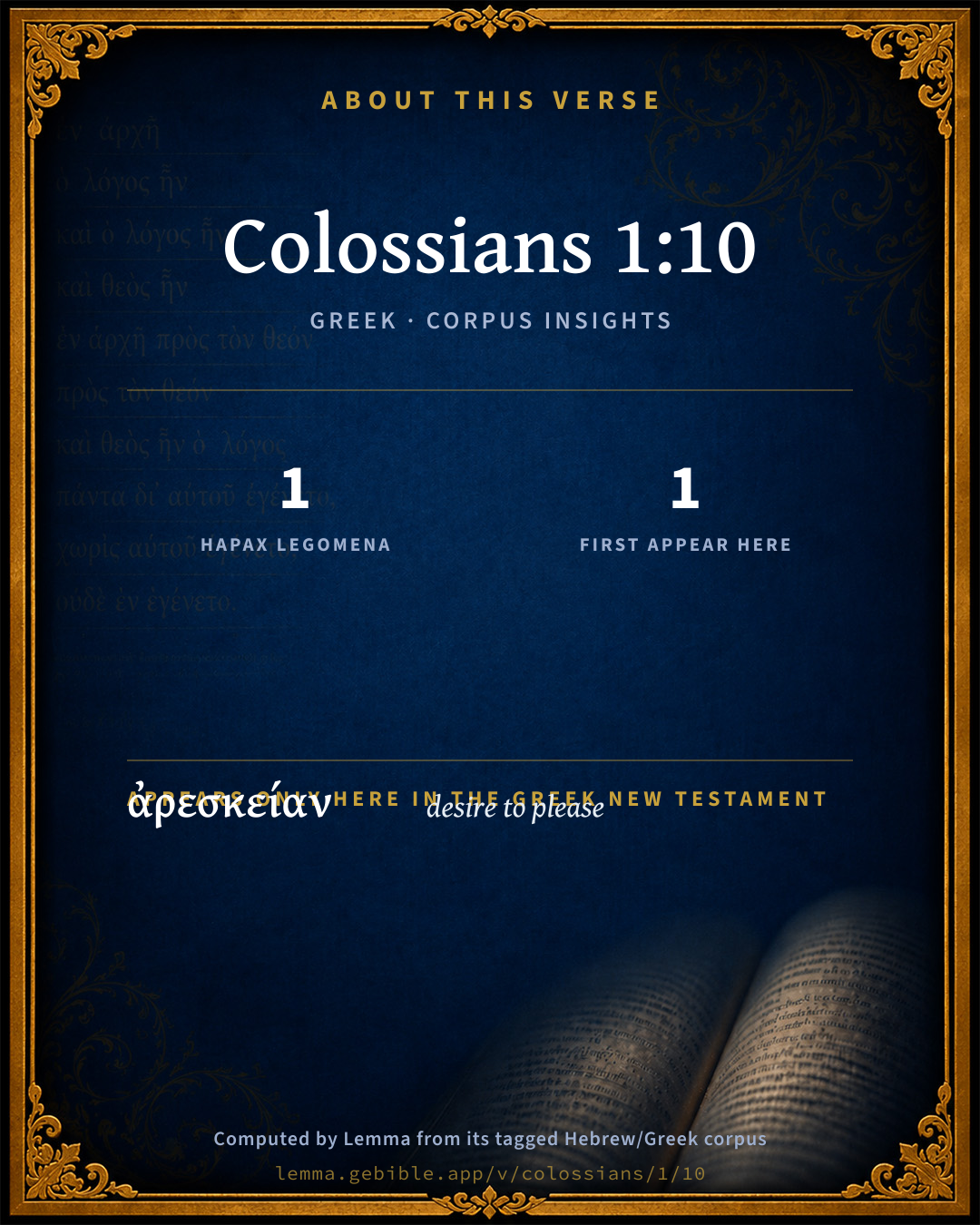
  • 1 hapax legomenon — only here in the Greek New Testament
  • 1 first appearance in the Greek New Testament
Full analysis ↓
Download a study sheet

One document with this verse’s original text, its word-by-word gloss line, the meaning frame, cross-references with their text, attributed commentary, and full source and license credits — printable, and it pastes into notes with its structure intact.

This verse Autodidact and up

Study sheet (.html) Plain text (.txt)

A passage Seminary Student

Up to 50 verses in one chapter. A passage sheet keeps up to 6 commentary sources and 12 cross-references per verse, in the order this page ranks them, and says so on the sheet whenever that leaves anything out. Ask for a single verse and you get the Autodidact verse sheet above.

Everything on this page stays free to read, with no account — the sheet is a download of what is already on screen, not access to it.

Want to remove ads? Support Godless Engineer
Compare translations 3

The same verse in 3 English versions, stacked beneath the original-language interlinear above. Click any original word for its lexicon entry.

Each is an independent rendering of the whole verse — the interlinear is not word-aligned to these translations.

Highlighted words mark where these versions differ — a whole-verse word diff, not a word-by-word alignment.

  • World English Bible Public Domain
    that you may walk worthily of the Lord, to please him in all respects, bearing fruit in every good work, and increasing in the knowledge of God;
  • King James Version Public Domain
    That ye might walk worthy of the Lord unto all pleasing, being fruitful in every good work, and increasing in the knowledge of God;
  • unfoldingWord Literal Text CC BY-SA 4.0
    to walk worthily of the Lord in every pleasing, bearing fruit in every good deed and growing in the knowledge of God,

unfoldingWord Literal Text — © unfoldingWord, licensed CC BY-SA 4.0. Word-aligned USFM3 via Door43 (git.door43.org/unfoldingWord/en_ult).

Versions to compare (up to 4)

3 of 4 selected

Show all 19 translations

Every available English version of this verse, each an independent rendering of the whole verse.

  • World English Bible Public Domain
    that you may walk worthily of the Lord, to please him in all respects, bearing fruit in every good work, and increasing in the knowledge of God;
  • Berean Standard Bible Public Domain
    so that you may walk in a manner worthy of the Lord and may please Him in every way: bearing fruit in every good work, growing in the knowledge of God,
  • Majority Standard Bible Public Domain
    so that you may walk in a manner worthy of the Lord and may please Him in every way: bearing fruit in every good work, growing in the knowledge of God,
  • King James Version Public Domain
    That ye might walk worthy of the Lord unto all pleasing, being fruitful in every good work, and increasing in the knowledge of God;
  • American Standard Version (1901) Public Domain
    to walk worthily of the Lord unto all pleasing, bearing fruit in every good work, and increasing in the knowledge of God;
  • Revised Version (1885) Public Domain
    to walk worthily of the Lord unto all pleasing, bearing fruit in every good work, and increasing in the knowledge of God;
  • Geneva Bible (1599) Public Domain
    That ye might walke worthy of the Lord, and please him in all things, being fruitefull in all good workes, and increasing in the knowledge of God,
  • Douay-Rheims (1899) Public Domain
    That you may walk worthy of God, in all things pleasing; being fruitful in every good work, and increasing in the knowledge of God:
  • Young's Literal Translation Public Domain
    to your walking worthily of the Lord to all pleasing, in every good work being fruitful, and increasing to the knowledge of God,
  • Literal Standard Version CC BY-SA 4.0
    to walk worthily of the LORD, pleasing in all, being fruitful in every good work, and increasing in the knowledge of God,
  • Unlocked Literal Bible CC BY-SA 4.0
    We have been praying that you will walk worthily of the Lord in pleasing ways. We have been praying that you will bear fruit in every good deed and that you will grow in the knowledge of God.
  • unfoldingWord Literal Text CC BY-SA 4.0
    to walk worthily of the Lord in every pleasing, bearing fruit in every good deed and growing in the knowledge of God,
  • Darby Bible Public Domain
    [so as] to walk worthily of the Lord unto all well-pleasing, bearing fruit in every good work, and growing by the true knowledge of God;
  • World Messianic Bible Public Domain
    that you may walk worthily of the Lord, to please him in all respects, bearing fruit in every good work and increasing in the knowledge of God,
  • Webster's Bible Public Domain
    That ye may walk worthy of the Lord to all pleasing, being fruitful in every good work, and increasing in the knowledge of God;
  • Free Bible Version CC BY-SA 4.0
    That way you'll live lives that rightly represent the Lord and please him, producing all kinds of good results and gaining greater knowledge of God.
  • Bible in Basic English Public Domain
    Living uprightly in the approval of the Lord, giving fruit in every good work, and increasing in the knowledge of God;
  • Text-Critical English NT CC BY 4.0
    so that you may walk in a manner worthy of the Lord with every desire to please him: bearing fruit in every good work and increasing in the knowledge of God;
  • Tyndale New Testament (1534) Public Domain
    that ye myght be fulfilled with the knowledge of his will in all wisdome and spretuall vnderstodynge that ye myght walke worthy of the lorde in all thynges that please beynge frutfull in all good workes and encreasynge in the knowledge of God

Literal Standard Version (2020), Covenant Press — licensed CC BY-SA 4.0. Text via the HelloAO Bible API (eBible.org). Unlocked Literal Bible (unfoldingWord) — licensed CC BY-SA 4.0. Text via the HelloAO Bible API (eBible.org). unfoldingWord Literal Text — © unfoldingWord, licensed CC BY-SA 4.0. Word-aligned USFM3 via Door43 (git.door43.org/unfoldingWord/en_ult). Free Bible Version, Dr. Jonathan Gallagher — licensed CC BY-SA 4.0. Text via the HelloAO Bible API (eBible.org).

Word by word

More ways to search: Search by grammar → Find every occurrence → Compare this word →

Practice this passage: Drill this verse → Learn its vocabulary →

ἀρεσκείαν
areskeía
G699
“desire to please”
Noun, Accusative, Singular, Feminine
Part of Speech
Noun
Case
Accusative
Number
Singular
Gender
Feminine
Full Thayer's Definition

Origin: from a derivative of G700

TDNT: 08:36,8

1. desire to please
  1. περιπατῆσαι peripatéō G4043 “to walk” Verb, Aorist, Active, Infinitive
  2. ἀξίως axíōs G516 “worthily” Adverb
  3. τοῦ ho G3588 “the” Article, Genitive, Singular, Masculine
  4. κυρίου kýrios G2962 “Lord” Noun, Genitive, Singular, Masculine
  5. εἰς eis G1519 “into” Preposition
  6. πᾶσαν pâs G3956 “all” Adjective, Accusative, Singular, Feminine
  7. ἐν en G1722 “in” Preposition
  8. παντὶ pâs G3956 “all” Adjective, Dative, Singular, Neuter
  9. ἔργῳ érgon G2041 “work” Noun, Dative, Singular, Neuter
  10. ἀγαθῷ agathós G18 “good” Adjective, Dative, Singular, Neuter
  11. καρποφοροῦντες karpophoréō G2592 “to bear fruit” Verb, Present, Active, Participle, Nominative, Plural, Masculine
  12. καὶ kaí G2532 “and” Conjunction
  13. αὐξανόμενοι auxánō G837 “to increase” Verb, Present, Passive, Participle, Nominative, Plural, Masculine
  14. τῇ ho G3588 “the” Article, Dative, Singular, Feminine
  15. ἐπιγνώσει epígnōsis G1922 “precise knowledge” Noun, Dative, Singular, Feminine
  16. τοῦ ho G3588 “the” Article, Genitive, Singular, Masculine
  17. θεοῦ theós G2316 “God” Noun, Genitive, Singular, Masculine

About this verse

These counts appear in no published source. They are computed here, from the morphology-tagged text and Lemma’s own curated glosses. What Lemma adds →

18
words
15
distinct lemmas
Pauline Epistles
section

Notable vocabulary

1 hapax legomenon — a word that appears only here in the entire Greek New Testament:

  • ἀρεσκείαν desire to please G699

First appearance in Scripture

This word makes its first canonical appearance in the Greek New Testament here:

  • ἀρεσκείαν desire to please G699

Shared distinctive vocabulary

ἀξίως worthily G516 occurs in 6 verses of the Greek New Testament. Also found in:
Repetition

Words recur within this verse:

Cross-references

41

Topical passages linked to Colossians 1:10 in the Treasury of Scripture Knowledge — connected by theme and wording, ordered by reader-vote popularity; previews shown in the World English Bible.

  • Ephesians 4:1 I therefore, the prisoner in the Lord, beg you to walk worthily of the calling with which you were called,
  • Hebrews 13:21 make you complete in every good work to do his will, working in you that which is well pleasing in his sight, through Jesus Christ, to whom be the glory forever and ever. Amen.
  • 2 Peter 1:2–3 Grace to you and peace be multiplied in the knowledge of God and of Jesus our Lord,
  • John 15:16 You didn't choose me, but I chose you, and appointed you, that you should go and bear fruit, and that your fruit should remain; that whatever you will ask of the Father in my name, he may give it to you.
  • 1 John 3:22 and whatever we ask, we receive from him, because we keep his commandments and do the things that are pleasing in his sight.
  • 1 Thessalonians 4:1 Finally then, brothers, we beg and exhort you in the Lord Jesus, that as you received from us how you ought to walk and to please God, that you abound more and more.
  • Hebrews 13:16 But don't forget to be doing good and sharing, for with such sacrifices God is well pleased.
  • John 15:8 "In this is my Father glorified, that you bear much fruit; and so you will be my disciples.
  • Galatians 5:22–23 But the fruit of the Spirit is love, joy, peace, patience, kindness, goodness, faithfulness,
  • Proverbs 16:7 When a man's ways please Yahweh, He makes even his enemies to be at peace with him.
  • Titus 3:14 Let our people also learn to maintain good works for necessary uses, that they may not be unfruitful.
  • 2 Peter 1:8 For if these things are yours and abound, they make you to be not idle nor unfruitful to the knowledge of our Lord Jesus Christ.
  • 2 Peter 3:18 But grow in the grace and knowledge of our Lord and Savior Jesus Christ. To him be the glory both now and forever. Amen.
  • Micah 4:5 Indeed all the nations may walk in the name of their gods; But we will walk in the name of Yahweh our God forever and ever.
  • Colossians 2:6 As therefore you received Christ Jesus, the Lord, walk in him,
  • 1 Thessalonians 2:12 to the end that you should walk worthily of God, who calls you into his own Kingdom and glory.
  • Ephesians 2:10 For we are his workmanship, created in Christ Jesus for good works, which God prepared before that we would walk in them.
  • Ephesians 5:15 Therefore watch carefully how you walk, not as unwise, but as wise;
  • Colossians 4:5 Walk in wisdom toward those who are outside, redeeming the time.
  • Romans 6:4 We were buried therefore with him through baptism to death, that just like Christ was raised from the dead through the glory of the Father, so we also might walk in newness of life.
  • 2 Corinthians 2:14 Now thanks be to God, who always leads us in triumph in Christ, and reveals through us the sweet aroma of his knowledge in every place.
  • Ephesians 5:2 Walk in love, even as Christ also loved you, and gave himself up for us, an offering and a sacrifice to God for a sweet-smelling fragrance.
  • Ephesians 5:10 proving what is well-pleasing to the Lord.
  • Philippians 1:11 being filled with the fruits of righteousness, which are through Jesus Christ, to the glory and praise of God.
  • Philippians 1:27 Only let your manner of life be worthy of the Gospel of Christ, that, whether I come and see you or am absent, I may hear of your state, that you stand firm in one spirit, with one soul striving for the faith of the Gospel;
  • Habakkuk 2:14 For the earth will be filled with the knowledge of the glory of Yahweh, as the waters cover the sea.
  • Ephesians 4:13 until we all attain to the unity of the faith, and of the knowledge of the Son of God, to a full grown man, to the measure of the stature of the fullness of Christ;
  • Colossians 3:20 Children, obey your parents in all things, for this pleases the Lord.
  • Titus 3:1 Remind them to be in subjection to rulers and to authorities, to be obedient, to be ready for every good work,
  • 1 John 5:20 We know that the Son of God has come, and has given us an understanding, that we know him who is true, and we are in him who is true, in his Son Jesus Christ. This is the true God, and eternal life.
  • Hebrews 11:5 By faith, Enoch was taken away, so that he wouldn't see death, and he was not found, because God translated him. For he has had testimony given to him that before his translation he had been well pleasing to God.
  • Ephesians 1:17 that the God of our Lord Jesus Christ, the Father of glory, may give to you a spirit of wisdom and revelation in the knowledge of him;
  • Philippians 4:18 But I have all things, and abound. I am filled, having received from Epaphroditus the things that came from you, a sweet-smelling fragrance, an acceptable and well-pleasing sacrifice to God.
  • Colossians 2:19 and not holding firmly to the Head, from whom all the body, being supplied and knit together through the joints and ligaments, grows with God's growth.
  • 2 Timothy 2:4 No soldier on service entangles himself in the affairs of life, that he may please him who enrolled him as a soldier.
  • Isaiah 53:11 He shall see of the travail of his soul, [and] shall be satisfied: by the knowledge of himself shall my righteous servant justify many; and he shall bear their iniquities.
  • Daniel 12:4 But you, Daniel, shut up the words, and seal the book, even to the time of the end: many shall run back and forth, and knowledge shall be increased."
  • 2 Corinthians 9:8 And God is able to make all grace abound to you, that you, always having all sufficiency in everything, may abound to every good work.
  • John 17:3 This is eternal life, that they should know you, the only true God, and him whom you sent, Jesus Christ.
  • Romans 4:12 The father of circumcision to those who not only are of the circumcision, but who also walk in the steps of that faith of our father Abraham, which he had in uncircumcision.
  • 2 Corinthians 4:6 seeing it is God who said, "Light will shine out of darkness," who has shone in our hearts, to give the light of the knowledge of the glory of God in the face of Jesus Christ.

Cross-references courtesy of OpenBible.info (CC BY 4.0).

Commentary

Notes on Colossians 1:10 from classic Christian and Jewish commentators (each source and its license shown beneath its notes). The classic Christian expositions comment on the surrounding passage and are grouped to its opening verse, so a note may address several verses; the Jewish commentaries on the Tanakh (Rashi and others) are per-verse, so they appear only where the commentator wrote on this verse.

Lemma curates 59 commentaries, every one of them public domain or Creative Commons licensed, each selected and text-cleaned for this edition rather than reprinted as found. About our sources →

Ellicott's Commentary for English Readers

(10) Walk worthy (worthily) of the Lord. Here St. Paul begins to dwell on the practical life, much in the same spirit in which, in Eph_4:1, he returns from the profound thought of Colossians 2, 3 to the entreaty “to walk worthy of the vocation with which they are called.” “The Lord” is here, as usual, the Lord Jesus Christ; to walk worthy of Him is to have His life reproduced in us, to follow His example, to have “the mind of Christ Jesus.” The “worthiness” is, of course, relative to our capacity, not absolute.

All pleasing.—The word here used is not found elsewhere in the New Testament, but is employed in classic and Hellenistic Greek to mean “a general disposition to please”—a constant preference of the will of others before our own. It is here used with tacit reference to God, since towards Him alone can it be a safe guide of action. Otherwise it must have the bad sense which in general usage was attached to it. St. Paul emphatically disowns and condemns the temper of “men-pleasing” (see Gal_1:10; Eph_6:6; Col_3:22; 1Th_2:4), as incompatible with being “the servant of Christ.” He could, indeed, “be all things to all men” (1Co_9:22); he could bid each man “please his neighbour for his edification” (Rom_15:12). But the only “pleasing” to which the whole life can be conformed is (see 1Th_4:1) the consideration “how we ought to walk and to please God.” Only in subordination to this can we safely act on the desire of “all pleasing” towards men.

Increasing in (or, by) the knowledge of God.—The context evidently shows that the path towards the knowledge of God here indicated is not the path of thoughtful speculation, or of meditative devotion, but the third path co-ordinate with these—the path of earnest practice, of which the watchword is, “Do and thou shalt know.”

A Bible Commentary for English Readers, edited by Charles John Ellicott (1878–1897) — public domain. Text from a community e-Sword module.

Bengel's Gnomon

Johann Albrecht Bengel

Col 1:10. Περιπατῆσαι) that ye may walk. Such walking is derived from the knowledge of the will of God.—αξίως τοῦ Κυριου) as it is worthy of Christ the Lord, Eph 4:1.—ἀρέσκειαν, the desire of pleasing) on your part; so far as (even to that degree that) in reality you may please the Lord. חן, LXX., αρέσκειαι, Pro 31:30.—καρποφοροῦντες, bearing fruit) The participles, bearing fruit, increasing, strengthened, depend on the verb πληρωθῆτε, Col 1:9, that ye may be filled.

Bengel's Gnomon of the New Testament — English translation (T&T Clark, Edinburgh, 1860) — public domain. Text from a community e-Sword module.

Meyer's Critical & Exegetical Commentary

Heinrich August Wilhelm Meyer

Col_1:10. The practical aim[18] which that πληρωθῆναι κ.τ.λ. is to accomplish; ἀεὶ τῇ πίστει σὐζεύγνυσι τὴν πολιτείαν, Chrysostom. The Vulgate renders correctly: ut ambuletis (in opposition to Hofmann, see on Col_1:9).

ἀξίως τοῦ κυρίου] so that your behaviour may stand in morally appropriate relation to your belonging to Christ. Comp. Rom_16:2; Eph_4:1; Php_1:27; 1Th_2:12; 3Jn_1:6. The genitive (and in the N. T. such is always used with ἀξίως) does not even perhaps (Hofmann) belong to the following εἰς π. ἀρεσκ., especially as ἁρεσκεία, in the Greek writers and in Philo (see Loesner, p. 361), stands partly with, partly without, a genitival definition, and the latter is here quite obvious of itself. Such a combination would be an unnecessary artificial device. Comp. Plat. Conv. p. 180 D: ἀξίως τοῦ Θεοῦ.

εἰς πᾶσαν ἀρεσκείαν] on behalf of every kind of pleasing, that is, in order to please Him in every way. The word only occurs here in the N. T., but the apostle is not on that account to be deprived of it (Holtzmann); it is found frequently in Polybius, Philo, et al.; also Theophr. Char. 5; LXX. Pro_31:30 (Pro_30:30); Symmachus, Psa_80:12. On πᾶσαν ἀρ. comp. Polybius, xxxi. 26. 5: πᾶν γένος ἀρεσκείας προσφερόμενος. Among the Greeks, ἀρεσκεία (to be accentuated thus, see Winer, p. 50 [E. T. 57]; Buttmann, Neut. Gr. p. 11 [E. T. 12]) bears, for the most part, the sense of seeking to please. Comp. Pro_31:30 : ψευδεῖς ἀρεσκείαι.

ἐν παντὶ ἔργῳ κ.τ.λ.] There now follow three expositions, in order to define more precisely the nature and mode of the περιπατῆσαι ἀξίως κ.τ.λ. We must, in considering these, notice the homogeneous plan of the three clauses, each of which commences with a prepositional relation of the participial idea, viz. (1) ἐν παντὶ ἔργῳ κ.τ.λ., (2) ἐν πάσῃ δυνάμει, (3) μετὰ χαρᾶς, and ends with a relation expressed by εἰς, viz. (1) εἰς τ. ἐπίγν. τ. Θεοῦ, (2) εἰς πᾶσ. ὑπομ. κ. μακροθυμ., (3) εἰς τὴν μερίδα κ.τ.λ. The construction would be still more symmetrical if, in the third clause, ἐν πάσῃ χαρᾷ (Rom_15:32) had been written instead of μετὰ χαρᾶςwhich was easily prevented by the versatility of the apostles form of conception.

ἐν παντὶ ἔργῳ ἀγαθῷ καρποφ. is to be taken together (and then again, αὐξανόμ. εἰς τὴν ἐπίγν. τ. Θεοῦ), inasmuch as ye by every good work (by your accomplishing every morally good action) bear fruit, as good trees, comp. Mat_7:17. But not as if the καρποφορεῖν and the σὐξάνεσθαι were separate things; they take place, as in Col_1:6, jointly and at the same time, although, after the manner of parallelism, a special more precise definition is annexed to each. Moreover, ἐν παντὶ ἔργ. ἀγ. is not to be connected with εἰς πᾶσαν ἀρεσκ. (Oecumenius, Theophylact, Erasmus, and others, also Steiger); otherwise we mistake and destroy the symmetrical structure of the passage.

καὶ αὐξανόμ. εἰς τ. ἐπίγν. τ. Θ.] and, inasmuch as with this moral fruit-bearing at the same time ye increase in respect to the knowledge of God, that is, succeed in knowing Him more and more fully. The living, effective knowledge of God, which is meant by ἐπίγν. τ. Θεοῦ (Col_1:6; Col_3:10; Col_2:2), sustains an ethically necessary action and reaction with practical morality. Just as the latter is promoted by the former, so also knowledge grows through moral practice in virtue of the power of inward experience of the divine life (the ζωὴ τοῦ Θεοῦ, Eph_4:18), by which God reveals Himself more and more to the inner man. The fact that here τοῦ Θεοῦ generally is said, and not τοῦ θελήματος Θεοῦ repeated, is in keeping with the progressive development set forth; there is something of a climax in it. On εἰς, used of the telic reference, and consequently of the regulative direction of the growth, comp. on Eph_4:15; 2Pe_1:8. The reading τῇ ἐπιγνώσει τ. Θ. would have to be taken as instrumental, with Olshausen, Steiger, Huther, de Wette, Bleek, who follow it, but would yield after Col_1:9 something quite self-evident. We may add that αὐξάν., with the dative of spiritual increase by something, is frequent in Plato and classic writers.

As to the nominatives of the participles, which are not to be taken with πληρωθ. (Beza, Bengel, Reiche, and others), but relate to the logical subject of περιπατ. ἀξίως, comp. on Eph_4:2; 2Co_1:7.

[18] Not to be attached as object of the request immediately to προσευχόμενοι, and all that intervenes to be assigned to the interpolator (Holtzmann, p. 85). Yet, according to Holtzmann, p. 123, ἐν παντὶ ἔργῳ down τοῦ Θεοῦ is alleged to be simply an interpolated duplicate of ver. 6; in which case, however, it would not be easy to see why καρποφορούμενοι was not written, after the precedent of ver. 6, but on the contrary καρποφοροῦντες.

Meyer — Critical and Exegetical Commentary on the New Testament — English translation by Peter Christie, edited by Frederick Crombie (T&T Clark, 1880) — public domain. Text from a community e-Sword module.

Expositor's Greek Testament

ed. W. Robertson Nicoll

Col 1:10 . περιπατῆσαι ἀξίως τοῦ Κυρίου ( Cf. Eph 4:1 ). This lofty wisdom and insight is not an end in itself. It must issue in right practice. Doctrine and ethics are for Paul inseparable. Right conduct must be founded on right thinking, but right thinking must also lead to right conduct. The infinitive expresses result “so as to walk”. τοῦ Κυρ ., i.e. , of Christ, not of God (Hofm., Ol.). In 1Th 2:12 τοῦ Θεοῦ is used, but ὁ Κύρ . in Paul means Christ. ἀρεσκείαν in classical Greek used generally in a bad sense, of obsequiousness. But it often occurs in Philo in a good sense; see the note on the word in Deissmann’s Bible Studies , p. 224. καρποφοροῦντες καὶ αὐξανόμενοι . For the collocation Cf. Col 1:6 . The participles should probably be connected with περιπατῆσαι , not (as by Beng., Hofm., Weiss) with πληρωθῆτε , which is too far away. The continuation of an infinitive by a nominative participle instead of the accusative is frequent in classical Greek, and occurs several times in Paul (Col 2:2 , Col 3:16 , Eph 4:2-3 ). They should not be separated. The whole clause should be translated “bearing fruit and increasing in every good work by the knowledge of God”. Fruit bearing is one of Paul’s favourite metaphors. τῇ ἐπιγνώσει : not as R.V. and Moule “in the knowledge,” for Paul has already spoken of this in Col 1:9 , but “by the knowledge,” the knowledge of God being the means of their spiritual growth. Meyer, against the overwhelming weight of evidence, reads εἰς τὴν ἐπίγνωσιν , “as regards the knowledge”. This would make knowledge the goal of conduct ( Cf. Joh 7:17 ), whereas previously the relation is reversed.

The Expositor's Greek Testament, edited by W. Robertson Nicoll (1897–1910) — public domain. Text from a community e-Sword module.

International Critical Commentary

10. περιπατῆσαι ὑμᾶς ἀξίως τοῦ Κυρίου. A similar expression occurs 1Th 2:12, ἀξίως τοῦ Θεοῦ: and Eph 4:1, τῆς κλήσεως, “in a manner worthy of,” i.e. befitting your connexion with Him. The infinitive expresses the consequence (and proof) of πληρωθῆναι, ἀεὶ τῇ πίστει συζεύγνυσι τὴν πολιτείαν, Chrys.

If ὑμᾶς after περιπατῆσαι were genuine (Text. Rec.), the infinitive might conceivably be regarded as dependent on προσευχόμενοι; but it is certainly spurious, being omitted by א* A B C D* G 17, al. Clem., Boh. It is added in אc Dc K L P, most MSS. Chrys., Theodoret, Arm.

εἰς πᾶσαν ἀρεσκείαν. I.e. “so as to please God in every way.” Compare 1Th 4:5, πῶς δεῖ ὑμᾶς περιπατεῖν καὶ ἀρέκειν Θεῷ. In classical authors ἀρεσκεία has generally an unfavourable sense, “obsequiousness,” and it is so defined both in Eth. Eudem. (τὸ λίαν πρὸς ἠδονήν, ii. 3) and by Theophrastus (Char. 5). Polybius uses it especially of trying to gain the favour of a sovereign. Similarly Philo, πάντα καὶ λέγειν καὶ πράττειν ἐσπούδαζεν εἰς ἀρεσκείαν τοῦ πατρὸς καὶ βασιλέως (i. p. 34), but he also uses it of pleasing God. The ἀνθρώποις ἀρέσκειν is disavowed by the apostle in Gal 1:10; 1Th 2:4; compare ch. 3:22. The verb is used, however, without any unfavourable connotation, in Rom 15:2 (τῷ πλησίον ἀρεσκέτω) and elsewhere.

ἐν παντὶ ἔρλῳ ἀγαθῷ qualifies the following, as ἐν πάσῃ δυνάμει qualifies the following participle. Most commentators separate καρποφοροῦντες and αὐξανόμενοι; but then αὐξ. τῇ ἐπιγνώσει becomes tautologous with πληρωθῆτε τὴν ἐπίγνωσιν, ver. 9. Moreover, the combination καρποφορούμενον καὶ αὐξ. in ver. 6 seems to require that the two participles here also should be taken together. What is true of the gospel in the world and amongst the Colossians is also to hold good of those whose lives are inspired by its teaching. The participles refer to the logical subject of περιπατῆσαι, not to πληρωθῆτε (Beza, Bengel). Cf. Eph 4:2. τῇ ἐπίγνωσε ιτοῦ Θεοῦ, “by the knowledge of God,” instrumental dative, a frequent use of the dative with αὐξαν. (So Alford, Eadie, Ellicott, Lightfoot, Soden, RV.mg.) The fruitfulness and growth are wrought through the ἐπίγνωσις τοῦ Θεοῦ, and this again results from the practice of his will, ver. 9.

Some commentators take the dative as one of reference, as in Rom 4:20 (?), “increasing in the knowledge of God” (Moule, RV. text), which, after πληρωθῆτε τὴν ἐπιγν., ver. 9, would be somewhat of a tautology.

τῇ ἐπιγνώσει is the reading of א A B C D* G P 17, al. Amiat., Arm. al. ἐν is prefixed in אc 47, and a few others, Chrys., Old Lat. and Vulg-Clem. have “in scientia Dei,” which is doubtful. Text. Rec. has είς τήν ἐπίγνωσιν, with Dc K L most MSS., Theodoret, Theoph. Oec. This appears to be an attempt to simplify the construction. Meyer, on the contrary, regards the dative as an explanation of the more difficult (?) είς τὴν ἐπ., which, he thinks, is also confirmed by the parallelism in structure of the other participial clauses, which conclude with a definition introduced by εἰς. He understands it as “in respect of,” that is, always more fully attaining to a knowledge of God, εἰς indicating the final reference, or direction of the growth, comparing Eph 4:15 and 2Pe 1:8. As to the comparative difficulty of the readings, Alford’s judgment, that the simple dative “is by far the most difficult of the three readings,” is surely more correct than Meyer’s. είς τὴν ἐπίγν. would, in fact, present no difficulty to the ordinary reader.

International Critical Commentary — older volumes (1896–1929), various authors — public domain. Text from a community e-Sword module.

Jamieson, Fausset & Brown

Robert Jamieson, A. R. Fausset & David Brown

Greek, "So as to walk"; so that ye may walk. True knowledge of God's will is inseparable from walking conformably to it.

worthy of the Lord-- (Eph 4:1).

unto--so as in every way to be well-pleasing to God.

pleasing--literally, "desire of pleasing."

being fruitful--Greek, "bearing fruit." This is the first manifestation of their "walking worthy of the Lord." The second is, "increasing (growing) in the knowledge of God (or as the oldest manuscripts read, 'growing BY the full knowledge of God')"; thus, as the Gospel word (Col 1:6) was said to "bring forth fruit," and to "grow" in all the world, even as it did in the Colossians, ever since the day they knew the grace of God, so here it is Paul's prayer that they might continue to "bring forth fruit," and "grow" more and more by the full knowledge of God, the more that "knowledge" (Col 1:9) was imparted to them. The full knowledge of God is the real instrument of enlargement in soul and life of the believer [ALFORD]. The third manifestation of their walk is (Col 1:11), "Being strengthened with all might," &c. The fourth is (Col 1:12), "Giving thanks unto the Father," &c.

Jamieson, Fausset & Brown — Commentary Critical and Explanatory on the Whole Bible (1871) — public domain (CC PDM 1.0). Text via the HelloAO Bible API.

Adam Clarke's Commentary

Verse 10. That ye might walk worthy of the Lord] Suitably to your Christian profession, exemplifying its holy doctrines by a holy and useful life. See Clarke on Eph 4:1; and on "Php 1:27".

Unto all pleasing] Doing every thing in the best manner, in the most proper time, and in a becoming spirit. Even a good work may be marred and rendered fruitless by being done improperly, out of season, or in a temper of mind that grieves the Holy Spirit.

Being fruitful in every good work] See Clarke on Col 1:6.

St. Paul exhorts the Christians at Colosse,

1. To walk-to be active in their Christian calling.

2. To walk worthily-suitably to the dignity of that calling, and to the purity of that God who had called them into this state of salvation.

3. To do every thing unto all pleasing; that God might be pleased with the manner, the time, the motive, disposition, design, and object of every act.

4. That they should be fruitful; mere harmlessness would not be sufficient; as God had sown good seed, he expected good fruit.

5. That every work should be good; they must not be fruitful in some works and fruitless in others.

6. That they should increase in religious knowledge as time rolled on, knowing, by genuine Christian experience, more of God, of his love, and of his peace, day by day.

Adam Clarke's Commentary on the Bible (1810–1826) — public domain. Text from a community e-Sword/MySword module.

John Calvin's Commentaries

10. That ye may walk worthy of God. In the first place he teaches, what is the end of spiritual understanding, and for what purpose we ought to make proficiency in God’s school — that we may walk worthy of God, that is, that it may be manifest in our life, that we have not in vain been taught by God. Whoever they may be that do not direct their endeavors towards this object, may possibly toil and labor much, but they do nothing better than wander about in endless windings, without making any progress. Farther, he admonishes us, that if we would walk worthy of God, we must above all things take heed that we regulate our whole course of life according to the will of God, renouncing our own understanding, and bidding farewell to all the inclinations of our flesh.

This also he again confirms by saying — unto all obedience, or, as they commonly say, well-pleasing. Hence if it is asked, what kind of life is worthy of God, let us always keep in view this definition of Paul — that it is such a life as, leaving the opinions of men, and leaving, in short, all carnal inclination, is regulated so as to be in subjection to God alone. From this follow good works, which are the fruits that God requires from us.

Increasing, in the knowledge of God. He again repeats, that they have not arrived at such perfection as not to stand in need of farther increase; by which admonition he prepares them, and as it were leads them by the hand, to an eagerness for proficiency, that they may shew themselves ready to listen, and teachable. What is here said to the Colossians, let all believers take as said to themselves, and draw from this a common exhortation that we must always make progress in the doctrine of piety until death.

John Calvin's Commentaries (1540-1563) — public domain. Text from the Calvin Translation Society English edition (1840s-50s) via the Christian Classics Ethereal Library (ccel.org). Calvin's coverage is partial (roughly two-thirds of the Bible); uncommented books and verses are honest gaps, never fabricated. The 19th-century editor's footnotes and remarks are omitted so the notes are faithfully Calvin's own voice.

The Cambridge Bible for Schools and Colleges

gen. ed. J. J. S. Perowne

10. walk] A very frequent word in St Paul; most frequent in Eph., where see Col_4:1 for a close parallel. See 1Th_2:12 for one still closer verbally. The word denotes life in its action and intercourse.—The spiritual knowledge which he asks for them is thus sought for the most sacredly practical of purposes—in order to their closer conformity to the will of God in real life.

worthy of the Lord] Lit., worthily &c.; so R.V. But all previous English versions read as A.V., perhaps using the adjective adverbially.—Ideally, of course, no human “walk” is “worthy of the Lord.” But practically it can and should be so, in the sense of being governed at every step by the Divine motive of His love and presence, and so presenting a true correspondence to that motive.

“The Lord:”—“St Paul’s common, and apparently universal, usage requires us to understand [‘the Lord’] of Christ.” (Lightfoot). The “worthy of God” of 1Th_2:12 thus gives to the phrase here a deep significance in relation to the Godhead of Christ. Such alternative expressions indicate how truly for St Paul the Father and the Son are Persons of the same Order of being. Cp. for similar indications (among very many passages) Rom_8:35 with 39; Eph_2:22 with Col_3:17.

unto all pleasing] “So as to aim at, and go the length of, meeting every wish (of the Lord’s).”—The word rendered “pleasing” is most instructive. In classical Greek it denotes a cringing and subservient habit, ready to do or say anything to please a patron; not only to meet but to anticipate his most trivial wishes. But when transferred to the spiritual region, and the believer’s relations to his Lord, the word at once rises by its association. To do anything to meet, to anticipate, His wishes, is not only the most beneficial but the most absolutely right thing we can do. It is His eternal and sacred due; it is at the same time the surest path to our own highest development and gain.—See Lightfoot’s excellent note.—For a close parallel to the wording here, see 1Th_4:1, where the cognate verb is used.

fruitful] See above on Col_1:6. The verb here is in the active, not middle, and so somewhat less pregnant in meaning.

every good work] Observe the characteristic impartiality and whole-heartedness of Christian obedience; as just above, “all pleasing.”

increasing] See above on Col_1:6; and cp. below Col_2:19; 1Pe_2:2; 2Pe_3:18.

in the knowledge] The Greek, in the best-attested reading, is capable also of the rendering “by the knowledge;” and so Ellicott, Lightfoot, and margin R.V. But the text R.V. renders as A.V., though using this other and better-attested Greek, which gives epignósis in the dative, without preposition. This is quite good grammatically; cp. e.g. the Greek of Rom_4:20; Php_2:8. The dative is used as the case of reference; the growth is growth with regard to spiritual knowledge of God; that is, it is a development of that knowledge in the believer, a growth in it.—The other (and we think inferior) rendering meanwhile conveys an undoubted and important truth.

“The knowledge of God:”—which “is life eternal” (Joh_17:3). “You must needs know that to enjoy God and His Christ is eternal Life; and the soul’s enjoying is in knowing” (Baxter, Saint’s Everlasting Rest, Part i. sect. vii.).

The Cambridge Bible for Schools and Colleges (gen. ed. J. J. S. Perowne; Cambridge University Press, 1878–1918) — public domain. Text from a community e-Sword module.

John Gill's Exposition

That ye might walk worthy of the Lord,.... The Vulgate Latin version reads, "of God"; to which the Ethiopic version agrees; but rather the Lord Jesus Christ seems to be designed: and to "walk worthy" of him, is to walk by faith in him; to walk after his Spirit, and according to his word, and in his ordinances; to have the conversation as becomes his Gospel, and worthy of that calling wherewith the saints are called by grace to the obtaining of his kingdom and glory. The apostle prays that their knowledge might issue in practice; for knowledge, without practice, is of no avail: he first asks for knowledge, and then practice, for how should men act according to the will of God, or Christ, unless they know it? and when they know it, they should not rest in their knowledge, but put it in practice:

unto all pleasing. The Syriac reads it, "that ye may please God in all good works": an unregenerate man cannot please God in anything; without faith in Christ it is impossible to please him by anything man can do; Christ only could, and did always the things that pleased his Father; there are many things done by believers which are displeasing to God; nor is there anything they can do that is pleasing to God but through Christ, in whom their persons and, services are accepted; good works being done in faith, and from a principle of love, and with a view to the glory of God, are acceptable unto him through Christ; and therefore are to be carefully maintained, and studiously performed by all those that have a spiritual understanding of the will of God, and believe in Christ their Lord and Redeemer:

being fruitful in every good work; saints are trees of righteousness, the planting of the Lord; good works are the fruit, which, under the influence of divine grace, they bring forth; and this is not of one sort only, as trees usually do, but of every kind; being ingrafted into Christ the true vine, and deriving life, sap, and nourishment from him, they are filled with the fruits of righteousness by him, which they bring forth and bear, to the glory of his heavenly Father; and being such, they are pleasant plants to him, as fruit bearing trees are to the owner of them: wherefore, in order to the saints walking in their lives and conversations unto all pleasing, or pleasing in all things, the apostle prays they might be fruitful in good works, and that in everyone, in every kind of good works:

and increasing in the knowledge of God; not barely of his nature and perfections, as they are displayed in the works of creation; but of his mind, and will, and the mysteries of his grace, as they are revealed in the Gospel; of the knowledge of him in Christ, as the God of all grace, and as a covenant God and Father. The apostle had before prayed for an increase of the knowledge of the will of God, previous to his request, for the putting of it in practice; and now suggests, that an increase of the knowledge of God himself may be expected in a practical use of means, an attendance on the ordinances of Christ, and a diligent performance of good works: from the whole of these petitions, it may be observed by the apostle's asking for them, that all our knowledge, and the increase of it, and all our fruitfulness in good works, are all from the Lord; and therefore we have no reason to boast of our knowledge, nor depend upon our works, but frankly to own, that notwithstanding all we know, and do, we are but unprofitable servants.

John Gill's Exposition of the Whole Bible (1746–1763) — public domain (CC PDM 1.0). Text via the HelloAO Bible API.

Trapp's Complete Commentary

John Trapp

10 That ye might walk worthy of the Lord unto all pleasing, being fruitful in every good work, and increasing in the knowledge of God;

Ver. 10. That ye might walk worthy] By walking before God, with God, after God, according to God, as it is phrased in several Scriptures, all to one purpose. See the note on Eph 4:1.

Unto all pleasing] As Enoch walked with God, and thereby got this testimony, that he "pleased God," Heb 11:5. So David did all his wills, and was therefore a "man after his heart," Act 13:22. The many alls here used in Col 1:9-11 show that he that will please God must be a "throughout Christian." Now he, and only he, is such, whose whole nature is elevated by the spirit of grace; and all whose principles, practices, and aims are divine and supernatural.

John Trapp, A Commentary or Exposition upon All the Books of the Old and New Testament (1647–1656) — public domain. Text from a community e-Sword module.

Albert Barnes' Notes on the Bible

That ye might walk worthy of the Lord - That you may live as becomes the followers of the Lord. How this was to be done he states in this and the following verses.

Unto all pleasing - So as to please him in all things; compare Heb 11:5.

Being fruitful in every good work - This is one way in which we are to walk worthy of the Lord, and so as to please him; see the notes at Joh 15:8.

And increasing in the knowledge of God - This is another way in which we may walk worthy of the Lord, and so as to please him. It is by endeavoring to become better acquainted with his true character. God is pleased with those who desire to understand what he is; what he does; what he purposes; what he commands. Hence he not only commands us to study his works (compare Psa 111:2), but he has made a world so beautiful as to invite us to contemplate his perfections as reflected in that world. All good beings desire that others should understand their character, and God delights in those who are sincerely desirous of knowing what he is, and who inquire with humility and reverence into his counsels and his will. People are often displeased when others attempt to look into their plans, for they are sensible they will not bear the light of investigation. God has no plans which would not be seen to be, in the highest degree, glorious to him.

Albert Barnes' Notes on the Bible (1834–1885) — public domain. Text from a community e-Sword/MySword module.

Haydock's Catholic Bible Commentary

Worthy of God: Greek: axios tou kuriou. So St. Ambrose and the Greek doctors; or thus, worthily, pleasing God, and this not by faith only, but fruitful in every good work. (Ibid.) --- God, in [1] all things pleasing him. This is the construction of the Latin by the Greek. (Witham)

===============================

[BIBLIOGRAPHY]

Ut ambuletis digne Deo per omnia placentes; Greek: axios tou Kuriou eis pasan areskeian.

George Leo Haydock (1774–1849), Haydock's Catholic Family Bible and Commentary, 1859 edition — public domain. Excludes Psalms (Douay-Rheims chapter numbering differs from Protestant) and Deuterocanonical books (Catholic canon only).

Matthew Poole's English Annotations

That ye might walk worthy of the Lord: they prayed for the above mentioned gracious habits, that the Colossians might exercise them in a course of life as it becomes those who are effectually called by the gospel to be the sons of God, and the servants of Christ; suitable to the members of the body of Christ: See Poole on "Eph 4:1". See Poole on "Phi 1:27"; compared with Rom 16:2; 1Th 2:12; 2Th 1:11. As the word God alone ordinary connotes the Father, so Lord doth Christ; answerable to whose wisdom, holiness, and example, Christians professing a relation to him, and expecting benefit by his purchase, should behave themselves; so that the papists cannot from this walking

worthy of the Lord justly infer a merit of condignity, behaving ourselves as Christians being so far from any merit or desert of ours, that it is a debt, we being indispensably obliged to do so, practice being the end of our knowledge. And this end we are to respect

unto all pleasing, i.e. designing and endeavouring not in one thing only, or in few things, but in all things whatsoever are incmnbent on us, we may find aceptance with our Lord and Master, Col 3:20; 1Co 7:32; 10:31; 1Th 2:4; Heb 12:28; all should be great and generous, such as may best like our Lord, keeping themselves from the defilements of the age, Rev 3:4.

Being fruitful in every good work; particularly fructifying, which in the sense may be joined with being filled, Col 1:8; being fruitful is a metaphorical expression borrowed from fruit-bearing trees, unto which godly men and real Christians are compared, Psa 1:3; Joh 15:8; and

every good work is the fruit which these plants of the Lord, having his Spirit as the seed remaining in them, 1Jo 3:9, do bring forth of every sort from a right principle, 1Ti 1:5, according to rule warranted by God, Isa 29:13; Gal 6:16; or having a call from him, for his glory: see 2Co 9:8; Phi 1:11; 2Th 2:17; Heb 13:21.

And increasing in the knowledge of God: the Colossians were not yet perfect in knowledge, and therefore they prayed that they might go on, and grow in grace and knowledge of God and Christ, 2Pe 3:18, the best here knowing but in part, 1Co 13:9; therefore they desired these Christians, as the Philippians, Phi 3:10,12, and the Ephesians, Eph 4:13, might come to their stature: see on the texts.

Matthew Poole's English Annotations on the Holy Bible (1683–1685) — public domain. Text from a community e-Sword/MySword module.

Whedon's Commentary on the Bible

Daniel D. Whedon

10. That ye might walk—The result of such full knowledge is a life worthy of the Lord Jesus, pleasing him in all things. This is possible only through the teaching and help of the Holy Spirit. As mere intellectual processes are utterly unable to attain this knowledge, so sinful men, unaided from on high, cannot thus walk. But the life whose sincere aim is to please Christ, though it fall far below that absolute perfectness which his majesty and holiness may rightfully demand, is yet a life worthy of him, for it is moved by a love that brings its best and holiest tribute to his feet. What such a life involves is further specified in four particulars, fruitfulness, moral growth, strength against evil, and thanksgiving.

Fruitful—In good works extending beyond ordinary benevolence and right doing, to all inward and outward obedience, and to the studious use of our consecrated powers for whatever will glorify Christ. The figure is that of a tree which bears fruit, and is at the same time steadily growing. The believer is not only fruitful in his holy living, but in all that goes to make up character he is constantly increasing in, or rather, by, (as the best texts show,) the full knowledge of God, as the instrument of his growth.

Daniel D. Whedon (gen. ed.), Commentary on the Old and New Testaments (1874–1909) — public domain. Text from a community e-Sword module.

The Pulpit Commentary

To walk worthily of the Lord unto all pleasing (Eph_4:1; Php_1:27; 1Th_2:12 1Th_4:1; 2Th_1:5, 2Th_1:11; 1Jn_2:6; Rev_3:4; Heb_13:21) so as to please him in every way. "The end of all knowledge, the apostle would say, is conduct" (Lightfoot). Spiritual enlightenment (ver. 9) enables the Christian to walk (a Hebraism adopted also into biblical English) in a way "worthy of the Lord", (Christ Col_2:6 Col_3:24; Act_20:19, etc.) becoming those who have such a Lord and who profess to be his servants. And to be "worthy of Christ" is to "please God" (Rom_8:29; Eph_1:4, Eph_1:5, Eph_1:11; 1Co_1:9) This is the ideal and the aim of the religious life throughout the Bible (comp. 1Sa_13:14; Mic_6:6-8; Heb_11:5, Heb_11:6; Joh_8:29; Rom_8:8) The characteristics of this walk are set forth by three coordinate participial phrases (vers. 10b-12), standing in the half independent nominative case instead of the more regular accusative (as agreeing with the understood object of the infinitive peripathsai: see Winer"s "N. T. Grammar," p. 716: compare, for the idiom. (Col_3:16 Col_2:2) In every good work bearing fruit (Eph_4:28; Gal_6:9, Gal_6:10; 1Th_5:15; 2Th_2:17; 1Ti_5:10; Tit_3:8; Heb_13:16; Act_9:36) "Good work" is that which is beneficial, practically good (see parallel passages). "In every good work" might grammatically qualify the foregoing" pleasing (so R.V margin and many older interpreters), but appears to be parallel in position and sense with "in all power" (ver. 11). On"bearing fruit" (active in voice where the subject is personal: comp. ejnergew in, (Col_1:29 and Php_2:13) see note to ver. 6. While doing good to his fellow-men, the Christian is growing by (or, in) the knowledge of God (Col_2:19; Eph_4:13-16; 2Pe_3:18; 1Co_3:1, 2 14:20 16:13; Heb_5:12-14) His own nature becomes larger, stronger, more complete. Here it is individual (internal) growth, in ver. 6 collective (external) growth (of the gospel, the Church) that is implied; the two are combined insei. (Eph_4:13-16) The dative th ejpignw (so best copies and Revised Text: the Received, unto the knowledge, is a repetition of ver. 9) is "dative of instrument" (Alford, Lightfoot) rather than "of respect" (in the knowledge; so R.V).

The Pulpit Commentary (1880–1919), ed. H.D.M. Spence-Jones & Joseph S. Exell — public domain. Text from a community e-Sword module.

John Wesley's Explanatory Notes

That, knowing his whole will, ye may walk worthy of the Lord, unto all pleasing - So as actually to please him in all things; daily increasing in the living, experimental knowledge of God, our Father, saviour, Sanctifier.

John Wesley, Explanatory Notes Upon the Whole Bible (1754–1765) — public domain. Text via the GEBible commentary corpus.

Burkitt's Expository Notes on the New Testament

William Burkitt

Here the apostle sets down the end of his prayer in the fore-mentioned manner for the Colossians, why he desired that their knowledge should so exceedingly increase; it was in order to practise, that they might walk worthy of the Lord, unto all pleasing, and be fruitful in every good work; this is the true end of knowledge, practical obedience.

All this is the true end of knowledge, practical obedience. All knowledge without this, makes a man like Nebuchadnezzar’s image, with an head of gold, and feet of clay: Some persons study to know, only to know, that is curiosity; others endeavour to know only to make themsleves known, this is vain-glory: But to know, that we may practise what we know, this is gospel duty.

Quest. But how can any person be said to walk worthy of the Lord?

Ans. Not with a worthiness of merit, but with a worthiness of meetness, when we walk as it is meet and fit for persons professing godliness to walk; when we walk as becometh the gospel of Jesus Christ, in obedience to his precepts, in imitation of his pattern, answerable to the helps and supplies of grace which the gospel affords, and answerable to the high and glorious hopes which the raises us to the expectation of, this is to walk worthy of the Lord unto all pleasing.

The second branch of the apostle’s prayer, on behalf of these Colossians, was, that they might be fruitful in every good work, that is, labour after an universal fruitfulness in good works.

By good works, he undoubtedly means works of piety towards God, works of righteousness towards our neighbours, works of sobriety towards ourselves, works of charity towards all.

By fruitfulness in these good works, he means an unwearied diligence, and persevering constancy in the doing of them, that our fruitfulness be an universal fruitfulness, an humble and self-denying fruitfulness, a proportionable fruitfulness, an abounding and abiding fruitfulness; that is to be fruitful in every good work.

The third request, which in this verse he puts up for them, is, That they may increase in the knowledge of God. As fruitfulness in good works makes much for the increase of knowledge, so increasing in knowledge will contribute very much towards our fruitfulness in good works; the way to grow in grace is to grow in the knowledge of our Lord Jesus Christ, 2Pe 3:18.

William Burkitt's Expository Notes on the New Testament (1700–1703) — public domain. Text from a community e-Sword module.

The People's New Testament

B. W. Johnson

10. That ye might walk, etc. Thus they would be equipped so as to please the Lord in all things in their walk. Being fruitful. Some things are named which please the Lord. The first is to abound in good works. The second is to increase in the knowledge of God.

B. W. Johnson's The People's New Testament with Notes (1889–1891) — public domain. Electronic text from the Christian Classics Ethereal Library (CCEL) ThML edition.

Cambridge Greek Testament for Schools and Colleges

10. περιπατῆσαι. Probably epexegetic, see Act 15:10; Luk 1:54; 1Sa 12:23; Pss. Sol. 2:28. It may be due to the influence of Hebrew, in which both the construct (e.g. Psa 78:18) and the absolute (Jer 22:19) forms of the infinitive may be used to expand a preceding statement. In English we can hardly use the infinitive in this sense, and must translate “walking.”

Observe that περιπατεῖν in its metaphorical meaning (also Col 2:6, Col 3:7, Col 4:5), self-evident as it appears to us, seems never to have been so used by Greeks uninfluenced by Semitic thought (though in Thuc. III. 64. 7 we find μετὰ γὰρ Ἀθηναίων ἄδικον ὁδὸν ἰόντων ἐχωρήσατε, and parallels for ἀναστρέφομαι and ἀναστροφή are quoted in Deissmann, Bibl. Studies, pp. 88, 194, from the Inscriptions). But in Hebrew it is very common (e.g. Psa 26:11) and the metaphor even gives the name to the strictly legal part of Rabbinic lore, the Halacha, i.e. the “walk.”

ἀξίως. Observe that while περιπατεῖν is almost entirely Semitic ἀξίως is almost entirely Greek. No Hebrew word quite expresses the idea (cf. שׁוה Pro 3:15; Pro 8:11; Est 7:4). Therefore Delitzsch can only render our passage by a free paraphrase, כַּטּוֹב בְּעֵינֵי הָאָדוֹן, “to walk according to that which is good in the eyes of the Lord and according to all His good pleasure.” Had we nothing else whereby to tell the nature of the education of the Apostle the combination περιπατῆσαι ἀξίως would give us the clue to it being Graeco-Semitic.

For ἀξίως τοῦ κυρίου compare, besides the passages quoted above, Wis 3:5; Sir 14:11 (Greek only), and the phrases ἄξιος, and ἀξίως, τοῦ θεοῦ (τῶν θεῶν) in inscriptions at Pergamum (Deissmann, Bible Studies, p. 248).

It is perhaps worth noting that the Peshitta here reads “that ye may walk as is becoming, and may please God,” i.e. omitting πᾶσαν and recombining the other words. Did it mistranslate from the Latin “ut ambuletis digne Deo per omnia placentes”?

τοῦ κυρίου. Though Theodoret (in Ellicott) understands this of God (i.e. presumably the Father), and the analogy of 1Th 2:12 (quoted supra) confirms it, yet “St Paul’s common, and apparently universal, usage requires us to understand ὁ Κύριος of Christ” (Lightfoot). Moule rightly points out that “such alternative expressions indicate how truly for St Paul the Father and the Son are Persons of the same Order of being.” St Paul is thinking of the Lord Jesus as the Master in glory, who ought to be worthily represented by us His servants here, and takes pleasure, or otherwise, in our behaviour.

εἰς. The final object of knowledge and a godly life is to please God.

πᾶσαν, i.e. in every case, see Col 1:9 πάσῃ.

ἀρεσκίαν†. ἀρέσκειν θεῷ (τ. κυρίῳ) in Rom 8:8; 1Co 7:32; 1Th 2:15, and especially 1Th 4:1; cf. ἀρεστός Joh 8:29, and 1Jn 3:22.

ἀρεσκία is not found in classical writers of the best period, but in Theophrastus, Char. 2 (5), Polybius 31. 26. 5, Diod. 13. 53 it means “complaisance,” “obsequiousness.” Yet in an inscription given in Deissmann, Bible Studies, p. 224, χάριν τῆς εἰς τὴν πόλιν ἀρεσκείας it evidently has a good sense, and it is repeatedly used by Philo of pleasing God, as here; e.g. Quis rer. div. her. 24 (I. p. 490, § 123, Wendland) ὡς ἀποδεχομένου (τοῦ Θεοῦ) καὶ δεχομένου τὰς ψυχῆς ἑκουσίου ἀρεσκείας; de Vict. Off. 8 (II. p. 527) διὰ πασῶν ἰέναι τῶν εἰς ἀρεσκείαν ὁδῶν. In ἀνθρωπάρεσκοι (Col 3:22) on the contrary the former meaning is apparent; see note there.

ἐν παντὶ ἔργῳ ἀγαθῷ. Perhaps to be taken with the preceding words. So R.V.mg. “to walk worthily of the Lord unto all pleasing, in every good work.” The words would thus expand the thought of πᾶσαν. But the sentence then becomes heavy and even somewhat tautological. Hence it is better to take the words closely with καρποφοροῦντες. The whole phrase is then, no doubt, explanatory of εἰς πᾶσαν ἀρεσκίαν. So Chrysostom, Πῶς δὲ, πᾶσαν ἀρεσκείαν; Ἐν παντʼ ἔργῳ ἀγαθῷ καρποφοροῦντες, καὶ αὐξανόμενοι ἐν (sic) τῇ ἐπιγνώσει τοῦ θεοῦ.

καρποφοροῦντες, “bearing fruit in every good work.” See Col 1:6 note. Surely not dependent on πληρωθῆτε (Beng., B. Weiss), but on περιπατῆσαι.

καὶ αὐξανόμενοι, closely with καρποφοροῦντες, as in Col 1:6 (see note).

τῇ ἐπιγνώσει τοῦ θεοῦ. “By the knowledge of God.” With αὐξανόμενοι only, for bearing fruit by knowledge would be too strained a metaphor. It is probably the instrumental dative “representing the knowledge of God as the dew or the rain which nurtures the growth of the plant; Deu 32:2; Hos 14:5” (Lightfoot). It is indeed possible to take it as the dative denoting the attribute in respect of which anything takes place, Col 1:21; 1Co 14:20; Act 16:5; Php 2:8. So R.V. “increasing in the knowledge of God” (verbally like A.V. which reads εἰς τὴν ἐπίγνωσιν), but this seems hardly probable after πληρωθῆτε τὴν ἐπίγνωσιν in Col 1:9.

Cambridge Greek Testament for Schools and Colleges (Cambridge University Press, 1896; 21 vols, various authors incl. Carr, Maclear, Plummer, Farrar, Lumby, Moule, M. R. James, Simcox) — public domain. Text from a community e-Sword module.

Vincent's Word Studies in the New Testament

Marvin R. Vincent

Walk worthy [περιπατησαι αξιως] . The phrase occurs Eph 4:1; 1Th 2:12. Rev. gives the correct adverbial rendering worthily.

Unto all pleasing [εις πασαν αρεσκειαν] . So as to please God in all ways. Compare 1Th 4:1, Areskeia pleasing, only here in the New Testament. In classical Greek it has a bad sense, obsequiousness, cringing. Compare men - pleasers, ch. 3 22.

In the knowledge [εις την επιγνωσιν] . Lit. unto the knowledge. The best texts read th ejpignwsei "by the knowledge :" by means of.

Marvin R. Vincent, Word Studies in the New Testament (1887–1900) — public domain. Text from a community e-Sword/MySword module.

Lightfoot's Colossians and Philemon

J. B. Lightfoot

σοφίᾳ καὶ συνέσει] ‘wisdom and intelligence.’ The two words are frequently found together: e.g. Exod. xxxi. 3, Deut. iv. 6, 1 Chron. xxii. 12, 2 Chron. i. 10 sq., Is. xi. 2, xxix. 14, Dan. ii. 20, Baruch iii. 23, 1 Cor. i. 19, Clem. Rom. 32. So too σοφοὶ καὶ συνετοί, Prov. xvi. 21, Matt. xi. 25, and elsewhere. In the parallel passage, Eph. i. 8, the words are ἐν πάσῃ σοφίᾳ καὶ φρονήσει, and the substitution of φρόνησις for σύνεσις there is instructive. The three words are mentioned together, Arist. Eth. Nic. i. 13, as constituting the intellectual (διανοητικαὶ) virtues. Σοφία is mental excellence in its highest and fullest sense; Arist. Eth. Nic. vi. 7 ἡ ἀκριβεστάτη τῶν ἐπιστημῶν ... ὥσπερ κεφαλὴν ἔχουσα ἐπιστήμη τῶν τιμιωτάτων (see Waitz on Arist. Organ. II. p. 295 sq.), Cicero de Off. i. 43 ‘princeps omnium virtutum,’ Clem. Alex. Pæd. ii. 2, p. 181, τελεία ... ἐμπεριλαβοῦσα τὰ ὅλα. The Stoic definition of σοφία, as ἐπιστήμη θείων καὶ ἀνθρωπίνων καὶ τῶν τούτων αἰτιῶν, is repeated by various writers: e.g. Cic. de Off. ii. 5, Philo. Congr. erud. grat. 14, p. 530, [Joseph.] Macc. 2, Clem. Alex. Pæd. ii. 2, p. 181, Strom. i. 5, p. 333, Aristob. in Eus. Præp. Ev. xiii. 12 p. 667). And the glorification of σοφία by heathen writers was even surpassed by its apotheosis in the Proverbs and in the Wisdom of Solomon. While σοφία ‘wisdom’ is thus primary and absolute (Eth. Nic. vi. 7 μὴ μόνον τὰ ἐκ τῶν ἀρχῶν εἰδέναι ἀλλὰ καὶ περὶ τὰς ἀρχὰς ἀληθεύειν), both σύνεσις ‘intelligence’ and φρόνησις ‘prudence’ are derivative and special (Eth. Nic. vi. 12 τῶν ἐσχάτων καὶ τῶν καθ’ ἕκαστον). They are both applications of σοφία to details, but they work on different lines; for, while σύνεσις is critical, φρόνησις is practical; while σύνεσις apprehends the bearings of things, φρόνησις suggests lines of action: see Arist. Eth. Nic. vi. 11 ἡ μὲν γὰρ φρόνησις ἐπιτακτική ἐστιν ... ἡ δὲ σύνεσις κριτική. For σύνεσις see 2 Tim. ii. 7 νόει ὃ λέγω, δώσει γάρ σοι ὁ Κύριος σύνεσιν ἐν πᾶσιν. This relation of σοφία to σύνεσις explains why in almost every case σοφία (σοφός) precedes σύνεσις (συνετός), where they are found together, and also why in Baruch iii. 23 οἱ ἐκζητηταὶ τῆς συνέσεως, ὁδὸν δὲ σοφίας οὐκ ἔγνωσαν, we find σύνεσις implying a tentative, partial, approach to σοφία. The relation of σοφία to φρόνησις will be considered more at length in the note on the parallel passage, Ephes. i. 8.

πνευματικῇ] The word is emphatic from its position. The false teachers also offered a σοφία, but it had only a show of wisdom (ii. 23); it was an empty counterfeit calling itself philosophy (ii. 8); it was the offspring of vanity nurtured by the mind of the flesh (ii. 18). See 2 Cor. i. 12 οὐκ ἐν σοφίᾳ σαρκικῇ, where a similar contrast is implied, and 1 Cor. i. 20, ii. 5, 6, 13, iii. 19, where it is directly expressed by σοφία τοῦ κόσμου, σοφία ἀνθρώπων, σοφία τοῦ αἰῶνος τούτου, ἀνθρωπίνη σοφία, etc.

10. περιπατῆσαι ἀξίως κ.τ.λ.] So 1 Thess. ii. 12, Ephes. iv. i; comp. Phil. i. 27. The infinitive here denotes the consequence (not necessarily the purpose) of the spiritual enlightenment described in ἵνα πληρωθῆτε κ.τ.λ.; see Winer § xliv. p. 399 sq. With the received text τοῦ περιπατῆσαι ὑμᾶς ἀξίως κ.τ.λ. the connexion might be doubtful; but this reading is condemned by external evidence. The emphasis of the sentence would be marred by the insertion of ὑμᾶς. The end of all knowledge, the Apostle would say, is conduct.

τοῦ Κυρίου] i.e. ‘of Christ.’ In 1 Thess. ii. 12 indeed we have περιπατεῖν ἀξίως τοῦ Θεοῦ; but St Paul’s common, and apparently universal, usage requires us to understand ὁ Κύριος of Christ.

ἀρέσκειαν] i.e. ‘to please God in all ways’; comp. 1 Thess. iv. 1 πῶς δεῖ ὑμᾶς περιπατεῖν καὶ αρέσκειν Θεῷ. As this word was commonly used to describe the proper attitude of men towards God, the addition of τοῦ Θεοῦ would not be necessary: Philo Quis rer. div. her. 24 (I. p. 490) ὡς ἀποδεχομένου (τοῦ Θεοὖ τὰς ψυχῆς ἑκουσίου ἀρεσκείας, de Abrah. 25 (II. p. 20) τὰς πρὸς ἀρέσκειαν ὁρμάς, de Vict. Off. 8 (II. p. 257) διὰ πασῶν ἰέναι τῶν εἰς ἀρέσκειαν ὁδῶν, with other passages quoted by Loesner. Otherwise it is used especially of ingratiating oneself with a sovereign or potentate, e.g. Polyb. vi. 2. 12; and perhaps in the higher connexion, in which it occurs in the text, the idea of a king is still prominent, as e.g. Philo de Mund. Op. 50 (I. p. 34) πάντα καὶ λέγειν καὶ πράττειν ἐσπούδαζεν εἰς ἀρέσκειαν τοῦ πατρὸς καὶ βασιλέως. Towards men this complaisance is always dangerous and most commonly vicious; hence ἀρέσκεια is a bad quality in Aristotle [?] (Eth. Eud. ii. 3 τὸ λίαν πρὸς ἡδονήν) as also in Theophrastus (Char. 5 οὐκ ἐπὶ τῷ βελτίστῳ ἡδονῆς παρασκευαστική), but towards the King of kings no obsequiousness can be excessive. The ἀρέσκεια of Aristotle and Theophrastus presents the same moral contrast to the ἀρέσκεια here, as ἀνθρώποις ἀρέσκειν to Θεῷ ἀρέσκειν in such passages as 1 Thess. ii. 4, Gal. i. 10. Opposed to the ἀρέσκεια commended here is ἀνθρωπαρέσκεια condemned below, iii. 22.

ἐν παντὶ κ.τ.λ.] i.e. ‘not only showing the fruits of your faith before men (Matt. vii. 16), but yourselves growing meanwhile in moral stature (Eph. iv. 13).’

J. B. Lightfoot, St Paul's Epistles to the Colossians and Philemon: a revised text with introductions, notes and dissertations (London: Macmillan, 1875) — public domain. Electronic text from Project Gutenberg (ebook #50857). Covers Colossians and Philemon only (the verse-by-verse notes; introductions and dissertations are omitted); Lightfoot's companion Galatians and Philippians volumes are not included, as the available public-domain scans carry garbled Greek that cannot be faithfully reproduced.

Lesson kit

Teaching starters — assembled from the data on this page, not authored interpretation. Every prompt links to the verse data it draws on. Edit before teaching.

Colossians, in the Pauline Epistles, opens this verse with 18 words (15 distinct Greek lemmas). Its most distinctive word is areskeía (“desire to please”). A historical commentator’s framing appears above. Read the whole chapter for the surrounding context.

Discussion questions

  1. What does “desire to please” (areskeía) contribute to the verse as a whole?
  2. This verse holds 1 word here found nowhere else in the Greek New Testament. What might the rare word draw attention to?
  3. The word “desire to please” first appears here in Scripture. What is being introduced at this debut?
  4. Romans 16:2 shares the word «worthily» with this verse. How do the two illuminate each other?
  5. “all” occurs 2× in this one verse. What is the effect of the repetition?
  6. These translations render this verse differently; the difference is in the English rendering, not the original. What questions does that raise?
  7. Reading how Ellicott's Commentary for English Readers and Bengel's Gnomon read this verse, where do the two commentators agree and where do they part?

Things to notice

  • 1 word in this verse appears nowhere else in the Greek New Testament.
  • 1 word makes its first canonical appearance in Scripture here.
  • These translations choose different wording for 18 words in this verse.
  • “all” occurs 2× in this single verse.
  • 15 distinct Greek lemmas span 18 words in this verse.

Reading settings

Reading text

Shown beneath each verse's original-language words.

Old Testament
Old Testament edition

Read the OT as the Masoretic Hebrew (MT) or the Greek Septuagint (LXX).

English shown for the Greek Septuagint (in the Hebrew ↔ Greek comparison).

Comparing translations? Open the Compare panel on any verse page to stack up to four side by side.