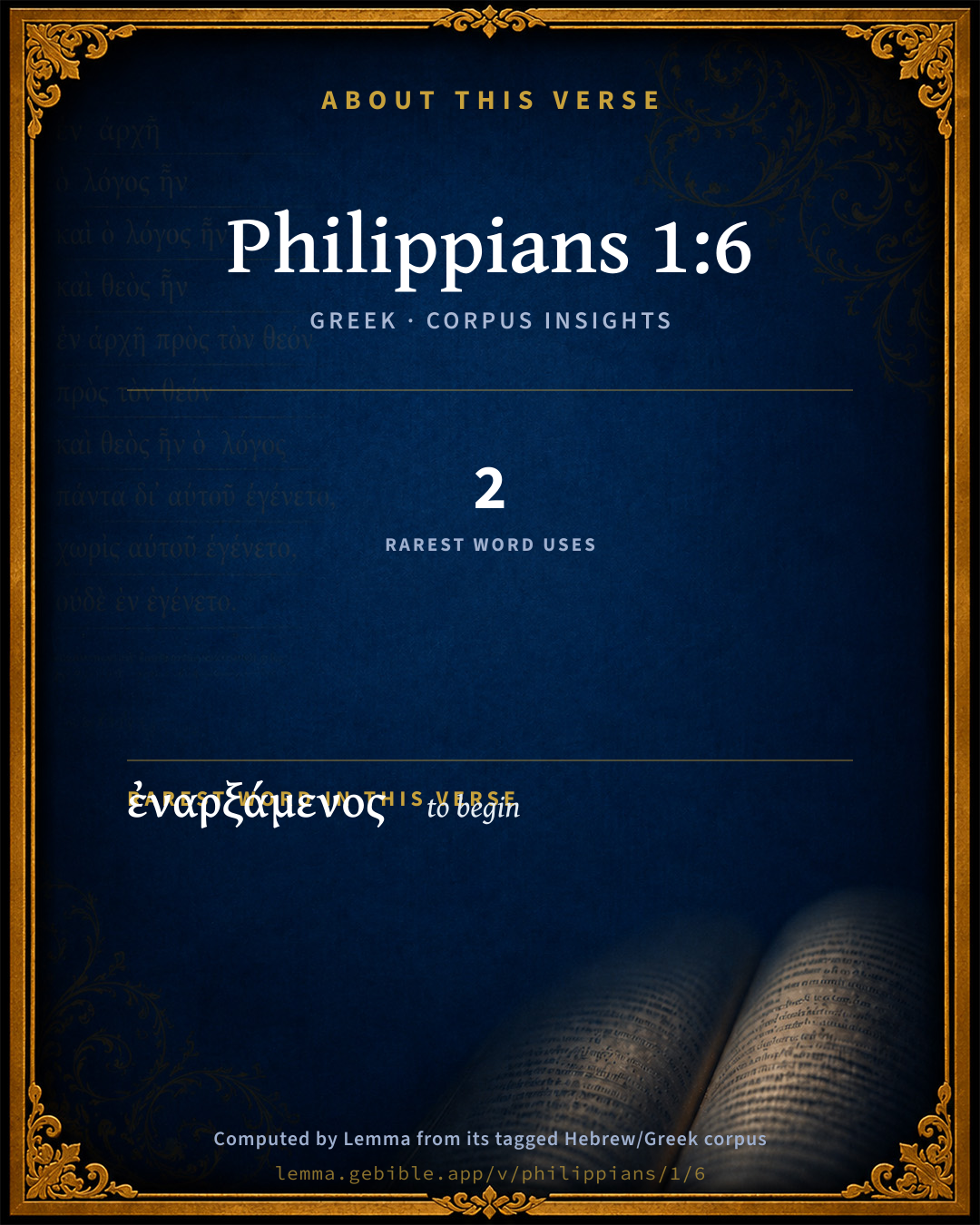
Philippians 1:6

Greek (Tischendorf 8th ed.) Philippians 1:6 appears in the Greek New Testament. The text above is from the Tischendorf 8th edition. Each word links to its Strong’s number and a concise gloss. Click any word for its full Thayer’s Greek Lexicon entry.

Download image
Cite this verse

Philippians 1:6 (World English Bible). Public Domain. Lemma interlinear Bible study tool, https://lemma.gebible.app/v/philippians/1/6.

Show BibTeX & RIS
BibTeX
RIS
English Translation
being confident of this very thing, that he who began a good work in you will complete it until the day of Jesus Christ.
World English Bible · Public Domain
Download a study sheet

One document with this verse’s original text, its word-by-word gloss line, the meaning frame, cross-references with their text, attributed commentary, and full source and license credits — printable, and it pastes into notes with its structure intact.

This verse Autodidact and up

Study sheet (.html) Plain text (.txt)

A passage Seminary Student

Up to 50 verses in one chapter. A passage sheet keeps up to 6 commentary sources and 12 cross-references per verse, in the order this page ranks them, and says so on the sheet whenever that leaves anything out. Ask for a single verse and you get the Autodidact verse sheet above.

Everything on this page stays free to read, with no account — the sheet is a download of what is already on screen, not access to it.

Want to remove ads? Support Godless Engineer
Compare translations 3

The same verse in 3 English versions, stacked beneath the original-language interlinear above. Click any original word for its lexicon entry.

Each is an independent rendering of the whole verse — the interlinear is not word-aligned to these translations.

Highlighted words mark where these versions differ — a whole-verse word diff, not a word-by-word alignment.

  • World English Bible Public Domain
    being confident of this very thing, that he who began a good work in you will complete it until the day of Jesus Christ.
  • King James Version Public Domain
    Being confident of this very thing, that he which hath begun a good work in you will perform it until the day of Jesus Christ:
  • unfoldingWord Literal Text CC BY-SA 4.0
    having become confident about this very thing, that the one having begun a good work in you will perfect until the day of Jesus Christ;

unfoldingWord Literal Text — © unfoldingWord, licensed CC BY-SA 4.0. Word-aligned USFM3 via Door43 (git.door43.org/unfoldingWord/en_ult).

Versions to compare (up to 4)

3 of 4 selected

Show all 19 translations

Every available English version of this verse, each an independent rendering of the whole verse.

  • World English Bible Public Domain
    being confident of this very thing, that he who began a good work in you will complete it until the day of Jesus Christ.
  • Berean Standard Bible Public Domain
    being confident of this, that He who began a good work in you will carry it on to completion until the day of Christ Jesus.
  • Majority Standard Bible Public Domain
    being confident of this, that He who began a good work in you will carry it on to completion until the day of Christ Jesus.
  • King James Version Public Domain
    Being confident of this very thing, that he which hath begun a good work in you will perform it until the day of Jesus Christ:
  • American Standard Version (1901) Public Domain
    being confident of this very thing, that he who began a good work in you will perfect it until the day of Jesus Christ:
  • Revised Version (1885) Public Domain
    being confident of this very thing, that he which began a good work in you will perfect it until the day of Jesus Christ:
  • Geneva Bible (1599) Public Domain
    And I am persuaded of this same thing, that he that hath begunne this good worke in you, wil perfourme it vntill the day of Iesus Christ,
  • Douay-Rheims (1899) Public Domain
    Being confident of this very thing, that he, who hath begun a good work in you, will perfect it unto the day of Christ Jesus.
  • Young's Literal Translation Public Domain
    having been confident of this very thing, that He who did begin in you a good work, will perform `it' till a day of Jesus Christ,
  • Literal Standard Version CC BY-SA 4.0
    having been confident of this very thing, that He who began a good work in you, will complete [it] until [the] day of Jesus Christ,
  • Unlocked Literal Bible CC BY-SA 4.0
    I am confident of this very thing, that he who began a good work in you will continue to complete it until the day of Jesus Christ.
  • unfoldingWord Literal Text CC BY-SA 4.0
    having become confident about this very thing, that the one having begun a good work in you will perfect until the day of Jesus Christ;
  • Darby Bible Public Domain
    having confidence of this very thing, that he who has begun in you a good work will complete it unto Jesus Christ's day:
  • World Messianic Bible Public Domain
    being confident of this very thing, that he who began a good work in you will complete it until the day of Yeshua the Messiah.
  • Webster's Bible Public Domain
    Being confident of this very thing, that he who hath begun a good work in you, will perform it until the day of Jesus Christ:
  • Free Bible Version CC BY-SA 4.0
    I'm absolutely sure that God who began this good work in you will continue working and bring it to a successful conclusion when Jesus Christ returns.
  • Bible in Basic English Public Domain
    For I am certain of this very thing, that he by whom the good work was started in you will make it complete till the day of Jesus Christ:
  • Text-Critical English NT CC BY 4.0
    I am confident that he who began a good work in you will carry it on to completion until the day of Christ Jesus.
  • Tyndale New Testament (1534) Public Domain
    and am suerly certified of this that he which beganne a good worke in you shall go forthe with it vntyll the daye of Iesus Christ

Literal Standard Version (2020), Covenant Press — licensed CC BY-SA 4.0. Text via the HelloAO Bible API (eBible.org). Unlocked Literal Bible (unfoldingWord) — licensed CC BY-SA 4.0. Text via the HelloAO Bible API (eBible.org). unfoldingWord Literal Text — © unfoldingWord, licensed CC BY-SA 4.0. Word-aligned USFM3 via Door43 (git.door43.org/unfoldingWord/en_ult). Free Bible Version, Dr. Jonathan Gallagher — licensed CC BY-SA 4.0. Text via the HelloAO Bible API (eBible.org).

Word by word

More ways to search: Search by grammar → Find every occurrence → Compare this word →

Practice this passage: Drill this verse → Learn its vocabulary →

ἐναρξάμενος
enárchomai
G1728
“to begin”
Verb, Aorist, Middle deponent, Participle, Nominative, Singular, Masculine
Part of Speech
Verb
Tense
Aorist
Voice
Middle deponent
Mood
Participle
Case
Nominative
Number
Singular
Gender
Masculine
Full Thayer's Definition

Origin: from G1722 and G756

TDNT: None

1. to begin, to make a beginning
  1. πεποιθὼς peíthō G3982 “to persuade” Verb, Perfect, Active, Participle, Nominative, Singular, Masculine
  2. αὐτὸ autós G846 “he” Personal pronoun, Accusative, Singular, Neuter
  3. τοῦτο hoûtos G3778 “this” Demonstrative pronoun, Accusative, Singular, Neuter
  4. ὅτι hóti G3754 “that” Conjunction
  5. ὁ ho G3588 “the” Article, Nominative, Singular, Masculine
  6. ἐν en G1722 “in” Preposition
  7. ὑμῖν hymeîs G5210 “you” Personal pronoun, 2nd person, Dative, Plural
  8. ἔργον érgon G2041 “work” Noun, Accusative, Singular, Neuter
  9. ἀγαθὸν agathós G18 “good” Adjective, Accusative, Singular, Neuter
  10. ἐπιτελέσει epiteléō G2005 “to complete” Verb, Future, Active, Indicative, 3rd person, Singular
  11. ἄχρι áchri G891 “until” Adverb
  12. ἡμέρας hēméra G2250 “day” Noun, Genitive, Singular, Feminine
  13. Χριστοῦ Christós G5547 “Christ” Noun, Genitive, Singular, Masculine
  14. Ἰησοῦ Iēsoûs G2424 “Jesus” Noun, Genitive, Singular, Masculine

About this verse

These counts appear in no published source. They are computed here, from the morphology-tagged text and Lemma’s own curated glosses. What Lemma adds →

15
words
15
distinct lemmas
Pauline Epistles
section

Notable vocabulary

The rarest word here is ἐναρξάμενος to begin G1728 — appearing just 2 times in the whole Greek New Testament.

Shared distinctive vocabulary

ἐναρξάμενος to begin G1728 occurs in 2 verses of the Greek New Testament. Also found in:

Cross-references

31

Topical passages linked to Philippians 1:6 in the Treasury of Scripture Knowledge — connected by theme and wording, ordered by reader-vote popularity; previews shown in the World English Bible.

  • 1 Thessalonians 5:23–24 May the God of peace himself sanctify you completely. May your whole spirit, soul, and body be preserved blameless at the coming of our Lord Jesus Christ.
  • Philippians 2:13 For it is God who works in you both to will and to work, for his good pleasure.
  • Ephesians 4:12 for the perfecting of the saints, to the work of serving, to the building up of the body of Christ;
  • Hebrews 13:20–21 Now may the God of peace, who brought again from the dead the great shepherd of the sheep with the blood of an eternal covenant, our Lord Jesus,
  • Psalms 138:8 Yahweh will fulfill that which concerns me; Your loving kindness, Yahweh, endures forever. Don't forsake the works of your own hands.
  • 1 Peter 5:10 But may the God of all grace, who called you to his eternal glory by Christ Jesus, after you have suffered a little while, perfect, establish, strengthen, and settle you.
  • Romans 8:28–30 We know that all things work together for good for those who love God, to those who are called according to his purpose.
  • 1 Corinthians 1:8 who will also confirm you until the end, blameless in the day of our Lord Jesus Christ.
  • 2 Thessalonians 1:11 To this end we also pray always for you, that our God may count you worthy of your calling, and fulfill every desire of goodness and work of faith, with power;
  • Hebrews 10:35 Therefore don't throw away your boldness, which has a great reward.
  • John 6:29 Jesus answered them, "This is the work of God, that you believe in him whom he has sent."
  • Philippians 1:10 so that you may approve the things that are excellent; that you may be sincere and without offense to the day of Christ;
  • Hebrews 12:2 looking to Jesus, the author and perfecter of faith, who for the joy that was set before him endured the cross, despising shame, and has sat down at the right hand of the throne of God.
  • Titus 3:4–6 But when the kindness of God our Savior and his love toward mankind appeared,
  • 2 Thessalonians 2:13–14 But we are bound to always give thanks to God for you, brothers loved by the Lord, because God chose you from the beginning for salvation through sanctification of the Spirit and belief in the truth;
  • Ephesians 2:4–10 But God, being rich in mercy, for his great love with which he loved us,
  • James 1:16–18 Don't be deceived, my beloved brothers.
  • 1 Peter 1:2–3 according to the foreknowledge of God the Father, in sanctification of the Spirit, that you may obey Jesus Christ and be sprinkled in his blood: Grace to you and peace be multiplied.
  • 1 Thessalonians 1:3 remembering without ceasing your work of faith and labor of love and patience of hope in our Lord Jesus Christ, before our God and Father.
  • Philemon 1:21 Having confidence in your obedience, I write to you, knowing that you will do even beyond what I say.
  • Philippians 1:29 Because it has been granted to you on behalf of Christ, not only to believe in him, but also to suffer on his behalf,
  • 2 Thessalonians 3:4 We have confidence in the Lord concerning you, that you both do and will do the things we command.
  • Colossians 2:12 having been buried with him in baptism, in which you were also raised with him through faith in the working of God, who raised him from the dead.
  • 2 Corinthians 7:16 I rejoice that in everything I am of good courage concerning you.
  • Acts 11:18 When they heard these things, they held their peace, and glorified God, saying, "Then God has also granted to the Gentiles repentance to life!"
  • Acts 16:14 A certain woman named Lydia, a seller of purple, of the city of Thyatira, one who worshiped God, heard us; whose heart the Lord opened to listen to the things which were spoken by Paul.
  • 2 Peter 3:10 But the day of the Lord will come as a thief in the night; in which the heavens will pass away with a great noise, and the elements will be dissolved with fervent heat, and the earth and the works that are in it will be burned up.
  • Galatians 5:10 I have confidence toward you in the Lord that you will think no other way. But he who troubles you will bear his judgment, whoever he is.
  • 2 Corinthians 9:4 so that I won't by any means, if there come with me any of Macedonia and find you unprepared, we (to say nothing of you) should be disappointed in this confident boasting.
  • 2 Corinthians 2:3 And I wrote this very thing to you, so that, when I came, I wouldn't have sorrow from them of whom I ought to rejoice; having confidence in you all, that my joy would be shared by all of you.
  • 2 Corinthians 1:15 In this confidence, I was determined to come first to you, that you might have a second benefit;

Cross-references courtesy of OpenBible.info (CC BY 4.0).

Commentary

Notes on Philippians 1:6 from classic Christian and Jewish commentators (each source and its license shown beneath its notes). The classic Christian expositions comment on the surrounding passage and are grouped to its opening verse, so a note may address several verses; the Jewish commentaries on the Tanakh (Rashi and others) are per-verse, so they appear only where the commentator wrote on this verse.

Lemma curates 59 commentaries, every one of them public domain or Creative Commons licensed, each selected and text-cleaned for this edition rather than reprinted as found. About our sources →

The Biblical Illustrator

Joseph S. Exell

Php_1:6

Being confident of this very thing.

Spiritual culture

I. The signs whereby we may know God has begun this gracious work.

1. The signs are not to be sought in any set methods or patterns by which God is supposed to begin His work of training the soul for Himself. His ways are endless. Some souls have to be smitten: for others a gentle look is enough, e.g., Saul and Zacchaeus.

2. There are certain impressions and effects produced by the preaching of the gospel or by the ways of God in His providence which are sometimes mistaken for signs of a gracious work. The consequences of sin may fill the conscience with remorse, and vows made to begin a new life. A sense of happiness springs up in emotional natures on a very superficial acquaintance with religion and its responsibilities. Nor is the sign found in a head well informed.

3. What then is the sign? Love to God, Christ, man, showing itself in trust and obedience, and goodness.

II. The conditions under which this good work will be perfected by God.

1. Remember that so long as you are in this world the work is incomplete. For the development of a soul in Christs likeness time is necessary. First the blade, etc. Some are discouraged because they cannot see the full corn at once. If it is time for the full corn, however, do not be satisfied with the ear or blade. It is the indolent man who thinks he has only to believe once for all.

2. You must concur in Gods work as it advances from stage to stage till it is completed in the day of Jesus Christ. Growth proceeds slowly if it is to endure. Mushrooms spring up in the night but they soon decay. (R. Tuck, B. A.)

Pauls confidence was

I. Totally isolated from judaism and self (Php_3:3-7).

II. Grounded solely in Christ.

1. As his medium of access to the mind, the heart, the power of God (Eph_3:12).

2. As the repository of all his interests (2Ti_1:12).

3. As being united to Him by love bonds which neither the mere incidents of life, nor satanic power could sever (Rom_8:38-39).

III. A means of perpetuating living relations between him and the churches which he bad formed. He expresses his confidence--

1. In the sympathy of the Corinthians (2Co_1:14-15; 2Co_2:3).

2. In the steadfastness of the Galatians in Christianity (Gal_5:10).

3. In the obedience of the Thessalonians to his teaching (2Th_3:4).

4. In the purity and intelligence of the Romans (Rom_15:14).

5. In the final perfectness of the Philippians.

IV. The seed he lived to disseminate among men. (G. G. Ballard.)

Confidence and completion

I. Of what was paul confident?

1. That the work of salvation in this people would be perfected. They were running a race, and he was confident that they would receive the prize. They were the workmanship of the Divine redeeming hand; Paul was confident that the work would not be forsaken by the Workman. That God would perfect this work. It is God that worketh in you. Paul knew that his own influence was nothing, except as it was the medium and the vehicle of the influence of God.

2. That the work would be finished in the day of the Lord. In that day every work will be tried as by fire. Gods work in this people would appear then to be perfected. A sublime persuasion, this! To stand on some moorland and see some young oaks planted, and feel quite confident that they would grow to perfection; to visit a dockyard slip, and to see the timbers of the keel of a first-rate man-of-war laid down, and to feel confident that she would answer every trial of her strength, until she had rendered full service to the nation; to be present at some important public undertaking, and to feel sure that it would be noble, and prosperous, and of national benefit; to hear the birth cry of a human being, and to feel confident that its path from the cradle to the sepulchre would be that shining brighter and brighter unto perfect day, are all glorious positions; but they cannot be compared, so far as true greatness and moral grandeur are concerned, with the position of Paul here. The sublimity of this persuasion is largely connected with the love of Pauls heart. The multitude are thoughtless, indifferent, and careless about each other, or they are envious and malicious. But this is true, sincere, pure Christian love, which writes, Being confident of this very thing.

II. On what did Pauls confidence rest?

1. On the character and resources of the Worker. It does not rest on the Church. Not because Church polity is all right, because you are thoroughly orthodox, nor because your modes of worship are just what they ought to be. The foundation of his confidence was God in Christ. Men fail in work by loss of means and of power, by change of purpose, by their dependence upon others, and by reason of death. But it is not thus with the Creator.

2. On the nature and quality of the work about which he is assured. The work is remedial to the creature, and supremely honourable to the redeeming God.

3. On the fact that the commencement of this work was by God Himself. The beginning is the pledge of the consummation. Even a wise man does nothing at random.

4. On the fact that a day is fixed for exhibiting this work in all its completeness. The day of Christ, without redemption, would indeed be a dark day.

5. He happens to blend with all this his own experience of the faithfulness and wealth of the redeeming God--Father, Son, and Holy Ghost.

III. How did this confidence operate on paul?

1. It did not prevent Paul praying for these people.

2. It gave fervency and gladness to his intercessions.

3. It did not keep Paul from exhorting the people and directing them to the use of means. Conclusion: Cherish such confidence concerning yourselves and each other, but be devoutly careful not to abuse it. (S. Martin.)

Divine workmanship

I. Its highest sphere--man (Eph_2:10).

II. Its chosen instrumentality--holy men (1Co_4:9).

III. Its model--Divine perfectness (Mat_5:48).

IV. Its law of accomplishment--gradual but certain progression--begun, perform.

V. Its guarantee of completion--Gods will. His willingness is--

1. Revealed in His word.

2. Embodied in Christ the Foundation.

3. Ratified by experience.

4. Plighted to us in the earnest of the Spirit. (G. G. Ballard.)

A good work

I. The good work.

1. Its nature. A new creation (Eph_2:10), without which we have neither will nor power to perform good works (Php_2:13).

2. Its property. It is a good work because--

(1) It is begun by a good God (Psa_25:8).

(2) It is wrought out for a good purpose (Col_1:12).

(3) It is performed with a good end in view (Rom_8:30; Heb_12:14).

II. The grounds of Pauls confidence that this good work would be completed.

1. The perfections of Gods works (Deu_32:4) in creation, providence, and grace.

2. The atonement of Christ (Joh_10:15).

3. The Christians union to Christ (Joh_14:19).

4. The earnest of the Spirit (2Co_1:22).

5. The nature of the life Christ gives (Joh_10:28).

6. The intercession of Christ (Heb_7:22; Joh_11:42; Joh_17:24). (S. Barnard.)

The good work within

I. A gracious operation.

1. It is good. Why? Because--

(1) God the best of beings is the author of it. He is the author of the wisdom that designed it; the influence which begins, continues, and completes it; the holiness which is its pattern; the love which it displays; the means whereby it is performed.

(2) Its effects are good.

(a) In respect of the soul that is the subject of it, which passes from death unto life, from sin to holiness, etc.

(b) In respect to families. When this good work is begun in the hearts of parents religion with all its pleasantness and peace dwells in the house, and God commands His blessing.

(c) Upon ministers, who thereby are made not ashamed of the gospel.

(d) Upon the Church, whose increase and prosperity is the edification and comfort of individual believers.

(e) To the world. Every convert exercises, like salt, a purifying and preserving influence.

(f) On heaven itself (Luk_15:10).

(3) Its end and completion are good. The soul is born for glory.

2. It is a work.

(1) It is primarily and chiefly the operation of the Holy Spirit. He removes all obstacles from the heart, and gives the truth free course over the inner man.

(2) It is begun and carried on by means of the Word, which is the power of God unto salvation.

(3) All the faculties of the soul which is the subject of it are brought into lively and diligent exercise: serious thought, anxious inquiry, restless desire, fervent prayer, repentance, faith, love.

II. Its important situation--in you. Not only in the head but in the heart.

1. It is evident that it is an inward work from the many figures which denote it--temple; inner man; good seed.

2. How does it exist then?

(1) As light in the mind.

(2) As love shed abroad in the heart.

(3) As peace in the conscience.

Conclusion:

1. This inward religion will be evidenced by corresponding fruits without.

2. You in whom this good work is be thankful, for by the grace of God you are what you are. Be anxious, watchful, prayerful, too, that it may go on.

3. You in whom it is begun, but fear that it is not, compare what your feelings and desires are with what they were.

4. You who think it is within you, but whose life proves that it is not, fear and tremble.

5. You who show no desire for it--if there is not a good work in you, there is an evil work there, evil in its origin, effects, end. Contemplate your danger. (Congregational Remembrancer.)

I. A wonderful fact. He who began the work.

1. The work is Divine. No part of Gods work bears so distinctly the signs of divinity (Jam_1:18). Human agency is the channel.

2. The work is gracious. Wisdom is here and power, but goodness is a special feature. Gods compassion in the gospel is a power to make us good. To make men wise, rich, happy, healthy, is a great work--but to make them good is better (2Th_2:16-17).

3. The work is progressive. The stages of spiritual life are like those of physical life advancing towards manhood.

II. A glorious certainty.

1. The resources of God are inexhaustible (Isa_46:9-10).

2. The faithfulness of God is unfailing (Hos_2:20).

3. Perfection is Gods end in everything. (Weekly Pulpit.)

Whether this good work relates entirely to the special act of beneficence which had called forth this Epistle may be fairly disputed. Taken upon this narrow ground the apostles joy would be but the refinement of selfishness. Rather he lays down a great principle respecting the Divine method of working, viz., to begin is to finish, and that principle, wide enough to encompass the universe, will also comprehend every detail of Christian service.

I. God works by a plan--to prepare manhood for the final day--a period of time, or a perfection of development; the day of death, of judgment, or of the completeness of Christian manhood.

II. God is not fickle in the prosecution of his purposes. He begins not that He may conduct an experiment, but that He may perform a design.

III. God has so revealed himself in the education of the individual and the training of society as to justify the most emphatic expression of confidence on the part of his church. The past fortells the future. When the world was young it needed Elijahs, Ezekiels, and Daniels; but the richer the world becomes in history the louder and sweeter will be its tone of confidence. God cannot publish any amended edition of Himself. You may therefore make the past the source of the widest inferences. (J. Parker, D. D.)

The perseverance of the saints

The passage suggests--

I. That real religion is a work upon the heart.

1. In opposition to the mere profession of orthodox sentiments and opinions. The truth may be held in unrighteousness. Christ is not only set forth a propitiation before His people, but is made unto them wisdom, etc. The gospel must be received as well as believed.

2. In opposition to a bare attendance upon the prescribed duties of religion. This will indeed follow but only as a means, not as an end.

II. That this work is a good work.

1. It has respect to the immortal soul.

2. It qualifies for fellowship with God the chief good.

3. It is productive of good fruits.

4. Its fruition is glory.

III. That it is the province of God to begin this work. Every other cause is inadequate.

IV. That wherever God begins a work of grace he will carry it on and perfect it.

1. He cannot be at a loss to accomplish the work He has commenced. As it is not more difficult to create than to uphold, so it is as easy for Him to communicate great supplies of grace as it was to bestow it at the first.

2. To suppose otherwise would be altogether inconsistent with His purposes of grace and love.

3. But God will perfect His work by the use of means.

(1) Secret prayer.

(2) Perusal of His Word.

Hence perseverance is not only a privilege but a duty.

V. That the second coming of Christ is the period when the work of grace shall be perfected and publicly recognized. (Congregational Remembrancer.)

Sanctification and perseverance

Sanctification, unlike the act of justification, is a work of the Holy Spirit, which will not be completed till the soul is perfected in glory. It is the gradual transformation of the renovated but imperfect heart continued until this corruptible shall put on incorruption.

I. This work consists in--

1. A gradual purification of our nature. Regeneration is the first act, but by mournful experience Paul knew, and we know, that the remains of depravity are left behind. These it is the work of sanctification to remove.

(1) It clarifies the sight of believers, enabling them more distinctly to discern Divine things.

(2) It purges the conscience, causing it to pronounce more correctly on the relations of the conduct to the law and to the gospel.

(3) It brings to light the lines of the Divine image already engraven on the heart.

2. A correspondent purification of our lives so that our obedience gradually approaches nearer the standard of holiness (Eph_2:10).

(1) Evil propensities are diminished.

(2) The graces produced by regeneration are strengthened: Faith, humility, love.

II. The motives which should induce us to seek this sanctification.

1. God commands it.

2. The love of Christ urges it.

3. We can only be prepared for glory by it.

4. It alone will enable us to glorify God. (J. Foot, D. D.)

The day of Jesus Christ

Man has his day; Christ shall have His. When--

1. His toil and suffering shall be remunerated.

2. His government be vindicated.

3. His glory be revealed.

4. All men be brought into closest relations with Him.

5. His kingship receive universal recognition on whose head are many crowns.

That day is--

(1) The goal of the human race.

(2) The terminus of history.

(3) The fulness of time. For it Paul longed, watched, waited, lived. (G. G. Ballard.)

The present dispensation

I. Excelleth in glory the former.

II. Is incomplete in its results as yet.

III. Is culminative to a higher and final glory.

IV. Is rich in spiritual forces.

V. Is one is which divine operations for mans welfare are all pervasive.

VI. Is marvellous in its history.

VII. Is accumulative in its events towards, and formative of, a future time.

Former dispensations gradually opened the path of man from the guilt of Eden to the altar of atonement: this dispensation shall terminate in dissipating the shame of the cross by the glory of the Redeemers kingdom. (G. G. Ballard.)

The danger and security of the Christian

The dangers which attend the spiritual life are of the most appalling character. The life of a Christian is a series of miracles. See a spark living in mid ocean, see a stone hanging in the air, see health blooming in a lazar house, and the snow-white swan among rivers of filth, and you behold an image of the Christian life. The new nature is kept alive between the jaws of death, preserved by the power of God from instant destruction; by no power less than Divine could its existence be continued. When the instructed Christian sees his surroundings, he finds himself to be like a defenceless dove flying to her nest, while against her tens of thousands of arrows are levelled. The Christian life is like that doves anxious flight, as it threads its way between the death-bearing shafts of the enemy, and by constant miracle escapes unhurt. The enlightened Christian sees himself to be like a traveller, standing on the narrow summit of a lofty ridge; on the right hand and on the left are gulfs unfathomable, yawning for his destruction; if it were not that by Divine grace his feet are made like hinds feet, so that he is able to stand upon his high places, he would long ere this have fallen to his eternal destruction. (C. H. Spurgeon.)

The faithfulness of God

Grandly did the old Scottish believer, of whom Dr. Brown tells us in his Horae Subsecivae, respond to the challenge of her pastor regarding the ground of her confidence. Janet, said the minister, what would you say, if after all He has done for you, God should let you drop into hell? Eens (even as) He likes, answered Janet. If He does, Hell lose mair than Ill do. At first sight Janets reply looks irreverent, if not something worse. As we contemplate it, however, its sublimity grows upon us. Like the Psalmist she could say, I on Thy Word rely (Psa_119:114, metrical version). If His Word were broken, if His faithfulness should fail, if that foundation could be destroyed, truly He would lose more than His trusting child. (Clerical Library.)

The perfection of Gods works

Show me for once a world abandoned and thrown aside half formed; show me a universe east off from the Great Potters wheel, with the design in outline, the clay half hardened, and the form unshapely from incompleteness. Direct me, I pray you, to a star, a sun, a satellite--nay, I will challenge you on lower ground: point me out a plant, an emmet, a grain of dust that hath about it any semblance of incompleteness. All that man completes, let him polish as he may, when it is put under the microscope, is but roughly finished, because man has only reached a certain stage, and cannot get beyond it; it is perfection to his feeble optics, but it is not absolute perfection. But all Gods works are finished with wondrous care; He as accurately fashions the dust of a butterflys wing, as those mighty orbs that gladden the silent night. (C. H. Spurgeon.)

The basis of Pauls confidence

He had one great historical instance to commend his theological inference. For he knew, with all the depth and intensity of a late and reluctant realization, that the whole history of his own people had been one vast illustration of the truth on which he relied. In them, far back, in the very childhood of the race, God had begun a good work: patriarchs, psalmists, prophets had by faith been confident that He would perform it: and He had actually performed it until the day of Jesus Christ, until His first coming. From the call of Abraham to the Incarnation one purpose had been steadfast, one work had moved on a line determined from the beginning--all that vast period, with its surprises and disasters, its restless shirtings, its immeasurable contrasts, had been spanned by one dominant conception--through all that seemed so disorderly and aimless there had sped the evolution of one supreme design--from first to last one thought held good, one will pressed on--and He who came at last could look back across the centuries to that majestic, solitary form upon the far-distant watch-tower, and could declare--Your father Abraham rejoiced to see My day: and he saw it and was glad. (J. Paget, D. D.)

Means of progress in the Divine life

Man is not formed in his infancy, but passes through several stages which bring him gradually to perfection; one polishes his memory, another sharpens his mind; this strengthens his judgment, and that embellishes his manners; so is it with the work of piety. For this new man who must be brought to perfection, can only be so by various degrees. He has his infancy before he attains his riper years. As in the schools of painters they first draw the figures with the pencil, and then add the colouring, giving them at different sittings and with much labour the last gloss of perfection, which in the studies of those which they adorn steals the senses of the beholders; so in the school of God, the faithful are begun and the work sketched, and then they are polished and finished. Here this work is well begun; but it can only be finished in heaven. We are the pencil sketch of the work of God to which He daily adds some touch; but the last finishing stroke we shall not receive till the great day of the Lord. (J. Daille.)

The perseverance of the saints does not supersede human effort

If any of you should be well assured that, in a certain line of business, you would make a vast sum of money, would that confidence lead you to refuse that business, would it lead you to lie in bed all day, or to desert your post altogether? No, the assurance that you would be diligent and would prosper would make you diligent. I will borrow a metaphor from the revelries of the season, such as Paul aforetime borrowed from the games of Greece--if any rider at the races should be confident that he was destined to win, would that make him slacken speed? Napoleon believed himself to be the child of destiny, did that freeze his energies? To show you that the certainty of a thing does not hinder a man from striving after it, but rather quickens him, I will give you an anecdote of myself: it happened to me when I was but a child of some ten years of age, or less. Mr. Richard Knill, of happy and glorious memory, an earnest worker for Christ, felt moved, I know not why, to take me on his knee, at my grandfathers house, and to utter words like these, which were treasured up by the family, and by myself especially, This child, said he, will preach the gospel, and he will preach it to the largest congregations of our times. I believed his prophecy, and my standing here today is partly occasioned by such belief. It did not hinder me in my diligence in seeking to educate myself because I believed I was destined to preach the gospel to large congregations; not at all, but the prophecy helped forward its own fulfilment; and I prayed, and sought, and strove, always having this Star of Bethlehem before me, that the day should come when I should preach the gospel. Even so the belief that we shall one day be perfect, never hinders any true believer from diligence, but is the highest possible incentive to make a man struggle with the corruptions of the flesh, and seek to persevere according to Gods promise. (C. H. Spurgeon.)

The permanence and sacrificial character of the work of grace

These words, found linked together more than once in Pauline usage, e.g., 2Co_8:6, Gal_3:3, have probably a sacrificial import. They are used in describing religious ceremonials, and especially the ritual of sacrifice. The metaphor then may be this: just as a sacrifice, when once it is solemnly inaugurated, is carried through with all the appropriate rites to its completion, so every work of grace in the believers heart, being not only Gods work, but a work which is an offering presented unto Him, will be carried on to its proper consummation. Nothing will be allowed to come in the way, so as to render it a half-finished, a mutilated, an imperfect thing. Begun, it must be performed. Paul is now writing to a Christian community composed for the most part of those who had once been heathen; his language therefore purposely takes appropriate colouring from their former but now forsaken rites. There is, he would say, a sacrifice carried on within their souls, a work of grace, a work shown in Christian liberality, which God will not permit to remain mutilated and incomplete. This explanation is all the more probable in view of a similar figure found in 2:17. There substantially the same metaphor appears distinctly on the surface, which at least lies only hidden here. It reminds us of the infinite solemnity belonging to every good work wrought within us and wrought by us. It is an odour of a sweet smell, a sacrifice acceptable, well pleasing to God. But the apostle directs the thought forward to the final completion of this service, until the day of Jesus Christ. (J. Hutchinson, D. D.)

The day of Jesus Christ

That is the goal of our race. That is the point to which every Christian eye is directed. Every other day of our lives, every other day of the worlds existence, is a day; a common, ordinary, casual day and no more: this is the day. It is sometimes so called without further epithet or explanation (1Co_3:13; Heb_10:25). Do we remember, do we live in the remembrance of all that is involved in it? The day of Jesus Christ is the day which is His altogether; the day which shall reveal Him as He is, disclose His real greatness, put down every rival power, and erect His throne forever as the King of kings and Lord of lords. Where shall we be then? Shall we be among those slothful and disobedient servants who shall be punished with everlasting destruction from the presence of the Lord? or rather among those who have been long waiting for Him with loins girt and lights burning, and to whom the day of the revelation of Jesus Christ will be also the day of their own final manifestation as the sons of God? (Dean Vaughan.)

The Biblical Illustrator, edited by Joseph S. Exell (c. 1880s–1900s) — public domain. Text from a community e-Sword module.

Tyndale Open Study Notes

Tyndale Open Resources

1:6 God, who began the good work within you: God takes the initiative to work his salvation in people (see Rom 9:16; Eph 1:3-8, 11; 2:4-10), so he can be trusted to continue his work of changing people into the likeness of his Son (see Rom 8:29; Eph 4:13, 15).

Tyndale Open Study Notes — © Tyndale Open Resources, licensed CC BY-SA 4.0. Text via the HelloAO Bible API.

Bengel's Gnomon

Johann Albrecht Bengel

Php 1:6. Πεποιθὼς, being confident) This confidence constitutes the sinews of thanksgiving.—ὁ ἐναρξάμενος εν ὑμῖν, who has begun in you) ἐν twice emphatically.—ἔργον ἀγαθὸν, a good work) It is the one great and perpetual work of God for our salvation, ch. Php 2:13.—ἐπιτελέσει, will perfect) The beginning is the pledge of its final consummation. Not even a man begins anything at random.[3]—ἌΧΡΙς, even to) Believers set before their minds, as the goal, the day of Christ, rather than their own death.—ἡμέρας, the day) Php 1:10.

[3] Much less does God.—ED.

Bengel's Gnomon of the New Testament — English translation (T&T Clark, Edinburgh, 1860) — public domain. Text from a community e-Sword module.

Expositor's Greek Testament

ed. W. Robertson Nicoll

Phi 1:6 . αὐτὸ τοῦτο . Accus. of the “inner object,” where the neuter pronoun takes the place of a cognate substantive; cf. 2Co 13:1 , τρίτον τοῦτο ἔρχομαι (see Blass, Gram. , p. 89). αὐτὸ τοῦτο is characteristic of Paul, “the firm touch of an intent mind” (Moule, CT [46] ad loc. ). “Having this firm persuasion.” Curiously enough, the same confident assurance, although based on very different grounds, is characteristic also of the later Jewish theology, e.g. , Apocal. of Baruch (ed. Charles), xiii., 3. “Thou shalt be assuredly preserved to the consummation of the times.” Also xxv., 1; lxxvi., 2. “Christianity, by its completely rounded view of the world, guarantees to believers that they shall be preserved unto eternal life in the kingdom of God, which is God’s revealed end in the world” (Ritschl, Justification , E. Tr., p. 200). ἐναρξάμενος . This verb, although a word of ritual in classical Greek, is found in LXX (Pentat.) apparently in the simple sense “begin”. In its only other occurrence in N.T., Gal 3:3 , it is combined with ἐπιτελέω as here. ἔργον ἀγαθόν . De W., Lft [47] and others refer this to κοινωνία of Phi 1:5 . Is it not far more natural to regard it as “the work of God” par excellence , the production of spiritual life, the imparting of the χάρις of Phi 1:7 ? Cf. chap. Phi 2:13 and esp [48] Rom 14:20 , μὴ ἕνεκεν βρώματος κατάλυε τὸ ἔργον τοῦ Θεοῦ . ἡμέρας Ἰ . Χ . On the order Ἰ . Χ ., see Phi 1:1 supr. ἡμ . lacks the article on the analogy of ἡμέρα Κυρίου (LXX). This favourite conception of O.T. prophecy refers to “the time when the Lord reveals Himself in His fulness to the world, when He judges evil and fulfils His great purposes of redemption among men.… But the judgment has not its end in itself, it is but the means of making Jehovah known to the world, and this knowledge of Him is salvation” (Davidson, Nahum , etc., p. 105). It is easy to see how the N.T. idea grows out of this. Paul probably assumes that the day is not far off, but indulges in no dogmatising. This name is given to the day because Christ as Κύριος is to be judge. Belief in the Parousia of Christ has a most prominent place in Paul’s religious thought. He never attempts to specify the time. But it cheers him, esp [49] in crises of his history (as in this Epistle), to believe that the Lord is near. (See Teichmann, Die paulin. Vorstellungen von Auferstehung und Gericht , p. 11 ff.). There is perhaps no part of Paul’s thought in which it is so difficult to trace a fixed outline of ideas as the eschatological. And yet there is no part more regulative for him than this.

[46] Cambridge Greek Testament .

[47] Lightfoot.

[48] especially.

[49] especially.

The Expositor's Greek Testament, edited by W. Robertson Nicoll (1897–1910) — public domain. Text from a community e-Sword module.

International Critical Commentary

6. πεποιθὼς: ‘being confident.’ Appended to εὐχαριστὼ and parallel with ποιούμενος.

αὐτὸ τοῦτο: Not governed by πεποιθὼς, but appended to it as specially marking the content and compass of the action (Ellic.). It prepares the way for the matter introduced by ὅτι. (Comp. Eph 6:22; Col 4:8.) Not ‘for this very reason’ (Mey.), i.e. by reason of your past coöperation, but referring to what follows.

ὁ ἐναρξάμενος: ‘He’—God—is the source of Paul’s confidence, not only for himself, but for his converts; God, whom he thanks in all his remembrance of them. For the omission of θεὸς, comp. Rom 8:11; Gal 1:6, Gal 1:2:8, Gal 1:3:5, Gal 1:5, Gal 1:5:8; 1Th 5:24. That ἐναρξάμενος contains a sacrificial metaphor, the beginning of the gospel-work among the Philippians being conceived as the inauguration of a sacrifice (Lightf.), is not probable. The word is used in that sense mostly in poetry, and the conception, in any case, is far-fetched. Lightf. compares 2:17, but that can hardly be said to be in point. Ἐνάρχεσθαι occurs three times in the N.T. (2Co 8:6; Gal 3:3), only in Paul, and always with ἐπιτελεῖν.

ἐν ὑμῖν: ‘In you’; in your hearts. Not ‘among you.’ (Comp. 2:13.)

ἔργον αʼγαθὸν: Comp. 2:13. The work begun in their reception of the gospel, and developed in their activity and close fellowship for its promotion. The thought is taken up again in vs. 7.

ἐπιτελέσει: ‘Complete,’ ‘consummate.’ For the thought, comp. 1Co 1:8; 1Th 5:24; 2Th 3:3. The sense is pregnant; will carry it on toward completion, and finally complete.

ἄχρι ἡμέρας Ἰησοῦ Χριστοῦ: ‘Day of Jesus Christ’ is the second coming or parousia of the Lord. The phrase is varied in Paul’s epistles: ἡ ἡμέρα, absolutely (1Th 5:4; 1Co 3:13; Rom 8:12); ἡ ἡμέρα ἐκείνη (2Th 1:10); ἡμέρα Χριστοῦ (Php 1:10, Php 2:16); ἡμέρα κυρίου or τοῦ κυρίιου (1Co 5:5; 1Th 5:2; 2Th 2:2); ἡμέρα τοῦ κυρίου ἡμῶν Ἰησοῦ (Χτοῦ) (1Co 1:8; 2Co 1:14). It refers to a definite point of time when the Lord will appear, and Paul expects this appearance soon. Attempts to evade this by referring his expressions to the day of death, or to the advance toward perfection after death until the final judgment, are forced and shaped by dogmatic preconceptions of the nature of inspiration. (See Jowett, “On the Belief of the Coming of Christ in the Apostolical Age,” in The Epistles of St. Paul to the Thessalonians, etc.).

International Critical Commentary — older volumes (1896–1929), various authors — public domain. Text from a community e-Sword module.

Geneva Bible (1599)

Geneva Bible translators

The Spirit of God will not forsake you unto the very latter end, until your mortal bodies shall appear before the judgment of Christ, to be glorified.

Geneva Bible (1599) marginal notes — public domain. Text via Bolls.life.

Jamieson, Fausset & Brown

Robert Jamieson, A. R. Fausset & David Brown

confident--This confidence nerves prayers and thanksgivings (Phi 1:3-4).

this very thing--the very thing which he prays for (Phi 1:4) is the matter of his believing confidence (Mar 11:24; Jo1 5:14-15). Hence the result is sure.

he which hath begun--God (Phi 2:13).

a good work--Any work that God begins, He will surely finish (Sa1 3:12). Not even men begin a work at random. Much more the fact of His beginning the work is a pledge of its completion (Isa 26:12). So as to the particular work here meant, the perfecting of their fellowship in the Gospel (Phi 1:5; Psa 37:24; Psa 89:33; Psa 138:8; Joh 10:28-29; Rom 8:29, Rom 8:35-39; Rom 11:1-2 Heb 6:17-19; Jam 1:17; Jde 1:24). As God cast not off Israel for ever, though chastening them for a time, so He will not cast off the spiritual Israel (Deu 33:3; Isa 27:3; Pe1 1:5).

perform it until--"perfect it up to" [ALFORD, ELLICOTT, and others].

the day of . . . Christ-- (Phi 1:10). The Lord's coming, designed by God in every age of the Church to be regarded as near, is to be the goal set before believers' minds rather than their own death.

Jamieson, Fausset & Brown — Commentary Critical and Explanatory on the Whole Bible (1871) — public domain (CC PDM 1.0). Text via the HelloAO Bible API.

Adam Clarke's Commentary

Verse 6. Being confident] There shall be nothing lacking on God's part to support you; and to make you wise, holy and happy; and bring you at last to his kingdom and glory.

Adam Clarke's Commentary on the Bible (1810–1826) — public domain. Text from a community e-Sword/MySword module.

John Calvin's Commentaries

6 Persuaded of this very thing. An additional ground of joy is furnished in his confidence in them for the time to come. But some one will say, why should men dare to assure themselves for to-morrow amidst so great an infirmity of nature, amidst so many impediments, ruggednesses, and precipices? Paul, assuredly, did not derive this confidence from the steadfastness or excellence of men, but simply from the fact, that God had manifested his love to the Philippians. And undoubtedly this is the true manner of acknowledging God’s benefits — when we derive from them occasion of hoping well as to the future. For as they are tokens at once of his goodness, and of his fatherly benevolence towards us, what ingratitude were it to derive from this no confirmation of hope and good courage! In addition to this, God is not like men, so as to be wearied out or exhausted by conferring kindness. Let, therefore, believers exercise themselves in constant meditation upon the favors which God confers, that they may encourage and confirm hope as to the time to come, and always ponder in their mind this syllogism: God does not forsake the work which his own hands have begun, as the Prophet bears witness, (Psalm 138:8; Isaiah 64:8;) we are the work of his hands; therefore he will complete what he has begun in us. When I say that we are the work of his hands, I do not refer to mere creation, but to the calling by which we are adopted into the number of his sons. For it is a token to us of our election, that the Lord has called us effectually to himself by his Spirit.

It is asked, however, whether any one can be certain as to the salvation of others, for Paul here is not speaking of himself but of the Philippians. I answer, that the assurance which an individual has respecting his own salvation, is very different from what he has as to that of another. For the Spirit of God is a witness to me of my calling, as he is to each of the elect. As to others, we have no testimony, except from the outward efficacy of the Spirit; that is, in so far as the grace of God shews itself in them, so that we come to know it. There is, therefore, a great difference, because the assurance of faith remains inwardly shut up, and does not extend itself to others. But wherever we see any such tokens of Divine election as can be perceived by us, we ought immediately to be stirred up to entertain good hope, both in order that we may not be envious towards our neighbors, and withhold from them an equitable and kind judgment of charity; and also, that we may be grateful to God. This, however, is a general rule both as to ourselves and as to others — that, distrusting our own strength, we depend entirely upon God alone.

Until the day of Jesus Christ The chief thing, indeed, to be understood here is — until the termination of the conflict. Now the conflict is terminated by death. As, however, the Spirit is accustomed to speak in this manner in reference to the last coming of Christ, it were better to extend the advancement of the grace of Christ to the resurrection of the flesh. For although those who have been freed from the mortal body do no longer contend with the lusts of the flesh, and are, as the expression is, beyond the reach of a single dart, yet there will be no absurdity in speaking of them as in the way of advancement, inasmuch as they have not yet reached the point at which they aspire, — they do not yet enjoy the felicity and glory which they have hoped for; and in fine, the day has not yet shone which is to discover the treasures which lie hid in hope. And in truth, when hope is treated of, our eyes must always be directed forward to a blessed resurrection, as the grand object in view.

John Calvin's Commentaries (1540-1563) — public domain. Text from the Calvin Translation Society English edition (1840s-50s) via the Christian Classics Ethereal Library (ccel.org). Calvin's coverage is partial (roughly two-thirds of the Bible); uncommented books and verses are honest gaps, never fabricated. The 19th-century editor's footnotes and remarks are omitted so the notes are faithfully Calvin's own voice.

Ellicott's Commentary for English Readers

(6) That he who hath begun (or rather, who began) a good work in you will also (see margin) finish it.—The ground of St. Paul’s confidence in their perseverance is the belief that it was God’s grace which began the good work in them, and that, not being resisted (as was obvious by their enthusiasm for good), He would complete what He had begun. In his view, God’s grace is the beginning and the end; man’s co-operation lies in the intermediate process linking both together. This is made still plainer in Php_2:12-13.

The day of Jesus Christ.—So also in Php_1:10; Php_2:16, “the day of Christ;” and in 1Co_1:8, “the day of our Lord Jesus Christ;” in all other Epistles “the day of our Lord” (as in 1Co_5:5; 2Co_1:14; 1Th_5:2; 2Th_2:2); or, still more commonly, both in Gospels and Epistles, “that day.” As is usual in the Epistles, the day of the Lord is spoken of as if it were near at hand. St. Paul, in the Second Epistle to the Thessalonians (Php_2:2, et seq.), declines to pronounce that it is near; yet does not say that it is far away, and only teaches that there is much to be done, even in the development of Anti-Christian power, before it does come. It is of course clear that, in respect of the confidence here expressed, it makes no difference whether it be near or far away. The reality of the judgment as final and complete is the one point important; “the times and seasons” matter not to us.

A Bible Commentary for English Readers, edited by Charles John Ellicott (1878–1897) — public domain. Text from a community e-Sword module.

The Cambridge Bible for Schools and Colleges

gen. ed. J. J. S. Perowne

6. Being confident] This verse is a parenthesis in the thought, suggested by the continuity “until now” of the Philippians’ love and labour. The past of grace leads him to speak of its future. The English word “confident” happily represents the Greek, which like it sometimes denotes reliance, on definite grounds (so Mat_27:43; Mar_10:24; 2Co_1:9; below, Php_2:24, Php_3:3-4; Heb_2:13, &c), sometimes a more or less arbitrary assurance (so Rom_2:19). In every case in the N. T. the word indicates a feeling of personal certainty, for whatever cause.

this very thing] A favourite phrase with St Paul; Rom_9:17 (where he varies the phrase of the LXX.), Rom_13:6; 2Co_2:3; 2Co_5:5; 2Co_7:11; Gal_2:10; Eph_6:18; Eph_6:22; Col_4:8. Elsewhere it occurs only 2Pe_1:5, and there the reading is disputed. The words are a characteristic touch of keen and earnest thought.

he which hath begun] Lit. he that began; at the crisis of their evangelization and conversion. “He” is God the Father (as habitually, where nothing in the context defines Either of the Other Persons), the supreme Author of the work of grace.

The Greek verb here occurs also Gal_3:3, where the crisis of conversion is viewed from the convert’s point of view; “ye began by the Spirit.” The reference to the Holy Spirit, however, reminds us there also that a Divine enabling is absolutely needed in order to man’s “beginning” the new life.

a good work] We may perhaps render the good work. The article is absent in the Greek, but the reference is obviously to the work of works. Cp. below, Php_2:13, and note.

will perform it] Better, as R.V., will perfect it. Cp. again Gal_3:3; “ye began by the Spirit; are ye now being perfected by the flesh?”

For the thought of this sentence cp. Psa_138:8; “the Lord will complete (all) for me; O Lord, Thy mercy is for ever; forsake not the works of Thy hands.” There the individual believing soul expresses the confidence of faith which is here expressed with regard to the community (“you”) of such souls.

until the day, &c.] The glorious goal of the redeeming process, because then, and not before, the whole being of the saint, body (Rom_8:23) as well as spirit, shall be actually delivered from all the results of sin. The mention of this Day here is thus equally in point whether or not the Apostle were contemplating a speedy or distant return of the Lord. If He returns before the believer’s death, His coming is of course the final crisis; if otherwise, “the redemption of the body,” and so far the redemption of the being, is deferred. Cp. Eph_4:30; 2Ti_1:12.

The “Day” of Christ is mentioned below, Php_1:10, Php_2:16; and altogether, in St Paul, about twenty times. For the Lord’s own use of the word “Day” for the Crisis of His Return as Judge and Redeemer, cp. Mat_7:22; Mat_10:15; Mat_11:22; Mat_11:24; Mat_12:36; Mat_24:36; Luk_17:24; Luk_17:26 (“days”), Luk_17:30-31, Luk_21:34; Joh_6:39-40; Joh_6:44; Joh_6:54.

The Cambridge Bible for Schools and Colleges (gen. ed. J. J. S. Perowne; Cambridge University Press, 1878–1918) — public domain. Text from a community e-Sword module.

John Gill's Exposition

Being confident of this very thing,.... The reason of his thanksgiving, and of his making request with joy continually on the behalf of this church, was the confidence and full persuasion he had of this same thing, of which he could be as much assured as of any thing in the world:

that he which hath begun a good work in you, will perform it until the day of Jesus Christ: by this good work is not meant the preaching of the Gospel among them, nor a Gospel church state set up in the midst of them: for though the preaching of the Gospel was a good work, and issued well in the conversion of many, in their edification and comfort, and which was still continued; and though a Gospel church state was erected among them, and was now flourishing, yet the apostle could not assure himself of the continuance of either of them, especially until the day of Christ; and both have been removed from thence many hundreds of years ago: nor is their liberal communication to the support of the Gospel intended; for though this was a good work, yet this was not wrought by God, but by themselves, and was not wrought in them, but done by them; nor their good lives and conversations. The Syriac version indeed renders it "good works", but these cannot be designed, for the same reasons as before; for though they are good things, and answer many valuable ends and purposes, yet they are external works done by men, and not internal ones wrought in them by God; wherefore by it is undoubtedly meant the work of grace upon their hearts, sometimes called the work of faith, because that is a principal part of it: this is God's work, and not man's, as may be concluded from the nature of the work itself, which is the transforming of a man by the reviewing of him, a regeneration, a resurrection, and a creation, and therefore requires almighty power; and from the condition man is in by nature, he is dead in sin, and has no power to act spiritually, and much less what is equal to such a work as this; he has no will, desire, and inclination to it, but all the reverse; and if he had, he could no more effect it, than the dry bones in Ezekiel's vision could cause themselves to live. This is the work of God. Sometimes it is ascribed to the Father, who regenerates, calls by his grace, reveals his Son, and draws souls unto him; and sometimes to the Son, who quickens whom he will, whose Spirit is given, whose image is stamped, and out of whose fulness grace is received; but more commonly it is attributed to the Spirit, who is a spirit of regeneration, sanctification, and faith: and this is a "good work", as it must needs be, since it is God's work; he is the efficient cause of it; his good will and pleasure, his grace and mercy are the moving cause of it, and not men's works; and his good word is the means of it. The matter of it is good; it is an illumination of the understanding, a subduing of the will, a taking away of the stony heart, and a giving of an heart of flesh, an infusion of spiritual life, a formation of Christ in the soul, and an implantation of all grace there: it is good in its effects; it makes a man a good man, and fits and qualifies him to perform good works, which without it he cannot do; it makes a man a proper habitation for God, and gives him meetness for the heavenly inheritance. And this is an internal work, a work begun "in" the saints; nothing external is this work; not an outward reformation, which, when right, is the fruit of this good work; nor external humiliation for sin; nor a cessation from the grosser acts of sin; nor a conformity and submission to Gospel ordinances; all which may be where this work is not; but it is something within a man; as appears from the names by which it goes; such as spirit, so called, because it is of a spiritual nature, wrought by the Spirit of God, and has its seat in the spirit of man; it is called the inward man, which is renewed day by day; a seed that remains in him, and a root which is out of sight, and oil in the vessel, the heart, as distinct from the lamp of an outward profession: as also from the several things, which, together, make up the subject of it; it is the understanding which is enlightened; the will which is subdued; the heart and inward parts in which the laws of God are written; the mind and conscience, which are sprinkled with the blood of Christ, and cleansed; and the affections, which are set on divine objects. This is a begun work, and but a begun one. It may be said to be begun as soon as light is let into the soul by the Spirit of God; when it sees its lost state, and need of a Saviour, for as the first thing in the old creation was light, so in the new; when the fear of God is put into the heart, which is the beginning of wisdom; when love appears in the soul to God, to Christ, to his people, word, and ordinances; and when there are the seeing, venturing, and relying acts of faith on Christ, though there is a great deal of darkness, trembling, and unbelief; and when it is got thus far, and even much further, it is but a begun work; it is not yet finished and perfect: this appears from the several parts of this work, which are imperfect, as faith, hope, love, knowledge, &c. from the indwelling of sin, and corruption in the best of saints; from their various continual wants and necessities; from their disclaiming perfection in this life, and their desires after it. But the apostle was confident, and so may every good man be confident, both for himself and others, that God who has, and wherever he has begun the good work of grace, will "perform", finish it, or bring it to an end, as the word here used signifies: and this the saints may assure themselves of, from many considerations; as from the nature of the work itself, which is called living water, because it always continues, a well of it, because of its abundance, and is said to spring up to eternal life; because it is inseparably connected with it, where there is grace, there will be glory; grace is the beginning of glory, and glory the perfection of grace; this work of grace is an incorruptible seed, and which remains in the saints, and can never be lost; it is a principle of life, the root of which is hid in Christ, and that itself is maintained by him, and can never be destroyed by men or devils: and also from the concern God has in it, who is unchangeable in his nature, purposes, promises, gifts, and calling; who is a rock, and his work is perfect sooner or later; who is faithful, and will never forsake the work of his hands, and has power to accomplish it; and who has promised his people, that they shall grow stronger and stronger, that they shall not depart from him, and he will never leave them. Moreover, this may be concluded from the indwelling of the Spirit, as a spirit of sanctification, as the earnest and seal of the inheritance, and that for ever; and from the intercession and fulness of grace in Christ, and the saints' union to him, and standing in him; as well as front the impotency of any to hinder the performance of this work, as sin, Satan, or the world: to which may be added the glory of all the three Persons herein concerned; for if this work is not finished, the glory of God the Father in election, in the covenant of grace, in the contrivance of salvation, in the mission of his Son, the glory of Christ in redemption, and of the Spirit in sanctification, would be entirely lost: wherefore it may be depended on, this work will be performed wherever it is begun, and that "until the day of Jesus Christ"; meaning either the day of death, when Christ takes the souls of believers to himself, and they shall be for ever with him, when this work of grace upon the soul will be finished; for God, who is the guide of his people, will be their God and guide even unto death: or else the last day, the day of judgment, the resurrection day, when Christ shall appear and raise the dead, and free the bodies of the saints from all their bondage, corruption, vileness, and weakness, which will be putting the last and finishing hand to this good work; nor will even the bodies of the saints be quitted by the Spirit of God till this is done.

John Gill's Exposition of the Whole Bible (1746–1763) — public domain (CC PDM 1.0). Text via the HelloAO Bible API.

Trapp's Complete Commentary

John Trapp

6 Being confident of this very thing, that he which hath begun a good work in you will perform it until the day of Jesus Christ:

Ver. 6. That he which hath begun a good work] Gr. εναρξαμενος, "That he which hath in-begun a good work in you;" for the work is wholly inward and spiritual, saith an interpreter. So God is said to indwell in his people, 2Co 6:16, as if he could never have enough communion with them.

Will perform it] Or perfect it. God doth not use to do his work by the halves, but goes through-stitch with it, 1Th 5:24; Psa 138:8. Only we must pray as Luther was wont to do, "Confirm, O Lord, in us what thou hast wrought, and perfect the work that thou hast begun in us to thy glory. So be it." And as Queen Elizabeth prayed, "Look upon the wounds of thy hands, and despise not the work of thy hands. Thou hast written me down in thy book of preservation with thine own hand; oh, read thine own handwriting, and save me," &c.

John Trapp, A Commentary or Exposition upon All the Books of the Old and New Testament (1647–1656) — public domain. Text from a community e-Sword module.

Albert Barnes' Notes on the Bible

Being confident - This is strong language. It means to be fully and firmly persuaded or convinced; participle, middle voice, from πείθω peithō - to persuade; compare Luk 16:31. “Neither will they be persuaded, though one rose from the dead;” that is, they would not be convinced; Act 17:4; Heb 11:13; Act 28:24. It means here that Paul was entirely convinced of the truth of what he said. It is the language of a man who had no doubt on the subject.

That he which hath begun a good work in you - The “good work” here referred to, can be no other than religion, or true piety. This is called the work of God; the work of the Lord; or the work of Christ; Joh 6:29; compare 1Co 15:58; 1Co 16:10; Phi 2:30. Paul affirms here that that work was begun by God. It was not by their own agency or will; compare the notes on Joh 1:13. It was on the fact that it was begun by God, that he based his firm conviction that it would be permanent. Had it been the agency of man, he would have had no such conviction, for nothing that man does today can lay the foundation of a certain conviction that he will do the same thing tomorrow. If the perseverance of the Christian depended wholly on himself, therefore, there could be no sure evidence that he would ever reach heaven.

Will perform it - Margin, “Or, finish” The Greek word - ἐπιτελέσει epitelesei - means that he would carry it forward to completion; he would perfect it. It is an intensive form of the word, meaning that it would be carried through to the end. It occurs in the following places: Luk 13:32, “I do cures;” Rom 15:28, “when I have performed this;” 2Co 7:1, “perfecting holiness;” 2Co 8:6, “so he would also finish in you;” 2Co 8:11, “perform the doing of it;” Gal 3:3, “are ye now made perfect by the flesh;” Heb 8:5, “when he was about to make the tabernacle;” Heb 9:6, “accomplishing this service;” and 1Pe 5:9, “are accomplished in your brethren.” The word occurs nowhere else; and here means that God would carry on the work which he had begun to completion. He would not leave it unfinished. It would not he commenced and then abandoned. This would or could be “performed” or “finished” only:

(1) By keeping them from falling from grace, and,

(2) By their ultimate entire perfection.

Until the day of Jesus Christ - The day when Christ shall so manifest himself as to be the great attractive object, or the day when he shall appear to glorify himself, so that it may be said emphatically to be his day. That day is often called “his day,” or “the day of the Lord,” because it will be the day of his triumph and glory. It refers here to the day when the Lord Jesus will appear to receive his people to himself - the day of judgment. We may remark on this verse, that Paul believed in the perseverance of saints. It would be impossible to express a stronger conviction of the truth of that doctrine than he has done here. Language could not be clearer, and nothing can be more unequivocal than the declaration of his opinion that where God has begun a good work in the soul, it will not be finally lost. The ground of this belief he has not stated in full, but has merely hinted at it. It is based on the fact that God had begun the good work. That ground of belief is something like the following:

(1) It is in God alone. It is not in man in any sense. No reliance is to be placed upon man in keeping himself. He is too weak; too changeable; too ready to be led astray; too much disposed to yield to temptation.

(2) The reliance, therefore, is on God; and the evidence that the renewed man will be kept is this:

God began the work of grace in the soul. He had a design in it. It was deliberate, and intentional. It was not by chance or haphazard. It was because he had some object that was worthy of his interposition. There is no reason why he should begin such a work and then abandon it. It cannot be because he has no power to complete it, or because there are more enemies to be overcome than he had supposed; or because there are difficulties which he did not foresee; or because it is not desirable that the work should be completed. Why then should he abandon it? God abandons nothing that he undertakes. There are no unfinished worlds or systems; no half-made and forsaken works of His hands. There is no evidence in His works of creation of change of plan, or of having forsaken what He began from disgust, or disappointment, or lack of power to complete them. Why should there be in the salvation of the soul? He has promised to keep the renewed soul to eternal life; see Joh 10:27-29; Heb 6:17-20; compare Rom 8:29-30.

Albert Barnes' Notes on the Bible (1834–1885) — public domain. Text from a community e-Sword/MySword module.

Matthew Poole's English Annotations

Being confident of this very thing; i.e. having thanked God for what he had done and did for them, he expresseth his firm persuasion and charitable hope of their perseverance for the future.

That he which hath begun a good work in you, will perform it; not from any thing in themselves more than others, but because God the Father, (who is not weary of well-doing), having begun the work of faith in them Phi 2:13, with Joh 6:29, who else were dead in sins, as the Ephesians, Eph 2:1, he would preserve and carry on that internal and spiritual work in the fruits of real Christians, and not leave it imperfect, Psa 138:8; Isa 64:8; but would make it perfect, or perfect, stablish, strengthen, and settle them in it, those words being of the same import in Scripture with perform it, connoting the difficulty of it.

Until the day of Jesus Christ; i.e. either until the day of their death, when the spirits of just men are made perfect, and Christ appears to their particular judgment, Heb 12:23, not as being perfect while here in this state, Phi 3:12; or rather, until the day of Christ, or latter day, at judgment, 1Co 1:8; 1Th 4:15; when they shall be acknowledged to be blameless, to the glory of Christ, who hath carried them through all, and fullfilled the work of faith in them, and glorified them, 2Th 1:11, and who are his glory, 2Co 8:23.

Matthew Poole's English Annotations on the Holy Bible (1683–1685) — public domain. Text from a community e-Sword/MySword module.

Whedon's Commentary on the Bible

Daniel D. Whedon

6. Confident—So uninterrupted and uniform in this respect had their past history been, that it was a reasonable expectation that their future would be of the same blessed character, but developing with time into a more beautiful maturity. This full persuasion deepens Paul’s joy, and the more so as he contemplates its final fruit.

A good work—Plainly, the fellowship just mentioned. Begun in them on the divine side by God, and maintained and growing for ten years, there was good ground (derived not from a theological belief in infallible perseverance, but from the present evidences of their case) for expecting its continuance under his gracious guidance unto the end. Does not God always incite young converts to this same spirit of active interest in the cause of the gospel? And, if so, why should it not abide and grow, keeping the Church in lively sympathy with plans and labours for the conversion of the world?

Day of Jesus Christ—See note, 2Th_2:2.

Daniel D. Whedon (gen. ed.), Commentary on the Old and New Testaments (1874–1909) — public domain. Text from a community e-Sword module.

The Pulpit Commentary

Being confident of this very thing. St. Paul"s thanksgiving refers, not only to the past, but also to the future. He has a confident trustfulness in God"s power and love. The words auto touto might mean "on this account," i.e. on account of the perseverance described in Ver. 5, but the order seems to support the ordinary rendering. That he which hath begun a good work in you will perform it; rather, as R.V, which began. Both enarxamenov and epitelesei have (Bishop Lightfoot) a sacrificial reference. The good work is self-consecration, the sacrifice of themselves, their souls and bodies, issuing in the co-operation of labor and almsgiving. This sacrificial metaphor recurs in Php_2:17. The good work is God"s; he began it and he will perfect it. The beginning (Bengel) is the pledge of the consummation. Yet it is also their work their co-operation towards the gospel. (comp. Php_2:12, 13) Until the day of Jesus Christ. The perfecting will go on until the great day. To the individual Christian that clay is practically the day of his death; though, indeed, the process of perfecting may be going on in the holy dead till they obtain their perfect consummation and bliss both in body and soul. These words do not imply that St. Paul expected the second advent during the life of his Philippian converts. The words "in you" must be understood as meaning "in your hearts," not merely "among you.

The grounds of the apostle"s thanksgiving.

"Being confident of this very thing, that he which began a good work in you will perfect it till the day of Christ.

I THE SUBJECT OF HIS CONFIDENCE. "A good work," regarded:

1. In itself. It is the work of grace or salvation in the human soul.

2. In its development. It has a beginning and an ending. It is God, not man, who begins it; and he who begins it ends it. It is thus a good work,

(1) because it is God"s through all its stages;

(2) because it brings good to man, being the restoration of the Divine image in his heart;

(3) because it brings glory to God.

II THE GROUNDS OF HIS CONFIDENCE. Not in the power of priesthood or sacrament, but in the character and resources of the Worker. He who begins will end it, for he has fixed a day for its completeness very day of Christ." Not the day of death, but the day of Christ, because man does not exist in his completely glorified condition till he stands in the redemption of both body and soul. The grounds of a believer"s perseverance are not, therefore, to be found in his own watchfulness or his own strength, but

(1) in the purposes and promises of God,

(2) in the mediation of Christ,

(3) in the constant indwelling of the Holy Spirit.

III HOW THIS CONFIDENCE OPERATED IN THE APOSTLE. It did not prevent him from.praying for his converts or exhorting them to the use of means for their continuance in grace. It suggests

(1) that we ought to be careful not to abuse assurance; and

(2) that we ought to interest ourselves deeply in each other"s spiritual welfare. T.C.

Vers. 6-8. Personal Christianity.

"Being confident of this very thing, that he which hath begun a good work in you will perform it until the day of Jesus Christ: even as it is meet for me to think this of you all, because I have you in my heart; inasmuch as both in my bonds, and in the defense and confirmation of the gospel, ye all are partakers of my grace. For God is my record, how greatly I long after you all all in the bowels of Jesus Christ." These words bring under our notice personal Christianity.

I In this the greatest apostle HAD THE STRONGEST CONFIDENCE. "Being confident of this very thing, that he which hath begun a good work in you will perform it." The apostle seems to have had confidence:

1. In its character. It is "a good work." Genuine religion is in every sense a good thing.

(1) Good in its essence supreme love to the supremely good.

(2) Good in its influence. In its influence on self, elevating the soul to the image and the friendship of God. Good in its influence on society, ameliorating the woes of the race by enlightening the ignorant, healing the afflicted, enfranchising the enthralled. Whatever of goodness is found in Christendom unknown in heathen lands to-day must be ascribed to this "good work.

2. In its internality. "In you." Some would read, "amongst you," supposing the reference to be to the influence of Christianity on Philippi and its neighborhood; but there is no authority for this. It is in you." Christianity is a good thing outside of us, yet unless it enters into our natures, permeates, inspires, dominates, etc., he it is of no service no more service than the noontide sun is to the man whose eyes are scaled in darkness.

3. In its divinity. "He which hath begun a good work." He, undoubtedly the all-loving Father. Every good in the universe begins with the good One. The first good thoughts, sympathy, volitions, aims, principles of action in the human soul, originate with him, from whence comes every "good and perfect gift." Personal Christianity in a man is a Divine thing; it is the eternal Logos made flesh.

4. In its perpetuity. "Will perform it until the day of Jesus Christ." "The day of Jesus Christ." "So also in Php_1:10 2:16; and in 1Co_1:18, "the day of our Lord Jesus Christ;" in all other Epistles, "the day of our Lord", (as in 1Co_5:5 2Co_1:14 1Th_5:2 2Th_2:2) or still more commonly both in Gospel and Epistles, "that day." As is usual in the Epistles, the day of the Lord is spoken of as if it were near at hand. St. Paul in 2Th_2:2 declines to pronounce that it is near, yet does not say that it is far away, and only teaches that there is much to be done even in the development of and-Christian power before it does come. It is, of course, clear that, in respect of the confidence here expressed, it makes no difference whether it be near or far away. The reality of the judgment as final and complete is the one point important, the times and seasons matter not to us" (Dr. Barry). Whatever period is here pointed to, it must not be supposed as conveying the idea that this "good work" terminates at that period, "until the day." It does not say that then it will become extinct. The idea it suggests rather to me is that, having existed up to that period under most inauspicious circumstances, struggling with awful difficulties, after that, when all that is unfavourable is removed, it will go on for ever. The doctrine of final perseverance, as it has been called, has engaged immense discussion, often foolish, sometimes acrimonious, seldom useful. It should not be looked upon as a doctrine, but rather regarded as a duty, and as a law of spiritual life.

II With this the greatest apostle FELT THE INTENSEST SYMPATHY. "Even as it is meet right for me to think this of you all, because I have you in my heart; inasmuch as both in my bonds, and in the defense and confirmation of the gospel, ye all are partakers of my grace;" or rather as in the margin, "partakers with me of grace." His sympathy with them is shown by the fact that:

1. They occupied his thoughts. "Even as it is meet;" diakion, that is just, or right, to have this prayerful confidence. According to a law of mind, we must always think of those with whom we have the deepest sympathy. The chief object of love is ever the chief subject of thought.

2. They filled his heart. "I have you in my heart." And the reason he assigns is because of their hearty identification with him in his ministry. "Inasmuch as both in my bonds, and in the defense and confirmation of the gospel, ye all are partakers of my grace." What a blessed thing it is for a man to have himself in the heart of a true-hearted, truly generous one!

3. They inspired his Christliness. "For God is my record, how greatly I long after you all in the bowels of Jesus Christ." The word "bowels" should be translated "heart long after you all in the heart of Christ Jesus" (Dr. Samuel Davidson). In another place the apostle says, "I live; yet not I, but Christ liveth in me." Perhaps what the apostle means here is All that I have in me of the ideas, spirit, and aim of Christ are excited to a yearning for your good when! think of you. It is a characteristic of a genuine disciple that he is under the inspiration and control of the same great moral passion as his Master; viz. disinterested, self-sacrificing, all-conquering love. "All real spiritual love is but a portion of Christ"s love which yearns for all to be united to him" (Dean Alford). D.T.

The truest guarantee of perseverance.

Note

I ST. PAUL"S CONFIDENCE THAT THESE PHILIPPIANS WOULD PERSEVERE UNTO THE END.

II THE GROUNDS ON WHICH BE RESTS THIS CONFIDENCE.

1. That it is God"s work. If we know that God is working in us we can trust him to complete his work.

2. God"s work demands man"s he"s co-operation. St. Paul recognizes in the zeal which these Philippians displayed in the furtherance of the gospel (ver. 5) the best evidence of their co-operation with God, and therefore the best guarantee of their perseverance.

III WHAT THIS ZEAL IS NOT. It is not the same as anxiety for the victory of a party, of a particular set of views, or of our own personal influence. It is not a devotion to the merely external aspects of religion.

IV WHAT THIS ZEAL IS. It is joy at the progress or God"s kingdom in human souls by whatever methods that progress may have been brought about. It is readiness to bear witness for Christ and to work for him.

V THIS ZEAL FOR THE FURTHERANCE OF THE GOSPEL IS:

1. Apostolic. (Act_11:23)

2. It is angelic. (Luk_2:13, Luk_2:14)

3. It is Divine.

VI THIS WITNESS-REARING IS IN ITSELF AN ELEMENT OF STRENGTH; and therefore of perseverance. (Rom_10:10)

VII If you lack perseverance, remember its secret, which is that it is to be found a GENUINE CO-OPERATION IN GOD"S WORK for mankind. VW.H.

Begun, continued, and ridded in God.

This phrase describes the first essential condition of the Christian life.

I CHRISTIANS HAVE A GOOD WORK GOING ON WITHIN THEM.

1. Christianity is first of all internal. What is in us is the matter of chief importance.

2. A work is going on in the heart of the Christian, creating, developing, training, pruning, purging, building up.

3. This work is good. It is good for the soul to be brought from death to life, and for others that sympathy may be shown them and active good done as was the case with the Philippians in their relations to St. Paul.

II THE WORK IS AS YET ONLY IN THE BEGINNING. A perfect Christian is the result of years of training. The new birth produces a babe in Christ. Much spiritual nourishment and education are required to develop the full-grown man.

III THE WORK IS BEGUN BY GOD.

1. It begins in a new creation. God only can create. So great a change as is required in turning from a life of selfish sin to a life self-sacrificing holiness can only be effected by a Divine influence. That influence is put forth so that the greatest sinner may become the greatest saint.

2. Though the work is conditioned by our faith, still that is "not of ourselves, it is the gift of God.

IV THE FACT THAT GOD HAS BEGUN THE GOOD WORK IS A GROUND FOR THINKING THAT HE WILL COMPLETE IT.

1. The character of God implies this. He is not fickle that he should change, nor weak that he should fail.

2. The natu re of the work implies this. The first step is the hardest. Every stage in the Christian progress is a prophecy of future stages. The force of habit which was before set against the good work becomes increasingly engaged in supporting it.

V THE OBJECT OF COMPLETING THE GOOD WORK IS THAT IT MAY BE READY FOR the DAY OF CHRIST.

1. That day is a day of trial. In the first age it came with the destruction of Jerusalem and consequent troubles. We need to be strengthened in the time of calm that we may stand firm in the storm.

2. Glorious victory follows the trouble of the day of Christ. Christians should be ready to share in that triumph.

VI THE GOOD WORK WILL ONLY BE BEGUN, CONTINUED, AND ENDED IN GOD WHEN WE CO-OPERATE. That is not stated here. But it is stated elsewhere. (e.g. Php_2:12) St. Paul is "persuaded" of success with the work in the Philippians partly on account of what he knows of their disposition and behavior. We must exercise faith and obedience in the strength of God and for the reception of God"s work in us. W.F.A.

The Pulpit Commentary (1880–1919), ed. H.D.M. Spence-Jones & Joseph S. Exell — public domain. Text from a community e-Sword module.

John Wesley's Explanatory Notes

Being persuaded - The grounds of which persuasion are set down in the following verse. That he who hath begun a good work in you, will perfect it until the day of Christ - That he who having justified, hath begun to sanctify you, will carry on this work, till it issue in glory.

John Wesley, Explanatory Notes Upon the Whole Bible (1754–1765) — public domain. Text via the GEBible commentary corpus.

Scofield Reference Notes

C. I. Scofield

day of

(See Scofield "1Co 1:8").

The Scofield Reference Bible (1917 edition), notes by C. I. Scofield — public domain. Text from a community e-Sword module.

Burkitt's Expository Notes on the New Testament

William Burkitt

Here we have a further cause assigned of St. Paul’s joy on the Philippians’ behalf: namely, the firm and full assurance which he had of their perseverance in grace unto the end. God, that has begun, will perfect, that is, augment and increase it, till it arrive at perfection in glory.

Note here, 1. The nature of grace described, or the proper title deservedly given to the grace of God; it is called a good work; he that hath begun a good work, &c. Well may regenerating grace be called a good work, because it is the living foundation and vital principle from whence all good works do proceed and flow; the grace of God in the heart is the root of all true holiness in the life; as good works are necessary to salvation, so renewing grace is necessary to good works.

Note, 2. As the nature of grace described, so the author and augmenter of grace declared, and that is, God. He that hath begun a good work in you, will perform it, that is, augment it, and increase it. As the good work of grace in the heart is God’s work, and he is the author of it, so he will maintain it, and carry it on to perfection, and be both the increaser and perfecter of it; God never doth his work by halves.

Note, 3. The certainty of grace asserted: Being confident of this very thing.

But what ground had St. Paul for this confidence?

Ans. Because grace is the care of the whole Trinity: all the Persons, Father, Son, and Holy Ghost, do concern themselves both in the production, preservation, and perfection of it; the Father decrees it, the Son purchases it, the Spirit infuses it: the Father begets it, the Son excites it, the Holy Spirit conducts: and as they all did concur to its production, so did they all co-operate and work together for the preservation of it.

Learn hence, That such persons, in whose souls Almighty God has begun a good work of grace, may with much assurance expect by the influence of God’s care, and the exercise of their own endeavours, that they shall hold out and persevere in a state of grace unto the end; until the day of Christ, that is, the day of judgment.

William Burkitt's Expository Notes on the New Testament (1700–1703) — public domain. Text from a community e-Sword module.

The People's New Testament

B. W. Johnson

6. Being confident. So faithful have they been that he is confident that they will be faithful to the end. He which began a good work. God, who sent Paul to them with the gospel, began the good work. He will sustain them by his grace. Day of Jesus Christ. The day they are called to his presence.

B. W. Johnson's The People's New Testament with Notes (1889–1891) — public domain. Electronic text from the Christian Classics Ethereal Library (CCEL) ThML edition.

Cambridge Greek Testament for Schools and Colleges

6. πεποιθὼς. “Feeling confident.” The word sometimes denotes reliance, on sure grounds, expressed or not (so e.g. Mat 27:43; 2Co 1:9; below, Php 2:24, Php 3:3-4); sometimes a more arbitrary assurance (Rom 2:19); in every case, a feeling of personal certainty. This expression of “confidence” about their future is perhaps occasioned by the words just previous, about their preserving consistency “until now.”

αὐτὸ τοῦτο. A characteristic Pauline expression; the firm touch of an intent mind. See e.g. Rom 9:17; Rom 13:6; 2Co 2:3; 2Co 5:5; Gal 2:10; Eph 6:18; Col 4:8. Elsewhere in N. T. it appears only in 2Pe 1:5, in a disputed reading.

ὁ ἐναρξάμενος. We may perhaps render, “He who did inaugurate.” Ἐνάρχεσθαι in Greek of the golden age (e.g. Eurip., I. A. 435) habitually means the solemn opening of the sacrificial ritual, the taking the barley from the basket. And in the Apocrypha it seems to tend on occasion to a certain solemnity; e.g. Sir 38:16, τέκνον, ἐπὶ νεκρῷ … ὡς δεινὰ πάσχων ἔναρξαι θρήνου. But there are cases enough to justify the simpler rendering “He who did begin,” if it is otherwise preferred.—The aorist participle points of course to the biographical crisis of their evangelization and conversion, when the Giver of grace made His message effectual in them. Cp. Gal 3:3, ἐναρξάμενοι πνεύματι νῦν σαρκὶ ἐπιτελεῖσθε; There the crisis of conversion is viewed from the convert’s side.

ἔργον ἀγαθὸν. We may perhaps render “the good work”; so plainly is “the work of works” in view, defined by its own greatness.

ἐπιτελέσει, “Will complete it.” The verb, like ἐνάρχεσθαι, has occasionally a religious solemnity of meaning; e.g. Hdt. ii. 63, θυσίας ἐπιτελέουσι. But Biblical Greek usage hardly warrants our pressing such a meaning here. Cp. again Gal 3:3: “are ye now being completed, ἐπιτελεῖσθε, by the flesh?”—The thought here is that of Psa 138:8, where it appears as the individual believer’s personal assurance. (Aquila and Symmachus there have ἐπιτελέσει.)

ἄχρις ἡμέρας Χ. Ἰ. I.e., the process issuing in “completion” will go on till then, and be then summed up. “The day” is the goal, because not till then will the whole being of the Christian, body (Rom 8:23) as well as spirit, be fully “redeemed” from the results of sin. The mention of “the day” is thus equally in point, whether or not the Lord should be coming soon. In either case it, and no previous date, is the point of “completion.”—“The day” is mentioned below, Php 1:10, Php 2:16, and altogether, in St Paul, about twenty times. The Lord uses the word of His own Return, Mat 7:22, and in some fourteen other places in the Gospels, including Joh 6:39-40; Joh 6:44; Joh 6:55.

Cambridge Greek Testament for Schools and Colleges (Cambridge University Press, 1896; 21 vols, various authors incl. Carr, Maclear, Plummer, Farrar, Lumby, Moule, M. R. James, Simcox) — public domain. Text from a community e-Sword module.

Alford’s Greek Testament

Henry Alford

6. ὁ ἐναρξ.] He who has begun in you a good work, viz. God: cf. ch. 2:13. Wakefield, perversely enough, renders, ‘he among you who has begun, &c.’

By ‘a good work,’ he refers his confidence to the general character of God as the doer and finisher of good: the one good work in his mind being, their κοινωνία &c. ἐν is in, not ‘among:’ but the preposition in ἐναρξάμενος seems not to be connected with it, cf. reff., where the verb has an absolute meaning, irrespective of any immanent working.

The ἄχρι ἡμέρας χρ. Ἰησοῦ assumes the nearness of the coming of the Lord (μέχρι τῆς τοῦ σωτῆρος ἡμῶν ἐπιφανείας, Thdrt.). Here, as elsewhere, Commentators (even Ellic. recently) have endeavoured to escape from this inference. Thus Thl., Œc., refer the saying not only to the then existing generation of Philippians, but καὶ τοῖς ἐξ ὑμῶν: Estius, in the case of each man, ‘usque ad mortem suam;’ Calov., understanding not the continuance till the day of Christ, but ‘terminus et complementum perfectionis, quod habituri isto die erimus:’ and so nearly Calvin, but saying very beautifully,—‘Tametsi enim qui ex corpore mortali sunt liberati, non amplius militent cum carnis concupiscentiis, sintque extra teli jactum ut aiunt: tamen nihil erit absurdi, si dicentur esse in profectu, quia nondum pertigerunt quo aspirant: nondum potiuntur felicitate et gloria quam sperarunt: denique nondum illuxit dies, qui revelet absconditos in spe thesauros. Atque adeo quum de spe agitur, semper ad beatam resurrectionem, tanquam ad scopum, referendi sunt oculi.’ Doubtless, this is our lesson, and must be our application of such passages: but this surely was not the sense in which the Apostle wrote them.

Henry Alford, The Greek Testament (1849–1861) — public domain. Text from a community e-Sword module.

Vincent's Word Studies in the New Testament

Marvin R. Vincent

Being confident [πεποιθως] . With a slightly causative force : since I am confident.

Hath begun - will perform [εναρξαμενος - επιτελεσει] . The two words occur together, 2Co 8:6; Gal 3:3. Both were used of religious ceremonials. So Euripides : "But come! Bring up the sacrificial meal - basket" [εξαρχου κανα] ; that is, begin the offering by taking the barley - meal from the basket (" Iphigenia in Aulis, " 435). Some find the sacrificial metaphor here, and compare ch. 2 17, see note. Perform, better as Rev., perfect. Perform, in its older and literal sense of carrying through (per) or consummating would express the idea; but popular usage has identified it with do.

Marvin R. Vincent, Word Studies in the New Testament (1887–1900) — public domain. Text from a community e-Sword/MySword module.

Lesson kit

Teaching starters — assembled from the data on this page, not authored interpretation. Every prompt links to the verse data it draws on. Edit before teaching.

Philippians, in the Pauline Epistles, opens this verse with 15 words (15 distinct Greek lemmas). Its most distinctive word is enárchomai (“to begin”). A historical commentator’s framing appears above. Read the whole chapter for the surrounding context.

Discussion questions

  1. The word enárchomai carries the sense “to begin.” How does it shape the verse?
  2. Galatians 3:3 shares the word «to begin» with this verse. How do the two illuminate each other?
  3. These translations render this verse differently; the difference is in the English rendering, not the original. What questions does that raise?
  4. Reading how The Biblical Illustrator and Tyndale Open Study Notes read this verse, where do the two commentators agree and where do they part?

Things to notice

Reading settings

Reading text

Shown beneath each verse's original-language words.

Old Testament
Old Testament edition

Read the OT as the Masoretic Hebrew (MT) or the Greek Septuagint (LXX).

English shown for the Greek Septuagint (in the Hebrew ↔ Greek comparison).

Comparing translations? Open the Compare panel on any verse page to stack up to four side by side.