
Titus 1:16

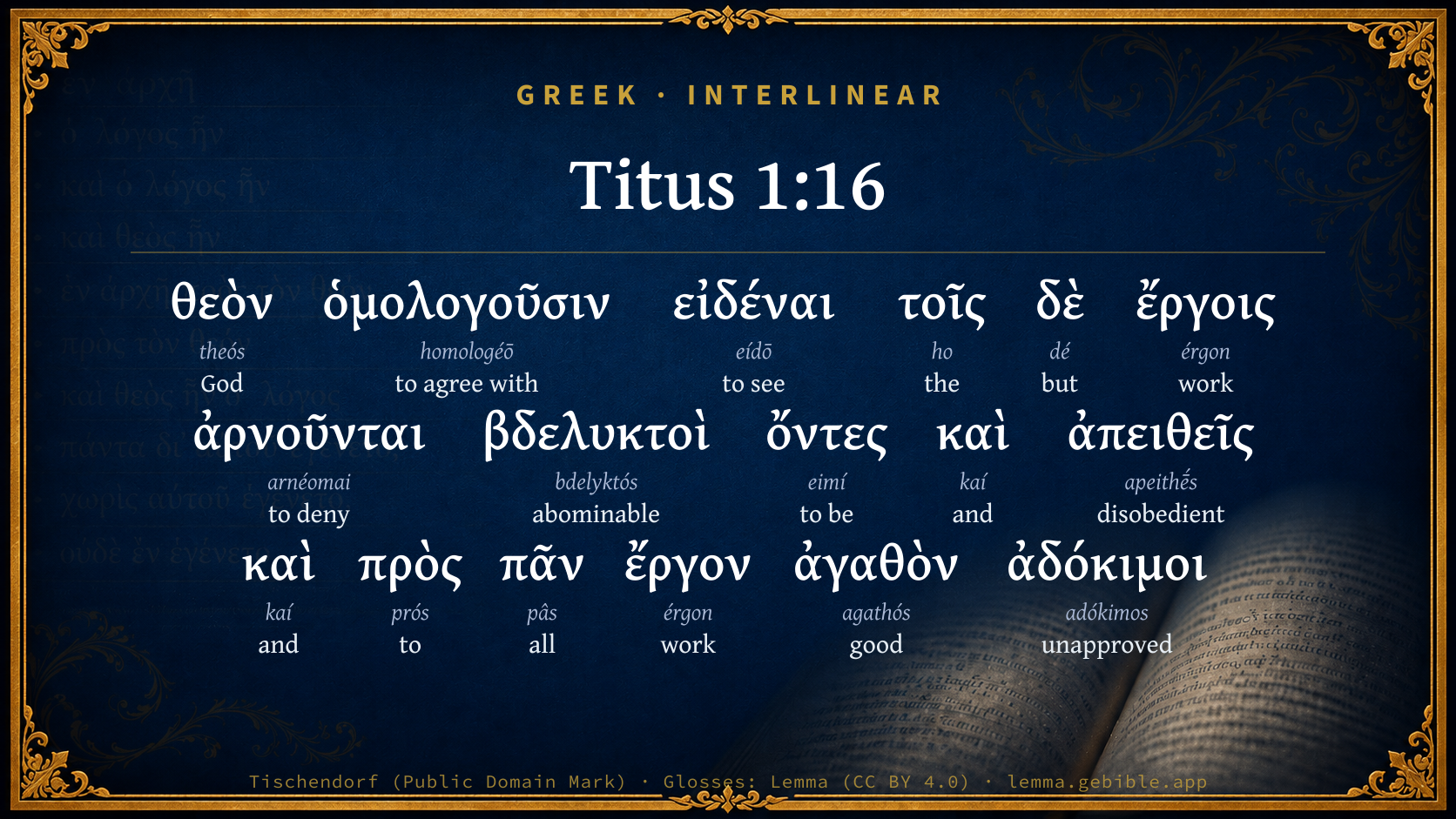
Greek (Tischendorf 8th ed.) Titus 1:16 appears in the Greek New Testament. The text above is from the Tischendorf 8th edition. Each word links to its Strong’s number and a concise gloss. Click any word for its full Thayer’s Greek Lexicon entry.
Download image
Cite this verse

Titus 1:16 (World English Bible). Public Domain. Lemma interlinear Bible study tool, https://lemma.gebible.app/v/titus/1/16.

Show BibTeX & RIS
BibTeX
RIS
English Translation
They profess that they know God, but by their works they deny him, being abominable, disobedient, and unfit for any good work.
World English Bible · Public Domain
Highlights
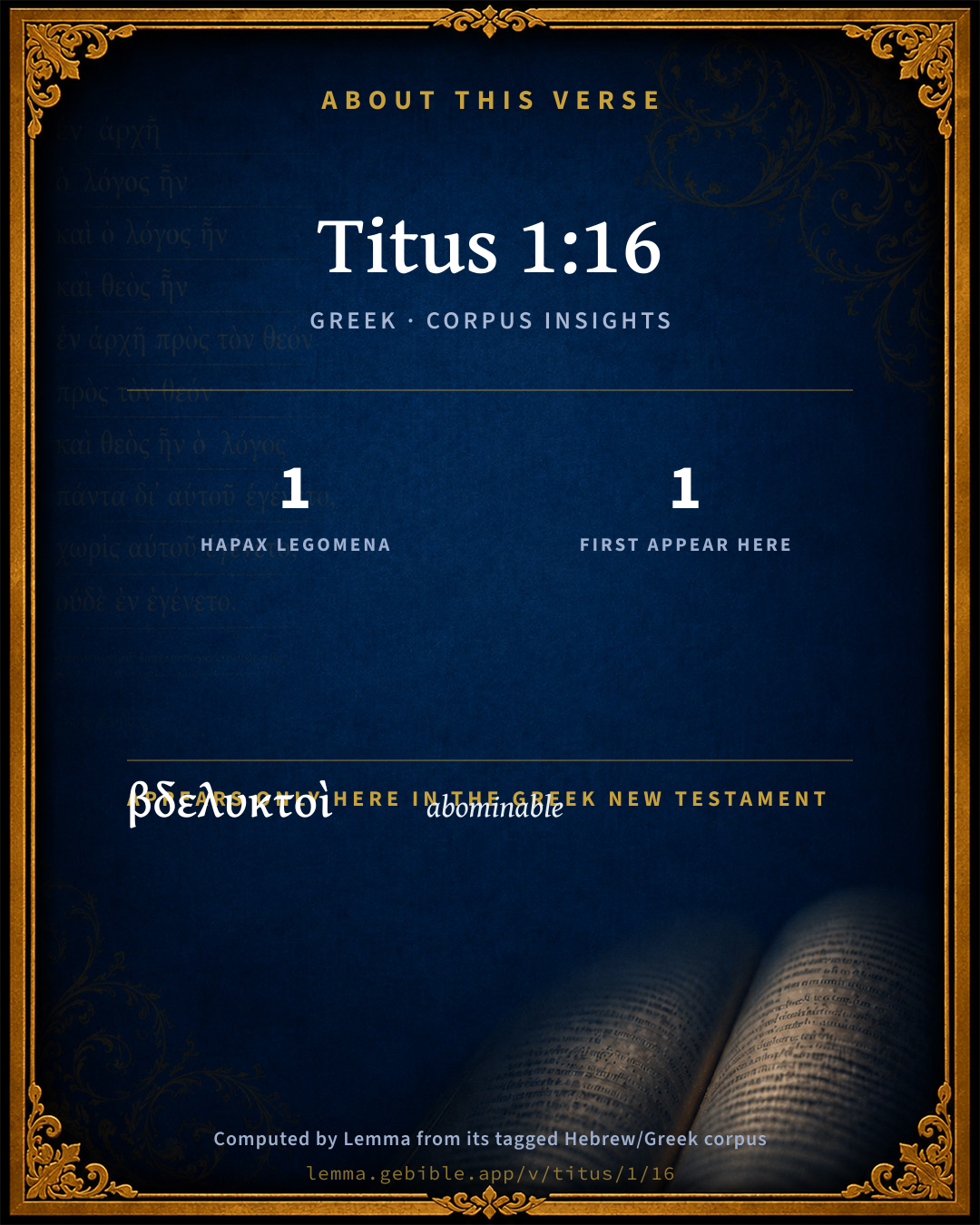
  • 1 hapax legomenon — only here in the Greek New Testament
  • 1 first appearance in the Greek New Testament
Full analysis ↓
Download a study sheet

One document with this verse’s original text, its word-by-word gloss line, the meaning frame, cross-references with their text, attributed commentary, and full source and license credits — printable, and it pastes into notes with its structure intact.

This verse Autodidact and up

Study sheet (.html) Plain text (.txt)

A passage Seminary Student

Up to 50 verses in one chapter. A passage sheet keeps up to 6 commentary sources and 12 cross-references per verse, in the order this page ranks them, and says so on the sheet whenever that leaves anything out. Ask for a single verse and you get the Autodidact verse sheet above.

Everything on this page stays free to read, with no account — the sheet is a download of what is already on screen, not access to it.

Want to remove ads? Support Godless Engineer
Compare translations 3

The same verse in 3 English versions, stacked beneath the original-language interlinear above. Click any original word for its lexicon entry.

Each is an independent rendering of the whole verse — the interlinear is not word-aligned to these translations.

Highlighted words mark where these versions differ — a whole-verse word diff, not a word-by-word alignment.

  • World English Bible Public Domain
    They profess that they know God, but by their works they deny him, being abominable, disobedient, and unfit for any good work.
  • King James Version Public Domain
    They profess that they know God; but in works they deny him, being abominable, and disobedient, and unto every good work reprobate.
  • unfoldingWord Literal Text CC BY-SA 4.0
    They profess to know God, but they deny by their actions, being detestable and disobedient and unfit for any good work.

unfoldingWord Literal Text — © unfoldingWord, licensed CC BY-SA 4.0. Word-aligned USFM3 via Door43 (git.door43.org/unfoldingWord/en_ult).

Versions to compare (up to 4)

3 of 4 selected

Show all 19 translations

Every available English version of this verse, each an independent rendering of the whole verse.

  • World English Bible Public Domain
    They profess that they know God, but by their works they deny him, being abominable, disobedient, and unfit for any good work.
  • Berean Standard Bible Public Domain
    They profess to know God, but by their actions they deny Him. They are detestable, disobedient, and unfit for any good deed.
  • Majority Standard Bible Public Domain
    They profess to know God, but by their actions they deny Him. They are detestable, disobedient, and unfit for any good deed.
  • King James Version Public Domain
    They profess that they know God; but in works they deny him, being abominable, and disobedient, and unto every good work reprobate.
  • American Standard Version (1901) Public Domain
    They profess that they know God; but by their works they deny him, being abominable, and disobedient, and unto every good work reprobate.
  • Revised Version (1885) Public Domain
    They profess that they know God; but by their works they deny him, being abominable, and disobedient, and unto every good work reprobate.
  • Geneva Bible (1599) Public Domain
    They professe that they know God, but by works they deny him, and are abominable and disobedient, and vnto euery good worke reprobate.
  • Douay-Rheims (1899) Public Domain
    They profess that they know God: but in their works they deny him; being abominable, and incredulous, and to every good work reprobate.
  • Young's Literal Translation Public Domain
    God they profess to know, and in the works they deny `Him', being abominable, and disobedient, and unto every good work disapproved.
  • Literal Standard Version CC BY-SA 4.0
    They profess to know God, but they deny [Him] by their works, being abominable, and disobedient, and disapproved to every good work.
  • Unlocked Literal Bible CC BY-SA 4.0
    They profess to know God, but they deny him by their actions. They are detestable, disobedient, and unfit for doing any good work.
  • unfoldingWord Literal Text CC BY-SA 4.0
    They profess to know God, but they deny by their actions, being detestable and disobedient and unfit for any good work.
  • Darby Bible Public Domain
    They profess to know God, but in works deny [him], being abominable, and disobedient, and found worthless as to every good work.
  • World Messianic Bible Public Domain
    They profess that they know God, but by their deeds they deny him, being abominable, disobedient, and unfit for any good work.
  • Webster's Bible Public Domain
    They profess that they know God; but in works they deny him, being abominable, and disobedient, and to every good work reprobate.
  • Free Bible Version CC BY-SA 4.0
    They claim to know God, but they prove this is false by what they do. They are detestable and disobedient, worthless for doing anything good.
  • Bible in Basic English Public Domain
    They say that they have knowledge of God, while by their acts they are turning their backs on him; they are hated by all, hard-hearted, and judged to be without value for any good work.
  • Text-Critical English NT CC BY 4.0
    They profess to know God, but by their works they deny him. They are detestable, disobedient, and have proven themselves to be unqualified for any good work.
  • Tyndale New Testament (1534) Public Domain
    They confesse that they knowe god: but with the dedes they denye hym and are abhominable and disobedient and vnto all good workes discommendable.

Literal Standard Version (2020), Covenant Press — licensed CC BY-SA 4.0. Text via the HelloAO Bible API (eBible.org). Unlocked Literal Bible (unfoldingWord) — licensed CC BY-SA 4.0. Text via the HelloAO Bible API (eBible.org). unfoldingWord Literal Text — © unfoldingWord, licensed CC BY-SA 4.0. Word-aligned USFM3 via Door43 (git.door43.org/unfoldingWord/en_ult). Free Bible Version, Dr. Jonathan Gallagher — licensed CC BY-SA 4.0. Text via the HelloAO Bible API (eBible.org).

Word by word

More ways to search: Search by grammar → Find every occurrence → Compare this word →

Practice this passage: Drill this verse → Learn its vocabulary →

βδελυκτοὶ
bdelyktós
G947
“abominable”
Adjective, Nominative, Plural, Masculine
Part of Speech
Adjective
Case
Nominative
Number
Plural
Gender
Masculine
Full Thayer's Definition

Origin: from G948

TDNT: 10:58,1

1. abominable, detestable
  1. θεὸν theós G2316 “God” Noun, Accusative, Singular, Masculine
  2. ὁμολογοῦσιν homologéō G3670 “to agree with” Verb, Present, Active, Indicative, 3rd person, Plural
  3. εἰδέναι eídō G1492 “to see” Verb, Perfect, Active, Infinitive
  4. τοῖς ho G3588 “the” Article, Dative, Plural, Neuter
  5. δὲ dé G1161 “but” Conjunction
  6. ἔργοις érgon G2041 “work” Noun, Dative, Plural, Neuter
  7. ἀρνοῦνται arnéomai G720 “to deny” Verb, Present, Middle or Passive deponent, Indicative, 3rd person, Plural
  8. ὄντες eimí G1510 “to be” Verb, Present, Active, Participle, Nominative, Plural, Masculine
  9. καὶ kaí G2532 “and” Conjunction
  10. ἀπειθεῖς apeithḗs G545 “disobedient” Adjective, Nominative, Plural, Masculine
  11. καὶ kaí G2532 “and” Conjunction
  12. πρὸς prós G4314 “to” Preposition
  13. πᾶν pâs G3956 “all” Adjective, Accusative, Singular, Neuter
  14. ἔργον érgon G2041 “work” Noun, Accusative, Singular, Neuter
  15. ἀγαθὸν agathós G18 “good” Adjective, Accusative, Singular, Neuter
  16. ἀδόκιμοι adókimos G96 “unapproved” Adjective, Nominative, Plural, Masculine

About this verse

These counts appear in no published source. They are computed here, from the morphology-tagged text and Lemma’s own curated glosses. What Lemma adds →

17
words
15
distinct lemmas
Pauline Epistles
section

Notable vocabulary

1 hapax legomenon — a word that appears only here in the entire Greek New Testament:

  • βδελυκτοὶ abominable G947

First appearance in Scripture

This word makes its first canonical appearance in the Greek New Testament here:

  • βδελυκτοὶ abominable G947

Shared distinctive vocabulary

ἀπειθεῖς disobedient G545 occurs in 6 verses of the Greek New Testament. Also found in:
Repetition

Words recur within this verse:

  • ἔργοις work G2041 ×2
  • καὶ and G2532 ×2

Cross-references

20

Topical passages linked to Titus 1:16 in the Treasury of Scripture Knowledge — connected by theme and wording, ordered by reader-vote popularity; previews shown in the World English Bible.

  • 1 John 2:4 One who says, "I know him," and doesn't keep his commandments, is a liar, and the truth isn't in him.
  • Isaiah 29:13 The Lord said, Because this people draw near [to me], and with their mouth and with their lips to honor me, but have removed their heart far from me, and their fear of me is a commandment of men which has been taught [them];
  • Ephesians 5:6 Let no one deceive you with empty words. For because of these things, the wrath of God comes on the children of disobedience.
  • Ezekiel 33:31 They come to you as the people comes, and they sit before you as my people, and they hear your words, but don't do them; for with their mouth they show much love, but their heart goes after their gain.
  • 2 Timothy 3:5–8 holding a form of godliness, but having denied the power thereof. Turn away from these, also.
  • Jude 1:4 For there are certain men who crept in secretly, even those who were long ago written about for this condemnation: ungodly men, turning the grace of our God into lasciviousness, and denying our only Master, God, and Lord, Jesus Christ.
  • Romans 1:28 Even as they refused to have God in their knowledge, God gave them up to a reprobate mind, to do those things which are not fitting;
  • Revelation 21:27 There will in no way enter into it anything profane, or one who causes an abomination or a lie, but only those who are written in the Lamb's book of life.
  • 1 Samuel 15:22 Samuel said, Has Yahweh as great delight in burnt offerings and sacrifices, as in obeying the voice of Yahweh? Behold, to obey is better than sacrifice, and to listen than the fat of rams.
  • Revelation 21:8 But for the cowardly, unbelieving, sinners, abominable, murderers, sexually immoral, sorcerers, idolaters, and all liars, their part is in the lake that burns with fire and sulfur, which is the second death."
  • 1 Timothy 5:8 But if anyone doesn't provide for his own, and especially his own household, he has denied the faith, and is worse than an unbeliever.
  • Isaiah 48:1 Hear you this, house of Jacob, who are called by the name of Israel, and are come forth out of the waters of Judah; who swear by the name of Yahweh, and make mention of the God of Israel, but not in truth, nor in righteousness
  • Isaiah 58:2 Yet they seek me daily, and delight to know my ways: as a nation that did righteousness, and didn't forsake the ordinance of their God, they ask of me righteous judgments; they delight to draw near to God.
  • Job 15:16 How much less one who is abominable and corrupt, A man who drinks iniquity like water!
  • 1 Samuel 15:24 Saul said to Samuel, I have sinned; for I have transgressed the commandment of Yahweh, and your words, because I feared the people, and obeyed their voice.
  • Romans 2:18–24 and know his will, and approve the things that are excellent, being instructed out of the law,
  • Hosea 8:2–3 They cry to me, 'My God, we Israel acknowledge you!'
  • Numbers 24:16 He says, who hears the words of God, Knows the knowledge of the Most High, Who sees the vision of the Almighty, Falling down, and having his eyes open:
  • Jeremiah 6:30 Refuse silver shall men them, because Yahweh has rejected them.
  • 1 Timothy 1:9 as knowing this, that law is not made for a righteous man, but for the lawless and insubordinate, for the ungodly and sinners, for the unholy and profane, for murderers of fathers and murderers of mothers, for manslayers,

Cross-references courtesy of OpenBible.info (CC BY 4.0).

Commentary

Notes on Titus 1:16 from classic Christian and Jewish commentators (each source and its license shown beneath its notes). The classic Christian expositions comment on the surrounding passage and are grouped to its opening verse, so a note may address several verses; the Jewish commentaries on the Tanakh (Rashi and others) are per-verse, so they appear only where the commentator wrote on this verse.

Lemma curates 59 commentaries, every one of them public domain or Creative Commons licensed, each selected and text-cleaned for this edition rather than reprinted as found. About our sources →

The Biblical Illustrator

Joseph S. Exell

Tit_1:16

They profess that they know God

Conventional Christians

I.

Conventional Christians are professional atheists.

II. Conventional Christians are practical atheists.

1. They deny Gods authority in everyday life; ignore the claims He has upon their existence, powers, possessions.

2. They deny His teaching, He teaches that spiritual interests are supreme. They declare in their daily life that temporal interest are paramount. He teaches that no man should live to himself, but should be inspired by that benevolence that will promote the common weal. But they practically declare that self-interests are supreme, that every man should work for himself, regardless of the common good. He teaches to honour all men on account of what they are. They declare that those only are to be honoured who are endowed with wealth, and move in the pageantry of worldly pomp and power. (Homilist.)

The judgment of hypocrisy

I. Hypocrisy the occasion of atheism. False and inconsistent professors cause more scepticism than the active propagandism of infidels.

II. Hypocrisy is offensive even to the ungodly.

III. Hypocrisy is practical disobedience. The law is first for the spirit, then the letter: for the life through the heart.

IV. Hypocrisy universally condemned. Though in appearance full of good works, the hypocrite is condemned as destitute of any. (F. Wagstaff.)

Hypocrites in the Church

I. There will always be hypocrites in the church. Although the Lord could easily and at once purge His floor of them, yet in great wisdom He suffereth them.

1. In regard of His own glory, that His holiness might appear in the daily discovering of them and purging His Church; for he cannot abide that hypocrites should go in the tale and account of His children. But one time or other, one way or other, will be sanctified in all them that come near Him; at which time His glory also shineth out unto others in their just judgment.

2. In regard of the wicked, that they should the more stumble at the truth by reason of some hypocrites among professors.

3. In regard of the godly, that they should partly be exercised by this means, and partly driven to examine what truth is in them.

4. In respect of the truth itself, which getteth some testimony hence, as Christ on the cross by the very title of His enemies, affirming that He was the King of the Jews.

II. The character of the hypocrite.

1. The hypocrite is a great professor of religion, and hence cometh to be answerable to his name, in seeming to be, and sustaining the person that he is not. As a clown or knave on a stage playeth the part of a noble, or king, but is well known to be the next remove from a rogue, so these fellows whom the apostle noteth have often in their mouths the name of God and of Christ, the title of the Church, and pretend great knowledge of God and cunning in the Scriptures, and other ecclesiastical writings; yea further, make a great show of faith and pity, and if bare profession would lead to heaven, these could not be the least or last there. And to make this a little more plain, an hypocrite can carry himself so level and even in his course, as no man shall be able outwardly to accuse him, or impute anything unto him, no more than the disciples could accuse Judas, when every man said, Master, is it I? but none of them said, Master, is it Judas?

2. The second note is in these words, But indeed they deny him. That is, all the religion of an hypocrite is only in outward profession, separated from the inward sincerity of the heart. All that we have spoken of him is but a lifeless form of godliness, in which the power of it is denied (2Ti_3:5). Men may be said to deny a thing three ways.

1. With the tongue.

2. With the heart; thus the atheist denieth God (Psa_24:1).

3. With the life or actions, which is here properly meant.

For ask the tongues and words of these men concerning their courses, all will appear to be fish whole, but ask their lives, and you shall hear their works (which are far more evident witnesses with or against a man, than his words) speak otherwise. Or, grant they do many glorious works to the eye, yet even herein after a sort God is denied, in that they are lame, and, indeed, carcases of good actions, without any soul to quicken them; all is external, and in such works they may be very busy, but spiritually they perform nothing.

3. The third note or character, is in a further degree of the sin, in that they are said, rebellious to Gods commandment, and disobedient to the doctrine of God. The Word giveth us to discover two vices in these titular Christians.

(1) Infidelity.

(2) Rebellion, or in one word, the want of the obedience of faith.

True it is they make a great show of faith, but the apostle distinguisheth of faith; one kind is feigned, another is unfeigned: the former may be joined with much knowledge, much talk of piety, but never with a pure heart and good conscience, as the latter. Now this unfeigned faith, being the mother and mistress of unfained obedience, and the only root whence this fruit can bud and blossom, whosoever are destitute of the former cannot but be barren of the latter. What are the fruits of unbelief, see Act_17:5; 2Th_3:2; Heb_3:12.

4. The fourth note is yet in a further degree of the sin, and goeth near the detection of him; when after long custom in sin, and cracking his conscience checking him, he becomes as a crazy pitcher which is unfit to hold water; so is he reprobate to every good duty; now can he do nothing but rush into sin thick and threefold, and dowse himself over head and ears in impiety.

III. The miserable condition of the hypocrite. They are abominable to God, which appeareth both

1. In their persons.

2. Their actions.

3. Their punishment.

For their persons, they are but half Christians, neither hot nor cold, and therefore the Lord cannot digest them, compared to cakes but half baked (Hos_7:10), and not turned on the other side. Seeing, therefore, they are such as withdraw their best part from God, the soul of God can take no pleasure in them. Their actions, although never so good in themselves, never so specious unto others, yet are abominable unto God. Yea, in their most devout services, they do nothing but (as Ephraim) compass the Lord with lies, and deceit (Hos_11:12). Their punishment showeth them to be every way abhorred of God; for as men deal with things they hate, so the Lord

1. Casteth them out of His sight (Job_13:16). The hypocrite shall not come before Him, the workers of lies shall not enter within the walls of that holy city. Yea, sometimes they are cast out of His presence, as Cain was, even out of the visible Church, as they are ever out of the invisible, to show that they shall never be endured hereafter.

2. Destroyeth them; for their destruction from the Lord sleepeth not, but shall surprise them; perhaps while they are in the body, as Ananias and Sapphira, but certainly hereafter. (T. Taylor, D. D.)

Professing God, but denying Him

Here learn

1. That hypocrites are generally great professors: they profess great knowledge of God, and great zeal for Him.

2. That to deny God is a very heinous sin, and an abominable wickedness: there is a twofold denial of God; first in words, expressly and openly; secondly, in practice, closely and consequentially; They profess that they know God; but in words they deny Him. There may be at once a professing of God, and a denial of Him; many a mans practice speaks loud, that there is no God, when he makes a fair confession and profession of Him with his mouth and tongue.

3. That no sorts of persons are so odious to God, and abominable in His sight as those who make a profession of His holy name and truth, but walk contrary in their lives to that profession. (W. Burkitt, M. A.)

A tarnished Christian

I laid aside a coin one day but did not remember just where I had put it, till one day I found it in a comer, encrusted with rust. At first, I thought it was copper, but careful examination proved it to be silver. It had lain there so long that it was tarnished and unrecognisable. Just as many Christians, alas I are so covered with the grime and filth of this world that it is no wonder that the unconverted and Christians look upon them as copper instead of being good silver.

Inconsistencies of Christians

In true kindness of heart, sweetness of temper, open-handed generosity, the common charities of life, many mere men of the world lose nothing by comparison with such professors; and how are you to keep the world from saying, Ah! your man of religion is no better than others; nay, he is sometimes worse! With what frightful prominence does this stand out in the answer--never-to-be-forgotten answer--of an Indian chief to the missionary who urged him to become a Christian. The plumed and painted savage drew himself up in the consciousness of superior rectitude; and with indignation quivering on his lip and flashing in his eagle eye, he replied, Christian lie! Christian cheat! Christian steal!--drink!--murder! Christian has robbed me of my lands, and slain my tribe! adding, as he turned haughtily away, The devil, Christian! I will be no Christian. Many such reflections teach us to be careful how we make a religious profession! And having made the profession, cost what it may, by the grace of God let us live up to it; and act it out. It is better not to vow, than, having vowed, not to pay. (T. Guthrie, D. D.)

Religion not to be rejected because of hypocrites

Many people are offended with the profession of religion, because all are not religious who make a profession. A little consideration will correct this error. Does the sheep despise its fleece because the wolf has worn it? Who blames a crystal river because some melancholy men have drowned themselves in its streams? The best drugs have their adulterants. And will you refuse an opiate, because some have wantonly poisoned themselves with it? Though you have been cozened with false colours, yet you should not dis-esteem that which is dyed in grain. He is a bad economist who, having a spot in his garment, cuts off the cloth, instead of rubbing off the dirt. God rejects all religion but His own. (T. Seeker.)

.

The Biblical Illustrator, edited by Joseph S. Exell (c. 1880s–1900s) — public domain. Text from a community e-Sword module.

Tyndale Open Study Notes

Tyndale Open Resources

1:16 Sound teaching and godliness are always linked together in the letters to Timothy and Titus (see 1 Tim 1:7-11; 3:15-16; 5:24-25; 2 Tim 3:5, 9). Similarly, the ungodly way they live is connected with false teaching. • anything good: This contrasts with Titus 3:1.

Tyndale Open Study Notes — © Tyndale Open Resources, licensed CC BY-SA 4.0. Text via the HelloAO Bible API.

Bengel's Gnomon

Johann Albrecht Bengel

Tit 1:16. Θεὸν, God) Whom to know is the highest wisdom.—ὁμολογοῦσι εἰδέναι) profess, and by profession claim to themselves knowledge; 1Ti 6:20.—ἀρνοῦνται) deny God.—βδελυκτοὶ) abominable. This agrees with the LXX., Pro 17:15: ἀκαθάρτος καὶ βδελυκτός, unclean and abominable.—ἀδόκιμοι) This may here be taken actively for those who are not fit for anything, because they cannot approve what is good either in themselves or in others.

Bengel's Gnomon of the New Testament — English translation (T&T Clark, Edinburgh, 1860) — public domain. Text from a community e-Sword module.

Meyer's Critical & Exegetical Commentary

Heinrich August Wilhelm Meyer

Tit_1:16. Θεὸν ὁμολογοῦσιν εἰδέναι] not: they pretend (Matthies), but they loudly and publicly confess, that they know God. Paul leaves it undecided whether their confession is correct or not. He does not grant to them, as de Wette thinks, that they have the theoretical knowledge of God, and in a practical aspect, nor does he deny this to them. His purpose here is to declare that, in spite of this their confession, their actions are of such a nature as to argue that they had no knowledge of God: τοῖς δὲ ἔργοις ἀρνοῦνται] ἀρνοῦνται, opposed to ὁμολογοῦσιν, see 1Ti_5:8; 2Ti_3:5. Supply Θεὸν εἰδέναι (so, too, van Oosterzee, Hofmann).

βδελυκτοὶ ὄντες καὶ ἀπειθεῖς] βδελυκτός (ἅπ. λεγ.), equivalent to abominabilis, detestable (comp. Luk_16:15); Luther: whom God holds in abomination.

The word is joined with ἀκάθαρτος in Pro_17:15, LXX. Paul does not apply this epithet to the heretics, because they were defiling themselves with actual worship of idols, which especially was regarded by the Jews as βδέλυγμα, but in order to describe their moral depravity.

καὶ ἀπειθεῖς] and disobedient, synonymous with ἀνυπότακτοι in Tit_1:10; this indicates why they are βδελυκτοί.

καὶ πρὸς πᾶν ἔργον ἀγαθὸν ἀδόκιμοι] the result of the preceding characteristics (Wiesinger); ἀδόκιμος, as 2Ti_3:8.

Meyer — Critical and Exegetical Commentary on the New Testament — English translation by Peter Christie, edited by Frederick Crombie (T&T Clark, 1880) — public domain. Text from a community e-Sword module.

Expositor's Greek Testament

ed. W. Robertson Nicoll

Tit 1:16 . θεὸν ὁμολογοῦσιν εἰδέναι : “ We know God ”; that was their profession of faith. They “gloried in God,” Rom 2:17 . This is an allusion to the Jewish pride of religious privilege. Weiss points out that this phrase alone is sufficient to prove that the heretics in question are not the Gnostics of the second century (Hort, Judaistic Christianity , p. 133). See the use of the phrase in Gal 4:8 , 1Th 4:5 . Compare 2Ti 3:5 , “Holding a form of godliness, but having denied the power thereof”; also 1Jn 2:4 . There is here the constant antithesis between words and deeds.

τοῖς δὲ ἔργοις ἀρνοῦνται : Their lives give the lie to their professions; “They acted as if this Supreme Being was a mere metaphysical abstraction, out of all moral relation to human life, as if He were neither Saviour nor Judge” (J. H. Bernard comm. in loc .).

πρὸς πᾶν ἔργον ἀγαθόν : See note on 2Ti 3:17 .

ἀδόκιμοι : worthless, unfit . See note on 2Ti 3:8 .

The Expositor's Greek Testament, edited by W. Robertson Nicoll (1897–1910) — public domain. Text from a community e-Sword module.

Jamieson, Fausset & Brown

Robert Jamieson, A. R. Fausset & David Brown

They profess--that is, make a profession acknowledging God. He does not deny their theoretical knowledge of God, but that they practically know Him.

deny him--the opposite of the previous "profess" or "confess" Him (Ti1 5:8; Ti2 2:12; Ti2 3:5).

abominable--themselves, though laying so much stress on the contracting of abomination from outward things (compare Lev 11:10-13; Rom 2:22).

disobedient--to God (Tit 3:3; Eph 2:2; Eph 5:6).

reprobate--rejected as worthless when tested (see on Rom 1:28; Co1 9:27; Ti2 3:8).

Next: Titus Chapter 2

Jamieson, Fausset & Brown — Commentary Critical and Explanatory on the Whole Bible (1871) — public domain (CC PDM 1.0). Text via the HelloAO Bible API.

Adam Clarke's Commentary

Verse 16. They profess that they know God] He still speaks concerning the unbelieving Jews, the seducing teachers, and those who had been seduced by their bad doctrine. None were so full of pretensions to the knowledge of the true God as the Jews. They would not admit that any other people could have this knowledge; nor did they believe that God ever did or ever would reveal himself to any other people; they supposed that to give the law and the prophets to the Gentiles would be a profanation of the words of God. Hence they became both proud, uncharitable, and intolerant; and in this disposition they continue till the present day.

But in works they deny him] Their profession and practice were at continual variance. Full of a pretended faith, while utterly destitute of those works by which a genuine faith is accredited and proved. Dio Cassius represents Caesar as saying of his mutinous soldiers: Ονομα Ῥωμαιων εχοντας, εργα δε Κελτων δρωντας. "Having the name of Romans, while they had the manners of the Gauls." How near are those words to the saying of the apostle!

Being abominable] βδελυκτοι. This word sometimes refers to unnatural lusts.

And disobedient] απειθεις. Unpersuadable, unbelieving, and consequently disobedient. Characters remarkably applicable to the Jews through all their generations.

Unto every good work reprobate.] αδοκιμοι. Adulterate; like bad coin, deficient both in the weight and goodness of the metal, and without the proper sterling stamp; and consequently not current. If they did a good work, they did not do it in the spirit in which it should be performed. They had the name of God's people; but they were counterfeit. The prophet said; Reprobate silver shall men call them.

1. THOUGH the principal part of this chapter, and indeed of the whole epistle, may be found in nearly the same words in the First Epistle to Timothy, yet there are several circumstances here that are not so particularly noted in the other; and every minister of Christ will do well to make himself master of both; they should be carefully registered in his memory, and engraven on his heart.

2. The truth, which is according to godliness, in reference to eternal life, should be carefully regarded. The substantial knowledge of the truth must have faith for its foundation, godliness for its rule, and eternal life for its object and end. He who does not begin well, is never likely to finish fair. He who does not refer every thing to eternity, is never likely to live either well or happily in time.

3. There is one subject in this chapter not sufficiently attended to by those who have the authority to appoint men to ecclesiastical offices; none should be thus appointed who is not able, by sound doctrine, both to exhort and convince the gainsayers. The powers necessary for this are partly natural, partly gracious, and partly acquired. 1. If a man have not good natural abilities, nothing but a miracle from heaven can make him a proper preacher of the Gospel; and to make a man a Christian minister, who is unqualified for any function of civil life, is sacrilege before God. 2. If the grace of God do not communicate ministerial qualifications, no natural gifts, however splendid, can be of any avail. To be a successful Christian minister, a man must feel the worth of immortal souls in such a way as God only can show it, in order to spend and be spent in the work. He who has never passed through the travail of the soul in the work of regeneration in his own heart, can never make plain the way of salvation to others. 3. He who is employed in the Christian ministry should cultivate his mind in the most diligent manner; he can neither learn nor know too much. If called of God to be a preacher, (and without such a call he had better be a galley slave,) he will be able to bring all his knowledge to the assistance and success of his ministry. If he have human learning, so much the better; if he be accredited, and appointed by those who have authority in the Church, it will be to his advantage; but no human learning, no ecclesiastical appointment, no mode of ordination, whether Popish, Episcopal, Protestant, or Presbyterian, can ever supply the Divine unction, without which he never can convert and build up the souls of men. The piety of the flock must be faint and languishing when it is not animated by the heavenly zeal of the pastor; they must be blind if he be not enlightened; and their faith must be wavering when he can neither encourage nor defend it.

4. In consequence of the appointment of improper persons to the Christian ministry, there has been, not only a decay of piety, but also a corruption of religion. No man is a true Christian minister who has not grace, gifts, and fruit; if he have the grace of God, it will appear in his holy life and godly conversation. If to this he add genuine abilities, he will give full proof of his ministry; and if he give full proof of his ministry, he will have fruit; the souls of sinners will be converted to God through his preaching, and believers will be built up on their most holy faith. How contemptible must that man appear in the eyes of common sense, who boasts of his clerical education, his sacerdotal order, his legitimate authority to preach, administer the Christian sacraments, c., while no soul is benefited by his ministry! Such a person may have legal authority to take tithes, but as to an appointment from God, he has none else his word would be with power, and his preaching the means of salvation to his perishing hearers.

Adam Clarke's Commentary on the Bible (1810–1826) — public domain. Text from a community e-Sword/MySword module.

John Calvin's Commentaries

16 They profess that they know God He treats those persons as they deserve; for hypocrites, who give their whole attention to minute observances, despise fearlessly what constitutes the chief part of the Christian life. The consequence is, that they display their vanity, while contempt of God is manifested in open crimes. And this is what Paul means; that they who wish to be seen abstaining from one kind of food — indulge in wantonness and rebellion, as if they had shaken of the yoke; that their conduct is disgraceful and full of wickedness, and that not a spark of virtue is visible in their whole life.

For they are abominable, disobedient, and to every good work reprobate. When he calls them, βδελυκτούς abominable, he seems to allude to their pretended holiness, to which they gave their earnest attention. But Paul declares that they gain no advantage, for they do not cease to be profane and detestable. With good reason does he accuse them of disobedience; for nothing can be more haughty than hypocrites, who exert themselves so laboriously about ceremonies, in order that they may have it in their power to despise with impunity the chief requirements of the law. We may appropriately interpret the word ἀδόκιμοι reprobate in an active signification; as if he had said, that they who wish to be thought so sagacious instructors in trifles — are destitute of judgment and understanding as to good works.

John Calvin's Commentaries (1540-1563) — public domain. Text from the Calvin Translation Society English edition (1840s-50s) via the Christian Classics Ethereal Library (ccel.org). Calvin's coverage is partial (roughly two-thirds of the Bible); uncommented books and verses are honest gaps, never fabricated. The 19th-century editor's footnotes and remarks are omitted so the notes are faithfully Calvin's own voice.

Ellicott's Commentary for English Readers

(16) They profess that they know God; but in works they deny him.—These bitter foes to the truth, Titus must remember, will present themselves under the guise of friends. They will rank themselves in the Christian company openly, with their lips confessing God, but in their way of life, in their acts, practically denying the very things they were so careful to affirm with their lips; in other words, taking back, withdrawing, the solemn declaration of faith they had been making.

Being abominable.—This is the only place where this strong expression is used in the New Testament. It signifies that the life and actions of these men, who professed to be His servants, had made them hateful in the sight of God.

And disobedient.—Rebellious and opposed to all law and order would Titus find them.

And unto every good work reprobate.—As a consequence of their hypocritical, selfish, defiled life, these men, when any good and noble work had to be done, were simply useless, worthless; and to teachers of this kind were many of the Cretan believers content to go for instruction in Christian doctrine and practice.

A Bible Commentary for English Readers, edited by Charles John Ellicott (1878–1897) — public domain. Text from a community e-Sword module.

The Cambridge Bible for Schools and Colleges

gen. ed. J. J. S. Perowne

16. They profess that they know God] Vulg. ‘confitentur’; ‘profess’ is retained by R.V., though its modern sense is more generally ‘pretend’: the Greek is ‘openly acknowledge,’ and the word is used of those Books of the Bible which are ‘homologoumena,’ ‘fully acknowledged.’ This sense of ‘profess’ remains in our ‘Professor’ or Public Teacher. Cf. Mat_7:23 ‘then will I profess unto them.’

being abominable, and disobedient] Vulg. ‘cum sint abominati.’ Compare Rev_21:8 ‘the fearful and unbelieving and abominable,’ 27 ‘anything unclean or he that maketh an abomination and a lie.’

unto every good work reprobate] The first of six occurrences of the phrase ‘good or ‘fair’ ‘work’ in this Epistle, cf. Tit_2:7; Tit_2:14, Tit_3:1; Tit_3:8; Tit_3:14. So in 1 Tim. it occurs six times and twice in 2 Tim. For the force of this particular word for ‘good’ see note on 1Ti_1:18. The application of sound doctrine to daily life is the natural and necessary object of the Apostle at this stage of progress in the Christian Church. See Introduction, pp. 32–34. ‘Reprobate’ comes from the Vulg. ‘reprobi’; the Greek is lit. ‘unable to stand the test,’ ‘tried and found wanting.’ It occurs again 2Ti_3:8. Its best known use is in 1Co_9:27 ‘lest after I have preached to others I myself should be rejected.’ Worthless here gives the force.

The Cambridge Bible for Schools and Colleges (gen. ed. J. J. S. Perowne; Cambridge University Press, 1878–1918) — public domain. Text from a community e-Sword module.

John Gill's Exposition

They profess that they know God,.... That there is a God; that there is but one, only, true, and living God, the God of Israel, as professed by the Jews; and that this God is Father, Son, and Spirit, as believed by the Christians: for the persons the apostle speaks of were judaizing Christians. Yet this knowledge was but notional; it lay in theory and profession only; they had not a spiritual experimental knowledge of God in Christ, which only has eternal life connected with it:

but in works they deny him. The Syriac, Arabic, and Ethiopic versions read, "in their own works"; they were not professed, but practical atheists; they owned there was a God, and boasted of their knowledge of him; but their lives and conversations showed that they had no true knowledge of him, and that the fear of him was not before their eyes; these gave the lie to their profession; they practically denied that faith they professed to hold, and the power of godliness, of which they had the form.

Being abominable; in the sight of God, however esteemed by men; and notwithstanding the vizor and mask of sanctity and religion they put on, which could not screen them from the omniscience of God, who will one day declare he knows them not, and will bid them depart from him, being workers of iniquity.

And disobedient; to God; to his law, and Gospel; to his ministers and churches; and even to parents and civil magistrates; for of this cast were the false teachers, and their followers, as maybe learned from many passages.

And unto every good work reprobate: or "unaccustomed", unused to them, as the Arabic version renders it; or rather "without judgment", and understanding, concerning them; there was no good in them, nor was it in them to do good; to do good they had no knowledge, nor any inclination; they were unfit for it, and had not a capacity to perform it; they were not good themselves, and therefore could not do good; the tree must first be made good, ere its fruit will be good; they were without Christ, and without his Spirit, and grace, without which no man can do anything that is spiritually good; they had no true faith, and therefore what they did was sinful; they had neither right principles, from which, nor right ends to which they acted, and therefore were not qualified for the performance of good works; which require that men should be good men, created in Christ Jesus, be believers in him, and have principles of truth and love, and views to the glory of God.

Next: Titus Chapter 2

John Gill's Exposition of the Whole Bible (1746–1763) — public domain (CC PDM 1.0). Text via the HelloAO Bible API.

Trapp's Complete Commentary

John Trapp

16 They profess that they know God; but in works they deny him, being abominable, and disobedient, and unto every good work reprobate.

Ver. 16. They profess that they know] Aliud in titulo, aliud in pyxide. Outside Christians who perform, as Ephraim, dough baked duties, are almost persuaded, as Agrippa, come near God’s kingdom with that young Pharisee; faint chapmen that go without the bargain, as he did that came kneeling to our Saviour, and saying, "What shall I do to inherit eternal life?" These do virtutis stragulam pudefacere, put honesty to an open shame, as Diogenes said to Antipater, who being vicious, wore a white cloak, the ensign of innocence.

Being abominable] Gr. βδελυκτοι (α βδεω, pedo), such as stink above ground, and are of an offensive savour.

To every good work reprobate] αδοκιμοι, or injudicious; such as cannot make a right judgment of any good works, so as to approve and relish them, to see a beauty in them, as good, &c.

But in works they deny him] Which is, as if a man should confess his faith in English and deny it again in Latin. These are no better than devils wrapped up in Samuel’s mantle; hot meteors, shooting and showing like stars.

John Trapp, A Commentary or Exposition upon All the Books of the Old and New Testament (1647–1656) — public domain. Text from a community e-Sword module.

Albert Barnes' Notes on the Bible

They profess that they know God - That is, the Jewish teachers particularly, who are referred to in Tit 1:14. All those persons were professors of religion, and claimed that they had a special knowledge of God.

But in works they deny him - Their conduct is such as to show that they have no real acquaintance with him.

Being abominable - In their conduct. The word here used - βδελυκτοὶ bdeluktoi - occurs nowhere else in the New Testament. It means that which is detestable, or to be held in abhorrence.

And disobedient, and unto every good work reprobate - Margin, “void of judgment.” On the word here used - ἀδοκίμος adokimos - see the Rom 1:28 note; 2Co 13:5 note. It means here that in reference to everything that was good, their conduct was such that it could not be approved, or deserved disapprobation. It was for this reason; from the character of the people of the island of Crete, and of those who claimed to be teachers there enforcing the obligation of the Mosaic law, that it was so important for Titus to exercise special care in introducing men into the ministry, and in completing the arrangements contemplated in the organization of the churches there. Yet is this character confined to them? Are there none now who profess that they know God, but in works deny him; whose conduct is such that it ought to be abhorred; who are disobedient to the plain commands of God, and whose character in respect to all that pertains to true piety is to be disapproved by the truly pious, and will be by God at the last day? Alas, taking the church at large, there are many such, and the fact that there are such persons is the grand hindrance to the triumphs of religion on the earth. “The way to heaven is blocked up by dead professors of religion.”

Albert Barnes' Notes on the Bible (1834–1885) — public domain. Text from a community e-Sword/MySword module.

Haydock's Catholic Bible Commentary

They confess that they know God. He speaks not therefore of those who were properly infidels, without the knowledge of the true God; so that it is foolish to pretend from hence, that every action of an infidel must be a sin. (Witham)

George Leo Haydock (1774–1849), Haydock's Catholic Family Bible and Commentary, 1859 edition — public domain. Excludes Psalms (Douay-Rheims chapter numbering differs from Protestant) and Deuterocanonical books (Catholic canon only).

Matthew Poole's English Annotations

They profess that they know God; he is speaking of the Jews, who (all of them) professed to know and to believe one living and true God.

But in works they deny him; but they lived like atheists, as if there were no God in the world, Rom 2:17-24.

Being abominable, and disobedient, and unto every good work reprobate; they are persons justly to be abominated of all good men, απειθεις, unbelieving in the gospel, disobedient to the rule of the law, and awkward to, and averse from, any good work.

Matthew Poole's English Annotations on the Holy Bible (1683–1685) — public domain. Text from a community e-Sword/MySword module.

Whedon's Commentary on the Bible

Daniel D. Whedon

16. Profess… know God—Rather, they confess; the verb implying the truth of what they acknowledge. They are monotheists, acknowledging the holy God of Israel.

But—Contrastive. There is a contradiction between their confession and their conduct.

Works… deny—Their actions ignore the God who requires holiness of life.

Abominable—The Greek rendering of that most expressive Hebrew term by which the Old Testament designates that horrible blend of sexual licentiousness with religious worship of which the Phenician Sidon was the apparent centre, and Ashtoreth (the Ishtar of the Babylonian tablets and the Astarte of Greek literature) the idol goddess, against which all the force of the Jehovah worship was for ages arrayed. This was that “goddess of the Zidonians,” denounced 1Ki_11:5, And the present gainsayers were the true successors of the old abominable sensualists against whom St. Paul—true successor of the prophets of old—arrays all the force of Jehovah-Jesus.

Disobedient—To the true decalogue which the holy Jehovah, whom they profess, enjoins.

Reprobate—Cannot stand the test of scrutiny as to being real doers of any good work. The word has no reference to an eternally predestined reprobation. See notes on 1Co_9:27; and 2Co_13:5, where the same Greek word occurs.

Daniel D. Whedon (gen. ed.), Commentary on the Old and New Testaments (1874–1909) — public domain. Text from a community e-Sword module.

The Pulpit Commentary

By their for in, A.V They profess that they know God. (Rom_2:17-20) The arrogant claim to be God"s people and to superior holiness, while all the while they were denying God by their evil deeds, and bringing dishonor upon his Name among the Gentiles, was a marked feature of the Jews in St. Paul"s time. (comp. 2Ti_3:5) Abominable (bdeluktoi); objects or causes of disgust; only here in the New Testament, but found in the LXX But bdelugma and bdelussomai are not uncommon. Reprobate (adokimoi); as 2Ti_3:8 (where see note). This picture of the circumcision is indeed sad. (comp. 1Th_2:15, 16 Act_28:25-28)

The great contradiction.

The apostle here describes their moral deficiency. "They confess that they know God, but in works they deny him.

I THEY WERE MERE PROFESSORS OF RELIGION, POSSESSING ITS FORM BUT DENYING ITS POWER.

1. Their knowledge of God was purely theoretical or speculative, but they were practical atheists.

2. Hypocrites often profess great knowledge of God.

3. Even in apostolic times the communion of the Church was considerably mixed. There is no trace of a pure Church anywhere on earth. The Church in Crete had unbelievers in its visible membership.

II THEIR DENIAL OF GOD TOOK A MOST PRACTICAL SHAPE. Their conduct gave the lie to their profession. They wore:

1. Abominable in the sight of God. They were morally abandoned. They were as hateful in the sight of God as the idols of the nations.

2. Disobedient. They were refractory and incorrigible, despising all order and repudiating obligation.

3. Reprobate unto every good work. They were as useless for the service of God as reprobate silver, which cannot bear the fire of the refiner.

a. They did no good works.

b. They had neither knowledge nor inclination to do good works.

c. Therefore they were quite useless in the service of God and man. T.C.

The Pulpit Commentary (1880–1919), ed. H.D.M. Spence-Jones & Joseph S. Exell — public domain. Text from a community e-Sword module.

Fairbairn on Ezekiel, Jonah & the Pastoral Epistles

Patrick Fairbairn

Ver. 16. The description is wound up by a fearful announcement of their morally shipwrecked and hopeless condition: they confess that they know God, but in works deny [Him] being abominable and disobedient, and unto every good work reprobate. The description, it must be borne in mind, relates to those who have come within the sphere of religious truth, who have had their minds instructed in its principles and obligations, and have withal not formally renounced the profession of godliness which they naturally involve; but who have all along, from sinister motives, withstood the truth in their hearts, have talked big and done little; nay, have become adepts in evading the plainest calls of duty, and following courses at variance with the great principles of morality and religion. Of persons who have pursued such a career it may justly be said, that the very foundations of their moral being are out of course; and according to God’s ordinary methods of dealing, there is no hope of recovering them to truth and righteousness. By calling them reprobate in regard to every good work— ἀδόκιμοι—the apostle means that they are of no worth or account in that respect: when the question is about a good work, such persons may be rejected as having no proper affinity to it.

Patrick Fairbairn — An Exposition of Ezekiel (1851), Jonah (1849), and The Pastoral Epistles (1874) — public domain. Text from a community e-Sword module.

Burkitt's Expository Notes on the New Testament

William Burkitt

Behold here the dismal character of many hypocritical persons in the Jewish church. They professed the knowledge of God, the true God, but in their works, in their actions, they denied him, and so became abominable both to God and man, disobedient to the law, and averse to every good work.

Here learn, 1. That hypocrites are generally great professors, they profess great knowledge of God, and great zeal for him.

2. That to deny God is a very heinous sin, and an abominable wickedness;

There is a twofold denial of God,

first, in words expressly and openly; secondly, in practice, closely and consequentially.

They profess that they know God, but in works they deny him. There may be at once a professing of God, and a denial of him: many a man’s practice speaks aloud, that there is no God, when he makes a fair confession and profession of him with his mouth and tongue.

Learn, 3. That no sorts of persons are so odious to God, and abominable in his sight, as those who make a profession of his holy name and truth, but walk contrary in their lives to their profession.

William Burkitt's Expository Notes on the New Testament (1700–1703) — public domain. Text from a community e-Sword module.

The People's New Testament

B. W. Johnson

16. They profess that they know God. These teachers of Jewish fables and carnal ordinances profess to know and serve God, yet their immoral lives are a denial of him.

B. W. Johnson's The People's New Testament with Notes (1889–1891) — public domain. Electronic text from the Christian Classics Ethereal Library (CCEL) ThML edition.

Cambridge Greek Testament for Schools and Colleges

16. θεὸν ὁμολοῦσιν εἰδέναι. They confess that they know God. There is here no hint of Gnostic pretensions to esoteric knowledge of deity. It was ever the boast and the pride of Judaism that it was the religion of the One True God, in contrast to the religions of τὰ ἔθνη τὰ μὴ εἰδότα τὸν θεόν (1Th 4:5; cp. also Gal 4:8; 2Th 1:8). And so far the heretical Judaisers at Crete were right; their confession, so far, was a ‘good confession’ (1Ti 6:12).

τοῖς δὲ ἔργοις ἀρνοῦνται, but they deny Him by their works; they acted as if this Supreme Being was a mere metaphysical abstraction, out of all moral relation to human life, as if He were neither Saviour nor Judge. Cp. 2Ti 2:12, and see note on 1Ti 2:10.

βδελυκτοὶ ὄντες, being abominable.

βδελυκτός is not found again in the N.T.; in Pro 17:15 (LXX.) the man who perverts moral distinctions is described as ἀκάθαρτος καὶ βδελυκτὸς παρὰ θεῷ (cp. Sir 41:5; 2Ma 1:27 for other occurrences of the word).

καὶ ἀπειθεῖς. Cp. Rom 11:32; Tit 3:3. The two ideas of disobedience to Jehovah and abominableness in His sight go together in Judaism; these Judaisers, putting in the forefront of their teaching the Unity of God and claiming for themselves a special knowledge of God as His peculiar people, were yet disobedient to His word and so abominable in His sight.

καὶ πρὸς πᾶν ἔργον ἀγαθὸν ἀδόκιμοι, and unto every good work reprobate. For the form of the expression cp. 2Ti 3:17; Tit 3:1; for ἀδόκιμος see on 2Ti 3:8.

Cambridge Greek Testament for Schools and Colleges (Cambridge University Press, 1896; 21 vols, various authors incl. Carr, Maclear, Plummer, Farrar, Lumby, Moule, M. R. James, Simcox) — public domain. Text from a community e-Sword module.

Alford’s Greek Testament

Henry Alford

16.] Expansion of the last clause, shewing (cf. Dion. Hal. above) their ἑκουσίως ψεύδεσθαι. They make confession (openly, in sight of men: but not so only—their confession is a true one so far, that they have the knowledge, and belie it: not ‘they profess,’ as E. V.: ὁμολογοῦσιν necessarily contains an implication of the subjective truth of the thing given out) that they know God, but in (or, by) their works they deny (Him) (not ‘it:’ see 2Ti 2:12), being abominable (cf. βδέλυγμα ἐνώπιον τοῦ θεοῦ, Luk 16:15. In ref. Prov. βδελυκτὸς παρὰ θεῷ is joined with ἀκάθαρτος) and disobedient, and for (towards the accomplishing of) every good work worthless (ref.).

Henry Alford, The Greek Testament (1849–1861) — public domain. Text from a community e-Sword module.

International Critical Commentary

16. ὁμολογοῦσιν] They acknowledge, assert in their Creed—the word does not imply boastful profession—that they know God, but in practice belie such knowledge; cf. Jas 2:14-26, 1Jn 2:4.

ἀρνοῦνται] not in the earlier, but frequent in the Past. Epistles; Cf. 2:12, 1Ti 5:8, 2Ti 2:12, 2Ti 2:13, 2Ti 2:3:5.

βδελυκτοὶ … ἀδόκιμοι] “Hæc sunt opera quæ nesciunt Deum” (Ambrosiaster). “Christus sapientia est, justitia, veritas, sanctitas, fortitudo. Negatur per insipientiam sapientia, per iniquitatem justitia, per turpitudinem sanctitas, per imbecillitatem fortitudo, et quotiescunque vincimur vitiis et peccatis, toties Deum negamus” (Jerome).

βδελυκτοί] takes up μεμιασμένοι 15, the antithesis to καθαροί (cf. Pro 17:15 ὃς δίκαιον κρίνει τὸν ἄδικον, ἄδικον δὲ τὸν δίκαιον ἀκάθαρτος καὶ βδελυκτὸς παρὰ Θεῷ): perhaps with an allusion to the use βδέλυγμα of the abominations of heathen idolatry; cf. ματαιολόγοι 10 note.

ἀπειθεῖς] “incredibiles,” Vulg. “diffidentes,” Theod.; but better, “inobedientes,” Jer. Ambrosiaster. It takes up ἀπίστοις but interprets it in the sphere of action; cf. ἀνυπότακτοι 10, and contrast 3:1-3.

πρὸς πᾶν ἔργον ἀγ. ἀδόκιμοι] worthless for the tasks for which they ought to be ready (3:1): much more for the excellence for which God’s peculiar people are eager (2:13). The whole of 2:1-13 is a contrast to this phrase.

Tynd. Tyndale’s New Testament, 1534.

Cov. Coverdale’s New Testament.

Souter Novum Testamentum Grœce. Textui a Retractoribus Anglicis adhibito brevem adnotationem criticam subjecit, A. Souter, Oxford, 1910.

M.M. The Vocabulary of the Greek Testament, by J. H. Moulton and G. Milligan, 1914-

Pap. Tebt. The Tebtunis Papyri, ed. Grenfell, Hunt, and Smyly, London, 1902-1907.

Pap. Oxyr. The Oxyrhynchus Papyri, ed. Grenfell and Hunt, vols. i.-xv., London, 1898-

1 For the interpretation of the phrase as a reference to the Personal Logos, cf. 3:8 note

A.V. Authorized Version of the English Bible.

W.-H The New Testament in Greek, with Introduction and Appendix, by Westcott and Hort, Cambridge, 1881.

International Critical Commentary — older volumes (1896–1929), various authors — public domain. Text from a community e-Sword module.

Vincent's Word Studies in the New Testament

Marvin R. Vincent

They profess (oJmologousin). Better, confess. See on 2Co 9:13, and comp. 1Ti 6:12. Not loudly and publicly profess (as Huther), but confess as opposed to deny (Joh 1:20); comp. Heb 11:13; Rom 10:9, 10.

Abominable [βδελυκτοι] . N. T. o. Class. LXX, Pro 17:15; Sir. 41 5; 2 Macc. 1 27. See on, bdelugma abomination, Mt 24:15, and comp. Rev 17:4, 5; Rev 21:27. The kindred verb, bdelussesqai abhor, Rom 2:22; Rev 21:8.

Reprobate [αδοκιμοι] . See on Rom 1:28; 1Co 9:27, and comp. 2Ti 3:8. The phrase reprobate unto every good work, N. T. o.

Marvin R. Vincent, Word Studies in the New Testament (1887–1900) — public domain. Text from a community e-Sword/MySword module.

Lesson kit

Teaching starters — assembled from the data on this page, not authored interpretation. Every prompt links to the verse data it draws on. Edit before teaching.

Titus, in the Pauline Epistles, opens this verse with 17 words (15 distinct Greek lemmas). Its most distinctive word is bdelyktós (“abominable”). A historical commentator’s framing appears above. Read the whole chapter for the surrounding context.

Discussion questions

  1. What does “abominable” (bdelyktós) contribute to the verse as a whole?
  2. 1 word here appears nowhere else in the Greek New Testament. Why might the author reach for such rare wording?
  3. This is the first place “abominable” appears in Scripture (first appears here). What does its debut here establish?
  4. How does Luke 1:17, which shares the word «disobedient», read alongside this verse?
  5. What does the repetition of “work” (2× in this one verse) do in this verse?
  6. The translations on this page render this verse differently — a whole-verse word diff, not a word-by-word alignment. What might account for the different wordings?
  7. Compare how The Biblical Illustrator and Tyndale Open Study Notes read this verse. Where do they agree or differ?

Things to notice

  • 1 word in this verse appears nowhere else in the Greek New Testament.
  • 1 word makes its first canonical appearance in Scripture here.
  • These translations choose different wording for 9 words in this verse.
  • “work” occurs 2× in this single verse.
  • 15 distinct Greek lemmas span 17 words in this verse.

Reading settings

Reading text

Shown beneath each verse's original-language words.

Old Testament
Old Testament edition

Read the OT as the Masoretic Hebrew (MT) or the Greek Septuagint (LXX).

English shown for the Greek Septuagint (in the Hebrew ↔ Greek comparison).

Comparing translations? Open the Compare panel on any verse page to stack up to four side by side.