Exodus 28:6

Hebrew (Westminster Leningrad Codex) Exodus 28:6 appears in the Hebrew Old Testament. The text above is from the Westminster Leningrad Codex. Each word links to its Strong’s number, a concise gloss, and parsing drawn from the Open Scriptures Hebrew Bible morphology. Click any word for its full Brown-Driver-Briggs (BDB) entry.
Download image
Cite this verse

Exodus 28:6 (World English Bible). Public Domain. Lemma interlinear Bible study tool, https://lemma.gebible.app/v/exodus/28/6.

Show BibTeX & RIS
BibTeX
RIS
English Translation
"They shall make the ephod of gold, of blue, and purple, scarlet, and fine twined linen, the work of the skillful workman.
World English Bible · Public Domain
Download a study sheet

One document with this verse’s original text, its word-by-word gloss line, the meaning frame, cross-references with their text, attributed commentary, and full source and license credits — printable, and it pastes into notes with its structure intact.

This verse Autodidact and up

Study sheet (.html) Plain text (.txt)

A passage Seminary Student

Up to 50 verses in one chapter. A passage sheet keeps up to 6 commentary sources and 12 cross-references per verse, in the order this page ranks them, and says so on the sheet whenever that leaves anything out. Ask for a single verse and you get the Autodidact verse sheet above.

Everything on this page stays free to read, with no account — the sheet is a download of what is already on screen, not access to it.

Want to remove ads? Support Godless Engineer
Compare translations 3

The same verse in 3 English versions, stacked beneath the original-language interlinear above. Click any original word for its lexicon entry.

Each is an independent rendering of the whole verse — the interlinear is not word-aligned to these translations.

Highlighted words mark where these versions differ — a whole-verse word diff, not a word-by-word alignment.

  • World English Bible Public Domain
    "They shall make the ephod of gold, of blue, and purple, scarlet, and fine twined linen, the work of the skillful workman.
  • King James Version Public Domain
    And they shall make the ephod of gold, of blue, and of purple, of scarlet, and fine twined linen, with cunning work.
  • unfoldingWord Literal Text CC BY-SA 4.0
    And they shall make the ephod from gold, blue, and purple, worm of scarlet, and twisted fine linen—the work of a skillful craftsman.

unfoldingWord Literal Text — © unfoldingWord, licensed CC BY-SA 4.0. Word-aligned USFM3 via Door43 (git.door43.org/unfoldingWord/en_ult).

Versions to compare (up to 4)

3 of 4 selected

Show all 18 translations

Every available English version of this verse, each an independent rendering of the whole verse.

  • World English Bible Public Domain
    "They shall make the ephod of gold, of blue, and purple, scarlet, and fine twined linen, the work of the skillful workman.
  • Berean Standard Bible Public Domain
    They are to make the ephod of finely spun linen embroidered with gold, and with blue, purple, and scarlet yarn.
  • Majority Standard Bible Public Domain
    They are to make the ephod of finely spun linen embroidered with gold, and with blue, purple, and scarlet yarn.
  • King James Version Public Domain
    And they shall make the ephod of gold, of blue, and of purple, of scarlet, and fine twined linen, with cunning work.
  • American Standard Version (1901) Public Domain
    And they shall make the ephod of gold, of blue, and purple, scarlet, and fine twined linen, the work of the skilful workman.
  • Revised Version (1885) Public Domain
    And they shall make the ephod of gold, of blue, and purple, scarlet, and fine twined linen, the work of the cunning workman.
  • Geneva Bible (1599) Public Domain
    And they shall make the Ephod of gold, blewe silke, and purple, skarlet, and fine twined linen of broydred worke.
  • Douay-Rheims (1899) Public Domain
    And they shall make the ephod of gold, and violet, and purple, and scarlet twice dyed, and fine twisted linen, embroidered with divers colours.
  • Young's Literal Translation Public Domain
    and have made the ephod of gold, blue, and purple, and scarlet, and twined linen, work of a designer;
  • Literal Standard Version CC BY-SA 4.0
    and have made the ephod of gold, blue, and purple, and scarlet, and twined linen, the work of a designer;
  • Unlocked Literal Bible CC BY-SA 4.0
    They must make the ephod of gold, of blue, purple, and scarlet wool, and of fine-twined linen. It must be the work of a skillful craftsman.
  • unfoldingWord Literal Text CC BY-SA 4.0
    And they shall make the ephod from gold, blue, and purple, worm of scarlet, and twisted fine linen—the work of a skillful craftsman.
  • Darby Bible Public Domain
    and shall make the ephod of gold, blue, and purple, scarlet and twined byssus, of artistic work.
  • World Messianic Bible Public Domain
    “They shall make the ephod of gold, blue, purple, scarlet, and fine twined linen, the work of the skillful workman.
  • Webster's Bible Public Domain
    And they shall make the ephod of gold, of blue, and of purple, of scarlet, and fine twined linen, with curious work.
  • Free Bible Version CC BY-SA 4.0
    They are to make the ephod of finely-woven linen embroidered with gold, and with blue, purple, and crimson thread, skillfully worked.
  • Bible in Basic English Public Domain
    And make the ephod of gold and blue and purple and red and the best linen, the work of a designer.
  • JPS Tanakh (1917) Public Domain
    And they shall make the ephod of gold, of blue, and purple, scarlet, and fine twined linen, the work of the skilful workman.

Literal Standard Version (2020), Covenant Press — licensed CC BY-SA 4.0. Text via the HelloAO Bible API (eBible.org). Unlocked Literal Bible (unfoldingWord) — licensed CC BY-SA 4.0. Text via the HelloAO Bible API (eBible.org). unfoldingWord Literal Text — © unfoldingWord, licensed CC BY-SA 4.0. Word-aligned USFM3 via Door43 (git.door43.org/unfoldingWord/en_ult). Free Bible Version, Dr. Jonathan Gallagher — licensed CC BY-SA 4.0. Text via the HelloAO Bible API (eBible.org).

Word by word

More ways to search: Search by grammar → Find every occurrence → Compare this word →

Practice this passage: Drill this verse → Learn its vocabulary →

מָשְׁזָ֖ר
shâzar
H7806
“twisted”
Verb, Hophal, Participle Passive, Masculine, Singular, Absolute
Part of Speech
Verb
Stem
Hophal
Form
Participle Passive
Gender
Masculine
Number
Singular
State
Absolute
Full BDB Definition

Origin: a primitive root

TWOT: 2358

to twist, be twisted - (Hophal) - to be twisted - twisted (participle)
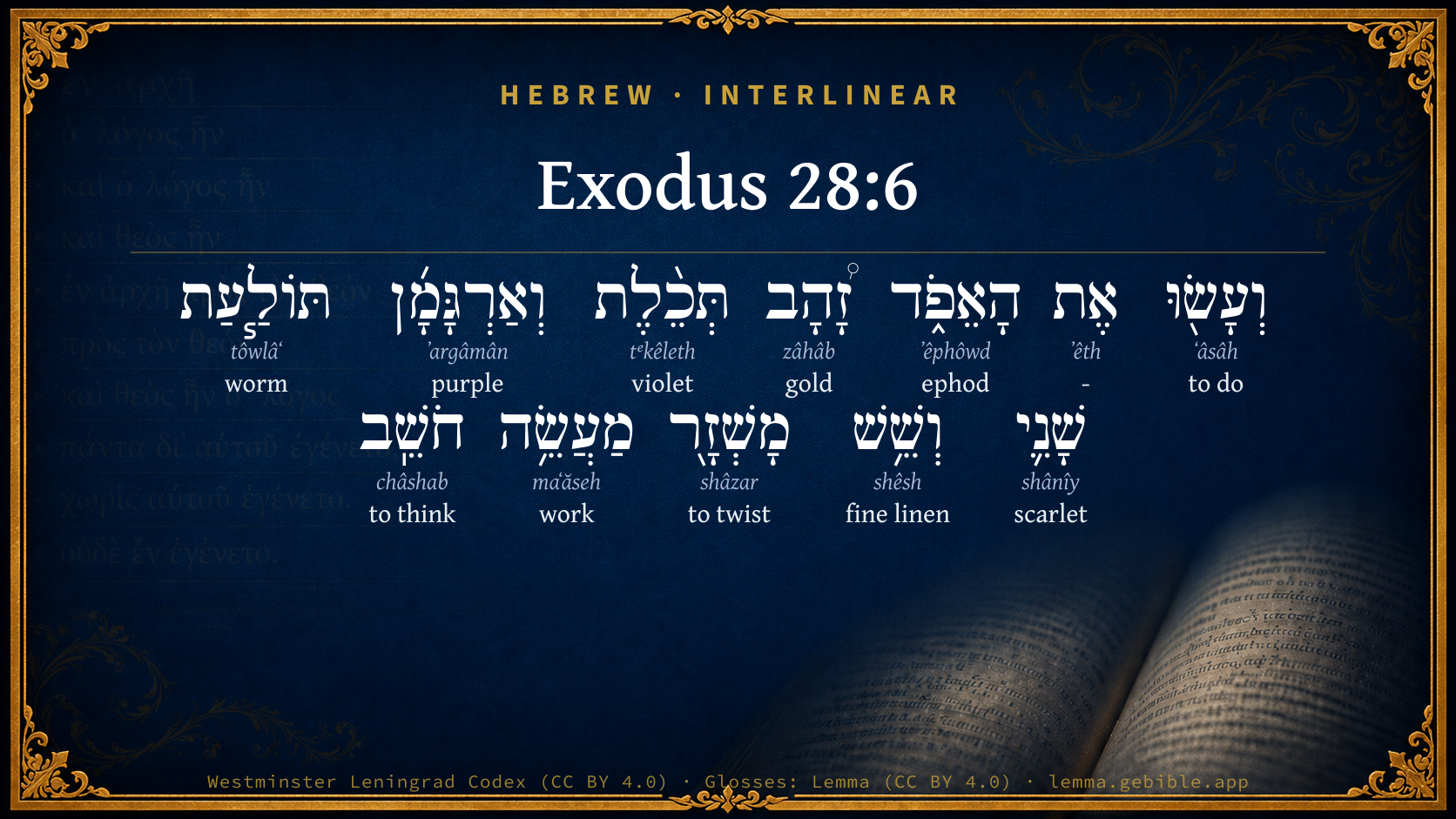
  1. וְעָשׂ֖וּ ʻâsâh H6213 “and · to do” Conjunction + Verb, Qal, Sequential Perfect, 3rd Person, Common, Plural
  2. אֶת ʼêth H853 “-” Particle, Direct Object
  3. הָאֵפֹ֑ד ʼêphôwd H646 “the · ephod” Particle, Definite Article + Noun, Common, Masculine, Singular, Absolute
  4. זָ֠הָב zâhâb H2091 “gold” Noun, Common, Masculine, Singular, Absolute
  5. תְּכֵ֨לֶת tᵉkêleth H8504 “violet” Noun, Common, Feminine, Singular, Absolute
  6. וְאַרְגָּמָ֜ן ʼargâmân H713 “and · purple” Conjunction + Noun, Common, Masculine, Singular, Absolute
  7. תּוֹלַ֧עַת tôwlâʻ H8438 “worm of” Noun, Common, Feminine, Singular, Construct
  8. שָׁנִ֛י shânîy H8144 “scarlet” Noun, Common, Masculine, Singular, Absolute
  9. וְשֵׁ֥שׁ shêsh H8336 “and · fine linen” Conjunction + Adjective, Cardinal number, Feminine, Singular, Absolute
  10. מַעֲשֵׂ֥ה maʻăseh H4639 “work of” Noun, Common, Masculine, Singular, Construct
  11. חֹשֵֽׁב châshab H2803 “thinking” Verb, Qal, Participle Active, Masculine, Singular, Absolute

About this verse

These counts appear in no published source. They are computed here, from the morphology-tagged text and Lemma’s own curated glosses. What Lemma adds →

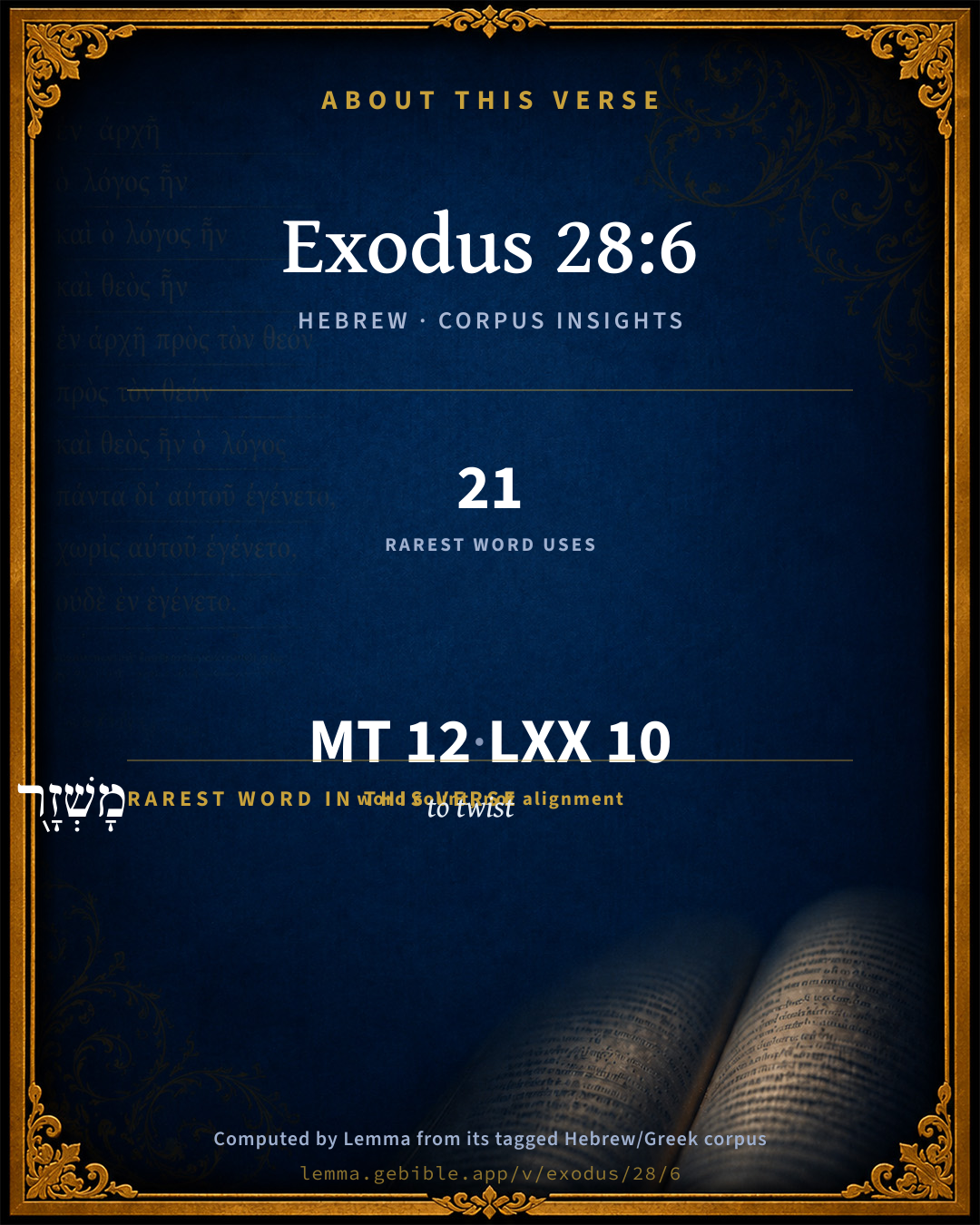
12
words
12
distinct lemmas
Pentateuch
section

Notable vocabulary

The rarest word here is מָשְׁזָ֖ר to twist H7806 — appearing just 21 times in the whole Hebrew Bible.

Shared distinctive vocabulary

מָשְׁזָ֖ר to twist H7806 occurs in 21 verses of the Hebrew Bible. Also found in:

Grammatical profile

  • 3 verbs
  • 7 nouns
  • 1 adjective
  • 1 particle

Verb forms

  • וְעָשׂ֖וּ Qal · Sequential Perfect
  • מָשְׁזָ֖ר Hophal · Participle Passive
  • חֹשֵֽׁב Qal · Participle Active

Hebrew & Septuagint length

In English translation the verse runs 22 words from the Hebrew and 16 from the Septuagint (LXX English) — closely comparable.

A rough comparison of the two English renderings, which tokenize alike — not a word-level alignment.

Word counts can differ between the Hebrew and the Greek without any difference in meaning — e.g. the Hebrew direct-object marker אֵת has no separate Greek word, and Greek often adds the article ὁ.

In the original languages it is 12 Hebrew tokens and 10 Greek tokens — but the two are counted differently (Hebrew bundles its prefixes and suffixes into one token; the Greek is in lemma form), so that isn’t a like-for-like length.

Cross-references

2

Topical passages linked to Exodus 28:6 in the Treasury of Scripture Knowledge — connected by theme and wording, ordered by reader-vote popularity; previews shown in the World English Bible.

  • Exodus 26:1 "Moreover you shall make the tent with ten curtains; of fine twined linen, and blue, and purple, and scarlet, with cherubim. The work of the skillful workman you shall make them.
  • Exodus 39:2–7 He made the ephod of gold, blue, purple, scarlet, and fine twined linen.

Cross-references courtesy of OpenBible.info (CC BY 4.0).

Hebrew and Greek witnesses Masoretic Hebrew ↔ Greek Septuagint

The same verse in the two great witnesses to the Old Testament, shown verse-for-verse.

These are two independent witnesses, not word-aligned to each other, and the Septuagint is shown in lemma (dictionary) form.

Hebrew Exodus 28:6 Masoretic · Westminster Leningrad Codex

וְעָשׂ֖וּ אֶת הָאֵפֹ֑ד זָ֠הָב תְּכֵ֨לֶת וְאַרְגָּמָ֜ן תּוֹלַ֧עַת שָׁנִ֛י וְשֵׁ֥שׁ מָשְׁזָ֖ר מַעֲשֵׂ֥ה חֹשֵֽׁב

"They shall make the ephod of gold, of blue, and purple, scarlet, and fine twined linen, the work of the skillful workman.

World English Bible · Public Domain

Greek LXX Exodus 28:6 Septuagint · lemma form

καί ποιέω ὁ ἐπωμίς ἐκ βύσσος κλώθω ἔργον ὑφαντός ποικιλτής

And they shall make the shoulder-piece of fine linen spun, the woven work of the embroiderer.

LXX2012 (modern English Septuagint) · Public Domain

On this verse, Keil & Delitzsch discusses the Septuagint’s reading. Read the note in Commentary ↓

Hebrew: Westminster Leningrad Codex (CC BY 4.0). Greek: Septuagint (public domain); English from LXX2012 (modern English Septuagint) (Public Domain). How the Septuagint differs from the Hebrew →

Targum (Aramaic paraphrase)

2

The Targum is the ancient Jewish Aramaic paraphrase of the Hebrew Scriptures — an interpretive translation, not the Hebrew text itself. Onkelos (literal) and Pseudo-Jonathan (expansive) render the Torah, and Jonathan the Prophets. Coverage is partial: where no permissively-licensed English translation exists for a verse, only the Aramaic is shown. This is verse-level text, not a word-by-word alignment to the Hebrew.

  1. Targum Onkelos Torah (Genesis–Deuteronomy)
    וְיַעְבְּדוּן יָת אֵפוֹדָא דַהֲבָא תִּכְלָא וְאַרְגְוָנָא צְבַע זְהוֹרִי וּבוּץ שְׁזִיר עוֹבַד אֳמָן:

    (no public-domain English translation for this verse)

    Targum Onkelos — Aramaic: “Onkelos Genesis” (public domain); “Onkelos Exodus” (public domain); “Onkelos Leviticus” (public domain); “Onkelos Numbers” (public domain); “Onkelos Deuteronomy” (public domain). English: “Sefaria Community Translation” (CC0 1.0 (public-domain dedication)); “J.W. Etheridge. The Targums of Onkelos and Jonathan Ben Uzziel on the Pentateuch. London: Longmans, Green, 1862” (public domain). Text via Sefaria.

  2. Targum Pseudo-Jonathan Torah (Genesis–Deuteronomy)
    וְיַעַבְדוּן יַת אֵיפוֹדָא תִּכְלָא וְאַרְגְּוָונָא צְבַע זְהוֹרֵי וּבוּץ שְׁזִיר עוֹבַד אוּמָן

    And they shall make the ephod of hyacinth, and purple, and crimson, and fine linen, twined, the work of the artificer.

    Targum Pseudo-Jonathan — Aramaic: “Targum Jonathan on Genesis” (public domain); “Targum Jonathan on Exodus” (public domain); “Targum Jonathan on Leviticus” (public domain); “Targum Jonathan on Numbers” (public domain); “Targum Jonathan on Deuteronomy” (public domain). English: “The Targum of Jonathan ben Uzziel, trans. J. W. Etheridge, London, 1862” (public domain). Text via Sefaria.

Commentary

Notes on Exodus 28:6 from classic Christian and Jewish commentators (each source and its license shown beneath its notes). The classic Christian expositions comment on the surrounding passage and are grouped to its opening verse, so a note may address several verses; the Jewish commentaries on the Tanakh (Rashi and others) are per-verse, so they appear only where the commentator wrote on this verse.

Lemma curates 59 commentaries, every one of them public domain or Creative Commons licensed, each selected and text-cleaned for this edition rather than reprinted as found. About our sources →

Matthew Henry's Commentary

Directions are here given concerning the ephod, which was the outmost garment of the high priest. Linen ephods were worn by the inferior priests, Sa1 22:18. Samuel wore one when he was a child (Sa1 2:18), and David when he danced before the ark (Sa2 6:14); but this which the high priest only wore was called a golden ephod, because there was a great deal of gold woven into it. It was a short coat without sleeves, buttoned closely to him, with a curious girdle of the same stuff (Exo 28:6-8); the shoulder-pieces were buttoned together with two precious stones set in gold, one on each shoulder, on which were engraven the names of the children of Israel, Exo 28:9-12. In allusion to this, 1. Christ our high priest appeared to John girt about the breast with a golden girdle, such as was the curious girdle of the ephod, Rev 1:13. Righteousness is the girdle of his loins (Isa 11:6), and should be of ours, Eph 6:14. He is girt with strength for the work of our salvation, and is ready for it. 2. The government is said to be upon his shoulders (Isa 9:6), as Aaron had the names of all Israel upon his shoulders in precious stone. He presents to himself and to his Father a glorious church, Eph 5:27. He has power to support them, interest to recommend them, and it is in him that they are remembered with honour and favour. He bears them before the Lord for a memorial (Exo 28:12), in token of his appearing before God as the representative of all Israel and an advocate for them.

Matthew Henry's Commentary on the Whole Bible (1708–1710) — public domain (CC PDM 1.0). Text via the HelloAO Bible API.

Trapp's Complete Commentary

John Trapp

Exo 28:6 And they shall make the ephod [of] gold, [of] blue, and [of] purple, [of] scarlet, and fine twined linen, with cunning work.

Ver. 6. The ephod of gold.] This the high priest only might wear; neither might any imitate it; for that was the fall of Gideon’s house. {Jdg 8:26-27}

John Trapp, A Commentary or Exposition upon All the Books of the Old and New Testament (1647–1656) — public domain. Text from a community e-Sword module.

The Biblical Illustrator

Joseph S. Exell

Exo_28:6-14

The ephod.

The ephod

The ephod, with its curious girdle and the oynx stones upon its shoulder-pieces, was the distinctive priestly garment. It hung upon the shoulders down to the waist, and was formed of the most costly and beautiful materials, corresponding exactly to those employed in the interior decoration of the holy place. The girdle was made of the same materials, with the same combination of colours. As garments were associated in the Hebrew mind with character, and the girdle with energy in work, we find in the correspondence of both with the interior of the holy place, a memorial of the necessity that those who enter the house of the Lord must be themselves holy and beautiful in character, and be engaged in high and holy service. But the most important parts of the ephod were the shoulder-pieces, on which were set two oynx stones, with the names of the tribes engraven on them (see Exo_28:12). Here we have the idea of representation clearly and beautifully symbolized. The shoulders, to a Hebrew mind, were the symbol of strength; and the idea was, that when the high priest entered the holy place he did not go alone, but carried with him on his strong shoulders the children of Israel whom he represented; and the estimation in which the people were held was expressed in the value of the precious stones on which the names were engraved, and the setting of pure gold with which they were surrounded. (J. M. Gibson, D. D.)

The ephod

The ephod, with the breastplate and girdle fastened to it, and put upon the person of Aaron, constituted him a worshipper; adorned with this he could draw near and worship in the holy place. It was put on over the blue robe, and is supposed to have been much shorter than that garment, reaching a little below the knees, whilst the blue robe reached down to the feet. It fitted closely to the person, and was kept in its place by the girdle. It was made of gold, blue, purple, scarlet, and fine linen. These materials represent the purity, loveliness, and glory of Christ as the Man Jesus Christ and the mighty God. It would spangle with gold, and the colours would be so blended as to display their richness and beauty in the best possible way. The four materials were the same as the vail was made of, viz., fine linen, blue, purple, and scarlet, which represent the manhood of Christ in all its perfection as such (Heb_10:19-20); but in the gold thread with which that cloth was embroidered (Exo_39:3), I see the Godhead of the Lord, and the two are so joined together that you cannot have one without the other. The back and front parts of the ephod were joined at the shoulders, by means of the shoulder-pieces from which it was suspended. In each shoulder-piece was a precious stone set in gold--an oynx stone, a beautiful white and half-transparent stone. In these precious stones the names of the twelve tribes of Israel were engraven. Aaron carried the names of his people upon his shoulders. He presented them thus before the Lord, and when God looked down upon Aaron, He saw the names of His people indelibly engraven in white stones. The shoulder is the place of strength. The omnipotent strength of Christ is ours. He carries His peoples burdens and themselves too (Isa_63:9; Isa_40:11; Isa_46:4; Psa_55:22). The government is upon His shoulder, and the crown is upon His head. (G. Rodgers.)

The Biblical Illustrator, edited by Joseph S. Exell (c. 1880s–1900s) — public domain. Text from a community e-Sword module.

Joseph Benson's Commentary

Exo 28:6. They shall make the ephod of gold — This was the outmost garment of the high-priest. Linen ephods were worn by the inferior priests; but this which the high-priest wore was called a golden ephod, because there was a great deal of gold woven into it. It was a short linen coat without sleeves, of various colours, which hung behind upon the back and shoulders, and came down before upon the breast. The shoulder pieces were buttoned together with two onyx-stones, set in gold, one on each shoulder. And on these two onyx-stones were engraven the names of the twelve sons of Israel, six on each stone, according to their seniority, that the high-priest might bear their names before the Lord in his ministrations, in token of his appearing before God as their representative, and for a memorial, that he might both remember to plead their cause as their advocate, and also might put the Lord in remembrance, so to speak, of his promises to them, Isa 9:6. A similar reason is given, (Exo 28:29,) for his wearing the breast-plate. Le Clerc gives it as his opinion, that these names upon the two precious stones signified further, 1st, The union of all the tribes in one commonwealth; 2d, Their union in one religion and priesthood; and, 3d, That the care of the public religion rested, as it were, upon the high-priest, and was, of all concerns, to be next his heart. According to our translation, and as most interpreters have understood the expression, the ephod was girt on with a girdle over the breast, dyed, embroidered, and interwoven with gold, like the other parts of the ephod.

Thus Christ appeared to John, girt about the paps with a golden girdle, Rev 1:13. Righteousness was the girdle of his loins. He was girt with strength for the work of our salvation, and was clad with zeal as with a cloak. The government also is upon his shoulders, and he ever liveth to make intercession for his people, bearing their names before God, as a memorial, not engraven on stones of onyx, but in characters of unspeakable and everlasting love upon his heart. Hence, as their representative and advocate, he interposes in their behalf, prevalently pleads their cause, and will present them to himself and to his Father, a glorious church, (Eph 5:27,) without spot, or wrinkle, or any such thing.

Joseph Benson's Commentary on the Old and New Testaments (1811–1818) — public domain. Text from a community e-Sword module.

Tyndale Open Study Notes

Tyndale Open Resources

28:6-14 The ephod was a kind of apron consisting of front and back pieces joined by shoulder straps (28:7) and secured by a decorative sash (28:8, 27-28). Perhaps it is mentioned first because it was understood to be the distinctive high priestly garment. The fact that Gideon later made a gold ephod (Judg 8:27) suggests that the garment was thought to have special powers.

Tyndale Open Study Notes — © Tyndale Open Resources, licensed CC BY-SA 4.0. Text via the HelloAO Bible API.

Jamieson, Fausset & Brown

Robert Jamieson, A. R. Fausset & David Brown

ephod--It was a very gorgeous robe made of byssus, curiously embroidered, and dyed with variegated colors, and further enriched with golden tissue, the threads of gold being either originally interwoven or afterwards inserted by the embroiderer. It was short--reaching from the breast to a little below the loins--and though destitute of sleeves, retained its position by the support of straps thrown over each shoulder. These straps or braces, connecting the one with the back, the other with the front piece of which the tunic was composed, were united on the shoulder by two onyx stones, serving as buttons, and on which the names of the twelve tribes were engraved, and set in golden encasements. The symbolical design of this was, that the high priest, who bore the names along with him in all his ministrations before the Lord, might be kept in remembrance of his duty to plead their cause, and supplicate the accomplishment of the divine promises in their favor. The ephod was fastened by a girdle of the same costly materials, that is, dyed, embroidered, and wrought with threads of gold. It was about a handbreadth wide and wound twice round the upper part of the waist; it fastened in front, the ends hanging down at great length (Rev 1:13).

Jamieson, Fausset & Brown — Commentary Critical and Explanatory on the Whole Bible (1871) — public domain (CC PDM 1.0). Text via the HelloAO Bible API.

Ellicott's Commentary for English Readers

(6) With cunning work.—On this phrase, see Note on Exo_26:1.

1. THE EPHOD.

(6-12) The ephod was, as already observed (Note on Exo_28:4), a sort of jerkin or waistcoat. It was made in two pieces, a front piece and a back piece, which were joined together at the shoulders, apparently by a seam (Exo_28:7). The pieces descended to the waist; and there one or other of them was expanded into a band, called “the curious girdle of the ephod,” which being passed round the waist and fastened, kept both front and back pieces in place (Exo_28:8). On either shoulder was an onyx stone set in gold (Exo_28:9-11), and engraved with the names of six of the tribes.

A Bible Commentary for English Readers, edited by Charles John Ellicott (1878–1897) — public domain. Text from a community e-Sword module.

The Cambridge Bible for Schools and Colleges

gen. ed. J. J. S. Perowne

6. gold] i.e. gold thread (see Exo_39:3). The other materials for the ephod were the same as those for the curtains (Exo_26:1): but the ephod would be the handsomer on account of the gold thread interwoven with them.

the work of the designer] or pattern-weaver: see on Exo_26:1.

The Cambridge Bible for Schools and Colleges (gen. ed. J. J. S. Perowne; Cambridge University Press, 1878–1918) — public domain. Text from a community e-Sword module.

John Gill's Exposition

And they shall make the ephod,.... This was the outermost garment of, all, and was put over the robe; it was a short garment, reaching to the loins, as Kimchi (p); or to the buttocks, as Abarbinel (q); and not to the heels or feet, as Jarchi (r), and Maimonides (s); for Josephus (t) says it was but a cubit long, which was little more than half a yard; he means that part of it which was distinct from the shoulder pieces, and came down from thence: the hinder part of it covered the back, and reached to the middle of the buttocks; and the forepart covered the breast and belly, and with shoulder pieces under the arm holes was buttoned with onyx stones upon the top of the shoulders, and was girt about the breast with a curious girdle: it had no sleeves, though Josephus (u) says it had, as appears from the make of it; it was different from the linen ephod worn by the common priests and others, and was a symbol of the human nature of Christ, our great High Priest: it was made of

gold, of blue, and of purple, of scarlet, and fine twined linen, with cunning work; the stuff of which it was made was interwoven with threads of gold, and threads of blue, purple, and scarlet yarn, and threads of linen, wrought with divers figures in a curious manner, which looked very beautiful; and was a fit emblem of the glory, excellency, and purity of Christ's human nature; of the various graces of the Spirit in it; of his heavenly original; of his blood, sufferings, and death, and glorious exaltation; and of its being a curious piece of workmanship wrought by the Lord himself, Heb 10:5.

(p) Comment. in 1 Chron. 15. 27. (q) Comment. in loc. (r) Comment. in loc. (s) Hilchot Cele Hamikdash, c. 9. sect. 9. (t) Antiqu. l. 3. c. 7. sect. 5. (u) Ib.

John Gill's Exposition of the Whole Bible (1746–1763) — public domain (CC PDM 1.0). Text via the HelloAO Bible API.

Haydock's Catholic Bible Commentary

Ephod, (superhumerale.) That of the other priests was made of linen; and such were worn by Samuel, and by David, when he danced before the ark. (Menochius)

George Leo Haydock (1774–1849), Haydock's Catholic Family Bible and Commentary, 1859 edition — public domain. Excludes Psalms (Douay-Rheims chapter numbering differs from Protestant) and Deuterocanonical books (Catholic canon only).

Matthew Poole's English Annotations

Of gold, beaten out into plates, and cut into wires.

Matthew Poole's English Annotations on the Holy Bible (1683–1685) — public domain. Text from a community e-Sword/MySword module.

Whedon's Commentary on the Bible

Daniel D. Whedon

6. The ephod — This was the most conspicuous garment of the high priest, and was made of the same material as the tabernacle-cloth and vail, (Exo_26:1; Exo_26:31,) but was interlaced with gold threads, the cunning work of the weaver. According to Wilkinson the Egyptian monuments exhibit coloured costumes woven with what appear like threads of gold.

Daniel D. Whedon (gen. ed.), Commentary on the Old and New Testaments (1874–1909) — public domain. Text from a community e-Sword module.

The Pulpit Commentary

The Ephod.

They shall make the ephod The word ephod signifies etymologically any "vestment" or "garment;" but in its use it is confined to the special vestment here described, the great object of which was to be a receptacle for the "breast-plate." The ephod was a sort of jerkin or waistcoat, consisting of two pieces, one to cover the chest and the other the back, joined together probably by a seam, above the shoulders, and united at the waist by a band called "the curious girdle of the ephod." This band was of one piece with the ephod, being woven on either to the front or the back part; it held the other part in place, and was passed round the body and fastened either with a clasp, or with buttons, or strings. Of gold, of blue, of purple, etc. i.e. , "of the same materials as the curtains and veil of the sanctuary, with the addition of gold." The gold was probably in the shape of gold thread, or wire of extreme tenuity, and was introduced by the needle after the fabric bad been woven, as was commonly done in Egypt (Heb 3:47; Wilkinson"s Ancient Egyptians, vol. 3. p. 128: compare below. (Exo_39:3) The white, blue, purple, and scarlet threads were doubtless woven into a pattern of some kind; but it is impossible to say what the pattern was. In Egypt patterns were not much affected, the dress worn being commonly white, with a stripe sometimes at the edge; but the Semitic tribes, who bordered Egypt on the East, affected gay colours and. varied designs, if we may trust the Egyptian wall-paintings. With cunning work. Literally, "work of the skilled (workman)." Some of the Hebrews had evidently carried on the trade of weaving in Egypt, and had brought their looms with them. The Egyptian looms were hand-looms, and of no great size; they admitted of easy transport.

Vers. 6-12. The symbolism of the ephod and its onyx stones.

The ephod was, par excellence, the priestly garment. When idolatrous rites grew up in Palestine, which sheltered themselves under the pretence of being modifications, or adaptations, of the Sinaitic religion, an ephod was always retained, and made a prominent feature in the new form of worship. (Jud_1:8:27 17:5 18:14; etc.) The ephod came to be worn by a/l Israelitish priests (1Sa_22:18; Hos_3:4) and even by laymen when engaged in sacred functions. (2Sa_6:14; 1Ch_15:27) Its materials and workmanship united it pointedly with the tabernacle, (Exo_26:1) and especially with the holy of holies ( ib, ver. 51). It may be considered

I AS TYPIFYING THE UNITY OF THE CHURCH. The shoulder pieces of the ephod were to be "joined together" (ver. 7). The "curious girdle" was to be of one piece with it (ver. 8). Though formed of various parts, it was to be one single indivisible garment, united both above and below, and always worn in its entirety. The seamless robe of our Blessed Saviour is generally allowed to prefigure his one Church. The ephod as worn, was, perhaps, not seamless; but still it was "woven of one piece," and so far resembled the Lord"s garment.

II AS REPRESENTING THE VARIETY OF GIFTS AND GRACES WITHIN THE CHURCH. The blue, and purple, and scarlet, and fine linen, and gold, and gems of the ephod gave it a variety and a beauty which made it the most glorious of all the priestly vestments. Variety has a charm of its own, and is a mark of the Church, in which there is such vast "diversity of gifts," though there is but one spirit. Gold is especially appropriate for the dignity of those whom God has made "both priests and kings." "The king"s daughter is all glorious within; her clothing is of wrought gold". (Psa_45:13) Purple, too, is an imperial colour, and suits those who shall "reign with Christ for ever". (Rev_22:5)

III AS CONSTITUTING, WHEN WORN BY THE HIGH-PRIEST, A PRESENTATION OF THE CHURCH TO GOD IN PERFECT BEAUTY. The onyx, or sardonyx stones, with the twelve names engraved upon them, completed the representative character of the ephod, and showed clearly that the high priest, when, thus attired, he entered the sanctuary, presented before God the Church whereof he was the head, as freed from sin by the expiation which he had made at the altar before entering, and made meet for the presence of the Most High. And this presentation was, we are distinctly told, (Heb_9:9-12 Heb_10:19-22) a type or figure of that far more precious one, which Christ is ever making before his Father"s throne in heaven, where he presents to him his Church, "a glorious Church, not having spot, or wrinkle, or any such thing, but holy and without blemish", (Eph_5:27) washed in his blood, redeemed by his death, sanctified by his in-dwelling. Christ can and will purge his elect from all sin; (1Jn_1:7) Christ can and will present them pure before God. He has his "sealed" ones of all the twelve tribes; (Rev_7:4-8) and, besides these, he has others who are equally his great multitude which no man could number, of all nations, and kindreds, and peoples, and tongues" (ib, 9) who "have washed their robes and made them white in the blood of the Lamb" ( ib, 14), and whom he will "present faultless" to his Father.

The Pulpit Commentary (1880–1919), ed. H.D.M. Spence-Jones & Joseph S. Exell — public domain. Text from a community e-Sword module.

John Wesley's Explanatory Notes

The ephod, was the outmost garment of the high-priest; linen ephods were worn by the inferior priests, but this, which the high- priest wore, was called a golden ephod, because there was a great deal of gold woven into it. It was a short coat without sleeves, buttoned close to him with a curious girdle of the same stuff. The shoulder pieces were buttoned together with two precious stones set in gold, one on each shoulder. In allusion to this, Christ our high priest appeared to John, girt about the paps with a golden girdle, such as was the curious girdle of the ephod, Rev. i, 13. Righteousness is the girdle of his loins. He is girt with strength for the work of our salvation. And as Aaron had the names of all Israel upon his shoulders in precious stones, so He presents to himself and to his Father a glorious church, Eph. v, 27. He bears them before the Lord for a memorial, in token of his appearing before God as the representative of all Israel, and an advocate for them.

John Wesley, Explanatory Notes Upon the Whole Bible (1754–1765) — public domain. Text via the GEBible commentary corpus.

Keil & Delitzsch

C. F. Keil & F. Delitzsch

The first part mentioned of Aaron's holy dress, i.e., of the official dress of the high priest, is the ephod. The etymology of this word is uncertain; the Sept. rendering is ἐπωμίς (Vulg. superhumerale, shoulder-dress; Luther, "body-coat"). It was to be made of gold, hyacinth, etc., artistically woven, - of the same material, therefore, as the inner drapery and curtain of the tabernacle; but instead of having the figures of cherubim woven into it, it was to be worked throughout with gold, i.e., with gold thread. According to Exo 39:3, the gold plates used for the purpose were beaten out, and then threads were cut (from them), to be worked into the hyacinth, purple, scarlet, and byssus. It follows from this, that gold threads were taken for every one of these four yearns, and woven with them.

(Note: The art of weaving fabrics with gold thread (cf. Plin. h. n. 33, c. 3, s. 19, "aurum netur ac texitur lanae modo et sine lana"), was known in ancient Egypt. "Among the coloured Egyptian costumes which are represented upon the monuments, there are some that are probably woven with gold thread." - Wilkinson 3, 131. Hengstenberg, Egypt, etc., p. 140.)

Exo 28:7

"Two connecting shoulder-pieces shall it have for its two ends, that it may be bound together." If we compare the statement in Exo 39:4, - "shoulder-pieces they made for it, connecting; at its two ends was it connected," - there can hardly be any doubt that the ephod consisted of two pieces, which were connected together at the top upon (over) the shoulders; and that Knobel is wrong in supposing that it consisted of a single piece, with a hole cut on each side for the arms to be put through. If it had been a compact garment, which had to be drawn over the head like the robe (Exo 28:31, Exo 28:32), the opening for the head would certainly have been mentioned, as it is in the case of the latter (Exo 28:32). The words of the text point most decidedly to the rabbinical idea, that it consisted of two pieces reaching to about the hip, one hanging over the breast, the other down the back, and that it was constructed with two shoulder-pieces which joined the two together. These shoulder-pieces were not made separate, however, and then sewed upon one of the pieces; but they were woven along with the front piece, and that no merely at the top, so as to cover the shoulders when the ephod was worn, but according to Exo 28:25 (? 27), reaching down on both sides from the shoulders to the girdle (Exo 28:8).

Exo 28:8

"And the girdle of its putting on which (is) upon it, shall be of it, like its work, gold, etc." There was to be a girdle upon the ephod, of the same material and the same artistic work as the ephod, and joined to it, not separated from it. The חשׁב mentioned along with the ephod cannot mean ὕφασμα, textura (lxx, Cler., etc.), but is to be traced to חשׁב = חבשׁ to bind, to fasten, and to be understood in the sense of cingulum, a girdle (compare Exo 29:5 with Lev 8:7, "he girded him with the girdle of the ephod"). אפדּה is no doubt to be derived from אפד, and signifies the putting on of the ephod. In Isa 30:22 it is applied to the covering of a statue; at the same time, this does not warrant us in attributing to the verb, as used in Exo 9:5 and Lev 8:7, the meaning, to put on or clothe. This girdle, by which the two parts of the ephod were fastened tightly to the body, so as not to hang loose, was attached to the lower part or extremity of the ephod, so that it was fastened round the body below the breastplate (cf. Exo 28:27, Exo 28:28; Exo 39:20-21).

Exo 28:9-10

Upon the shoulder-piece of the ephod two beryls (previous stones) were to be placed, one upon each shoulder; and upon these the names of the sons of Israel were to be engraved, six names upon each "according to their generations," i.e., according to their respective ages, or, as Josephus has correctly explained it, so that the names of the six elder sons were engraved upon the previous stone on the right shoulder, and those of the six younger sons upon that on the left.

Exo 28:11

"Work of the engraver in stone, of seal-cutting shalt thou engrave the two stones according to the names of the sons of Israel." The engraver in stone: lit., one who works stones; here, one who cuts and polishes precious stones. The meaning is, that just as precious stones are cut, and seals engraved upon them, so these two stones were to be engraved according to the name of the sons of Israel, i.e., so that the engraving should answer to their names, or their names be cut into the stones. "Surrounded by gold-twist shalt thou make it." זהב משׁבּצות, from שׁבץ to twist, is used in Exo 28:39 (cf. Psa 45:14) for a texture woven in checks; and here it denotes not merely a simple gold-setting, but, according to Exo 28:13, gold-twists or ornaments representing plaits, which surrounded the golden setting in which the stones were fixed, and not only served to fasten the stones upon the woven fabric, but formed at the same time clasps or brooches, by which the two parts of the ephod were fastened together. Thus Josephus says (Ant. iii. 7, 5) there were two sardonyxes upon the shoulders, to be used for clasps.

Exo 28:12

The precious stones were to be upon the shoulder-pieces of the ephod, stones of memorial for the sons of Israel; and Aaron was to bear their names before Jehovah upon his two shoulders for a memorial, i.e., that Jehovah might remember the sons of Israel when Aaron appeared before Him clothed with the ephod (cf. Exo 28:29). As a shoulder-dress, the ephod was par excellence the official dress of the high priest. The burden of the office rested upon the shoulder, and the insignia of the office were also worn upon it (Isa 22:22). The duty of the high priest was to enter into the presence of God and made atonement for the people as their mediator. To show that as mediator he brought the nation to God, the names of the twelve tribes were engraved upon precious stones on the shoulders of the ephod. The precious stones, with their richness and brilliancy, formed the most suitable earthly substratum to represent the glory into which Israel was to be transformed as the possession of Jehovah (Exo 19:5); whilst the colours and material of the ephod, answering to the colours and texture of the hangings of the sanctuary, indicated the service performed in the sanctuary by the person clothed with the ephod, and the gold with which the coloured fabric was worked, the glory of that service.

Exo 28:13-14

There were also to be made for the ephod two (see Exo 28:25) golden plaits, golden borders (probably small plaits in the form of rosettes), and two small chains of pure gold: "close shalt thou make them, corded" (lit., work of cords or strings), i.e., not formed of links, but of gold thread twisted into cords, which were to be placed upon the golden plaits or fastened to them. As these chains served to fasten the choshen to the ephod, a description of them forms a fitting introduction to the account of this most important ornament upon the state-dress of the high priest.

Keil & Delitzsch — Biblical Commentary on the Old Testament (1861–1891) — public domain (CC PDM 1.0). Text via the HelloAO Bible API. (Old Testament only.)

Scofield Reference Notes

C. I. Scofield

ephod Gold, Deity in manifestation; blue, heavenly; purple, royalty; scarlet, sacrifice; fine linen, personal righteousness, see margin ref., Exo 26:1.

(See Scofield "Exo 26:1").

The Scofield Reference Bible (1917 edition), notes by C. I. Scofield — public domain. Text from a community e-Sword module.

unfoldingWord translationNotes

Door43 World Missions Community

General Information:

Yahweh continues to tell Moses what the people must do.

fine-twined linen

"finely-twisted linen." This was cloth made from fine linen threads that someone twisted together to make a stronger thread. See how you translated this in Exodus 26:36.

skillful craftsman

a person who can make beautiful objects by hand

it must be made of one piece

This can be stated in active form. AT: "they must make it in one piece" (See: Active or Passive)

onyx stones

These are valuable stones that have layers of white and black, red or brown. See how you translated this in Exodus 25:7. (See: Translate Unknowns)

translationWords

ephod

gold

Israel

unfoldingWord translationNotes — © Distant Shores Media and the Door43 World Missions Community, licensed CC BY-SA 4.0. Source: git.door43.org/Door43/en_tn.

Rashi

Rabbi Shlomo Yitzchaki (Rashi)

ועשו את האפד AND THEY SHALL MAKE THE EPHOD — If I set myself to explain the making of the ephod and the breast-plate in the order of the verses, the description of them would be fragmentary and the reader might err in piecing the details together: therefore I shall write down how they were made, just as each of them was, in order that “he who runs may read” (may have a comprehensive idea of them in their entirety), and afterwards I shall explain it in the order of the verses. The ephod was made like that kind of apron of women who ride on horse-back. He (the priest) tied it on behind him opposite (at the height of) his heart below his elbows. Its breadth was equal to the measure of a man’s back and somewhat more (cf. Rashi, end of v. 26), and it reached to his heels. The belt was attached to its top edge along the whole of its width, being of weaver’s work (i. e. woven in one piece with the ephod) and it extended on both sides beyond the width of the ephod in order that it might go right round the body and gird on the ephod by means of it. The shoulder-pieces were attached to the belt, one on the right and one the left, behind the priest, at the two ends of the width of the apron, and when they were lifted up they stood (we should say “they lay”) upon his two shoulders, so that they were like two straps made of the same material as the ephod itself, and sufficiently long to lift them up to reach to his neck on both sides, and they hung over in front of him a little below his shoulders. The onyx stones were fixed in them, one on his right shoulder and one on his left shoulder, and the settings were placed in their ends in front of his shoulders on his breast. Two cords of gold were inserted through two rings which were on the breastplate at the two ends of its upper width (edge), one on the right and one on the left, and the two ends of the chain (or cord) were fixed in the setting on the right, and similarly the two ends of the left chain were fixed in the setting which was on the left shoulder. Consequently, the breast-plate hung in front of him over his heart from the settings of the ephod. Further, there were two rings at the two ends of the breast-plate on its lower edge, and opposite them two rings below on the two shoulder pieces of the ephod on the lower edge of each where this was joined to the belt. The under two rings on the breast-plate were opposite the rings on the ephod, lying one upon the other, and they fastened them (each pair of rings) together by a blue purple thread which was inserted through the rings in the ephod and breast-plate, so that the lower edge of the breast-plate should lie close to the belt of the ephod and should not move about and come apart from it, swinging to and fro.

זהב תכלת וארגמן תולעת שני ושש משזר OF GOLD, OF BLUE PURPLE, AND OF RED PURPLE, OF CRIMSON AND FINE TWISTED LINEN — The five materials were intertwined in every strand: they beat out the gold into the form of thin plates and from them they cut threads, and they wove that gold thread together with six threads of blue purple and a gold thread with six threads of red purple, and similarly with the crimson and similarly with the fine linen; because all the materials had their threads sixfold and there was a gold thread with each of them. Then they intertwined them all into one thread; it followed, therefore, that their thread was 28-fold. This is how it is explained in Treatise Yoma 72a and it is derived from the following verse: (Exodus 39:3) “And they beat out the gold into thin plates and cut it into threads to work the threads of gold in the blue purple and in the red purple, etc.” — this tells us that a gold thread was intertwined with each material.

מעשה חשב THE WORK OF AN ARTIST — I have already explained (Exodus 26:1) that this was weaving on both sides: that is, that the designs on both sides were not similar one to the other.

Rashi on the Tanakh — English translations: “The Judaica Press complete Tanach with Rashi, translated by A. J. Rosenberg” (CC BY 4.0); “Pentateuch with Rashi's commentary by M. Rosenbaum and A.M. Silbermann, 1929-1934” (public domain); “The Metsudah Tanach series, Lakewood, N.J” (CC BY 4.0); and “The Book of Joshua, Metsudah Publications, 1997” (CC BY 4.0). Text via Sefaria.

Lesson kit

Teaching starters — assembled from the data on this page, not authored interpretation. Every prompt links to the verse data it draws on. Edit before teaching.

Exodus, in the Pentateuch, opens this verse with 12 words (12 distinct Hebrew lemmas). Its most distinctive word is shâzar (“to twist”). A historical commentator’s framing appears above. Read the whole chapter for the surrounding context.

Discussion questions

  1. What does “to twist” (shâzar) contribute to the verse as a whole?
  2. Exodus 26:1 shares the word «to twist» with this verse. How do the two illuminate each other?
  3. The translations on this page render this verse differently — a whole-verse word diff, not a word-by-word alignment. What might account for the different wordings?
  4. The verb «וְעָשׂ֖וּ» is Qal Sequential Perfect. How does its form color the action?
  5. Reading how Matthew Henry's Commentary and Trapp's Complete Commentary read this verse, where do the two commentators agree and where do they part?

Things to notice

Reading settings

Reading text

Shown beneath each verse's original-language words.

Old Testament
Old Testament edition

Read the OT as the Masoretic Hebrew (MT) or the Greek Septuagint (LXX).

English shown for the Greek Septuagint (in the Hebrew ↔ Greek comparison).

Comparing translations? Open the Compare panel on any verse page to stack up to four side by side.