Galatians 3:5

Greek (Tischendorf 8th ed.) Galatians 3:5 appears in the Greek New Testament. The text above is from the Tischendorf 8th edition. Each word links to its Strong’s number and a concise gloss. Click any word for its full Thayer’s Greek Lexicon entry.
Download image
Cite this verse

Galatians 3:5 (World English Bible). Public Domain. Lemma interlinear Bible study tool, https://lemma.gebible.app/v/galatians/3/5.

Show BibTeX & RIS
BibTeX
RIS
English Translation
He therefore who supplies the Spirit to you, and works miracles among you, does he do it by the works of the law, or by hearing of faith?
World English Bible · Public Domain
Download a study sheet

One document with this verse’s original text, its word-by-word gloss line, the meaning frame, cross-references with their text, attributed commentary, and full source and license credits — printable, and it pastes into notes with its structure intact.

This verse Autodidact and up

Study sheet (.html) Plain text (.txt)

A passage Seminary Student

Up to 50 verses in one chapter. A passage sheet keeps up to 6 commentary sources and 12 cross-references per verse, in the order this page ranks them, and says so on the sheet whenever that leaves anything out. Ask for a single verse and you get the Autodidact verse sheet above.

Everything on this page stays free to read, with no account — the sheet is a download of what is already on screen, not access to it.

Want to remove ads? Support Godless Engineer
Compare translations 3

The same verse in 3 English versions, stacked beneath the original-language interlinear above. Click any original word for its lexicon entry.

Each is an independent rendering of the whole verse — the interlinear is not word-aligned to these translations.

Highlighted words mark where these versions differ — a whole-verse word diff, not a word-by-word alignment.

  • World English Bible Public Domain
    He therefore who supplies the Spirit to you, and works miracles among you, does he do it by the works of the law, or by hearing of faith?
  • King James Version Public Domain
    He therefore that ministereth to you the Spirit, and worketh miracles among you, doeth he it by the works of the law, or by the hearing of faith?
  • unfoldingWord Literal Text CC BY-SA 4.0
    Therefore, the one providing the Spirit to you and working miracles among you, by works of the law, or by hearing of faith?

unfoldingWord Literal Text — © unfoldingWord, licensed CC BY-SA 4.0. Word-aligned USFM3 via Door43 (git.door43.org/unfoldingWord/en_ult).

Versions to compare (up to 4)

3 of 4 selected

Show all 19 translations

Every available English version of this verse, each an independent rendering of the whole verse.

  • World English Bible Public Domain
    He therefore who supplies the Spirit to you, and works miracles among you, does he do it by the works of the law, or by hearing of faith?
  • Berean Standard Bible Public Domain
    Does God lavish His Spirit on you and work miracles among you because you practice the law, or because you hear and believe?
  • Majority Standard Bible Public Domain
    Does God lavish His Spirit on you and work miracles among you because you practice the law, or because you hear and believe?
  • King James Version Public Domain
    He therefore that ministereth to you the Spirit, and worketh miracles among you, doeth he it by the works of the law, or by the hearing of faith?
  • American Standard Version (1901) Public Domain
    He therefore that supplieth to you the Spirit, and worketh miracles among you, `doeth he it' by the works of the law, or by the hearing of faith?
  • Revised Version (1885) Public Domain
    He therefore that supplieth to you the Spirit, and worketh miracles among you, doeth he it by the works of the law, or by the hearing of faith?
  • Geneva Bible (1599) Public Domain
    He therefore that ministreth to you the Spirit, and worketh miracles among you, doeth he it through the workes of the Law, or by the hearing of faith preached?
  • Douay-Rheims (1899) Public Domain
    He therefore who giveth to you the Spirit, and worketh miracles among you; doth he do it by the works of the law, or by the hearing of the faith?
  • Young's Literal Translation Public Domain
    He, therefore, who is supplying to you the Spirit, and working mighty acts among you -- by works of law or by the hearing of faith `is it'?
  • Literal Standard Version CC BY-SA 4.0
    He, therefore, who is supplying the Spirit to you and working mighty acts among you—[is it] by works of law or by the hearing of faith?
  • Unlocked Literal Bible CC BY-SA 4.0
    Does he who gives the Spirit to you and works miracles among you do so by the works of the law, or by hearing with faith?
  • unfoldingWord Literal Text CC BY-SA 4.0
    Therefore, the one providing the Spirit to you and working miracles among you, by works of the law, or by hearing of faith?
  • Darby Bible Public Domain
    He therefore who ministers to you the Spirit, and works miracles among you, [is it] on the principle of works of law, or of [the] report of faith?
  • World Messianic Bible Public Domain
    He therefore who supplies the Spirit to you and does miracles among you, does he do it by the works of the law, or by hearing of faith?
  • Webster's Bible Public Domain
    He therefore that ministereth to you the Spirit, and worketh miracles among you, doeth he this by the works of the law, or by the hearing of faith?
  • Free Bible Version CC BY-SA 4.0
    Let me ask you: does God give you the Spirit and do so many miracles among you because you keep the law, or is it because you trust in what you heard?
  • Bible in Basic English Public Domain
    He who gives you the Spirit, and does works of power among you, is it by the works of law, or by the hearing of faith?
  • Text-Critical English NT CC BY 4.0
    Does God supply you with the Spirit and work miracles among you because you perform the works of the law or because you hear with faith?
  • Tyndale New Testament (1534) Public Domain
    Which ministered to you the sprete and worketh myracles amonge you doth he it thorow the dedes of the lawe or by preachinge of the fayth?

Literal Standard Version (2020), Covenant Press — licensed CC BY-SA 4.0. Text via the HelloAO Bible API (eBible.org). Unlocked Literal Bible (unfoldingWord) — licensed CC BY-SA 4.0. Text via the HelloAO Bible API (eBible.org). unfoldingWord Literal Text — © unfoldingWord, licensed CC BY-SA 4.0. Word-aligned USFM3 via Door43 (git.door43.org/unfoldingWord/en_ult). Free Bible Version, Dr. Jonathan Gallagher — licensed CC BY-SA 4.0. Text via the HelloAO Bible API (eBible.org).

Word by word

More ways to search: Search by grammar → Find every occurrence → Compare this word →

Practice this passage: Drill this verse → Learn its vocabulary →

ἐπιχορηγῶν
epichorēgéō
G2023
“to supply”
Verb, Present, Active, Participle, Nominative, Singular, Masculine
Part of Speech
Verb
Tense
Present
Voice
Active
Mood
Participle
Case
Nominative
Number
Singular
Gender
Masculine
Full Thayer's Definition

Origin: from G1909 and G5524

TDNT: None

1. to supply, furnish, present 2. to be supplied, ministered to, assisted
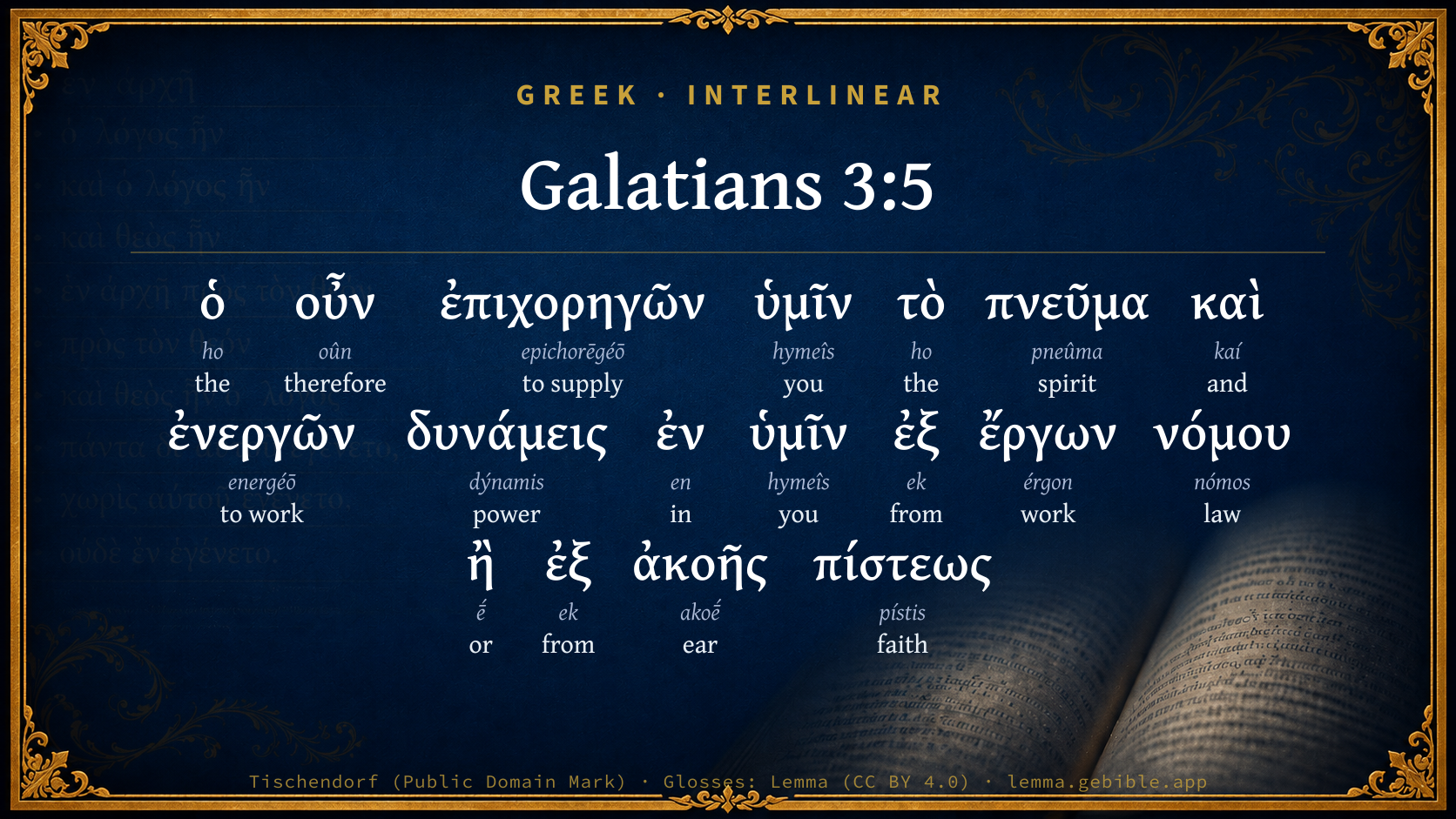
  1. ὁ ho G3588 “the” Article, Nominative, Singular, Masculine
  2. οὖν oûn G3767 “therefore” Conjunction
  3. ὑμῖν hymeîs G5210 “you” Personal pronoun, 2nd person, Dative, Plural
  4. τὸ ho G3588 “the” Article, Accusative, Singular, Neuter
  5. πνεῦμα pneûma G4151 “spirit” Noun, Accusative, Singular, Neuter
  6. καὶ kaí G2532 “and” Conjunction
  7. ἐνεργῶν energéō G1754 “to work” Verb, Present, Active, Participle, Nominative, Singular, Masculine
  8. δυνάμεις dýnamis G1411 “power” Noun, Accusative, Plural, Feminine
  9. ἐν en G1722 “in” Preposition
  10. ὑμῖν hymeîs G5210 “you” Personal pronoun, 2nd person, Dative, Plural
  11. ἐξ ek G1537 “from” Preposition
  12. ἔργων érgon G2041 “work” Noun, Genitive, Plural, Neuter
  13. νόμου nómos G3551 “law” Noun, Genitive, Singular, Masculine
  14. ἢ ḗ G2228 “or” Particle
  15. ἐξ ek G1537 “from” Preposition
  16. ἀκοῆς akoḗ G189 “ear” Noun, Genitive, Singular, Feminine
  17. πίστεως pístis G4102 “faith” Noun, Genitive, Singular, Feminine

About this verse

These counts appear in no published source. They are computed here, from the morphology-tagged text and Lemma’s own curated glosses. What Lemma adds →

18
words
15
distinct lemmas
Pauline Epistles
section

Notable vocabulary

The rarest word here is ἐπιχορηγῶν to supply G2023 — appearing just 5 times in the whole Greek New Testament.

Shared distinctive vocabulary

ἐπιχορηγῶν to supply G2023 occurs in 5 verses of the Greek New Testament. Also found in:

Repetition

Words recur within this verse:

Cross-references

11

Topical passages linked to Galatians 3:5 in the Treasury of Scripture Knowledge — connected by theme and wording, ordered by reader-vote popularity; previews shown in the World English Bible.

  • Galatians 3:2 I just want to learn this from you. Did you receive the Spirit by the works of the law, or by hearing of faith?
  • Acts 14:9–10 He was listening to Paul speaking, who, fastening eyes on him, and seeing that he had faith to be made whole,
  • Acts 19:11–12 God worked special miracles by the hands of Paul,
  • Acts 14:3 Therefore they stayed there a long time, speaking boldly in the Lord, who testified to the word of his grace, granting signs and wonders to be done by their hands.
  • 1 Corinthians 1:4–5 I always thank my God concerning you, for the grace of God which was given you in Christ Jesus;
  • 2 Corinthians 13:3 seeing that you seek a proof of Christ who speaks in me; who toward you is not weak, but is powerful in you.
  • Romans 15:19 in the power of signs and wonders, in the power of God's Spirit; so that from Jerusalem, and around as far as to Illyricum, I have fully preached the Gospel of Christ;
  • 2 Corinthians 10:4 for the weapons of our warfare are not of the flesh, but mighty before God to the throwing down of strongholds,
  • 2 Corinthians 12:12 Truly the signs of an apostle were worked among you in all patience, in signs and wonders and mighty works.
  • 1 Corinthians 12:10 and to another workings of miracles; and to another prophecy; and to another discerning of spirits; to another different kinds of languages; and to another the interpretation of languages.
  • 2 Corinthians 3:8 won't service of the Spirit be with much more glory?

Cross-references courtesy of OpenBible.info (CC BY 4.0).

Commentary

Notes on Galatians 3:5 from classic Christian and Jewish commentators (each source and its license shown beneath its notes). The classic Christian expositions comment on the surrounding passage and are grouped to its opening verse, so a note may address several verses; the Jewish commentaries on the Tanakh (Rashi and others) are per-verse, so they appear only where the commentator wrote on this verse.

Lemma curates 59 commentaries, every one of them public domain or Creative Commons licensed, each selected and text-cleaned for this edition rather than reprinted as found. About our sources →

The Biblical Illustrator

Joseph S. Exell

Gal_3:5

He therefore that ministereth to you the Spirit, and worketh miracles.

Moral inspiration

I. Its nature. The supernatural power of the Holy Spirit in man.

1. In ordinary Christians: regeneration; Christian energy moral influence.

2. In extraordinary ministers, as apostles and prophets: miracles; tongues; prophecy. The latter form intermittent; the former permanent.

II. Its origin. Divine, and therefore to be distinguished from--

1. The intellectual inspiration of genius.

2. The emotional inspiration of rhapsody.

3. The evil inspiration of imposture.

On the lowest possible hypothesis the inspiration of Shakespeare, Mohammed, and Simon Magus must differ not only in degree but in kind from that of St. Paul.

III. Its measure.

1. Sufficient for

(1) the age in which it works;

(2) the purpose for which it is given.

2. According to the capacity of the recipient.

IV. The means of its enjoyment.

1. Not the works of the law. The folly of this supposition may be seen by the endeavour to work for the inspiration of the poet; but poets are born, not made. So are apostles and Christians.

2. By the hearing of faith. We do not call the genius a deserving man, but a gifted man; so is the apostle in working miracles, and the Christian in exerting his influence for good.

Inspiration, literary and moral

The great, the sublime, is almost always something involuntary and unforeseen. The higher we rise in literary creation, the more it seems as though we get effaced, and no longer dispose of ourselves. The mediocre in our achievements is thoroughly our own. We feel this by our fatigue, our exhaustion. The great is given us. We write under dictation; we do not know the source, we cannot predict the arrival. It is ours, and yet not ours. What we are, then, we are by grace; and thus all poets have spoken of their inspiration, of a God in us, of a mens divinior, Remarkable testimony, and too little reflected upon! Oh, why will man, who in his artistic life so readily believes in grace and in the Spirit, in his moral life believe only in himself? Why not understand this confession of poets, and recognize in general that man is not the source but the channel and the organ of all that rises above the habitual level of his life; that he is then only a medium through which the Divine alternately appears and disappears. (Vinet.)

Inspiration to be respected

Let, us respect in each man, whether he be poet or no, the moment--so well named that of inspiration--when he says more than he knows, does more than he can, and becomes more than he is; that mysterious moment when he ceases to comprehend himself, when he honours himself not in what he himself is, but in the word he has just pronounced, the act he has just accomplished; when, perhaps, he trembles at the unforeseen height on which that effort has placed him, because well aware that his own strength cannot sustain him there. It is the Titan raising himself beneath the mountain that crushes him, or some imprisoned god that sighs within our breast. (Vinet.)

The use of miracles

Miracles, says Fuller, are the swaddling-clothes of the infant churches; and, we may add, not the garments of the full-grown. They were as the proclamation that the king was mounting his throne; who, however, is not proclaimed every day, but only at his accession. When he sits acknowledged on his throne, the proclamation ceases. They were as the bright clouds which gather round and announce the sun at his first appearing: his midday splendour, though as full, and fuller indeed, of light and heat, knows not those bright heralds and harbingers of his rising. Or they may be likened to the framework on which the arch is rounded, which framework is taken down as soon as that is completed. (R. C. Trench.)

Miracles of to-day

Miracles are like candles lit up until the sun rises, and then blown out. Therefore, I am amused when I hear sects and Churches talk about having evidence of Divine authority, because they have miracles. Miracles in our time are like candles in the street at midday. We do not want miracles. They are to teach men how to find out truths themselves; and, after they have learned this, they no more need them than a well man needs a staff, or than a grown-up child needs a walking-stool. They are the educating expedients of the early periods of the world. As such, they are divinely wise. After they have served their purpose as such, it is humanly foolish for persons to pretend to have them. There is no teaching in Scripture of a stated providence of miracles. They are not daily helps. They do not even belong to the mere economic relations of men. In secular things, God helps the men that help themselves. (H. W. Beecher.)

The Biblical Illustrator, edited by Joseph S. Exell (c. 1880s–1900s) — public domain. Text from a community e-Sword module.

Joseph Benson's Commentary

Gal 3:5-9. He therefore — Namely, God; that ministereth to you the Spirit — Who is continually giving you additional supplies of grace by the Spirit; and worketh miracles, &c. — Bestows the extraordinary gifts of the Spirit upon you; doeth he it by the works of the law — Through your hearing and embracing the doctrine of those who inculcate the necessity of observing the ceremonies of the law; or by the hearing of faith — By your hearing, receiving, and acquiescing in the doctrine of justification and salvation by faith in Christ and his gospel? Or doeth he it in confirmation of men’s preaching justification by observing regal rites, or of their preaching justification by faith? Even as Abraham, &c. — Doubtless he does it in confirmation of that grand doctrine, that we are justified by faith even as Abraham was. The apostle, both in this and in the epistle to the Romans, makes great use of the instance of Abraham; the rather, because from Abraham the Jews drew their great argument (as they do at this day) both for their own continuance in Judaism, and for denying the Gentiles to be the church of God. As Abraham believed God — When God said, Thy seed shall be as the stars; and it was accounted to him for righteousness — Because his belief of this promise implied that he entertained just conceptions of the divine power, goodness, and veracity. See notes on Rom 4:3-22. Know then that they which are of faith — Who receive God’s truths and promises in faith, relying on the power, goodness, and faithfulness of God to fulfil them; the same are the children of Abraham — Show themselves to be his spiritual children, of the same disposition with him, and entitled to the same blessings of which he was the heir. And the Scripture — That is, the Holy Spirit, by whose inspiration the Holy Scriptures were written; foreseeing that God would justify the heathen — When he should call them by his grace, in the same manner as he justified Abraham; only through faith, preached before the gospel unto Abraham — Declared to him the glad tidings of salvation; saying, In, or through thee — As the father of the Messiah; shall all nations — Gentiles as well as Jews; be blessed — That is to say, by their faith in that glorious person who is to descend from thee, all persons, of whatever nation they be, who imitate thy ready and obedient faith, shall obtain justification, and all other blessings, as Abraham did by his faith. So then — The inference to be drawn is; all they — And they only; who are of faith — Who believe God as Abraham did, and show their faith by their works; are blessed with faithful Abraham — Shall inherit the promises made to him, and the blessings promised, though they are as he was when he first received these promises, in a state of uncircumcision, and always remain in that state, and never comply with the ceremonies of the Mosaic law.

Joseph Benson's Commentary on the Old and New Testaments (1811–1818) — public domain. Text from a community e-Sword module.

Whedon's Commentary on the Bible

Daniel D. Whedon

The Abrahamic faith-covenant—is superior to law, which works curse, Gal_3:5-14.

5. He—God.

Ministereth—Abundantly supplies.

Worketh miracles— Rather, inworketh within you miraculous powers. Endoweth you with the power of performing miracles. This assumes that the Galatians had performed miracles, but not as Judaizers.

Faith—In its various uses in the Bible the word faith ranges through the various meanings of belief, trust, fidelity, trustworthiness. And in the Christian signification of justification, these four ideas are embraced; though in particular cases some one of the four may be most prominent. And true faith, beginning with belief, runs through and includes the other three. The man who has this faith in God is in sympathy with God. And in special ages of divine dispensation that sympathy becomes the medium of supernatural intercourse, and so, as in the apostolic age, even with these Galatians there were the inworkings of miraculous powers. And Paul here appeals to them to say whether these were not the result of faith.

Daniel D. Whedon (gen. ed.), Commentary on the Old and New Testaments (1874–1909) — public domain. Text from a community e-Sword module.

Tyndale Open Study Notes

Tyndale Open Resources

3:5 work miracles: See 1 Cor 12:4-11. The Holy Spirit is present with believers and in the church because of faith in the message . . . about Christ.

Tyndale Open Study Notes — © Tyndale Open Resources, licensed CC BY-SA 4.0. Text via the HelloAO Bible API.

Bengel's Gnomon

Johann Albrecht Bengel

Gal 3:5. Ὁ ἐπιχορηγῶν—καὶ ἐνεργῶν) He that ministered—and wrought [viz. God]: so Chrysost. For the participle of the imperfect tense is contained in the participle of the present: ἐπὶ, in the first of these participles, is emphatic; for he who preaches ministers (χορηγεῖ). God, in the strict sense, ἐπιχορηγεῖ.[21]—δυνάμεις, powers) miraculous.—ἐξ, by) Supply, did He it.—ἐξ ἀκοῆς πίστεως, by the hearing of faith) This expression along with the following verse constitutes the proposition, and in καθὼς, even as, assumes the force of an affirmative.

[21] Ἐπιχορηγεῖν, to supply from above and abundantly gifts and graces, applies to God. Χορηγεῖν, to minister those gifts to others as the servant and instrument of God, applies to the minister.—ED.

Bengel's Gnomon of the New Testament — English translation (T&T Clark, Edinburgh, 1860) — public domain. Text from a community e-Sword module.

Meyer's Critical & Exegetical Commentary

Heinrich August Wilhelm Meyer

Gal_3:5. After the logical parenthesis (Gal_3:3-4), οὖν resumes (Hartung, Partikell. II. p. 22 f.; Klotz, ad Devar. p. 719) what was said in Gal_3:2, but in an altered tense (the present), in order to annex the example of Abraham as a proof of justification by faith.

ἐπιχορηγῶν and ἐνεργῶν are not to be understood as imperfect participles (Castalio, Bengel, Semler, and others); for, if referring to the reception of the Spirit for the first time corresponding to ἐλάβετε in Gal_3:2, Paul must have written ἐπιχορηγήσας and ἐνεργήσας. No, he denotes the ἐπιχορηγεῖν κ.τ.λ. as still continuing among the Galatians; it has not yet ceased, although now, of course, in consequence of the active efforts of the Judaizers under which they had suffered, it could not but be less strong and general than previously (νῦν σαρκὶ ἐπιτελεῖσθε, Gal_3:3); nondum ceciderant, sed inclinabantur, ut caderent, Augustine.

In ἐπιχορηγεῖν the ἐπί is not insuper, but denotes the direction, as in the German darreichen, zukommen lassen (2Co_9:10; Col_2:19; 2Pe_1:5; comp. also Php_1:19).

καὶ ἐνεργ.] andto make mention of a particular χάρισμαwhich, etc.

δυνάμεις] may be miracles (1Co_12:10), in which case ἐν is among (Winer and others); or miraculous powers (1Co_12:28), in which case ἐν is within you (Borger, Usteri, Matthies, Schott, Olshausen, Wieseler, and others). The analogy of 1Co_12:6 (comp. Php_2:13; Eph_2:2) favours the latter.

ἐξ ἔργων νόμου, ἤ ἐξ ἀκοῆς πίστ.] sc. ποιεῖ τοῦτο (Buttmann, neut. Gr. p. 336), or ἐπιχορηγεῖ ὑμῖν τὸ πνεῦμα κ. ἐνεργεῖ δυνάμεις ἐν ὑμῖν; Is this his operation upon you caused by works of the law or by the news of faith? comes it in consequence of your prosecuting those works, or of such news being communicated to you? by the former way of active merit, or by the latter way of the reception of divine preaching? As to ἀκοὴ πίστεως, here also not (with Hofmann) = πίστις ἀκοῆς, see on Gal_3:2.

Meyer — Critical and Exegetical Commentary on the New Testament — English translation by Peter Christie, edited by Frederick Crombie (T&T Clark, 1880) — public domain. Text from a community e-Sword module.

Expositor's Greek Testament

ed. W. Robertson Nicoll

Gal 3:5 . ἐπιχορηγῶν . The verb χορηγεῖν acquired its meaning from the function of the χορηγός whose duty it was to supply the members of his chorus with all necessary equipment in the course of their training and performance. As men took pride in the liberal fulfilment of this duty, the word came to denote a liberal supply. The compound ἐπιχορηγεῖν denotes apparently an enhancement of this bounty (2Co 9:10 ). δυνάμεις . This word is sometimes applied in the Gospels to visible miracles, but in the language of Paul, as elsewhere, it denotes forces or powers. Here accordingly it refers to the supernatural powers imparted by the Spirit to Christians.

The Expositor's Greek Testament, edited by W. Robertson Nicoll (1897–1910) — public domain. Text from a community e-Sword module.

Geneva Bible (1599)

Geneva Bible translators

He repeateth the third argument which was taken of the effects, because he had interlaced certain other arguments by the way.

Geneva Bible (1599) marginal notes — public domain. Text via Bolls.life.

Jamieson, Fausset & Brown

Robert Jamieson, A. R. Fausset & David Brown

He . . . that ministereth--or "supplieth," God (Co2 9:10). He who supplied and supplies to you the Spirit still, to the present time. These miracles do not prove grace to be in the heart (Mar 9:38-39). He speaks of these miracles as a matter of unquestioned notoriety among those addressed; an undesigned proof of their genuineness (compare 1Co. 12:1-31).

worketh miracles among you--rather, "IN you," as Gal 2:8; Mat 14:2; Eph 2:2; Phi 2:13; at your conversion and since [ALFORD].

doeth he it by the works of the law--that is, as a consequence resulting from (so the Greek) the works of the law (compare Gal 3:2). This cannot be because the law was then unknown to you when you received those gifts of the Spirit.

Jamieson, Fausset & Brown — Commentary Critical and Explanatory on the Whole Bible (1871) — public domain (CC PDM 1.0). Text via the HelloAO Bible API.

Adam Clarke's Commentary

Verse 5. He therefore that ministereth to you the Spirit] The apostle means himself: he had been the means of conveying the Holy Spirit to them, and by that Spirit he wrought miracles among them; and he did all this, not as a Jew, (for as such he had no power,) but he did all as a believer in Christ. The word επιχορηγων, which we translate ministereth, is very emphatic, and signifies leading up the chorus, bringing up one after another, adding grace to grace, benefit to benefit; so that it appears that they had not only some, but many benefits; God, by means of his apostle, having greatly enriched them with various spiritual blessings.

Adam Clarke's Commentary on the Bible (1810–1826) — public domain. Text from a community e-Sword/MySword module.

John Calvin's Commentaries

5. He therefore that ministereth. He is not now speaking of the grace of regeneration, but of the other gifts of the Spirit; for a subject different from the preceding one is manifestly introduced. He warns them that all the gifts of the Holy Spirit, in which they excelled, are the fruits of the gospel, of that gospel which had been preached among them by his own lips. Their new teachers deprived them of those gifts when they left the gospel, and fled to another kind of doctrine. In proportion to the value which they attached to those gifts, to which the apostle here adds miracles, they ought the more carefully and resolutely to adhere to the gospel.

John Calvin's Commentaries (1540-1563) — public domain. Text from the Calvin Translation Society English edition (1840s-50s) via the Christian Classics Ethereal Library (ccel.org). Calvin's coverage is partial (roughly two-thirds of the Bible); uncommented books and verses are honest gaps, never fabricated. The 19th-century editor's footnotes and remarks are omitted so the notes are faithfully Calvin's own voice.

Ellicott's Commentary for English Readers

(5) The appeal by which the Apostle sought to check the defection of his thoughtless converts was not only an appeal to their past experience, when first they listened to his own preaching, but also to their present experience of facts that they saw actually going on among them. The first great outpouring of the Spirit, both in its miraculous and non-miraculous forms, though checked, had not entirely ceased; and the Galatians might thus see, simply by looking around them, that the channel which God chose for conveying His gifts was not that upon which the Judaisers insisted—the Law—but rather the preaching of faith. Where the faith implanted by the Apostle’s preaching still showed signs of vital growth, there the gifts of the Spirit were seen in connection with it; but not amongst the Judaisers and their party.

Therefore.—This word takes up again the question which had been started in Gal_3:2, but brings it down, as it were, to the present time. The opposition between the effects of faith, on the one hand, and works, on the other, was conspicuous when the Galatians were first converted; it is as conspicuous still. The argument is the same, whichever standpoint is assumed.

Ministereth.—The notion contained in this word is not only that of “supply,” but of “liberal supply.” At Athens it was the custom for wealthy citizens to bear the cost of bringing out the chorus—which was practically equivalent to putting a play upon the stage—at the great public feasts. The word translated “ministereth” was the technical term for this. The same word is used in 2Co_9:10; Col_2:19; 2Pe_1:5; 2Pe_1:11. In three out of the four places it is rendered by the same word “minister;” in 2Pe_1:5 it appears in the phrase “add to your faith virtue” (rather, furnish forth in your faith virtue—i.e., “let your faith prompt you to abundant acts of virtue”). “He that ministereth” is, of course, God.

Worketh miracles among you.—The Greek means not so much “causes miracles to be wrought in your midst” as “implants in you miraculous powers.” The power to work miracles is regarded as a special faculty bestowed by God upon individual Christians. The means by which they become receptive of it is that enthusiastic condition aroused in them by faith. Mere formal obedience to a written law had no such efficacy.

A Bible Commentary for English Readers, edited by Charles John Ellicott (1878–1897) — public domain. Text from a community e-Sword module.

The Cambridge Bible for Schools and Colleges

gen. ed. J. J. S. Perowne

5. He therefore] St Paul, after a digression in which he rebukes their folly in reversing the true order of the soul’s progress (Gal_3:3) and in relinquishing the truth which they had embraced at the cost even of persecution (Gal_3:4) resumes the appeal of Gal_3:2 in another form. ‘He then, as I was saying, &c.’

The reference has hitherto been to the time when they first embraced the Gospel. It is now directed to that continued supply of the spirit which God graciously bestowed upon His Church, as combined with, and manifested by the exercise of miraculous powers.

He … ministereth] ‘He then (i.e. God) who graciously bestoweth on you, &c.’ The force of the word ‘ministereth’ (R.V. ‘supplieth’) may be understood by reference to the use of it elsewhere, e.g. 2Co_9:10; Php_1:19.

worketh miracles] For the different terms employed in N. T. to designate the supernatural operations of the Holy Ghost through human agency, see Trench On the Miracles, chap. 1; esp. p. 6 for the term ‘powers’ used here.

among you] Perhaps, ‘in you’, both as more personal, and as agreeing with 1Co_12:6; Php_2:13. See also Mat_14:2, R.V.

by the works … or by] Rather, ‘from the works … or from’ &c. The preposition denotes rather the consequence or result, than the means.

The Cambridge Bible for Schools and Colleges (gen. ed. J. J. S. Perowne; Cambridge University Press, 1878–1918) — public domain. Text from a community e-Sword module.

John Gill's Exposition

He therefore that ministereth to you the Spirit,.... By whom he means not himself, nor any other minister of the Gospel, in whose power it does not lie to minister the Spirit, either the ordinary or the extraordinary gifts of it unto men; but either God or Christ who had ministered, and still continued to minister the grace of the Spirit through the preaching of the Gospel; or rather the extraordinary gifts of the Spirit, which were manifested at the first preaching of the Gospel to them for the confirmation of it, and which they were still supplied with, as the following words show:

and worketh miracles among you; so that this is a distinct argument from that in Gal 3:2 and a further proof and aggravation of the folly and stupidity of the members of this church, who had not only received through the Gospel the Spirit, as a spirit of regeneration, at least many of them, but had seen the Gospel confirmed by the extraordinary gifts, signs, and wonders of the Holy Ghost, and which were still among them; and yet they were departing from this Gospel, through which all this was done: for it is asked,

doth he it by the works of the law, or by the hearing of faith? and the apostle's meaning is, that these extraordinary gifts of the Spirit, and these miracles done among them, did not attend the preaching of the law, or the doctrine of justification by works, taught by the false apostles, but the doctrine of faith, of justification by faith in the righteousness of Christ, delivered by him and others, for the truth of which he appeals to themselves; and therefore they must be guilty of the most egregious folly, once to think of, or take anyone step towards a departure from that doctrine. The Alexandrian copy reads here, as in Gal 3:2, "received ye the Spirit by the works of the law, or by the hearing of faith?"

John Gill's Exposition of the Whole Bible (1746–1763) — public domain (CC PDM 1.0). Text via the HelloAO Bible API.

Trapp's Complete Commentary

John Trapp

5 He therefore that ministereth to you the Spirit, and worketh miracles among you, doeth he it by the works of the law, or by the hearing of faith?

Ver. 5. Or by the hearing of faith] Faith (and so life) is let into the soul by the sense of hearing, Isa 55:1-3, to cross the devil, who by the same door brought death into the world.

John Trapp, A Commentary or Exposition upon All the Books of the Old and New Testament (1647–1656) — public domain. Text from a community e-Sword module.

Albert Barnes' Notes on the Bible

He therefore that ministereth ... - This verse contains substantially a repetition of the argument in Gal 3:2. The argument is, that the gift of the Holy Spirit to them was not imparted in consequence of the observance of the Law of Moses, but in connection with the preaching of the gospel. By the word “he” in this place, Clarke, Doddridge, Bloomfield, Chandler, Locke and many others, suppose that the apostle means himself Bloomfield says, that it is the common opinion of “all the ancient commentators.” But this seems to me a strange opinion. The obvious reference, it seems to me, is to God, who had furnished or imparted to them the remarkable influences of the Holy Spirit, and this had been done in connection with the preaching of the gospel, and not by the observance of the Law. If, however, it refers to Paul, it means that he had been made the agent or instrument in imparting to them those remarkable endowments, and that this had been done by one who had not enforced the necessity of obeying the Law of Moses, but who had preached to them the simple gospel.

Albert Barnes' Notes on the Bible (1834–1885) — public domain. Text from a community e-Sword/MySword module.

Matthew Poole's English Annotations

He had asked them, Gal 3:2, whether they had received the Spirit by the works of the law, or by hearing the gospel? Some think what he saith here to be a continuation of the same argument, but it rather seems a new one: there he spake of their receiving the Spirit, here he speaks of the ministration of the Spirit. Some understand it of God, who gives his Holy Spirit to them that ask him, and who was the Author of those miraculous operations wrought by the Spirit. I should rather understand it of the ministers of the gospel, to whom God hath committed the ministration of the Spirit; and to some of whom God, in the primitive times, gave a power to work miracles.

Doeth he it by the works of the law, or by the hearing of faith? Doth God concur with our ministry upon our preaching the law, or upon our preaching the gospel? So that though there be a great cognation between the apostle’s arguing, Gal 3:2, and his arguing in this verse, yet there is some difference; the apostle there arguing from the success of preaching the gospel, here from the ministration itself.

Matthew Poole's English Annotations on the Holy Bible (1683–1685) — public domain. Text from a community e-Sword/MySword module.

The Pulpit Commentary

He therefore that ministereth to you the Spirit, and worketh miracles among you (oJ oun ejpicorhgwn uJmin to Pneuma kaimeiv ejn uJmin); he then that supplieth to you the Spirit and worketh powers in you, or, miracles among you. The "then" marks the taking up afresh of the topic brought forward in ver. 2, with especial prominence given here to the miraculous manifestations of the Spirit"s presence. The argumentative treatment of this topic of the gift of the Spirit was interrupted in vers. 3 and 4 by curt, strongly emotional interrogatories, darted forth upon the apostle"s recollecting the animated spirituality which marked those early days of their discipleship. The impassioned desultoriness of his language here, together with its abrupt, niggardly wording, is paralleled by Gal_4:10-20. Perhaps these features in the form of the composition were in part occasioned by the circumstance that he was writing this Epistle with his own hand and not through an amanuensis; such manual exertion being, it should seem, unusual with him, and from some cause even laborious and painful: and so from time to time he appears, as it were, laying down the pen, to rest, to quell emotion, to reflect. The compound verb ejpicorhgein, supply, differs probably from the simple form corhgein only by indicating profusion in the supply; but this qualification of its meaning is too slight to be representable in translation. Besides 2Pe_1:5, 2Pe_1:11, we find it in 2Co_9:10, "He that supplieth (oJ ejpicorhgwn) seed shall supply (corhghsei) and multiply your seed for sowing;" Col_2:19, "From whom all the body being supplied;" 1Pe_4:11, "As of the strength which God sup-plieth." And with similar application the substantive "supply" (ejpicorhgia) in Php_1:19, "Supply of the Spirit of Jesus Christ;" Eph_4:16, "Through every joint of the supply." These passages make it clear that "he that supplieth" is no other than God. And this conclusion is borne out by the comparing of the other clause, worketh powers in you," with 1Co_12:6, "It is the same God (oJ ejnergwn who worketh all in all" (referring to the charismata) which passage shows that powers"(dunameiv) are not miracles" themselves as in Mat_7:22 Mat_11:20, and often, but power to work miracles, the plural number pointing to the various forms of its manifestation, as in rgwn 1Co_12:10, 1Co_12:28, 1Co_12:29. The apostle uses the present participles ejpicorhgwn and ejnergwn as describing an agency which the Almighty was continually putting forth among believers in general, including the Galatian Churches themselves. Doeth he it by the works of the Law, or by the hearing of faith? (ejx e nomou h ejx ajkohv pistewv;) in consequence of works of the Law or of the hearing of faith? With the sparingness of words above noted, the apostle barely jots down, so to speak, the substance of the interrogative dilemma, without filling in the form of the question. The suppletion would naturally be that of our version, "doeth he it." The substance of the argument apparently required no more than, as before, the question Was it in consequence of works of the Law or of the hearing of faith that the Spirit and his wonderworking powers were received? But instead of putting it so, St. Paul interposes the personality of the great God himself as imparting these great gifts, making his sentence thereby the more stately and impressive: it is with God in the might of his working that these corrupters of the gospel have to reckon. The impartation of the Spirit and the charisms evidenced God"s complacency in the recipients. On what was that complacency founded? on their earning it by ceremonial performances, or on their simply opening their hearts to receive his love? It was a question which the Galatian Churchmen might, if they would, see the answer to in experiences of their own. Among themselves these powers had appeared, and no doubt were still operative. "Well, then," says the apostle, "look and see: are they not operative in those only of you who had received them upon the mere acceptance of righteousness offered them through faith in Christ simply, without having given any heed to Mosaic ceremonialism? Have any of you received them after taking up with such ceremonialism?" The apostle, it will be observed and the remark is one of no small importance makes an appeal to simple matters of fact, founded upon his and their own familiar acquaintance with the facts, and defying contradiction. We may be sure, therefore, that the facts were as he indicates, however small the extent may be to which we, with our imperfect knowledge of the circumstances, are ourselves able to verify his statement. In some degree, however, we can. Besides the striking illustration afforded by what occurred in the house of Cornelius, (Act_10:44) we see that such charismata were bestowed, and in some instances, as, e.g. at Corinth, in exceeding great profusion, in the train of St. Paul"s evangelizing ministrations; and how remote those ministrations were from the inculcation, or even the admission, among Gentile converts of Mosaic ceremonialism we know perfectly.

The Pulpit Commentary (1880–1919), ed. H.D.M. Spence-Jones & Joseph S. Exell — public domain. Text from a community e-Sword module.

John Wesley's Explanatory Notes

And, at the present time, Doth he that ministereth the gift of the Spirit to you, and worketh miracles among you, do it by the works of the law - That is, in confirmation of his preaching justification by works, or of his preaching justification by faith?

John Wesley, Explanatory Notes Upon the Whole Bible (1754–1765) — public domain. Text via the GEBible commentary corpus.

Luther on Galatians

Martin Luther

VERSE 5. He therefore that ministereth to you the Spirit, and worketh miracles among you, doeth he it by the works of the law, or by the hearing of faith?

This argument based on the experience of the Galatians, pleased the Apostle so well that he returns to it after he had warned them against their twofold danger. "You have not only received the Spirit by the preaching of the Gospel, but by the same Gospel you were enabled to do things." "What things?" we ask. Miracles. At least the Galatians had manifested the striking fruits of faith which true disciples of the Gospel manifested in those days. On one occasion the Apostle wrote: "The kingdom of God is not in word, but in power." This "power" revealed itself not only in readiness of speech, but in demonstrations of the supernatural ability of the Holy Spirit.

When the Gospel is preached unto faith, hope, love, and patience, God gives His wonder-working Spirit. Paul reminds the Galatians of this. "God had not only brought you to faith by my preaching. He had also sanctified you to bring forth the fruits of faith. And one of the fruits of your faith was that you loved me so devotedly that you were willing to pluck out your eyes for me." To love a fellow-man so devotedly as to be ready to bestow upon him money, goods, eyes in order to secure his salvation, such love is the fruit of the Holy Spirit.

"These products of the Spirit you enjoyed before the false apostles misled you," the Apostle reminds the Galatians. "But you haven’t manifested any of these fruits under the regime of the Law. How does it come that you do not grow the same fruits now? You no longer teach truly; you do not believe boldly; you do not live well; you do not work hard; you do not bear things patiently. Who has spoiled you that you no longer love me; that you are not now ready to pluck out your eyes for me? What has happened to cool your personal interest in me?"

The same thing happened to me. When I began to proclaim the Gospel, there were many, very many who were delighted with our doctrine and had a good opinion of us. And now? Now they have succeeded in making us so odious to those who formerly loved us that they now hate us like poison.

Paul argues: "Your experience ought to teach you that the fruits of love do not grow on the stump of the Law. You had not virtue prior to the preaching of the Gospel and you have no virtues now under the regime of the false apostles."

We, too, may say to those who misname themselves "evangelical" and flout their new-found liberty: Have you put down the tyranny of the Pope and obtained liberty in Christ through the Anabaptists and other fanatics? Or have you obtained your freedom from us who preach faith in Christ Jesus? If there is any honesty left in them they will have to confess that their freedom dates from the preaching of the Gospel.

Martin Luther — Commentary on the Epistle to the Galatians (1535), English translation by Theodore Graebner (Zondervan, 1939) — public domain (U.S. copyright not renewed). Text from a community e-Sword module.

Burkitt's Expository Notes on the New Testament

William Burkitt

Observe here, 1. That God did accompany the first preaching and planting of the gospel with the extraordinary gifts of the Spirit, with a power to work miracles, to heal diseases, and to speak with tongues which were so many attestations and confirmations that the doctrine of the gospel was from God; for here St. Paul appeals to the Galatians, as men that had the Spirit and miracles amongst them, He that ministereth to you the Spirit, and worketh miracles; implying, that almighty God had given to them his holy Spirit, both in the sanctifying graces, and miraculous gifts of it.

Observe, 2. That the Spirit thus communicated in the first and early days of Christianity, was not given to the Galatians, or any other Gentiles, by the preaching of the law, but by the ministry and dispensation of the gospel, which is here called the hearing of faith: He that ministereth to you the Spirit, doth he it by the works of the law, or by the hearing of faith?

Learn hence, that although the gifts and graces of God’s holy Spirit are conveyed to the hearers of the gospel by the ministry of the word, yet God is the author, the minister, and dispenser of them, and the gospel only the instrument and mean of their conveyance: He ministereth to you the Spirit.

William Burkitt's Expository Notes on the New Testament (1700–1703) — public domain. Text from a community e-Sword module.

McGarvey & Pendleton's Commentaries

J. W. McGarvey

He therefore that supplieth to you the Spirit, and worketh miracles among you, doeth he it by the works of the law, or by the hearing of faith? [According to the unvarying rule of Paul's writings, the pronoun "he" in this verse refers to God rather than to God's minister, though the latter reference might make the smoother reading. The idea is this: Does God, who works miracles among you (or perhaps in you-- Gal_2:8 ; Mat_14:2 ; Eph_2:2 ; Phi_2:13 ), do it as a result of your obedience to the law, or because you have heard the gospel and believed it? Verily, by your belief; and so your case is like Abraham's.]

J. W. McGarvey (with Philip Y. Pendleton), Commentaries on the New Testament (The Fourfold Gospel, 1914; Acts; and the epistles) — public domain. Text from a community e-Sword/MySword module.

The People's New Testament

B. W. Johnson

5. He therefore that ministereth to you the Spirit. Did God bestow spiritual gifts and miraculous powers among you as the result of works of the law, or of the hearing of faith? Were these bestowed through the law, or the gospel?

B. W. Johnson's The People's New Testament with Notes (1889–1891) — public domain. Electronic text from the Christian Classics Ethereal Library (CCEL) ThML edition.

Cambridge Greek Testament for Schools and Colleges

5. Here he appeals to their present experience. For “frequently abstract teaching may be verified by reference to our own spiritual life” (Beet).

οὖν. In logical deduction from Gal 3:2. If the past showed that spiritual blessings came through faith, I argue that the present teaches the same lesson.

ὁ … ἐπιχορηγῶν (Col 2:19 note). ἐνεργῶν (supra Gal 2:8).

δυνάμεις, i.e. miracles, 1Co 12:10.

ἐν ὑμῖν. They saw them. We are told of earlier miracles among the South Galatians at Iconium, Act 14:3, and Lystra, Act 14:9-10, where observe πίστιν τοῦ σωθῆναι.

Cambridge Greek Testament for Schools and Colleges (Cambridge University Press, 1896; 21 vols, various authors incl. Carr, Maclear, Plummer, Farrar, Lumby, Moule, M. R. James, Simcox) — public domain. Text from a community e-Sword module.

Alford’s Greek Testament

Henry Alford

5.] οὖν takes up again the question of ver. 2, and asks it in another form. There is a question whether the participles ἐπιχορηγῶν and ἐνεργῶν are present, referring to things done among them while the Apostle was writing, or imperfect, still spoken of the time when he was with them? Chrys., Thdrt., &c., and Bengel, al., maintain the latter: Luth., Calv., Rück., Meyer, De W., &c., the former. It seems to me, that this question must be settled by first determining who is the agent here spoken of. Is it the Apostle? or is it not rather God, and is not this indicated by the reference to Abraham’s faith in the next verse, and the taking up the passive ἐλογίσθη by δικαιοῖ ὁ θεός in ver. 8? If it be so, then the participles here must be taken as present, but indefinite, in a substantive sense (Winer), as ὁ διώκων ἡμᾶς ποτέ, ch. 1:23. And certainly God alone can be said (and so in ref. 2 Cor.) ἐπιχορηγεῖν τὸ πνεῦμα, and ἐνεργεῖν (Ch. 2:8) δυνάμεις ἐν ὑμῖν (see below).

ἐπιχορ.] The ἐπί does not imply addition, but as so often with prepositions of motion in composition, the direction of the supply: see notes on Act 27:7; Rom 8:16.

δυνάμεις] here, not merely miracles or χαρίσματα, though those are included: nor is ἐν ὑμῖν, ‘among you;’ but δυν. are the wonders wrought by divine Power in you (cf. θεὸς ὁ ἐνεργῶν τὰ πάντα ἐν πᾶσιν, 1Co 12:6. θεὸς γάρ ἐστιν ὁ ἐνεργῶν ἐν ὑμῖν τὸ θέλειν κ.τ.λ. Php 2:13.Eph 2:2Eph 2:2; also Mat 14:2), viz. at your conversion and since.

ἐξ ἔργ.] (supply does He it) in consequence of (“as the originating or moving cause,” Ellic.) the works of the law, or in consequence of the hearing (see above, ver. 2) of faith?

Henry Alford, The Greek Testament (1849–1861) — public domain. Text from a community e-Sword module.

International Critical Commentary

5. ὁ οὖν ἐπιχορηγῶν ὑμῖν τὸ πνεῦμα καὶ ἐνεργῶν δυνάμεις ἐν ὑμῖν ἐξ ἔργων νόμου ἢ ἐξ ἀκοῆς πίστεως; “He therefore that supplied the Spirit richly to you, and wrought miracles among you, did he do these things on ground of works of law or of a hearing of faith?” This sentence in effect repeats the question of v. 2, and, like that, is doubtless to be understood as referring to the experiences of the Galatians in connection with and shortly after their conversion. The two participles, ἐπιχορηγῶν and ἐνεργῶν, limited by one article evidently refer to the same person, and describe related activities affecting the same persons (ὑμῖν … ἐν ὑμῖν). It is obvious, therefore, that the two parts of the phrase are to be regarded as mutually interpretative. This, in turn, implies that the apostle has in mind chiefly the charismatic manifestation of the Spirit (see detached note on Πνεῦμα and Σάρξ, I D III B. 1 (a), p. 490), which attests itself in δυνάμεις and other kindred manifestations (see 1Co 12:10, 2Co 12:12, and for the use of the word δύναμις Mar 6:2, Luk 10:13, Act 2:22, etc.). Yet it must also be borne in mind that in the view of the apostle it was one Spirit that produced alike the outward χαρίσματα and the inward moral fruit of the Spirit (chap. 5:22, 23), and hence that the latter though not included in δυνάμεις is not necessarily excluded from the thought expressed by ἐπιχορηγῶν ὑμῖν τὸ πνεῦμα; the words ἐνεργῶν … ὑμῖν may be narrower in scope than the preceding phrase. The whole phrase ὁ οὖν … ἐν ὑμῖν is a designation of God (cf. chap. 4:6, 1Th 4:8, 2Co 1:22, and especially Rom 5:5, where the idea of abundant supply, here expressed by ἐπιχορηγῶν, is conveyed by ἐκκέχυται). θεός is omitted and left to be supplied in thought as in 2:8 and probably in 1:15 also. δυνάμεις referring to outward deeds, ἐν ὑμῖν naturally takes the meaning “among you” (cf. on ἐν τοῖς ἔθνεσιν, 1:16, 2:2); yet in view of the dative ὑμῖν after ἐπιχορηγῶν the δυνάμεις must be supposed to have been wrought not principally by Paul but by the Galatians themselves, as 1Co 12:10, 1Co 12:28, 1Co 12:29 imply was the case among the Corinthians. 2Co 12:12 indeed suggests that such things were signs of the apostle, yet probably not in the sense that he only wrought them, but that the δυνάμεις of the apostle were in some way more notable, or that they constituted a part of the evidence of his apostleship. The phrases ἐξ ἔργων νόμου and ἐξ ἀκοῆς πίστεως are, of course, to be taken as in the similar question in v. 2.

Ἐπιχορ·, comp. of ἐπί and χορηγέω, expresses strongly the idea “to supply abundantly.” The simple verb means to defray the expense of providing a “chorus” at the public feast. In view of 2Pe 1:5, ἐπιχορηγήσατε ἐν τῇ πίστει ὑμῶν τὴν ἀρετήν, and Php 1:19 ἐπιχορηγίας τοῦ πνεύματος, the preposition ἐπί is to be interpreted not as directive (so Ell. Beet, Sief.), but, with Ltft., as additive and hence in effect intensive, and, therefore, as still further emphasising the idea of abundance. Cf. 2Co 9:10, Col 2:19, 2Pe 1:5, 2Pe 1:11. From these participles, ἐπιχορ· and ἐνεργ·, the unexpressed verbs of the sentence are to be supplied, but they afford no clue to the tense of such verbs. To this the only guide is the fact that the apostle is still apparently speaking of the initial Christian experience of the Galatians and, in effect, repeating here the question of v. 2. This would suggest aorists here also, ἐπεχορήγησε and ἐνήργησε. The participles may be either general presents (BMT 123), in effect equivalent to nouns, “the supplier,” “the worker,” or progressive presents, and in that case participles of identical action, since they refer to the same action as the unexpressed principal verbs (BMT 120). The choice of the present tense rather than the aorist shows that the apostle has in mind an experience extended enough to be thought of as in progress, but not that it is in progress at the time of writing (Beet), or that the participle is an imperfect participle (Sief.; cf. BMT 127).

5. Answer to the objection that the preceding argument leaves the law without a reason for being (3:19-22)

The apostle’s strong and repeated insistence on the inferiority of law to the promise, and its inability to justify, naturally raises the question, weighty for one who was not prepared to deny to the law all divine authority, What, then, is the law for? This Paul answers by ascribing to it the function of producing transgressions, denying to it power to give life, and making it simply temporary and preparatory to the gospel.

19What then is the significance of the law? For the sake of the transgressions it was added, to continue until the seed should come to whom the promise still in force was made, being enacted through the agency of angels in the hand of a mediator. 20But the mediator is not of one; but God is one. 21Is the law, then, contrary to the promises of God? By no means. For if there had been given a law that could give life, righteousness would indeed be by law. 22But the scripture shut up all things under sin that, on ground of faith in Jesus Christ, the promise might be given to those who believe.

International Critical Commentary — older volumes (1896–1929), various authors — public domain. Text from a community e-Sword module.

Vincent's Word Studies in the New Testament

Marvin R. Vincent

Therefore [ουν] . Resumes the thought of verse 2 (lv. 3, 4 being, practically, parenthetical), in order to adduce the example of Abraham as a proof of justification by faith. The thought of verse 2 is further emphasized. The gift of the Spirit, and the bestowment of miraculous powers, is a purely divine operation in believers, which is not merited by legal works, but can be received and experienced only through the message of faith.

He that ministereth [ο επιχορηγων] . Or supplieth. See 2Co 9:10; Col 2:19; 2Pe 1:5. The idea of abundant supply (Lightfoot), if conveyed at all, resides, not in the preposition ejpi, which indicates direction, but in the simple verb, which is used of abundant, liberal supply. He that ministereth is God.

Worketh [ενεργων] . See on 1Th 2:13.

Miracles [δυναμεις] . See on Mt 11:20. Either miracles, as Mr 6:2; 1Co 12:10, or miraculous powers, as 1Co 12:6; Phi 2:13; Eph 2:2. The analogy of these latter passages favors the second meaning.

Among you [εν υμιν] . So, if dunameiv is explained as miracles. If miraculous powers, render in you.

Marvin R. Vincent, Word Studies in the New Testament (1887–1900) — public domain. Text from a community e-Sword/MySword module.

Lesson kit

Teaching starters — assembled from the data on this page, not authored interpretation. Every prompt links to the verse data it draws on. Edit before teaching.

Galatians, in the Pauline Epistles, opens this verse with 18 words (15 distinct Greek lemmas). Its most distinctive word is epichorēgéō (“to supply”). A historical commentator’s framing appears above. Read the whole chapter for the surrounding context.

Discussion questions

  1. What does “to supply” (epichorēgéō) contribute to the verse as a whole?
  2. 2 Corinthians 9:10 shares the word «to supply» with this verse. How do the two illuminate each other?
  3. “the” occurs 2× in this one verse. What is the effect of the repetition?
  4. The translations on this page render this verse differently — a whole-verse word diff, not a word-by-word alignment. What might account for the different wordings?
  5. Reading how The Biblical Illustrator and Joseph Benson's Commentary read this verse, where do the two commentators agree and where do they part?

Things to notice

Reading settings

Reading text

Shown beneath each verse's original-language words.

Old Testament
Old Testament edition

Read the OT as the Masoretic Hebrew (MT) or the Greek Septuagint (LXX).

English shown for the Greek Septuagint (in the Hebrew ↔ Greek comparison).

Comparing translations? Open the Compare panel on any verse page to stack up to four side by side.