Hebrews 3:9

Greek (Tischendorf 8th ed.) Hebrews 3:9 appears in the Greek New Testament. The text above is from the Tischendorf 8th edition. Each word links to its Strong’s number and a concise gloss. Click any word for its full Thayer’s Greek Lexicon entry.
Download image
Cite this verse

Hebrews 3:9 (World English Bible). Public Domain. Lemma interlinear Bible study tool, https://lemma.gebible.app/v/hebrews/3/9.

Show BibTeX & RIS
BibTeX
RIS
English Translation
Where your fathers tested me by proving me, And saw my works for forty years.
World English Bible · Public Domain
Download a study sheet

One document with this verse’s original text, its word-by-word gloss line, the meaning frame, cross-references with their text, attributed commentary, and full source and license credits — printable, and it pastes into notes with its structure intact.

This verse Autodidact and up

Study sheet (.html) Plain text (.txt)

A passage Seminary Student

Up to 50 verses in one chapter. A passage sheet keeps up to 6 commentary sources and 12 cross-references per verse, in the order this page ranks them, and says so on the sheet whenever that leaves anything out. Ask for a single verse and you get the Autodidact verse sheet above.

Everything on this page stays free to read, with no account — the sheet is a download of what is already on screen, not access to it.

Want to remove ads? Support Godless Engineer
Compare translations 3

The same verse in 3 English versions, stacked beneath the original-language interlinear above. Click any original word for its lexicon entry.

Each is an independent rendering of the whole verse — the interlinear is not word-aligned to these translations.

Highlighted words mark where these versions differ — a whole-verse word diff, not a word-by-word alignment.

  • World English Bible Public Domain
    Where your fathers tested me by proving me, And saw my works for forty years.
  • King James Version Public Domain
    When your fathers tempted me, proved me, and saw my works forty years.
  • unfoldingWord Literal Text CC BY-SA 4.0
    where your fathers tested by examination, and they saw my works

unfoldingWord Literal Text — © unfoldingWord, licensed CC BY-SA 4.0. Word-aligned USFM3 via Door43 (git.door43.org/unfoldingWord/en_ult).

Versions to compare (up to 4)

3 of 4 selected

Show all 19 translations

Every available English version of this verse, each an independent rendering of the whole verse.

  • World English Bible Public Domain
    Where your fathers tested me by proving me, And saw my works for forty years.
  • Berean Standard Bible Public Domain
    where your fathers tested and tried Me, and for forty years saw My works.
  • Majority Standard Bible Public Domain
    where your fathers tested and tried Me, and for forty years saw My works.
  • King James Version Public Domain
    When your fathers tempted me, proved me, and saw my works forty years.
  • American Standard Version (1901) Public Domain
    Where your fathers tried `me' by proving `me,' And saw my works forty years.
  • Revised Version (1885) Public Domain
    Wherewith your fathers tempted me by proving me, And saw my works forty years.
  • Geneva Bible (1599) Public Domain
    Where your fathers tempted me, prooued me, and sawe my workes fourtie yeeres long.
  • Douay-Rheims (1899) Public Domain
    Where your fathers tempted me, proved and saw my works,
  • Young's Literal Translation Public Domain
    in which tempt Me did your fathers, they did prove Me, and saw My works forty years;
  • Literal Standard Version CC BY-SA 4.0
    in which your fathers tempted Me; they proved Me, and saw My works [for] forty years;
  • Unlocked Literal Bible CC BY-SA 4.0
    This was when your ancestors rebelled by testing me, and when, during forty years, they saw my deeds.
  • unfoldingWord Literal Text CC BY-SA 4.0
    where your fathers tested by examination, and they saw my works
  • Darby Bible Public Domain
    where your fathers tempted [me], by proving [me], and saw my works forty years.
  • World Messianic Bible Public Domain
    where your fathers tested me and tried me, and saw my deeds for forty years.
  • Webster's Bible Public Domain
    When your fathers tempted me, proved me, and saw my works forty years.
  • Free Bible Version CC BY-SA 4.0
    Your fathers put me through it, trying my patience, and they saw the evidence I gave them for forty years.
  • Bible in Basic English Public Domain
    When your fathers put me to the test, and saw my works for forty years.
  • Text-Critical English NT CC BY 4.0
    where your fathers tried me, tested me, and saw my works for forty years.
  • Tyndale New Testament (1534) Public Domain
    where youre fathers tempted me proved me and sawe my workes xl. yeare longe.

Literal Standard Version (2020), Covenant Press — licensed CC BY-SA 4.0. Text via the HelloAO Bible API (eBible.org). Unlocked Literal Bible (unfoldingWord) — licensed CC BY-SA 4.0. Text via the HelloAO Bible API (eBible.org). unfoldingWord Literal Text — © unfoldingWord, licensed CC BY-SA 4.0. Word-aligned USFM3 via Door43 (git.door43.org/unfoldingWord/en_ult). Free Bible Version, Dr. Jonathan Gallagher — licensed CC BY-SA 4.0. Text via the HelloAO Bible API (eBible.org).

Word by word

More ways to search: Search by grammar → Find every occurrence → Compare this word →

Practice this passage: Drill this verse → Learn its vocabulary →

δοκιμασίᾳ
dokimḗ
G1382
“approval”
Noun, Dative, Singular, Feminine
Part of Speech
Noun
Case
Dative
Number
Singular
Gender
Feminine
Full Thayer's Definition

Origin: from the same as G1384

TDNT: 06:15,2

1. proving, trial 2. approved, tried character 3. a proof, a specimen of tried worth
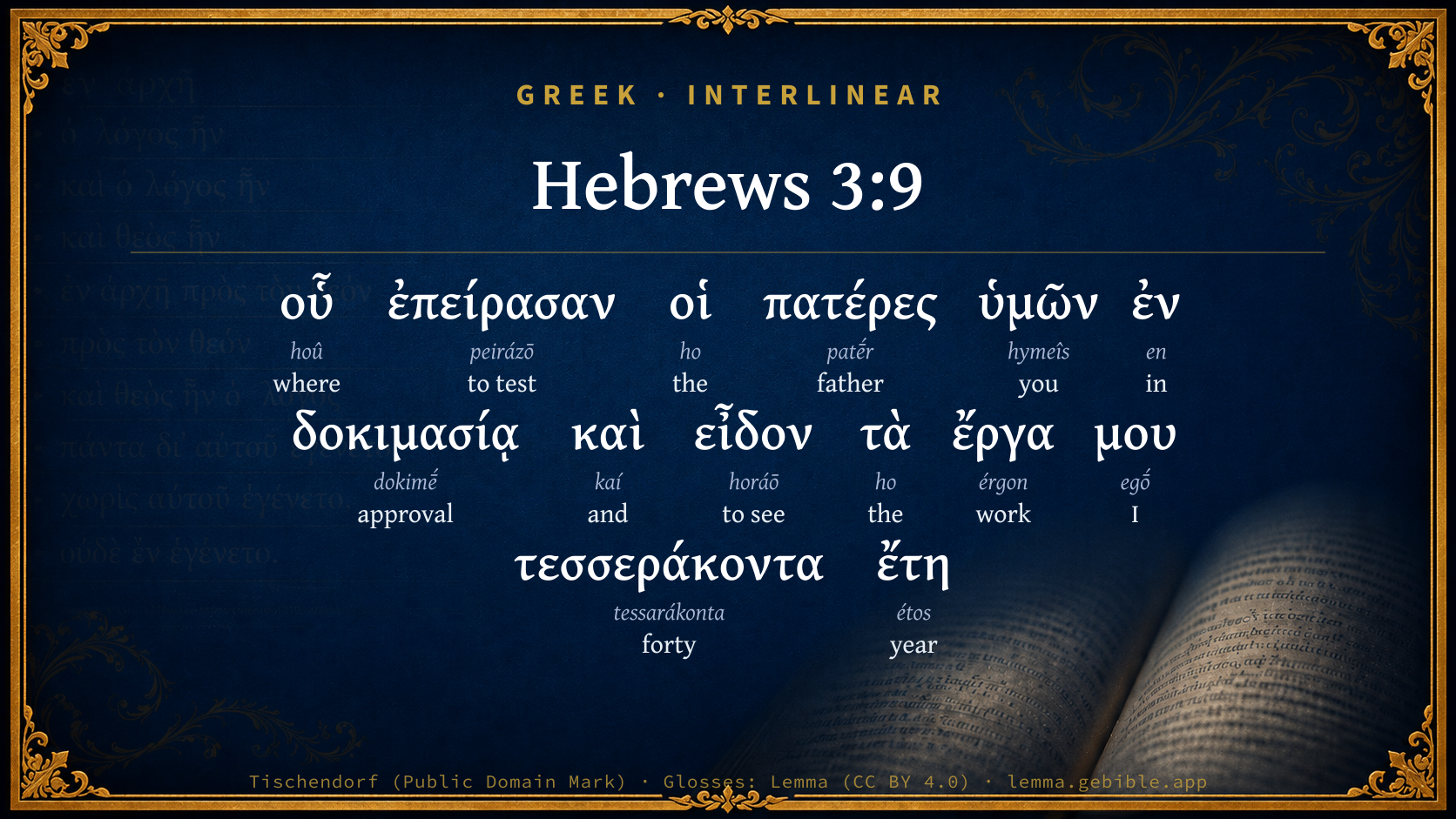
  1. οὗ hoû G3757 “where” Adverb
  2. ἐπείρασαν peirázō G3985 “to test” Verb, Aorist, Active, Indicative, 3rd person, Plural
  3. οἱ ho G3588 “the” Article, Nominative, Plural, Masculine
  4. πατέρες patḗr G3962 “father” Noun, Nominative, Plural, Masculine
  5. ὑμῶν hymeîs G5210 “you” Personal pronoun, 2nd person, Genitive, Plural
  6. ἐν en G1722 “in” Preposition
  7. καὶ kaí G2532 “and” Conjunction
  8. εἶδον horáō G3708 “to see” Verb, Aorist, Active, Indicative, 3rd person, Plural
  9. τὰ ho G3588 “the” Article, Accusative, Plural, Neuter
  10. ἔργα érgon G2041 “work” Noun, Accusative, Plural, Neuter
  11. μου egṓ G1473 “I” Personal pronoun, 1st person, Genitive, Singular
  12. τεσσεράκοντα tessarákonta G5062 “forty” Adjective, Numeral (indeclinable)
  13. ἔτη étos G2094 “year” Noun, Accusative, Plural, Neuter

About this verse

These counts appear in no published source. They are computed here, from the morphology-tagged text and Lemma’s own curated glosses. What Lemma adds →

14
words
13
distinct lemmas
General Epistles
section

Notable vocabulary

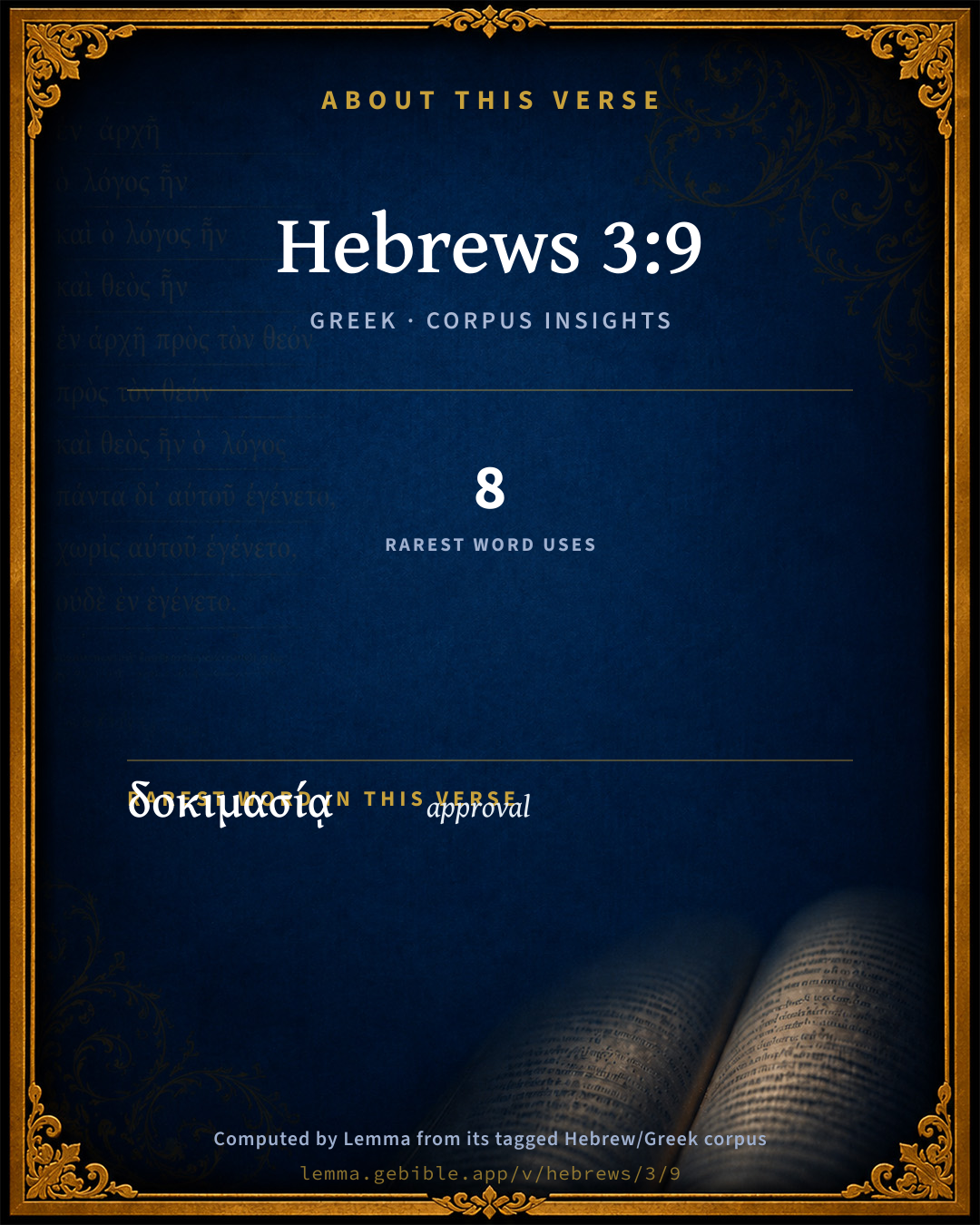
The rarest word here is δοκιμασίᾳ approval G1382 — appearing just 8 times in the whole Greek New Testament.

Shared distinctive vocabulary

δοκιμασίᾳ approval G1382 occurs in 7 verses of the Greek New Testament. Also found in:

Repetition

A word recurs within this verse:

Cross-references

16

Topical passages linked to Hebrews 3:9 in the Treasury of Scripture Knowledge — connected by theme and wording, ordered by reader-vote popularity; previews shown in the World English Bible.

  • Acts 7:36 This man led them out, having worked wonders and signs in Egypt, in the Red Sea, and in the wilderness for forty years.
  • Deuteronomy 4:9 Only take heed to yourself, and keep your soul diligently, lest you forget the things which your eyes saw, and lest they depart from your heart all the days of your life; but make them known to your children and your children's children;
  • Exodus 19:4 'You have seen what I did to the Egyptians, and how I bore you on eagles' wings, and brought you to myself.
  • Deuteronomy 4:3 Your eyes have seen what Yahweh did because of Baal Peor; for all the men who followed Baal Peor, Yahweh your God has destroyed them from the midst of you.
  • Deuteronomy 8:4 Your clothing didn't grow old on you, neither did your foot swell, these forty years.
  • Exodus 20:22 Yahweh said to Moses, "This is what you shall tell the children of Israel: 'You yourselves have seen that I have talked with you from heaven.
  • Numbers 14:33 Your children shall be wanderers in the wilderness forty years, and shall bear your prostitution, until your dead bodies be consumed in the wilderness.
  • Deuteronomy 8:2 You shall remember all the way which Yahweh your God has led you these forty years in the wilderness, that he might humble you, to prove you, to know what was in your heart, whether you would keep his commandments, or not.
  • Deuteronomy 29:2 Moses called to all Israel, and said to them, You have seen all that Yahweh did before your eyes in the land of Egypt to Pharaoh, and to all his servants, and to all his land;
  • Joshua 23:3 and you have seen all that Yahweh your God has done to all these nations because of you; for Yahweh your God, he it is that has fought for you.
  • Joshua 24:7 When they cried out to Yahweh, he put darkness between you and the Egyptians, and brought the sea on them, and covered them; and your eyes saw what I did in Egypt: and you lived in the wilderness many days.
  • Amos 2:10 Also I brought you up out of the land of Egypt, And led you forty years in the wilderness, To possess the land of the Amorite.
  • Luke 7:22 Jesus answered them, "Go and tell John the things which you have seen and heard: that the blind receive their sight, the lame walk, the lepers are cleansed, the deaf hear, the dead are raised up, and the poor have good news preached to them.
  • Acts 13:8 But Elymas the sorcerer (for so is his name by interpretation) withstood them, seeking to turn aside the proconsul from the faith.
  • Deuteronomy 11:7 but your eyes have seen all the great work of Yahweh which he did.
  • Joshua 5:6 For the children of Israel walked forty years in the wilderness, until all the nation, even the men of war who came forth out of Egypt, were consumed, because they didn't listen to the voice of Yahweh: to whom Yahweh swore that he wouldn't let them see the land which Yahweh swore to their fathers that he would give us, a land flowing with milk and honey.

Cross-references courtesy of OpenBible.info (CC BY 4.0).

Where the printed editions differ

2 variants

Places in this verse where the major printed Greek editions disagree on the wording in a way that affects the translation — a comparison of editions, not a manuscript-by-manuscript collation. The editions are the modern critical texts (Nestlé-Aland 28/27, SBL, Westcott-Hort, Tregelles, Tyndale House) and the traditional texts behind the KJV (the Textus Receptus and the Byzantine/Majority text). It is not a claim about which reading is original.

  1. Extra text
    με

    “me”

    In TRByz Not in NA28NA27TynSBLWHTreg

    με (me) 'me' is only in traditional manuscripts (TR+Byz)

  2. Extra text
    με

    “me”

    In TRByz Not in NA28NA27TynSBLWHTreg

    με (me) 'me' is only in traditional manuscripts (TR+Byz)

Textual data: Translators Amalgamated Greek New Testament (STEPBible TAGNT) · CC BY 4.0.

Commentary

Notes on Hebrews 3:9 from classic Christian and Jewish commentators (each source and its license shown beneath its notes). The classic Christian expositions comment on the surrounding passage and are grouped to its opening verse, so a note may address several verses; the Jewish commentaries on the Tanakh (Rashi and others) are per-verse, so they appear only where the commentator wrote on this verse.

Lemma curates 59 commentaries, every one of them public domain or Creative Commons licensed, each selected and text-cleaned for this edition rather than reprinted as found. About our sources →

The Biblical Illustrator

Joseph S. Exell

Heb_3:9

When your fathers tempted Me

How men can tempt God

1.

If having means we neglect them, fondly flying to the supposed providence of God; if Christ, having a pair of stairs to come down by, should have cast Himself down from the pinnacle of the Temple, He had tempted God.

2. Men tempt God when, having had evident proof and manifest experience of His wisdom, power, mercy, and goodness, yet if they be driven into any straits, and see no present means to come out, then they murmur against God, despair of His providence, and are ready to exclaim against God. This was the Israelites fault, and thus often times they tempted God in the wilderness. They had seen with what a strong hand God had brought them out of Egypt, yet for all that when they were in any difficulty then God was of no power or willingness to do for them. This was a tempting of God which highly displeased Him. Therefore in all distresses let us trust in Him, though all worldly means fail us; in sickness and health, in poverty and wealth, in death and life let Him be our pillar to lean upon. (W. Jones, D. D.)

Israel in the wilderness

The thought of Moses naturally suggests the Israelites in the wilderness. Faithful was the Mediator, through whom God dealt with them: but was Israel faithful? God spake: did they obey? God showed them wonderful signs: did they trust and follow in faith? And if Israel was not faithful under Moses, and their unbelief brought ruin up ,n them, how much more guilty shall we be, and how much greater our danger, if we are not faithful unto the Lord Jesus? The history of the wanderings of Israel in the wilderness is most instructive (1Co_10:1-33.). According to the solemn words addressed by the glorified Saviour to the Church of Thyatira, Israels experience is to be a warning to all the Churches.

1. It is a marvellous history from beginning to end. The exodus out of Egypt, the passage through the Red Sea, the giving of the Law at Mount Sinai the manna, the pillar of cloud and fire, the victory over Amelek, the rock that followed them, the garments that never became old; all is miracle, full of the wondrous love and power of God who is Israels Redeemer. Consider the Messenger, the Angel of the Covenant, Christ, who led them. Their whole life and history was a life and history by the word of God. Do you know this as a present experience?

2. It was a history of solemn and glorious privilege. God separated Israel unto Himself. Their daily need, their absolute dependence on Divine help, the constant gift of manna, guidance and defence, the daily beholding of Gods mighty and gracious works--all this was a marvellous privilege, the life of faith was made near and easy. Is this not a picture of the Christians life?

3. It is a sad history from beginning to end: continual murmuring, doubt, ingratitude, idolatry, sin; looking back unto Egypt and its pleasures, forgetting its degradation and bondage, doubting Gods goodness and power, yielding to the temptations of lust and tempting the Lord Jehovah, the faithful and merciful Christ. It is a sad history, full of fearful judgments. And yet the Lord was with them all the days, and every day, ready to bless and to gladden them. Do you understand the parable? Yet was there in Israel also faith and love; and God remembers the time of their espousals, when they followed Him in a laud that was not sown. There were not merely murmurings, but hymns of thanksgiving; there were willing offerings unto the Lord of gold and silver, there was victory over the enemies, there were Joshua and Caleb, who followed the Lord fully. (A. Saphir.)

The Biblical Illustrator, edited by Joseph S. Exell (c. 1880s–1900s) — public domain. Text from a community e-Sword module.

Tyndale Open Study Notes

Tyndale Open Resources

3:9-10 Despite seeing the miracles God had performed on their behalf, the people of Israel tested God’s patience by refusing to trust him in the wilderness (Num 14:11, 22). The essence of their rebellion was that their hearts always turned away from God—they did not desire to obey him. The result was that God was angry with them.

Tyndale Open Study Notes — © Tyndale Open Resources, licensed CC BY-SA 4.0. Text via the HelloAO Bible API.

Bengel's Gnomon

Johann Albrecht Bengel

Heb 3:9. Οὗ) viz. πειρασμοῦ, Attic for ᾧ.—ἐπείρασάν Με, they tempted Me) [to try] whether I was able or willing.—οἱ πατέρες ὑμῶν, your fathers) whose hardness of heart is very often mentioned. Therefore the authority of the ancients is not conclusive.—ἐδοκίμασαν, proved) i.e. searched out, put Me to the test; not approved. Weigh well what follows.—εἶδον, they saw) evidently, but without improvement.—τὰ ἔργα μου, my works) most glorious in affording help, partly also in executing vengeance.—τεσσαρὰκοντα ἔτη, forty years) This is joined with προσώχθισα in the LXX. and in the Hebrew, and below Heb 3:17. At the same time the people both saw פעל, work of GOD, and offended GOD, until they filled up the full measure of their guilt. Here it is joined with εἶδον, they saw; and therefore the hard heart of the people is implied.

Bengel's Gnomon of the New Testament — English translation (T&T Clark, Edinburgh, 1860) — public domain. Text from a community e-Sword module.

Meyer's Critical & Exegetical Commentary

Heinrich August Wilhelm Meyer

Heb_3:9. Οὖ] is taken by Erasmus Schmid, Bengel, and Peirce as attraction to πειρασμοῦ instead of ᾧ, wherewith. But in this case οὗ would have been connected immediately with πειρασμοῦ. It is the local where; thus stands, as frequently, in the sense of ὅπου, and refers back to ἐρήμῳ.

οὗ ἐπείρασαν οἱ πατέρες ὑμῶν ἐν δοκιμασίᾳ] where your fathers essayed temptation,[59] on the ground of proving or testing, i.e. where your fathers tempted me and put me to the test. δοκιμασία as ΠΕΙΡΆΖΕΙΝ here in the bad sense. The former contains an enhancement of the latter. This involves doubt with regard to the inclination of God to render help, that doubt with regard to His power of doing so.

καὶ εἶδον] κ.τ.λ.] and yet saw my works forty years long. This was a fact that aggravated their guilt. In the original, τεσσαράκοντα ἔτη belongs to the following ΠΡΟΣΏΧΘΙΣΑ. To the author of the Epistle to the Hebrews also this original connection was known, as is evident from Heb_3:17. If he nevertheless refers ΤΕΣΣΑΡΆΚΟΝΤΑ ἜΤΗ to that which precedes, and moreover consolidates this connection by means of the ΔΙΌ (ΔΙʼ Ὅ) interpolated only by himself, he must have been guided by a distinct design in doing so. Rightly, therefore, is it assumed (Calov, Wittich, Akersloot, Surenhus, Schöttgen, Chr. Fr. Schmid, Abresch, Böhme, Bleek, de Wette, Delitzseh, Riehm, Lehrbegr. des Hebräerbr. p. 618; Alford, Reiche, Comm. Crit. p. 22; Maier, Moll, Kurtz, and others) that the author discovered in the forty years during which the Israelites in the wilderness saw the works of God, a typical reference to the about equal space of time during which the Hebrews had now also witnessed the government of God as manifested in Christ, and would make this reference clear to the readers, in order thereby to render the more impressive his exhortation to receptiveness, while there is yet time. The reminder of Akersloot, Chr. Fr. Schmid, Abresch, Bleek, and others, is at the same time worthy of notice, viz. that also in the Talmud and by the Rabbins a duration of forty years is assigned to the Messianic kingdom with reference to Psalms 95. and the forty years of the wilderness. Comp. Sanhedr. fol. 99, 1 : R. Eliezer dixit: dies Messiae sunt quadraginta anni, sicut dicitur: quadraginta annos sqq. (Psa_95:10); Tanchuma, fol. 79, 4 : Quamdiu durant anni Messiae? R. Akiba dixit: quadraginta annos, quemadmodum Israëlitae per tot annos in deserto fuerunt.

[59] In an unnatural manner, Hofmann: as εἶδον, so also even ἐπείρασαν finds its object in τὰ ἔργα μου.

Meyer — Critical and Exegetical Commentary on the New Testament — English translation by Peter Christie, edited by Frederick Crombie (T&T Clark, 1880) — public domain. Text from a community e-Sword module.

Expositor's Greek Testament

ed. W. Robertson Nicoll

Heb 3:9 . οὗ ἐπείρασάν με …, “where your fathers tempted me,” i.e. , in the wilderness. Others take οὗ as = “with which,” attracted into genitive by πειρασμοῦ . ἐν δοκιμασίᾳ , “in putting me to the proof”. καὶ εἶδον … ἔτη , “and saw my works forty years,” the wonders of mercy and of judgment. In the psalm τεσσ . ἔτη are joined to προσώχθισα , διὸ being omitted. The same connection is adopted in Heb 3:17 .

The Expositor's Greek Testament, edited by W. Robertson Nicoll (1897–1910) — public domain. Text from a community e-Sword module.

Jamieson, Fausset & Brown

Robert Jamieson, A. R. Fausset & David Brown

When--rather, "Where," namely, in the wilderness.

your fathers--The authority of the ancients is not conclusive [BENGEL].

tempted me, proved me--The oldest manuscripts read, "tempted (Me) in the way of testing," that is, putting (Me) to the proof whether I was able and willing to relieve them, not believing that I am so.

saw my works forty years--They saw, without being led thereby to repentance, My works of power partly in affording miraculous help, partly in executing vengeance, forty years. The "forty years" joined in the Hebrew and Septuagint, and below, Heb 3:17, with "I was grieved," is here joined with "they saw." Both are true; for, during the same forty years that they were tempting God by unbelief, notwithstanding their seeing God's miraculous works, God was being grieved. The lesson intended to be hinted to the Hebrew Christians is, their "to-day" is to last only between the first preaching of the Gospel and Jerusalem's impending overthrow, namely, FORTY YEARS; exactly the number of years of Israel's sojourn in the wilderness, until the full measure of their guilt having been filled up all the rebels were overthrown.

Jamieson, Fausset & Brown — Commentary Critical and Explanatory on the Whole Bible (1871) — public domain (CC PDM 1.0). Text via the HelloAO Bible API.

Adam Clarke's Commentary

Verse 9. When your fathers tempted me] It would be better to translate ου where than when, as the Vulgate has done in its ubi; and this translation has been followed by Wiclif, Coverdale, Tindal, and our first translators in general. In my old MS. Bible the 7th, 8th, and 9th verses stand thus:- Heb 3:7-9

Wherefore as the Holy Gost seith, to-day gif yhe han herde his voyce: nye yhe herden ghour hertis as in wrath-thinge, after the day of temptacioun in desert. Where ghoure fadris temptiden me: provyden and saiden my werkis. Wherefore fourtye yeere I was offendid or wrothe to this generatoun.

In behalf of this translation, Dr. Macknight very properly argues: "The word WHEN implies that, at the time of the bitter provocation, the Israelites had seen God's works forty years; contrary to the history, which shows that the bitter provocation happened, in the beginning of the third year after the Exodus: whereas the translation where, as well as the matter of fact, represents God as saying, by David, that the Israelites tempted God in the wilderness during forty years, notwithstanding all that time they had seen God's miracles."

Adam Clarke's Commentary on the Bible (1810–1826) — public domain. Text from a community e-Sword/MySword module.

John Calvin's Commentaries

9. Tempted, etc. This word is to be taken in a bad sense; it means to provoke in a proud and insulting manner, which we express in French by saying, defier comme en depitant For though God had often brought them help, yet they forgot all, and scornfully asked, where was his power. Proved, etc. This clause is to be thus explained, “When yet they had proved me and seen my works”. For it enhanced the guilt of their impiety, that having been taught by so many evidences of divine power, they had made so bad a progress. For it was a marvelous supineness and stupidity to esteem God’s power as nothing, which had been so fully proved.

Forty years. These are connected by David with what follows. But we know that the Apostles in quoting passages attend more to the general meaning than to the words. And no doubt God complained that the people had been vexatious to him for forty years, because so many benefits had availed nothing for the purpose of teaching them; for though God did good continually to them who were wholly unworthy, they yet never ceased to rise up against him. Hence arose his continual indignation, as though he had said “Not once or for a short time have they provoked me, but by their incessant wickedness for forty years.” Generation means race, or men of one age.

John Calvin's Commentaries (1540-1563) — public domain. Text from the Calvin Translation Society English edition (1840s-50s) via the Christian Classics Ethereal Library (ccel.org). Calvin's coverage is partial (roughly two-thirds of the Bible); uncommented books and verses are honest gaps, never fabricated. The 19th-century editor's footnotes and remarks are omitted so the notes are faithfully Calvin's own voice.

Ellicott's Commentary for English Readers

(9) According to our best MSS. this verse will run thus: Where (or, wherewith) your fathers tempted by trial, and saw My works forty years. The meaning of the Hebrew (with which the LXX. very nearly agrees) is: “Where your fathers tempted Me, proved Me; also saw My work.” The change of reading is more interesting than important, as the sense is not materially different. Both here and in the original passage it seems probable that the “work,” or “works,” should be understood of the divine judgments which the disobedient people “saw” and bore during forty years. In the Psalm (and apparently in Heb_3:17 of this chapter) the mention of the forty years connects itself with the words which follow; but here with the provocations of the people and their punishment. It is held by many that in this period of forty years is contained a reference to the time that intervened between our Saviour’s earthly ministry and the destruction of Jerusalem; and a Jewish tradition is quoted which assigns to “the days of Messiah” a duration of forty years.

A Bible Commentary for English Readers, edited by Charles John Ellicott (1878–1897) — public domain. Text from a community e-Sword module.

The Cambridge Bible for Schools and Colleges

gen. ed. J. J. S. Perowne

9. when] Rather, “where,” i.e. at Massah, or in the wilderness. The rendering “wherewith” or “with which temptation,” would have been more naturally expressed in other ways.

proved me] The better reading is “by proving me.”

saw my works forty years] The “forty years” is purposely transferred from the next verse of the Psalm. The scene at Massah took place in the 40th and that at Meribah in the 1st year of the wanderings. Deu_9:7; Deu_33:8. They indicate the spirit of the Jews through the whole period. The number 40 is in the Bible constantly connected with judgment or trial, and it would have sounded more impressive in this passage if the date of the Epistle was shortly before the Fall of Jerusalem, i.e. about 40 years after the Ascension. The Rabbis had a saying “The days of the Messiah are 40 years.”

The Cambridge Bible for Schools and Colleges (gen. ed. J. J. S. Perowne; Cambridge University Press, 1878–1918) — public domain. Text from a community e-Sword module.

John Gill's Exposition

When your fathers tempted me,.... This the apostle cites and repeats, to expose the glorying of the Jews in their ancestors; to dissuade them from following their sinful practices; to deter them from the same by observing both their sin and punishment; and to heighten their regards to the voice and Gospel of Christ:

proved me; this is either an explication of the former phrase; or it may design the experience this people had of the power and goodness of God, notwithstanding their tempting and provoking the Lord by a distrust of them; which is an aggravation of their sin and ingratitude, and shows the forbearance of God, and that wicked men may partake of outward favours:

and saw my works forty years; that is, God's works of providence, in furnishing them with the necessaries of life, in guiding, protecting, and supporting them for the space of forty years, in the wilderness; and his miracles, and the punishment of their enemies; yet they saw and perceived not, but all this time sinned against the Lord, see Deu 29:2 the space of time, forty years, is in the psalm placed to the beginning of the next verse, and is joined with God's grief and indignation at the people, as it is also by the apostle, in Heb 3:17 but the people's sin, and God's grief at it, being of equal duration, it matters not to which it is placed, and therefore to both; perhaps, one reason of its being repeated, and so much notice taken of it is, because there was just this number of years from Christ's sufferings, to the destruction of Jerusalem; which the apostle might have in view.

John Gill's Exposition of the Whole Bible (1746–1763) — public domain (CC PDM 1.0). Text via the HelloAO Bible API.

Trapp's Complete Commentary

John Trapp

9 When your fathers tempted me, proved me, and saw my works forty years.

Ver. 9. Tempted me] God must be trusted, but not tempted, as he is, when men, 1. Question and awake his power; 2. Limit the Holy One of Israel, and presume to prescribe to him, set him a time, &c.; 3. Nelgect the use of means, and serve not his providence.

John Trapp, A Commentary or Exposition upon All the Books of the Old and New Testament (1647–1656) — public domain. Text from a community e-Sword module.

Albert Barnes' Notes on the Bible

Proved me - “As if they would have made an experiment how much it was possible for me to bear.” - Doddridge. The meaning is: “they put my patience to a thorough trial.”

And saw my works - That is, my miracles, or my interpositions in their behalf. They saw the wonders at the Red Sea, the descent on Mount Sinai, the supply of manna, etc., and yet while seeing those works they rebelled. Even while sinners look on the doings of God, and are surrounded by the proofs of his power and goodness, they rebel, and provoke him to anger. Men sin when God is filling their houses with plenty; when he opens his hand daily to supply their wants; when they behold the manifestations of his goodness on the sea and on the land; and even in the midst of all the blessings of redemption, they provoke him to wrath.

Forty years - The whole time during which they were passing from Egypt to the promised land. This may mean either that they saw his works forty years, or that they tempted him forty years. The sense is not materially affected whichever interpretation is preferred.

Albert Barnes' Notes on the Bible (1834–1885) — public domain. Text from a community e-Sword/MySword module.

Matthew Poole's English Annotations

When your fathers tempted me; in the time and place forementioned, the fathers from whom you derive your being and corruption, yet glory in them and their traditions, whose state is aggravated from your line of successive rebellion, Act 7:51-53. They have imbittered my Spirit by their unbelief; for upon the want of water, they questioned his power, wisdom, truth, and providence, to the denial of all, and sometimes multiplied it, Num 16:1-50, &c.

Proved me; a discontented quarrel with, and scrutiny of, Christ the Redeemer, that if he would not serve their lust, they would deny him, and apostatize from him, and return to Egypt; notwithstanding their having sufficient proof of him, yet they would contend with him, 1Co 10:9.

And saw my works forty years; all the Redeemer’s miracles, which he wrought for them in Egypt and the wilderness, they saw them plainly and presently on their tempting him; miracles of mercy and of punishments, by fire, by the earth opening, by fiery serpents, by the sword, by consuming six hundred thousand of them: all which were evidences sufficient to convince any of the wickedness of mistrusting him, Deu 29:2-4. This hardening of their hearts yet continued forty years, till all but two of them, Joshua and Caleb, were consumed; God by their sin was so grieved with them after such experience of his power for so long a time: see Exo 32:10; Num 14:22.

Matthew Poole's English Annotations on the Holy Bible (1683–1685) — public domain. Text from a community e-Sword/MySword module.

Whedon's Commentary on the Bible

Daniel D. Whedon

9. Tempted… proved—Made trial—ascertained.

Forty years—The perversity of the people at Meribah was at the beginning of this forty years. In the psalm the forty years is in the following verse, measuring the time in which I was grieved. Our author, in thought, measures the same period, though he varies the phrase. It was, also, forty years between the crucifixion and the destruction of Jerusalem and the overthrow of the Jewish race. The period had nearly expired when this epistle was written.

Daniel D. Whedon (gen. ed.), Commentary on the Old and New Testaments (1874–1909) — public domain. Text from a community e-Sword module.

John Wesley's Explanatory Notes

Where your fathers - That hard-hearted and stiff-necked generation. So little cause had their descendants to glory in them. Tempted me - Whether I could and would help them. Proved me - Put my patience to the proof, even while they saw my glorious works both of judgment and mercy, and that for forty years.

John Wesley, Explanatory Notes Upon the Whole Bible (1754–1765) — public domain. Text via the GEBible commentary corpus.

The People's New Testament

B. W. Johnson

9. When your fathers tempted me, proved me. Tempted me by proving me. Seeing how much murmuring and sin I would endure. Saw my works forty years. All his mighty manifestations in their behalf during all the period of their sojourn in the wilderness.

B. W. Johnson's The People's New Testament with Notes (1889–1891) — public domain. Electronic text from the Christian Classics Ethereal Library (CCEL) ThML edition.

unfoldingWord translationNotes

Door43 World Missions Community

General Information:

This quotation is from the Psalms.

your ancestors

Here "your" is plural and refers to the people of Israel. (See: Forms of You)

by testing me

Here "me" refers to God.

forty years

"40 years" (See: Numbers)

I was displeased

"I was angry" or "I was greatly unhappy"

They have always gone astray in their hearts

Here "gone astray in their hearts" is a metaphor for not being loyal to God. Here "hearts" is a metonym for minds or desires. AT: "They have always rejected me" or "They have always refused to obey me" (See: Metaphor and Metonymy)

They have not known my ways

This speaks of a manner of conducting one's life as if it were a way or a path. AT: "They have not understood how I want them to conduct their lives" (See: Metaphor)

They will never enter my rest

The peace and security provided by God are spoken of as if they were rest that he can give, and as if they were a place to which people could go. AT: "They will never enter the place of rest" or "I will never allow them to experience my blessings of rest" (See: Metaphor)

translationWords

ancestor

rebel

test

year

works

generation

astray

heart

oath

anger

rest

unfoldingWord translationNotes — © Distant Shores Media and the Door43 World Missions Community, licensed CC BY-SA 4.0. Source: git.door43.org/Door43/en_tn.

Cambridge Greek Testament for Schools and Colleges

9. ἐν δοκιμασίᾳ אABCDEM.

9. οὗ, not “when” as in the A. V. but “where,” i.e. at Massah, or in the wilderness. The rendering “wherewith” (R. V.) or “with which temptation,” would have been more naturally expressed in other ways. It is true that οὗ for ὅπου is not found elsewhere in this Ep., but it is common in the LXX. and N. T.

ἐν δοκιμασίᾳ, “by proving me”; or possibly “in your probation by me.” Comp. Psalms 81[80]:7 ἐδοκίμασά σε.

τεσσεράκοντα ἔτη. The “forty years” is purposely transferred from the next verse of the Psalm. The scene at Massah took place in the 40th and that at Meribah in the 1st year of the wanderings. Deu 9:7; Deu 33:8. They indicate the spirit of the Jews through the whole period. The number 40 is in the Bible constantly connected with judgement or trial, and it would have sounded more impressive in this passage if the date of the Epistle was shortly before the Fall of Jerusalem, i.e. about 40 years after the Ascension. The Rabbis had a saying “The days of the Messiah are 40 years.”

Cambridge Greek Testament for Schools and Colleges (Cambridge University Press, 1896; 21 vols, various authors incl. Carr, Maclear, Plummer, Farrar, Lumby, Moule, M. R. James, Simcox) — public domain. Text from a community e-Sword module.

Vincent's Word Studies in the New Testament

Marvin R. Vincent

When [ου] . Rend. where. See ou= after erhmov wilderness, Deu 8:15.

Tempted me, proved me [επειρασαν εν δοκιμασια] . Lit. tried (me) in proving. The text differs from LXX, which reads ejpeirasan, ejdokimasan tempted, proved, as A. V. The phrase here means tempted by putting to the test. Comp. ejkpeirazein to tempt or try with a view to seeing how far one can go. See on 1Co 10:9.

And saw my works [και ειδον τα εργα μου] . Some construe my works with both verbs : tried and saw my works : but it is better to supply me after ejpeirasan tempted, to take works with saw only, and to give kaithe force of and yet (see on Luk 18:7). "They tempted and yet saw my works;" although they saw my works. The Hebrew is "tried me, proved me, yea saw my works."

Forty years. In LXX this is connected with saw my works. In the Hebrew forty years begins the next clause.

Marvin R. Vincent, Word Studies in the New Testament (1887–1900) — public domain. Text from a community e-Sword/MySword module.

Westcott on Hebrews & the Epistles of John

Brooke Foss Westcott

9. οὗ] where, Vulg. δὲ, and not ‘in which’ by attraction for -_

dwelp. ἐν δοκιμασίᾳ) The absence of a direct object in this clause according to the true reading points to the connexion of ἐπείρ. as well as εἶδον with τὰ ἔργα pov (Vulg. probaverunt et viderunt opera mea). This rendering departs considerably from the Hebrew and from the .xx., but places in a more vivid light the character of unbelief. The faithlces people tried and tested not the invisible God but His visible works. They found reason to question where they should have rested in faith.

τὰ ἔργα pov] The Hebrew is singular. The many works of God in the wilderness were all one work, one in essence and aim, whether they were works of deliverance or works of chastisoment. Under this aspoct acta of rightoous judgment and of mercy were parts of the same counsel of loving discipline.

τεσσερ. ὅτη)] In the original these words go with the following clause (and so in σ. 17). Here they are transposed to draw attention to the duration of God’s discipline. The poriod had a significant coincidence with the interval which had elapsed since the Passion at the time when the Epistle was written.

Jewish writers connected the ‘forty years’ in the wildernces with the time of Messiah, For example: R. Eliezer said: The days of the Messiah are forty years, as it is said: Ps. xov. 10 (Sanh. 99. 1, quoted by Bleek).

Brooke Foss Westcott (1825–1901), The Epistle to the Hebrews (1889) and The Epistles of St John (1883) — public domain (pre-1929). Text recovered from Internet Archive / Google Books OCR scans. Westcott’s Gospel of John commentary is not included (its OCR lost the chapter running-heads required for reliable verse-keying). Some Greek quoted in the Hebrews volume is imperfectly rendered by the OCR.

Lesson kit

Teaching starters — assembled from the data on this page, not authored interpretation. Every prompt links to the verse data it draws on. Edit before teaching.

Hebrews, in the General Epistles, opens this verse with 14 words (13 distinct Greek lemmas). Its most distinctive word is dokimḗ (“approval”). A historical commentator’s framing appears above. Read the whole chapter for the surrounding context.

Discussion questions

  1. What does “approval” (dokimḗ) contribute to the verse as a whole?
  2. Romans 5:4 shares the word «approval» with this verse. How do the two illuminate each other?
  3. “the” occurs 2× in this one verse. What is the effect of the repetition?
  4. The translations on this page render this verse differently — a whole-verse word diff, not a word-by-word alignment. What might account for the different wordings?
  5. Reading how The Biblical Illustrator and Tyndale Open Study Notes read this verse, where do the two commentators agree and where do they part?

Things to notice

Reading settings

Reading text

Shown beneath each verse's original-language words.

Old Testament
Old Testament edition

Read the OT as the Masoretic Hebrew (MT) or the Greek Septuagint (LXX).

English shown for the Greek Septuagint (in the Hebrew ↔ Greek comparison).

Comparing translations? Open the Compare panel on any verse page to stack up to four side by side.