
2 Timothy 4:14

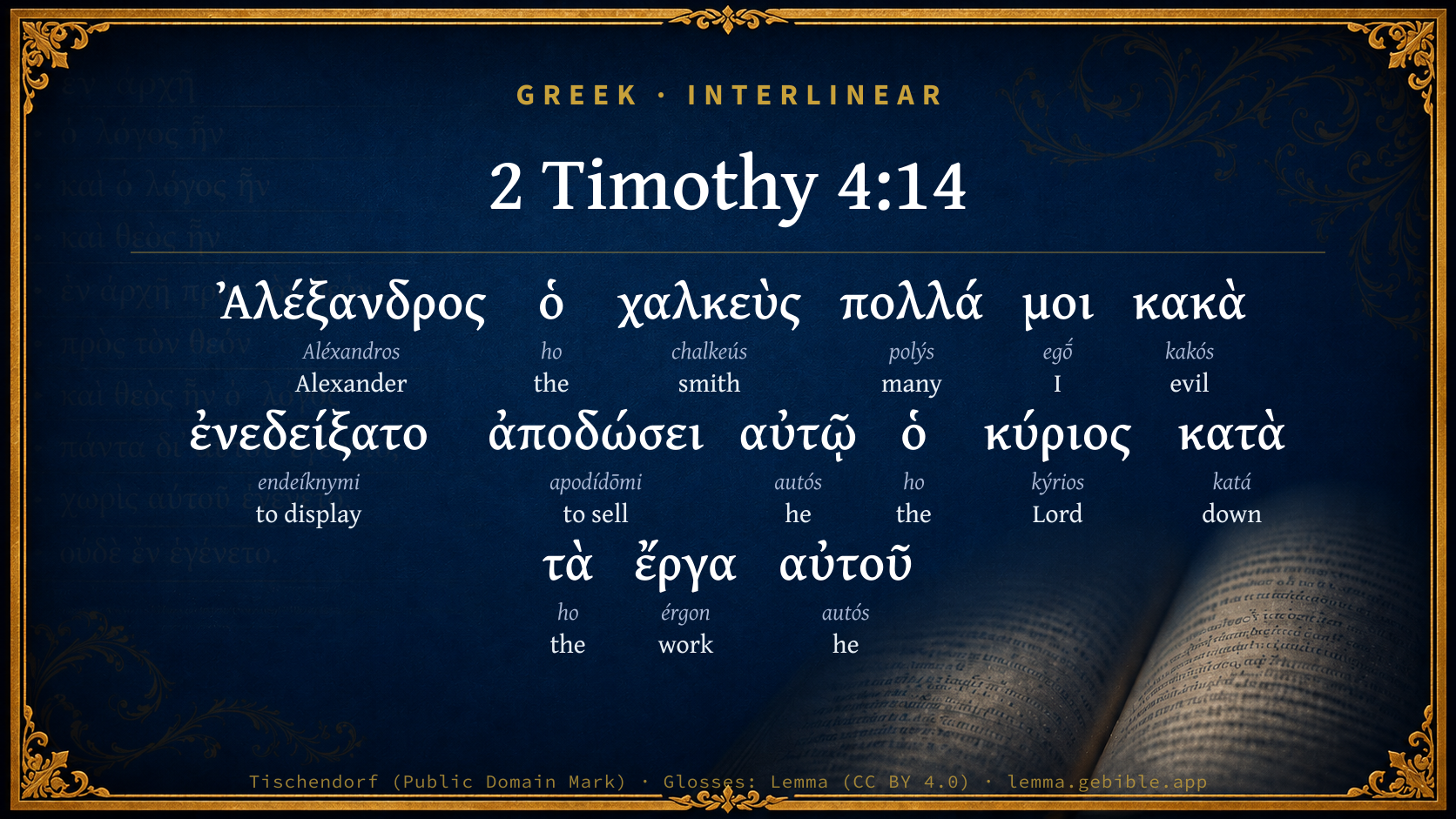
Greek (Tischendorf 8th ed.) 2 Timothy 4:14 appears in the Greek New Testament. The text above is from the Tischendorf 8th edition. Each word links to its Strong’s number and a concise gloss. Click any word for its full Thayer’s Greek Lexicon entry.
Download image
Cite this verse

2 Timothy 4:14 (World English Bible). Public Domain. Lemma interlinear Bible study tool, https://lemma.gebible.app/v/2-timothy/4/14.

Show BibTeX & RIS
BibTeX
RIS
English Translation
Alexander, the coppersmith, did much evil to me. The Lord will repay him according to his works,
World English Bible · Public Domain
Highlights
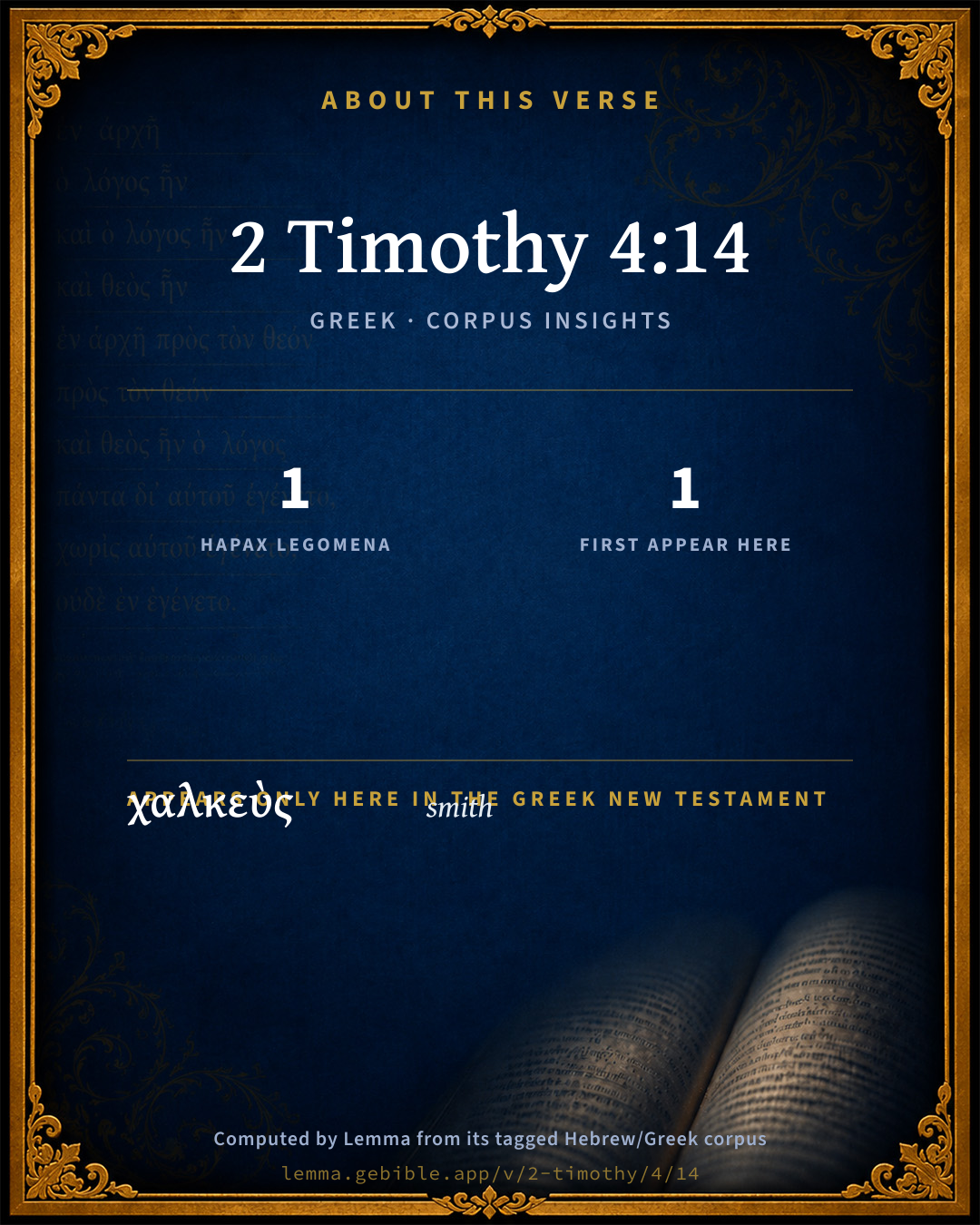
  • 1 hapax legomenon — only here in the Greek New Testament
  • 1 first appearance in the Greek New Testament
Full analysis ↓
Download a study sheet

One document with this verse’s original text, its word-by-word gloss line, the meaning frame, cross-references with their text, attributed commentary, and full source and license credits — printable, and it pastes into notes with its structure intact.

This verse Autodidact and up

Study sheet (.html) Plain text (.txt)

A passage Seminary Student

Up to 50 verses in one chapter. A passage sheet keeps up to 6 commentary sources and 12 cross-references per verse, in the order this page ranks them, and says so on the sheet whenever that leaves anything out. Ask for a single verse and you get the Autodidact verse sheet above.

Everything on this page stays free to read, with no account — the sheet is a download of what is already on screen, not access to it.

Want to remove ads? Support Godless Engineer
Compare translations 3

The same verse in 3 English versions, stacked beneath the original-language interlinear above. Click any original word for its lexicon entry.

Each is an independent rendering of the whole verse — the interlinear is not word-aligned to these translations.

Highlighted words mark where these versions differ — a whole-verse word diff, not a word-by-word alignment.

  • World English Bible Public Domain
    Alexander, the coppersmith, did much evil to me. The Lord will repay him according to his works,
  • King James Version Public Domain
    Alexander the coppersmith did me much evil: the Lord reward him according to his works:
  • unfoldingWord Literal Text CC BY-SA 4.0
    Alexander the coppersmith showed many evils to me. The Lord will repay him according to his works,

unfoldingWord Literal Text — © unfoldingWord, licensed CC BY-SA 4.0. Word-aligned USFM3 via Door43 (git.door43.org/unfoldingWord/en_ult).

Versions to compare (up to 4)

3 of 4 selected

Show all 19 translations

Every available English version of this verse, each an independent rendering of the whole verse.

  • World English Bible Public Domain
    Alexander, the coppersmith, did much evil to me. The Lord will repay him according to his works,
  • Berean Standard Bible Public Domain
    Alexander the coppersmith did great harm to me. The Lord will repay him according to his deeds.
  • Majority Standard Bible Public Domain
    Alexander the coppersmith did great harm to me. May the Lord repay him according to his deeds.
  • King James Version Public Domain
    Alexander the coppersmith did me much evil: the Lord reward him according to his works:
  • American Standard Version (1901) Public Domain
    Alexander the coppersmith did me much evil: the Lord will render to him according to his works:
  • Revised Version (1885) Public Domain
    Alexander the coppersmith did me much evil: the Lord will render to him according to his works:
  • Geneva Bible (1599) Public Domain
    Alexander the coppersmith hath done me much euill: the Lord rewarde him according to his workes.
  • Douay-Rheims (1899) Public Domain
    Alexander the coppersmith hath done me much evil: the Lord will reward him according to his works:
  • Young's Literal Translation Public Domain
    Alexander the coppersmith did me much evil; may the Lord repay to him according to his works,
  • Literal Standard Version CC BY-SA 4.0
    Alexander the coppersmith did me much evil; may the LORD repay to him according to his works,
  • Unlocked Literal Bible CC BY-SA 4.0
    Alexander the coppersmith displayed many evil deeds against me. The Lord will repay him according to his deeds.
  • unfoldingWord Literal Text CC BY-SA 4.0
    Alexander the coppersmith showed many evils to me. The Lord will repay him according to his works,
  • Darby Bible Public Domain
    Alexander the smith did many evil things against me. The Lord will render to him according to his works.
  • World Messianic Bible Public Domain
    Alexander the coppersmith did much evil to me. The Lord will repay him according to his deeds.
  • Webster's Bible Public Domain
    Alexander the copper-smith did me much evil: the Lord reward him according to his works:
  • Free Bible Version CC BY-SA 4.0
    Alexander the coppersmith caused me a lot of trouble—may God judge him for what he did.
  • Bible in Basic English Public Domain
    Alexander the copper-worker did me much wrong: the Lord will give him the reward of his works:
  • Text-Critical English NT CC BY 4.0
    Alexander the coppersmith did me great harm. May the Lord repay him according to his works.
  • Tyndale New Testament (1534) Public Domain
    Alexander the coppersmyth did me moche evyll the lorde rewarde him accordynge to his dedes

Literal Standard Version (2020), Covenant Press — licensed CC BY-SA 4.0. Text via the HelloAO Bible API (eBible.org). Unlocked Literal Bible (unfoldingWord) — licensed CC BY-SA 4.0. Text via the HelloAO Bible API (eBible.org). unfoldingWord Literal Text — © unfoldingWord, licensed CC BY-SA 4.0. Word-aligned USFM3 via Door43 (git.door43.org/unfoldingWord/en_ult). Free Bible Version, Dr. Jonathan Gallagher — licensed CC BY-SA 4.0. Text via the HelloAO Bible API (eBible.org).

Word by word

More ways to search: Search by grammar → Find every occurrence → Compare this word →

Practice this passage: Drill this verse → Learn its vocabulary →

χαλκεὺς
chalkeús
G5471
“smith”
Noun, Nominative, Singular, Masculine
Part of Speech
Noun
Case
Nominative
Number
Singular
Gender
Masculine
Full Thayer's Definition

Origin: from G5475

TDNT: None

1. a worker in copper or iron, a smith
  1. Ἀλέξανδρος Aléxandros G223 “Alexander” Noun, Nominative, Singular, Masculine
  2. ὁ ho G3588 “the” Article, Nominative, Singular, Masculine
  3. πολλά polýs G4183 “many” Adjective, Accusative, Plural, Neuter
  4. μοι egṓ G1473 “I” Personal pronoun, 1st person, Dative, Singular
  5. κακὰ kakós G2556 “evil” Adjective, Accusative, Plural, Neuter
  6. ἐνεδείξατο endeíknymi G1731 “to display” Verb, Aorist, Middle, Indicative, 3rd person, Singular
  7. ἀποδώσει apodídōmi G591 “to sell” Verb, Future, Active, Indicative, 3rd person, Singular
  8. αὐτῷ autós G846 “he” Personal pronoun, Dative, Singular, Masculine
  9. ὁ ho G3588 “the” Article, Nominative, Singular, Masculine
  10. κύριος kýrios G2962 “Lord” Noun, Nominative, Singular, Masculine
  11. κατὰ katá G2596 “down” Preposition
  12. τὰ ho G3588 “the” Article, Accusative, Plural, Neuter
  13. ἔργα érgon G2041 “work” Noun, Accusative, Plural, Neuter
  14. αὐτοῦ autós G846 “he” Personal pronoun, Genitive, Singular, Masculine

About this verse

These counts appear in no published source. They are computed here, from the morphology-tagged text and Lemma’s own curated glosses. What Lemma adds →

15
words
12
distinct lemmas
Pauline Epistles
section

Notable vocabulary

1 hapax legomenon — a word that appears only here in the entire Greek New Testament:

  • χαλκεὺς smith G5471

First appearance in Scripture

This word makes its first canonical appearance in the Greek New Testament here:

  • χαλκεὺς smith G5471

Shared distinctive vocabulary

Ἀλέξανδρος Alexander G223 occurs in 5 verses of the Greek New Testament. Also found in:
Repetition

Words recur within this verse:

Cross-references

15

Topical passages linked to 2 Timothy 4:14 in the Treasury of Scripture Knowledge — connected by theme and wording, ordered by reader-vote popularity; previews shown in the World English Bible.

  • 1 Timothy 1:20 of whom is Hymenaeus and Alexander; whom I delivered to Satan, that they might be taught not to blaspheme.
  • Psalms 28:4 Give them according to their work, and according to the wickedness of their doings. Give them according to the operation of their hands. Bring back on them what they deserve.
  • 2 Thessalonians 1:6 Since it is a righteous thing with God to repay affliction to those who afflict you,
  • 1 Samuel 24:12 Yahweh judge between me and you, and Yahweh avenge me of you; but my hand shall not be on you.
  • 2 Samuel 3:39 I am this day weak, though anointed king; and these men the sons of Zeruiah are too hard for me. May Yahweh reward the evil-doer according to his wickedness."
  • Psalms 62:12 Also to you, Lord, belongs loving kindness, For you reward every man according to his work.
  • Psalms 109:5–20 They have rewarded me evil for good, And hatred for my love.
  • Jeremiah 15:15 Yahweh, you know; remember me, and visit me, and avenge me of my persecutors; don't take me away in your longsuffering: know that for your sake I have suffered reproach.
  • Jeremiah 18:19–23 Give heed to me, Yahweh, and listen to the voice of those who contend with me.
  • Acts 19:33–34 They brought Alexander out of the multitude, the Jews putting him forward. Alexander beckoned with his hand, and would have made a defense to the people.
  • Romans 12:19 Don't seek revenge yourselves, beloved, but give place to God's wrath. For it is written, "Vengeance belongs to me; I will repay, says the Lord."
  • Revelation 18:6 Return to her just as she returned, and repay her double as she did, and according to her works. In the cup which she mixed, mix to her double.
  • 1 John 5:16 If anyone sees his brother sinning a sin not leading to death, he shall ask, and God will give him life for those who sin not leading to death. There is a sin leading to death. I don't say that he should make a request concerning this.
  • Revelation 6:10 They cried with a loud voice, saying, "How long, Master, the holy and true, until you judge and avenge our blood on those who dwell on the earth?"
  • Revelation 18:20 Rejoice over her, O heaven, you saints, apostles, and prophets; for God has judged your judgment on her."

Cross-references courtesy of OpenBible.info (CC BY 4.0).

Commentary

Notes on 2 Timothy 4:14 from classic Christian and Jewish commentators (each source and its license shown beneath its notes). The classic Christian expositions comment on the surrounding passage and are grouped to its opening verse, so a note may address several verses; the Jewish commentaries on the Tanakh (Rashi and others) are per-verse, so they appear only where the commentator wrote on this verse.

Lemma curates 59 commentaries, every one of them public domain or Creative Commons licensed, each selected and text-cleaned for this edition rather than reprinted as found. About our sources →

The Biblical Illustrator

Joseph S. Exell

2Ti_4:14

Alexander the coppersmith did me much evil.

Indignation an important quality in a true man

At a party at Dalkeith Palace, where Mr.

in his mawkish way was finding palliations for some villainous transaction, Adam Smith waited in patient silence until he was gone, then exclaimed, Now I can breathe more freely. I cannot bear that man; he has no indignation in him. (W. H. Baxendale.)

Of whom be thou ware

1. We must shun the society of incurable sinners. Whilst men are hopeful and curable we must try all means to win them.

2. Opposing of the truth is very grievous to a gracious soul. For he hath greatly withstood our words. Gods people are baptized with fire as well as with water, and must be hot and not lukewarm or indifferent in the things of God.

3. Wicked men do not so much oppose our persons as our preaching. They hate us not as men, but as ministers, because we publish the truth that condemns their wicked practices. (T. Hall, B. D.)

The Biblical Illustrator, edited by Joseph S. Exell (c. 1880s–1900s) — public domain. Text from a community e-Sword module.

Joseph Benson's Commentary

2Ti 4:14-15. Alexander the coppersmith — Or brasier; did me much evil — This seems to have been the person mentioned 1Ti 1:20 : probably he was one of the Judaizing teachers, who violently opposed the true doctrine of the gospel. The Lord reward him — The Alexandrian, and six other MSS., the Syriac and the Vulgate versions, and some of the Fathers, read here, αποδωσει, the Lord will reward him: and it is probable the words ought to be considered as spoken prophetically. At least, as Doddridge observes, “what we know of Paul’s character must lead us to conclude, that if he did not mean the words as a mere prediction, he did not, however, wish evil to him as evil, but only that he might be so animadverted upon as to prevent the contagion of his bad example from spreading in the church, and to bring him to repentance and reformation, that so he might be preserved from final destruction.” Of whom be thou ware also — Be thou upon thy guard wherever thou happenest to meet with him; for he hath greatly withstood our words — Hath used every means in his power to prevent the progress and advancement of the true gospel.

Joseph Benson's Commentary on the Old and New Testaments (1811–1818) — public domain. Text from a community e-Sword module.

Whedon's Commentary on the Bible

Daniel D. Whedon

4. Reminiscences of his former trial, 2Ti_4:14-18.

14. Alexander the coppersmith—Or rather, brazier. See note, Act_19:33. He was probably a resident of Ephesus, but went to Rome as witness or prosecutor against Paul at his trial.

The Lord reward—The best authorities read will reward; making the words a prediction rather than an imprecation. The position of both Alford and Fairbairn is, that the imprecative form presents no greater theological difficulty than the predictive. One of the most solemn, yet approvable, passages of the Apocalypse, Rev_6:9-10, is imprecative. An inspired prayer may anticipate and invoke the just judgment that a holy God is about to execute. Yet upon such passages sceptical cavil will always be offered.

Daniel D. Whedon (gen. ed.), Commentary on the Old and New Testaments (1874–1909) — public domain. Text from a community e-Sword module.

The Preacher's Complete Homiletical Commentary

Joseph S. Exell (gen. ed.)

CRITICAL AND EXPLANATORY NOTES

2Ti_4:14. The Lord reward him according to his works.—R.V. “the Lord will render,” etc. What the Jew Alexander would have said to the Ephesian mob we cannot now know, but he must have been one of the leaders of the Jewish element in the mob, and therefore we conclude it was he to whom St. Paul here refers (cf. Act_19:33, and margin R.V.).

MAIN HOMILETICS OF THE PARAGRAPH.—2Ti_4:14-15

Opposition to the Truth—

I. Is often violently persistent.—“For he hath greatly withstood our words” (2Ti_4:15). Probably the Alexander at Ephesus, put forward by the Jews during the riot there (1Ti_1:20). He was then excommunicated, but afterwards restored, and by his able and determined opposition was a thorn in Paul’s side. A renegade is all the more troublesome because of the acquaintance with the side he once espoused and now attacks, using his knowledge of both sides with subtle and malicious dexterity.

II. Is fraught with much mischief.—“Alexander the coppersmith did me much evil” (2Ti_4:14). Though again restored to the Church and to the confidence of the apostle, he never forgot the indignity of his expulsion, and vented his spleen on the man who had shown him kindness, accusing Paul before the Roman judges either of incendiarism or of introducing a new religion. He misrepresented facts, as suchlike men usually do, and was perhaps a chief agent in procuring the martyrdom of Paul. It is in the power of a restless, discontented, and malicious opponent to do mischief he can never repair.

III. Should put the faithful teacher on his guard.—“Of whom be thou ware also” (2Ti_4:15). An unprincipled opponent is difficult to manage. All kindly and courteous advances he construes into fear; and even our silence he counts as submission and claims as a victory. Knowing the unfair use he will make of our words, we should be cautious not to give him the least advantage.

IV. Will not escape Divine punishment.—“The Lord reward him according to his works” (2Ti_4:14). Baffled in all our efforts to silence or to restore a refractory opponent, we can leave him to God. The Christian teacher should be above the indulgence of personal revenge. The obstinate sinner will be certainly punished according to his deeds; and the punishment will be both just and adequate.

Lessons.—

1. Truth is hated because it reproves our conscious sins.

2. A vindictive spirit is utterly impotent.

3. God will reckon with the enemies of His truth.

The Preacher's Complete Homiletical Commentary (gen. ed. Joseph S. Exell; Funk & Wagnalls, c. 1892) — public domain (pre-1929). A full-Bible homiletical/sermon-outline anthology covering 65 of 66 books (2 John is absent from the source module). Text from a community e-Sword module.

Tyndale Open Study Notes

Tyndale Open Resources

4:14 Alexander was a common name (cp. Mark 15:21; Acts 4:6; 19:33). Alexander the coppersmith was probably the same person as in 1 Tim 1:20. • did me much harm: Apparently he did more than merely oppose Paul’s teaching. Perhaps he had a hand in Paul’s arrest.

Tyndale Open Study Notes — © Tyndale Open Resources, licensed CC BY-SA 4.0. Text via the HelloAO Bible API.

Bengel's Gnomon

Johann Albrecht Bengel

2Ti 4:14. Ἐνεδείξατο, exhibited towards or occasioned me [did me]) at Ephesus, or even at Rome.—ἀποδῴη, reward) The apostle knew that he would not be unavenged; he therefore [does not hereby indulge in revenge, but] expresses his acquiescence in the judgment of the Lord.—λίαν, greatly) Therefore he will not discontinue.—ἡμετέροις, our) Believers have a common cause and interest: and Timothy already at that time was the companion of Paul. This adversary was there, where Timothy was, and where Paul had been, viz. at Ephesus, and Timothy must therefore be on his guard against him.

Bengel's Gnomon of the New Testament — English translation (T&T Clark, Edinburgh, 1860) — public domain. Text from a community e-Sword module.

Meyer's Critical & Exegetical Commentary

Heinrich August Wilhelm Meyer

2Ti_4:14-15. Warning against a certain Alexander. Ἀλέξανδρος ὁ χαλκεύς] see on 1Ti_1:20.

πολλά μοι κακὰ ἐνεδείξατο] The words point to a personal injury which he had inflicted on the apostle. This must, however, be added to an attitude of opposition to his words, as is shown in the words: λίαν γὰρ ἀντέστη τοῖς ἡμετέροις λόγοις] It is doubtful where this was done, and where Alexander was at the time of the composition of this epistle. Further, the warning: ὃν καὶ σὺ φυλάσσου, may refer both to Timothys presence in Ephesus and to his future stay in Rome (de Wette). Wiesinger conjectures that this Alexander, a native of Ephesus, had come from there to Rome to give testimony against the apostle (at his πρώτη ἀπολογία, 2Ti_4:16), and had afterwards returned to Ephesus.[68] This conjecture obtains some probability from the fact that in the very next verse Paul speaks of the ἀπολογία; but this fact cannot be regarded as making the matter certain. The words preceding this warning, if we read ἀποδώσει αὐτῷ ὁ κύριος κατὰ τὰ ἔργα αὐτοῦ, present no difficulty. Even with the reading ἀποδώῃ they cannot form a reason for reproaching the apostle with a desire for vengeance; Christian love does not extinguish the feeling of justice; besides, the apostle does not speak the words because of the personal injury, but because of Alexanders hostility to the truth. Justin (quaest. 125, ad Orthod.) says of these words: πρέπουσα ἀνδρὶ ἀποστόλῳ μὴ ἐκδικοῦντι ἑαυτὸν, ἀλλὰ διδόντι τόπον τῇ ὀργῇ; comp. Rom_12:19; 1Pe_2:23.

[68] Hofmann supposes that this Alexander was the same as the one mentioned in Acts 19., and that he had given testimony against the apostle in Ephesus. The opinion is manifestly too far-fetched, that Luke would not have mentioned him in the Acts, if the Roman Theophilus, for whom in the first place he wrote the Acts, had not known Alexander from some other source, in the manner in which we make acquaintance with him in the passage before us.

Meyer — Critical and Exegetical Commentary on the New Testament — English translation by Peter Christie, edited by Frederick Crombie (T&T Clark, 1880) — public domain. Text from a community e-Sword module.

Expositor's Greek Testament

ed. W. Robertson Nicoll

2Ti 4:14-15 . Beware of Alexander the smith.

2Ti 4:14 . Ἀλέξανδρος ὁ χαλκεύς : It is probable that this is the Alexander mentioned in 1Ti 1:20 , and it is possible that he may be the Jew of that name who was unwillingly prominent in the riot at Ephesus (Act 19:33-34 ).

χαλκεύς : does not mean that he worked only in copper. The term came to be used of workers in any kind of metal (see Gen 4:22 , LXX).

πολλά μοι κακὰ ἐνεδείξατο : Multa mala mihi ostendit (Vulg.). His odium theologicum expressed itself in deeds as well as in words. For this use of ἐνδείκνυμαι , compare reff. Moulton and Milligan ( Expositor , vii., vii. 282) cite from a papyrus of ii. A.D. πᾶσαν πίστιν μοι ἐνδεικνυμένῃ .

ἀποδώσει : The future indic. is certainly attested by a greater weight of external evidence than the optative. The moral question raised by the clause is quite independent of the mood and tense used: it is, Was the future punishment of Alexander, which St. Paul considered equitable, a matter of more satisfaction than distress to the apostle? The answer would seem to be, Yes. And, provided that no element of personal spite intrudes, such a feeling cannot be logically condemned. If God is a moral governor; if sin is a reality; those who know themselves to be on God’s side cannot help a feeling of joy in knowing that evil will not always triumph over good. The sentiment comes from Deu 32:35 , as quoted in Rom 12:19 , ἐγὼ ἀνταποδώσω . The exact wording is found in Psa 61 (62):13, σὺ ἀποδώσεις ἑκάστῳ κατὰ τὰ ἔργα αὐτοῦ . Cf. Psa 27 (28):4; Pro 24:12 .

The Expositor's Greek Testament, edited by W. Robertson Nicoll (1897–1910) — public domain. Text from a community e-Sword module.

Jamieson, Fausset & Brown

Robert Jamieson, A. R. Fausset & David Brown

Alexander the coppersmith--or "smith" in general. Perhaps the same as the Alexander (see on Ti1 1:20) at Ephesus. Excommunicated then he subsequently was restored, and now vented his personal malice because of his excommunication in accusing Paul before the Roman judges, whether of incendiarism or of introducing a new religion. See my Introduction. He may have been the Alexander put forward by the Jews in the tumult at Ephesus (Act 19:33-34).

reward--The oldest manuscripts read, "shall reward," or "requite him." Personal revenge certainly did not influence the apostle (Ti2 4:16, end).

Jamieson, Fausset & Brown — Commentary Critical and Explanatory on the Whole Bible (1871) — public domain (CC PDM 1.0). Text via the HelloAO Bible API.

Adam Clarke's Commentary

Verse 14. Alexander the coppersmith] We are not to understand this of any tradesman, but of some rabbin; for it was not unusual for the Jews to apply the name of some trade as an epithet to their rabbins and literary men. He is, in all probability, the very same mentioned Ac 19:33, where see the note; and it is not unlikely that he may have been the same whom the apostle was obliged to excommunicate, 1Ti 1:20.

The Lord reward him] Αποδῳη αυτῳ ὁ Κυριος· But instead of αποδωη, which has here the power of a solemn imprecation, αποδωσει, he will reward, is the reading of the very best MSS., several of the versions, and some of the chief Greek fathers. This makes the sentence declaratory: The Lord WILL reward him according to his works. This reading is most like the spirit and temper of this heavenly man. See 2Tim 4:16.

Adam Clarke's Commentary on the Bible (1810–1826) — public domain. Text from a community e-Sword/MySword module.

John Calvin's Commentaries

14 Alexander the coppersmith In this man was exhibited a shocking instance of apostasy. He had made profession of some zeal in advancing the reign of Christ, against which he afterwards carried on open war. No class of enemies is more dangerous or more envenomed than this. But from the beginning, the Lord determined that his Church should not be exempted from this evil, lest our courage should fail when we are tried by any of the same kind.

Hath done me many evil things It is proper to observe, what are the “many evils” which Paul complains that Alexander brought upon him. They consisted in this, that he opposed his doctrine. Alexander was an artificer, not prepared by the learning of the schools for being a great disputer; but domestic enemies have always been abundantly able to do injury. And the wickedness of such men always obtains credit in the world, so that malicious and impudent ignorance sometimes creates trouble and difficulty greater than the highest abilities accompanied by learning. Besides, when the Lord brings his servants into contest with persons of this low and base class, he purposely withdraws them from the view of the world, that they may not indulge in ostentatious display.

From Paul’s words, (ver. 15,) for he vehemently opposed our discourses, we may infer that he had committed no greater offense than an attack on sound doctrine; for if Alexander had wounded his person, or committed an assault on him, he would have endured it patiently; but when the truth of God is assailed, his holy breast burns with indignation, because, in all the members of Christ that saying must hold good,

“The zeal of thy house hath eaten me up.” (Psalm 69:9.)

And this is also the reason of the stern imprecation into which he breaks out, that the Lord may reward him according to his works. A little afterwards, when he complains that all had forsaken him, (Psalm 69:9,) still he does not call down the vengeance of God on them, but, on the contrary, appears as their intercessor, pleading that they may obtain pardon. So mild and so merciful to all others, how comes it that he shows himself so harsh and inexorable towards this individual? The reason is this. Because some had fallen through fear and weakness, he desires that the Lord would forgive them; for in this manner we ought to have compassion on the weakness of brethren. But because this man rose against God with malice and sacrilegious hardihood, and openly attacked known truth, such impiety had no claim to compassion.

We must not imagine, therefore, that Paul was moved by excessive warmth of temper, when he broke out into this imprecation; for it was from the Spirit of God, and through a well regulated zeal, that he wished eternal perdition to Alexander, and mercy to the others. Seeing that it is by the guidance of the Spirit that Paul pronounces a heavenly judgment from on high, we may infer from this passage, how dear to God is his truth, for attacking which he punishes so severely. Especially it ought to be observed how detestable a crime it is, to fight with deliberate malice against the true religion

But lest any person, by falsely imitating the Apostle, should rashly utter similar imprecations, there are three things here that deserve notice. First, let us not avenge the injuries done to ourselves, lest self-love and a regard to our private advantage should move us violently, as frequently happens. Secondly, while we maintain the glory of God, let us not mingle with it our own passions, which always disturb good order. Thirdly, let us not pronounce sentence against every person without discrimination, but only against reprobates, who, by their impiety, give evidence that such is their true character; and thus our wishes will agree with God’s own judgment otherwise there is ground to fear that the same reply may be made to us that Christ made to the disciples who thundered indiscriminately against all who did not comply with their views,

“Ye know not of what spirit ye are.” (Luke 9:55.)

They thought that they had Elijah as their supporter, (2 Kings 1:10,) who prayed to the Lord in the same manner; but because they differed widely from the spirit of Elijah, the imitation was absurd. It is therefore necessary, that the Lord should reveal his judgment before we burst forth into such imprecations; and wish that by his Spirit he should restrain and guide our zeal. And whenever we call to our remembrance the vehemence of Paul against a single individual, let us also recollect his amazing meekness towards those who had so basely forsaken him, that we may learn, by his example, to have compassion on the weakness of our brethren.

Here I wish to put a question to those who pretend that Peter presided over the church at Rome. Where was he at that time? According to their opinion, he was not dead; for they tell us, that exactly a year intervened between his death and that of Paul. Besides, they extend his pontificate to seven years. Here Paul mentions his first defense: his second appearance before the court would not be quite so soon. In order that Peter may not lose the title of Pope, must he endure to be charged with the guilt of so shameful a revolt? Certainly, when the whole matter has been duly examined, we shall find that everything that has been believed about his Popedom is fabulous.

John Calvin's Commentaries (1540-1563) — public domain. Text from the Calvin Translation Society English edition (1840s-50s) via the Christian Classics Ethereal Library (ccel.org). Calvin's coverage is partial (roughly two-thirds of the Bible); uncommented books and verses are honest gaps, never fabricated. The 19th-century editor's footnotes and remarks are omitted so the notes are faithfully Calvin's own voice.

Ellicott's Commentary for English Readers

(14) Alexander the coppersmith did me much evil.—Most probably, the same Alexander, mentioned in the First Epistle (1Ti_1:20) “as delivered to Satan,” and not improbably identical with the Alexander “the Jew” put forward by the Jews in the Ephesian tumult. (Act_19:33-34).

It has been suggested that this Alexander, an influential Ephesian Jew, had done much injury to the cause of the Christians generally, and to St. Paul personally, with the imperial authorities at Rome.

The Lord reward him according to his works.—The older authorities read, “shall reward him . . .” The works referred to were the bitter injuries he had done to the cause of Christ, rather than to the Apostle himself.

A Bible Commentary for English Readers, edited by Charles John Ellicott (1878–1897) — public domain. Text from a community e-Sword module.

The Cambridge Bible for Schools and Colleges

gen. ed. J. J. S. Perowne

14. did me much evil] The Greek word has a technical meaning, ‘impeached,’ ‘indicted,’ and so it is sometimes rendered here ‘laid many grievous things to my charge’; but it is in the simpler sense, ‘shewed me much mischief,’ that the verb is used nine times by St Paul. Cf. 1Ti_1:16, Tit_2:10; Tit_3:2.

the Lord reward him] The aorist optative has less weight of ms. authority than the future indic, will render, which tense of the same verb has occurred 2Ti_4:8.

14, 15. Dr Farrar’s suggestion for the link of connexion is possible, that St Paul’s second arrest took place at Troas, and that such an one as Alexander the coppersmith could easily have procured his arrest, and when suddenly seized by the lictors at Troas he could have had no time to take away his possessions. On 1Ti_1:20 we have seen that there is no particular reason to identify this Alexander with the one mentioned there. Rather the addition of ‘coppersmith’ as a distinguishing title suggests the opposite. ‘The smith’ would be perhaps more certainly correct; the word being quite as commonly used for ‘blacksmith.’

The Cambridge Bible for Schools and Colleges (gen. ed. J. J. S. Perowne; Cambridge University Press, 1878–1918) — public domain. Text from a community e-Sword module.

John Gill's Exposition

At my first answer no man stood with me,.... Meaning, that when he made his first defence against the charges laid unto him in one of the courts of judicature in Rome, no man appeared in his cause, to speak to his character, to be a witness for him, or plead his cause:

but all men forsook me; all his friends, all that came with him from Judea, or from Asia; see Ti2 1:15 being timorous of coming into danger, and of the loss of their lives; as the disciples of Christ were, when he was apprehended, who all at that time forsook him and fled:

I pray God that it may not be laid to their charge; that this sin may not be imputed to them, or they be punished for it, but that it might be pardoned; so differently does he express himself on the account of these, than on the account of the coppersmith; he sinning through malice, wilfully and obstinately, these through surprise, temptation, and weakness.

John Gill's Exposition of the Whole Bible (1746–1763) — public domain (CC PDM 1.0). Text via the HelloAO Bible API.

Trapp's Complete Commentary

John Trapp

14 Alexander the coppersmith did me much evil: the Lord reward him according to his works:

Ver. 14. Alexander the coppersmith] Who was once martyrio propinquus, saith Calvin, near unto martyrdom in Paul’s cause, Act 19:33. A glorious professor may become a furious persecutor. "Let him that stands take heed lest he fall."

The Lord reward him] This is neither a curse nor a railing speech, saith an ancient, but a prediction well beseeming an apostle, that avenged not himself, but rather gave place to wrath, Rom 12:19. (Author quaest. apud Just. Mar.)

John Trapp, A Commentary or Exposition upon All the Books of the Old and New Testament (1647–1656) — public domain. Text from a community e-Sword module.

Albert Barnes' Notes on the Bible

Alexander the coppersmith - Or, rather, “the brazier” - ὁ χαλκεύς ho chalkeus. The word is used, however, to denote a worker in any kind of metals. This is probably the same person who is mentioned in 1Ti 1:20, and perhaps the same as the one mentioned in Act 19:33; see the notes on 1Ti 1:20.

Did me much evil - In what way this was done, is not mentioned. If this is the same person who is referred to in 1Ti 1:20, it is probable that it was not evil to Paul personally, so much as embarrassment to the cause of religion which he advocated; compare 2Ti 2:17-18.

The Lord reward him according to his works; - compare the notes at 1Ti 1:20. This need not be regarded as an expression of private feeling; still less should it be understood as expressing a desire of revenge. It is the language of one who wished that God would treat him exactly as he ought to be treated, and might be in accordance with the highest benevolence of any heart. It is the aim of every just government that every one should be treated exactly as he deserves; and every good citizen should desire and pray that exact justice may be done to all. It is the business of a police officer to ferret out the guilty, to bring them to trial, to secure a just sentence; and any police officer might “pray,” with the utmost propriety, that God would assist him in his endeavors, and enable him to perform his duty. This might be done with no malevolent feeling toward any human being, but with the purest love of country, and the most earnest desire for the welfare of all.

if such a police officer, or if a judge, or a juryman, were heard thus to pray, who would dare to accuse him of having a vindictive spirit, or a malevolent heart? And why should Paul be so charged, when his prayer amounts to no more than this? For it remains yet to be proved that he refers to any private wrong which Alexander had done him, or that he was actuated by any other desire than that the sacred interests of truth should be guarded, and equal justice done to all. Why is it wrong to desire or to pray that universal justice may be done, and that every man may be treated as, under all the circumstances of the case, he ought to be treated? On the subject of the “Imprecations in the Scriptures,” the reader may consult an article in the Bibliotheca Sacra, vol. 1, pp. 97-110. It should be added here, that some manuscripts, instead of ἀποδῴη apodōē, “may the Lord reward,” read it in the future - ἀποδώσει apodōsei, “will reward.” See Wetstein. The future is also found in the Vulgate, Coptic, and in Augustine, Theodoret, and Chrysostom. Augustine says (on the Sermon on the Mount), “He does not say, may he reward (reddat); but, he will reward (reddet), which is a verb of prophecy, not of imprecation. The authority, however, is not sufficient to justify a change in the present reading. These variations have doubtless arisen from a belief that the common reading expresses a sentiment inconsistent with the true spirit of a Christian, and a desire to find a better. But there is no reason for “desiring” a change in the text.

Albert Barnes' Notes on the Bible (1834–1885) — public domain. Text from a community e-Sword/MySword module.

Haydock's Catholic Bible Commentary

The Lord will render [8] to him. We read shall render, not only in the Latin and Syriac, but also in divers Greek manuscripts which Dr. Wells again prefers before the ordinary Greek copies, in which we read, The Lord render or reward him, as in the Protestant translation. If that was the true reading, we must take the words by way of a prophecy, and not as an imprecation or curse. (Witham)

===============================

[BIBLIOGRAPHY]

Reddet, Greek: apodosei, in some manuscripts though in more, Greek: apodoe. The commentary of St. John Chrysostom agrees with the Latin.

====================

George Leo Haydock (1774–1849), Haydock's Catholic Family Bible and Commentary, 1859 edition — public domain. Excludes Psalms (Douay-Rheims chapter numbering differs from Protestant) and Deuterocanonical books (Catholic canon only).

Matthew Poole's English Annotations

Alesander the coppersmith did me much evil; we read of three Alexanders; one Mar 15:21, the son of him that bare Christ’s cross; another Act 4:6, akin to Annas the High Priest; a third, Act 19:33, probably the person here meant, for he was an Ephesian; but he at that time was a disciple of Paul’s, as appears there; probably afterward he apostasized, and was excommunicated by Paul, 1Ti 1:20, which might possibly provoke him: what harm he did to him, and where, whether at Ephesus or Rome, it is not said. The Lord reward him according to his works; how far it is lawful to pray against our enemies, (as Paul did here against Alexander), See Poole "Psa 99:6", See Poole "Jer 11:20", See Poole "Jer 12:3".

Matthew Poole's English Annotations on the Holy Bible (1683–1685) — public domain. Text from a community e-Sword/MySword module.

The Pulpit Commentary

Will render to him for reward him, A.V and T.R. Alexander; apparently an Ephesian, as appears by the words, "of whom be thou ware also." It seems probable, though it is necessarily uncertain, that this Alexander is the same person as that mentioned in 1Ti_1:20 as "a blasphemer," which agrees exactly with what is here said of him, "he greatly withstood our words". (comp. Act_13:45, "contradicted the things which were spoken by Paul, and blasphemed He may or may not be the same as the Alexander named in Act_19:33. Supposing the Alexander of 1Ti_1:20 and this place to be the same, the points of resemblance with the Alexander of Act_19:33 are that both resided at Ephesus, that both seem to have been Christians (see note on, (1Ti_1:20) and both probably Jews, inasmuch as 1Ti 1 relates entirely to Jewish heresies (vers. 4, 7, 8), and; Act_19:33 expressly states that he was a Jew. The coppersmith (oJ calkeuv; only here in the New Testament) properly, a coppersmith, but used generally of any smith silversmith, or goldsmith, or blacksmith. Did me much evil (polla moi kakaxato). This is a purely Hellenistic idiom, and is found in the LXX of Gen_1:15, Gen_1:17; Song of the Three Children, 19; RAPC 2Macc 13:9. In classical Greek the verb ejndeikuumai, in the middle voice, "to display," can only be followed by a subjective quality, as "good will," "virtue," "long suffering," an "opinion," and the like (see Alford, in loc. ). And so it is used in 1Ti_1:16; sei Tit_2:10 Tit_3:2. The question naturally arises When and where did Alexander thus injure St. Paul? at Ephesus or at Rome? Bengel suggests Rome, and with great probability. Perhaps he did him evil by stirring up the Jews at Rome against the apostle at the time of "his first defence;" or by giving adverse testimony before the Roman tribunal, possibly accusing him of being seditious, and bringing up the riot at Ephesus as a proof of it; or in some other way, of which the memory has perished. Will render. The R.T. has the future, ajpodw for the optative ajpodwh, "a late and incorrect form for ajpodoih" (Ellicott, in loc. ).

Vers. 14, 15.

The warning against Alexander the coppersmith.

I THE CHARACTER OF THIS MAN. "Alexander the coppersmith did me much evil for he greatly withstood our words." This implies that he had been at Rome, and was still an enemy to the gospel, (1Ti_1:20) as in the day when the apostle delivered him and Hymenaeus over to Satan at Ephesus. Probably trade interests may have inspired the fierceness of his hatred to the apostle, for he may have been an idol maker. He was insulting and spiteful and obstinate in his gainsaying.

II THE RETRIBUTION THAT WOULD OVERTAKE HIM. "The Lord will render to him according to his works.

1. This is to state a fact in Divine providence, quite irrespective of the apostle"s wishes or feelings.

2. Transgressors against the cause of God have to reckon in the last resort, not with humble apostles, but with God himself.

III WARNING AGAINST HIS WAYS. "Of whom be thou ware also." He was a heretic and a blasphemer, and as such had been delivered to Satan, and was still perversely opposed to the truth. Timothy was warned to be watchful against his devices. It was no personal injury, but resistance to the gospel, that dictated this counsel. T.C.

The Pulpit Commentary (1880–1919), ed. H.D.M. Spence-Jones & Joseph S. Exell — public domain. Text from a community e-Sword module.

John Wesley's Explanatory Notes

The Lord will reward him - This he spoke prophetically.

John Wesley, Explanatory Notes Upon the Whole Bible (1754–1765) — public domain. Text via the GEBible commentary corpus.

Fairbairn on Ezekiel, Jonah & the Pastoral Epistles

Patrick Fairbairn

Ver. 14. Alexander the coppersmith (or, simply smith; for latterly χαλκεὺς came to signify a worker in metals of any sort, and particularly in iron, as being the most frequently used) did me much evil— ἐνεδείξατο, exhibited it, but which is all one with doing it. Where he did it, however, is not said; nor how, though the language seems to betoken outward, active malignity. He may have been the same Alexander who is mentioned along with Hymenaeus in 1Ti 1:20; but it is just as probable that he was not; and possibly the more precise designation here of the person by his trade may have been meant to distinguish him from the other. The Lord will requite him according to his works—ἀποδώσει seems clearly the correct reading (being that of א, A, C, D, F, also the Vulg., Cop., Syriac versions, Chrysostom, Theodoret; while the ἀποδῴη of the received text has the support only of K, L, at first hand, and of many cursives). The future, as compared with the optative, may be called popularly the milder sense; and Theodoret seems to lay some stress on so explaining: “It is a prediction, not an imprecation; and it was given forth for the purpose of consoling the blessed Timothy, and teaching him not to be disconcerted by the assaults of the adversaries.” In a theological respect, however, there is no material difference; and if the optative were the correct reading, no one need stumble at it. For, surely, what it is perceived God is going to do, a believer, an apostle, nay, even the purest of angelic natures, may fitly desire to see accomplished. “Thy will be done” is the prayer of all saints, alike in heaven and on earth; only, when the thing to be done is the execution of deserved judgment upon the wicked, the difficulty is to breathe the prayer without any intermixture of wrathful feeling—with nothing but a pure and simple regard to the glory of God and the interests of righteousness. This may, however, be done even on earth by the ripened Christian, such as the apostle, who might now be said almost to stand midway between earth and heaven. From what he had seen in the behaviour and suffered at the hands of Alexander, he had come to understand that it was meet this man should, in some marked way, receive the due recompense of his misdeeds: the cause of the gospel required it—why should not God do it, and righteous men desire it to be done? It might be the best thing even for the man himself—possibly the one chance for him of being brought to a better mind; as many adversaries and persecutors of the truth have been led to see, only when humbled to the dust by chastisement and rebuke, how vain it is to contend with the Almighty.

Patrick Fairbairn — An Exposition of Ezekiel (1851), Jonah (1849), and The Pastoral Epistles (1874) — public domain. Text from a community e-Sword module.

Scofield Reference Notes

C. I. Scofield

Lord

Jehovah. 2Sa 3:39.

The Scofield Reference Bible (1917 edition), notes by C. I. Scofield — public domain. Text from a community e-Sword module.

Burkitt's Expository Notes on the New Testament

William Burkitt

Here our apostle, 1. Complains of the injuries and oppositions which he had met with from Aexander the Coppersmith, who was before a great professor, but now become a grievous persecutor: He made shipwreck of the faith, 1Ti 1:19 which he did before profess; nay, ’tis thought this man, Act 19:33 was near martyrdom, yet afterwards an opposer of the truth. The best things corrupted, become worst; the sweetest wine makes the sharpest vinegar. Be not offended then, if at any time you see professors turn blasphemers; nay, preachers themselves turn persecutors.

Observe, 2. An apostolical prediction, rather than a dreadful imprecation, passed upon Alexander; The Lord reward him according to his works. The Lord will reward him according to his works. The apostle by a prophetic spirit, saw what was coming upon him, and foretels his doom. Imprecations against the enemies of the church if lawful, yet must be cautiously and very rarely used: What we find in scripture looking like such, are rather to be accounted predictions, than imprecations.

Observe, lastly; The caution given to TImothy to shun him; Of whom be thou aware also, for he is an opposer of the truth. Wicked men do not so much oppose the ministers, as the ministry; not so much oppose preachers, as preaching: ’Tis the light of truth which evil- doers hate; because it has a searching, discovering, condemning power.

St. Paul doth not complain of Alexander;s unkindness towards him, but of his malicious resisting the truth, and hindering the preaching of the gospel: He hath greatly withstood our words.

William Burkitt's Expository Notes on the New Testament (1700–1703) — public domain. Text from a community e-Sword module.

The People's New Testament

B. W. Johnson

14, 15. Alexander the coppersmith. An Alexander is named in Acts 19:33 and in 1 Tim. 1:20 as belonging to Ephesus. This may have been the same man. We cannot be sure whether the evil was done in Ephesus, or Rome. Did me much evil. By his opposition. The Lord reward him. The Christian, when wronged, is to turn over to the Lord the recompense for the wrong.

B. W. Johnson's The People's New Testament with Notes (1889–1891) — public domain. Electronic text from the Christian Classics Ethereal Library (CCEL) ThML edition.

unfoldingWord translationNotes

Door43 World Missions Community

Alexander the coppersmith displayed

"Alexander, who works with metal, displayed"

Alexander

This is the name of a man. (See: How to Translate Names)

displayed many evil deeds against me

Paul speaks of doing evil deeds as if they were put on display. AT: "did many evil things to me" (See: Metaphor)

The Lord will repay him according to his deeds

Paul speaks of punishment as if it were payment. AT: "The Lord will punish him for what he has done" (See: Metaphor)

him ... his ... him ... he

These all refer to Alexander.

opposed our words

Here "words" refers to a message or teaching. AT: "opposed the message that we teach" (See: Metonymy)

At my first defense

"When I first appeared in court and explained my actions"

no one stood with me

"no one stayed with me and helped me"

May it not be counted against them

This can be stated in active form. AT: "May God not count it against them" or "I pray that God does not punish those believers for leaving me" (See: Active or Passive)

translationWords

lord

word

unfoldingWord translationNotes — © Distant Shores Media and the Door43 World Missions Community, licensed CC BY-SA 4.0. Source: git.door43.org/Door43/en_tn.

Cambridge Greek Testament for Schools and Colleges

14. ἀποδώσει. This, the reading of אACD2*E*G &c., must certainly be preferred to the rec. ἀποδῴη of D2cKL, which appears to have come in from a reminiscence of 2Ti 1:16; 2Ti 1:18.

14. Ἀλέξανδρος ὁ χαλκεύς. See note on 1Ti 1:20.

πολλά μοι κακὰ ἐνεδείξατο, did me, sc. publicly, much evil. Cp. for ἐνδείκνυσθαι, 1Ti 1:16 &c. It would seem from the context that it was at Rome during the Apostle’s imprisonment that Alexander’s ill-will had been displayed. The warning in 2Ti 4:15 ὃν καὶ σὺ φυλάσσου would seem to give the reason of his being mentioned. Whether he was now at Ephesus, or whether it was in view of Timothy’s meeting him at Rome that the warning was given, we have no means of determining. St Ephraem (on 2Co 12:7) notes the curious tradition that “Alexander the coppersmith” was Paul’s “thorn in the flesh”!

ἀποδώσει αὐτῷ ὁ κύριος κατὰ τὰ ἔργα αὐτοῦ. The reading of the rec. text (see crit. note) would make this an imprecation. As it stands, it is a parenthetical quotation of the familiar words of Psalms 62 (61):12 (cp. also Pro 24:12), and merely amounts to the reflection ‘I leave him to God.’ St Paul quotes these words in another context at Rom 2:6.

Cambridge Greek Testament for Schools and Colleges (Cambridge University Press, 1896; 21 vols, various authors incl. Carr, Maclear, Plummer, Farrar, Lumby, Moule, M. R. James, Simcox) — public domain. Text from a community e-Sword module.

Alford’s Greek Testament

Henry Alford

14.] Alexander the smith (Eustathius, on Hom. Od. γ. p. 139 (Wetst.), says, χαλκεὺς δὲ ὁ πρὸ βραχέων χρυσόχοος, κατὰ ὄνομα γενικὸν ἀπὸ πρώτου φανέντος μετάλλου. διὸ καὶ ὁ Ἥφαιστος χαλκεὺς ἐλέγετο, καὶ χαλκεύειν τὸ οἱανοῦν ἐλατὴν ὕλην σφύρᾳ παίειν. Similarly the Etymol. (ib.),—ἀπὸ γὰρ τοῦ πρώτου φανέντος μετάλλου πάντας τοὺς δημιουργοὺς ἐκάλουν οὕτως οἱ παλαιοί. See ref. Gen., and 2Ch 24:12. Perhaps the same with the Alexander of 1Ti 1:20, where see note. There is nothing here said, inconsistent with his being an Ephesian resident. It has been indeed supposed that he was at Rome, and that the following caution refers to Timotheus’s approaching visit: but the aor. ἐνεδείξατο seems to suit better the other hypothesis. It must ever remain uncertain, whether the Alexander whom we find put forward by the Jews in the Ephesian tumult, Act 19:33, Act 19:34, is this same person: nothing in that narrative is against it. The title ὁ χαλκεύς may be intended to mark another Alexander: but it may also be a mere cursory designation of the same person) did to me much evil (such, as in E. V., is the nearest representation in our language of the phrase κακὰ ἐνδείξασθαι. Cf. Gen 50:15, μή ποτε μνησικακήσῃ ἡμῖν Ἰωσὴφ καὶ ἀνταπόδομα ἀνταποδῷ ἡμῖν πάντα τὰ κακὰ ἃ ἐνεδειξάμεθα εἰς αὐτόν—and ver. 17, ἄφες αὐτοῖς … ὅτι πονηρά σοι ἐνεδείξαντο. In both these places ἐνδείξασθαι represents the Hebrew verb גָּמֹל, ‘affecit:’ similarly the Song of the Three Children, ver. 19, ἐντραπείησαν πάντες οἱ ἐνδεικνύμενοι τοῖς δούλοις σου κακά: and 2 Macc. 13:9, τοῖς δὲ φρονήμασιν ὁ βασιλεὺς βεβαρβαρωμένος ἤρχετο, τὰ χείριστα τῶν ἐπὶ τοῦ πατρὸς αὐτοῦ γεγονότων ἐνδειξόμενος τοῖς Ἰουδαίοις. This usage is easily explained. From the primary sense of the middle verb ‘to manifest,’ applied to a subjective quality (reff. Tit., Heb., and εὔνοιαν, Aristoph. Plut. 785,—γνώμην, Herod. viii. 141: al. in Lexx.), we have idiomatically the same sense applied to objective facts in Hellenistic Greek: Palm and Rost give from Plutarch, ἐνδείξασθαι φιλανθρωπίας, a phrase intermediate between the two usages. Then in rendering ἐνδείξασθαί τινι κακά, it is for us to enquire, whether we shall be best expressing the mind of the original by changing the subjective ἐνδείξασθαι into an objective verb, or by changing the objective subst. κακά to a subjective quality (κακίαν):—and the answer to this is clear. The κακά were facts which we must not disguise. The ἐνδείξασθαι, not the κακά, is used in an improper and secondary meaning; and therefore in rendering the phrase in a language which admits of no such idiom, it is the verb which must be made objective to suit the substantive, not vice versâ. Conyb.’s rendering, ‘charged me with much evil,’ as also his alternative, ‘manifested many evil things (?) against me,’ would, it seems to me, require the active verb): the Lord shall requite him according to his works (the optative of the rec. makes no real difficulty it is not personal revenge, but zeal for the cause of the Gospel which the wish would express, cf. ver. 16 below, where his own personal feelings were concerned): whom do thou also beware of (see above, on Alexander); for he exceedingly withstood our (better than ‘my,’ seeing that μοι occurs in the same sentence, and immediately follows. The plural may be used because the λόγοι were such as were common to all Christians—arguments for, or declarations of, our common faith) words.

Henry Alford, The Greek Testament (1849–1861) — public domain. Text from a community e-Sword module.

International Critical Commentary

14. Nothing is known of this event or of Alexander, but cf. I 1:20. The context would suggest that it happened either at Troas, to which his mind has just gone back, or at Rome at the same time as 16.

ἐνεδείξατο] cf. Gen 50:15 πάντα τὰ κακὰ ἃ ἐνεδειξάμεθα αὐτῷ, Dan 3:44, Dan 3:2 Mac 13:9.

ἀποδώσει] perhaps with conscious contrast to 8: cf. Pro 24:12, Ps 62:13 σὺ ἀποδώσεις ἑκάστῳ κατὰ τὰ ἔργα αὐτοῦ: cf. Rom 2:6, Rom 12:19, and contrast 1 K 2:8, 9. For the reading, v. Introd., p xxxviii.

International Critical Commentary — older volumes (1896–1929), various authors — public domain. Text from a community e-Sword module.

Vincent's Word Studies in the New Testament

Marvin R. Vincent

Alexander the coppersmith. Comp. 1Ti 1:20, and Act 19:33. The same person is probably meant in all three cases.

Did me much evil [πολλα μοι κακα ενεδειξατο] . Lit. shewed me much ill - treatment. Comp. 1Ti 1:16.

May the Lord reward [αποδωσει] . More correctly shall reward. A. V. follows the reading ajpodwh.

Marvin R. Vincent, Word Studies in the New Testament (1887–1900) — public domain. Text from a community e-Sword/MySword module.

Lesson kit

Teaching starters — assembled from the data on this page, not authored interpretation. Every prompt links to the verse data it draws on. Edit before teaching.

2 Timothy, in the Pauline Epistles, opens this verse with 15 words (12 distinct Greek lemmas). Its most distinctive word is chalkeús (“smith”). A historical commentator’s framing appears above. Read the whole chapter for the surrounding context.

Discussion questions

  1. What does “smith” (chalkeús) contribute to the verse as a whole?
  2. 1 word here appears nowhere else in the Greek New Testament. Why might the author reach for such rare wording?
  3. This is the first place “smith” appears in Scripture (first appears here). What does its debut here establish?
  4. How does Mark 15:21, which shares the word «Alexander», read alongside this verse?
  5. What does the repetition of “the” (3× in this one verse) do in this verse?
  6. The translations on this page render this verse differently — a whole-verse word diff, not a word-by-word alignment. What might account for the different wordings?
  7. Compare how The Biblical Illustrator and Joseph Benson's Commentary read this verse. Where do they agree or differ?

Things to notice

  • 1 word in this verse appears nowhere else in the Greek New Testament.
  • 1 word makes its first canonical appearance in Scripture here.
  • These translations choose different wording for 9 words in this verse.
  • “the” occurs 3× in this single verse.
  • 12 distinct Greek lemmas span 15 words in this verse.

Reading settings

Reading text

Shown beneath each verse's original-language words.

Old Testament
Old Testament edition

Read the OT as the Masoretic Hebrew (MT) or the Greek Septuagint (LXX).

English shown for the Greek Septuagint (in the Hebrew ↔ Greek comparison).

Comparing translations? Open the Compare panel on any verse page to stack up to four side by side.