Revelation 2:5

Greek (Tischendorf 8th ed.) Revelation 2:5 appears in the Greek New Testament. The text above is from the Tischendorf 8th edition. Each word links to its Strong’s number and a concise gloss. Click any word for its full Thayer’s Greek Lexicon entry.
Download image
Cite this verse

Revelation 2:5 (World English Bible). Public Domain. Lemma interlinear Bible study tool, https://lemma.gebible.app/v/revelation/2/5.

Show BibTeX & RIS
BibTeX
RIS
English Translation
Remember therefore from where you have fallen, and repent and do the first works; or else I am coming to you swiftly, and will move your lampstand out of its place, unless you repent.
World English Bible · Public Domain
Download a study sheet

One document with this verse’s original text, its word-by-word gloss line, the meaning frame, cross-references with their text, attributed commentary, and full source and license credits — printable, and it pastes into notes with its structure intact.

This verse Autodidact and up

Study sheet (.html) Plain text (.txt)

A passage Seminary Student

Up to 50 verses in one chapter. A passage sheet keeps up to 6 commentary sources and 12 cross-references per verse, in the order this page ranks them, and says so on the sheet whenever that leaves anything out. Ask for a single verse and you get the Autodidact verse sheet above.

Everything on this page stays free to read, with no account — the sheet is a download of what is already on screen, not access to it.

Want to remove ads? Support Godless Engineer
Compare translations 3

The same verse in 3 English versions, stacked beneath the original-language interlinear above. Click any original word for its lexicon entry.

Each is an independent rendering of the whole verse — the interlinear is not word-aligned to these translations.

Highlighted words mark where these versions differ — a whole-verse word diff, not a word-by-word alignment.

  • World English Bible Public Domain
    Remember therefore from where you have fallen, and repent and do the first works; or else I am coming to you swiftly, and will move your lampstand out of its place, unless you repent.
  • King James Version Public Domain
    Remember therefore from whence thou art fallen, and repent, and do the first works; or else I will come unto thee quickly, and will remove thy candlestick out of his place, except thou repent.
  • unfoldingWord Literal Text CC BY-SA 4.0
    Therefore, remember from where you have fallen and repent and do the first works. But if not, I will come to you and I will remove your lampstand from its place—if you do not repent.

unfoldingWord Literal Text — © unfoldingWord, licensed CC BY-SA 4.0. Word-aligned USFM3 via Door43 (git.door43.org/unfoldingWord/en_ult).

Versions to compare (up to 4)

3 of 4 selected

Show all 19 translations

Every available English version of this verse, each an independent rendering of the whole verse.

  • World English Bible Public Domain
    Remember therefore from where you have fallen, and repent and do the first works; or else I am coming to you swiftly, and will move your lampstand out of its place, unless you repent.
  • Berean Standard Bible Public Domain
    Therefore, keep in mind how far you have fallen. Repent and perform the deeds you did at first. But if you do not repent, I will come to you and remove your lampstand from its place.
  • Majority Standard Bible Public Domain
    Therefore, keep in mind how far you have fallen. Repent and perform the deeds you did at first. But if you do not repent, I will come to you quickly and remove your lampstand from its place.
  • King James Version Public Domain
    Remember therefore from whence thou art fallen, and repent, and do the first works; or else I will come unto thee quickly, and will remove thy candlestick out of his place, except thou repent.
  • American Standard Version (1901) Public Domain
    Remember therefore whence thou art fallen, and repent and do the first works; or else I come to thee, and will move thy candlestick out of its place, except thou repent.
  • Revised Version (1885) Public Domain
    Remember therefore from whence thou art fallen, and repent, and do the first works; or else I come to thee, and will move thy candlestick out of its place, except thou repent.
  • Geneva Bible (1599) Public Domain
    Remember therefore from whence thou art fallen, and repent, and doe the first workes: or els I will come against thee shortly, and will remooue thy candlesticke out of his place, except thou amend.
  • Douay-Rheims (1899) Public Domain
    Be mindful therefore from whence thou art fallen: and do penance, and do the first works. Or else I come to thee, and will move thy candlestick out of its place, except thou do penance.
  • Young's Literal Translation Public Domain
    remember, then, whence thou hast fallen, and reform, and the first works do; and if not, I come to thee quickly, and will remove thy lamp-stand from its place -- if thou mayest not reform;
  • Literal Standard Version CC BY-SA 4.0
    Remember, then, from where you have fallen, and convert, and do the first works; and if not, I come to you quickly, and will remove your lampstand from its place—if you may not convert;
  • Unlocked Literal Bible CC BY-SA 4.0
    Remember therefore from where you have fallen. Repent and do the things you did at first. Unless you repent, I will come to you and I will remove your lampstand from its place.
  • unfoldingWord Literal Text CC BY-SA 4.0
    Therefore, remember from where you have fallen and repent and do the first works. But if not, I will come to you and I will remove your lampstand from its place—if you do not repent.
  • Darby Bible Public Domain
    Remember therefore whence thou art fallen, and repent, and do the first works: but if not, I am coming to thee, and I will remove thy lamp out of its place, except thou shalt repent.
  • World Messianic Bible Public Domain
    Remember therefore from where you have fallen, and repent and do the first works; or else I am coming to you swiftly, and will move your lamp stand out of its place, unless you repent.
  • Webster's Bible Public Domain
    Remember therefore from whence thou hast fallen, and repent, and do the first works; or else I will come to thee quickly, and will remove thy candlestick out of its place, except thou repent.
  • Free Bible Version CC BY-SA 4.0
    So remember how far you've fallen—repent and go back to what you were doing at first. Otherwise I'll come to you and I will remove your candlestick from where it is—unless you repent.
  • Bible in Basic English Public Domain
    So keep in mind where you were at first, and be changed in heart and do the first works; or I will come to you, and will take away your light from its place, if your hearts are not changed.
  • Text-Critical English NT CC BY 4.0
    Therefore, remember where yoʋ have fallen from; repent and do the works yoʋ did at first. If yoʋ do not repent, I will come to yoʋ quickly and remove yoʋr lampstand from its place.
  • Tyndale New Testament (1534) Public Domain
    Remember therfore from whence thou art fallen and repent and do the fyrst workes. Or elles I wyll come vnto the shortly and will remove thy candlestyke out of his place excepte thou repent.

Literal Standard Version (2020), Covenant Press — licensed CC BY-SA 4.0. Text via the HelloAO Bible API (eBible.org). Unlocked Literal Bible (unfoldingWord) — licensed CC BY-SA 4.0. Text via the HelloAO Bible API (eBible.org). unfoldingWord Literal Text — © unfoldingWord, licensed CC BY-SA 4.0. Word-aligned USFM3 via Door43 (git.door43.org/unfoldingWord/en_ult). Free Bible Version, Dr. Jonathan Gallagher — licensed CC BY-SA 4.0. Text via the HelloAO Bible API (eBible.org).

Word by word

More ways to search: Search by grammar → Find every occurrence → Compare this word →

Practice this passage: Drill this verse → Learn its vocabulary →

κινήσω
kinéō
G2795
“to move”
Verb, Future, Active, Indicative, 1st person, Singular
Part of Speech
Verb
Tense
Future
Voice
Active
Mood
Indicative
Person
1st person
Number
Singular
Full Thayer's Definition

Origin: from kio (poetic for eimi, to go)

TDNT: 14:58,4

1. to cause to go, i.e. to move, set in motion a. to be moved, move: of that motion which is evident in life b. to move from a place, to remove 2. metaph. a. to move excite b. a riot, disturbance c. to throw into commotion
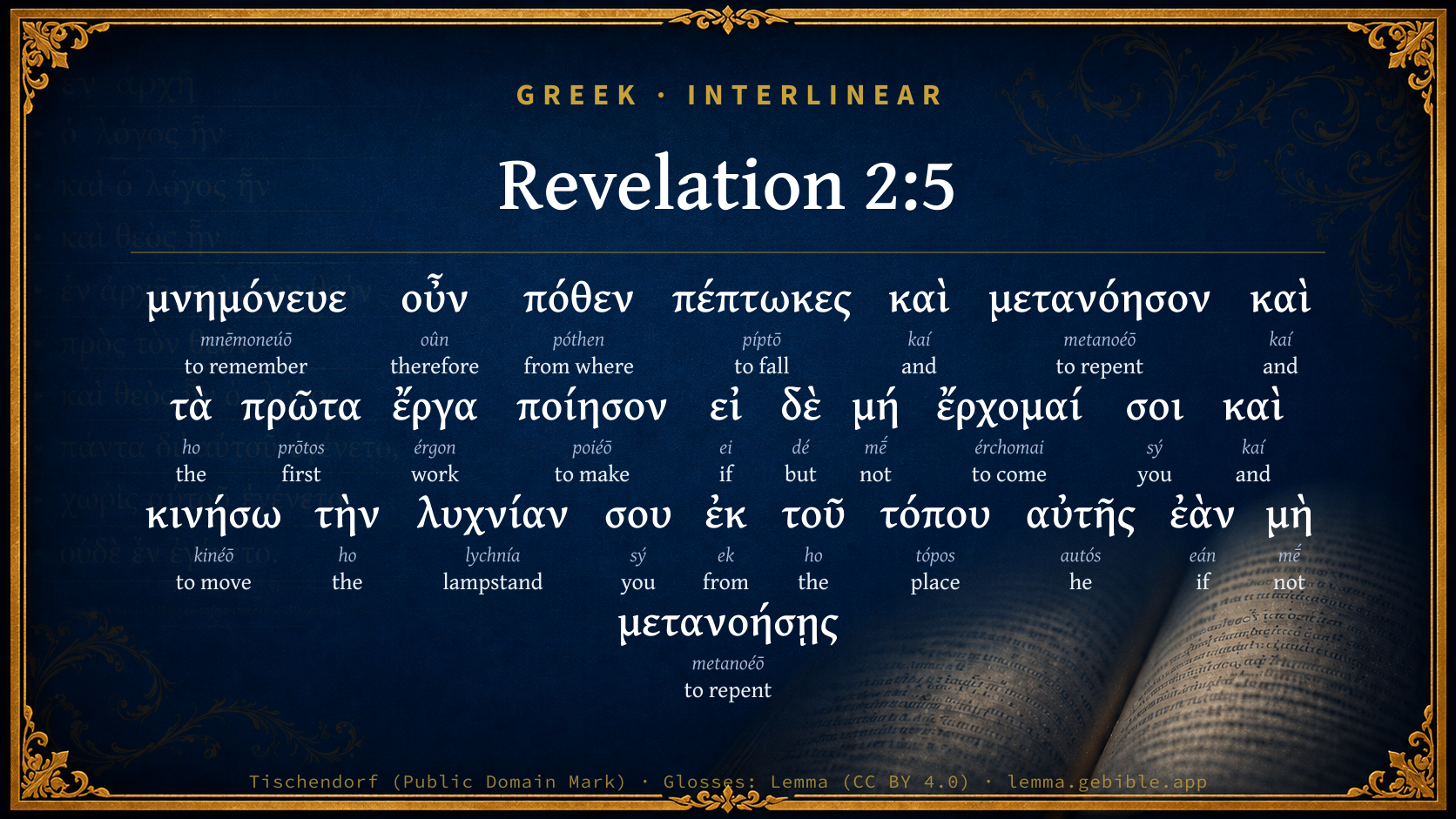
  1. μνημόνευε mnēmoneúō G3421 “to remember” Verb, Present, Active, Imperative, 2nd person, Singular
  2. οὖν oûn G3767 “therefore” Conjunction
  3. πόθεν póthen G4159 “from where” Adverb, Interrogative
  4. πέπτωκες píptō G4098 “to fall” Verb, Perfect, Active, Indicative, 2nd person, Singular
  5. καὶ kaí G2532 “and” Conjunction
  6. μετανόησον metanoéō G3340 “to repent” Verb, Aorist, Active, Imperative, 2nd person, Singular
  7. καὶ kaí G2532 “and” Conjunction
  8. τὰ ho G3588 “the” Article, Accusative, Plural, Neuter
  9. πρῶτα prōtos G4413 “first” Adjective, Accusative, Plural, Neuter, Superlative
  10. ἔργα érgon G2041 “work” Noun, Accusative, Plural, Neuter
  11. ποίησον poiéō G4160 “to make” Verb, Aorist, Active, Imperative, 2nd person, Singular
  12. εἰ ei G1487 “if” Conditional
  13. δὲ dé G1161 “but” Conjunction
  14. μή mḗ G3361 “not” Particle, Negative
  15. ἔρχομαί érchomai G2064 “to come” Verb, Present, Middle or Passive deponent, Indicative, 1st person, Singular
  16. σοι sý G4771 “you” Personal pronoun, 2nd person, Dative, Singular
  17. καὶ kaí G2532 “and” Conjunction
  18. τὴν ho G3588 “the” Article, Accusative, Singular, Feminine
  19. λυχνίαν lychnía G3087 “lampstand” Noun, Accusative, Singular, Feminine
  20. σου sý G4771 “you” Personal pronoun, 2nd person, Genitive, Singular
  21. ἐκ ek G1537 “from” Preposition
  22. τοῦ ho G3588 “the” Article, Genitive, Singular, Masculine
  23. τόπου tópos G5117 “place” Noun, Genitive, Singular, Masculine
  24. αὐτῆς autós G846 “he” Personal pronoun, Genitive, Singular, Feminine
  25. ἐὰν eán G1437 “if” Conditional
  26. μὴ mḗ G3361 “not” Particle, Negative
  27. μετανοήσῃς metanoéō G3340 “to repent” Verb, Aorist, Active, Subjunctive, 2nd person, Singular

About this verse

These counts appear in no published source. They are computed here, from the morphology-tagged text and Lemma’s own curated glosses. What Lemma adds →

28
words
21
distinct lemmas
Revelation
section

Notable vocabulary

The rarest word here is κινήσω to move G2795 — appearing just 8 times in the whole Greek New Testament.

Shared distinctive vocabulary

κινήσω to move G2795 occurs in 8 verses of the Greek New Testament. Also found in:

Repetition

Words recur within this verse:

Cross-references

30

Topical passages linked to Revelation 2:5 in the Treasury of Scripture Knowledge — connected by theme and wording, ordered by reader-vote popularity; previews shown in the World English Bible.

  • Revelation 3:2–3 Wake up, and keep the things that remain, which you were about to throw away, for I have found no works of yours perfected before my God.
  • Revelation 3:19 As many as I love, I reprove and chasten. Be zealous therefore, and repent.
  • Revelation 2:16 Repent therefore, or else I am coming to you quickly, and I will make war against them with the sword of my mouth.
  • Hosea 14:1 Israel, return to Yahweh your God; For you have fallen because of your sin.
  • Acts 17:30–31 The times of ignorance therefore God overlooked. But now he commands that all people everywhere should repent,
  • Revelation 2:21–22 I gave her time to repent, but she refuses to repent of her sexual immorality.
  • Ezekiel 20:43 There shall you remember your ways, and all your doings, in which you have polluted yourselves; and you shall loathe yourselves in your own sight for all your evils that you have committed.
  • Malachi 4:6 He will turn the hearts of the fathers to the children, and the hearts of the children to their fathers, lest I come and strike the earth with a curse."
  • Luke 1:17 He will go before him in the spirit and power of Elijah, 'to turn the hearts of the fathers to the children,' and the disobedient to the wisdom of the just; to make ready a people prepared for the Lord."
  • Revelation 1:20 the mystery of the seven stars which you saw in my right hand, and the seven golden lampstands. The seven stars are the angels of the seven assemblies. The seven lampstands are seven assemblies.
  • Revelation 2:19 I know your works, your love, faith, service, patient endurance, and that your last works are more than the first.
  • Isaiah 1:26 I will restore your judges as at the first, And your counselors as at the beginning. Afterward you shall be called 'The city of righteousness, A faithful town.'
  • Ezekiel 36:31 Then shall you remember your evil ways, and your doings that were not good; and you shall loathe yourselves in your own sight for your iniquities and for your abominations.
  • Luke 12:45–46 But if that servant says in his heart, 'My lord delays his coming,' and begins to beat the menservants and the maidservants, and to eat and drink, and to be drunken,
  • Matthew 21:41–43 They told him, "He will miserably destroy those miserable men, and will lease out the vineyard to other farmers, who will give him the fruit in its season."
  • Matthew 24:48–51 But if that evil servant should say in his heart, 'My lord is delaying his coming,'
  • Mark 12:9 What therefore will the lord of the vineyard do? He will come and destroy the farmers, and will give the vineyard to others.
  • Luke 20:16 He will come and destroy these farmers, and will give the vineyard to others." When they heard it, they said, "May it never be!"
  • Isaiah 14:12 How you are fallen from heaven, day-star, son of the morning! How you are cut down to the ground, who laid the nations low!
  • Jeremiah 2:2–3 Go, and cry in the ears of Jerusalem, saying, Thus says Yahweh, I remember for you the kindness of your youth, the love of your weddings; how you went after me in the wilderness, in a land that was not sown.
  • Ezekiel 16:61–63 Then shall you remember your ways, and be ashamed, when you shall receive your sisters, your elder [sisters] and your younger; and I will give them to you for daughters, but not by your covenant.
  • Hosea 9:10 I found Israel like grapes in the wilderness. I saw your fathers as the first ripe in the fig tree at its first season; But they came to Baal Peor, and consecrated themselves to the shameful thing, And became abominable like that which they loved.
  • Malachi 3:4 Then the offering of Judah and Jerusalem will be pleasant to Yahweh, as in the days of old, and as in ancient years.
  • Galatians 5:4 You are alienated from Christ, you who desire to be justified by the law. You have fallen away from grace.
  • Hebrews 10:32 But remember the former days, in which, after you were enlightened, you endured a great struggle with sufferings;
  • Revelation 2:2 "I know your works, and your toil and perseverance, and that you can't tolerate evil men, and have tested those who call themselves apostles, and they are not, and found them false.
  • Revelation 9:20–21 The rest of mankind, who were not killed with these plagues, didn't repent of the works of their hands, that they wouldn't worship demons, and the idols of gold, and of silver, and of brass, and of stone, and of wood; which can neither see, nor hear, nor walk.
  • 2 Peter 1:12–13 Therefore I will not be negligent to remind you of these things, though you know them, and are established in the present truth.
  • Jude 1:24 Now to him who is able to keep them from stumbling, and to present you faultless before the presence of his glory in great joy,
  • Revelation 16:9 People were scorched with great heat, and people blasphemed the name of God who has the power over these plagues. They didn't repent and give him glory.

Cross-references courtesy of OpenBible.info (CC BY 4.0).

Commentary

Notes on Revelation 2:5 from classic Christian and Jewish commentators (each source and its license shown beneath its notes). The classic Christian expositions comment on the surrounding passage and are grouped to its opening verse, so a note may address several verses; the Jewish commentaries on the Tanakh (Rashi and others) are per-verse, so they appear only where the commentator wrote on this verse.

Lemma curates 59 commentaries, every one of them public domain or Creative Commons licensed, each selected and text-cleaned for this edition rather than reprinted as found. About our sources →

Joseph Benson's Commentary

Rev 2:5. Remember therefore, &c. — It is not possible for any church, or individual Christian, whether public teacher or private member, that has lost the first love, to recover it, but by taking the three steps here spoken of. 1st, Remember; 2d, Repent; 3d, Do the first works. Remember from whence thou art fallen — From what degree of faith, love, holiness, though perhaps insensibly; and repent — Have a deep and lively conviction of thy fall, be humbled and truly sorry for it before God, earnestly desiring to be pardoned and renewed, and bringing forth fruits worthy of repentance in all respects; do the first works — Outwardly and inwardly, otherwise thou canst never regain the first love; or else thou must expect that I will come unto thee quickly — In some awful dispensations of providence. By this word is the warning sharpened to those five churches which are called to repent, this admonition belonging equally to them; (for if Ephesus was threatened, how much more shall Sardis and Laodicea be afraid!) and according as they obey the call or not, there is a promise or a threatening, Rev 2:5; Rev 2:16; Rev 2:22; Rev 3:3; Rev 3:20. But even in the threatening the promise is implied in the case of true repentance. And will remove thy candlestick out of its place — This threatening, considered as addressed to the angel or pastor of the church, meant, Unless thou repent, I will remove the flock now under thy care to another place, and put it under the care of another pastor, where it shall be better taken care of. Considered as addressed to the church, it implies that it should no longer continue to be a church, if the members of it did not endeavour to recover their lost ground, and to shine at least with their former lustre; but that the hedge of discipline should be broken down, and the light of the gospel removed from them. From the flourishing state of the church, however, at Ephesus, for a time after this, there is reason to believe that both the pastor and his flock did repent, although, not long after, they declined again, and fell lower than ever; and this church, with the other churches addressed in these letters, was ruined and overthrown by heresies and divisions from within, and by the arms of the Saracens from without. So that Mohammedanism prevails and prospers in all those countries which were once the glory of Christendom, their churches being turned into mosques, and their worship into superstitions; even Ephesus, which was once so magnificent and glorious a city, being become, as is observed on Rev 2:1, a mean, sordid village, with scarcely a single family of Christians dwelling in it.

Joseph Benson's Commentary on the Old and New Testaments (1811–1818) — public domain. Text from a community e-Sword module.

Tyndale Open Study Notes

Tyndale Open Resources

2:5 Christ calls even those who keep the faith to turn back to him and repent of cold-heartedness. The warning, I will come and remove your lampstand, means that they would lose their status as a church; God would treat them as he did the apostates within Israel (see Rom 11).

Tyndale Open Study Notes — © Tyndale Open Resources, licensed CC BY-SA 4.0. Text via the HelloAO Bible API.

Bengel's Gnomon

Johann Albrecht Bengel

Rev 2:5. [29] Εἰ δὲ μὴ) This is spoken absolutely without a verb, Rev 2:16; ἐὰν μὴ, with a verb, presently after in this verse, and Rev 2:22, ch. Rev 3:3; Rev 3:20.—ἔρχομαί σοι καὶ κινήσω) The coming of the Lord was about to take place at one time; and the denunciation of His coming was made first at Ephesus, etc., lastly at Laodicea. [In these denunciations the idea of nearness of approach increases: Rev 2:16; Rev 2:25, ch. Rev 3:3; Rev 3:11; Rev 3:20.—Not. Crit.] The verb ἔρχομαι is used so constantly in the present, that it remains so even when followed by a future: ἔρχομαι καὶ κινήσω· ἔρχομαι καὶ πολεμήσω, Rev 2:16. See also Joh 14:3. The angel ought to effect much, on account of his close tie of connection with his own church.

[29] μνημόνευε, remember) A remembrance of this kind profits very much: ch. Rev 3:3.—V. g.

Bengel's Gnomon of the New Testament — English translation (T&T Clark, Edinburgh, 1860) — public domain. Text from a community e-Sword module.

Expositor's Greek Testament

ed. W. Robertson Nicoll

Rev 2:5 . πόθεν , from what a height. Contrast Cic. ad Attic . iv. 17: “non recordor unde ceciderim, sed unde resurrexerim”. To realise that a decline has taken place, or to admit a lapse, is the first step and stimulus to amendment (see the fine passage in Bunyan’s preface to Grace Abounding , and the “Hymn of the Soul,” 44, 45, in Acts of Thomas ). Once this is brought home to the mind ( μνημόνευε , a prolonged effort), repentance quick and sharp ( μετανόησον , aor.) will follow, issuing in a return to the first level of excellence ( καὶ τὰ πρῶτα ἔργα ποίησον ), i.e. , to the initial charity ( 2Jn 1:6 ; 2Jn 1:8 ; love shown in deeds). The way to regain this warmth of affection is neither by working up spasmodic emotion nor by theorising about it (Arist. Eth. Nic. ii. 4), but by doing its duties. (“The two paracletes of man are repentance and good works,” Sanhed. 32). It is taken for granted that man possesses the power of turning and returning; the relation of Christ’s redeeming death to the forgiveness of sins throughout the Christian life, although implied, is never explicitly argued (as in Hebrews) by this writer. The present ( ἔρχ .) emphasises the nearness of the approach, while the future ( κιν .) denotes a result to follow from it. σοι either a dat. incommodi or (more probably) a local dat. (rare in classical literature, cf. Aesch. Pr. ver. 360) with “the sense of motion to a place,” (Simcox, Lang. N. T. 81), if not an incorrect reproduction of Heb. לָךְ (as Mat 21:5 , Blass). Cf. Journ. Theol. St. iii. 516. κινήσω κ . τ . λ ., (“efficiam ut ecclesia esse desinas,” Areth.); not degradation but destruction is the threat, brotherly love being the articulus stantis aut cadentis ecclesiae . So, in a remarkable parallel from Paul (Phi 2:14-16 ), quarrelsomeness forfeits the privileges of Christ’s care and service, since the function of being φωστῆρες ἐν κόσμῳ , λόγον ζωῆς ἐπέχοντες depends upon concord and charity in the church ( πάντα ποιεῖτε χωρὶς γογγυσμῶν καὶ διαλογισμῶν ). A slackened sense of the obligation to mutual love formed the cardinal sin at Ephesus; to repent of this was the condition of continued existence as a church; utility or extinction is the alternative held out to her. The nature of the visitation is left unexplained; the threat is vague, but probably eschatological. The Apocalypse, however, knows nothing of the Jewish idea that Israel’s repentance would bring the advent of messiah ( cf. Schürer’s Hist. II. ii. 163, 164), as though the transgressions of the people hindered his appearance.

The Expositor's Greek Testament, edited by W. Robertson Nicoll (1897–1910) — public domain. Text from a community e-Sword module.

Jamieson, Fausset & Brown

Robert Jamieson, A. R. Fausset & David Brown

whence--from what a height.

do the first works--the works which flowed from thy first love. Not merely "feel thy first feelings," but do works flowing from the same principle as formerly, "faith which worketh by love."

I will come--Greek, "I am coming" in special judgment on thee.

quickly--omitted in two oldest manuscripts, Vulgate and Coptic versions: supported by one oldest manuscript.

remove thy candlestick out of his place--I will take away the Church from Ephesus and remove it elsewhere. "It is removal of the candlestick, not extinction of the candle, which is threatened here; judgment for some, but that very judgment the occasion of mercy for others. So it has been. The seat of the Church has been changed, but the Church itself survives. What the East has lost, the West has gained. One who lately visited Ephesus found only three Christians there, and these so ignorant as scarcely to have heard the names of St. Paul or St. John" [TRENCH].

Jamieson, Fausset & Brown — Commentary Critical and Explanatory on the Whole Bible (1871) — public domain (CC PDM 1.0). Text via the HelloAO Bible API.

Adam Clarke's Commentary

Verse 5. Remember] Consider the state of grace in which you once stood; the happiness, love, and joy which you felt when ye received remission of sins; the zeal ye had for God's glory and the salvation of mankind; your willing, obedient spirit, your cheerful self-denial, your fervour in private prayer, your detachment from the world, and your heavenly-mindedness. Remember-consider, all these.

Whence thou art fallen] Fallen from all those blessed dispositions and gracious feelings already mentioned. Or, remember what a loss you have sustained; for so εκπιπτειν is frequently used by the best Greek writers.

Repent] Be deeply humbled before God for having so carelessly guarded the Divine treasure.

Do the first works] Resume your former zeal and diligence; watch, fast, pray, reprove sin, carefully attend all the ordinances of God, walk as in his sight, and rest not till you have recovered all your lost ground, and got back the evidence of your acceptance with your Maker.

I will come unto thee quickly] In the way of judgment.

And will remove thy candlestick] Take away my ordinances, remove your ministers, and send you a famine of the word. As there is here an allusion to the candlestick in the tabernacle and temple, which could not be removed without suspending the whole Levitical service, so the threatening here intimates that, if they did not repent, c., he would unchurch them they should no longer have a pastor, no longer have the word and sacraments, and no longer have the presence of the Lord Jesus.

Adam Clarke's Commentary on the Bible (1810–1826) — public domain. Text from a community e-Sword/MySword module.

Ellicott's Commentary for English Readers

(5) Remember therefore from whence thou art fallen, . . . and do the first works.—It is argued that we have here evidence that the later, or Domitian, date of the Apocalypse is the true one, since it describes a fall in spiritual life which might have occurred in thirty years, but would hardly have taken place in the few years—ten at the utmost—which elapsed between the visit of St. Paul (Act_20:29-30) and the reign of Nero. But greater changes than a decay of this kind have passed over communities in equally short periods. We have seen nations pass from imperialism to republicanism, from the fever-heat of radicalism to the lethargy of conservatism, in shorter space. Has not the past decade shown marvellously rapid movements in the Church of our own land! The change, moreover, in the Ephesian Church was not so great as the advocates of the later apocalyptic date would describe. There is at present little outward sign of decay; they have resisted evil and false teachers; they have shown toil and endurance; but the great Searcher of hearts detects the almost imperceptible symptoms of an incipient decay. He alone can tell the moment when love of truth is passing into a noisy, Pharisaic zealotism; when men are “settling down into a lower state of spiritual life than that which they once aimed at and once knew.” Such a backsliding is “gentle, unmarked, unnoticed in its course.” Further, it must not be forgotten that the Apostle did express his presentiments of coming danger, and specially warned the elders (Act_20:28) to take heed unto themselves; and in his Epistle (Eph_6:24) he gives in his closing words the covert caution that their love to Christ should be j an incorruptible, unchanging love: “Grace be with all them that love our Lord Jesus Christ in incorruption” (“sincerity,” English version). The advice now given is, “Repent, and do the first works.” The advice is three-fold: remember, repent, reform. Remember the love of the past peaceful hours. “How sweet their memory still!” “There are ever goads,” says Archbishop Trench, “in the memory of a better and a nobler past, goading him who has taken up with meaner things and lower, and urging him to make what he has lost once more his own.” (Comp. Luk_15:17, and Heb_10:32.) So Ulysses urges his crew to further exertions.

“Call to mind from whence ye sprung:

Ye were not formed to live as brutes,

But virtue to pursue and knowledge high.”

—Inf. xxvi.

Remember, but also repent, and repent in true practical fashion; for Love will recognise no repentance but that which is confirmed in the doing of the first works. It must be a repentance whereby we forsake sin. “Christ does not say, ‘Feel thy first feelings,’ but, ‘Do the first works.’” “An ounce of reality,” says a modern novelist, “is worth a pound of romance.”

Or else I will come . . .—Better, Or else I am coming unto (or, for thee, in a way which concerns) thee, and (omit “quickly,” which is wanting in the oldest MSS.) will remove thy candlestick out of its place, unless thou shalt have repented—i.e., unless the change shall have come before the day of visitation. The “now they are hid from thine eyes,” is not yet spoken for Ephesus.

A Bible Commentary for English Readers, edited by Charles John Ellicott (1878–1897) — public domain. Text from a community e-Sword module.

The Cambridge Bible for Schools and Colleges

gen. ed. J. J. S. Perowne

5. repent] Neither this word, nor the cognate subst. repentance, is used in St John’s Gospel or Epistles.

do the first works] He does not say, “Love with the first love,” though the works were only valuable as proceeding from love: for to love, though depending on the state of the will, is not a directly voluntary act. But He says “do the first works,” for that is in thy power. Do again what love made thee do, that thou mayest learn to love again. The paradox is as true of spiritual graces as of natural virtues (Arist. Eth. Nic. II. Rev_4:1-2) that the good habitual character is only gained by good acts, while really good acts are only possible as the product of the good character.

I will come] Literally, I am coming—the verb having, from its own nature, the sense of future time: cf. Rev_1:4 and note.

remove thy candlestick out of his place] i.e. make thee cease to be a Church. It seems scarcely relevant to point to the destruction of the city by the Turks, and its present desolation, as a fulfilment of this threat. We may presume that the Church of Ephesus did repent, as it was famous and prosperous, and fertile in Saints, for centuries. It is likely enough that the Turkish conquest was God’s judgement on the sins of the Eastern Empire and its Churches: but we cannot conclude that the Church of Ephesus was in the 14th century more corrupt than e.g. that of Smyrna, because it was more entirely exterminated.

The Cambridge Bible for Schools and Colleges (gen. ed. J. J. S. Perowne; Cambridge University Press, 1878–1918) — public domain. Text from a community e-Sword module.

John Gill's Exposition

Remember therefore from whence thou art fallen,.... Believers cannot totally and finally fall away from the grace which they have received; but they may fall into sin, and from a degree of grace, and the exercise of it, as these first and pure churches did, from some degree of their love to God, and Christ, and one another; and therefore are called upon to remember, mind, and observe from what degree of it they were fallen; in order to bring them under a conviction and acknowledgment of their evil, and a sense of their present state, and to quicken their desires after a restoration to their former one:

and repent; of their coldness and lukewarmness, of the remissness of their love, and of those evils which brought it upon them:

and do the first works; of faith and love, with the like zeal and fervour, which will show the repentance to be sincere and genuine; so the Arabic version reads, "and exercise the former works, to wit, charity" or "love". The Jews have a saying (b),

"if a man repents, do not say to him, "remember" , "thy first works";

which they seem to understand of evil works; but former good works are to be remembered and done, to show the truth of repentance for evil ones,

Or else I will come unto thee quickly; not in a spiritual way, to pay a love visit, nor in a judicial way, to take vengeance or inflict punishment, but in a providential way, to rebuke and chastise:

and will remove thy candlestick out of his place, except thou repent; or thee out of the candlestick, the pastor from the church, either by persecution or by death; or else the church, and church state itself, signified by a candlestick; See Gill on Rev 1:12; and may design a shaking and an unsettling of it, which is sometimes done by violent persecutions, and by false teachers and their doctrines, and by the divisions and contentions of saints among themselves; and by the former particularly was there a change made in the state of this apostolic church, when it passed into the Smyrnean one, which was a period of great persecution and distress; for this cannot be understood of the total removing of the church state itself quickly, no, not of Ephesus itself; for though there is not now indeed, nor has there been for many hundred years, a church of Christ in that place, yet there was one till the times of Constantine, when there was none in any of the other seven cities, and a long time after; See Gill on Act 20:17; which shows, that this was not a commination or threatening of divine vengence to that church literally, but to the state of the church, which that represented; nor does it intend the utter abolition of that church, for the apostolic church still continued, though it ceased to be in the circumstances it was before,

(b) Misn. Bava Metzia, c. 4. sect. 10.

John Gill's Exposition of the Whole Bible (1746–1763) — public domain (CC PDM 1.0). Text via the HelloAO Bible API.

Trapp's Complete Commentary

John Trapp

5 Remember therefore from whence thou art fallen, and repent, and do the first works; or else I will come unto thee quickly, and will remove thy candlestick out of his place, except thou repent.

Ver. 5. From whence thou art fallen] viz. From thy former feelings and present fitness for God’s kingdom, Luk 9:62.

And repent] See the practice of this second repentance in the relapsed spouse returning to her old husband, Son 5:6. {See Trapp on "2Co 7:11"} See an excellent letter of the Lady Jane to that apostate Harding, sometime her chaplain, Acts and Mon. fol. 1292, and what sweet counsel Bradford afterwards gave the same Harding, lb. fol. 1564, besides the example of Mr Bartlet Green, martyr, fol. 1680.

And do the first works] Begin the world again (as the Nazarite was to do that had broken his vow, Num 6:1-27), and, to set thee up afresh, make a gathering of prayers, and see that thy works be better at last than at first.

And remove thy candlestick] Sins are the snuffs that dim our candlestick and threaten the removal of it. And surely if we repent not, a removal thereof may be as certainly foreseen and foretold as if visions and letters were sent us from heaven, as to these seven Churches. There is a prophecy in Thelesphorus, reported, that Antichrist shall never overcome Venice, nor Paris, nor London; but we have a more sure word of prophecy here. This nation is sick of a spiritual pleurisy; we begin to surfeit on the bread of life. When God sees his mercies lying under table, it is just with him to call to the enemy to take away.

Except thou repent] Minatur Deus ut non puniat. God therefore menaceth, that men may be warned. As a bee stings not till provoked; so neither doth God punish till there be no remedy, 2Ch 36:16. Currat ergo poenitentia, ne proecurrat sententia, saith one; mittamus preces et lacrymas cordis legatos, saith another. Haste, haste, haste, to meet the Lord with entreaties of peace; lest we be laid waste as Sodom and desolate as the people of Gomorrah, Isa 1:9.

John Trapp, A Commentary or Exposition upon All the Books of the Old and New Testament (1647–1656) — public domain. Text from a community e-Sword module.

Albert Barnes' Notes on the Bible

Remember therefore from whence thou art fallen - The eminence which you once occupied. Call to remembrance the state in which you once were. The duty here enjoined is, when religion has declined in our hearts, or in the church, to call to distinct recollection the former state - the ardor, the zeal, the warmth of love which once characterized us. The reason for this is, that such a recalling of the former state will be likely to produce a happy influence on the heart. Nothing is better adapted to affect a backsliding Christian, or a backsliding church, than to call to distinct recollection the former condition - the happier days of piety. The joy then experienced, the good done, the honor reflected on the cause of religion, the peace of mind of that period, will contrast strongly with the present, and nothing will be better suited to recall an erring church, or an erring individual, from their wanderings than such a reminiscence of the past. The advantages of thus “remembering” their former condition would be many; for some of the most valuable impressions which are made on the mind, and some of the most important lessons learned, are from the recollections of a former state. Among those advantages, in this case, would be such as the following:

It would show how much they might have enjoyed if they had continued as they began, how much more real happiness they would have had than they actually have enjoyed. How much good they might have done, if they had only persevered in the zeal with which they commenced the Christian life. How much more good might most Christians do than they actually accomplish, if they would barely, even without increasing it, continue with the degree of zeal with which they begin their course. How much greater attainments they might have made in the divine life, and in the knowledge of religion, than they have made; that is, how much more elevated and enlarged might have been their views of religion, and their knowledge of the Word of God. And,

(d)Such a recollection of their past state as, contrasted with what they now are, would exert a powerful influence in producing true repentance; for there is nothing better adapted to do this than a just view of what we might have been, as compared with what we now are.

If a man has become cold toward his wife, nothing is better suited to reclaim him than to recall to his recollection the time when he led her to the altar, the solemn vow then made, and the rapture of his heart when he pressed her to his bosom and called her his own.

And repent - The word used here means “to change one’s mind and purposes,” and, along with that, “to change one’s conduct or demeanor.” The duty of repentance here urged would extend to all the points in which they had erred.

And do the first works - The works which were done when the church was first established. That is, manifest the zeal and love which were formerly evinced in opposing error, and in doing good. This is the true counsel to be given to those who have backslidden, and have “left their first love,” now. Often such persons, sensible that they have erred, and that they have not the enjoyment in religion which they once had, profess to be willing and desirous to return, but they know not how to do it - how to revive their ardor, how to rekindle in their bosom the flame of extinguished love. They suppose it must be by silent meditation, or by some supernatural influence, and they wait for some visitation from above to call them back, and to restore to them their former joy. The counsel of the Saviour to all such, however, is to do their first works. It is to engage at once in doing what they did in the first and best days of their piety, the days of their “espousals” Jer 2:2 to God. Let them read the Bible as they did then; let them pray as they did then; let them go forth in the duties of active benevolence as they did then; let them engage in teaching a Sunday school as they did then; let them relieve the distressed, instruct the ignorant, raise up the fallen, as they did then; let them open their heart, their purse, and their hand, to bless a dying world. As it was in this way that they manifested their love then, so this would be better suited than all other things to rekindle the flame of love when it is almost extinguished. The weapon that is used keeps bright; that which has become rusty will become bright again if it is used.

Or else I will come unto thee quickly - On the word rendered “quickly” (τάχει tachei), see the notes on Rev 1:1. The meaning is, that he would come as a Judge, at no distant period, to inflict punishment in the manner specified - by removing the candle-stick out of its place. He does not say in what way it would be done; whether by some sudden judgment, by a direct act of power, or by a gradual process that would certainly lead to that result.

And will remove thy candlestick out of his place, except thou repent - On the meaning of the word “candlestick” see the notes on Rev 1:12. The meaning is, that the church gave light in Ephesus; and that what he would do in regard to that place would be like removing a lamp, and leaving a place in darkness. The expression is equivalent to saying that the church there would cease to exist. The proper idea of the passage is, that the church would be wholly extinct; and it is observable that this is a judgment more distinctly disclosed in reference to this church than to any other of the seven churches. There is not the least evidence that the church at Ephesus did repent, and the threatening has been most signally fulfilled. Long since the church has become utterly extinct, and for ages there was not a single professing Christian there. Every memorial of there having been a church there has departed, and there are nowhere, not even in Nineveh, Babylon, or Tyre, more affecting demonstrations of the fulfillment of ancient prophecy than in the present state of the ruins of Ephesus. A remark of Mr. Gibbon (Decline and Fall, iv. 260) will show with what exactness the prediction in regard to this church has been accomplished.

He is speaking of the conquests of the Turks. “In the loss of Ephesus the Christians deplored the fall of the first angel, the extinction of the first candlestick of the Revelations; the desolation is complete; and the temple of Diana, or the Church of Mary will equally elude the search of the curious traveler.” Thus, the city, with the splendid temple of Diana, and the church that existed there in the time of John, has disappeared, and nothing remains but unsightly ruins. These ruins lie about ten days’ journey from Smyrna, and consist of shattered walls, and remains of columns and temples. The soil on which a large part of the city is supposed to have stood, naturally rich, is covered with a rank, burnt-up vegetation, and is everywhere deserted and solitary, though bordered by picturesque mountains. A few grainfields are scattered along the site of the ancient city. Toward the sea extends the ancient port, a pestilential marsh.

Along the slope of the mountain, and over the plain, are scattered fragments of masonry and detached ruins, but no thing can now be fixed on as the great temple of Diana. There are ruins of a theater; there is a circus, or stadium, nearly entire; there are fragments of temples and palaces scattered around; but there is nothing that marks the site of a church in the time of John; there is nothing to indicate even that such a church then existed there. About a mile and a half from the principal ruins of Ephesus there is indeed now a small village called Asalook, a Turkish word, which is associated with the same idea as Ephesus, meaning, The City of the Moon. A church, dedicated to John, is supposed to have stood near, if not on the site of the present mosque. Dr. Chandler (p. 150, 4to) gives us a striking description of Ephesus as he found it in 1764: “Its population consisted of a few Greek peasants, living in extreme wretchedness, dependence, and insensibility, the representatives of an illustrious people, and inhabiting the wreck of their greatness. Some reside in the substructure of the glorious edifices which they raised; some beneath the vaults of the stadium, and the crowded scenes of these diversions; and some in the abrupt precipice, in the sepulchres which received their ashes. Its streets are obscured and overgrown. A herd of goats was driven to it for shelter from the sun at noon, and a noisy flight of crows from the quarries seemed to insult its silence. We heard the partridge call in the area of the theater and of the stadium ... Its fate is that of the entire country; a garden has become a desert. Busy centers of civilization, spots where the refinements and delights of the age were collected, are now a prey to silence, destruction, and death.

Consecrated first of all to the purposes of idolatry, Ephesus next had Christian temples almost rivaling the pagan in splendor, wherein the image of the great Diana lay prostrate before the cross; after the lapse of some centuries Jesus gives way to Muhammed, and the crescent glittered on the dome of the recently Christian church. A few more scores of years, and Ephesus has neither temple, cross, crescent, nor city, but is desolation, a dry land, and a wilderness.” See the article” Ephesus” in Kitto’s Cyclopedia, and the authorities there referred to. What is affirmed here of Ephesus has often been illustrated in the history of the world, that when a church has declined in piety and love, and has been called by faithful ministers to repent, and has not done it, it has been abandoned more and more, until the last appearance of truth and piety has departed, and it has been given up to error and to ruin.

And the same principle is as applicable to individuals, for they have as much reason to dread the frowns of the Saviour as churches have. If they who have “left their first love” will not repent at the call of the Saviour, they have every reason to apprehend some fearful judgment, some awful visitation of his Providence that shall overwhelm them in sorrow, as a proof of his displeasure. Even though they should finally be saved, their days may be without comfort, and perhaps their last moments without a ray of conscious hope. The accompanying engraving, representing the present situation of Ephesus, will bring before the eye a striking illustration of the fulfillment of this prophecy, that the candlestick of Ephesus would be removed from its place. See also the engravings prefixed to the notes on the Epistle to the Ephesians.

Albert Barnes' Notes on the Bible (1834–1885) — public domain. Text from a community e-Sword/MySword module.

Matthew Poole's English Annotations

Remember therefore from whence thou art fallen; that is, in what degree thy love was formerly, and compare it with what it is now.

And repent; repentance in man, signifieth both the change of the heart and of the actions.

And do the first works; recover thy former warmth of love, and zeal for good works.

Or else I will come unto thee quickly; if thou do not, I that know thee, and walk in the midst of thee, will show myself an enemy to thee.

And will remove thy candlestick out of his place; and unchurch thee, and say unto thee, Lo-ammi, You are not my people. Which threatening is long since made good; for where is now the famous church of Ephesus?

Matthew Poole's English Annotations on the Holy Bible (1683–1685) — public domain. Text from a community e-Sword/MySword module.

Whedon's Commentary on the Bible

Daniel D. Whedon

5. Remember—A calling to remembrance the days when his heart was rich with his first divine love, is often the first inspiring impulse for the backslider to return.

First works—For that early love was not a mere emotion ending where it begun, within the feeling, but put itself forth in works.

I will come—Greek present tense, I come, or, am coming; but remove is in the future, showing that the present of come implies vividness of conception. The come does not designate the second advent, for which parousia is the unequivocal word, as noted in 2Pe_3:4. This coming is the interposition of Christ to remove the Church of Ephesus. This removal some interpreters apply to the transfer of the primary episcopate elsewhere. Others, to the transfer of the Christian Church from east to west, from Asia to Europe. We can easily imagine how the necessity of uttering this threat to his own Ephesus should touch the heart of St. John.

Daniel D. Whedon (gen. ed.), Commentary on the Old and New Testaments (1874–1909) — public domain. Text from a community e-Sword module.

The Pulpit Commentary

The exhortation and threat are clear as trumpet notes: "Remember, repent, and return, or I will return and remove thee." A modem heathen philosophy teaches us that in this world to be happy is to forget. That is not the teaching of Christ. The past is both an encouragement and a warning to us; therefore "remember." Some have to remember heights from which they have fallen; others, depths from which they have been raised; others again, both. Cicero ("Ad. Att.," 4:16) would remember the one and forget the other. Non recorder unde ceciderim, sed unde resurrexerim. The present imperative here shows that the remembering is to continue; on the other hand, the repentance (aor. imp.) is a thing to be done immediately, once for all. "The first works" means "the fruits of thy first love." Christ will have works, not feelings. I come to thee. There is no "quickly" in the true text; and the verb is present, not future. (comp. Joh_14:18) The coming, of course, refers to a special visitation, not to the second advent. The removing of the candlestick is not the deposition of the bishop, but the dethroning of the Church, cancelling its claim to the kingdom, severing its union with Christ. Compare "The kingdom of God shall be taken away from you, and shall be given to a nation bringing forth the fruits thereof". (Mat_22:43) The warning would seem to have been heeded at first, judging from the account of Ephesus in the Ignatian Epistles. But the Church has long since ceased to exist. Ephesus itself is a heap of ruins. Except thou repent. This repetition drives home the charge given above; repentance is the thing absolutely necessary, and at once. This shows that what Christ has against them cannot be a mere "somewhat" (Authorized Version in ver. 4). It is nothing less than this that with all their discernment of evil, and zeal against it, they lacked reality. Their light still burned, but in a dull, lifeless way; their service had become mechanical.

The Pulpit Commentary (1880–1919), ed. H.D.M. Spence-Jones & Joseph S. Exell — public domain. Text from a community e-Sword module.

John Wesley's Explanatory Notes

It is not possible for any to recover the first love, but by taking these three steps,

1. Remember:

2. Repent:

3. Do the first works. Remember from whence thou art fallen - From what degree of faith, love, holiness, though perhaps insensibly. And repent - Which in the very lowest sense implies a deep and lively conviction of thy fall. Of the seven angels, two, at Ephesus and at Pergamos, were in a mixed state; two, at Sardis and at Laodicea, were greatly corrupted: all these are exhorted to repent; as are the followers of Jezebel at Thyatira: two, at Smyrna and Philadelphia, were in a flourishing state, and are therefore only exhorted to steadfastness. There can be no state, either of any pastor, church, or single person, which has not here suitable instructions. All, whether ministers or hearers, together with their secret or open enemies, in all places and all ages, may draw hence necessary self-knowledge, reproof, commendation, warning, or confirmation. Whether any be as dead as the angel at Sardis, or as much alive as the angel at Philadelphia, this book is sent to him, and the Lord Jesus hath something to say to him therein. For the seven churches with their angels represent the whole Christian church, dispersed throughout the whole world, as it subsists, not, as some have imagined, in one age after another, but in every age. This is a point of deep importance, and always necessary to be remembered: that these seven churches are, as it were, a sample of the whole church of Christ, as it was then, as it is now, and as it will be in all ages. Do the first works - Outwardly and inwardly, or thou canst never regain the first love. But if not - By this word is the warning sharpened to those five churches which are called to repent; for if Ephesus was threatened, how much more shall Sardis and Laodicea be afraid! And according as they obey the call or not, there is a promise or a threatening, ver. 5, 16, 22; chap. iii, 3, 20. But even in the threatening the promise is implied, in case of true repentance. I come to thee, and will remove thy candlestick out of its place - I will remove, unless thou repent, the flock now under thy care to another place, where they shall be better taken care of. But from the flourishing state of the church of Ephesus after this, there is reason to believe he did repent.

John Wesley, Explanatory Notes Upon the Whole Bible (1754–1765) — public domain. Text via the GEBible commentary corpus.

Burkitt's Expository Notes on the New Testament

William Burkitt

We had Christ’s commendation and reprehension of the church of Ephesus before, we have this admonition and exhortation now. The words before us are partly monitory, and partly minatory; monitory in the former part of the verse, Remember from whence thou art fallen and repent.

Note here, That Christ did not surprisingly come upon this church at unawares; they were admonished before chastised, warned before laid waste; Christ doth premonish before he punishes. In the minatory part we have a great guilt and sin supposed, a great judgment for that guilt denounced, the unchurching of them that had committed it; and the means prescribed for the averting of that judgment, to wit, repentence.

Learn hence, 1. That a people professing religion and godliness may fall.

2. That fallen professors should and ought to remember from whence they are fallen.

3. That fallen professors should be repenting professors, and do their first works.

4. That without repentance and reformation, God will certainly remove a people’s candlestick, take away the gospel from them, as the severest judgment which he can inflict upon them.

Remember, repent, and do the first works, else I will remove thy candlestick out of its place: that is, such a tempest of persecution shall arise, as will shake your tottering candlestick out of its place. The universal church only has a promise of stability; any particular church may be unchurched finally.

William Burkitt's Expository Notes on the New Testament (1700–1703) — public domain. Text from a community e-Sword module.

Godbey's Commentary on the New Testament

William B. Godbey

5. Here comes in God’s terrible rebuke for apostasy, loving call to repentance, and importunate appeal to come back and do their first works over; i.e., get religion again. So here we see a Church whom God pronounces perfectly orthodox, and against whom there is not an insinuation immorality or disloyalty; yet God condemns them, pronounces them backsliders, and appeals to them to come and get their first religion again.

William B. Godbey, Commentary on the New Testament (1896–1900) — public domain. Text from a community e-Sword module.

The People's New Testament

B. W. Johnson

5. Remember … from whence thou art fallen. Note what this exhortation includes: 1. They had been at a height of excellence. 2. They had fallen from that height; there had been a spiritual declension. 3. Repent. The comparison and its proof that they were retrograding should bring repentance. 4. Do the first works. There must be the first love, and the fruits of that love in a renewal of their first works. Unless this is done Christ will come. Not in person, but in providence and judgments. The church with a waning love will be repudiated. Will remove thy candlestick. “Thy” refers to the Angel of the church through whom the address is made. To remove the candlestick would be to suffer the church to cease to exist. How signally this has been fulfilled in the case of Ephesus is seen in the fact that not one vestige of the church remains, and of the city itself naught but mouldering ruins. What concerns us, however, is that this warning is addressed to every church which has lost its first love. Unless it repents, and does its first works, its candlestick will finally be removed from its place.

B. W. Johnson's The People's New Testament with Notes (1889–1891) — public domain. Electronic text from the Christian Classics Ethereal Library (CCEL) ThML edition.

Cambridge Greek Testament for Schools and Colleges

5. μνημόνευε οὖν. Prim. omits οὖν; 38 reads μνημόνευσον; see notes on 16, Rev 3:3, Rev 3:19. It is easier to imagine reasons why some verbs should be in the present, others in the aorist, than why some should be followed by οὖν and not others. Accidents of transcription would account for both.

πέπτωκας. With א (πεπτωκες) AB2C; P 1 and Text. Rec[81] read ἐκπἐπτωκας.

[81] Rec. Textus Receptus as printed by Scrivener.

5. μνημόνευε οὖν … καὶ μετανόησον. Here again it is possible to suppose that the contrast of tenses has the force it would bear in ordinary Greek, that the remembrance of the fall is to continue after the instantaneous change of purpose and conduct. Neither μετανοεῖν nor μετάνοια is used in St John’s Gospel or Epistles.

τὰ πρῶτα ἔργα ποίησον. Here too we may find a reason for the aorist; the Church is not merely to set about the first works, but to “perform the doing of them.” He does not say, “Love with the first love,” though the works were only valuable as proceeding from love: for to love, though depending on the state of the will, is not a directly voluntary act. But He says, “Do the first works,” for that is in thy power. Do again what love made thee do, that thou mayest learn to love again. The paradox is as true of spiritual graces as of natural virtues (Arist. Eth. Nic. II. iv. 1, 2) that the good habitual character is only gained by good acts, while really good acts are only possible as the product of the good character.

ἔρχομαι. Lit. “I am coming” the verb having of its own nature the sense of future time; cf. Rev 1:4 and note. Possibly the distinction of tenses is intentional, the present here and Rev 2:16; Rev 2:22-23; Rev 3:11-12 marking the immediate, and the future the subsequent action of the Speaker.

κινήσω τὴν λυχνίαν σου. i. e. make thee cease to be a Church. It seems scarcely relevant to point to the destruction of the city by the Turks, and its present desolation, as a fulfilment of this threat. We may presume that the Church of Ephesus did repent, as it was famous and prosperous, and fertile in saints, for centuries. It is likely enough that the Turkish conquest was God’s judgement on the sins of the Eastern Empire and its Churches: but we cannot conclude that the Church of Ephesus was in the 14th century more corrupt than e.g. that of Smyrna, because it was more entirely exterminated.

Cambridge Greek Testament for Schools and Colleges (Cambridge University Press, 1896; 21 vols, various authors incl. Carr, Maclear, Plummer, Farrar, Lumby, Moule, M. R. James, Simcox) — public domain. Text from a community e-Sword module.

Vincent's Word Studies in the New Testament

Marvin R. Vincent

Thou art fallen [εκπεπτωκας] Lit., hast fallen out.

Repent [μετανοησον] . See on Mt 3:2; Mt 21:29.

l will come [ερχομαι] . Rev., correctly, I come.

Quickly. Omit.

Will remove thy candlestick. "Its candlestick has been for centuries removed out of his place; the squalid Mohammedan village which is nearest to its site does not count one Christian in its insignificant population; its temple is a mass of shapeless ruins; its harbor is a reedy pool; the bittern booms amid its pestilent and stagnant marshes; and malaria and oblivion reign supreme over the place where the wealth of ancient civilization gathered around the scenes of its grossest superstitions and its most degraded sins" (Farrar, "Life and Work of Paul," 2, 43, 44). John employs the verb kinew remove (Rev., move) only in Revelation, and only once besides the present instance, in chapter Rev 6:14, where, as here, it signifies moving in judgment.

The Nicolaitans. From nikan to conquer, and laov the people. There are two principal explanations of the term. The first and better one historical. A sect springing, according to credible tradition, from Nicholas a proselyte of Antioch, one of the seven deacons of Jerusalem (Act 6:5), who apostatized from the truth, and became the founder of an Antinomian Gnostic sect. They appear to have been characterized by sensuality, seducing Christians to participate in the idolatrous feasts of pagans, and to unchastity. Hence they are denoted by the names of Balaam and Jezebel, two leading agents of moral contamination under the Old Testament dispensation. Balaam enticed the Israelites, through the daughters of Moab and Midian, to idolatry and fornication (Num 31:16). Jezebel murdered the Lord 's prophets, and set up idolatry in Israel. The Nicolaitans taught that, in order to master sensuality, one must know the whole range of it by experience; and that he should therefore abandon himself without reserve to the lusts of the body, since they concerned only the body and did not touch the spirit. These heretics were hated and expelled by the Church of Ephesus (Rev 2:6), but were tolerated by the Church of Pergamum (Rev 2:15). The other view regards the name as symbolic, and Nicholas as the Greek rendering of Balaam, whose name signifies destroyer or corrupter of the people. This view is adopted by Trench (" Seven Churches "), who says : "The Nicolaitans are the Balaamites; no sect bearing the one name or the other; but those who, in the new dispensation, repeated the sin of Balaam in the old, and sought to overcome or destroy the people of God by the same temptations whereby Balaam had sought to overcome them before." The names, however, are by no means parallel : Conqueror of the people not being the same as corrupter of the people. Besides, in verse 14, the Balaamites are evidently distinguished from the Nicolaitans.

Alford remarks : "There is no sort of reason for interpreting the name otherwise than historically. It occurs in a passage indicating simple matters of historical fact, just as the name Antipas does in verse 13."

Marvin R. Vincent, Word Studies in the New Testament (1887–1900) — public domain. Text from a community e-Sword/MySword module.

Lesson kit

Teaching starters — assembled from the data on this page, not authored interpretation. Every prompt links to the verse data it draws on. Edit before teaching.

Revelation, in the Revelation, opens this verse with 28 words (21 distinct Greek lemmas). Its most distinctive word is kinéō (“to move”). A historical commentator’s framing appears above. Read the whole chapter for the surrounding context.

Discussion questions

  1. How does “to move” (kinéō) shape what this verse is saying?
  2. Matthew 23:4 shares the word «to move» with this verse. How do the two illuminate each other?
  3. “to repent” occurs 2× in this one verse. What is the effect of the repetition?
  4. The translations on this page render this verse differently — a whole-verse word diff, not a word-by-word alignment. What might account for the different wordings?
  5. Reading how Joseph Benson's Commentary and Tyndale Open Study Notes read this verse, where do the two commentators agree and where do they part?

Things to notice

  • These translations choose different wording for 19 words in this verse.
  • “to repent” occurs 2× in this single verse.
  • 21 distinct Greek lemmas span 28 words in this verse.

Reading settings

Reading text

Shown beneath each verse's original-language words.

Old Testament
Old Testament edition

Read the OT as the Masoretic Hebrew (MT) or the Greek Septuagint (LXX).

English shown for the Greek Septuagint (in the Hebrew ↔ Greek comparison).

Comparing translations? Open the Compare panel on any verse page to stack up to four side by side.