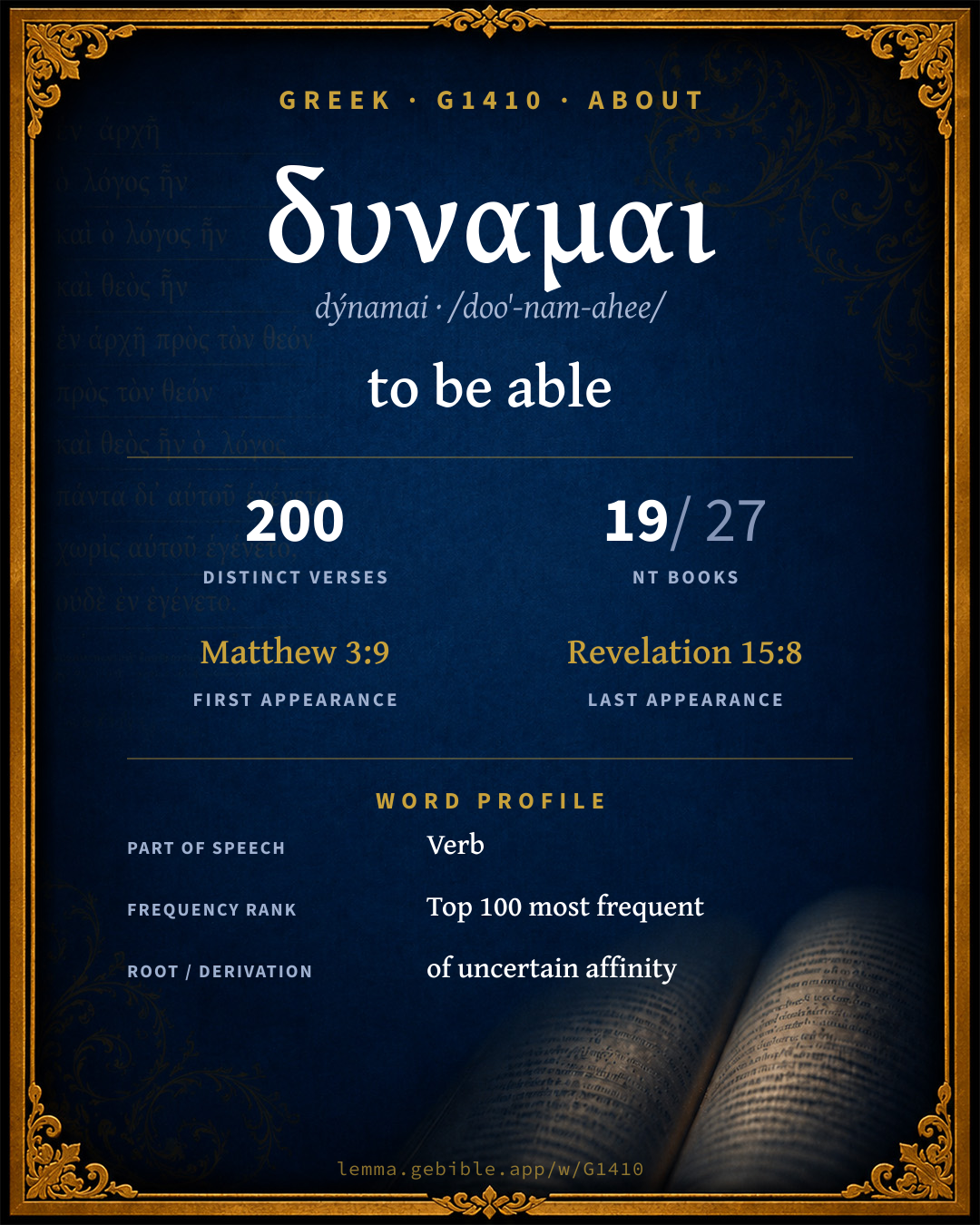
δύναμαι
to be able
‘to be able’ is one of 3 main senses fuller range ↓
Full lexicon entry — Thayer's Greek Lexicon
From Thayer's Greek Lexicon
Where this word appears
See every Present-tense verb in the Greek New Testament →
Grammar key — what these labels mean
Part of speech
- Verb
- An action or state-of-being word.
Tense
- Present
- Ongoing or general action in present time (imperfective aspect).
- Imperfect
- Continuous or repeated action in past time (“was writing”).
- Future
- Action expected in future time.
- Aorist
- Action viewed as a simple whole, without regard to duration — often past (perfective aspect).
Voice
- Middle or Passive deponent
- Middle/passive in form but active in meaning.
- Middle deponent
- Middle in form but active in meaning.
- Passive deponent
- Passive in form but active in meaning.
Mood
- Indicative
- States a fact or asks a factual question (the mood of reality).
- Infinitive
- A verbal noun (“to write”), unmarked for person or number.
- Participle
- A verbal adjective (“writing,” “having written”).
- Optative
- Expresses a wish or a remote possibility.
- Subjunctive
- Expresses probability, purpose, or possibility (the mood of contingency).
Case
- Nominative
- The case of the subject (and the predicate nominative).
- Accusative
- The case of the direct object and of extent.
- Dative
- The case of the indirect object, means, or location — “to / for / with / in.”
- Genitive
- The case of source, possession, or “of” — answers “whose / from what.”
Person
- 3rd person
- The one spoken about (“he / she / it / they”).
- 2nd person
- The one addressed (“you”).
- 1st person
- The speaker (“I / we”).
Gender
- Masculine
- Grammatically masculine.
- Neuter
- Grammatically neuter.
- Feminine
- Grammatically feminine.
Number
- Singular
- One.
- Plural
- More than one.
Grammatical forms 37 distinct
- Verb, Present, Middle or Passive deponent, Indicative, 3rd person, Singular 71 times (34%)
- Verb, Present, Middle or Passive deponent, Indicative, 2nd person, Plural 27 times (13%)
- Verb, Imperfect, Middle or Passive deponent, Indicative, 3rd person, Singular 11 times (5%)
- Verb, Present, Middle or Passive deponent, Indicative, 2nd person, Singular 11 times (5%)
- Verb, Present, Middle or Passive deponent, Indicative, 3rd person, Plural 9 times (4%)
- Verb, Present, Middle or Passive deponent, Indicative, 1st person, Plural 8 times (4%)
- Verb, Present, Middle or Passive deponent, Infinitive 8 times (4%)
- Verb, Present, Middle or Passive deponent, Indicative, 1st person, Singular 7 times (3%)
+29 more forms (57 occurrences)
Parsed forms decoded from the imported morphology (Robinson–Tischendorf, public domain), counted across 209 parsed occurrences — not distinct verses.
Every verse where G1410 appears — 200 distinct verses across 19 books. Click any verse to open its interlinear word-by-word view. Verse text shown in the World English Bible for context — . Each verse’s Greek form is shown with its reference; the English is not keyword-highlighted, since the data carries no word-level English alignment. Use “Compare translations” on any verse to read it across multiple English versions. This concordance covers the Greek New Testament; Septuagint (Greek Old Testament) occurrences of this word are not indexed here.
Matthew 24 verses
- Matthew 3:9 δύναται pres mid/pass.dep ind 3sg Don't think to yourselves, 'We have Abraham for our father,' for I tell you that God is able to raise up children to Abraham from these stones.
- Matthew 5:14 δύναται pres mid/pass.dep ind 3sg You are the light of the world. A city located on a hill can't be hidden.
- Matthew 5:36 δύνασαι pres mid/pass.dep ind 2sg Neither shall you swear by your head, for you can't make one hair white or black.
- Matthew 6:24 δύναται δύνασθε pres mid/pass.dep ind 3sg pres mid/pass.dep ind 2pl "No one can serve two masters, for either he will hate the one and love the other; or else he will be devoted to one and despise the other. You can't serve both God and Mammon.
- Matthew 6:27 δύναται pres mid/pass.dep ind 3sg "Which of you, by being anxious, can add one cubit to the measure of his life?
- Matthew 7:18 δύναται pres mid/pass.dep ind 3sg A good tree can't produce evil fruit, neither can a corrupt tree produce good fruit.
- Matthew 8:2 δύνασαί pres mid/pass.dep ind 2sg Behold, a leper came to him and worshiped him, saying, "Lord, if you want to, you can make me clean."
- Matthew 9:15 δύνανται pres mid/pass.dep ind 3pl Jesus said to them, "Can the friends of the bridegroom mourn, as long as the bridegroom is with them? But the days will come when the bridegroom will be taken away from them, and then they will fast.
- Matthew 9:28 δύναμαι pres mid/pass.dep ind 1sg When he had come into the house, the blind men came to him. Jesus said to them, "Do you believe that I am able to do this?" They told him, "Yes, Lord."
- Matthew 10:28 δυναμένων δυνάμενον pres mid/pass.dep ptcp gen pl masc pres mid/pass.dep ptcp acc sg masc Don't be afraid of those who kill the body, but are not able to kill the soul. Rather, fear him who is able to destroy both soul and body in Gehenna.
- Matthew 12:29 δύναταί pres mid/pass.dep ind 3sg Or how can one enter into the house of the strong man, and plunder his goods, unless he first bind the strong man? Then he will plunder his house.
- Matthew 12:34 δύνασθε pres mid/pass.dep ind 2pl You offspring of vipers, how can you, being evil, speak good things? For out of the abundance of the heart, the mouth speaks.
- Matthew 16:3 δύνασθε;] pres mid/pass.dep ind 2pl In the morning, 'It will be foul weather today, for the sky is red and threatening.' Hypocrites! You know how to discern the appearance of the sky, but you can't discern the signs of the times!
- Matthew 17:16 ἠδυνήθησαν aor pass.dep ind 3pl attic So I brought him to your disciples, and they could not cure him."
- Matthew 17:19 ἠδυνήθημεν aor pass.dep ind 1pl attic Then the disciples came to Jesus privately, and said, "Why weren't we able to cast it out?"
- Matthew 19:12 δυνάμενος pres mid/pass.dep ptcp nom sg masc For there are eunuchs who were born that way from their mother's womb, and there are eunuchs who were made eunuchs by men; and there are eunuchs who made themselves eunuchs for the Kingdom of Heaven's sake. He who is able to receive it, let him receive it."
- Matthew 19:25 δύναται pres mid/pass.dep ind 3sg When the disciples heard it, they were exceedingly astonished, saying, "Who then can be saved?"
- Matthew 20:22 δύνασθε δυνάμεθα pres mid/pass.dep ind 2pl pres mid/pass.dep ind 1pl But Jesus answered, "You don't know what you are asking. Are you able to drink the cup that I am about to drink, and be baptized with the baptism that I am baptized with?" They said to him, "We are able."
- Matthew 22:46 ἐδύνατο impf mid/pass.dep ind 3sg No one was able to answer him a word, neither dared any man from that day forth ask him any more questions.
- Matthew 26:9 ἐδύνατο impf mid/pass.dep ind 3sg For this ointment might have been sold for much, and given to the poor."
- Matthew 26:42 δύναται pres mid/pass.dep ind 3sg Again, a second time he went away, and prayed, saying, "My Father, if this cup can't pass away from me unless I drink it, your desire be done."
- Matthew 26:53 δύναμαι pres mid/pass.dep ind 1sg Or do you think that I couldn't ask my Father, and he would even now send me more than twelve legions of angels?
- Matthew 26:61 δύναμαι pres mid/pass.dep ind 1sg and said, "This man said, 'I am able to destroy the temple of God, and to build it in three days.'"
- Matthew 27:42 δύναται pres mid/pass.dep ind 3sg "He saved others, but he can't save himself. If he is the King of Israel, let him come down from the cross now, and we will believe in him.
Mark 32 verses
- Mark 1:40 δύνασαί pres mid/pass.dep ind 2sg There came to him a leper, begging him, kneeling down to him, and saying to him, "If you want to, you can make me clean."
- Mark 1:45 δύνασθαι pres mid/pass.dep inf But he went out, and began to proclaim it much, and to spread about the matter, so that Jesus could no more openly enter into a city, but was outside in desert places: and they came to him from everywhere.
- Mark 2:4 δυνάμενοι pres mid/pass.dep ptcp nom pl masc When they could not come near to him for the crowd, they removed the roof where he was. When they had broken it up, they let down the mat that the paralytic was lying on.
- Mark 2:7 δύναται pres mid/pass.dep ind 3sg "Why does this man speak blasphemies like that? Who can forgive sins but God alone?"
- Mark 2:19 δύνανται δύνανται pres mid/pass.dep ind 3pl pres mid/pass.dep ind 3pl Jesus said to them, "Can the groomsmen fast while the bridegroom is with them? As long as they have the bridegroom with them, they can't fast.
- Mark 3:20 δύνασθαι pres mid/pass.dep inf The multitude came together again, so that they could not so much as eat bread.
- Mark 3:23 δύναται pres mid/pass.dep ind 3sg He summoned them, and said to them in parables, "How can Satan cast out Satan?
- Mark 3:24 δύναται pres mid/pass.dep ind 3sg If a kingdom is divided against itself, that kingdom cannot stand.
- Mark 3:25 δυνήσεται fut mid.dep ind 3sg If a house is divided against itself, that house cannot stand.
- Mark 3:26 δύναται pres mid/pass.dep ind 3sg If Satan has risen up against himself, and is divided, he can't stand, but has an end.
- Mark 3:27 δύναται pres mid/pass.dep ind 3sg But no one can enter into the house of the strong man to plunder, unless he first binds the strong man; and then he will plunder his house.
- Mark 4:32 δύνασθαι pres mid/pass.dep inf yet when it is sown, grows up, and becomes greater than all the herbs, and puts out great branches, so that the birds of the sky can lodge under its shadow."
- Mark 4:33 ἠδύναντο impf mid/pass.dep ind 3pl attic With many such parables he spoke the word to them, as they were able to hear it.
- Mark 5:3 ἐδύνατο impf mid/pass.dep ind 3sg who had his dwelling in the tombs. Nobody could bind him any more, not even with chains,
- Mark 6:5 ἐδύνατο impf mid/pass.dep ind 3sg He could do no mighty work there, except that he laid his hands on a few sick people, and healed them.
- Mark 6:19 ἠδύνατο impf mid/pass.dep ind 3sg attic Herodias set herself against him, and desired to kill him, but she couldn't,
- Mark 7:15 δύναται pres mid/pass.dep ind 3sg There is nothing from outside of the man, that going into him can defile him; but the things which proceed out of the man are those that defile the man.
- Mark 7:18 δύναται pres mid/pass.dep ind 3sg He said to them, "Are you thus without understanding also? Don't you perceive that whatever goes into the man from outside can't defile him,
- Mark 7:24 ἠδυνάσθη aor pass.dep ind 3sg From there he arose, and went away into the borders of Tyre and Sidon. He entered into a house, and didn't want anyone to know it, but he couldn't escape notice.
- Mark 8:4 δυνήσεταί fut mid.dep ind 3sg His disciples answered him, "From where could one satisfy these people with bread here in a deserted place?"
- Mark 9:3 δύναται pres mid/pass.dep ind 3sg His clothing became glistening, exceedingly white, like snow, such as no launderer on earth can whiten them.
- Mark 9:22 δύνῃ pres mid/pass.dep ind 2sg Often it has cast him both into the fire and into the water, to destroy him. But if you can do anything, have compassion on us, and help us."
- Mark 9:23 δύνῃ pres mid/pass.dep ind 2sg Jesus said to him, "If you can believe, all things are possible to him who believes."
- Mark 9:28 ἠδυνήθημεν aor pass.dep ind 1pl attic When he had come into the house, his disciples asked him privately, "Why couldn't we cast it out?"
- Mark 9:29 δύναται pres mid/pass.dep ind 3sg He said to them, "This kind can come out by nothing, except by prayer and fasting."
- Mark 9:39 δυνήσεται fut mid.dep ind 3sg But Jesus said, "Don't forbid him, for there is no one who will do a mighty work in my name, and be able quickly to speak evil of me.
- Mark 10:26 δύναται pres mid/pass.dep ind 3sg They were exceedingly astonished, saying to him, "Then who can be saved?"
- Mark 10:38 δύνασθε pres mid/pass.dep ind 2pl But Jesus said to them, "You don't know what you are asking. Are you able to drink the cup that I drink, and to be baptized with the baptism that I am baptized with?"
- Mark 10:39 δυνάμεθα pres mid/pass.dep ind 1pl They said to him, "We are able." Jesus said to them, "You shall indeed drink the cup that I drink, and you shall be baptized with the baptism that I am baptized with;
- Mark 14:5 ἠδύνατο impf mid/pass.dep ind 3sg attic For this might have been sold for more than three hundred denarii, and given to the poor." They grumbled against her.
- Mark 14:7 δύνασθε pres mid/pass.dep ind 2pl For you always have the poor with you, and whenever you want to, you can do them good; but you will not always have me.
- Mark 15:31 δύναται pres mid/pass.dep ind 3sg Likewise, also the chief priests mocking among themselves with the scribes said, "He saved others. He can't save himself.
Luke 25 verses
- Luke 1:20 δυνάμενος pres mid/pass.dep ptcp nom sg masc Behold, you will be silent and not able to speak, until the day that these things will happen, because you didn't believe my words, which will be fulfilled in their proper time."
- Luke 1:22 ἐδύνατο impf mid/pass.dep ind 3sg When he came out, he could not speak to them, and they perceived that he had seen a vision in the temple. He continued making signs to them, and remained mute.
- Luke 3:8 δύναται pres mid/pass.dep ind 3sg Bring forth therefore fruits worthy of repentance, and don't begin to say among yourselves, 'We have Abraham for our father;' for I tell you that God is able to raise up children to Abraham from these stones!
- Luke 5:12 δύνασαί pres mid/pass.dep ind 2sg It happened, while he was in one of the cities, behold, there was a man full of leprosy. When he saw Jesus, he fell on his face, and begged him, saying, "Lord, if you want to, you can make me clean."
- Luke 5:21 δύναται pres mid/pass.dep ind 3sg The scribes and the Pharisees began to reason, saying, "Who is this that speaks blasphemies? Who can forgive sins, but God alone?"
- Luke 5:34 δύνασθε pres mid/pass.dep ind 2pl He said to them, "Can you make the friends of the bridegroom fast, while the bridegroom is with them?
- Luke 6:39 δύναται pres mid/pass.dep ind 3sg He spoke a parable to them. "Can the blind guide the blind? Won't they both fall into a pit?
- Luke 6:42 δύνασαι pres mid/pass.dep ind 2sg Or how can you tell your brother, 'Brother, let me remove the speck of chaff that is in your eye,' when you yourself don't see the beam that is in your own eye? You hypocrite! First remove the beam from your own eye, and then you can see clearly to remove the speck of chaff that is in your brother's eye.
- Luke 8:19 ἠδύναντο impf mid/pass.dep ind 3pl attic His mother and brothers came to him, and they could not come near him for the crowd.
- Luke 9:40 ἠδυνήθησαν aor pass.dep ind 3pl attic I begged your disciples to cast it out, and they couldn't."
- Luke 11:7 δύναμαι pres mid/pass.dep ind 1sg and he from within will answer and say, 'Don't bother me. The door is now shut, and my children are with me in bed. I can't get up and give it to you'?
- Luke 12:25 δύναται pres mid/pass.dep ind 3sg Which of you by being anxious can add a cubit to his height?
- Luke 12:26 δύνασθε pres mid/pass.dep ind 2pl If then you aren't able to do even the least things, why are you anxious about the rest?
- Luke 13:11 δυναμένη pres mid/pass.dep ptcp nom sg fem Behold, there was a woman who had a spirit of infirmity eighteen years, and she was bent over, and could in no way straighten herself up.
- Luke 14:20 δύναμαι pres mid/pass.dep ind 1sg "Another said, 'I have married a wife, and therefore I can't come.'
- Luke 14:26 δύναται pres mid/pass.dep ind 3sg "If anyone comes to me, and doesn't hate his own father, mother, wife, children, brothers, and sisters, yes, and his own life also, he can't be my disciple.
- Luke 14:27 δύναται pres mid/pass.dep ind 3sg Whoever doesn't bear his own cross, and come after me, can't be my disciple.
- Luke 14:33 δύναται pres mid/pass.dep ind 3sg So therefore whoever of you who doesn't renounce all that he has, he can't be my disciple.
- Luke 16:2 δύνῃ pres mid/pass.dep ind 2sg He called him, and said to him, 'What is this that I hear about you? Give an accounting of your management, for you can no longer be manager.'
- Luke 16:13 δύναται δύνασθε pres mid/pass.dep ind 3sg pres mid/pass.dep ind 2pl No servant can serve two masters, for either he will hate the one, and love the other; or else he will hold to one, and despise the other. You aren't able to serve God and mammon."
- Luke 16:26 δύνωνται pres mid/pass.dep subj 3pl Besides all this, between us and you there is a great gulf fixed, that those who want to pass from here to you are not able, and that none may cross over from there to us.'
- Luke 18:26 δύναται pres mid/pass.dep ind 3sg Those who heard it said, "Then who can be saved?"
- Luke 19:3 ἠδύνατο impf mid/pass.dep ind 3sg attic He was trying to see who Jesus was, and couldn't because of the crowd, because he was short.
- Luke 20:36 δύνανται pres mid/pass.dep ind 3pl For they can't die any more, for they are like the angels, and are children of God, being children of the resurrection.
- Luke 21:15 δυνήσονται fut mid.dep ind 3pl for I will give you a mouth and wisdom which all your adversaries will not be able to withstand or to contradict.
John 35 verses
- John 1:47 δύναταί pres mid/pass.dep ind 3sg Jesus saw Nathanael coming to him, and said about him, "Behold, an Israelite indeed, in whom is no deceit!"
- John 3:2 δύναται pres mid/pass.dep ind 3sg The same came to him by night, and said to him, "Rabbi, we know that you are a teacher come from God, for no one can do these signs that you do, unless God is with him."
- John 3:3 δύναται pres mid/pass.dep ind 3sg Jesus answered him, "Most assuredly, I tell you, unless one is born anew, he can't see the Kingdom of God."
- John 3:4 δύναται δύναται pres mid/pass.dep ind 3sg pres mid/pass.dep ind 3sg Nicodemus said to him, "How can a man be born when he is old? Can he enter a second time into his mother's womb, and be born?"
- John 3:5 δύναται pres mid/pass.dep ind 3sg Jesus answered, "Most assuredly I tell you, unless one is born of water and spirit, he can't enter into the Kingdom of God!
- John 3:9 δύναται pres mid/pass.dep ind 3sg Nicodemus answered him, "How can these things be?"
- John 3:27 δύναται pres mid/pass.dep ind 3sg John answered, "A man can receive nothing, unless it has been given him from heaven.
- John 5:19 δύναται pres mid/pass.dep ind 3sg Jesus therefore answered them, "Most assuredly, I tell you, the Son can do nothing of himself, but what he sees the Father doing. For whatever things he does, these the Son also does likewise.
- John 5:30 δύναμαι pres mid/pass.dep ind 1sg I can of myself do nothing. As I hear, I judge, and my judgment is righteous; because I don't seek my own will, but the will of my Father who sent me.
- John 5:44 δύνασθε pres mid/pass.dep ind 2pl How can you believe, who receive glory from one another, and you don't seek the glory that comes from the only God?
- John 6:44 δύναται pres mid/pass.dep ind 3sg No one can come to me unless the Father who sent me draws him, and I will raise him up in the last day.
- John 6:52 δύναται pres mid/pass.dep ind 3sg The Jews therefore contended with one another, saying, "How can this man give us his flesh to eat?"
- John 6:60 δύναται pres mid/pass.dep ind 3sg Therefore many of his disciples, when they heard this, said, "This is a hard saying! Who can listen to it?"
- John 6:65 δύναται pres mid/pass.dep ind 3sg He said, "For this cause have I said to you that no one can come to me, unless it is given to him by my Father."
- John 7:7 δύναται pres mid/pass.dep ind 3sg The world can't hate you, but it hates me, because I testify about it, that its works are evil.
- John 7:34 δύνασθε pres mid/pass.dep ind 2pl You will seek me, and won't find me; and where I am, you can't come."
- John 7:36 δύνασθε pres mid/pass.dep ind 2pl What is this word that he said, 'You will seek me, and won't find me; and where I am, you can't come?'"
- John 8:21 δύνασθε pres mid/pass.dep ind 2pl Jesus said therefore again to them, "I am going away, and you will seek me, and you will die in your sins. Where I go, you can't come."
- John 8:22 δύνασθε pres mid/pass.dep ind 2pl The Jews therefore said, "Will he kill himself, that he says, 'Where I am going, you can't come?'"
- John 8:43 δύνασθε pres mid/pass.dep ind 2pl Why don't you understand my speech? Because you can't hear my word.
- John 9:4 δύναται pres mid/pass.dep ind 3sg I must work the works of him who sent me, while it is day. The night is coming, when no one can work.
- John 9:16 δύναται pres mid/pass.dep ind 3sg Some therefore of the Pharisees said, "This man is not from God, because he doesn't keep the Sabbath." Others said, "How can a man who is a sinner do such signs?" There was division among them.
- John 9:33 ἠδύνατο impf mid/pass.dep ind 3sg attic If this man were not from God, he could do nothing."
- John 10:21 δύναται pres mid/pass.dep ind 3sg Others said, "These are not the sayings of one possessed by a demon. It isn't possible for a demon to open the eyes of the blind, is it?"
- John 10:29 δύναται pres mid/pass.dep ind 3sg My Father, who has given them to me, is greater than all. No one is able to snatch them out of my Father's hand.
- John 10:35 δύναται pres mid/pass.dep ind 3sg If he called them gods, to whom the word of God came (and the Scripture can't be broken),
- John 11:37 ἐδύνατο impf mid/pass.dep ind 3sg Some of them said, "Couldn't this man, who opened the eyes of him who was blind, have also kept this man from dying?"
- John 12:39 ἠδύναντο impf mid/pass.dep ind 3pl attic For this cause they couldn't believe, for Isaiah said again,
- John 13:33 δύνασθε pres mid/pass.dep ind 2pl Little children, I will be with you a little while longer. You will seek me, and as I said to the Jews, 'Where I am going, you can't come,' so now I tell you.
- John 13:36 δύνασαί pres mid/pass.dep ind 2sg Simon Peter said to him, "Lord, where are you going?" Jesus answered, "Where I am going, you can't follow now, but you will follow afterwards."
- John 13:37 δύναμαί pres mid/pass.dep ind 1sg Peter said to him, "Lord, why can't I follow you now? I will lay down my life for you."
- John 14:17 δύναται pres mid/pass.dep ind 3sg the Spirit of truth, whom the world can't receive; for it doesn't see him, neither knows him. You know him, for he lives with you, and will be in you.
- John 15:4 δύναται pres mid/pass.dep ind 3sg Remain in me, and I in you. As the branch can't bear fruit by itself, unless it remains in the vine, so neither can you, unless you remain in me.
- John 15:5 δύνασθε pres mid/pass.dep ind 2pl I am the vine. You are the branches. He who remains in me, and I in him, the same bears much fruit, for apart from me you can do nothing.
- John 16:12 δύνασθε pres mid/pass.dep ind 2pl "I have yet many things to tell you, but you can't bear them now.
Acts 21 verses
- Acts 4:16 δυνάμεθα pres mid/pass.dep ind 1pl saying, "What shall we do to these men? Because indeed a notable miracle has been done through them, as can be plainly seen by all who dwell in Jerusalem, and we can't deny it.
- Acts 4:20 δυνάμεθα pres mid/pass.dep ind 1pl for we can't help telling the things which we saw and heard."
- Acts 5:39 δυνήσεσθε fut mid.dep ind 2pl But if it is of God, you will not be able to overthrow it, and you would be found even to be fighting against God!"
- Acts 8:31 δυναίμην pres mid/pass.dep opt 1sg He said, "How can I, unless someone explains it to me?" He begged Philip to come up and sit with him.
- Acts 10:47 δύναται pres mid/pass.dep ind 3sg "Can any man forbid the water, that these who have received the Holy Spirit as well as we should not be baptized?"
- Acts 13:39 ἠδυνήθητε aor pass.dep ind 2pl attic and by him everyone who believes is justified from all things, from which you could not be justified by the law of Moses.
- Acts 15:1 δύνασθε pres mid/pass.dep ind 2pl Some men came down from Judea and taught the brothers, "Unless you are circumcised after the custom of Moses, you can't be saved."
- Acts 17:19 δυνάμεθα pres mid/pass.dep ind 1pl They took hold of him, and brought him to the Areopagus, saying, "May we know what this new teaching is, which is spoken by you?
- Acts 19:40 δυνησόμεθα fut mid.dep ind 1pl For indeed we are in danger of being accused concerning this day's riot, there being no cause. Concerning it, we wouldn't be able to give an account of this commotion."
- Acts 20:32 δυναμένῳ pres mid/pass.dep ptcp dat sg masc Now, brothers, I entrust you to God, and to the word of his grace, which is able to build up, and to give you the inheritance among all those who are sanctified.
- Acts 21:34 δυναμένου pres mid/pass.dep ptcp gen sg masc Some shouted one thing, and some another, among the crowd. When he couldn't find out the truth because of the noise, he commanded him to be brought into the barracks.
- Acts 24:8 δυνήσῃ fut mid.dep ind 2sg By examining him yourself you may ascertain all these things of which we accuse him."
- Acts 24:11 δυναμένου pres mid/pass.dep ptcp gen sg masc seeing that you can recognize that it is not more than twelve days since I went up to worship at Jerusalem.
- Acts 24:13 δύνανταί pres mid/pass.dep ind 3pl Nor can they prove to you the things of which they now accuse me.
- Acts 25:11 δύναται pres mid/pass.dep ind 3sg For if I have done wrong, and have committed anything worthy of death, I don't refuse to die; but if none of those things is true that they accuse me of, no one can give me up to them. I appeal to Caesar!"
- Acts 26:32 ἐδύνατο impf mid/pass.dep ind 3sg Agrippa said to Festus, "This man might have been set free if he had not appealed to Caesar."
- Acts 27:12 δύναιντο pres mid/pass.dep opt 3pl Because the haven was not suitable to winter in, the majority advised going to sea from there, if by any means they could reach Phoenix, and winter there, which is a port of Crete, looking northeast and southeast.
- Acts 27:15 δυναμένου pres mid/pass.dep ptcp gen sg neut When the ship was caught, and couldn't face the wind, we gave way to it, and were driven along.
- Acts 27:31 δύνασθε pres mid/pass.dep ind 2pl Paul said to the centurion and to the soldiers, "Unless these stay in the ship, you can't be saved."
- Acts 27:39 δύναιντο pres mid/pass.dep opt 3pl When it was day, they didn't recognize the land, but they noticed a certain bay with a beach, and they decided to try to drive the ship onto it.
- Acts 27:43 δυναμένους pres mid/pass.dep ptcp acc pl masc But the centurion, desiring to save Paul, stopped them from their purpose, and commanded that those who could swim should throw themselves overboard first to go toward the land;
Romans 5 verses
- Romans 8:7 δύναται pres mid/pass.dep ind 3sg because the mind of the flesh is hostile towards God; for it is not subject to God's law, neither indeed can it be.
- Romans 8:8 δύνανται pres mid/pass.dep ind 3pl Those who are in the flesh can't please God.
- Romans 8:39 δυνήσεται fut mid.dep ind 3sg nor height, nor depth, nor any other created thing, will be able to separate us from the love of God, which is in Christ Jesus our Lord.
- Romans 15:14 δυνάμενοι pres mid/pass.dep ptcp nom pl masc I myself am also persuaded about you, my brothers, that you yourselves are full of goodness, filled with all knowledge, able also to admonish others.
- Romans 16:25 δυναμένῳ pres mid/pass.dep ptcp dat sg masc
1 Corinthians 12 verses
- 1 Corinthians 2:14 δύναται pres mid/pass.dep ind 3sg Now the natural man doesn't receive the things of God's Spirit, for they are foolishness to him, and he can't know them, because they are spiritually discerned.
- 1 Corinthians 3:1 ἠδυνήθην aor pass.dep ind 1sg attic Brothers, I couldn't speak to you as to spiritual, but as to fleshly, as to babies in Christ.
- 1 Corinthians 3:2 ἐδύνασθε δύνασθε impf mid/pass.dep ind 2pl pres mid/pass.dep ind 2pl I fed you with milk, not with meat; for you weren't yet ready. Indeed, not even now are you ready,
- 1 Corinthians 3:11 δύναται pres mid/pass.dep ind 3sg For no one can lay any other foundation than that which has been laid, which is Jesus Christ.
- 1 Corinthians 6:5 δυνήσεται fut mid.dep ind 3sg I say this to move you to shame. Isn't there even one wise man among you who would be able to decide between his brothers?
- 1 Corinthians 7:21 δύνασαι pres mid/pass.dep ind 2sg Were you called being a bondservant? Don't let that bother you, but if you get an opportunity to become free, use it.
- 1 Corinthians 10:13 δύνασθε δύνασθαι pres mid/pass.dep ind 2pl pres mid/pass.dep inf No temptation has taken you except what is common to man. God is faithful, who will not allow you to be tempted above what you are able, but will with the temptation also make the way of escape, that you may be able to endure it.
- 1 Corinthians 10:21 δύνασθε δύνασθε pres mid/pass.dep ind 2pl pres mid/pass.dep ind 2pl You can't both drink the cup of the Lord and the cup of demons. You can't both partake of the table of the Lord, and of the table of demons.
- 1 Corinthians 12:3 δύναται pres mid/pass.dep ind 3sg Therefore I make known to you that no man speaking by God's Spirit says, "Jesus is accursed." No one can say, "Jesus is Lord," but by the Holy Spirit.
- 1 Corinthians 12:21 δύναται pres mid/pass.dep ind 3sg The eye can't tell the hand, "I have no need for you," or again the head to the feet, "I have no need for you."
- 1 Corinthians 14:31 δύνασθε pres mid/pass.dep ind 2pl For you all can prophesy one by one, that all may learn, and all may be exhorted.
- 1 Corinthians 15:50 δύναται pres mid/pass.dep ind 3sg Now I say this, brothers, that flesh and blood can't inherit the Kingdom of God; neither does corruption inherit incorruption.
2 Corinthians 3 verses
- 2 Corinthians 1:4 δύνασθαι pres mid/pass.dep inf who comforts us in all our affliction, that we may be able to comfort those who are in any affliction, through the comfort with which we ourselves are comforted by God.
- 2 Corinthians 3:7 δύνασθαι pres mid/pass.dep inf But if the service of death, written engraved on stones, came with glory, so that the children of Israel could not look steadfastly on the face of Moses for the glory of his face; which was passing away:
- 2 Corinthians 13:8 δυνάμεθά pres mid/pass.dep ind 1pl For we can do nothing against the truth, but for the truth.
Galatians 1 verse
Ephesians 5 verses
- Ephesians 3:4 δύνασθε pres mid/pass.dep ind 2pl by which, when you read, you can perceive my understanding in the mystery of Christ;
- Ephesians 3:20 δυναμένῳ pres mid/pass.dep ptcp dat sg masc Now to him who is able to do exceedingly abundantly above all that we ask or think, according to the power that works in us,
- Ephesians 6:11 δύνασθαι pres mid/pass.dep inf Put on the whole armor of God, that you may be able to stand against the wiles of the devil.
- Ephesians 6:13 δυνηθῆτε aor pass.dep subj 2pl Therefore, put on the whole armor of God, that you may be able to withstand in the evil day, and, having done all, to stand.
- Ephesians 6:16 δυνήσεσθε fut mid.dep ind 2pl above all, taking up the shield of faith, with which you will be able to quench all the fiery darts of the evil one.
Philippians 1 verse
1 Thessalonians 2 verses
- 1 Thessalonians 2:6 δυνάμενοι pres mid/pass.dep ptcp nom pl masc nor seeking glory from men (neither from you nor from others), when we might have claimed authority as apostles of Christ.
- 1 Thessalonians 3:9 δυνάμεθα pres mid/pass.dep ind 1pl For what thanksgiving can we render again to God for you, for all the joy with which we rejoice for your sakes before our God;
1 Timothy 3 verses
- 1 Timothy 5:25 δύνανται pres mid/pass.dep ind 3pl In the same way also there are good works that are obvious, and those that are otherwise can't be hidden.
- 1 Timothy 6:7 δυνάμεθα pres mid/pass.dep ind 1pl For we brought nothing into the world, and we certainly can't carry anything out.
- 1 Timothy 6:16 δύναται pres mid/pass.dep ind 3sg who alone has immortality, dwelling in unapproachable light; whom no man has seen, nor can see: to whom be honor and eternal power. Amen.
2 Timothy 3 verses
- 2 Timothy 2:13 δύναται pres mid/pass.dep ind 3sg If we are faithless, He remains faithful. He can't deny himself.
- 2 Timothy 3:7 δυνάμενα pres mid/pass.dep ptcp acc pl neut always learning, and never able to come to the knowledge of the truth.
- 2 Timothy 3:15 δυνάμενά pres mid/pass.dep ptcp acc pl neut From infancy, you have known the sacred writings which are able to make you wise for salvation through faith, which is in Christ Jesus.
Hebrews 9 verses
- Hebrews 2:18 δύναται pres mid/pass.dep ind 3sg For in that he himself has suffered being tempted, he is able to help those who are tempted.
- Hebrews 3:19 ἠδυνήθησαν aor pass.dep ind 3pl attic We see that they were not able to enter in because of unbelief.
- Hebrews 4:15 δυνάμενον pres mid/pass.dep ptcp acc sg masc For we don't have a high priest who can't be touched with the feeling of our infirmities, but one who has been in all points tempted like we are, yet without sin.
- Hebrews 5:2 δυνάμενος pres mid/pass.dep ptcp nom sg masc The high priest can deal gently with those who are ignorant and going astray, because he himself is also surrounded with weakness.
- Hebrews 5:7 δυνάμενον pres mid/pass.dep ptcp acc sg masc He, in the days of his flesh, having offered up prayers and petitions with strong crying and tears to him who was able to save him from death, and having been heard for his godly fear,
- Hebrews 7:25 δύναται pres mid/pass.dep ind 3sg Therefore he is also able to save to the uttermost those who draw near to God through him, seeing he ever lives to make intercession for them.
- Hebrews 9:9 δυνάμεναι pres mid/pass.dep ptcp nom pl fem which is a symbol of the present age, where gifts and sacrifices are offered that are incapable, concerning the conscience, of making the worshipper perfect;
- Hebrews 10:1 δύναται pres mid/pass.dep ind 3sg For the law, having a shadow of the good to come, not the very image of the things, can never with the same sacrifices year by year, which they offer continually, make perfect those who draw near.
- Hebrews 10:11 δύνανται pres mid/pass.dep ind 3pl Every priest indeed stands day by day ministering and often offering the same sacrifices, which can never take away sins,
James 6 verses
- James 1:21 δυνάμενον pres mid/pass.dep ptcp acc sg masc Therefore, putting away all filthiness and overflowing of wickedness, receive with humility the implanted word, which is able to save your souls.
- James 2:14 δύναται pres mid/pass.dep ind 3sg What good is it, my brothers, if a man says he has faith, but has no works? Can faith save him?
- James 3:8 δύναται pres mid/pass.dep ind 3sg But nobody can tame the tongue. It is a restless evil, full of deadly poison.
- James 3:12 δύναται pres mid/pass.dep ind 3sg Can a fig tree, my brothers, yield olives, or a vine figs? Thus no spring yields both salt water and fresh water.
- James 4:2 δύνασθε pres mid/pass.dep ind 2pl You lust, and don't have. You kill, covet, and can't obtain. You fight and make war. You don't have, because you don't ask.
- James 4:12 δυνάμενος pres mid/pass.dep ptcp nom sg masc Only one is the lawgiver, who is able to save and to destroy. But who are you to judge another?
1 John 2 verses
- 1 John 3:9 δύναται pres mid/pass.dep ind 3sg Whoever is born of God doesn't commit sin, because his seed remains in him; and he can't sin, because he is born of God.
- 1 John 4:20 δύναται pres mid/pass.dep ind 3sg If a man says, "I love God," and hates his brother, he is a liar; for he who doesn't love his brother whom he has seen, how can he love God whom he has not seen?
Jude 1 verse
Revelation 10 verses
- Revelation 2:2 δύνῃ pres mid/pass.dep ind 2sg "I know your works, and your toil and perseverance, and that you can't tolerate evil men, and have tested those who call themselves apostles, and they are not, and found them false.
- Revelation 3:8 δύναται pres mid/pass.dep ind 3sg "I know your works (behold, I have set before you an open door, which no one can shut), that you have a little power, and kept my word, and didn't deny my name.
- Revelation 5:3 ἐδύνατο impf mid/pass.dep ind 3sg No one in heaven above, or on the earth, or under the earth, was able to open the book, or to look in it.
- Revelation 6:17 δύναται pres mid/pass.dep ind 3sg for the great day of his wrath has come; and who is able to stand?"
- Revelation 7:9 ἐδύνατο impf mid/pass.dep ind 3sg After these things I looked, and behold, a great multitude, which no man could number, out of every nation and of all tribes, peoples, and languages, standing before the throne and before the Lamb, dressed in white robes, with palm branches in their hands.
- Revelation 9:20 δύνανται pres mid/pass.dep ind 3pl The rest of mankind, who were not killed with these plagues, didn't repent of the works of their hands, that they wouldn't worship demons, and the idols of gold, and of silver, and of brass, and of stone, and of wood; which can neither see, nor hear, nor walk.
- Revelation 13:4 δύναται pres mid/pass.dep ind 3sg They worshiped the dragon, because he gave his authority to the beast, and they worshiped the beast, saying, "Who is like the beast? Who is able to make war with him?"
- Revelation 13:17 δύνηται pres mid/pass.dep subj 3sg and that no one would be able to buy or to sell, unless he has that mark, the name of the beast or the number of his name.
- Revelation 14:3 ἐδύνατο impf mid/pass.dep ind 3sg They sing a new song before the throne, and before the four living creatures and the elders. No one could learn the song except the one hundred forty-four thousand, those who had been redeemed out of the earth.
- Revelation 15:8 ἐδύνατο impf mid/pass.dep ind 3sg The temple was filled with smoke from the glory of God, and from his power. No one was able to enter into the temple, until the seven plagues of the seven angels would be finished.
About this entry
At a glance — auto-summarized from this page’s data, not written by a person. Every figure links to its source below. This summary describes the numbers; it doesn’t interpret them.
δυναμαι — transliterated dýnamai — is a Greek verb carrying the sense “to be able.” Its English rendering has broadened — “can” classically, “able” (unfoldingWord Literal Text) in modern versions; see the renderings breakdown. The Greek New Testament uses it across 200 verses — common. It first appears in Matthew 3:9. Its lexical range runs to 3 senses. See the sense tree, 200-verse concordance, and the renderings breakdown below.
Gloss history
Strong's 1890 vs modern scholarship
About this word
Strong's G1410 catalogs a Greek word from the Greek New Testament.
These counts are not copied from any lexicon or concordance. They are computed here, from the morphology-tagged Greek New Testament. What Lemma adds →
- 200
- distinct verses
- The word appears in 200 distinct verses.
- 19 / 27
- NT books
- The word appears in 19 of 27 New Testament books.
- #78
- by frequency
- Top 100 most frequent Greek words (rank 78 of 5,347 Greek words by occurrence).
View all 200 occurrences in the concordance →
By section of the New Testament
By traditional corpus
Conventional, traditional groupings — biblical authorship is debated, so this is a traditional corpus grouping, not an authorship claim. Some books belong to more than one corpus (Luke is in both the Gospels and the Lukan corpus, and so on), so these shares overlap and need not total 100%. Each figure is a share of the word’s 200 distinct verses.
- Gospels 116 verses · 58%
- Johannine 47 verses · 24%
- Lukan (Luke–Acts) 46 verses · 23%
- Pauline corpus 35 verses · 18%
- Revelation 10 verses · 5%
- Hebrews 9 verses · 5%
- General (Catholic) Epistles 9 verses · 5%
How translations render this word
Counts come from each version’s own published word-to-Strong’s tagging or interlinear alignment — an approximate guide to how each version renders this word, not a word-level alignment the data otherwise carries. Because each total is that version’s own tagged count, the per-version totals vary from one another and need not match the appearance or distinct-verse counts above. These counts may also differ from a printed concordance because Lemma counts each distinctly tagged rendering and does not collapse phrase taggings into a single head-word total. This is a fixed set of word-tagged versions (KJV, ASV, BSB, ULT) and does not change with the reading translation you choose elsewhere. Each version’s license is shown beside its name below (and on Sources).
- King James Version: Can 45×, Could 16×, Is able 10×
- American Standard Version: Can 50×, Could 14×, Is able 10×
- Berean Standard Bible: Can 54×, Cannot 26×, Could 17×
- unfoldingWord Literal Text: Able 92×, Is able 32×, Is 27×
King James Version Public Domain
Renders G1410 across 160 tagged occurrences — most commonly:
Plus other, less common renderings. Plus 28 renderings that appear only once — usually multi-word phrases or single function words the recovered tagging swept in, not distinct renderings. Not rendered by a distinct English word in 54 further occurrences.
American Standard Version Public Domain
Renders G1410 across 187 tagged occurrences — most commonly:
Plus other, less common renderings. Plus 36 renderings that appear only once — usually multi-word phrases or single function words the recovered tagging swept in, not distinct renderings.
Berean Standard Bible Public Domain
Renders G1410 across 205 tagged occurrences — most commonly:
Plus other, less common renderings. Plus 30 renderings that appear only once — usually multi-word phrases or single function words the recovered tagging swept in, not distinct renderings. Not rendered by a distinct English word in 4 further occurrences.
unfoldingWord Literal Text CC BY-SA 4.0
Renders G1410 across 317 tagged occurrences — most commonly:
Plus other, less common renderings. Plus 24 renderings that appear only once — usually multi-word phrases or single function words the recovered tagging swept in, not distinct renderings.
Senses in Thayer's
The 3 senses Thayer's distinguishes for this word, in lexicon order (not ranked by frequency or importance). The full entry — with sub-senses — is in the Lexicon Entry tab.
- to be able, have power whether by virtue of one's own ability and resources, or of a state of mind, or through…
- to be able to do something
- to be capable, strong and powerful
Word origin
Origin: of uncertain affinity
Of uncertain affinity; to be able or possible : - be able can (do + -not) could may might be possible be of power.
— Strong’s Exhaustive Concordance (1890), public domain.
Forms in the corpus
The 45 distinct written forms G1410 takes in the Greek New Testament, most frequent first — each parse links to that tense’s occurrences in the concordance.
Same root — word family
Other Thayer's entries built from the same root as G1410, grouped by Strong’s listed origin. These share a root / origin per the lexicon — not necessarily a shared meaning. Each links to that word’s own entry.
Derived from this word
Compare all same-root words → They share a root, not necessarily a meaning.
Septuagint usage
The same Greek word δυναμαι appears 226 times in the Greek Old Testament (Septuagint), across 217 verses in 32 books.
- 226
- LXX occurrences
- Tagged occurrences of this Greek word in the Septuagint.
- 217
- verses
- Distinct Septuagint verses containing this word.
- 32 / 39
- OT books
- The word appears in 32 of the 39 Old Testament books.
Sample Septuagint occurrences
- Genesis 13:6 δύναμαι
- Exodus 2:3 δύναμαι
- Leviticus 26:37 δύναμαι
- Numbers 9:6 δύναμαι
- Deuteronomy 1:9 δύναμαι
- Joshua 7:12 δύναμαι
- Judges 1:19 δύναμαι
- Ruth 4:6 δύναμαι
- 1 Samuel 3:2 δύναμαι
- 2 Samuel 3:11 δύναμαι
- 1 Kings 3:9 δύναμαι
- 2 Kings 3:26 δύναμαι
Septuagint occurrences (same lexeme)
Every verse where the same Strong’s number (G1410) appears in the Greek Septuagint — showing the first 50 of 217. Verse text shown in the World English Bible for context; the Greek form is the matched word — the English is not keyword-highlighted.
- Genesis 13:6 δύναμαι The land was not able to bear them, that they might live together: for their substance was great, so that they could not live together.
- Genesis 13:16 δύναμαι I will make your offspring as the dust of the earth, so that if a man can number the dust of the earth, then your seed may also be numbered.
- Genesis 15:5 δύναμαι Yahweh brought him outside, and said, "Look now toward the sky, and count the stars, if you are able to count them." He said to Abram, "So shall your seed be."
- Genesis 19:19 δύναμαι See now, your servant has found favor in your sight, and you have magnified your loving kindness, which you have shown to me in saving my life. I can't escape to the mountain, lest evil overtake me, and I die.
- Genesis 19:22 δύναμαι Hurry, escape there, for I can't do anything until you get there." Therefore the name of the city was called Zoar.
- Genesis 24:50 δύναμαι Then Laban and Bethuel answered, "The thing proceeds from Yahweh. We can't speak to you bad or good.
- Genesis 29:8 δύναμαι They said, "We can't, until all the flocks are gathered together, and they roll the stone from the well's mouth. Then we water the sheep."
- Genesis 30:8 δύναμαι Rachel said, "With mighty wrestlings have I wrestled with my sister, and have prevailed." She named him Naphtali.
- Genesis 31:35 δύναμαι She said to her father, "Don't let my lord be angry that I can't rise up before you; for the manner of women is on me." He searched, but didn't find the teraphim.
- Genesis 32:26 δύναμαι The man said, "Let me go, for the day breaks." Jacob said, "I won't let you go, unless you bless me."
- Genesis 34:14 δύναμαι and said to them, "We can't do this thing, to give our sister to one who is uncircumcised; for that is a reproach to us.
- Genesis 36:7 δύναμαι For their substance was too great for them to dwell together, and the land of their travels couldn't bear them because of their cattle.
- Genesis 37:4 δύναμαι His brothers saw that their father loved him more than all his brothers, and they hated him, and couldn't speak peaceably to him.
- Genesis 41:49 δύναμαι Joseph laid up grain as the sand of the sea, very much, until he stopped counting, for it was without number.
- Genesis 43:32 δύναμαι They served him by himself, and them by themselves, and the Egyptians, that ate with him, by themselves, because the Egyptians don't eat bread with the Hebrews, for that is an abomination to the Egyptians.
- Genesis 44:1 δύναμαι He commanded the steward of his house, saying, "Fill the men's sacks with food, as much as they can carry, and put every man's money in his sack's mouth.
- Genesis 44:22 δύναμαι We said to my lord, 'The boy can't leave his father: for if he should leave his father, his father would die.'
- Genesis 44:26 δύναμαι We said, 'We can't go down. If our youngest brother is with us, then will we go down: for we may not see the man's face, unless our youngest brother is with us.'
- Genesis 45:1 δύναμαι Then Joseph couldn't control himself before all those who stood before him, and he cried, "Cause every man to go out from me!" There stood no man with him, while Joseph made himself known to his brothers.
- Genesis 45:3 δύναμαι Joseph said to his brothers, "I am Joseph! Does my father still live?" His brothers couldn't answer him; for they were terrified at his presence.
- Genesis 48:10 δύναμαι Now the eyes of Israel were dim for age, so that he couldn't see. He brought them near to him; and he kissed them, and embraced them.
- Exodus 2:3 δύναμαι When she could no longer hide him, she took a papyrus basket for him, and coated it with tar and with pitch. She put the child in it, and laid it in the reeds by the river's bank.
- Exodus 4:13 δύναμαι He said, "Oh, Lord, please send someone else."
- Exodus 7:18 δύναμαι The fish that are in the river shall die, and the river shall become foul; and the Egyptians shall loathe to drink water from the river."'"
- Exodus 7:21 δύναμαι The fish that were in the river died; and the river became foul, and the Egyptians couldn't drink water from the river; and the blood was throughout all the land of Egypt.
- Exodus 7:24 δύναμαι All the Egyptians dug round about the river for water to drink; for they couldn't drink of the water of the river.
- Exodus 8:14 δύναμαι They gathered them together in heaps, and the land stank.
- Exodus 9:11 δύναμαι The magicians couldn't stand before Moses because of the boils; for the boils were on the magicians, and on all the Egyptians.
- Exodus 10:5 δύναμαι and they shall cover the surface of the earth, so that one won't be able to see the earth. They shall eat the residue of that which has escaped, which remains to you from the hail, and shall eat every tree which grows for you out of the field.
- Exodus 12:39 δύναμαι They baked unleavened cakes of the dough which they brought forth out of Egypt; for it wasn't leavened, because they were thrust out of Egypt, and couldn't wait, neither had they prepared for themselves any food.
- Exodus 15:23 δύναμαι When they came to Marah, they couldn't drink from the waters of Marah, for they were bitter. Therefore the name of it was called Marah.
- Exodus 18:18 δύναμαι You will surely wear away, both you, and this people that is with you; for the thing is too heavy for you. You are not able to perform it yourself alone.
- Exodus 18:23 δύναμαι If you will do this thing, and God commands you so, then you will be able to endure, and all of these people also will go to their place in peace."
- Exodus 19:23 δύναμαι Moses said to Yahweh, "The people can't come up to Mount Sinai, for you charged us, saying, 'Set bounds around the mountain, and sanctify it.'"
- Exodus 33:20 δύναμαι He said, "You cannot see my face, for man may not see me and live."
- Exodus 40:32 δύναμαι When they went into the tent of meeting, and when they came near to the altar, they washed, as Yahweh commanded Moses.
- Leviticus 26:37 δύναμαι They will stumble over one another, as it were before the sword, when no one pursues: and you will have no power to stand before your enemies.
- Numbers 9:6 δύναμαι There were certain men, who were unclean because of the dead body of a man, so that they could not keep the Passover on that day, and they came before Moses and before Aaron on that day.
- Numbers 11:14 δύναμαι I am not able to bear all this people alone, because it is too heavy for me.
- Numbers 13:30 δύναμαι Caleb stilled the people before Moses, and said, Let us go up at once, and possess it; for we are well able to overcome it.
- Numbers 13:31 δύναμαι But the men who went up with him said, We aren't able to go up against the people; for they are stronger than we.
- Numbers 14:16 δύναμαι Because Yahweh was not able to bring this people into the land which he swore to them, therefore he has slain them in the wilderness.
- Numbers 22:6 δύναμαι Please come now therefore curse me this people; for they are too mighty for me: peradventure I shall prevail, that we may strike them, and that I may drive them out of the land; for I know that he whom you bless is blessed, and he whom you curse is cursed.
- Numbers 22:11 δύναμαι Behold, the people that is come out of Egypt, it covers the surface of the earth: now, come curse me them; peradventure I shall be able to fight against them, and shall drive them out.
- Numbers 22:18 δύναμαι Balaam answered the servants of Balak, If Balak would give me his house full of silver and gold, I can't go beyond the word of Yahweh my God, to do less or more.
- Numbers 22:37 δύναμαι Balak said to Balaam, Didn't I earnestly send to you to call you? why didn't you come to me? am I not able indeed to promote you to honor?
- Numbers 24:13 δύναμαι If Balak would give me his house full of silver and gold, I can't go beyond the word of Yahweh, to do either good or bad of my own mind; what Yahweh speaks, that will I speak?
- Deuteronomy 1:9 δύναμαι I spoke to you at that time, saying, I am not able to bear you myself alone:
- Deuteronomy 1:12 δύναμαι How can I myself alone bear your encumbrance, and your burden, and your strife?
- Deuteronomy 7:17 δύναμαι If you shall say in your heart, These nations are more than I; how can I dispossess them?
These are occurrences of the same Greek lexeme (G1410) in the Septuagint — not a translation of any one Hebrew word. The store carries no word-level Hebrew↔Greek alignment, so no Hebrew original is asserted here. Counts come from the recovered LXX Strong's tagging — high-frequency vocabulary is well covered, while rare or late forms may be untagged — so they reflect tagged occurrences and may slightly undercount.