
2 Timothy 3:7

Greek (Tischendorf 8th ed.) 2 Timothy 3:7 appears in the Greek New Testament. The text above is from the Tischendorf 8th edition. Each word links to its Strong’s number and a concise gloss. Click any word for its full Thayer’s Greek Lexicon entry.
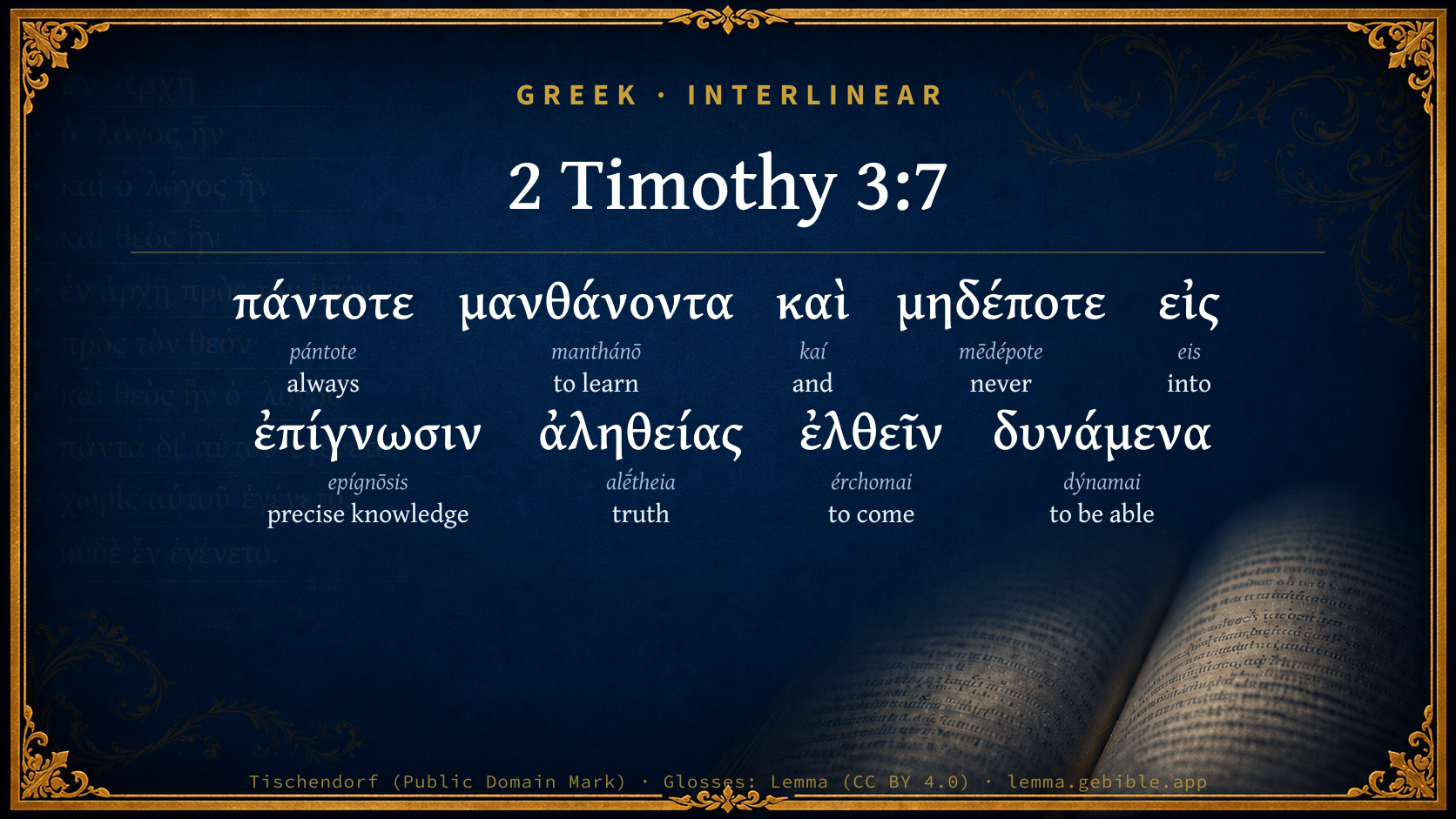
Download image
Cite this verse

2 Timothy 3:7 (World English Bible). Public Domain. Lemma interlinear Bible study tool, https://lemma.gebible.app/v/2-timothy/3/7.

Show BibTeX & RIS
BibTeX
RIS
English Translation
always learning, and never able to come to the knowledge of the truth.
World English Bible · Public Domain
Highlights
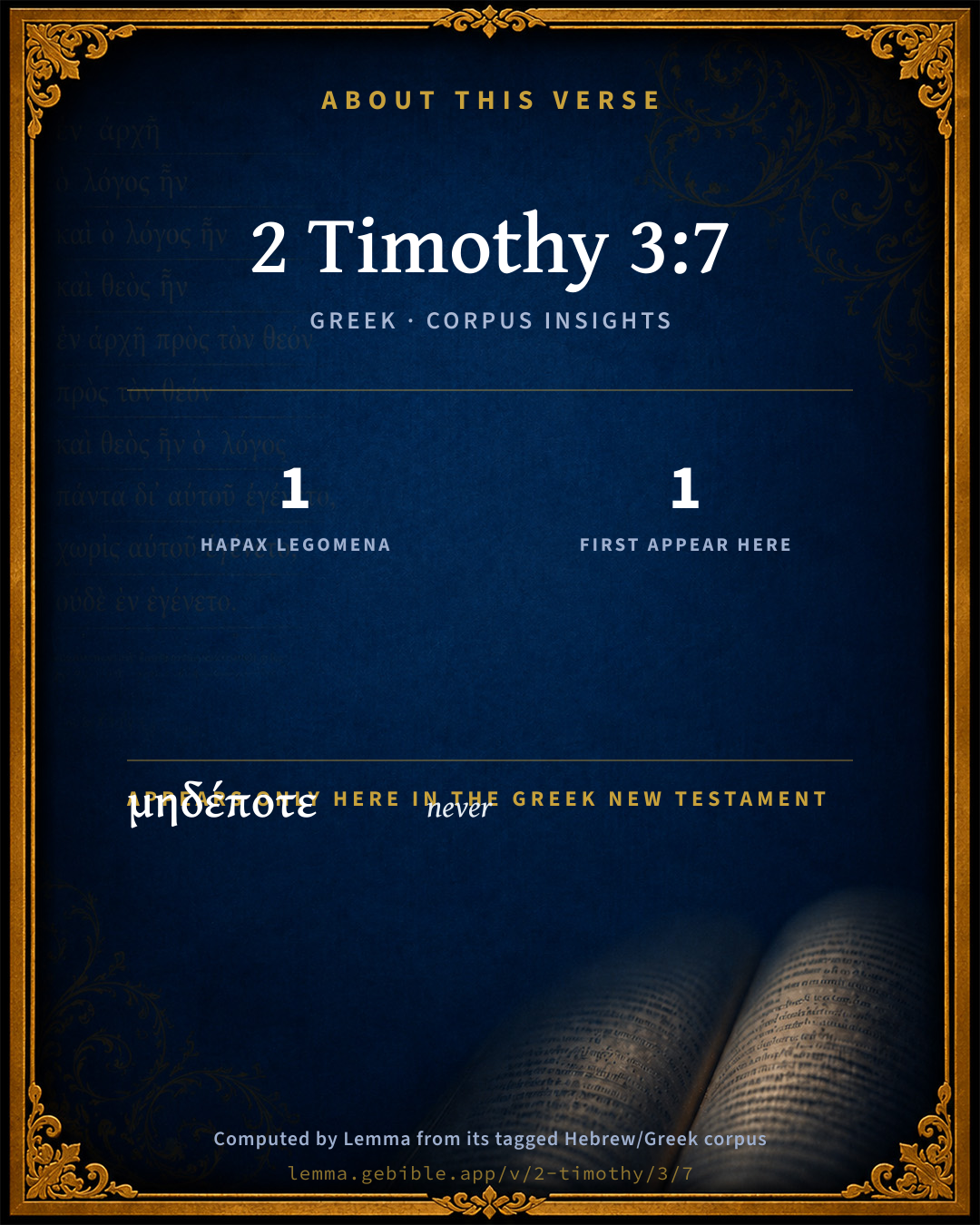
  • 1 hapax legomenon — only here in the Greek New Testament
  • 1 first appearance in the Greek New Testament
Full analysis ↓
Download a study sheet

One document with this verse’s original text, its word-by-word gloss line, the meaning frame, cross-references with their text, attributed commentary, and full source and license credits — printable, and it pastes into notes with its structure intact.

This verse Autodidact and up

Study sheet (.html) Plain text (.txt)

A passage Seminary Student

Up to 50 verses in one chapter. A passage sheet keeps up to 6 commentary sources and 12 cross-references per verse, in the order this page ranks them, and says so on the sheet whenever that leaves anything out. Ask for a single verse and you get the Autodidact verse sheet above.

Everything on this page stays free to read, with no account — the sheet is a download of what is already on screen, not access to it.

Want to remove ads? Support Godless Engineer
Compare translations 3

The same verse in 3 English versions, stacked beneath the original-language interlinear above. Click any original word for its lexicon entry.

Each is an independent rendering of the whole verse — the interlinear is not word-aligned to these translations.

Highlighted words mark where these versions differ — a whole-verse word diff, not a word-by-word alignment.

  • World English Bible Public Domain
    always learning, and never able to come to the knowledge of the truth.
  • King James Version Public Domain
    Ever learning, and never able to come to the knowledge of the truth.
  • unfoldingWord Literal Text CC BY-SA 4.0
    always learning, and never being able to come to knowledge of the truth.

unfoldingWord Literal Text — © unfoldingWord, licensed CC BY-SA 4.0. Word-aligned USFM3 via Door43 (git.door43.org/unfoldingWord/en_ult).

Versions to compare (up to 4)

3 of 4 selected

Show all 19 translations

Every available English version of this verse, each an independent rendering of the whole verse.

  • World English Bible Public Domain
    always learning, and never able to come to the knowledge of the truth.
  • Berean Standard Bible Public Domain
    who are always learning but never able to come to a knowledge of the truth.
  • Majority Standard Bible Public Domain
    who are always learning but never able to come to a knowledge of the truth.
  • King James Version Public Domain
    Ever learning, and never able to come to the knowledge of the truth.
  • American Standard Version (1901) Public Domain
    ever learning, and never able to come to the knowledge of the truth.
  • Revised Version (1885) Public Domain
    ever learning, and never able to come to the knowledge of the truth.
  • Geneva Bible (1599) Public Domain
    Which women are euer learning, and are neuer able to come to the acknowledging of the trueth.
  • Douay-Rheims (1899) Public Domain
    Ever learning, and never attaining to the knowledge of the truth.
  • Young's Literal Translation Public Domain
    always learning, and never to a knowledge of truth able to come,
  • Literal Standard Version CC BY-SA 4.0
    always learning, and never able to come to a knowledge of truth,
  • Unlocked Literal Bible CC BY-SA 4.0
    These women are always learning, but they are never able to come to the knowledge of the truth.
  • unfoldingWord Literal Text CC BY-SA 4.0
    always learning, and never being able to come to knowledge of the truth.
  • Darby Bible Public Domain
    always learning, and never able to come to [the] knowledge of [the] truth.
  • World Messianic Bible Public Domain
    always learning and never able to come to the knowledge of the truth.
  • Webster's Bible Public Domain
    Ever learning, and never able to come to the knowledge of the truth.
  • Free Bible Version CC BY-SA 4.0
    These women are always trying to learn but they're never able to understand the truth!
  • Bible in Basic English Public Domain
    Ever learning, and never coming to the knowledge of what is true.
  • Text-Critical English NT CC BY 4.0
    Such women are always learning yet never able to come to the knowledge of the truth.
  • Tyndale New Testament (1534) Public Domain
    ever learnynge and never able to come vnto the knowledge of the trueth.

Literal Standard Version (2020), Covenant Press — licensed CC BY-SA 4.0. Text via the HelloAO Bible API (eBible.org). Unlocked Literal Bible (unfoldingWord) — licensed CC BY-SA 4.0. Text via the HelloAO Bible API (eBible.org). unfoldingWord Literal Text — © unfoldingWord, licensed CC BY-SA 4.0. Word-aligned USFM3 via Door43 (git.door43.org/unfoldingWord/en_ult). Free Bible Version, Dr. Jonathan Gallagher — licensed CC BY-SA 4.0. Text via the HelloAO Bible API (eBible.org).

Word by word

More ways to search: Search by grammar → Find every occurrence → Compare this word →

Practice this passage: Drill this verse → Learn its vocabulary →

About this verse

These counts appear in no published source. They are computed here, from the morphology-tagged text and Lemma’s own curated glosses. What Lemma adds →

9
words
9
distinct lemmas
Pauline Epistles
section

Notable vocabulary

1 hapax legomenon — a word that appears only here in the entire Greek New Testament:

  • μηδέποτε never G3368

First appearance in Scripture

This word makes its first canonical appearance in the Greek New Testament here:

  • μηδέποτε never G3368

Shared distinctive vocabulary

ἐπίγνωσιν precise knowledge G1922 occurs in 20 verses of the Greek New Testament. Also found in:
Cross-references

14

Topical passages linked to 2 Timothy 3:7 in the Treasury of Scripture Knowledge — connected by theme and wording, ordered by reader-vote popularity; previews shown in the World English Bible.

  • 2 Timothy 4:3–4 For the time will come when they will not listen to the sound doctrine, but, having itching ears, will heap up for themselves teachers after their own lusts;
  • Ephesians 4:14 that we may no longer be children, tossed back and forth and carried about with every wind of doctrine, by the trickery of men, in craftiness, after the wiles of error;
  • 1 Timothy 2:4 who desires all people to be saved and come to full knowledge of the truth.
  • Proverbs 14:6 A scoffer seeks wisdom, and doesn't find it, But knowledge comes easily to a discerning person.
  • John 5:44 How can you believe, who receive glory from one another, and you don't seek the glory that comes from the only God?
  • 2 Timothy 2:25 in gentleness correcting those who oppose him: perhaps God may give them repentance leading to a full knowledge of the truth,
  • Hebrews 5:11 About him we have many words to say, and hard to interpret, seeing you have become dull of hearing.
  • Isaiah 30:10–11 who tell the seers, "Don't see;" and to the prophets, "Don't prophesy to us right things, speak to us smooth things, prophesy deceits,
  • John 3:20–21 For everyone who does evil hates the light, and doesn't come to the light, lest his works would be exposed.
  • John 12:42–43 Nevertheless even of the rulers many believed in him, but because of the Pharisees they didn't confess it, so that they wouldn't be put out of the synagogue,
  • 1 Corinthians 3:1–4 Brothers, I couldn't speak to you as to spiritual, but as to fleshly, as to babies in Christ.
  • Deuteronomy 29:4 but Yahweh has not given you a heart to know, and eyes to see, and ears to hear, to this day.
  • Matthew 13:11 He answered them, "To you it is given to know the mysteries of the Kingdom of Heaven, but it is not given to them.
  • Ezekiel 14:4–10 Therefore speak to them, and tell them, Thus says the Lord Yahweh: Every man of the house of Israel who takes his idols into his heart, and puts the stumbling block of his iniquity before his face, and comes to the prophet; I Yahweh will answer him therein according to the multitude of his idols;

Cross-references courtesy of OpenBible.info (CC BY 4.0).

Commentary

Notes on 2 Timothy 3:7 from classic Christian and Jewish commentators (each source and its license shown beneath its notes). The classic Christian expositions comment on the surrounding passage and are grouped to its opening verse, so a note may address several verses; the Jewish commentaries on the Tanakh (Rashi and others) are per-verse, so they appear only where the commentator wrote on this verse.

Lemma curates 59 commentaries, every one of them public domain or Creative Commons licensed, each selected and text-cleaned for this edition rather than reprinted as found. About our sources →

The Biblical Illustrator

Joseph S. Exell

2Ti_3:7

Ever learning, and never able to come to the knowledge of the truth.

Ever learning, never attaining

This is one of the features of the perilous times of the last days. Men shall be selfish. This lies at the root of all. Self enthroned where God ought to be--self pampered, to the neglect alike of duty and charity--this will explain anything in the longest and blackest list of vices. The text presents another characteristic of the perilous times. These selfish men, without natural affection, despisers of all that is good, lovers of pleasures more than lovers of God, yet tenacious of the form of that godliness of which they have utterly set at nought the power, shall exercise a strange empire, none the less, over the homes and over the lives and over the consciences of women. Professing themselves religious, calling themselves teachers of truth, they will insinuate themselves into houses, and captivate by their offers of an indulgent and accommodating Christianity, just those who need above all others a discipline of plain speaking--silly women laden with sins, led this way and that way by divers lusts. It is of these captives, these victims, of a debased and degenerate teaching, that the words of the text were written. There are those who, though they are ever learning, are never able to arrive at this sort of knowledge of truth. They are not careless hearers, they are not inattentive readers, they are not uninterested inquirers. If they were this, the wonder of the non-attainment would be at an end. But there is a wonder. The cry and the complaint is, I am always learning. I never allow a new book, which promises light upon some part of the truth, to escape my notice. I am athirst for knowledge; I would give all I possess to be quite sure.

1. There is in some minds an impatience of process and progress, fatal of itself to safe and solid attainment. By little and little is the motto of the spiritual dealing, whether it be in the putting out of enemies or in the discovery of truth.

2. Another cause of disappointment lies in confusion of thought as to the nature of spiritual certainty. If God speaks, certainly He will give me proof of it; but a proof in the same region and in the like material with the thing to be proved; not an evidence of sight, touch, or smell, as to things which, by their very hypothesis, lie outside it, but an evidence appealing to conscience, heart, and soul, as He made each; satisfying the whole (not one part) of me, that the thing of which He gives me the information is beneficial, is wholesome, is good for me--and, because good, therefore also true.

3. A further error contributes, in many, to this defeat of knowing, and it is the want of instant action on the footing of the thing learned. Many men listen to a sermon without the slightest intention of doing any one single thing in consequence. A man has been interested in a treatise upon Prayer, upon Inspiration, upon the Atonement. He closes the book with a feeling of satisfaction--now he can give a reason for the hope that is in him. Yet he feels that he has not come to the knowledge of that truth. It is not a part of him. It does not enter into his thought, mind, and life. It does not influence him; it has not flowed into him--for that is influence; it will not flow out from him into any one else. Why is this? Because he has not acted upon the thing learned. He has not carried out the acquisition of the head into the heart, if that is its province; or into the conduct, if its region of operation is there. A man powerfully impressed with the reasonableness of prayer will instantly set himself to pray with a new stimulus and a new intensity. If he does not he may have learned--as St. Paul would have us distinguish--but he cannot be said to know. A man who has received a new instruction on the subject of inspiration, forthwith opens his Bible, kneels on his knees with it, feels the breath of God in it all as he reads, and echoes each sentence of it in earnest prayer. (Dean Vaughan.)

Ever learning, and never able to come to the knowledge of the truth

The case here represented may perhaps strike us as having something in it rather extraordinary. That they who take no pains to learn should never grow wiser is what we can readily understand, but that there should be those who do labour in the work of religion and yet never succeed is surely not a little remarkable. Strange, however, as it may on the first view appear, the case is by no means uncommon. It will, then, be useful to investigate the causes of this. We may lay it down for a certain truth, that it is not owing to anything unattainable in the object itself.

1. The knowledge which is necessary to salvation is open to the most ordinary capacity. The great leading truths of the Bible are plain and simple, and, where the mind is in a right disposition, are easily understood.

2. The knowledge of the truth is not unattainable, because we have the promise of Christ that it shall be imparted to every one, be his condition what it may, who is sincere in seeking it. Without Divine illumination it is impossible for any human being to become wise unto salvation. But this illumination God is willing to pour upon the minds Of all who call upon Him for that purpose. The causes of their failure are to be traced entirely to themselves.

(1) One great cause of their coming short of saving knowledge is this--that they do not seek it in the right way. In the Bible Gods will is revealed to us, but to understand the Bible, and to derive effectual and saving information from it, we must have recourse to the Author of the Bible. But this method the persons of whom we are speaking do not pursue. Reason, with them, is all-sufficient. Reason, they think, is equal to the investigation of every subject; and the consequence is, that what reason cannot account for, what reason cannot comprehend, they refuse to admit. The meek will He guide in judgment; and the meek will He teach His way.

(2) Another reason why men, though continually learning, come not to the knowledge of the truth, is that they make a wrong use of the means of knowledge; that is, they mistake the means for the end--they mistake the means of religion for religion itself. They have hitherto satisfied themselves with the performance of the outward duties of prayer, reading, and hearing, without ever looking further; without ever asking themselves seriously, What do we these things for? Have the ordinances of religion produced in us any of the effects for which they were designed?

(3) The secret love of sin is another obstruction to the attainment of saving knowledge God tells the house of Israel that He will not be inquired of by them because they set up their idols in their heart, and put the stumbling-block of their iniquity before their face. If any man will do His will he shall know of the doctrine whether it be of God. The secret of the Lord is with them only that fear Him.

(4) They refuse to obey their convictions. They do not act up to the light they possess. (J. Boucher, M. A.)

Caution against enticement from the truth

1. I wish this were not the sin of silly men as well as of silly women, to be always learning, yet never come to the knowledge of the truth; how many are men in years, yet children in understanding (1Co_14:20). And when for the time they might have been teachers, they had need to be taught the elements of religion (Heb_5:12). Though the knowledge of the best in this life be imperfect, and we are always learners here, yet we must strive toward perfection and not always stick in the place of bringing forth (Hos_13:13); nor be like a horse in a mill, still going round in the same place; or like a picture that grows not, but is the same now that it was twenty years ago. Such barren trees are nigh to cursing (Luk_13:9), and such unprofitable learners are left by God justly to the power of seducers, as malefactors are to jailers. This is the true cause of all those errors and sins amongst us (Psa_95:10; Jer_9:3; Mat_22:19). As for ourselves, let us inquire for the good way, and when we have found it, sit not still, but be walking from knowledge to knowledge, from grace to grace, and from strength to strength, till at last we come to our celestial Sion.

2. Since seducers are so ready to seduce women, how careful should that sex be to shun conversing or disputing with them. Let every one know his own strength, and, if he be wise, keep within his own bounds.

3. Since women often are Satans instruments, by which he seduceth many, take heed of women; let not those syrens enchant thee so as to leap into the depths of errors. Consider how many of thy betters have fallen by them. Whosoever they be that seek to draw thee from thy God, let thy heart and thy hand be against them (Deu_13:6; Deu_13:8-9). (T. Hall, B. D.)

Unsanctified education

There is a right and wrong way of looking at everything. As a rule, whatever is most valuable in its use is most harmful in its abuse. The keener the surgeons knife, the more serviceable it is in skilled hands, but the more dangerous in hands unskilled. Education--learning--is of the utmost value, rightly acquired and rightly used. Misapplied--used as an end, not a means--it is a cogent factor of evil.

1. It is unsatisfactory and embittering. As a man who ascends the mountain-side far enough to enter the blinding mists, but not far enough to overlook them, so is the man of godless learning.

2. It destroys the humility and childlike simplicity so essential to a knowledge of real truth.

3. It is inefficient to cleanse from sin. Science, philosophy, all the learning of all the schools cannot, with out Christs atonement, regenerate sinful man. Give us, then, education; but let it be complete, as far as it goes--moral building up as well as intellectual. Cried Grotlus, the eminent historian, on his death-bed: Ah! I have consumed all my life in a laborious doing of nothing. I would give all my learning and honour for the plain integrity of John Urick--a poor man of remarkable piety. (Homiletic Monthly.)

Resultless study

What would be thought of a chemist who should conduct an experiment day after day, making a number of little variations in his method, but always withholding the deciding element from the crucible, or else persistently refusing to look at the result? Or what would be thought of a merchant always reckoning up his figures, but never writing down the final sums? Or what of a captain who should sail his ship in a circle? Or of a traveller always on the road, never reaching home or inn? (A Raleigh, D. D.)

Activity without progress

Two sailors happened to be on a military parade-ground when the soldiers were at drill, going through the evolution of marking time. One sailor, observing the other watching the movement of the company very attentively, with eyes fixed and arms akimbo, asked him what he thought of it. Well, Jack, replied his comrade, I am thinking there must be a pretty strong tide running this morning, for these poor fellows have been pulling away this half-hour, and have not got an inch ahead yet.

No further on the road

How wise I am! cried the finger-post to a willow-stump by his side. Are you? said the willow. Am I? indignantly retorted the post. Do you see my arms? Are not the name to the great town, and road to it and distance from it, plainly written there? Ah, yes! said the willow. Then you must acknowledge how superior I am to you. Why! I am a public teacher. True, indeed, answered the willow, and learned you are; but, as to wisdom, I see little difference between you and me. You know the way to the city, I believe, and are the means of enabling many to find it; but here you have stood these twenty years, and I dont see that you have got a step farther on the road than I have, who dont profess to understand anything about it. (Original Fables.)

The Biblical Illustrator, edited by Joseph S. Exell (c. 1880s–1900s) — public domain. Text from a community e-Sword module.

Bengel's Gnomon

Johann Albrecht Bengel

2Ti 3:7. Μανθάνοντα, learning) for the indulgence of curiosity.—μηδέποτε, never) Whence they are easily led captive, 2Ti 3:6.

Bengel's Gnomon of the New Testament — English translation (T&T Clark, Edinburgh, 1860) — public domain. Text from a community e-Sword module.

Expositor's Greek Testament

ed. W. Robertson Nicoll

2Ti 3:7 . πάντοτε μανθάνοντα : They have never concentrated their attention on any spiritual truth so as to have learnt it and assimilated it. They are always being attracted by “some newer thing,” τι καινότερον (Act 17:21 ), and thus their power of comprehension becomes atrophied.

μηδέποτε : For negatives with the participle, see Blass, Grammar , p. 255.

εἰς ἐπίγνωσιν ἀληθείας : See on 1Ti 2:4 .

The Expositor's Greek Testament, edited by W. Robertson Nicoll (1897–1910) — public domain. Text from a community e-Sword module.

Jamieson, Fausset & Brown

Robert Jamieson, A. R. Fausset & David Brown

Ever learning--some new point, for mere curiosity, to the disparagement of what they seemed to know before.

the knowledge--Greek, "the perfect knowledge"; the only safeguard against further novelties. Gnosticism laid hold especially of the female sex [ESTIUS, 1.13.3]: so Roman Jesuitism.

Jamieson, Fausset & Brown — Commentary Critical and Explanatory on the Whole Bible (1871) — public domain (CC PDM 1.0). Text via the HelloAO Bible API.

Adam Clarke's Commentary

Verse 7. Ever learning] From their false teachers, and never able to come to the knowledge of the truth, because that teaching never leads to the truth; for, although there was a form of godliness, which gave them a sort of authority to teach, yet, as they denied the power of godliness, they never could bring their votaries to the knowledge of the saving power of Christianity.

There are many professors of Christianity still who answer the above description. They hear, repeatedly hear, it may be, good sermons; but, as they seldom meditate on what they hear, they derive little profit from the ordinances of God. They have no more grace now than they had several years ago, though hearing all the while, and perhaps not wickedly departing from the Lord. They do not meditate, they do not think, they do not reduce what they hear to practice; therefore, even under the preaching of an apostle, they could not become wise to salvation.

Adam Clarke's Commentary on the Bible (1810–1826) — public domain. Text from a community e-Sword/MySword module.

John Calvin's Commentaries

7 Always learning, while yet they never can come to the knowledge of the truth That fluctuation between various desires, of which he now speaks, is when, having nothing solid in themselves, they are tossed about in all directions. They “learn,” he says, as people do who are under the influence of curiosity, and with a restless mind, but in such a manner as never to arrive at any certainty or truth. It is ill-conducted study, and widely different from knowledge. And yet such persons think themselves prodigiously wise; but what they know is nothing, so long as they do not hold the truth, which is the foundation of all knowledge.

John Calvin's Commentaries (1540-1563) — public domain. Text from the Calvin Translation Society English edition (1840s-50s) via the Christian Classics Ethereal Library (ccel.org). Calvin's coverage is partial (roughly two-thirds of the Bible); uncommented books and verses are honest gaps, never fabricated. The 19th-century editor's footnotes and remarks are omitted so the notes are faithfully Calvin's own voice.

Ellicott's Commentary for English Readers

(7) Ever learning, and never able to come to the knowledge of the truth.—A morbid love of novelty, and a hope to penetrate into mysteries not revealed to God’s true teachers, spurred these female learners on; but “to the full knowledge of the truth”—for this is the more accurate rendering of the Greek word—they never reached, for by their evil life their heart was hardened. That some of these false teachers laid claim to occult arts, to a knowledge of magic and sorcery, is clear from the statement contained in the next verse, where certain sorcerers of the time of Moses are compared to them.

A Bible Commentary for English Readers, edited by Charles John Ellicott (1878–1897) — public domain. Text from a community e-Sword module.

The Cambridge Bible for Schools and Colleges

gen. ed. J. J. S. Perowne

7. never able] The negative used indicates the class of persons conceived of.

the knowledge of the truth] The fall knowledge, a ‘decisive and stable apprehension,’ Alford. See note on 1Ti_2:4. Cf. Lightfoot, Revision N.T. p. 61, where he defines our word as ‘the advanced or perfect knowledge which is the ideal state of the true Christian,’ and quotes 2Co_6:9 ‘as unknown and yet well known.’

The Cambridge Bible for Schools and Colleges (gen. ed. J. J. S. Perowne; Cambridge University Press, 1878–1918) — public domain. Text from a community e-Sword module.

John Gill's Exposition

Ever learning,.... Some new notion and practice or another: and never able to come to the knowledge of the truth; partly because of the teachers, which they heap up to themselves, who are unapt to teach, are blind and ignorant guides, and know not the truth, but are enemies to it, and resist it; and partly because of themselves, the sins they are laden, and the lusts they are led away with, which hinder them from coming to the knowledge of the truth.

Ever learning,.... Some new notion and practice or another: and never able to come to the knowledge of the truth; partly because of the teachers, which they heap up to themselves, who are unapt to teach, are blind and ignorant guides, and know not the truth, but are enemies to it, and resist it; and partly because of themselves, the sins they are laden, and the lusts they are led away with, which hinder them from coming to the knowledge of the truth.

2 Timothy 3:8

ti2 3:8

ti2 3:8

ti2 3:8Now as Jannes and Jambres withstood Moses,.... These were not Jews, who rose up and opposed Moses, as Dathan and Abiram did, as some have thought; but Egyptian magicians, the chief of those that Pharaoh sent for, when Moses and Aaron came before him, and wrought miracles; and who did in like manner by their enchantments, Exo 7:11 upon which place the Targum of Jonathan has these words:

"and Pharaoh called the wise men and the magicians; and Janis and Jambres, the magicians of the Egyptians, did so by the enchantments of their divinations.''

And the same paraphrase on Exo 1:15 calls them by the same names; and this shows from whence the apostle had these names, which are not mentioned in any place in the Old Testament; namely, from the traditions and records of the Jews, with which he was well acquainted: there is no need to say he had this account by divine revelation, for some of the Heathens had knowledge of this story some such way. Numenius; the philosopher, speaks of Jannes and Jambres as Egyptian scribes, and famous for their skill in the magic art; and who opposed themselves to Moses when the Jews were driven out of Egypt (l). Pliny also makes mention of Janme and Jotape as magicians; though he wrongly calls them Jews, and places Moses with them (m), as Jannes likewise is by Apuleius (n). It is commonly said by the Jews (o), that these were the two sons of Balaam, and they are said to be the chief of the magicians of Egypt (p); the latter of these is called in the Vulgate Latin version Mambres; and in some Jewish writers his name is Mamre (q) by whom also the former is called Jochane or John; and indeed Joannes, Jannes, and John, are the same name; and R. Gedaliah (r) says, that their names in other languages are John and Ambrose, which is not unlikely. Mention is made of the sons of Jambri in the Apocrypha:

"But the children of Jambri came out of Medaba, and took John, and all that he had, and went their way with it.'' (1 Maccabees 9:36)

whom Josephus (s) calls the sons of Amaraeus. These are said to be the persons that told Pharaoh, that a child should be born among the Israelites, by whom the whole land of Egypt should be destroyed, and which was the reason of Pharaoh's giving such a charge to the Hebrew midwives (t); also the making of the golden calf is ascribed to them (u); for, according to the Jews, they afterwards became proselytes; but these things are not to be depended on: however, certain it is, that they withstood Moses by their enchantments, and hardened Pharaoh's heart, so that, for a while, he would not let the children of Israel go. Now between these magicians, and the Papists before described, there is a very great agreement; as these men were Egyptians, so the Papists may be called, since Rome is spiritually called Sodom and Egypt, Rev 11:8 as the one were, so the other are idolaters, who worshipped devils, idols of gold, silver, brass, stone, and wood, Rev 9:20 and both sorcerers, using the magic art; Rev 9:21 and they both pretended to miracles; though what they did were no other than lying wonders, Th2 2:9 and both agreed to keep the people of God in bondage, as much, and as long as they could: and particularly, as the magicians of Egypt withstood Moses,

so do these also resist the truth; the truth of one God, by their worshipping of images; and of one Mediator, by making use of angels, and saints departed, to intercede with God for them; and of justification by the righteousness of Christ, by introducing the doctrine of works, of merit, and supererogation; and of pardon and cleansing by the blood of Christ, and atonement by his sacrifice, by their pardons, indulgences, penance, purgatory, and the sacrifice of the Mass; yea, they resist the Scriptures of truth, not allowing them to be a sufficient rule without their unwritten traditions, and even Christ, who is truth itself, in all his offices, prophetic, priestly, and kingly.

Men of corrupt minds, of bad principles, holding antichristian tenets, derogatory to the grace of God, and glory of Christ; giving heed to seducing spirits, and doctrines of devils; like Jannes and Jambres, who were given to magic arts, and were under the influence of Satan:

reprobate concerning the faith; men of no judgment in the doctrine of faith; who have not their senses exercised to discern good and evil, to try things that differ, and approve the more excellent, but call good evil, and evil good: or as those who are disobedient and wicked in their lives, are said to be to every good work reprobate, Tit 1:16 so these are said to be reprobate to the faith; that is, to have no liking of it, or value for it, but despise it, hate it, and reject it; and upon that account, as they are like reprobate silver, whom God has rejected, they ought to be rejected by men.

(l) Apud Euseb. Praeparat. Evangel. l. 9. p. 411. (m) Nat. Hist. l. 30. c. 1. (n) Apolog. p. 248. (o) Targum Jon. in Numb. xxii. 22. & Zohar in Numb. fol. 78. 3. & Chronicon Mosis, fol. 6. 2. (p) Targum Jon. in Exod. i. 15. & vii. 11. & Zohar in Exod. fol. 75. 1. (q) T. Bab. Menachot, fol. 85. 1. Midrash Shemot Rabba, sect. 9. fol. 97. 3. & Aruch. in voce. (r) Shalsheleth Hakabala, fol. 7. 1. (s) Antiqu. l. 13. c. 1. sect. 2. (t) Targum Jon. in Exod. i. 15. (u) Zohar in Exod. fol. 75. 1. & in Numb. fol. 78. 3. Shalsheleth, ib.

John Gill's Exposition of the Whole Bible (1746–1763) — public domain (CC PDM 1.0). Text via the HelloAO Bible API.

Trapp's Complete Commentary

John Trapp

7 Ever learning, and never able to come to the knowledge of the truth.

Ver. 7. Ever learning, and never able] Because resolved not to lose their lusts. Intus existens prohibebat alienum; there was that within that kept out holy learning. It was therefore an excellent prayer of holy Zuinglius before his public lectures, Father of lights, enlighten our minds and open our hearts, so as that we may both understand thine oracles and be transformed into them. (Scultet. Annal.)

John Trapp, A Commentary or Exposition upon All the Books of the Old and New Testament (1647–1656) — public domain. Text from a community e-Sword module.

Albert Barnes' Notes on the Bible

Ever learning - That is, these “silly women;” for so the Greek demands. The idea is, that they seeM to be disciples. They put themselves wholly under the care of these professedly religious teachers, but they never acquire the true knowledge of the way of salvation.

And never able to come to the knowledge of the truth - They may learn many things, but the true nature of religion they do not learn. There are many such persons in the world, who, whatever attention they may pay to religion, never understand its nature. Many obtain much speculative acquaintance with the “doctrines” of Christianity, but never become savingly acquainted with the system; many study the constitution and government of the church, but remain strangers to practical piety; many become familiar with the various philosophical theories of religion, but never become truly acquainted with what religion is; and many embrace visionary theories, who never show that they are influenced by the spirit of the gospel. Nothing is more common than for persons to be very busy and active in religion, and even to “learn” many things about it, who still remain strangers to the saving power of the gospel.

Albert Barnes' Notes on the Bible (1834–1885) — public domain. Text from a community e-Sword/MySword module.

Haydock's Catholic Bible Commentary

Never attaining to the knowledge of the truth. These words, in construction, agree with the aforesaid women. (Witham)

George Leo Haydock (1774–1849), Haydock's Catholic Family Bible and Commentary, 1859 edition — public domain. Excludes Psalms (Douay-Rheims chapter numbering differs from Protestant) and Deuterocanonical books (Catholic canon only).

Matthew Poole's English Annotations

Women that pretend to be ever learning the truth, but cannot obtain of their lusts a leave to acknowledge the truth in their practice. The word is επιγνωσιν, which rather signifies a practical acknowledgment than a notional knowledge.

Matthew Poole's English Annotations on the Holy Bible (1683–1685) — public domain. Text from a community e-Sword/MySword module.

Whedon's Commentary on the Bible

Daniel D. Whedon

7. Ever learning—Being continually poring over the doctrines of their visionary teachers, and trying to obtain satisfactory discoveries.

Never able to come to the knowledge of the truth—Forever led on with the expectation of firm result, yet forever tantalized that no sure result, no firm foundation, is attained.

Daniel D. Whedon (gen. ed.), Commentary on the Old and New Testaments (1874–1909) — public domain. Text from a community e-Sword module.

The Pulpit Commentary

Ever learning, etc. This is the crowning feature of this powerful sketch of those "silly women," whose thoughts are busied about religion without their affections being reached or their principles being influenced by it. They are always beating about the bush, but they never get possession of the blessed and saving truth of the gospel of God. Their own selfish inclinations, and not the grace of God, continue to be the motive power with them.

The Pulpit Commentary (1880–1919), ed. H.D.M. Spence-Jones & Joseph S. Exell — public domain. Text from a community e-Sword module.

John Wesley's Explanatory Notes

Ever learning - New things. But not the truth of God.

John Wesley, Explanatory Notes Upon the Whole Bible (1754–1765) — public domain. Text via the GEBible commentary corpus.

The People's New Testament

B. W. Johnson

7. Ever learning. Listening with greedy ears to every one that comes along, but never learning anything.

B. W. Johnson's The People's New Testament with Notes (1889–1891) — public domain. Electronic text from the Christian Classics Ethereal Library (CCEL) ThML edition.

Cambridge Greek Testament for Schools and Colleges

7. πάντοτε μανθάνοντα, ever learning; they are full of morbid curiosity.

μηδέποτε. The tendency of the later language (see Blass, Grammar of N.T. Greek, § 75. 5) is to employ μή rather than οὐ, and especially with the participle. Hence we cannot lay any stress on the conditional negative μηδέποτε being used here in place of οὐδέποτε.

εἰς ἐπίγνωσιν ἀληθείας, to a knowledge of the truth; see note on 1Ti 2:4.

ἐλθεῖν δυνάμενα, they are really unable to gain the truth, to such a strait have they brought themselves. Their spiritual sense is dulled, through overmuch curiosity as to the solution of unpractical problems of speculative theology.

It is no wonder that their silly disciples cannot arrive at a perfect knowledge of the truth, which their false teachers withstand. And these latter had prototypes in the earlier history of Israel.

Cambridge Greek Testament for Schools and Colleges (Cambridge University Press, 1896; 21 vols, various authors incl. Carr, Maclear, Plummer, Farrar, Lumby, Moule, M. R. James, Simcox) — public domain. Text from a community e-Sword module.

International Critical Commentary

7. μανθάνοντα] cf. I 5:13, where there is a similar oxymoron ἀργαὶ μανθάνουσι. εἰς ἐπίγνωσιν ἀληθ. 2:25. A change of heart might still enable them to know: they would then regain the power which true piety gives, cf. δυνάμενα with τὴν δύναμιν 5; cf. Hermas, Sim. 9. 22, θέλοντες πάντα γινώσκειν καὶ οὐδὲν ὅλως γινώσκουσι.

International Critical Commentary — older volumes (1896–1929), various authors — public domain. Text from a community e-Sword module.

Vincent's Word Studies in the New Testament

Marvin R. Vincent

Ever learning. From any one who will teach them. See on 1Ti 5:13. It is a graphic picture of a large class, by no means extinct, who are caught and led by the instructions of itinerant religious quacks. Never able [μηδεποτε δυναμενα] . Because they have not the right motive, and because they apply to false teachers. Ellicott thinks that there is in dunamena a hint of an unsuccessful endeavor, in better moments, to attain to the truth.

Marvin R. Vincent, Word Studies in the New Testament (1887–1900) — public domain. Text from a community e-Sword/MySword module.

Lesson kit

Teaching starters — assembled from the data on this page, not authored interpretation. Every prompt links to the verse data it draws on. Edit before teaching.

2 Timothy, in the Pauline Epistles, opens this verse with 9 words (9 distinct Greek lemmas). Its most distinctive word is mēdépote (“never”). A historical commentator’s framing appears above. Read the whole chapter for the surrounding context.

Discussion questions

  1. The word mēdépote carries the sense “never.” How does it shape the verse?
  2. This verse holds 1 word here found nowhere else in the Greek New Testament. What might the rare word draw attention to?
  3. The word “never” first appears here in Scripture. What is being introduced at this debut?
  4. Romans 1:28 shares the word «precise knowledge» with this verse. How do the two illuminate each other?
  5. The translations on this page render this verse differently — a whole-verse word diff, not a word-by-word alignment. What might account for the different wordings?
  6. Reading how The Biblical Illustrator and Bengel's Gnomon read this verse, where do the two commentators agree and where do they part?

Things to notice

  • 1 word in this verse appears nowhere else in the Greek New Testament.
  • 1 word makes its first canonical appearance in Scripture here.
  • These translations choose different wording for 3 words in this verse.
  • 9 distinct Greek lemmas span 9 words in this verse.

Reading settings

Reading text

Shown beneath each verse's original-language words.

Old Testament
Old Testament edition

Read the OT as the Masoretic Hebrew (MT) or the Greek Septuagint (LXX).

English shown for the Greek Septuagint (in the Hebrew ↔ Greek comparison).

Comparing translations? Open the Compare panel on any verse page to stack up to four side by side.