2 Timothy 3:15

Greek (Tischendorf 8th ed.) 2 Timothy 3:15 appears in the Greek New Testament. The text above is from the Tischendorf 8th edition. Each word links to its Strong’s number and a concise gloss. Click any word for its full Thayer’s Greek Lexicon entry.
Download image
Cite this verse

2 Timothy 3:15 (World English Bible). Public Domain. Lemma interlinear Bible study tool, https://lemma.gebible.app/v/2-timothy/3/15.

Show BibTeX & RIS
BibTeX
RIS
English Translation
From infancy, you have known the sacred writings which are able to make you wise for salvation through faith, which is in Christ Jesus.
World English Bible · Public Domain
Highlights
  • 1 first appearance in the Greek New Testament
Full analysis ↓
Download a study sheet

One document with this verse’s original text, its word-by-word gloss line, the meaning frame, cross-references with their text, attributed commentary, and full source and license credits — printable, and it pastes into notes with its structure intact.

This verse Autodidact and up

Study sheet (.html) Plain text (.txt)

A passage Seminary Student

Up to 50 verses in one chapter. A passage sheet keeps up to 6 commentary sources and 12 cross-references per verse, in the order this page ranks them, and says so on the sheet whenever that leaves anything out. Ask for a single verse and you get the Autodidact verse sheet above.

Everything on this page stays free to read, with no account — the sheet is a download of what is already on screen, not access to it.

Want to remove ads? Support Godless Engineer
Compare translations 3

The same verse in 3 English versions, stacked beneath the original-language interlinear above. Click any original word for its lexicon entry.

Each is an independent rendering of the whole verse — the interlinear is not word-aligned to these translations.

Highlighted words mark where these versions differ — a whole-verse word diff, not a word-by-word alignment.

  • World English Bible Public Domain
    From infancy, you have known the sacred writings which are able to make you wise for salvation through faith, which is in Christ Jesus.
  • King James Version Public Domain
    And that from a child thou hast known the holy scriptures, which are able to make thee wise unto salvation through faith which is in Christ Jesus.
  • unfoldingWord Literal Text CC BY-SA 4.0
    and that from infancy you have known the sacred writings, which are able to make you wise for salvation through faith in Christ Jesus.

unfoldingWord Literal Text — © unfoldingWord, licensed CC BY-SA 4.0. Word-aligned USFM3 via Door43 (git.door43.org/unfoldingWord/en_ult).

Versions to compare (up to 4)

3 of 4 selected

Show all 19 translations

Every available English version of this verse, each an independent rendering of the whole verse.

  • World English Bible Public Domain
    From infancy, you have known the sacred writings which are able to make you wise for salvation through faith, which is in Christ Jesus.
  • Berean Standard Bible Public Domain
    From infancy you have known the Holy Scriptures, which are able to make you wise for salvation through faith in Christ Jesus.
  • Majority Standard Bible Public Domain
    From infancy you have known the Holy Scriptures, which are able to make you wise for salvation through faith in Christ Jesus.
  • King James Version Public Domain
    And that from a child thou hast known the holy scriptures, which are able to make thee wise unto salvation through faith which is in Christ Jesus.
  • American Standard Version (1901) Public Domain
    And that from a babe thou hast known the sacred writings which are able to make thee wise unto salvation through faith which is in Christ Jesus.
  • Revised Version (1885) Public Domain
    and that from a babe thou hast known the sacred writings which are able to make thee wise unto salvation through faith which is in Christ Jesus.
  • Geneva Bible (1599) Public Domain
    And that thou hast knowen the holy Scriptures of a childe, which are able to make thee wise vnto saluation, through the faith which is in Christ Iesus.
  • Douay-Rheims (1899) Public Domain
    And because from thy infancy thou hast known the holy scriptures, which can instruct thee to salvation, by the faith which is in Christ Jesus.
  • Young's Literal Translation Public Domain
    and because from a babe the Holy Writings thou hast known, which are able to make thee wise -- to salvation, through faith that `is' in Christ Jesus;
  • Literal Standard Version CC BY-SA 4.0
    and because you have known the Holy Writings from infancy, which are able to make you wise—to salvation, through faith that [is] in Christ Jesus.
  • Unlocked Literal Bible CC BY-SA 4.0
    You know that from childhood you have known the sacred writings. These are able to make you wise for salvation through faith in Christ Jesus.
  • unfoldingWord Literal Text CC BY-SA 4.0
    and that from infancy you have known the sacred writings, which are able to make you wise for salvation through faith in Christ Jesus.
  • Darby Bible Public Domain
    and that from a child thou hast known the sacred letters, which are able to make thee wise unto salvation, through faith which [is] in Christ Jesus.
  • World Messianic Bible Public Domain
    From infancy, you have known the holy Scriptures which are able to make you wise for salvation through faith which is in Messiah Yeshua.
  • Webster's Bible Public Domain
    And that from a child thou hast known the sacred scriptures, which are able to make thee wise to salvation through faith which is in Christ Jesus.
  • Free Bible Version CC BY-SA 4.0
    From your childhood you've known the holy Scriptures which can give you understanding for salvation by trusting in Christ Jesus.
  • Bible in Basic English Public Domain
    And that from the time when you were a child, you have had knowledge of the holy Writings, which are able to make you wise to salvation, through faith in Christ Jesus.
  • Text-Critical English NT CC BY 4.0
    and how from childhood yoʋ have known the sacred writings, which are able to give yoʋ wisdom for salvation through faith in Christ Jesus.
  • Tyndale New Testament (1534) Public Domain
    and for as moche also as thou hast knowe holy scripture of a chylde which is able to make the wyse vnto saluacion thorowe the fayth which ys in Christ Iesu.

Literal Standard Version (2020), Covenant Press — licensed CC BY-SA 4.0. Text via the HelloAO Bible API (eBible.org). Unlocked Literal Bible (unfoldingWord) — licensed CC BY-SA 4.0. Text via the HelloAO Bible API (eBible.org). unfoldingWord Literal Text — © unfoldingWord, licensed CC BY-SA 4.0. Word-aligned USFM3 via Door43 (git.door43.org/unfoldingWord/en_ult). Free Bible Version, Dr. Jonathan Gallagher — licensed CC BY-SA 4.0. Text via the HelloAO Bible API (eBible.org).

Word by word

More ways to search: Search by grammar → Find every occurrence → Compare this word →

Practice this passage: Drill this verse → Learn its vocabulary →

ἱερὰ
hierós
G2413
“sacred”
Adjective, Accusative, Plural, Neuter
Part of Speech
Adjective
Case
Accusative
Number
Plural
Gender
Neuter
Full Thayer's Definition

Origin: of uncertain affinity

TDNT: 06:41,3

1. sacred, consecrated to the deity, pertaining to God a. sacred Scriptures, because inspired by God, treating of divine things and therefore to be devoutly revered
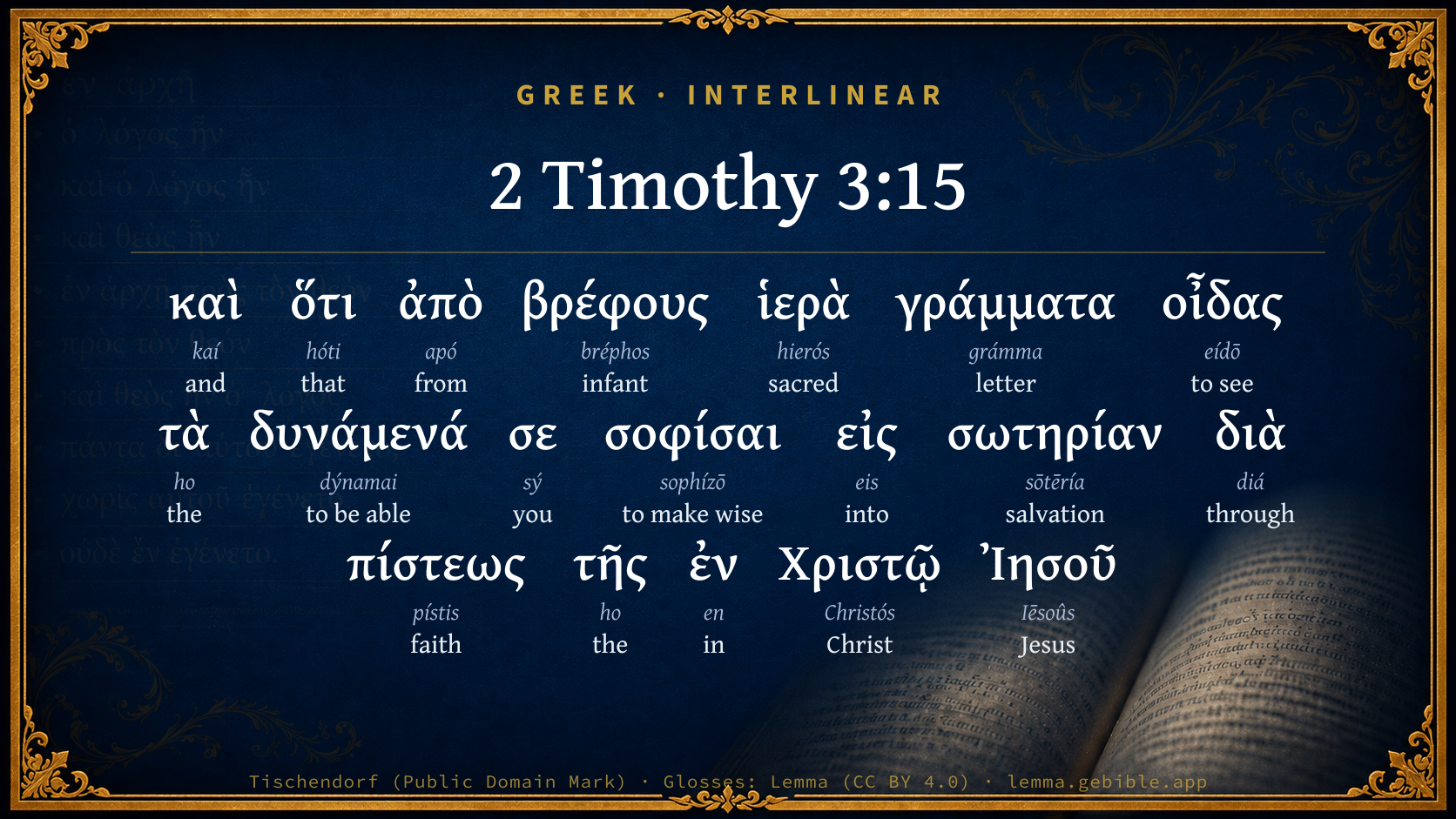
  1. καὶ kaí G2532 “and” Conjunction
  2. ὅτι hóti G3754 “that” Conjunction
  3. ἀπὸ apó G575 “from” Preposition
  4. βρέφους bréphos G1025 “infant” Noun, Genitive, Singular, Neuter
  5. γράμματα grámma G1121 “letter” Noun, Accusative, Plural, Neuter
  6. οἶδας eídō G1492 “to see” Verb, Perfect, Active, Indicative, 2nd person, Singular
  7. τὰ ho G3588 “the” Article, Accusative, Plural, Neuter
  8. δυνάμενά dýnamai G1410 “to be able” Verb, Present, Middle or Passive deponent, Participle, Accusative, Plural, Neuter
  9. σε sý G4771 “you” Personal pronoun, 2nd person, Accusative, Singular
  10. σοφίσαι sophízō G4679 “to make wise” Verb, Aorist, Active, Infinitive
  11. εἰς eis G1519 “into” Preposition
  12. σωτηρίαν sōtēría G4991 “salvation” Noun, Accusative, Singular, Feminine
  13. διὰ diá G1223 “through” Preposition
  14. πίστεως pístis G4102 “faith” Noun, Genitive, Singular, Feminine
  15. τῆς ho G3588 “the” Article, Genitive, Singular, Feminine
  16. ἐν en G1722 “in” Preposition
  17. Χριστῷ Christós G5547 “Christ” Noun, Dative, Singular, Masculine
  18. Ἰησοῦ Iēsoûs G2424 “Jesus” Noun, Dative, Singular, Masculine

About this verse

These counts appear in no published source. They are computed here, from the morphology-tagged text and Lemma’s own curated glosses. What Lemma adds →

19
words
18
distinct lemmas
Pauline Epistles
section

Notable vocabulary

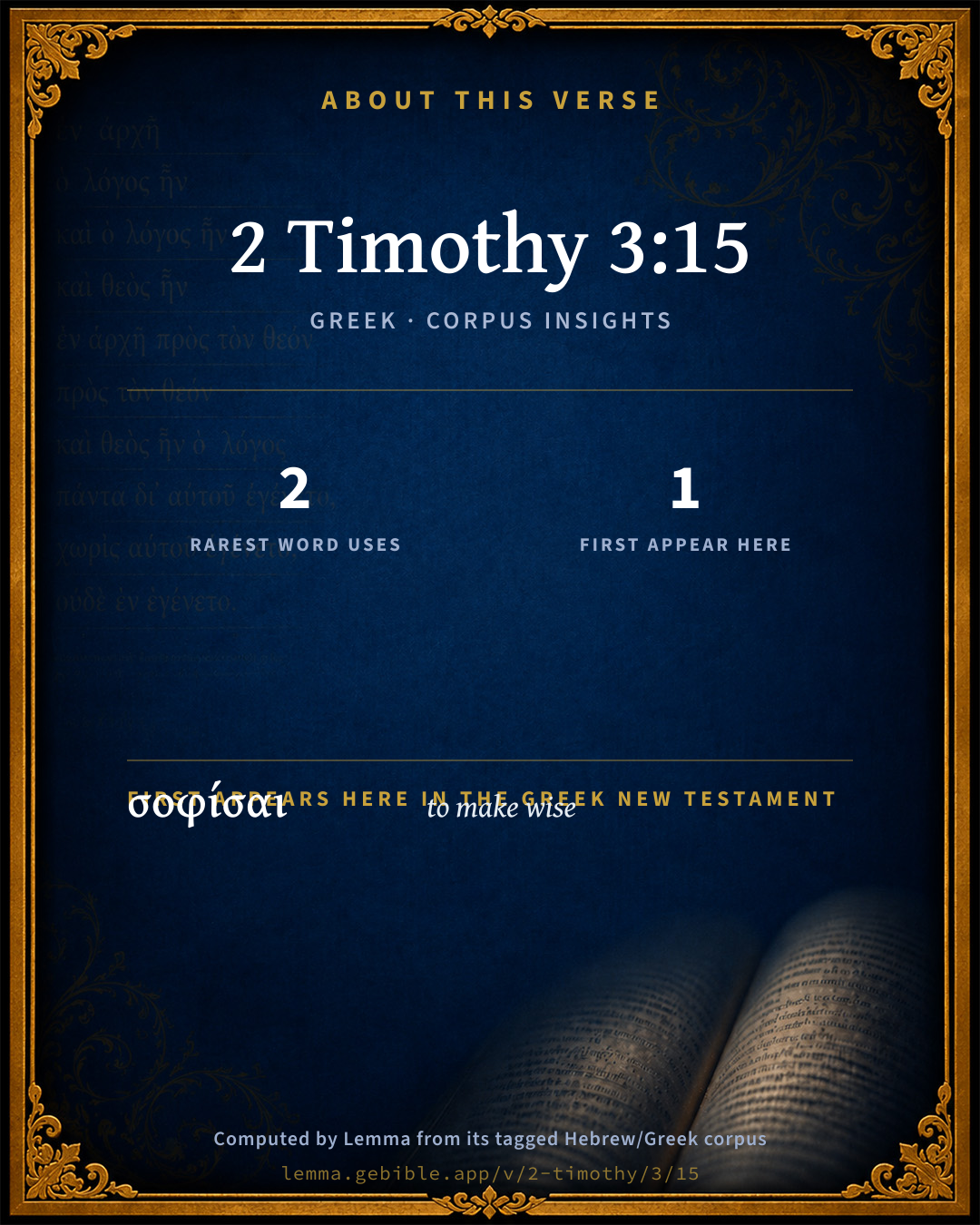
The rarest word here is ἱερὰ sacred G2413 — appearing just 2 times in the whole Greek New Testament.

First appearance in Scripture

This word makes its first canonical appearance in the Greek New Testament here:

  • σοφίσαι to make wise G4679

Shared distinctive vocabulary

ἱερὰ sacred G2413 occurs in 2 verses of the Greek New Testament. Also found in:

Repetition

A word recurs within this verse:

Cross-references

29

Topical passages linked to 2 Timothy 3:15 in the Treasury of Scripture Knowledge — connected by theme and wording, ordered by reader-vote popularity; previews shown in the World English Bible.

  • Psalms 119:98–99 Your commandments make me wiser than my enemies, For your commandments are always with me.
  • Luke 24:45 Then he opened their minds, that they might understand the Scriptures.
  • Proverbs 22:6 Train up a child in the way he should go, And when he is old he will not depart from it.
  • 2 Peter 1:20–21 knowing this first, that no prophecy of Scripture is of private interpretation.
  • Matthew 22:29 But Jesus answered them, "You are mistaken, not knowing the Scriptures, nor the power of God.
  • Luke 24:27 Beginning from Moses and from all the prophets, he explained to them in all the Scriptures the things concerning himself.
  • 1 Corinthians 15:3–4 For I delivered to you first of all that which I also received: that Christ died for our sins according to the Scriptures,
  • 2 Timothy 1:5 having been reminded of the unfeigned faith that is in you; which lived first in your grandmother Lois, and your mother Eunice, and, I am persuaded, in you also.
  • John 5:39–40 "You search the Scriptures, because you think that in them you have eternal life; and these are they which testify about me.
  • Psalms 19:7 Yahweh's law is perfect, restoring the soul. Yahweh's testimony is sure, making wise the simple.
  • Luke 2:40 The child was growing, and was becoming strong in spirit, being filled with wisdom, and the grace of God was upon him.
  • Psalms 71:17 God, you have taught me from my youth. Until now, I have declared your wondrous works.
  • Proverbs 8:17 I love those who love me. Those who seek me diligently will find me.
  • Luke 24:32 They said one to another, "Weren't our hearts burning within us, while he spoke to us along the way, and while he opened the Scriptures to us?"
  • Acts 10:43 All the prophets testify about him, that through his name everyone who believes in him will receive remission of sins."
  • Romans 1:2 which he promised before through his prophets in the holy Scriptures,
  • Romans 16:26
  • 1 Samuel 2:18 But Samuel ministered before Yahweh, being a child, girded with a linen ephod.
  • Acts 17:2 Paul, as was his custom, went in to them, and for three Sabbath days reasoned with them from the Scriptures,
  • 2 Chronicles 34:3 For in the eighth year of his reign, while he was yet young, he began to seek after the God of David his father; and in the twelfth year he began to purge Judah and Jerusalem from the high places, and the Asherim, and the engraved images, and the molten images.
  • Daniel 10:21 But I will tell you that which is inscribed in the writing of truth: and there is none who holds with me against these, but Michael your prince."
  • Acts 13:29 When they had fulfilled all things that were written about him, they took him down from the tree, and laid him in a tomb.
  • Revelation 19:10 I fell down before his feet to worship him. He said to me, "Look! Don't do it! I am a fellow bondservant with you and with your brothers who hold the testimony of Jesus. Worship God, for the testimony of Jesus is the Spirit of Prophecy."
  • Ecclesiastes 12:1 Remember also your Creator in the days of your youth, Before the evil days come, and the years draw near, When you will say, "I have no pleasure in them;"
  • Acts 13:38–39 Be it known to you therefore, brothers, that through this man is proclaimed to you remission of sins,
  • 1 Peter 1:10–12 Concerning this salvation, the prophets sought and searched diligently, who prophesied of the grace that would come to you,
  • 2 Peter 3:16 as also in all of his letters, speaking in them of these things. In those are some things hard to be understood, which the ignorant and unsettled twist, as they also do to the other Scriptures, to their own destruction.
  • 1 John 5:11–12 The testimony is this, that God gave to us eternal life, and this life is in his Son.
  • Luke 1:15 For he will be great in the sight of the Lord, and he will drink no wine nor strong drink. He will be filled with the Holy Spirit, even from his mother's womb.

Cross-references courtesy of OpenBible.info (CC BY 4.0).

Commentary

Notes on 2 Timothy 3:15 from classic Christian and Jewish commentators (each source and its license shown beneath its notes). The classic Christian expositions comment on the surrounding passage and are grouped to its opening verse, so a note may address several verses; the Jewish commentaries on the Tanakh (Rashi and others) are per-verse, so they appear only where the commentator wrote on this verse.

Lemma curates 59 commentaries, every one of them public domain or Creative Commons licensed, each selected and text-cleaned for this edition rather than reprinted as found. About our sources →

Bengel's Gnomon

Johann Albrecht Bengel

2Ti 3:15. Καὶ, and) Even after the death of Paul, Timothy is the more bound to the Scripture. Paul does not bind Timothy to himself alone, but enjoins him who, however grown up, was his son in the faith, to use the Scriptures. They ought to consider this, who are so devoted to their teachers, under whose training they have been once for all brought up, that they admit nothing beyond their circle which is afterwards presented to them from Scripture. Sometimes slothful over-fulness of the mind and αὐθάδεια, self-complacency, creep over men under the name of stedfastness (steadiness) and sobriety.—ἀπὸ βρέφους, from childhood [a child]) Tender age is best adapted for πιστοῦσθαι, being made faithful (assured), so that faith may be impressed upon it, diffusing firmness throughout the whole life.—τὰ ἱερὰ γράμματα, the sacred Scriptures) the books of Moses and the prophets. For these existed when Timothy was a child.—οἶδας, thou hast known) by the instructions of thy mother, ch. 2Ti 1:5.—τὰ δυνάμενα, which were able) The force of a preterite redounds from thou hast known, to the participle. This ability (of Scripture) expresses (its) sufficiency and perfection.—σὲ, thee) in such a way as if they were written for thee alone.—σοφίσαι, to make wise) A grand expression. The antithesis is ἄνοια, folly, 2Ti 3:9.—εἰς σωτηρίαν, to salvation) thy own and that of others.—διὰ πίστεως, through faith) He who does not believe, does not receive wisdom and salvation. Through is construed with salvation.

Bengel's Gnomon of the New Testament — English translation (T&T Clark, Edinburgh, 1860) — public domain. Text from a community e-Sword module.

Meyer's Critical & Exegetical Commentary

Heinrich August Wilhelm Meyer

2Ti_3:15. Καὶ ὅτι] Most expositors, including Wiesinger, Plitt, and Hofmann (Schriftbew. I. pp. 675 f., and so also in his commentary), assume that εἰδώς and ὅτι … οἶδας are co-ordinate sentences giving the reason why. In justification of this irregular construction, Bengel directs us to Joh_2:24-25; Act_22:29; but wrongly.[54]

Beza, on the other hand, gives the right construction by making καὶ ὅτι on dependent on εἰδώς: sciens a quo didiceris, teque a puero sacras literas novisse. This, too, de Wette (van Oosterzee agreeing with him) adopts, correctly remarking that εἰδώς usually denotes not only knowledge, but also reflection.

ἀπὸ βρέφους τὰ ἱερὰ γράμματα οἶδας] ἀπὸ βρέφονς, Mar_9:21 : παιδιόθεν. Chrysostom: ἐκ πεώτης ἡλικίας; comp. Antip. Th. 32: ἐκ βρέθεος. Ἀπὸ βρέφους stands first because it is emphatic; it points back to παρὰ τίων ἔμαθες. In order that he may continue in what he has learned, Timothy is to remember his teacher, and also that he has known the holy Scriptures from childhood.

τὰ ἱερὰ γράμματα] This name for the O. T. only occurs here; in Joh_7:15 without ἱερά; the more usual name is at αἱ γραφαί, with and without ἅγιαι. De Wettes conjecture is quite arbitrary, that the author of the epistle was also thinking here of some writings of the N. T.

τὰ δυνάμενά σε σοφίσαι εἰς σωτηρίαν] τὰ δυνάμενα is present and not preterite (quae poterant, Bengel); it tells us of a permanent characteristic of the O. T. (de Wette, Wiesinger). Σοφίζειν is equivalent to sapientem reddere; to explain the word as synonymous with διδάσκειν is inaccurate. When joined with εἰς σωτηρίαν it is usually taken in the sense: teach the way to holiness; but, as Paul adds διὰ πίστεως κ.τ.λ., which cannot be joined immediately with σωτηρίαν (= τὴν διὰ σωτηρ.), but belongs to σοφίσαι, that interpretation is here unsuitable; he who has faith is already on the way to σωτηρία, or rather is in possession of the σωτηρία. We must therefore adhere to the full signification of σωφίζειν; so that he is speaking here not of the first instruction in salvation, but of the ever deepening knowledge of it, how that furthers the σωτηρία (so, too, Wiesinger, van Oosterzee, Plitt).

διὰ πίστεως τῆς ἐν Χρ. Ἰησοῦ] comp. 1Ti_3:13. Wiesinger rightly remarks that these words are not to be taken as giving the means immanent in the Scriptures, but contain the necessary condition attached to the use of the O. T. (de Wette). Hofmann asserts that σοφ. εἰς σωτηρίαν only denotes an instruction, giving complete acquaintance with salvation; for in order that Timothy might remain in what he had learnt, it was only necessary for the Scripture to teach what he knew. But what any one already knows does not require still to be taught to him; and instruction leading on to knowledge ever more complete, does not hinder him from abiding in what he has already learnt. According to Hofmann, διὰ πίστεως is to be joined with σωτηρίαν, becauseas he strangely enough assertsinstruction by means of faith is a chimera (!).

[54] Hofmann, in regarding the appeal to Act_22:29 as appropriate, overlooks the difference of construction in the two passages. In Act_22:29, two sentences beginning with ὅτι are dependent on ἐπιγνούς, whereas here the first independent sentence would be expressed by a participle (εἰδώς instead of ὅτι οἶδας), to which a sentence beginning with ὅτι is made co-ordinate. This irregularity of construction is manifestly not removed by Hofmanns remark, that the first sentence gives an additional fact, the second furnishes a reason.

Meyer — Critical and Exegetical Commentary on the New Testament — English translation by Peter Christie, edited by Frederick Crombie (T&T Clark, 1880) — public domain. Text from a community e-Sword module.

Expositor's Greek Testament

ed. W. Robertson Nicoll

2Ti 3:15 . καὶ ὅτι : dependent on εἰδώς . For the change of construction, von Soden compares Rom 9:22-23 ; 1Co 14:5 . Timothy’s knowledge of things divine was derived not merely from persons, but from sacred writings; and, perhaps, as Theophylact notes, the two points are emphasised: ( a ) that the persons were of no ordinary merit, and ( b ) that his knowledge of Scripture was conterminous with the whole of his conscious existence. He could not recall a period when he had not known sacred writings. This is the force of the hyperbolic ἀπὸ βρέφους .

ἱερὰ γράμματα : sacras litteras, sacred writings (R.V.). For this use of γράμματα see Joh 7:15 , and Moulton and Milligan, Expositor , vii., vi. 383. The force of this peculiar phrase is that Timothy’s A B C lessons had been of a sacred nature. The usual N.T. equivalent for the Holy Scriptures (A.V.) is αἱ γραφαί or ἡ γραφή (once γραφαὶ ἅγιαι , Rom 1:2 ); but St. Paul here deliberately uses an ambiguous term in order to express vigorously the notion that Timothy’s first lessons were in Holy Scripture. τὰ ἱερὰ γράμματα is found in Josephus, Antiq . Prooem 3 and x. 10, 4, and elsewhere. Cf. παραναγνοὺς τὴν ἱερὰν βίβλον ( 2Ma 8:23 ). There may be also an allusion to γράμματα of the false teachers which were not ἱερά . See on next verse.

σοφίσαι ; instruere, cf . Psa 18 (19):8, ἡ μαρτυρία Κυρίου πιστή , σοφίζουσα νήπια . Also Psa 104 (105):22, 118 (119):98. The word is chosen for its O.T. reference, and also because of its strictly educational association.

εἰς σωτηρίαν : a constant Pauline phrase. See reff.

διὰ πίστεως : to be joined closely with σοφίσαι . Cf. de Imitatione Christi , iii. 2, “Let not Moses nor any prophet speak to me; but speak thou rather, O Lord God, who art the inspirer and enlightener of all the prophets; for thou alone without them canst perfectly instruct me, but they without thee will avail nothing. They may indeed sound forth words, but they do not add to them the Spirit.… They shew the way, but thou givest strength to walk in it,” etc.

The Expositor's Greek Testament, edited by W. Robertson Nicoll (1897–1910) — public domain. Text from a community e-Sword module.

Jamieson, Fausset & Brown

Robert Jamieson, A. R. Fausset & David Brown

from a child--literally, "from an infant." The tender age of the first dawn of reason is that wherein the most lasting impressions of faith may be made.

holy scriptures--The Old Testament taught by his Jewish mother. An undesigned coincidence with Ti2 1:5; Act 16:1-3.

able--in themselves: though through men's own fault they often do not in fact make men savingly alive.

wise unto salvation--that is, wise unto the attainment of salvation. Contrast "folly" (Ti2 3:9). Wise also in extending it to others.

through faith--as the instrument of this wisdom. Each knows divine things only as far as his own experience in himself extends. He who has not faith, has not wisdom or salvation.

which is in--that is, rests on Christ Jesus.

Jamieson, Fausset & Brown — Commentary Critical and Explanatory on the Whole Bible (1871) — public domain (CC PDM 1.0). Text via the HelloAO Bible API.

Adam Clarke's Commentary

Verse 15. From a child thou hast known the Holy Scriptures] The early religious education of Timothy has been already sufficiently noticed; see 2Ti 1:5, and the preface to the first epistle. St. Paul introduces this circumstance again here for the confirmation of Timothy's faith. He had learned the doctrines of Christianity from a genuine apostle; and, as Christianity is founded on the law and the prophets, Timothy was able to compare its doctrines with all that had been typified and predicted, and consequently was assured that the Christian religion was true.

Able to make thee wise unto salvation] The apostle is here evidently speaking of the Jewish Scriptures; and he tells us that they are able to make us wise unto salvation provided we have faith in Jesus Christ. This is the simple use of the Old Testament. No soul of man can be made wise unto salvation by it, but as he refers all to Christ Jesus. The Jews are unsaved though they know these Scriptures, because they believe not in Christ; for Christ is the end of the law for the justification of all that believe.

Adam Clarke's Commentary on the Bible (1810–1826) — public domain. Text from a community e-Sword/MySword module.

John Calvin's Commentaries

15 And that from (thy) childhood This was also no ordinary addition, that he had been accustomed, from his infancy, to the reading of the Scripture; for this long habit may make a man much more strongly fortified against every kind of deception. It was therefore a judicious caution observed in ancient times, that those who were intended for the ministry of the word should be instructed, from their infancy, in the solid doctrine of godliness, that, when they came to the performance of their office, they might not be untried apprentices. And it ought to be reckoned a remarkable instance of the kindness of God, if any person, from his earliest years, has thus acquired a knowledge of the Scriptures.

Which are able to make thee wise unto salvation It is a very high commendation of the Holy Scriptures, that we must not seek anywhere else the wisdom which is sufficient for salvation; as the next verse also expresses more fully. But he states, at the same time, what we ought to seek in the Scripture; for the false prophets also make use of it as a pretext; and therefore, in order that it may be useful to us for salvation, it is necessary to understand the right use of it.

Through faith, which is in Christ Jesus What if any one give his whole attention to curious questions? What if he adhere to the mere letter of the law, and do not seek Christ? What if he pervert the natural meaning by inventions that are foreign to it? For this reason he directs us to the faith of Christ as the design, and therefore as the sum, of the Scriptures; for on faith depends also what immediately follows.

John Calvin's Commentaries (1540-1563) — public domain. Text from the Calvin Translation Society English edition (1840s-50s) via the Christian Classics Ethereal Library (ccel.org). Calvin's coverage is partial (roughly two-thirds of the Bible); uncommented books and verses are honest gaps, never fabricated. The 19th-century editor's footnotes and remarks are omitted so the notes are faithfully Calvin's own voice.

Ellicott's Commentary for English Readers

(15) And that from a child thou hast known the holy scriptures.—The Greek words translated “from a child” should be rendered, from a very child, as the word denotes that Timothy’s instruction in the Holy Scriptures began at a very early and tender age.

The holy scriptures.—Literally, the sacred writings. The Scriptures of the Old Testament are here exclusively meant. The expression “writings” for the Scriptures is not found elsewhere in the New Testament; it is, however, used by Josephus.

Two powerful arguments have been here used by the Apostle to induce Timothy to remain steadfast to the great doctrines of faith, and neither to take anything from them or to add anything to them. The first presses upon him the source whence he had learned them. He, better than any one, knew who and what St. Paul was, and the position he held with his brother Apostles, as one who had been in direct communication with the Lord Himself; and the second reminded him of his own early training, under his pious mother. He appealed, as it were, to Timothy’s own deep knowledge of those Old Testament Scriptures. St. Paul’s disciple would know that the great Christian doctrines respecting the Messiah were all based strictly on these Old Testament writings. Timothy had a double reason for keeping to the old paths pointed out by the first generation of teachers. He knew the authority of the master who instructed him; and then, from his own early and thorough knowledge of the Scriptures of the Jews, he was able to test thoroughly whether or no his master’s teaching was in accordance with those sacred documents.

Which are able to make thee wise unto salvation.—The present participle rendered by “which are able” is noticeable, being here used to express the ever-present power of the Scriptures on the human heart. The Holy Scriptures had not completed their work on Timothy when, in his boyhood, he first mastered their contents. It was still going on. “Wise unto salvation” marks the glorious end and destination of the true wisdom which is gained by a study of these sacred books. Other wisdom has a different goal. In some cases it leads to power, fame, wealth; but this wisdom leads only to one goal—salvation. The last clause—“through faith which is in Christ Jesus”—points out the only way to use these Scriptures of the old covenant so as to attain through them the goal of all true wisdom—“eternal salvation.” They must be read and studied in the light of faith in Jesus Christ. “Those (Old Testament) Scriptures, he (St. Paul) granteth, were able to make him wise unto salvation;” but, he addeth, “through the faith which is in Christ” (Hooker, Ecc. Polity, i. 14, 4). Faith in Jesus must be the torch by the light of which these ancient prophecies and types must be read.

A Bible Commentary for English Readers, edited by Charles John Ellicott (1878–1897) — public domain. Text from a community e-Sword module.

The Cambridge Bible for Schools and Colleges

gen. ed. J. J. S. Perowne

15. from a child] Lit. from a babe; the word occurs four times in St Luke’s ‘Gospel of the Infancy,’ ch. 1 and 2, and again Luk_18:15; Act_7:19.

thou hast known] Lit. ‘thou knowest,’ the perfect having this present force, and the Greek idiom in a phrase like this using the present where we use the perfect definite. The meaning is that there has been a continued knowledge present always ‘from a babe’ and present now. So in Joh_15:27, ‘ye are, i.e. have been, with me from the beginning,’ cf. Winer, iii. § 40.

the holy scriptures] Lit. ‘the sacred writings’ of the Old Testament. It was a requirement of the Rabbis that a child should begin to learn the Law by heart when five years old. ‘Raf said to Samuel, the son of Schilath, a teacher, “Do not take the boy to be taught before he is six years old, but from that year receive him, and train him as you do the ox, which, day by day, bears a heavier load.” Philo, a contemporary of our Lord, says, “They are taught, so to speak, from their very swaddling clothes by their parents, masters and teachers, in the holy laws, and in the unwritten customs, and to believe in God, the one Father and Creator of the world,” (Legal. ad Caium, § 16). At the age of thirteen he became a “son of the Law,” and was bound to practise all its moral and ritual requirements.’ Geikie, Life of Christ, i. 173.

The original word for ‘scriptures’ is used of Moses’ writings Joh_5:47, where Westcott well points out that it ‘appears to mark the specific form rather than the general scope of the record’ which is denoted by the word used in 2Ti_3:16.

which are able] Present participle, in harmony with the present sense of ‘thou hast known,’ and marking the abiding continuous power of the Holy Scripture.

to make thee wise] The verb occurs here only in N.T.; its participle in 2Pe_1:16, ‘cunningly devised’; the tense is aorist according to the proper use of the aorist, to give the idea of the verb in its most general form, ‘the scriptures have this capacity of making wise.’

through faith which is in Christ Jesus] See note on 1Ti_3:13; the clause belongs to the verb ‘make wise,’ not to the noun ‘salvation.’ The doctrine and scheme of Christianity is required to illuminate the precept and history of the Old Testament. ‘In vetere Testamento latet novum, in novo vetus patet.’ Ellicott quotes Hooker, Eccl. Pol. i. 14. ‘The Old did make wise by teaching Salvation through Christ that should come, the New by teaching that Christ the Saviour is come.’ Cf. also Art. vii. in the English Prayer Book, ‘The Old Testament is not contrary to the New; for both in the Old and New Testament everlasting life is offered to mankind by Christ.’

The Cambridge Bible for Schools and Colleges (gen. ed. J. J. S. Perowne; Cambridge University Press, 1878–1918) — public domain. Text from a community e-Sword module.

John Gill's Exposition

All Scripture is given by inspiration of God,.... That is, all holy Scripture; for of that only the apostle is speaking; and he means the whole of it; not only the books of the Old Testament, but of the New, the greatest part of which was now written; for this second epistle to Timothy is by some thought to be the last of Paul's epistles; and this also will hold good of what was to be written; for all is inspired by God, or breathed by him: the Scriptures are the breath of God, the word of God and not men; they are "written by the Spirit", as the Syriac version renders it; or "by the Spirit of God", as the Ethiopic version. The Scriptures are here commended, from the divine authority of them; and which is attested and confirmed by various arguments; as the majesty and loftiness of their style, which in many places is inimitable by men; the sublimity of the matter contained in them, which transcends all human understanding and capacity ever to have attained unto and discovered; as the trinity of persons in the Godhead, the incarnation of Christ, the resurrection of the dead, &c. The purity and holiness of them before observed, show them to be the word of him that is of purer eyes than to behold iniquity; as also their harmony and agreement, though wrote by different persons, in different places, and ages, and at sundry times, and in divers manners; what seeming inconsistencies are observed in them may, with labour and industry, by divine assistance, be reconciled. The predictions of future events in them, as particularly concerning Josiah and Cyrus, by name, long before they were born, and especially concerning Jesus Christ, and which have had their accomplishment, and many others in the New Testament both by Christ and his apostles, are a proof that they could not be the writings of men, but must have the omniscient God for their author; the impartiality of the writers of them, in not concealing the mean extract of some of them, the sins of others before conversion, and even their sins and failings afterwards, as well as those of their nearest relations and dearest friends, strengthens the proof of their divine authority; to which may be added, the wonderful preservation of them, through all the changes and declensions of the Jewish church and state, to whom the books of the Old Testament were committed; and notwithstanding the violence and malice of Heathen persecutors, particularly Dioclesian, who sought to destroy every copy of the Scriptures, and published an edict for that purpose, and notwithstanding the numbers of heretics, and who have been in power, as also the apostasy of the church of Rome; and yet these writings have been preserved, and kept pure and incorrupt, which is not the case of other writings; nor are there any of such antiquity as the oldest of these: to which may be subjoined the testimony of God himself; his outward testimony by miracles, wrought by Moses and the prophets, concerned in the writings of the Old Testament, and by the apostles in the New; and his internal testimony, which is the efficacy of these Scriptures on the hearts of men; the reading and hearing of which, having been owned for the conversion, comfort and edification of thousands and thousands, and ten thousand times ten thousand: and

is profitable for doctrine; for the discovering, illustrating, and confirming any doctrine concerning God, the being, persons, and perfections of God; concerning the creation and fall of man; concerning the person and offices of Christ, redemption by him, justification by his righteousness, pardon by his blood, reconciliation and atonement by his sacrifice, and eternal life through him, with many others. The Scripture is profitable for ministers to fetch doctrine from, and establish it by; and for hearers to try and prove it by:

for reproof; of errors and heresies; this is the sword of the Spirit, which cuts all down. There never was, nor is, nor can be any error or heresy broached in the world, but there is a sufficient refutation of it in the Scriptures; which may be profitably used for that purpose, as it often has been by Christ and his apostles, and others since in all ages:

for correction; of vice; there being no sin, but the evil nature of it is shown, its wicked tendency is exposed, and the sad effects and consequences of it are pointed out in these writings: for instruction in righteousness; in every branch of duty incumbent upon men; whether with respect to God, or one another; for there is no duty men are obliged unto, but the nature, use, and excellency of it, are here shown: the Scriptures are a perfect rule of faith and practice; and thus they are commended from the usefulness and profitableness of them.

John Gill's Exposition of the Whole Bible (1746–1763) — public domain (CC PDM 1.0). Text via the HelloAO Bible API.

Trapp's Complete Commentary

John Trapp

15 And that from a child thou hast known the holy scriptures, which are able to make thee wise unto salvation through faith which is in Christ Jesus.

Ver. 15. And that from a child] Gr. απο βρεφους, from a suckling. As all children, so those especially that are dedicated to the work of the ministry, should be betimes inured to Scripture learning. {See Trapp on "1Ti 4:6"} The story of Mistress Elizabeth Wheatenhall, daughter of Mr Anthony Wheatenhall, of Tenterden in Kent, late deceased, is very memorable. She being brought up by her aunt, the Lady Wheatenhall, before she was nine years old (not much above eight), could say all the New Testament by heart; yea, being asked where any words thereof were, she would presently name book, chapter, and verse. Timothy was so sweet a child, that if that had not been his name, it might have been his surname, as Vopiscus saith of Probus the emperor. (David’s Love to God’s Word, by Mr Stoughton. Epist. to Reader.)

To make thee wise] Gr. σε σοφισαι, to wise thee, that thou mayest wise others, as Dan 12:3. The same Hebrew word שבל signifieth, 1. To understand; 2. To instruct others; 3. To prosper.

To salvation] He is the wise man that provides for eternity. And when all the world’s wizards shall very wisely cry out in hell, Nos insensati, We fools counted their lives madness; they shall shine as the brightness of the firmament, Dan 12:3. Sapientes sapienter descendunt in infernum.

John Trapp, A Commentary or Exposition upon All the Books of the Old and New Testament (1647–1656) — public domain. Text from a community e-Sword module.

Albert Barnes' Notes on the Bible

And that from a child thou hast known the holy Scriptures - That is, the Old Testament; for the New Testament was not then written; see the notes at Joh 5:39. The mother of Timothy was a pious Hebrewess, and regarded it as one of the duties of her religion to train her son in the careful knowledge of the word of God. This was regarded by the Hebrews as an important duty of religion, and there is reason to believe that it was commonly faithfully performed. The Jewish writings abound with lessons on this subject. Rabbi Judah says, “The boy of five years of age ought to apply to the study of the sacred Scriptures.” Rabbi Solomon, on Deu 11:19, says, “When the boy begins to talk, his father ought to converse with him in the sacred language, and to teach him the law; if he does not do that, he seems to bury him.” See numerous instances referred to in Wetstein, in loc. The expression used by Paul - “from a child” (ἀπὸ βρέφους apo brephous) - does not make it certain at precisely what age Timothy was first instructed in the Scriptures, though it would denote an “early” age. The word used - βρέφος brephos - denotes:

(1)A babe unborn, Luk 1:41, Luk 1:44;

(2)An infant, babe, suckling.

In the New Testament, it is rendered “babe and babes,” Luk 1:41, Luk 1:44; Luk 2:12, Luk 2:16; 1Pe 2:2; “infants,” Luk 8:15; and “young children,” Act 7:19. It does not elsewhere occur, and its current use would make it probable that Timothy had been taught the Scriptures as soon as he was capable of learning anything. Dr. Doddridge correctly renders it here “from infancy.” It may be remarked then,

(1) That it is proper to teach the Bible to children at as early a period of life as possible.

(2) That there is reason to hope that such instruction will not be forgotten, but will have a salutary influence on their future lives. The piety of Timothy is traced by the apostle to the fact that he had been early taught to read the Scriptures, and a great proportion of those who are in the church have been early made acquainted with the Bible.

(3) It is proper to teach the “Old” Testament to children - since this was all that Timothy had, and this was made the means of his salvation.

(4) We may see the utility of Sunday schools. The great, and almost the sole object of such schools is to teach the Bible, and from the view which Paul had of the advantage to Timothy of having been early made acquainted with the Bible, there can be no doubt that if Sunday-schools had then been in existence, he would have been their hearty patron and friend.

Which are able to make thee wise unto salvation - So to instruct you in the way of salvation, that you may find the path to life. Hence, learn:

(1) That the plan of salvation may be learned from the Old Testament. It is not as clearly revealed there as it is in the New, but “it is there;” and if a man had only the Old Testament, he might find the way to be saved. The Jew, then, has no excuse if he is not saved.

(2) The Scriptures have “power.” They are “able to make one wise to salvation.” They are not a cold, tame, dead thing. There is no book that has so much “power” as the Bible; none that is so efficient in moving the hearts, and consciences, and intellects of mankind. There is no book that has moved so many minds; none that has produced so deep and permanent effects on the world.

(3) To find the way of salvation, is the best kind of wisdom; and none are wise who do not make that the great object of life.

Through faith which is in Christ Jesus; - see the Mar 16:16 note; Rom 1:17 note. Paul knew of no salvation, except through the Lord Jesus. He says, therefore, that the study of the Scriptures, valuable as they were, would not save the soul unless there was faith in the Redeemer; and it is implied, also, that the proper effect of a careful study of the “Old” Testament, would be to lead one to put his trust in the Messiah.

Albert Barnes' Notes on the Bible (1834–1885) — public domain. Text from a community e-Sword/MySword module.

Matthew Poole's English Annotations

And that from a child; from thy infancy, by the instruction of thy mother Eunice, and thy grandmother Lois, 2Ti 1:5.

Thou hast known the Holy Scriptures; thou hast had a notion of the writings of Moses and the prophets, the Holy Scriptures of the Old Testament, for at this time no others were written.

Which are able to make thee wise unto salvation; which Holy Scriptures (without the help of the writings of Plato or Pythagoras, or any other pagan philosophers) have in them a sufficiency of doctrine to make thee, or any other, wise enough to get to heaven.

Through faith which is in Christ Jesus; but not without a faith in Christ Jesus, receiving him as thy and their Saviour, besides a faith assenting and agreeing to those holy writings as the revelation of the Divine will.

Matthew Poole's English Annotations on the Holy Bible (1683–1685) — public domain. Text from a community e-Sword/MySword module.

Whedon's Commentary on the Bible

Daniel D. Whedon

15. And—This Christ history derived from the original witnesses was fully in accord with the Old Testament, in which Timothy’s childhood was indoctrinated.

Holy Scriptures—The Old Testament, either in the Hebrew, or in the Septuagint translation thereof into Greek, or both. For although Eunice’s husband was a Greek, the old Bible ruled in her system of education.

Are able—With thy proper use of them.

To make thee wise—Being, as they are, predictive, both by spoken prophecy and by sacrificial ritual, of the true Saviour.

Unto salvation—From Jewish, pagan, and Gnostic error, from sin, condemnation, and death.

Through faith—Since it is only as our faith embraces them that they are powerful in us.

Daniel D. Whedon (gen. ed.), Commentary on the Old and New Testaments (1874–1909) — public domain. Text from a community e-Sword module.

The Pulpit Commentary

Babe for child, A.V; sacred writings for Holy Scriptures, A.V And that from a babe, etc. Another consideration urged as a reason for standing fast. He was no novice in the Scriptures. His mother and grandmother had been careful to imbue him with that sacred literature which should make him wise unto salvation through faith in Jesus Christ, from his very earliest years. Surely he would not throw away such a precious advantage. The sacred writings (ta iJerammata); literally, the holy letters, or learning. An ordinarily educated child learns grammata, (Joh_7:15) in contradistinction to the uneducated, who are ajgrammatoi. (Act_4:13) But Timothy had learnt ta iJerammata, whose excellence is described in the next verse.

The Pulpit Commentary (1880–1919), ed. H.D.M. Spence-Jones & Joseph S. Exell — public domain. Text from a community e-Sword module.

John Wesley's Explanatory Notes

From an infant thou hast known the holy scriptures - Of the Old Testament. These only were extant when Timothy was an infant. Which are able to make thee wise unto salvation, through faith in the Messiah that was to come. How much more are the Old and New Testament together able, in God's hand, to make us more abundantly wise unto salvation! Even such a measure of present salvation as was not known before Jesus was glorified.

John Wesley, Explanatory Notes Upon the Whole Bible (1754–1765) — public domain. Text via the GEBible commentary corpus.

Fairbairn on Ezekiel, Jonah & the Pastoral Epistles

Patrick Fairbairn

Ver. 15. And that from a very child (ἀπὸ βρέφους, from an infant, the youngest period of childhood) thou knowest the holy Scriptures, which are able to make thee wise unto salvation. This is only a further specification and enhancement of the preceding statement, bringing out more distinctly the kind of learning Timothy had received, and from what period it dated. The expression τὰ ἱερὰ γράμματα for the divine word is peculiar, so far as the New Testament is concerned; but it occurs in Philo and Josephus (see in Wetstein), and always in the definite sense, the sacred writings, or the Holy Scriptures, namely, of the Old Testament. Here also, of course, it is Old Testament Scripture that is meant. And the things contained in them are represented as still possessed of saving virtue—possessing it even for such a believer as Timothy: which are able (δυνάμενά, the present, not the past, as the οἶδας, knowest, virtually is) to make thee wise unto salvation—σοφίσαι εἰς σωτηρίαν (the verb used in this sense also, Septuagint, Psa 19:7, Psa 105:22); yet not now as apart from the revelation of Christ in the gospel, but through the faith which is in Christ Jesus (or, through faith—that, namely, which is in Christ Jesus). When ability to such an extent is ascribed to the Old Testament Scriptures, instrumental agency is all that can be meant—available means in regard to salvation when intelligently and faithfully used; which they can be now only as handmaids to the faith in Christ—the end to which they all more or less pointed; not when employed as a barrier to keep men at a distance from Christ, as if they were in themselves God’s perfected revelation. It was necessary that the apostle should thus guard himself in respect to Old Testament Scripture, considering the abuse to which the unbelieving Jews were ever applying it. But having so guarded himself, he proceeds in the next two verses to give a fuller deliverance of his sentiments respecting the value and importance of sacred Scripture.

Patrick Fairbairn — An Exposition of Ezekiel (1851), Jonah (1849), and The Pastoral Epistles (1874) — public domain. Text from a community e-Sword module.

Scofield Reference Notes

C. I. Scofield

salvation

(See Scofield "Rom 1:16").

The Scofield Reference Bible (1917 edition), notes by C. I. Scofield — public domain. Text from a community e-Sword module.

The People's New Testament

B. W. Johnson

15. And that from a child. Taught by his grandmother, Lois, and his mother, Eunice, he had learned to know the Scriptures from childhood. Holy Scriptures. The Books given by inspiration. The Jewish Scriptures are primarily meant, but a part of the New Testament was already written. Make thee wise. Give thee the wisdom that leads to salvation. If the Old Testament could make him wise, how much more the New! Through faith which is in Christ Jesus. This is essential. Unless the Scriptures lead to Christ, there is no salvation.

B. W. Johnson's The People's New Testament with Notes (1889–1891) — public domain. Electronic text from the Christian Classics Ethereal Library (CCEL) ThML edition.

Cambridge Greek Testament for Schools and Colleges

15–17. THE USES OF HOLY SCRIPTURE

15. τὰ ἱερά. The rec. text has the article, following AC*D2cEKLP; it is omitted by Tischendorf and WH as by אCbD2*G17. It may have come in from the τά a few words further on. Lachmann and Tregelles put it in brackets.

15. καὶ ὄτι, and that, not ‘because’; ὄτι depends upon εἰδώς.

ἀπὸ βρέφους, from a babe; cp. 2Ti 1:5. It was the custom to teach Jewish children the law at a very early age, and to cause them to commit parts of it to memory.

τὰ ἱερὰ γράμματα οἶδας, thou hast known the sacred writings. The reading (see critical note) is uncertain; if we omit the article before ἱερά, it would be necessary to translate ‘thou didst know sacred writings,’ γράμματα being used as at Joh 5:47; Joh 7:16. But τὰ ἱερὰ γράμματα is a quasi-technical expression in Philo (Vit. Mos. III. 39 and Fragm. in Exod. Mangey’s ed. II. 657, and cp. de Vit. cont. 3) and in Josephus (Ant. Proem. 3 and 10:10. 4) for the Scriptures of the Old Testament[520], and, when this is borne in mind, the manuscript attestation to τά seems amply sufficient.

[520] Of Christian writers, the first to apply this phrase to the N.T. is Clement of Alexandria (Strom. I. 20 § 98); he is also the first to call the N.T. θεόπνευστος (Strom. VII. 16 § 101).

This is the only place in the N.T. where the epithet ἱερός, sacer, ‘hallowed’ or ‘sacred,’ as contrasted with profane (a quite different adjective from ἅγιος, sanctus, ‘holy,’ which points to the work of the Divine Spirit), is applied to Scripture; but it is frequently so applied both before and after the Apostolic age. Cp. e.g. 2Ma 8:23, τὴν ἱερὰν βίβλον, and Clem. Rom. § 53 τὰς ἱερὰς γραφάς &c.

τὰ δυνάμενά σε σοφίσαι εἰς σωτηρίαν, which are able to make thee wise unto salvation. The present participle δυνάμενα expresses the continuous and abiding power of Scripture; it is not only fitted σοφίζειν νήπια (Psa 19:8), but it is as valuable to Timothy the bishop as to Timothy the child: cp. Psa 119:98. The words εἰς σωτηρίαν are important, as clearly expressing the kind of wisdom which Scripture supplies. The significance of the O.T. is not that it contains an account of the creation of man or the history of the fortunes of Israel; its aim is not knowledge, whether scientific or historical, but wisdom, and that εἰς σωτηρίαν. σωτηρία, the Salvation of man, is the final purpose of the whole Bible. On this great theme it tells enough to make men wise; it contains “all things necessary to salvation” (Art. vi.), and so candidates for the priesthood are required at ordination to declare in the words of the Apostle their persuasion that “the holy Scriptures contain sufficiently all doctrine required of necessity for eternal salvation through faith in Jesus Christ.” “If we be ignorant,” say the Translators of our A.V. to their readers, “they will instruct us; if out of the way, they will bring us home; if out of order, they will reform us; if in heaviness, comfort us; if dull, quicken us; if cold, inflame us. Tolle, lege; tolle, lege.”

διὰ πίστεως τῆς ἐν Χριστῷ Ἰησοῦ. Faith in Christ Jesus (see 1Ti 3:13) is the instrument, as it were, through which the σωτηρία, expounded in Scripture, may be grasped. And this limiting clause provides at once the link between O.T. and N.T., so that what St Paul said to Timothy about the O.T. may also be applied to the N.T., “the difference between them consisting in this, that the Old did make wise by teaching salvation through Christ that should come, the New by teaching that Christ the Saviour is come” (Hooker, E. P. I. xiv. 4).

Cambridge Greek Testament for Schools and Colleges (Cambridge University Press, 1896; 21 vols, various authors incl. Carr, Maclear, Plummer, Farrar, Lumby, Moule, M. R. James, Simcox) — public domain. Text from a community e-Sword module.

International Critical Commentary

15. ἀπὸ βρέφους] The Jewish parent’s duty was to teach his child the Law when in his fifth year; cf. Philo, Leg. ad Caium, p. 562, c. 16, δεδιδαγμένους ἐξ αὐτῶν τρόπον τινὰ σπαργάνων ὑπὸ γονέων; cf. Joseph. c. Apion. I. 12; Susanna 3, 4 Mac 18:9.

ἱερὰ γράμματα] The reference is doubtless to the O.T. (cf. Test. XII. Patr., Levi xiii. 2, infra); but he does not use the full phrase, “the Holy Scriptures,” τὰ ἱερὰ γράμματα (common in Josephus), or τὰς ἱερὰς γραφάς, but ἱερὰ γρ. (a) Because he is laying stress on Timothy’s knowledge, and uses a technical phrase of education—“religious teaching,” “sacred letters”; cf. Joh 7:15 πῶς οὗτος γράμματα οἶδε, μὴ μεμαθηκώς: Isa 29:11 ἀνθρώπῳ ἐπισταμένῳ γράμματα: Test. XII. Patr., Levi xiii. 2, διδάξατε δὲ καὶ ὑμεῖς τὰ τέκνα ὑμῶν γράμματα ἵνα ἔχωσιν σύνεσιν . . . ἀναγινώσκοντες ἀδιαλείπτως τὸν νόμον. For instances from the papyri, cf. M.M. s.vv. γράμμα and ἀγράμματος.

(b) Possibly also he wishes to hint at an antithesis both to the unwritten myths and genealogies of the false teachers and to the Ἐφέσια γράμματα, the sacred books and charms of the magicians at Ephesus, Act 19:19 (Encycl. B. ii. col. 1304). Your text-books were Scriptures, not tradition; they were ἱερά, not βέβηλα.

σοφίσαι] a contrast to ἄνοια (9) and πλανώμενοι (13), with perhaps a reminiscence of Psa 18:8 ἡ μαρτυρία Κυρίου πιστή, σοφίζουσα νήπια (cf. ἀπὸ βρέφους)

εἰς σωτηρίαν] “tuam et aliorum,” Bengel; cf. I. 4:16.

διὰ πίστεως] if combined with faith, not otherwise; cf. Joh 5:39-47.

International Critical Commentary — older volumes (1896–1929), various authors — public domain. Text from a community e-Sword module.

Vincent's Word Studies in the New Testament

Marvin R. Vincent

From a child [απο βρεφους] . Mostly in Luke. o P. Only here in Pastorals. See on 1Pe 2:2. Comp. Mr 9:21, ejk paidioqen from a child.

The holy Scriptures [ιερα γραμματα] . Note particularly the absence of the article. Grammata is used in N. T. in several senses. Of characters of the alphabet (2Co 3:7; Gal 6:11) : of a document (Luk 16:6, take thy bill) : of epistles (Act 28:21) : of the writings of an author collectively (Jas 5:4 7) : of learning (Act 26:24, polla grammatra much learning). In LXX, ejpistamenov grammata knowing how to read (Isa 29:11, 12). The Holy Scriptures are nowhere called iJera grammata in N. T. In LXX, grammata is never used of sacred writings of any kind. Both Josephus and Philo use ta iJera grammata for the O. T. Scriptures. 142 The words here should be rendered sacred learning. The books in the writer's mind were no doubt the Old Testament. Scriptures, in which Timothy, like every Jewish boy, had been instructed; but he does not mean to designate those books as iJera grammata. He means the learning acquired from Scripture by the rabbinic methods, according to which the Old Testament books were carefully searched for meanings hidden in each word and letter, and especially for messianic intimations. Specimens of such learning may be seen here and there in the writings of Paul as 1Co 9:9 f.; 1Co 10:1 f.; Gal 3:16f.; Gal 4:21 f. In Act 4:13, the council, having heard Peter's speech, in which he interpreted Psa 118:22 and Isa 28:16 of Christ, at once perceived that Peter and John were ajgrammatoi, not versed in the methods of the schools. Before Agrippa, Paul drew thc doctline of the Resurrection from the Old Testament, whereupon Festus exclaimed, "much learning (polla grammata, thy acquaintanee with the exegesis of the schools) hath made thee made (Act 26:24). To Agrippa, who was" expert in all customs and questions which are among the Jews "(Act 26:3), the address of Paul, a pulpil of Hillel, was not surprising, although he declared that Paul 's reasoning did not appeal to him. In Joh 7:15, when Jesus taught in the temple, the. Jews wondered and said : the;" How knoweth this man letters? " That a. Jew should know the Scriptures was not strange The wonder lay in the exegetical skill of one who had not been trained by the literary methods of the time.

To make thee wise [σε σοφισαι] . Only hero and 2Pe 1:16;. See note there on cunningly devised. To give thee understanding of that which lies behind the letter; to enable thee to detect in the Old Testaments. books various hidden allusions to Christ; to draw from the Old Testaments the mystery of messianic salvation, and to interpret the Old Testaments with Christ as the key. This gives significance to the following words through faith which is in Christ, Jesus. Jesus Christ was the key of Scripture, and through faith in him Shripture became a power unto salvation. The false teachers also had their learning but used it in expounding Jewish fables, genealogies, etc. Hence, their expositions, instead of making wise unto salvation, were vain babblings; profane and old wives ' fables (1Ti 4:7; 2Ti 2:16). Const. through faith, etc., with make wise, not with salvation.

Marvin R. Vincent, Word Studies in the New Testament (1887–1900) — public domain. Text from a community e-Sword/MySword module.

Lesson kit

Teaching starters — assembled from the data on this page, not authored interpretation. Every prompt links to the verse data it draws on. Edit before teaching.

2 Timothy, in the Pauline Epistles, opens this verse with 19 words (18 distinct Greek lemmas). Its most distinctive word is hierós (“sacred”). A historical commentator’s framing appears above. Read the whole chapter for the surrounding context.

Discussion questions

  1. The word hierós carries the sense “sacred.” How does it shape the verse?
  2. This is the first place “to make wise” appears in Scripture (first appears here). What does its debut here establish?
  3. How does 1 Corinthians 9:13, which shares the word «sacred», read alongside this verse?
  4. What does the repetition of “the” (2× in this one verse) do in this verse?
  5. The translations on this page render this verse differently — a whole-verse word diff, not a word-by-word alignment. What might account for the different wordings?
  6. Compare how Bengel's Gnomon and Meyer's Critical & Exegetical Commentary read this verse. Where do they agree or differ?

Things to notice

  • 1 word makes its first canonical appearance in Scripture here.
  • These translations choose different wording for 8 words in this verse.
  • “the” occurs 2× in this single verse.
  • 18 distinct Greek lemmas span 19 words in this verse.

Reading settings

Reading text

Shown beneath each verse's original-language words.

Old Testament
Old Testament edition

Read the OT as the Masoretic Hebrew (MT) or the Greek Septuagint (LXX).

English shown for the Greek Septuagint (in the Hebrew ↔ Greek comparison).

Comparing translations? Open the Compare panel on any verse page to stack up to four side by side.