
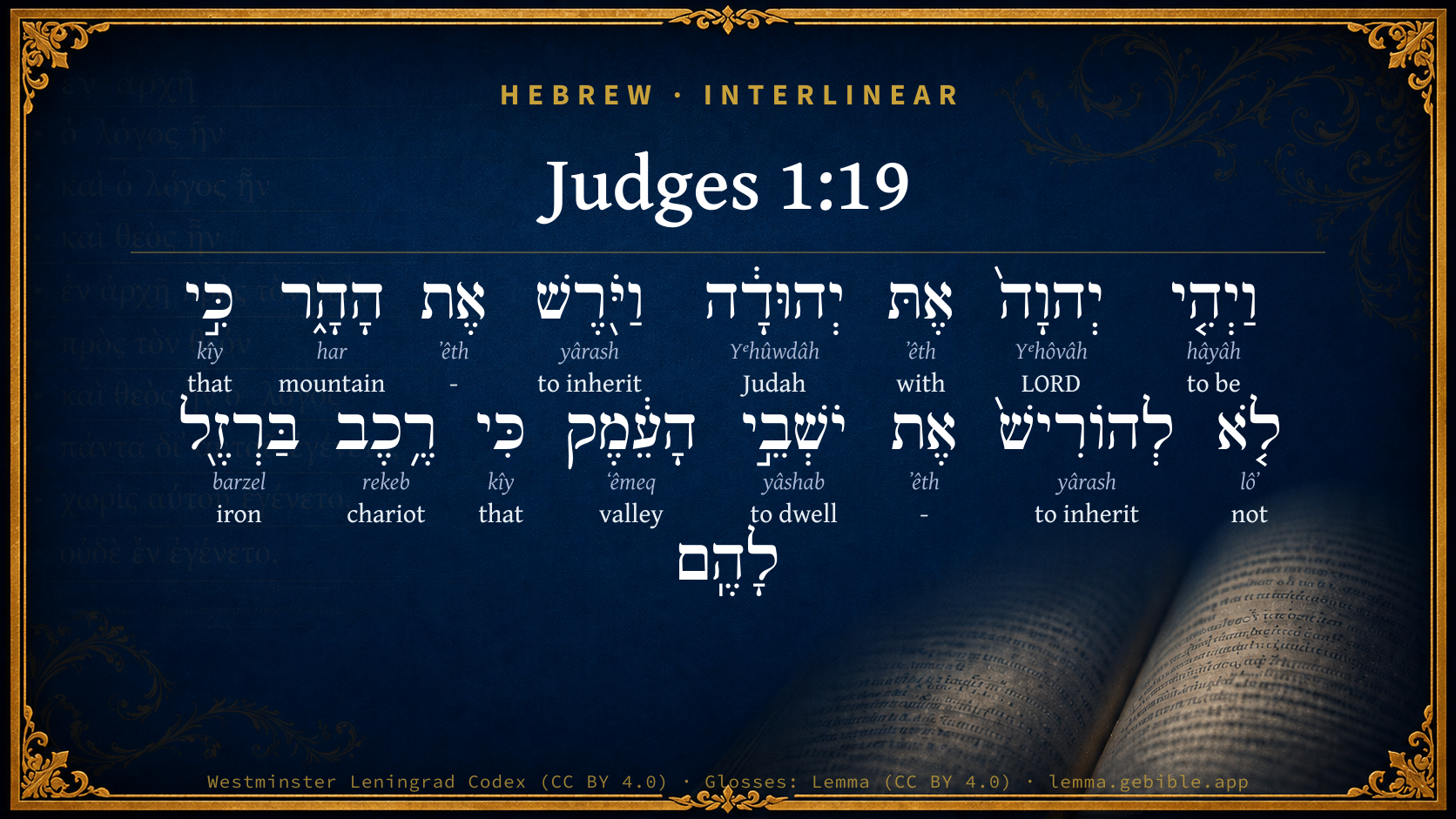
Judges 1:19

Hebrew (Westminster Leningrad Codex) Judges 1:19 appears in the Hebrew Old Testament. The text above is from the Westminster Leningrad Codex. Each word links to its Strong’s number, a concise gloss, and parsing drawn from the Open Scriptures Hebrew Bible morphology. Click any word for its full Brown-Driver-Briggs (BDB) entry.
Download image
Cite this verse

Judges 1:19 (World English Bible). Public Domain. Lemma interlinear Bible study tool, https://lemma.gebible.app/v/judges/1/19.

Show BibTeX & RIS
BibTeX
RIS
English Translation
Yahweh was with Judah; and drove out [the inhabitants of] the hill-country; for he could not drive out the inhabitants of the valley, because they had chariots of iron.
World English Bible · Public Domain
Download a study sheet

One document with this verse’s original text, its word-by-word gloss line, the meaning frame, cross-references with their text, attributed commentary, and full source and license credits — printable, and it pastes into notes with its structure intact.

This verse Autodidact and up

Study sheet (.html) Plain text (.txt)

A passage Seminary Student

Up to 50 verses in one chapter. A passage sheet keeps up to 6 commentary sources and 12 cross-references per verse, in the order this page ranks them, and says so on the sheet whenever that leaves anything out. Ask for a single verse and you get the Autodidact verse sheet above.

Everything on this page stays free to read, with no account — the sheet is a download of what is already on screen, not access to it.

Want to remove ads? Support Godless Engineer
Compare translations 3

The same verse in 3 English versions, stacked beneath the original-language interlinear above. Click any original word for its lexicon entry.

Each is an independent rendering of the whole verse — the interlinear is not word-aligned to these translations.

Highlighted words mark where these versions differ — a whole-verse word diff, not a word-by-word alignment.

  • World English Bible Public Domain
    Yahweh was with Judah; and drove out [the inhabitants of] the hill-country; for he could not drive out the inhabitants of the valley, because they had chariots of iron.
  • King James Version Public Domain
    And the LORD was with Judah; and he drave out the inhabitants of the mountain; but could not drive out the inhabitants of the valley, because they had chariots of iron.
  • unfoldingWord Literal Text CC BY-SA 4.0
    Now it happened Yahweh with Judah and he possessed the hill country. But he did not dispossess the dwellers of the valley, for chariotry of iron to them.

unfoldingWord Literal Text — © unfoldingWord, licensed CC BY-SA 4.0. Word-aligned USFM3 via Door43 (git.door43.org/unfoldingWord/en_ult).

Versions to compare (up to 4)

3 of 4 selected

Show all 18 translations

Every available English version of this verse, each an independent rendering of the whole verse.

  • World English Bible Public Domain
    Yahweh was with Judah; and drove out [the inhabitants of] the hill-country; for he could not drive out the inhabitants of the valley, because they had chariots of iron.
  • Berean Standard Bible Public Domain
    The LORD was with Judah, and they took possession of the hill country; but they could not drive out the inhabitants of the plains because they had chariots of iron.
  • Majority Standard Bible Public Domain
    The LORD was with Judah, and they took possession of the hill country; but they could not drive out the inhabitants of the plains because they had chariots of iron.
  • King James Version Public Domain
    And the LORD was with Judah; and he drave out the inhabitants of the mountain; but could not drive out the inhabitants of the valley, because they had chariots of iron.
  • American Standard Version (1901) Public Domain
    And Jehovah was with Judah; and drove out `the inhabitants of' the hill-country; for he could not drive out the inhabitants of the valley, because they had chariots of iron.
  • Revised Version (1885) Public Domain
    And the LORD was with Judah; and he drave out the inhabitants of the hill country; for he could not drive out the inhabitants of the valley, because they had chariots of iron.
  • Geneva Bible (1599) Public Domain
    And the Lord was with Iudah, and he possessed the mountaines: for he could not driue out the inhabitantes of the valleis, because they had charrets of yron.
  • Douay-Rheims (1899) Public Domain
    And the Lord was with Juda, and he possessed the hill country: but was not able to destroy the inhabitants of the valley, because they had many chariots armed with scythes.
  • Young's Literal Translation Public Domain
    and Jehovah is with Judah, and he occupieth the hill-country, but not to dispossess the inhabitants of the valley, for they have chariots of iron.
  • Literal Standard Version CC BY-SA 4.0
    and YHWH is with Judah, and he occupies the hill-country, but not to dispossess the inhabitants of the valley, for they have chariots of iron.
  • Unlocked Literal Bible CC BY-SA 4.0
    Yahweh was with the people of Judah and they took possession of the hill country, but they could not drive out the inhabitants of the plains because they had iron chariots.
  • unfoldingWord Literal Text CC BY-SA 4.0
    Now it happened Yahweh with Judah and he possessed the hill country. But he did not dispossess the dwellers of the valley, for chariotry of iron to them.
  • Darby Bible Public Domain
    And the LORD was with Judah, and he took possession of the hill country, but he could not drive out the inhabitants of the plain, because they had chariots of iron.
  • World Messianic Bible Public Domain
    The LORD was with Judah, and drove out the inhabitants of the hill country; for he could not drive out the inhabitants of the valley, because they had chariots of iron.
  • Webster's Bible Public Domain
    And the LORD was with Judah; and he drove out the inhabitants of the mountain; but could not drive out the inhabitants of the valley, because they had chariots of iron.
  • Free Bible Version CC BY-SA 4.0
    The Lord was with Judah, and they took over the hill country, but they could not drive out the people living on the plain because they had iron chariots.
  • Bible in Basic English Public Domain
    And the Lord was with Judah; and he took the hill-country for his heritage; but he was unable to make the people of the valley go out, for they had war-carriages of iron.
  • JPS Tanakh (1917) Public Domain
    And the LORD was with Judah; and he drove out the inhabitants of the hill-country; for he could not drive out the inhabitants of the valley, because they had chariots of iron.

Literal Standard Version (2020), Covenant Press — licensed CC BY-SA 4.0. Text via the HelloAO Bible API (eBible.org). Unlocked Literal Bible (unfoldingWord) — licensed CC BY-SA 4.0. Text via the HelloAO Bible API (eBible.org). unfoldingWord Literal Text — © unfoldingWord, licensed CC BY-SA 4.0. Word-aligned USFM3 via Door43 (git.door43.org/unfoldingWord/en_ult). Free Bible Version, Dr. Jonathan Gallagher — licensed CC BY-SA 4.0. Text via the HelloAO Bible API (eBible.org).

Word by word

More ways to search: Search by grammar → Find every occurrence → Compare this word →

Practice this passage: Drill this verse → Learn its vocabulary →

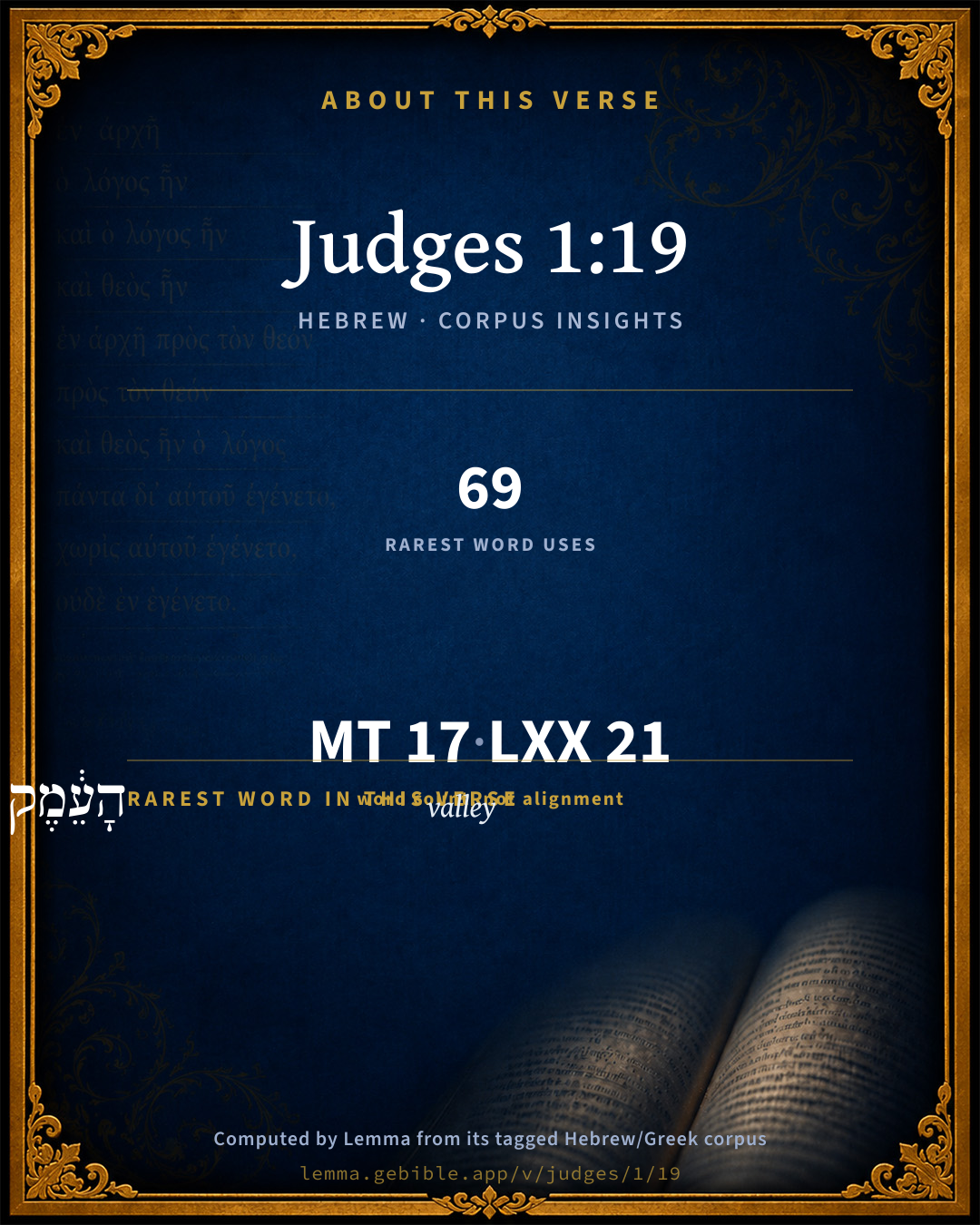
הָעֵ֔מֶק
ʻêmeq
H6010
“the · valley”
Particle, Definite Article + Noun, Common, Masculine, Singular, Absolute
Part of Speech
Particle + Noun
Type
Common
Gender
Masculine
Number
Singular
State
Absolute
Full BDB Definition

Origin: from H6009

TWOT: 1644a

valley, vale, lowland, open country
  1. וַיְהִ֤י hâyâh H1961 “and · to be” Conjunction + Verb, Qal, Sequential Imperfect, 3rd Person, Masculine, Singular
  2. יְהוָה֙ Yᵉhôvâh H3068 “LORD” Noun, Proper
  3. אֶתּ ʼêth H854 “with” Preposition
  4. יְהוּדָ֔ה Yᵉhûwdâh H3063 “Judah” Noun, Proper
  5. וַיֹּ֖רֶשׁ yârash H3423 “and · to inherit” Conjunction + Verb, Hiphil, Sequential Imperfect, 3rd Person, Masculine, Singular
  6. אֶת ʼêth H853 “-” Particle, Direct Object
  7. הָהָ֑ר har H2022 “the · mountain” Particle, Definite Article + Noun, Common, Masculine, Singular, Absolute
  8. כִּ֣י kîy H3588 “that” Conjunction
  9. לֹ֤א lôʼ H3808 “not” Particle, Negative
  10. לְהוֹרִישׁ֙ yârash H3423 “to inherit” Preposition + Verb, Hiphil, Infinitive Construct
  11. אֶת ʼêth H853 “-” Particle, Direct Object
  12. יֹשְׁבֵ֣י yâshab H3427 “dwelling” Verb, Qal, Participle Active, Masculine, Plural, Construct
  13. כִּי kîy H3588 “that” Conjunction
  14. רֶ֥כֶב rekeb H7393 “chariot of” Noun, Common, Masculine, Singular, Construct
  15. בַּרְזֶ֖ל barzel H1270 “iron” Noun, Common, Masculine, Singular, Absolute

About this verse

These counts appear in no published source. They are computed here, from the morphology-tagged text and Lemma’s own curated glosses. What Lemma adds →

17
words
13
distinct lemmas
Historical
section

Grammatical profile

  • 4 verbs
  • 6 nouns
  • 2 prepositions
  • 2 conjunctions
  • 3 particles

Verb forms

  • וַיְהִ֤י Qal · Sequential Imperfect
  • וַיֹּ֖רֶשׁ Hiphil · Sequential Imperfect
  • לְהוֹרִישׁ֙ Hiphil · Infinitive Construct
  • יֹשְׁבֵ֣י Qal · Participle Active

Repetition

Words recur within this verse — often emphatic in Hebrew:

  • וַיֹּ֖רֶשׁ to inherit H3423 ×2
  • כִּ֣י that H3588 ×2

Hebrew & Septuagint length

In English translation the verse runs 29 words from the Hebrew and 27 from the Septuagint (LXX English) — closely comparable.

A rough comparison of the two English renderings, which tokenize alike — not a word-level alignment.

Word counts can differ between the Hebrew and the Greek without any difference in meaning — e.g. the Hebrew direct-object marker אֵת has no separate Greek word, and Greek often adds the article ὁ.

In the original languages it is 17 Hebrew tokens and 21 Greek tokens — but the two are counted differently (Hebrew bundles its prefixes and suffixes into one token; the Greek is in lemma form), so that isn’t a like-for-like length.

Cross-references

28

Topical passages linked to Judges 1:19 in the Treasury of Scripture Knowledge — connected by theme and wording, ordered by reader-vote popularity; previews shown in the World English Bible.

  • Psalms 60:12 Through God we shall do valiantly, For it is he who will tread down our adversaries.
  • Isaiah 41:10 Don't you be afraid, for I am with you; don't be dismayed, for I am your God; I will strengthen you; yes, I will help you; yes, I will uphold you with the right hand of my righteousness.
  • Judges 1:2 Yahweh said, Judah shall go up: behold, I have delivered the land into his hand.
  • Isaiah 41:14–15 Don't be afraid, you worm Jacob, and you men of Israel; I will help you, says Yahweh, and your Redeemer is the Holy One of Israel.
  • Matthew 1:23 "Behold, the virgin shall be with child, And shall bring forth a son. They shall call his name Immanuel;" Which is, being interpreted, "God with us."
  • Matthew 14:30–31 But when he saw that the wind was strong, he was afraid, and beginning to sink, he cried out, saying, "Lord, save me!"
  • Matthew 17:19–20 Then the disciples came to Jesus privately, and said, "Why weren't we able to cast it out?"
  • Romans 8:31 What then shall we say about these things? If God is for us, who can be against us?
  • Philippians 4:13 I can do all things through Christ, who strengthens me.
  • Genesis 39:2 Yahweh was with Joseph, and he was a prosperous man. He was in the house of his master the Egyptian.
  • Genesis 39:21 But Yahweh was with Joseph, and showed kindness to him, and gave him favor in the sight of the keeper of the prison.
  • Exodus 14:7–31 and he took six hundred chosen chariots, and all the chariots of Egypt, and captains over all of them.
  • Joshua 1:5 There shall not any man be able to stand before you all the days of your life. As I was with Moses, so I will be with you; I will not fail you, nor forsake you.
  • Joshua 1:9 Haven't I commanded you? Be strong and of good courage; don't be afraid, neither be dismayed: for Yahweh your God is with you wherever you go.
  • Joshua 7:12 Therefore the children of Israel can't stand before their enemies; they turn their backs before their enemies, because they are become accursed: I will not be with you any more, except you destroy the devoted thing from among you.
  • Joshua 11:1–9 It happened, when Jabin king of Hazor heard of it, that he sent to Jobab king of Madon, and to the king of Shimron, and to the king of Achshaph,
  • Joshua 14:12 Now therefore give me this hill-country, of which Yahweh spoke in that day; for you heard in that day how the Anakim were there, and cities great and fortified: it may be that Yahweh will be with me, and I shall drive them out, as Yahweh spoke.
  • Joshua 17:16–18 The children of Joseph said, The hill-country is not enough for us: and all the Canaanites who dwell in the land of the valley have chariots of iron, both they who are in Beth-shean and its towns, and they who are in the valley of Jezreel.
  • Judges 1:27–32 Manasseh did not drive out [the inhabitants of] Beth-shean and its towns, nor [of] Taanach and its towns, nor the inhabitants of Dor and its towns, nor the inhabitants of Ibleam and its towns, nor the inhabitants of Megiddo and its towns; but the Canaanites would dwell in that land.
  • Judges 6:12–13 The angel of Yahweh appeared to him, and said to him, Yahweh is with you, you mighty man of valor.
  • 2 Samuel 5:10 David grew greater and greater; for Yahweh, the God of hosts, was with him.
  • 2 Kings 18:7 Yahweh was with him; wherever he went forth he prospered: and he rebelled against the king of Assyria, and didn't serve him.
  • Psalms 46:7 Yahweh of Hosts is with us. The God of Jacob is our refuge. Selah.
  • Psalms 46:9 He makes wars cease to the end of the earth. He breaks the bow, and shatters the spear. He burns the chariots in the fire.
  • Psalms 46:11 Yahweh of Hosts is with us. The God of Jacob is our refuge. Selah.
  • Ecclesiastes 9:11 I returned, and saw under the sun, that the race is not to the swift, nor the battle to the strong, neither yet bread to the wise, nor yet riches to men of understanding, nor yet favor to men of skill; but time and chance happen to them all.
  • Isaiah 7:14 Therefore the Lord himself will give you a sign. Behold, the virgin will conceive, and bear a son, and shall call his name Immanuel.
  • Isaiah 8:10 Take counsel together, and it shall be brought to nothing; speak the word, and it shall not stand: for God is with us.

Cross-references courtesy of OpenBible.info (CC BY 4.0).

Hebrew and Greek witnesses Masoretic Hebrew ↔ Greek Septuagint

The same verse in the two great witnesses to the Old Testament, shown verse-for-verse.

These are two independent witnesses, not word-aligned to each other, and the Septuagint is shown in lemma (dictionary) form.

Hebrew Judges 1:19 Masoretic · Westminster Leningrad Codex

וַיְהִ֤י יְהוָה֙ אֶתּ יְהוּדָ֔ה וַיֹּ֖רֶשׁ אֶת הָהָ֑ר כִּ֣י לֹ֤א לְהוֹרִישׁ֙ אֶת יֹשְׁבֵ֣י הָעֵ֔מֶק כִּי רֶ֥כֶב בַּרְזֶ֖ל לָהֶֽם

Yahweh was with Judah; and drove out [the inhabitants of] the hill-country; for he could not drive out the inhabitants of the valley, because they had chariots of iron.

World English Bible · Public Domain

Greek LXX Judges 1:19 Septuagint · lemma form

καί εἰμί κύριος μετά ιουδα καί κληρονομέω ὁ ὄρος ὅτι οὐ δύναμαι ἐκὀλεθρεύω ὁ καταοἰκέω ὁ κοιλάς ὅτι ρηχαβ διαστέλλω αὐτός

And the Lord was with Judas, and he inherited the mountain; for they were not able to destroy the inhabitants of the valley, for Rechab prevented them.

LXX2012 (modern English Septuagint) · Public Domain

On this verse, Ellicott's Commentary for English Readers discusses the Septuagint’s reading. Read the note in Commentary ↓

Hebrew: Westminster Leningrad Codex (CC BY 4.0). Greek: Septuagint (public domain); English from LXX2012 (modern English Septuagint) (Public Domain). How the Septuagint differs from the Hebrew →

Targum (Aramaic paraphrase)

1

The Targum is the ancient Jewish Aramaic paraphrase of the Hebrew Scriptures — an interpretive translation, not the Hebrew text itself. Onkelos (literal) and Pseudo-Jonathan (expansive) render the Torah, and Jonathan the Prophets. Coverage is partial: where no permissively-licensed English translation exists for a verse, only the Aramaic is shown. This is verse-level text, not a word-by-word alignment to the Hebrew.

  1. Targum Jonathan Prophets (Joshua–Malachi)
    וַהֲוָה מֵימְרָא דַייָ בְּסַעֲדֵיהּ דְבֵית יְהוּדָה וְתָרִיכוּ יַת יַתְבֵי טוּרָא וּבָּתַר כֵּן דְחָבוּ לָא יְכִילוּ לְתָרָכָא יַת יַתְבֵי מֵישְׁרָא אֲרֵי רְתִיכִין דְבַרְזְלָא לְהוֹן:

    (no public-domain English translation for this verse)

    Targum Jonathan — Aramaic: “Mikraot Gedolot” (public domain). English: “Sefaria Community Translation” (CC0 1.0 (public-domain dedication)); “London "Chaldee Paraphrase," 1871” (public domain). Text via Sefaria.

Commentary

Notes on Judges 1:19 from classic Christian and Jewish commentators (each source and its license shown beneath its notes). The classic Christian expositions comment on the surrounding passage and are grouped to its opening verse, so a note may address several verses; the Jewish commentaries on the Tanakh (Rashi and others) are per-verse, so they appear only where the commentator wrote on this verse.

Lemma curates 59 commentaries, every one of them public domain or Creative Commons licensed, each selected and text-cleaned for this edition rather than reprinted as found. About our sources →

Ellicott's Commentary for English Readers

(19) The Lord was with Judah.—The Targum here has “The Word of the Lord.” The expression is frequently used to imply insured prosperity (Gen_39:23; 1Sa_18:14; 2Ki_18:7. Comp. Mat_18:20).

But.—Rather, for (kî): i.e., they only dispossessed their enemies of the mountain, for, &c.

Could not.—The Hebrew seems purposely to avoid this expression, and says “there was no driving out.” Judah could have driven them out; but their faith was cowed by the (Jdg_1:19) iron chariots.

The valley.—Here Emek, not Shephelah. “Broad sweeps between parallel ranges of hills,” like, e.g., the “valley of Jezreel,” i.e., the plain of Esdraelon. It differs from Gî, which means a gorge or ravine.

Chariots of iron.—See Jdg_4:3; Jos_11:6-9; Jos_17:16; 1Sa_13:6. R. Tanchum makes it mean “very strong chariots;” but the phrase means either “chariots with iron-bound wheels,” or “scythed chariots.” Ktesias attributes scythed chariots to Ninus, but none are seen on the Nineveh sculptures, and it is doubtful whether they were known so early. Xenophon says that scythed chariots were invented by Cyrus, which would not be till five centuries after this period. For this clause the LXX. have,” because Rechab resisted them,” mistaking rekeb, “chariot,” for a proper name (as they often do with other words). Hence the notion of Theodoret that the Kenites, to which Rechab belonged (2Ki_10:15-23; Jer_35:2), secretly helped the Philistines, is quite groundless. We see a reason for the partial failure of the Israelites in the fact that at this time they had not attained to the same level of civilisation as the Canaanites in arts and arms. This advantage could only have been rendered unavailing by more faith and faithfulness than they showed in their conduct. “Their warriors often rather overran than subdued the land. . . . The chariots and better arms of the Canaanites rendered the conquest of the valleys and plains long and laborious, especially to Joseph, Judah, and Dan. . . . The Hebrews ‘walked upon the high places of the land’ (Psa_18:33; 2Sa_22:34; Hab_3:19; Isa_58:14; Deu_32:13; Deu_32:29; Deu_32:33); but these heights were often encompassed like islands by the inhabitants of the valleys” (Ewald, ii. 264).

A Bible Commentary for English Readers, edited by Charles John Ellicott (1878–1897) — public domain. Text from a community e-Sword module.

Trapp's Complete Commentary

John Trapp

Jdg 1:19 And the LORD was with Judah; and he drave out [the inhabitants of] the mountain; but could not drive out the inhabitants of the valley, because they had chariots of iron.

Ver. 19. Drave out the inhabitants of the mountain.] Or, Possessed the mountain: for the same Hebrew word Jarash, signifies to possess and to dispossess.

But could not drive out.] Indeed, for want of faith: else they might have driven them out; Si ex fide fortiter pugnassent: to faith all things are feasible. Is not the same God, God of the valleys also, as well as of the mountains? But as it is said that {Mar 6:5} our Saviour "could do no mighty work" - that is, he would do no mighty work - "in his own country, because of their unbelief," so was it here.

19 These be they who separate themselves, sensual, having not the Spirit.

Ver. 19. Who separate] From Church assemblies, upon pretence of newer lights, greater holiness. The Arabic renders it, intermitters, sc. of Church worship. Such as upon pretence of a more than ordinary holiness, and I know not what imaginary perfection, thought they might give over hearing of the word, as having immediate teaching; and separated from holy duties, as the words following show.

Sensual] Gr. ψυχικοι, animal; such as have no more than a reasonable soul, and are yet in their pure naturals, 1Co 2:14, and by their profane practices animas etiam incarnaverunt, have turned their very spirits into a lump of flesh.

Having not the Spirit] Unless it be the spirit of delusion, as Muncer the Anabaptist had, who wrote a book against Luther, dedicated it "To the most illustrious Prince Christ" (as his words are), uphraideth Luther with want of the Spirit, and calleth him a carnal man, a silly soul. (Scultet. Annal. 338.)

John Trapp, A Commentary or Exposition upon All the Books of the Old and New Testament (1647–1656) — public domain. Text from a community e-Sword module.

Joseph Benson's Commentary

Jdg 1:19. Could not drive out the inhabitants of the valley — Because of their unbelief, through which they distrusted God’s power to destroy those who had chariots of iron, and so gave way to their own fear and sloth, whereby God was provoked to withdraw his helping hand.

Joseph Benson's Commentary on the Old and New Testaments (1811–1818) — public domain. Text from a community e-Sword module.

Jamieson, Fausset & Brown

Robert Jamieson, A. R. Fausset & David Brown

the Lord was with Judah; . . . but they could not drive out the inhabitants of the valley--The war was of the Lord, whose omnipotent aid would have ensured their success in every encounter, whether on the mountains or the plains, with foot soldiers or cavalry. It was distrust, the want of a simple and firm reliance on the promise of God, that made them afraid of the iron chariots (see on Jos 11:4-9).

Jamieson, Fausset & Brown — Commentary Critical and Explanatory on the Whole Bible (1871) — public domain (CC PDM 1.0). Text via the HelloAO Bible API.

Adam Clarke's Commentary

Verse 19. And the Lord was with Judah, and he drave out the inhabitants of the mountain; but could not drive out the inhabitants of the valley, because they had chariots of iron.] Strange! were the iron chariots too strong for Omnipotence? The whole of this verse is improperly rendered. The first clause, The Lord was with Judah should terminate the 18th verse, and this gives the reason for the success of this tribe: The Lord was with Judah, and therefore he slew the Canaanites that inhabited Zephath, c., &c. Here then is a complete period: the remaining part of the verse either refers to a different time, or to the rebellion of Judah against the Lord, which caused him to withdraw his support. Therefore the Lord was with Judah, and these were the effects of his protection but afterwards, when the children of Israel did evil in the sight of the Lord, and served Baalim, c., God was no longer with them, and their enemies were left to be pricks in their eyes, and thorns in their side, as God himself had said.

This is the turn given to the verse by Jonathan ben Uzziel, the Chaldee paraphrast: "And the WORD of Jehovah was in the support of the house of Judah, and they extirpated the inhabitants of the mountains but afterwards, WHEN THEY SINNED, they were not able to extirpate the inhabitants of the plain country, because they had chariots of iron." They were now left to their own strength, and their adversaries prevailed against them.

From a work called the Dhunoor Veda, it appears that the ancient Hindoos had war chariots similar to those of the Canaanites. They are described as having many wheels, and to have contained a number of rooms. - Ward's Customs.

Adam Clarke's Commentary on the Bible (1810–1826) — public domain. Text from a community e-Sword/MySword module.

The Cambridge Bible for Schools and Colleges

gen. ed. J. J. S. Perowne

19. The natural place for this verse is after Jdg_1:7, i. e. after the account of Judah’s first success in the Southern Highlands. He conquered the hill country, but the inhabitants of the plain were too strong for him. There is no one word for the Hebr. verb meaning ‘drive out,’ ‘dispossess,’ ‘conquer.’

for he could not drive out] lit. ‘for (he was) not for driving out,’ a most unusual construction; correct he was not able to drive out, so two Hebr. MSS. and the Versions. The text of Jdg_1:21; Jdg_1:27; Jdg_1:32 is to be corrected in the same way. Comparing Jdg_1:21 with Jos_15:63, Jdg_1:27 with ib. Jdg_17:12, 2Ch_8:8 with 1Ki_9:21, we note a tendency to obliterate the impotence of Israel. In this chap. the editor’s theory (Jdg_2:1 b–5a) has influenced the alteration: the cause of the tribes’ failure was not their inability to match the Canaanites, but their unfaithfulness (so Targum here).

the inhabitants of the valley] i.e. of the Philistine plain, between the hills and the sea; see Jdg_1:18 note.

chariots of iron] Cf. Jdg_4:3; Jdg_4:13, Jos_17:16; Jos_17:18; i.e. plated or studded with iron, like the Hittite chariots figured on Egyptian monuments: the currus falcati, i. e. scythed chariots, as Vulgate renders, were not yet invented. The horses and chariots of the Canaanites were probably adopted from the Egyptians; but ultimately, like those of the Egyptians, from the Hittites or N. Syrians. Recent excavations confirm what we learn from the O.T. Thus at Taanach iron implements have been found in large quantities; at Megiddo they occur plentifully first at the period which is dated in the middle of the Israelite monarchy, also much earlier but in smaller quantities. In Egypt iron was in common use at the time of the Exodus, and considerably earlier; it came chiefly from the mines in the Sinaitic Peninsula.

The Cambridge Bible for Schools and Colleges (gen. ed. J. J. S. Perowne; Cambridge University Press, 1878–1918) — public domain. Text from a community e-Sword module.

John Gill's Exposition

And the Lord was with Judah,.... Encouraging, strengthening, succeeding, and giving the tribe victory over the Canaanites; the Targum is,"the Word of the Lord was for the help of the house of Judah:"

and he drove out the inhabitants of the mountains; the mountainous part of Judea, such as was about Jerusalem, and where Hebron stood, and other cities, see Jos 15:48, &c. which though fortified both by nature and man, yet God being with them, they were easily subdued:

but could not drive out the inhabitants of the valley; God forsaking them, because they were afraid of them, for a reason after mentioned, or through slothfulness, and being weary of fighting, or because they fell into some sins, which occasioned the divine displeasure; so the Targum,"after they had sinned, they could not drive out the inhabitants of the valley:"

because they had chariots of iron; but this was no reason why they could not drive them out, if God was with them, who could as easily have delivered these into their hands, as the inhabitants of the mountains; but is the reason why they were afraid to fight with them, and to attempt to drive them out, and which they themselves gave why they did not.

John Gill's Exposition of the Whole Bible (1746–1763) — public domain (CC PDM 1.0). Text via the HelloAO Bible API.

Haydock's Catholic Bible Commentary

Was not able, &c. Through a cowardly fear of their chariots armed with hooks and scythes, and for want of confidence in God. (Challoner) --- Hebrew does not sy expressly that Juda could not: quia non ad expellendum, &c. He had not the courage or the will. With God’s assistance, what had he to fear? Were these Philistines with their chariots, more terrible than the giants in their fortresses? --- Scythes. Hebrew receb barzel, "chariots of iron." (Calmet) --- The Roman and Alexandrian Septuagint have "Rechab was opposed to them." (Haydock) --- The edition of Basil adds, "and they had chariots of iron," as St. Augustine (q. 5,) reads. A double translation is thus given. (Calmet) --- These chariots were calculated to cut down all that came in contact with them. (Curtius iv.) (Worthington)

George Leo Haydock (1774–1849), Haydock's Catholic Family Bible and Commentary, 1859 edition — public domain. Excludes Psalms (Douay-Rheims chapter numbering differs from Protestant) and Deuterocanonical books (Catholic canon only).

Matthew Poole's English Annotations

On account of their unbelief, whereby they doubted and distrusted God’s power to destroy those who had chariots of iron and so gave way to their own fear and sloth, whereby God was provoked to withdraw his helping hand from them, and so they were really made impotent, as they were unwilling. See Jos 17:16.

Matthew Poole's English Annotations on the Holy Bible (1683–1685) — public domain. Text from a community e-Sword/MySword module.

Whedon's Commentary on the Bible

Daniel D. Whedon

19. And he drave out the inhabitants of the mountain — Hebrews, he seized or possessed the mountain. In ordinary cases of foreign invasion the mountains are the fortresses which are last to surrender. But the Israelites, having confidence only in mountain warfare, concentrated their energies upon these fastnesses and secured their possession.

But could not drive out — Literally, for not to drive out the inhabitants of the valley; that is, they were not to be driven out, or, as one might say, there was no driving them out. The word rendered valley is עמק, emek, and does not necessarily refer at all to the Philistine plain, which is called the Shephelah, Jdg_1:9. Emek denotes any valley, basin, or depression between mountains, and may here refer to plains situated among the mountains of Judah or elsewhere.

Because they had chariots of iron — This we are doubtless to take as the occasion, not the necessitating cause, of Judah’s ultimate failure to conquer all his foes. Iron chariots could not withstand the forces of Joshua (Jos_11:4-9) nor of Barak, (Jdg_4:15,) when the people of Jehovah fought with faith in his power, and Judah might likewise have conquered; but we understand that, after many triumphs, when Judah was brought to face these chariots of iron — instruments of warfare strange and terrible — he hesitated, wavered, gave way to fear, and thus lost faith in God, and then there was no driving out his enemy.

Daniel D. Whedon (gen. ed.), Commentary on the Old and New Testaments (1874–1909) — public domain. Text from a community e-Sword module.

The Pulpit Commentary

Chariots of iron. The chariots of the Canaanites were very formidable to the Israelites, who had no means of coping with them. Thus we are told of Jabin, king of Canaan, who reigned in Hazer, that he had 900 chariots of iron, and mightily oppressed the children of Israel. They were later an important part of King Solomon"s army. (1Ki_10:26) See too Jos_17:16.

Divine help versus material obstacles.

The statement of this verse is perplexing; hardly softened if we render "there was no driving out," etc. On the one hand, apparently, infinite power is on the side of Judah; on the other, there are sharply-defined limits to his success, and singular reasons for his failure. (Describe inhabitants of mountain and valley.) One would suppose that if God had really been with Judah, the chariots of iron would be neither here nor there in the question. "If God be for us, who can be against us?" But the difficulty arises from looking at the problem wholly from the Divine side. The same difficulty faces us to-day. "But this temptation was so great!" "But was not the Lord with you?" Infinite power may be on our side, but we may be debarred by failure of faith from making full use of it.

I UNREALISED SPIRITUAL POWER. Many of the brutes have power greater than man, but they cannot bring it to bear. Is man never similarly unfortunate? In what sense can the power of God in the saint be unrealised? It is not power wasted or lying idle, but simply like a cheque unused. Our spiritual nature is not developed enough.

II INSUFFICIENT REASONS FOR FAILURE OR SUCCESS. These arise from the same cause as the preceding. The tool in hands of tyro and master. The true panoply of a Church is spiritual; and its material advantages may sometimes be as Goliath"s armour to David; and so may the spiritual advantages, if we do not realise them, keep ourselves in continual communion with them: and test their virtue by continual exercises of faith.

III WAYS IN WHICH MAN LIMITS GOD. By failure of faith. By neglect of the means of grace. By personal unholiness. God"s arm is not shortened," etc., "but ye are straitened in your own selves. M.

Vers. 19-21. A title to be made good.

Each of these Judah, Caleb (of the same tribe), and Benjamin had received their portion at the hands of the Lord; but they had to conquer it. Judah partially succeeded, Caleb wholly succeeded, and Benjamin had a grievous drawback to his success. This is suggestive of the blessedness to be attained by Christians.

I THE PROMISE IS COMPLETE AND ABSOLUTE TO EVERY CHRISTIAN. "This is the victory that overcometh the world even your faith." The least Christian is assured of this splendid triumph.

II ITS REALISATION WILL DEPEND UPON THE MEASURE OF HIS FAITH, etc. The estate with a mortgage. Judah had already "fought against Jerusalem" and subdued it, at least the southern portion abutting upon, or included in, their boundary. But they did not subdue the citadel, which was in Benjamin"s lot. The latter, on the other hand, are too careless, unwarlike, or indisposed to make good their possession. M.

HOMILIES BY W.F. ADENEY Ver. 19. The presence of God in the battle of life.

The most remarkable circumstance connected with the wars of ancient Israel is the religious faith which guided and inspired the people for battle. In this respect the conduct of those wars is typical of the Christian method of spiritual warfare.

I GOD IS WITH HIS PEOPLE IN THE BATTLE OF LIFE. God is not only the Refuge in distress and the Father of peaceful mercies; he is the Source of strength and of courage, and the Inspirer of the masculine virtues of the Church militant he is with us in battle. God does not grant his aid from a distance, through messengers, etc.; he is present in the active exercise of his power.

1. When God calls people to any task, he will follow and help them in it. God had chosen Judah for the work of conquering the Canaanites. He also followed Judah to battle. Divine election was followed by Divine power. God never expects us to undertake any work in which he will not aid us. If he calls us to any difficult task, he will go first, and prepare the way for us, and then will accompany us in it, as our Guide and Protector.

2. They who are fruited in, the service of God have peculiar reason for expecting the presence of God. Judah and Simeon were united, and God aided them in their common task. God does not desert the solitary: e.g. , (Gen_16:13) Jacob, (Gen_28:16) Elijah. (1Ki_19:9) But we have a special right to expect his presence when we cooperate in brotherly sympathy. Christ is present where two or three are met together in his name. The Holy Ghost came on the day of Pentecost, when the whole Church was assembled together. (Act_2:1)

II THE PRESENCE OF GOD IS THE CHIEF SOURCE OF SUCCESS IN THE BATTLE OF LIFE. God was with Judah, therefore he obtained possession of the mountains. If God is with his people in their time of toil and difficulty, his presence is a security of active aid. He is with us not merely to approve, but to help. The victory comes from him. It is not all who have faith and spiritual insight to discern this truth. God does not come with a visible host and with "chariots of iron;" but his presence and aid are felt in the providential control of events; in the inspiration of strength and courage; in the enlightenment of Divine wisdom. The best human securities for success will not justify us in neglecting the help of God. Simeon and Judah were united, and were the stronger for their union; yet it was not the human strength thus obtained, but God"s presence, which brought victory. There is a danger lest we should trust too much to imposing human arrangements, large societies, elaborate organisations, etc. The most splendid Christian army will be miserably defeated if it ventures to enter the field without the leadership of the "Captain of salvation.

III THE PRESENCE OF GOD WILL NOT ALONE SECURE PERFECT AND IMMEDIATE SUCCESS. Though God was with Judah, still Judah could not drive out the inhabitants of the valley.

1. Gears presence and aid do not dispense with human effort. It is Judah, not God, who fails. We may fail on our side of the work while God is not wanting on his.

2. God"s presence does not make us entirely independent of earthly circumstances. God did not annihilate the chariots of iron. We must not expect God to work such violent miracles as shall liberate us from all the inconveniences of life.

3. Human weakness may still linger about us after we have been blessed with the aid of God"s presence. The Israelites were too weak to overcome the inhabitants of the valley. Possibly they feared to face the chariots of iron. The measure of help we have from God is not limited in itself, but it is limited by our faith. If we had perfect faith we should have perfect success. But when we look away from God to the iron chariots of our foes, or, like Peter, from Christ to the threatening waves, we may fail from fear and human weakness, and God"s almighty power will not then save us from defeat. A.

The Pulpit Commentary (1880–1919), ed. H.D.M. Spence-Jones & Joseph S. Exell — public domain. Text from a community e-Sword module.

John Wesley's Explanatory Notes

Could not drive - Because of their unbelief, whereby they distrusted God's power to destroy those who had chariots of iron, and so gave way to their own fear and sloth, whereby God was provoked to withdraw his helping hand.

John Wesley, Explanatory Notes Upon the Whole Bible (1754–1765) — public domain. Text via the GEBible commentary corpus.

Rashi

Rabbi Shlomo Yitzchaki (Rashi)

However, he could not oust. [Targum] Yonasan interprets: Afterward, as they had sinned, they could not oust the valley dwellers.

Rashi on the Tanakh — English translations: “The Judaica Press complete Tanach with Rashi, translated by A. J. Rosenberg” (CC BY 4.0); “Pentateuch with Rashi's commentary by M. Rosenbaum and A.M. Silbermann, 1929-1934” (public domain); “The Metsudah Tanach series, Lakewood, N.J” (CC BY 4.0); and “The Book of Joshua, Metsudah Publications, 1997” (CC BY 4.0). Text via Sefaria.

Lesson kit

Teaching starters — assembled from the data on this page, not authored interpretation. Every prompt links to the verse data it draws on. Edit before teaching.

Judges, in the Historical, opens this verse with 17 words (13 distinct Hebrew lemmas). Its most distinctive word is ʻêmeq (“valley”). A historical commentator’s framing appears above. Read the whole chapter for the surrounding context.

Discussion questions

  1. How does “valley” (ʻêmeq) shape what this verse is saying?
  2. How does Psalms 60:12, which shares this passage’s theme, read alongside this verse?
  3. What does the repetition of “to inherit” (2× in this one verse) do in this verse?
  4. These translations render this verse differently. What is at stake in choosing one wording over another?
  5. «וַיְהִ֤י» is a Qal Sequential Imperfect verb. How does that grammatical form shape the action described?
  6. Compare how Ellicott's Commentary for English Readers and Trapp's Complete Commentary read this verse. Where do they agree or differ?

Things to notice

Reading settings

Reading text

Shown beneath each verse's original-language words.

Old Testament
Old Testament edition

Read the OT as the Masoretic Hebrew (MT) or the Greek Septuagint (LXX).

English shown for the Greek Septuagint (in the Hebrew ↔ Greek comparison).

Comparing translations? Open the Compare panel on any verse page to stack up to four side by side.