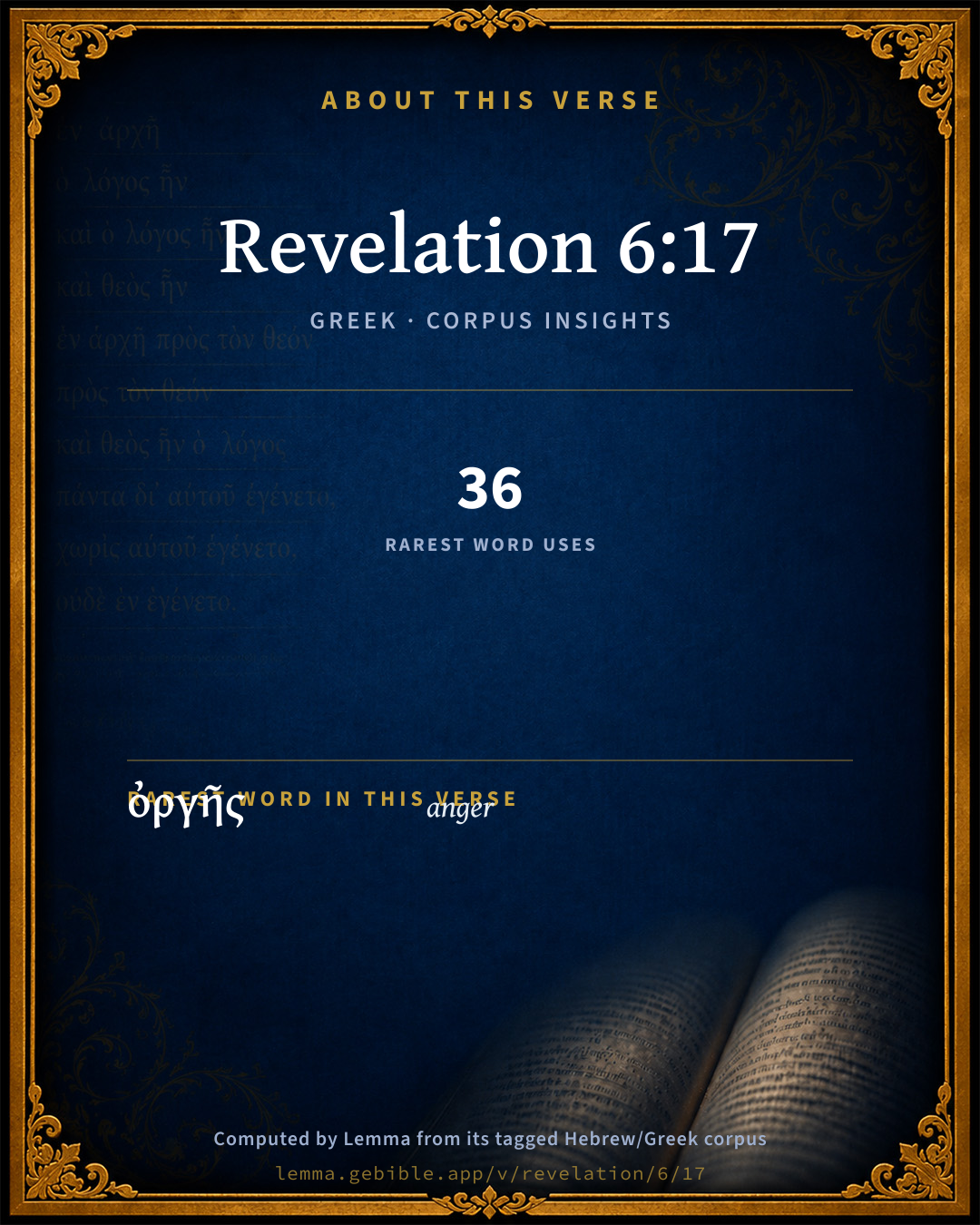
Revelation 6:17

Greek (Tischendorf 8th ed.) Revelation 6:17 appears in the Greek New Testament. The text above is from the Tischendorf 8th edition. Each word links to its Strong’s number and a concise gloss. Click any word for its full Thayer’s Greek Lexicon entry.
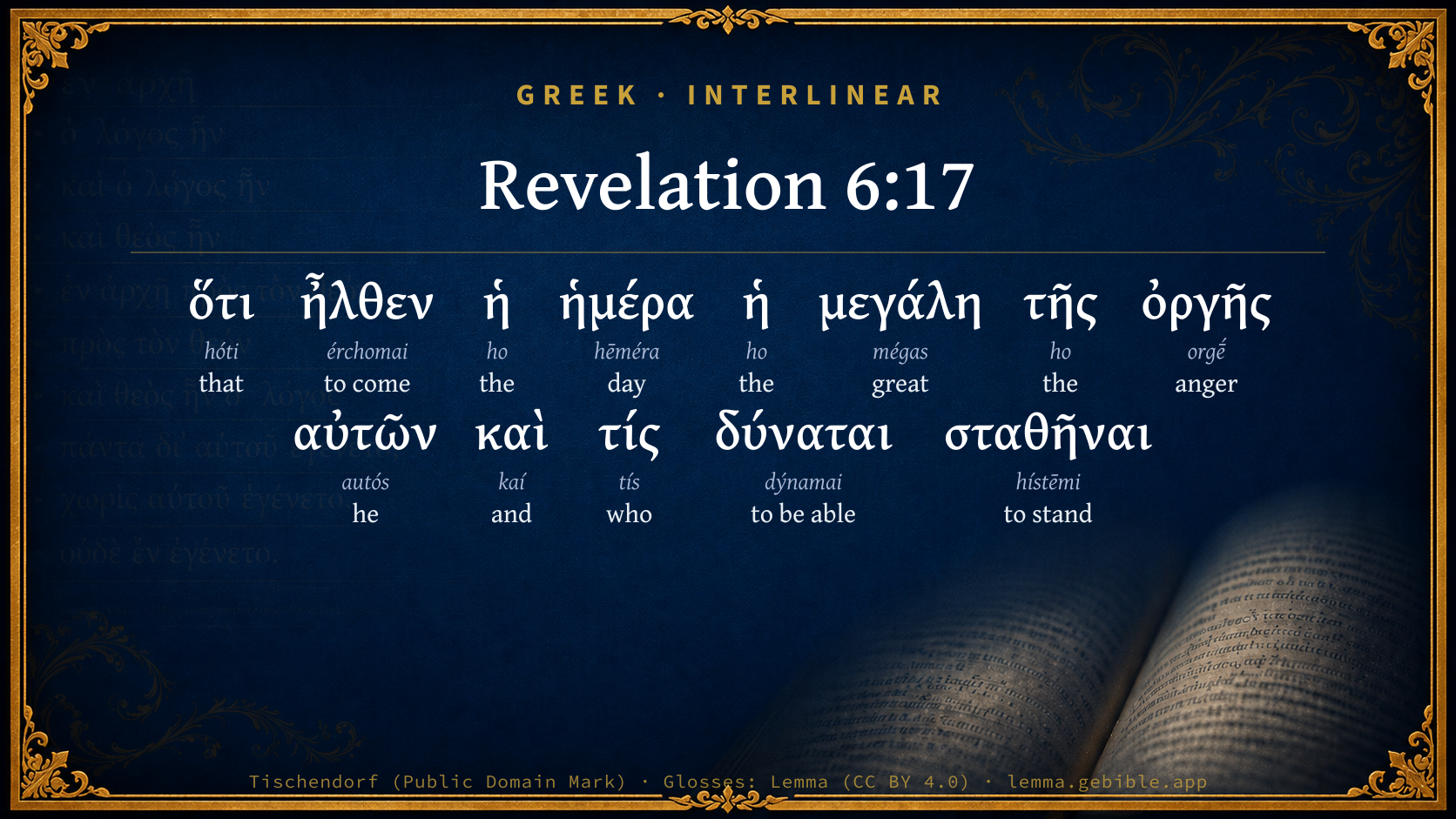
Download image
Cite this verse

Revelation 6:17 (World English Bible). Public Domain. Lemma interlinear Bible study tool, https://lemma.gebible.app/v/revelation/6/17.

Show BibTeX & RIS
BibTeX
RIS
English Translation
for the great day of his wrath has come; and who is able to stand?"
World English Bible · Public Domain
Download a study sheet

One document with this verse’s original text, its word-by-word gloss line, the meaning frame, cross-references with their text, attributed commentary, and full source and license credits — printable, and it pastes into notes with its structure intact.

This verse Autodidact and up

Study sheet (.html) Plain text (.txt)

A passage Seminary Student

Up to 50 verses in one chapter. A passage sheet keeps up to 6 commentary sources and 12 cross-references per verse, in the order this page ranks them, and says so on the sheet whenever that leaves anything out. Ask for a single verse and you get the Autodidact verse sheet above.

Everything on this page stays free to read, with no account — the sheet is a download of what is already on screen, not access to it.

Want to remove ads? Support Godless Engineer
Compare translations 3

The same verse in 3 English versions, stacked beneath the original-language interlinear above. Click any original word for its lexicon entry.

Each is an independent rendering of the whole verse — the interlinear is not word-aligned to these translations.

Highlighted words mark where these versions differ — a whole-verse word diff, not a word-by-word alignment.

  • World English Bible Public Domain
    for the great day of his wrath has come; and who is able to stand?"
  • King James Version Public Domain
    For the great day of his wrath is come; and who shall be able to stand?
  • unfoldingWord Literal Text CC BY-SA 4.0
    because the great day of their anger has come, and who is able to stand?”

unfoldingWord Literal Text — © unfoldingWord, licensed CC BY-SA 4.0. Word-aligned USFM3 via Door43 (git.door43.org/unfoldingWord/en_ult).

Versions to compare (up to 4)

3 of 4 selected

Show all 19 translations

Every available English version of this verse, each an independent rendering of the whole verse.

  • World English Bible Public Domain
    for the great day of his wrath has come; and who is able to stand?"
  • Berean Standard Bible Public Domain
    For the great day of Their wrath has come, and who is able to withstand it?”
  • Majority Standard Bible Public Domain
    For the great day of Their wrath has come, and who is able to withstand it?”
  • King James Version Public Domain
    For the great day of his wrath is come; and who shall be able to stand?
  • American Standard Version (1901) Public Domain
    for the great day of their wrath is come; and who is able to stand?
  • Revised Version (1885) Public Domain
    for the great day of their wrath is come; and who is able to stand?
  • Geneva Bible (1599) Public Domain
    For the great day of his wrath is come, and who can stand?
  • Douay-Rheims (1899) Public Domain
    For the great day of their wrath is come, and who shall be able to stand?
  • Young's Literal Translation Public Domain
    because come did the great day of His anger, and who is able to stand?
  • Literal Standard Version CC BY-SA 4.0
    because the great day of His anger has come, and who is able to stand?
  • Unlocked Literal Bible CC BY-SA 4.0
    For the great day of their wrath has come. Who is able to stand?”
  • unfoldingWord Literal Text CC BY-SA 4.0
    because the great day of their anger has come, and who is able to stand?”
  • Darby Bible Public Domain
    because the great day of his wrath is come, and who is able to stand?
  • World Messianic Bible Public Domain
    for the great day of his wrath has come, and who is able to stand?”
  • Webster's Bible Public Domain
    For the great day of his wrath is come; and who will be able to stand?
  • Free Bible Version CC BY-SA 4.0
    For the terrible day of their judgment has come, and who can stand against it?”
  • Bible in Basic English Public Domain
    For the great day of their wrath is come, and who may keep his place?
  • Text-Critical English NT CC BY 4.0
    for the great day of his wrath has come, and who can withstand it?”
  • Tyndale New Testament (1534) Public Domain
    for the grete daye of hys wrath ys come And who can endure it.

Literal Standard Version (2020), Covenant Press — licensed CC BY-SA 4.0. Text via the HelloAO Bible API (eBible.org). Unlocked Literal Bible (unfoldingWord) — licensed CC BY-SA 4.0. Text via the HelloAO Bible API (eBible.org). unfoldingWord Literal Text — © unfoldingWord, licensed CC BY-SA 4.0. Word-aligned USFM3 via Door43 (git.door43.org/unfoldingWord/en_ult). Free Bible Version, Dr. Jonathan Gallagher — licensed CC BY-SA 4.0. Text via the HelloAO Bible API (eBible.org).

Word by word

More ways to search: Search by grammar → Find every occurrence → Compare this word →

Practice this passage: Drill this verse → Learn its vocabulary →

ὀργῆς
orgḗ
G3709
“anger”
Noun, Genitive, Singular, Feminine
Part of Speech
Noun
Case
Genitive
Number
Singular
Gender
Feminine
Full Thayer's Definition

Origin: from G3713

TDNT: 11:22,7

1. anger, the natural disposition, temper, character 2. movement or agitation of the soul, impulse, desire, any violent emotion, but esp. anger 3. anger, wrath, indignation 4. anger exhibited in punishment, hence used for punishment itself a. of punishments inflicted by magistrates
  1. ὅτι hóti G3754 “that” Conjunction
  2. ἦλθεν érchomai G2064 “to come” Verb, Aorist, Active, Indicative, 3rd person, Singular
  3. ἡ ho G3588 “the” Article, Nominative, Singular, Feminine
  4. ἡμέρα hēméra G2250 “day” Noun, Nominative, Singular, Feminine
  5. ἡ ho G3588 “the” Article, Nominative, Singular, Feminine
  6. μεγάλη mégas G3173 “great” Adjective, Nominative, Singular, Feminine
  7. τῆς ho G3588 “the” Article, Genitive, Singular, Feminine
  8. αὐτῶν autós G846 “he” Personal pronoun, Genitive, Plural, Masculine
  9. καὶ kaí G2532 “and” Conjunction
  10. τίς tís G5101 “who” Interrogative pronoun, Nominative, Singular, Masculine
  11. δύναται dýnamai G1410 “to be able” Verb, Present, Middle or Passive deponent, Indicative, 3rd person, Singular
  12. σταθῆναι hístēmi G2476 “to stand” Verb, Aorist, Passive, Infinitive

About this verse

These counts appear in no published source. They are computed here, from the morphology-tagged text and Lemma’s own curated glosses. What Lemma adds →

13
words
11
distinct lemmas
Revelation
section

Shared distinctive vocabulary

ὀργῆς anger G3709 occurs in 34 verses of the Greek New Testament. Also found in:

Repetition

A word recurs within this verse:

Cross-references

13

Topical passages linked to Revelation 6:17 in the Treasury of Scripture Knowledge — connected by theme and wording, ordered by reader-vote popularity; previews shown in the World English Bible.

  • Psalms 76:7 You, even you, are to be feared. Who can stand in your sight when you are angry?
  • Joel 2:11 Yahweh thunders his voice before his army; For his forces are very great; For he is strong who obeys his command; For the day of Yahweh is great and very awesome, And who can endure it?
  • Malachi 3:2 "But who can endure the day of his coming? And who will stand when he appears? For he is like a refiner's fire, and like launderer's soap;
  • Joel 2:31 The sun will be turned into darkness, And the moon into blood, Before the great and terrible day of Yahweh comes.
  • Jeremiah 30:7 Alas! for that day is great, so that none is like it: it is even the time of Jacob's trouble; but he shall be saved out of it.
  • Revelation 16:14 for they are spirits of demons, performing signs; which go forth to the kings of the whole inhabited earth, to gather them together for the war of that great day of God, the Almighty.
  • Psalms 130:3–4 If you, Yah, kept a record of sins, Lord, who could stand?
  • Isaiah 13:6–22 Wail; for the day of Yahweh is at hand; as destruction from the Almighty shall it come.
  • Zephaniah 1:14–18 The great day of Yahweh is near. It is near, and hurries greatly, the voice of the day of Yahweh. The mighty man cries there bitterly.
  • Romans 2:5 But according to your hardness and unrepentant heart you are treasuring up for yourself wrath in the day of wrath, revelation, and of the righteous judgment of God;
  • Luke 21:36 Therefore be watchful all the time, asking that you may be counted worthy to escape all these things that will happen, and to stand before the Son of Man."
  • Jude 1:6 Angels who didn't keep their first domain, but deserted their own dwelling place, he has kept in everlasting bonds under darkness for the judgment of the great day.
  • Revelation 11:18 The nations were angry, and your wrath came, as did the time for the dead to be judged, and to give your bondservants the prophets, their reward, as well as to the saints, and those who fear your name, to the small and the great; and to destroy those who destroy the earth."

Cross-references courtesy of OpenBible.info (CC BY 4.0).

Where the printed editions differ

1 variant

Places in this verse where the major printed Greek editions disagree on the wording in a way that affects the translation — a comparison of editions, not a manuscript-by-manuscript collation. The editions are the modern critical texts (Nestlé-Aland 28/27, SBL, Westcott-Hort, Tregelles, Tyndale House) and the traditional texts behind the KJV (the Textus Receptus and the Byzantine/Majority text). It is not a claim about which reading is original.

  1. Different wording
    αὐτῶν,

    “of them,”

    In NA28NA27TynSBLWHTreg Not in TRByz

    αὐτοῦ (autou) 'of Him' occurs in traditional manuscripts (TR+Byz) instead of αὐτῶν, (autōn) 'of them,' in older manuscripts (NA28+NA27+Tyn+SBL+WH+Treg)

Textual data: Translators Amalgamated Greek New Testament (STEPBible TAGNT) · CC BY 4.0.

Commentary

Notes on Revelation 6:17 from classic Christian and Jewish commentators (each source and its license shown beneath its notes). The classic Christian expositions comment on the surrounding passage and are grouped to its opening verse, so a note may address several verses; the Jewish commentaries on the Tanakh (Rashi and others) are per-verse, so they appear only where the commentator wrote on this verse.

Lemma curates 59 commentaries, every one of them public domain or Creative Commons licensed, each selected and text-cleaned for this edition rather than reprinted as found. About our sources →

Jamieson, Fausset & Brown

Robert Jamieson, A. R. Fausset & David Brown

Literally, "the day, the great (day)," which can only mean the last great day. After the Lord has exhausted all His ordinary judgments, the sword, famine, pestilence, and wild beasts, and still sinners are impenitent, the great day of the Lord itself' shall come. Mat. 24:6-29 plainly forms a perfect parallelism to the six seals, not only in the events, but also in the order of their occurrence: Mat 24:3, the first seal; Mat 24:6, the second seal; Mat 24:7, the third seal; Mat 24:7, end, the fourth seal; Mat 24:9, the fifth seal, the persecutions and abounding iniquity under which, as well as consequent judgments accompanied with gospel preaching to all nations as a witness, are particularly detailed, Mat. 24:9-28; Mat 24:29, the sixth seal.

to stand--to stand justified, and not condemned before the Judge. Thus the sixth seal brings us to the verge of the Lord's coming. The ungodly "tribes of the earth" tremble at the signs of His immediate approach. But before He actually inflicts the blow in person, "the elect" must be "gathered "out.

Next: Revelation Chapter 7

Jamieson, Fausset & Brown — Commentary Critical and Explanatory on the Whole Bible (1871) — public domain (CC PDM 1.0). Text via the HelloAO Bible API.

Adam Clarke's Commentary

Verse 17. For the great day of his wrath] The decisive and manifest time in which he will execute judgment on the oppressors of his people.

Who shall be able to stand?] No might can prevail against the might of God. All these things may literally apply to the final destruction of Jerusalem, and to the revolution which took place in the Roman empire under Constantine the Great. Some apply them to the day of judgment; but they do not seem to have that awful event in view. These two events were the greatest that have ever taken place in the world, from the flood to the eighteenth century of the Christian era; and may well justify the strong figurative language used above.

Through I do not pretend to say that my remarks on this chapter point out its true signification, yet I find others have applied it in the same way. Dr. Dodd observes that the fall of Babylon, Idumea, Judah, Egypt, and Jerusalem, has been described by the prophets in language equally pompous, figurative, and strong. See Isa 13:10; Isa 34:4, concerning Babylon and Idumea; Jer 4:23; Jer 4:24, concerning Judah; Eze 32:7, concerning Egypt; Joel 2:10; Joel 2:31, concerning Jerusalem; and our Lord himself, Mt 24:29, concerning the same city. "Now," says he, "it is certain that the fall of any of these cities or kingdoms was not of greater concern or consequence to the world, nor more deserving to be described in pompous figures, than the fall of the pagan Roman empire, when the great lights of the heathen world, the sun, moon, and stars, the powers civil and ecclesiastical, were all eclipsed and obscured, the heathen emperors and Caesars were slain, the heathen priests and augurs were extirpated, the heathen officers and magistrates were removed, the temples were demolished, and their revenues were devoted to better uses. It is customary with the prophets, after they have described a thing in the most symbolical and figurative manner, to represent the same again in plainer language; and the same method is observed here, Re 6:15-17: And the kings of the earth, c. That is, Maximin, Galerius, Maxentius, Licinius, c., with all their adherents and followers, were so routed and dispersed that they hid themselves in dens, &c. expressions used to denote the utmost terror and confusion. This is, therefore, a triumph of Christ over his heathen enemies, and a triumph after a severe persecution so that the time and all the circumstances, as well as the series and order of the prophecy, agree perfectly with this interpretation. Galerius, Maximin, and Licinius, made even a public confession of their guilt, recalled their decrees and edicts against the Christians, and acknowledged the just judgments of God and of Christ in their own destruction." See Newton, Lowman, &c., and Dr. Dodd on this chapter, with the works of several more recent authors.

Adam Clarke's Commentary on the Bible (1810–1826) — public domain. Text from a community e-Sword/MySword module.

Ellicott's Commentary for English Readers

(17) Who shall be (or, is) able to stand?—The thought is derived from Mal_3:2, which spoke of a coming of the Lord. Every advent of Christ is the advent of One whose fan is in His hand, and who will thoroughly purge His floor. Whether it be His advent in the flesh, He tested men; or whether one of His advents in Providence—such as the fall of Jerusalem, the overthrow of Pagan Rome, the convulsions of the Reformation and Revolution epochs of history—He still tests men whether they are able to abide in faith and love the day of His coming; and much more, then, in the closing personal advent, when these visions will receive their fullest illustration, will He try men. “Who is able to stand?” It is the question of questions. Christ’s answer is: “Apart from Me ye can do nothing.” “Let your loins be girt about and your lights burning, and ye yourselves like to men that wait for their Lord’s coming.” And parallel is St. Paul’s advice: “Wherefore take unto you, (not the weapons on which men rely, but) the whole armour of God, that ye may be able to withstand in the evil day, and, having done all, to stand.” This anxiety that his converts should be ready for the day of testing is continually appearing in his Epistles. Comp, the recurrence of “the day of Christ” in Php_1:6; Php_1:10, and the Apostle’s wish that the Philippians might be sincere and without offence till the day of Christ; and St. John’s desire that Christians should not “be ashamed before Him at His coming,” and “may have boldness in the day of judgment” (1Jn_2:28; 1Jn_4:17). “Who is able to stand?” The question is answered in the next chapter. They shall stand who are sealed with the seal of the living God.

The sixth seal does not give us a completed picture. We see the great and awe-inspiring movements which are heralds of the day of wrath. The whole world is stirred and startled at the tread of the approaching Christ, and then the vision melts away; we see no more, but we have seen enough to be sure that the close of the age is at hand. Yet we are anxious to know something of those who have been faithful, pure, and chivalrous witnesses for truth and right, for Christ and God. In that day, that awful day, the whole population of the world seems to be smitten with dismay; the trees, shaken with that terrible tempest, seem to be shedding all their fruit; the trembling of all created things seems to be about to shake down every building. Are all to go? Are none strong enough to survive? We heard that there were seven seals attached to the mystic book which the Lion of the tribe of Judah was opening; but this sixth seal presents us with the picture of universal desolation; what is there left for the seventh seal to tell us? The answer to these questions is given in the seventh chapter, which introduces scenes which may either be taken as dissolving views, presented in the course of the sixth seal, or as complementary visions. And those scenes show us in pictorial form that the Lord knoweth how to deliver the godly out of temptation: that in the midst of the time of the shaking of all things, when all might, majesty, strength, and genius of men is laid low, and every mere earth-born kingdom is overthrown, there is a kingdom which cannot be shaken. The germ of life was indestructible, and ready to break forth in fruit again: an ark, which sheltered all that was good, moved ever secure over the desolating floods:—

“I looked: aside the dust-cloud rolled,

The waster seemed the builder too;

Upspringing from the ruined old

I saw the new.

“’Twas but the ruin of the bad—

The wasting of the wrong and ill;

Whate’er of good the old time had

Was living still.”

A Bible Commentary for English Readers, edited by Charles John Ellicott (1878–1897) — public domain. Text from a community e-Sword module.

The Cambridge Bible for Schools and Colleges

gen. ed. J. J. S. Perowne

17. for the great day of his wrath is come] So the world has thought in every great social convulsion, since they have learnt so far to believe the Gospel, as to confess that such a day is coming. The thought has led men to repentance or to despair, as they were worthy of one or other: but, since the world has so often thought wrongly that the Day has come, it does not follow that, when this Book tells us that the world thinks it has come, we must suppose the world to be right.

who shall be able to stand?] Cf. Mal_3:2.

The Cambridge Bible for Schools and Colleges (gen. ed. J. J. S. Perowne; Cambridge University Press, 1878–1918) — public domain. Text from a community e-Sword module.

John Gill's Exposition

For the great day of his wrath is come,.... The Vulgate Latin and Syriac versions read, "of their wrath"; both of him that sits upon the throne, and of the Lamb, against the Heathen gods and Heathen persecutors, in answer to the cry of the martyrs in Rev 6:9.

And who shall be able to stand? against either of them, or in their presence, and so as to bear their wrath and displeasure; all which expresses guilt, shame, fear, and despair.

Next: Revelation Chapter 7

John Gill's Exposition of the Whole Bible (1746–1763) — public domain (CC PDM 1.0). Text via the HelloAO Bible API.

Trapp's Complete Commentary

John Trapp

17 For the great day of his wrath is come; and who shall be able to stand?

Ver. 17. Who shall be able to stand] They could not stand before their own misgiving hearts and soul condemning consciences; how much less before God that was greater than their hearts! God sent his hornet, which drove out these Canaanites, Exo 23:28. Facti sunt a corde suo fugitivi, They were made by their heart a fugitive, as Tertullian hath it.

John Trapp, A Commentary or Exposition upon All the Books of the Old and New Testament (1647–1656) — public domain. Text from a community e-Sword module.

Matthew Poole's English Annotations

For this judgment that is upon us, is the effect of his wrath for our abusing and persecuting his members; and we, with all our courage, might, and power, are not able to abide his wrath. These words import, that in this great change, as the greatest persons should be at a loss what to do, so they should perish under a conviction that the great vengeance of God was come upon them for their opposing the gospel, and provoking Christ by persecuting of his members.

There are other more particular explications of the sun, moon, stars, heavens, & c., but they all centre in this general, that here is prophesied a great and universal change of the religion of the world, which should strike a great terror into the pagan rulers, and issue in the overturning of all their altars and temples, and the ruin of the great men, relating either to their civil or ecclesiastical state; and that they at last should know that, God was God, and that these judgments came upon them for their opposition to Christ. And (which addeth strength to this interpretation) Mr. Durham hath observed, that no so short period of time hath produced so many remarkable judgments, and extorted so many ingenuous confessions from enemies, that what came upon them was for their persecutions; and a catalogue of which may be found in Mr. Mede, and in Mr. Durham. Mr. Mede reckoneth Galerius, Maximinus, and Licinius. Galerius was eaten up of worms, being before he died sensible of his guilt, ceasing from his persecution, and begging the Christians’ prayers. Maximinus, another Roman emperor, (or partner in the empire with the former), being beaten by Licinius, fled to Tarsus, and there fell upon his pagan priests, who had deceived him by their lying oracles, and made a decree for the Christians’ liberty; but God would not suffer so bloodly a wretch to die after the ordinary death of man; he died miserably through intolerable pain, his eyes dropping out of his head. Licinius was a Christian, and joined a while with Constantine, but apostatized, was overcome in two battles, taken, and by him put to death. All these three were within the space of eighteen years. Mr. Durham to these adds the instances of Dioclesian and Maximinian, little above twenty years before, in the heat of their persecution making a stop, and through a horror of conscience laying down their imperial dignity; and Maxentius, drowned in the river Tiber; and he says Licinius, before mentioned, before he died, revenged himself upon his idolatrous priests that had persuaded him to forsake Constantine’s God. The change was so great in the empire, upon Constantine the Great’s coming to the throne, by the death of some great persons, turning others out of place, destroying the whole frame and practice of the pagans’ religion, that it might well be expressed by earthquakes, the sun turning black, the moon as blood, the stars falling from heaven to earth, the heavens departing like a scroll, and the removal of islands and mountains, and by the consternation it would bring all the pagan great men into, &c. And this time, which was a period of about twenty-five or twenty-seven years, is thought to be understood to be the time predicted upon the opening of the sixth seal. Thus we see the dragon’s reign at an end in about three hundred and eleven or three hundred and twenty-five years after Christ; the empire, as pagan, persecuting the church of Christ, and following it with ten successive persecutions, quite overturned, and a Christian emperor, Constantine the Great, ruling it. But we must understand these great things were not perfected in a few months; some relics of paganism remained; for though Constantine shut up the pagan temples, yet all the idols in them were not destroyed until the time of Theodosius, who began to rule in the empire Anno 379, and reigned sixteen years. Between Constantine and him were Constantius and Constans, Julian the Apostate, and Jovianus, Valentinianus, Valens, and Gratian; during some of whose reigns (Julian’s especially) the Christians suffered much both from pagans and Arians, so that the Christians had not a full and perfect quiet till after the year 390.

Matthew Poole's English Annotations on the Holy Bible (1683–1685) — public domain. Text from a community e-Sword/MySword module.

Whedon's Commentary on the Bible

Daniel D. Whedon

17. The great day of his wrath—Can be no other than God’s day of judgment doom.

Who—Of the trembling profane world.

To stand—To meet the decision of the judge, without falling into the pit of the second death.

Daniel D. Whedon (gen. ed.), Commentary on the Old and New Testaments (1874–1909) — public domain. Text from a community e-Sword module.

The Pulpit Commentary

For the great day of his wrath is come. Of their wrath, which is read in the Revised Version, is found in a, C, 38, Vulgate, Syriae; but autou , "his," is supported by A, B, F, Coptic, Andreas, Arethas, Primasius. The article is repeated, making the term almost a proper name the day, the great day. Alford remarks that this of itself should be sufficient to keep commentators right in confining their interpretation of this seal to the last judgment. (cf. Joe_1:15 Joe_2:1, 2 Act_2:20 Jud_1:6) And who shall be able to stand? Who is able (Revised Version). Thus Mal_3:2, "Who shall stand when he appeareth?" And Nah_1:6. Thus, then, the question in ver. 10, "How long?" is answered; not by limiting the length of time, but by a renewed assurance of an awful termination of the course of the world, at the appearance of the Judge. The dread attending that end is vividly portrayed, and the fear of the wicked, with their conscience-stricken inquiry, "Who is able to stand?" an answer to which is required for the edification of the faithful. And, therefore, the seer immediately describes the preservation of the righteous from amidst the destruction of the wicked, and their raptured praises, a joyous contrast with the despairing fate of those whose doom has just been narrated.

The last judgment; or, the dawn of the retributive era.

"Who shall he able to stand?" There will assuredly come a day of judgment, or the dawn of the retributive era. The material universe symbolically prophesies some such moral crisis in the history of man. The flowing river, the growing plants, the breathing tribes, the planetary systems, all tend to a crisis. The unremitting increase from age to age in the human family, viewed in connection with the limited capacity of this planet to sustain animal existence, irresistibly indicates some such a turning point in human history. The universal and concurrent references of the human conscience through all ages and lands give a high probability to the dawn of such a moral juncture. The sentence preceding our text calls it a great day. It will be great on account of the number and variety of the moral beings that will be assembled together; great on account of the results which will then be effected redemptive providences ended, and the agencies of a righteous retribution brought into lull play; great on account of the Divine glories which will then be displayed. Our point is, "Who shall be able to stand on that day?" In order to illustrate this solemn question with that simplicity that may make it spiritually serviceable to us now, I shall suppose a case. What under a legal charge could enable you to look calmly forward to the coming day of trial, feeling that you could stand? We can only conceive of six things which would answer that purpose.

I A CONSCIOUSNESS OF INNOCENCE, AND THE POWER OF SHOWING THAT THE CHARGE HAS NO FOUNDATION. The feeling of innocence in itself would brace you with energy, and enable you to look onward with imperturbed heart to the day of trial. But if you felt that in connection with this you have the power of demonstrating your innocence to the full conviction of the court, would you not feel even the stronger and calmer still? Now, have you this in relation to the day of judgment? Are you conscious of your innocence? Still less are you conscious of the power to demonstrate it? No; your conscience condemns you, and "God is greater than your conscience, and knoweth all things." This, then, will not serve you, will not enable you to stand in the judgment.

II AN ASSURANCE THAT THE EVIDENCE WILL BE FOUND INSUFFICIENT TO CONVICT. You may know that you are in reality guilty, you may be certain of the impotency of the evidence; there may be no witnesses, or, if there are, they may be shown by the able counsel you have engaged to be unworthy of belief. You may be sure that his genius is sufficient so to colour and torture the evidence as to destroy its worth. All this might make you feel, in the supposed case, that you can stand in the trial. But have you this in relation to the day of judgment? No, no. There will be:

1. The omniscient Judge. He knows everything about you.

2. The people to whom and through whom you have sinned. All your sins against God have had to do with men. The falsehoods you have spoken have fallen on some ear, and your dishonesties, cruelties, seductions, will have to do with those who then by thousands confront you eye to eye. Were you to dare to deny the charge, a million voices would confound you with their contradiction.

3. The conscience within you bearing the strongest testimony against you. This, then, will not serve you will not enable you to stand in the judgment.

III A FEELING THAT THE CRIME WITH WHICH YOU ARE CHARGED IS VERY INSIGNIFICANT. "It is true," you may say, "I am guilty, and the evidence of my guilt is irresistible; but the deed is so very unimportant that the case, if entertained in court, will result in a mere nominal penalty." This would enable you to feel that you could stand the trial. But have you this for the day of judgment? No. Sin, believe me, is no trifling matter.

1. Think of it in relation to God. It is a violation of the most righteous laws; for he is your Proprietor, and you are his stewards. It is a violation of the most wonderful love. He is your loving Father.

2. Think of it in its bearing on yourself and on the universe. "One sinner destroyeth much good." What would you think of the man who, infected with a pestilential disease, ran malignantly from house to house in order to spread it? Sin is a pestilence. Think of the judgments it has brought upon the world; think of the crucifixion of Christ, and talk no more about the insignificancy of sin. This, then, will not enable you to stand in the judgment.

IV A FELT CAPABILITY OF PROVING THAT THE CRIME WAS COMMITTED ACCIDENTALLY, NOT BY PURPOSE. If you were well assured that on the day of trial you could prove that you did not intend to commit the act, you might look forward without any agitation or misgivings. But have you this in relation to the day of judgment? No. You know that your sin has not been accidental, but intentional not an exception in your history, but the law; not an occasional act, but the habit of your existence.

V FAITH IN THE SYMPATHY OF THE WHOLE COURT IN YOUR FAVOUR. If you felt assured that on the day of trial the whole jury would be composed of none but warm and attached friends, and that the judge himself would have the kindest and strongest sympathies in your favour, you would have strong hope in being able to stand. You know how love blinds the soul to faults, and turns even opposing evidence to its own account. In such a case mercy is almost sure to triumph over judgment. But have you any hope of anything like this, that will serve you at the day of judgment? None. True, he who will be the Judge on that day is love, and is full of the tenderest mercy now. But whilst no change will have taken place in his nature, he will then, notwithstanding, appear and act as the inexorable Just One.

VI AN ABILITY TO PROVE THAT YOU HAVE RENDERED SIGNAL SERVICE TO THE STATE. Suppose that you had, by some heroic campaign, hurled back from your country"s shores the advancing tide of a terrible invasion; or by some scientific discovery given a new impulse to the industry of the population, and introduced a new and bright era into commerce; in such a case you might have hope of being able to stand in trial. Though found guilty, your past services would be felt to be such a set off as would obtain for you an acquittal, or at any rate reduce your punishment to a mere nominal thing. But have you anything like this to serve you on the day of judgment? Have you any hope of being able to show that you have been of service to the universe? No, no. You will feel then that the universe would have been better off had you never existed. Had you never thought, never acted, never been, there would have existed less crime and less misery in the creation. D.T.

The Pulpit Commentary (1880–1919), ed. H.D.M. Spence-Jones & Joseph S. Exell — public domain. Text from a community e-Sword module.

Bengel's Gnomon

Johann Albrecht Bengel

Ver. 17. τίς, who) They who are freed from wrath to come, having fellowship with the Lamb.—V. g. ABCh Vulg. support ὅλη: Rec. Text omits it.—E.

Bengel's Gnomon of the New Testament — English translation (T&T Clark, Edinburgh, 1860) — public domain. Text from a community e-Sword module.

Cambridge Greek Testament for Schools and Colleges

17. αὐτῶν with אC syr[262] vg[263] Test. Rec. Lach[264] Weiss. read αὐτοῦ with AB2P.

[262] Syriac.

[263] Vulgate.

[264] Lachmann’s larger edition.

17. ἦλθεν ἡ ἡμέρα ἡ μεγάλη. So the world has thought in every great social convulsion, since they have learnt so far to believe the Gospel, as to confess that such a day is coming. The thought has led men to repentance or to despair, as they were worthy of one or other: but, since the world has so often thought wrongly that the Day has come, it does not follow that, when this Book tells us that the world thinks it has come, we must suppose the world to be right.

τίς δύναται σταθῆναι; Cf. Mal 3:2.

Cambridge Greek Testament for Schools and Colleges (Cambridge University Press, 1896; 21 vols, various authors incl. Carr, Maclear, Plummer, Farrar, Lumby, Moule, M. R. James, Simcox) — public domain. Text from a community e-Sword module.

Vincent's Word Studies in the New Testament

Marvin R. Vincent

The great day [η ημερα η μεγαλη] . Lit., the day, the great (day). For the construction, see on 1Jo 4:9.

Is come [ηλθεν] . Lit., came.

Shall be able to stand [δυναται σταθηναι] . Rev., rightly, is able. Compare Nah 1:6; Mal 3:2.

Marvin R. Vincent, Word Studies in the New Testament (1887–1900) — public domain. Text from a community e-Sword/MySword module.

Lesson kit

Teaching starters — assembled from the data on this page, not authored interpretation. Every prompt links to the verse data it draws on. Edit before teaching.

Revelation, in the Revelation, opens this verse with 13 words (11 distinct Greek lemmas). Its most distinctive word is orgḗ (“anger”). A historical commentator’s framing appears above. Read the whole chapter for the surrounding context.

Discussion questions

  1. How does “anger” (orgḗ) shape what this verse is saying?
  2. How does Matthew 3:7, which shares the word «anger», read alongside this verse?
  3. What does the repetition of “the” (3× in this one verse) do in this verse?
  4. The translations on this page render this verse differently — a whole-verse word diff, not a word-by-word alignment. What might account for the different wordings?
  5. Compare how Jamieson, Fausset & Brown and Adam Clarke's Commentary read this verse. Where do they agree or differ?

Things to notice

Reading settings

Reading text

Shown beneath each verse's original-language words.

Old Testament
Old Testament edition

Read the OT as the Masoretic Hebrew (MT) or the Greek Septuagint (LXX).

English shown for the Greek Septuagint (in the Hebrew ↔ Greek comparison).

Comparing translations? Open the Compare panel on any verse page to stack up to four side by side.