

Mark 14:5
Greek (Tischendorf 8th ed.) Mark 14:5 appears in the Greek New Testament. The text above is from the Tischendorf 8th edition. Each word links to its Strong’s number and a concise gloss. Click any word for its full Thayer’s Greek Lexicon entry.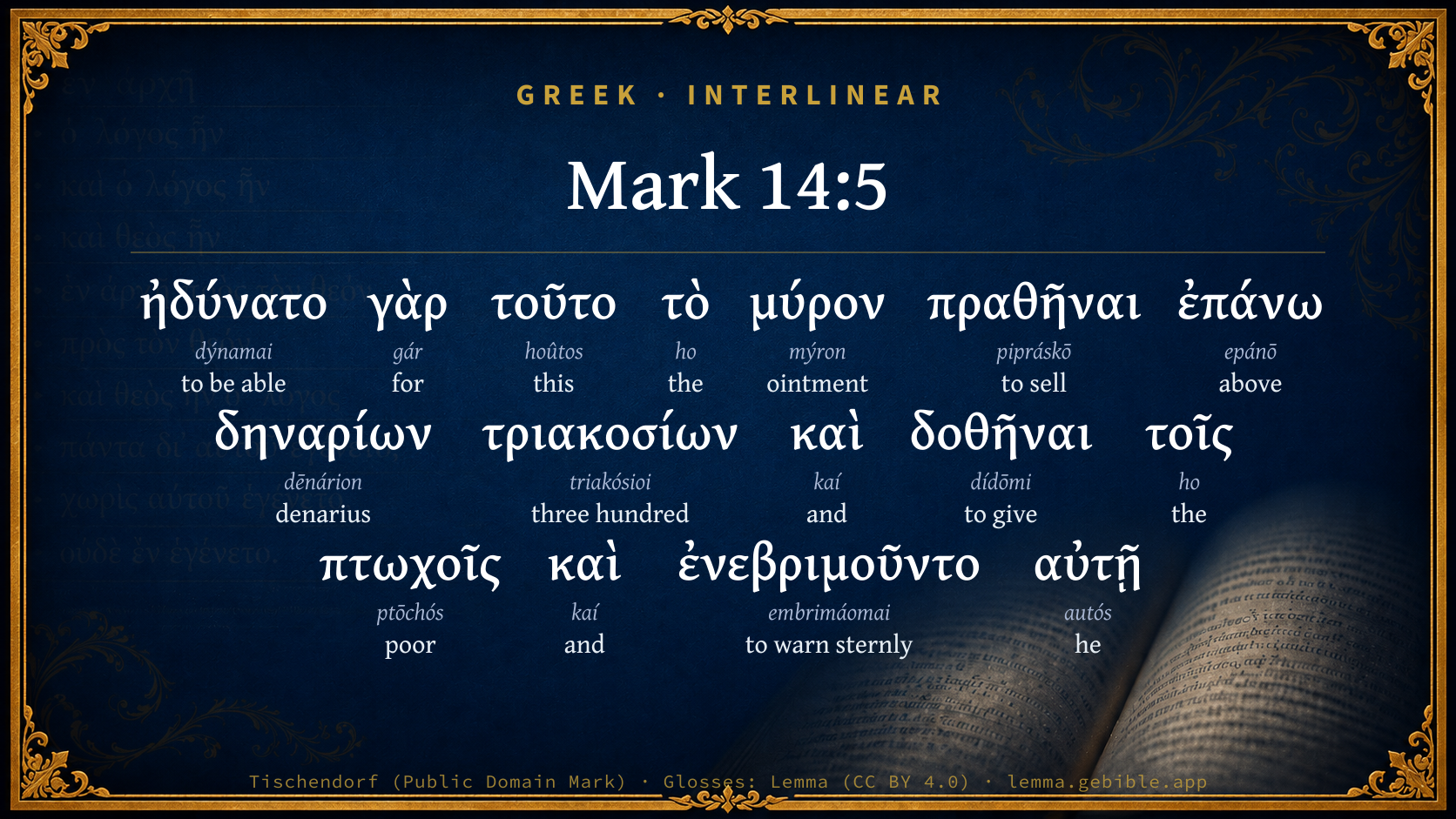
For this might have been sold for more than three hundred denarii, and given to the poor." They grumbled against her.
Download a study sheet
One document with this verse’s original text, its word-by-word gloss line, the meaning frame, cross-references with their text, attributed commentary, and full source and license credits — printable, and it pastes into notes with its structure intact.
This verse Autodidact and up
A passage Seminary Student
Up to 50 verses in one chapter. A passage sheet keeps up to 6 commentary sources and 12 cross-references per verse, in the order this page ranks them, and says so on the sheet whenever that leaves anything out. Ask for a single verse and you get the Autodidact verse sheet above.
Everything on this page stays free to read, with no account — the sheet is a download of what is already on screen, not access to it.
Compare translations 3
The same verse in 3 English versions, stacked beneath the original-language interlinear above. Click any original word for its lexicon entry.
Each is an independent rendering of the whole verse — the interlinear is not word-aligned to these translations.
Highlighted words mark where these versions differ — a whole-verse word diff, not a word-by-word alignment.
-
World English Bible Public Domain
For this might have been sold for more than three hundred denarii, and given to the poor." They grumbled against her.
-
King James Version Public Domain
For it might have been sold for more than three hundred pence, and have been given to the poor. And they murmured against her.
-
unfoldingWord Literal Text CC BY-SA 4.0
For this perfumed oil was able to be sold for more than 300 denarii and given to the poor.” And they were scolding her.
unfoldingWord Literal Text — © unfoldingWord, licensed CC BY-SA 4.0. Word-aligned USFM3 via Door43 (git.door43.org/unfoldingWord/en_ult).
Show all 19 translations
Every available English version of this verse, each an independent rendering of the whole verse.
-
World English Bible Public Domain
For this might have been sold for more than three hundred denarii, and given to the poor." They grumbled against her.
-
Berean Standard Bible Public Domain
It could have been sold for over three hundred denarii and the money given to the poor.” And they scolded her.
-
Majority Standard Bible Public Domain
It could have been sold for over three hundred denarii and the money given to the poor.” And they scolded her.
-
King James Version Public Domain
For it might have been sold for more than three hundred pence, and have been given to the poor. And they murmured against her.
-
American Standard Version (1901) Public Domain
For this ointment might have been sold for above three hundred shillings, and given to the poor. And they murmured against her.
-
Revised Version (1885) Public Domain
For this ointment might have been sold for above three hundred pence, and given to the poor. And they murmured against her.
-
Geneva Bible (1599) Public Domain
For it might haue bene sold for more then three hundreth pence, and bene giuen vnto the poore, and they murmured against her.
-
Douay-Rheims (1899) Public Domain
For this ointment might have been sold for more than three hundred pence, and given to the poor. And they murmured against her.
-
Young's Literal Translation Public Domain
for this could have been sold for more than three hundred denaries, and given to the poor;' and they were murmuring at her.
-
Literal Standard Version CC BY-SA 4.0
For this could have been sold for more than three hundred denarii, and given to the poor”; and they were murmuring at her.
-
Unlocked Literal Bible CC BY-SA 4.0
This perfume could have been sold for more than three hundred denarii, and given to the poor.” Then they scolded her.
-
unfoldingWord Literal Text CC BY-SA 4.0
For this perfumed oil was able to be sold for more than 300 denarii and given to the poor.” And they were scolding her.
-
Darby Bible Public Domain
for this ointment could have been sold for more than three hundred denarii and given to the poor. And they spoke very angrily at her.
-
World Messianic Bible Public Domain
For this might have been sold for more than three hundred denarii and given to the poor.” So they grumbled against her.
-
Webster's Bible Public Domain
For it might have been sold for more than three hundred pence, and have been given to the poor. And they murmured against her.
-
Free Bible Version CC BY-SA 4.0
It could've been sold for a year's wages and the money given to the poor.” They were angry with her.
-
Bible in Basic English Public Domain
We might have got more than three hundred pence for it, and given the money to the poor. And they said things against her among themselves.
-
Text-Critical English NT CC BY 4.0
It could have been sold for more than three hundred denarii, and the money could have been given to the poor.” So they began scolding her.
-
Tyndale New Testament (1534) Public Domain
For it myght have bene soolde for more then thre hundred pens and bene geve vnto the poore. And they grudged agaynste hir.
Literal Standard Version (2020), Covenant Press — licensed CC BY-SA 4.0. Text via the HelloAO Bible API (eBible.org). Unlocked Literal Bible (unfoldingWord) — licensed CC BY-SA 4.0. Text via the HelloAO Bible API (eBible.org). unfoldingWord Literal Text — © unfoldingWord, licensed CC BY-SA 4.0. Word-aligned USFM3 via Door43 (git.door43.org/unfoldingWord/en_ult). Free Bible Version, Dr. Jonathan Gallagher — licensed CC BY-SA 4.0. Text via the HelloAO Bible API (eBible.org).
Word by word
More ways to search: Search by grammar → Find every occurrence → Compare this word →
Practice this passage: Drill this verse → Learn its vocabulary →
- Appears 2× in the Greek New Testament
- First appears here
- Part of Speech
- Adjective
- Case
- Genitive
- Number
- Plural
- Gender
- Neuter
Full Thayer's Definition
- ἠδύνατο dýnamai G1410 “to be able” Verb, Imperfect, Middle or Passive deponent, Indicative, 3rd person, Singular, Attic form
- γὰρ gár G1063 “for” Conjunction
- τοῦτο hoûtos G3778 “this” Demonstrative pronoun, Nominative, Singular, Neuter
- τὸ ho G3588 “the” Article, Nominative, Singular, Neuter
- μύρον mýron G3464 “ointment” Noun, Nominative, Singular, Neuter
- πραθῆναι pipráskō G4097 “to sell” Verb, Aorist, Passive, Infinitive
- ἐπάνω epánō G1883 “above” Adverb
- δηναρίων dēnárion G1220 “denarius” Noun, Genitive, Plural, Neuter
- τριακοσίων triakósioi G5145 “three hundred” Adjective, Genitive, Plural, Neuter
- καὶ kaí G2532 “and” Conjunction
- δοθῆναι dídōmi G1325 “to give” Verb, Aorist, Passive, Infinitive
- τοῖς ho G3588 “the” Article, Dative, Plural, Masculine
- πτωχοῖς ptōchós G4434 “poor” Adjective, Dative, Plural, Masculine
- καὶ kaí G2532 “and” Conjunction
- ἐνεβριμοῦντο embrimáomai G1690 “to warn sternly” Verb, Imperfect, Middle or Passive deponent, Indicative, 3rd person, Plural
- αὐτῇ autós G846 “he” Personal pronoun, Dative, Singular, Feminine
About this verse
These counts appear in no published source. They are computed here, from the morphology-tagged text and Lemma’s own curated glosses. What Lemma adds →
- 16
- words
- 14
- distinct lemmas
- Gospels
- section
Notable vocabulary
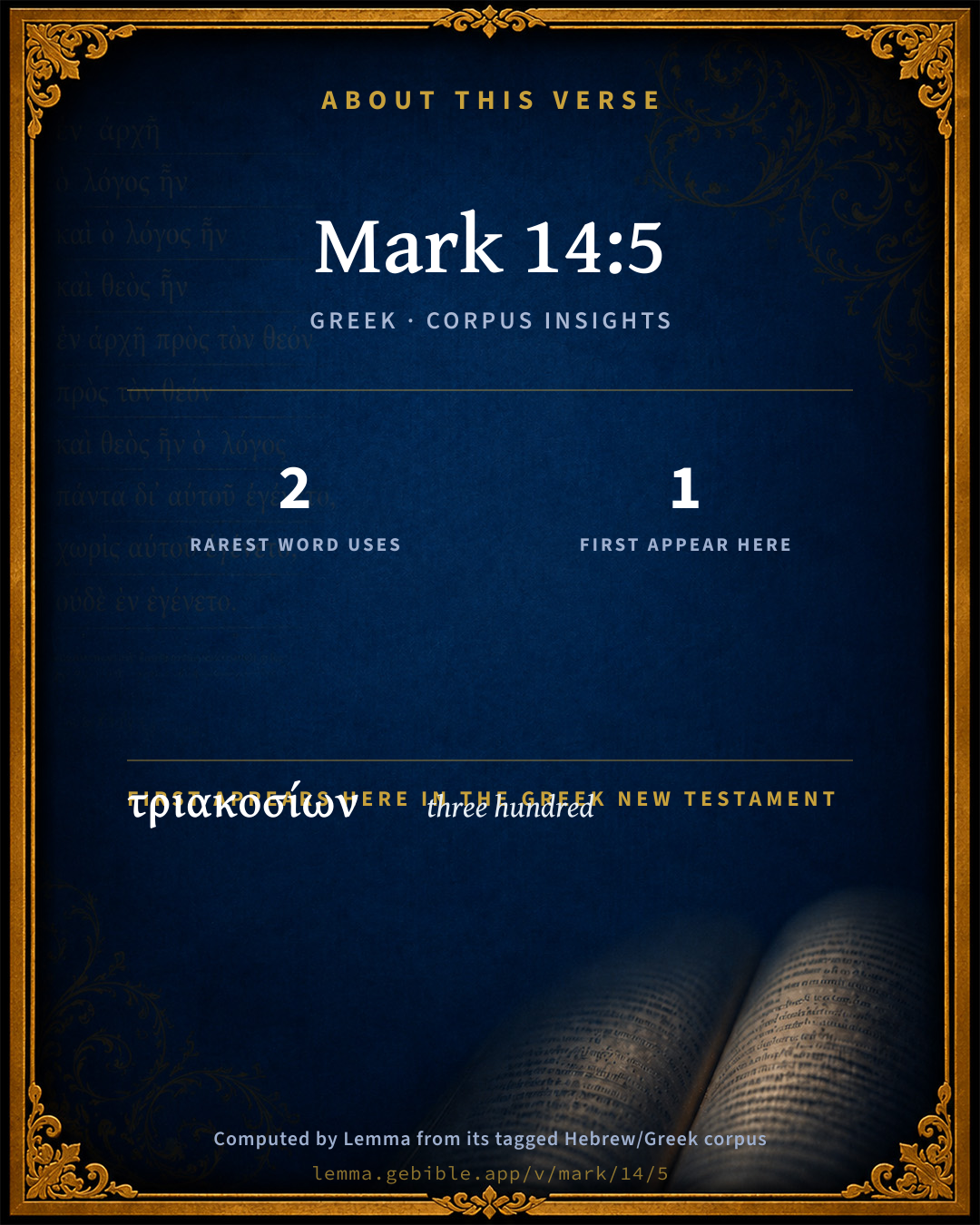
The rarest word here is τριακοσίων three hundred G5145 — appearing just 2 times in the whole Greek New Testament.
First appearance in Scripture
This word makes its first canonical appearance in the Greek New Testament here:
- τριακοσίων three hundred G5145
Shared distinctive vocabulary
τριακοσίων three hundred G5145 occurs in 2 verses of the Greek New Testament. Also found in:
Cross-references
14Topical passages linked to Mark 14:5 in the Treasury of Scripture Knowledge — connected by theme and wording, ordered by reader-vote popularity; previews shown in the World English Bible.
- Matthew 20:11 When they received it, they murmured against the master of the household,
- John 13:29 For some thought, because Judas had the money box, that Jesus said to him, "Buy what things we need for the feast," or that he should give something to the poor.
- Exodus 16:7–8 and in the morning, then you shall see the glory of Yahweh; because he hears your murmurings against Yahweh. Who are we, that you murmur against us?"
- Deuteronomy 1:27 and you murmured in your tents, and said, Because Yahweh hated us, he has brought us forth out of the land of Egypt, to deliver us into the hand of the Amorites, to destroy us.
- Psalms 106:25 But murmured in their tents, And didn't listen to Yahweh's voice.
- Matthew 18:28 "But that servant went out, and found one of his fellow servants, who owed him one hundred denarii, and he grabbed him, and took him by the throat, saying, 'Pay me what you owe!'
- Luke 15:2 The Pharisees and the scribes murmured, saying, "This man welcomes sinners, and eats with them."
- John 6:7 Philip answered him, "Two hundred denarii worth of bread is not sufficient for them, that everyone of them may receive a little."
- John 6:43 Therefore Jesus answered them, "Don't murmur among yourselves.
- John 12:5–6 "Why wasn't this ointment sold for three hundred denarii, and given to the poor?"
- 1 Corinthians 10:10 Neither grumble, as some of them also grumbled, and perished by the destroyer.
- Ephesians 4:28 Let him who stole steal no more; but rather let him labor, working with his hands the thing that is good, that he may have something to give to him who has need.
- Philippians 2:14 Do all things without murmurings and disputes,
- Jude 1:16 These are murmurers and complainers, walking after their lusts (and their mouth speaks proud things), showing respect of persons to gain advantage.
Cross-references courtesy of OpenBible.info (CC BY 4.0).
Lesson kit
Teaching starters — assembled from the data on this page, not authored interpretation. Every prompt links to the verse data it draws on. Edit before teaching.
Mark, in the Gospels, opens this verse with 16 words (14 distinct Greek lemmas). Its most distinctive word is triakósioi (“three hundred”). A historical commentator’s framing appears above. Read the whole chapter for the surrounding context.
Discussion questions
- The word triakósioi carries the sense “three hundred.” How does it shape the verse?
- This is the first place “three hundred” appears in Scripture (first appears here). What does its debut here establish?
- How does John 12:5, which shares the word «three hundred», read alongside this verse?
- What does the repetition of “the” (2× in this one verse) do in this verse?
- These translations render this verse differently; the difference is in the English rendering, not the original. What questions does that raise?
- Compare how Bengel's Gnomon and Expositor's Greek Testament read this verse. Where do they agree or differ?
Things to notice
- 1 word makes its first canonical appearance in Scripture here.
- These translations choose different wording for 15 words in this verse.
- “the” occurs 2× in this single verse.
- 14 distinct Greek lemmas span 16 words in this verse.
Commentary
Notes on Mark 14:5 from classic Christian and Jewish commentators (each source and its license shown beneath its notes). The classic Christian expositions comment on the surrounding passage and are grouped to its opening verse, so a note may address several verses; the Jewish commentaries on the Tanakh (Rashi and others) are per-verse, so they appear only where the commentator wrote on this verse.
Lemma curates 59 commentaries, every one of them public domain or Creative Commons licensed, each selected and text-cleaned for this edition rather than reprinted as found. About our sources →
Bengel's Gnomon
Johann Albrecht Bengel
Bengel's Gnomon of the New Testament — English translation (T&T Clark, Edinburgh, 1860) — public domain. Text from a community e-Sword module.
Expositor's Greek Testament
ed. W. Robertson Nicoll
The Expositor's Greek Testament, edited by W. Robertson Nicoll (1897–1910) — public domain. Text from a community e-Sword module.
Geneva Bible (1599)
Geneva Bible translators
Geneva Bible (1599) marginal notes — public domain. Text via Bolls.life.
Adam Clarke's Commentary
Adam Clarke's Commentary on the Bible (1810–1826) — public domain. Text from a community e-Sword/MySword module.
Ellicott's Commentary for English Readers
A Bible Commentary for English Readers, edited by Charles John Ellicott (1878–1897) — public domain. Text from a community e-Sword module.
The Cambridge Bible for Schools and Colleges
gen. ed. J. J. S. Perowne
The Cambridge Bible for Schools and Colleges (gen. ed. J. J. S. Perowne; Cambridge University Press, 1878–1918) — public domain. Text from a community e-Sword module.
John Gill's Exposition
John Gill's Exposition of the Whole Bible (1746–1763) — public domain (CC PDM 1.0). Text via the HelloAO Bible API.
Trapp's Complete Commentary
John Trapp
John Trapp, A Commentary or Exposition upon All the Books of the Old and New Testament (1647–1656) — public domain. Text from a community e-Sword module.
The Pulpit Commentary
The Pulpit Commentary (1880–1919), ed. H.D.M. Spence-Jones & Joseph S. Exell — public domain. Text from a community e-Sword module.
Cambridge Greek Testament for Schools and Colleges
Cambridge Greek Testament for Schools and Colleges (Cambridge University Press, 1896; 21 vols, various authors incl. Carr, Maclear, Plummer, Farrar, Lumby, Moule, M. R. James, Simcox) — public domain. Text from a community e-Sword module.
Alford’s Greek Testament
Henry Alford
Henry Alford, The Greek Testament (1849–1861) — public domain. Text from a community e-Sword module.
International Critical Commentary
International Critical Commentary — older volumes (1896–1929), various authors — public domain. Text from a community e-Sword module.
Vincent's Word Studies in the New Testament
Marvin R. Vincent
Marvin R. Vincent, Word Studies in the New Testament (1887–1900) — public domain. Text from a community e-Sword/MySword module.