
James 3:8

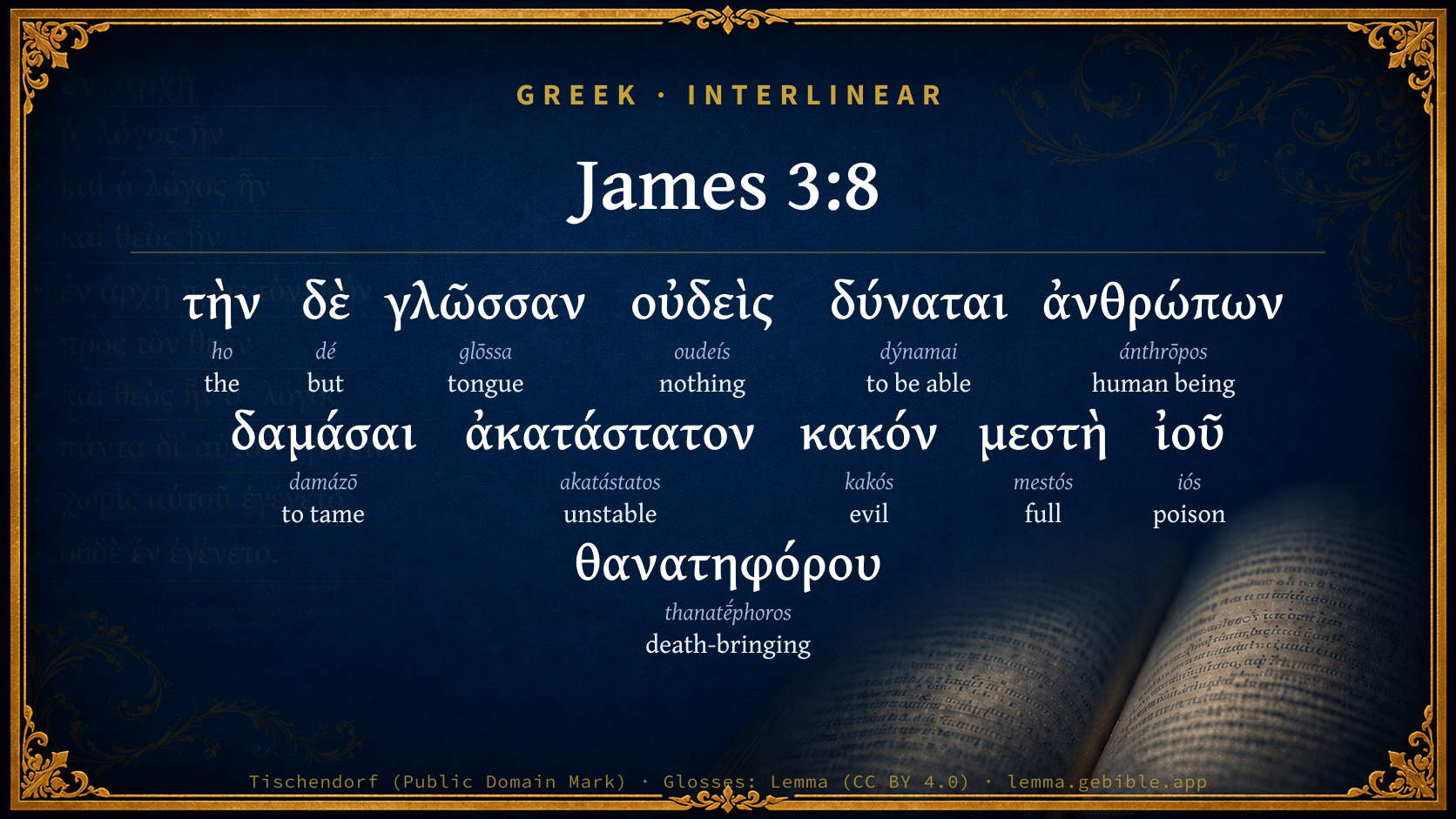
Greek (Tischendorf 8th ed.) James 3:8 appears in the Greek New Testament. The text above is from the Tischendorf 8th edition. Each word links to its Strong’s number and a concise gloss. Click any word for its full Thayer’s Greek Lexicon entry.
Download image
Cite this verse

James 3:8 (World English Bible). Public Domain. Lemma interlinear Bible study tool, https://lemma.gebible.app/v/james/3/8.

Show BibTeX & RIS
BibTeX
RIS
English Translation
But nobody can tame the tongue. It is a restless evil, full of deadly poison.
World English Bible · Public Domain
Highlights
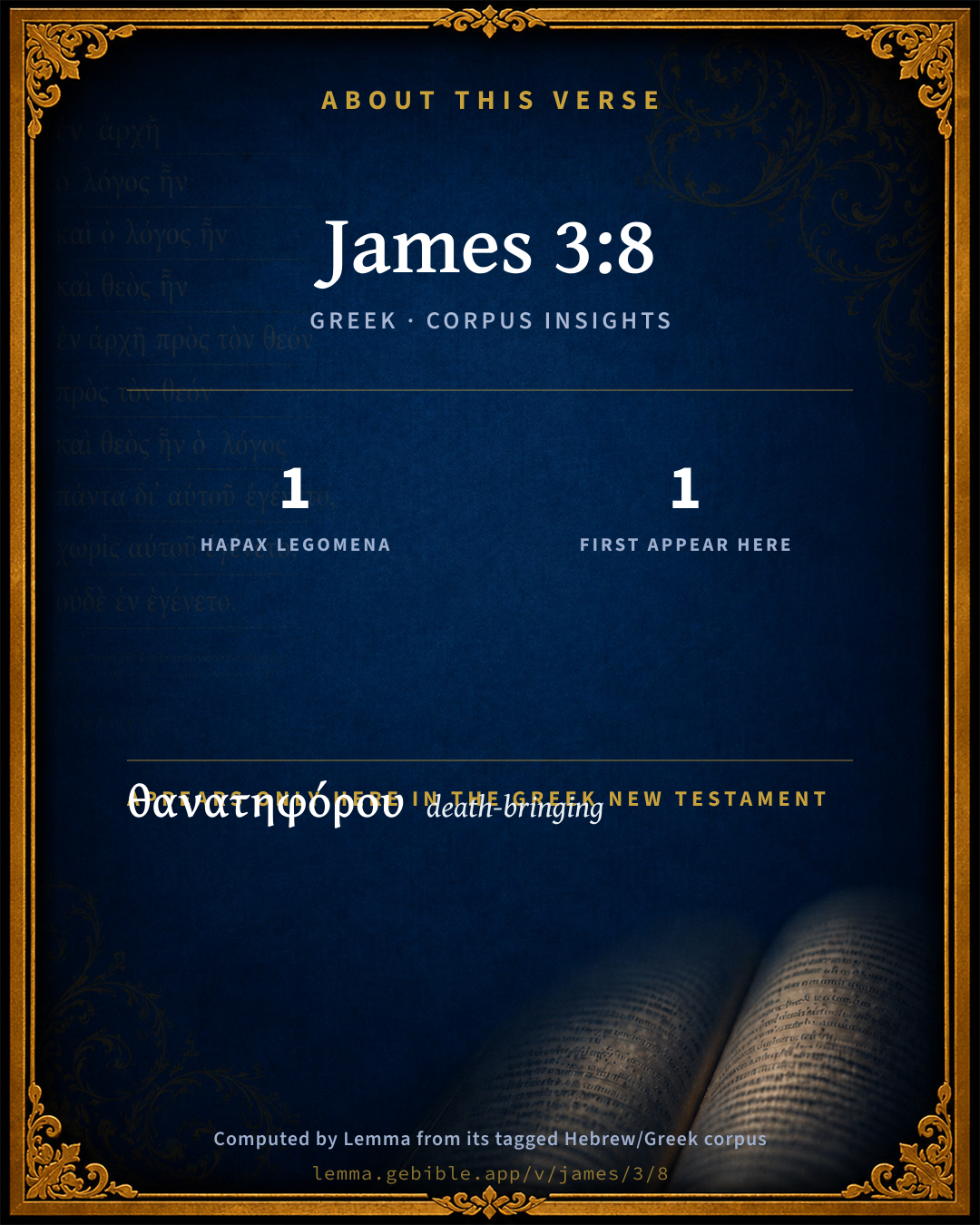
  • 1 hapax legomenon — only here in the Greek New Testament
  • 1 first appearance in the Greek New Testament
Full analysis ↓
Download a study sheet

One document with this verse’s original text, its word-by-word gloss line, the meaning frame, cross-references with their text, attributed commentary, and full source and license credits — printable, and it pastes into notes with its structure intact.

This verse Autodidact and up

Study sheet (.html) Plain text (.txt)

A passage Seminary Student

Up to 50 verses in one chapter. A passage sheet keeps up to 6 commentary sources and 12 cross-references per verse, in the order this page ranks them, and says so on the sheet whenever that leaves anything out. Ask for a single verse and you get the Autodidact verse sheet above.

Everything on this page stays free to read, with no account — the sheet is a download of what is already on screen, not access to it.

Want to remove ads? Support Godless Engineer
Compare translations 3

The same verse in 3 English versions, stacked beneath the original-language interlinear above. Click any original word for its lexicon entry.

Each is an independent rendering of the whole verse — the interlinear is not word-aligned to these translations.

Highlighted words mark where these versions differ — a whole-verse word diff, not a word-by-word alignment.

  • World English Bible Public Domain
    But nobody can tame the tongue. It is a restless evil, full of deadly poison.
  • King James Version Public Domain
    But the tongue can no man tame; it is an unruly evil, full of deadly poison.
  • unfoldingWord Literal Text CC BY-SA 4.0
    But no one of men is able to tame the tongue, an unsettled evil, full of deadly poison.

unfoldingWord Literal Text — © unfoldingWord, licensed CC BY-SA 4.0. Word-aligned USFM3 via Door43 (git.door43.org/unfoldingWord/en_ult).

Versions to compare (up to 4)

3 of 4 selected

Show all 19 translations

Every available English version of this verse, each an independent rendering of the whole verse.

  • World English Bible Public Domain
    But nobody can tame the tongue. It is a restless evil, full of deadly poison.
  • Berean Standard Bible Public Domain
    but no man can tame the tongue. It is a restless evil, full of deadly poison.
  • Majority Standard Bible Public Domain
    but no man can tame the tongue. It is an unruly evil, full of deadly poison.
  • King James Version Public Domain
    But the tongue can no man tame; it is an unruly evil, full of deadly poison.
  • American Standard Version (1901) Public Domain
    But the tongue can no man tame; `it is' a restless evil, `it is' full of deadly poison.
  • Revised Version (1885) Public Domain
    but the tongue can no man tame; it is a restless evil, it is full of deadly poison.
  • Geneva Bible (1599) Public Domain
    But the tongue can no man tame. It is an vnruly euill, full of deadly poyson.
  • Douay-Rheims (1899) Public Domain
    But the tongue no man can tame, an unquiet evil, full of deadly poison.
  • Young's Literal Translation Public Domain
    and the tongue no one of men is able to subdue, `it is' an unruly evil, full of deadly poison,
  • Literal Standard Version CC BY-SA 4.0
    but no one of men is able to subdue the tongue—[it is] an unruly evil, full of deadly poison;
  • Unlocked Literal Bible CC BY-SA 4.0
    But no human being can tame the tongue. It is a restless evil, full of deadly poison.
  • unfoldingWord Literal Text CC BY-SA 4.0
    But no one of men is able to tame the tongue, an unsettled evil, full of deadly poison.
  • Darby Bible Public Domain
    but the tongue can no one among men tame; [it is] an unsettled evil, full of death-bringing poison.
  • World Messianic Bible Public Domain
    but nobody can tame the tongue. It is a restless evil, full of deadly poison.
  • Webster's Bible Public Domain
    But the tongue can no man tame; it is an unruly evil, full of deadly poison.
  • Free Bible Version CC BY-SA 4.0
    but no one can tame the tongue—it's an evil thing, hard to control, full of deadly poison.
  • Bible in Basic English Public Domain
    But the tongue may not be controlled by man; it is an unresting evil, it is full of the poison of death.
  • Text-Critical English NT CC BY 4.0
    but no man can tame the tongue. It is an unruly evil, full of deadly poison.
  • Tyndale New Testament (1534) Public Domain
    But the tonge can no man tame. That is an vntuely evyll full of deedly poyson.

Literal Standard Version (2020), Covenant Press — licensed CC BY-SA 4.0. Text via the HelloAO Bible API (eBible.org). Unlocked Literal Bible (unfoldingWord) — licensed CC BY-SA 4.0. Text via the HelloAO Bible API (eBible.org). unfoldingWord Literal Text — © unfoldingWord, licensed CC BY-SA 4.0. Word-aligned USFM3 via Door43 (git.door43.org/unfoldingWord/en_ult). Free Bible Version, Dr. Jonathan Gallagher — licensed CC BY-SA 4.0. Text via the HelloAO Bible API (eBible.org).

Word by word

More ways to search: Search by grammar → Find every occurrence → Compare this word →

Practice this passage: Drill this verse → Learn its vocabulary →

θανατηφόρου
thanatḗphoros
G2287
“death-bringing”
Adjective, Genitive, Singular, Masculine
Part of Speech
Adjective
Case
Genitive
Number
Singular
Gender
Masculine
Full Thayer's Definition

Origin: from (the feminine form of) G2288 and G5342

TDNT: None

1. death bringing, deadly
  1. τὴν ho G3588 “the” Article, Accusative, Singular, Feminine
  2. δὲ dé G1161 “but” Conjunction
  3. γλῶσσαν glōssa G1100 “tongue” Noun, Accusative, Singular, Feminine
  4. οὐδεὶς oudeís G3762 “nothing” Adjective, Nominative, Singular, Masculine, Negative
  5. δύναται dýnamai G1410 “to be able” Verb, Present, Middle or Passive deponent, Indicative, 3rd person, Singular
  6. ἀνθρώπων ánthrōpos G444 “human being” Noun, Genitive, Plural, Masculine
  7. δαμάσαι damázō G1150 “to tame” Verb, Aorist, Active, Infinitive
  8. ἀκατάστατον akatástatos G182 “unstable” Adjective, Nominative, Singular, Neuter
  9. κακόν kakós G2556 “evil” Adjective, Nominative, Singular, Neuter
  10. μεστὴ mestós G3324 “full” Adjective, Nominative, Singular, Feminine
  11. ἰοῦ iós G2447 “poison” Noun, Genitive, Singular, Masculine

About this verse

These counts appear in no published source. They are computed here, from the morphology-tagged text and Lemma’s own curated glosses. What Lemma adds →

12
words
12
distinct lemmas
General Epistles
section

Notable vocabulary

1 hapax legomenon — a word that appears only here in the entire Greek New Testament:

  • θανατηφόρου death-bringing G2287

First appearance in Scripture

This word makes its first canonical appearance in the Greek New Testament here:

  • θανατηφόρου death-bringing G2287

Shared distinctive vocabulary

ἀκατάστατον unstable G182 occurs in 2 verses of the Greek New Testament. Also found in:
Cross-references

11

Topical passages linked to James 3:8 in the Treasury of Scripture Knowledge — connected by theme and wording, ordered by reader-vote popularity; previews shown in the World English Bible.

  • Romans 3:13 "Their throat is an open tomb. With their tongues they have used deceit." "The poison of vipers is under their lips;"
  • Psalms 140:3 They have sharpened their tongues like a serpent. Viper's poison is under their lips. Selah.
  • Psalms 55:21 His mouth was smooth as butter, But his heart was war. His words were softer than oil, Yet they were drawn swords.
  • James 3:6 And the tongue is a fire. The world of iniquity among our members is the tongue, which defiles the whole body, and sets on fire the course of nature, and is set on fire by Gehenna.
  • Psalms 57:4 My soul is among lions. I lie among those who are set on fire, Even the sons of men, whose teeth are spears and arrows, And their tongue a sharp sword.
  • Psalms 64:3–4 Who sharpen their tongue like a sword, And aim their arrows, deadly words,
  • Psalms 58:4 Their poison is like the poison of a snake; Like a deaf cobra that stops its ear,
  • Psalms 59:7 Behold, they spew with their mouth. Swords are in their lips, "For," they say, "who hears us?"
  • Ecclesiastes 10:11 If the snake bites before it is charmed, then is there no profit for the charmer's tongue.
  • Deuteronomy 32:33 Their wine is the poison of serpents, The cruel venom of asps.
  • Revelation 12:9 The great dragon was thrown down, the old serpent, he who is called the devil and Satan, the deceiver of the whole world. He was thrown down to the earth, and his angels were thrown down with him.

Cross-references courtesy of OpenBible.info (CC BY 4.0).

Commentary

Notes on James 3:8 from classic Christian and Jewish commentators (each source and its license shown beneath its notes). The classic Christian expositions comment on the surrounding passage and are grouped to its opening verse, so a note may address several verses; the Jewish commentaries on the Tanakh (Rashi and others) are per-verse, so they appear only where the commentator wrote on this verse.

Lemma curates 59 commentaries, every one of them public domain or Creative Commons licensed, each selected and text-cleaned for this edition rather than reprinted as found. About our sources →

Tyndale Open Study Notes

Tyndale Open Resources

3:8 no one can tame the tongue: The tongue has an astonishing capacity for committing evil. If its evil is motivated by hell (3:6), it certainly cannot be tamed by mere human effort. • full of deadly poison: This might allude to the serpent in the Garden of Eden (Gen 3:1), who is identified with the devil (Rev 20:2).

Tyndale Open Study Notes — © Tyndale Open Resources, licensed CC BY-SA 4.0. Text via the HelloAO Bible API.

Bengel's Gnomon

Johann Albrecht Bengel

Jas 3:8. Οὐδεὶς, ἀνθρώπων, no one of men) The antithesis is, of man, Jas 3:7.—οὐδεὶς, no other; scarcely each individual himself.—ἀκατάσχετον κακὸν) an unruly evil. Phocylides, λαός τοι καὶ ὕδωρ καὶ πῦρ, ἀκατάσχετα πάντα. So πῦρ, Jas 3:6.—μεστὴ, full) The nominative, after the parenthesis, compared with Jas 3:6. Then especially the evil is not to be restrained, when[38] it swells with deadly poison.

[38] So Beng. seems to take μεστὴ, when it is full, etc.—E.

Bengel's Gnomon of the New Testament — English translation (T&T Clark, Edinburgh, 1860) — public domain. Text from a community e-Sword module.

Meyer's Critical & Exegetical Commentary

Heinrich August Wilhelm Meyer

Jam_3:8. The chief thought is marked by δέ, as a contrast to the foregoing. With τὴν γλῶσσαν is meant not the tongue of others (Estius, Grotius, Hornejus, Baumgarten), but ones own tongue (according to Lange, both are indicated, the last primarily). The remark of Bengel is also unsuitable: nemo alius, vix ipse quisque. The words οὐδεὶς δύναται ἀνθρώπων δαμάζειν (or more correctly, after B C: οὐδεὶς δαμάσαι δύναται ἀνθρώπων, because the accent is on δαμάσαι) are to be understood in all their sharpness; the weakening completion of the Schol. in Matthaei: εὐκόλως δηλαδὴ καὶ ἄνευ πόνου, is false. By this thought, what was said in Jam_3:2 now receives its full light. The moral earnestness of the author urges him at the close to the exclamation: ἀκατάστατον κακόν κ.τ.λ.; hence the independent form of this addition (see Winer, p. 471 [E. T. 668]). By ἀκατάστατον (unsteady, restless, see chap. Jam_1:8) the unrest of the passions is indicated, not simply with reference to what follows, unsteadfastness (de Wette); comp. Hermas, Past. II. mand. 2 : πονηρὸν πνεῦμά ἐστιν ἡ καταλαλία, καὶ ἀκατάστατον δαιμόνιον. This reading is to be preferred to that of the Rec. ἀκατάσχετον (not to be tamed), because it adds a new idea after οὐδεὶς δαμάσαι δυν. ἀνθρ. (Wiesinger).

The image of the poisonous serpent lies at the foundation of the second exclamation: μεστὴ ἰοῦ θανατηφόρου; comp. Psa_140:4.

Meyer — Critical and Exegetical Commentary on the New Testament — English translation by Peter Christie, edited by Frederick Crombie (T&T Clark, 1880) — public domain. Text from a community e-Sword module.

Jamieson, Fausset & Brown

Robert Jamieson, A. R. Fausset & David Brown

no man--literally, "no one of men": neither can a man control his neighbor's, nor even his own tongue. Hence the truth of Jam 3:2 appears.

unruly evil--The Greek, implies that it is at once restless and incapable of restraint. Nay, though nature has hedged it in with a double barrier of the lips and teeth, it bursts from its barriers to assail and ruin men [ESTIUS].

deadly--literally, "death-bearing."

Jamieson, Fausset & Brown — Commentary Critical and Explanatory on the Whole Bible (1871) — public domain (CC PDM 1.0). Text via the HelloAO Bible API.

Adam Clarke's Commentary

Verse 8. But the tongue wan no man tame] No cunning, persuasion, or influence has ever been able to silence it. Nothing but the grace of God, excision, or death, can bring it under subjection.

It is an unruly evil] ακατασχετον κακον. An evil that cannot be restrained; it cannot be brought under any kind of government; it breaks all bounds.

Full of deadly poison.] He refers here to the tongues of serpents, supposed to be the means of conveying their poison into wounds made by their teeth. Throughout the whole of this poetic and highly declamatory description, St. James must have the tongue of the slanderer, calumniator, backbiter, whisperer, and tale-bearer, particularly in view. Vipers, basilisks; and rattlesnakes are not more dangerous to life, than these are to the peace and reputation of men.

Adam Clarke's Commentary on the Bible (1810–1826) — public domain. Text from a community e-Sword/MySword module.

Ellicott's Commentary for English Readers

(8) But the tongue can no man tame; it is an unruly (or, restless) evil, full of deadly poison.—Mortiferous, bringer of death, like a poisoned dart or arrow; and therefore most suggestive of envenomed flights at the fame of others. St. James does not mean that no one can tame his own tongue, for so he would hardly be responsible for its vagaries; and lower down it is written expressly, “these things ought not so to be.” The hopeless savagery of the tongue, excelling the fury of wild beasts, must be that of the liar, the traducer, and blasphemer. (Comp. Psalms 140)

A Bible Commentary for English Readers, edited by Charles John Ellicott (1878–1897) — public domain. Text from a community e-Sword module.

The Cambridge Bible for Schools and Colleges

gen. ed. J. J. S. Perowne

8. but the tongue can no man tame] There is a special force in the Greek tense for “tame”, which expresses not habitual, but momentary action. St James had learnt, by what he saw around him, and yet more, it may be, by personal experience, that no powers of the “nature of man” were adequate for this purpose. He had learnt also, we must believe, that the things which are impossible with man are possible with God.

an unruly evil] Literally, uncontrollable. Many of the better MSS., however, give the adjective which is rendered “unstable” in ch. Jas_1:8, and which carries with it, together with that meaning, the idea of restlessness and turbulence. So in the Shepherd of Hermas (11.2) calumny is described as a “restless demon.”

full of deadly poison] Literally, death-bringing. For the idea comp. “the poison of asps is under their lips,” Psa_140:3. The adjective is found in the LXX. version of Job_33:23, for “angels or messengers of death.”

The Cambridge Bible for Schools and Colleges (gen. ed. J. J. S. Perowne; Cambridge University Press, 1878–1918) — public domain. Text from a community e-Sword module.

John Gill's Exposition

But the tongue can no man tame,.... Either his own, or others; not his own, for the man that has the greatest guard upon himself, his words and actions; yet, what through pride or passion, or one lust or another in his heart, at one time or another, bolts out vain, idle, angry, and sinful words: and he that does not may be set down for a perfect man indeed: nor can he tame or restrain the tongues of others from detraction, calumnies, backbitings, and whisperings; who say, their lips are their own, and who is Lord over us? no man can, by his own power and strength, tame or subdue his tongue, or restrain it from evils it is habituated to, be it lying, cursing, swearing, or what else: God, by his Spirit, power, and grace, can, and often does, change the note of the curser, swearer, liar, and blasphemer; but no man can do this, though he can tame beasts, birds, serpents, and fishes; which shows the tongue to be worse than anything to be found in the whole compass of nature:

it is an unruly evil: an evil it is, for it is a world of iniquity; and an unruly one, being more so than the horse and mule, which are without understanding, who are kept in and governed, and turned any way by the bit and bridle: but though in nature the tongue is fenced by a double fence of the lips and teeth, this is not sufficient to restrain it; it breaks all bounds, and is not to be kept in by nature, art, or argument: nothing but the grace of God can in any measure govern it, or lay an embargo on it:

full of deadly poison, which, privately, secretly, and gradually, destroys the characters, credit, and reputation of men; and is of fatal consequence in families, neighbourhoods, churches, and states.

John Gill's Exposition of the Whole Bible (1746–1763) — public domain (CC PDM 1.0). Text via the HelloAO Bible API.

Trapp's Complete Commentary

John Trapp

8 But the tongue can no man tame; it is an unruly evil, full of deadly poison.

Ver. 8. But the tongue, &c.] Where then are our justiciaries with their pretended perfection? David’s heart deceived him Psa 39:1; "I said, I will look to my ways, I will bridle my tongue." But presently after, he shows how soon he brake his word. "My heart was hot," &c., and "I spake with my tongue." Pambus, in the ecclesiastical history, could never take out that one lesson read him out of Psa 39:1. There is one Bennus celebrated in the same ecclesiastical history for this (but I can hardly believe it), that he was never seen of any man to be angry, never beard to swear, or lie, or utter a vain word. (Sozomen, vi. 28.)

An unruly evil] There be but five virtues of the tongue reckoned by philosophers. But there are 24 different sins of the tongue, as Peraldus recounteth them. The Arabians have a proverb, Cave ne feriat lingua tua collum tuum; Take heed thy tongue cut not thy throat. An open mouth is often a purgatory to the master. {See Trapp on "Jas 3:6"}

Full of deadly poison] Such as poisoneth itself, and poisoneth at a distance, which no other poison doth. Some poisons are not poisonous to some creatures; storks feed upon serpents, ducks upon toads, &c. But the tongue is a universal poison, &c.

John Trapp, A Commentary or Exposition upon All the Books of the Old and New Testament (1647–1656) — public domain. Text from a community e-Sword module.

Albert Barnes' Notes on the Bible

But the tongue can no man tame - This does not mean that it is never brought under control, but that it is impossible effectually and certainly to subdue it. It would be possible to subdue and domesticate any kind of beasts, but this could not be done with the tongue.

It is an unruly evil - An evil without restraint, to which no certain and effectual check can be applied. Of the truth of this no one can have any doubt, who looks at the condition of the world.

Full of deadly poison - That is, it acts on the happiness of man, and on the peace of society, as poison does on the human frame. The allusion here seems to be to the bite of a venomous reptile. Compare Psa 140:3, “They have sharpened their tongues like serpent; adders” poison is under their lips.” Rom 3:13, “with their tongues they have used deceit; the poison of asps is under their lips.” Nothing would better describe the mischief that may be done by the tongue. There is no sting of a serpent that does so much evil in the world; there is no poison more deadly to the frame than the poison of the tongue is to the happiness of man. Who, for example, can stand before the power of the slanderer? What mischief can be done in society that can be compared with that which he may do?

- ’Tis slander;

Whose edge is sharper than the sword; whose tongue

Outvenoms all the worms of Nile; whose breath

Rides on the posting winds, and doth belie

All corners of the world: kings, queens, and states,

Maids, matrons, nay, the secrets of the grave

This viperous slander enters.

Shakespeare in Cymbellna.

Albert Barnes' Notes on the Bible (1834–1885) — public domain. Text from a community e-Sword/MySword module.

Haydock's Catholic Bible Commentary

But the tongue no man can tame, without the special assistance of God. (Witham) --- Wherefore we are to understand, says St. Augustine, that as no one is able of himself to govern his tongue, we must fly to the Lord for his assistance. (St. Augustine, ser. 4. de verb.; Matthew vi. --- It is an unquiet evil,[5] which cannot be stopt [stopped]. It is full of deadly poison, which brings oftentimes death both to men’s bodies and souls. (Witham)

===============================

[BIBLIOGRAPHY]

Inquietum malum; so in divers Greek manuscripts, Greek: akatastaton, though in others, Greek: akatacheton, quod coerceri non potest.

George Leo Haydock (1774–1849), Haydock's Catholic Family Bible and Commentary, 1859 edition — public domain. Excludes Psalms (Douay-Rheims chapter numbering differs from Protestant) and Deuterocanonical books (Catholic canon only).

Matthew Poole's English Annotations

But the tongue; not only other men’s tonges, but his own.

Can no man tame; no man of himself, and without the assistance of Divine grace, can bring his tongue into subjection, and keep it in order; nor can any man, by the assistance of any grace promised in this life, so keep it, as that it shall never at all offend.

It is an unruly evil; or, which cannot be restrained, and kept within bounds: wild beasts are kept in by grates and bars, but this by no restraint.

Full of dead poison; the wickedness of the tongue is compared to poison, in respect of the mischief it doth to others. It seems to allude to those kinds of serpents which have poison under their tongues, Psa 140:3, with which they kill those they bite. The poison of the tongue is no less deadly, it murders men’s reputations by the slanders it utters, their souls by the lusts and passions it stirs up in them, and many times their bodies too by the contentions and quarrels it raiseth against men.

Matthew Poole's English Annotations on the Holy Bible (1683–1685) — public domain. Text from a community e-Sword/MySword module.

Whedon's Commentary on the Bible

Daniel D. Whedon

8. Tongue can no man tame—Augustine says, that never, but by the grace of God, has any tongue been tamed. It may be replied that worldly self-interest often tames the tongue as effectually as divine wisdom. As to that, however, it may be asked, To what does worldly prudence tame the tongue? And it may be answered, It tames the tongue to a subdued but still wild and depraved state. Nothing but the grace of God tames the tongue to that docility to which our apostle alludes, submission to the divine law, and the hearty utterance of a holy confession.

Daniel D. Whedon (gen. ed.), Commentary on the Old and New Testaments (1874–1909) — public domain. Text from a community e-Sword module.

The Pulpit Commentary

It is an unruly evil; rather restless, reading ajkatastaton (a, A, B) for ajkatasceton of Textus Receptus (C, K, L); Vulgate, inquietum malum. (cf. Jam_1:8) The nominatives in this verse should be noticed: "The last words are to be regarded as a kind of exclamation, and are therefore appended in an independent construction" (Winer, p. 668). A restless evil! Full of deadly poison! Compare the abrupt nominative inrov); Php_3:19 with Bishop Light-feet"s note. Deadly (qanathfo) here only in the New Testament. In the LXX it is found Num_18:22; Job_33:23 RAPC 4Ma 8:17, 24 15:23. For the figure, cf. Psa_140:3, "They have sharpened their tongues like a serpent; adders" poison is under their lips."

The Pulpit Commentary (1880–1919), ed. H.D.M. Spence-Jones & Joseph S. Exell — public domain. Text from a community e-Sword module.

John Wesley's Explanatory Notes

But no man can tame the tongue - Of another; no, nor his own, without peculiar help from God.

John Wesley, Explanatory Notes Upon the Whole Bible (1754–1765) — public domain. Text via the GEBible commentary corpus.

The People's New Testament

B. W. Johnson

8. But the tongue can no man tame. Man has never tamed this organ as a whole. Some may have ruled their own, but the organ itself still does its evil work in the world. It is an unruly evil. Not only an evil, but unruly. Generally used. Full of deadly poison. Often charged with malice, envy, anger, slander, etc.

B. W. Johnson's The People's New Testament with Notes (1889–1891) — public domain. Electronic text from the Christian Classics Ethereal Library (CCEL) ThML edition.

Cambridge Greek Testament for Schools and Colleges

8. ἀκατάστατον with אABP, Old Latin and Vulgate &c. ἀκατάσχετον of the T.R. is read in CKL and many later MSS.

8. ἀκατάστατον, restless, disquieted. ἀκατάσχετον, uncontrolled, unruly. For the reading see critical notes. For the thought comp. Hesiod, Ἔργα 761 δεινὴν δὲ βροτῶν ὑπαλεύεο φήμην· | φήμη γάρ τε κακὴ πέλεται κούφη μὲν ἀεῖραι | ῥεῖα μάλʼ ἀργαλέη δὲ φέρειν χαλεπὴ δʼ ἀποθέσθαι. | φήμη δʼ οὔτις πάμπαν ἀπόλλυται ἤν τινα πολλοὶ | λαοὶ φημίζουσι· θεός νύ τις ἐστὶ καὶ αὐτή.

μεστὴ ἰοῦ θανατοφόρου, comp. Psa 141:3 ἰὸς ἀσπίδων ὑπὸ τὰ χείλη αὐτῶν.

Cambridge Greek Testament for Schools and Colleges (Cambridge University Press, 1896; 21 vols, various authors incl. Carr, Maclear, Plummer, Farrar, Lumby, Moule, M. R. James, Simcox) — public domain. Text from a community e-Sword module.

Alford’s Greek Testament

Henry Alford

8.] The untameableness of the tongue. The thought in ver. 3, though not directly leading on to this, yet is a hint tending towards it.

8.] but (exception) the tongue no one of men can tame (the assertion is absolute, not to be weakened by εὐκόλως κ. ἄνευ πόνου, as the Schol. in Matthæi. And it is plain that to read it, as Œc., interrogatively (εἰ τὰ ἀτίθασσα θηρία ὁ ἄνθρωπος τιθασσεύει καὶ χειροήθη ποιεῖ, ἆρα τὴν ἑαυτοῦ γλῶσσαν οὐ δαμάσει;), is quite out of the question. Observe δαμάσαι, aor., ‘even to tame once,’ not habitually, pres. Now we see fully the meaning of ver. 2): it is a restless mischief (ἀκατάστατον expresses both fickleness and restlessness, see above on ch. 1:8 and Dio Chrys. there, who calls a democracy ἄστατον κακόν. The figure here seems to correspond nearly to what is related of Proteus, that he eluded the grasp of Menelaus under many various shapes. Cf. Hermas, Pastor ii. 2, p. 916, ὦ πόσον πονηρά ἐστιν ἡ καταλαλιά, καὶ ἀκατάστατον δαιμόνιον), (it is) (the supply of a copula is necessary on account of the change of gender, referring back again to γλῶσσα. Or, the two clauses may be rendered without any copulæ, as quasi-exclamations) full of death-bringing poison (cf. ref. Ps., ἠκόνησαν γλῶσσαν αὐτῶν ὡσεὶ ὄφεως, ἰὸς ἀσπίδων ὑπὸ τὰ χείλη αὐτῶν). I cannot forbear referring the reader to Erasmus’s very elegant paraphrase of these two verses, 7, 8; and thanking Wiesinger for directing attention to it.

9,

Henry Alford, The Greek Testament (1849–1861) — public domain. Text from a community e-Sword module.

International Critical Commentary

8. οὐδεὶς δαμάσαι δύναται. Notice the alliteration with δ, cf. v. 5, and 4 Macc. 15:31, where κ is repeated six times.

ἀνθρώπων. Belongs with οὐδείς; alludes to ἀνθρωπίνῃ.

This is not meant to be, as Augustine (De nat. et grat. ch. 15) and others since have thought, in contrast with the divine power which can do all things, but is a popular way of saying that complete control of the tongue is not to be expected; cf. v. 2 τέλειος ἀνήρ.

The Pelagian interpretation, which took this as a question, in order to avoid a proof-text for universal sinfulness, is unacceptable because opposed to the context.

ἀκατάστατον κακόν, “a restless, forthputting, evil”; best taken (because of μεστή) as nominative absolute; cf. Mar 12:38. ἀκατάστατος is the opposite of δεδαμασμένος; see on 1:8, and cf. 3:16 ἀκαταστασία. Cf. Hermas, Mand. ii, 3 πονηρὰ ἡ καταλαλιά, ἀκατάστατον δαιμόνιόν ἐστιν.

ἀκατάστατον] CKL minnpler m syrutr Cyr read ἀκατάσχετον; more commonplace, hence probably an emendation.

ἰοῦ θανατηφόρου, “deadly poison,” probably with allusion to the poison of the serpent’s tongue. Cf. Psa 140:3, quoted in Rom 3:13. Cf. Lucian, Fugit. 19 ἰοῦ μεστὸν αὐτοῖς τὸ στόμα. The figure of poison was a common one among the Greeks, used for various hateful things (references in Mayor).

International Critical Commentary — older volumes (1896–1929), various authors — public domain. Text from a community e-Sword module.

Vincent's Word Studies in the New Testament

Marvin R. Vincent

No man [ουδεις ανθρωπων] . A strong expression. Lit., no one of men.

Unruly [ακατασχετον] . Lit., not to be held back. The proper reading, however, is ajkatastaton, unsettled. See on kaqistatai, hath its place, ver. 6. Rev., correctly, restless.

Deadly [θανατηφορου] . Lit., death - bearing, or bringing. Only here in New Testament.

Poison [ιου] . Rendered rust at ch. 5 3; and found only in these two passages and in Rom 3:13, in the citation of Psa 140:3.

Marvin R. Vincent, Word Studies in the New Testament (1887–1900) — public domain. Text from a community e-Sword/MySword module.

Lesson kit

Teaching starters — assembled from the data on this page, not authored interpretation. Every prompt links to the verse data it draws on. Edit before teaching.

James, in the General Epistles, opens this verse with 12 words (12 distinct Greek lemmas). Its most distinctive word is thanatḗphoros (“death-bringing”). A historical commentator’s framing appears above. Read the whole chapter for the surrounding context.

Discussion questions

  1. How does “death-bringing” (thanatḗphoros) shape what this verse is saying?
  2. 1 word here appears nowhere else in the Greek New Testament. Why might the author reach for such rare wording?
  3. This is the first place “death-bringing” appears in Scripture (first appears here). What does its debut here establish?
  4. How does James 1:8, which shares the word «unstable», read alongside this verse?
  5. These translations render this verse differently. What is at stake in choosing one wording over another?
  6. Compare how Tyndale Open Study Notes and Bengel's Gnomon read this verse. Where do they agree or differ?

Things to notice

  • 1 word in this verse appears nowhere else in the Greek New Testament.
  • 1 word makes its first canonical appearance in Scripture here.
  • These translations choose different wording for 9 words in this verse.
  • 12 distinct Greek lemmas span 12 words in this verse.

Reading settings

Reading text

Shown beneath each verse's original-language words.

Old Testament
Old Testament edition

Read the OT as the Masoretic Hebrew (MT) or the Greek Septuagint (LXX).

English shown for the Greek Septuagint (in the Hebrew ↔ Greek comparison).

Comparing translations? Open the Compare panel on any verse page to stack up to four side by side.