1 Corinthians 3:2

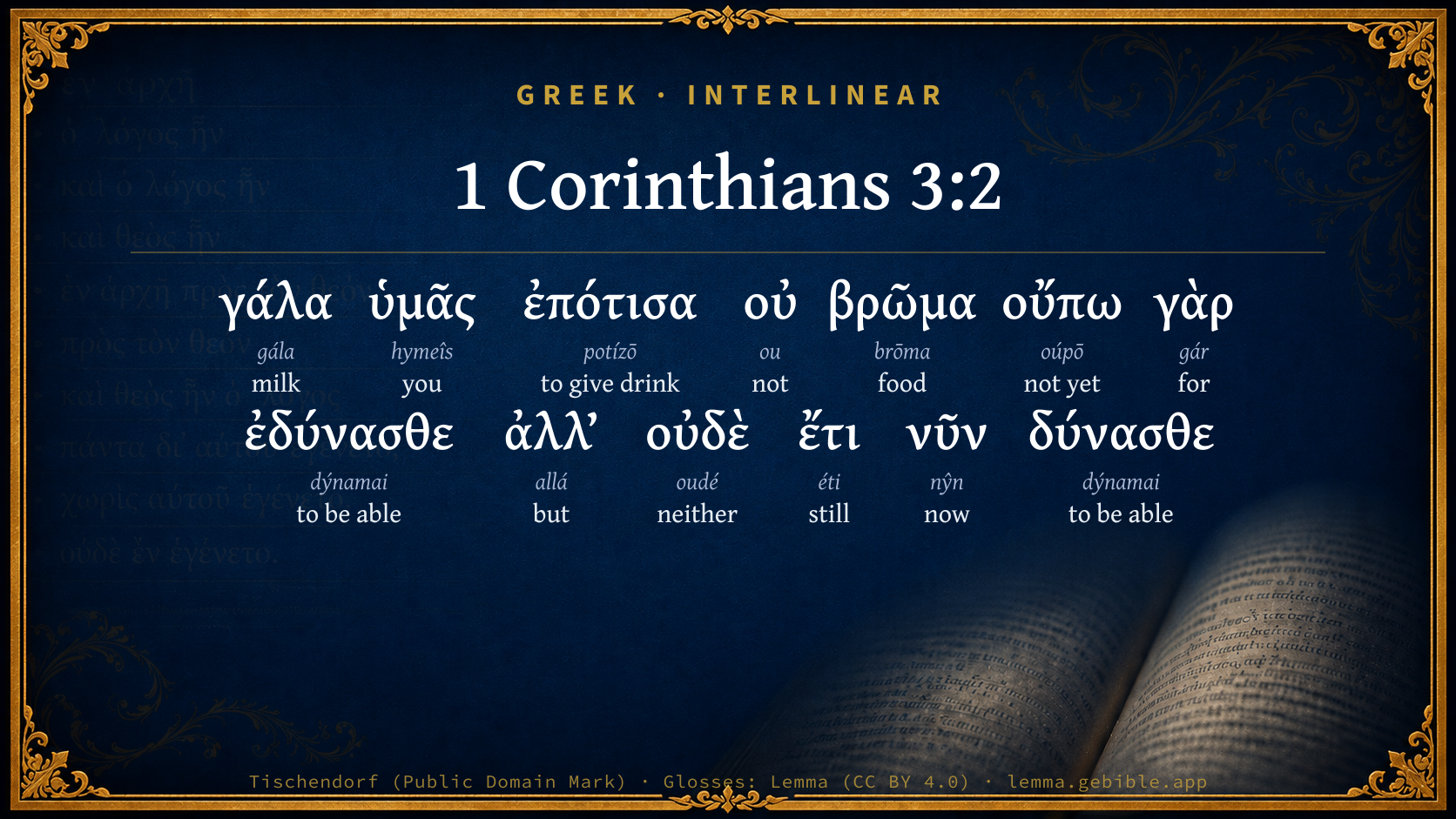
Greek (Tischendorf 8th ed.) 1 Corinthians 3:2 appears in the Greek New Testament. The text above is from the Tischendorf 8th edition. Each word links to its Strong’s number and a concise gloss. Click any word for its full Thayer’s Greek Lexicon entry.
Download image
Cite this verse

1 Corinthians 3:2 (World English Bible). Public Domain. Lemma interlinear Bible study tool, https://lemma.gebible.app/v/1-corinthians/3/2.

Show BibTeX & RIS
BibTeX
RIS
English Translation
I fed you with milk, not with meat; for you weren't yet ready. Indeed, not even now are you ready,
World English Bible · Public Domain
Highlights
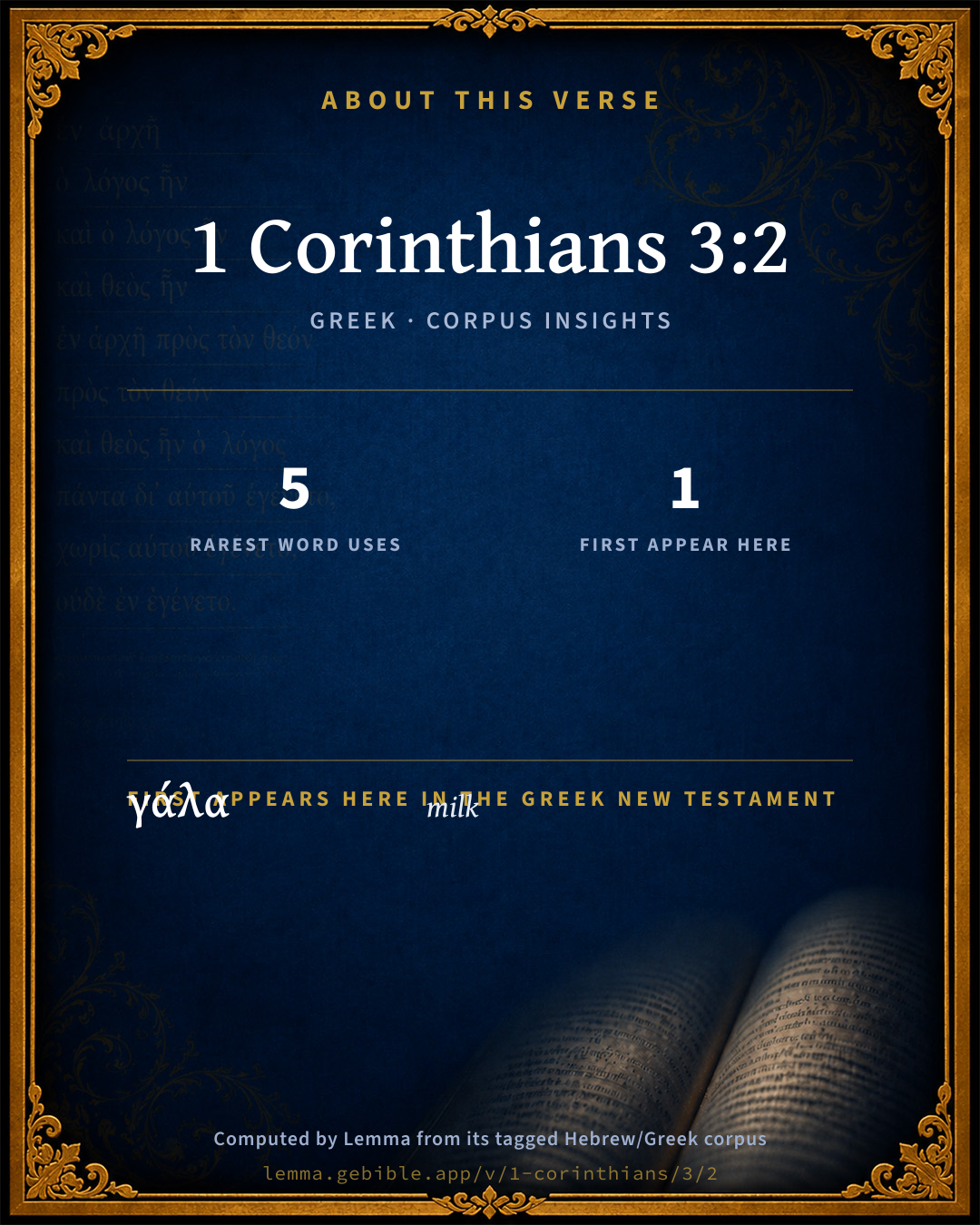
  • 1 first appearance in the Greek New Testament
Full analysis ↓
Download a study sheet

One document with this verse’s original text, its word-by-word gloss line, the meaning frame, cross-references with their text, attributed commentary, and full source and license credits — printable, and it pastes into notes with its structure intact.

This verse Autodidact and up

Study sheet (.html) Plain text (.txt)

A passage Seminary Student

Up to 50 verses in one chapter. A passage sheet keeps up to 6 commentary sources and 12 cross-references per verse, in the order this page ranks them, and says so on the sheet whenever that leaves anything out. Ask for a single verse and you get the Autodidact verse sheet above.

Everything on this page stays free to read, with no account — the sheet is a download of what is already on screen, not access to it.

Want to remove ads? Support Godless Engineer
Compare translations 3

The same verse in 3 English versions, stacked beneath the original-language interlinear above. Click any original word for its lexicon entry.

Each is an independent rendering of the whole verse — the interlinear is not word-aligned to these translations.

Highlighted words mark where these versions differ — a whole-verse word diff, not a word-by-word alignment.

  • World English Bible Public Domain
    I fed you with milk, not with meat; for you weren't yet ready. Indeed, not even now are you ready,
  • King James Version Public Domain
    I have fed you with milk, and not with meat: for hitherto ye were not able to bear it, neither yet now are ye able.
  • unfoldingWord Literal Text CC BY-SA 4.0
    I gave you milk to drink, not solid food, for you were not yet able. Indeed, even now, you are not able.

unfoldingWord Literal Text — © unfoldingWord, licensed CC BY-SA 4.0. Word-aligned USFM3 via Door43 (git.door43.org/unfoldingWord/en_ult).

Versions to compare (up to 4)

3 of 4 selected

Show all 19 translations

Every available English version of this verse, each an independent rendering of the whole verse.

  • World English Bible Public Domain
    I fed you with milk, not with meat; for you weren't yet ready. Indeed, not even now are you ready,
  • Berean Standard Bible Public Domain
    I gave you milk, not solid food, for you were not yet ready for solid food. In fact, you are still not ready,
  • Majority Standard Bible Public Domain
    I gave you milk, not solid food, for you were not yet ready for solid food. In fact, you are still not ready,
  • King James Version Public Domain
    I have fed you with milk, and not with meat: for hitherto ye were not able to bear it, neither yet now are ye able.
  • American Standard Version (1901) Public Domain
    I fed you with milk, not with meat; for ye were not yet able `to bear it': nay, not even now are ye able;
  • Revised Version (1885) Public Domain
    I fed you with milk, not with meat; for ye were not yet able to bear it: nay, not even now are ye able;
  • Geneva Bible (1599) Public Domain
    I gaue you milke to drinke, and not meat: for yee were not yet able to beare it, neither yet nowe are yee able.
  • Douay-Rheims (1899) Public Domain
    I gave you milk to drink, not meat; for you were not able as yet. But neither indeed are you now able; for you are yet carnal.
  • Young's Literal Translation Public Domain
    with milk I fed you, and not with meat, for ye were not yet able, but not even yet are ye now able,
  • Literal Standard Version CC BY-SA 4.0
    with milk I fed you, and not with meat, for you were not yet able, but not even yet are you now able,
  • Unlocked Literal Bible CC BY-SA 4.0
    I fed you milk, not solid food, for you were not ready for it; and even now you are not yet ready.
  • unfoldingWord Literal Text CC BY-SA 4.0
    I gave you milk to drink, not solid food, for you were not yet able. Indeed, even now, you are not able.
  • Darby Bible Public Domain
    I have given you milk to drink, not meat, for ye have not yet been able, nor indeed are ye yet able;
  • World Messianic Bible Public Domain
    I fed you with milk, not with solid food, for you weren’t yet ready. Indeed, you aren’t ready even now,
  • Webster's Bible Public Domain
    I have fed you with milk, and not with meat: for hitherto ye were not able to bear it, neither yet now are ye able.
  • Free Bible Version CC BY-SA 4.0
    I gave you milk—I couldn't give you solid food to eat, because you weren't ready for it.
  • Bible in Basic English Public Domain
    I gave you milk and not meat, because you were, then, unable to take it, and even now you are not able;
  • Text-Critical English NT CC BY 4.0
    I fed you milk, not solid food, for you were not yet able to receive it. Even now you are still not able,
  • Tyndale New Testament (1534) Public Domain
    I gave you mylke to drinke and not meate. For ye then were not stronge no nether yet are.

Literal Standard Version (2020), Covenant Press — licensed CC BY-SA 4.0. Text via the HelloAO Bible API (eBible.org). Unlocked Literal Bible (unfoldingWord) — licensed CC BY-SA 4.0. Text via the HelloAO Bible API (eBible.org). unfoldingWord Literal Text — © unfoldingWord, licensed CC BY-SA 4.0. Word-aligned USFM3 via Door43 (git.door43.org/unfoldingWord/en_ult). Free Bible Version, Dr. Jonathan Gallagher — licensed CC BY-SA 4.0. Text via the HelloAO Bible API (eBible.org).

Word by word

More ways to search: Search by grammar → Find every occurrence → Compare this word →

Practice this passage: Drill this verse → Learn its vocabulary →

About this verse

These counts appear in no published source. They are computed here, from the morphology-tagged text and Lemma’s own curated glosses. What Lemma adds →

13
words
12
distinct lemmas
Pauline Epistles
section

Notable vocabulary

The rarest word here is γάλα milk G1051 — appearing just 5 times in the whole Greek New Testament.

First appearance in Scripture

This word makes its first canonical appearance in the Greek New Testament here:

Shared distinctive vocabulary

γάλα milk G1051 occurs in 5 verses of the Greek New Testament. Also found in:

Repetition

A word recurs within this verse:

  • ἐδύνασθε to be able G1410 ×2

Cross-references

3

Topical passages linked to 1 Corinthians 3:2 in the Treasury of Scripture Knowledge — connected by theme and wording, ordered by reader-vote popularity; previews shown in the World English Bible.

  • Hebrews 5:11–14 About him we have many words to say, and hard to interpret, seeing you have become dull of hearing.
  • John 16:12 "I have yet many things to tell you, but you can't bear them now.
  • 1 Peter 2:2 as newborn babes, long for the pure milk of the Word, that you may grow thereby,

Cross-references courtesy of OpenBible.info (CC BY 4.0).

Commentary

Notes on 1 Corinthians 3:2 from classic Christian and Jewish commentators (each source and its license shown beneath its notes). The classic Christian expositions comment on the surrounding passage and are grouped to its opening verse, so a note may address several verses; the Jewish commentaries on the Tanakh (Rashi and others) are per-verse, so they appear only where the commentator wrote on this verse.

Lemma curates 59 commentaries, every one of them public domain or Creative Commons licensed, each selected and text-cleaned for this edition rather than reprinted as found. About our sources →

Tyndale Open Study Notes

Tyndale Open Resources

3:2 Because of the Corinthian Christians’ lack of spiritual maturity, Paul was unable to speak about the deeper truths of life in Christ, the solid food (see 2:6-7) that is reserved for mature Christians. Instead, he had to restrict himself to milk, the basic teachings of the Good News (cp. Heb 5:12-14; 6:1-3; 1 Pet 2:2).

Tyndale Open Study Notes — © Tyndale Open Resources, licensed CC BY-SA 4.0. Text via the HelloAO Bible API.

Bengel's Gnomon

Johann Albrecht Bengel

1Co 3:2. Γάλα, milk) He speaks in this way to bring the Corinthians to humility.—οὐ, not) supply, I have fed, or any other word, akin to, I have given you drink. An instructor does not necessarily teach what he himself knows, but what is suitable to his hearers. Scripture is perfect; for, as an example, to the Corinthians milk is supplied; to the Hebrews, solid food.

Bengel's Gnomon of the New Testament — English translation (T&T Clark, Edinburgh, 1860) — public domain. Text from a community e-Sword module.

Meyer's Critical & Exegetical Commentary

Heinrich August Wilhelm Meyer

1Co_3:2. Keeping to the same figure (comp Heb_5:12; Philo, de agric. p. 301), he designates as γάλα: τὴν εἰσαγωγικὴν καὶ ἁπλουστέραν τοῦ εὐαγγελίου διδασκαλίαν (Basil. Hom. I. p. 403, ed. Paris. 1638), see Heb_5:12; Heb_6:1 f., and as βρῶμα: the further and higher instruction, the σοφία, which, as distinguished from the γνῶσιν τὴν ἐκ κατηχήσεως (Clemens Alexandrinus), is taught among the τέλειοι (1Co_6:6 ff.). Comp Suicer, Thes. I. p. 721, 717. Wetstein in loc[462]

As regards the zeugma (comp Homer, Il. viii. 546; Odyssey, xx. 312; Hesiod. Theog. 640), see Bremi, a[464] Lys. Exc. III. p. 437 f.; Winer, p. 578 [E. T. 777]; Kühner, a[465] Xen. Anab. iv. 5. 8; also Nägelsbach on the Iliad, p. 179, ed. 3.

ἐδύνασθε] Ye were not yet strong and vigorous. What weakness is meant, the context shows: in the figure, that of the body; in its application, that of the mind and spirit. Comp regarding this absolute use of δύναμαι, δυνατός κ.τ.λ[467] (which makes any supplementing of it by ἘΣΘΊΕΙΝ ΒΡῶΜΑ and the like quite superfluous), Dem. 484, 25, 1187, 8; Aesch. p. 40. 39; Plato, Men. p. 77 B, Prot. p. 326 C; Xen. Anab. iv. 5. 11, vii. 6. 37; 1Ma_5:41; Schaefer, a[468] Bos. Ell. p. 267 ff.

ἈΛΛʼ ΟὐΔῈ ἜΤΙ ΝῦΝ ΔΎΝ.] ἈΛΛʼ ΟὐΔΈ, yea, not even. See Fritzsche, a[469] Marc. p. 157. Herm. a[470] Eurip. Suppl. 121, Add. 975. That Paul, notwithstanding of this remark, does give a section of the higher wisdom in chap. 15, is to be explained from the apologetic destination of that chapter (1Co_15:12), which did not allow him to treat the subject in an elementary style. There is no self-contradiction here, but an exception demanded by the circumstances. For the profound development of the doctrine of the resurrection in chap. 15 belonged really to the βρῶμα (comp 1Co_2:9), and rises high above that elementary teaching concerning the resurrection, with which every Jew was acquainted, and which Paul himself so often gave without thereby speaking ἘΝ ΤΕΛΕΊΟΙς, whence also it is rightly placed in Heb_6:1 among the first rudiments of Christian doctrine.

[462] n loc. refers to the note of the commentator or editor named on the particular passage.

[464] d refers to the note of the commentator or editor named on the particular passage.

[465] d refers to the note of the commentator or editor named on the particular passage.

[467] .τ.λ. καὶ τὰ λοιπά.

[468] d refers to the note of the commentator or editor named on the particular passage.

[469] d refers to the note of the commentator or editor named on the particular passage.

[470] d refers to the note of the commentator or editor named on the particular passage.

Meyer — Critical and Exegetical Commentary on the New Testament — English translation by Peter Christie, edited by Frederick Crombie (T&T Clark, 1880) — public domain. Text from a community e-Sword module.

Expositor's Greek Testament

ed. W. Robertson Nicoll

1Co 3:2 . “(Since you were babes), I gave you milk to drink, not meat:” a common figure for the simpler and more solid forms of instruction contrasted (see parls.). The teaching of 1 Thess. (see 1Co 2:7 f.) is γάλα as compared with the βρῶμα of Rom. or Coloss.; so the Synoptics, in comparison with the Fourth Gospel. The zeugma ἐπότισα … βρῶμα is natural in Paul’s conversational style; see 1Co 9:7 , per contra . οὔπω γὰρ ἐδύνασθε : “for not yet (while I was with you) were you equal to it”. This absolute use of δύναμαι (= δυνατός εἰμι ) is cl [461] , but h.l [462] for the N.T.; the tense impf [463] , of continued state.

[461] classical.

[462] .l. hapax legomenon , a solitary expression.

[463]mpf. imperfect tense.

The Expositor's Greek Testament, edited by W. Robertson Nicoll (1897–1910) — public domain. Text from a community e-Sword module.

Hodge's Commentary on Romans, Ephesians & First Corinthians

Charles Hodge

1Co_3:2

I have fed you with milk and not with meat; for hitherto ye were not able (to bear it), neither yet now are ye able.

As they were children, he had treated them accordingly. He had fed them with milk; literally, I gave you milk to drink and not meat. A concise form of expression. What is the distinction which the apostle here makes between milk and meat? It is evidently not the distinction between the wisdom of the world and the wisdom of God. Paul did not preach the wisdom of the world to babes in Christ, and the wisdom of God to advanced Christians. Neither does he sanction any thing of the nature of the Disciplina Arcani, or doctrine of the hidden essence of Christianity, which was introduced in later times. For the sake either of conciliating the heathen, or of preventing beginners from forming false notions of the gospel, it became common deliberately to conceal the truth. This is the foundation of the doctrine of reserve, as it is called, which the Romish church has so extensively practiced and taught, inculcating a blind faith, and keeping the people in ignorance. Neither is the distinction that which also extensively prevailed in the early church after the age of the apostles, between truth as the object of faith and truth as the object of knowledge. This is a distinction true in itself, but as men understood, it meant nothing less than the difference between the doctrines of the Bible and the speculations of men. Philosophers of our own, and of every other age, have been willing to allow the people the truth as presented in the Scriptures, provided they themselves were allowed to explain them away into philosophical formulas. The true nature of the distinction is to be learnt partly from the import of the figure, and partly from parallel passages. The import of the figure leads to the conclusion that the difference is rather in the mode of instruction, than in the things taught. The same truth in one form is milk, in another form strong meat. Christ, says Calvin, is milk for babes, and strong meat for men. Every doctrine which can be taught to theologians, is taught to children. We teach a child that God is a Spirit, every where present and knowing all things; and he understands it. We tell him that Christ is God and man in two distinct natures and one person for ever. This to the child is milk, but it contains food for angels. The truth expressed in these propositions may be expanded indefinitely, and furnish nourishment for the highest intellects to eternity. The difference between milk and strong meat, according to this view, is simply the difference between the more or less perfect development of the things taught. This view is confirmed by those passages in which the same distinction is made. Thus in Heb_5:11-14, the apostle speaks of his readers as having need of milk and not of strong meat. The reference is there to the distinction between the simple doctrine of the priesthood of Christ and the full development of that doctrine. The important truth is that there are not two sets of doctrine, a higher and a lower form of faith, one for the learned and the other for the unlearned; there is no part of the gospel which we are authorized to keep back from the people. Every thing which God has revealed is to be taught to every one just so fast and so far as he has the capacity to receive it.

Charles Hodge — Commentary on Romans (1835), First Corinthians (1857), and Ephesians (1856) — public domain. Text from a community e-Sword module.

Geneva Bible (1599)

Geneva Bible translators

Substantial meat, or strong meat.

To be fed by me with substantial meat: therefore as the Corinthians grew up in age, so the Apostle nourished them by teaching first with milk, then with strong meat, which difference was only but in the manner of teaching.

Geneva Bible (1599) marginal notes — public domain. Text via Bolls.life.

Jamieson, Fausset & Brown

Robert Jamieson, A. R. Fausset & David Brown

(Heb 5:12).

milk--the elementary "principles of the doctrine of Christ."

Jamieson, Fausset & Brown — Commentary Critical and Explanatory on the Whole Bible (1871) — public domain (CC PDM 1.0). Text via the HelloAO Bible API.

Adam Clarke's Commentary

Verse 2. I have fed you with milk.] I have instructed you in the elements of Christianity-in its simplest and easiest truths; because from the low state of your minds in religious knowledge, you were incapable of comprehending the higher truths of the Gospel: and in this state you will still continue. The apostle thus exposes to them the absurdity of their conduct in pretending to judge between preacher and preacher, while they had but a very partial acquaintance even with the first principles of Christianity.

Adam Clarke's Commentary on the Bible (1810–1826) — public domain. Text from a community e-Sword/MySword module.

John Calvin's Commentaries

2. I have fed you with milk Here it is asked, whether Paul transformed Christ to suit the diversity of his hearers. I answer, that this refers to the manner and form of his instructions, rather than to the substance of the doctrine. For Christ is at once milk to babes, and strong meat to those that are of full age, (Hebrews 5:13, 14,) the same truth of the gospel is administered to both, but so as to suit their capacity. Hence it is the part of a wise teacher to accommodate himself to the capacity of those whom he has undertaken to instruct, so that in dealing with the weak and ignorant, he begins with first principles, and does not go higher than they are able to follow, (Mark 4:33,) and so that, in short, he drops in his instructions by little and little, lest it should run over, if poured in more abundantly. At the same time, those first principles will contain everything necessary to be known, no less than the farther advanced lessons that are communicated to those that are stronger. On this point read Augustine’s 98th homily on John. This tends to refute the specious pretext of some, who, while they do but mutter out, from fear of danger, something of the gospel in an indistinct manner, pretend to have Paul’s example here. Meanwhile, they present Christ at such a distance, and covered over, besides, with so many disguises, that they constantly keep their followers in destructive ignorance. I shall say nothing of their mixing up many corruptions, their presenting Christ not simply in half, but torn to fragments, their not merely concealing such gross idolatry, but confirming it also by their own example, and, if they have said anything that is good, straightway polluting it with numerous falsehoods. How unlike they are to Paul is sufficiently manifest; for milk is nourishment and not poison, and nourishment that is suitable and useful for bringing up children until they are farther advanced.

For ye were not yet able to bear it That they may not flatter themselves too much on their own discernment, he first of all tells them what he had found among them at the beginning, and then adds, what is still more severe, that the same faults remain among them to this day. For they ought at least, in putting on Christ, to have put off the flesh; and thus we see that Paul complains that the success which his doctrine ought to have had was impeded. For if the hearer does not occasion delay by his slowness, it is the part of a good teacher to be always going up higher, till perfection has been attained.

John Calvin's Commentaries (1540-1563) — public domain. Text from the Calvin Translation Society English edition (1840s-50s) via the Christian Classics Ethereal Library (ccel.org). Calvin's coverage is partial (roughly two-thirds of the Bible); uncommented books and verses are honest gaps, never fabricated. The 19th-century editor's footnotes and remarks are omitted so the notes are faithfully Calvin's own voice.

Ellicott's Commentary for English Readers

(2) Milk . . . meat.—The use of the word “infant” naturally suggests these two images for the higher wisdom and for the simpler truths of the gospel respectively.

Hitherto ye were not able.—Better, for ye were not yet able. Up to this point the Apostle has been speaking of the condition in which he found the Corinthians when he came first to Corinth, and he proceeds from this to rebuke them for continuing in this condition. He does not blame them for having been “babes” at the outset, but he does in the following passage blame them for not having yet grown up out of infancy.

(2, 3) Neither yet now are ye able, for ye are yet carnal.—Better, but not even now are ye able, for ye are still carnal. It is for this absence of growth—for their continuing up to this time in the same condition—that the Apostle reproaches them; and he shows that the fault which they find with him for not having given them more advanced teaching really lies at their own door.

A Bible Commentary for English Readers, edited by Charles John Ellicott (1878–1897) — public domain. Text from a community e-Sword module.

John Gill's Exposition

I have fed you with milk,.... It is usual with the Jews to compare the law to milk, and they say (c), that

"as milk strengthens and nourishes an infant, so the law strengthens and nourishes the soul;''

but the apostle does not here mean , "the milk of the law", as they (d) call it, but the Gospel; comparable to milk, for its purity and wholesomeness, for the nourishing virtue there is in it, and because easy of digestion; for he designs by it, the more plain and easy doctrines of the Gospel, such as babes in Christ were capable of understanding and receiving: and not with meat; the more solid doctrines of the Gospel, and sublime mysteries of grace; the wisdom of God in a mystery, the hidden wisdom; such truths as were attended with difficulties, to which the carnal reason of men made many objections, and so were only fit to be brought before such who are of full age, young men, or rather fathers in Christ; who have had a large experience, and a long time of improvement in spiritual knowledge, and have their senses exercised to distinguish between truth and error. The reason he gives for this his conduct is,

for hitherto ye were not able to bear it; they could not receive, relish, and digest it; it was too strong meat for them, they being weak in faith, and but babes in Christ; wherefore he prudently adapted things to their capacities, and that in perfect consistence with that faithfulness and integrity, for which he was so remarkable: for the Gospel he preached to them, which he calls "milk", was not another Gospel, or contrary to that which goes by the name of "meat": only the one consisted of truths more easily to be understood, and was delivered in a manner more suited to their capacities than the other: he adds,

neither yet now are ye able; which carries in it a charge of dulness and negligence, that they had been so long learning, and were improved no more in the knowledge of the truth; were as yet only in the alphabet of the Gospel, and needed to be afresh instructed in the first principles of the oracles of God; for anything beyond these was too high for them. The apostle seems to allude to the manner and custom of the Jews, in training up their children to learning; as to their age when they admit them scholars, their rule is this (e),

"they introduce children (into the school) to be taught when six or seven years of age, , "according to the child's strength, and the make of his body, and less than six years of age they do not take any in."''

But sooner than this, a father is obliged to teach his child at home, concerning which they say (f),

"from what time is his father obliged to teach him the law? as soon as he begins to speak, he teaches him the law Moses commanded us, and "hear O Israel", and after that he instructs him, , "by little and little, here and there a verse", till he is six or seven years of age, and, , "all this according to the clearness of his understanding";''

i.e. as he is able to take things in; and even till twelve years he was to be used with a great deal of tenderness:

"says R. Isaac (g), at Usha they made an order, that a man should "use his son gently", until he is twelve years of age; the gloss upon it is, if his son refuses to learn, he shall use him , "with mildness and tender language."''

(c) Kimchi in Isa. lv. 1. Abarbinel, Mashamia Jeshua, fol. 26. 1. (d) Jarchi in Cant. v. 12. (e) Maimom. Talmud Tora, c. 2. sect. 2. (f) Ib. c. 1. sect. 6. (g) T. Bab. Cetubot, fol. 50. 1.

John Gill's Exposition of the Whole Bible (1746–1763) — public domain (CC PDM 1.0). Text via the HelloAO Bible API.

Trapp's Complete Commentary

John Trapp

2 I have fed you with milk, and not with meat: for hitherto ye were not able to bear it, neither yet now are ye able.

Ver. 2. I have fed you with milk] Ministers must condescend to their hearers’ capacities, though they be slighted for so doing, as Paul was; or jeered, as Isaiah, Isa 28:9-10, for his "line upon line, precept upon precept," Kau lekau, and Zau lezau; the sound of the words carries a taunt, as scornful people by the tone of their voice and rhyming words, scorn at such as they despise.

John Trapp, A Commentary or Exposition upon All the Books of the Old and New Testament (1647–1656) — public domain. Text from a community e-Sword module.

Albert Barnes' Notes on the Bible

I have fed you with milk - Paul here continues the metaphor, which is derived from the custom of feeding infants with the lightest food. Milk here evidently denotes the more simple and elementary doctrines of Christianity - the doctrines of the new birth, of repentance, faith, etc. The same figure occurs in Heb 5:11-14; and also in Classical writers. See Wetstein.

And not with meat - “Meat” here denotes the more sublime and mysterious doctrines of religion.

For hitherto - Formerly, when I came among you, and laid the foundations of the church.

Not able to bear it - You were not sufficiently advanced in Christian knowledge to comprehend the higher mysteries of the gospel.

Neither yet now ... - The reason why they were not then able he proceeds immediately to state.

Albert Barnes' Notes on the Bible (1834–1885) — public domain. Text from a community e-Sword/MySword module.

Matthew Poole's English Annotations

Milk signifies what the apostle to the Hebrews calls the first principles of the oracles of God, and so is opposed to sublime spiritual doctrines, here set out under the notion of meat; called strong meat, Heb 5:14, fit for those of full age: as young children’s stomachs will not endure strong meat, so neither are sublime spiritual mysteries fit for new converts, until they have senses exercised to discern good and evil; and therefore the apostle gives this as a reason, why he had not communicated the deep things of God to them, because as yet they had not been able to bear the notion of them, nor indeed were they yet able: it should seem that there were many in the church of Corinth, who though they were true Christians, yet were not grown and judicious Christians, but had great imperfections, as indeed it will further appear in this Epistle.

Matthew Poole's English Annotations on the Holy Bible (1683–1685) — public domain. Text from a community e-Sword/MySword module.

Whedon's Commentary on the Bible

Daniel D. Whedon

2. With milk… meat—By these terms is not meant the easier and the harder doctrines of theology, as foreknowledge and predestination, resurrection, etc. These are easily intelligible by the logical understanding to those who are not even babes in Christ, but are unregenerate. Paul refers to the principles of the lower and the higher Christian life. Milk is the doctrine of repentance, of avoiding sin, while meat represents those higher views of the spiritual (1Co_2:14-16) which the carnal could not receive, such as deep communion with God, profound purity of conscience, and the utter consecration of all to holiness and God.

Yet now—This entire epistle, as to babes, deals almost exclusively with the principles of Christian ethics and doctrine; whereas that to the Ephesians, as to spiritual, mounts to the very heights of Christian spirit and life.

Daniel D. Whedon (gen. ed.), Commentary on the Old and New Testaments (1874–1909) — public domain. Text from a community e-Sword module.

The Pulpit Commentary

I fed you with milk. The metaphor is expanded in Heb_5:13, "Every one that partaketh of milk is without experience of the Word of righteousness; for he is a babe." The same metaphor is found in Philo; and the young pupils of the rabbis were called "sucklings" (twqwnyt) and "little ones". (comp Mat_10:42) Not with meat; not with solid food, which is for full grown or spiritually perfect men. (Heb_5:14) For hitherto; rather, for ye were not yet when I preached to youable to bear it. The same phrase is used by our Lord in Joh_16:12, "I have many things to say unto you, but ye cannot bear them now;" and he taught them in parables, "as they were able to bear it". (Mar_4:33) Not even now are ye able. Though you imagine that you have advanced so far beyond my simpler teaching.

The Pulpit Commentary (1880–1919), ed. H.D.M. Spence-Jones & Joseph S. Exell — public domain. Text from a community e-Sword module.

John Wesley's Explanatory Notes

I fed you, as babes, with milk - The first and plainest truths of the gospel. So should every preacher suit his doctrine to his hearers.

John Wesley, Explanatory Notes Upon the Whole Bible (1754–1765) — public domain. Text via the GEBible commentary corpus.

Burkitt's Expository Notes on the New Testament

William Burkitt

With milk, that is, with easy and common truths; not with the mysterious parts of gospel knowledge; with the first principles of the doctrine of Christ, and not with the higher doctrines of Christianity, which neither then nor now are ye able to bear.

Learn hence, That it is great prudence and wisdom in the ministers of Christ to instruct people in the first principles of religion, in order to their regularly advancing higher in Christianity. Ministers are spiritual nurses; they first must feed with milk, then with meat, otherwise they will not nourish, but destroy.

William Burkitt's Expository Notes on the New Testament (1700–1703) — public domain. Text from a community e-Sword module.

Godbey's Commentary on the New Testament

William B. Godbey

2. “I have fed you with milk, and not meat; for ye were not yet able. But neither are ye yet now able:

William B. Godbey, Commentary on the New Testament (1896–1900) — public domain. Text from a community e-Sword module.

McGarvey & Pendleton's Commentaries

J. W. McGarvey

I fed you with milk, not with meat, for ye were not yet able to bear it [he had merely grounded them in first principles, and had not enlightened them as to those higher doctrines which lead on to perfection, because they could not grasp them. Comp. Heb_5:11-6:2 ; 1Pe_2:2 ; Mar_4:33 ; Joh_16:12 ]: nay, not even now are ye able ;

J. W. McGarvey (with Philip Y. Pendleton), Commentaries on the New Testament (The Fourfold Gospel, 1914; Acts; and the epistles) — public domain. Text from a community e-Sword/MySword module.

The People's New Testament

B. W. Johnson

2. I have fed you with milk. When he was at Corinth he treated them as babes, teaching them the simple, rudimentary principles. Milk. Simple teaching. Meat. Stronger and deeper doctrines. In the school of Christ, like all others, the teaching must be adapted to the advancement of the learner.

B. W. Johnson's The People's New Testament with Notes (1889–1891) — public domain. Electronic text from the Christian Classics Ethereal Library (CCEL) ThML edition.

Cambridge Greek Testament for Schools and Colleges

2. ἐπότισα. This word is used in two senses by St Paul. Here it means to give to drink, in 1Co 3:6 to water. See ch. 1Co 12:13. Observe the instance of zeugma, whereby βρῶμα is construed with ἐπότισα. The A.V. meat signified no more than food when that version was made.

ἀλλ’ οὐδὲ ἔτι. No, not even yet. οὐδέ suits the sense better than the rec. οὔτε which (though authorities differ on the point) would most probably mean ‘and neither are ye able.’ And it has incomparably better MSS. support.

δύνασθε. Cf. Psa 138:6 (LXX.) οὐ μὴ δύνωμαι πρὸς αὐτήν.

Cambridge Greek Testament for Schools and Colleges (Cambridge University Press, 1896; 21 vols, various authors incl. Carr, Maclear, Plummer, Farrar, Lumby, Moule, M. R. James, Simcox) — public domain. Text from a community e-Sword module.

Alford’s Greek Testament

Henry Alford

2.] See the same figure in Heb 5:12. So also Philo de Agricult. § 2, vol. i. p. 301, ἐπεὶ δὲ νηπίοις μέν ἐστι γάλα τροφή, τελείοις δὲ τὰ ἐκ πυρῶν πέμματα, καὶ ψυχῆς γαλακτώδεις μὲν ἂν εἰεν τροφαὶ κατὰ τὴν παιδικὴν ἡλικίαν … τέλειαι δὲ καὶ ἀνδράσιν … Basil, Hom. i. p. 403, ed. Paris, 1638, cited by Meyer, explains, γάλα, τὴν εἰσαγωγικὴν κ. ἁπλουστέραν τοῦ εὐαγγελίου διδασκαλίαν: see also Heb 6:1,—τὸν τῆς ἀρχῆς τοῦ χριστοῦ λόγον.

On ἐπότισα … βρῶμα, Wetst. quotes νέκταρ τʼ ἀμβροσίην τε, τά περ θεοὶ αὐτοὶ ἔδουσι, Hes. Theogon. 640. See Hom. Il. θ. 546. Winer, edn. 6, § 66. 2. e.

οὔπω γὰρ ἐδύνασθε] Either, for ye were not yet able (scil. βρῶμα ἐσθίειν),—or, for ye were not yet strong, δύναμαι being used absolutely, as in Demosth. 1187. 8, δυνάμενος τῷ τε πράττειν κ. τῷ εἰπεῖν, and 484. 25, τῶν πολιτευομένων τινὲς δυνηθέντες, and see other reff. in Meyer. In the former case, the ellipsis is harsh: the latter meaning seems preferable, though not found elsewhere in the N. T.

ἀλλʼ οὐδὲ ἔτι νῦν, but neither even now …; the οὔτε of the rec. is grammatically inadmissible,—see Winer, edn. 6, § 55. 6.

Henry Alford, The Greek Testament (1849–1861) — public domain. Text from a community e-Sword module.

International Critical Commentary

2. γάλα ὑμᾶς ἐπότισα, οὐ Βρῶμα. Cf. Heb 5:12, where στερεὰ τροφή takes the place of βρῶμα. The verb governs both substantives by a very natural zeugma: it takes a double accusative, and the passive has the accusative of the thing (12:13). The γάλα is described 2:2, the βρῶμα, 2:6-13, and the distinction corresponds to the method necessarily adopted by every skilful teacher. The wise teacher proves himself to be such by his ability to impart, in the most elementary grade, what is really fundamental and educative—what is simple, and yet gives insight into the full instruction that is to follow. The ‘milk,’ or ὁ τῆς ἀρχῆς τοῦ Χριστοῦ λόγος (Heb 4:1), would be more practical than doctrinal (as 2:2), and would tell of ‘temperance and righteousness and judgment to come’ before communicating the foundation-truths as to the person and work of Christ. Christ Himself begins in this way; ‘Thou knowest the commandments’; ‘Repent ye, for the kingdom of God is at hand.’ The metaphor was current among the Rabbis, and occurs in Philo (see Lightfoot’s note). The aorist ἐπότισα refers to a definite period, evidently that which began with the ἦλθον of 2:1, viz. the eighteen months of Act 18:11.

οὔπω γὰρ ἐδύνασθε. ‘For ye had not yet the power.’ The verb is used absolutely, as in 10:13.*. This use is not rare in LXX, and is found in Plato, Xenophon, etc. The tense indicates a process. This process was one of growth, but the growth was too slow.

D E F G L, Arm. Aeth. AV. insert καί before οὐ βρῶμα. אA B C P, Vulg. Copt. RV. omit.

International Critical Commentary — older volumes (1896–1929), various authors — public domain. Text from a community e-Sword module.

Vincent's Word Studies in the New Testament

Marvin R. Vincent

I fed [εποτισα] . Lit., I gave you to drink. An instance of the rhetorical figure zeugma, by which one verb is attached to two nouns, of which it only suits the meaning of one, but suggests a verb suitable for the other. Thus "gave to drink" is applied to meat as well as to milk. For another illustration see hindering (A. V. and Rev., forbidding), 1Ti 4:3.

Marvin R. Vincent, Word Studies in the New Testament (1887–1900) — public domain. Text from a community e-Sword/MySword module.

Godet's Commentaries

Frédéric Louis Godet

Vv. 2. The figures used by the apostle relate to the term babes. Milk, according to 1Co 2:2, denotes the preaching of Jesus crucified, with its simplest contents and its most immediate consequences, expiation, justification by faith, the sanctification of the justified believer by the Holy Spirit, what saves by converting and regenerating. Meat represents what Paul has just called wisdom, the contemplation of the Divine plan in its entirety from its eternal predestination to its final consummation. The same figure occurs Heb 5:12; Heb 6:2, but with this difference, that there the persons in question are former Hebrews, and that the rudiments of religious knowledge (milk) are not exactly the same for those who were formerly Jews as for those who were formerly heathen.

The apostle says (literally), I have given you to drink, and that in relation to the two substantives, though the figure only corresponds to the first. It is a usual inaccuracy; comp. Luk 1:64. — The words, Ye could not yet, naturally refer to the time of Paul’s first stay. Meyer, Edwards think that it is unnecessary to understand an infinitive (to bear meat); perhaps they are right; it is in this sense that I have translated, “Ye were not strong enough.” — Paul adds (what is still more humiliating) that this weakness characterizes even their present condition. The οὐδέ, and no more or not even, which is the reading of almost all the Mjj., is harder than the οὔτε, neither, of the T. R. This second reading is more delicate. I should not be surprised if the οὐδέ had been substituted for the οὔτε, because the τε wanted its correlative particle.

Billroth was the first to ask how this saying agrees with chap. 15 of our Epistle, where the apostle enters into such profound details respecting Christian eschatology. I think that the Ye are not able did not exclude an excursion into the domain of wisdom, when positive negations demanded it. And perhaps, as Rückert supposes, the apostle thought good to seize this opportunity to show his detractors how far he could rise when it pleased him to spread his wings.

Frédéric Louis Godet — Commentaries on Luke, John, Romans, and 1 Corinthians — English translation (T&T Clark, Edinburgh, 1870s–1890s) — public domain. Text from a community e-Sword module.

Lesson kit

Teaching starters — assembled from the data on this page, not authored interpretation. Every prompt links to the verse data it draws on. Edit before teaching.

1 Corinthians, in the Pauline Epistles, opens this verse with 13 words (12 distinct Greek lemmas). Its most distinctive word is gála (“milk”). A historical commentator’s framing appears above. Read the whole chapter for the surrounding context.

Discussion questions

  1. How does “milk” (gála) shape what this verse is saying?
  2. The word “milk” first appears here in Scripture. What is being introduced at this debut?
  3. 1 Corinthians 9:7 shares the word «milk» with this verse. How do the two illuminate each other?
  4. “to be able” occurs 2× in this one verse. What is the effect of the repetition?
  5. These translations render this verse differently; the difference is in the English rendering, not the original. What questions does that raise?
  6. Reading how Tyndale Open Study Notes and Bengel's Gnomon read this verse, where do the two commentators agree and where do they part?

Things to notice

  • 1 word makes its first canonical appearance in Scripture here.
  • These translations choose different wording for 15 words in this verse.
  • “to be able” occurs 2× in this single verse.
  • 12 distinct Greek lemmas span 13 words in this verse.

Reading settings

Reading text

Shown beneath each verse's original-language words.

Old Testament
Old Testament edition

Read the OT as the Masoretic Hebrew (MT) or the Greek Septuagint (LXX).

English shown for the Greek Septuagint (in the Hebrew ↔ Greek comparison).

Comparing translations? Open the Compare panel on any verse page to stack up to four side by side.