Ephesians 3:4

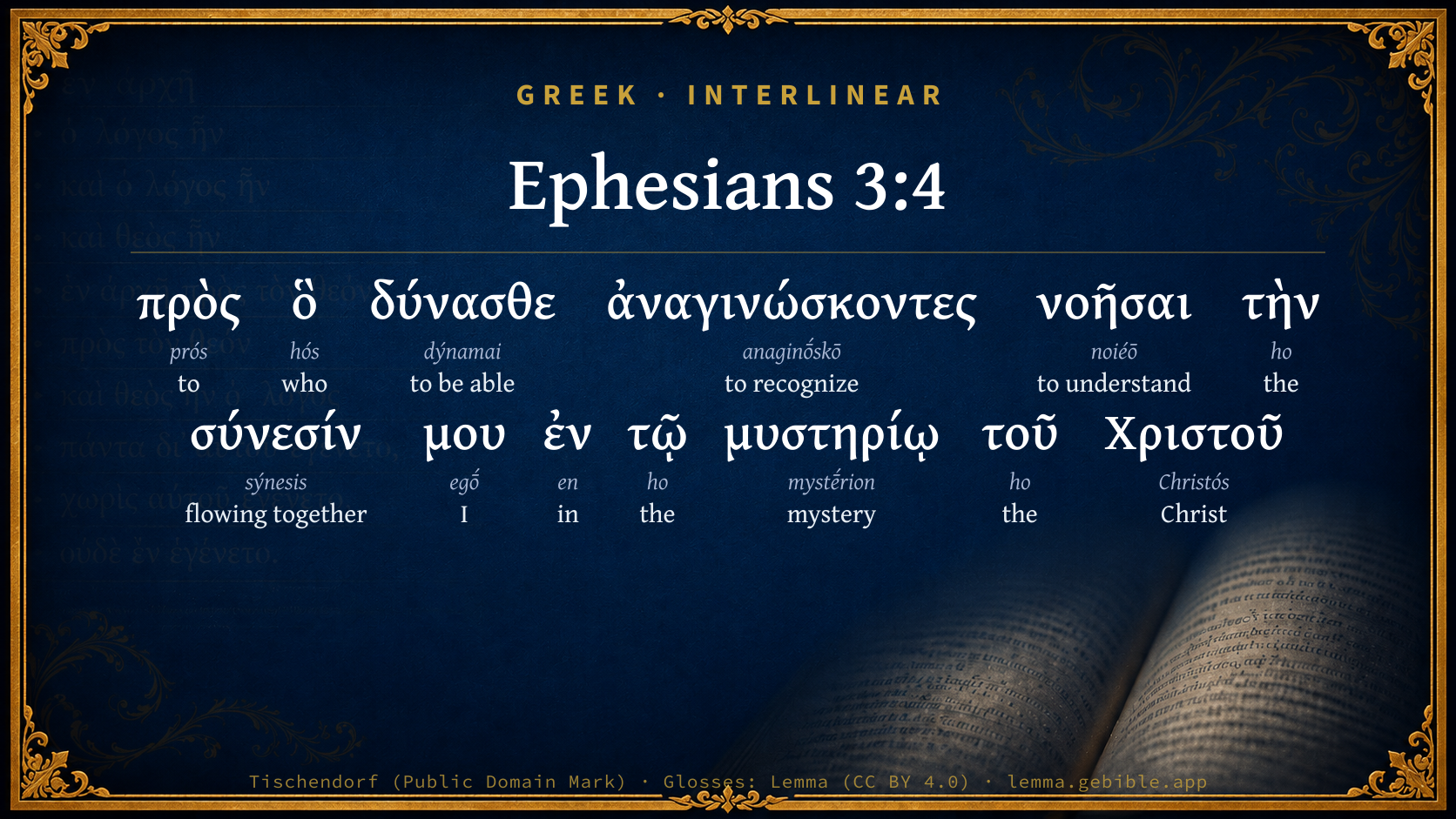
Greek (Tischendorf 8th ed.) Ephesians 3:4 appears in the Greek New Testament. The text above is from the Tischendorf 8th edition. Each word links to its Strong’s number and a concise gloss. Click any word for its full Thayer’s Greek Lexicon entry.
Download image
Cite this verse

Ephesians 3:4 (World English Bible). Public Domain. Lemma interlinear Bible study tool, https://lemma.gebible.app/v/ephesians/3/4.

Show BibTeX & RIS
BibTeX
RIS
English Translation
by which, when you read, you can perceive my understanding in the mystery of Christ;
World English Bible · Public Domain
Download a study sheet

One document with this verse’s original text, its word-by-word gloss line, the meaning frame, cross-references with their text, attributed commentary, and full source and license credits — printable, and it pastes into notes with its structure intact.

This verse Autodidact and up

Study sheet (.html) Plain text (.txt)

A passage Seminary Student

Up to 50 verses in one chapter. A passage sheet keeps up to 6 commentary sources and 12 cross-references per verse, in the order this page ranks them, and says so on the sheet whenever that leaves anything out. Ask for a single verse and you get the Autodidact verse sheet above.

Everything on this page stays free to read, with no account — the sheet is a download of what is already on screen, not access to it.

Want to remove ads? Support Godless Engineer
Compare translations 3

The same verse in 3 English versions, stacked beneath the original-language interlinear above. Click any original word for its lexicon entry.

Each is an independent rendering of the whole verse — the interlinear is not word-aligned to these translations.

Highlighted words mark where these versions differ — a whole-verse word diff, not a word-by-word alignment.

  • World English Bible Public Domain
    by which, when you read, you can perceive my understanding in the mystery of Christ;
  • King James Version Public Domain
    Whereby, when ye read, ye may understand my knowledge in the mystery of Christ)
  • unfoldingWord Literal Text CC BY-SA 4.0
    Concerning that, reading, you will be able to understand my insight into the mystery of Christ,

unfoldingWord Literal Text — © unfoldingWord, licensed CC BY-SA 4.0. Word-aligned USFM3 via Door43 (git.door43.org/unfoldingWord/en_ult).

Versions to compare (up to 4)

3 of 4 selected

Show all 19 translations

Every available English version of this verse, each an independent rendering of the whole verse.

  • World English Bible Public Domain
    by which, when you read, you can perceive my understanding in the mystery of Christ;
  • Berean Standard Bible Public Domain
    In reading this, then, you will be able to understand my insight into the mystery of Christ,
  • Majority Standard Bible Public Domain
    In reading this, then, you will be able to understand my insight into the mystery of Christ,
  • King James Version Public Domain
    Whereby, when ye read, ye may understand my knowledge in the mystery of Christ)
  • American Standard Version (1901) Public Domain
    whereby, when ye read, ye can perceive my understanding in the mystery of Christ;
  • Revised Version (1885) Public Domain
    whereby, when ye read, ye can perceive my understanding in the mystery of Christ;
  • Geneva Bible (1599) Public Domain
    Whereby when ye reade, ye may knowe mine vnderstanding in the mysterie of Christ)
  • Douay-Rheims (1899) Public Domain
    As you reading, may understand my knowledge in the mystery of Christ,
  • Young's Literal Translation Public Domain
    in regard to which ye are able, reading `it', to understand my knowledge in the secret of the Christ,
  • Literal Standard Version CC BY-SA 4.0
    in regard to which you are able, reading [it], to understand my knowledge in the secret of the Christ,
  • Unlocked Literal Bible CC BY-SA 4.0
    When you read about this, you will be able to understand my insight into this hidden truth about Christ.
  • unfoldingWord Literal Text CC BY-SA 4.0
    Concerning that, reading, you will be able to understand my insight into the mystery of Christ,
  • Darby Bible Public Domain
    by which, in reading it, ye can understand my intelligence in the mystery of the Christ,)
  • World Messianic Bible Public Domain
    by which, when you read, you can perceive my understanding in the mystery of Messiah,
  • Webster's Bible Public Domain
    By which when ye read, ye may understand my knowledge in the mystery of Christ,
  • Free Bible Version CC BY-SA 4.0
    and when you read this you'll be able to understand my insight into the mystery of Christ.
  • Bible in Basic English Public Domain
    By the reading of which you will be clear about my knowledge of the secret of Christ;
  • Text-Critical English NT CC BY 4.0
    When you read what I have written, you can understand my insight into the mystery of Christ,
  • Tyndale New Testament (1534) Public Domain
    wher by when ye rede ye maye knowe myne vnderstondynge in the mistery of Christ

Literal Standard Version (2020), Covenant Press — licensed CC BY-SA 4.0. Text via the HelloAO Bible API (eBible.org). Unlocked Literal Bible (unfoldingWord) — licensed CC BY-SA 4.0. Text via the HelloAO Bible API (eBible.org). unfoldingWord Literal Text — © unfoldingWord, licensed CC BY-SA 4.0. Word-aligned USFM3 via Door43 (git.door43.org/unfoldingWord/en_ult). Free Bible Version, Dr. Jonathan Gallagher — licensed CC BY-SA 4.0. Text via the HelloAO Bible API (eBible.org).

Word by word

More ways to search: Search by grammar → Find every occurrence → Compare this word →

Practice this passage: Drill this verse → Learn its vocabulary →

σύνεσίν
sýnesis
G4907
“flowing together”
Noun, Accusative, Singular, Feminine
Part of Speech
Noun
Case
Accusative
Number
Singular
Gender
Feminine
Full Thayer's Definition

Origin: from G4920

TDNT: 21:48,1

1. a running together, a flowing together with 2. knowledge a. understanding b. the understanding, i.e the mind so far forth as it understands
  1. πρὸς prós G4314 “to” Preposition
  2. ὃ hós G3739 “who” Relative pronoun, Accusative, Singular, Neuter
  3. δύνασθε dýnamai G1410 “to be able” Verb, Present, Middle or Passive deponent, Indicative, 2nd person, Plural
  4. ἀναγινώσκοντες anaginṓskō G314 “to recognize” Verb, Present, Active, Participle, Nominative, Plural, Masculine
  5. νοῆσαι noiéō G3539 “to understand” Verb, Aorist, Active, Infinitive
  6. τὴν ho G3588 “the” Article, Accusative, Singular, Feminine
  7. μου egṓ G1473 “I” Personal pronoun, 1st person, Genitive, Singular
  8. ἐν en G1722 “in” Preposition
  9. τῷ ho G3588 “the” Article, Dative, Singular, Neuter
  10. μυστηρίῳ mystḗrion G3466 “mystery” Noun, Dative, Singular, Neuter
  11. τοῦ ho G3588 “the” Article, Genitive, Singular, Masculine
  12. Χριστοῦ Christós G5547 “Christ” Noun, Genitive, Singular, Masculine

About this verse

These counts appear in no published source. They are computed here, from the morphology-tagged text and Lemma’s own curated glosses. What Lemma adds →

13
words
11
distinct lemmas
Pauline Epistles
section

Notable vocabulary

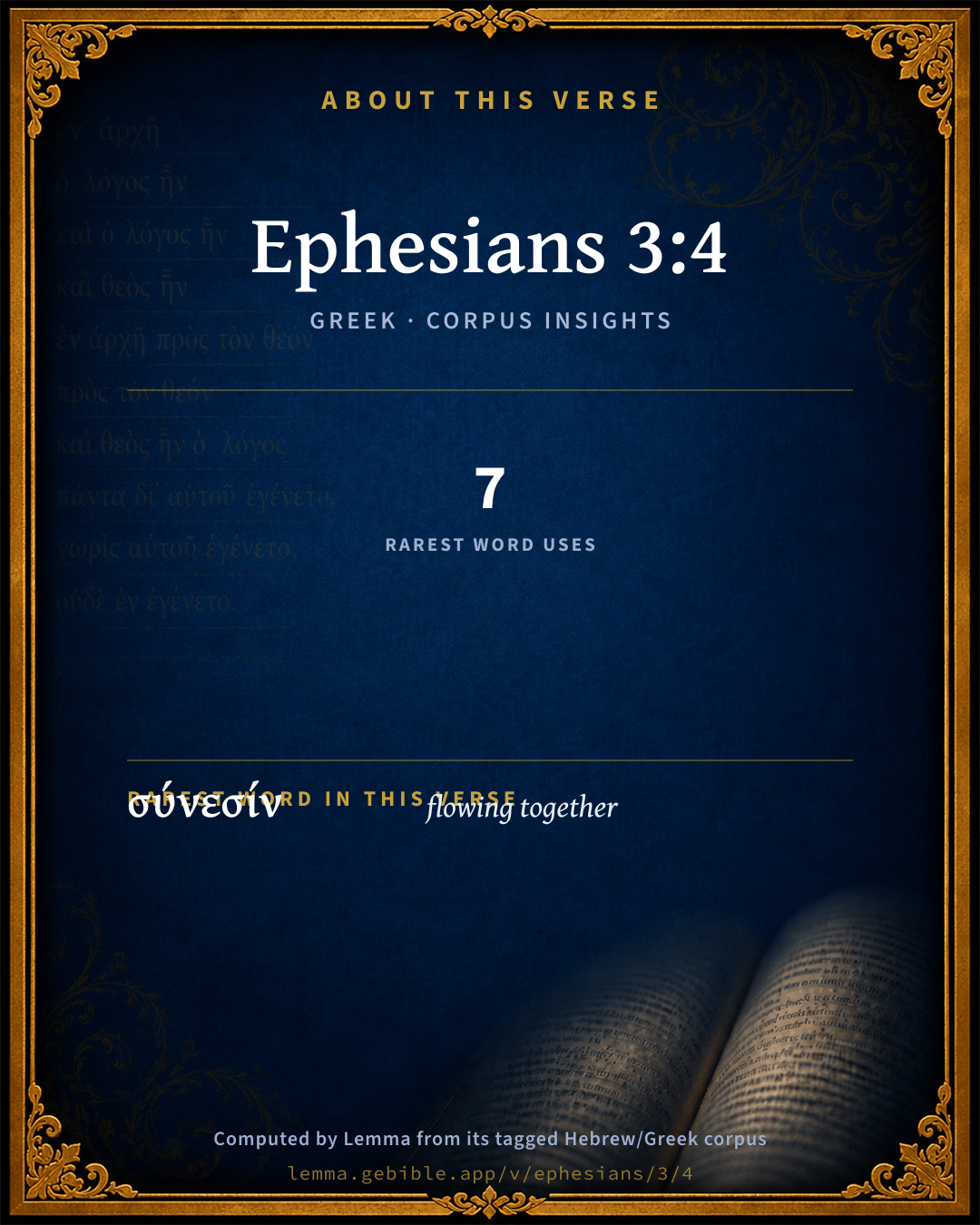
The rarest word here is σύνεσίν flowing together G4907 — appearing just 7 times in the whole Greek New Testament.

Shared distinctive vocabulary

σύνεσίν flowing together G4907 occurs in 7 verses of the Greek New Testament. Also found in:

Repetition

A word recurs within this verse:

Cross-references

14

Topical passages linked to Ephesians 3:4 in the Treasury of Scripture Knowledge — connected by theme and wording, ordered by reader-vote popularity; previews shown in the World English Bible.

  • 2 Corinthians 11:6 But though I am unskilled in speech, yet I am not unskilled in knowledge. No, in every way we have been revealed to you in all things.
  • Colossians 4:3 praying together for us also, that God may open to us a door for the word, to speak the mystery of Christ, for which I am also in bonds;
  • 1 Corinthians 4:1 So let a man think of us as Christ's servants, and stewards of God's mysteries.
  • 1 Corinthians 2:6–7 We speak wisdom, however, among those who are full grown; yet a wisdom not of this world, nor of the rulers of this world, who are coming to nothing.
  • Colossians 2:2 that their hearts may be comforted, they being knit together in love, and gaining all riches of the full assurance of understanding, that they may know the mystery of God, both of the Father and of Christ,
  • 1 Timothy 3:9 holding the mystery of the faith in a pure conscience.
  • 1 Timothy 3:16 Without controversy, the mystery of godliness is great: God was revealed in the flesh, Justified in the spirit, Seen by angels, Preached among the nations, Believed on in the world, And received up in glory.
  • Luke 2:10–11 The angel said to them, "Don't be afraid, for behold, I bring you good news of great joy which will be to all the people.
  • Ephesians 1:9 making known to us the mystery of his will, according to his good pleasure which he purposed in him
  • Ephesians 6:19 on my behalf, that utterance may be given to me in opening my mouth, to make known with boldness the mystery of the Gospel,
  • Matthew 13:11 He answered them, "To you it is given to know the mysteries of the Kingdom of Heaven, but it is not given to them.
  • Luke 8:10 He said, "To you it is given to know the mysteries of the Kingdom of God, but to the rest in parables; that 'seeing they may not see, and hearing they may not understand.'
  • Ephesians 5:32 This mystery is great, but I speak concerning Christ and of the assembly.
  • 1 Corinthians 13:2 If I have the gift of prophecy, and know all mysteries and all knowledge; and if I have all faith, so as to remove mountains, but don't have love, I am nothing.

Cross-references courtesy of OpenBible.info (CC BY 4.0).

Commentary

Notes on Ephesians 3:4 from classic Christian and Jewish commentators (each source and its license shown beneath its notes). The classic Christian expositions comment on the surrounding passage and are grouped to its opening verse, so a note may address several verses; the Jewish commentaries on the Tanakh (Rashi and others) are per-verse, so they appear only where the commentator wrote on this verse.

Lemma curates 59 commentaries, every one of them public domain or Creative Commons licensed, each selected and text-cleaned for this edition rather than reprinted as found. About our sources →

The Biblical Illustrator

Joseph S. Exell

Eph_3:4; Eph_3:6

Whereby, when ye read, ye may understand my knowledge In the mystery of Christ, which in other ages was not made known unto the sons of men, as it is now revealed unto His holy apostles.

The reserve of God in relation to His grace

I. Its bearing on the Divine character. We must bear in mind--

1. That it was a reserve of grace. What belongs to grace can never be demanded by justice.

2. That the proper appreciation of Divine grace required a preliminary education of the race.

3. That the Author of universal salvation could alone judge of the fitting time for declaring it.

4. Although new in manifestation, Gods saving purpose was eternal.

II. Its justification by results. Religious exclusiveness, race hatred, etc., had done their work, and men were weary of the evils they entailed. A distinctly new interest and attraction was given to the gospel by this element in its proclamations. By the very contradiction and dishonour to human nature which had accrued from their rivalries and contempts, men were enabled to appreciate the grandeur and blessing of a universal religion, given, not in word merely, but in a distinctly new experience, to man as man. And to all who heard it it came with a peculiar authority from the very fact that it had not grown out of experience or speculation as a word of man, but had had to be revealed as the word of God. (A. F. Muir, M. A.)

The reserve of God

The reserve which God used for thousand years after thousand years, should suggest to us caution in limiting the purpose of God. God has doubtless unspeakable things still in reserve. The Jewish people were made to feel that there was an awful distance and separation between them and God; but of His nearness to them, under their distance and darkness, they had little suspicion. That the condemning power of sin was the condition of their own nature, that Gods whole heart was towards all nations, that He was resolved, by the Sun of His love, to break through the sin cloud between Himself and them, and to establish with them direct relationship, were more than they could imagine. That, before the foundation of the world, the Son of God had made the difficulty of sin His own, that in the fulness of time, He would come in human nature, to be made sin for men, purge away their sin by His death, and by His glorification become wisdom, righteousness, sanctification, and redemption unto all who should receive Him, were impossible conceptions to them. But the special conceit of their self-love was, that they, of all men, were the favourites of God. When, therefore, God disclosed the fact that He is no respecter of persons--that the Gentile world is as dear to Him as the Jewish--that the gospel of His heart is equally for all nations, the Jew took offence, and refused to enter a kingdom, which gave to him no distinction above other men. (J. Pulsford.)

Scripture reading

Seeing that reading is so beneficial, we must be exhorted to set apart some time to spend this way. We are so affected to the writings of our friends, that if a letter come in when we are about to sit down, we will not taste anything till we have read it. These writings are the letter of God to us. If we have anything bequeathed as in some will, we will have, if not all the will, yet the clause of it perfectly in memory and at our fingers ends. These things written are Gods testament, which we cannot without great indignity neglect. Again, why do you desire gold and silver, but because it is so valuable that it will purchase any earthly commodity? Yet what is that in comparison of the Word, which together with the Spirit worketh unto life everlasting? If any of you should this day, walking by himself, hear the voice of God break out of heaven, he would be astonished at the hearing, and perhaps he would easily be persuaded that he should ponder every syllable. But this Word is as great and as much. In this thou hast God speaking by Himself, by men, by angels, by all means to draw thee unto Him. Wherefore, if thou art desirous to hear God speak (as I think some curious spirits are), thou hast Moses and the prophets, the written will of God, which convey God speaking to thee daily. Again, is there any that hopes to gain lands and possessions, and will not acquaint himself with the evidences which may lead him thereunto? In the written Word lies the great grant of that blessed land promised to Abraham and his seed, and from thence how it is entailed unto us of the Gentiles. Naturally we all desire knowledge, as the blind man deprived of his sight; how from the Word flows all knowledge as the river from the seas, and enriches the mind with a quick and sharp capacity. Lastly, we desire to hear tell of strange things: what more strange than to read of that celestial palace beyond the stars, called Paradise, and of the glory thereof? What more strange than to hear tell of the Father of spirits, and all the host of heaven, angels and saints? to hear tell in like manner of the place of darkness and shadow of death, of the prince thereof and his attendants? If all this will not provoke thee to this duty, humble thyself, suspect thyself of some gross iniquity which fills thy stomach to the full. (Paul Bayne.)

Deep spiritual knowledge is conditional

We know not Christ aright till we are conformed to what we know of Him. The pure in heart see the pure and holy God. When the lady said to Mr. Turner (the painter), Sir, I have seen that spot many times, but I never saw that which you have pictured. No, maam, he replied, I dare say you have not; but dont you wish you could? The artists eye sees what another eye cannot, and the pure in heart can see in God what no one else can see, because they are like to God. (C. H. Spurgeon.)

Spiritual insight

My own experience is that the Bible is dull when I am dull. When I am really alive, and set in upon the text with a tidal pressure of living affinities, it opens, it multiplies discoveries, and reveals depths even faster than I can note them. The worldly spirit shuts the Bible; the Spirit of God makes it a fire, flaming out all meanings and glorious truths. (Horace Bushnell, D. D.)

Progressive revelation

1. God does not in all ages give the same measure of light to His Church.

2. By degrees He revealed the Messiah to His people.

3. The whole will of God is made known to us.

(1) How foolish are those who will believe no more than their fathers believed.

(2) How thankful should we be, that we have so much greater light than those under the law.

4. Since Christ came to declare to us the will of God, we have the mystery of salvation more fully opened; we must therefore yield the greater obedience.

5. The things of God are revealed to us by the Spirit. Let us then seek His aid--

(1) By prayer.

(2) By attendance on the Word and Sacraments.

(3) By a Christian course of obedience. (Paul Bayne.)

Need of Divine revelation

Varro, a Roman writer of the first century B.C. states, that, in his day, he had been at the pains to collect the various opinions on the question, What is the true object of human life? in other words, What is the supreme good? He had reckoned up as many as three hundred and twenty answers. How needful is Divine revelation l And how essential to those who are starting in life, that a heavenly guide should teach them the true end and purpose of earthly existence! (Biblical Treasury.)

Christ partially revealed to the prophets

I was visited by a very distinguished young Israelite who had seen me distributing the sacred volume, and I proposed that we should read a portion of Scripture together. He agreed, on the condition that it should be from the Old Testament, and I read the fifty-third chapter of Isaiah. But, said he, that is in the New Testament. No, no, I replied. There, take the book. Read it with that true heart which I perceive in you, and you will find what you seek. He has found his Saviour, has accepted Him, and confesses Him with joy. (Pasteur Hirsch.)

The Holy Spirit and preaching

Charles G. Finney used to discover that sometimes his preaching was mighty in its influence to convict and convert sinners. At other times he seemed to be firing only blank cartridges. The results depended entirely upon his own spiritual condition, upon his nearness to or his absence from God. When he was in close communion with God the currents of power were mighty and irresistible. When his connection with the Lord ceased, either through unbelief or unworthy living, his lifting power was gone. Drawing nigh to God was invariably the most effectual way to draw the impenitent. (T. L. Cuyler, D. D.)

The gospel inheritance

1. The condition to which it is Gods intention that the Gentiles should be brought.

(1) They should be joint heirs with Christ.

(2) They should be of the same body with Christ and His Church; for first we must become beloved children in Christ the Beloved, before we can be inheritors.

(3) They should be partakers of the promise; for by faith in the word of promise, we come to have fellowship with Christ.

2. The means. By the gospel. It is the gospel which brings us to faith, and to our heavenly inheritance.

(1) We are not to be discouraged from following the Word;

(a) either by the unworthiness of the preachers;

(b) or by the consciousness of our own unworthiness;

(c) or by our not profiting to our mind.

(2) Ministers must not give over preaching;

(a) either upon conceit of their ignorance;

(b) or of the small good they see come of it;

(c) or for want of feeling in themselves the power of what they preach;

(d) or upon sense of temptations contrary to it. (Paul Bayne.)

Sharing the privileges

One incident gives high proof of the native generosity of Turners nature. He was one of the Hanging Committee, as the phrase goes, of the Royal Academy. The walls were full when Turners attention was attracted by a picture sent in by an unknown provincial artist by the name of Bird. A good picture! he exclaimed; it must be hung up and exhibited. Impossible! responded the committee of academicians. The arrangement cannot be disturbed. Quite impossible! A good picture, iterated Turner; it must be hung up; and finding his colleagues to be as obstinate as himself, he hitched down one of his own pictures, and hung up Birds in its place. Would to God that in far more instances the like spirit ruled among servants of the Lord Jesus. The desire to honour others and to give others a fair opportunity to rise should lead ministers of distinction to give place to less eminent men to whom it may be of essential service to become better known. We are not to look every man on his own things, but every man also on the things of others. (C. H. Spurgeon.)

The union of Jews and believing Gentiles in Christ

The topic of the early portion of the first chapter of this Epistle, is that good men have been the subjects of Divine thought and predestination in Christ from everlasting ages. The topic of the latter portion of the first chapter is, that their future destiny runs parallel throughout eternity with that of the Son of God, raised from the dead and glorified. The subject of the second chapter and the early portion of the third, is the close union of believing Jews and Gentiles in all this grace and glory forever. It is worth while to describe the state of things between Jews and heathen in the days of the apostles, and to show the bearing of those facts on the present and future position of the Israelites in the world.

1. Let us, then, note first, that in former ages God had established a discipline of marvellous complexity for the separation of the Abrahamic people.

(1) They were thus separated from the nations, in order that they might be delivered from the contamination of surrounding paganism, and might preserve in ever-increasing strength a zeal for their own religion, which was, so far as it went, the only true one on earth.

(2) The object of their separation was to enable them to transmit with intensity the rays of that lighthouse of truth, placed on the heights of Zion, over the dark and troubled sea of surrounding paganism, so that the nations might more effectually learn the verities which Judaism enshrined.

(3) Their separation was a necessary preliminary for a future mission as the missionaries and evangelists of the whole world.

2. The next point to notice is that the Hebrew prophets, ages before the coming of Christ, had foretold that when the Messiah appeared this middle wall of partition between Jews and Gentiles would be broken down, so that all who served God would be brought into one church of the true worshippers (see Isa_2:2-3; Isa_43:1; Isa_49:6; Isa_51:5; Jer_3:17; Zec_8:22).

3. But this mystery of the future worship of Jehovah to be rendered by united Jews and Gentiles was hidden from the eyes of the Jewish people until it was proclaimed and asserted by Christ (Joh_10:16).

4. Although the gospel of Jesus has established the spiritual union of all believing Jews and believing Gentiles in one spiritual Church, so that they form one body in Christ, still so long as the earth lasts, this spiritual union of Jew and Gentile has not abolished the nationality of the Jews, any more than it has annihilated the nationality of the Englishman, the Spaniard, the German, or the Dane. (E. White.)

The Biblical Illustrator, edited by Joseph S. Exell (c. 1880s–1900s) — public domain. Text from a community e-Sword module.

Bengel's Gnomon

Johann Albrecht Bengel

Eph 3:4. Πρὸς ὁ, whereby) This expression is not exclusively to be referred to in a few words, but to the whole thought; and πρὸς marks the analogy, according to [“from which ye may understand”]: as in the common saying, the size of the lion may be inferred from the size of his claw.[41] From what I have written above, you may, etc.—δύνασθε, you may) The word is modestly and ingenuously used.—ἀναγινώσκουτες, when you read) This book is very sublime, and yet it is put into the hands of all to be read.—νοῆσαι τὴν σύνεσίν μου, understand my knowledge [perceive my understanding in]) and therefore profit by me. Paul wrote with greater plainness and sublimity in this epistle, than he had formerly done in any other.

[41] Joh. Michaelis quotes a similar phrase from Thucydides: πρὸς τὰς ἐπιστολὰς ὑπόπτευον, they suspected him by reason of his letters.—E. B.

Bengel's Gnomon of the New Testament — English translation (T&T Clark, Edinburgh, 1860) — public domain. Text from a community e-Sword module.

Meyer's Critical & Exegetical Commentary

Heinrich August Wilhelm Meyer

Eph_3:4. In accordance with which ye, while ye read it, are able to discern, etc.[168]

ΠΡῸς Ὅ applies to that which Paul ΠΡΟΈΓΡΑΨΕ, and ΠΡΌς indicates the standard of the judging; in accordance with which. See Bernhardy, p. 205; Ellendt, Lex. Soph. II. p. 652; Winer, p. 361 [E. T. 505]. The inference: οὐκ ἔγραψεν ὅσα ἐχρῆν, ἈΛΛʼ ὍΣΑ ἘΧΏΡΟΥΝ ΝΟΕῖΝ (Oecumenius, comp. Chrysostom; Bengel compares ex ungue leonem), finds no justification at all in what Paul has previously written.

ἀναγινώσκοντες] not attendentes (Calvin), but, as always in the N.T., legentes.

τὴν σύνεσίν μου ἐν τῷ μυστηρίῳ τοῦ Χ.] is to be taken together, and before ἐν it was not needful to repeat the article, because ΣΥΝΙΈΝΑΙ ἘΝ (to have understanding in a matter) was a very current expression (2Ch_34:12; Jos_1:7; Dan_1:17). Comp. 3 Esdr. 1:33: τῆς συνέσεως αὐτοῦ ἐν τῷ νόμῳ κυρίου. The genitive ΤΟῦ ΧΡΙΣΤΟῦ is ordinarily taken as genitivas objecti: the mystery which has reference to Christ. But, even apart from Col_1:27, the whole subsequent detailed statement as far as Eph_3:12 suggests the contextually more exact view, according to which Paul means the μυστήριον contained in Christ. Christ Himself, His person and His whole work, especially His redeeming death, connecting also the Gentiles with the people of God (Eph_3:6), is the concretum of the Divine mystery.

The assailants of the genuineness of the Epistle find Eph_3:4 incompatible with the apostolic dignity (de Wette), nay, even self-complacent and courting favour (Schwegler). But here precisely the point brought into prominence, that the mystery had become known to him κατὰ ἀποκάλυψιν, justifies the stress laid upon his ΣΎΝΕΣΙς in the mystery, so far as he has already manifested the same in his Epistle. The apostle might have appealed in proof of this ΣΎΝΕΣΙς to his working, but he might alsoespecially taking into account the change which had meanwhile occurred in the personal composition of the churchadduce for this purpose his writing, in doing which his very apostolic dignity raised him above considerations of the semblance of self-complacency and the like. Hardly would another, who had merely assumed the name of the apostle Paul, have put into his mouth such a self-display of his σύνεσιςwhich, in order not to fall out of his assumed apostolic part, he would rather have avoided.

As to ΣΎΝΕΣΙς, see on Col_1:9.

[168] Wiggers (Stud. u. Krit. 1841, p. 433) regards as subject the Ephesians, not as such, but as representatives of the Gentile world: ye Gentiles. Arbitrarily imported, and entirely unnecessary. Doubtless the σύνεσις of the Ap. ἐν τῷ μυστηρίῳ τοῦ Χ. must have been entirely beyond doubt for the readers in consequence of their personal connection with him; but thereby his appeal to what he has just written does not become inappropriate, but only the more forcible and effective. There lies a certain μείωσις in this reference to that which he has just written.

Meyer — Critical and Exegetical Commentary on the New Testament — English translation by Peter Christie, edited by Frederick Crombie (T&T Clark, 1880) — public domain. Text from a community e-Sword module.

Expositor's Greek Testament

ed. W. Robertson Nicoll

Eph 3:4 . πρὸς ὃ δύνασθε ἀναγινώσκοντες νοῆσαι τὴν σύνεσίν μου ἐν τῷ μυστηρίῳ τοῦ Χριστοῦ : in accordance with which, when ye read, ye can perceive my understanding in the mystery of the Christ . The ὅ refers to the προγεγραμμένον indicated in the προέγραψα the πρός with acc. expressing here, as often, the idea of the standard or measure of the νοῆσαι (Win.-Moult., p. 505; Bernhardy, Synt. , p. 205). Wicl. gives “as”; Cov., “like as”; Rhem., “according as”; Tynd., Gen., AV and RV, “whereby”. The aor. νοῆσαι follows the present ἀναγινώσκοντες , the perception being regarded as a single, accomplished act, the result of the process of reading. The verbs νοεῖν and συνιέναι when contrasted are supposed ( cf. Tittmann, Syn. , p. 191, and Ell., in loc. ) to differ as merken , “perceive,” differs from verstehen , “understand”. But such distinctions are precarious as regards NT Greek. The noun σύνεσις , which is applied sometimes to the understanding mind (Mar 13:33 ; Wis 4:11 ), occurs repeatedly in the NT in the sense of mental apprehension (Luk 2:47 ; 1Co 1:19 ; Col 1:9 ; Col 2:2 ; 2Ti 2:7 ). It is defined as “ insight depending on judgment and inference” (Mey. on Col 1:9 ), usually in the theoretical sense, but sometimes in the practical ( cf. Mar 12:33 ). It appears to denote critical understanding, the apprehension of the bearings of things, while φρόνησις conveys the idea of practical, ethical understanding ( cf. Light. on Col 1:9 ; Schmidt, Synonymik , chap. xiii., § 10, chap. cxlvii., § 8). Here σύνεσις is followed by ἐν ( cf. also 3 Ezr 1:3 ), συνιέναι ἐν being a common phrase for having understanding in a matter (2Ch 34:12 ; Jos 1:7 ; Dan 1:17 ). As the σύνεσίν μου ἐν τῶ . etc., makes one idea, the article is dispensed with after the prep. The τοῦ Χριστοῦ is taken by some as that of originating cause (Hofm.), = the mystery of which Christ is the author; by others as the gen. objecti , = the mystery relating to the Christ (Abb., Haupt, etc.), by others still as the gen. of apposition (Mey., Alf., etc.), or of identity (Ell.), = the mystery which is the Christ, which He makes, or which is contained in Him. The latter is thought to be favoured by Col 1:27 . But the idea there is that of the Christ in us, which is not quite the same; and it seems best on the whole to take the second view, “the mystery relating to the Christ,” i.e. , the revelation of the long-hidden purpose of God regarding the Christ as not for Israel only, but also for the Gentiles.

The Expositor's Greek Testament, edited by W. Robertson Nicoll (1897–1910) — public domain. Text from a community e-Sword module.

Hodge's Commentary on Romans, Ephesians & First Corinthians

Charles Hodge

Eph_3:4

By reading what he had written, they could judge of his knowledge of the mystery of Christ. πρὸς ὅ, according to which. What he had written might be taken as the standard or evidence of his knowledge. Mystery of Christ, may mean the mystery or revelation concerning Christ; or of which he is the author (i.e. of the secret purpose of redemption), or which is Christ. Christ himself is the great mystery of godliness, God manifest in the flesh. He is the revelation of the μυστήριον or secret purpose of God, which had been hid for ages. Thus the apostle in writing to the Colossians says: God would make known the riches of the glory of the mystery among the Gentiles; which (i.e. the mystery) is Christ in you, the hope of glory. Col_1:27.

What Paul had written respecting the calling of the Gentiles in the preceding chapter, was an indication of his knowledge of the whole plan of salvation here designated as the mystery of Christ, which includes far more than the truth that the Gentiles were fellow citizens of the saints. It has the same extensive meaning in Col_4:3, where Paul prays that God would open a door of utterance for him to speak the mystery of Christ. This verse is, therefore, virtually a parenthesis, in so far as the relative ὅ at the beginning of the next verse refers to the word μυστήριον in Eph_3:3; or if referred to that word as used in Eph_3:4, it is to it as including the more limited idea expressed in Eph_3:3.

Charles Hodge — Commentary on Romans (1835), First Corinthians (1857), and Ephesians (1856) — public domain. Text from a community e-Sword module.

Jamieson, Fausset & Brown

Robert Jamieson, A. R. Fausset & David Brown

understand my knowledge--"perceive my understanding" [ALFORD], or "intelligence." "When ye read," implies that, deep as are the mysteries of this Epistle, the way for all to understand them is to read it (Ti2 3:15-16). By perceiving his understanding of the mysteries, they, too, will be enabled to understand.

the mystery of Christ--The "mystery" is Christ Himself, once hidden, but now revealed (Col 1:27).

Jamieson, Fausset & Brown — Commentary Critical and Explanatory on the Whole Bible (1871) — public domain (CC PDM 1.0). Text via the HelloAO Bible API.

Adam Clarke's Commentary

Verse 4. Whereby, when ye read] When ye refer back to them.

Ye may understand my knowledge] Ye may see what God has given me to know concerning what has been hitherto a mystery-the calling of the Gentiles, and the breaking down the middle wall between them and the Jews, so as to make both one spiritual body, and on the same conditions.

Adam Clarke's Commentary on the Bible (1810–1826) — public domain. Text from a community e-Sword/MySword module.

John Calvin's Commentaries

4. By attending to which, ye may understand, πρὸς ὃ δύνασθε ἀναγινώσκοντες νοὢσαι. Erasmus renders it, “from which things, when ye read, ye may understand.” But to translate ἀναγινώσκειν τι as signifying to read is, I think, at variance with Greek syntax. I leave it as a subject of consideration, whether it does not rather signify to attend. The participle would then be connected with the preposition πρὸς, in the commencement of the verse, and the clause would run thus, to which when ye attend, ye may understand If, however, by viewing the verb ἀναγινώσκοντες, as disjoined from the preposition, you make it signify reading, the meaning will still be, “by reading you may understand according to what I have written;” taking the phrase πρὸς ὃ, to which, as equivalent to καθ ᾿ ὃ, according to which; but I suggest this merely as a doubtful conjecture.

If we adopt the view which is almost universally approved, that the apostle had formerly written to the Ephesians, this is not the only Epistle which we have lost. And yet there is no room for the sneers of the ungodly, as if the Scriptures had been mutilated, or in any part had become imperfect. If we duly consider Paul’s earnestness, — his watchfulness and care, — his zeal and fervor, — his kindness and readiness in assisting brethren, — we shall be led to regard it as highly probable that he would write many epistles, both of a public and private nature, to various places. Those which the Lord judged to be necessary for his church have been selected by his providence for everlasting remembrance. Let us rest assured, that what is left is enough for us, and that the smallness of the remaining number is not the result of accident; but that the body of Scripture, which is in our possession, has been adjusted by the wonderful counsel of God.

My knowledge. The frequent mention of this point shews the necessity that the calling of ministers should be firmly believed both by themselves and by their people. But Paul looks more to others than to himself. He had everywhere indeed given great offense by preaching the gospel indiscriminately to Jews and Gentiles, but his solicitude was not chiefly on his own account. There were not a few who, overwhelmed by the slanders of wicked men, began to doubt of his apostleship, and whose faith was consequently shaken. It was this that induced him so frequently to remind the Ephesians that he knew the will and command of God who called him to the office. — In the mystery of Christ,

John Calvin's Commentaries (1540-1563) — public domain. Text from the Calvin Translation Society English edition (1840s-50s) via the Christian Classics Ethereal Library (ccel.org). Calvin's coverage is partial (roughly two-thirds of the Bible); uncommented books and verses are honest gaps, never fabricated. The 19th-century editor's footnotes and remarks are omitted so the notes are faithfully Calvin's own voice.

The Cambridge Bible for Schools and Colleges

gen. ed. J. J. S. Perowne

4. may understand] R.V., can perceive; and so better.

my knowledge] Better, intelligence, understanding (R. V.). The thought is, not any laudation of the Apostle’s intellect, but substantiation of his God-granted insight, verified by the spiritual reader, and resulting in further confidence on the reader’s part.

of Christ] The great Secret was bound up with His work (Eph_2:14) and His glory (Eph_1:10). As to experience, its essence was “Christ in you, the hope of glory” (Col_1:27). See also Col_1:27; where, probably, read “the mystery of God, [which mystery is] Christ.”

The Cambridge Bible for Schools and Colleges (gen. ed. J. J. S. Perowne; Cambridge University Press, 1878–1918) — public domain. Text from a community e-Sword module.

John Gill's Exposition

Whereby when ye read,.... The above chapters, and seriously consider what is contained in them:

ye may understand my knowledge in the mystery of Christ of his person, office, and grace; and which knowledge was very large indeed.

John Gill's Exposition of the Whole Bible (1746–1763) — public domain (CC PDM 1.0). Text via the HelloAO Bible API.

Trapp's Complete Commentary

John Trapp

4 Whereby, when ye read, ye may understand my knowledge in the mystery of Christ)

Ver. 4. My knowledge in the mystery] The highest point of heavenly learning; and hereby he proveth his calling to the ministry. The priest’s lips should both preserve knowledge and present it to the people, to give them the knowledge of salvation by the remission of their sins, Mal 2:7; Luk 1:77. An ass might not be coupled with an ox in ploughing. No ignorant doltish ass may plough in God’s field, the Church; such as was that silly soul, who coming to be ordained, and being asked by the bishop, Esne dignus? answered, No, my lord, I shall dine anon with your men.

John Trapp, A Commentary or Exposition upon All the Books of the Old and New Testament (1647–1656) — public domain. Text from a community e-Sword module.

Albert Barnes' Notes on the Bible

Whereby, when ye read - By the bare reading of which you may understand the view which I entertain of the plan of salvation, and the knowledge which I have of God’s method of saving people, particularly of his intention in regard to the salvation of the Gentiles.

In the mystery of Christ - This does not refer to anything “mysterious” in the person of Christ; or the union of the divine and human nature in him; or to anything difficult of apprehension in the work of the atonement. It means the hitherto concealed doctrine that through the Messiah, the Gentiles were to be received to the same privileges as the Jews, and that the plan of salvation was to be made equally free for all. This great truth had been hitherto concealed, or but partially understood, and Paul says that he was appointed to make it known to the world. His “knowledge” on the subject, he says, could be understood by what he had said, and from that they could judge whether he was qualified to state and defend the doctrines of the gospel. Paul evidently supposed that the knowledge which he had on that subject was of eminent value; that it was possessed by few; that it was important to understand it. Hence he dwells upon it. He speaks of the glory of that truth. He traces it back to the counsels of God. He shows that it entered into his eternal plans; and he evidently felt that the truth which he had communicated in the former part of this Epistle, was among the most important that could come before the mind.

Albert Barnes' Notes on the Bible (1834–1885) — public domain. Text from a community e-Sword/MySword module.

Matthew Poole's English Annotations

When ye read; or, unto which attending.

Matthew Poole's English Annotations on the Holy Bible (1683–1685) — public domain. Text from a community e-Sword/MySword module.

Whedon's Commentary on the Bible

Daniel D. Whedon

4. When ye attentively read it as a sample of my gospel, ye may be able to appreciate my insight. The mystery of, or concerning the Christ or Messiah.

Daniel D. Whedon (gen. ed.), Commentary on the Old and New Testaments (1874–1909) — public domain. Text from a community e-Sword module.

The Pulpit Commentary

In accordance with which, when ye read, ye may understand my knowledge in the mystery of Christ. Pros o with reference to which, i.e. to what I wrote afore: to make that more intelligible I write on the subject more fully now, so that you shall see that your instructor is thoroughly informed in this matter of the mystery in Christ this once concealed but now revealed purpose of his grace.

The Pulpit Commentary (1880–1919), ed. H.D.M. Spence-Jones & Joseph S. Exell — public domain. Text from a community e-Sword module.

Burkitt's Expository Notes on the New Testament

William Burkitt

Our apostle here proceeds in setting forth this great mystery of man’s redemption in general, and the calling of the Gentiles in particular: he styles it a mystery.

1. Now a mystery is a purpose and decree of God, unknown to, and unsearchable by, man, unless first by revelation discovered and made known by God himself; such a mystery was the whole gospel in general, and this article concerning the calling of the Gentiles in particular.

2. St. Paul styles it a mystery, in other ages of the church, not made known, that is, not so plainly and clearly, unto the sons of men, Jews or Gentiles; for the calling of the Gentiles was foretold and prophesied of, under the Old Testament, but darkly and obscurely; the time when, the manner how, and the means by which, were not understood, till now the Holy Spirit of God revealed it to the apostles and evangelical prophets under the New Testament.

3. The apostle amplifies and sets forth the glorious excellency of that mystery which here he had made mention of; namely, that the Gentiles should have access into the church without an entrance by the door of circumcision, be joint-heirs of the heavenly inheritance with all believers, and together with the Jews taken into the bond of the covenant; and finally, that they were brought into this happy estate by the preaching of the gospel, and by believing and obeying of it.

Learn hence, That the calling of the neglected and despised Gentiles to the knowledge of Christ, and participation of gospel privileges with the Jews, was a great mystery, awfully to be admired, and a glorious mercy, with all thankfulness to be acknowledged, That the Gentiles should be fellow-heirs of the same body, & c.

William Burkitt's Expository Notes on the New Testament (1700–1703) — public domain. Text from a community e-Sword module.

The People's New Testament

B. W. Johnson

4. Whereby, when ye read. When they read what he wrote above (afore), and what he writes now, they can perceive his knowledge of this mystery.

B. W. Johnson's The People's New Testament with Notes (1889–1891) — public domain. Electronic text from the Christian Classics Ethereal Library (CCEL) ThML edition.

Cambridge Greek Testament for Schools and Colleges

4. πρὸς ὃ δύνασθε ἀναγινώσκοντες νοῆσαι. ‘By reference to which ye can as ye read the Scriptures understand.’ It seems, as Hort has pointed out (Rom. and Eph. 150 ff.), impossible to account for πρὸς ὅ if ἀναγινώσκοντες is taken in its obvious sense as referring to the reading of the letter itself. His alternative, to take ἀναγιν. in the technical sense of ‘the reading of the Scriptures,’ not only gives a clear meaning to πρὸς ὅ, but it also supplies that reference to the O.T. which St Paul’s habitual practice both in writing and preaching would lead us to expect. The parallel, if this interpretation is accepted, with the closely similar passage in Rom 16:25 f. becomes complete. It is true that no certain parallel to this absolute use of ἀναγινώσκειν can be produced from the N.T., but there are at least two other passages (Mar 13:14 and 1Ti 4:13) which seem to require it. Zahn’s suggestion that the Apostle is referring to an earlier letter, e.g. Gal., hardly fits the conditions of a circular letter, nor does it supply the criterion of an external standard by which the Apostle’s insight, as expressed in this statement, could be judged.

τὴν σύνεσίν μου ἐν τῷ μυστηρίῳ τοῦ χρ. Cf. (with Robinson) 1 (3) 3 Esdr. 1:31, τῆς συνέσεως αὐτοῦ ἐν τῷ νόμῳ Κυρίου, and 2Ti 2:7, σύνεσιν ἐν πᾶσιν. συνιέναι and σύνεσις are specially used of the power to grasp the inner meaning of teaching and so especially of a parable or μυστήριον (Mat 13:51; Mat 15:10; Luk 24:45; &c.).

ἐν τῷ μυστηρίῳ τοῦ χριστοῦ. The ‘mystery of the Christ’ as we know from the Acts was according to St Paul to be studied in the O.T. Cf. Act 17:2 f., Act 26:22 f.

Cambridge Greek Testament for Schools and Colleges (Cambridge University Press, 1896; 21 vols, various authors incl. Carr, Maclear, Plummer, Farrar, Lumby, Moule, M. R. James, Simcox) — public domain. Text from a community e-Sword module.

Alford’s Greek Testament

Henry Alford

4.] by (or,‘in accordance with;’ perhaps ‘at’ is our word nearest corresponding. The use of πρός is as in πρὸς τὸ ἀδόκητον τεταραγμένους) which (viz., that which I wrote: not the fact of my having written briefly, as Kypke) ye can, while reading (ἀναγ. absolute), perceive (aorist, because the act is regarded as one of a series, each of which, when it occurs, is sudden and transitory) my understanding in (construction see reff., and compare σύνεσιν ἐν πάσῃ σοφία, Dan 1:17, also Dan 10:1, LXX and Theod.) the mystery of Christ (by comparing Col 1:27, it will clearly appear that this genitive is one of apposition:—the mystery is Christ in all His fulness; not of the object, ‘relating to Christ’),

Henry Alford, The Greek Testament (1849–1861) — public domain. Text from a community e-Sword module.

International Critical Commentary

4. πρὸς ὅ is, “according to which, or looking to which,” namely, to what I have said. Comp. “πρὸς ἃ ἔπραξεν,” 2Co 5:10; πρὸς τὴν ἀληθείαν τοῦ εὐαγγ., Gal 2:14; πρὸς τὸ θέλημα αὐτοῦ, Luk 12:47. But the usage is quite classical.

ἀναγινώσκοντες, present, because it is “while reading,” or “as ye read.”

νοῆσαι. Where it is indifferent whether the aorist or present infinitive is used, the aorist is more frequent (Winer, § 44. 7), especially after such verbs as δύναμαι, θέλω, etc. Hort thinks this ἀναγ. refers to reading the O.T. prophecies, comparing Mat 24:15. But there the passage “read” is distinctly specified, and although in Mar 13:14 Daniel is not named, he is quoted.

τὴν συνεσίν μου ἐν τῷ μυστηρίῳ τοῦ χριστοῦ. “My understanding in the mystery of Christ.” The article is not required before ἐν τῷ μ., because συνιέναι ἐν is a frequent expression (Jos 1:7; 2Ch 34:12).

μυστ. τοῦ Χρ. We have the same expression in Col 4:3, where it clearly means the doctrine of the free admission of the Gentiles (διʼ ὃ καὶ δέδεμαι). It is the same here, as explained in ver. 6. Similarly, in Col 1:27 we have τοῦ μ. τούτου ὅ ἐστιν Χριστὸς ἐν ὑμῖν. That passage has been used (by Alford, Ellicott, Meyer) to prove that the genitive here is one of apposition or identity; but it fails in this, since there it is not Χριστός but Χριστὸς ἐν ὑμῖν, that constitutes the μ. It is better, therefore, to understand “the mystery (or doctrine) relating to the Christ”; the genitive being that of the object.

Critics who question the genuineness of the Epistle regard this verse as the expression of a boastfulness not in accordance with the dignity of an apostle, and only a clumsy imitation of 2Co 11:5, 2Co 11:6, where St. Paul is merely claiming for himself that in which his opponents claim to surpass him. But there is no self-laudation in this assertion of σύνεσις (see, on the contrary, ver. 8); nor even as high a claim to exceptional knowledge as is involved in κατὰ ἀποκάλυψιν, which it only serves to illustrate. Is it not quite natural that in writing to Churches where he was not personally known, and where there were teachers whose teaching was of a corrupt and paganising tendency (v. 11-14), and threatened to cause a schism between the Jewish and the Gentile members of the Church, the apostle, who was, in fact, combating these errors, and expounding the true nature of the privileges to which the Gentiles were admitted, should remind them in some such way that the subject was one on which he could speak with authority, and thus guard against objections which might possibly be urged by these unsound teachers? From this point of view it will be seen that this indirect and delicate way of meeting possible opposition is thoroughly Pauline. On the other hand, a writer who merely assumed the name of Paul, especially one of such power as the writer of this Epistle, would hardly put into his mouth an expression of such seeming self-complacency, without any hint of opposition. Still less would such a writer forthwith add so striking an expression of self-depreciation as is contained in ver. 8.

International Critical Commentary — older volumes (1896–1929), various authors — public domain. Text from a community e-Sword module.

Vincent's Word Studies in the New Testament

Marvin R. Vincent

Whereby [προς ο] . Lit., agreeably to which, namely, what he had written.

Mystery of Christ. The mystery which is Christ. See on Col 1:26; Rom 11:25.

Marvin R. Vincent, Word Studies in the New Testament (1887–1900) — public domain. Text from a community e-Sword/MySword module.

Lesson kit

Teaching starters — assembled from the data on this page, not authored interpretation. Every prompt links to the verse data it draws on. Edit before teaching.

Ephesians, in the Pauline Epistles, opens this verse with 13 words (11 distinct Greek lemmas). Its most distinctive word is sýnesis (“flowing together”). A historical commentator’s framing appears above. Read the whole chapter for the surrounding context.

Discussion questions

  1. What does “flowing together” (sýnesis) contribute to the verse as a whole?
  2. How does Mark 12:33, which shares the word «flowing together», read alongside this verse?
  3. What does the repetition of “the” (3× in this one verse) do in this verse?
  4. The translations on this page render this verse differently — a whole-verse word diff, not a word-by-word alignment. What might account for the different wordings?
  5. Compare how The Biblical Illustrator and Bengel's Gnomon read this verse. Where do they agree or differ?

Things to notice

Reading settings

Reading text

Shown beneath each verse's original-language words.

Old Testament
Old Testament edition

Read the OT as the Masoretic Hebrew (MT) or the Greek Septuagint (LXX).

English shown for the Greek Septuagint (in the Hebrew ↔ Greek comparison).

Comparing translations? Open the Compare panel on any verse page to stack up to four side by side.