James 3:12

Greek (Tischendorf 8th ed.) James 3:12 appears in the Greek New Testament. The text above is from the Tischendorf 8th edition. Each word links to its Strong’s number and a concise gloss. Click any word for its full Thayer’s Greek Lexicon entry.
Download image
Cite this verse

James 3:12 (World English Bible). Public Domain. Lemma interlinear Bible study tool, https://lemma.gebible.app/v/james/3/12.

Show BibTeX & RIS
BibTeX
RIS
English Translation
Can a fig tree, my brothers, yield olives, or a vine figs? Thus no spring yields both salt water and fresh water.
World English Bible · Public Domain
Highlights
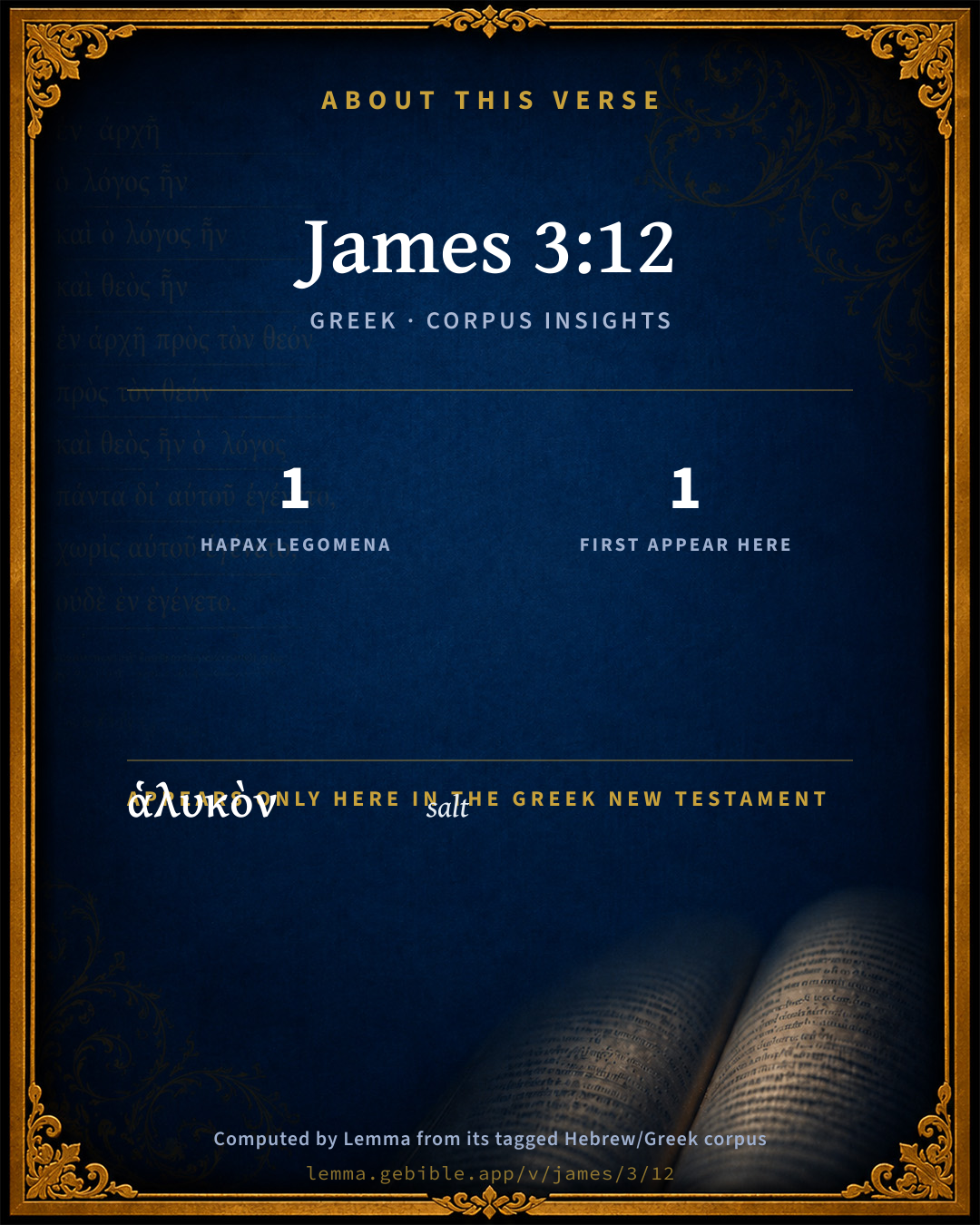
  • 1 hapax legomenon — only here in the Greek New Testament
  • 1 first appearance in the Greek New Testament
Full analysis ↓
Download a study sheet

One document with this verse’s original text, its word-by-word gloss line, the meaning frame, cross-references with their text, attributed commentary, and full source and license credits — printable, and it pastes into notes with its structure intact.

This verse Autodidact and up

Study sheet (.html) Plain text (.txt)

A passage Seminary Student

Up to 50 verses in one chapter. A passage sheet keeps up to 6 commentary sources and 12 cross-references per verse, in the order this page ranks them, and says so on the sheet whenever that leaves anything out. Ask for a single verse and you get the Autodidact verse sheet above.

Everything on this page stays free to read, with no account — the sheet is a download of what is already on screen, not access to it.

Want to remove ads? Support Godless Engineer
Compare translations 3

The same verse in 3 English versions, stacked beneath the original-language interlinear above. Click any original word for its lexicon entry.

Each is an independent rendering of the whole verse — the interlinear is not word-aligned to these translations.

Highlighted words mark where these versions differ — a whole-verse word diff, not a word-by-word alignment.

  • World English Bible Public Domain
    Can a fig tree, my brothers, yield olives, or a vine figs? Thus no spring yields both salt water and fresh water.
  • King James Version Public Domain
    Can the fig tree, my brethren, bear olive berries? either a vine, figs? so can no fountain both yield salt water and fresh.
  • unfoldingWord Literal Text CC BY-SA 4.0
    A fig tree is not able to make olives, is it, my brothers, or a grapevine, figs? Nor salty to make sweet water.

unfoldingWord Literal Text — © unfoldingWord, licensed CC BY-SA 4.0. Word-aligned USFM3 via Door43 (git.door43.org/unfoldingWord/en_ult).

Versions to compare (up to 4)

3 of 4 selected

Show all 19 translations

Every available English version of this verse, each an independent rendering of the whole verse.

  • World English Bible Public Domain
    Can a fig tree, my brothers, yield olives, or a vine figs? Thus no spring yields both salt water and fresh water.
  • Berean Standard Bible Public Domain
    My brothers, can a fig tree grow olives, or a grapevine bear figs? Neither can a salt spring produce fresh water.
  • Majority Standard Bible Public Domain
    My brothers, can a fig tree grow olives, or a grapevine bear figs? In the same way, no spring can produce both salt water and fresh water.
  • King James Version Public Domain
    Can the fig tree, my brethren, bear olive berries? either a vine, figs? so can no fountain both yield salt water and fresh.
  • American Standard Version (1901) Public Domain
    Can a fig tree, my brethren, yield olives, or a vine figs? Neither `can' salt water yield sweet.
  • Revised Version (1885) Public Domain
    Can a fig tree, my brethren, yield olives, or a vine figs? neither can salt water yield sweet.
  • Geneva Bible (1599) Public Domain
    Can ye figge tree, my brethren, bring forth oliues, either a vine figges? so can no fountaine make both salt water and sweete.
  • Douay-Rheims (1899) Public Domain
    Can the fig tree, my brethren, bear grapes; or the vine, figs? So neither can the salt water yield sweet.
  • Young's Literal Translation Public Domain
    is a fig-tree able, my brethren, olives to make? or a vine figs? so no fountain salt and sweet water `is able' to make.
  • Literal Standard Version CC BY-SA 4.0
    Is a fig tree able, my brothers, to make olives? Or a vine figs? Neither is salty [water able] to have made sweet water.
  • Unlocked Literal Bible CC BY-SA 4.0
    Does a fig tree, my brothers, make olives? Or a grapevine, figs? Neither can salty water produce sweet water.
  • unfoldingWord Literal Text CC BY-SA 4.0
    A fig tree is not able to make olives, is it, my brothers, or a grapevine, figs? Nor salty to make sweet water.
  • Darby Bible Public Domain
    Can, my brethren, a fig produce olives, or a vine figs? Neither [can] salt [water] make sweet water.
  • World Messianic Bible Public Domain
    Can a fig tree, my brothers, yield olives, or a vine figs? Thus no spring yields both salt water and fresh water.
  • Webster's Bible Public Domain
    Can the fig-tree, my brethren, bear olive-berries? or a vine, figs? so no fountain can yield both salt water and fresh.
  • Free Bible Version CC BY-SA 4.0
    My friends, a fig tree can't produce olives, and a vine can't produce figs, any more than a salt water spring can produce fresh water!
  • Bible in Basic English Public Domain
    Is a fig-tree able to give us olives, my brothers, or do we get figs from a vine, or sweet water from the salt sea?
  • Text-Critical English NT CC BY 4.0
    Can a fig tree, my brothers, produce olives, or a grapevine figs? In the same way, no spring can produce both salt water and fresh water.
  • Tyndale New Testament (1534) Public Domain
    Can the fygge tree my Brethren beare olive beries: other a vyne beare fygges? So can no fountayne geve bothe salt water and fresshe also.

Literal Standard Version (2020), Covenant Press — licensed CC BY-SA 4.0. Text via the HelloAO Bible API (eBible.org). Unlocked Literal Bible (unfoldingWord) — licensed CC BY-SA 4.0. Text via the HelloAO Bible API (eBible.org). unfoldingWord Literal Text — © unfoldingWord, licensed CC BY-SA 4.0. Word-aligned USFM3 via Door43 (git.door43.org/unfoldingWord/en_ult). Free Bible Version, Dr. Jonathan Gallagher — licensed CC BY-SA 4.0. Text via the HelloAO Bible API (eBible.org).

Word by word

More ways to search: Search by grammar → Find every occurrence → Compare this word →

Practice this passage: Drill this verse → Learn its vocabulary →

ἁλυκὸν
halykós
G252
“salt”
Adjective, Accusative, Singular, Neuter
Part of Speech
Adjective
Case
Accusative
Number
Singular
Gender
Neuter
Full Thayer's Definition

Origin: from G251

TDNT: None

1. salt
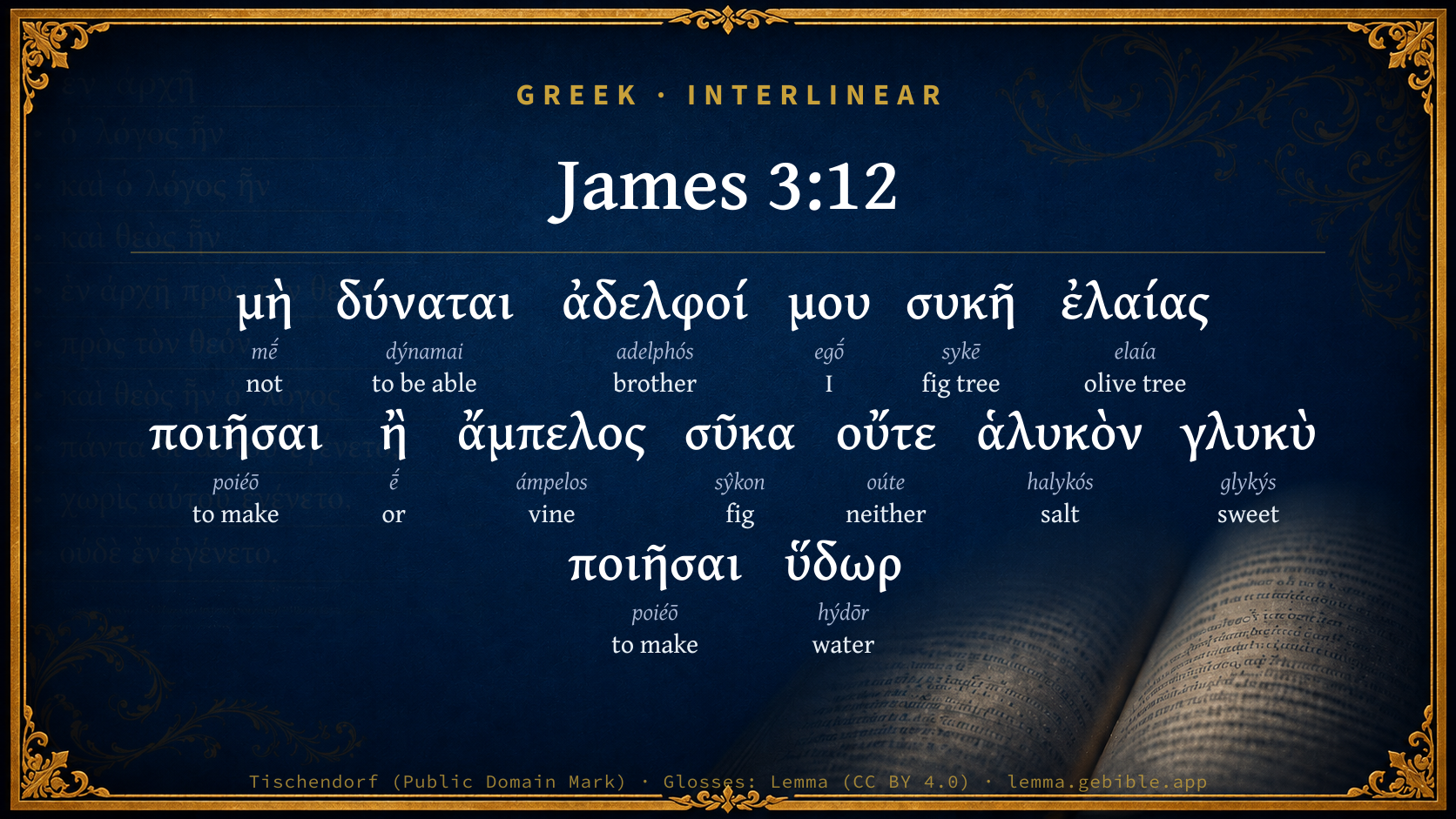
  1. μὴ mḗ G3361 “not” Particle, Negative
  2. δύναται dýnamai G1410 “to be able” Verb, Present, Middle or Passive deponent, Indicative, 3rd person, Singular
  3. ἀδελφοί adelphós G80 “brother” Noun, Vocative, Plural, Masculine
  4. μου egṓ G1473 “I” Personal pronoun, 1st person, Genitive, Singular
  5. συκῆ sykē G4808 “fig tree” Noun, Nominative, Singular, Feminine
  6. ἐλαίας elaía G1636 “olive tree” Noun, Accusative, Plural, Feminine
  7. ποιῆσαι poiéō G4160 “to make” Verb, Aorist, Active, Infinitive
  8. ἢ ḗ G2228 “or” Particle
  9. ἄμπελος ámpelos G288 “vine” Noun, Nominative, Singular, Feminine
  10. σῦκα sŷkon G4810 “fig” Noun, Accusative, Plural, Neuter
  11. οὔτε oúte G3777 “neither” Conjunction, Negative
  12. γλυκὺ glykýs G1099 “sweet” Adjective, Accusative, Singular, Neuter
  13. ποιῆσαι poiéō G4160 “to make” Verb, Aorist, Active, Infinitive
  14. ὕδωρ hýdōr G5204 “water” Noun, Accusative, Singular, Neuter

About this verse

These counts appear in no published source. They are computed here, from the morphology-tagged text and Lemma’s own curated glosses. What Lemma adds →

15
words
14
distinct lemmas
General Epistles
section

Notable vocabulary

1 hapax legomenon — a word that appears only here in the entire Greek New Testament:

  • ἁλυκὸν salt G252

First appearance in Scripture

This word makes its first canonical appearance in the Greek New Testament here:

  • ἁλυκὸν salt G252

Shared distinctive vocabulary

σῦκα fig G4810 occurs in 4 verses of the Greek New Testament. Also found in:

Repetition

A word recurs within this verse:

  • ποιῆσαι to make G4160 ×2

Cross-references

7

Topical passages linked to James 3:12 in the Treasury of Scripture Knowledge — connected by theme and wording, ordered by reader-vote popularity; previews shown in the World English Bible.

  • Luke 6:43–44 For there is no good tree that brings forth rotten fruit; nor again a rotten tree that brings forth good fruit.
  • Matthew 12:33 "Either make the tree good, and its fruit good, or make the tree corrupt, and its fruit corrupt; for the tree is known by its fruit.
  • Matthew 7:16–20 By their fruits you will know them. Do you gather grapes from thorns, or figs from thistles?
  • Jeremiah 2:21 Yet I had planted you a noble vine, wholly a right seed: how then are you turned into the degenerate branches of a foreign vine to me?
  • Romans 11:16–18 If the first fruit is holy, so is the lump. If the root is holy, so are the branches.
  • Isaiah 5:2–4 He dug it up, Gathered out its stones, Planted it with the choicest vine, Built a tower in its midst, And also cut out a winepress therein. He looked for it to yield grapes, But it yielded wild grapes.
  • Ezekiel 47:8–11 Then said he to me, These waters issue forth toward the eastern region, and shall go down into the Arabah; and they shall go toward the sea; into the sea [shall the waters go] which were made to issue forth; and the waters shall be healed.

Cross-references courtesy of OpenBible.info (CC BY 4.0).

Where the printed editions differ

1 variant

Places in this verse where the major printed Greek editions disagree on the wording in a way that affects the translation — a comparison of editions, not a manuscript-by-manuscript collation. The editions are the modern critical texts (Nestlé-Aland 28/27, SBL, Westcott-Hort, Tregelles, Tyndale House) and the traditional texts behind the KJV (the Textus Receptus and the Byzantine/Majority text). It is not a claim about which reading is original.

  1. Extra text
    πηγὴ

    “spring”

    In TRByz Not in NA28NA27TynSBLWHTreg

    πηγὴ (pēgē) 'spring' is only in traditional manuscripts (TR+Byz)

Textual data: Translators Amalgamated Greek New Testament (STEPBible TAGNT) · CC BY 4.0.

Commentary

Notes on James 3:12 from classic Christian and Jewish commentators (each source and its license shown beneath its notes). The classic Christian expositions comment on the surrounding passage and are grouped to its opening verse, so a note may address several verses; the Jewish commentaries on the Tanakh (Rashi and others) are per-verse, so they appear only where the commentator wrote on this verse.

Lemma curates 59 commentaries, every one of them public domain or Creative Commons licensed, each selected and text-cleaned for this edition rather than reprinted as found. About our sources →

The Biblical Illustrator

Joseph S. Exell

Jam_3:9; Jam_3:12

Therewith bless we God

The moral contradictions in the reckless talker

In these concluding sentences of the paragraph respecting sins of the tongue St.

James does two things--he shows the moral chaos to which the Christian who fails to control his tongue is reduced, and he thereby shows such a man how vain it is for him to hope that the worship which he offers to Almighty God can be pure and acceptable. He has made himself the channel of hellish influences. He cannot at pleasure make himself the channel of heavenly influences, or become the offerer of holy sacrifices. A man who curses his fellow-men, and then blesses God, is like one who professes the profoundest respect for his sovereign, while he insults the royal family, throws mud at the royal portraits, and ostentatiously disregards the royal wishes. It is further proof of the evil character of the tongue that it is capable of lending itself to such chaotic activity. Therewith bless we the Lord and Father, i.e., God in His might and in His love; and therewith curse we men, which are made after the likeness of God. The heathen fable tells us the apparent contradiction of being able to blow both hot and cold with the same breath; and the son of Sirach points out that if thou blow the spark, it shall burn; if thou Spit upon it, it shall be quenched; and both these come out of thy mouth (Sir_28:12). St. James, who may have had this passage in his mind, shows us that there is a real and a moral contradiction which goes far beyond either of these: Out of the same mouth cometh forth blessing and cursing. Well may he add, with affectionate earnestness, My brethren, these things ought not so to be. Assuredly they ought not; and yet how common the contradiction has been, and still is, among those who seem to be, and who think themselves to be, religious people! There is perhaps no particular in which persons professing to have a desire to serve God are more ready to invade His prerogatives than in venturing to denounce those who differ from themselves, and are supposed to be therefore under the ban of Heaven. There are many questions which have to be carefully considered and answered before a Christian mouth, which has been consecrated to the praise of our Lord and Father, ought to venture to utter denunciations against others who worship the same God and are also His offspring and His image. Is it quite certain that the supposed evil is something which God abhors; that those whom we would denounce are responsible for it; that denunciation of them will do any good; that this is the proper time for such denunciation; that we are the proper persons to utter it? The illustrations of the fountain and the fig-tree are among the touches which, if they do not indicate one who is familiar with Palestine, at any rate agree well with the fact that the writer of this Epistle was such. Springs tainted with salt or with sulphur are not rare, and it is stated that most of those on the eastern slope of the hill-country of Judaea are brackish. The fig-tree, the vine, and the olive were abundant throughout the whole country; and St. James, if he looked out of the window as he was writing, would be likely enough to see all three. It is not improbable that in one or more of the illustrations he is following some ancient saying or proverb. Thus, Arrian, the pupil of Epictetus, writing less than a century later, asks, How can a vine grow, not vinewise, but olivewise, or an olive, on the other hand, not olivewise, but vinewise? It is impossible, inconceivable. It is possible that our Lord Himself, when He used a similar illustration in connection with the worst of all sins of the tongue, was adapting a proverb already in use (Mat_12:33-36). And previously, in the Sermon on the Mount, where He is speaking of deeds rather than of Mat_7:16-18). Can it be the case that while physical contradictions are not permitted in the lower classes of unconscious objects, moral contradictions of a very monstrous kind are allowed in the highest of all earthly creatures? Just as the double-minded man is judged by his doubts, and not by his forms of prayer, so the double-tongued man is judged by his curses, and not by his forms of praise. In each case one or the other of the two contradictories is not real. If there is prayer, there are no doubts; and if there are doubts, there is no prayer--no prayer that will avail with God. So also in the other case: if God is sincerely and heartily blessed, there will be no cursing of His children; and if there is such cursing, God cannot acceptably be blessed; the very words of praise, coming from such lips, will be an offence to Him. But it may be urged, our Lord Himself has set us an example of strong denunciation in the woes which He pronounced upon the scribes and Pharisees; and again, St. Paul cursed Hymensaeus and Alexander (1Ti_1:20), the incestuous person at Corinth (1Co_5:5), and Elymas the sorcerer Act_13:10). Most true. But firstly, these curses were uttered by those who could not err in such things. Christ knew what was in man, and could read the hearts of all; and the fact that St. Pauls curses were supernaturally fulfilled proves that he was acting under Divine guidance in what he said. And secondly, these stern utterances had their source in love; not, as human curses commonly have, in hate. And let us remember the proportion which such things bear to the rest of Christs words and of St. Pauls words, so far as they have been preserved for us. All this applies with much force to those who believe themselves to be called upon to denounce and curse all such as seem to them to be enemies of God and His truth: but with how much more force to those who in moments of anger and irritation deal in execrations on their own account, and curse a fellow-Christian, not because he seems to them to have offended God, but because he has offended themselves! That such persons should suppose that their polluted mouths can offer acceptable praises to the Lord and Father, is indeed a moral contradiction of the most startling kind. The writer of this Epistle has been accused of exaggeration. It has been urged that in this strongly worded paragraph he himself is guilty of that unchastened language which he is so eager to condemn; that the case is over-stated, and that the highly-coloured picture is a caricature. Is there any thoughtful person of large experience that can honestly assent to this verdict? Who has not seen what mischief may be done by a single utterance of mockery, or enmity, or bravado; what confusion is wrought by exaggeration, innuendo, and falsehood; what suffering is inflicted by slanderous suggestions and statements; what careers of sin have been begun by impure stories and filthy jests? All these effects may follow, be it remembered, from a single utterance in each case, may spread to multitudes, may last for years. One reckless word may blight whole life. And there are persons who habitually pour forth such things, who never pass a day without uttering what is unkind, or false, or impure. (A. Plummer, D. D.)

The tongue--its blessing and cursing

I. THE INCONSISTENCY OF THE TONGUE.

1. Its blessing of God. This is the great end for which the human tongue exists--this the highest employment in which it can be engaged. We do this in various ways. We thus bless Him in our praises. These are sung either more privately in our own dwellings or more publicly in the sanctuary. He requires, above everything, the soul, but He will have the body also; the members and organs of the one, not less than the faculties and affections of the other. We thus bless God also in our prayers, whether these be secret, domestic, or public. In them adoring and thankful praises constitute no small or subordinate element. We extol the Lord for His infinite perfections, we give Him the glory due unto His great and holy name. We testify our obligations to Him for His mercies without number, and lay offerings of grateful homage on His altar.

2. Its cursing of men. Even the most orthodox and charitable Christians are not wholly exempt from this tendency. We are far too ready to pass sentence on our brethren, and in effect, if not in form, to curse such as do not happen to agree with us in some respects, and these, it may be, of quite secondary importance. Everything of this sort is of the nature of cursing--it partakes in one degree or another of that character. And mark the aggravating circumstance, that which involves the frightful inconsistency charged against the tongue--men, which are made after the similitude of God. We were at first created in His image, stamped with His moral lineaments in knowledge, righteousness, and true holiness. And in a sense too, as the, language here obviously implies, we still bear that likeness. Such cursing is in reality a cursing of God Himself whom we yet bless--a cursing of Him in man, who is not only His workmanship, but His reflection, His image--not merely a being formed by His hand, but formed after His likeness. We cannot keep the first table of the law, and at the same time set at nought the second. The strangely, outrageously inconsistent nature of the whole proceeding is still more forcibly exhibited by bringing the two contrary things together, placing them side by side, presenting them in sharpest contrast (Jam_3:10). There it is that the flagrant, shocking contradiction appears.

II. THE UNNATURALNESS OF THIS INCONSISTENCY (Jam_3:11-12). Doth a fountain send forth at the same place--the same hole, chink, or fissure, as in the rock whence it issues--sweet water and bitter? No--nothing of this kind is ever witnessed. The water which flows from the spring may have either, but it cannot have both of these qualities. It may indeed afterwards undergo a change, it may lose its original properties, and be turned into the opposite of what it was, by reason of the soil through which it runs, or the purposes to which it is applied. What was sweet may by certain mixtures become bitter. But at first, in its own nature, and apart from all foreign ingredients, it is wholly the one or the other. There is no inconsistency in the material region. He passes to a higher department, the vegetable kingdom, and shows that there too plants and trees bring forth a single kind of fruit, and that which is suited to the order, the species to which they belong. Can the fig-tree, my brethren, bear olive-berries, either a vine figs? Of course it cannot. Any such thing would be a monstrosity. Titan, returning to the spring, not without reference to the internal, hidden source from which all our words proceed, be adds, So can no fountain both yield salt water and fresh. He wishes to fix attention on the inconsistency manifested in the use of the tongue, and lead them to the right explanation of its origin. This anomaly does seem to be exhibited in the moral world, if not in the material. But it is so more in appearance than in reality. That water is often the same which looks different. What to some tastes and tests is fresh, when thoroughly examined, is found to be salt as the ocean. Much that to our earthly senses is sweet, to the spiritually-discerning is bitter indeed. Thus the blessing of many is formal, if not even false, having nothing gracious in it, no love or homage of the heart, no element or quality fitted to render it acceptable to the great object of worship. In its origin and essence it is not opposed to, nor, indeed, different from the cursing of man, with which it is associated. The latter reveals the true nature of the common source, or there may be two fountains where only one is perceptible. The former supposition applies to nominal and hypocritical Christians--this latter to living, genuine believers. They have an old man and a new, corruption and grace both existing and working within them; and as the one or the other gains the ascendancy, and, for the time, governs the tongue, the stream of discourse that issues from it is wholesome or deleterious--fresh as that of the bubbling spring, or salt as that of the briny deep. (John Adam.)

The evil tongue

St. James uses three special arguments to restrain Christians from the unruly use of the tongue: the first is the inconsistency of the thing--that the heart touched by the Holy Spirit should do the works of the flesh--that the fountain which hath been purified should again flow with bitter waters and the servants of Christ should serve Belial We have promised to study the strains of angels, and become familiar with and adopt them as our own; so that instead of being now a Babel of confusion, the Church may utter but one language in the presence of the Lamb; and how very inconsistent that from such lips cursing should proceed--how very inconsistent if any of you who have been now repeating Davids psalms, the notes of heaven, should to-morrow be found uttering an oath, or even using a passionate expression. It is bad enough for one who only professes Christianity to use the language of the devil, but it is a greater inconsistency when out of the same mouth proceeds blessing and cursing--when you, the same person, bless God, yet curse His image. Let the wicked do it; the heathen who is without God, and without Christ, if it must be. He that is unjust, &c. But a Christian man--a man who has been baptized into the Holy Trinity; a man who readsthe Bible, and comes into Gods house and worships there: a man who joins himself to the company of the saints, dead and living, and takes into his mouth the same words, the same prayers, the same Scripture passages with them;--nay, the man who perhaps approaches the awful mystery of the Body and Blood of His Lord;-that from such a mouth should proceed the gibes and imprecations of lost spirits, is it not shockingly inconsistent? Next, St. James reminds us of the consequences both to others and ourselves. Behold how great a matter a little fire kindleth, awed the tongue is a fire. How far may a single spark dropped among stubble reach! Bow does it steal along the floor, creep up the wall, envelop the roof, spread from house to house, and seize churches and noble buildings, till it wrap a whole city in conflagration! So does a single word dropped unadvisedly. If a soft answer turneth away wrath, on the other hand grievous words stir up anger. If you reply quietly to a provocation, or refuse to answer, the quarrel dies; but one word draws on another, and wrath kindleth wrath; and that is made eternal which might have been extinguished if only one had been a Christian. You see, then, how great a matter a little fire kindleth. Is it surprising if of every idle word we shall give an account at the judgment? But again, you say something injurious of your neighbour. There is a little truth in it, but much more falsehood. It has been added to, and enlarged, and swollen into a crime. But you repeat it. The story spreads. It is told everywhere, and though it wounds your neighbour to death, and from the calumny he loses all acquaintances and friends, yet you cannot recall it now. See how great a matter a little fire kindleth. Again, you utter impure words before a child, the child treasures them up all through his life; though he lives sixty or seventy years, unhappy being, his thoughts and language take their complexion from your words; but besides, to how many has lie communicated what he first heard from you! Mark again, how great a little fire kindleth. Surely the tongue is a fire, a world of iniquity, and setteth on fire the course of nature. To conclude: if we will not restrain our members by the aid of Gods Spirit, and especially that member which St. Peter calls an unruly evil, full of deadly poison; if we will, in the indulgence of a wilful spirit, scatter firebrands about, unkind, malicious, polluting, or injurious words, wide-spread as the evil may be, will it stop short with others? No, it will return upon ourselves; which setteth on fire the course of nature, and it is set on fire of hell. The fire which hath gone forth spreading and consuming, at the judgment hour is stopped in its course, and rolling back again is concentrated on the tongue which gave it existence. You who uttered the word, which has done such mischief to thousands, and ruined so many souls, now feel its burning effects in your own person. Ought not this to make you careful of your words, those winged words, which once launched forth take a flight you know not whither? (J. M. Chaunter, M. A.)

Made after the similitude of God

Man made after Gods image

This image of God consisteth in three things--

1. In His nature, which was intellectual. God gave him a rational soul, spiritual, simple, immortal, free in its choice; yea, in the body there were some rays and strictures of the Divine glory and majesty.

2. In those qualities of knowledge (Col_3:10); righteousness Ecc_7:29); and true holiness (Eph_4:24).

3. In his state, in a happy confluence of all inward and outward blessings, as the enjoyment of God, power over the creatures, &c. But now this image is in a great part defaced and lost, and can only be restored in Christ. Well, then, this was the g, eat privilege of our creation, to be made like God: the more we resemble Him the more happy. Oh! remember the height of your original. We press men to walk worthy of their extraction. Those potters that were of a servile spirit disgraced the kingly family and line of which they came (1Ch_4:22). Plutarch saith of Alexander, that he was wont to heighten his courage by remembering he came of the gods. Remember you were made after the image of God; do not deface it in yourselves, or render it liable to contempt, by giving others occasion to revile you. (T. Manton.)

The Biblical Illustrator, edited by Joseph S. Exell (c. 1880s–1900s) — public domain. Text from a community e-Sword module.

Bengel's Gnomon

Johann Albrecht Bengel

Jas 3:12. Μὴ δύναται, is it possible?) He now prepares a transition from the mouth to the heart. He had said with regard to the former, There is no need [it is not becoming]; he says respecting the latter, it is impossible.—οὕτως οὐδὲ ἁλυκὸν γλυκὺ ποιησαι ὕδωρ, so neither can a salt spring produce sweet water) viz. δύναται (to be supplied). Thus the most weighty authorities, Colbert. 7; Cov. 4; Gen.; Æth.; Copt.; Lat., and the Syr[41], The Alexand. reads οὔτε ἁλυκόν. Baumgarten has a long dissertation in favour of the more generally received reading: Exam., p. xxxii. You will see my reply in App. Crit., Ed. ii., on this passage.[42] The apostle had said in Jas 3:11, that it is not befitting that two contraries should proceed from one source; he now says, that nothing can proceed from any source whatever, unless it be of the same kind. Salt (water), in the nominative case, has the force of a substantive, as just before, sweet and bitter. In Hesychius ἁλυκὴ, ἡ θάλασσα, the sea. In James, ἁλυκὸν has a wider meaning, a lake or spring of salt, pouring forth water.—οὕτως, thus, is used before the word salt, now in particular, because this resemblance, already represented in the 11th verse, puts on here a more strict propriety,[43] and in this place contains the Apodosis itself, which is about to be added immediately, in plain (unfigurative) words.

[41] yr. the Peschito Syriac Version: second cent.: publ. and corrected by Cureton, from MS. of fifth cent.

[42] ABC corrected and later Syr. omit οὕτως, which Rec. Text prefixes without very old authority. ABC Vulg. Memph. Syr. read οὔτε ἁλυκὸν γλυκύ. But Rec. Text without any old authority except later Syr., reads οὐδεμία πηγὴ ἁλυκὸν καὶ γλυκύ.—E.

[43] i.e. It is more strictly in accordance with the simile that ἁλυκὸν should be supposed to send forth γλυκύ, sweet water, than that a πηγὴ, as in ver. 11, should send it forth.—E.

Bengel's Gnomon of the New Testament — English translation (T&T Clark, Edinburgh, 1860) — public domain. Text from a community e-Sword module.

Meyer's Critical & Exegetical Commentary

Heinrich August Wilhelm Meyer

Jam_3:12. This verse shows, by examples taken from nature, that from one principle opposite things cannot be produced, but that any cause can only bring forth that which corresponds to its nature. Semler incorrectly paraphrases the first question: μὴ δύναται συκῆ ἐκαίας ποιῆσαι: an fieri potest, ut ficus, cujus est dulcis natura, producat amaras oleas; for that here the contrast of sweet and bitter (which only the last clause of the verse resumes) is not designed to be expressed, is evident from what immediately follows: ἢ ἄμπελος σῦκα, where James would otherwise have mentioned the olive instead of the vine. The idea is rather that nothing can bring forth that which is not corresponding to its nature.[179] Consequently the opinion of de Wette, that here thistles (according to Mat_7:16), or something similar, instead of ἄμπελος would be more appropriate, is incorrect.

To the question follows as its conclusion the negative clause: ΟὔΤΕ ἉΛΥΚῸΝ ΓΛΥΚῪ ΠΟΙῆΣΑΙ ὝΔΩΡ, which is so construed as if the former sentence, not only in meaning, but also in form, was a negative one; ΟὔΤΕ (א: ΟὐΔΈ) and the omission of ΔΎΝΑΤΑΙ are thus to be explained.[180]

ἁλυκόν is the subject, and ΓΛΥΚῪ ὝΔΩΡ the object; ΠΟΙῆΣΑΙ is used in the same signification as before; thus: Nor can bitter bring forth sweet water. The opposite ideas ἁλυκόν and ΓΛΥΚΎ are emphatically placed beside each other. James hereby indicates, that if from one month the bitter (namely, the κατάρα) and also the sweet (namely, the ΕὐΛΟΓΊΑ) proceed, this is not only morally reprehensible, to which Jam_3:10 points, but is something impossible; accordingly, the person who curses man, who is made after the image of God, cannot also bless (praise) God, and that thus if the mouth yet express both, the εὐλογεῖν can only be mere seeming and hypocrisy (Lange).[181]

[179] Comp. Arrian, Epikt. ii. 20: πῶς γὰρ δύναται ἄμπελος μὴ ἀμπελικῶς κινεῖσθαι ἀλλʼ ἐλαϊκῶς, ἢ ἐλαία πάλιν μὴ ἐλαϊκῶς ἀλλʼ ἀμπελικῶς; ἀμήχανον, ἀδιανόητον; comp. also Plut. de tranq. an. p. 472 E.

[180] Buttmann (p. 315 [E. T. 367]), following Lachmann, praef. p. xliv., assumes a corruption of the passage.

[181] Gunkel incorrectly thinks that ver. 12 only discloses the unnaturalness of the conduct denounced in ver. 10, for μὴ δύναται evidently expresses impossibility. It is also to be observed, that in the last clause of ver. 12 ἁλυκόν (ὕδωρ) is considered as the fountain which cannot bring forth γλυκὺ ὕδωρ, and accordingly points to the bitter disposition, from which only that which is bitter (namely, the bitter κατάρα), but not that which is sweet (namely, the εὐλογία), can proceed. Lange correctly observes, that the multiplying of examples has the effect of illustrating the general application of the law of life here laid down; but he strangely supposes that the individual examples have a symbolical meaning; the fig-tree, the symbol of a luxurious natural life; the olives, the symbols of spiritual life, etc.

Meyer — Critical and Exegetical Commentary on the New Testament — English translation by Peter Christie, edited by Frederick Crombie (T&T Clark, 1880) — public domain. Text from a community e-Sword module.

Expositor's Greek Testament

ed. W. Robertson Nicoll

Jas 3:12 . With the whole verse cf. Mat 7:16-17 ; for the use of ποιεῖν see Mat 3:10 , πᾶν δένδρον μὴ ποιοῦν καρπόν …; ἁλυκόν does not occur elsewhere in the N.T. or Septuagint, though in Num 3:12 , Deu 3:17 , etc., we have the phrase ἡ θάλασσα ἡ ἁλυκή = the Dead Sea. “There is great harshness in the construction μὴ δύναται ποιῆσαι ; οὔτε ποιῆσαι . If the government of δύναται is continued, we ought to have ἤ for οὔτε followed by a question; otherwise we should have expected an entirely independent clause, reading ποιήσει for ποιῆσαι ” (Mayor).

The Expositor's Greek Testament, edited by W. Robertson Nicoll (1897–1910) — public domain. Text from a community e-Sword module.

Jamieson, Fausset & Brown

Robert Jamieson, A. R. Fausset & David Brown

Transition from the mouth to the heart.

Can the fig tree, &c.--implying that it is an impossibility: as before in Jam 3:10 he had said it "ought not so to be." James does not, as Matthew (Mat 7:16-17), make the question, "Do men gather figs of thistles?" His argument is, No tree "can" bring forth fruit inconsistent with its nature, as for example, the fig tree, olive berries: so if a man speaks bitterly, and afterwards speaks good words, the latter must be so only seemingly, and in hypocrisy, they cannot be real.

so can no fountain . . . salt . . . and fresh--The oldest authorities read, "Neither can a salt (water spring) yield fresh." So the mouth that emits cursing, cannot really emit also blessing.

Jamieson, Fausset & Brown — Commentary Critical and Explanatory on the Whole Bible (1871) — public domain (CC PDM 1.0). Text via the HelloAO Bible API.

Adam Clarke's Commentary

Verse 12. So can no fountain both yield salt water and fresh.] For the reading of the common text, which is οὑτως ουδεμια πηγη ἁλυκον και γλυκυ ποιησαι ὑδωρ, so no fountain can produce salt water and sweet, there are various other readings in the MSS. and versions. The word ουτως, so, which makes this a continuation of the comparison in Jas 3:11, is wanting in ABC, one other, with the Armenian and ancient Syriac; the later Syriac has it in the margin with an asterisk. ABC, five others, with the Coptic, Vulgate, one copy of the Itala, and Cyril, have ουτε ἁλυκον γλυκυ ποιησαι ὑδωρ, neither can salt water produce sweet. In the Syriac and the Arabic of Erpen, it is, So, likewise, sweet water cannot become bitter; and bitter water cannot become sweet. The true reading appears to be, Neither can salt water produce sweet, or, Neither can the sea produce fresh water; and this is a new comparison, and not an inference from that in Jas 3:11. This reading Griesbach has admitted into the text; and of it Professor White, in his Crisews, says, Lectio indubie genuina, "a reading undoubtedly genuine." There are therefore, four distinct comparisons here:

1. A fountain cannot produce sweet water and bitter.

2. A fig tree cannot produce olive berries.

3. A vine cannot produce figs.

4. Salt water cannot be made sweet. That is, according to the ordinary operations of nature, these things are impossible. Chemical analysis is out of the question.

Adam Clarke's Commentary on the Bible (1810–1826) — public domain. Text from a community e-Sword/MySword module.

Ellicott's Commentary for English Readers

(12) Can the fig-tree, my brethren, bear olive berries? either a vine, figs?—Read, Can a fig-tree bear olives, or a vine, figs? The inquiry sounds like a memory of our Lord’s, “Do men gather grapes of thorns, or figs of thistles?” (Mat_7:16.)

So can no fountain . . .—This, the last clause of the sentence above in the Authorised version is very confused in the original, but seems to be merely this, Neither can salt (water) bring forth fresh; or, as Wordsworth renders it, Nor can water that is salt produce what is sweet. And such in effect is Alford’s comment: “If the mouth emit cursing, thereby making itself a brackish spring, it cannot to any purpose also emit the sweet stream of praise and good words; if it appear to do so, all must be hypocrisy and mere seeming.” Every blessing is, in fact, tainted by the tongue which has uttered curses; and even “Praise is not seemly in the mouth of a sinner” (Sir_15:9).

A Bible Commentary for English Readers, edited by Charles John Ellicott (1878–1897) — public domain. Text from a community e-Sword module.

The Cambridge Bible for Schools and Colleges

gen. ed. J. J. S. Perowne

12. Can the fig tree, my brethren, bear olive berries?…] The comparison here also has an eminently local character. The court-yard of well-nigh every house had its vine and fig-tree (2Ki_18:31). The Mount of Olives supplied the other feature. The idea, as a whole, is parallel to that of Mat_7:16-17, and may well have been suggested by it.

so can no fountain both yield salt water and fresh] The better MSS. give a somewhat briefer form, Neither can a salt (spring) yield sweet (the same adjective as in the preceding verse) water. The comparison seems at first to break down, as the fact which it was meant to illustrate was that “blessing and cursing” did issue from the same mouth. What is meant, however, is that in such a case, the “blessing” loses its character, and is tainted with the bitterness of the cursing. The prayers and praises of the hypocrite who cherishes hatred in his heart, are worse than worthless.

The Cambridge Bible for Schools and Colleges (gen. ed. J. J. S. Perowne; Cambridge University Press, 1878–1918) — public domain. Text from a community e-Sword module.

John Gill's Exposition

Can the fig tree, my brethren, bear olive berries?.... Every tree bears fruit, according to its kind; a fig tree produces figs, and an olive tree olive berries; a fig tree does not produce olive berries, or an olive tree figs; and neither of them both:

either a vine, figs? or fig trees, grapes; or either of them, figs and grapes:

so can no fountain both yield salt water and fresh. The Alexandrian copy reads, "neither can the salt water yield sweet water"; that is, the sea cannot yield sweet or fresh water: the Syriac version renders it, "neither can salt water be made sweet": but naturalists say, it may be made sweet, by being strained through sand: the design of these similes is to observe how absurd a thing it is that a man should both bless and curse with his tongue.

John Gill's Exposition of the Whole Bible (1746–1763) — public domain (CC PDM 1.0). Text via the HelloAO Bible API.

Trapp's Complete Commentary

John Trapp

12 Can the fig tree, my brethren, bear olive berries? either a vine, figs? so can no fountain both yield salt water and fresh.

Ver. 12. Both yield salt water and fresh] That is strange that is reported of the rivers of Peru, that after they have run into the main sea, yea, some write 20 or 30 miles, they keep themselves unmixed with the salt water; so that a very great way within the sea men may take up as fresh water as if they were near the land. (Abbot’s Geog.) But that is as sure as strange, that an eyewitness reporteth of the Danube and Sara (two great rivers in Hungary), that their waters meeting mingle no more than water and oil; so that near the middle of the river I have gone in a boat (saith mine author) and tasted of the Danube, as clear and pure as a well; then putting my hand not an inch farther, I have taken of the Sava, as troubled as a street channel, tasting the gravel in my teeth. Thus they run 60 miles together. (Blount’s Voyage.)

John Trapp, A Commentary or Exposition upon All the Books of the Old and New Testament (1647–1656) — public domain. Text from a community e-Sword module.

Albert Barnes' Notes on the Bible

Can the fig-tree, my brethren, bear olive-berries? - Such a thing is impossible in nature, and equally absurd in morals. A fig-tree bears only figs; and so the tongue ought to give utterance only to one class of sentiments and emotions. These illustrations are very striking, and show the absurdity of that which the apostle reproves. At the same time, they accomplish the main purpose which he had in view, to repress the desire of becoming public teachers without suitable qualifications. They show the power of the tongue; they show what a dangerous power it is for a man to wield who has not the proper qualifications; they show that no one should put himself in the position where he may wield this power without such a degree of tried prudence, wisdom, discretion, and piety, that there shall be a moral certainty that he will use it aright.

Albert Barnes' Notes on the Bible (1834–1885) — public domain. Text from a community e-Sword/MySword module.

Matthew Poole's English Annotations

Can the tree, my brethren, bear olive berries? either a vine, figs? The same tree cannot ordinarily bring forth fruit of different kinds, (on the same branch, whatever it may on different, by ingrafting), much less contrary natures: see Mat 7:16-18.

So can no fountain both yield salt water and fresh; or, neither can a salt fountain yield fresh water; but the scope is still the same as in our reading. The apostle argues from what is impossible, or monstrous, in naturals, to what is absurd in manners: q.d. It is as absurd in religion, for the tongue of a regenerate man, which is used to bless God, to take a liberty at other times to curse man, as it would be strange in nature for the same tree, on the same branch, to bear fruits of different kinds; or the same fountain at the same place to send forth bitter water and sweet.

Matthew Poole's English Annotations on the Holy Bible (1683–1685) — public domain. Text from a community e-Sword/MySword module.

The People's New Testament

B. W. Johnson

12. Can the fig tree. Neither does a tree bear two opposite kinds of fruits. Nor should the mouth bear blessing and cursing, good and evil.

B. W. Johnson's The People's New Testament with Notes (1889–1891) — public domain. Electronic text from the Christian Classics Ethereal Library (CCEL) ThML edition.

Cambridge Greek Testament for Schools and Colleges

12. οὔτε ἁλυκὸν γλυκὺ ποιῆσαι ὕδωρ with א (οὐδεὲ) ABD, Old Latin and Vulgate. The T.R. has the support of KLP and later MS. authority and some versions in reading οὐδεμία πηγὴ ἁλυκὸν καὶ γλυκὺ ποιῆσαι ὕδωρ. The reading in the text is an instance of the rule that a reading is to be preferred out of which all the rest may have been derived, although it could not have been derived from any of them.

12. συκῆ ἐλαίας ποιῆσαι κ.τ.λ. Comp. Mat 7:16-17, where the thought is similar but not quite parallel.

ἁλυκὸν (ὕδωρ). So θερμόν, Aristoph. Nub. 1040: and in Latin frigida, calida, gelida (aqua). In LXX. ἁλυκός is always used of the Salt Sea (never called the Dead Sea in the Bible), e.g. ἔσται ἡ διέξοδος θάλασσα ἡ ἁλυκή Num 34:12: ἕως θαλάσσης Ἀραβὰ θαλάσσης ἁλυκῆς Deu 3:17.

Cambridge Greek Testament for Schools and Colleges (Cambridge University Press, 1896; 21 vols, various authors incl. Carr, Maclear, Plummer, Farrar, Lumby, Moule, M. R. James, Simcox) — public domain. Text from a community e-Sword module.

Alford’s Greek Testament

Henry Alford

12.] Shews further that natural organizations do not bring forth things opposite to or inconsistent with their usual fruits, but each one has one result, and that always. Can, my brethren, a figtree bring forth (see on the whole, and on ποιῆσαι in this sense, Mat 7:16 ff. But De Wette is wrong, when he says that thistles or the like would be here, as there, more agreeable to the similitude. For the reasoning is not here, that we must not look for good fruit from a bad tree: but that no tree can bring forth fruit inconsistent with its own nature: as in Arrian, Epict. ii. 20, πῶς δύναται ἄμπελος μὴ ἀμπελικῶς κινεῖσθαι, ἀλλʼ ἐλαϊκῶς; ἢ ἔλαια πάλιν μὴ ἐλαϊκῶς ἀλλʼ ἀμπελικῶς; ἀμήχανον, ἀδιανόητον) olives, or a vine figs? Nor (as if the former sentence had been a negative one) can salt (water) bring forth sweet water (i. e. if the mouth emit cursing, thereby making itself a brackish spring, it cannot to any purpose also emit the sweet stream of praise and good words: if it appear to do so, all must be hypocrisy and mere seeming).

Henry Alford, The Greek Testament (1849–1861) — public domain. Text from a community e-Sword module.

International Critical Commentary

12. ἀδελφοί μου. Here inserted to add emphasis, not, as more often, to mark a transition; Son 1:16; Son 2:5.

συκῆ, ἐλαίας, ἄμπελος.

The fig, the olive, and the vine are the three characteristic natural products of warm countries about the Mediterranean. For the figure, cf. Mat 7:16, Mat 7:12:33; Plutarch, De tranquill. anim. p. 472 F τὴν ἄμπελον σῦκα φέρειν οὐκ ἀξιοῦμεν οὐδὲ τὴν ἐλαίαν βότρυς; similarly, Seneca, Ep. 8725, De ira ii, 106; Epict. Diss. 2, 2018.

οὔτε seems to be an error for οὐδέ, but the constant interchange of these words in the Mss. by textual corruption makes it hard to be sure that good ancient writing did not exercise more freedom in the use of them than the grammarians would sanction; see Radermacher, Neutestamentliche Grammatik, p. 172.

ἁλυκόν, sc. ὕδωρ, “salt water”; i. e. a salt spring. There were salt springs or brine-pits on the shore of the Dead Sea, and the hot springs of Tiberias are described as bitter and salt; see Robinson, Biblical Researches in Palestine, 1856, ii, p. 384.

γλυκὺ ποιῆσαι ὕδωρ, sc. δύναται (as is shown by the parallel first half of the verse).

No application of these illustrations is made, and James turns abruptly to another aspect of the matter. The passage well illustrates his vividness and fertility of illustration, as well as his method of popular suggestiveness, rather than systematic development of the thought.

οὔτε ἁλυχὸν γλυχύ] BAC minn.

οὕτως οὔτε [οὐδὲ א minn] ἁλυκὸν γλυκύ] אC2 minn ff vg syrpesh boh Cyr.

οὕτως οὐδεμία πηγὴ ἁλυκὸν καὶ γλυκύ] KLP (οὔτε) minnpler syrhcl c.* (syrhel txt ομ οὕτως).

International Critical Commentary — older volumes (1896–1929), various authors — public domain. Text from a community e-Sword module.

Vincent's Word Studies in the New Testament

Marvin R. Vincent

So can no fountain both yield salt water and fresh. The best texts omit so can no fountain, and the and between salt and fresh. Thus the text reads, oute aJlukon gluku poihsai udwr. Render, as Rev., neither can salt water yield sweet. Another of James' local allusions, salt waters. The Great Salt Sea was but sixteen miles from Jerusalem. Its shores were lined with salt - pits, to be filled when the spring freshets should raise the waters of the lake. A salt marsh also terminated the valley through which the Jordan flows from the Lake of Tiberias to the Dead Sea, and the adjoining, plain was covered with salt streams and brackish springs. Warm springs impregnated with sulfur abound in the volcanic valley of the Jordan. 'Alukon, salt, occurs only here in the New Testament.

Marvin R. Vincent, Word Studies in the New Testament (1887–1900) — public domain. Text from a community e-Sword/MySword module.

Lesson kit

Teaching starters — assembled from the data on this page, not authored interpretation. Every prompt links to the verse data it draws on. Edit before teaching.

James, in the General Epistles, opens this verse with 15 words (14 distinct Greek lemmas). Its most distinctive word is halykós (“salt”). A historical commentator’s framing appears above. Read the whole chapter for the surrounding context.

Discussion questions

  1. How does “salt” (halykós) shape what this verse is saying?
  2. This verse holds 1 word here found nowhere else in the Greek New Testament. What might the rare word draw attention to?
  3. The word “salt” first appears here in Scripture. What is being introduced at this debut?
  4. Matthew 7:16 shares the word «fig» with this verse. How do the two illuminate each other?
  5. “to make” occurs 2× in this one verse. What is the effect of the repetition?
  6. The translations on this page render this verse differently — a whole-verse word diff, not a word-by-word alignment. What might account for the different wordings?
  7. Reading how The Biblical Illustrator and Bengel's Gnomon read this verse, where do the two commentators agree and where do they part?

Things to notice

  • 1 word in this verse appears nowhere else in the Greek New Testament.
  • 1 word makes its first canonical appearance in Scripture here.
  • These translations choose different wording for 22 words in this verse.
  • “to make” occurs 2× in this single verse.
  • 14 distinct Greek lemmas span 15 words in this verse.

Reading settings

Reading text

Shown beneath each verse's original-language words.

Old Testament
Old Testament edition

Read the OT as the Masoretic Hebrew (MT) or the Greek Septuagint (LXX).

English shown for the Greek Septuagint (in the Hebrew ↔ Greek comparison).

Comparing translations? Open the Compare panel on any verse page to stack up to four side by side.