1 Thessalonians 3:9

Greek (Tischendorf 8th ed.) 1 Thessalonians 3:9 appears in the Greek New Testament. The text above is from the Tischendorf 8th edition. Each word links to its Strong’s number and a concise gloss. Click any word for its full Thayer’s Greek Lexicon entry.
Download image
Cite this verse

1 Thessalonians 3:9 (World English Bible). Public Domain. Lemma interlinear Bible study tool, https://lemma.gebible.app/v/1-thessalonians/3/9.

Show BibTeX & RIS
BibTeX
RIS
English Translation
For what thanksgiving can we render again to God for you, for all the joy with which we rejoice for your sakes before our God;
World English Bible · Public Domain
Download a study sheet

One document with this verse’s original text, its word-by-word gloss line, the meaning frame, cross-references with their text, attributed commentary, and full source and license credits — printable, and it pastes into notes with its structure intact.

This verse Autodidact and up

Study sheet (.html) Plain text (.txt)

A passage Seminary Student

Up to 50 verses in one chapter. A passage sheet keeps up to 6 commentary sources and 12 cross-references per verse, in the order this page ranks them, and says so on the sheet whenever that leaves anything out. Ask for a single verse and you get the Autodidact verse sheet above.

Everything on this page stays free to read, with no account — the sheet is a download of what is already on screen, not access to it.

Want to remove ads? Support Godless Engineer
Compare translations 3

The same verse in 3 English versions, stacked beneath the original-language interlinear above. Click any original word for its lexicon entry.

Each is an independent rendering of the whole verse — the interlinear is not word-aligned to these translations.

Highlighted words mark where these versions differ — a whole-verse word diff, not a word-by-word alignment.

  • World English Bible Public Domain
    For what thanksgiving can we render again to God for you, for all the joy with which we rejoice for your sakes before our God;
  • King James Version Public Domain
    For what thanks can we render to God again for you, for all the joy wherewith we joy for your sakes before our God;
  • unfoldingWord Literal Text CC BY-SA 4.0
    For what thanks are we able to give back to God concerning you for all the joy with which we rejoice because of you before our God,

unfoldingWord Literal Text — © unfoldingWord, licensed CC BY-SA 4.0. Word-aligned USFM3 via Door43 (git.door43.org/unfoldingWord/en_ult).

Versions to compare (up to 4)

3 of 4 selected

Show all 19 translations

Every available English version of this verse, each an independent rendering of the whole verse.

  • World English Bible Public Domain
    For what thanksgiving can we render again to God for you, for all the joy with which we rejoice for your sakes before our God;
  • Berean Standard Bible Public Domain
    How can we adequately thank God for you in return for our great joy over you in His presence?
  • Majority Standard Bible Public Domain
    How can we adequately thank God for you in return for our great joy over you in His presence?
  • King James Version Public Domain
    For what thanks can we render to God again for you, for all the joy wherewith we joy for your sakes before our God;
  • American Standard Version (1901) Public Domain
    For what thanksgiving can we render again unto God for you, for all the joy wherewith we joy for your sakes before our God;
  • Revised Version (1885) Public Domain
    For what thanksgiving can we render again unto God for you, for all the joy wherewith we joy for your sakes before our God;
  • Geneva Bible (1599) Public Domain
    For what thankes can wee recompense to God againe for you, for all the ioy wherewith we reioyce for your sakes before our God,
  • Douay-Rheims (1899) Public Domain
    For what thanks can we return to God for you, in all the joy wherewith we rejoice for you before our God,
  • Young's Literal Translation Public Domain
    for what thanks are we able to recompense to God for you, for all the joy with which we do joy because of you in the presence of our God?
  • Literal Standard Version CC BY-SA 4.0
    For what thanks are we able to repay to God for you, for all the joy with which we delight because of you in the presence of our God,
  • Unlocked Literal Bible CC BY-SA 4.0
    For what thanks can we give to God for you, for all the joy that we have before our God over you?
  • unfoldingWord Literal Text CC BY-SA 4.0
    For what thanks are we able to give back to God concerning you for all the joy with which we rejoice because of you before our God,
  • Darby Bible Public Domain
    For what thanksgiving can we render to God for you, for all the joy wherewith we rejoice on account of you before our God,
  • World Messianic Bible Public Domain
    For what thanksgiving can we give again to God for you, for all the joy with which we rejoice for your sakes before our God,
  • Webster's Bible Public Domain
    For what thanks can we render to God again for you, for all the joy with which we rejoice for your sakes before our God;
  • Free Bible Version CC BY-SA 4.0
    As we go into the presence of our God, how can we ever thank God enough for you because of all the joy you bring to us?
  • Bible in Basic English Public Domain
    For how great is the praise which we give to God for you, and how great the joy with which we are glad because of you before our God;
  • Text-Critical English NT CC BY 4.0
    How can we thank God enough for you in return for all the joy we have in the presence of our God because of you?
  • Tyndale New Testament (1534) Public Domain
    For what thankes can we recompence to god agayne for you over all the ioye that we ioye for youre sakes before oure god

Literal Standard Version (2020), Covenant Press — licensed CC BY-SA 4.0. Text via the HelloAO Bible API (eBible.org). Unlocked Literal Bible (unfoldingWord) — licensed CC BY-SA 4.0. Text via the HelloAO Bible API (eBible.org). unfoldingWord Literal Text — © unfoldingWord, licensed CC BY-SA 4.0. Word-aligned USFM3 via Door43 (git.door43.org/unfoldingWord/en_ult). Free Bible Version, Dr. Jonathan Gallagher — licensed CC BY-SA 4.0. Text via the HelloAO Bible API (eBible.org).

Word by word

More ways to search: Search by grammar → Find every occurrence → Compare this word →

Practice this passage: Drill this verse → Learn its vocabulary →

ἀνταποδοῦναι
antapodídōmi
G467
“to repay”
Verb, Aorist, Active, Infinitive
Part of Speech
Verb
Tense
Aorist
Voice
Active
Mood
Infinitive
Full Thayer's Definition

Origin: from G473 and G591

TDNT: 04:49,2

1. in a good sense, to repay, requite 2. in a bad sense, penalty and vengeance
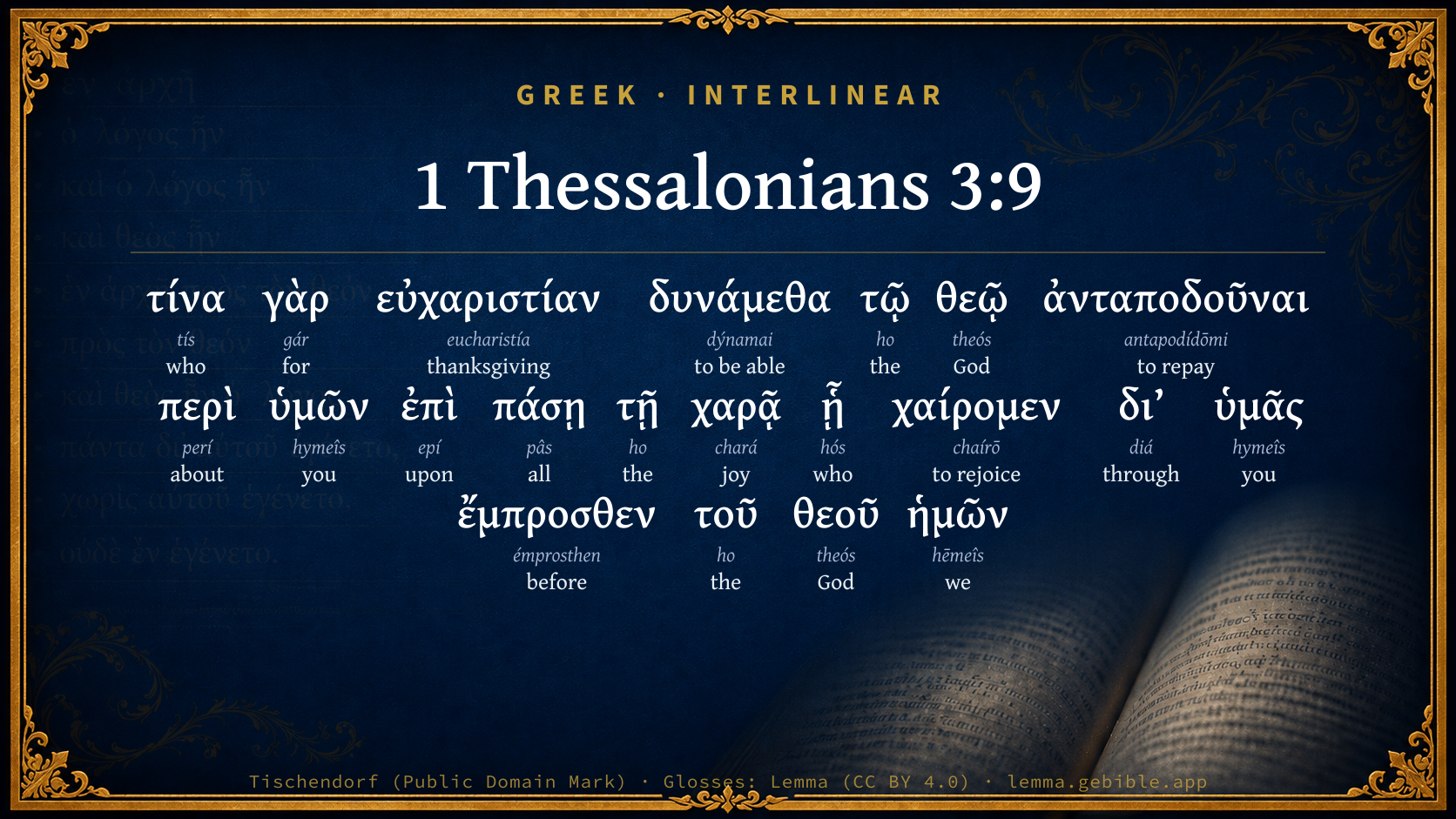
  1. τίνα tís G5101 “who” Interrogative pronoun, Accusative, Singular, Feminine
  2. γὰρ gár G1063 “for” Conjunction
  3. εὐχαριστίαν eucharistía G2169 “thanksgiving” Noun, Accusative, Singular, Feminine
  4. δυνάμεθα dýnamai G1410 “to be able” Verb, Present, Middle or Passive deponent, Indicative, 1st person, Plural
  5. τῷ ho G3588 “the” Article, Dative, Singular, Masculine
  6. θεῷ theós G2316 “God” Noun, Dative, Singular, Masculine
  7. περὶ perí G4012 “about” Preposition
  8. ὑμῶν hymeîs G5210 “you” Personal pronoun, 2nd person, Genitive, Plural
  9. ἐπὶ epí G1909 “upon” Preposition
  10. πάσῃ pâs G3956 “all” Adjective, Dative, Singular, Feminine
  11. τῇ ho G3588 “the” Article, Dative, Singular, Feminine
  12. χαρᾷ chará G5479 “joy” Noun, Dative, Singular, Feminine
  13. ᾗ hós G3739 “who” Relative pronoun, Dative, Singular, Feminine
  14. χαίρομεν chaírō G5463 “to rejoice” Verb, Present, Active, Indicative, 1st person, Plural
  15. δι’ diá G1223 “through” Preposition
  16. ὑμᾶς hymeîs G5210 “you” Personal pronoun, 2nd person, Accusative, Plural
  17. ἔμπροσθεν émprosthen G1715 “before” Preposition
  18. τοῦ ho G3588 “the” Article, Genitive, Singular, Masculine
  19. θεοῦ theós G2316 “God” Noun, Genitive, Singular, Masculine
  20. ἡμῶν hēmeîs G2249 “we” Personal pronoun, 1st person, Genitive, Plural

About this verse

These counts appear in no published source. They are computed here, from the morphology-tagged text and Lemma’s own curated glosses. What Lemma adds →

21
words
17
distinct lemmas
Pauline Epistles
section

Notable vocabulary

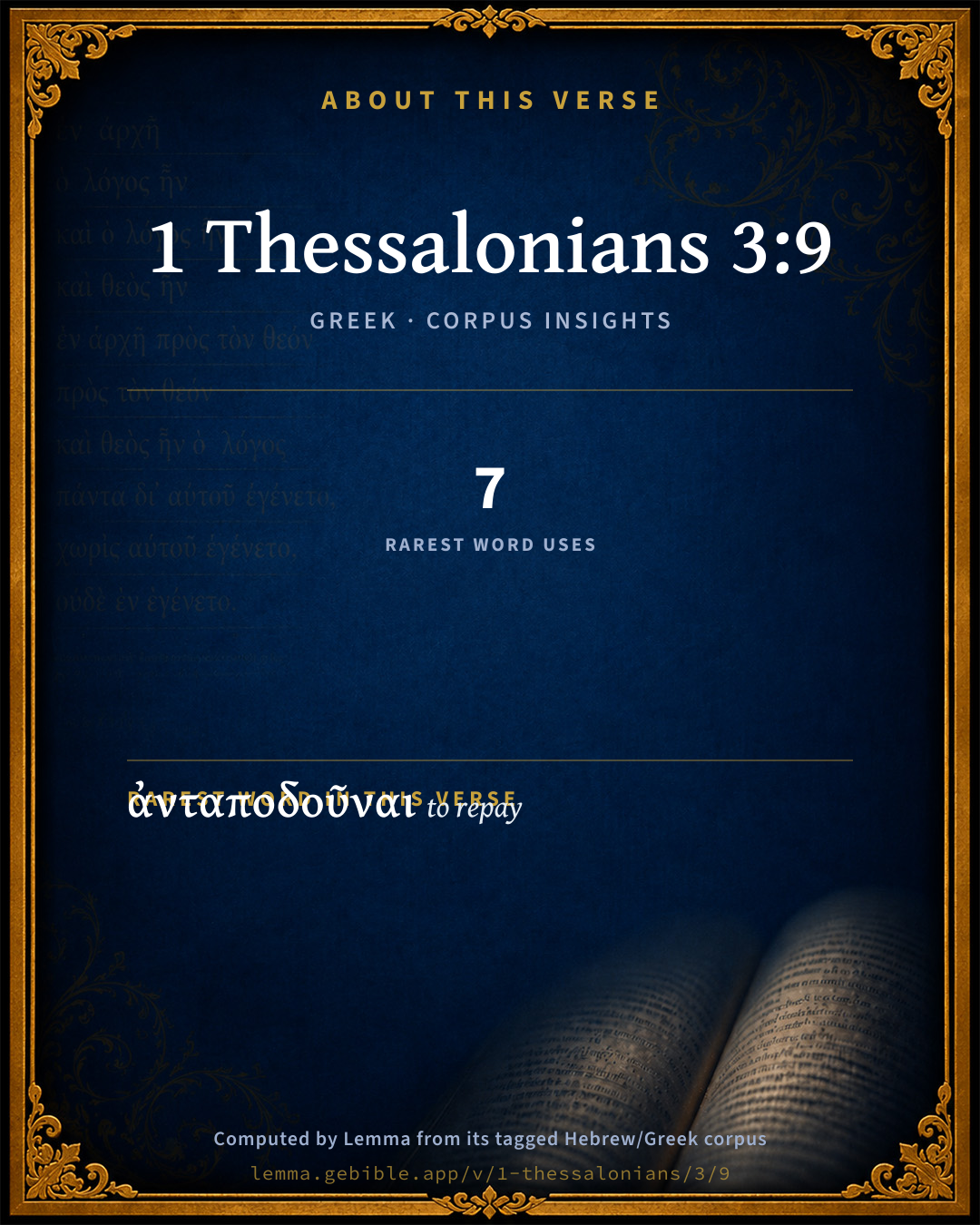
The rarest word here is ἀνταποδοῦναι to repay G467 — appearing just 7 times in the whole Greek New Testament.

Shared distinctive vocabulary

ἀνταποδοῦναι to repay G467 occurs in 6 verses of the Greek New Testament. Also found in:

Repetition

Words recur within this verse:

Cross-references

15

Topical passages linked to 1 Thessalonians 3:9 in the Treasury of Scripture Knowledge — connected by theme and wording, ordered by reader-vote popularity; previews shown in the World English Bible.

  • Psalms 96:12–13 Let the field and all that is in it exult! Then all the trees of the woods shall sing for joy
  • 2 Corinthians 9:15 Now thanks be to God for his unspeakable gift!
  • Psalms 71:14–15 But I will always hope, And will add to all of your praise.
  • 1 Thessalonians 1:2–3 We always give thanks to God for all of you, mentioning you in our prayers,
  • 2 Samuel 7:18–20 Then David the king went in, and sat before Yahweh; and he said, Who am I, Lord Yahweh, and what is my house, that you have brought me thus far?
  • 1 Thessalonians 3:7–8 for this cause, brothers, we were comforted over you in all our distress and affliction through your faith.
  • Deuteronomy 12:2 You shall surely destroy all the places in which the nations that you shall dispossess served their gods, on the high mountains, and on the hills, and under every green tree:
  • Deuteronomy 12:18 but you shall eat them before Yahweh your God in the place which Yahweh your God shall choose, you, and your son, and your daughter, and your man-servant, and your maid-servant, and the Levite who is within your gates: and you shall rejoice before Yahweh your God in all that you put your hand to.
  • Deuteronomy 16:11 and you shall rejoice before Yahweh your God, you, and your son, and your daughter, and your man-servant, and your maid-servant, and the Levite who is within your gates, and the foreigner, and the fatherless, and the widow, who are in the midst of you, in the place which Yahweh your God shall choose, to cause his name to dwell there.
  • 2 Samuel 6:21 David said to Michal, [It was] before Yahweh, who chose me above your father, and above all his house, to appoint me prince over the people of Yahweh, over Israel: therefore will I play before Yahweh.
  • Nehemiah 9:5 Then the Levites, Jeshua, and Kadmiel, Bani, Hashabneiah, Sherebiah, Hodiah, Shebaniah, [and] Pethahiah, said, Stand up and bless Yahweh your God from everlasting to everlasting; and blessed be your glorious name, which is exalted above all blessing and praise.
  • Psalms 98:8–9 Let the rivers clap their hands. Let the mountains sing for joy together.
  • 1 Thessalonians 2:19 For what is our hope, or joy, or crown of rejoicing? Isn't it even you, before our Lord Jesus at his coming?
  • Psalms 68:3 But let the righteous be glad. Let them rejoice before God. Yes, let them rejoice with gladness.
  • 2 Corinthians 2:14 Now thanks be to God, who always leads us in triumph in Christ, and reveals through us the sweet aroma of his knowledge in every place.

Cross-references courtesy of OpenBible.info (CC BY 4.0).

Commentary

Notes on 1 Thessalonians 3:9 from classic Christian and Jewish commentators (each source and its license shown beneath its notes). The classic Christian expositions comment on the surrounding passage and are grouped to its opening verse, so a note may address several verses; the Jewish commentaries on the Tanakh (Rashi and others) are per-verse, so they appear only where the commentator wrote on this verse.

Lemma curates 59 commentaries, every one of them public domain or Creative Commons licensed, each selected and text-cleaned for this edition rather than reprinted as found. About our sources →

Joseph Benson's Commentary

1Th 3:9-13. What thanks can we render to God — That is, what sufficient thanks; for you — On account of your perseverance; for all the joy —

That I have thereby such unfeigned cause of rejoicing; so that the apostle’s joy respecting the Thessalonians, arose first from their conversion, and next, from their steady adherence to the faith and profession of the gospel amidst great temptation and persecution; before, or, in the presence of, our God — As εμπροσθεν του Θεου ημων properly signifies. Joy in the presence of God is not a carnal or worldly but a spiritual joy, such as God approves. Night and day praying exceedingly — That is, with great earnestness and importunity: that God would permit us to see your face — Once more in the flesh; and might perfect that which is lacking in your faith — Thus it appears St. Paul did not suppose that they who are once upon the rock no longer need to be taught by man! Now God himself and our Father, and our Lord Jesus Christ — Here we have a plain instance of prayer being addressed to Christ as well as to the Father, and even in the same words, and at the same time. A similar instance occurs 2Th 2:16-17. And doubtless these petitions are addressed to him because he is God, for unless he be present everywhere, how can he hear the prayers which are everywhere put up to him by his disciples? Direct — Clear, or make straight; our way unto you — Namely, by removing those obstructions which at present remain. This prayer is founded on the supposition that the common events on which the apostle’s prosperous journey to the Thessalonians depended, were under the direction of God. The apostle, it appears, was heard in his prayer; for, as we are told (Act 20:2) that he gave the brethren in Macedonia much exhortation, we have reason to believe he did not pass by the Thessalonians, whom he was so desirous to visit. And the Lord make you to increase and abound — Πλεονασαι και περισσευσα, to abound and overflow; in love — The Lord Jesus seems to be here addressed, because all spiritual blessings which are originally from the Father come to us immediately through and from Christ, to whom belongs the office of bestowing every blessing, whether of nature, of providence, or of grace, upon his followers. The apostle’s example in praying thus fervently and importunately for his converts, well deserves to be imitated by all ministers of the gospel. And toward all men, as we toward you — Chandler’s remark on this passage is worthy of particular attention: “The apostle loved the Thessalonians as a father loves his children, and as a mother the infant at her breast, 1Th 2:7. This his great love to them made him solicitous for their perseverance and salvation, so as to be willing to be persecuted, and to live in continual straits, (1Th 3:7,) and to lose his life, (1Th 2:8,) if it could have contributed to their perseverance in the faith, and to their eternal happiness. Generous apostle! how like the Master he served! Well therefore might he propose his own love to them as a pattern of their love to one another and to all. What an excellent religion is the Christian, which enjoins such a universal benevolence, even toward enemies and persecutors, and which roots out of the mind every tendency to anger, envy, malice, and revenge.” To the end — That by means of your love, which is the root of all piety and virtue; he may establish your hearts unblameable in holiness — May make you steadfast in the experience of all Christian graces, and in the practice of all godliness and righteousness; and this before God, even our Father — Whose eyes are always upon you. These are high expressions when applied to fallen creatures, but what cannot the grace of God in Christ effect? Ye shall be perfect, says the Lord Jesus to his disciples, as, or because, your Father in heaven is perfect. And St. Paul informs us, that apostles, prophets, evangelists, pastors, and teachers, are appointed for the work of the ministry, in order to the perfecting of the saints, till they all come unto the full measure of Christ’s stature, Eph 4:11-13; and accordingly that they made it the great end of their preaching to present every man perfect in Christ Jesus, Col 1:28. At the coming of our Lord Jesus with all his saints — That you may be found such at the day of final judgment.

Joseph Benson's Commentary on the Old and New Testaments (1811–1818) — public domain. Text from a community e-Sword module.

Meyer's Critical & Exegetical Commentary

Heinrich August Wilhelm Meyer

1Th_3:9. Reason of ζῶμεν, 1Th_3:8; γάρ, consequently, is not mera particula transeundi (Koppe, Pelt). In a truly monstrous construction, Hofmann, with a renunciation of all exegetical tact, pulls to pieces the simple and clear structure of the words, taking τίνα γὰρ εὐχαριστίαν δυνάμεθα τῷ Θεῷ ἀνταποδοῦναι περὶ ὑμῶν (1Th_3:9) as a parenthetic clause, the object of which is to give beforehand the reason of δεόμενοι (1Th_3:10), referring ἐπὶ πάσῃ τῇ χαρᾷ, ᾗ χαίρομεν διʼ ὑμᾶς to δεόμενοι as a statement of what he joined to his request; considering δεόμενοι, which is a participle of the imperfect, as an apodosis, which, passing over the parenthesis, is annexed to παρεκλήθημεν (1Th_3:7), and to which διὰ τῆς ὑμῶν πίστεως ὅτι νῦν ζῶμεν (1Th_3:7-8) forms the protasis!

τίνα γὰρ εὐχαριστίαν κ.τ.λ.] for what thanks can we give in return to God on behalf of you for all the joy we feel for your sakes before our God? i.e., What expression of thanks can be sufficiently great to be an equivalent for the fulness and superabundance of our joy? Theophylact: Τοσαύτη, φησίν, ἡ διʼ ὑμᾶς χαρά, ὅτι οὐδὲ εὐχαριστῆσαι τῷ Θεῷ κατʼ ἀξίαν δυνάμεθα ὑπὲρ ὑμων. God has brought about and arranged this joy by His higher guidance; therefore to Him belongs the thanks; therefore is this thanks a return for the proof of His grace (ἀνταποδοῦναι).

πᾶσα ἡ χαρά] cannot denote joy of every kind; accordingly, cannot indicate the multiplicity of objects which the joy for the Thessalonians has (which Schott thinks possible). It means, as the article added requires, the whole joyjoy in its sum total. See Winer, p. 101 [E. T. 137]. A joy in its totality is certainly the greatest conceivable joy; so that it may be said that πᾶσα ἡ χαρά denotes laetitia maxima (Flatt, Pelt, Schott).

ᾗ χαίρομεν] by attraction instead of ἣν χαίρομεν; comp. Mat_2:10.

ἔμπροσθεν τοῦ Θεοῦ ἡμῶν] belongs not to the following (Ewald, Hofmann), but to the preceding; but not to χαρᾷ (Koppe, Pelt, Bloomfield), but to χαίρομεν. The addition serves to bring forward the purity of this joy, to which nothing earthly cleaves. Erroneously Oecumenius and Bloomfield: Paul would think on God as the Author of the joy.

On ἡμῶν, comp. on 1Th_2:2.

Meyer — Critical and Exegetical Commentary on the New Testament — English translation by Peter Christie, edited by Frederick Crombie (T&T Clark, 1880) — public domain. Text from a community e-Sword module.

Jamieson, Fausset & Brown

Robert Jamieson, A. R. Fausset & David Brown

For what thanks--what sufficient thanks?

render . . . again--in return for His goodness (Psa 116:12).

for you--"concerning you."

for all the joy--on account of all the joy. It was "comfort," Th1 3:7, now it is more, namely, joy.

for your sakes--on your account.

before our God--It is a joy which will bear God's searching eye: a joy as in the presence of God, not self-seeking, but disinterested, sincere, and spiritual (compare Th1 2:20; Joh 15:11).

Jamieson, Fausset & Brown — Commentary Critical and Explanatory on the Whole Bible (1871) — public domain (CC PDM 1.0). Text via the HelloAO Bible API.

Adam Clarke's Commentary

Verse 9. What thanks can we render to God] The high satisfaction and uncommon joy which the apostle felt are strongly depicted in the language he uses. How near his heart did the success of his ministry lie! It was not enough for him that he preached so often, laboured so hard, suffered so much; what were all these if souls were not converted? And what were all conversions, if those who embraced the Gospel did not walk steadily in the way to heaven, and persevere?

Adam Clarke's Commentary on the Bible (1810–1826) — public domain. Text from a community e-Sword/MySword module.

John Calvin's Commentaries

9 For what thanksgiving. Not satisfied with a simple affirmation, he intimates how extraordinary is the greatness of his joy, by asking himself what thanks he can render to God; for by speaking thus he declares that he cannot find an expression of gratitude that can come up to the measure of his joy. He says that he rejoices before God, that is, truly and without any pretense.

John Calvin's Commentaries (1540-1563) — public domain. Text from the Calvin Translation Society English edition (1840s-50s) via the Christian Classics Ethereal Library (ccel.org). Calvin's coverage is partial (roughly two-thirds of the Bible); uncommented books and verses are honest gaps, never fabricated. The 19th-century editor's footnotes and remarks are omitted so the notes are faithfully Calvin's own voice.

Ellicott's Commentary for English Readers

(9) For what thanks can we render.—An apology for the enthusiastic expressions used in the three foregoing verses. “I may call it a gospel, a balm for all anxieties, a new life, for what mode of thanksgiving could be deemed extravagant in such a case of joy?”

Before our God.—As in 1Th_1:3, the occasion on which the joy and thankfulness bursts out is “in prayer;” perhaps, in connection with thanksgiving, especially at the great Eucharistic Thanksgiving (1Co_14:16), when he “stood before the Lord in a special manner (Act_13:2; comp. Lev_1:3; Lev_1:11; Lev_3:1, et al).

A Bible Commentary for English Readers, edited by Charles John Ellicott (1878–1897) — public domain. Text from a community e-Sword module.

The Cambridge Bible for Schools and Colleges

gen. ed. J. J. S. Perowne

9. For what thanks can we render to God again for you] “Again” belongs to the verb “render;” and “thanks” is strictly “thanksgiving.” So we may translate, more freely: what due return of thanksgiving can we make to God? The Apostle puts this question in proof of the strong declaration he has made in 1Th_3:8. He says: “The news that Timothy brings from you is new life to me, so much so that I can find no words sufficient to express my gratitude to God for the abounding joy which now fills my heart in thinking of you.”

The same verb, to render due return (one word in Greek), is employed in a very different connection in 2Th_1:6.

for all the joy wherewith we joy for your sakes] More exactly, because of you, or on your account. Observe the emphasis of delight with which the Apostle dwells on “you;” he repeats the pronoun eight times in the last four verses.

before our God] comp. 1Th_3:13, and ch. 1Th_1:3. God was the witness of this exceeding joy, which strove in vain to find expression in fit words of praise.

The condition of alarm and depression which St Paul had previously experienced made this rebound of joy the more vivid. Only those who have suffered much know joy in its full capacity, “as dying, and behold we live! as sorrowing, but ever rejoicing” (2Co_6:9-10).

The Cambridge Bible for Schools and Colleges (gen. ed. J. J. S. Perowne; Cambridge University Press, 1878–1918) — public domain. Text from a community e-Sword module.

John Gill's Exposition

For what thanks can we render to God again or you,.... They had given thanks to God for them before, for their faith, love, and patience; see Th1 1:2 and now having received a further account of them, they looked upon themselves bound to give fresh thanks to God for them, for the increase of their faith and love, and for their perseverance, as they did; see Th2 1:3 since these are gifts of God's grace; but they knew not where to begin, what to render, and when to end: the phrase is much like that in Psa 116:12 "what shall I render unto the Lord", &c.

for all the joy wherewith we joy for your sakes before our God: the joy they had was all joy, perfect and complete in its kind; see Jam 1:2 and it was not for themselves, on their own account, because of any worldly interest or advantage they had therein, but for the sake of these Thessalonians, whose spiritual welfare they rejoiced at: nor was their joy of a carnal nature, but spiritual; it was a joy in the Holy Ghost, and which was hearty and sincere: it was "before God our" God, their covenant God and Father; it was in his sight and presence, who sees and knows all things, all actions, and the principles of them. Though this last clause, "before our God", is in the Syriac version, placed at the beginning of the next verse, according to which, it refers, not to thanks or joy before God, but to prayer before him.

John Gill's Exposition of the Whole Bible (1746–1763) — public domain (CC PDM 1.0). Text via the HelloAO Bible API.

Trapp's Complete Commentary

John Trapp

9 For what thanks can we render to God again for you, for all the joy wherewith we joy for your sakes before our God;

Ver. 9. For what thanks, &c.] q.d. No sufficient thanks. Spiritual joy vents itself by an infinite desire of praising God, whereby it seeks to fill up the distance between God and the good soul. In our thanksgivings let there be modus sine modo, as Bernard hath it. Let us still deliberate what more to do, as David, Psa 116:12.

John Trapp, A Commentary or Exposition upon All the Books of the Old and New Testament (1647–1656) — public domain. Text from a community e-Sword module.

Albert Barnes' Notes on the Bible

For what thanks can we render to God again - That is, what expression of thanksgiving can we render to God that shall be an equivalent for the joy which your holy walk has furnished, or which will suitably express our gratitude for it.

Albert Barnes' Notes on the Bible (1834–1885) — public domain. Text from a community e-Sword/MySword module.

Matthew Poole's English Annotations

This is another effect of the message Timothy brought, it caused in the apostle great thanksgivings to God. First he rejoiced in their faith, and then gives thanks to God for that joy. The matter of his rejoicing was their faith, but the author and upholder of this faith was God; and in giving thanks to God for his joy, he gives thanks also to God for their faith from whence it sprang. The joy that ministers have in their people’s faith should break forth into thanksgivings. And the apostle’s thanks to God was beyond what he could return or express, as appears by the form of his speech:

For what thanks can we render? &c.; as Psa 116:12; What shall I render unto the Lord? said David. And his rejoicing before God implies both the nature of it, it was divine and spiritual, and his respect to God therein, as David danced before the Lord with all his might, 2Sa 6:14; i.e. with a respect to God’s goodness then declared Or the apostle might mean his joy was inward, before God, rather than before men.

Matthew Poole's English Annotations on the Holy Bible (1683–1685) — public domain. Text from a community e-Sword/MySword module.

Whedon's Commentary on the Bible

Daniel D. Whedon

9. Thanks… render—Our apostle now first describes his thanks, his joy, his nightly and daily prayers over the news from Thessalonica; and, then, breaks forth into one of those same prayers in their behalf.

Daniel D. Whedon (gen. ed.), Commentary on the Old and New Testaments (1874–1909) — public domain. Text from a community e-Sword module.

The Pulpit Commentary

For; assigning the reason of the declaration, "now we live." What thanks can we render to God again for you. As their steadfastness in the faith was owing to God"s grace, thanks was to be rendered to God on their behalf. For all the joy; joy in all its fullness. (Jam_1:2, "Count it all joy Wherewith we joy for your sakes before our God. Giving prominence to the purity of their joy. Joy in the spiritual welfare of others.

We rejoice in the temporal prosperity of our friends; much more ought we to rejoice in their spiritual prosperity. "Now we live," says the apostle, "if ye stand fast in the Lord." And similarly the Apostle John says, "I have no greater joy than to hear that my children walk in the truth." We must imitate the angels in heaven, who rejoice at the repentance of a sinner. We must imbibe the spirit of the Lord Jesus himself, who is represented as rejoicing when he had found the sheep that was lost. We should rejoice

(1) because souls are rescued from hell and Satan;

(2) because Christ is glorified in the salvation of men;

(3) because new members are born into the family of God;

(4) because boundless happiness is secured.

Vers. 9, 10.

The apostle"s gratitude to God and his further solicitude for his converts.

I HIS GRATITUDE FOR THE JOY IMPARTED BY TIMOTHY"S TIDINGS. "For what thanks can we render to God again for you, for all the joy wherewith we joy for your sakes before our God?

1. He has no words to express his gratitude to God for their constancy.

2. The joy he experienced was not in the greed of any worldly advantage he had gained, but was the hearty and sincere joy of one profoundly interested in their spiritual welfare.

3. It was joy "before God," who sees and knows all inward thoughts and feelings, and therefore knows its reality and power.

II HIS PRAYERFUL ANXIETY TO SEE THE THESSALONIANS FOR THEIR FURTHER BENEFIT. "Night and day praying exceedingly that we might see your face, and might perfect that which is lacking in your faith." His prayers had an extraordinary fervency. Ministers ought to be much in prayer for their flocks.

1. The deficiencies in their faith. They had already received the grace of faith and the doctrine of faith, and exhibited in its fullness the "work of faith." But there were deficiencies still to be supplied.

(1) Their faith wanted still greater power, for they had hardly yet escaped all danger of relapse into heathen impurities.

(2) It wanted to be more widely diffused through all the duties of life, for they needed to mind honest industry and forswear idleness.

(3) They needed fuller light upon the second advent.

2. The design of the ministry is to supply these deficiencies of faith. The apostle longed to be at Thessalonica once more, not only to impart to them "some spiritual gift, to the end they might be established", (Rom_1:10, Rom_1:11) but to give them fuller teaching upon the various points where their faith needed enlargement. It is God"s work to increase faith, but ministers can promote it as instruments, for they are "for the perfecting of the saints in the knowledge of the Son of God. T.C.

The Pulpit Commentary (1880–1919), ed. H.D.M. Spence-Jones & Joseph S. Exell — public domain. Text from a community e-Sword module.

Kretzmann's Popular Commentary

Paul E. Kretzmann

The apostle prays for their further establishment in faith and love:

v. 9. for what thanks can we render to God again for you, for all the joy wherewith we joy for your sakes before our God,

v. 10. night and day praying exceedingly that we might see your face, and might perfect that which is lacking in your faith?

v. 11. Now God Himself and our Father, and our Lord Jesus Christ, direct our way unto you.

v. 12. And the Lord make you to increase and abound in love one toward another and toward all men, even as we do toward you,

v. 13. to the end he may establish your hearts unblamable in holiness before God, even our father, at the coming of our Lord Jesus Christ with all His saints.

Paul here rises to an enthusiasm bordering on ecstasy. The high satisfaction and peculiar joy which he felt are strongly shown in the language which he uses: What sufficient thanks can I render to God, in return, concerning you for all the joy with which we rejoice on your account before our God, night and day praying most fervently that we may see your face, and might perfect the deficiencies of your faith? The apostle has received definite information of the stability of the Thessalonians in faith. This wonderful condition he attributes entirely to God, whose power has been manifested through the Gospel. He is anxious to make some return of appropriate thanksgiving to the Lord of grace; he is casting about for ways and means which would adequately express the gratitude which is overflowing from his heart. His reason for thanksgiving he has in the joy which is now striving for utterance, in his exultant rejoicing on their account. Without ceasing, night and day, his fervent supplications are rising to the Throne of Grace that God would grant him the boon of seeing his pupils at Thessalonica face to face. For that would give him an opportunity of perfecting any deficiencies which their faith still had, it would give him the chance to rectify certain matters of belief and practice. The Thessalonians were still in need of instruction, of exhortation, of intercession; for no Christians attain to complete perfection in this life. The fundamental outlines of the truth were in their possession, but it was necessary to fill out these outlines, to supply the details, to make them perfectly fitted to every good word and work.

The prayer of the apostle now rises to still greater heights of fervor: But God Himself and our Father and our Lord Jesus Christ direct our way to you; you, however, may the Lord cause to increase and to excel in love toward one another and toward all, just as we stand toward you, in order that He may establish your hearts irreproachable in holiness before God and our Father at the coming (the royal visit) of our Lord Jesus Christ with all His saints. Amen. The first petition of the apostle concerns himself, namely, that God would so arrange it, would so guide and direct matters, that it would be possible for him to visit Thessalonica as soon as possible, Note that his prayer is directed to both God the Father and to the Lord Jesus Christ, these two persons of the Godhead being equal in deity. Mark also that every prayer is heard by God through Jesus Christ, by whom we have access to the Father, in whom the Father gives all His gifts to His children on earth. Should there be any delay in his coming, however, or, no matter what would happen, he has another petition, namely, that the Lord, the Giver of all good gifts, would cause the Thessalonian Christians to become filled with, to increase in, love, and thus to excel, to superabound in love toward one another, in the midst of their own congregation and toward all men. In this respect Paul was their example and model, in the love which he bore them. The result of this work of the Lord would be that the hearts of all the believers in the congregation would be established as being without reproach in holiness. This includes the whole life in and from the Spirit. The purity and the soundness of a Christian’s holiness is based upon the disinterestedness of his love toward his fellow-Christians and toward all men. Thus would the Thessalonian Christians be prepared to stand before God the Father on the great day when our Lord Jesus Christ will pay His promised royal visit to the earth in visible form, accompanied by all His holy angels and the saints from heaven, Heb 12:22-23; Luk 20:26. Mark: The apostle never fails to call attention to the end and aim of the Christian life, the perfection of heaven, the reward of grace to those that remain steadfast in faith and love, in holiness of life, to the end.

Summary

The apostle gives further proof of his love for the Thessalonians in that he had sent Timothy to strengthen them, whose excellent report concerning their firmness had comforted him greatly; he includes a prayer for their further establishment in faith and love unto the end.

Paul E. Kretzmann, Popular Commentary of the Bible (1921–1924) — public domain. Text from a community e-Sword module.

Godbey's Commentary on the New Testament

William B. Godbey

9. Paul’s gratitude to God on the reception of Timothy’s cheering report knows no bounds.

William B. Godbey, Commentary on the New Testament (1896–1900) — public domain. Text from a community e-Sword module.

McGarvey & Pendleton's Commentaries

J. W. McGarvey

For what thanksgiving can we render again unto God for you, for all the joy wherewith we joy for your sakes before our God . [Paul felt that he could not be thankful enough for the joy which the faith of the Thessalonians gave him; not a joy arising from worldly or personal pride in them, but a joy so pure and holy that it could be displayed before the searching eye of God];

J. W. McGarvey (with Philip Y. Pendleton), Commentaries on the New Testament (The Fourfold Gospel, 1914; Acts; and the epistles) — public domain. Text from a community e-Sword/MySword module.

The People's New Testament

B. W. Johnson

9–13. What thanks can we render? How can we be thankful enough?

B. W. Johnson's The People's New Testament with Notes (1889–1891) — public domain. Electronic text from the Christian Classics Ethereal Library (CCEL) ThML edition.

Cambridge Greek Testament for Schools and Colleges

9. τῳ κυριῳ, instead of τῷ θεῳ, א* (also εμπροσθεν του κυριου later) D*G (the Gothic Version has domino deo, by conflation): an aberrant Western reading—perhaps determined by εν κυριῳ at the end of 1Th 3:8.

B reads περι ημων, for περι υμων.

9. τίνα γὰρ εὐχαριστίαν δυνάμεθα τῷ θεῷ ἀνταποδοῦναι περὶ ὑμῶν …; For what due thanksgiving can we render to God for you …? Ἀντί in ἀνταποδοῦναι implies correspondence between the boon and its acknowledgement (cf. 2Th 1:6; Luk 14:14; Col 3:24, &c.); ἀποδοῦναι, to give back, repay, appears in 1Th 3:13, Rom 2:6; Rom 13:7, Luk 20:25, &c. For εὐχαριστία, see note on -τέω, 1Th 1:2. Γάρ, of explanation, naturally introduces this question: the fact that the writers cannot thank God enough for “the joy” given to them by Timothy’s report, shows how greatly they were encouraged by it (1Th 3:7), and how vital to them is the fidelity of this Church (1Th 3:8). This inexpressible thanks is due to God, who upholds the readers under the storm of persecution: see 1Th 2:12, 1Th 5:24; 2Th 3:3; and cf. Joh 10:29; Joh 17:11, &c.

ἐπὶ πάσῃ τῇ χαρᾷ ῇ χαίρομεν διʼ ὑμᾶς ἔμπροσθεν τοῦ θεοῦ ἡμῶν, for all the joy with which we rejoice because of you before our God. For ἐπί in this connexion, see note on 1Th 3:7. Πᾶσα ἡ χαρά is “the sum of joy” collectively: cf. 1Th 3:7; 1Co 13:2; Php 1:3. Ἧ,, perhaps by attraction for the cognate accus. ἥν, as in Mat 2:10; yet χαρᾷ χαίρειν in Joh 3:29 (cf. 1Pe 1:8): Hebraistic feeling favoured such emphatic assonant combinations (see e.g. Isa 35:2; Isa 66:10), but they were idiomatic in Greek poetry. Χαίρειν διά, as in Joh 3:29; Joh 11:15; while the ordinary ἐπί (as with παρακαλοῦμαι, εὐχαριστία above) would give the occasion of χαίρειν, and ἐν the ground (Php 1:18; Php 3:1, &c.), διά introduces the reason of joy, that to which it is referred on reflexion: when the Apostles consider what this news from Thessalonica means and all it implies in their converts (cf. 1Th 1:4), their hearts overflow with gladness before God. For the ἔμπροσθεν clause, cf. 1Th 1:3; since “our God”—the God of the Christian faith and revelation—sent His servants on the errand of the Gospel (1Th 2:2; 1Th 2:4, &c.), “to” Him “thanks” are “rendered back,” and “before” Him “the joy” is testified which its assured success awakens. Ten times, with an emphasis of affection, is the pronoun ὑμεῖς repeated in 1Th 3:6-10.

Cambridge Greek Testament for Schools and Colleges (Cambridge University Press, 1896; 21 vols, various authors incl. Carr, Maclear, Plummer, Farrar, Lumby, Moule, M. R. James, Simcox) — public domain. Text from a community e-Sword module.

Alford’s Greek Testament

Henry Alford

9.] And this vigour of life shews itself in the earnest desire of abundant thanksgiving: so the γάρ accounts for, and specifies the action of, the ζωή just mentioned.

τίνα, what—i.e. what sufficient—?

ἀνταπ.] reff.: thanks is itself a return for God’s favours: see especially ref. Ps.

ἐπί, may be taken as above (ref. y), or as for,—in return for: the two meanings in fact run up into one.

πάσ. τῇ χαρᾷ, all the joy: i.e. not the joy from so many different sources, but the joy in its largeness and depth: q. d. τῇ χαρᾷ τῇ μεγάλῃ.

ᾗ attr. for ἥν,—see Mat 2:10: not as Joh 3:29,—see note there.

ἔμπρ. τ. θεοῦ ἡμ. shews the joy to be of the very highest and best,—no joy of this world, or of personal pride, but one which will bear, and does bear, the searching eye of God, and is His joy (Joh 15:11).

Henry Alford, The Greek Testament (1849–1861) — public domain. Text from a community e-Sword module.

International Critical Commentary

9. τίνα γὰρ εὐχαριστίαν κτλ. The faith of the converts gave Paul and his associates not only life but joy (Chrys.), as γά, parallel to ὅτ and introducing a second and unqualifed confirmation of διὰ τῆς ὑηῶν πίστεω, makes plain. This joy, which is not so much personal as religious, and which therefore finds its constant outlet ἔμπροσθεν τοῦ θεοῦ ἡμῶ (Dob.), is so excessive that Paul is unable to give God that adequate thanks which is his due. Although it is pointed out, over against the insinuations of the Jews, that it is none other than the converts for whom (περὶ ὑμῶ) he renders thanks to God, none other than they who are the basis of his joy (ἐπὶ πάσῃ τῇ χαρᾷ), and none other than they on whose account (διʼ ὑμᾶ; cf. 1:5) he constantly expresses before the Christian God (ὁ θεὸς ἡμῶ; cf. 2:2) his overwhelming feeling of joy, yet it is likewise indicated that it is God after all, not himself, not even the converts, that he must try to thank for their spiritual attainment.

On the co-ordinating γά in interrogative sentences, see Bl 78:6. εὐχαριστί, a favourite word of Paul, denotes for him not “gratitude” (Sir. 37:11, 2 Mac. 2:27) but the “giving of thanks” (Sap. 16:28 where it is parallel to ἐντυγχάνει). ἀνταποδιδόνα, common in Lxx and used by Paul either in a good sense as here and Psa 115:3 (Grot.) or in a bad sense (cf. II 1:6, Rom 12:19, Deu 32:41), is probably stronger than ἀποδιδόνα (5:15), and “expresses the idea of full, complete return” (Mill.). “What sufficient thanks can we repay?” (Lft.). Instead of τῷ θεῷ (ABEKL), אDFG read κυρίῳ, influenced doubtless by ἐν κυρίῳ (v. 8); similarly א reads at the end of v. 9 τοῦ κυρίου ἡμῶ—For περὶ ὑμῶ, B alone has περὶ ἡμῶ, which is “sinnlos” (Weiss).—περι after δυνάμεθα ἀνταποδοῦνα is like that with εὐχαριστεῖ (1:2, II 1:3, 2:13, etc.). ἐπι indicates that joy, full and intense (πάσῃ contrast ἐπὶ πάσῃ τῇ ἀνάγκῃ v. 8), is the basis of the thanksgiving; cf. 2Co 9:15. ᾖ before χαίρομε stands not for ἐφʼ ᾖ (cf. 2Co 7:13), but either for the cognate dative χαρᾷ (Joh 3:29, Isa 66:10 B) or for the congnate accus. ἥ (Mat 2:10, Isa 39:2 אA, 66:10 A, Jon 4:6). διʼ ὑμᾶ (Joh 3:29) is stronger than the expected ἐφʼ ὑμῖ (cf. χαίρειν ἐπι Rom 16:19, 1Co 13:6, 16:17, 2Co 7:13; Isa 39:2, Hab 3:18 and often in Lxx). ἔμπροσθε goes with χαίρομε

International Critical Commentary — older volumes (1896–1929), various authors — public domain. Text from a community e-Sword module.

Lesson kit

Teaching starters — assembled from the data on this page, not authored interpretation. Every prompt links to the verse data it draws on. Edit before teaching.

1 Thessalonians, in the Pauline Epistles, opens this verse with 21 words (17 distinct Greek lemmas). Its most distinctive word is antapodídōmi (“to repay”). A historical commentator’s framing appears above. Read the whole chapter for the surrounding context.

Discussion questions

  1. How does “to repay” (antapodídōmi) shape what this verse is saying?
  2. How does Luke 14:14, which shares the word «to repay», read alongside this verse?
  3. What does the repetition of “God” (2× in this one verse) do in this verse?
  4. These translations render this verse differently; the difference is in the English rendering, not the original. What questions does that raise?
  5. Compare how Joseph Benson's Commentary and Meyer's Critical & Exegetical Commentary read this verse. Where do they agree or differ?

Things to notice

Reading settings

Reading text

Shown beneath each verse's original-language words.

Old Testament
Old Testament edition

Read the OT as the Masoretic Hebrew (MT) or the Greek Septuagint (LXX).

English shown for the Greek Septuagint (in the Hebrew ↔ Greek comparison).

Comparing translations? Open the Compare panel on any verse page to stack up to four side by side.