James 1:21

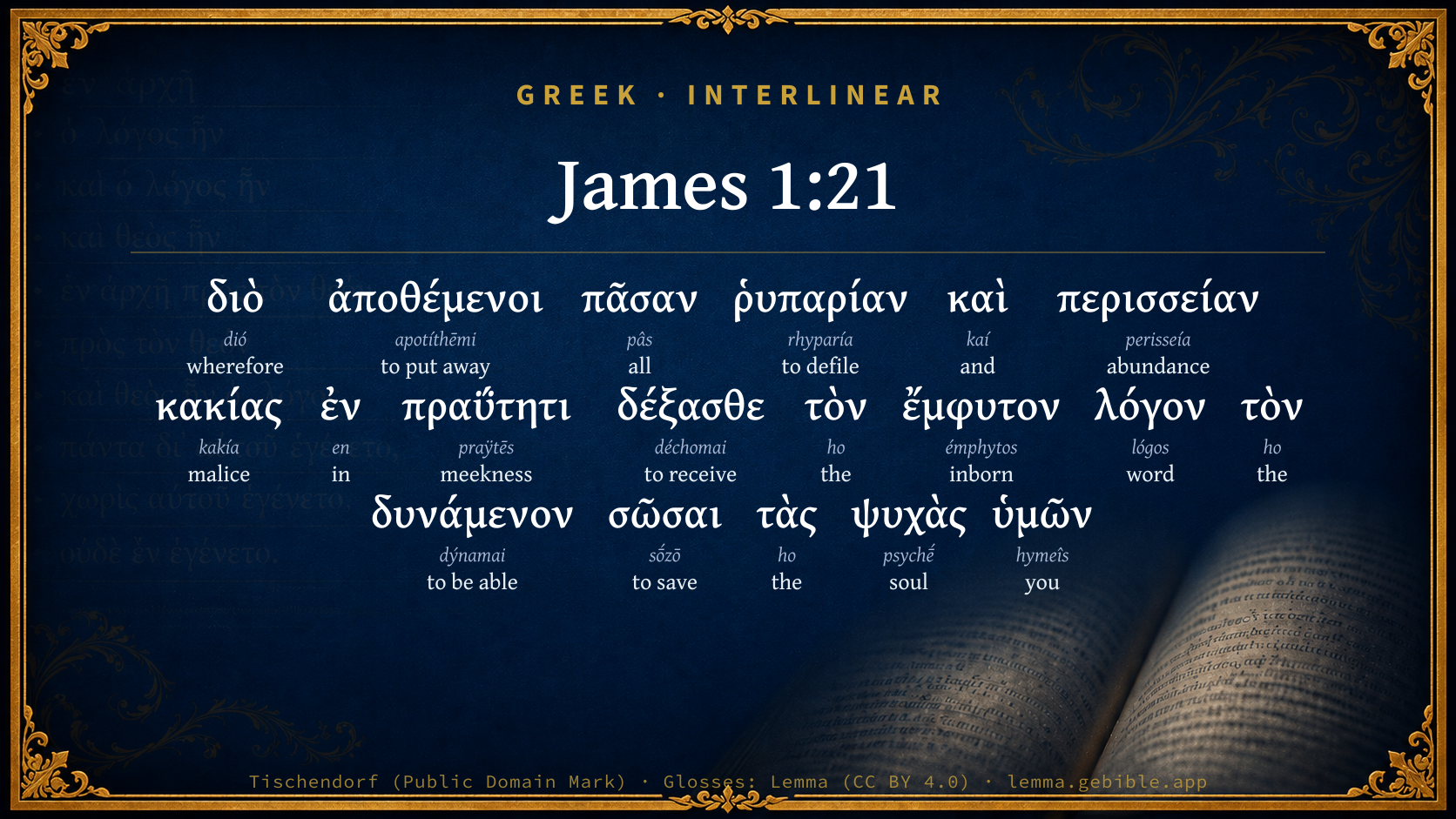
Greek (Tischendorf 8th ed.) James 1:21 appears in the Greek New Testament. The text above is from the Tischendorf 8th edition. Each word links to its Strong’s number and a concise gloss. Click any word for its full Thayer’s Greek Lexicon entry.
Download image
Cite this verse

James 1:21 (World English Bible). Public Domain. Lemma interlinear Bible study tool, https://lemma.gebible.app/v/james/1/21.

Show BibTeX & RIS
BibTeX
RIS
English Translation
Therefore, putting away all filthiness and overflowing of wickedness, receive with humility the implanted word, which is able to save your souls.
World English Bible · Public Domain
Highlights
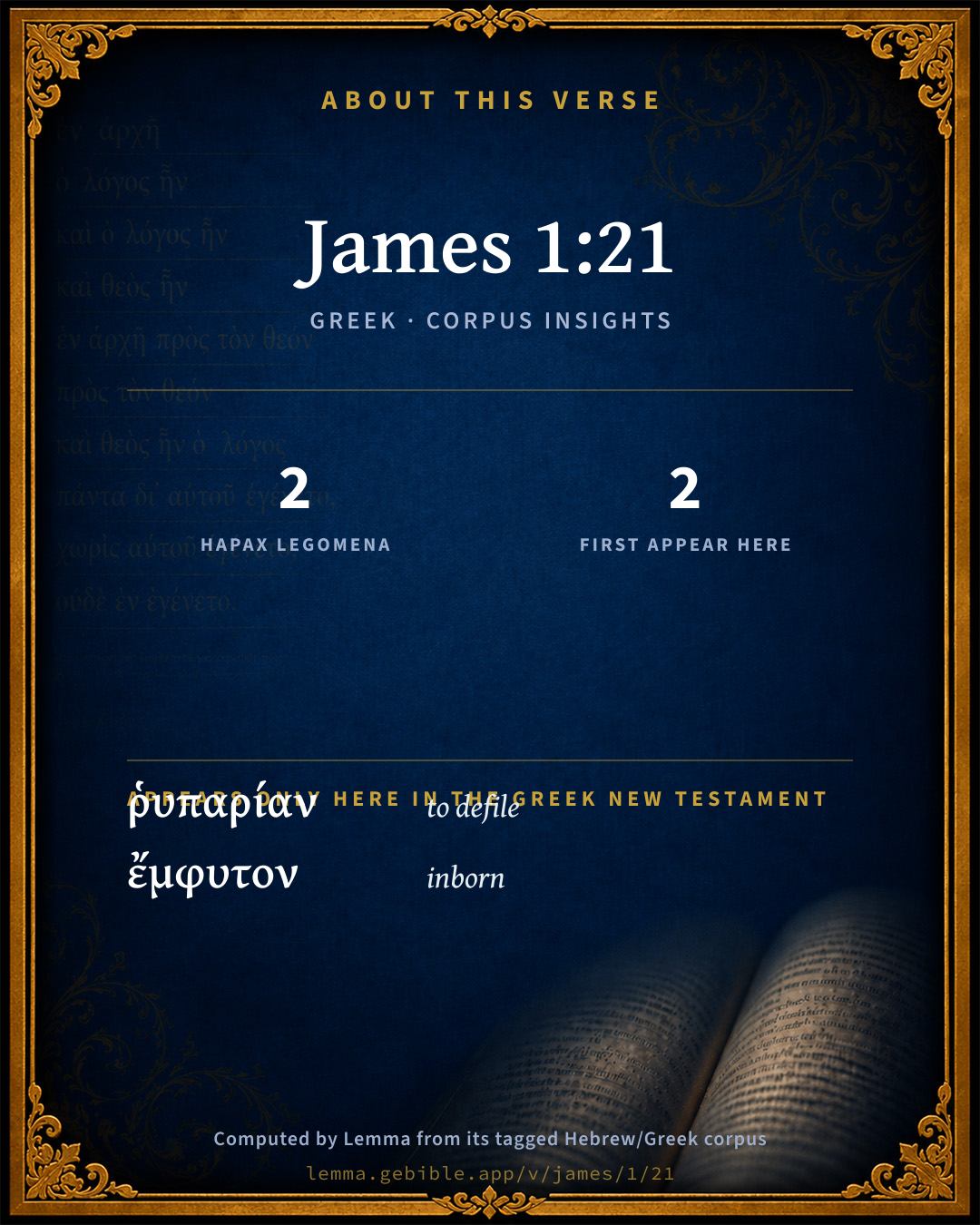
  • 2 hapax legomena — only here in the Greek New Testament
  • 2 first appearances in the Greek New Testament
Full analysis ↓
Download a study sheet

One document with this verse’s original text, its word-by-word gloss line, the meaning frame, cross-references with their text, attributed commentary, and full source and license credits — printable, and it pastes into notes with its structure intact.

This verse Autodidact and up

Study sheet (.html) Plain text (.txt)

A passage Seminary Student

Up to 50 verses in one chapter. A passage sheet keeps up to 6 commentary sources and 12 cross-references per verse, in the order this page ranks them, and says so on the sheet whenever that leaves anything out. Ask for a single verse and you get the Autodidact verse sheet above.

Everything on this page stays free to read, with no account — the sheet is a download of what is already on screen, not access to it.

Want to remove ads? Support Godless Engineer
Compare translations 3

The same verse in 3 English versions, stacked beneath the original-language interlinear above. Click any original word for its lexicon entry.

Each is an independent rendering of the whole verse — the interlinear is not word-aligned to these translations.

Highlighted words mark where these versions differ — a whole-verse word diff, not a word-by-word alignment.

  • World English Bible Public Domain
    Therefore, putting away all filthiness and overflowing of wickedness, receive with humility the implanted word, which is able to save your souls.
  • King James Version Public Domain
    Wherefore lay apart all filthiness and superfluity of naughtiness, and receive with meekness the engrafted word, which is able to save your souls.
  • unfoldingWord Literal Text CC BY-SA 4.0
    Therefore, having laid aside all filth and abundance of wickedness, in humility receive the implanted word, which is able to save your souls.

unfoldingWord Literal Text — © unfoldingWord, licensed CC BY-SA 4.0. Word-aligned USFM3 via Door43 (git.door43.org/unfoldingWord/en_ult).

Versions to compare (up to 4)

3 of 4 selected

Show all 19 translations

Every available English version of this verse, each an independent rendering of the whole verse.

  • World English Bible Public Domain
    Therefore, putting away all filthiness and overflowing of wickedness, receive with humility the implanted word, which is able to save your souls.
  • Berean Standard Bible Public Domain
    Therefore, get rid of all moral filth and every expression of evil, and humbly accept the word planted in you, which can save your souls.
  • Majority Standard Bible Public Domain
    Therefore, get rid of all moral filth and every expression of evil, and humbly accept the word planted in you, which can save your souls.
  • King James Version Public Domain
    Wherefore lay apart all filthiness and superfluity of naughtiness, and receive with meekness the engrafted word, which is able to save your souls.
  • American Standard Version (1901) Public Domain
    Wherefore putting away all filthiness and overflowing of wickedness, receive with meekness the implanted word, which is able to save your souls.
  • Revised Version (1885) Public Domain
    Wherefore putting away all filthiness and overflowing of wickedness, receive with meekness the implanted word, which is able to save your souls.
  • Geneva Bible (1599) Public Domain
    Wherefore lay apart all filthinesse, and superfluitie of maliciousnesse, and receiue with meekenes the word that is graffed in you, which is able to saue your soules.
  • Douay-Rheims (1899) Public Domain
    Wherefore casting away all uncleanness, and abundance of naughtiness, with meekness receive the ingrafted word, which is able to save your souls.
  • Young's Literal Translation Public Domain
    wherefore having put aside all filthiness and superabundance of evil, in meekness be receiving the engrafted word, that is able to save your souls;
  • Literal Standard Version CC BY-SA 4.0
    for this reason, having put aside all filthiness and superabundance of evil, receive the implanted word in meekness, that is able to save your souls;
  • Unlocked Literal Bible CC BY-SA 4.0
    Therefore take off all sinful filth and abundant amounts of evil. In humility receive the implanted word, which is able to save your souls.
  • unfoldingWord Literal Text CC BY-SA 4.0
    Therefore, having laid aside all filth and abundance of wickedness, in humility receive the implanted word, which is able to save your souls.
  • Darby Bible Public Domain
    Wherefore, laying aside all filthiness and abounding of wickedness, accept with meekness the implanted word, which is able to save your souls.
  • World Messianic Bible Public Domain
    Therefore, putting away all filthiness and overflowing of wickedness, receive with humility the implanted word, which is able to save your souls.
  • Webster's Bible Public Domain
    Wherefore lay apart all filthiness and superfluity of naughtiness, and receive with meekness the ingrafted word, which is able to save your souls.
  • Free Bible Version CC BY-SA 4.0
    So get rid of all that's filthy and evil. Humbly accept the word that's been implanted within you—for this is what can save you.
  • Bible in Basic English Public Domain
    For this reason, putting away all dirty behaviour and the overweight of evil, take into your souls without pride the word which, being planted there, is able to give you salvation.
  • Text-Critical English NT CC BY 4.0
    Therefore, putting aside all filthiness and rampant wickedness, humbly receive the implanted word, which is able to save your souls.
  • Tyndale New Testament (1534) Public Domain
    Wherfore laye a parte all fylthynes all superfluite of maliciousnes and receave with meknes the worde that is grafted in you which is able to save youre soules.

Literal Standard Version (2020), Covenant Press — licensed CC BY-SA 4.0. Text via the HelloAO Bible API (eBible.org). Unlocked Literal Bible (unfoldingWord) — licensed CC BY-SA 4.0. Text via the HelloAO Bible API (eBible.org). unfoldingWord Literal Text — © unfoldingWord, licensed CC BY-SA 4.0. Word-aligned USFM3 via Door43 (git.door43.org/unfoldingWord/en_ult). Free Bible Version, Dr. Jonathan Gallagher — licensed CC BY-SA 4.0. Text via the HelloAO Bible API (eBible.org).

Word by word

More ways to search: Search by grammar → Find every occurrence → Compare this word →

Practice this passage: Drill this verse → Learn its vocabulary →

ῥυπαρίαν
rhyparía
G4507
“to defile”
Noun, Accusative, Singular, Feminine
Part of Speech
Noun
Case
Accusative
Number
Singular
Gender
Feminine
Full Thayer's Definition

Origin: from G4508

TDNT: None

1. to make filthy, befoul 2. to defile, dishonour 3. to make filthy
  1. διὸ dió G1352 “wherefore” Conjunction
  2. ἀποθέμενοι apotíthēmi G659 “to put away” Verb, Aorist, Middle, Participle, Nominative, Plural, Masculine
  3. πᾶσαν pâs G3956 “all” Adjective, Accusative, Singular, Feminine
  4. καὶ kaí G2532 “and” Conjunction
  5. περισσείαν perisseía G4050 “abundance” Noun, Accusative, Singular, Feminine
  6. κακίας kakía G2549 “malice” Noun, Genitive, Singular, Feminine
  7. ἐν en G1722 “in” Preposition
  8. πραΰτητι praÿtēs G4240 “meekness” Noun, Dative, Singular, Feminine
  9. δέξασθε déchomai G1209 “to receive” Verb, Aorist, Middle deponent, Imperative, 2nd person, Plural
  10. τὸν ho G3588 “the” Article, Accusative, Singular, Masculine
  11. ἔμφυτον émphytos G1721 “inborn” Adjective, Accusative, Singular, Masculine
  12. λόγον lógos G3056 “word” Noun, Accusative, Singular, Masculine
  13. τὸν ho G3588 “the” Article, Accusative, Singular, Masculine
  14. δυνάμενον dýnamai G1410 “to be able” Verb, Present, Middle or Passive deponent, Participle, Accusative, Singular, Masculine
  15. σῶσαι sṓzō G4982 “to save” Verb, Aorist, Active, Infinitive
  16. τὰς ho G3588 “the” Article, Accusative, Plural, Feminine
  17. ψυχὰς psychḗ G5590 “soul” Noun, Accusative, Plural, Feminine
  18. ὑμῶν hymeîs G5210 “you” Personal pronoun, 2nd person, Genitive, Plural

About this verse

These counts appear in no published source. They are computed here, from the morphology-tagged text and Lemma’s own curated glosses. What Lemma adds →

19
words
17
distinct lemmas
General Epistles
section

Notable vocabulary

2 hapax legomena — words that appear only here in the entire Greek New Testament:

  • ῥυπαρίαν to defile G4507
  • ἔμφυτον inborn G1721

First appearance in Scripture

These words make their first canonical appearance in the Greek New Testament here:

  • ῥυπαρίαν to defile G4507
  • ἔμφυτον inborn G1721

Shared distinctive vocabulary

περισσείαν abundance G4050 occurs in 4 verses of the Greek New Testament. Also found in:

Repetition

A word recurs within this verse:

Cross-references

34

Topical passages linked to James 1:21 in the Treasury of Scripture Knowledge — connected by theme and wording, ordered by reader-vote popularity; previews shown in the World English Bible.

  • Ephesians 4:22 that you put away, as concerning your former way of life, the old man, that grows corrupt after the lusts of deceit;
  • Ephesians 1:13 in whom you also, having heard the word of the truth, the Gospel of your salvation,--in whom, having also believed, you were sealed with the Holy Spirit of promise,
  • 1 Peter 2:11 Beloved, I beg you as foreigners and pilgrims, to abstain from fleshly lusts, which war against the soul;
  • John 6:63 It is the spirit who gives life. The flesh profits nothing. The words that I speak to you are spirit, and are life.
  • Psalms 25:9 He will guide the humble in justice. He will teach the humble his way.
  • Colossians 3:5–8 Put to death therefore your members which are on the earth: sexual immorality, uncleanness, depraved passion, evil desire, and covetousness, which is idolatry;
  • 1 Peter 2:1 Putting away therefore all wickedness, all deceit, hypocrisies, envies, and all evil speaking,
  • Hebrews 12:1 Therefore let us also, seeing we are surrounded by so great a cloud of witnesses, lay aside every weight and the sin which so easily entangles us, and let us run with patience the race that is set before us,
  • James 4:8 Draw near to God, and he will draw near to you. Cleanse your hands, you sinners; and purify your hearts, you double-minded.
  • 2 Timothy 3:15–17 From infancy, you have known the sacred writings which are able to make you wise for salvation through faith, which is in Christ Jesus.
  • Titus 2:11 For the grace of God has appeared, bringing salvation to all men,
  • Isaiah 29:19 The humble also shall increase their joy in Yahweh, and the poor among men shall rejoice in the Holy One of Israel.
  • Romans 6:17 But thanks be to God, that, whereas you were bondservants of sin, you became obedient from the heart to that form of teaching whereunto you were delivered.
  • Hebrews 4:2 For indeed we have had good news preached to us, even as they also did, but the word they heard didn't profit them, because it wasn't mixed with faith by those who heard.
  • John 6:68 Simon Peter answered him, "Lord, to whom would we go? You have the words of eternal life.
  • Romans 1:16 For I am not ashamed of the Gospel of Christ, for it is the power of God for salvation for everyone who believes; for the Jew first, and also for the Greek.
  • 1 Corinthians 15:2 by which also you are saved, if you hold firmly the word which I preached to you--unless you believed in vain.
  • 2 Corinthians 7:1 Having therefore these promises, beloved, let us cleanse ourselves from all defilement of flesh and spirit, perfecting holiness in the fear of God.
  • Hebrews 2:3 how will we escape if we neglect so great a salvation-- which at the first having been spoken through the Lord, was confirmed to us by those who heard;
  • Isaiah 61:1 The Spirit of the Lord Yahweh is on me; because Yahweh has anointed me to preach good news to the humble; he has sent me to bind up the broken-hearted, to proclaim liberty to the captives, and the opening [of the prison] to those who are bound;
  • 1 Thessalonians 2:13 For this cause we also thank God without ceasing, that, when you received from us the word of the message of God, you accepted it not as the word of men, but, as it is in truth, the word of God, which also works in you who believe.
  • Isaiah 2:20 In that day, men shall cast away their idols of silver, And their idols of gold, Which have been made for themselves to worship, To the moles and to the bats;
  • Isaiah 30:22 You shall defile the overlaying of your engraved images of silver, and the plating of your molten images of gold: you shall cast them away as an unclean thing; you shall tell it, Get you hence.
  • Ezekiel 18:31 Cast away from you all your transgressions, in which you have transgressed; and make you a new heart and a new spirit: for why will you die, house of Israel?
  • Matthew 5:5 Blessed are the gentle, For they shall inherit the earth.
  • Acts 13:26 Brothers, children of the stock of Abraham, and those among you who fear God, the word of this salvation is sent out to you.
  • Romans 11:17 But if some of the branches were broken off, and you, being a wild olive, were grafted in among them, and became partaker with them of the root and of the richness of the olive tree;
  • Ezekiel 36:25 I will sprinkle clean water on you, and you shall be clean: from all your filthiness, and from all your idols, will I cleanse you.
  • Zephaniah 2:3 Seek Yahweh, all you humble of the land, who have kept his ordinances. Seek righteousness. Seek humility. It may be that you will be hidden in the day of Yahweh's anger.
  • Acts 10:33 Therefore I sent to you at once, and it was good of you to come. Now therefore we are all here present in the sight of God to hear all things that have been commanded you by God."
  • Ephesians 5:4 nor filthiness, nor foolish talking, nor jesting, which are not appropriate; but rather giving of thanks.
  • 1 Thessalonians 1:5 and that our Gospel came to you not in word only, but also in power, and in the Holy Spirit, and with much assurance. You know what kind of men we showed ourselves to be among you for your sake.
  • 1 Peter 1:9 receiving the result of your faith, the salvation of your souls.
  • Romans 13:12–13 The night is far gone, and the day is near. Let's therefore throw off the works of darkness, and let's put on the armor of light.

Cross-references courtesy of OpenBible.info (CC BY 4.0).

Commentary

Notes on James 1:21 from classic Christian and Jewish commentators (each source and its license shown beneath its notes). The classic Christian expositions comment on the surrounding passage and are grouped to its opening verse, so a note may address several verses; the Jewish commentaries on the Tanakh (Rashi and others) are per-verse, so they appear only where the commentator wrote on this verse.

Lemma curates 59 commentaries, every one of them public domain or Creative Commons licensed, each selected and text-cleaned for this edition rather than reprinted as found. About our sources →

The Biblical Illustrator

Joseph S. Exell

Jam_1:21-22

Lay aside all filthiness … and receive with meekness

Of preaching, hearing, and practising the Word of God

I.

THAT TO LAY APART ALL THE FILTHINESS AND SUPERFLUITY OF NAUGHTINESS HERE MENTIONED IS NECESSARY FOR EVERY ONE WHO

INTENDS TO BE A TRUE CHRISTIAN. Plain as this may seem to be, it is fit to be taken notice of.

1. Because there are some who, though they maintain no such principles in speculation, yet in their practice seem to compromise matters between their vicious inclinations and the Divine laws; and are by no means so holy, so free from all filthiness and superfluity of naughtiness, as the religion of Jesus requires them to be.

2. Because there are others professing Christianity who, even by their doctrines, would reconcile some sorts of impurity with it.

II. THAT THERE IS A PARTICULAR CONNECTION BETWEEN OUR CLEANSING OURSELVES FROM SUCH POLLUTIONS, AND OUR PROFITABLY HEARING, THE WORD OF GOD. It is self-evident that the better disposed the mind is, the more likely it must be to receive and retain the heavenly instructions. As a vessel which is empty, clean, and sound, is best fitted to receive and retain pure water, or any such liquor poured into it. Whereas, on the contrary, the foul exhalations of lust will be apt to exclude the Word.

III. THAT MEEKNESS, OR A FREEDOM FROM PASSION AND PREJUDICE, AND WHATEVER ELSE IS IMPLIED IN THAT WORD, IS MORE ESPECIALLY REQUISITE IN ORDER TO SUCH PROFITABLE HEARING. As new-born babes, desire the sincere milk of the Word that ye may grow thereby, Receive it with the mature understandings of men, but with the unprejudiced wills of children; with the sweetness, innocence, and simplicity of infants.

IV. THAT THE WORD OF GOD HAS A MOST POWERFUL, NAY, A NEVERFAILING EFFICACY TO SAVE OUR SOULS (see 2Ti_2:15).

V. THAT IT IS A VAIN THING TO HEAR IT UNLESS WE PRACTISE IT; AND THAT WE DO BUT DECEIVE OURSELVES IF WE EXPECT ANY BENEFIT FROM THE FORMER WITHOUT THE LATTER. (Joseph Trapp, D. D.)

Reception of the gospel with meekness

I. THE OBJECT. By the ingrafted Word we are to understand the gospel of our Lord Jesus Christ, which began to be engrafted or planted in the hearts of men when our Lord and His apostles entered on the ministry.

II. THE PROPERTY ascribed to it.

III. THE QUALIFICATION, how it must be received.

1. Meekness is such a good disposition of mind as prepares men for the reception of the gospel. It is also such a disposition as may be under the influence of grace, acquired by prudential motives and considerations, such as the notions of Gods infinite power, justice, and truth; the presages of conscience that rewards and punishments must be distributed equally some time or other.

2. And as this good disposition may be acquired by these and the like considerations, for this reason we ought to distinguish it from some things that are thought to bear a resemblance to it.

(1) It ought to be distinguished from nature, which, being defiled by the first transgression, is the greatest obstacle of a ready obedience to Gods commands.

(2) This good disposition of spirit ought to be distinguished from what we call good nature, because this has a regard chiefly to civil conversation betwixt man and man, and discovers itself either by doing or receiving good offices, and that with a desire to please and oblige others.

(3) This good disposition ought to be more especially distinguished from a contemptible, abject spirit, which is a character profane men are wont to affix upon this excellent qualification.

(4) This tractable, meek spirit ought to be distinguished also from that mean, abject spirit that takes shelter in an implicit faith.

3. I proceed to show how necessary this qualification of meekness is to us in the state we are in, and that with reference only to the mysteries of faith. Which way soever the controversy turns, the mysteries of it continue still, and must continue till time shall be no more. In this case whatever assistance we crave from reason, reason rightly informed will tell us, first, that this is not a matter that lies properly within her verge and jurisdiction. (S. Estwick, B. D.)

How we may hear the Word with profit

I. By THE WORD I understand the Word of God; which Word of God may be considered either as it is written in the Scripture, or as it is preached by the ministers of Christ.

II. WE PROFIT by the Word when we get that good and spiritual advantage from it for which it was designed by God. Now, God hath appointed His Word--

1. For learning and instruction.

2. For conversion. The Word turns man unto God--

(1) As it discovers sin (1Co_14:24-25).

(2) As it brings people to the confession of sins (Mat_3:6; Act_19:18).

(3) As it works a kindly mourning and sorrow for sin (Act_2:37; Neh_8:9; Jer_3:21).

(4) As it works amendment and reformation (1Th_1:9; Col_1:5-6).

2. For the building up of those that are called, converted, and sanctified Act_20:32; Act_18:27; 1Ti_4:6).

4. For consolation (1Co_14:31; Act_8:5; Act_8:8). Now the Word comforts--

(1) As it opens Gods attributes, such as His mercy, wisdom, faithfulness, and power:

(2) As it discovers Christ, the promises and privileges of the saints.

(3) As it discovers and reveals the marks and characters of Gods children.

(4) As it answers the doubts and fears of saints.

III. How WE SHALL PROFIT by hearing the Word.

1. Hear it attentively (Mar_4:2-3 : Act_13:16; Rev_2:7).

2. With meekness.

3. With a good and honest heart.

(1) An understanding heart.

(2) A believing heart.

(3) A loving heart.

4. Keep what you hear of it (Luk_8:15; 1Th_5:21; 1Co_15:2).

(1) Repeat it in your families.

(2) Talk of it as you go from hearing.

(3) Pray to the Lord that He would preserve the Word in your heart by His Spirit. (Thos. Senior, B. D.)

Ways of treating the Word

There are two ways of treating the seed. The botanist splits it up, and discourses on its curious characteristics; the simple husbandman eats and sows, sows and eats. Similarly there are two ways of treating the gospel. A critic dissects it, raises a mountain of debate about the structure of the whole, and relation of its parts; and when he is done with his argument, he is done; to him the letter is dead; he neither lives on it himself, nor spreads it for the good of his neighbours; he neither eats nor sows. The disciple of Jesus, hungering for righteousness, takes the seed whole; it is bread for to-days hunger, and seed for to-morrows supply. (W. Arnot, D. D.)

Moral hindrance to the reception of the truth

As filthiness (which is the literal import of the original word--a word which occurs only here in the New Testament) of the outward person is offensive to the senses of one who is of cleanly and delicate taste and habits, so offensive is sin or moral evil to the spiritual sensibilities of the new man; of him who is begotten of God, and whose seed remaineth in him--the seed of the pure Word of God. The exhortation will thus correspond very closely with that of another apostle, which is also connected with the representation of believers as belonging to Gods family (2Co_7:1). Then--retaining the same view of the connection--the word rendered naughtiness will naturally be taken in its largest and most general acceptation as meaning evil--evil, that is, in principle, affection, and conduct. I am inclined, however, without being positive, to understand the connection of the words as more immediate with the preceding two verses; and as referring especially to the outward expression or utterance of that wrath of man which worketh not the righteousness of God. In this way, I would interpret filthiness of the vile abusive language in which that wrath is ever prone to indulge itself; of ribaldry--coarse and foul invective. And this corresponds well with the style of the writer, who dwells afterwards at such lengths on the evils of the tongue. The low abuse of a wrathful and misguided zeal was one description of the filthy communication which Paul, too, commands believers to put off. On the same principle, I take the word rendered here naughtiness, to have the sense of malice or maliciousness, rather than the more general sense of evil. These things they were to lay apart as hindrances to the reception and influence of Gods Word, as at variance with the temper of mind necessary to its right reception and its right operation. Meekness has here the distinctive sense of an humble, calm, childlike docile disposition. It is a state of mind unreservedly open to the instructions and directions of Divine wisdom and Divine authority; conscious of ignorance and of proneness to err. The Word is denominated the engrafted Word, or the implanted Word. The more usual figure is that of seed--seed sown in the heart. Hence it is a shoot--a shoot, as it were, from the tree of life--implanted in the same soil by the agency of Gods Spirit. It becomes the plant of grace in the heart; and, in the life, brings forth fruit unto God. And of that implanted Word it is here added, which is able to save your souls. There are two parts of the souls salvation, for both of which the Word of the truth of the gospel is alike adapted and sufficient. It reveals, in the first place, the ground of the pardon of sin, and of justification before God; and by faith in this ground we are pardoned and justified. That ground consists in the atonement and righteousness of the Divine Saviour--His mediatorial obedience unto death. The Word of the truth of the gospel, when believed, thus saves the soul from guilt and condemnation, and brings it into a state of life and acceptance with God. Then, secondly, it becomes the instrument of renewal and progressive sanctification--an equally important element of the souls salvation. It saves the soul by delivering it from the power and the love of sin. We are saved by the washing of regeneration, and renewing of the Holy Ghost. And this is by means of the Word. It is then, when brought to the possession of the inheritance among them that are sanctified, that the soul is fully and for ever saved. This latter part of the gospel salvation James was anxious to impress, in its indispensable necessity, on the minds of those to whom he wrote--the practical influence of the truth which he here exhorts them to receive, and to receive, in all its lessons, with meekly submissive docility--the vanity of all professions of having so received the truth if its practical efficacy was not apparent. This is an invariable characteristic of Gods Word. The doctrinal and the practical are inseparable. It follows here accordingly: But be ye doers of the Word, and not hearers only, deceiving your own selves. The great general principle, or truth, in this verse is, that all mere hearing of the Word, and all professed faith of it, are self-delusions, where there is not the experience of its inward holy influence manifested in its outward practical effects--that the hearing and the professing are worthless without the doing, as the required and necessary evidence of our being accepted of God in Christ. The doing of the Word is a proof of our being believers of the Word; of our having indeed received it with meekness, and of its being divinely and savingly implanted in our hearts. (R. Wardlaw, D. D.)

The engrafted Word

The engrafted Word

St. James is, by eminence, the apostle of practical Christianity. The keynote of his Epistle is, that the religion of Jesus is less a thing to talk about than a thing to act upon, that Christianity is nothing if it is not a life-controlling, life-moulding power.

I. Observe now THIS WORD IS HERE QUALIFIED. It is called the engrafted Word. It is a metaphor drawn from the vegetable world. The sacred metaphors of Scripture teach by pointing out real correspondences between one department of Gods works and another.

1. This metaphor implies that it is no part of the intellectual outfit of the human mind. The Divine Word came to the human mind from without, as a graft to be inserted.

2. It shows its assimilative power. There must be, in the vegetable world, a family likeness to start with, an organic affinity between the stock and the graft. There is a great deal in common between the Word of Jesus and the existing aspirations and beliefs of the human soul. Beneath every heathen superstition fragments of truth which have close fellowship with the one true faith lie buried.

3. In this metaphor we see its power of laying the nature into which it is inserted under contribution. The engrafted Word does not say to human nature that nothing can be done with it, and that it is fit only for destruction. It makes the most of it; it perfects and consecrates human nature by the gifts of grace.

II. THE MASTER BENEFIT THAT IT CONFERS. Able to save your souls. The apostle does not say it will save them, that it is a talisman which will operate irrespectively of your wills: Lo, you can check, you can refuse it. But it is able to save.

III. WE ARE TO RECEIVE THE WORD OF CHRIST IN A PARTICULAR MORAL TEMPER AND ATTITUDE with meekness. It is not meant to add fuel to your controversies, it is meant to govern your lives.

IV. THE DUTY INCUMBENT UPON EVERY CHRISTIAN PARENT OF TEACHING HIS CHILD THE FAITH OF CHRIST. Beyond a certain age the stock takes a graft only with difficulty. When all else has been parted with in later life, the early lessons of piety will rise before the soul as from the very grave and thrill it with a new and awful power. (Canon Liddon.)

The reception of the Divine Word

1. Lay apart all filthiness and superfluity of naughtiness. The evil to be got rid of is represented as a foul garment or sore encumbrance. It is to be entirely apart. We are to deal thus with all filthiness and superfluity of naughtiness. None of it is to be spared. The least of it is vastly too much, and may not be tolerated. The whole of this Amalek is doomed, and woe to him who acts Sauls part, and makes any exception when carrying on the work of destruction.

2. And receive with meekness the engrafted Word, which is able to save your souls. This is the end to which the other is only the means. We are to receive the Word, that is, admit it into our souls, which we do by believing. Faith accepts it, appropriates it, makes it our own, lodges it within us as a real and abiding possession. This grace has not only a perceptive, but also a receptive power. This is to be done with meekness, gentleness, mildness--with a disposition the opposite of an angry, malicious spirit. No other can be suited to receiving the Word, which, in its very nature, is humbling to our pride, and, being all impregnated with love, cannot dwell where enmity continues to retain its seat. The one must make way for the other. And mark how he describes the Word which is to be thus received. Often is it spoken of under the emblem of seed sown, here it is the kindred one of a shoot planted or engrafted. The Word had already been lodged within the per, sons here directly addressed. They had been begotten by it, and hence, in their case, it was engrafted. It had been inserted into the old and wild stock of nature by the Spirit, and thus had changed the whole character of the tree and its productions. What they were now to do was to receive it more fully. We need ever to be appropriating afresh Divine truth, using it as the aliment of the spiritual life, drawing from it the motives to, and the materials for, holy living. Which is able to save your souls. Your souls, that is your whole persons, which are here designated by their principal part, that in which corruption chiefly dwells, and on which destruction chiefly falls. This is the Words highest excellence, its crowning distinction. It can do what is here ascribed to it, not efficiently, but only instrumentally. It reveals and offers salvation, spreads out the blessings of it, and commends them to our acceptance. (John Adam.)

Before sermon, at sermon, and after sermon

It is a good thing to be under the sound of the Word of God. Even if the very lowest motive should induce persons to come to hear the gospel, it is nevertheless a good thing that they should come. He that comes near to its fire, even with the intent to quench it, may find himself overcome by its heat. Master Hugh Latimer, in his quaint manner, when exhorting people to go to church, tells of a woman who could not sleep for many nights, notwithstanding that drugs had been given to her; but she said that if they would take her to her parish church she could sleep there, for she had often enjoyed a quiet slumber under the sermon; and he goes the length of saying that if people even come to the sermon to sleep, it is better than not to come at all; for, he adds, in his fine old Saxon, they may be caught napping. Yet it will strike you at once that though it be well to come to the hearing of the Word in any case, yet it is better to come in a better way. We should endeavour to gather the most we can from the means of grace, and not pluck at them at random. Let us not lose a grain of the blessing through our own fault. The Word of the Lord is precious in these days; let us not trifle with it.

I. Let us consider the fit and proper preparation for listening to the gospel, or what is to be done BEFORE HEARING. There should be no stumbling into the place of worship half-asleep, no roaming thither as if it were no more than going to a play-house. We cannot expect to profit much if we bring with us a swarm of idle thoughts and a heart crammed with vanity. If we are full of folly, we may shut out the truth of God from our minds. We should make ready to receive what God is so ready to bestow. When I think of our engagements throughout the week, who of us can feel fit to come into the holy place of the tabernacles of the Most High? I mean not into these tabernacles made with hands, but into the inner spiritual temple of communion with God. How shall we come unto God until we are washed? After travelling so miry a road as that which runs through this foul world, can we come unto God without shaking the dust from off our feet? There is a common consent among mankind that there should be some preparedness for worship. In making this preparation our text tells us that there are some things to be laid aside. All filthiness. Now sin of every kind is filthiness. By faith in the precious blood of Jesus it must be washed out, for we cannot come before God with acceptance while iniquity is indulged. Filth, you know, is a debasing thing, meet only for beggars and thieves; and such is sin. Filth is offensive to all cleanly persons. However poor a man is he might be clean; and when he is not, he becomes a common nuisance to those who speak with him, or sit near him. If bodily filthiness is horrible to us, what must the filthiness of sin be to the pure and holy God? Moreover, sin is not only offensive, but it is dangerous. He who harbours filth is making a hot-bed for the germs of disease, and thus he is the enemy of his family and of his neighbourhood. The filthy man is a public poisoner, a suicide, and a murderer. Sin is the greatest conceivable danger to a mans own soul: it makes a man to be dead while he lives, yea, corrupt before he is dead. There are three sins at least that are intended here, and one is covetousness. Hence the desire of unholy gain is called filthy lucre, because it leads men to do dirty deeds which else they would not think of. If the lust of wealth enters into the heart, it rots it to the core. Then, with peculiar correctness, lustfulness may be spoken of as filthiness. How should the thrice holy Spirit come and dwell in that heart which is a den of unclean desires? But in the connection of my text the filthiness meant is especially anger. How can you accept the Word of peace while you are at enmity with your brother? How can you hope to find forgiveness under the hearing of the Word when you forgive not those that have trespassed against you? The wrath of man is so filthy a thing, that it cannot work the righteousness of God; nor is it likely that the righteousness of God will be wrought in the heart that is hot like an oven with passion and malice. But it is added, and superfluity of naughtiness. The phrase here used differs not in meaning from the first epithet of the text: it gives another view of the same thing. You have seen a rose-tree which, perhaps was bearing very few roses, and you half wondered why. It was a good rose; and planted in good soil, but its flowers were scanty. You looked around it, and by and by you perceived that suckers were growing up from its roof. Now, these suckers come from the old, original briar, on which the rose had been grafted, and this rose had a superfluity of strength which it used in these suckers. These superfluities, or overflows, took away from the rose the life which it required, so that it could not produce the full amount of flowers which you expected from it. These superfluities of naughtiness that were coming up here and there were to the injury of the tree. Children of God, you cannot serve the Lord if you are giving your strength to any form of wrong; your naughtinesses are springing from the briar stock of your old nature, and the best thing to do is to cut off those suckers and stop them as much as possible, so that all the strength may return into the rose, and the lovely flowers of grace may abound. Oh, that Gods people, when they come up here on the Sabbath-day, may first have undergone that Divine priming which shall take away the superfluity of naughtiness, for there cannot be grafting without a measure of pruning. The gardener takes off from a certain part of the tree a shoot of the old stock, and then he inserts the graft. There must be a removal of superfluities in order that we may receive with meekness the engrafted Word, which is able to save our souls. Why is this? Why is a man as he comes to hear the gospel to see to this? I take it because all these evil things preoccupy the mind. If we come here with this filthiness about us, how can we expect that the pure and incorruptible Word shall be sweet to us? Moreover, sin prejudices against the gospel. A man says, I do not enjoy the sermon. How can you? What have you been enjoying during the week? What flavour did last night leave in your mouth?

II. Secondly, I will talk a little about DURING HEARING. How shall we act while listening to the Word? Receive with meekness the engrafted Word, which is able to save your souls. The first thing, then, is receive. That word receive is a very instructive gospel word; it is the door through which Gods grace enters to us. We are not saved by working, but by receiving; not by what we give to God, but by what God gives to us, and we receive from Him. The preaching of the Word is as a shower from heaven; but what happens to the soil if the raindrops fall, but none are absorbed into the soil? Of what avail is the shower if none is drunk in by the thirsty furrows? A medicine may have great healing power, but if it is not received, then it does not purge the inward parts of the body. There must be a receiving of any good thing before the goodness of it can be ours. Then it is added, receive with meekness. We stand at the bar to be tried by Gods Word, and searched; but woe unto us if, rejecting every pretence of meekness, we ascend the tribunal, and summon God Himself before us. The spirit of critics ill becomes sinners when they seek mercy of the Lord. His message must be received with teachableness of mind. When you know it is Gods Word, it may upbraid you, but you must receive it with meekness. It may startle you with its denunciations: but receive it with meekness. It may be, there is something about the truth which at the first blush does not commend itself to your understanding; it is perhaps too high, too terrible, too deep; receive it with meekness. What is this which is to be received? Receive with meekness the engrafted Word. We are not bidden to receive with meekness mens words, for they are many, and there is little in them: but receive with meekness Gods Word, for it is one, and there is power in each Word which proceedeth out of His mouth. It is called the engrafted Word. Engrafting implies theft the heart is wounded and opened, and then the living Word is laid in and received with meekness into the bleeding, wounded soul of the man. There is the gash, and there is the space opened thereby. Here comes the graft: the gardener must establish a union between the tree and the graft. This new life, this new branch, is inserted into the old stem, and they are to be livingly joined together. At first they are bound together by the gardener, and clay is placed about the points of junction; but soon they begin to grow into one another, and then only is the grafting effectual. This new cutting grows into the old, and it begins to suck up the life of the old, and change it so that it makes new fruit. That bough, though it be in the grafted tree, is altogether of another sort. Now we want the Word of God to be brought to us after a similar fashion: our heart must be cut and opened, and then the Word must be laid into the gash till the two adhere, and the heart begins to hold to the Word, to believe in it, to hope in it, to love it, to grow to it, to grow into it, and to bear fruit accordingly. Once more you are to receive it by faith, for you are to regard the Word as being able. Believe in the power of Gods Word, receive it as being fully able to save your souls from beginning to end. Two ways it does this: by putting away your sin as you accept the blood and righteousness of Christ, and by changing your nature as you accept the Lord Jesus to be your Master and your Lord, your life and your all.

III. Lastly, let us think of AFTER SERMON. Be ye doers of the Word, and not hearers only, deceiving your own selves. First, the command is positive--Be ye doers of the Word. Sirs, ye have heard about repentance and the putting away of filthiness: repent, then, and let your filthiness be put away. May God the Holy Ghost lead you to do so--not to hear about it, but do it. Ye have heard us preach continually concerning faith in the Lord Jesus Christ, and you know all about believing; but have you believed? We are to admonish you concerning all those blessed duties which spring out of that living faith which works by love; but it is nothing to hear about these virtues unless you possess them. Doing far surpasses hearing. I believe that with a very little knowledge and great doing of what we know, we may attain to a far higher degree of grace than with great knowledge and little doing of what we know. Observe that the command is put negatively: the text says, not hearers only. Those who are hearers only are wasters of the Word. What poor creatures hearers are, for they have long ears and no hands! Ye have heard of him who one day was discoursing eloquently of philosophy to a crowd, who greatly applauded him. He thought he had made many disciples, but suddenly the market-bell rang, and not a single person remained. Gain was to be made, and in their opinion no philosophy could be compared to personal profit. They were hearers till the market-bell rang, and then, as they had been hearers only, they quitted the hearing also. I fear it is so With our preachings: if the devil rings the bell for sin, for pleasure, for worldly amusement, or evil gain, our admirers quit us right speedily. The voice of the world drowns the voice of the Word. Those who are only hearers, are hearers but for a time. Remember, if any man will be lost, he will most surely be lost who heard the gospel and refused it. Over the cell of such a man write, He knew his duty, but he did it not; and that cell will be found to be built in the very centre of Gehenna; it is the innermost prison of hell. Wilful rejection of Christ ensures woful rejection from Christ. The text closes with this solemn word: Deceiving your own selves. Whereupon says Bishop Brownrig, To deceive is bad, to deceive yourselves is worse, to deceive yourselves about your souls is worst of all. (C. H. Spurgeon.)

The engrafted Word

I. THE GIFT TO BE BESTOWED.

1. The nature of the gift. The application of truths to the soul in practical activity. The will of God as imparted by revelation. The guidance of God.

2. The benefit of the gift. Able to save the soul. Preservation from sorrow, ruin, death.

II. THE METHOD BY WHICH IT IS TO BE IMPARTED.

1. NO meritorious deserving.

2. No heavy price.

III. THE WAY WHICH IT IS TO BE RECEIVED.

1. With thoroughness.

2. With meekness.

3. With docility.

IV. THE EFFECT IT WILL PRODUCE.

1. Transform the entire nature.

2. Enlighten the life.

3. Bestow salvation. (Homilist.)

The engrafted Word

Various images are given to us to set forth the manifold value of the Word of truth. It is compared to gold and silver Psa_119:72). By St. James in this passage it is called the engrafted Word, or the implanted Word (R.V.). It is as the graft put into the tree, which, when it takes and grows, changes its whole character and produce. So, when Gods truth enters the soul, it becomes as the germ and origin of a new and holy life. Or, the expression used by St. James may lead us to another view. It is like seed planted in the earth, as in the parable of the Luk_8:11). And, as seed, the Word has a mighty power and operation. We are told that in Mexico you come upon vast masses of masonry, once forming part of their heathen temples, but now utterly overthrown and broken up. But how has this been accomplished? It is by seeds carried by birds of the air, and lodged in the crevices, and these, by and by, have grown and grown until they have split into fragments walls and buildings which once seemed likely to abide for centuries. Thus, too, is there a power in the Word of God to cast down the strongholds of sin, superstition, error, and idolatry, and, whether in countries or in human hearts, utterly to destroy that which dishonours the Lord. We are reminded by St. James in this passage that this Word is able to save your souls.

1. It is Gods instrument for convincing men of the evil of their doings. It shows to them the peril of living in unpardoned sin. It leads them to seek the way of life, and, like the multitude on the day of Pentecost, to ask, What must we do?

2. The Word is able to save the soul, because it ever points to Him who is able to save, even to the uttermost.

3. The Word is able to save because it points out the path of true holiness, without which no man shall see the Lord. It gives us the holy law of God in all its breadth and fulness. It calls us to the loftiest standard of self-denial and consecration to Gods service. But to learn these lessons and obtain these benefits, the Word of God must be received into the heart. It may fall upon the ear, or be read by the eye, and yet fail to impart any true blessing. Hence we need to look for the aid of Gods Holy Spirit. Pray much that you may rightly understand what is revealed, and, above all, that you may love the truth and follow it. If you would receive the Word aright, there must be hearty renunciation of all past evil. Cast aside old habits of sloth, self-indulgence, worldliness, evil speaking, and all else that belongs to sin and the flesh. I know full well you cannot do this in your own strength. St. James adds another particular as to the reception of the Word. It must be received with meekness and humility. All pride, prejudice, and self-wisdom must be cast to the winds. You must come to the Word to learn what God would teach you, and you must come in the spirit of a little child. Perhaps we can find no better example of the spirit in which we should hear or read than that of Mary, sitting at the feet of Jesus and hearing His Word (Luk_10:39). Yeas there ever a better student in Divine knowledge? (G. Everard, M. A.)

The Bible and human souls

I. THE BIBLE.

1. It is the Word. Pure. Loving. Faithful. Conquering.

2. It is the engrafted Word. An incorruptible seed.

3. It is the Word to save from spiritual ignorance, prejudice, thraldom, selfishness, sensuality, guilt, &c.

II. THE HUMAN SOUL.

1. Its amazing capability.

2. Its moral obligations. Receive the Word in a humble, reverent, docile spirit. (Homilist.)

Receiving the Word

1. Before we come to the Word, there must be preparation. Many come to hear, but they do not consider the weight and importance of the duty. Christ saith (Luk_8:18).

(1) By way of caution.

(a) Do not exclude God out of your preparations. Usually men mistake in this matter, and hope by their own care to work themselves into a fitness of spirit.

(b) Though you cannot get your hearts into such a frame as you do desire, trust God, and that help which is absent to sense and feeling may be present to faith.

(2) By way of direction. I cannot go out into all the severals of preparations, how the heart must be purged, faith exercised, repentance renewed, wants and weaknesses reviewed, Gods glory considered, the nature, grounds, and ends of the ordinances weighed in our thoughts. Only, in the general, so much preparation there must be as will make the heart reverent. God will be served with a joy mixed with trembling (Gen_28:17). And again, such preparation as will settle the bent of the spirit heavenward. It is said somewhere, They set themselves to seek the Lord Psa_57:7).

2. Christian preparation consists most in laying aside and dispossessing evil frames. Weeds must be rooted out before the ground is fit to receive the Jer_4:3). There is an unsuitableness between a filthy spirit and the pure holy Word.

3. Put it off, as a rotten and filthy garment. Sin must be left with an utter detestation (Isa_30:22).

4. We must not lay aside sin in part only, but all sin (1Pe_2:1; Psa_119:104). The least sins may undo you.

5. Sin is filthiness; it sullies the glory and beauty of the soul, defaces the image of God (2Co_7:1; Job_14:4; Job_15:14).

6. From that superfluity of wickedness. That there is abundance of wickedness to be purged out of the heart of man. All the imaginations of the heart are evil, only evil, and that continually; it runneth out into every thought, into every desire, into every purpose. As there is saltness in every drop of the sea, and bitterness in every branch of wormwood, so sin in everything that is framed within the soul. Whatever an unclean person touched, though it were holy flesh, it was unclean; so all our actions are poisoned with it.

7. Our duty in hearing the Word is to receive it. In receiving there is an act of the understanding, in apprehending the truth and musing upon it Luk_9:44). And there is an act of faith, the crediting and believing faculty is stirred up to entertain it (Heb_4:2). And there is an act of the will and affections to embrace and lodge it in the soul, which is called a receiving the truth in love, when we make room for it, that carnal affections and prejudices may not vomit and throw it up again.

8. The Word must be received with all meekness. First, this excludes--

(1) A wrathful fierceness, by which men rise in a rage against the Word Jer_6:10).

(2) A proud stubbornness, when men are resolved to hold their own Jer_2:25).

(3) A contentions wrangling, which is found in men of an unsober wit, that scorn to captivate the pride of reason, and therefore stick to every shift Psa_25:8-9).

Secondly, it includes--

(1) Humility and brokenness of spirit. There must be insection before insition, meek ness before ingrafting.

(2) Teachableness and tractableness of spirit (Jam_3:17). The servants of God come with a mind to obey; they do but wait for the discovery of their duty (Act_10:33). Disputing against the Word, it is a judging yourselves; it is as if, in effect, you should say, I care not for God, nor all the tenders of grace and glory that He maketh to me.

9. The Word must not only be apprehended by us, but planted in us. It is Gods promise (Jer_31:33).

10. The Word in Gods hand is an instrument to save our souls.

11. That the main care of Christian should be to save his soul. This is propounded as an argument why we should hear the Word; it will save your souls. Usually our greatest care is to gratify the body. (T. Manton.)

The gospel

I. ITS CHARACTER

1. The distinctness of its existence. It is a graft taken from the tree of eternal thought. Christ brought it to the earth, and grafted it upon human souls.

2. The affinity of its nature.

3. The appropriateness of its force. The gospel, when it enters the human soul, lays under contribution all its reasoning, creative, and susceptible powers.

II. ITS CAPABILITY. AS the buds of a fruitful tree engrafted on some barren plant make the worthless valuable, the unfertile fruitful, so the gospel saves all the souls faculties, turns them all to a right use.

III. ITS RECEPTION.

1. Not with--

(1) Thoughtlessness.

(2) Servility.

2. With the meekness of--

(1) Docility.

(2) Devotion. (Homilist.)

The ingrafted Word

The man who supposes that all that is necessary is that he run over a passage of Scripture before leaving his bed-chamber, and another at family prayer, and give respectful attention to his clergyman in church, is greatly mistaken. He must work out in life what he reads and hears, as the sap of a tree works out fruit on the stem which is grafted thereon. It is the failure to do this which has so greatly retarded our religious life. Men have heard the Word with their outward ears, and have gone out of the church thinking that the sermon was done, whereas it had not begun in their practice, not even in their hearts. No; the moment I have learned anything from the Word, I must make a strenuous effort to reproduce it in my life. Then the next thing learned, then the rest; and so on, until my life be an incarnation of the Bible. If each hearer did this, how powerful our holy faith would be among men! Compared with this, what is success in controversy, although I could silence every theological opponent? What Biblical learning, although I could repeat every verse of the Bible in every tongue ever spoken among men? Neither of these would save me; but the truth, animated into fruitage by my spiritual vitality, would make me a tree worth a place in Gods orchard. (C. Deems, D. D.)

Preparation of heart

That the Word of God may have full power over us, there must be a preparation of heart for its reception. We must cease to do evil before we can learn to do well. We must lay aside everything which is offensive to the purity of God. By the term filthiness James seems to wish to arouse a sense of the loathsomeness of all sin. He does not simply mean that we shall lay aside those particular sins which are disgusting to us; but rather to impress us theft all sin has in it that which makes it disgusting to God. He may here be supposed to be thinking of sins of the flesh, the visible violations of the moral law. Then we are to lay aside all superfluity of naughtiness. The word occurs in Rom_5:15 and 2Co_8:2; it indicates that which goes out to others. Here it means the outflowing of malice. By the one phrase James may be supposed to refer to sins of the flesh, and by the other sins of the spirit. While indulging ourselves either in sins which others cannot see, or sins which show themselves in displays of evil temper, we cannot profit by the Word of God. Meekness, as well as purity, is essential to the proper hearing of the Word of God. One cannot in private approach the study of the Word in the pride of opinion or of scholarship, nor can one resort to the Word for the purpose of sustaining ones own dogma, and while in that spirit find the Word profitable. You know that this is sometimes done. A man may take down the Bible to find proof passages, just as a lawyer may search the Reports of the Supreme Court to find only that which will sustain his theory of the case which he is to try. In such search he throws aside whatever does not make for his side. He is not learning laws, he is hunting helps. If the Bible be so studied, it will be unprofitable. We must approach it with the docility of little children (Mat_18:23). We must simply wish to learn what is the mind of the Spirit in the Word of God. (C. Deems, D. D.)

The engrafted Word

It is only in the apprehension of what we really are that the Word begins to be engrafted. We may have correct theories about the exceeding sinfulness of sin and the mischief that it works; but it is when we see ourselves in the mirror, and discern what sin has done for us, that Gods view of sin begins to be ours, and we shrink from it and long to be saved from it, as if it really were what the Word represents it as being--a terrible and fatal disease, a very plague-spot in the soul. You shall see two persons going out of the same church, after having listened to the same sermon. They are both, we will say, sinners, and unforgiven sinners; but the one is full of admiration of all that he has heard. What a magnificent sermon! I never heard anything more scathing than his denunciation of sin. How he did show it up! I really think he is the most impressive preacher I ever listened to. And the other slips away in silence like one ashamed; his whole life rises up in witness against him. The preachers voice has seemed to thunder in his ear, Thou art the man! His self-complacency is rent to shreds; he feels, like the publican, as though ha could not so much as lift up his eyes unto heaven. He retreats into the solitude of his own chamber, and casts himself upon his knees with a cry of anguish, God, be merciful to me, a sinner! What is it that makes the two to differ? In the one case the Word has been heard, and only heard; and in the other case it has been implanted. In both cases the mirror has been presented; but in the one ease the man has been content with a glance, and then straightway has forgotten what manner of man he was; while the other has looked boldly and resolutely into the glass, until his inmost conscience has been roused and his very heart appalled by what he has seen there. The image still haunts him; he cannot escape from it. His self-esteem is levelled in the dust; he has seen his natural face in the glass, and he has really discovered what manner of man he is. (W. M. H. Aitken, M. A.)

The Biblical Illustrator, edited by Joseph S. Exell (c. 1880s–1900s) — public domain. Text from a community e-Sword module.

Joseph Benson's Commentary

Jas 1:21. Wherefore — Because wrath is such a hinderance to true religion, and you are regenerated; lay apart — As you would a dirty garment; all filthiness — Every kind of sin which is of a defiling nature. The word ρυπαρια, here used, signifies filthiness adhering to the body. When, as here, applied to the mind, it denotes those lusts and appetites, and other sins which defile the soul, particularly those which are gratified by gluttony, drunkenness, and uncleanness; vices to which many Jews, pretending to be teachers, were addicted; and superfluity of naughtiness — Κακιας, maliciousness, or wickedness of any sort; for however specious and necessary it may appear to worldly wisdom, it is vile, hateful, contemptible, and really superfluous: every reasonable end may be effectually answered without any kind or degree of it. Lay this, every known sin, aside by the grace of God, or all your hearing is vain; and receive — Into your ears, your heart, your life; with meekness — Constant evenness and serenity of mind, or with an humble, submissive frame of spirit; the ingrafted word — The word of the gospel, ingrafted in penitent, believing souls by regeneration, (Jas 1:18,) and by habit, (Heb 5:14,) through the influence of God’s Spirit attending the ministry of your teachers, 1Co 3:5-6. Which is able to save your souls — As a means appointed by God for that end, and when received by faith, Heb 4:2.

Joseph Benson's Commentary on the Old and New Testaments (1811–1818) — public domain. Text from a community e-Sword module.

Tyndale Open Study Notes

Tyndale Open Resources

1:21 get rid of: Literally put off, like filthy clothing; cp. Eph 4:22; 1 Pet 2:1. • the word God has planted . . . has the power to save your souls: James emphasizes that Christians are called to respond to a word that God himself has put within our very beings (in fulfillment of Jer 31:31-34). • The soul refers to the whole person (so also in Jas 5:20; see Gen 2:7; 1 Pet 3:20).

Tyndale Open Study Notes — © Tyndale Open Resources, licensed CC BY-SA 4.0. Text via the HelloAO Bible API.

Bengel's Gnomon

Johann Albrecht Bengel

Jas 1:21. Ἀποθέμενοι πᾶσαν ῥυπαρίαν, laying aside all filthiness) A metaphor from a garment; ch. Jas 2:2. Ῥυπαρία, defilement, which is cleansed away by hearing the word: Joh 15:3.—τερισσείαν κακίας) abundance, excess, which is usually faulty, especially in speaking (Mat 5:37). [In thoughts, words, gestures, and works, excess is not without fault.—V. g.] Κακία does not mean malice or craftiness; but badness or vice (faultiness), as opposed to virtue; and the genitive κακίας has here the force of an epithet [faulty excess; not as Engl. Vers.]—ἐν πραΰτητι, with meekness) This is opposed to wrath, and is shown in all things. Comp. 1Pe 2:1-2. Anger and sudden impetuosity of mind is a hindrance to hearing: therefore meekness is required.—δέξασθε, receive) with your mind, with your ears, and in action. [Act the part of ready hearers.—V. g.]—τὸν ἔμφυτον, engrafted) by regeneration, Jas 1:18, and by habit [which you have acquired from your earliest years.—V. g.], Heb 5:14; and also by custom derived from their ancestors, who were Israelites [namely, the people of GOD.—V. g.], Jas 1:1. Comp. 2Ti 1:5. It is engrafted, and therefore most intimately connected with the faithful, and nigh unto them; Rom 10:8: therefore it is to be received with meekness.—λόγον, the word) the Gospel: 1Pe 1:23, etc.—τὸν δυνάμενον, which is able) with great efficacy.—σῶσαι, to save) The hope of salvation nourishes meekness; and this in turn supports that.

Bengel's Gnomon of the New Testament — English translation (T&T Clark, Edinburgh, 1860) — public domain. Text from a community e-Sword module.

Meyer's Critical & Exegetical Commentary

Heinrich August Wilhelm Meyer

Jam_1:21. James infers (διό) from the thought in Jam_1:20 the exhortation ἐν πραΰτητι δέξασθε τὸν ἔμφυτον λόγον, with evident reference to ἀπεκύησεν ἡμᾶς λόγῳ ἀληθείας (Jam_1:18). He places before this exhortation the participial clause: ἀποθέμενοι … κακίας] laying aside all filthiness and abundance of wickedness, i.e. all filthy and abundantly prevalent wickedness. The word ῥυπαρία (ἅπ. λεγ. in the N. T.) is here figurative (synonymous with ἀκαθαρσία in Rom_6:19 and other places), as ῥυπαρός and ῥυπαρεύω, Rev_22:11 (ῥυπαρός occurs in its literal sense in chap. Jam_2:2 : ῥύπος in 1Pe_3:21). Several interpreters (Calvin, Rosenmüller, Baumgarten, Hornejus, Bouman, Lange, and others) take it here as standing alone, equivalent to moral uncleanness (see 2Co_7:1 : πᾶς μολυσμὸς σαρκὸς καὶ πνεύματος), either generally every immoral disposition, or specifically as avaritia (Storr), or scortatio (Laurentius), or vitia intemperantiae, gulae et lasciviae (Heisen), or filth in a religious theocratical sense (Lange); but it is better to join ῥυπαρίαν with κακίας (Theile, de Wette, Wiesinger, and others), so that the ethical judgment of the author on the κακία is thereby expressed (comp. Act_15:20; Rev_17:4), equivalent to πᾶσαν κακίαν ῥυπαράν, or less exactly ῥυπαίνουσαν τὸν ἄνθρωπον (Schol. on Matt.); only the idea is more strongly brought forward by the substantive than by the adjective. The word περισσεία, united to ῥυπαρίαν by the copulative καί (not as Schneckenburger thinks exegetical; in the cited passages, Joh_1:16 and 1Co_3:5, the position of καί is entirely different), foreign to classical Greek, has in the N. T. the signification abundance, properly: abundance flowing over the measure, which Lange incorrectly renders outflow, communication of life; see Rom_5:17; 2Co_8:2; 2Co_10:15. Nevertheless the word has been here taken in a meaning corresponding to ῥυπαρία, and has been explained as = περίσσωμα excrementum (Beza, Piscator, Erasmus, Schmid, and others), or also growth (Lösner, Pott, Hottinger, Kern, Schneckenburger, de Wette). But both meanings are arbitrary. The defenders of the second explanation indeed appeal to the passage in Philo, de vict. off. p. 854 B: περιτέμνεσθε … τὰς περιττὰς φύσεις (fortasse ἐμφύσεις, de Wette) τοῦ ἡγεμονικοῦ; but from this passage it does not follow that περισσεία can be explained de ramis in vite vel arbore abundantibus falceque resecandis (Lösner). It is equally unjustifiable when Küttner, Michaelis, Augusti, Gebser, Bouman, and others explain περισσεία κακίας as κακία surviving from earlier times, and thus take περισσεία as synonymous with περίσσευμα (Mar_8:8). Against all these arbitrary views Theile, Wiesinger, Brückner correctly retain the word in the same sense which it has elsewhere in the N. T., so that περισσεία κακίας is the abundance of κακία, i.e. the abundantly existing κακία; only ἐν ὑμῖν is hardly to be supplied as if James had only his readers specially in view (Theile: quod lectoribus peculiare erat).

Κακία is not here synonymous with πονηρία (1Co_5:8) = vitiositas (Semler, Theile, and others), but, according to the context, in contrast with ἐν πραΰτητι, as in Eph_4:31, Col_3:8, Tit_3:3, 1Pe_2:1, a more special idea, namely, the hostile disposition toward our neighbour which we call malignity (Cremer: malevolence, as social faultiness). Wiesinger inaccurately takes it as equivalent to ὀργή, as that is only one of the proofs of κακία; incorrectly Rosenmüller = morositas.[94] On ἀποθέμενοι, comp. Eph_4:25; 1Pe_2:1; Heb_12:1.[95] The participle precedes as a subordinate thought to δέξασθε, because in consequence of mans sinful nature room can only be made for the good by the rejection of the bad. Also, where similar sentences are co-ordinate, the exhortation to ἀποτίθεσθαι precedes; comp. Rom_13:12, Eph_4:22-23, and also the exhortation of Christ: μετανοεῖτα καὶ πιστεύετε, Mar_1:15.

In the positive exhortation: ἐν πραΰτητι δέξασθε τὸν ἔμφυτον λόγον] ἐν πραΰτητι emphatically precedes, in contrast to the κακία from which flows ὀργή. πραΰτης (= πραότης) denotes a loving, gentle disposition toward our neighbour; comp. 1Co_4:21, 2Ti_2:25, Tit_3:2, and other passages; the opposite is ὀριλότης (Papes Gr. Wörterb.); incorrectly Calvin: hoc verbo significat modestiam et facilitatem mentis ad discendum compositae. ἐν πραΰτητι does not therefore mean docili animo (Grotius, Rosenmüller, Hottinger), nor with a modest disposition, which recognises the good deeds of Christianity (Gebser). Also ἐν πρ. δέξασθε is not a pregnant construction, as if the sense were: monet … illo λόγῳ duce πραΰτητα exerceant (Schneckenburger); but James exhorts to the reception of the word ἐν πραΰτητι, in contrast to those who hear the word in order to use it as a weapon of hatred (condemning others).

Δέξασθε (opp. to λαλῆσαι, Jam_1:19) corresponds to ἀκοῦσαι, but expresses more than that, namely: the inner reception, the taking hold of it with the heart; comp. 1Th_1:6. The object belonging to it: τὸν λόγον ἔμφυτον, can only be the same as what was called the λόγος ἀληθείας in Jam_1:18 (Wiesinger); it is neither the reason innate in man (Oecumenius: τὸν διακριτικὸν τοῦ βελτίονος καὶ τοῦ χείρονος· καθʼ ὃ καὶ λογικοὶ ἐσμὲν καὶ λεγόμεθα; see Constit. Apost. viii. 12: νόμον δέδωκας ἔμφυτον), nor the so-called inner light of the mystics, nor the gospel in its subjective form of life (Lange). The verb δέχεσθαι is opposed to these explanations. James designates the gospel a λόγον ἔμφυτον, inasmuch as it was no longer strange to the hearts of his readers as Christians; also because it was not merely transmitted (Hottinger: ἔμφυτος = traditus), but implanted.[96] The verb δέξασθε does not conflict with this, as the word by which the new birth is effected among Christians is to them ever proclaimed anew, and must by them be ever received anew, in order that the new life may be preserved and increased in them. It is therefore not necessary, against the use of language, to change the idea: verbum quod implantatum or insertum est, into: verbum quod implantatur or inseritur, or to assume here a prolepsis, as is undoubtedly the case in 1Co_1:8, Php_3:21 (see Meyer in loco), and 1Th_3:13 (Lünemann in loco), and with Calvin to explain it: ita suscipite ut vere inseratur (similarly Semler, de Wette,[97] and others). The mode in which the adjective is united with the substantive is opposed to a prolepsis, which would be only imaginable were it said: ΤῸΝ ΛΌΓΟΝ ἜΜΦΥΤΟΝ ΤΑῖς ΚΑΡΔΊΑΙς ὙΜῶΝ, or something similar.

For the strengthening of the exhortation expressed, James annexes to ΤῸΝ ἜΜΦΥΤΟΝ ΛΌΓΟΝ the clause ΤῸΝ ΔΥΝΆΜΕΝΟΝ ΣῶΣΑΙ ΤᾺς ΨΥΧᾺς ὙΜῶΝ, by which, on the one hand, the value of the ΛΌΓΟς is prominently brought forward, and, on the other hand, is indicated what result ought to arise from the hearing of the word. By the verb ΔΥΝΆΜΕΝΟΝ not the freedom of the human will (Serrarius: quod potest salvare, ut arbitrii libertas indicetur), but the power of the word is emphasized; it is, as Paul says, δύναμις Θεοῦ εἰς σωτηρίαν πάντι τῷ πιστεύσντι (Rom_1:16). But if it has this power, man must receive it, and that in a right manner, so that it may prove its efficacy in him and save his soul. It is to be observed that James says this of his readers, whom he had previously designated as born again (Jam_1:18). Thus, according to James, Christians by the new birth do not as yet possess ΣΩΤΗΡΊΑ (the future salvation), but its obtainment is conditioned by their conduct.

Instead of ΤᾺς ΨΥΧᾺς ὙΜῶΝ, James might simply have written ὙΜᾶς, but Schneckenburger correctly warns: cave pro mera sumas circumscriptione personalis; animi enim proprie res agitur; see chap. Jam_5:20.

[94] Meyers translation: malice (Rom_1:29), malicious disposition (Col_3:8), would also not be entirely suitable, but too special. How Luther has understood the idea cannot be determined from his translation wickedness (Boshcit); since he thus constantly renders κακία, it may be taken in a general or in a special sense; the word badness (Schlechtigkeit) does not occur with him.

[95] To the assertion of Lange, that ἀποθέμενοι is not to be rendered putting off, because the reference is not figuratively to the putting off of filthy garments, but removing; the passages Rom_13:12 (ἀποθώμεθα … ἐνδυσώμεθα) and Eph_4:22; Eph_4:24, and the etymology of the word are opposed.

[96] Lange incorrectly explains the ἐν ὑμῖν to be supplied to ἔμφυτον in and among you, referring it to the Jewish Christians and the Jews.

[97] De Wette expresses himself doubtfully: Either the adjective is used proleptically, or, which I prefer, it is the word implanted by the second birth; but by this also, on account of δέξασθε, a prolepsis occurs, receive the word of truth, that it may grow in you by that new birth. But opposed to this, it is to be observed that the word is not implanted by the second birth, but that the second birth is the fruit of the implanted word. In conclusion de Wette remarks: It must be taken rather as a reference to the whole of Christendom than to individuals: the word implanted in us Christians. But the individual is only a member of the church by having the word of God implanted in him. Brückner has given the correct explanation.

Meyer — Critical and Exegetical Commentary on the New Testament — English translation by Peter Christie, edited by Frederick Crombie (T&T Clark, 1880) — public domain. Text from a community e-Sword module.

Expositor's Greek Testament

ed. W. Robertson Nicoll

Jas 1:21-25 form a self-contained section. By putting away all impurity the “implanted word” can influence the heart; but it is necessary not only to hear the word but also to act in accordance with it.

Jas 1:21 . ἀποθέμενοι : used in Heb 12:1 of putting off every weight preparatory to “running the race that is set before us”; the metaphor is taken from the divesting oneself of clothes. ῥυπαρία : not elsewhere in the N.T. or Septuagint; the Syriac has טנפולא which is the same word used in Eze 44:6 for the Hebrew תוִעבה “abomination,” meaning that which is abhorrent to God; usually it has reference to idolatrous practices, but it occurs a number of times in the later literature in reference to unchastity, this more especially in Proverbs. The adjective is used in Zec 3:4 of garments, and cf. Rev 22:11 , where the meaning is “filthy”. The word before us, therefore, probably means “filthiness” in the sense of lustful impurity. περισσείαν κακίας : not merely “excess” in the sense of the A.V. “superfluity” and the R.V. “overflowing,” because κακία in the smallest measure is already excess. The phrase seems to mean simply “manifold wickedness”; this has to be got out of the way first before the “implanted word” can be received. ἐν πραΰτητι : this must refer to the meekness which is the natural result of true repentance. Cf. Mat 4:17 , Repent ye, for the Kingdom of Heaven is at hand . τὸν ἔμφυτον λόγον : ἔμφυτος occurs only here in the N.T.; in Wis 12:10 we have, οὐκ ἀγνοῶν ὅτι πονηρὰ ἡ γένεσις αὐτῶν καὶ ἔμφυτος ἡ κακία αὐτῶν . Mayor holds that the expression must be understood as “the rooted word,” i.e. , a word whose property it is to root itself like a seed in the heart, cf. Mat 13:21 , οὐκ ἔχει δὲ ῥίζαν ἐν ἑαυτῷ ; and Mat 15:13 , πᾶσα φυτεία ἣν οὐκ ἐφύτευσεν ὁ πατήρ μου ὁ οὐράνιος ἐκριζωθήσεται ; and cf. 4 Esdr. 9:31, “Ecce enim semino in vobis legem meam, et faciet in vobis fructum et glorificabimini in eo per saeculum”. The meaning “rooted word” agrees admirably with the rest of the verse, and seems to give the best sense, see further below. τὸν δυνάμενον σῶσαι τὰς ψυχὰς ὑμῶν : Cf. 1Pe 1:9 ., τὸ τέλος τῆς πίστεως σωτηρίαν ψυχῶν . The words before us leave the impression that those to whom they were addressed could not yet be called Christians; πᾶσαν ῥυπαρίαν καὶ περισσείαν κακίας , which they are enjoined to put off, implies a state far removed from even a moderate Christian ideal; and the “rooted word,” which is able to save their souls, has evidently not been received yet. On the subject of the “rooted word” being able to save souls, see further under Jas 1:22 .

The Expositor's Greek Testament, edited by W. Robertson Nicoll (1897–1910) — public domain. Text from a community e-Sword module.

Geneva Bible (1599)

Geneva Bible translators

By meekness, he meaneth modesty, and whatsoever is contrary to an haughty and proud stomach.

Geneva Bible (1599) marginal notes — public domain. Text via Bolls.life.

Jamieson, Fausset & Brown

Robert Jamieson, A. R. Fausset & David Brown

lay apart--"once for all" (so the Greek): as a filthy garment. Compare Joshua's filthy garments, Zac 3:3, Zac 3:5; Rev 7:14. "Filthiness" is cleansed away by hearing the word (Joh 15:3).

superfluity of naughtiness--excess (for instance, the intemperate spirit implied in "wrath," Jam 1:19-20), which arises from malice (our natural, evil disposition towards one another). Pe1 2:1 has the very same words in the Greek. So "malice" is the translation, Eph 4:31; Col 3:8. "Faulty excess" [BENGEL] is not strong enough. Superfluous excess in speaking is also reprobated as "coming of evil" (the Greek is akin to the word for "naughtiness" here) in the Sermon on the Mount (Mat 5:37), with which James' Epistle is so connected.

with meekness--in mildness towards one another [ALFORD], the opposite to "wrath" (Jam 1:20): answering to "as new-born babes" (Pe1 2:2). Meekness, I think, includes also a childlike, docile, humble, as well as an uncontentious, spirit (Psa 25:9; Psa 45:4; Isa 66:2; Mat 5:5; Mat 11:28-30; Mat 18:3-4; contrast Rom 2:8). On "receive," applied to ground receiving seed, compare Mar 4:20. Contrast Act 17:11; Th1 1:6 with Th2 2:10.

engrafted word--the Gospel word, whose proper attribute is to be engrafted by the Holy Spirit, so as to be livingly incorporated with the believer, as the fruitful shoot is with the wild natural stock on which it is engrafted. The law came to man only from without, and admonished him of his duty. The Gospel is engrafted inwardly, and so fulfils the ultimate design of the law (Deu 6:6; Deu 11:18; Psa 119:11). ALFORD translates, "The implanted word," referring to the parable of the sower (Mat. 13:1-23). I prefer English Version.

able to save--a strong incentive to correct our dulness in hearing the word: that word which we hear so carelessly, is able (instrumentally) to save us [CALVIN].

souls--your true selves, for the "body" is now liable to sickness and death: but the soul being now saved, both soul and body at last shall be so (Jam 5:15, Jam 5:20).

Jamieson, Fausset & Brown — Commentary Critical and Explanatory on the Whole Bible (1871) — public domain (CC PDM 1.0). Text via the HelloAO Bible API.

Adam Clarke's Commentary

Verse 21. All filthiness] πασαν ροπαριαν. This word signifies any impurity that cleaves to the body; but applied to the mind, it implies all impure and unholy affections, such as those spoken of Jas 1:15, which pollute the soul; in this sense it is used by the best Greek writers.

Superfluity of naughtiness] περισσειαν κακιας. The overflowing of wickedness. Perhaps there is an allusion here to the part cut off in circumcision, which was the emblem of impure desire; and to lessen that propensity, God, in his mercy, enacted this rite. Put all these evil dispositions aside, for they blind the soul, and render it incapable of receiving any good, even from that ingrafted word of God which otherwise would have saved their souls.

The ingrafted word] That doctrine which has already been planted among you, which has brought forth fruit in all them that have meekly and humbly received it, and is as powerful to save your souls as the souls of those who have already believed. I think this to be the meaning of εμφυτον λογον, the ingrafted word or doctrine. The seed of life had been sown in the land; many of them had received it to their salvation; others had partially credited it, but not so as to produce in them any saving effects. Besides, they appear to have taken up with other doctrines, from which they had got no salvation; he therefore exhorts them to receive the doctrine of Christ, which would be the means of saving them unto eternal life. And when those who were Jews, and who had been originally planted by God as altogether a right vine, received the faith of the Gospel, it is represented as being ingrafted on that right stock, the pure knowledge of the true God and his holy moral law. This indeed was a good stock on which to implant Christianity. This appears to be what the apostle means by the ingrafted word, which is able to save the soul.

Adam Clarke's Commentary on the Bible (1810–1826) — public domain. Text from a community e-Sword/MySword module.

John Calvin's Commentaries

21 Wherefore lay apart. He concludes by saying how the word of life is to be received. And first, indeed, he intimates that it cannot be rightly received except it be implanted, or strike roots in us. For the expression, to receive the implanted word, ought to be thus explained, “to receive it, that it may be really implanted.” For he alludes to seed often sown on and ground, and not received into the moist bosom of the earth; or to plants, which being cast on the ground, or laid on dead wood, soon wither. He then requires that it should be a living implanting, by which the word becomes as it were united with our heart.

He at the same time shews the way and manner of this reception, even with meekness. By this word he means humility and the readiness of a mind disposed to learn, such as Isaiah describes when he says,

“On whom does my Spirit rest, except on the humble and meek?” (Isaiah 57:15.)

Hence it is, that so far profit in the school of God, because hardly one in a hundred renounces the stubbornness of his own spirit, and gently submits to God; but almost all are conceited and refractory. But if we desire to be the living plantation of God, we must subdue our proud hearts and be humble, and labor to become like lambs, so as to suffer ourselves to be ruled and guided by our Shepherd.

But as men are never thus tamed, so as to have a calm and meek heart, except they are purged from depraved affections, so he bids us to lay aside uncleanness and redundancy of wickedness. And as James borrowed a comparison from agriculture, it was necessary for him to observe this order, to begin by rooting up noxious weeds. And since he addressed all, we may hence conclude that these are the innate evils of our nature, and that they cleave to us all; yea, since he addresses the faithful, he shews that we are never wholly cleansed from them in this life, but that they are continually sprouting up, and therefore he requires that care should be constantly taken to eradicate them. As the word of God is especially a holy thing; to be fitted to receive it, we must put off the filthy things by which we have been polluted.

Under the word κακία, he comprehends hypocrisy and obstinacy as well as unlawful desires or lusts. Not satisfied with specifying the seat of wickedness as being in the soul of man, he teaches us that so abounding is the wickedness that dwells there, that it overflows, or that it rises up as it were into a heap; and doubtless, whosoever will well examine himself will find that there is within him an immense chaos of evils.

Which is able to save. It is a high eulogy on heavenly truth, that we obtain through it a sure salvation; and this is added, that we may learn to seek and love and magnify the word as a treasure that is incomparable. It is then a sharp goad to chastise our idleness, when he says that the word which we are wont to hear so negligently, is the means of our salvation, though for this purpose the power of saving is not ascribed to the word, as if salvation is conveyed by the external sound of the word, or as if the office of saving is taken away from God and transferred elsewhere; for James speaks of the word which by faith penetrates into the hearts of men, and only intimates that God, the author of salvation, conveys it by his Gospel.

John Calvin's Commentaries (1540-1563) — public domain. Text from the Calvin Translation Society English edition (1840s-50s) via the Christian Classics Ethereal Library (ccel.org). Calvin's coverage is partial (roughly two-thirds of the Bible); uncommented books and verses are honest gaps, never fabricated. The 19th-century editor's footnotes and remarks are omitted so the notes are faithfully Calvin's own voice.

Ellicott's Commentary for English Readers

(21) Wherefore lay apart all filthiness and superfluity of naughtiness.—So Peter (1Pe_3:21) speaks of “the filth of the flesh.” But the defilement here referred to seems general and not special, common, that is, to the whole natural man. The superabundance—the overgrowth—of evil will occupy the heart, if care be not taken to root it out; and, like the thorns in the parable of the sower (Mat_13:7, et seq.), spring up and choke the good seed. All such a rank and poisonous crop must be gathered and laid aside, in caps may be, for some fiery trouble to consume, that out of the dead luxuriant weeds a richer soil for virtue may be made.

Naughtiness (ne-aughtiness, or nothingness) was used in 1611, instead of the older and more correct translation, malice or maliciousness. The badness implied in the original is much more positive than that which appears from our present version.

Receive with meekness the engrafted word.—Or, in mildness accept ye this word of truth (see Jas_1:18, above), engrafted, like a good olive tree, or rather implanted, in you. The term is peculiar to this place, and means “innate” in its first intention. If taken so, “the innate Word” will be Christ Himself formed within us. (Comp. Gal_4:19.)

Able to save your souls.—In like manner Paul at Miletus commends the elders of Ephesus “to God, and to the Word of His grace, which is able to build you up, and to give you an inheritance among all them which are sanctified” (Act_20:32). Observe, the idea of salvation thus conveyed by the implanted word, is so potentially and not actually. Tended and cultured, it will grow into a tree of life, the fruit whereof may heal the wounds of sin; but the after-growth of this plant of God is largely in the hands of man.

We can hardly help making a brief inquiry in this place on the meaning of “soul.” There are few words more vaguely used by devout persons, or which present greater difficulties to the learned, or open wider fields of speculation for the thoughtful. In common language we speak of “body and soul,” meaning much the same as “body and spirit;” but theologians write more carefully of “body, soul, and spirit” (comp. 1Th_5:23); and psychologists distinguish between the animal branch of their subject and the rational or intellectual (ψυχή νοῦς). The second of these methods of division is known as the trilogy, and is of most importance to the Christian reader. By it is understood (1) the body, wholly and entirely material, of and belonging to this world; (2) the mind or reason, corporal also—that is, arising from the body, and depending in its exquisite balance upon it; (3) the true soul or spirit, the breath as it were of God, immaterial and immortal. Our bodily nature, of course, is shared with the lower creation, and the spiritual with the higher, while the intellectual is peculiar to mankind. If it be hard to draw a line between vegetable and animal, harder still is it to separate instinct from reason, the difference being of degree rather than kind. But if the one side of the mental soul—namely, the rational, be near akin to what is termed instinctive in the brute, the other, the intellectual, however it may, as it does, soar upward, yet approaches not to the angels, for the difference here is of kind and not degree. Now, strange to say, the Apostle treats not of the spirit but the natural soul. Other texts in plenty assure us that God is able to save the one; from this we may learn salvation is for both, such being the work of “the engrafted Word.” Reason and intellect consecrated to divine service have an eternity before them, one of activity and not repose. The highest conception of God to the Greek mind was the Aristotelian idea of intellectual self-sufficiency and contemplation; the Oriental strives, as for ages it has striven, for extinction and nothingness; but to the Christian is given the sure and certain hope of the glorified body, the enlightened soul, the perfected spirit—three in one, and one in three—working the will and praise of its Maker and Redeemer for ever.

A Bible Commentary for English Readers, edited by Charles John Ellicott (1878–1897) — public domain. Text from a community e-Sword module.

The Cambridge Bible for Schools and Colleges

gen. ed. J. J. S. Perowne

21. lay apart all filthiness …] The cognate adjective is found in its literal sense in ch. Jas_2:2, and figuratively in Rev_22:11. A kindred noun appears in a like combination in “the putting away of the fifth of the flesh” of 1Pe_3:21 and in the LXX. of Pro_30:12. The word points not specifically to what we call “sins of impurity,” but to every form of sin, including the “wrath” of the preceding verse, as defiling the soul.

superfluity of naughtiness] Better, excess of malice, i. e. excess characterised by malice. The English “naughtiness,” though used in the 16th century, as by Latimer and Shakespeare, as equivalent to “sin” or “wickedness,” has gradually lost its sharpness, and has come to be applied almost exclusively to the faults of children. The Greek word, though, like the Latin word from which malice comes, originally generic in its meaning, had come to be associated mainly (as in Eph_4:31; Col_3:8; 1Pe_2:1) with the sins that have their root in wrath and anger, rather than with those that originate in love of pleasure, and so carries on the sequence of thought.

receive with meekness the engrafted word] The order of the words in the original is more emphatic, but in meekness (as contrasted with wrath and malice) receive ye. The “engrafted word” is that which was before referred to as the instrument by which the new and better life was engendered. The English “engrafted” suggests one process of growth somewhat too definitely, and implanted would be a better rendering. The word is not found elsewhere in the New Testament (the Greek word in Rom_11:17 is more specific), but, like so many of St James’s phrases, appears in the sapiential books of the Apocrypha (Wis_12:10, “their malice was bred in them”). We note the agreement of his teaching with that of the Parable of the Sower, where the Seed is the “Word,” and the conditions of its fertility are found in “the honest and good heart” (Mat_13:23), free from prejudice and bitterness. Moral discipline, the putting away of that which defiles, is the right preparation for the highest spiritual life.

which is able to save your souls] The words express at once the power, and the limits of the power. There was in the implanted word, taken in its widest sense, the promise and the potency of salvation, yet it did not work as by compulsion or by a charm, but required the co-operation of man’s will. So, later on, St James speaks of God Himself as being “able to save” (chap. Jas_4:12).

The Cambridge Bible for Schools and Colleges (gen. ed. J. J. S. Perowne; Cambridge University Press, 1878–1918) — public domain. Text from a community e-Sword module.

Trapp's Complete Commentary

John Trapp

21 Wherefore lay apart all filthiness and superfluity of naughtiness, and receive with meekness the engrafted word, which is able to save your souls.

Ver. 21. All filthiness] Gr. ρυπαριαν, the stinking filth of a pestilent ulcer. Sin is the devil’s vomit, the soul’s excrement, the superfluity or garbage of naughtiness, περισσειαν, as it is here called by an allusion to the garbage of the sacrifices cast into the brook Kedron, that is, into the town ditch. Retentio excrementorum est parens morborum. Out with it, therefore. Some say that the word rendered filthiness, properly signifies "the filth under the nails and armholes;" but translated to the mind, it signifies covetousness, as sordes in Latin; but here any kind of sin, especially inward, as superfluity may note outward evils, that do superfluere, float at top.

Receive with meekness] It is ill sowing in a storm: so a stormy spirit will not suffer the word to take place.

The engrafted word] εμφυτος, engrafted upon the heart, as the scion upon the stock, or sowed in the soul, and mingled with faith, that it may bring forth fruit to God.

John Trapp, A Commentary or Exposition upon All the Books of the Old and New Testament (1647–1656) — public domain. Text from a community e-Sword module.

Albert Barnes' Notes on the Bible

Wherefore - In view of the fact that God has begotten us for his own service; in view of the fact that excited feeling tends only to wrong, let us lay aside all that is evil, and submit ourselves wholly to the influence of truth.

Lay apart all filthiness - The word here rendered filthiness, occurs nowhere else in the New Testament, It means properly filth; and then is applied to evil conduct considered as disgusting or offensive. Sin may be contemplated as a wrong thing; as a violation of law; as evil in its nature and tendency, and therefore to be avoided; or it may be contemplated as disgusting, offensive, loathsome. To a pure mind, this is one of its most odious characteristics; for, to such a mind, sin in any form is more loathsome than the most offensive object can be to any of the senses.

And superfluity of haughtiness - Literally, “abounding of evil.” It is rendered by Doddridge, “overflowing of malignity;” by Tindal, “superfluity of maliciousness;” by Benson, “superfluity of malice;” by Bloomfield, “petulance.” The phrase “superfluity of haughtiness,” or of evil, does not exactly express the sense, as if we were only to lay aside that which abounded, or which is superfluous, though we might retain that which does not come under this description; but the object of the apostle is to express his deep abhorrence of the thing referred to by strong and emphatic language. He had just spoken of sin in one aspect, as filthy, loathsome, detestable; here he designs to express his abhorrence of it by a still more emphatic description, and he speaks of it not merely as an evil, but as an evil abounding, overflowing; an evil in the highest degree. The thing referred to had the essence of evil in it (κακία kakia); but it was not merely evil, it was evil that was aggravated, that was overflowing, that was eminent in degree (περισσείαν perisseian). The particular reference in these passages is to the reception of the truth; and the doctrine taught is, that a corrupt mind, a mind full of sensuality and wickedness, is not favorable to the reception of the truth. It is not fitted to see its beauty, to appreciate its value, to understand its just claims, or to welcome it to the soul. Purity of heart is the best preparation always for seeing the force of truth.

And receive with meekness - That is, open the mind and heart to instruction, and to the fair influence of truth. Meekness, gentleness, docility, are everywhere required in receiving the instructions of religion, as they are in obtaining knowledge of any kind. See the notes at Mat 18:2-3.

The engrafted word - The gospel is here represented under the image of that which is implanted or engrafted from another source; by a figure that would be readily understood, for the art of engrafting is everywhere known. Sometimes the gospel is represented under the image of seed sown (Compare Mar 6:14, following); but here it is under the figure of a shoot implanted or engrafted, that produces fruit of its own, whatever may be the original character of the tree into which it is engrafted. Compare the notes at Rom 11:17. The meaning here is, that we should allow the principles of the gospel to be thus engrafted on our nature; that however crabbed or perverse our nature may be, or however bitter and vile the fruits which it might bring forth of its own accord, it might, through the engrafted word, produce the fruits of righteousness.

Which is able to save your souls - It is not, therefore, a weak and powerless thing, merely designed to show its own feebleness, and to give occasion for God to work a miracle; but it has power, and is adapted to save. Compare the notes at Rom 1:16; 1Co 1:18; 2Ti 3:15.

Albert Barnes' Notes on the Bible (1834–1885) — public domain. Text from a community e-Sword/MySword module.

Haydock's Catholic Bible Commentary

All uncleanness.[8] The Greek shews that hereby is meant a sordid, filthy uncleanness, infecting and defiling the soul. --- The engrafted [9] word. The word and doctrine of Christ, by the labours of his preachers, and chiefly by his divine grace engrafted and fixed in your souls. (Witham)

===============================

[BIBLIOGRAPHY]

Immunditiam, Greek: ruparian, from Greek: rupos, sordes, spurcitia.

===============================

[BIBLIOGRAPHY]

Insitum verbum, Greek: emphuton logon.

====================

George Leo Haydock (1774–1849), Haydock's Catholic Family Bible and Commentary, 1859 edition — public domain. Excludes Psalms (Douay-Rheims chapter numbering differs from Protestant) and Deuterocanonical books (Catholic canon only).

Matthew Poole's English Annotations

Wherefore lay apart; not only restrain it, and keep it in; but put off, and throw it away as a filthy rag, Isa 30:22; see Eph 4:22; Col 3:8; 1Pe 2:1.

All, of every kind.

Filthiness; or, sordidness; a metaphor borrowed from the filth of the body, 1Pe 3:21, and thence transferred to the soul; and it here seems to imply, not only sensuality or covetousness, but all sorts of lusts, whereby men are defiled, 2Co 7:1; 2Pe 2:20.

And superfluity of naughtiness; i.e. that naughtiness which is superfluous. That is said to be superfluous or redundant, which is more than should be in a thing; in which respect all sin is superfluous in the soul, as being that which should not be in it: and so this intimates that we are not only to lay apart more gross pollutions, but all the lusts of the flesh, and relics of old Adam, as being all superfluities which may well be spared, or excrements, (as some render the word, agreeably to the former metaphor), which should be cast away.

And receive; not only into your heads by knowledge, but into your hearts by faith.

With meekness; with humility, modesty, and gentleness, which makes men submissive to the truth of the word, and ready to learn of God even those things which are above their natural capacity, Psa 25:9; Isa 66:2; Mat 11:5,27; this is opposed to wrath, which makes men unteachable.

The ingrafted word; either which is ingrafted or implanted, viz. ministerially, by the preachers of the gospel, 1Co 3:6,7; principally by the Spirit of God, who writes it in the heart, Jer 31:33. And thus it may be taken particularly for the word of the gospel, in opposition to the law, which came to men’s ears from without, and admonished them of their duty, but was not written in their hearts, or ingrafted thereto from them unto obedience to it. Or, that it may be ingrafted, i.e. intimately united to, or rooted in, the heart by a vital union; or made natural to it, (as some render the word), the heart being transformed by the power of it, and conformed to the precepts of it, 2Co 3:18; Rom 6:17.

Which, viz. when received by faith, is able to save, instrumentally, as being the means wherein God puts forth his power in saving them, Rev 1:16.

Your souls; yourselves; the soul, as the noblest part, is by a synecdoche put for the whole person: see 1Pe 1:9.

Matthew Poole's English Annotations on the Holy Bible (1683–1685) — public domain. Text from a community e-Sword/MySword module.

Whedon's Commentary on the Bible

Daniel D. Whedon

21. Filthiness—Ribaldry and indecency against the gospel and its professors and teachers. It often designates filthiness of apparel. Hence, when young Wesley, at Oxford, was walking with the pious Moravian, (Peter Bohler,) and was inclined to shrink from the ribaldry of the students, Peter said, with a smile, “My brother, it does not even stick to your clothes.”

Superfluity—Over-abundance, such as the wrath of man could fluently pour forth.

Naughtiness—Malignity.

Receive—The advice is to James’ unconverted brethren.

Ingrafted word—That gospel, word of truth, (Jas_1:18,) which, as a graft produces a new tree, produces a regenerate man.

Save—Instrumentally, as a means, and conditionally, by being received.

Daniel D. Whedon (gen. ed.), Commentary on the Old and New Testaments (1874–1909) — public domain. Text from a community e-Sword module.

The Pulpit Commentary

With the form of expression in this verse, comp. 1Pe_2:1, "Putting away, therefore, all wickedness (ajpoqemenoi ou=n pasan kakian), and all guile, and hypocrisies, and envies, and all evil-speakings, as new-born babes long for the spiritual milk," etc. Filthiness (rJuparian). Here only in the New Testament, never in LXX; but the adjective rJuparov is the word used of the "filthy garments" in Zec_3:3, 4 a narrative which illustrates the passage before us. Karts is not vice in general, but rather that vicious nature which is bent on doing harm to others. (see Lightfoot on Col_3:8) Thus the two words rJuparia and kakia comprise two classes of sins the sensual and the malignant, Engrafted; rather, implanted. The word is only found again in RAPC Wis 12:10, where it signifies "inborn." St. James"s teaching here is almost like a reminiscence of the parable of the sower. (Mat_13:3, etc.) The "implanted Word" is the gospel teaching. "The seed is the Word of God". (Luk_8:11)

The Pulpit Commentary (1880–1919), ed. H.D.M. Spence-Jones & Joseph S. Exell — public domain. Text from a community e-Sword module.

John Wesley's Explanatory Notes

Therefore laying aside - As a dirty garment. All the filthiness and superfluity of wickedness - For however specious or necessary it may appear to worldly wisdom, all wickedness is both vile, hateful, contemptible, and really superfluous. Every reasonable end may be effectually answered without any kind or degree of it. Lay this, every known sin, aside, or all your hearing is vain. With meekness - Constant evenness and serenity of mind. Receive - Into your ears, your heart, your life. The word - Of the gospel. Ingrafted - In believers, by regeneration, ver. 18 and by habit, Heb. v, 14. Which is able to save your souls - The hope of salvation nourishes meekness.

John Wesley, Explanatory Notes Upon the Whole Bible (1754–1765) — public domain. Text via the GEBible commentary corpus.

Scofield Reference Notes

C. I. Scofield

save

(See Scofield "Rom 1:16").

The Scofield Reference Bible (1917 edition), notes by C. I. Scofield — public domain. Text from a community e-Sword module.

Burkitt's Expository Notes on the New Testament

William Burkitt

These words are a direction given for the right hearing of, and due profiting by the word of God.

In order to the former, our apostle shews, 1. What we must lay aside, namely, all filthiness and superfluity of naughtiness; that is, all sensual lusts, and angry passions.

And, 2. Receive with meekness, calmness, and submission, the engrafted word; that is, the word planted and sown in our hearts by the hands of Christ’s ministers: which is able to save our souls, that is, from hell and damnation; yet does not the word save of itself, but God by the word; the power of the word is not intrinsical, but extrinsical, derived from God, whose the word is.

Learn hence, 1. That as all sin in general, so anger, wrath, and malice in particular, ought to be laid aside by us at all times, but then especially when we go forth to hear the word of God.

Learn, 2. That the word must be received with all meekness of spirit, if we would hear it with profit and advantage; there must not be found with us either a wrathful fierceness, or a proud stubbornness, or a contentious wrangling, but humility and brokenness of spirit, dociblilty and tractableness of spirit, under the word, otherwise all our hearing will be an addition to our sin, and an aggravation of our condemnation.

Learn, 3. That he word must not only be apprehended and received by us, but implanted and engrafted in us, or it will never be able to save our souls; receive the engrafted word, which is able to save your souls.

Quest. But how may we know when the word is an engrafted word?

Ans. When it is a fruitful word, The word of the truth of the gospel is come unto you, and bringeth forth fruit Col 1:6.

Learn, 4. Though hearing of the word be a duty, yet it must not be rested in; be hearers, but not only hearers. Alas! bare hearing of the word is the least part of Christianity, and the lightest part of Christianity; though we be intelligent hearers, though we be very diligent and attentive hearers, though we be affectionate hearers, yea, though we make great proficiency in knowlege by our hearing, yet all this will deceive us at last, if nothing farther be added to it.

Therefore, learn, 5. That the doers of the word are the best hearers, yea, the only hearers in God’s account: not to hear at all is atheistical, and produces no religion; to hear, and not to know and be affected with what we hear, is stoical, and breeds a blind religion; to know, and not to do, is Pharisaical, and breeds a lame religion; the practical hearer is the only approved hearer in the account of God: A good understanding have they that do they commandments, Psa 111:10.

Lastly, without this, all our hearing is but self-deceiving; and this is the most shameful deceit, the most dangerous deceit, and, if timely care and endeavours prevent not, an irreparable and eternal deceit: Be ye doers of the word, and not hearers only, deceiving your own selves.

William Burkitt's Expository Notes on the New Testament (1700–1703) — public domain. Text from a community e-Sword module.

The People's New Testament

B. W. Johnson

21. Lay aside all filthiness. Every impurity of life. Naughtiness. “Overflowing” of wickedness in the Revision. Wrath would cause such an overflow. The engrafted word. The word of God planted in your hearts.

B. W. Johnson's The People's New Testament with Notes (1889–1891) — public domain. Electronic text from the Christian Classics Ethereal Library (CCEL) ThML edition.

Cambridge Greek Testament for Schools and Colleges

21. ἀποθέμενοι, of putting off a garment, τὰ ἱμάτια, Act 7:58; a burden, ὅγκον, Heb 12:1. More frequently figuratively, Rom 13:12 τὰ ἔργα τοῦ σκότους. Eph 4:22; Eph 4:25 τὸν παλαιὸν ἄνθρωπον … τὸ ψεῦδος. Col 3:8 τὰ πάντα, ὀργήν, θυμόν, κ.τ.λ. 1 Peter 2 :1 πᾶσαν κακίαν. The tense implies a single, decisive effort.

πᾶσαν ῥυπαρίαν. πᾶσαν, in its whole extent. ῥυπαρίαν, ἅπ. λεγ. in N.T., uncleanness, comp. σαρκὸς ἀπόθεσις ῥύπου, 1Pe 3:21; ὁ ῥυπαρὸς ῥυπανθήτω ἔτι, Rev 22:11.

περισσείαν κακίας, excess of wickedness. περισσείαν not classical: ἄπ. λεγ. in N.T.

ἐν πραΰτητι, with meekness. πραΰτης is a note of the Kingdom. Psa 25:9; Psa 34:2; Psa 37:11; Psa 76:9; Psa 147:6; Psa 149:4.

Christ calls Himself πραΰς Mat 11:29, and places the πραεῖς in the forefront of those who are ‘blessed,’ Mat 5:4 (or 5). πρᾳότης as an ethical term is concerned with anger, it means absence from resentment, meekness in suffering; it is mentioned with very faint praise by Aristotle, who says, ἐπὶ τὸν μέσον τὴν πρᾳότητα φέρομεν πρὸς τὴν ἕλλειψιν ἀποκλίνουσαν, and again εἴπερ δὴ ἡ πρᾳότης ἐπαινεῖται. It is therefore one of those distinctively Christian terms which, like ὑπομονή, μακροθυμία, ταπεινοφροσύνη, point the divergence from pagan ethics. Closely associated with πρᾳότης in N.T. are, ἐπιείκεια, 2Co 10:1; ἐγκράτεια, Gal 5:23; ταπεινοφροσύνη and μακροθυμία, Eph 4:2; Col 3:12; ὑπομονή, 2Th 3:5. Comp. also 1Co 4:21; Gal 6:1; Tit 3:2. With the exception of this passage and 1Pe 3:15 πρᾳότης (πρᾳΰτης) is a Pauline word.

δέξασθε τὸν ἔμφυτον λόγον. Comp. μετὰ χαρᾶς δέχονται τὸν λόγον, Luk 8:13. ἐδέξασθε οὐ λόγον ἀνθρώπων ἀλλὰ καθὼς ἀληθῶς ἐστὶν λόγον θεοῦ, 1Th 2:13.

τὸν ἔμφυτον λόγον, the implanted word. The word that becomes a part of the φύσις or character, that is worked into the nature just as the elements which go to form the plant are absorbed in it, and tend to its growth. ἔμφυτον is formally proleptic here; it is implanted after its reception. But in fact it expresses a constant quality of the λόγος and forms with it a single compound noun.

τὸν δυνάμενον σῶσαι κ.τ.λ. Comp. infra Jas 4:12 ὁ δυνάμενος σῶσαι. The power there attributed to God is here attributed to the implanted Word, and in fact the implanted Word is scarcely distinguishable from the indwelling Christ.

Cambridge Greek Testament for Schools and Colleges (Cambridge University Press, 1896; 21 vols, various authors incl. Carr, Maclear, Plummer, Farrar, Lumby, Moule, M. R. James, Simcox) — public domain. Text from a community e-Sword module.

Alford’s Greek Testament

Henry Alford

21.] Wherefore (consequence from ver. 20: seeing that ὀργή excludes you from having a share in the righteous work of God) putting off (reff.: aor., because it must be done as a single act, antecedently to that which follows. The previous putting off is the condition of the subsequent reception) all filthiness (ῥυπαρία is here figurative, as ῥυπαρός and ῥυπαρεύω in ref. Rev.: in the other reff. the word occurs in its literal sense. Some Commentators take it here as standing alone: Others join it with καὶ περισσείαν, as belonging to the genitive κακίας, which seems better for the context, which concerns not the putting away of moral pollution of all kinds, but only of that kind which belongs to κακία: see below. And thus taken it will mean that κακία pollutes the soul, and renders it unfit to receive the ἔμφυτος λόγος. It is very possible that the agricultural similitude in ἔμφυτος may have influenced the choice of both these words, ῥυπαρία and περισσεία. The ground must be ridded of all that pollutes and chokes it, before the seed can sink in and come to maturity: must be cleaned and cleared) and abundance (“superfluity” is perhaps too strong; it is, if the above figure be allowed, the rank growth, the abundant crop. Beza, Erasm. Schmid, al. take it as = περίσσωμα, “excrementum;” Pott, Schneckenb., De Wette, al., as “efflorescence,” as Lösner, “ramos in vite vel arbore abundantes, falceque resecandos;” Michaelis, al. take it as the remnant of κακία surviving from old times = περίσσευμα Mar 8:8. But the usual meaning seems preferable, as being both philologically correct, and suiting in its simplicity the solemn character of the exhortation) of malignity (evil disposition towards one another, as in reff. The word carries on the ὀργή above: which springs from (see note on ref. Eph.) κακία, evil disposition, which is inherent in our hearts, and requires putting off before we can receive the word of God. That this is so, is evident from ἐν πραΰτητι which follows. However the exhortation may apply in the wider sense, it is not its sense here, as the context plainly shews), in mildness (towards one another, reff.: not “modestia et facilitas mentis ad discendum composita,” Calv., nor “docili animo,” Grot., al.: see above on κακία) receive (cf. reff. and παραδέχονται, Mar 4:20, of the good ground) the implanted word (the word spoken of is beyond doubt the same as the λόγος ἀληθείας above—i. e. the gospel, in its fulness. But the epithet makes some little difficulty. First of all, it clearly is not, as Œc. seems to take it, “innate:” τὸν διακριτικὸν τοῦ βελτίονος καὶ τοῦ χείρονος, διʼ ὃ καὶ λογικοὶ ἐσμὲν καὶ λεγόμεθα: and so in the Apostolical Constt. viii. 12, νόμον δέδωκας ἔμφυτον, for this would stultify δέξασθε, we having it already. Nor must ἔμφυτος be taken as proleptic, “ita ut inseratur,” as Calvin, Semler, De Wette (but doubtfully), al. Nor again can it mean ‘the word which has been planted in the whole of Christendom,’ seeing that individuals are here being dealt with: but the allusion is apparently to the parable of the sower, and it is the word implanted (= which has been sown), the word whose attribute and ἀρετή it is to be ἔμφυτος, and which is ἔμφυτος, awaiting your reception of it to spring up and take up your being into it and make you new plants), which is able to save your souls (cf. Rom 1:16, where the εὐαγγέλιον is said to be δύναμις θεοῦ εἰς σωτηρίαν παντὶ τῷ πιστεύοντι. “Magnificum cœlestis doctrinæ encomium, quod certam ex ea salutem consequimur. Est autem additum, ut sermonem illum instar thesauri incomparabilis et expetere et amare et magnificare discamus. Est ergo acris ad castigandam nostram ignaviam stimulus, sermonem cui solemus tam negligenter aures præbere, salutis nostræ esse causam. Tametsi non in hunc finem servandi vis sermoni adscribitur, quasi aut salus in externo vocis sonitu inclusa foret, aut servandi munus Deo ablatum alio transferretur. Nam de sermone tractat Jacobus, qui fide in corda hominum penetravit: et tantum indicat, Deum salutis auctorem evangelio suo eam peragere.” Calvin. Observe ψυχάς. It is the ψυχή which carries the personality of the man: which is between the πνεῦμα drawing it upwards, and the σάρξ drawing it downwards, and is saved or lost, passes into life or death, according to the choice between these two. And the λόγος ἔμφυτος, working through the πνεῦμα and by the divine πνεῦμα, is a spiritual agency, able to save the ψυχή. And σῶσαι, the aor., because the power is to complete the work and to have done it for ever).

Henry Alford, The Greek Testament (1849–1861) — public domain. Text from a community e-Sword module.

International Critical Commentary

21. διό, “acting on this principle.” An exhortation to a meek and receptive spirit. The emphatic word is πραΰτητι.

ἀποθέμενοι, “stripping off.” For the same collocation, διὸ ἀποθέμενοι used to introduce an exhortation, see Eph 4:25. Cf. also 1Pe 2:1 ἀποθέμενοι, with Hort’s note, Rom 13:12, Eph 4:22 ff., Col 3:5 ff., Clem. Rom_13, Ps.-Clem. Epistle to James, 11.

The word is used of clothes, but also of the removal of dirt from the body (cf. 1Pe 3:21 σαρκὸς ἀπόθεσις ῥύπου), and very commonly in Greek writers of the rejection of a mental or moral quality. For quotations from early Christian writers, see Mayor3, p. 66.

ῥυπαρίαν, “filthiness” (cf. 2:2), probably carrying out the figure of clothes. Evil habits and propensities in general seem to be meant.

ῥυπαρίαν is complete in itself and does not need to be connected with κακίας. The force of πᾶσαν, however, probably continues to περισσείαν, which would otherwise have the article.

For O. T. use of the figure of dirty clothes, cf. Zec 3:4. Derivatives of ῥύπος are used in Philo (e. g. De mut. nom. 21) and in Greek writers to denote moral defilement (see references in Mayor).

περισσείαν κακίας, “excrescent wickedness,” “superfluity of naughtiness” (A.V.), cf. Rom 5:17 τὴν περισσείαν τῆς χάριτος. κακίας is genitive of apposition, and the phrase calls attention to the fact that wickedness is in reality an excrescence on character, not a normal part of it. Cf. Philo, De somn. ii, 9, where he uses the figure of pruning off sprouts, καθάπερ γὰρ τοῖς δένδρεσιν ἐπιφύονται βλάσται περισσαί κτλ.; De sacr. 9 τὰς περιττὰς φύσεις τοῦ ἡγεμονικοῦ, ἃς αἱ ἄμετροι τῶν παθῶν ἔσπειράν τε καὶ συνηύξησαν ὁρμαὶ καὶ ὁ κακὸς ψυχῆς γεωργὸς ἐφύτευσεν, ἀφροσύνη, μετὰ σπουδῆς ἀποκείρασθε and the figure of pruning used in Joh 15:2.

This is more forcible than to take the phrase to mean merely “abundance of evil,” i. e. “the abounding evil,” “the great amount of evil,” which we find in our hearts, cf. 2Co 8:2, Luk 6:45. Still less natural is the interpretation of some who make περισσεία equivalent to περίσσευμα, “remainder” (cf. Mar 8:8), i. e. from the past life.* For other unacceptable interpretations, see Mayor and Beyschlag.

The fact that the Aramaic סְרַח seems to be used to mean both “be foul” and “be abundant,” as well as “sin,” is probably of merely curious interest. See Buxtorf, Lexicon, cols. 1549-1550. More significant is the use of ῥυπαρία in the sense of sordid meanness by Teles (ed. Hense2, pp. 33, 37) and Plutarch, De adul. et amico, 19.

κακίας, “naughtiness” (A.V.), “wickedness” (R.V.). This more general meaning (cf. ῥυπαρίαν) is better here than the special sense of “malice,” which is not rendered appropriate to the context even by ὀργή, and is not the natural opposite of πραΰτης; cf. Act 8:22. See, however, Lightfoot on Col 3:8, Trench, Synonyms, § xi.

ἐν πραΰτητι, “meekness,” “docility.” The contrast is with ὀργή rather than κακίας. Cf. 3:13. Calvin: significat modestiam et facilitatem mentis ad discendum compositae. This is the centre of the whole disposition recommended in vv. 19-21. Cf. Ecclus. 3:17, 4:8, 10:28, 45:4 (ἐν πραΰτητι in each case).

Cf. Lightfoot on Col 3:12, Trench, Synonyms, § xlii; Heisen, Novae hypotheses, p. 637, gives some good Greek definitions of meekness.

δέξασθε, Jer 9:20, Pro 1:3, Pro 2:1, Pro 4:10, Ecclus. 51:16.

This seems to refer (like δέξασθαι εἰς τὴν καρδίαν σου in Deu 30:1), not to the mere initial acceptance of the gospel, preached and heard, but (cf. ἔμφυτον) to attention to the knowledge of God’s will, cf. Mat 11:14, 1Co 2:14. The Christian’s ideal should not be much talking (which leads to angry strife) but meek and docile listening to the voice of God. There lies the way to salvation.

τὸν ἔμφυτον λόγον. ἔμφυτος, from ἐμφύειν, “implant,” may mean “implanted” (R.V.), “innate” (Wisd. 12:10), “intrinsic,” “deep-rooted.”

ἔμφυτος often means the “natural”—in contrast to the “taught” (Plato, Eryx, 398 C διδακτὸν ἡ ἀρετὴ ἢ ἔμφυτον), to the “extraneous” (Herod. ix, 94 ἔμφυτον μαντικὴν εἶχε, i. e. “as a power arising within himself”), or to the “acquired” (Justin Martyr, Apol. ii, 8 διὰ τὸ ἔμφυτον παντὶ γένει ἀνθρώπων σπέρμα τοῦ λόγου); it also means the “deep-rooted,” in contrast to the “superficial” (Polyb. ii, 45 διὰ τὴν ἔμφυτον ἀδικίαν καὶ πλεονεξίαν φθονήσαντες). But, since the “implanted” or “inherent” is not necessarily innate, ἔμφυτος can be used of that which has been in fact bestowed, provided it is thought of as deeply rooted within the man.

On the other hand, the rendering “engrafted” (A.V.), which has been recommended to many by the connection with δέξασθε, is unsuitable because it directly expresses the idea of “foreign,” “applied from without,” “not a natural growth,” a meaning for which a derivative of ἔμφυτεύειν, “engraft,” would be required.

In the present context the sense “innate” is made inappropriate by δέξασθε, by τὸν δυνάμενον κτλ., and by the absence of any special indication of this meaning. ἔμφυτος seems to be used here to describe the “word” as one which has entered into union with the nature and heart of man, “the word deeply rooted within you.” The attribute adds a certain solemnity and intensity to the appeal.

Cf. Ep. Barnab. 1:2 οὕτως ἔμφυτον τῆς δωρεᾶς πνευματικῆς χάριν εἰλήφατε, “I rejoice … at your blessed and glorious spirits; so deeply rooted within is the grace of the spiritual gift that ye have received,” 9:9 οἶδεν ὁ τὴν ἔμφυτον δωρεὰν τῆς διαθήκης αὐτοῦ θέμενος ἐν ἡμῖν, Pseudo-Ign. Eph. 17 διὰ τί ἔμφυτον τὸ περὶ θεοῦ παρὰ Χριστοῦ λαβόντες κριτήριον εἰς ἄγνοιαν καταπίπτομεν.

The ἔμφυτος λόγος itself is called in v. 25 νόμος τέλειος, and in vv. 22 f. is described as something to be done. It seems to mean the sum of present knowledge of God’s will. It is inwrought into a man’s nature and speaks from

within, but this does not exclude that it should also exist for man’s use in written or traditional form, whether in the law of Moses or in the precepts of Jesus. In v. 25, as was natural for a Jew, the writer seems to have turned in his thought to the external expression in the law.

Cf. 4 Ezra 9:31, “For, behold, I sow my law in you, and it shall bring forth fruit in you, and ye shall be glorified in it for ever”; 4 Ezr 8:6, Deu 30:11-14 (v. 14, “But the word is very nigh unto thee, in thy mouth and in thy heart, that thou mayest do it”).

There is probably no allusion to the parable of the sower; yet cf. Mar 4:20, Luk 8:18.

The interpretation here given is substantially the one most common in modern commentaries. Similarly “Œcumenius” takes the whole phrase as referring to conscience, ἔμφυτον λόγον καλεῖ τὸν διακριτικὸν τοῦ βελτίονος καὶ τοῦ χείρονος, καθʼ ὃ καὶ λογικοὶ ἐσμὲν καὶ καλούμεθα.

Hort’s note gives valuable material, and Heisen, Novae hypotheses, pp. 640-699, has collected a great number of more or less apposite quotations, and fully presented the older history of the exegesis. Calvin, De Wette, and others take ἔμφυτον as proleptic, “Receive the word and let it become firmly planted” (Calvin: ita suscipite ut vere inseratur); but the attributive position seems hardly to admit this.

The ancient versions translate as follows:

Bohairic, “newly implanted.”

Syriac, Peshitto, “received in our nature.”

Latin,

Cod. Corb. (ff) genitum.

Cod. Bob. (s) insitum.

Vulgate insitum.

The Latin insitus means “implanted” or “engrafted” or “innate”; see the instructive examples from Cicero and other writers in Harpers’ Latin Dictionary.

The history of the English translation has been as follows:

Wiclif, 1380, “insent or joyned”; 1388, “that is planted.”

Tyndale, 1526, “that is grafted in you.”

Great Bible, 1539, “that is graffed in you.”

Geneva, 1557, “that is graffed in you.”

Rheims, 1582, “engrafted.”

A.V. 1611, “engrafted.”

R.V. 1881, “implanted,” mg. “inborn.”

σῶσαι. Cf. 2:14, 4:12, 5:20, Rom 1:16 οὐ γὰρ ἐπαισχύνομαι τὸ εὐαγγέλιον, δύναμις γὰρ θεοῦ ἐστὶν εἰς σωτηρίαν, Act 20:32.

τὰς ψυχὰς ὑμῶν. Cf. 5:20, 1Pe 1:9 σωτηρίαν ψυχῶν, Heb 10:39 εἰς περιποίησιν ψυχῆς, Ep. Barnab. 19:10 μελετῶν εἰς τὸ σῶσαι ψυχὴν τῷ λόγῳ.

Evidently, when this was written, not merely the idea of salvation but the phrase “salvation of the soul” was fully current.

International Critical Commentary — older volumes (1896–1929), various authors — public domain. Text from a community e-Sword module.

Vincent's Word Studies in the New Testament

Marvin R. Vincent

Filthiness [ρυπαριαν] . Only here in New Testament, but James uses the kindred adjective (ch. 2 2), "vile raiment." 'Rupov, filth, occurs in 1Pe 3:21 - on which see notes; and the verb rJupow, to be filthy, is found in Rev 22:11.

Superfluity of naughtiness [περισσειαν κακιας] . A translation which may be commended to the attention of indiscriminate panegyrists of the A. V. Perisseia is an unclassical word, and occurs in three other New - Testament passages - Rom 5:17; 2Co 8:2; 2Co 10:15. In all these it is rendered abundance, both by A. V. and Rev. There seems to be no need of departing from this meaning here, as Rev., overflowing. The sense is abounding or abundant wickedness. For naughtiness Rev. gives wickedness, as in 1Pe 2:1, 16, where it changes malice to wickedness. It is mosty rendered malice in both A. V. and Rev. In this passage, as in the two from Peter, Rev. gives malice, in margin. Malice is an adequate translation, the word denoting a malevolent disposition toward one's neighbor. Hence it is not a general term for moral evil, but a special form of vice. Compare the wrath of man, ver. 20. Naughtiness has acquired a petty sense in popular usage, as of the mischievous pranks of children, which renders it out of the question here.

With meekness [εν πραυτητι] . Lit., "in meekness;" opposed to malice.

Engrafted [εμφυτον] . Only here in New Testament. Better, and more literally, as Rev., implanted. It marks a characteristic of the word of truth (ver. 18). It is implanted; divinely given, in contrast with something acquired by study. Compare Mt 13:19, "the word of the kingdom - sown in his heart." Grafted or graffed is expressed by a peculiar word, employed by Paul only, ejgkentrizw, from kentron, a sharp point, thus emphasizing the fact of the incision required in grafting. See Rom 11:17, 19, 23, 24.

Which is able to save [τον δυναμενον σωσαι] . Compare Rom 1:16, "the power of God unto salvation."

Marvin R. Vincent, Word Studies in the New Testament (1887–1900) — public domain. Text from a community e-Sword/MySword module.

Lesson kit

Teaching starters — assembled from the data on this page, not authored interpretation. Every prompt links to the verse data it draws on. Edit before teaching.

James, in the General Epistles, opens this verse with 19 words (17 distinct Greek lemmas). Its most distinctive word is rhyparía (“to defile”). A historical commentator’s framing appears above. Read the whole chapter for the surrounding context.

Discussion questions

  1. How does “to defile” (rhyparía) shape what this verse is saying?
  2. This verse holds 2 words here found nowhere else in the Greek New Testament. What might the rare words draw attention to?
  3. 2 words here appear for the first time in Scripture. What is being introduced at this debut?
  4. Romans 5:17 shares the word «abundance» with this verse. How do the two illuminate each other?
  5. “the” occurs 3× in this one verse. What is the effect of the repetition?
  6. These translations render this verse differently. What is at stake in choosing one wording over another?
  7. Reading how The Biblical Illustrator and Joseph Benson's Commentary read this verse, where do the two commentators agree and where do they part?

Things to notice

  • 2 words in this verse appear nowhere else in the Greek New Testament.
  • 2 words make their first canonical appearance in Scripture here.
  • These translations choose different wording for 20 words in this verse.
  • “the” occurs 3× in this single verse.
  • 17 distinct Greek lemmas span 19 words in this verse.

Reading settings

Reading text

Shown beneath each verse's original-language words.

Old Testament
Old Testament edition

Read the OT as the Masoretic Hebrew (MT) or the Greek Septuagint (LXX).

English shown for the Greek Septuagint (in the Hebrew ↔ Greek comparison).

Comparing translations? Open the Compare panel on any verse page to stack up to four side by side.