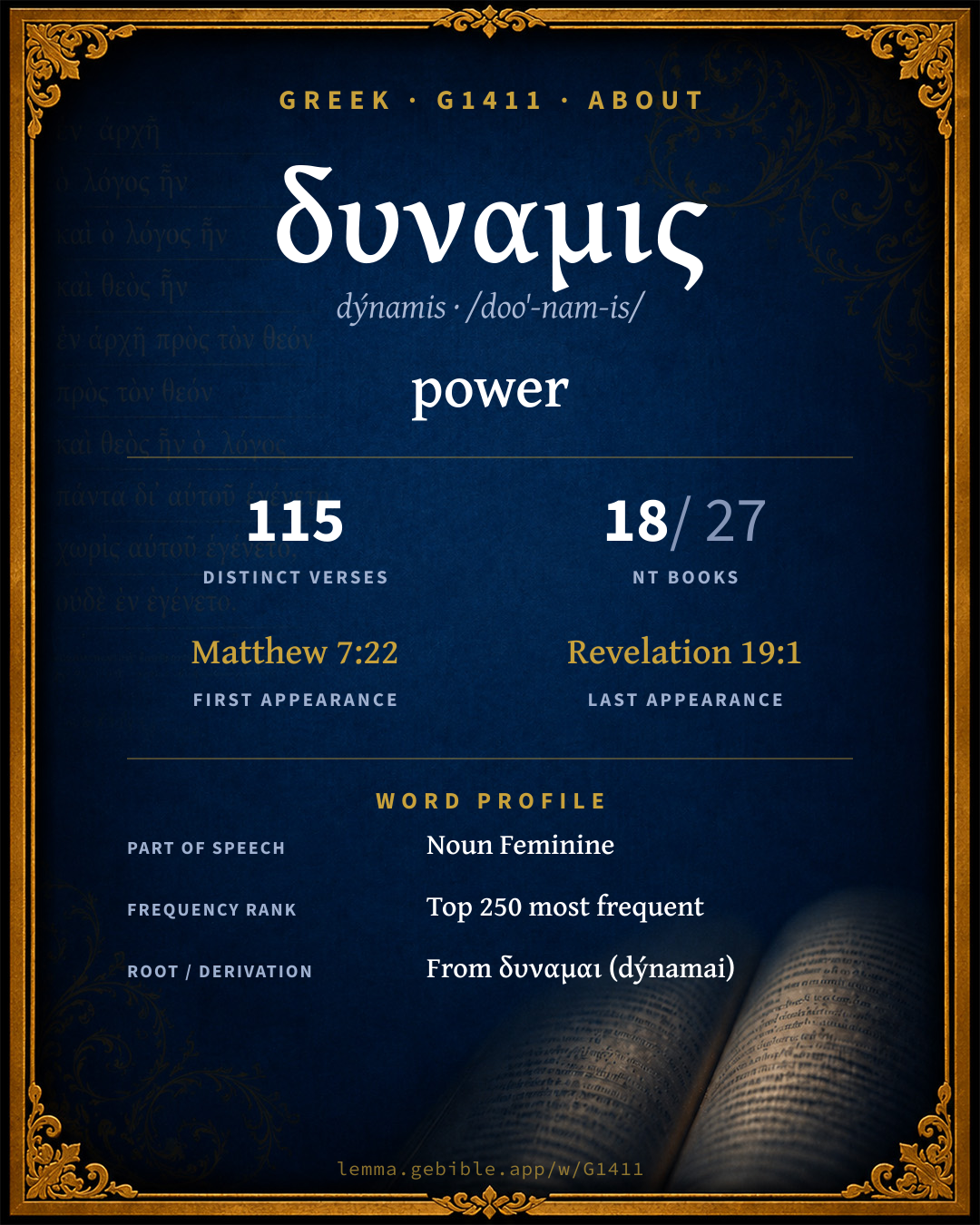
δύναμις
power
Full lexicon entry — Thayer's Greek Lexicon
From Thayer's Greek Lexicon
Where this word appears
See every Accusative-case word in the Greek New Testament →
Grammar key — what these labels mean
Part of speech
- Noun
- A naming word — a person, place, thing, or idea.
Case
- Accusative
- The case of the direct object and of extent.
- Dative
- The case of the indirect object, means, or location — “to / for / with / in.”
- Genitive
- The case of source, possession, or “of” — answers “whose / from what.”
- Nominative
- The case of the subject (and the predicate nominative).
Gender
- Feminine
- Grammatically feminine.
Number
- Singular
- One.
- Plural
- More than one.
Grammatical forms
- Noun, Accusative, Singular, Feminine 33 times (28%)
- Noun, Dative, Singular, Feminine 26 times (22%)
- Noun, Genitive, Singular, Feminine 21 times (18%)
- Noun, Nominative, Plural, Feminine 13 times (11%)
- Noun, Nominative, Singular, Feminine 13 times (11%)
- Noun, Accusative, Plural, Feminine 7 times (6%)
- Noun, Dative, Plural, Feminine 3 times (3%)
- Noun, Genitive, Plural, Feminine 3 times (3%)
Parsed forms decoded from the imported morphology (Robinson–Tischendorf, public domain), counted across 119 parsed occurrences — not distinct verses.
Every verse where G1411 appears — 115 distinct verses across 18 books. Click any verse to open its interlinear word-by-word view. Verse text shown in the World English Bible for context — . Each verse’s Greek form is shown with its reference; the English is not keyword-highlighted, since the data carries no word-level English alignment. Use “Compare translations” on any verse to read it across multiple English versions. This concordance covers the Greek New Testament; Septuagint (Greek Old Testament) occurrences of this word are not indexed here.
Matthew 12 verses
- Matthew 7:22 δυνάμεις n acc pl fem Many will tell me in that day, 'Lord, Lord, didn't we prophesy in your name, in your name cast out demons, and in your name do many mighty works?'
- Matthew 11:20 δυνάμεις n nom pl fem Then he began to denounce the cities in which most of his mighty works had been done, because they didn't repent.
- Matthew 11:21 δυνάμεις n nom pl fem "Woe to you, Chorazin! Woe to you, Bethsaida! For if the mighty works had been done in Tyre and Sidon which were done in you, they would have repented long ago in sackcloth and ashes.
- Matthew 11:23 δυνάμεις n nom pl fem You, Capernaum, who are exalted to Heaven, you will go down to Hades. For if the mighty works had been done in Sodom which were done in you, it would have remained until this day.
- Matthew 13:54 δυνάμεις n nom pl fem Coming into his own country, he taught them in their synagogue, so that they were astonished, and said, "Where did this man get this wisdom, and these mighty works?
- Matthew 13:58 δυνάμεις n acc pl fem He didn't do many mighty works there because of their unbelief.
- Matthew 14:2 δυνάμεις n nom pl fem and said to his servants, "This is John the Baptizer. He is risen from the dead. That is why these powers work in him."
- Matthew 22:29 δύναμιν n acc sg fem But Jesus answered them, "You are mistaken, not knowing the Scriptures, nor the power of God.
- Matthew 24:29 δυνάμεις n nom pl fem But immediately after the oppression of those days, the sun will be darkened, the moon will not give its light, the stars will fall from the sky, and the powers of the heavens will be shaken;
- Matthew 24:30 δυνάμεως n gen sg fem and then the sign of the Son of Man will appear in the sky. Then all the tribes of the earth will mourn, and they will see the Son of Man coming on the clouds of the sky with power and great glory.
- Matthew 25:15 δύναμιν n acc sg fem To one he gave five talents, to another two, to another one; to each according to his own ability. Then he went on his journey.
- Matthew 26:64 δυνάμεως n gen sg fem Jesus said to him, "You have said it. Nevertheless, I tell you, henceforth you will see the Son of Man sitting at the right hand of Power, and coming on the clouds of the sky."
Mark 10 verses
- Mark 5:30 δύναμιν n acc sg fem Immediately Jesus, perceiving in himself that the power had gone out from him, turned around in the crowd, and asked, "Who touched my clothes?"
- Mark 6:2 δυνάμεις n nom pl fem When the Sabbath had come, he began to teach in the synagogue, and many hearing him were astonished, saying, "Where did this man get these things?" and, "What is the wisdom that is given to this man, that such mighty works come about by his hands?
- Mark 6:5 δύναμιν n acc sg fem He could do no mighty work there, except that he laid his hands on a few sick people, and healed them.
- Mark 6:14 δυνάμεις n nom pl fem King Herod heard this, for his name had become known, and he said, "John the Baptizer has risen from the dead, and therefore these powers are at work in him."
- Mark 9:1 δυνάμει n dat sg fem He said to them, "Most assuredly I tell you, there are some standing here who will in no way taste death until they see the Kingdom of God come with power."
- Mark 9:39 δύναμιν n acc sg fem But Jesus said, "Don't forbid him, for there is no one who will do a mighty work in my name, and be able quickly to speak evil of me.
- Mark 12:24 δύναμιν n acc sg fem Jesus answered them, "Isn't this because you are mistaken, not knowing the Scriptures, nor the power of God?
- Mark 13:25 δυνάμεις n nom pl fem the stars will be falling from the sky, and the powers that are in the heavens will be shaken.
- Mark 13:26 δυνάμεως n gen sg fem Then they will see the Son of Man coming in clouds with great power and glory.
- Mark 14:62 δυνάμεως n gen sg fem Jesus said, "I AM. You will see the Son of Man sitting at the right hand of Power, and coming with the clouds of the sky."
Luke 15 verses
- Luke 1:17 δυνάμει n dat sg fem He will go before him in the spirit and power of Elijah, 'to turn the hearts of the fathers to the children,' and the disobedient to the wisdom of the just; to make ready a people prepared for the Lord."
- Luke 1:35 δύναμις n nom sg fem The angel answered her, "The Holy Spirit will come on you, and the power of the Most High will overshadow you. Therefore also the holy one who is born from you will be called the Son of God.
- Luke 4:14 δυνάμει n dat sg fem Jesus returned in the power of the Spirit into Galilee, and news about him spread through all the surrounding area.
- Luke 4:36 δυνάμει n dat sg fem Amazement came on all, and they spoke together, one with another, saying, "What is this word? For with authority and power he commands the unclean spirits, and they come out!"
- Luke 5:17 δύναμις n nom sg fem It happened on one of those days, that he was teaching; and there were Pharisees and teachers of the law sitting by, who had come out of every village of Galilee, Judea, and Jerusalem. The power of the Lord was with him to heal them.
- Luke 6:19 δύναμις n nom sg fem All the multitude sought to touch him, for power came out from him and healed them all.
- Luke 8:46 δύναμιν n acc sg fem But Jesus said, "Someone did touch me, for I perceived that power has gone out of me."
- Luke 9:1 δύναμιν n acc sg fem He called the twelve together, and gave them power and authority over all demons, and to cure diseases.
- Luke 10:13 δυνάμεις n nom pl fem "Woe to you, Chorazin! Woe to you, Bethsaida! For if the mighty works had been done in Tyre and Sidon which were done in you, they would have repented long ago, sitting in sackcloth and ashes.
- Luke 10:19 δύναμιν n acc sg fem Behold, I give you authority to tread on serpents and scorpions, and over all the power of the enemy. Nothing will in any way hurt you.
- Luke 19:37 δυνάμεων n gen pl fem As he was now getting near, at the descent of the Mount of Olives, the whole multitude of the disciples began to rejoice and praise God with a loud voice for all the mighty works which they had seen,
- Luke 21:26 δυνάμεις n nom pl fem men fainting for fear, and for expectation of the things which are coming on the world: for the powers of the heavens will be shaken.
- Luke 21:27 δυνάμεως n gen sg fem Then they will see the Son of Man coming in a cloud with power and great glory.
- Luke 22:69 δυνάμεως n gen sg fem From now on, the Son of Man will be seated at the right hand of the power of God."
- Luke 24:49 δύναμιν n acc sg fem Behold, I send forth the promise of my Father on you. But wait in the city of Jerusalem until you are clothed with power from on high."
Acts 10 verses
- Acts 1:8 δύναμιν n acc sg fem But you will receive power when the Holy Spirit has come upon you. You will be witnesses to me in Jerusalem, in all Judea and Samaria, and to the uttermost parts of the earth."
- Acts 2:22 δυνάμεσι n dat pl fem "Men of Israel, hear these words! Jesus of Nazareth, a man approved by God to you by mighty works and wonders and signs which God did by him in the midst of you, even as you yourselves know,
- Acts 3:12 δυνάμει n dat sg fem When Peter saw it, he responded to the people, "You men of Israel, why do you marvel at this man? Why do you fasten your eyes on us, as though by our own power or godliness we had made him walk?
- Acts 4:7 δυνάμει n dat sg fem When they had stood them in the middle of them, they inquired, "By what power, or in what name, have you done this?"
- Acts 4:33 δυνάμει n dat sg fem With great power, the apostles gave their testimony of the resurrection of the Lord Jesus. Great grace was on them all.
- Acts 6:8 δυνάμεως n gen sg fem Stephen, full of faith and power, performed great wonders and signs among the people.
- Acts 8:10 δύναμις n nom sg fem to whom they all listened, from the least to the greatest, saying, "This man is that great power of God."
- Acts 8:13 δυνάμεις n acc pl fem Simon himself also believed. Being baptized, he continued with Philip. Seeing signs and great miracles occuring, he was amazed.
- Acts 10:38 δυνάμει n dat sg fem even Jesus of Nazareth, how God anointed him with the Holy Spirit and with power, who went about doing good and healing all who were oppressed by the devil, for God was with him.
- Acts 19:11 Δυνάμεις n acc pl fem God worked special miracles by the hands of Paul,
Romans 7 verses
- Romans 1:4 δυνάμει n dat sg fem who was declared to be the Son of God with power, according to the Spirit of holiness, by the resurrection from the dead, Jesus Christ our Lord,
- Romans 1:16 δύναμις n nom sg fem For I am not ashamed of the Gospel of Christ, for it is the power of God for salvation for everyone who believes; for the Jew first, and also for the Greek.
- Romans 1:20 δύναμις n nom sg fem For the invisible things of him since the creation of the world are clearly seen, being perceived through the things that are made, even his everlasting power and divinity; that they may be without excuse.
- Romans 8:38 δυνάμεις n nom pl fem For I am persuaded, that neither death, nor life, nor angels, nor principalities, nor things present, nor things to come, nor powers,
- Romans 9:17 δύναμίν n acc sg fem For the Scripture says to Pharaoh, "For this very purpose I caused you to be raised up, that I might show in you my power, and that my name might be published abroad in all the earth."
- Romans 15:13 δυνάμει n dat sg fem Now may the God of hope fill you with all joy and peace in believing, that you may abound in hope, in the power of the Holy Spirit.
- Romans 15:19 δυνάμει δυνάμει n dat sg fem n dat sg fem in the power of signs and wonders, in the power of God's Spirit; so that from Jerusalem, and around as far as to Illyricum, I have fully preached the Gospel of Christ;
1 Corinthians 15 verses
- 1 Corinthians 1:18 δύναμις n nom sg fem For the word of the cross is foolishness to those who are dying, but to us who are saved it is the power of God.
- 1 Corinthians 1:24 δύναμιν n acc sg fem but to those who are called, both Jews and Greeks, Christ is the power of God and the wisdom of God.
- 1 Corinthians 2:4 δυνάμεως n gen sg fem My speech and my preaching were not in persuasive words of human wisdom, but in demonstration of the Spirit and of power,
- 1 Corinthians 2:5 δυνάμει n dat sg fem that your faith wouldn't stand in the wisdom of men, but in the power of God.
- 1 Corinthians 4:19 δύναμιν n acc sg fem But I will come to you shortly, if the Lord is willing. And I will know, not the word of those who are puffed up, but the power.
- 1 Corinthians 4:20 δυνάμει n dat sg fem For the Kingdom of God is not in word, but in power.
- 1 Corinthians 5:4 δυνάμει n dat sg fem In the name of our Lord Jesus Christ, you being gathered together, and my spirit, with the power of our Lord Jesus Christ,
- 1 Corinthians 6:14 δυνάμεως n gen sg fem Now God raised up the Lord, and will also raise us up by his power.
- 1 Corinthians 12:10 δυνάμεων n gen pl fem and to another workings of miracles; and to another prophecy; and to another discerning of spirits; to another different kinds of languages; and to another the interpretation of languages.
- 1 Corinthians 12:28 δυνάμεις n acc pl fem God has set some in the assembly: first apostles, second prophets, third teachers, then miracle workers, then gifts of healings, helps, governments, and various kinds of languages.
- 1 Corinthians 12:29 δυνάμεις n nom pl fem Are all apostles? Are all prophets? Are all teachers? Are all miracle workers?
- 1 Corinthians 14:11 δύναμιν n acc sg fem If then I don't know the meaning of the sound, I would be to him who speaks a foreigner, and he who speaks would be a foreigner to me.
- 1 Corinthians 15:24 δύναμιν n acc sg fem Then the end comes, when he will deliver up the Kingdom to God, even the Father; when he will have abolished all rule and all authority and power.
- 1 Corinthians 15:43 δυνάμει n dat sg fem It is sown in dishonor; it is raised in glory. It is sown in weakness; it is raised in power.
- 1 Corinthians 15:56 δύναμις n nom sg fem The sting of death is sin, and the power of sin is the law.
2 Corinthians 7 verses
- 2 Corinthians 1:8 δύναμιν n acc sg fem For we don't desire to have you uninformed, brothers, concerning our affliction which happened to us in Asia, that we were weighed down exceedingly, beyond our power, so much that we despaired even of life.
- 2 Corinthians 4:7 δυνάμεως n gen sg fem But we have this treasure in clay vessels, that the exceeding greatness of the power may be of God, and not from ourselves.
- 2 Corinthians 6:7 δυνάμει n dat sg fem in the word of truth, in the power of God; by the armor of righteousness on the right hand and on the left,
- 2 Corinthians 8:3 δύναμιν δύναμιν n acc sg fem n acc sg fem For according to their power, I testify, yes and beyond their power, they gave of their own accord,
- 2 Corinthians 12:9 δύναμις δύναμις n nom sg fem n nom sg fem He has said to me, "My grace is sufficient for you, for my power is made perfect in weakness." Most gladly therefore I will rather glory in my weaknesses, that the power of Christ may rest on me.
- 2 Corinthians 12:12 δυνάμεσιν n dat pl fem Truly the signs of an apostle were worked among you in all patience, in signs and wonders and mighty works.
- 2 Corinthians 13:4 δυνάμεως δυνάμεως n gen sg fem n gen sg fem For he was crucified through weakness, yet he lives through the power of God. For we also are weak in him, but we will live with him through the power of God toward you.
Galatians 1 verse
Ephesians 5 verses
- Ephesians 1:19 δυνάμεως n gen sg fem and what is the exceeding greatness of his power toward us who believe, according to that working of the strength of his might
- Ephesians 1:21 δυνάμεως n gen sg fem far above all rule, and authority, and power, and dominion, and every name that is named, not only in this age, but also in that which is to come.
- Ephesians 3:7 δυνάμεως n gen sg fem of which I was made a servant, according to the gift of that grace of God which was given me according to the working of his power.
- Ephesians 3:16 δυνάμει n dat sg fem that he would grant you, according to the riches of his glory, that you may be strengthened with power through his Spirit in the inward man;
- Ephesians 3:20 δύναμιν n acc sg fem Now to him who is able to do exceedingly abundantly above all that we ask or think, according to the power that works in us,
Philippians 1 verse
Colossians 2 verses
1 Thessalonians 1 verse
2 Thessalonians 3 verses
- 2 Thessalonians 1:7 δυνάμεως n gen sg fem and to give relief to you that are afflicted with us, when the Lord Jesus is revealed from heaven with his mighty angels in flaming fire,
- 2 Thessalonians 1:11 δυνάμει n dat sg fem To this end we also pray always for you, that our God may count you worthy of your calling, and fulfill every desire of goodness and work of faith, with power;
- 2 Thessalonians 2:9 δυνάμει n dat sg fem even he whose coming is according to the working of Satan with all power and signs and lying wonders,
2 Timothy 3 verses
- 2 Timothy 1:7 δυνάμεως n gen sg fem For God didn't give us a spirit of fear, but of power, love, and self-control.
- 2 Timothy 1:8 δύναμιν n acc sg fem Therefore don't be ashamed of the testimony of our Lord, nor of me his prisoner; but endure hardship for the Gospel according to the power of God,
- 2 Timothy 3:5 δύναμιν n acc sg fem holding a form of godliness, but having denied the power thereof. Turn away from these, also.
Hebrews 6 verses
- Hebrews 1:3 δυνάμεως n gen sg fem His Son is the radiance of his glory, the very image of his substance, and upholding all things by the word of his power, when he had by himself made purification for our sins, sat down on the right hand of the Majesty on high;
- Hebrews 2:4 δυνάμεσιν n dat pl fem God also bearing witness with them, both by signs and wonders, and by various works of power, and by gifts of the Holy Spirit, according to his own will?
- Hebrews 6:5 δυνάμεις n acc pl fem and tasted the good word of God, and the powers of the age to come,
- Hebrews 7:16 δύναμιν n acc sg fem who has been made, not after the law of a fleshly commandment, but after the power of an endless life:
- Hebrews 11:11 δύναμιν n acc sg fem By faith, even Sarah herself received power to conceive, and she bore a child when she was past age, since she counted him faithful who had promised.
- Hebrews 11:34 δύναμιν n acc sg fem quenched the power of fire, escaped the edge of the sword, from weakness were made strong, grew mighty in war, and turned to flight armies of aliens.
1 Peter 2 verses
2 Peter 3 verses
- 2 Peter 1:3 δυνάμεως n gen sg fem seeing that his divine power has granted to us all things that pertain to life and godliness, through the knowledge of him who called us by his own glory and virtue;
- 2 Peter 1:16 δύναμιν n acc sg fem For we did not follow cunningly devised fables, when we made known to you the power and coming of our Lord Jesus Christ, but we were eyewitnesses of his majesty.
- 2 Peter 2:11 δυνάμει n dat sg fem whereas angels, though greater in might and power, don't bring a railing judgment against them before the Lord.
Revelation 12 verses
- Revelation 1:16 δυνάμει n dat sg fem He had seven stars in his right hand. Out of his mouth proceeded a sharp two-edged sword. His face was like the sun shining at its brightest.
- Revelation 3:8 δύναμιν n acc sg fem "I know your works (behold, I have set before you an open door, which no one can shut), that you have a little power, and kept my word, and didn't deny my name.
- Revelation 4:11 δύναμιν n acc sg fem "Worthy are you, our Lord and God, the Holy One, to receive the glory, the honor, and the power, for you created all things, and because of your desire they existed, and were created!"
- Revelation 5:12 δύναμιν n acc sg fem saying with a loud voice, "Worthy is the Lamb who has been killed to receive the power, wealth, wisdom, strength, honor, glory, and blessing!"
- Revelation 7:12 δύναμις n nom sg fem saying, "Amen! Blessing, glory, wisdom, thanksgiving, honor, power, and might, be to our God forever and ever! Amen."
- Revelation 11:17 δύναμίν n acc sg fem saying: "We give you thanks, Lord God, the Almighty, the one who is and who was; because you have taken your great power, and reigned.
- Revelation 12:10 δύναμις n nom sg fem I heard a loud voice in heaven, saying, "Now is come the salvation, the power, and the Kingdom of our God, and the authority of his Christ; for the accuser of our brothers has been thrown down, who accuses them before our God day and night.
- Revelation 13:2 δύναμιν n acc sg fem The beast which I saw was like a leopard, and his feet were like those of a bear, and his mouth like the mouth of a lion. The dragon gave him his power, his throne, and great authority.
- Revelation 15:8 δυνάμεως n gen sg fem The temple was filled with smoke from the glory of God, and from his power. No one was able to enter into the temple, until the seven plagues of the seven angels would be finished.
- Revelation 17:13 δύναμιν n acc sg fem These have one mind, and they give their power and authority to the beast.
- Revelation 18:3 δυνάμεως n gen sg fem For all the nations have drunk of the wine of the wrath of her sexual immorality, the kings of the earth committed sexual immorality with her, and the merchants of the earth grew rich from the abundance of her luxury."
- Revelation 19:1 δύναμις n nom sg fem After these things I heard something like a loud voice of a great multitude in heaven, saying, "Hallelujah! Salvation, power, and glory belong to our God:
About this entry
At a glance — auto-summarized from this page’s data, not written by a person. Every figure links to its source below. This summary describes the numbers; it doesn’t interpret them.
δυναμις — transliterated dýnamis — is a Greek noun carrying the sense “power.” Its earliest occurrence is Matthew 7:22. It appears 115 verses across 18 books of the Greek New Testament, among its common vocabulary. It shares a root with δυναμαι, δυναστης and δυνατος. See the sense tree, 115-verse concordance, and the renderings breakdown below.
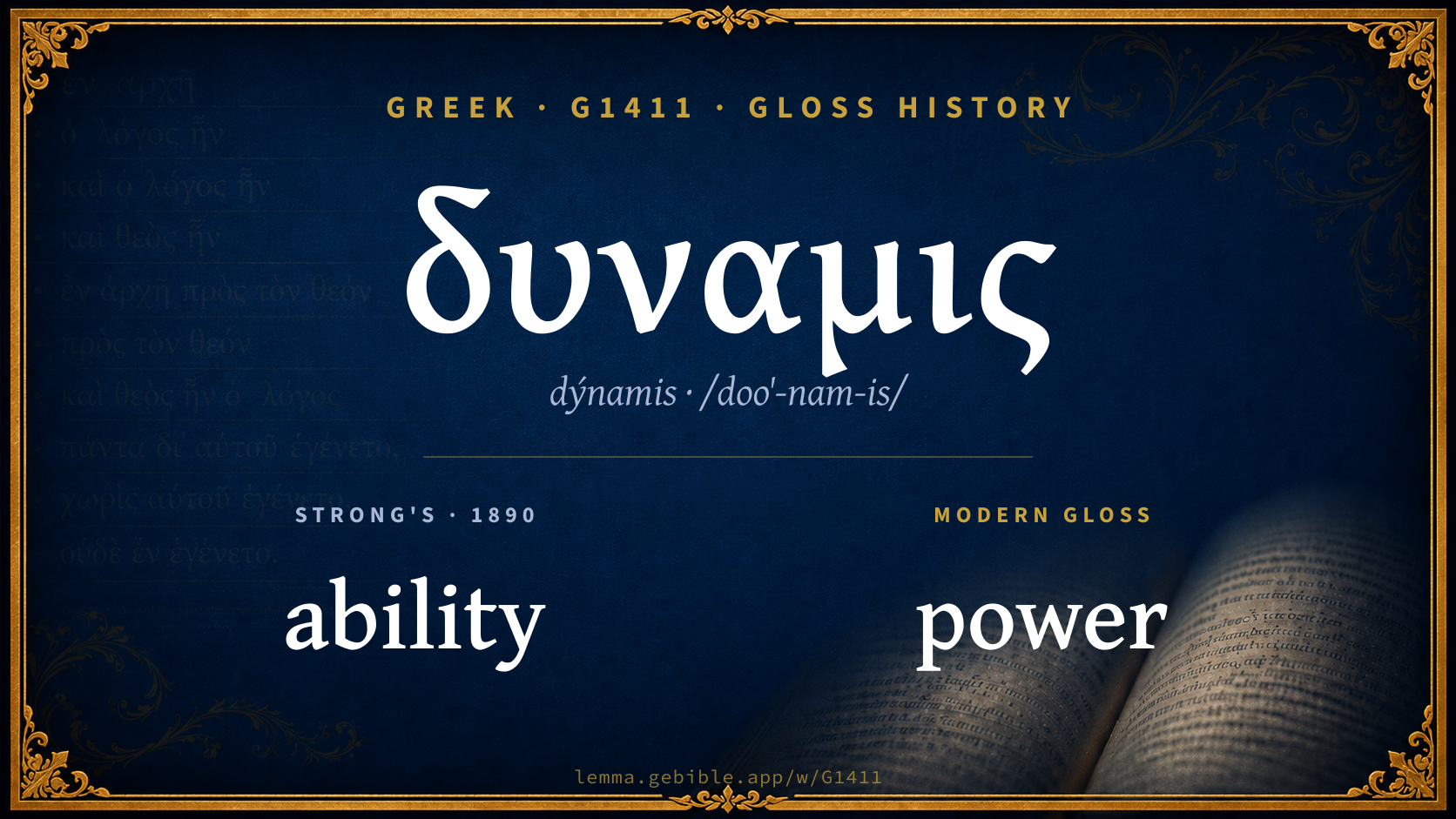
Gloss history
Strong's 1890 vs modern scholarship
About this word
Strong's G1411 catalogs a Greek word from the Greek New Testament.
These counts are not copied from any lexicon or concordance. They are computed here, from the morphology-tagged Greek New Testament. What Lemma adds →
- 115
- distinct verses
- The word appears in 115 distinct verses.
- 18 / 27
- NT books
- The word appears in 18 of 27 New Testament books.
- #138
- by frequency
- Top 250 most frequent Greek words (rank 138 of 5,347 Greek words by occurrence).
View all 115 occurrences in the concordance →
Most concentrated in
- Luke 15 verses 13%
- 1 Corinthians 15 verses 13%
- Matthew 12 verses 10%
By section of the New Testament
By traditional corpus
Conventional, traditional groupings — biblical authorship is debated, so this is a traditional corpus grouping, not an authorship claim. Some books belong to more than one corpus (Luke is in both the Gospels and the Lukan corpus, and so on), so these shares overlap and need not total 100%. Each figure is a share of the word’s 115 distinct verses.
- Pauline corpus 45 verses · 39%
- Gospels 37 verses · 32%
- Lukan (Luke–Acts) 25 verses · 22%
- Johannine 12 verses · 10%
- Revelation 12 verses · 10%
- Hebrews 6 verses · 5%
- General (Catholic) Epistles 5 verses · 4%
How translations render this word
Counts come from each version’s own published word-to-Strong’s tagging or interlinear alignment — an approximate guide to how each version renders this word, not a word-level alignment the data otherwise carries. Because each total is that version’s own tagged count, the per-version totals vary from one another and need not match the appearance or distinct-verse counts above. These counts may also differ from a printed concordance because Lemma counts each distinctly tagged rendering and does not collapse phrase taggings into a single head-word total. This is a fixed set of word-tagged versions (KJV, ASV, BSB, ULT) and does not change with the reading translation you choose elsewhere. Each version’s license is shown beside its name below (and on Sources).
- King James Version: Power 71×, Mighty works 10×, Miracles 7×
- American Standard Version: Power 83×, Mighty works 11×, Powers 7×
- Berean Standard Bible: Power 77×, Miracles 18×, Powers 5×
- unfoldingWord Literal Text: Power 83×, Miracles 13×, Powers 8×
King James Version Public Domain
Renders G1411 across 119 tagged occurrences — most commonly:
Plus 9 renderings that appear only once — usually multi-word phrases or single function words the recovered tagging swept in, not distinct renderings. Not rendered by a distinct English word in 1 further occurrence.
American Standard Version Public Domain
Renders G1411 across 122 tagged occurrences — most commonly:
Plus 11 renderings that appear only once — usually multi-word phrases or single function words the recovered tagging swept in, not distinct renderings.
Berean Standard Bible Public Domain
Renders G1411 across 116 tagged occurrences — most commonly:
Plus 11 renderings that appear only once — usually multi-word phrases or single function words the recovered tagging swept in, not distinct renderings. Not rendered by a distinct English word in 2 further occurrences.
unfoldingWord Literal Text CC BY-SA 4.0
Renders G1411 across 124 tagged occurrences — most commonly:
Plus 10 renderings that appear only once — usually multi-word phrases or single function words the recovered tagging swept in, not distinct renderings.
Senses in Thayer's
The 1 sense Thayer's distinguishes for this word, in lexicon order (not ranked by frequency or importance). The full entry — with sub-senses — is in the Lexicon Entry tab.
- strength power, ability
Word origin
Derived from δυναμαι (dýnamai) (G1410) — to be able.
From G1410 ; force (literally or figuratively); specifically miraculous power (usually by implication a miracle itself): - ability abundance meaning might (-ily -y -y deed) (worker of) miracle (-s) power strength violence mighty (wonderful) work.
— Strong’s Exhaustive Concordance (1890), public domain.
Forms in the corpus
The 10 distinct written forms G1411 takes in the Greek New Testament, most frequent first — each parse links to that case’s occurrences in the concordance.
| Form | Parsing | Example | Uses |
|---|---|---|---|
| δύναμιν dýnamin | Noun, Accusative, Singular, Feminine | Matthew 22:29 | 31 |
| δυνάμει dynámei | Noun, Dative, Singular, Feminine | Mark 9:1 | 26 |
| δυνάμεως dynámeōs | Noun, Genitive, Singular, Feminine | Matthew 24:30 | 21 |
| δυνάμεις dynámeis | Noun, Nominative, Plural, Feminine | Matthew 11:20 | 19 |
| δύναμις dýnamis | Noun, Nominative, Singular, Feminine | Luke 1:35 | 13 |
| δυνάμεων dynámeōn | Noun, Genitive, Plural, Feminine | Luke 19:37 | 3 |
| δυνάμεσιν dynámesin | Noun, Dative, Plural, Feminine | 2 Corinthians 12:12 | 2 |
| δύναμίν dýnamín | Noun, Accusative, Singular, Feminine | Romans 9:17 | 2 |
| Δυνάμεις Dynámeis | Noun, Accusative, Plural, Feminine | Acts 19:11 | 1 |
| δυνάμεσι dynámesi | Noun, Dative, Plural, Feminine | Acts 2:22 | 1 |
Same root — word family
Other Thayer's entries built from the same root as G1411, grouped by Strong’s listed origin. These share a root / origin per the lexicon — not necessarily a shared meaning. Each links to that word’s own entry.
Derives from
Shares the same root
Derived from this word
Compare all same-root words → Showing 4 of 5 — not the complete family. They share a root, not necessarily a meaning.
Septuagint usage
The same Greek word δυναμις appears 380 times in the Greek Old Testament (Septuagint), across 360 verses in 30 books.
- 380
- LXX occurrences
- Tagged occurrences of this Greek word in the Septuagint.
- 360
- verses
- Distinct Septuagint verses containing this word.
- 30 / 39
- OT books
- The word appears in 30 of the 39 Old Testament books.
Sample Septuagint occurrences
- Genesis 21:22 δύναμις
- Exodus 6:26 δύναμις
- Numbers 1:3 δύναμις
- Deuteronomy 3:24 δύναμις
- Joshua 4:24 δύναμις
- Judges 3:29 δύναμις
- Ruth 3:11 δύναμις
- 1 Samuel 2:4 δύναμις
- 2 Samuel 6:2 δύναμις
- 1 Kings 1:19 δύναμις
- 2 Kings 2:16 δύναμις
- 1 Chronicles 5:18 δύναμις
Septuagint occurrences (same lexeme)
Every verse where the same Strong’s number (G1411) appears in the Greek Septuagint — showing the first 50 of 360. Verse text shown in the World English Bible for context; the Greek form is the matched word — the English is not keyword-highlighted.
- Genesis 21:22 δύναμις It happened at that time, that Abimelech and Phicol the captain of his host spoke to Abraham, saying, "God is with you in all that you do.
- Genesis 21:32 δύναμις So they made a covenant at Beersheba. Abimelech rose up with Phicol, the captain of his host, and they returned into the land of the Philistines.
- Genesis 26:26 δύναμις Then Abimelech went to him from Gerar, and Ahuzzath his friend, and Phicol the captain of his host.
- Exodus 6:26 δύναμις These are that Aaron and Moses, to whom Yahweh said, "Bring out the children of Israel from the land of Egypt according to their hosts."
- Exodus 7:4 δύναμις But Pharaoh will not listen to you, and I will lay my hand on Egypt, and bring forth my hosts, my people the children of Israel, out of the land of Egypt by great judgments.
- Exodus 12:17 δύναμις You shall observe the feast of unleavened bread; for in this same day have I brought your hosts out of the land of Egypt: therefore shall you observe this day throughout your generations by an ordinance forever.
- Exodus 12:41 δύναμις It happened at the end of four hundred thirty years, even the same day it happened, that all the hosts of Yahweh went out from the land of Egypt.
- Exodus 12:51 δύναμις It happened the same day, that Yahweh brought the children of Israel out of the land of Egypt by their hosts.
- Exodus 14:28 δύναμις The waters returned, and covered the chariots and the horsemen, even all Pharaoh's army that went in after them into the sea. There remained not so much as one of them.
- Exodus 15:4 δύναμις Pharaoh's chariots and his host has he cast into the sea; His chosen captains are sunk in the Red Sea.
- Numbers 1:3 δύναμις from twenty years old and upward, all who are able to go out to war in Israel. You and Aaron shall number them by their divisions.
- Numbers 1:20 δύναμις The children of Reuben, Israel's firstborn, their generations, by their families, by their fathers' houses, according to the number of the names, one by one, every male from twenty years old and upward, all who were able to go out to war;
- Numbers 1:22 δύναμις Of the children of Simeon, their generations, by their families, by their fathers' houses, those who were numbered of it, according to the number of the names, one by one, every male from twenty years old and upward, all who were able to go out to war;
- Numbers 1:24 δύναμις Of the children of Gad, their generations, by their families, by their fathers' houses, according to the number of the names, from twenty years old and upward, all who were able to go out to war;
- Numbers 1:26 δύναμις Of the children of Judah, their generations, by their families, by their fathers' houses, according to the number of the names, from twenty years old and upward, all who were able to go out to war;
- Numbers 1:28 δύναμις Of the children of Issachar, their generations, by their families, by their fathers' houses, according to the number of the names, from twenty years old and upward, all who were able to go out to war;
- Numbers 1:30 δύναμις Of the children of Zebulun, their generations, by their families, by their fathers' houses, according to the number of the names, from twenty years old and upward, all who were able to go out to war;
- Numbers 1:32 δύναμις Of the children of Joseph, of the children of Ephraim, their generations, by thir families, by their fathers' houses, according to the number of the names, from twenty years old and upward, all who were able to go out to war;
- Numbers 1:34 δύναμις Of the children of Manasseh, their generations, by their families, by their fathers' houses, according to the number of the names, from twenty years old and upward, all who were able to go out to war;
- Numbers 1:36 δύναμις Of the children of Benjamin, their generations, by their families, by their fathers' houses, according to the number of the names, from twenty years old and upward, all who were able to go out to war;
- Numbers 1:38 δύναμις Of the children of Dan, their generations, by their families, by their fathers' houses, according to the number of the names, from twenty years old and upward, all who were able to go forth to war;
- Numbers 1:40 δύναμις Of the children of Asher, their generations, by their families, by their fathers' houses, according to the number of the names, from twenty years old and upward, all who were able to go forth to war;
- Numbers 1:42 δύναμις Of the children of Naphtali, their generations, by their families, by their fathers' houses, according to the number of the names, from twenty years old and upward, all who were able to go forth to war;
- Numbers 1:45 δύναμις So all those who were numbered of the children of Israel by their fathers' houses, from twenty years old and upward, all who were able to go out to war in Israel;
- Numbers 1:52 δύναμις The children of Israel shall pitch their tents, every man by his own camp, and every man by his own standard, according to their divisions.
- Numbers 2:3 δύναμις Those who encamp on the east side toward the sunrise shall be of the standard of the camp of Judah, according to their divisions: and the prince of the children of Judah shall be Nahshon the son of Amminadab.
- Numbers 2:4 δύναμις His division, and those who were numbered of them, were seventy-four thousand six hundred.
- Numbers 2:6 δύναμις His division, and those who were numbered of it, were fifty-four thousand four hundred.
- Numbers 2:8 δύναμις His division, and those who were numbered of it, were fifty-seven thousand four hundred.
- Numbers 2:9 δύναμις All who were numbered of the camp of Judah were one hundred eighty-six thousand four hundred, according to their divisions. They shall set out first.
- Numbers 2:10 δύναμις "On the south side shall be the standard of the camp of Reuben according to their divisions. The prince of the children of Reuben shall be Elizur the son of Shedeur.
- Numbers 2:11 δύναμις His division, and those who were numbered of it, were forty-six thousand five hundred.
- Numbers 2:13 δύναμις His division, and those who were numbered of them, were fifty-nine thousand three hundred.
- Numbers 2:15 δύναμις His division, and those who were numbered of them, were forty-five thousand six hundred fifty.
- Numbers 2:16 δύναμις "All who were numbered of the camp of Reuben were one hundred fifty-one thousand four hundred fifty, according to their hosts. They shall set out second.
- Numbers 2:18 δύναμις "On the west side shall be the standard of the camp of Ephraim according to their divisions: and the prince of the children of Ephraim shall be Elishama the son of Ammihud.
- Numbers 2:19 δύναμις His division, and those who were numbered of them, were forty thousand five hundred.
- Numbers 2:21 δύναμις His division, and those who were numbered of them, were thirty-two thousand two hundred.
- Numbers 2:23 δύναμις His host, and those who were numbered of them, were thirty-five thousand four hundred.
- Numbers 2:24 δύναμις "All who were numbered of the camp of Ephraim were one hundred eight thousand one hundred, according to their divisions. They shall set out third.
- Numbers 2:25 δύναμις "On the north side shall be the standard of the camp of Dan according to their divisions: and the prince of the children of Dan shall be Ahiezer the son of Ammishaddai.
- Numbers 2:26 δύναμις His division, and those who were numbered of them, were sixty-two thousand seven hundred.
- Numbers 2:28 δύναμις His division, and those who were numbered of them, were forty-one thousand and five hundred.
- Numbers 2:30 δύναμις His division, and those who were numbered of them, were fifty-three thousand four hundred.
- Numbers 2:32 δύναμις These are those who were numbered of the children of Israel by their fathers' houses. All who were numbered of the camps according to their hosts were six hundred three thousand five hundred fifty.
- Numbers 6:21 δύναμις "This is the law of the Nazirite who vows, and of his offering to Yahweh for his separation, besides that which he is able to get. According to his vow which he vows, so he must do after the law of his separation."
- Numbers 10:14 δύναμις In the first [place] the standard of the camp of the children of Judah set forward according to their hosts: and over his host was Nahshon the son of Amminadab.
- Numbers 10:15 δύναμις Over the host of the tribe of the children of Issachar was Nethanel the son of Zuar.
- Numbers 10:16 δύναμις Over the host of the tribe of the children of Zebulun was Eliab the son of Helon.
- Numbers 10:18 δύναμις The standard of the camp of Reuben set forward according to their hosts: and over his host was Elizur the son of Shedeur.
These are occurrences of the same Greek lexeme (G1411) in the Septuagint — not a translation of any one Hebrew word. The store carries no word-level Hebrew↔Greek alignment, so no Hebrew original is asserted here. Counts come from the recovered LXX Strong's tagging — high-frequency vocabulary is well covered, while rare or late forms may be untagged — so they reflect tagged occurrences and may slightly undercount.