
Hebrews 5:7

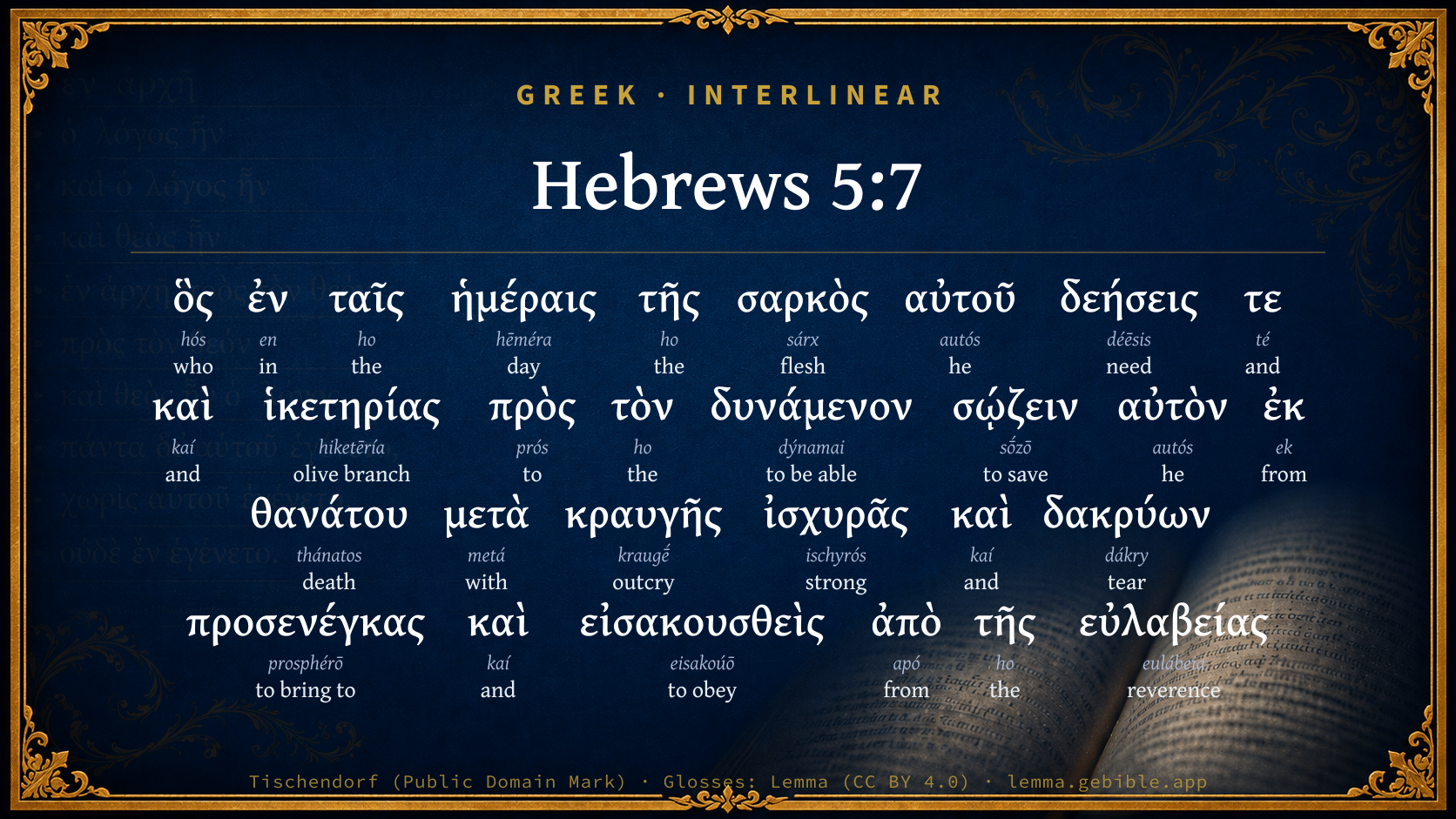
Greek (Tischendorf 8th ed.) Hebrews 5:7 appears in the Greek New Testament. The text above is from the Tischendorf 8th edition. Each word links to its Strong’s number and a concise gloss. Click any word for its full Thayer’s Greek Lexicon entry.
Download image
Cite this verse

Hebrews 5:7 (World English Bible). Public Domain. Lemma interlinear Bible study tool, https://lemma.gebible.app/v/hebrews/5/7.

Show BibTeX & RIS
BibTeX
RIS
English Translation
He, in the days of his flesh, having offered up prayers and petitions with strong crying and tears to him who was able to save him from death, and having been heard for his godly fear,
World English Bible · Public Domain
Highlights
  • 1 hapax legomenon — only here in the Greek New Testament
  • 2 first appearances in the Greek New Testament
Full analysis ↓
Download a study sheet

One document with this verse’s original text, its word-by-word gloss line, the meaning frame, cross-references with their text, attributed commentary, and full source and license credits — printable, and it pastes into notes with its structure intact.

This verse Autodidact and up

Study sheet (.html) Plain text (.txt)

A passage Seminary Student

Up to 50 verses in one chapter. A passage sheet keeps up to 6 commentary sources and 12 cross-references per verse, in the order this page ranks them, and says so on the sheet whenever that leaves anything out. Ask for a single verse and you get the Autodidact verse sheet above.

Everything on this page stays free to read, with no account — the sheet is a download of what is already on screen, not access to it.

Want to remove ads? Support Godless Engineer
Compare translations 3

The same verse in 3 English versions, stacked beneath the original-language interlinear above. Click any original word for its lexicon entry.

Each is an independent rendering of the whole verse — the interlinear is not word-aligned to these translations.

Highlighted words mark where these versions differ — a whole-verse word diff, not a word-by-word alignment.

  • World English Bible Public Domain
    He, in the days of his flesh, having offered up prayers and petitions with strong crying and tears to him who was able to save him from death, and having been heard for his godly fear,
  • King James Version Public Domain
    Who in the days of his flesh, when he had offered up prayers and supplications with strong crying and tears unto him that was able to save him from death, and was heard in that he feared;
  • unfoldingWord Literal Text CC BY-SA 4.0
    He, during the days of his flesh, offered up both prayers and requests with loud cries and tears to the one being able to save him from death and he was heard because of his godly life.

unfoldingWord Literal Text — © unfoldingWord, licensed CC BY-SA 4.0. Word-aligned USFM3 via Door43 (git.door43.org/unfoldingWord/en_ult).

Versions to compare (up to 4)

3 of 4 selected

Show all 19 translations

Every available English version of this verse, each an independent rendering of the whole verse.

  • World English Bible Public Domain
    He, in the days of his flesh, having offered up prayers and petitions with strong crying and tears to him who was able to save him from death, and having been heard for his godly fear,
  • Berean Standard Bible Public Domain
    During the days of Jesus’ earthly life, He offered up prayers and petitions with loud cries and tears to the One who could save Him from death, and He was heard because of His reverence.
  • Majority Standard Bible Public Domain
    During the days of Jesus’ earthly life, He offered up prayers and petitions with loud cries and tears to the One who could save Him from death, and He was heard because of His reverence.
  • King James Version Public Domain
    Who in the days of his flesh, when he had offered up prayers and supplications with strong crying and tears unto him that was able to save him from death, and was heard in that he feared;
  • American Standard Version (1901) Public Domain
    Who in the days of his flesh, having offered up prayers and supplications with strong crying and tears unto him that was able to save him from death, and having been heard for his godly fear,
  • Revised Version (1885) Public Domain
    Who in the days of his flesh, having offered up prayers and supplications with strong crying and tears unto him that was able to save him from death, and having been heard for his godly fear,
  • Geneva Bible (1599) Public Domain
    Who in the dayes of his flesh did offer vp prayers and supplications, with strong crying and teares vnto him, that was able to saue him from death, and was also heard in that which he feared.
  • Douay-Rheims (1899) Public Domain
    Who in the days of his flesh, with a strong cry and tears, offering up prayers and supplications to him that was able to save him from death, was heard for his reverence.
  • Young's Literal Translation Public Domain
    who in the days of his flesh both prayers and supplications unto Him who was able to save him from death -- with strong crying and tears -- having offered up, and having been heard in respect to that which he feared,
  • Literal Standard Version CC BY-SA 4.0
    who in the days of His flesh having offered up both prayers and supplications with strong crying and tears to Him who was able to save Him from death, and having been heard in respect to that which He feared,
  • Unlocked Literal Bible CC BY-SA 4.0
    During the days of his flesh, Christ offered up both prayers and requests with loud cries and tears to God, the one able to save him from death, and he was heard because of his godly life.
  • unfoldingWord Literal Text CC BY-SA 4.0
    He, during the days of his flesh, offered up both prayers and requests with loud cries and tears to the one being able to save him from death and he was heard because of his godly life.
  • Darby Bible Public Domain
    Who in the days of his flesh, having offered up both supplications and entreaties to him who was able to save him out of death, with strong crying and tears; (and having been heard because of his piety;)
  • World Messianic Bible Public Domain
    He, in the days of his flesh, having offered up prayers and petitions with strong crying and tears to him who was able to save him from death, and having been heard for his godly fear,
  • Webster's Bible Public Domain
    Who in the days of his flesh, when he had offered up prayers and supplications with strong crying and tears to him that was able to save him from death, and was heard, in that he feared;
  • Free Bible Version CC BY-SA 4.0
    Jesus, while he was here in human form, prayed and appealed with loud cries and tears to God, the one who was able to save him from death. Jesus was heard because of his respect for God.
  • Bible in Basic English Public Domain
    Who in the days of his flesh, having sent up prayers and requests with strong crying and weeping to him who was able to give him salvation from death, had his prayer answered because of his fear of God.
  • Text-Critical English NT CC BY 4.0
    In the days of his flesh, Jesus offered up prayers and supplications, with loud cries and tears, to the one who was able to save him from death, and he was heard because of his reverence.
  • Tyndale New Testament (1534) Public Domain
    Which in the dayes of his flesshe did offer vp prayers and sup plicacions with stronge cryinge and teares vnto him that was able to save him from deeth: and was also hearde because of his godlines.

Literal Standard Version (2020), Covenant Press — licensed CC BY-SA 4.0. Text via the HelloAO Bible API (eBible.org). Unlocked Literal Bible (unfoldingWord) — licensed CC BY-SA 4.0. Text via the HelloAO Bible API (eBible.org). unfoldingWord Literal Text — © unfoldingWord, licensed CC BY-SA 4.0. Word-aligned USFM3 via Door43 (git.door43.org/unfoldingWord/en_ult). Free Bible Version, Dr. Jonathan Gallagher — licensed CC BY-SA 4.0. Text via the HelloAO Bible API (eBible.org).

Word by word

More ways to search: Search by grammar → Find every occurrence → Compare this word →

Practice this passage: Drill this verse → Learn its vocabulary →

ἱκετηρίας
hiketēría
G2428
“olive branch”
Noun, Accusative, Plural, Feminine
Part of Speech
Noun
Case
Accusative
Number
Plural
Gender
Feminine
Full Thayer's Definition

Origin: from a derivative of the base of G2425 (through the idea of approaching for a favour)

TDNT: 07:56,4

1. an olive branch a. for suppliants approached the one whose aid they would implore holding an olive branch entwined with white wool and fillets, to signify that they came as suppliants 2. supplication
  1. ὃς hós G3739 “who” Relative pronoun, Nominative, Singular, Masculine
  2. ἐν en G1722 “in” Preposition
  3. ταῖς ho G3588 “the” Article, Dative, Plural, Feminine
  4. ἡμέραις hēméra G2250 “day” Noun, Dative, Plural, Feminine
  5. τῆς ho G3588 “the” Article, Genitive, Singular, Feminine
  6. σαρκὸς sárx G4561 “flesh” Noun, Genitive, Singular, Feminine
  7. αὐτοῦ autós G846 “he” Personal pronoun, Genitive, Singular, Masculine
  8. δεήσεις déēsis G1162 “need” Noun, Accusative, Plural, Feminine
  9. τε té G5037 “and” Particle
  10. καὶ kaí G2532 “and” Conjunction
  11. πρὸς prós G4314 “to” Preposition
  12. τὸν ho G3588 “the” Article, Accusative, Singular, Masculine
  13. δυνάμενον dýnamai G1410 “to be able” Verb, Present, Middle or Passive deponent, Participle, Accusative, Singular, Masculine
  14. σῴζειν sṓzō G4982 “to save” Verb, Present, Active, Infinitive
  15. αὐτὸν autós G846 “he” Personal pronoun, Accusative, Singular, Masculine
  16. ἐκ ek G1537 “from” Preposition
  17. θανάτου thánatos G2288 “death” Noun, Genitive, Singular, Masculine
  18. μετὰ metá G3326 “with” Preposition
  19. κραυγῆς kraugḗ G2906 “outcry” Noun, Genitive, Singular, Feminine
  20. ἰσχυρᾶς ischyrós G2478 “strong” Adjective, Genitive, Singular, Feminine
  21. καὶ kaí G2532 “and” Conjunction
  22. δακρύων dákry G1144 “tear” Noun, Genitive, Plural, Neuter
  23. προσενέγκας prosphérō G4374 “to bring to” Verb, Aorist, Active, Participle, Nominative, Singular, Masculine
  24. καὶ kaí G2532 “and” Conjunction
  25. εἰσακουσθεὶς eisakoúō G1522 “to obey” Verb, Aorist, Passive, Participle, Nominative, Singular, Masculine
  26. ἀπὸ apó G575 “from” Preposition
  27. τῆς ho G3588 “the” Article, Genitive, Singular, Feminine
  28. εὐλαβείας eulábeia G2124 “reverence” Noun, Genitive, Singular, Feminine

About this verse

These counts appear in no published source. They are computed here, from the morphology-tagged text and Lemma’s own curated glosses. What Lemma adds →

29
words
23
distinct lemmas
General Epistles
section

Notable vocabulary

1 hapax legomenon — a word that appears only here in the entire Greek New Testament:

  • ἱκετηρίας olive branch G2428

First appearance in Scripture

These words make their first canonical appearance in the Greek New Testament here:

  • ἱκετηρίας olive branch G2428
  • εὐλαβείας reverence G2124

Shared distinctive vocabulary

εὐλαβείας reverence G2124 occurs in 2 verses of the Greek New Testament. Also found in:
Repetition

Words recur within this verse:

  • ταῖς the G3588 ×4
  • καὶ and G2532 ×3
  • αὐτοῦ he G846 ×2

Cross-references

35

Topical passages linked to Hebrews 5:7 in the Treasury of Scripture Knowledge — connected by theme and wording, ordered by reader-vote popularity; previews shown in the World English Bible.

  • Luke 22:41–44 He was withdrawn from them about a stone's throw, and he knelt down and prayed,
  • Mark 14:32–39 They came to a place which was named Gethsemane. He said to his disciples, "Sit here, while I pray."
  • John 17:1 Jesus said these things, and lifting up his eyes to heaven, he said, "Father, the time has come. Glorify your Son, that your Son may also glorify you;
  • Matthew 27:46 About the ninth hour Jesus cried with a loud voice, saying, "Eli, Eli, lima sabachthani?" That is, "My God, my God, why have you forsaken me?"
  • John 17:4–5 I glorified you on the earth. I have accomplished the work which you have given me to do.
  • John 12:27–28 "Now my soul is troubled. What shall I say? 'Father, save me from this time?' But for this cause I came to this time.
  • Mark 15:34 At the ninth hour Jesus cried with a loud voice, saying, "Eloi, Eloi, lama sabachthani?" which is, being interpreted, "My God, my God, why have you forsaken me?"
  • Matthew 26:28–44 for this is my blood of the new covenant, which is poured out for many for the remission of sins.
  • Matthew 27:50 Jesus cried again with a loud voice, and yielded up his spirit.
  • John 11:35 Jesus wept.
  • Hebrews 12:28 Therefore, receiving a Kingdom that can't be shaken, let us have grace, through which we serve God acceptably, with reverence and awe,
  • Psalms 22:1–21 My God, my God, why have you forsaken me? Why are you so far from helping me, and from the words of my groaning?
  • Psalms 22:24 For he has not despised nor abhorred the affliction of the afflicted, Neither has he hidden his face from him; But when he cried to him, he heard.
  • Mark 15:37 Jesus cried out with a loud voice, and gave up the spirit.
  • Psalms 69:1 Save me, God, For the waters have come up to my neck!
  • Luke 23:46 Jesus, crying with a loud voice, said, "Father, into your hands I commit my spirit!" Having said this, he breathed his last.
  • Hebrews 2:14 Since then the children have shared in flesh and blood, he also himself in like manner partook of the same, that through death he might bring to nothing him who had the power of death, that is, the devil,
  • Psalms 69:13–16 But as for me, my prayer is to you, Yahweh, in an acceptable time. God, in the abundance of your loving kindness, answer me in the truth of your salvation.
  • Hebrews 13:20 Now may the God of peace, who brought again from the dead the great shepherd of the sheep with the blood of an eternal covenant, our Lord Jesus,
  • Leviticus 2:2 He shall bring it to Aaron's sons the priests; and he shall take his handful of its fine flour, and of its oil, with all its frankincense; and the priest shall burn the memorial of it on the altar, an offering made by fire, of a sweet savor to Yahweh.
  • Psalms 40:1–3 I waited patiently for Yahweh. He turned to me, and heard my cry.
  • Isaiah 53:11 He shall see of the travail of his soul, [and] shall be satisfied: by the knowledge of himself shall my righteous servant justify many; and he shall bear their iniquities.
  • Galatians 4:4 But when the fullness of the time came, God sent out his Son, born to a woman, born under the law,
  • 1 Timothy 3:16 Without controversy, the mystery of godliness is great: God was revealed in the flesh, Justified in the spirit, Seen by angels, Preached among the nations, Believed on in the world, And received up in glory.
  • Isaiah 49:8 Thus says Yahweh, In an acceptable time have I answered you, and in a day of salvation have I helped you; and I will preserve you, and give you for a covenant of the people, to raise up the land, to make them inherit the desolate heritage:
  • John 11:42 I know that you always listen to me, but because of the multitude that stands around I said this, that they may believe that you sent me."
  • 1 John 4:3 and every spirit who doesn't confess that Jesus Christ has come in the flesh is not of God, and this is the spirit of the antichrist, of whom you have heard that it comes. Now it is in the world already.
  • 2 John 1:7 For many deceivers have gone out into the world, those who don't confess that Jesus Christ came in the flesh. This is the deceiver and the Antichrist.
  • Leviticus 4:4–14 He shall bring the bull to the door of the Tent of Meeting before Yahweh; and he shall lay his hand on the head of the bull, and kill the bull before Yahweh.
  • Psalms 18:19–20 He brought me forth also into a large place. He delivered me, because he delighted in me.
  • Psalms 88:1 Yahweh, the God of my salvation, I have cried day and night before you.
  • Romans 8:3 For what the law couldn't do, in that it was weak through the flesh, God did, sending his own Son in the likeness of sinful flesh and for sin, he condemned sin in the flesh;
  • Isaiah 53:3 He was despised, and rejected by men; a man of suffering, and acquainted with disease: and as one from whom men hide their face he was despised; and we didn't respect him.
  • Matthew 26:52–53 Then Jesus said to him, "Put your sword back into its place, for all those who take the sword will die by the sword.
  • John 1:14 The Word became flesh, and lived among us. We saw his glory, such glory as of the one and only Son of the Father, full of grace and truth.

Cross-references courtesy of OpenBible.info (CC BY 4.0).

Commentary

Notes on Hebrews 5:7 from classic Christian and Jewish commentators (each source and its license shown beneath its notes). The classic Christian expositions comment on the surrounding passage and are grouped to its opening verse, so a note may address several verses; the Jewish commentaries on the Tanakh (Rashi and others) are per-verse, so they appear only where the commentator wrote on this verse.

Lemma curates 59 commentaries, every one of them public domain or Creative Commons licensed, each selected and text-cleaned for this edition rather than reprinted as found. About our sources →

Jamieson, Fausset & Brown

Robert Jamieson, A. R. Fausset & David Brown

in the days of his flesh-- (Heb 2:14; Heb 10:20). Heb 5:7-10 state summarily the subject about to be handled more fully in the seventh and eighth chapters.

when he had offered--rather, "in that He offered." His crying and tears were part of the experimental lesson of obedience which He submitted to learn from the Father (when God was qualifying Him for the high priesthood). "Who" is to be construed with "learned obedience" (or rather as Greek, "His obedience"; "the obedience" which we all know about). This all shows that "Christ glorified not Himself to be made an High Priest" (Heb 5:5), but was appointed thereto by the Father.

prayers and supplications--Greek, "both prayers and supplications." In Gethsemane, where He prayed thrice, and on the cross, where He cried, My God, my God . . . probably repeating inwardly all the twenty-second Psalm. "Prayers" refer to the mind: "supplications" also to the body (namely, the suppliant attitude) (Mat 26:39) [BENGEL].

with strong crying and tears--The "tears" are an additional fact here communicated to us by the inspired apostle, not recorded in the Gospels, though implied. Mat 26:37, "sorrowful and very heavy." Mar 14:33; Luk 22:44, "in an agony He prayed more earnestly . . . His sweat . . . great drops of blood falling down to the ground." Psa 22:1 ("roaring . . . cry"), Psa 22:2, Psa 22:19, Psa 22:21, Psa 22:24; Psa 69:3, Psa 69:10, "I wept."

able to save him from death-- Mar 14:36, "All things are possible unto Thee" (Joh 12:27). His cry showed His entire participation of man's infirmity: His reference of His wish to the will of God, His sinless faith and obedience.

heard in that he feared--There is no intimation in the twenty-second Psalm, or the Gospels that Christ prayed to be saved from the mere act of dying. What He feared was the hiding of the Father's countenance. His holy filial love must rightly have shrunk from this strange and bitterest of trials without the imputation of impatience. To have been passively content at the approach of such a cloud would have been, not faith, but sin. The cup of death He prayed to be freed from was, not corporal, but spiritual death, that is, the (temporary) separation of His human soul from the light of God's countenance. His prayer was "heard" in His Father's strengthening Him so as to hold fast His unwavering faith under the trial (My God, my God, was still His filial cry under it, still claiming God as His, though God hid His face), and soon removing it in answer to His cry during the darkness on the cross, "My God, my God," &c. But see below a further explanation of how He was heard. The Greek literally, is, "Was heard from His fear," that is, so as to be saved from His fear. Compare Psa 22:21, which well accords with this, "Save me from the lion's mouth (His prayer): thou hast heard me from the horns of the unicorns." Or what better accords with the strict meaning of the Greek noun, "in consequence of His REVERENTIAL FEAR," that is, in that He shrank from the horrors of separation from the bright presence of the Father, yet was reverentially cautious by no thought or word of impatience to give way to a shadow of distrust or want of perfect filial love. In the same sense Heb 12:28 uses the noun, and Heb 11:7 the verb. ALFORD somewhat similarly translates, "By reason of His reverent submission." I prefer "reverent fear." The word in derivation means the cautious handling of some precious, yet delicate vessel, which with ruder handling might easily be broken [TRENCH]. This fully agrees with Jesus' spirit, "If it be possible . . . nevertheless not My will, but Thy will be done"; and with the context, Heb 5:5, "Glorified not Himself to be made an High Priest," implying reverent fear: wherein it appears He had the requisite for the office specified Heb 5:4, "No man taketh this honor unto himself." ALFORD well says, What is true in the Christian's life, that what we ask from God, though He may not grant in the form we wish, yet He grants in His own, and that a better form, does not hold good in Christ's case; for Christ's real prayer, "not My will, but Thine be done," in consistency with His reverent fear towards the Father, was granted in the very form in which it was expressed, not in another.

Jamieson, Fausset & Brown — Commentary Critical and Explanatory on the Whole Bible (1871) — public domain (CC PDM 1.0). Text via the HelloAO Bible API.

Adam Clarke's Commentary

Verse 7. Who in the days of his flesh] The time of his incarnation, during which he took all the infirmities of human nature upon him, and was afflicted in his body and human soul just as other men are, irregular and sinful passions excepted.

Offered up prayers and supplications] This is one of the most difficult places in this epistle, if not in the whole of the New Testament. The labours of learned men upon it have been prodigious; and even in their sayings it is hard to find the meaning.

I shall take a general view of this and the two following verses, and then examine the particular expressions.

It is probable that the apostle refers to something in the agony of our Lord, which the evangelists have not distinctly marked.

The Redeemer of the world appears here as simply man; but he is the representative of the whole human race. He must make expiation for sin by suffering, and he can suffer only as man. Suffering was as necessary as death; for man, because he has sinned, must suffer, and because he has broken the law, should die. Jesus took upon himself the nature of man, subject to all the trials and distresses of human nature. He is now making atonement; and he begins with sufferings, as sufferings commence with human life; and he terminates with death, as that is the end of human existence in this world. Though he was the Son of God, conceived and born without sin, or any thing that could render him liable to suffering or death, and only suffered and died through infinite condescension; yet, to constitute him a complete Saviour, he must submit to whatever the law required; and therefore he is stated to have learned OBEDIENCE by the things which he suffered, Heb 5:8, that is, subjection to all the requisitions of the law; and being made perfect, that is, having finished the whole by dying, he, by these means, became the author of eternal salvation to all them who obey him, Heb 5:9; to them who, according to his own command, repent and believe the Gospel, and, under the influence of his Spirit, walk in holiness of life. "But he appears to be under the most dreadful apprehension of death; for he offered up prayers and supplications, with strong crying and tears, unto him that was able to save him from death, Heb 5:7." I shall consider this first in the common point of view, and refer to the subsequent notes. This fear of death was in Christ a widely different thing from what it is in men; they fear death because of what lies beyond the grave; they have sinned, and they are afraid to meet their Judge. Jesus could have no fear on these grounds: he was now suffering for man, and he felt as their expiatory victim; and God only can tell, and perhaps neither men nor angels can conceive, how great the suffering and agony must be which, in the sight of infinite Justice, was requisite to make this atonement. Death, temporal and eternal, was the portion of man; and now Christ is to destroy death by agonizing and dying! The tortures and torments necessary to effect this destruction Jesus Christ alone could feel, Jesus Christ alone could sustain, Jesus Christ alone can comprehend. We are referred to them in this most solemn verse; but the apostle himself only drops hints, he does not attempt to explain them: he prayed; he supplicated with strong crying and tears; and he was heard in reference to that which he feared. His prayers, as our Mediator, were answered; and his sufferings and death were complete and effectual as our sacrifice. This is the glorious sum of what the apostle here states; and it is enough. We may hear it with awful respect; and adore him with silence whose grief had nothing common in it to that of other men, and is not to be estimated according to the measures of human miseries. It was: -

A weight of wo, more than whole worlds could bear.

I shall now make some remarks on particular expressions, and endeavour to show that the words may be understood with a shade of difference from the common acceptation.

Prayers and supplications, c.] There may be an allusion here to the manner in which the Jews speak of prayer, c. "Rabbi Yehudah said: All human things depend on repentance and the prayers which men make to the holy blessed God especially if tears be poured out with the prayers. There is no gate which tears will not pass through." Sohar, Exod., fol. 5.

"There are three degrees of prayer, each surpassing the other in sublimity prayer, crying, and tears: prayer is made in silence; crying, with a loud voice; but tears surpass all." Synops. Sohar, p. 33.

The apostle shows that Christ made every species of prayer, and those especially by which they allowed a man must be successful with his Maker.

The word ικετηριας, which we translate supplications, exists in no other part of the New Testament. ικετης signifies a supplicant, from ικομαι, I come or approach; it is used in this connection by the purest Greek writers. Nearly the same words are found in Isocrates, De Pace: Ἱκετηριας πολλας και δεησεις ποιουμενοι. Making many supplications and prayers. Ἱκετηρια, says Suidas, καλειται ελαιας κλαδος, στεμματι εστεμμενος· - εστιν, ἡν οἱ δεομενοι κατατιθενται που, η μετα χειρας εχουσις. "Hiketeria is a branch of olive, rolled round with wool - is what suppliants were accustomed to deposite in some place, or to carry in their hands." And ικετης, hiketes, he defines to be, ὁ δουλοπρεπως παρακαλων, και δεομενος περι τινος ὁτουουν. "He who, in the most humble and servile manner, entreats and begs any thing from another." In reference to this custom the Latins used the phrase velamenta pratendere, "to hold forth these covered branches," when they made supplication; and Herodian calls them ικετηριας θαλλους, "branches of supplication." Livy mentions the custom frequently; see lib. xxv. cap. 25: lib. xxix. c. 16; lib. xxxv. c. 34; lib. xxxvi. c. 20. The place in lib. xxix. c. 16, is much to the point, and shows us the full force of the word, and nature of the custom. "Decem legati Locrensium, obsiti squalore et sordibus, in comitio sedentibus consulibus velamenta supplicium, ramos oleae (ut Graecis mos est,) porrigentes, ante tribunal cum flebili vociferatione humi procubuerunt." "Ten delegates from the Locrians, squalid and covered with rags, came into the hall where the consuls were sitting, holding out in their hands olive branches covered with wool, according to the custom of the Greeks; and prostrated themselves on the ground before the tribunal, with weeping and loud lamentation." This is a remarkable case, and may well illustrate our Lord's situation and conduct. The Locrians, pillaged, oppressed, and ruined by the consul, Q. Plemmius, send their delegates to the Roman government to implore protection and redress they, the better to represent their situation, and that of their oppressed fellow citizens, take the hiketeria, or olive branch wrapped round with wool, and present themselves before the consuls in open court, and with wailing and loud outcries make known their situation. The senate heard, arrested Plemmius, loaded him with chains, and he expired in a dungeon. Jesus Christ, the representative of and delegate from the whole human race, oppressed and ruined by Satan and sin, with the hiketeria, or ensign of a most distressed suppliant, presents himself before the throne of God, with strong crying and tears, and prays against death and his ravages, in behalf of those whose representative he was; and he was heard in that he feared-the evils were removed, and the oppressor cast down. Satan was bound, he was spoiled of his dominion, and is reserved in chains of darkness to the judgment of the great day.

Every scholar will see that the words of the Roman historian answer exactly to those of the apostle; and the allusion in both is to the same custom. I do not approve of allegorizing or spiritualizing; but the allusion and similarity of the expressions led me to make this application. Many others would make more of this circumstance, as the allusion in the text is so pointed to this custom. Should it appear to any of my readers that I should, after the example of great names, have gone into this house of Rimmon, and bowed myself there, they will pardon their servant in this thing.

To save him from death] I have already observed that Jesus Christ was the representative of the human race; and have made some observations on the peculiarity of his sufferings, following the common acceptation of the words in the text, which things are true, howsoever the text may be interpreted. But here we may consider the pronoun αυτον, him, as implying the collective body of mankind; the children who were partakers of flesh and blood, Heb 2:14; the seed of Abraham, Heb 2:16, who through fear of death were all their life subject to bondage. So he made supplication with strong crying and tears to him who was able to save THEM from death; for I consider the τουτους, them, of Heb 2:15, the same or implying the same thing as αυτον, him, in this verse; and, thus understood, all the difficulty vanishes away. On this interpretation I shall give a paraphrase of the whole verse: Jesus Christ, in the days of his flesh, (for he was incarnated that he might redeem the seed of Abraham, the fallen race of man,) and in his expiatory sufferings, when representing the whole human race, offered up prayers and supplications, with strong crying and tears, to him who was able to save THEM from death: the intercession was prevalent, the passion and sacrifice were accepted, the sting of death was extracted, and Satan was dethroned.

If it should be objected that this interpretation occasions a very unnatural change of person in these verses, I may reply that the change made by my construction is not greater than that made between verses 6 and 7; in the first of which the apostle speaks of Melchisedec, who at the conclusion of the verse appears to be antecedent to the relative who in Heb 5:7; and yet, from the nature of the subject, we must understand Christ to be meant. And I consider, Heb 5:8, Though he were a Son, yet learned he obedience by the things which he suffered, as belonging, not only to Christ considered in his human nature, but also to him in his collective capacity; i.e., belonging to all the sons and daughters of God, who, by means of suffering and various chastisements, learn submission, obedience and righteousness; and this very subject the apostle treats in considerable detail in Heb 12:2-11, to which the reader will do well to refer.

Adam Clarke's Commentary on the Bible (1810–1826) — public domain. Text from a community e-Sword/MySword module.

The Biblical Illustrator

Joseph S. Exell

Heb_5:7-11

With strong crying and tears

The exercise of the Son of God in His agony

I.

In the first place we shall illustrate the definition of THE SEASON OF THE AGONY OF THY, SON OF GOD in these words: The days of His flesh. In general, it may he observed that the application of the term flesh to the mystery of His incarnation is remarkable. By the application of this term something more is expressed than the subsistence of our nature in His person.

1. The beginning of these days is at His birth. In His birth the Son of God entered into the infirmities of our flesh, and, for our sakes, exposed Himself not only to sufferings attending ordinary births, but unto hardships peculiar to the circumstances of His own extraordinary birth.

2. These days ended at His resurrection. The human nature subsisting in the person of the Son of God, was the same nature after His resurrection that it had been before His death. But the likeness, or appearance, was different. Before His death it had the likeness of sinful flesh; after His resurrection it appeared in the original glory of human nature subsisting still in His person.

3. The number of these days is not exactly known. The Author of revelation is the Judge of what is proper to appear in the witness which He hath testified of His Son, and what is proper to be concealed.

4. These were the days of His sufferings and temptations. At their beginning, the Son of God entered into His sufferings, and suffered every day until their end.

5. Toward the close of these days He suffered an agony. Day after day, all the days of His flesh, He waded deeper and deeper in the ocean of sorrow, and toward the last the waves rose high and broke over Him in the fury and vengeance of the curse.

6. These were the days of His supplication, prayers, and tears.

II. But in regard our text refers unto THE PRAYERS AND SUPPLICATIONS WHICH IN THE CLOSE OF THE DAYS OF HIS FLESH HE OFFERED UP, under His agony, we proceed to the second head of our general method, and shall illustrate these words of the text: When He had offered up prayers and supplications, with strong crying and tears, unto Him who was able to save Him from death.

1. Offering up prayers and supplications is the action of the Son of God under His agony in the close of the days of His flesh. In our nature, He is the High Priest of our profession; and His suffering and dying for our sins are represented in many texts of Scripture as actions of a priest offering sacrifice, and making atonement and reconciliation for sins.

2. To Him who was able to save Him from death, is the description of the object unto whom the Son of God, under His agony, in the days of His flesh, offered up prayers and supplications. In our nature, and in that station wherein the Son of God stood, He considered His righteous and holy Father as possessing sovereign power ever Him with respect to life and death, and executing the curse upon Him according to the penalty of the law; He considered Him as able, not to deliver Him from dying-this is not the object of His prayers--but to uphold His suffering nature in conflicting with the pangs and sorrows of death, and to save Him from the mouth of the lion, and from the horns of the unicorn, or from being overcome by the prince of this world who had the power of death; and He considered Him as able to loose the cords and pains of death, and, through the blood of the everlasting covenant, to bring Him again from the dead by a glorious resurrection on the third day.

3. Strong crying and tears are expressions of the fervency with which the Son of God, under His agony, in the close of the days of His flesh, offered up prayers and supplications to His righteous Father, who was able to save Him from death.

III. We proceed to illustrate His ACCEPTANCE, which is affirmed by the apostle in the latter part of our text: Heard in that He feared.

1. The nature of that fear, which is ascribed to the Son of God under His agony, is to be ascertained. The term used by the apostle, and translated fear, signifies godly fear, accompanied with weakness and feelings in the present frame of our nature. Impressions of the holiness of His Father, together with sensations of His displeasure, sunk deep into His soul, and affected every member of His body, exciting that fear which is the sum of obedience and the essence of adoration, and which, in His state, was accompanied with infirmities and feelings of flesh and blood. Obedience and adoration were in His prayer; and His agony itself, in one consideration, was suffering affliction, and, in another, subjection to the will and obedience to the commandment of His Father.

2. We shall collect several principles which gave force to the operation of fear in the Son of God under His agony in the days of His flesh.

(1) His apprehensions of the glory and majesty of His Father were clear and sublime.

(2) His burden was heavy and pressed His suffering nature to the ground.

(3) His sensations of the wrath and curse of God were deep and piercing.

(4) His temptations were violent and extraordinary.

(5) The sorrows of death drew up and stood before Him in battle array. But while His soul was offering for sin, and sorrowing even unto death, every desponding and gloomy apprehension which attacked His faith was resisted and broken, and full assurance of His hope of a resurrection by the glory of the Father held firm unto the end. Thy right hand, triumphant Sufferer, doth ever valiantly!

3. The sense in which the Son of God under His agony, in the days of His flesh, was heard is to be ascertained and illustrated.

(1) The prayers and supplications, which in the days of His flesh the Son of God offered up unto Him who was able to save Him from death, were answered.

(2) His fatigued and dying nature was strengthened.

(3) His sacrifice was accepted; and, in the odour of perfection, came up before His Father with a sweet-smelling savour.

(4) His body was raised from the dead and saw no corruption.

(5) He was received up into heaven, crowned with glory and honour, and made Captain of salvation, to bring unto glory the multitude of sons.

IV. After illustrating the several parts of our text, SOME APPLICATIONS are proper for reproof, correction, and instruction, unto the peculiar people who are in the fellowship of Gods dear Son in the first place; and, in the second, unto the children of disobedience who will not enter into this holy fellowship.

1. Holy brethren, consider the Apostle and High Priest of our profession. Consider His infirmities, consider His temptations, consider His conflict, consider His example, consider His acceptance, and consider His divinity.

2. After these considerations which have been addressed unto the peculiar people who are in the fellowship of the mystery of godliness, we would have the children of disobedience to consider the existence and holiness of God; the provocation which they have given Him; the necessity of reconciliation; the access to the benefit of the reconciliation which the merciful and faithful High Priest of our profession made for the sins of the people; and the penal and certain consequences of refusing the benefit of this reconciliation. (Alex. Shanks.)

The mental sadness of Christ

I. HIS MIND WAS THE SUBJECT OF INTENSE EMOTIONS.

II. A DREAD OF DEATH SEEMS TO HAVE BEEN ONE OF HIS MOST DISTRESSING EMOTIONS.

III. UNDER THIS MOST INTENSE EMOTION HE SOUGHT RELIEF IN PRAYER.

IV. HIS PRAYERS WERE ANSWERED IN CONSEQUENCE OF HIS PIETY. The dread was taken away and strength given to bear it. (Homilist.)

The benefit arising to Christ from His own sufferings

I. His CONDUCT UNDER HIS SUFFERINGS. Never were the sufferings of any creature comparable with those of Christ. His bodily sufferings perhaps were less than many of His followers have been called to endure--but those of His soul were infinitely beyond our conception (Psa_22:14, Mat_26:38; Luk_22:44). Under them He poured out His heart in prayer unto His heavenly Father. He never lost sight of God as His Father, but addressed Him with the greater earnestness under that endearing title (Mar_14:36). Not that He repented of the work He had undertaken; but only desired such a mitigation of His sufferings as might consist with His Fathers glory and the salvation of men. Nor did He desist from prayer till He had obtained His request. Him the Father always heard; nor was an answer now denied Him. Though the cup was not removed, He was not suffered to faint in drinking it. His sufferings indeed could not be dispensed with; but they were amply recompensed by

II. THE BENEFIT HE DERIVED FROM THEM.

1. Personal. It was necessary for Him, as our High Priest, to experience everything which His people are called to endure in their conflicts with sin and Satan (Heb_2:17). Now the difficulty of abiding faithful to God in arduous circumstances is exceeding great. This is a trial which all His people are called to sustain. Though as the Son of God He knew all things in a speculative manner, yet He could not know this experimentally, but by being reduced to a suffering condition. This therefore was one benefit which He derived from His sufferings. He learned by them more tenderly to sympathise with His afflicted people, and more speedily to succour them when imploring His help with strong crying and tears (verse 18).

2. Official. As the priests were consecrated to their office by the blood of their sacrifices, so was Jesus by His own blood. From that time He had a right to impart salvation.

III. LEARN

1. What we should do under sufferings, or a dread of Gods displeasure. We should not hastily conclude that we are not His children (Heb_12:6). We should rather go with humble boldness to God as our Father Luk_15:17-18). We should plead His gracious promises (Psa_51:15).

2. Whither to go for salvation. The Father was able to save His Son from death. And doubtless He can save us also. But He has exalted His Son to be a Prince and a Saviour (Act_5:31). To Christ therefore we are to go, and to the Father through Christ (Eph_2:18). In this way we shall find Him to be the author of eternal salvation to us (Heb_7:25).

3. What is to be our conduct when He has saved us? Jesus died to purchase to Himself a peculiar people zealous of good works. We must therefore obey Him, and that too as willingly in seasons of severe trial as in times of peace. We must be content to be conformed to the likeness of our Lord and Master. Let us be faithful unto death (Rev_2:10). (Theological Sketch-Book.)

Our sympathising High Priest

I. First, that we may see the suitability of our Lord to deal with us in our cares and sorrows, we shall view Him as A SUPPLIANT.

1. The text begins with a word which reveals His weakness: Who in the days of His flesh. Our blessed Lord was in such a condition that He pleaded out of weakness with the God who was able to save. When our Lord was compassed with the weakness of flesh He was much in prayer.

2. In the days of His flesh our Divine Lord felt His necessities. The words, He offered up prayers and supplications, proved that He had many needs. Men do not pray and supplicate unless they have greater need than this world can satisfy. The Saviour offered no petitions by way of mere form; His supplications arose out of an urgent sense of His need of heavenly aid.

3. Further, let us see how like the Son of God was to us in His intensity of prayer. The intensity of His prayer was such that our Lord expressed Himself in crying and tears. Since from His lips you hear strong crying, and from His eyes you see showers of tears, you may well feel that His is a sympathetic spirit, to whom you may run in the hour of danger, even as the chicks seek the wings of the hen.

4. We have seen our Lords needs and the intensity of His prayer; now note His understanding in prayer. He prayed unto Him that was able to save Him from death. The expression is startling; the Saviour prayed to be saved. In His direst woe He prayed thoughtfully, and with a clear apprehension of the character of Him to whom He prayed. It is a great help in devotion to pray intelligently, knowing well the character of God to whom you are speaking. Jesus was about to die, and therefore the aspect under which He viewed the great Father was as Him that was able to save Him from death. This passage may be read in two ways: it may mean that He would be saved from actually dying if it could be done consistently with the glorifying of the Father; or it may mean that He pleaded to be saved out of death, though He actually descended into it. The word may be rendered either from or out of. The Saviour viewed the great Father as able to preserve Him in death from the power of death, so that He should triumph on the Cross; and also as able to bring Him up again from among the dead.

5. It will further help you if I now call your attention to His fear. I believe our old Bibles give us a correct translation, much better than the Revised Version, although much can be said for the latter, With strong crying and tears unto Him that was able to save Him from death, and was heard in that He feared. That is to say, He had a fear, a natural and not a sinful fear; and from this fear He was delivered by the strength brought to Him from heaven by the angel. God has implanted in all of us the love of life, and we cannot part from it without a pang: our Lord felt a natural dread of death.

6. But then notice another thing in the text, namely, His success in prayer, which also brings Him near to us. He was heard in that He feared. O my soul! to think that it should be said of thy Lord that He was heard, even as thou a poor suppliant, art heard. Yet the cup did not pass from Him, neither was the bitterness thereof in the least abated.

II. Behold our Lord as A SON. His prayers and pleadings were those of a son with a father.

1. The Sonship of our Saviour is well attested. The Lord declared this in the second Psalm: Thou art My Son; this day have I begotten Thee. Thrice did the voice out of the excellent glory proclaim this truth, and He was declared to be the Son of God with power, according to the spirit of holiness, by the resurrection from the dead. So, when you are put to great grief, do not doubt your sonship.

2. Being a Son, the text goes on to tell us that He had to learn obedience. How near this brings our Lord to us, that He should be a Son and should have to learn! We go to school to Christ and with Christ, and so we feel His fitness to be our compassionate High Priest.

3. Jesus must needs learn by suffering. As swimming is only to be learned in the water, so is obedience only learned by actually doing and suffering the Divine will.

4. The Lord Jesus Christ learned this obedience to perfection.

5. Our Lord learned by suffering mixed with prayer and supplication. His was no unsanctified sorrow, His griefs were baptised in prayer. It cost Him cries and tears to learn the lesson of His sufferings. He never suffered without prayer, nor prayed without suffering.

III. Behold the Lord Jesus as A SAVIOUR.

1. As a Saviour He is perfect. Nothing is lacking in Him in any one point. However difficult your case may seem, He is equal to it. Made perfect by suffering, He is able to meet the intricacies of your trials, and to deliver you in the most complicated emergency.

2. Henceforth He is the author of salvation. Author! How expressive! He is the cause i,f salvation; the originator, the worker, the producer of salvation. Salvation begins with Christ; salvation is carried on by Christ; salvation is completed by Christ. He has finished it, and you cannot sad to it; it only remains for you to receive it.

3. Observe that it is eternal salvation: the author of eternal salvation. Jesus does not save us to-day and leave us to perish to-morrow; He knows what is in man, and so He has prepared nothing less than eternal salvation for man.

4. Furthermore, inasmuch as He has learned obedience and become a perfect High Priest, His salvation is wide in its range, for it is unto all them that obey Him.

5. Note, that He is all this for ever, for He is a priest for ever. If you could have seen Him when He came from Gethsemane, yon think you could have trusted Him. Oh! trust Him to-day, for He is called of God to be an High Priest after the order of Melchizedec, and that order of Melchizedec is an everlasting and perpetual priesthood. He is able today to plead for you, able to-day to put away your sins. (C. H. Spurgeon.)

Christ in the infirmity of the flesh

I. THE LORD JESUS CHRIST HIMSELF HAD A TIME OF INFIRMITY IN THIS WORLD. It is true His infirmities were all sinless, but all troublesome and grievous. By them was He exposed unto all sorts of temptations and sufferings, which are the two springs of all that is evil and dolorous unto our nature. And thus it was with Him not a few days, nor a short season only, but during His whole course in this world.

1. It was out of infinite condescension and love unto our souls, that Christ took on Himself this condition (Php_2:6-8).

2. As He had other ends herein, for the-e things were indispensably required unto the discharge of the sacerdotal office, so He designed to set us an example, that we should not faint under our infirmities and sufferings on their account (Heb_12:2-3; 1Pe_4:1).

(1) His patience, unconquerable and unmovable in all things that befell Him in the days of His flesh (Isa_42:2). Whatever befell Him, He bore itquietly and patiently.

(2) His trust in God. By this testimony that it is said of Him, I wilt put My trust in God, doth our apostle prove that He had the same nature with us, subject to the same weakness and infirmities (Heb_2:13). And this we are taught thereby, that there is no management of our human nature, as now beset with infirmities, but by a constant trust in God.

(3) His earnest, fervent prayers and supplications, which are here expressed by our apostle, and accommodated unto the days of His flesh.

II. A LIFE OF GLORY MAY ENSUE AFTER A LIFE OF INFIRMITY. We see that it hath done so with Jesus Christ. His season of infirmity issued in eternal glory. And nothing but unbelief and sin can hinder ours from doing so also.

III. THE LORD CHRIST IS NO MORE NOW IN A STATE OF WEAKNESS AND TEMPTATION; THE DAYS OF HIS FLESH ARE PAST AND GONE. With His death, ended the days of His flesh. His revival or return unto life, was into absolute, eternal, unchangeable glory.

IV. THE LORD CHRIST FILLED UP EVERY SEASON WITH DUTY, WITH THE PROPER DUTY OF IT. The days of His flesh, were the only season wherein He could offer to God; and He missed it not, He did so accordingly. It is true, in His glorified state, He continually represents in heaven, the offering that He made of Himself on the earth, in an effectual application of it unto the advantage of the elect. But the offering itself was in the days of His flesh. Then was His body capable of pain, His soul of sorrow, His nature of dissolution, all which were necessary unto this duty.

V. THE LORD CHRIST, IN HIS OFFERING UP HIMSELF FOR US, LABOURED AND TRAVAILED IN SOUL, TO BRING THE WEEK UNTO A GOOD AND HOLY ISSUE. A hard labour it was, and as such, it is here expressed. He went through it with fears, sorrows, tears, outcries, prayers, and humble supplications.

1. All the holy, natural affections of His soul were filled, taken up, and extended to the utmost capacity, in acting and suffering.

2. All His graces, the gracious qualifications of His mind and affections were, in a like manner, in the height of their exercise. Both those whose immediate object was God Himself, and those which respected the Church, were all of them excited, drawn forth, arid engaged. As

(1) Faith and trust in God. These Himself expresseth, in His greatest trial, as those which He betook Himself unto (Isa_50:7-8; Psa_22:9, Heb_2:13). These graces in Him were now tried to the utmost. All their strength, all their efficacy was exercised and proved.

(2) Love to mankind. As this in His Divine nature was the peculiar spring of that infinite condescension, whereby He took our nature on Him, for the work of mediation (Php_2:6-8); so it wrought mightily and effectually in His human nature, in the whole course of His obedience, but especially in the offering of Himself unto God for us.

(3) Zeal to the glory of God. This was committed unto Him, and concerning this, He took care that it might not miscarry.

(4) He was now in the highest exercise of obedience unto God, and that in such a peculiar manner as before He had no occasion for.

3. He did so also with respect to that confluence of calamities, distresses, pains, and miseries, which was upon His whole nature. And that in these consisted no small part of His trials, wherein He underwent and suffered the utmost which human nature is capable to undergo, is evident from the description given of His dolorous sufferings both in prophecy (Psa_22:1-31.;

Isa_53:1-12.) and in the story of what befell Him in the evangelists. And in this manner of His death, there were sundry things concurring.

(1) A natural sign of His readiness to embrace all sinners that should come unto Him, His arms being, as it were, stretched out to receive them Isa_45:22; Isa_45:1).

(2) A moral token of His condition, being left as one rejected of all between heaven and earth for a season; but in Himself interposing between heaven and earth for the justice of God and sins of men, to make reconciliation and peace (Ephesians if. 16, 17).

(3) The accomplishment of sundry types; as

(a) Of that of him who was hanged on a tree, as cursed of the Lord Deu_21:22).

(b) Of the brazen serpent which was lifted up in the wilderness (Joh_2:14), with respect whereunto He says, that when He is lifted up, He would draw all men to Him (Joh_12:32).

(c) Of the wave-offering, which was moved, shaken, and turned several ways, to declare that the Lord Christ in this offering of Himself, should have respect unto all parts of the world, and all sorts of men (Exo_29:26).

(4) The conflict He had with Satan, and all the powers of darkness, was another part of His travail. And herein He laboured for that victory and success which in the issue He did obtain (Col_2:13-14; Heb_2:14; 1Jn_3:18).

(5) His inward conflict, in the making His soul an offering for sin, in His apprehensions, and undergoing of the wrath of God due unto sin, hath been already spoken unto, so far as is necessary unto our present purpose.

(6) In, and during all these things, there was in His eye continually that unspeakable glory that was set before Him, of being the repairer of the breaches of the creation, the rest,refer of mankind, the captain of salvation unto all that obey Him, the destruction of Satan, with his kingdom of sin and darkness, and in all the great restorer of Divine glory, to the eternal praise of God. Whilst all these things were in the height of their transaction, is it any wonder if the Lord Christ laboured and travailed in soul, according to the description here given of Him?

VI. THE LORD CHRIST, IN THE TIME OF HIS OFFERING AND SUFFERING, CONSIDERING GOD WITH WHOM HE HAD TO DO, AS THE SOVEREIGN LORD OF LIFE AND DEATH, AS THE SUPREME RECTOR AND JUDGE OF ALL, CASTS HIMSELF BEFORE HIM WITH MOST FERVENT PRAYERS FOR DELIVERANCE, FROM THE SENTENCE OF DEATH AND THE CURSE OF THE LAW.

1. HOW great a matter it was, to make peace with God for sinners, to make atonement and reconciliation for sin. This is the life and spirit of our religion, the centre wherein all the lines of it do meet (Php_3:8-10; 1 Corinthians if. 2; Gal_6:14).

2. A sight and sense of the wrath of God due unto sin, will be full of dread and terror for the souls of men, and will put them to a great conflict with wrestling for deliverance.

VII. IN ALL THE PRESSURES THAT WERE ON THE LORD JESUS CHRIST, IN ALL THE DISTRESSES HE HAD TO CONFLICT WITHAL IN HIS SUFFERING, HIS FAITH FOR DELIVERANCE AND SUCCESS WAS FIRM AND UNCONQUERABLE. This was the ground He stood upon in all His prayers and supplications.

VIII. THE SUCCESS OF OUR LORD JESUS CHRIST, IN HIS TRIALS, AS OUR HEAD AND SURETY, IS A PLEDGE AND ASSURANCE OF SUCCESS UNTO US IN ALL OUR SPIRITUAL CONFLICTS. (John Owen, D. D.)

Christs sufferings

In this one sentence there is more for us to learn than either eye hath seen or ear hath heart or all flesh in this life shall attain unto: it is the depth of the glorious gospel which the angels do desire to behold.

I. We have to learn by the example of our Saviour Christ in this place, THAT IN ALL TEMPTATIONS WE SHOULD APPROACH UNTO OUR GOD, and make our complaints unto Him, who is only able and ready for to help us. In all miseries we are not sunken so deep in sorrow as He that for our sakes made prayers end supplications, with strong cryings and with tears, and was delivered from His fear.

II. The second point that we have here to learn in this example of our Saviour Christ is, TO KNOW UNTO WHOM WE SHOULD MAKE OUR PRAYERS IN THE DAY OF TROUBLE, which the apostle testifieth in these words: that Christ made His prayers unto Him that was able to deliver Him from death. It followeth in the text: with great crying and with tears.

III. Here we have to NOTE, IN WHAT MEASURE OUR SAVIOUR CHRIST WAS AFFLICTED, even so far, that He cried out in the bitterness of His soul. Who hath been ever so full of woe, and who hath been brought so low into the dust of death? His virtues were unspeakable, and righteous above all measure, yet was He accounted among the wicked. And if these were the causes that Christ had to complain, then think not that His cryings were above His sorrow; to see so near unto His heart, even in His own person, innocence blamed, virtue defaced, righteousness trodden down, holiness profaned, love despised, glory contemned, honour reviled, all goodness ashamed, faith oppugned, and life wounded to death; how could He yet abstain from strong crying and tears, when the malice of Satan had gotten so great a conquest? His grief was exceeding to see all virtue and godliness so trodden under feet and Satan to prevail against man, to his everlasting condemnation. No creature could ever bear such a perfect image of a man of sorrow. But the height and depth of all miseries was yet behind: the sin that He hated He must take it upon His own body, and bear the wrath of His Father, that was poured out against it. This is the fulness of all pain that compassed Him round about, which no tongue is able to utter, and no heart can conceive.

IV. But let us now see what the apostle further teacheth us, and while our Saviour Christ is in these great extremities, WHAT FRUIT OF WELL-DOING HE HATH LEARNED BY IT. It followeth, and although He were the Son, yet learned He obedience by the things He suffered. Lo, this was no little profit of all His troubles; He learned thereby, how and what it was to obey His Father; He might have great boldness that His obedience was perfect. The shame of the world, the afflictions of the flesh, the vexations of the mind, the pains of hell, when these could make Him utter no other words but, Father, as Thou wilt, so let it be done, what hope, what faith did He surely build on, that His obedience was precious in the sight of His Father? This example is our instruction. We know then best how we love the Lord, when we feel by experience what we will suffer for His sake. So faint not in your mournings, but endure patiently; you know not the happiness of that which seemeth your misery; let this be the first cause why we should be glad of temptations. Lo, these are the healthful counsels of the Lord toward us, that we should be made like unto His Son Christ in many afflictions, that at the last we might be also like Him in eternal glory. Thus far we have heard two special causes why we ought to rejoice in all temptations: the one, that so we learn true obedience; the other, that by them we be made like unto Christ. The third cause at this time which I will touch, is this: God sendeth us sundry chastisements, and especially that which is most grievous of all other, the anguish of spirit, and affliction of the soul; for this purpose, that we should be warned in time how to turn unto Him and be free from the plague when it cometh. It followeth in the apostle: And being consecrate, He was made the author of salvation to all them that obey Him.

V. In these words we are taught, WHAT FRUIT AND COMMODITY WE HAVE THROUGH THESE BITTER SUFFERINGS OF OUR SAVIOUR CHRIST, AND ALSO BY WHAT MEANS WE ARE MADE PARTAKERS OF IT. The fruit is eternal salvation, the means to go unto it is obedience. In the first we learn that all promise and hope of life is in Christ alone; He hath alone the words of life, and he that dwelleth not in Him, shall see no life: but the wrath of God abideth on him. Take hold of Christ, and take hold of life; reach forth thine hand to any other thing, and thou reachest unto vanity which cannot help. (E. Deering, B. D.)

Distractions in prayer

Such is the pattern which He, who is our pattern, gives us of acceptable effectual prayer. What are our prayers? Heavy, for the most part, and earthly; often we are unwilling to begin them, readily falling in with some plea, why we should not pray now, readily ceasing. And well may we have no pleasure in prayers such as we too often offer. Or of those she really desire to pray, how many have their minds so little controlled at other times, or so thronged with the things of this life, that the thoughts of the world pour in upon them, when they would pray. Step by step, we sunk amid the distractions of the world, and step by step only may we hope that our Father will raise us out of the mire wherein we plunged ourselves. Rut our first step, the very beginning and condition of our restoration, is to unlearn the distractions whereby we have been beset. In seeking to remedy our distractions, our first labour must be to amend ourselves. Such as we are at other times, such will our prayers be. A person cannot be full of cares, and riches, and pleasures, and enjoyments, and vanities of this life, up to the very moment when he falls down at Gods footstool, and leave these companions of his other hours behind him, so that they will not thrust themselves in with him into the holy presence. We cannot keep our thoughts disengaged at prayer, if they are through the day engaged; we cannot keep out vain thoughts then, if at other times we yield to them. We must live more to God, if we would pray more to God; we must be less engrossed with the world, if we would not have the world thrust itself in upon our prayers and stifle them. But still further, even when we would serve God, or do our duty in this life, we must see that we do our very duties calmly. There is a religious, as well as a worldly, distraction. We may mix up self in doing duty, as well as when we make self our end. Religious excitement, or excitement about things of religion, may as effectually bar our praying as eagerness about worldly things. We may be engaged about the things of God, yet our mind may all the while centre in these things, not in God. Holy Scripture joins these two together, calmness or sobriety and prayer; Be ye therefore sober, and watch unto prayer. Peace is the beginning and end of prayer; its condition and its reward. Resign yourselves, that ye may pray, and God will guard your thoughts, and hold them to Himself. If, also, you would guard against wandering in prater, you must practise yourself in keeping a check upon your thoughts at other times. In this busy age, in which every one would know about everything, and, like the Athenians, our occupation seems to be to know some new thing, and what conveys news is thought the instrument of knowledge, and knowledge of every sort is thought a good, it is not a light matter, but one to which we must take great heed; what we hear, and admit into our minds. Our minds are holy things: they are the temples of God; and so, for His honors sake who has so hallowed them, we should be on our guard what we allow to enter there. Be not curious about things which concern you not: what happens in the street, or passes by you, or befalls a neighbour, unless charity requires it of you. These things waste the mind more than you can well think. Rather recollect that your concern is not with the world; your home, your hopes, your abiding-place, is not here, but in God; your citizenship is not on earth, but in the heavens; your places here shall shortly know you no more; the earth shall contain no more of you than the dust of your bodies, in keeping for you against the resurrection. Then, on the other hand, as we seek, during the day, to weaken the hold which the world has upon us and our thoughts, so must we by His grace to strengthen our own capacity of turning to God. Away from the world and to God! Commit to Him thoughts, words, and works, to be ordered by His governance, to do that is righteous in His sight; to be begun, continued, and ended in Him. So when you come to your fuller and more set devotions, you may hope that He, whom you serve continually, will keep you then also, and will vouchsafe Himself to visit you, and be in your thoughts, which you would fain make His, and will shut out the world by filling your thoughts with Himself. It is the infrequency of prayer which makes prayer so difficult. It is not a great effort now and then, which makes the things even of this life easy to us; it is their being the habit of our bodies or our minds. It was by continued exercise which we were not aware of, that our bodies, as children, were strengthened; it was by continued practice that we learnt anything. By continued gazing at far-off objects, the eye sees further than others; by continued practice the hand becomes steadied and obeys the motions of our mind. So and much more must the mind, by continual exercise, be steadied, to fix itself on Him whom it cannot grasp, and look up to Him whom it cannot see. Yea, so much the more exceedingly must it with strong effort fix itself by His grace on Him, because we cannot see Him or approach to Him, but by His revealing Himself and coming down to us, and giving us eyes to see and hearts to comprehend; and this He will do only to the earnest and persevering, and to us severally, as we are such. They then will pray best, who, praying truly, pray oftenest. This, also, is one great blessing of the practice of ejaculatory prayer, that is, prayer which is darted up from the mind in the little intervals which occur, whatever we are doing, Nothing goes on without breaks, to leave us space to turn to God. Amid conversation there is silence; in the busiest life there are moments, if we would mark them, when we must remain idle. We are kept waiting, or we must bear what is wearisome; let prayer take the place of impatience. In preparing for business, let prayer take the place of eagerness; in closing it, of self-satisfaction. Are we weary? be it our refreshment! Are we strong? let us hallow our strength by thanksgiving! The very preparation or close of any business brings with it of necessity a pause, teaching us by this very respite to begin and end with prayer; with prayer beforehand for His help, or at the end thanksgiving to Him who carried us through it, or for pardon for what has been amiss in it. Such are some of the more distant preparations for prayer, such as it should be, fixed and earnest; to strive to make God, not the world, the end of our lives; not to be taken up even with our duties in the world, but amid them to seek Him; to subdue self, and put a restraint upon our senses at other times, that we may have the control over them then; to lift our thoughts to Him at other times, so will they rise more readily then. These are, in their very nature, slowly learnt. Yet as, if wholly learnt, it were heaven itself, so is each step, a step heavenwards. Yet there are many more immediate helps, at the very time of prayer. Neglect nothing which can produce reverence. Pass not at once from the things of this world to prayer, but collect thyself. Think what thou art, what God is; thyself a child, and God thy Father; but also thyself dust and ashes, God, a consuming fire, before whom angels hide their faces: thyself unholy, God holy; thyself a sinner, God thy Judge. Then forget not that of thyself thou canst not pray. We come before Him, as helpless creatures, who need to be taught what to ask for, and knowing, to be enabled to ask, and a-king, to be enabled to persevere to ask. Then watch thyself, what helps or hinders thee to fix thy mind on God. Then as to the words of our prayer: we should beware how we pass hastily over any of our prayers. It is not how much we say, but what we pray, which is of real moment. Then, the best models of prayer consist of brief petitions, as suited to men in need; for when they really feel their need, they use not many words. Lord, save us, we perish, is the cry of need. And so the petitions of the pattern of all prayer, our Lords, are very short, but each containing manifold prayers. So are the Psalms in prayer or praise: Blot out all mine iniquities, Create in me a new heart, Cast me not away from Thy presence, Save me by Thy Name. In this way we may collect our strength and attention for each petition, and so pray on, step by step, through the whole, resting at each step on Him, who alone can carry us to the end, and if, by human frailty, we be distracted, sum up briefly with one strong concentrated effort what we have lost by wandering. In public prayer the case is different. For here, if we wander, the prayers meanwhile go on, and we find that we have lost a portion of our daily bread; that Gods Church on earth has been praising with angels and archangels and the Church in heaven, while we have been bringing our sheep and our oxen and our money-changing, the things of this life, into Gods presence and the court of heaven. Yet the remedies are the same, and we have even greater helps. The majesty of the place may well awe us with devotion, and will aid us to it, if we waste not its impressiveness by our negligence or frivolity. Come we then calmly to this holy place, not thinking or speaking, up to its very threshold, of things of earth, but as men bent on a great service, where much is at stake; coming to a holy presence, from whom depends our all. Pray we, as we enter it, that God would guard our thoughts and compose oar minds and fix them on Him. Employ we any leisure before the service b, gins, in thought or private prayer; guard we our eyes from straying to those around us; listen we reverently to His holy word; use the pause before each prayer to ask God to enable us to pray this prayer also; and so pray each separate prayer, as far as we can, relying on His gracious aid. Yet we are not to think that by these or any other remedies distraction is to be cured at once. We cannot undo at once the habit, it may be, of years. Distraction will come through weakness, ill-health, fatigue: only pray, guard, strive against it; humble yourselves under it, and for the past negligences, of which it is mostly the sad fruit; rely less upon yourself, cast yourself more upon God, hang more wholly upon Him, and long the more for that blessed time, when the redeemed of the Lord shall serve Him day and night without distraction. (E. B. Pusey, D. D.)

Begging prayers

A little boy, one of the Sunday-school children in Jamaica, called upon the missionary and stated that he had lately been very ill, and in his sickness often wished his minister had been present to pray with him. But Thomas, said the missionary, I hope you prayed. Oh yes, sir. Well, how did you pray? Why, sir, I begged. (Henry T. Williams.)

The grace of tears

Lord Jesus, give me the grace of tears. (Augustine.)

Tears a safety-valve

The safety-valve of the heart when too much pressure is laid on. (Albert Smith.)

Yet learned He obedience by the things which He suffered.

Suffering the school of obedience

I. GOD HAS LAID EVEN UPON SORROW THE DESTINY OF FULFILLING HIS PURPOSES OF MERCY. In the beginning, sorrow was the wages of sin, penal and working death; by the law of Christs redemption, it is become a discipline of cleansing and perfection. To the impenitent, and such as will not obey the truth, it is still, as ever, a dark and crushing penalty; to the contrite and obedient it is as the refiners fire, keen and searching, purging out the soils, and perfecting the renewal of our spiritual nature. It is the discipline of saints, and the safest, though the austerest, school of sanctity; and that because suffering, or, as we are wont to say, trial, turns our knowledge into reality. There is laid upon us a mighty hand, from whose shadow we cannot flee. All general truths teem with a particular meaning, and speak to us with a piercing emphasis. Equally true this is, also, of all bright and blessed truths: they also are quickened with a living energy. The promises of heaven, and the times of refreshing, and the rest of the saints, and the love of God, and the presence of Christ, which we have so long thought of, and talked about, and felt after, and yet never seemed to grasp--all these likewise become realities. They seem to gather round us, andshed sensible influences of peace upon our suffering hearts; and this is what we mean when we say, I have long known these things to be true, but now I feel them to be true.

II. And, in the next place, SUFFERINGS SO PUT OUR FAITH ON TRIAL AS TO STRENGTHEN AND CONFIRM IT. They develop what was lying hid in us, unknown even to ourselves. And therefore we often see persons, who have shown no very great tokens of high devotion, come out, under the pressure of trials, into a more elevated bearing. This is especially true of sickness and affliction. Not only are persons of a holy life made to shine with a more radiant brightness, but common Christians, of no note or visibleness, are changed to a saintly character. They wrestle with their trial, as the patriarch with his unknown companion, and will not let it go without a blessing; and thereby the gifts which lie enwrapped in a regenerate nature are unfolded into life and energy.

III. Once more: NOTHING SO LIKENS US TO THE EXAMPLE OF CHRIST AS SUFFERING. All that suffer are not therefore saints; alas! far from it, for many suffer without the fruits of sanctity; but all saints at some time, and in some way and measure, have entered into the mystery of suffering. And this throws light on a very perplexing thought in which we sometimes entangle ourselves; I mean, on the wonderful fact that oftentimes the same persons are as visibly marked by sorrows as by sanctity. They seem never to pass out of the shadow of affliction; they seem to be a mark for all the storms and arrows of adversity, the world esteems them to be stricken, smitten of God, and afflicted; even religious people are perplexed at their trials. When we see eminently holy persons suddenly bereaved, or suffering sharp bodily anguish, and their trials long drawn out, or multiplied by succession, we often say, How strange and dark is this dispensation! Who would have thought that one so poor, so patient, and resigned, should have been so visited and overwhelmed by strokes? And yet all this shows how shallow and blind our faith is, for we know little even of those we know best; we readily overrate their character, at all events they are far otherwise in the esteem of God than in our judgment; our thoughts are not His thoughts: we set up a poor, dim, depressed standard of perfection and we should miserably defraud even those we love most if it were in our power to mete out their trials by our measures; we little know what God is doing, and how can we know the way? And we often think that the sorrows of the saints are sent for their punishment, when they are sent for their perfection. We forget that Christ suffered, and why; and how He learned obedience, and what that obedience was. He was made perfect by sufferings, and that perfection, whatsoever it be, has an ineffable depth of meaning. It was not only a sacerdotal perfection by consecration to the priesthood of Melchisedec, but something of which that was the formal expression and manifestation of a great spiritual reality, a perfection of holiness, knowledge, obedience, sympathy, and will. And of this perfection, after the measures of a creature, and the proportions of our mere manhood, are the saints made to partake; they are purified, that they may be made perfect. (Archdeacon H. E. Manning.)

Learning obedience

Though He was a Son, He learned. Though a Son, i.e., though He was so exalted a being, not a mere servant like the angels, but One whom the angels worship. Not a servant like Moses or like Aaron, but the Son by whom God made the worlds, yet even He had something to learn, and learned it in the days of His flesh. There is a mystery here, yet if we are content to inquire instead of speculate we shall find sufficient answer. There is light in the word obedience. He learned not the art and wisdom of commanding, this belonged to His Eternal Nature. But obedience is an art which belongs of right to lower ranks of being. The Highest cannot, as the Highest, obey, for there is no authority above His own. Obedience may be taught from a throne, but it cannot be learned by one who occupies it. Thus, even the Son of God might learn obedience if He saw fit to empty Himself of Divine prerogative and take upon Him the form of a servant, wearing our human nature and accepting our duties and temptations. Therefore because obedience is so foreign to the Divine nature, it is a thing which the Son of God could learn by becoming incarnate, and could only learn by stooping to share our discipline and bear the Divine will as a yoke instead of wield it as a sceptre. Viewing the Sonship of Christ under another aspect, it might have been thought that a perfect Son would have needed no more teaching, and that when found in fashion as man, His filial spirit, His perfect readiness to obey would have sufficed. But this is denied. Having become a servant, having come down under the yoke of commandments, it is insisted that the Son went right through the actual course of human discipline, evading nothing, missing nothing, until He crowned His obedience by submission, even unto death. Though a Son He learnt obedience by suffering. Could He not learn it otherwise? We know that suffering is needful in our case because our spirits are so faulty, because we are so prone to err and go astray. But a Son, a perfect Son I surely such an One having no share in our defects might have learnt obedience without pain! Can we be wrong in such a view? Perhaps not. If a faultless Son began life in a faultless world; if He were born into a sinless family, or were created in a paradise where no fall had taken place, He might possibly have learned obedience by a painless and unfailing life of conformity to the Fathers will. But whatever might have been possible in heaven or in paradise, painless obedience was not possible in the moral wilderness. In a world where sin abounded Christ had constantly to choose between affliction and iniquity. Without using miraculous powers to screen Himself from the natural consequences of His actions, He was obliged to suffer. The suffering was at once the measure and test of His obedience, and thus it was He passed through pain to perfectness as a learner in the school of human life. This must be so, yet still our hearts cry out in pity for One so holy and true--surely it was not needful for Him to suffer so much! Could not the Father have spared His well-beloved Son such extreme agonies while obedience was being learned? The answer is clear. This might have been possible under some circumstances. An easier life might have been laid out for Jesus as it is laid out for most of us. He might have lived obediently in the midst of plenty. Why then should the Father be pleased to set His well-beloved Son such agonising tasks, why be pleased to bruise and put to grief the Son who always did His will? That is a question which admits of many answers. It is one which none but the Father Himself can answer altogether, yet part of His answer shines before us here. The Son of God came not to learn obedience for Himself, but for our sakes. He came not merely to become perfect As a man before God who reads the heart, but to be visibly perfect before men who can only read actions. He came to be made thus visibly perfect not only as a man, but as a Saviour and as the Author of obedience in us. Look at a few reasons why death, the death of the Cross, was needful to this end. Christ came to set us an example. He came to do much more than this, but that was one great object of His incarnation. But if He had stopped short of obedience unto death, He would have left no example how we ought to act when shut up to the dilemma of being obliged to either sin or die. Christ came to magnify Divine law, to make it venerable in our sight, and to declare the entire rightness of Gods will. While Gods will appoints us a path of flowers, and while duty brings honour and reward, gratitude and trust are easy. But when duty runs straight into a Red Sea! When it leads to a fiery furnace! When the soul, intent on doing right, finds itself alone, misunderstood, and persecuted, then is the time when the enemy finds a listening ear for his slander, God is careless, God is cruel, God is unfaithful to those who are most faithful to Himself. Where then would be the value of Christs testimony to the goodness of Gods will when most in danger of being doubted, if He Himself had been spared this terrible temptation? Be thou faithful unto death; we can hear that from Christ. Christ came to reveal the Divine sympathy with us in all our afflictions, but that revelation would have been very partial if destitute of any kindly light to shed on dying eyes. We are not all called to martyrdom, hut we have all to die. But where could we have seen the sympathy of Christ with ourselves as mortal, if He had left the world by a private door of rapture? Wherefore to be our sympathetic Friend in the dark valley, Jesus was obedient even unto death. Christ came to preach the forgiveness of sins, to declare the righteousness of God in the act of forgiveness, to commend the love of God to all men, including the very chief of sinners and the most malignant of His foes; and in all these things He must have failed had His obedience stopped short of death. Wherefore Jesus was obedient unto death. Christ came to bring life and immortality to light, and for this end it was needful He should die and rise again. The mere continuance of His life would have had no revelation of a future life to us. But an emptied grave visibly spoils death, breaks the bars of Hades, preaches resurrection to us, who have to die, and reveals Jesus as the first-fruits of them that slept. Wherefore that He might be the Author of an eternal salvation and bring life end immortality to light, the Son was obedient unto death. (T. V. Tymms.)

Christ a learner

I. THE DIVINE EXALTATION OF THE CHARACTER OF HIM WHO IS THE REDEEMER OF MEN, A Son. Though He were a Son, The Son of God, as in the previous context. We understand this expression as in the first place presenting the Redeemer in the nature, and with the attributes of Deity.

II. His GRACIOUS CONDESCENSION. Though He were a Son, yet learned He obedience, &c. Here we behold the Son of God, He who was infinite in excellency and in working, condescending to become a learner, placing Himself in circumstances in which He might receive instruction. No doubt the Spirit of God that was in Him taught Him better than the scribe, or priest, or ruler, or parent could; but the child Jesus, growing up to manhood, learned, received the wisdom, the counsel, the instruction that is from God. But, though He were a Son, He learned something more than knowledge. He learned how to obey. What affections were involved in obedience! What satisfaction resulted to the obedient mind! What intimate and fervent communion existed between Him that was obeyed and Him that did obey! But the lowliest condescension that we mark is, that He learned obedience by suffering. There are many who are willing to obey, and who find pleasure in obedience, when there is only joy, when there is the reward of obedience; but to go through the deep flood, to pass under the dark cloud, to penetrate the fiery furnace, and to endure all that could be heaped in the shape of sorrows, and woes, and to do this that He might learn obedience--this was Christs condescension. Ah! but He suffered more than this. The contradiction of sinners against Himself He suffered. He learned obedience by suffering ingratitude from those to whom He showed mercy. He suffered contumely and reproach, He entered into our sorrows. He Himself took our griefs and carried our sorrows. Still farther, and even more painful, was His humiliation. We know what it is to be convinced of sin; we know what it is to be overwhelmed with shame for sin. I know that Jesus knew no sin; but oh, in this I see the poignancy of His grief, when all our sins were made to meet on Him. And He was made perfect--He condescended to be made perfect by the things which He suffered, that He should be a perfectly righteous person in the midst of the most trying circumstances--that He should love even unto death, though death was heaped upon Him for His love.

III. THE END TO BE ACCOMPLISHED BY HIS HUMILIATION. That He might become the author of eternal salvation unto all them that obey Him. How much there is in those words! There would have been no salvation for guilty men if Jesus had not come to die. It is in Christs excellencies originally; it is in Christ as the perfect Saviour that we can alone have confidence towards God. He is the author of salvation, inasmuch as He has taken away sin by the sacrifice of Himself; He is the author of salvation, inasmuch as He has endured the curse of the broken law, and delivered us from the sentence of condemnation; He is the author of salvation, inasmuch as He has received from His Father the promised Spirit, by which poor guilty sinners are regenerated, and faith wrought in them, to trust in Jesus and His finished work; He is the author of salvation, inasmuch as He has gone to heaven to carry on the work, and He ever lives to make intercession for His people, and is able to save to the very uttermost all that come unto God by Him. He is the author of salvation, for it is the gospel that produces the happy change, that translates from the kingdom of darkness into the kingdom of light and glory. But it is eternal salvation. It is a salvation that, having been begun, will never be interrupted; it is a salvation that will be unto the end; it is a salvation that will be found, in its consummation, in the presence of God, where there is fulness of joy, and at His right hand, where there are pleasures for evermore. Unto all them that obey Him. You will mark what the obedience is which Christ requires. If He be a Son, He has authority. In His character of Son He is set at the right hand of the Majesty on high. Now, to obey Christ is to fulfil that which He has enjoined: in the first place, to accept of Him as He is offered; in the next place, to come to Him as He invites; in the third place, to trust in Him as He warrants; in the fourth place, to plead His finished work, and to seek the enjoyment of forgiveness through His continual intercession. Bowing to His sceptre, taking up His cross, uniting ourselves to His people, giving ourselves, first to the Lord, and then to one another, according to His will. All those that thus obey Him have the assurance that He is the author of eternal salvation unto them. Not by works of righteousness that they have done, but they are saved for His sake, and the work is wrought in them for His glory, and they are obedient to Him, having been made willing in the day of His power. (J. W.Massie, D. D.)

The suffering Son

I. INFINITE LOVE PREVAILED WITH THE SON OF GOD, TO LAY ASIDE THE PRIVILEGE OF HIS INFINITE DIGNITY, THAT HE MIGHT SUFFER FOR US AND OUR REDEMPTION. Although He was a Son, yet He learned, &c.

1. The name of Son carrieth with it infinite dignity, as our apostle proves at large (Heb_1:3-4, &c.).

2. He voluntarily laid aside the consideration, advantage, and exercise of it, that He might suffer for us. This our apostle fully expresseth Php_2:5-8). Concerning which we must observe, that the Son of God could not absolutely and really part with His eternal glory. Whatever He did, He was the Son of God, and God still. But He is said to empty Himself of His Divine glory

(1) With respect to the infinite condescension of His person.

(2) With respect to the manifestations of it in this world.

II. IN HIS SUFFERINGS, AND NOTWITHSTANDING THEM ALL, THE LORD CHRIST WAS THE SON STILL, THE SON OF GOD. He was so both as to real relation and as to suitable affection. He had in them all the state of a Son, and the love of a Son.

III. A PRACTICAL EXPERIENCE OF OBEDIENCE TO GOD IN SOME CASES WILL COST US DEAR. We cannot learn it but through the suffering of those things which will assuredly befall us on the account thereof. So was it with the Lord Christ. I intend not here the difficulties we meet withal in mortifying the internal lusts and corruptions of nature, for these had no place in the example here proposed to us. Those only are respected which come on us from without. And it is an especial kind of obedience also, namely, that which holds some conformity to the obedience of Christ, that is intended. Wherefore

1. It must be singular; it must have somewhat in it, that may, in an especial manner, turn the eyes of others towards it.

2. It is required that this obedience be universal. Sufferings will attend it. They that live godly in Christ Jesus shall suffer persecution. For this kind of obedience will be observed in the world. It cannot escape observation, because it is singular and it provokes the world, because it will admit of no compliance with it. And where the world is first awakened and then enraged, suffering of one kind or another will ensue. If it do not bite and tear, it will bark and rage.

IV. SUFFERINGS UNDERGONE ACCORDING TO THE WILL OF GOD ARE HIGHLY INSTRUCTIVE. Even Christ Himself learned by the things which He suffered, and much more may we who have so much more to learn. God designs our sufferings to this end, and to this end He blesseth them.

V. IN ALL THESE THINGS, BOTH AS TO SUFFERING, AND LEARNING, OR PROFITING THEREBY, WE HAVE A GREAT EXAMPLE IN OUR LORD JESUS CHRIST. AS such is He proposed unto us in all His course of obedience, especially in His sufferings (1Pe_2:2). For He would leave nothing undone which was any way needful, that His great work of sanctifying and saving His church to the utmost might be perfect.

VI. THE LOVE OF GOD TOWARDS ANY, THE RELATION OF ANY UNTO GOD, HINDERS NOT BUT THAT THEY MAY UNDERGO GREAT SUFFERINGS AND TRIALS. The Lord Christ did so, although He were a Son. And this instance irrefragably confirms our position. For the love of God to Jesus Christ was singular and supereminent. And yet His sufferings and trials were singular also. And in the whole course of the Scripture we may observe that the nearer any have been unto God, the greater have been their trials. For

1. There is not in such trials and exercises an) thing that is absolutely evil, but they are all such as may be rendered good, useful, honourable to the sufferers.

2. The love of God and the gracious emanations of it can, and do, abundantly compensate the temporary evils which any do undergo according to His will.

3. The glory of God, which is the end designed unto, and which shall infallibly ensue upon all the sufferings of the people of God, and that so much the greater as any of them, on any account, are nearer than others unto Him, is such a good unto them which suffer, as that their sufferings neither are, nor are esteemed by them to be evil. (John Owen, D. D.)

The education of sons of God

I. SONSHIP DOES NOT EXEMPT FROM SUFFERING.

1. Not even Jesus, as a Son, escaped suffering.

2. No honour put upon sons of God will exempt them from suffering.

3. No holiness of character, nor completeness of obedience, can exempt the children of God from the school of suffering.

4. No prayer of Gods sons, however earnest, will remove every thorn in the flesh from them.

5. No love in Gods child, however fervent, will prevent his being tried.

II. SUFFERING DOES NOT MAR SONSHIP. The case of our Lord is set forth as a model for all the sons of God.

1. His poverty did not disprove His Sonship (Luk_2:12).

2. His temptations did not shake His Sonship (Mat_4:3).

3. His endurance of slander did not jeopardise it (Joh_10:36).

4. His fear and sorrow did not put it in dispute (Mt

26:39).

5. His desertion by men did not invalidate it (Joh_16:32).

6. His bring forsaken of God did not alter it (Luk_23:46).

7. His death cast no doubt thereon (Mar_15:39). He rose again, and thus proved His Fathers pleasure in Him (Joh_20:17).

III. OBEDIENCE HAS TO BE LEARNED EVEN BY SONS.

1. It must be learned experimentally.

2. It must be learned by suffering.

3. It must be learned for use in earth and in heaven.

(1) On earth by sympathy with others.

(2) In heaven by perfect praise to God growing out of experience.

IV. SUFFERING HAS A PECULIAR POWER TO TEACH TRUE SONS. It is a better tutor than all else, because

1. It touches the mans self; his hone, his flesh, his heart.

2. It tests his graces, and sweeps away those shams which are not proofs of obedience, but pretences of self-will.

3. It goes to the root, and tests the truth of our new nature. It shows whether repentance, faith, prayer, &c., are mere importations, or home-grown fruits.

4. It tests our endurance, and makes us see how far we are established in the obedience which we think we possess. Can we say, Though He slay me, yet will I trust in Him?

(1) The anxious question--Am I a son?

(2) The aspiring desire--Let me learn obedience.

(3) The accepted discipline--I submit to suffer. (C. H. Spurgeon.)

Instructed by suffering

I bear my willing witness that I owe more to the fire, and the hammer, and the file, than to anything else in my Lords workshop. I sometimes question whether I have ever learned anything except through the rod. When my school-room is darkened, I see most. (C. H.Spurgeon.)

Suffering a good teacher of divinity

A minister was recovering from a danger, bus illness, when one of his friends addressed him thus, Sir, though God seems to be bringing you up from the gates of death, yet it will be a long time before you will sufficiently retrieve your strength, and regain vigour enough of mind to preach as usual. The good man answered, You are mistaken, my friend: for this six weeks illness has taught me more divinity than all my past studies and all my ten years ministry put together.

Christs experience of obedience

Obedience belongs to a servant, but accordance, concurrence, co-operation, are the characteristics of a son. In His eternal union with God there was no distinction of will and work between Him and His Father; as the Fathers life was the Sons life, and the Fathers glory the Sons also, so the Son was the very Word and Wisdom of the Father, His Power and Co-equal Minister in all things, the same and not the same as He Himself. But in the days of His flesh, when He had humbled Himself to the form of a servant, taking on Himself a separate will and a separate work, and the toil and sufferings incident to a creature, then what had been mere concurrence became obedience. This, then, is the force of the words, Though He was a Son, yet had He experience of obedience. He took on Him a lower nature, and wrought in it towards a Will higher and more perfect than it. Further, He learned obedience amid suffering, and therefore amid temptation. Before He came on earth He was infinitely above joy and grief, fear and anger, pain and heaviness; but afterwards all these properties and many more were His as fully as they are ours. Before He came on earth He had hut the perfections of God, but afterwards He had also the virtues of a creature, such as faith, meekness, self-denial. Before He came on earth He could not be tempted of evil, but afterwards He had a mans heart, a mans tears, and a mans wants and infirmities. His Divine nature indeed pervaded His manhood, so that every deed and word of His in the flesh savoured of eternity and infinity; but, on the other hand, from the time He was born of the Virgin Mary, He had a natural fear or danger, a natural shrinking from pain, though ever subject to the ruling influence of that Holy and Eternal Essence which was in Him. Thus He possessed at once a double assemblage of attributes, Divine and human. Still He was all-powerful, though in the form of a servant; still He was all-knowing, though seemingly ignorant; still incapable of temptation, though exposed to it. (J. H. Newman, D. D.)

Made perfect

The perfect Son

I. THE PERFECTION OF THE CHARACTER OF CHRIST. Of the manner of His life before He assumed the office of a public teacher we know almost nothing, except that He was not addicted to studious retirement, nor to the acquisition of human science, which have been employed by teachers of false religions to dazzle the ignorant; but that, living in the common intercourse of society. He laboured in the occupation of His reputed father, increasing in mind as in stature. When He appeared as the Messenger of Heaven He was already complete in the graces which His high character demanded, and that knowledge which was requisite for a teacher of righteousness. His pure life is the best illustration of His moral precepts. His doctrines were, literally, tidings of joy, for He disclosed the mercy and grace of the Divine nature towards penitent offenders, which all the efforts of the human understanding could never perfectly ascertain. He disclosed the high destination of man; He brought life and immortality clearly to light through His gospel. His precepts, also, were good tidings; He spake wholesome words, prescribing a doctrine according to godliness; His aim was to purify the heart and mind, and to teach us to live soberly, righteously, and godly, to qualify us for the glory and immortality which He had unfolded. In His temper and manners Christ exhibited a perfect model of all that can adorn and dignify human nature; He did no sin, nor was guile found in His mouth. But it was not innocence nor purity only that were found in His character; the highest virtues of our nature were peculiarly His; He exhibited a life, not only of strict justice, but of overflowing benignity and mercy, of the most tender compassion, and the most ardent piety. These virtues were so mingled, tempered, and contrasted, as to render the whole assemblage delightful, graceful, and perfect the whole life of Christ was a pattern of the sanctity and beauty which He portrayed in His discourses. Christ was perfect in His manner of communicating and enjoining His instructions; He spake with authority, yet with an admirable modesty and simplicity, beautifully calculated to inform and to impress the mind and the heart; He inculcates the most important lessons with simplicity and plainness adapted to human capacity; preferring use to the glare of ornament, no quaint play of words weakens the force of His emphatic language; all is chaste and pore alike--full of energy and of grace. Considered, then, even as a man, the character of Christ is perfect--nowhere can we find another so resplendent and so pleasing--so amiable and so venerable--one which presents so much for our admiration and our love; its beauties are peculiar, its awful greatness and dignity are relieved by the most concilating tenderness. Christ was made perfect. This expression, besides the meaning in which we have hitherto taken it, has a special reference to the subject which is described in this chapter; that subject is the priesthood and the sacrifice of Christ. Christ was made perfect by possessing the natural qualifications of the High Priest. He was able to have compassion on the ignorant, the sinning, the weak, and the afflicted, because He Himself was compassed with infirmity. In proof of this the apostle appeals to facts well known in the days of His flesh. He offered up prayers and supplications with strong crying and tears. If sympathy arises from the experience of suffering, and fellowship in affliction, we may well rely on the fellow feeling of the High Priest, who was made perfect through suffering whether, then, we view Christ as a teacher of righteousness, or as a High Priest of good things to come, the perfection of His nature is evident.

II. THE COMPLETE SALVATION OF WHICH HE IS THE AUTHOR.

III. THE CHARACTER OF THOSE TO WHOM THIS SALVATION IS IMPARTED. When we consider the high benefits procured for us by Christ, our hearts are naturally animated with the most grateful affection; and the natural expression of that affection is obedience to the will of our benefactor. That a good and ingenuous mind naturally dictates as our right conduct on such occasions is the very conduct which our Redeemer requires--that we may be made meet to be partakers of ,he blessings He hath purchased.

1. What you have heard now affords a most delightful subject of contemplation. What can be more pleasant to the human mind than to consider the mercy of our Heavenly Father, who hath sent His Son into the world to save us--the unsullied purity of the Redeemers character--the glorious privileges which He has conferred on this state of being, and the unfading joys He hath promised in the world to come?

2. It affords a subject of devout gratitude. What can warm the heart with lively and pious affection more than the display of that love of God, who sent His Son to die for us while we were yet sinners?

3. It affords a subject for watchful attention. While the pardon of sin has been purchased by Christ, and the hope of heaven offered to our view, we are not released from the obligations to duty. (L. Adamson, D. D.)

Jesus, the model of perfection

I. In the first place, we see the perfection of Jesus as our Saviour--in the PERFECT EXAMPLE He sets us. He is an example not of one point of character only, but of every point. And He is perfect in them all. He never failed in any of them. A young man had a situation as clerk in a mercantile house in one of our large cities. In writing home to his mother one day he said, I have been connected in business, at different times, with a number of merchants, all of them members of Christian churches; but I must say that Mr. Johnson, with whom I am now employed, is the best of them all, in the way in which be governs himself by his religion, in all his business affairs. I take great pleasure in watching how faithfully he does this. I must say of him that he is a Christian all over. It was a great honour to this good merchant that one of his clerks should feel obliged to speak thus of him. Now let us remember these last two illustrations; and let us all try to follow the example which Jesus sets us, in such a way that we may be Christians in little things--and Christians all over.

II. Jesus is a perfect Saviour, in the second place, because He gives us PERFECT HELP. There are three things about Jesus which make Him a perfect Helper.

1. He is--a near helper. Many persons, when they are in need of help, can think of their friends at home, who would be glad to help them. But they are far away, and it is impossible for them to do anything in the way of helping. But how different it is with Jesus! He is in every place. He is always near. He is a God--a helper--at hand, and not afar off. And this is one thing that makes Him a perfect Helper.

2. He is--able to help. It sometimes happens that though our friends are near us in our trouble, yet they are not able to help us. But it is not so with Jesus. Nothing is impressible with Him. His ability to help is perfect. St. Paul tells us that--He is able to save, and to helps unto the uttermost. He is able to do exceeding abundantly above all that we can ask or think.

3. He is willing to help. As one of our beautiful collects says, He is more ready to hear than we to pray, and is wont to give more than either we desire or deserve.

III. But, in the third place, He is a perfect Saviour, because He prepares for His people a PERFECT HOME in heaven. He will make their bodies perfect, after the pattern of His own glorious body, as it appeared on the Mount of Transfiguration. He will make their souls perfect. They will be entirely free from sin for ever. He will put them in a perfect home. (R. Newton, D. D.)

The author of eternal salvation

Eternal salvation in Christ

In what respects is He called the author of eternal salvation? I answer, He is ,he author of it, first in this sense, He rendered it possible for the justice, the holiness, and the truth of God, to bestow salvation on whom these attributes could not bestow it, and would not suffer it to be bestowed on other terms--that is, inconsistently with the glory and the honour of God. He could not save but by suffering; He could not ransom us at a less price than His death; and rather than see a world perish, He would not save Himself from being perfected by suffering, that we might be saved from irretrievable perdition. Again, He is the author of salvation in this sense, that He bestows it. He is exalted, a Prince and a Saviour to give repentance and remission of sins. Moreover, Christ is the sole author of eternal salvation to all them that obey Him. He says to you, Take all the benefit, and the only tribute I exact is a tribute which honours me and does not impoverish you--the tribute of praise and thanksgiving; in heart, in lip, in life. Having seen the exclusiveness of His work, and the exclusiveness of His jurisdiction and of His claims to the glory and honour, let us now inquire what salvation is, and what salvation means. He is the author of eternal salvation to all them that obey Him. His greatest glory is, not that He made the universe, nor yet that He rules the universe, but that He has redeemed a lost world; lost, not by His oversight, but by our sin; and by His Cross has brought it back to Himself a redeemed, a reinstated, and a renovated orb. What is this salvation which is so precious? It is a twofold thing, very easily explained and understood. Two great calamities have struck us from the Fall; namely, that we have lost a right to heaven by having justly forfeited it, and that if we had the right we have lost all fitness for it and desire for it by having become polluted, unholy, impure, corrupt. What will be to us salvation must be a provision that will put us right in both respects. The gospel does so, or rather our great High Priest does so. He gives us, first of all, by His sacrifice, His death, a recovery from the curse which we had earned; and by His obedience or righteousness, imputed to us, He entitles us to the inheritance which we had forfeited; and by the gift of His Holy Spirit, whom, He says, I will send unto you,! It regenerates our hearts, gives us new tastes, new sympathies, new thoughts, new life--in short, a new nature. And then one single epithet bestowed upon this salvation marks its character; it is eternal salvation. Now Adams standing was not eternal; it was liable to forfeiture. But our recovered standing in heaven is eternal, and never liable to any forfeiture. Having seen this, let me notice, in the next place, the character of them for whom it is provided. He became by His consecration the author of eternal salvation to all them that obey Him. First, I observe here there is no national monopoly. It is not said to the Jews, and not to the Gentiles, but it is to all them that obey Him. In other words, Christianity is not the peculiarity of an age, not the monopoly of a nation, nor the restriction of a sect; it is not only offered to the election, but it is for all them that obey Him. But, you ask, in the next place, and very justly, What do you mean by obeying? My answer is, that the word obey is not the just expression. The Greek word means, first, to listen, to hear, to hearken; secondly, to submit to, to acquiesce; and thirdly, not its strict meaning, but its intrinsic meaning, to obey, or render obedience to. Salvation is not like a gleam of sunshine that falls upon the evil and the good, but something that is given only to them that intelligently accept it, submit to it--receive it just as Christ reveals it to them. The patient only that takes the prescription makes a step towards recovery from his illness. In order to be benefited by the gospel you must take it just as it is offered, not upon your own terms, but upon the terms of the offerer, and thus alone do you receive eternal salvation. (J. Cumming, D. D.)

The Saviour you need

I. THE UNDOUBTED WILLINGNESS OF JESUS CHRIST TO SAVE. Being made perfect, He became the author of eternal salvation. Now, if we find that He was willing to undergo the process which made Him completely fit for the office of a Saviour, we may certainly conclude that He is willing enough to exercise the qualifications which He has obtained.

II. THE PERFECT FITNESS OF THE SAVIOUR FOR HIS WORK. We will view the fitness both Godward and manward.

1. View it Godward. Sinner, if any one is to deal with God for you so as to avail on your behalf, he must be one of Gods choosing, for no man taketh this honour upon himself, but he that was called of God, as was Aaron. So also Christ glorified not Himself to be made as high priest, but He that said unto Him, Thou art My Son, to-day have I begotten Thee. What God appoints it must be safe for us to accept. In order that Jesus Christ, being appointed, should be fit for His office, it was necessary that He should become man. Surely it is the sin of sins if we reject a Saviour who has made such a stoop in order to be perfectly qualified to save. Being found in fashion as a man, it was necessary towards God that Jesus should fulfil the law, and work out a perfect obedience. The High Priest who is to intercede for us must wear upon his forehead Holiness unto the Lord; and truly such a High Priest we have, for Jesus is holy, harmless, undefiled, and separate from sinners. Nor was this all towards God. The High Priest who should save us must be able to offer a sufficient sacrifice, efficacious to make atonement, so as to vindicate eternal justice and make an end of sin.

2. Christ Jesus, as our High Priest, needed to be perfected manward. O sinner, consider His perfections as they concern yourself. That He might save us He must have power to pardon, and to renew our hearts; these He has to the full, for all power is given unto Him in heaven and in earth; He both gives repentance and remission. There is one delightful thing in Christs perfect qualification to save, namely, that He ever liveth to make intercession for us. If Jesus Christ were dead and had left us the boon of salvation that we might freely help ourselves to it, we should have much to praise Him for; but He is not dead, He is alive. He left us a legacy, but many a legacy is left which never gets to the legatee: lo, the great Maker of the will is alive to carry out His own intentions. He died, and so made the legacy good; He rose again and lives to see that none shall rob any one of His beloved of the portion He has left. What think you of Christ pleading in heaven? Have you ever estimated the power of that plea?

III. THE HIGH POSITION WHICH OUR LORD JESUS TAKES IN REFERENCE TO SALVATION. According to the text, He became the author of eternal salvation. He is the designer, creator, worker, and cause of salvation.

IV. THE REMARKABLE CHARACTER OF THE SALVATION WHICH CHRIST HAS WROUGHT OUT. He is the author of eternal salvation. Oh, how I love that word eternal! Eternal salvation!

1. It is an eternal salvation as opposed to every other kind of deliverance.

2. It is eternal salvation in this sense, that it rescues from eternal condemnation and everlasting punishment.

3. It is eternal salvation as opposed to the risk of falling away and perishing.

4. It will ripen into eternal bliss.

V. THE PERSONS CONCERNED IN THIS SALVATION. TO all them that obey Him. The word obey signifies obedience upon hearing, and this indicates faith. To obey Christ is in its very essence to trust Him; and we might read our text as if it said, The author of eternal salvation to all them that believe in Him. If you would be saved your first act of obedience must be to trust Jesus wholly, simply, heartily, and alone. Recline your soul wholly on Jesus and you are saved now. (C. H. Spurgeon.)

Jesus Christ the author of eternal salvation

I. THE OFFICE OF CHRIST, He is the author of eternal salvation. He has undertaken to give back to us a title to heaven and a fitness for it. He has undertaken to save us from the dominion of sin, from the power of the devil, from the pains of hell. He has undertaken to make us the children of God, and heirs of eternal glory.

II. His FITNESS FOR DISCHARGING THIS OFFICE.

1. He was appointed of God to be our High Priest. This appointment was absolutely necessary to make Him duly fitted for the discharge of His office. Without it we could have had no certainty that God would accept His mediation.

2. He had wherewith to offer for the sins of the people. He was able to make reconciliation for iniquity; to offer such a sacrifice for sin as would take it away; and to deliver sinners from the punishment due to them by taking it upon Himself. Thus was the Captain of our salvation made perfect through suffering.

3. Christ is able effectually to intercede for His people. First, in that He ever liveth to make intercession for us. Secondly, in that He has something available to plead in our behalf, even the infinite merits of His own sufferings.

4. He is not only a priest, but a king. The government is upon His shoulders. Whatever happens in nature and in providence is under His control. The gift of the Spirit itself is at His disposal. He is King of kings, and Lord of lords; and shall reign as Mediator, till He hath put all enemies under His feet.

III. THE PERSONS TO WHOM THE BENEFIT OF HIS MEDIATION WILL REACH. Christ died for all. He tasted death for every man. His mediation is sufficient for all. All are invited to share the benefits of it. Christ is the author of eternal salvation to all them, but to them only who obey Him. This obedience has respect to His whole mediatorial office. Those who would be saved by Him must obey Him as their Priest and as their King. As their Priest they must humbly trust in His sacrifice and intercession, and place all their spiritual concerns in His hands. As their King they must submit to His government, and keep His commandments. (E. Cooper, M. A.)

Christ the author, and obedience the condition, of salvation

I. How AND BY WHAT MEANS CHRIST IS THE AUTHOR OF OUR SALVATION; and this is contained in these words, Being made perfect, He became the author of eternal salvation; that is, having finished His course, which was accomplished in His last sufferings; and having received the reward of them, being exalted at the right hand of God, He became the author of eternal salvation to us; so that, by all He did and suffered for us, in the days of His flesh, and in the state of His humiliation, and by all that He still continues to do for us now that He is in heaven at the right hand of God; He hath effected and brought about the great work of our salvation.

1. By the holiness and purity of His doctrine, whereby we are perfectly instructed in the will of God and our duty, and powerfully excited and persuaded to the practice of it.

2. The example of our Saviours life is likewise another excellent means to this end. The law lays an obligation upon us; but a pattern gives life and encouragement, and renders our duty more easy, and practicable, and familiar to us; for here we see obedience to the Divine law practised in our own nature, and performed by a man like ourselves, in all things like unto us, sin only excepted.

3. He is the author of eternal salvation, as He hath purchased it for us, by the merit of His obedience and sufferings, by which He hath obtained eternal redemption for us; not only deliverance from the wrath to come, but eternal life and happiness.

4. Christ is said to be the author of our salvation, in respect of His powerful and perpetual intercession for us at the right hand of God. And this seems to be more especially intimated and intended, in that expression here in the text, that being made perfect He became the author of eternal salvation to them that obey Him.

II. WHAT OBEDIENCE THE GOSPEL REQUIRES AS A CONDITION, AND IS PLEASED TO ACCEPT AS A QUALIFICATION, IN THOSE WHO HOPE FOR ETERNAL SALVATION.

1. Negatively. It is not a mere outward profession of the Christian religion, and owning of Christ for our Lord and lawgiver, that will be accepted in this case.

2. Positively. That which God requires as a condition and will accept as a qualification, in those who hope for eternal life, is faith in Christ and a sincere and universal obedience to the precepts of His holy gospel.

1. There is a virtual and there is an actual obedience to the laws of God. By an actual obedience I mean the practice of the several graces of Christianity in the course of a holy life; when out of a good conversation men do show forth their works; and, by the outward actions of their lives, do give real testimony of their piety, justice, sobriety, humility, meekness, and charity, and all other Christian graces and virtues, as occasion is ministered for the exercise of them. By a virtual obedience I mean a sincere belief of the gospel, of the holiness and equity of its precepts, of the truth of its promises, and the terror of its threatenings, and a true repentance for all our sins. This is obedience in the root and principle; for he who sincerely believes the gospel, and does truly repent of the errors and miscarriages of his life, is firmly resolved to obey the commandments of God, and to walk before Him in holiness and righteousness all the days of his life; so that there is nothing that prevents or hinders this mans actual obedience to the laws of God, in the course of a holy and good life, but only the want of time and opportunity for it.

2. There is a perfect, and there is a sincere obedience. Perfect obedience consists in the exact conformity of our hearts and lives to the law of God, without the least imperfection, and without failing in any point or degree of our duty. And this obedience, as it is not consistent with the frailty of corrupt nature, and the imperfection of our present state, so neither doth God require it of us as a necessary condition of eternal life. We are, indeed, commanded to be perfect, as our Father which is in heaven is perfect. But the plain meaning of this precept is that we should imitate those Divine perfections of goodness, and mercy, and patience, and purity, and endeavour to be as like God in all these as we can, and be still aspiring after a nearer resemblance of Him, as may be evident to any one who considers the connection and occasion of these words. By a sincere obedience I mean such a conformity of our lives and actions to the law of God, as to the general course and tenor of them, that we do not live in the habitual practice of any known sin, or in the customary neglect of any material or considerable part of our known duty; and that we be not wilfully and deliberately guilty of the single act of notorious sins. And this obedience, even in the best of men, is mixed with great frailty and imperfection; but yet, because it is the utmost that we can do in this state of infirmity and imperfection, the terms of the gospel are so merciful and gracious, as that God is pleased, for the sake of the meritorious obedience and sufferings of our blessed Saviour, to accept this sincere though imperfect obedience, and to reward it with eternal life. (Archbishop Tillotson.)

Author of eternal salvation

1. By salvation is meant deliverance from sin and all the consequences thereof, so as the party saved is made ever happy. There be both bodily and spiritual, temporal and eternal dangers whereunto man by sin is liable; and this salvation is a deliverance from all. There is deliverance as from some evils, and not all; so deliverance only for a time, and not for ever, but this salvation is a total deliverance from all evil, and that for ever. Eternal peace, safety, felicity, is the issue and consequence thereof.

2. This salvation being so noble and glorious an effect, must have some cause, some author and efficient; and this efficient was Christ; yet Christ as perfected and consecrated. For by His blood and purest sacrifice of Himself

(1) He satisfied Divine justice and merited this salvation.

(2) Being upon His resurrection constituted and made an High Priest and King, and fit to minister and officiate as a priest and reign as king in heaven, He ascends into that glorious temple and palace, and is set at the right hand of God.

(3) Being there established, He begins as King to send down the Holy Ghost, reveal the gospel, and by both to work faith in the hearts of men, and qualify them for justification and salvation.

(4) When men are once qualified and prepared so as to sue for pardon in His name before the throne of God, He, as Priest, begins His intercession, and by the plea of His own blood for them procures their pardon and eternal salvation; so that, as consecrated and perfect, He becomes the great efficient cause of this salvation, by way of merit, intercession, and actual communication.

3. If it be communicated from and by Him, it must be received in some subject; and if in Him there be an eternal saving virtue, and He exercise it, there must be some subject and persons in whom this saving power shall produce this effect, so as that they shall be saved. And though this power be able to save all, yet only they and all who obey Him shall be saved: efficient causes work most effectually in subjects united and disposed aright. And so it is in this case; for though the mercies of God, merited by Christ, may be so far communicable to all, as that all may become savable, which is a great and universal benefit, yet they are not actually communicated to all, because all are not obedient. His laws require sincere submission and obedience in renouncing all others, and a total dependence upon Him, and Him alone, n repenting of our sins and believing upon Him. And this sincere faith is the fundamental virtue, and potentially all obedience. (G. Lawson.)

Salvation in Christ

Having Christ we have salvation also, while without receiving Christ Himself we cannot have the salvation. Having the fountain, we have its issuing streams. Cut off from the fountain the streams will not flow to us, Christ offers Himself to be the Bridegroom of the soul. He offers to endow His bride with all the riches of His own inheritance in the heirship of His Father. Taking Him as oar Bridegroom, and giving ourselves to Him as the bride espouses her husband, with Him we have all He has as well as all He is, while without Him we can have neither. The mistake is that of seeking the salvation instead of seeking the Saviour. Just the same mistake that the affianced would make if she should seek to have the possessions of him to whom she was engaged made over to her from him, without their union in wedlock, instead of accepting his offer of himself, and having the hymeneal bond completed by which he and all he has would become hers. (W. E. Boardman.)

Salvation, not compulsion

Well, then, said a sceptic to me on one occasion, why is the world not saved? My friend, said I, you misconceive the power required to convert souls. There was a little boy in the room; and I illustrated my meaning by saying, Suppose I will that that little boy leave the room. There are two ways in which I could give effect to that will. I could take him in my arms, and by superior muscular force remove him; or I could take him on my knee, speak lovingly and persuasively to him in order to induce him to leave the room himself. If I adopted the former, I should merely have removed his body: his volition would be against me, and he would feel that I had done him violence. If I succeed in the latter, I should have influenced his mind; and he himself would use his own limbs, and with a happy smile depart. (D. Thomas, D. D.)

Unto all them that obey Him

Obedience due to Christ

Let us examine our obedience. Christ wills us to avoid sins that cause His gospel to be ill spoken of, by good works to adorn it, to stop the mouths of the adversaries, &c. Do we so? Doth not drunkenness, covetousness, pride, malice, and uncleanness abound? As they said and promised to Joshua, so let us to Christ--Whatsoever Thou commandest us we will do, and whithersoever Thou sendest us we will go. How must we obey Him?

1. Fully. The young man in the gospel most proudly vaunted that he had kept all the commandments from his youth; let us endeavour that we may say so in truth and sincere heart, and as Zacharias and Elisabeth, let us walk in all the commandments and ordinances of the Lord, blameless.

2. Cheerfully. God loves a cheerful giver. I was glad, says the Psalm, when they said, Let us go up into the house of the Lord (Psa_122:1).

3. Constantly. A runner hath not the prize till he come to the goal. A tailor hath not his wages till the garment be finished. A traveller hath not his money till he come to his journeys end. Here we are as children (1Co_13:1-13.), growing higher and higher in knowledge, faith, love, obedience, &c. (W. Jones, D. D.)

The possibility and necessity of gospel obedience, and its consistence with free grace

I. THE POSSIBILITY OF OUR PERFORMING THIS CONDITION.

1. We are not sufficient of ourselves, and by any power in us, to perform the conditions of the gospel. The grace of God doth clearly appear in the whole business of our salvation: By grace ye are saved, says the apostle, and that not of yourselves, it is the gift of God. Faith is the gift of God, and so is repentance.

2. The grace of God is remedy to assist and enable us to the performance of these conditions; that is, to faith and repentance, and all the purposes of obedience and a holy life; if we be not wanting to ourselves, and do not reject or neglect to make use of that grace which God offers us, and is ready to afford us in a very plentiful manner.

3. What the grace of Go t is ready to enable us to do, if we be not wanting to ourselves, may properly be said to be possible to us, and in some sense in our power,

II. THE NECESSITY OF THIS OBEDIENCE IN ORDER TO OUR OBTAINING OF ETERNAL LIFE AND HAPPINESS. Christ is the author of eternal salvation to them that obey Him; that is, to such, and only to such, as live in obedience to the precepts of His holy gospel, to them who frame the general course of their lives according to His laws. Now the necessity of obedience, in order to eternal life and happiness, relies upon these three grounds:

1. The constitution and appointment of God.

2. The general reason of rewards.

3. The particular nature of that reward which God will confer upon us for our obedience.

III. THIS METHOD AND MEANS OF OUR SALVATION IS NO PREJUDICE TO THE LAW OF FAITH, AND TO THE FREE GRACE AND MERCY OF GOD DECLARED IN THE GOSPEL. For so long as these three things are but asserted and secured

1. That faith is the root and principle of obedience and a holy life, and that without it it is impossible to please God.

2. That we stand continually in need of the Divine grace and assistance to enable us to perform that obedience which the gospel requires of us, and is pleased to accept in order to eternal life. And

3. That the forgiveness of our sins, and the reward of eternal life, are founded in the free grace and mercy of God, conferring these blessings upon us, not for the merit of our obedience, but only for the merit and satisfaction of the obedience and sufferings of our blessed Saviour and Redeemer; I say, so long an we assert these things, we give all that the gospel anywhere ascribes to faith, and to the grace of God revealed in the gospel. Inferences:

1. To convince us that an empty profession of the Christian religion, how specious and glorious soever it be, if it be destitute of the fruits of obedience and a holy life, will by no means avail to bring us to heaven.

2. The consideration of what hath been said should stir us up to a thankful acknowledgment of what the author of our salvation hath done for us; and there is great reason for thankfulness whether we consider the greatness of the benefit conferred upon us, or the way and manner in which it was purchased, or the easy and reasonable terms upon which it may be obtained.

3. Here is abundant encouragement given to our obedience; we have the Divine assistance promised to us, to enable us to the performance of the most difficult parts of our duty; we have the Holy Spirit of God to help our infirmities, to excite us to that which is good, and to help and strengthen us in the doing of it. For our further encouragement we are assured of the Divine acceptance in case of our sincere obedience, notwithstanding the manifold failings and imperfections of it, for the sake of the perfect righteousness and obedience and the meritorious sufferings of our blessed Saviour.

4. The consideration of what hath been said upon this argument may serve severely to rebuke the groundless presumption of those who rely with so much confidence upon Christ for eternal salvation, without any conscience or care to keep His commandments; as if salvation lay upon His hands, and He knew not how to dispose of it, and were glad of any one that would come and take it off upon any terms. No, He came to save us from our sins, to redeem us from all iniquity, and to purify to Himself a peculiar people, zealous of good works. (Archbishop Tillotson.)

Gods obedience

It is reported of the old kings of Peru, that they were won t to use a tassel, or fringe, made of red wool, which they wore upon their heads, and when they sent any governor to rule as viceroy in any part of their country, they delivered unto him one of the threads of their tassel, and, for one of those simple threads, he was as much obeyed as if he had been the king himself--yea, it hath so happened that the king had sent a governor only with this thread to slay men and women of a whole province, without any further commission; for of such power and authority was the kings tassel with them, that they willingly submitted thereunto, even at the sight of one thread of it. Now, it is to be hoped that, if one thread shall be so forcible to draw heathen obedience, there will be no need of cart-ropes to houl on that which is Christian. Exemplary was that obedience of the Romans which was said to have come abroad to all men. And certainly gospel obedience is a grace of much worth, and of great force upon the whole man; for when it is once wrought in the heart, it worketh a conformity to all Gods will. Be it for life or death, one word from God will command the whole soul as soon as obedience hath fouled admittance into the heart. (J. Spencer.)

Faith and works

Twas an unhappy division that has been made between faith and works. Though in my intellect I may divide them, just as in the candle I know there is both light and heat, but yet put out the candle, and they are both gone; one remains not without the other; so it is betwixt faith and works. Nay, in a right conception tides eat opus: if I believe a thing because I am commanded, that is opus..(John Selden.)

The Biblical Illustrator, edited by Joseph S. Exell (c. 1880s–1900s) — public domain. Text from a community e-Sword module.

Joseph Benson's Commentary

Heb 5:7. Who, &c. — The sum of the things treated of in the 7th and following chapters, is contained in this paragraph, from Heb 5:7-10, and in this sum is admirably comprised the process of his passion with its inmost causes, in the very terms used by the evangelists. Who in the days of his flesh — Those two days in particular wherein his sufferings were at the height; when he had offered up prayers and supplications thrice; with strong crying and tears — In the garden; to him (his heavenly Father) that was able to save him from death — Which yet he endured in obedience to his Father’s will. The reader will easily understand what is here said concerning the fear and sorrow, the strong crying and tears of the Son of God, if he remember that He, who was perfect God, and possessed of all possible perfections as the eternal Word of the Father, was also perfect man, “of a reasonable soul and human flesh subsisting:” in other words, that in his mysterious person, the perfect human nature, consisting of soul and body, was indeed united indissolubly to the divine, but was not while he was on earth, (and is not even now,) absorbed by it. The union was such as gave an infinite dignity to the person of the Redeemer, and infinite merit to his sufferings, but not such as made him incapable of suffering, or rendered his sufferings of no efficacy, which would have been the case if they had not been felt. Only let this be kept in remembrance, and Christ’s humiliation and sorrow will not be a stone of stumbling to us, or rock of offence, any more than his exaltation and glory. And was heard in that he feared — To be heard, signifies, in Scripture, to be accepted in our requests, or to be answered in them. There is no doubt but the Father heard the Son always in the former sense, Joh 11:42 : but how far was he heard in the latter, so as to be delivered from what he prayed against? In answer to this it must be observed, the prayers of Christ on this occasion were, 1st, Conditional; namely, that the cup might pass from him if it were agreeable to his Father’s will; Father, if thou be willing, remove this cup from me, Luk 22:42. He could not have been man, and not have had an extreme aversion to the sufferings that were coming upon him in that hour and power of darkness: when it is certain that Satan and his angels, who had departed from him for a season, (Luk 4:13,) were again permitted to oppress his soul with inexpressible horror. Nothing, in fact, is suffering, or can be penal to us, but what is grievous to our nature. But the mind of Christ, amidst these assaults of hell, and the view given him of the sufferings which awaited him, was so supported and fortified, as to come to a perfect acquiescence in his Father’s will, saying, Nevertheless, not my will, but thine be done. But, 2d, His prayers were also absolute, and were absolutely heard. He had conceived a deep and dreadful apprehension of death, upon its being presented to him as attended with the wrath and curse of God, due to those sins of mankind, for which he was to make atonement. And he well knew how unable the human nature was to undergo it, (so as to remove that wrath and curse, and make way for the justification of such as should believe in him,) if not mightily supported and carried through the trial by the power of God. And while his faith and trust in God were terribly assaulted by the temptations of Satan suggesting fear, dread, and terrible apprehensions of the divine displeasure due to our sins, it was his duty, and a part of the obedience he owed to his heavenly Father, to pray that he might be supported and delivered, απο της ευλαβειας, in that he particularly feared — Or rather; from his fear, namely, the fear of that weight of infinite justice and wrath, which our sins had provoked; or, the being bruised and put to grief by the hand of God himself. Compared with this, every thing else was as nothing. And yet so greatly did he thirst to be obedient even unto this dreadful death, and to lay down his life for his sheep, under this dreadful load of anguish and sorrow, that he vehemently longed to be baptized with this baptism, Luk 12:50. The consideration of its being the will of God that he should thus suffer, first tempered his fear, and afterward swallowed it up. And he was heard — Not so that the cup should pass away, but so that he was enabled to drink it without any fear. Thus the prophet represents him as saying, The Lord God hath opened mine ear, and I was not rebellious, neither turned away back: I gave my back to the smiters, &c., for the Lord God will help me, therefore shall I not be confounded; therefore have I set my face like a flint, I know that I shall not be ashamed, &c, Isa 50:5-8. Add to this, that he was actually delivered from the power of death itself by a glorious resurrection, of which the prophet intimates his having an assured expectation, representing him as adding, He is near that justifieth me; namely, that acquits me from the charge of being an imposter and blasphemer, by raising me from the dead, exalting me to his own right hand, and investing me with all power in heaven and on earth, and especially by authorizing me to confer the Holy Ghost in his extraordinary gifts upon my disciples, and thereby to give demonstration of my being the true Messiah. In this sense the apostle seems to have understood the passage when he said, that he, who was put to death in the flesh; namely, as a blasphemer; was justified in, or by, the Spirit, conferred by him after his ascension.

Joseph Benson's Commentary on the Old and New Testaments (1811–1818) — public domain. Text from a community e-Sword module.

MacLaren's Expositions of Holy Scripture

Alexander MacLaren

Hebrews

GETHSEMANE

Heb 5:7

WE may take these great and solemn words as a commentary on the gospel narrative of Gethsemane. It is remarkable that there should be here preserved a detail of that agony which is not found in our Gospels. The strong crying and tears find no record in our evangelists, and so it would appear as though the writer of the Epistle to the Hebrews was not altogether dependent upon them for his knowledge of Christ’s life. In any case here we have independent witness to the story of Christ’s passion, and a very instructive hint as to the widespread and familiar knowledge of the story of our Lord’s suffering, which existed at the very early date of this Epistle in the churches, so that it could be referred to in this far-off allusive way with the certainty that hearers would distinctly understand what the writer was speaking about. So we get a confirmation of the historical veracity of the narrative that is preserved in our Gospel. But the value of such words as these is their bearing upon far deeper things than that. They point to Gethsemane as showing us Christ, as the companion of our sorrows and supplications, as a pattern of our submissive, devout resignation, and as a lesson for us all how prayer is most truly answered. First, then, take that great thought of my text, the Christ as being our companion in sorrow and in supplication. ‘In the days of His flesh - when He bore what I bear - in the days of His flesh He offered prayer and supplications with strong crying and tears unto Him that was able to save Him from death.’ Now I do not dwell at any length upon the additional contribution to the vividness and solemnity of the picture given us in the detail of the text before us, but I want to refer for one moment, and I will do it as reverently as I can, to the unapproachable narrative, and to make this one remark about it, that all the three evangelists who are our source of knowledge of that scene in the garden of Gethsemane employ strange, and all but unexampled, words in order to express the condition of our Saviour’s spirit then. Matthew, for instance, uses a word which, in our Bible, is translated ‘He began to be very heavy.’ Only once besides, as far as I know, is it employed in scripture, and it seems to mean something like ‘On the very verge of despair.’ And then Mark gives us the same singular expression, adding to it another one which is translated, ‘sore amazed.’ It has been suggested that a more adequate rendering would be ‘began to be appalled,’ and another suggestion has been, that it might be adequately rendered with the phrase ‘that He began to be out of Himself.’ Then comes Luke, with his word, which we have translated into English as ‘agony.’ And then there come Christ’s own strange words, ‘My soul is encompassed with sorrow almost up to the point of death.’ That is not a proverb; I take that to be a literal fact that one more pang and the physical frame would have given way. Now, I do not point to these things in any spirit of curious investigation. I feel, I hope, ‘Put off thy shoes from off thy feet, for the place whereon thou standest is holy ground.’ And yet I cannot help feeling that there is a tendency nowadays to say too little about the Gospel story of Christ’s sufferings; it is a reaction, no doubt, and prompted by good motives; it is a reaction from the preaching of a former time, when men used these sacred narratives of our Lord’s last days in the coarsest possible manner, and the climax of it is that horrible kind of preaching that Roman Catholic preachers used to indulge in - Passion sermons. And yet I cannot but feel that we are in danger of going to the other extreme and losing much by not sufficiently dwelling on the facts.

Then there is another point.. What is the meaning of that-what is the explanation of all the passion, and paroxysm of agony, and fear. and bloody sweat, and horror-stricken appeal? Is it not a very, very unheroic picture that? Is it not strangely unlike the spirit in which many men and women, who drew all courage from Christ, have gone to their death? Is not the servant above his master here, if you will think of a Latimer at the stake, or of many a poor unknown martyr that went to his death as to his bed, and set that side by side with the shrinking of Christ? Well, dear brethren, I know the attempt to explain the flood of sorrow, of dread, and horror of great darkness that wrapt the soul of Jesus Christ in these last moments, on psychological principles, and say it is a pure and lofty end, shrinking from death; but it seems to me the only explanation of it all is the good old one:

‘The Lord hath made to meet upon Him the iniquity of us all.’

And so with the weight of the sins and the sorrows of the world, He began to be sorrowful and very heavy.

And then, passing on, let me deal with the matter from another point of view, and remind you that, whatsoever there may be all His own and beyond that reach of common humanity, experienced in the solemn and awful hour, yet it is also the revelation of a companionship that never fails us in all our struggles, tears, and prayers. Oh, how different that makes our passage through the lonely experience of our human life! There are times in every life when all human affection and all human voices fail in the presence of a great sorrow, and when you feel that you must tread this path alone. Although loving hands are stretched out to me through the darkness, and have grasped my own and helped me to stand, yet nothing will still the aching of the solitary heart except the thought of a Christ who has suffered it all already, and who, in the days of His flesh, offered up, with strong crying and tears, His prayer unto Him that was able to save. You remember the old Roman story - grand in its heroic simplicity - of the husband and the wife resolved to escape from the miseries of a tyrant-ridden world by suicide - which to them was less criminal than it is to us - and the wife first of all struck the dagger into her own heart, and drawing it out, embrued with her own blood, hands it to her husband, with the dying words ‘Paetus! it is not painful.’ The sharp edge that strikes into your heart, brethren, has cut into Christ’s first, and the blade tinctured with His blood inflicts only healing wounds upon us. He is our priest because He has gone before us on every road of sorrow and loss, and is ready to sustain us when it comes to our turn to tread it.

And so turn for a moment to the other conception that is here, viz., that the same solemn scene shows us Christ as being, not only our companion in sorrow and supplication, but our pattern of submissive reverence. The language of my text needs just one word of explanation in order to show where this lies. You observe it reads, ‘And was heard in that He feared.’ Now, these last words, ‘in that He feared,’ have always received two varying expositions, and, I suppose, always will receive them. The text fairly allows one or the other. They may either mean, ‘He was heard or delivered from the thing He dreaded’ - which you know is not true - or they may mean that He was heard by reason of His reverence and submission, or, if we may use such a word - a word that is not Scriptural and very modern - was heard because of His piety. And I suppose the latter was distinctly the meaning in the writer’s mind. Christ’s prayer was, ‘If it be possible,’ and His second prayer was, ‘If this cup may not pass from Me Thy will be done.’ He felt the reluctance of the flesh to enter upon the path of suffering, the perfectly natural human shrinking from all that lay before Him. But that shrinking never made His purpose falter, nor made Him lose His son-like dependence upon the Father’s will and submission to the Father’s will. And so there come out of that, large lessons that I can only just touch for a moment.

And the first of them is this: let us learn and be thankful for the teaching, that resignation, submission to all the burdens and pains and struggles and sorrows which life brings to us, does not demand the suppression of the natural emotions and affections of the flesh. Christ recoiled from the cup, but Christ’s submission was perfect. And so for us there are two ways. Inclination and duty will often draw us two different ways. Tastes and weaknesses will often suggest one thing, and the high sense of the path we ought to travel upon will suggest another. But the inclination must never be allowed to mount up into the region of the will and to make our purpose falter, or make us abandon that which we feel will be the rough path-Then there will be no sin in the fact that the flesh shrinks, as shrink it must, from the thing which duty demands we should do. Christ, the example of a perfect resignation, is an example of a will that mastered flesh. That is full of encouragement and strength to us in our time of need and conflict.

And then there is the other side of the same thought Not only does there often come into our life the struggle of duty and inclination, but there comes into our life sometimes the other straggle between submission and sorrow. In like manner there is no sin in the tear, there is no sin in the strong crying. It is meet that when His hand is laid heavy upon my heart, my heart should feel the pressure; it is meet that I should take into my consciousness and into my feeling the pain; and then it is meet that if I cannot do anything more - and I don’t think we can - I should at least try through my tears to say, ‘Not my will, but Thine’; and if I cannot do anything more, at least, ‘I was dumb, I opened not my mouth because Thou didst it.’

And the last point I touch upon is this, that according to the teaching of this commentary upon that solemn scene, our Lord in it sets before us the lesson of what the true answer to prayer is. ‘He prayed unto Him that was able to save Him from death,’ and says my text: ‘He was heard.’ Was He? How was He heard? He was heard in this. There appeared unto Him an angel from heaven strengthening Him. He was heard in this because His prayer was not ‘Let this cup pass,’ but His prayer was, ‘Thy will be done,’ and God’s will was done.

And so there comes out the true heart of all true prayer, ‘Thy will be done.’ And the true answer that We get is, not the lifting away of the burden, but the breathing into our hearts strength to bear it, so that it ceases to be a burden. Let us make our prayers not petulant wishes to get our own way, but lowly efforts to enter into God’s way and make His will ours, so shall come to us peace and strength, and a power adequate to Our need. The cup will be sweetened, and our lips made willing to drink it. Christ was heard, and Christ was crucified.

Learn the lesson that if, in everything by prayer and supplication with thanksgiving, we make. our requests known unto God, whatsoever other answer may be sent, or not sent, the real and highest answer will surely’ be sent, and the peace of God, which passeth understanding, shall keep our hearts and minds in Christ Jesus.

Alexander MacLaren, Expositions of Holy Scripture (1904–1910) — public domain. Text from a community e-Sword module.

Tyndale Open Study Notes

Tyndale Open Resources

5:7-10 Jesus’ suffering was a foundation for his superior priesthood. The Son’s humiliation and suffering preceded his exaltation (2:9; Phil 2:5-11).

5:7 The phrase with a loud cry and tears is probably an allusion to Christ’s suffering in the Garden (see Matt 26:36-46; Mark 14:32-42; Luke 22:40-46). God heard his prayers in the sense of affirming his righteousness and suitability for his role as high priest. Jesus’ faithful devotion is being presented as an example for the readers (cp. Heb 12:2-3).

Tyndale Open Study Notes — © Tyndale Open Resources, licensed CC BY-SA 4.0. Text via the HelloAO Bible API.

Bengel's Gnomon

Johann Albrecht Bengel

Heb 5:7. Ὃς, who) namely Christ, the Son of God, the Priest. This is not said, but who, with great significancy in the relative pronoun; for the subsequent discourse corresponds to the names given in Heb 5:5-6. A summary of those things, which are to be discussed in ch. 7. and the following chapters, is contained in Heb 5:7-10, and introduced with a remarkable anticipatory caution[30] and preparation, Heb 5:11-12. And there is most exquisitely comprehended in this summary the onward progress of His passion, with its most secret (inmost) causes, from Gethsemane even to Golgotha, and the expressions used here are the same as those used by the evangelists: comp. also Psa 22:3; Psa 22:20, etc., Psa 22:25, Psa 69:4; Psa 69:11, Psa 109:22.—ἘΝ ΤᾶΙς ἩΜΈΡΑΙς Τῆς ΣΑΡΚῸς ΑὐΤΟῦ, in the days of His flesh) in those days, the two especially, during which He suffered those things, and in order to suffer them, He assumed flesh like to that, which was sinful and mortal: ch. Heb 2:14, Heb 10:20; Mat 26:41, at the end: when by reason of weakness He seemed to be a mere man, Joh 19:5.—δεήσεις τε καὶ ἰκετηρίας, both prayers and also supplications) plural; for in Gethsemane He prayed thrice. The particle τε, both, indicates that the words are not mere synonyms in this passage: prayers refer to the mind; supplications, also to the body, as the origin of the word, ἱκετέυω, I supplicate shows, in Eustathius. Regarding both see Mat 26:39.—πρὸς τὸν δυνάμενον σώζειν αὐτὸν ἐκ θανάτου, to Him that was able to save Him from death) Abba Father, says He, all things are POSSIBLE to Thee; let this cup pass from Me. Mar 14:36: comp. Joh 12:27. This possibility of all things to God is opposed to the weakness of Christ’s flesh.—σώζειν, to save) σώζειν, and presently ΣΩΤΗΡΊΑς, are conjugates, to save, salvation.—ἐκ) Presently; afterwards ἈΠῸ. The two words, in other respects, equivalent, agree here with the difference of the subject: out of death, from terror. He, however, in obedience to the will of the Father underwent the death, out of (ἐκ) which the Father might have delivered Him, so that He should not have died: He was altogether delivered from (ἀπὸ) its horror, in that He was heard.—ΜΕΤᾺ ΚΡΑΥΓῆς ἸΣΧΥΡᾶς ΚΑῚ ΔΑΚΡΎΩΝ, with strong crying and tears) On the cross, He is said to have cried, not to have shed tears. Both of these particulars, as the series of the events shows, refer to Gethsemane. κράζειι and ΚΡΑΥΓῊ in the LXX. correspond to the verbs זעק, and צעק, and שוע, and denote a cry from the depths of the soul, or vehement desire; ἘΚΤΕΝΈΣΤΕΡΟΝ, more earnestly, Luk 22:44; with a most willing spirit, Mat 26:41, whatever may be the words uttered; these occur very often in the Psalms, as אמר, to speak, to say, signifies also thought. Indeed, the cry of the mind, while the lips are closed, is more suitable to tears and sorrow; and yet there is no doubt, that Jesus added to His prayers in Gethsemane an incitement by uttering at intervals short cries, as well as to His supplications by tears (observe the Chiasmus) which were drawn forth not only from the eyes, but from the whole face and body, during that extreme heat [agony]. See Luke as quoted above: comp. with Rev 7:17; Rev 7:16. ΚΑῦΜΑ, ΔΆΚΡΥΟΝ, heat, tears. The sweat and blood of Christ were poured out like water. During the whole of His passion He alternately cried and was silent. Mat 26:37, etc.; Psa 22:2-3; Psa 22:15; Psa 69:2, etc., Psa 109:21, etc., where silence is an intimation of a wounded heart.—ΚΑῚ ΕἸΣΑΚΟΥΣΘΕῚς, and being heard) הושיע LXX. εἰσακούειν, Psa 55:17; עזד in like manner, 2Ch 18:31: therefore in this passage σώζειν and εἰσακούειν, to save, and to hearken to, are very nearly the same. The agony and its issue are here referred to, ἤρξατο λυπεῖσθαι καὶ ἀδημονεῖν, He began to be sorrowful and very heavy.—ἝΩς ΘΑΝΆΤΟΥ, unto death, Mat 26:37-38.—ἐκθαμβεῖσθαι, Mar 14:33: Luk 22:44 mentions the agony and sweat. When the cup was presented, there was also presented to the soul of the Saviour the horrible image of death, which was joined with sorrow, ignominy, and cursing, and was of a lingering nature, and He was moved to pray for the removal of the cup. But the purity of filial affection in the Saviour with the exercise of holy reason and moderation instantly softened that horror, and subsequently absorbed it completely, as the serenity of His mind returned. And He was heard, not that He should not drink the cup, but that He should now drink it without any horror; whence also He was strengthened by an angel. The fear was a something more horrible than death itself; when the feeling of horror was taken away before the coming of His enemies, He lays it down as a fixed principle, that the cup which he had wished conditionally not to drink, now cannot but be drunk. Joh 18:11.—ἈΠῸ) An abbreviated expression, ΕἸΣΑΚΟΥΣΘΕῚς ἈΠῸ, as ἘῤῬΑΝΤΙΣΜΈΝΟΙ ἈΠῸ, ch. Heb 10:22. So Psalms 118 (117):5, אגני במדחב ἘΠΉΚΟΥΣΈ ΜΟΥ ΕἸς ΠΛΑΤΥΣΜΌΝ.—ἈΠῸ Τῆς ΕὐΛΑΒΕΊΑς [not as Eng. Ver. in that He feared] from horror). The Greek word here has singular elegance and denotes something wore subtle than if one were to say fear. No Latin word more suitable than horror occurs to us. Comp. ΕὐΛΑΒΗΘΕῚς, ch. Heb 11:7. He had lately used ΘΑΝΆΤΟΥ, without the article; now he has Τῆς ΕὐΛΑΒΕΊΑς with the article, of which the relative power indicates that the signification of ΕὐΛΑΒΕΊΑς is included in the mention made of death, which was horrible in its assault.

[30] See Append. on προθεραπέια.

Bengel's Gnomon of the New Testament — English translation (T&T Clark, Edinburgh, 1860) — public domain. Text from a community e-Sword module.

Meyer's Critical & Exegetical Commentary

Heinrich August Wilhelm Meyer

Heb_5:7. Ὅς] refers back to the last main idea, thus to ὁ Χριστός, Heb_5:5. The tempus finitum belonging thereto is ἔμαθεν, Heb_5:8, in that Heb_5:7-10 form a single period, resolving itself into two co-ordinate statements (ὃς ἔμαθεν … καὶ ἐγένετο). To connect the ὄς first with ἐγένετο, Heb_5:9 (so Abresch, Dindorf, Heinrichs, Stengel, and others), is impossible, since Heb_5:8 cannot be taken as a parenthesis.

ἐν ταῖς ἡμέραις τῆς σαρκὸς αὐτοῦ] in the days of His flesh, i.e. during the time of His earthly life. Theodoret: Ἡμέρας δὲ σαρκὸς τὸν τῆς θνητότητος ἔφη καιρόν, τουτέστιν ἡνίκα θνητὸν εἶχε τὸ σῶμα. On the whole expression, comp. Heb_2:14; on αἱ ἡμέραι, in the more general sense of ὁ χρόνος, Heb_10:32, Heb_12:10. False, because opposed to the current linguistic use of σάρξ (Gal_2:20; 2Co_10:3; Php_1:22; Php_1:24; 1Pe_4:2, al.), and because ἐν ταῖς ἡμέραις τῆς σαρκὸς αὐτοῦ obtains its opposition in τελειωθείς, Heb_5:9,whereby, in general, the period of Christs life of humiliation is contrasted with the period of His life of exaltation,

Schlichting: what is specially meant is tempus infirmitatis Christi, et praesertim illud, quo infirmitas ejus maxime apparuit … dies illi, quibus Christus est passus. The note of time: ἐν ταῖς ἡμέραις τῆς σαρκὸς αὐτοῦ, however, is to be construed with the main verb ἔμαθεν, not with the participles προσενέγκας καὶ εἰσακουσθείς, which latter form a simply parenthetic clause.

As the occasion of this parenthetic clause δεήσεις … εὐλαβείας,in connection with which we have neither, with Theophylact, Peirce, Böhme, Bleek, de Wette, Bisping, Maier, Kurtz, and others, to derive the colouring of the linguistic expression from the authors having respect to certain utterances of the Psalms (as Psa_22:25 [24], ibid. Psa_5:3 [2], Psa_116:1 ff.), nor with Braun, Akersloot, Böhme, al., to suppose a reference to the loud praying of the Jewish high priest on the great day of atonement; neither is there an underlying comparison, as Hofmann (Schriftbew. II. 1, p. 399 f. 2 Aufl.) strangely supposes, of the supplication of Jesus, which He before (!) the learning of obedience offered for Himself as a sacrifice on account of weakness (!), with the sin-offering which, according to Heb_5:3, the Levitical high priest had on this day to present for himself before he could yet offer on behalf of the people,the author has present to his mind, according to the prevailing and, beyond doubt, correct view, the prayer of Christ in Gethsemane, as this was made known to him by oral or written tradition. Comp. Mat_26:36 ff.; Mar_14:32 ff.; Luk_22:39 ff. It is true we do not read in our Gospels that Christ at that time prayed to God μετὰ δακρύων. But, considering the great emotion of mind on the part of the Saviour, which is also described in the account given by our evangelists (comp. in particular, Mat_26:37 : ἤρξατο λυπείσθαι καὶ ἀδημονεῖν; Mar_14:33 : ἤρξατο ἐκθαμβεῖσθαι καὶ ἀδημονεῖν; Luk_22:44 : καὶ γενόμενος ἐν ἀγωνίᾳ ἐκτενέστερον προσηύχετο ἐγένετο δὲ ὁ ἱδρῶς αὐτοῦ ὡσεὶ θρόμβοι αἵματος καταβαίνοντες ἐπὶ τὴν γῆν), that fact has nothing improbable about it; comp. also Luk_19:41; Joh_11:35. On account of the addition μετὰ κραυγῆς ἰσχυρᾶς, others will have us understand the loud crying of Christ upon the cross (Mat_27:46; Mar_15:34), either, as Calvin, Cornelius a Lapide, Piscator, Owen, Limborch, Schulz, Stein, Stuart, Delitzsch, besides the prayer in Gethsemane, or, as Cajetan, Estius, Calov, Hammond, Kurtz, exclusively, or even, as Klee, the last cry, with which He departed (Mat_27:50; Mar_15:37; Luk_23:46). The supposition of such references we cannot, with de Wette (comp. also Hofmann, Schriftbew. II. 1, p. 70 f. 2 Aufl.), characterize as entirely-unsuitable. For de Wettes objection, that the author manifestly regarded the prayer as the preparation and condition of the ἔμαθε, that it must thus precede the suffering, does not apply, since προσενέγκας is not to be resolved into after, but into in that, or inasmuch as. Not as preparation and condition of the ἔμαθε is the prayer looked upon by the author, but rather is the historic fact of the fervent prayer of Christ mentioned by him as an evidence that Christ in reality submitted Himself to God, even in the severest sufferings. For that which Hofmann (l.c. p. 67) objects hereto, that the author, if he had meant this, would have written: μαθὼν ἀφʼ ὧν ἔπαθεν τὴν ὑπακοὴν δεήσεις τε καὶ ἱκετηρίας προσήνεγκεν, is devoid of sense; because, by means of such a transposition, that which is merely a secondary statement would be made the main statement. Yet the supposing of such references is not necessary, since also the plural δεήσεις τε καὶ ἱκετηρίας, to which appeal has been made, is sufficiently explained by the repetitions of the prayer in the garden of Gethsemane.

To ἱκετηρία, which conjoined with δέησις further occurs LXX. Job_40:22 [27], as also with the classic writers, ἐλαία or ῥάβδος (not κλάδος) is originally to be supplemented, inasmuch as it denotes the olive branch which the supplicant pleading for protection bore in his hand. Later it acquired like signification with ἱκετεία or ἱκεσία. It implies thus the prostrate or urgent entreaty of one seeking refuge. As an intensifying of δέησις it is rightly placed after this.

πρὸς τὸν δυνάμενον σώζειν αὐτὸν ἐκ θανάτου] is most naturally referred to προσενέγκας (so Calvin, Abresch, al.). To the connecting with δεήσεις τε καὶ ἱκετηρίας (Böhme, Bleek, de Wette, Delitzsch, Alford, Maier, Moll) we are forced neither by the position before μετὰ κραυγῆς ἰσχυρᾶς, nor by the fact of the combination of προσφέρειν with the dative being chosen elsewhere in the epistle (Heb_9:14, Heb_11:4), as it is also the more usual one with classical writers, since likewise the conjoining with πρός is nothing out of the way. Comp. e.g. Polyb. iv. 51. 2 : προσενεγκάμενοι πρὸς τὸν Ἀχαιὸν (equivalent to τῷ Ἀχαιῷ) τὴν χάριν ταύτην. In the characteristic of God as the One who was able to deliver Christ from death, there lies, at the same time, the indication of that which Christ implored of God. σώζειν ἐκ θανάτου, however, may denote one of two things, either: to save from death, in such wise that it needs not to be undergone, thus to preserve from death, or: to save out of the death to which one is exposed, so that one does not remain the prey of death, but is restored to life. In favour of the former interpretation seems to plead the fact that Christ, according to the account in the Gospels, in reality prayed that He might be spared the suffering of death. Nevertheless what decides against this, and in favour of the second, is the consideration, in the first place, that Christ in reality still suffered death, and then the addition in our verse that the prayer of Christ was answered. And then, finally, we have to take into account the fact that, according to our Gospels also, Christ does not pray absolutely to be preserved from death, but makes this His wish dependent upon the will of the Father, thus entirely subordinates Himself to the Father.

καὶ εἰσακουσθεὶς ἀπὸ τῆς εὐλαβείας] and being heard by reason of His piety, or fear of God. In this sense is εὐλάβεια (cf. Heb_12:28) rightly taken by Chrysostom, Photius, Oecumenius, Theophylact, the Vulgate (pro sua reverentia), Vigil. Taps., Primasius, Lyra, Luther, Castellio, Camerarius, Estius, Casaubon, Calov, Seb. Schmidt, Calmet, Rambach; Heinrichs, Schulz, Bleek, Bisping, Delitzsch, Riehm (Lehrbegr. des Hebräerbr. p. 327), Alford, Reuss, Maier, Moll, Kurtz, and others.[72] ἈΠΌ, as an indication of the occasioning cause, is also of very frequent occurrence elsewhere; cf. Mat_28:4; Luk_19:3; Luk_24:41; Joh_21:6; Act_12:14; Act_20:9; Act_22:11; Kühner, Gramm. II. p. 270. Christ, however, was heard in His prayer, inasmuch as He was raised out of death, exalted to the right hand of God, and made partaker of the divine glory. To be rejected is the explanation of the word preferred by Ambrose, Calvin, Beza, Cameron, Scaliger, Schlichting, Grotius, Owen, Hammond, Limborch, Wolf, Bengel, Wetstein, Whitby, Carpzov, Abresch, Böhme, Kuinoel, Paulus, Klee, Stuart, Stein, Ebrard, Bloomfield, Grimm (Theol. Literaturbl. to the Darmstadt A. K.-Z. 1857, No. 29, p. 665), Hofmann (Schriftbew. II. 1, p. 69, 2 Aufl.), and many others, according to which a pregnancy of meaning is assumed for the same, and εὐλάβεια is interpreted in the sense of metus: heard (and delivered) from the fear. There is then found expressed in it either the thought (and this is the common acceptation) that Christ was delivered from His agony of soul by the strengthening on the part of the angel, Luk_22:43, or εὐλάβεια is understood by metonymy of the object of the fear, i.e. death, from which Christ was delivered by the resurrection. So, among others, Calvin: exauditum fuisse Christum ex eo, quod timebat, ne scilicet malis obrutus succumberet, vel morte absorberetur; and Schlichting: a metu i. e. ab eo, quod metuebat, nimirum morte. But against the first modification of this view pleads the fact that the being heard must refer to the same thing as that for which Christ had prayed, but from that which precedes it is evident that Christ had besought God not for deliverance from the agony of soul, but for deliverance from death. Against both modifications pleads the fact that the strong signification of fear is never expressed by εὐλάβεια. Only the mild signification of timidity or awe (whether reverential awe of the Godhead, i.e. piety, or shyness of earthly things), as well as the notion arising from that of timidity, namely heedfulness, discretion, circumspectness in arranging that which is adapted to the bringing about of a definite result, lies in the word; as accordingly also the Greeks themselves, particularly the Stoics, expressly distinguished from each other φόβος and ΕὐΛΆΒΕΙΑ, and pronounced ΦΌΒΟς to be worthy of reprobation; ΕὐΛΆΒΕΙΑ, on the other hand, to be a duty. See the instances in Bleek. Nor. do the passages anew adduced by Grimm, l.c., Wis_17:8, 2Ma_8:16, Sir_41:3, in which the word is supposed to be used in the sense of fear, and the demonstrative force of which is acknowledged by Delitzsch (p. 190, and Observer and Correctt.), Riehm (l.c.), and Moll, prove what they are thought to prove. For in the first-mentioned passage we have to understand by κατεγέλαστος εὐλάβεια the perverted, idolatrous, and therefore ridiculous religious awe of the Egyptian magicians; the second passage is only a dissuasive against standing in any awe of the outward superiority in force of the hostile army; and the third, finally, against feeling any awe of death, since this is the common lot of all men. The notion of mere awe, however, is, on account of the preceding strong expressions, ΜΕΤᾺ ΚΡΑΥΓῆς ἸΣΧΥΡᾶς ΚΑῚ ΔΑΚΡΎΩΝ, unsuited to our passage.[73] In addition to this, the assumed constructio praegnans in connection with a verb like εἰσακουσθῆναι is, in any case, open to doubt, and is not yet at all justified by the alleged parallels which have been adduced, namely Psa_22:22 [21] (וּמִקַּרְנֵי רֵמִים עֲנִיתָנִי, which, however, the LXX. did not understand, and reproduced without pregnancy); LXX. Job_35:12 (ἐκεῖ κεκράξονται καὶ οὐ μὴ εὐσακούσῃ [καὶ] ἀπὸ ὕβρεως πονηρῶν, where, however, ἀπὸ κ.τ.λ., as in the Hebrew, refers back to the first verb); Psa_118:5 (καὶ ἐπήκουσέ μου εἰς πλατυσμὸν κύριος); Heb_10:22 (ἐῤῥαντισμένοι τὰς καρδίας ἀπὸ συνειδήσεως πονηρᾶς).

The addition καὶ εἰσακουσθεὶς ἀπὸ τῆς εὐλαβείας contains, for the rest, logically regarded, merely a parenthetic remark, called forth only by the contents of the foregoing participial clause.

[72] In this explanation Linden on Heb_5:7-9 (Stud. u. Krit. 1860, H. 4, p. 753 ff.) likewise, concurs, only he would have ἀπὸ τῆς εὐλαβείας separated by a comma from that which precedes, and taken in conjunction with that which follows. This construction, however, is not natural, inasmuch as ἔμαθεν already has a nearer definition before and after it, and the linguistic symmetry with the foregoing participial clause is destroyed by the εἰσακουσθείς standing alone.

[73] According to Tholuck, the author has before his mind the first petition of the Redeemer in prayer at Gethsemane, the petition with εἰ δυνατόν, in which is expressed a condition of lingering hesitancy, of detrectatio (!), which also according to him εὐλάβεια exactly indicates. From this hesitancy, which with the Redeemer continued just so long as He was absorbed in an abstract manner in the greatness of the impending suffering, He was delivered. Thus, it is true, the first prayer uttered in this condition remained unfulfilled, but it was certainly annulled in the second, wherein His own will had become perfectly harmonized with the divine will. So Tholuck. But neither does εὐλάβεια ever signify lingering hesitancy (not even in Plutarch, Fab. Max. c. 1, where it denotes nothing more than caution or wariness).

Heb_5:7-10. Further proofaccessory to the Scripture testimony, Heb_5:6that Christ did not on His own authority usurp to Himself the high-priesthood, but was invested with the same by God. Far removed from all self-exaltation, He displayed in His earthly life the most perfect obedience towards God. In consequence thereof He became, after His consummation and glorification, the Procurer (Vermittler) of everlasting blessedness for all believers, and was appointed by God High Priest after the manner of Melchisedec.

We have to reject the explanationmainly called forth by the expression προσενέγκας (compared with Heb_5:1; Heb_5:3)of Schlichting, Calov, Seb. Schmidt, Braun, Limborch, Akersloot, Cramer, Baumgarten, Heinrichs, Böhme, Klee, Bloomfield, and others, according to which the design in Heb_5:7-10 is to show that Christ already discharged the functions of the high-priestly office during His earthly life, in that He offered prayers as sacrifices to God. For evidently the main gist of Heb_5:7-10 lies in the words of Heb_5:8 : ἔμαθεν ἀφʼ ὧν ἔπαθεν τὴν ὑπακοήν, to which the statements Heb_5:9-10 attach themselves only for the completion of the figure traced out Heb_5:7-8, and for leading back to Heb_5:6. But by the fact that Christ manifested obedience, it cannot by any means be shown that He was already executing the office of High Priest.

Quite mistaken also is the opinion of Kurtz, that, Heb_5:7-10, a third requirement of the Levitical high-priesthood, namely, obedience to the will of Him that founded it (?), is shown to be satisfied in Christ. For neither does the form of the grammatical annexing of Heb_5:7 to that which precedes point in any way to the conclusion that the author designed to string on to the two necessary qualifications of the earthly high priest yet a third one of equal value; nor, as regards the import, is anything else to be found in Heb_5:7-8 than a wider unfolding of the foregoing statement, οὐχ ἑαυτὸν ἀδοξάσεν γενηθῆναι ἀρχιερέα, Heb_5:5.

Meyer — Critical and Exegetical Commentary on the New Testament — English translation by Peter Christie, edited by Frederick Crombie (T&T Clark, 1880) — public domain. Text from a community e-Sword module.

Geneva Bible (1599)

Geneva Bible translators

To deliver him from death.

While he lived here with us in our weak and frail nature.

The other part of the second comparison: Christ being exceedingly afflicted and exceedingly merciful, asked not for his sins, for he had none, but for his fear, and obtained his request, and offered himself for all his.

Geneva Bible (1599) marginal notes — public domain. Text via Bolls.life.

John Calvin's Commentaries

7. Who in the days, etc. As the form and beauty of Christ is especially disfigured by the cross, while men do not consider the end for which he humbled himself, the Apostle again teaches us what he had before briefly referred to, that his wonderful goodness shines forth especially in this respect, that he for our good subjected himself to our infirmities. It hence appears that our faith is thus confirmed, and that his honor is not diminished for having borne our evils.

He points out two causes why it behooved Christ to suffer, the proximate and the ultimate. The proximate was, that he might learn obedience; and the ultimate, that he might be thus consecrated a priest for our salutation.

The days of his flesh no doubt mean his life in this world. It hence follows, that the word flesh does not signify what is material, but a condition, according to what is said in 1 Corinthians 15:50, “Flesh and blood shall not inherit the kingdom of God.” Rave then do those fanatical men who dream that Christ is now divested of his flesh, because it is here intimated that he has outlived the days of his flesh for it is one thing to be a real man, though endued with a blessed immortality; it is another thing to be liable to those human sorrows and infirmities, which Christ sustained as long as he was in this world, but has now laid aside, having been received into heaven.

Let us now look into the subject. Christ who was a Son, who sought relief from the Father and was heard, yet suffered death, that thus he might be taught to obey. There is in every word a singular importance. By days of the flesh he intimates that the time of our miseries is limited, which brings no small alleviation. And doubtless hard were our condition, and by no means tolerable, if no end of suffering were set before us. The three things which follow bring us also no small consolations; Christ was a Son, whom his own dignity exempted from the common lot of men, and yet he subjected himself to that lot for our sakes: who now of us mortals can dare refuse the same condition? Another argument may be added, — though we may be pressed down by adversity, yet we are not excluded from the number of God’s children, since we see him going before us who was by nature his only Son; for that we are counted his children is owing only to the gift of adoption by which he admits us into a union with him, who alone lays claim to this honor in his own right.

When he had offered up prayers, etc. The second thing he mentions respecting Christ is, that he, as it became him, sought a remedy that he might be delivered from evils; and he said this that no one might think that Christ had an iron heart which felt nothing; for we ought always to consider why a thing is said. Had Christ been touched by no sorrow, no consolation could arise to us from his sufferings; but when we hear that he also endured the bitterest agonies of mind, the likeness becomes then evident to us. Christ, he says, did not undergo death and other evils because he disregarded them or was pressed down by no feeling of distress, but he prayed with tears, by which he testified the extreme anguish of his soul. Then by tears and strong crying the Apostle meant to express the intensity of his grief, for it is usual to show it by outward symptoms; nor do I doubt but that he refers to that prayer which the Evangelists mention, “Father, if it be possible, let this cup pass from me,” (Matthew 26:42; Luke 22:42;) and also to another, “My God, my God, why hast thou forsaken me?” (Matthew 27:46.) For in the second instance mention is made by the evangelists of strong crying; and in the first it is not possible to believe that his eyes were dry, since drops of blood, through excessive grief, flowed from his body. It is indeed certain that he was reduced to great straits; and being overwhelmed with real sorrows, he earnestly prayed his Father to bring him help.

And what application is to be made of this? Even this, that whenever our evils press upon us and overwhelm us, we may call to mind the Son of God who labored under the same; and since he has gone before us there is no reason for us to faint. We are at the same time reminded that deliverance from evils can be found from no other but from God alone, and what better guidance can we have as to prayer than the example of Christ? He betook himself immediately to the Father. And thus the Apostle indicates what ought to be done by us when he says that he offered prayers to him who was able to deliver him from death; for by these words he intimates that he rightly prayed, because he fled to God the only Deliverer. His tears and crying recommend to us ardor and earnestness in prayer, for we ought not to pray to God formally, but with ardent desires.

And was heard, etc. Some render the following words, “on account of his reverence” or fears but I wholly differ from them. In the first place he puts the word alone ἐυλαθείας without the possessive “his”; and then there is the preposition ἀπὸ “from,” not ὑπὲρ “on account of,” or any other signifying a cause or a reason. As, then, εὐλάθεια means for the most part fear or anxiety, I doubt not but that the Apostle means that Christ was heard from that which he feared, so that he was not overwhelmed by his evils or swallowed up by death. For in this contest the Son of God had to engage, not because he was tried by unbelief, the source of all our fears, but because he sustained as a man in our flesh the judgment of God, the terror of which could not have been overcome without an arduous effort. Chrysostom interprets it of Christ’s dignity, which the Father in a manner reverenced; but this cannot be admitted. Others render it “piety.” But the explanation I have given is much more suitable, and requires no long arguments in its favor.

Now he added this third particular, lest we should think that Christ’s prayers were rejected, because he was not immediately delivered from his evils; for at no time was God’s mercy and aid wanting to him. And hence we may conclude that God often hears our prayers, even when that is in no way made evident. For though it belongs not to us to prescribe to him as it were a fixed rule, nor does it become him to grant whatsoever requests we may conceive in our minds or express with our tongues, yet he shows that he grants our prayers in everything necessary for our salvation. So when we seem apparently to be repulsed, we obtain far more than if he fully granted our requests.

But how was Christ heard from what he feared, as he underwent the death which he dreaded? To this I reply, that we must consider what it was that he feared; why was it that he dreaded death except that he saw in it the curse of God, and that he had to wrestle with the guilt of all iniquities, and also with hell itself? Hence was his trepidation and anxiety; for extremely terrible is God’s judgment. He then obtained what he prayed for, when he came forth a conqueror from the pains of death, when he was sustained by the saving hand of the Father, when after a short conflict he gained a glorious victory over Satan, sin, and hell. Thus it often happens that we ask this or that, but not for a right end; yet God, not granting what we ask, at the same time finds out himself a way to succor us.

John Calvin's Commentaries (1540-1563) — public domain. Text from the Calvin Translation Society English edition (1840s-50s) via the Christian Classics Ethereal Library (ccel.org). Calvin's coverage is partial (roughly two-thirds of the Bible); uncommented books and verses are honest gaps, never fabricated. The 19th-century editor's footnotes and remarks are omitted so the notes are faithfully Calvin's own voice.

Ellicott's Commentary for English Readers

(7, 8) Who in the days of his flesh . . .—It will be observed that, of the two essential conditions mentioned in Heb_5:2 and Heb_5:4, the latter is first taken up in its application to Christ (Heb_5:5-6). This verse and the next correspond to the general thought of Heb_5:1-2, so far as it is applicable to “Him who knew no sin.”

The following rendering will, it is believed, best show the meaning of these two important verses, and the connection of the several parts: Who, in the days of His flesh, having with a strong cry and tears offered up prayers and supplications unto Him that was able to save Him out of death, and having been heard for His reverent fear, though He was a son, yet learned obedience by the things which He suffered. The most noticeable change of rendering occurs at the close of the seventh verse; here the interpretation given by all the Greek Fathers, followed in most of our English versions (and in the margin of the Authorised itself), certainly deserves the preference over that which, through the influence of Calvin and Beza, found its way into the Genevan Testament, and hence into the Bishops’ Bible and the translation of 1611. The word rendered “reverent fear” occurs in but one other place in the New Testament (Heb_12:28); but the kindred verb and adjective are found in Heb_11:7; Luk_2:25; Act_2:5; Act_8:2. It properly denotes, not terror, but a cautious foreseeing fear, opposed alike to rashness and to cowardice: the adjective, which is always rendered “devout,” is fully explained in the Notes on Act_2:5. No word could be more suitable where the relation of the Son of Man to His “God and Father” is expressed and it would be very difficult to find any other word which should be suitable to this relation and yet contain no implication of sin to be acknowledged with humility and shame. The object of the “prayers and supplications” thus heard and answered is implied in the words “unto Him that was able to save Him out of death.” Not “from death:” the Greek words may have that meaning, but it is not their most natural sense, as a comparison of other passages would show. The prayer, we are persuaded, was not that death might be averted, but that there might be granted deliverance out of death. This prayer was answered: His death was the beginning of His glory (Heb_2:9). It may indeed be asked, Could such a prayer be offered by One who knew “the glory that should follow” His sufferings? In a matter so far beyond our reasoning it is most reverent to point to the mystery of another prayer (Mat_26:39) offered by Him who had often taught His disciples that He must be put to death (Mat_16:21). Mark the striking correspondence between the petition thus understood and St. Peter’s quotation of Psa_16:10 (Act_2:24). Some of the expressions in this verse would lead us to believe that the writer’s thought is resting on the Agony in the Garden; but the “strong cry” brings before us the Crucifixion (Mat_27:46; Mat_27:50), and the words of Psa_22:1 lie very near the thought of this verse. It does not seem necessary to decide—we may doubt whether it is possible, and whether both should not be included. The opening words, “in the days of His flesh” (comp. Heb_2:14; Joh_1:14; 1Pe_3:18), would certainly seem to favour this latter view. The word “offered” must not be lightly passed over. Of frequent occurrence in this Epistle, in every case except one (which is not at all in point) it has a sacrificial sense; it seems certain, therefore, that these prayers—a token of His suffering, an example of His reverent fear—are included in the sacrifice which comprised His whole life and death.

A Bible Commentary for English Readers, edited by Charles John Ellicott (1878–1897) — public domain. Text from a community e-Sword module.

The Cambridge Bible for Schools and Colleges

gen. ed. J. J. S. Perowne

7. Who] i.e. the Christ.

of his flesh] The word “flesh” is here used for His Humanity regarded on the side of its weakness and humiliation. Comp. Heb_2:14.

when he had offered up] Lit. “having offered up.”

prayers and supplications] The idiosyncrasy of the writer, and perhaps his Alexandrian training, which familiarised him with the style of Philo, made him fond of these sonorous amplifications or full expressions. The word rendered “prayers” (deçseis) is rather “supplications,” i.e. “special prayers” for the supply of needs; the word rendered “entreaties” (which is joined with it in Job_41:3, comp. 2 Mace. Heb_9:18) properly meant olive-boughs (ἱκετηρίαι) held forth to entreat protection. Thus the first word refers to the suppliant, the second implies an approach (ἱκετηρίαι) to God. The “supplications and entreaties “referred to are doubtless those in the Agony at Gethsemane (Luk_22:39-46), though there may be a reference to the Cross, and some have even supposed that there is an allusion to Psalms 22, 116. See Mar_14:36; Joh_12:27; Mat_26:38-42.

with strong crying and tears] Though these are not directly mentioned in the scene at Gethsemane they are implied. See Joh_11:35; Joh_12:27; Mat_26:39; Mat_26:42; Mat_26:44; Mat_26:53; Mar_14:36; Luk_19:41.

and was heard] Rather, “and being heard” or “hearkened to,” Luk_22:43; Joh_12:28 (comp. Psa_22:21; Psa_22:24).

in that he feared] Rather, “from his godly fear,” or “because of his reverential awe.” The phrase has been explained in different ways. The old Latin (Vetus Itala) renders “exauditus a metu,” and some Latin Fathers and later interpreters explain it to mean “having been freed from the fear of death.” The Greek might perhaps be made to bear this sense, though the mild word used for “fear” is not in favour of it; but the rendering given above, meaning that His prayer was heard because of His awful submission (pro suâ reverentiâ, Vulg.) is the sense in which the words are taken by all the Greek Fathers. The word rendered “from” (apo) may certainly mean “because of” as in Luk_19:3, “He could not because of (apo) the crowd;” Luk_24:41, “disbelieving because of (apo) their joy” (comp. Joh_21:6; Act_22:11, &c). The word rendered “feared” is eulabeia, which means “reverent fear,” or “reasonable shrinking” as opposed to terror and cowardice. The Stoics said that the wise man could thus cautiously shrink (eulabeisthai) but never actually be afraid (phobeisthai). Other attempts to explain away the passage arise from the Apollinarian tendency to deny Christ’s perfect manhood: but He was “perfectly man “as well as “truly God.” He was not indeed “saved from death,” because He had only prayed that “the cup might pass from Him” if such were His Father’s will (Heb_10:7); but He was saved out of (ἐκ) death” by being raised on the third day, so that “He saw no corruption.” For the word eulabeia, “piety” or “reverent awe” see Heb_12:28.

The Cambridge Bible for Schools and Colleges (gen. ed. J. J. S. Perowne; Cambridge University Press, 1878–1918) — public domain. Text from a community e-Sword module.

John Gill's Exposition

Who in the days of his flesh,.... Or "of his humanity", as the Arabic version renders it; or "when he was clothed with flesh", as the Syriac version; in the time of his humiliation, when he was attended with the sinless infirmities of the flesh, or human nature; it may take in the whole course of his life on earth, especially the latter part of it: it is not to be concluded from hence, that he has not flesh now, or is not in the flesh; for it is certain that he had flesh after his resurrection; only now he is free from all the infirmities of the flesh, the pains, and sorrows, and griefs of it, which he endured when here on earth:

when he had offered up prayers and supplications; as he often did in many parts of his life, particularly in the garden, and upon the cross, when he offered up himself: and as the days of Christ's flesh were filled up with prayers and supplications, so should ours be also: the word for "supplications" signifies branches of olive trees, covered with wool (d); which such as sued for peace carried in their hands, and so came to signify supplications for peace: the manner in which these were offered up by Christ was

with strong crying and tears; with a most vehement outcry, with a loud voice, as when on the cross; and though there is no mention of his tears at that time, or when in the garden, no doubt but he shed them: all that Christ did, and said, are not written; some things were received by tradition, and by inspiration; Christ wept at other times, and why not at these? and there are some circumstances in his prayers which intimate as much, Mat 26:38 which shows the weight of sin, of sorrow, and of punishment, that lay upon him, and the weakness of the human nature, considered in itself: and it may be observed to our comfort, that as Christ's crying and tears were confined to the days of his flesh, or to the time of his life here on earth, so shall ours be also. Mention is made of , "strong prayers" (e), in Jewish writings. The person to whom Christ offered his prayers is described in the following words,

unto him that was able to save him from death; from a corporeal death, as he could, but that it was otherwise determined; or rather to raise him from the dead, to deliver him from the state of the dead, from the power of death, and the grave, as he did; and so the Syriac version renders it, "to quicken him from death"; to restore him from death to life:

and was heard in that he feared; or "by fear"; by God, who was the object of his fear, and who is called the fear of Isaac, Gen 31:42 he was always heard by him, and so he was in the garden, and on the cross; and was carried through his sufferings, and was delivered from the fear of death, and was saved from the dominion and power of it, being raised from the dead by his Father: or "he was heard because of his fear", or "reverence"; either because of the dignity and reverence of his person, in which he was had by God; or because of his reverence of his Father.

(d) Harpocration. Lex. p. 152. Alex. ab Alex. Genial. Dier. sect. 5. c. 3. (e) Tzeror Hammor, fol. 37. 4.

John Gill's Exposition of the Whole Bible (1746–1763) — public domain (CC PDM 1.0). Text via the HelloAO Bible API.

Trapp's Complete Commentary

John Trapp

7 Who in the days of his flesh, when he had offered up prayers and supplications with strong crying and tears unto him that was able to save him from death, and was heard in that he feared;

Ver. 7. Prayers and supplications] Gr. ικετηριας, deprecations, and most ardent requests, uttered with deep sighs, hands lifted up, and manifold moans, in a most submissive manner.

With strong crying and tears] Be our hearts so hard (saith one) that we cannot pray for ourselves or others? cry, Conqueror tibi lachrimis Iesu Christi, I cry to thee with Christ’s tears.

Unto him that was able to save him, &c.] Neither let any here object that many martyrs suffered with less ado, nay, with great joy and triumph. For, 1. What were all their sufferings to his? 2. He therefore suffered the worst, that they might the better suffer. 3. They were lifted up with the sense of God’s love, which he for present felt not. 4. Their bodily pains were miraculously mitigated; as Rose Allen, being asked by a friend how she could abide the painful burning of her hand held over a candle, so long till the very sinews cracked asunder? She said, at the first it was some grief to her; but afterward, the longer she burned the less she felt, or well near none at all. Sabina, a Roman martyr, crying out in her travail, and being asked by her keeper how she would endure the fire next day; Oh, well enough, said she, for now I suffer in child birth for my sins, Gen 3:16, but then Christ shall suffer in me and support me.

And was heard in that he feared] απο της ευλαβειας, or, He was heard (that is, delivered) from his fear. For no sooner had he prayed, but he met his enemies in the face, and asked them, "Whom seek ye?" I am he.

John Trapp, A Commentary or Exposition upon All the Books of the Old and New Testament (1647–1656) — public domain. Text from a community e-Sword module.

Albert Barnes' Notes on the Bible

Who - That is, the Lord Jesus - for so the connection demands. The object of this verse and the two following is, to show that the Lord Jesus had that qualification for the office of priest to which he had referred in Heb 5:2. It was one important qualification for that office that he who sustained it should be able to show compassion, to aid those that were out of the way, and to sympathize with sufferers; in other words, they were themselves encompassed with infirmity, and thus were able to succour those who were subjected to trials. The apostle shows now that the Lord Jesus had those qualifications, as far as it was possible for one to have them who had no sin. In the days of his flesh he suffered intensely; he prayed with fervor; he placed himself in a situation where he learned subjection and obedience by his trials; and in all this he went far beyond what had been evinced by the priests under the ancient dispensation.

In the days of his flesh - When he appeared on earth as a man. Flesh is used to denote human nature, and especially human nature as susceptible of suffering. The Son of God still is united to human nature, but it is human nature glorified, for in his case, as in all others, “flesh and blood cannot inherit the kingdom of God,” 1Co 15:50. He has now a glorified body Phi 3:21, such as the redeemed will have in the future world; compare Rev 1:13-17. The phrase “days of his flesh,” means the “time” when he was incarnate, or when he lived on earth in human form. The particular time here referred to, evidently, was the agony in the garden of Gethsemane.

Prayers and supplications - These words are often used to denote the same thing. If there is a difference, the former - δεήσεις deēseis - means petitions which arise “from a sense of need” - from δέομαι deomai - “to want, to need;” the latter refers usually to supplication “for protection,” and is applicable to one who under a sense of guilt flees to an altar with the symbols of supplication in his hand. Suppliants in such cases often carried an olive-branch as an emblem of the peace which they sought. A fact is mentioned by Livy respecting the Locrians that may illustrate this passage. “Ten delegates from the Locrians, squalid and covered with rags, came into the hall where the consuls were sitting, extending the badges of suppliants - olive-branches - according to the custom of the Greeks; and prostrated themselves on the ground before the tribunal, with a lamentable cry;” Lib. xxix. 100:16. The particular idea in the word used here - ἱκετηρία hiketēria - is petition for “protection, help,” or “shelter” (Passow), and this idea accords well with the design of the passage. The Lord Jesus prayed as one who had “need,” and as one who desired “protection, shelter,” or “help.” The words here, therefore, do not mean the same thing, and are not merely intensive, but they refer to distinct purposes which the Redeemer had in his prayers. He was about to die, and as a man needed the divine help; he was, probably, tempted in that dark hour (see the note, Joh 12:31), and he fled to God for “protection.”

With strong crying - This word does not mean “weeping,” as the word “crying” does familiarly with us. It rather means an outcry, the voice of wailing and lamentation. It is the cry for help of one who is deeply distressed, or in danger; and refers here to the “earnest petition” of the Saviour when in the agony of Gethsemane or when on the cross. It is the “intensity of the voice” which is referred to when it is raised by an agony of suffering; compare Luk 22:44, “He prayed more earnestly;” Mat 27:46, “And about the ninth hour Jesus cried with a loud voice - My God, my God, why hast thou forsaken me?” see also Mat 26:38-39; Mat 27:50.

And tears - Jesus wept at the grave of Lazarus Joh 11:35, and over Jerusalem; Luk 19:41. It is not expressly stated by the Evangelists that he “wept” in the garden of Gethsemane, but there is no reason to doubt that he did. In such an intense agony as to cause a bloody sweat, there is every probability that it would be accompanied with tears. We may remark then:

That there is nothing “dishonorable” in tears and that man should not be ashamed on proper occasions to weep. The fact that the Son of God wept is a full demonstration that it is not disgraceful to weep. God has so made us as to express sympathy for others by tears. Religion does not make the heart insensible and hard as stoical philosophy does; it makes it tender and susceptible to impression.

(2)It is not “improper” to weep. The Son of God wept - and if he poured forth tears it cannot be wrong for us. Besides, it is a great law of our nature that in suffering we should find relief by tears. God would not have so made us if it had been wrong.

(3)The fact that the Son of God thus wept should be allowed deeply to effect our hearts.

“He wept that we might weep;

Each sin demands a tear.”

He wept that he might redeem us we should weep that our sins were so great as to demand such bitter woes for our salvation. That we had sinned; that our sins caused him such anguish; that he endured for us this bitter conflict, should make us weep. Tear should answer to tear, and sigh respond to sigh, and groan to groan, when we contemplate the sorrows of the Son of God in accomplishing our redemption. That man must have a hard heart who has never had an emotion when he has reflected that the Son of God wept, and bled, and died for him.

Unto him that was able - To God. He alone was able then to save. In such a conflict man could not aid, and the help of angels, ready as they were to assist him, could not sustain him. We may derive aid from man in trial; we may be comforted by sympathy and counsel; but there are sorrows where God only can uphold the sufferer. That God was “able” to uphold him in his severe conflict, the Redeemer could not doubt; nor need “we” doubt it in reference to ourselves when deep sorrows come over our souls.

To save him from death - It would seem from this, that what constituted the agony of the Redeemer was the dread of death, and that he prayed that he might be saved from that. This might be, so far as the language is concerned, either the dread of death on the spot by the intensity of his sufferings and by the power of the tempter, or it might be the dread of the approaching death on the cross. As the Redeemer, however, knew that he was to die on the cross, it can hardly be supposed that he apprehended death in the garden of Gethsemane. What he prayed for was, that, if it were possible, he might be spared from a death so painful as he apprehended; Mat 26:39. Feeling that God had “power” to save him from that mode of dying, the burden of his petition was, that, if human redemption could be accomplished without such sufferings, it might please his Father to remove that cup from him.

And was heard - In Joh 11:42, the Saviour says,” I know that thou hearest me always.” In the garden of Gethsemane, he was heard. His prayer was not disregarded, though it was not” literally” answered. The cup of death was not taken away; but his prayer was not disregarded. What answer was given; what assurance or support was imparted to his soul, we are not informed. The case, however, shows us:

(1) That prayer may be heard even when the sufferings which are dreaded, and from which we prayed to be delivered, may come upon us. They may come with such assurances of divine favor, and such supports, as will be full proof that the prayer was not disregarded.

(2) That prayer offered in faith may not be always” literally answered.” No one can doubt that Jesus offered the prayer of faith; and it is as little to be doubted, if he referred in the prayer to the death on the cross, that it was not “literally” answered; compare Mat 26:39. In like manner, it may occur now, that prayer shall be offered with every right feeling, and with an earnest desire for the object, which may not be literally answered. Christians, even in the highest exercise of faith, are not inspired to know what is best for them, and as long as this is the case, it is possible that they may ask for things which it would not be best to have granted. They who maintain that the prayer of faith is always literally answered, must hold that the Christian is under such a guidance of the Spirit of God that he cannot ask anything amiss; see the notes on 2Co 12:9.

In that he feared - Margin, “For his piety.” Coverdale, “Because he had God in honor.” Tyndale, “Because he had God in reverence.” Prof. Stuart renders it, “And was delivered from what he feared.” So also Doddridge. Whitby, “Was delivered from his fear.” Luther renders it, “And was heard for that he had God in reverence” - “dass er Gott in Ehren hatte.” Beza renders it, “His prayers being heard, he was delivered, from fear.” From this variety in translating the passage, it will be seen at once that it is attended with difficulty. The Greek is literally “from fear or reverence” - ἀπὸ της εὐλαβείας apo tēs eulabeias. The word occurs in the New Testament only in one other place, Heb 12:28, where it is rendered “fear.” “Let us serve him with reverence and godly fear.” The word properly means “caution, circumspection;” then timidity, fear; then the fear of God, reverence, piety.

Where the most distinguished scholars have differed as to the meaning of a Greek phrase, it would be presumption in me to attempt to determine its sense. The most natural and obvious interpretation, however, as it seems to me, is, that it means that he was heard on account of his reverence for God; his profound veneration; his submission. Such was his piety that the prayer was “heard,” though it was not literally answered. A prayer may be “heard” and yet not literally answered; it may be acceptable to God, though it may not consist with his arrangements to bestow the very blessing that is sought. The posture of the mind of the Redeemer perhaps was something like this. He knew that he was about to be put to death in a most cruel manner. His tender and sensitive nature as a man shrank from such a death. As a man he went under the pressure of his great sorrows and pleaded that the cup might be removed, and that man might be redeemed by a less fearful scene of suffering.

That arrangement, however, could not be made. Yet the spirit which he evinced; the desire to do the will of God; the resignation, and the confidence in his Father which he evinced, were such as were acceptable in his sight. They showed that he had unconquerable virtue; that no power of temptation, and no prospect of the intensest woes which human nature could endure, could alienate him from piety. To show this was an object of inestimable value, and much as it cost the Saviour was worth it all. So now it is worth much to see what Christian piety can endure; what strong temptations it can resist; and what strength it has to hear up under accumulated woes; and even though the prayer of the pious sufferer is not directly answered, yet, that prayer is acceptable to God, and the result of such a trial is worth all that it costs.

Albert Barnes' Notes on the Bible (1834–1885) — public domain. Text from a community e-Sword/MySword module.

Haydock's Catholic Bible Commentary

Who in the days of his flesh, of his mortal and suffering condition, even with strong and fervent crying out, and tears, offering up as man, prayers and supplications to him, to God, who could save him from death; to wit, in the garden of Gethsemani, and on the cross, yet with a perfect resignation and conformity of his human will to the divine will, was heard for his reverence.[1] I leave this translation, which is in the Rhemes Testament, very literal from the Latin Vulgate, and which cannot be said to be any ways disagreeable to the Greek. As to the sense, there are two expositions in the best interpreters. St. John Chrysostom and many others understand, that he was heard as to every prayer that he made absolutely, and not conditionally only, (as when he prayed that the cup of his sufferings might pass from him) and he was heard for that reverence, reverential regard, and just consideration which the eternal Father had for him, who was his true Son. This interpretation agrees better with the Greek text, in which is left out the word his. Others by his reverence, understand that he was heard on account of that reverential fear, that respectful submission and piety, which he always had towards his eternal Father. And if it be asked in what Christ was not heard, and in what he was heard: he was not heard when he said, let this cup of sufferings, or this death, pass from me, because it was not what he asked and prayed for with an absolute desire, but only thereby expressed the natural fear which, as man, he had of death, and therefore presently added, but not my will but thine be done, expressing what he knew to be the divine will. And to shew this, St. John Chrysostom on these words, brings all those sentences by which our Saviour, Christ, had declared that he had power to lay down his life, and power to take it up again; that no one taketh it from him, but that he laid it down of himself. See John x. 18. and St. John Chrysostom, hom. vii. p. 475. But Christ was heard in all he prayed for with an absolute will, according to what he said to his Father, I know that thou always heareth me. (John xi. 42.) He was heard as to all that he asked with an absolute will, either for himself or his Church. (Witham) --- What excellent dispositions these of Jesus Christ in his sacrifice, which we learn from his apostles. How truly worthy are these tears both of our love and our adoration! Hence it appears, that Jesus Christ in his prayer both in the garden and on the cross shed tears, though the evangelists are silent on this head. (Menochius)

===============================

[BIBLIOGRAPHY]

Exauditus est pro sua reverentia, Greek: eisakoustheis apo tes eulabeias. Even the last Protestant translation, though much more exact than any of the former, puts, and was heard in that he feared. If the Rhemes translation, which I have not changed, be obscure, I much doubt whither theirs can be better understood. I will not suppose that they mean with Calvin, that Christ was so abandoned on the cross as to be driven to despair, and that he feared and felt the punishments of the damned, from which he begged to be freed, and was heard. Beza, says Calvin, was the first author of this exposition, that is, of this blasphemy. I will rather suppose that the Protestant translators only meant, that Christ, as man, feared death. How then was he heard in that he feared? not so as to be freed from death, and shortly after to rise and ascend triumphant into heaven. Dr. Wells, in his amendments to the Protestant translation, has changed it in this manner, was heard so as to be delivered from his fear; and in his paraphrase expounds it thus, namely, by an Angel sent on purpose to strengthen him; so that he expounds this text of the fear and prayer of Christ in the garden, from which fear he was freed at the appearing of the Angel. (Luke xxii. 43.) I pretend, notwithstanding, that the Protestant translation, was heard in that he feared, though we take it with the additions made by Dr. Wells, was heard so as to be delivered from his fear, is far from being exact, nor can it be looked upon as a proper and literal translation from the Greek text, Greek: apo tes eulabeias. First, where is there any thing in the Greek for he feared, or his fear? or that he was delivered from his fear? This is to add in the text itself a particular exposition, which at the same time is contrary to what divers interpreters take to be the literal sense of these words, Greek: apo tes eulabeias, who by Greek: eulabeias understand that great respect and regard which was in the Father towards Christ, because he was his Son. St. John Chrysostom understood the force of the Greek text as well as any one, and this seems the meaning of these his words: (Greek: log. e, p. 475, linea 20. Ed. Sav.) Greek: tosaue en autou e eulabeia, os kai apo toutou aideisthai auton ton theon. Nor does the Latin translator of St. John Chrysostom, Mutius Scholasticus, in the edition of Fronto Ducæus, seem to have mistaken the sense of St. John Chrysostom, where we find, (hom. viii. p. 1478) tanta fuit ejus reverentia, ac pietas, ut ideo eum revereretur Deus. Others indeed expound it of the reverential and godly fear, or piety, that was in Christ, as man, towards God, his Father, and that his prayers were heard on this account: but this will not justify the Protestant translation, that he was heard in that he feared, not the paraphrase of Dr. Wells, so as to be delivered from his fear, as if by Greek: eulabeias were understood merely a natural fear and apprehension. I find Mr. Legh, in his Critica Sacra, on the word Greek: eulabeias, says that the Syriac version has from fear: but he is mistaken, as may be seen in Walton’s Polyglot: the Syriac has only, he was heard, without any mention at all of any kind of fear, which is left out. Mr. Legh says, Nazianzen [St. Gregory of Nazianzus] and Theodoret follow this sense. He cites not the words nor the places. It must be again his mistake. Theodoret has nothing like it in his commentary on this passage, nor St. Gregory (orat. xxxvi.) where cites these words of St. Paul. It is true Greek: eulabeias, especially in profane authors, has sometimes the same signification as timor, or metus. It is, says Scapula, timiditas circumspecta; but also, even in profane writers, the same as, religio, pietas in Deum. See also what examples Scapula brings on Greek: eulaboumai and Greek: eulabes; on which he says, apud Ecclesiasticos Scriptores, et in Test. Novi libris, circumspectus et cautus circa ea quæ ad cultum divinum pertinent, religiosus, pius, ut Luc. 2. I know also, that in Hebrews xi. 7. it is said of Noe [Noah], metuens, in the vulgar Latin, for Greek: eulabetheis; and Acts xxiii. 10. Tribunus timens, Greek: eulabetheis; but neither do these two examples shew that in this place, where mention is made of our Saviour Christ, Greek: eulabeia can be properly and literally translated by fear, or that the sense is that Christ was heard so as to be delivered from his fear. For first, this exposition of fear and apprehension of death agrees not with the common exposition of the ancient Fathers, neither with St. John Chrysostom and those who follow him, nor with the others, as I have shewn already. Secondly, this translation agrees not with the Protestant translation in other places. As for the substantive, Greek: eulabeia, it is only found in one other place in the New Testament, to wit, Hebrews xii. 28. Greek: meta aidous, kai eulabeias, where the Protestant translation has with reverence and godly fear; and for the adjective, Greek: eulabes, where old Simeon is called Greek: eulabes in the common Greek copies, (Luke ii. 25.) they have translated, a devout man. Acts viii. 2. the men that buried St. Stephen, Greek: andres eulabeis, are translated devout men, as also Acts ii. 5. Thirdly, the ancient Arabic version signifies propter reverentiam ejus, and the Ethiopic ob justitiam ejus, as they are in the translations of Walton, which agree with the Latin Vulgate, but not with that sense in which the English Protestants have translated the Greek. In fine, it must be observed that Greek: apo here, according to these versions, bears the sense of ob or propter, and not of ab or ex, of which signification see many examples in Estius. (Witham)

====================

George Leo Haydock (1774–1849), Haydock's Catholic Family Bible and Commentary, 1859 edition — public domain. Excludes Psalms (Douay-Rheims chapter numbering differs from Protestant) and Deuterocanonical books (Catholic canon only).

Matthew Poole's English Annotations

Here Christ is paralleled in his nature, work, and compassions, to his types, and is set above them.

Who in the days of his flesh: he was taken out of men, as his type was, Heb 5:1. He was made flesh, and dwelt among us in the human nature, Joh 1:14. He had his days numbered, and his time set for his being and ministry beneath, doing and suffering the will of God here in a state of humiliation, frailty, and mortality; which infirmities attending his flesh, are now put off for ever, Heb 2:14.

When he had offered up prayers and supplications: he performed his service and offering to God, as his types, for the men for whom he was ordained, such as he delighted in; his prayers represented his inward desires to God for what he needed, and was necessary in our behalf to be obtained, a sacrifice fit to be offered by him, Heb 13:15; compare 1Pe 2:5. Ικετηριας, a word but this once used in the New Testament; its root signifieth an olive branch, which petitioners carried in their hands; an emblem of the vehement desire of such supplicants of a peaceful answer or return to their prayers. These of Christ were the most fervent supplications, flowing from a deeply afflicted soul in a prostrate body, when he was preparing for the offering up his soul a sacrifice for sin, when he was in the garden, Luk 22:40,46, in his agony, and when actually offering it on the cross, Mat 27:46. These were the prayers of God-man, the gospel High Priest.

With strong crying and tears, put up by him unto God the Father, who is essentially good and powerful, willing and able to hear and answer his supplications, the fountain of all mercy, blessing, and help, who could deliver him from, and save him in, the greatest dangers, so as none of those which encompassed him should hurt him, no, not death; for he was delivered from the evils which were far more dreadful to him than death itself, and which were to exercise him both before and at the hour of death. Those deadly temptations which he underwent in his agony and on the cross, and from which he chargeth the disciples to pray, that both he and they might be kept, Mat 26:37,38. Those deadly stings in his soul, Mat 26:41; Mar 14:38; Luk 22:40,46; such conflicts as his Father supported him under, carried him through, and gave him the victory over all that curse and power that might do him or his mystical body hurt. It was this death of deaths that did terrify him. As for the other, he cheerfully underwent it, resigned his spirit to his Father, trusted his body in his treasury, and was so far from being swallowed up by it, that he was gloriously risen from it.

Unto him, that was able to save him from death; evident in his agony, in the mighty groans that his soul poured out then when he prayed more earnestly, Luk 22:44; that which made him sweat through his flesh congealed clots of blood, squeezed by his agony out of his body, which made him weep and cry loudly; his voice as well as his soul was stretched out in prayer: the like was exercised by him in his conflict on the cross, Mat 27:46. How bitter was his passion to him! How fervent, importunate, and loud his prayers! How did it break through the cloud wherewith God covered his face then! Psa 22:1-31, represents in prophecy what was now fulfilled, Mar 15:34,37; Lu 23:46; It was in making satisfaction to the justice of God for us that these were exercised, to show his inward compassions to us, and to secure sustentation for us in our sufferings by temptations, Heb 2:17,18; 4:15,16.

And was heard in that he feared; the efficacy of these mighty prayers and supplications is evident by their reaching God’s ear, and procuring his help for him. He was helped, delivered, saved; so the Septuagint use this word in the Old Testament, putting hearing for helping and saving, as in Psa 55:16-18; 2Ch 18:31; απο της ευλαβειας, this is the right acceptation strictly read; for as a thing is truly apprehended, it stirreth up fear. This word hath in Scripture use two senses:

1. From the thing feared, by a metonymy, fear being put for that which works it, which was not here death simply, for that he suffered, but what he was more afraid of than death, viz. from the fear of being by his temptations hurried into diffidence of his Father, impatience in his agony, or despair at the eclipse in his death, which the devil designed. As to this his Father did hear, answer, and help him; in his agony sent his angel to strengthen him, Luk 22:43; and which he derfected for him at the end of his passion, when he breathed out his soul triumphantly into his Father’s hands, Mat 27:46,50; Mr 15:37,39; Joh 19:28-30. Or,

2. From the fear, that godly fear and care in him not to displease God in any thing he did or suffered; this was a proper cause of his acceptance, and his prayer being heard, and his deliverance, which is becoming the Mediator. This is a truth, and may be admitted; but it seemeth especially to refer to the former by his prevalency, against which by prayer he defeated the devil, was made feelingly sensible of his temptations, showed himself compassed with infirmities, though not with sinful ones, and as our High Priest was rendered pitiful and compassionate to us under our temptations, so as to intercede for us above, as he did pray for himself on earth, and to procure for us succour under and deliverance from them.

Matthew Poole's English Annotations on the Holy Bible (1683–1685) — public domain. Text from a community e-Sword/MySword module.

Whedon's Commentary on the Bible

Daniel D. Whedon

7. From the pinnacle of the Messiah’s exaltation our author now descends at once to the scene of his deepest agony in the garden of Gethsemane. He shows, with touches of deep pathos, that the woes there endured were a filial suffering undergone to give him a complete fitness for conferring salvation upon all obedient to him. His purpose is to show that this deep descent is the source and condition of his subsequent ascent as exalted giver of salvation to us.

In the days of his flesh—As he is now in the days of his resurrection glory, on the throne of his divine royalty.

Prayers… supplications… crying… tears—As profound in the depths of his sorrows then as exalted in the heights of his glory now. Evidently the scene of Gethsemane is here depicted, not with verbal quotation from either of the evangelists, but with something of the freshness of an original. It is not Luke here quoting himself, but Paul quoting what his attendant Luke narrates, and more.

Heard in that he feared—A phrase ambiguous both in the Greek and the English. It may mean that he was heard in regard to the point about which he feared; or that he was heard because he submissively and reverently feared as a Son. This last is the more probable meaning, inasmuch as the word is ordinarily used to signify a reverent and holy fear. But the statement that he was heard, indicates that the object for which he prayed was granted. It was not, indeed, granted if fear of physical death were the motive, and rescue from it the object for which he prayed. It was granted, if, as we think, he prayed for a divine support to buoy him up above a fearful breakdown under the forces bearing upon him, and which, but for that divine support, might have taken place. Then he was heard, and divine sustaining strength was granted him, impersonated in the consoling angel. See our notes, Mat_26:37-39. And by the death from which he was saved according to his prayer, we do not understand his mere bodily death, (from which, indeed, he was not saved,) but a fulness of woe at the depth and mystery of which his soul was “amazed.” And this, too, was the “cup” which he prayed might so “pass” from him as that not only he might not drink it, in which sense it did not pass from him, but that he might not drink it to its bottomless depths, in which sense it did pass from him. In the bottomless depths of that death and of that “cup” were destruction to himself and failure of his work and of his future. And his prayer and perfect submission were the means by which, through divine strength imparted, he was saved from failure and won immortal victory.

Daniel D. Whedon (gen. ed.), Commentary on the Old and New Testaments (1874–1909) — public domain. Text from a community e-Sword module.

The Pulpit Commentary

Vers. 7, 8. Who in the days of his flesh, when he had offered up (rather, when he offered up) prayers and supplications to him that was able to save him from death, and was heard in that he feared; though he were a Son, yet learned he obedience by the things which he suffered. Here (according to the view taken above of the chiastic structure of the passage) we have the account of how Christ fulfilled the human requirements of a High Priest, referred to in vers. 2, 3. This main intention of vers. 7, 8 must be kept in mind for a proper understanding of them. Christ is in them regarded, not as executing his priestly office, but as being prepared and consecrated for it. His eternal priesthood is conceived as entered on after the human experience which is the subject of these verses (of kai teleiwyeiv egeneto (ver. 9), and what was said under ver. 5). With regard to the participial aorists, prosenegkav aisakousyeiv , it is a misapprehension of their proper force to regard them as denoting a time previous to that of emayen in ver. 8; as if the meaning were having in Gethsemane "offered," etc., and "been heard," he afterwards "learnt obedience" on the cross. All they express is that in offering, etc., and being heard, he learned obedience. The idea of subsequent time does not come in till ver. 9; "and being perfected," after thus learning obedience, "he became," etc. Thus the only question with regard to time in vers. 7, 8 is whether they have reference to the agony in the garden only, or both to the agony and the cress. That they refer mainly, if not exclusively, to the agony is evident from the expressions used, corresponding so closely with the Gospel history. The view presented is, as in the Gospels, of some intense inward struggle, outwardly manifested, and expressing itself in repeated prayers (observe the plural, dehseiv kai ikethriav) aloud for deliverance. It is true that the Gospels, as we have them now, do not mention tears; but these too are quite in keeping with the bloody sweat specified by St. Luke, and Epiphanius states that the original copies of Luk_22:43, 44 contained the verb eklause . Some interpreters would identify the kraugh iscura of ver. 7 with the "loud voice (fwnh megalh)" from the cross. (Mat_27:46 Mar_15:34 Luk_23:46) But there is nothing to suggest this; the "strong crying and tears" evidently denote the manner of the "prayers and supplications;" and the thrice-repeated prayer in the garden recorded by the evangelists may be well conceived to have been thus loudly uttered, so as to be heard by the three disciples, a stone"s cast distant, before sleep overcame them. "In cruce clamasse dicitur; lachrymasse non dicitur. Utrum horum respicit locum Gethsemane" (Bengel). What, then, as seen in the light of these verses, was the meaning of the "prayer and supplications" in the garden of Gethsemane? The expression, tomenon swzein autotou , corresponding with panta dunata soi of Mar_14:36, confirms the view that the "cup" which he prayed might pass from him, was the death before him, and that the purport of his prayer was, not to be raised from death after undergoing it, but to be saved from undergoing it. Such is the ordinary meaning of swzein ek yanatou in reference to one still alive. (cf. Psa_33:19 Jam_5:20) It does not indeed positively follow that, because he prayed to One who was able in this sense to save him, his prayer was that he might be in this sense saved. It is, however, the natural inference. But, if so, two difficulties present themselves.

(1) How was such a prayer consistent with his distinct knowledge that death must be undergone, and his late strong rebuke to Peter for venturing to dissuade him from it?

(2) How can he be said to have been heard (eisakousyeiv), since he was not saved from death in the sense intended? To the first of these questions the answer is that the prayer expressed, not the deliberate desire of his Divine will, but only the inevitable shrinking of the human will from such an ordeal as was before him. As man, he experienced this shrinking to the full, and as man he craved deliverance, though with entire submission to the will of the Father. His human will did not oppose itself to the Divine will: it conformed itself in the end entirely to it; but this according to the necessary conditions of humanity, through the power of prayer. Had it not been so with him, his participation in human nature would have been incomplete; he would not have been such as to be "touched with a feeling of our infirmities, being in all things tempted like as we are;" nor would he have stood forth for ever as the great Example to mankind. St. John, who so deeply enters into and interprets the mind of Christ, records an utterance before the agony which anticipates its meaning: (Joh 12) "The hour is come" (ver. 23); and then (ver. 27), "Now is my soul troubled; and what shall I say? Father, save me from this hour cf. swzein ek yanatou ; but for this cause came I unto this hour. Father, glorify thy Name." The "hour" was that of the drinking of the cup. (cf. Mar_14:35, "And prayed that, if it were possible, the hour might pass from him "Father, save me from this hour" was the human craving of the agony; but still, "Father, glorify thy Name" was the essence of the prayer; and perfect submission to the Divine will was the outcome of it, after this troubling of his human soul. The mystery surrounding the whole subject of the Divine and human in Christ remains still. What was said with regard to it about the temptation in the wilderness (Heb_4:15) is applicable also here. If it be further asked how it was that Christ, in his humanity, so shrank from the "cup" before him, seeing that mere men have been found to face death calmly in its most appalling forms, the answer may be found in the consideration of what this cup implied. It was more than physical death, more than physical pain, more than any sorrow that falls to the lot of man. Such expressions as Hrxato lupeisyai kai adhmonein ... perilupov esti mou ewv yanatou ; (Mat_26:37, Mat_26:38) Hrxato ekqambeisyai kai adhmonein ; (Mar_14:33) Genomenov en agwuia ektenesteron proshuceto ; (Luk_22:44) the bloody sweat, and the cry of "My God, my God, why hast thou forsaken me? convey in themselves the impression of a mysterious ordeal, beyond what we can fathom, undergone by the atoning Savior in that "hour" of the "power of darkness." Of the second difficulty mentioned above, as to how Christ was "heard," not having been saved "from death" in the apparent sense of his prayer, the solution may be that the prayer, conditioned as it was by ei dunaton , was most truly answered by the angel sent to strengthen him, and the power thenceforth given him to "endure the cross, despising the shame." "Mortem ex qua Pater cum liberare posset, ne moreretur, tamen subiit, voluntati Patris obediens: ab horrore plane liberatus est per exauditionem Exauditus est, non ut ne biberet calicem, sed ut jam sine ullo horrore biberet: unde etiam per angelum corroboratus est" (Bengel). The example to us thus becomes the more apparent. For we, too, praying legitimately for release from excessive trial, may have our prayer best answered by grace given to endure the trial, and by "a happy issue" out of it; as was the case with Christ. For his bitter passion was made the path to eternal glory; and thus in the Resurrection too his prayer was answered. The exact meaning of eisakousyei thv eulabeiav is not easy to determine. It is taken by a large proportion of commentators to mean "deliverance from his fear;" eisakousyei being supposed to be a constructio praegnans in the sense of "heard so as to be delivered," and eulabeia to denote the dread experienced in Gethsemane. So the old Italian Versions, and Ambrose, "exauditus a metu;" so Bengel, "ab hrr-rore liberatus per exauditlonem." This interpretation is upheld by Beza, Grotius, Tholuck, Hofmann, Ebrard, and many others; some of whom, less tenably (as Calvin, Hammond, Jackson), understand eulabeia as meaning, not the fear felt, but the thing feted: "ab eo quod timebat" (Calvin). The objections to this view are

(1) the doubtfulness of the constructio praegnans (the instances adduced ephkouse mou eiv platusmon , Psa_118:5; errantismenoi ... apo suneidhseav ponhrav , Heb_10:22 are not parallel); and

(2) the sense assigned to eulabeia , since eulabeisyai and its derivatives, when used to express fear, denote usually, not a shrinking, but a wary or cautious fear, and commonly carry with them (in this Epistle and St. Luke especially) the idea of piety. Thus in Heb_11:7, of Noah, eulabhyeiase kibwton : Heb_12:28, met aidouv kai eulabeaiv : and in Luk_2:25 Act_2:5 Act_8:2 Act_22:12, eulabhv is synonymous with eusebhv . The rendering hence preferred by many, having the authority of Chrysostom, and among moderns of Lunemann, Bleek, Delitzsch, Alford, and others, is that of the Vulgate, "exauditus pro sua reverentia." So Vigilius, "propter timorem;" the A.V," heard in that he feared," or, as in the margin, "heard for his piety;" and in the recent revision, "for his godly fear;" which is the A.V"s rendering of eulabeia Heb_12:28. The objection to the use of apo to express the cause of his being heard is met by reference to the frequent usage of St. Luke, whose language most resembles that of our Epistle. Thus: apo tou oclou ; (Luk_19:3) apo thv carav ; (Luk_24:41 and Act_12:14) apo tou upnou ; (Act_20:9) apo thv doxhv . (Act_22:11)

The phrase, thus understood, brings out the more markedly the thoroughly human conditions to which Christ was subjected. It was not in right of his sonship that he was heard. He won his hearing by his human piety; though he was SON, and as such knew that his Father heard him always, (Joh_11:42) he learnt humanly his lesson of obedience. In the expression, kaiper wn uiov , Son is surely meant in the peculiar sense in which it has all along been applied to Christ, expressing mere than that his relation to God was that of any son to a father, and thus we perceive the full force of kaiper . It is true that it was not till after the Resurrection that he attained his exalted position as SON; (see under Heb_1:5 and Heb_5:5) but still he was all along the Son, in virtue of his origin as well as of his destiny. Cf. elalhsen hmin en uiw . (Heb_1:9) Wn uio does not indeed, in itself, express that he was the Second Person of the Trinity (this application of the word uio being nowhere found in the Epistle); but it implies that, even in his state of humiliation, he was more than man; for there would be nothing very extraordinary, so as to justify kaiper , in the case of an ordinary son learning obedience to his father through suffering. Recurring now to the question raised under ver. 3, whether the high priest"s obligation to offer in the first place for himself had any counterpart in the case of Christ, we may perceive such a counterpart in the agony, as above regarded. For, although for himself Christ needed no atonement, yet the "prayers and supplications" were offered in his own behalf, being due to his own entire participation in the conditions of humanity; the whole "agony and bloody sweat" were part of his own preparation and consecration for executing the office of a High Priest for others, and, like the Aaronic priest"s offering for himself, they were the sign and evidence of his being one metriopayein dunamenov . Thus (cwriav being all along understood) they answered truly to the preparatory part of Aaron"s original consecration, (Lev_8:14-36; Lev_9:1-15) or to the high priest"s own offering, before his offering for the people and entering behind the veil, on the Day of Atonement. (Lev_14:6) It may be (though not necessarily so) that the word prosenegkav in ver. 7, corresponding with prosferein in ver. 3, is intended to suggest this analogy.

Vers. 7, 8. The suffering Savior.

Who in the days of his flesh, when he had offered, etc. Our text suggests the following observations:

I IN THE DAYS OF HIS FLESH OUR LORD ENDURED SEVEREST SUFFERINGS. "The things which he suffered" induced the agonizing prayer, the "strong crying and tears." He bore the common sufferings of our humanity; e.g. hunger, thirst, weariness, etc. He suffered from the cruel ingratitude of men, from the base slanders of his enemies, and from the subtle and sinful solicitations of Satan. His sensitive and holy soul suffered keenly from his contact with so much of sin and sorrow and pain in this world. But the particular reference in the text is to his anguish in Gethsemane. How sore was his sorrow, how terrible his agony, upon that occasion! "He began to be greatly amazed and sore troubled: and he saith, My soul is exceedingly sorrowful, even unto death.

II IN HIS SUFFERINGS OUR LORD SOUGHT RELIEF IN PRAYER, "He offered up prayers and supplications," etc. (ver. 7). Notice:

1. The Belong to whom he addressed his prayer. "Unto him that was able to save him from death," i.e. to the great Sovereign of both life and death; "the God in whose hand our breath is," who "giveth to all life and breath and all things,... in whom we live and move and have our being." Our Savior directed his prayer to his Father, saying, "O my Father," etc.

2. The object which he sought in his prayer. This is not mentioned here; but it is in the narrative of the conflict in Gethsemane. "O my Father, if it be possible, let this cup pass away from me." From what did the Savior recoil so shudderingly? Certainly neither from mere death, nor from "the dread of something after death." The pains of dissolution could not have affrighted him, and beyond death there was nothing to dismay or repel him. But death, with all the dread significance and terrible circumstances such as awaited him, he shrank from in intense spiritual pain. This has been forcibly expressed by Dr. Farrar: "It was something far deadlier than death. It was the burden and the mystery of the world"s sin which lay heavy on his heart; it was the tasting, in the Divine humanity of a sinless life, the bitter cup which sin had poisoned; it was the bowing of Godhead to endure a stroke to which man"s apostasy had lent such frightful possibilities. It was the sense, too, of how virulent, how frightful, must have been the force of evil in the universe of God which could render necessary so infinite a sacrifice. It was the endurance, by the perfectly guiltless, of the worst malice which human hatred could devise; it was to experience, in the bosom of perfect innocence and perfect love, all that was detestable in human ingratitude, all that was pestilent in human hypocrisy, all that was cruel in human rage. It was to brave the last triumph of Satanic spite and fury, uniting against his lonely head all the flaming arrows of Jewish falsity and heathen corruption the concentrated wrath of the rich and respectable, the yelling fury of the blind and brutal mob. It was to feel that his own, to whom he came, loved darkness rather than light that the race of the chosen people could be wholly absorbed in one insane repulsion against infinite goodness and purity and love. Through all this he passed in that hour which, with a recoil of sinless horror beyond our capacity to conceive, foretasted a worse bitterness than the worst bitterness of death." This was the cup which he prayed might pass away from him.

3. The intensity with which he urged his prayer. This is indicated

(1) by the fact that two words, which are nearly synonymous, are used to express his prayer. He offered up prayers and supplications." The conjunction of synonymous words is a mode of expressing intensity, which is very frequent in the sacred writings.

(2) By his strong crying." The loud cries were the expression of agonized feeling and of earnest entreaty.

(3) By his "tears." Great natures weep, but not for trifles. Their tears indicate deep emotion. Our Lord"s tears in Gethsemane welled up from a "soul exceeding sorrowful," and were significant of a painful fervency of supplication. "Being in an agony he prayed more earnestly," etc. (Luk_22:44)

III IN ANSWER TO HIS PRAYER OUR LORD OBTAINED SUPPORT IN HIS SUFFERINGS.

1. The nature of the answer to his prayer, Not exemption from the cup, but victory over the dread of it, and support in drinking it. He was fortified for his future sufferings and trials, and sustained in them. "There appeared unto him an angel from heaven, strengthening him." His personal wishes were now lost in the perfect will of his Father. His dread anxieties are gone, and he is divinely calm. His trembling fears have departed, and he is sublimely courageous. Henceforth, even unto the bitter end, he is serene in sternest sufferings, patient under the most irritating provocations, a meek yet majestic Conqueror. Such was the Father"s answer to his prayer. And every true prayer which is offered to God is answered by him, though not always by granting the specific requests. (cf. 2Co_12:7-10)

2. The reason of the answer to his prayer. "And was heard in that he feared;" margin, "for his piety;" Revised Version, "Having been heard for his godly fear;" Alford, "Having been heard by reason of his reverent submission." His pious resignation to the holy will of his Father was the ground upon which his prayer was answered, and the victory was given unto him. "Nevertheless," said he, "not as I will, but as Thou wilt.... O my Father, if this cannot pass away, except I drink it, thy will be done." When we can thus say, "Thy will Be done," we have already an installment of the answer to our prayers, and the fullness of the blessing will not tarry.

IV BY HIS SUFFERINGS HIS OBEDIENCE TO THE HOLY WILL OF HIS FATHER WAS PERFECTED. "Though he was a Son, yet learned he obedience by," etc. His obedience as a Son was always perfect. His obedience here spoken of is obedience in suffering. As his obedience became more difficult, involving more and more of self-renunciation, and pain ever increasing in severity, he still obeyed, He willed to endure the sharpest, sternest sufferings rather than fail even in the slightest degree in his practical loyalty to the perfect will of his Father. "He became obedient unto death, even the death of the cross." This obedience he learned, as he proceeded step by step along his painful path, until the lesson was finished and the obedience was consummated on the cress. All Christ"s disciples need the discipline of suffering to perfect them in the practice of the Father"s will. W.J. (cf. Mat_16:24)

Vers. 7-10. Christ"s human experience the second qualification for high priestly work.

The second proof that Christ holds the high priestly position. In vers. 1, 2 the double qualification for this is shown a qualification Godward and rearward; he must be appointed by God, and able to sympathize with man. Both these are shown to be true of Christ, and that he is, therefore, officially "perfect" (vers. 9, 10).

I THE NECESSITY THAT THE HIGH PRIEST SHOULD HAVE PERSONAL ACQUAINTANCE WITH HUMAN EXPERIENCE. He "must be taken from among men.

1. Apart from this he could be no true representative of mankind. Human obedience to the Divine Law was required of men. Christ undertook, as their Representative, to meet all requirements; that made the Incarnation a necessity. Christ must keep the Law on the same footing on which Adam stood when he came from God"s hand. So, likewise, bearing man"s penalty, he must assume a nature which could be. That is, he must become man.

2. Apart from this he could not secure the confidence of the people. Christ need not pass through human experience in order to understand it; he understands it by his omniscience. But the infirmity of human faith can better confide in the sympathy of one who, it knows, has personally endured its trials.

II THE FULFILMENT OF THIS QUALIFICATION IN THE LORD JESUS CHRIST. "Who in the days of his flesh," etc.

1. An illustration of Christ"s deep experience of human suffering. The reference is, evidently, to Gethsemane. What could have affected the Savior then so intensely? Not the anticipation of physical anguish, for then he would have fallen lower than the martyrs; not the dread of rejection by the people, for he had already endured that with great calmness; not the fear of the act of death, for he spoke of that with joy: If ye loved me ye would rejoice, because," etc. It could only have been because death would be to him what it could be to none other the bearing of the world"s sin, the experience of sin"s doom. But why does the writer refer to this, but because it is the culminating point of our Lord"s suffering? He leads them to look at Jesus when he has reached the deepest depth of suffering possible. However deep his people"s darkness, Jesus has gone deeper still. He knows the lowest, therefore also the intermediate stages.

2. An illustration of the pain involved in submitting our will to God. "He learned obedience by the things which he suffered." Obedience is submission of the will to God. That was the burden of the prayer in Gethsemane. He laid his will absolutely at the Father"s feet. Christ did not learn to be obedient. He came to do God"s will; that was his meat and drink. He did always (from the first) those things which please the Father. He learned obedience came to know what it means for the flesh to submit ever to the will of Heaven; what it is to obey God amidst human frailties, pains, temptations.

3. An illustration of Christ"s dependence for fidelity on heavenly helps. He prayed to be saved (not "from") "out of death;" not that death might be averted for his prayer "was heard but that he might be delivered out of it. Divine support was given, and a glorious resurrection. Christ, as man, had no inherent power by reason of his Deity for what, as man, he had to do and bear. He stood on man"s footing. Perhaps nothing brings him closer to us than that for all he needed he had to cling to God in trustful supplication as we have, and receive delivering and sustaining grace because thereof as we do.

III THE WORTH TO HIS PEOPLE OF CHRIST"S FULFILMENT OF THIS QUALIFICATION. He was thus "made perfect perfect as to his fullness for high priestly work. Then:

1. The perfection of Christ"s priesthood makes every other priesthood needless. He is "a high priest after the order of Melchizedek;" not in the Aaronic order, not thus for Israel after the flesh, but "for all those who obey him," i.e. submit to him. Christ, High Priest for every sinner who yields himself to him; and for this he is perfect. Then what room for any other mediator?

2. The power of sympathy in a God who has himself suffered. For perfect repose we must have one of whose fellow-feeling we are assured by his experience of our own trials. If we only knew God in heaven, we might revere, obey, trust, love him; but we could not put our head on his bosom and weep there. But when we see that there is not a trial we experience whose counterpart we cannot find in his earthly life, we can rest in the Lord.

3. The humiliation and woe by which alone our salvation was secured. See how Christ shrank from Calvary, and yet how he advanced to it with unswerving willingness, and thus "became the Author," etc. That leaves on the mind two deep impressions:

(1) the baseness of making light of what was bought at such a cost; and

(2) the terror of that wrath which shall overtake the impenitent, since such was the experience of the Son of God when he stooped to the penalty of sin. C.N.

Vers. 7-10. Sacrificial sorrow.

I THERE IS HERE AN AFFECTING OUTLINE OF THE SACRIFICIAL SORROWS OF OUR LORD. Like the ancient psalmists, he bows in solemn and agonizing prayer, with profuse weeping, that the cup which was presented to him in Gethsemane might be removed from him. It was a bitter and brimming cup of indescribable distress. Scripture gives us the outward signs of the sorrow, and leaves the awful cause in solemn silence. This must have been from his standing in our place as Surety and Substitute. He was heard; and an angel from heaven appeared to strengthen him.

II THERE IS THE CONTRAST BETWEEN HIS DIGNITY AS THE SON AND THE PROOF OF HIS OBEDIENCE. If we would understand the glory of his sonship, it is necessary to turn to the first chapter of the Epistle; yet he submitted, and learned, not by painful failure and unsuccessful attempts to obey his Father, but passed through the whole circle of teaching, working, enduring contradiction, until he could say, "I have glorified thee on the earth: I have finished the work thou Rarest me to do.

III THE DIVINE PERFECTION AND ISSUES OF HIS OBEDIENCE. He passed through his Divine consecration, and received the approving voice of his Father, who raised him from the dead. From him can now flow eternal salvation, which begins here in redemption from guilt, the restraint of sin, the indwelling of the Spirit, freedom from the penal stroke of death, and the blessedness of eternal life. All this is connected with obedience on the part of believers, who, while they trust in his sacrifice, yield their life to his authority as the King of Zion. He was called of God." The appointment is valid and unchangeable, and foreshadowed by the ministry and office of Melchizedek. B.

Vers. 7-9. Gethsemane.

Here we have Gethsemane, apart from external circumstances the treachery of Judas, the apathy, ignorance, and drowsiness of the disciples. The one thing of supreme importance is set before us, even the struggle and suffering in the heart of Jesus himself. Note

I THE ELEMENTS OF THE SUFFERING.

1. The possession of a suffering nature. This struggle happened in the days of his flesh. It was nothing wonderful that he should shrink from physical pain, especially when he knew it was to be such pain as of the scourging and the cross.

2. The possession of a sinless nature. To find a sinless human being shrinking with peculiar horror from death, accords with the great theological dictum that death is the result of sin. The right of Jesus could not be less than to pass from this world as Enoch did, by translation into glory. Death is the thing from which he shrinks. And full of life as Jesus was, life of the whole being, spiritual life most of all, how should he not shrink from death?

II INTENSITY OF THE SUFFERING. This is shown by the urgency of the supplications. Jesus had had his times of intercession, his times for sweet remembrance of his disciples, and of a sinning, sorrowing world; but now here is a prayer out of keen personal agony agony with an overpowering effect on the very thoughts and intents of the heart. Here in Gethsemane is the field of the Lord"s supreme temptation. He who had raised others from the dead, it was not for him to submit to death without clear proof that such was the will of his Father. We have to submit. We look on death as a constant possibility; in us there are no resources for warding it off or recovering us from its captivity, as there were in Jesus. Hence the considerations which would press on him, "Can it be right that I should die? Shall I let myself sink into the hands of this approaching band, and finally into the grasp of Pilate, to become passive and yielding in everything save spiritual integrity?" What wonder was it that in such a struggle of the heart he should sweat as it were great drops of blood!

III SUCCESSFUL ENDURANCE OF THE SUFFERING. Jesus goes into this struggle of Gethsemane with one great practical truth in his heart, viz. that his Father"s will was the supreme determining guide of his course.

To adopt a subsequent metaphor of the Epistle, this was the anchor within the veil. That will, his guide hitherto, had led him to Gethsemane, had led him into the very midst of plots and treacheries, into a thick circle of the wicked, each with his own special interest, and yet all wonderfully combined in bringing Jesus to the cross. This great truth, that he was in the midst of these things by God"s will, kept Jesus as on the rock in the great hour of his temptation. There was more to be done for God"s glory and the world"s good through death, than through mere continuance of life. A dying Jesus is infinitely more than a translated Enoch.

IV RESULT OF THE SUFFERING. His obedience becomes the measure of obedience to others; and also their inspiration the thing that prompts ever to ask inquiringly, earnestly, with singleness of heart, as to what the will of God is. To the right-hearted. God ever gives an infallible intimation; and. before such ever stands also the figure of their perfected Leader. By the will of God he went to the cross, yielded to death; and then came the ascension, the passing within the veil, the entrance on the functions of the true High Priest. And so he became the cause of eternal salvation eternal as distinguished from temporal. To Lazarus he had once been the cause of temporal salvation; but Lazarus would die again, and needed, through faith and obedience, eternal salvation. That is the salvation which transcends death. Death may get mixed up with the process, may for a time even conceal, or at least dim, the reality; but in due course death is left behind, and eternal salvation shines forth in all its Divine glory. Y.

The Pulpit Commentary (1880–1919), ed. H.D.M. Spence-Jones & Joseph S. Exell — public domain. Text from a community e-Sword module.

John Wesley's Explanatory Notes

The sum of the things treated of in the seventh and following chapters is contained, ver. 7-10; and in this sum is admirably comprised the process of his passion, with its inmost causes, in the very terms used by the evangelists. Who in the days of his flesh - Those two days, in particular, wherein his sufferings were at the height. Having offered up prayers and supplications - Thrice. With strong crying and tears - In the garden. To him that was able to save him from death - Which yet he endured, in obedience to the will of his Father. And being heard in that which he particularly feared - When the cup was offered him first, there was set before him that horrible image of a painful, shameful, accursed death, which moved him to pray conditionally against it: for, if he had desired it, his heavenly Father would have sent him more than twelve legions of angels to have delivered him. But what he most exceedingly feared was the weight of infinite justice; the being "bruised" and "put to grief" by the hand of God himself. Compared with this, everything else was a mere nothing; and yet, so greatly did he ever thirst to be obedient to the righteous will of his Father, and to "lay down" even "his life for the sheep," that he vehemently longed to be baptized with this baptism, Luke xii, 50. Indeed, his human nature needed the support of Omnipotence; and for this he sent up strong crying and tears: but, throughout his whole life, he showed that it was not the sufferings he was to undergo, but the dishonour that sin had done to so holy a God, that grieved his spotless soul. The consideration of its being the will of God tempered his fear, and afterwards swallowed it up; and he was heard not so that the cup should pass away, but so that he drank it without any fear.

John Wesley, Explanatory Notes Upon the Whole Bible (1754–1765) — public domain. Text via the GEBible commentary corpus.

Scofield Reference Notes

C. I. Scofield

feared

(See Scofield "Psa 19:9").

The Scofield Reference Bible (1917 edition), notes by C. I. Scofield — public domain. Text from a community e-Sword module.

Burkitt's Expository Notes on the New Testament

William Burkitt

Observe here, 1. A special act of Christ’s priesthood or priestly office. He offered up.

2. The subject-matter of his offering, supplications and prayers.

3. The intense manner of his offering, with strong cries and tears.

4. The person to whom he offered unto god, who was able to save him from death.

5. The time of his offering in the days of his flesh; that is, in the time of this mortal life, when clothed with our frail nature.

6. The issue and success of all this, he was heard in that he feared.

Learn hence, 1. That the holy Jesus did not only take upon him our human nature, but the infirmities of our nature also. Christ had in this world a time of infirmities as well as ourselves.. True, his infirmities were sinless, but sorrowful and grievous, which exposed him to all sorts of temptations and sufferings.

Learn, 2. That the Lord Jesus Christ, our great High Priest, offered up most ardent prayers and supplications to Almighty God, in the days of his flesh, upon its own and our behalf. The text mentions prayers and supplications, with strong cries.

Learn, 3. That Christ shed tears as well as blood for a lost world: He offered up strong cries and tears: by this he showed the truth of his humanity, and that he did not accept only the human nature, but did also assume human affections.

Learn, 4. That Christ’s prayers were always heard, either in kind or in equivalency: He was not specifically heard as to the passing of the cup from him, when he prayed in the garden; but he was equivalently heard as to the support of his spirit, and as to supplies of strength, to enable him to drink the bitter cup with silence and submission; he was heard in that he feared, by being delivered, not from death, but out of death, as his followers must expect to be delivered.

William Burkitt's Expository Notes on the New Testament (1700–1703) — public domain. Text from a community e-Sword module.

The People's New Testament

B. W. Johnson

7–10. Who in the days of his flesh. Christ, while on earth, is referred to. When he had offered up prayers, etc. A particular time when these earnest supplications were offered is pointed out. The agony of Gethsemane is meant. It was then that he said, “If it is possible, let this cup pass from me.” Even there he was heard. For an angel descended to strengthen him. Feared. Reverenced the Father in humble submission. A pious fear is meant.

B. W. Johnson's The People's New Testament with Notes (1889–1891) — public domain. Electronic text from the Christian Classics Ethereal Library (CCEL) ThML edition.

unfoldingWord translationNotes

Door43 World Missions Community

During the days of his flesh

Here "the days" stands for a period of time. And, "flesh" stand for Jesus's earthly life. AT: "While he lived on earth" (See: Metonymy)

prayers and requests

Both of these words mean basically the same thing. (See: Doublet)

the one able to save him from death

Possible meanings are 1) God was able to save Christ so that he would not die. AT: 'to save him from dying" or 2) God was able to save Christ after Christ's death by making him alive again. If possible, translate this in a way that allows both interpretations.

he was heard

This can be stated in active form. AT: "God heard him" (See: Active or Passive)

a son

This is an important title for Jesus, the Son of God. (See: Translating Son and Father)

translationWords

flesh

pray

die

godly

Son of God

obey

suffer

unfoldingWord translationNotes — © Distant Shores Media and the Door43 World Missions Community, licensed CC BY-SA 4.0. Source: git.door43.org/Door43/en_tn.

Cambridge Greek Testament for Schools and Colleges

7. ὅς, i.e. the Christ.

τῆς σαρκός. The word “flesh” is here used for His Humanity regarded on the side of its weakness and humiliation. Comp. Heb 2:14.

αὐτοῦ. Here, as elsewhere, some editions read αὑτοῦ, but according to Bleek and Buttmann αὑτοῦ is never used in the N. T. for ἑαυτοῦ. Winer (p. 189) thinks otherwise.

δεήσεις τε καὶ ἱκετηρίας. The idiosyncrasy of the writer, and perhaps his Alexandrian training, which familiarised him with the style of Philo, made him fond of these sonorous amplifications or full expressions. Δεήσεις, rendered “prayers” in the A. V., is rather “supplications,” i.e. “special prayers” for the supply of needs. Ἱκετηρίας rendered “entreaties” (which is joined with it in Job 41:3, comp. 2Ma 9:18), properly meant olive-boughs held forth to entreat protection. Thus the first word refers to the suppliant, the second implies an approach (ἱκνέομαι) to God. The “supplications and entreaties” referred to are doubtless those in the Agony at Gethsemane (Luk 22:39-46), though there may be a reference to the Cross, and some have even supposed that there is an allusion to Psalms 22, 116. See Mar 14:36; Joh 12:27; Mat 26:38-42.

σώζειν ἐκ θανάτου. Comp. Joh 12:27, σῶσόν με ἐκ τῆς ὥρας ταύτης. The “death” referred to is not bodily death, but deadly anguish. Or if we understand it of death it means the final triumph of death, whereas Christ’s death was the defeat of death.

μετὰ κραυγῆς ἰσχυρᾶς καὶ δακρύων. Though these are not directly mentioned in the scene at Gethsemane they are implied. See Joh 11:35; Joh 12:27; Mat 26:39; Mat 26:42; Mat 26:44; Mat 26:53; Mar 14:36; Luk 19:41.

εἰσακουσθείς. “Being heard” or “hearkened to,” Luk 22:43; Joh 12:28 (comp. Psa 22:21; Psa 22:24).

ἀπὸ τῆς εὐλαβείας. “From his godly fear,” or “because of his reverential awe.” The phrase has been explained in different ways. The old Latin renders “exauditus a metu,” and some Latin Fathers and later interpreters explain it to mean “having been freed from the fear of death.” The Greek might perhaps be made to bear this sense, though the mild word used for “fear” is not in favour of it; but the rendering given above, meaning that His prayer was heard because of His awful submission (pro suâ reverentiâ, Vulg.), is the sense in which the words are taken by all the Greek Fathers. Ἀπὸ may certainly mean “because of” as in Luk 19:3, “He could not because of (ἀπὸ) the crowd”; Luk 24:41, “disbelieving because of (ἀπὸ) their joy” (comp. Joh 21:6; Act 22:11, &c.). The word rendered “feared” is εὐλάβεια which means “reverent fear,” or “reasonable shrinking,” as opposed to terror and cowardice. The Stoics said that the wise man could thus cautiously shrink (εὐλαβεῖσθαι), but never actually be afraid (φοβεῖσθαι). Other attempts to explain away the passage arise from the Apollinarian tendency to deny Christ’s perfect manhood: but He was “perfectly man” as well as “truly God.” He was not indeed “saved from death,” because He had only prayed that “the cup might pass from Him” if such were His Father’s will (Heb 10:7); but he was “saved out of (ἐκ) death” by being immediately strengthened by the Angel of the Agony and by being raised on the third day, so that “He saw no corruption.” For the word εὐλάβεια, “piety” or “reverent awe,” see Heb 12:28.

Cambridge Greek Testament for Schools and Colleges (Cambridge University Press, 1896; 21 vols, various authors incl. Carr, Maclear, Plummer, Farrar, Lumby, Moule, M. R. James, Simcox) — public domain. Text from a community e-Sword module.

Alford’s Greek Testament

Henry Alford

7 ff.] The sufferings of Christ are now adduced, as a portion of his δοξασθῆναι to be made High Priest. They were all in subjection to the will of the Father: they were all parts of his τελείωσις, by virtue of which He is now, in the fullest and most glorious sense, our High Priest. So that these verses are no digression, but stand directly in the course of the argument, as proving the proposition, οὐχ ἑαυτὸν ἐδόξασεν γενηθῆναι ἀρχιερέα. Part of this connexion is recognized by Bleek, but not all. He regards the verses as introduced to shew that Christ was never, not even in his deepest humiliation, severed from the Father, whose Son He was, and who subsequently, at his resurrection, appointed Him to his High Priesthood: thus missing the one link which binds this passage into the argument, viz. that this obedience and these sufferings were all a part of His being glorified for his High Priestly office: a part of that office itself, performed before He was perfected by entrance, through the veil of His flesh by death, into the most holy place. This mistake about the time of commencement of the High Priesthood of Christ has misled several of the Commentators throughout this part of the Epistle.

ὃς ἐν κ.τ.λ.] It will be best to mark at once what I believe to be the connexion of this much-disputed sentence, and then to justify each portion in detail afterwards. Who in the days of his flesh, in that he offered up prayers and supplications with strong crying and tears to Him that was able to save him from death, and was heard by reason of his reverent submission, though He was a son, learned, from the things which He suffered, his obedience, and being made perfect, became the cause of eternal salvation to all who obey Him, being addressed by God as High Priest after the order of Melchisedek. That is, being paraphrased,—‘who had a course of glorifying for the High Priest’s office to go through, not of his own choice, but appointed for Him by the Father, as is shewn by that sharp lesson of obedience (not as contrasted with disobedience, but as indicating a glorious degree of perfect obedience, τὴν ὑπακ.), familiar to us all, which He, though God’s own Son, learned during the days of his flesh: when He cried to God with tears for deliverance from death, and was heard on account of His resignation to the Father’s will (“Not my will, but Thine be done”),’ &c. Then as to details: ἐν ταῖς ἡμέραις τῆς σαρκὸς αὐτοῦ I understand as a general wide date for the incident which is about to be brought in,—as contrasted with His present days of glorification in the Spirit.

προσφέρειν δέησιν is found in Achil. Tat. vii. 1 (Bl.), ὡς δὲ οὐκ ἔπειθεν.… δευτέραν αὐτῷ προσφέρει δέησιν, and Longin. Pastoral. ii. 23: Jos., B. J. iii. 8. 3, has προσφέρει εὐχήν.

ἱκετηρία is properly an adjective used of κλάδος, ῥάβδος, &c. held out by the ἱκέτης. So Philo, Legat. ad Caium, § 36, vol. ii. p. 586, γραφὴ δὲ μηνύσει μου τὴν δέησιν, ἣν ἀνθʼ ἱκετηρίας προτείνω. But it also was used as = ἱκεσία or ἱκετεία: so, joined as here with δέησις, by Isocr. de Pace 46, πολλὰς ἱκετηρίας καὶ δεήσεις: see reff. and more instances in Bleek.

πρὸς τὸν δυνάμ. is to be taken with the substantives δεήσεις τε καὶ ἱκετ., not with the verb προσενέγκας, in which case the words would most probably be placed after μετὰ κραυγ. ἰσχ. κ. δακρ., next the verb.

σώζειν αὐτὸν ἐκ θανάτου is by Estius, Schulz, al. understood to mean, not as generally, to rescue Him from death, but “ut celeriter eriperetur a morte quam erat passurus: quod,” Estius adds, “factum est, quando a morte ad vitam immortalem resurrexit tertia die.” So also more recently Ebrard. But this is not only against the usage of σώζειν ἐκ θανάτου: cf. reff., and the examples given in Bl.: e. g. Od. δ. 755, ἡ γάρ κέν μιν ἔπειτα καὶ ἐκ θανάτοιο σαώσαι: Aristid. Plat. i. p. 90, (ὁ κυβερνήτης) σώζων ἐκ θανάτου καὶ οὗτος ἀνθρώπους κ. αὐτοὺς κ. χρήματα,—but still more decidedly against the truth of the sacred narrative: “Father, if it be possible, let this cup pass from me:” for we must of course assume, that in such a designation of the Father, the contents of the prayer made to Him are also indicated.

The μετὰ δακρύων is not distinctly asserted in the sacred narrative: but is a most obvious inference from what is there: cf. Mat 26:37 . Bl. has noticed that from the juxtaposition of κραυγή and εἰσακουσθείς, it is probable that the Writer may have had before his mind such passages from the Psalms as 21:2, ὁ θεός μου, κεκράξομαι ἡμέρας πρός σε καὶ οὐκ εἰσακούσῃ: ib. ver. 24, καὶ ἐν τῷ κεκραγέναι με πρὸς αὐτὸν εἰσήκουσέ (ἐπήκ. Α) με: Psa 114 (116):1. I may remark, that there seems no reason for understanding the κραυγὴ ἰσχυρά and δάκρυα of any other time than the agony at Gethsemane, as some have done. This is adduced as the most illustrious instance of that learning obedience from suffering. Epiphanius reports that this weeping of the Lord in His agony was once related in some texts of St. Luke: see note on Luk 22:43, Luk 22:44.

εἰσακουσθεὶς ἀπὸ τῆς εὐλαβείας is rendered in three different ways. 1. “He was heard on account of His pious resignation.” 2. “He was heard, and so delivered, from that which He feared.” 3. “He was heard by Him who was His fear.” Of these, (3) may shortly be discussed. It is cited by Wolf, Curæ in loc., as the view of Albert Ehlers, and is justified by God being called “the Fear of Isaac,” Gen 31:42, Gen 31:53. See also Isa 8:13. But as Wolf answers, “Si Deum indicare voluisset Apostolus, procul dubio scripsisset, ὑπʼ αὐτοῦ, vel ἀπʼ αὐτοῦ, cum antea τοῦ δυναμένου σώζειν, i. e. Dei facta fuisset mentio.” And usage would be wholly against such a sense of εὐλάβεια. (2) has found a formidable phalanx of supporters. The old Latin versions, “exauditus a metu:” Ambrose on Psa_61. p. 957, “exauditus ab illo metu:” Calv., Beza, Schlichting, Grot., Gerhard, Erasm. Schmid, Jac. Cappell., Hammond, Limborch, Schöttgen, Wolf, Bengel, Wetst., Storr, Ernesti, Bretschn., Kuinoel, De Wette, Stuart, Tholuck, Ebrard, and many others. Of these, most understand εὐλάβεια of His own fear (abstr.), from which, by strengthening Him, God delivered Him: some, as Calv., Schlicht., Hamm., take it (concr.) of the thing itself which He feared, viz. death: “ex eo quod timebat,” Calv. But neither can this be maintained. Bleek has most elaborately discussed the meanings of εὐλάβεια, and shewn, that however near it may seem to approach in some Greek sentences, to fear, yet it is always the fear of caution or modesty, not of terror: and even could it be thus taken (which Delitzsch, though interpreting the passage as I have done below, yet maintains it may be, on the strength of such examples as Sir. 41:3, μὴ εὐλαβοῦ κρῖμα θανάτου), it would not be agreeable either to the propriety of the passage to express that Christ was delivered from death in such a phrase, when σώζειν ἐκ θανάτου has immediately preceded,—nor to its purpose, to predicate such a deliverance from death of Him at all, seeing that He did actually undergo that death which He feared. This would apply to the concrete acceptation of εὐλάβεια: and the abstract is precluded by the usage of the word. Besides which, the expression εἰσηκούσθη ἀπό would be, if not altogether unprecedented, yet so harsh as to be exceedingly improbable. None of the precedents alleged for it apply. In Psa 22:22, “Thou hast heard me from among the horns of the unicorns,” the LXX (21:21) have κ. ἀπὸ κεράτων μονοκερώτων τὴν ταπείνωσίν μου, which is no example: in Job 35:12, ἐκεῖ κεκράξονται καὶ οὐ μὴ εἰσακούσῃ καὶ (om. καί Α) ἀπὸ ὕβρεως πονηρῶν, the ἀπό belongs to the former verb κεκράξονται. The only case of a pregnant construction at all similar, seems to be, Ps. 117:5, εἰσήκουσέ μου εἰς πλατυσμὸν (κύριος): but as Bl. remarks, it surely is no reason, because a translator reproduces a Hebrew pregnancy, that a writer should have a far harsher construction of the same kind attributed to him when there is no such justifying reason. The other instances, from our Epistle, ch. 10:22, ῥεραντισμένοι … ἀπὸ συνειδήσεως πονηρᾶς, 6:1, are to no purpose, as the verbs there carry in them the idea of being cleansed, or of turning, from something, and the prep. therefore naturally follows. It remains then to examine (1), against which it is urged by Beza, and even by Tholuck (but not in his last edn.), that ἀπό will not bear the meaning ‘on account of.’ It is surprising that a scholar should ever have made such an objection, in the face of the instances in the reff., to which many more might be added out of the classics from those given by Bleek. The objection which Tholuck still brings, that such an interpretation would require αὐτοῦ after τῆς εὐλαβ., is equally futile, the unusual expression of the art. after a preposition carrying the full force of a possessive. On the other hand it must be urged, that this meaning, ‘He was heard on account of His pious resignation,’ as it is that given by all the Greek expositors, so is the only one which will satisfy the usage of εὐλάβεια. The account of the word, which I take mainly from Bleek, is this: it is derived from εὐλαβής, and that from εὖ and λαμβάνειν, denoting one who lays hold of any thing well, i. e. carefully, so as not to break or injure it; and is used of a man proceeding cautiously in his design, so as to avoid injury to himself or another. As such, it is opposed to θράσος by Demosth. 517. 21, κ. γὰρ ἐκ τούτου φανερὰ πᾶσιν ὑμῖν ἥ τε τῶν ἄλλων ἁπάντων ὑμῶν εὐλάβεια γενήσεται κ. τὸ τούτου θράσος. Thus again in Plut. Marc. 9, p. 252, τὸ θαῤῥαλέον αὐτοῦ κ. δραστήριον πρὸς τὴν ἐκείνου κεραννύντες κ. ἁρμόττοντες εὐλάβειαν κ. πρόνοιαν. And Polyb. iii. 105. 8, διὰ μὲν τὴν Μάρκου τόλμαν ἀπόλωλε τὰ ὅλα, διὰ δὲ τὴν εὐλάβειαν τοῦ Φαβίου σέσωσται καὶ πρὸ τοῦ καὶ νῦν. And hence the meaning sometimes approaches very near to fear: but, as above observed, always the fear of great caution or great modesty, not that of terror in any case. So Liban. iv. 265 a, μεστός ἐστιν εὐλαβείας κ. δέδοικεν: Jos. Antt. vi. 9. 2, μὴ ταπεινὸν ἔστω φρόνημα μηδʼ εὐλαβές, ὦ βασιλεῦ. And in Antt. xi. 6. 9, Esther is said to have come in to the king μετὰ δέους, but he laid the sceptre on her neck, εὐλαβείας αὐτὴν ἀπολύων. So far is the word from representing the fear of terror, that it is expressly opposed to it: as e. g. by Demosth. 405. 19, τίνα δὲ οὗτοι μὲν ἄτολμον κ. δειλὸν πρὸς τοὺς ὄχλους φασὶν εἶναι, ἐγὼ δὲ εὐλαβῆ; ἐμέ. Diog. Laert. says of , τὴν δʼ εὐλάβειαν (ἐναντίαν φησὶν εἶναι τῷ φόβῳ) οὖσαν εὔλογον ἔκκλισιν· φοβηθήσεσθαι μὲν γὰρ τὸν σοφὸν οὐδαμῶς, εὐλαβηθήσεσθαι δέ. See also in Bleek a remarkable extract from Plutarch, where he mentions εὐλάβεια being used by the Stoics as an euphemism for φόβος. From these meanings the transition was very easy to that cautious reverence with which the pious man approaches a Divine Being. So Plut. Camill., τὴν τοῦ Ἀλβίνου πρὸς τὸ θεῖον εὐλάβειαν κ. τιμήν: l, εὐλαβεῖσθαι θεόν: Philo, Quis Rer. Div. Hær. § 6, vol. i. p. 476, εὐλαβείᾳ τὸ θαῤῥοῦν ἀνακέκραται. τὸ μὲν γὰρ “τί μοι δώσεις (Gen 15:2);” θάρσος ἐμφαίνει· τὸ δὲ “ὦ δέσποτα,” εὐλάβειαν: cf. also reff., especially ch. 12:28, the only other place where it is found in the N. T. And this religious sense certainly suits remarkably well in our passage. No term could more exactly express the reverent submission to His Heavenly Father’s will which is shewn in those words, “Not my will, but thine be done:” none the constant humbling of himself in comparison with the Father, and exalting Him in word and deed, of which our Saviour’s life is full. I have no hesitation therefore in adopting this rendering, and feeling entirely satisfied with it. Besides fulfilling the requisites of philology and of fact, it admirably suits the context here, where the appointment of Christ by the Father to his High Priesthood and the various steps by which that High Priesthood was perfected, are in question. As the ancient schol. says, εἰ καὶ χάριτι, φησί, πατρικῇ ὡς υἱὸς εἰσηκούσθη, ἀλλʼ ἀπὸ τῆς οἰκείας εὐλαβείας, εὐλαβείας γὰρ ἦν τὸ λέγειν Πλὴν οὐχ ὡς ἐγὼ θέλω, ἀλλʼ ὡς σύ.

The matter of fact represented by εἰσακουσθείς may require some explanation. He was heard, not in the sense of the cup passing away from Him, which indeed was not the prayer of his εὐλάβεια,—but in strength being ministered to Him to do and to suffer that will of his Father, to fulfil which was the prayer of his εὐλάβεια—“Not my will, but thine be done.” And I have little doubt that the word immediately refers to the “angel from heaven, strengthening Him,” of Luk 22:43. Calvin’s remarks (“Ita sæpe fit, ut hoc vel illud petamus, sed in alium finem: ipse vero Deus quod petieramus, eo modo quo petieramus, non concedens, interea modum invenit, quo nobis succurrat”), however true in the Christian life, do not apply here, because the real prayer of our Lord, as εὐλαβὴς πρὸς τὸν πατέρα, was granted in the very form in which it was expressed, not in another.

καίπερ ὢν υἱός] This clause, according to all analogy of the use of καίπερ with a participle, is to be taken by itself, not with what follows. So καίπερ πολλὰ παθόντα, Od. η. 224; κοίπερ ο στέργων ὅμως, Æsch. Sept. c. Theb. 714: &c. Bleek, who adduces many more examples, doubts whether any authentic instance of the use of καίπερ with a finite verb can be produced (not Rev 17:8: see text there): see also reff. Thus much being certain, the next question is, to what these words are to be applied. A threefold connexion is mentioned by Photius (in Œc.). The first alternative involves an inversion which would be unnatural in the last degree: ὃς ἐν τ. ἡμ. τῆς σαρκ. αὐτ., καίπερ ὢν υἱός, δεήσεις κ. ἱκ. … προσενέγκας. The second is to take the words with the clause immediately preceding: εἰσηκούσθη, φησί, καίπερ ὢν υἱός, κ. μὴ δεόμενος εἰσακουσθῆναι. And so Thl. (Chrys. in one place, but see also below; Phot. prefers it among the three), al. And this doubtless is possible, both grammatically and contextually. For the καίπερ ὢν υἱός would thus come in as an exceptional clause, not to εἰσακουσθείς, in which light Bleek, Lünem., al. object to it, seeing that his being a Son would be rather the reason why He should than why He should not be heard,—but to the whole clause εἰσακ. ἀπὸ τῆς εὐλαβείας,—though He was a Son, yet not this, but his εὐλάβεια, was the ground of his being heard: which gives an undoubted good sense. Not much dissimilar will be the sense given by the other and more general way: viz. to take the words with the following clause, ἔμαθεν ἀφʼ ὧν ἔπαθεν τὴν ὑπακοήν: although He was a Son, He learned his obedience, not from this relation, but from his sufferings. So Chrys. (τί λέγεις; ὁ υἱὸς τοῦ θεοῦ ἀπὸ εὐλαβείας ἠκούετο; καὶ τί περὶ τῶν προφητῶν πλέον ἂν εἴποι τις; ποία δὲ καὶ ἀκολουθία εἰπεῖν εἰσκουσθεὶς ἀπὸ τῆς εὐλαβείας, καὶ ἐπαγαγεῖν, καίπερ ὢν υἱὸς ἔμαθεν ἀφʼ ὧν ἔπαθε τὴν ὑπακοήν; but see also above), Ambrose (Ep. 63. vol. iii. p. 1033: “et ex iis quæ passus est, quamvis esset filius Dei, discere videretur obedientiam:” and alibi), and almost all the moderns. And there can be little doubt that this yields the better sense, and points to the deeper truth. Christ was a Son: as a Son, He was ever obedient, and ever in union with his Father’s will; but ἡ ὑπακοή, His special obedience, that course of submission by which He became perfected as our High Priest, was gone through in Time, and matter of acquirement for Him, and practice, by suffering.

The expression, ἔμαθεν ἀφʼ ὧν ἔπαθεν, brings to mind a number of Greek sayings founded on the proverb, παθήματα, μαθήματα. So Herod. i. 207, of Crœsus, τὰ δέ μοι παθήματα, ἐόντα ἀχάριστα, μαθήματα γέγονεν: Æschyl. Agam. 177, τὸν πάθει μάθος θέντα, and a very long list of examples in Wetstein and Bleek. The ancients found this assertion startling, attributing too narrow a sense to our Lord’s παθήματα: so Thdrt., τὸ δὲ ἔμαθεν ἀφʼ ὧν ἔπαθε τὴν ὑπακοήν, ἡπερβολικῶς ὁ ἀπόστολος τέθεικε· τὴν γὰρ ὑπακοὴν οὐ μετὰ τὸ πάθος, ἀλλὰ πρὸ τοῦ πάθους ἀπεδείξατο. And Chrys., ὁ μέχρι θανάτου πρὸ τούτου ὑπακούσας ὡς πατρὶ νἱός, πῶς δὲ καὶ ὕστερον ἔμαθεν; This indeed would be a difficulty, were the Writer speaking of the Passion only, in its stricter sense; but he is speaking, I take it, of that continuous course of new obedience entered on by new suffering, of which the prayer in Gethsemane furnishes indeed the most notable instance, but of which also almost every act of His life on earth was an example. Thl. is so scandalized by the whole passage as applied to Christ that he says, εἶδες πῶς διὰ τὴν τῶν ἀκροατῶν ὠφέλειαν οὕτω συγκατέβη Παῦλος, ὥστε καὶ ἄτοπά τινα λέγων φαίνεσθαι.

Two mistakes must be avoided: 1. though He was the Son, which I find in Craik’s new translation of the Epistle: cf. ch. 3:5, 6, Μωυσῆς, ὡς θεράπων … χριστὸς, ὡς υἱός: and consider besides, that if we take from the simple predicative force of υἱός, as a well-known relative, we take from the καίπερ ὤν at the same time, by diminishing the general appreciation of the exceptional καίπερ: and, 2. that of Whitby, that ἔμαθεν here means “taught (us).” If such a meaning ever could be admitted, least of all could it, from the context, here, where the subject treated is entirely Christ Himself, in his completion as our High Priest, and not till this is finished does that which He became to others come into question.

τελειωθείς, see note on ch. 2:10, perfected, completed, brought to his goal of learning and suffering, through death: the time to which the word would apply is that of the Resurrection, when his triumph began: so our Lord Himself on the way to Emmaus, οὐχὶ ταῦτα ἔδει παθεῖν τὸν χριστόν, καὶ (τελειωθείς would come in here) εἰσελθεῖν εἰς τὴν δόξαν αὐτοῦ; Thdrt., τελείωσιν δὲ τὴν ἀνάστασιν κ. τὴν ἀθανασίαν ἐκάλεσε· τοῦτο γὰρ τῆς οἰκονομίας τὸ πέρας.

ἐγένετο, by means of that course which ended in His τελείωσις. In πᾶσιν τοῖς ὑπακούουσιν αὐτῷ there is probably an allusion to the ὑπακοή above. As He obeyed the Father, so must we obey Him, if we would be brought to that σωτηρία αἰώνιος into which He has led the way. The expression is strictly parallel with οἱ πιστεύσαντες, ch. 4:3, and τοὺς προσερχομένους διʼ αὐτοῦ τῷ θεῷ, ch. 7:25. Some have thought that in πᾶσιν, the Writer hints to his Jewish readers, that such salvation was not confined to them alone. But it hardly seems likely that such a by-purpose should lie in the word. This unlikelihood is increased if πᾶσιν (as it must do) begins, instead of closing the clause as in rec. αὐτῷ is of course Christ.

αἴτιος εἶναι τινί τινος is good Greek, and often found: see examples in Bleek, e. g. Xen. Cyr. viii. 5. 2, πολλῶν κ. ἀγαθῶν αἴτιοι ἀλλήλοις ἔσεσθε: Diod. Sic. iv. 82, τοῖς ἄλλοις αἴτιος ἐγένετο τῆς σωτηρίας: and the same expression in Jos. Antt. iii. 3. 1; vii. 1. 1: Philo de Agric. § 22, vol. i. p. 315:De Vita Contempl. § 11, vol. ii. p. 485. See reff. also on σωτηρία αἰώνιος.

The next clause, προσαγορευθεὶς κ.τ.λ., depends closely upon τελειωθείς κ.τ.λ. above, and belongs to the time of Christ’s exaltation, indicated by τελειωθείς: and therefore must not be divided by a colon, as done by Griesbach, Bengel, Matthäi, al., from the foregoing, nor supposed to refer to the whole from ver. 7. As to the word itself, it refers to the passage of the Psalm above, and carries with it a slight causal force, ‘being,’ or ‘inasmuch as He is, named.’ προσαγορεύω in this connexion has a force of solemnity and formal appellation: so, Xen. Cyr. vii. 2. 4, Crœsus says to Cyrus, χαῖρε ὦ δέσποτα· τοῦτο γὰρ ἡ τύχη καὶ ἔχειν.… δίδωσί σοι, καὶ ἐμοὶ προσαγορεύειν: Diod. Sic. i. 4, Γάϊος Ἰούλιος Καῖσαρ, ὁ διὰ τὰς πράξεις προσαγορευθεὶς θεός. See reff. 2 Macc., and many more examples in Bleek. So that it here implies, not ‘appointed’ or ‘inaugurated,’ but ‘addressed as,’ ‘named,’ it being of course implied that He was both appointed and inaugurated.

Henry Alford, The Greek Testament (1849–1861) — public domain. Text from a community e-Sword module.

Vincent's Word Studies in the New Testament

Marvin R. Vincent

He is now to show that Christ was under training for the priesthood, and describes the process of training.

Who [ος] . Nominative to emaqen learned, ver. 8, to which all the participles are preparatory.

In the days of his flesh [εν ταις ημεραις της σαρκος αυτου] . During his mortal life.

When he had offered up prayers and supplications [δεησεις τε και ικετηριας προσενεγκας] . Dehseiv special, definite requests : iJkethriav, N. T. o, is properly an adjective, pertaining to or fit for suppliants, with rJabdouv staves or ejlaiav olive - branches understood. The olive - branch bound round with wool was held forth by a suppliant in token of his character as such. The phrase prosfrein N. T. o. 187 Unto him that was able to save him from death [προς τον δυναμενον σωζειν αυτον εκ θανατου] . Const. with prayers and supplications, not with offered. To save him from death may mean to deliver him from the fear of death, from the anguish of death, or from remaining a prey to death. In either case, the statement connects itself with the thought of Christ 's real humanity. He was under the pressure of a sore human need which required divine help, thus showing that he was like unto his brethren. He appealed to one who could answer his prayer. The purport of the prayer is not stated. It is at least suggested by Mt 26:39. And was heard in that he feared [και εισακουσεις απο της ευλαβειας] . Rend. was heard on account of his godly fear. jEulabeia only here and ch. 12 28. The verb eujlabeisqai to act cautiously, beware, fear, only ch. 11 7. The image in the word is that of a cautious taking hold [λαμβανειν] and careful and respectful handling : hence piety of a devout and circumspect character, as that of Christ, who in his prayer took account of all things, not only his own desire, but his Father 's will. Eulabeia is ascribed to Christ as a human trait, see ch. Heb 12:28. He was heard, for his prayer was answered, whatever it may have been. God was able to save him from death altogether. He did not do this. He was able to sustain him under the anguish of death, and to give him strength to suffer the Father 's will : he was also able to deliver him from death by resurrection : both these he did. It is not impossible that both these may be combined in the statement he was heard. 188

Marvin R. Vincent, Word Studies in the New Testament (1887–1900) — public domain. Text from a community e-Sword/MySword module.

Westcott on Hebrews & the Epistles of John

Brooke Foss Westcott

7. 6s} The relative goes back to the main subject of Ὁ. 5, Christ, who has been more fully described in the two intervening verses. Here there is no difficulty. Oomp. 2 Thess. ii. 9; 1 Pet. iv. 11. Inc iii 6 the ambiguity is greater, but there od is to be re-

Rom. xv. 31; 2 Thess. iii. 2; both constructions are found together 2 Tim. iv. 17, 18.

The force of the present σώζειν will be seen in contrast with σῶσαι Luke xix. 10.

μετὰ κραυγῆς ley.) Vulg. cum clamore valido, The passage finds a utriking illustration iu a Jewish saying: ‘There are three kinds of prayors each loftier than the preceding: prayer, crying, and tears. Prayer is made in silence: crying with raised voice; but tears overcome all things (‘there is no door through which tears do not pass’]’ Synopsis Sohar ap. Schoettgen ad loc.

αὐτόν Chrys.). Perhaps it is best to answer gonerally, for tho victory over doath the fruit of sin. This was the end of His work, and to this end every part of it contributed. Under this aspect the conditional prayers for His own deliverance (Matt. xxvi. 39 and parallels; John xii. 27) become intelligible. And the due connexion is established between the prayer at

Acts xii. 14; xxii. 11; John xxi. 6.

Brooke Foss Westcott (1825–1901), The Epistle to the Hebrews (1889) and The Epistles of St John (1883) — public domain (pre-1929). Text recovered from Internet Archive / Google Books OCR scans. Westcott’s Gospel of John commentary is not included (its OCR lost the chapter running-heads required for reliable verse-keying). Some Greek quoted in the Hebrews volume is imperfectly rendered by the OCR.

Lesson kit

Teaching starters — assembled from the data on this page, not authored interpretation. Every prompt links to the verse data it draws on. Edit before teaching.

Hebrews, in the General Epistles, opens this verse with 29 words (23 distinct Greek lemmas). Its most distinctive word is hiketēría (“olive branch”). A historical commentator’s framing appears above. Read the whole chapter for the surrounding context.

Discussion questions

  1. What does “olive branch” (hiketēría) contribute to the verse as a whole?
  2. This verse holds 1 word here found nowhere else in the Greek New Testament. What might the rare word draw attention to?
  3. 2 words here appear for the first time in Scripture. What is being introduced at this debut?
  4. Hebrews 12:28 shares the word «reverence» with this verse. How do the two illuminate each other?
  5. “the” occurs 4× in this one verse. What is the effect of the repetition?
  6. These translations render this verse differently. What is at stake in choosing one wording over another?
  7. Reading how Jamieson, Fausset & Brown and Adam Clarke's Commentary read this verse, where do the two commentators agree and where do they part?

Things to notice

  • 1 word in this verse appears nowhere else in the Greek New Testament.
  • 2 words make their first canonical appearance in Scripture here.
  • These translations choose different wording for 21 words in this verse.
  • “the” occurs 4× in this single verse.
  • 23 distinct Greek lemmas span 29 words in this verse.

Reading settings

Reading text

Shown beneath each verse's original-language words.

Old Testament
Old Testament edition

Read the OT as the Masoretic Hebrew (MT) or the Greek Septuagint (LXX).

English shown for the Greek Septuagint (in the Hebrew ↔ Greek comparison).

Comparing translations? Open the Compare panel on any verse page to stack up to four side by side.