Hebrews 5:2

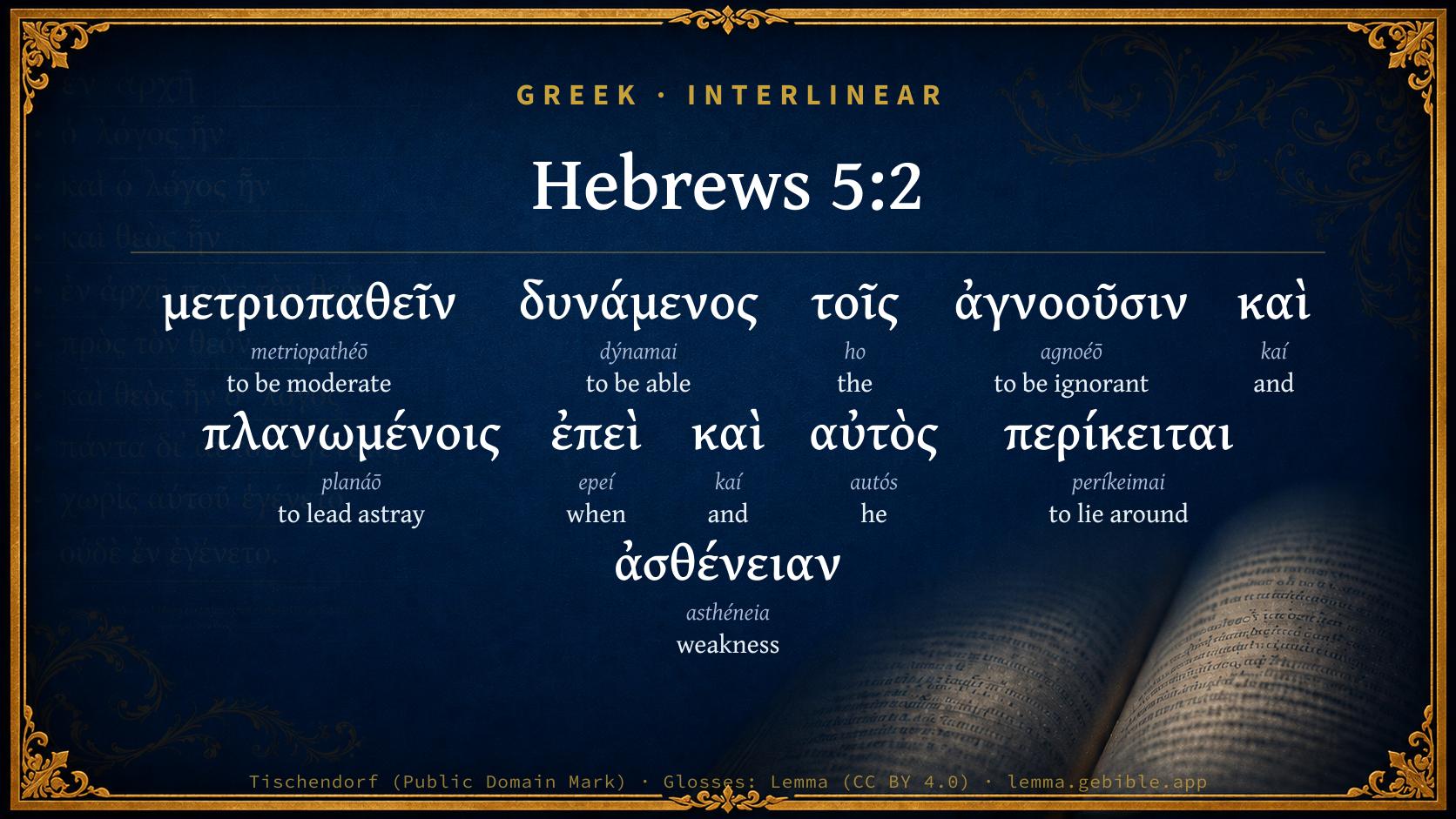
Greek (Tischendorf 8th ed.) Hebrews 5:2 appears in the Greek New Testament. The text above is from the Tischendorf 8th edition. Each word links to its Strong’s number and a concise gloss. Click any word for its full Thayer’s Greek Lexicon entry.
Download image
Cite this verse

Hebrews 5:2 (World English Bible). Public Domain. Lemma interlinear Bible study tool, https://lemma.gebible.app/v/hebrews/5/2.

Show BibTeX & RIS
BibTeX
RIS
English Translation
The high priest can deal gently with those who are ignorant and going astray, because he himself is also surrounded with weakness.
World English Bible · Public Domain
Highlights
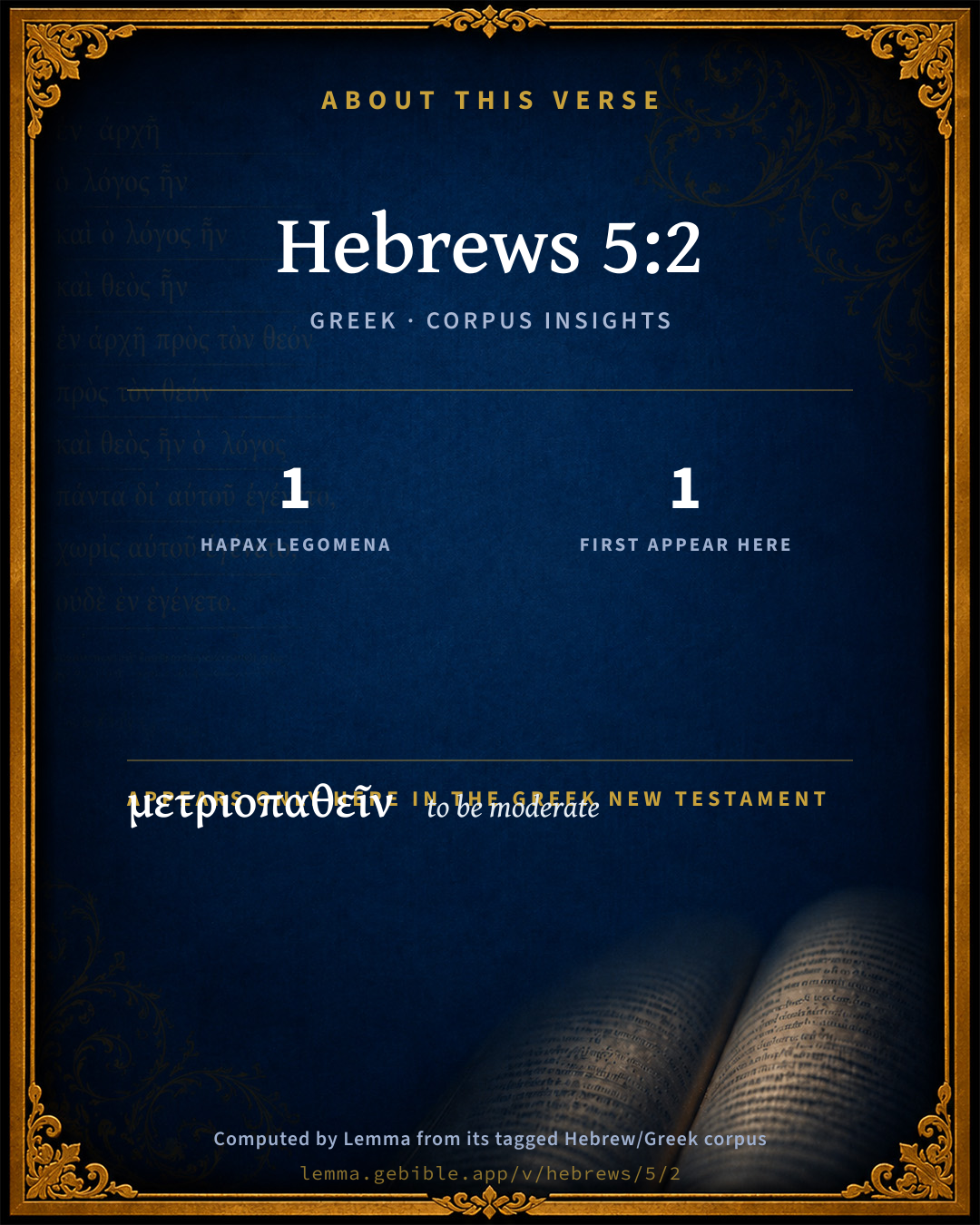
  • 1 hapax legomenon — only here in the Greek New Testament
  • 1 first appearance in the Greek New Testament
Full analysis ↓
Download a study sheet

One document with this verse’s original text, its word-by-word gloss line, the meaning frame, cross-references with their text, attributed commentary, and full source and license credits — printable, and it pastes into notes with its structure intact.

This verse Autodidact and up

Study sheet (.html) Plain text (.txt)

A passage Seminary Student

Up to 50 verses in one chapter. A passage sheet keeps up to 6 commentary sources and 12 cross-references per verse, in the order this page ranks them, and says so on the sheet whenever that leaves anything out. Ask for a single verse and you get the Autodidact verse sheet above.

Everything on this page stays free to read, with no account — the sheet is a download of what is already on screen, not access to it.

Want to remove ads? Support Godless Engineer
Compare translations 3

The same verse in 3 English versions, stacked beneath the original-language interlinear above. Click any original word for its lexicon entry.

Each is an independent rendering of the whole verse — the interlinear is not word-aligned to these translations.

Highlighted words mark where these versions differ — a whole-verse word diff, not a word-by-word alignment.

  • World English Bible Public Domain
    The high priest can deal gently with those who are ignorant and going astray, because he himself is also surrounded with weakness.
  • King James Version Public Domain
    Who can have compassion on the ignorant, and on them that are out of the way; for that he himself also is compassed with infirmity.
  • unfoldingWord Literal Text CC BY-SA 4.0
    being able to deal gently with the ones being ignorant and being deceived, because he also is subject to weakness.

unfoldingWord Literal Text — © unfoldingWord, licensed CC BY-SA 4.0. Word-aligned USFM3 via Door43 (git.door43.org/unfoldingWord/en_ult).

Versions to compare (up to 4)

3 of 4 selected

Show all 19 translations

Every available English version of this verse, each an independent rendering of the whole verse.

  • World English Bible Public Domain
    The high priest can deal gently with those who are ignorant and going astray, because he himself is also surrounded with weakness.
  • Berean Standard Bible Public Domain
    He is able to deal gently with those who are ignorant and misguided, since he himself is beset by weakness.
  • Majority Standard Bible Public Domain
    He is able to deal gently with those who are ignorant and misguided, since he himself is beset by weakness.
  • King James Version Public Domain
    Who can have compassion on the ignorant, and on them that are out of the way; for that he himself also is compassed with infirmity.
  • American Standard Version (1901) Public Domain
    who can bear gently with the ignorant and erring, for that he himself also is compassed with infirmity;
  • Revised Version (1885) Public Domain
    who can bear gently with the ignorant and erring, for that he himself also is compassed with infirmity;
  • Geneva Bible (1599) Public Domain
    Which is able sufficiently to haue compassion on them that are ignorant, and that are out of the way, because that hee also is compassed with infirmitie,
  • Douay-Rheims (1899) Public Domain
    Who can have compassion on them that are ignorant and that err: because he himself also is compassed with infirmity.
  • Young's Literal Translation Public Domain
    able to be gentle to those ignorant and going astray, since himself also is compassed with infirmity;
  • Literal Standard Version CC BY-SA 4.0
    being able to be gentle to those being ignorant and going astray, since he is also surrounded with weakness;
  • Unlocked Literal Bible CC BY-SA 4.0
    He can deal gently with those who are ignorant and who have been deceived, because he himself is subject to weakness.
  • unfoldingWord Literal Text CC BY-SA 4.0
    being able to deal gently with the ones being ignorant and being deceived, because he also is subject to weakness.
  • Darby Bible Public Domain
    being able to exercise forbearance towards the ignorant and erring, since he himself also is clothed with infirmity;
  • World Messianic Bible Public Domain
    The high priest can deal gently with those who are ignorant and going astray, because he himself is also surrounded with weakness.
  • Webster's Bible Public Domain
    Who can have compassion on the ignorant, and on them that are out of the way; for that he himself also is compassed with infirmity.
  • Free Bible Version CC BY-SA 4.0
    The high priest understands how ignorant and deluded people feel because he also experiences the same kind of human weaknesses.
  • Bible in Basic English Public Domain
    He is able to have feeling for those who have no knowledge and for those who are wandering from the true way, because he himself is feeble;
  • Text-Critical English NT CC BY 4.0
    He is able to deal gently with those who are ignorant and going astray, since he himself is subject to weakness.
  • Tyndale New Testament (1534) Public Domain
    which can have compassion on the ignoraunt and on them that are out of the waye because that he him silfe also is compased with infirmitie:

Literal Standard Version (2020), Covenant Press — licensed CC BY-SA 4.0. Text via the HelloAO Bible API (eBible.org). Unlocked Literal Bible (unfoldingWord) — licensed CC BY-SA 4.0. Text via the HelloAO Bible API (eBible.org). unfoldingWord Literal Text — © unfoldingWord, licensed CC BY-SA 4.0. Word-aligned USFM3 via Door43 (git.door43.org/unfoldingWord/en_ult). Free Bible Version, Dr. Jonathan Gallagher — licensed CC BY-SA 4.0. Text via the HelloAO Bible API (eBible.org).

Word by word

More ways to search: Search by grammar → Find every occurrence → Compare this word →

Practice this passage: Drill this verse → Learn its vocabulary →

μετριοπαθεῖν
metriopathéō
G3356
“to be moderate”
Verb, Present, Active, Infinitive
Part of Speech
Verb
Tense
Present
Voice
Active
Mood
Infinitive
Full Thayer's Definition

Origin: from a compound of the base of G3357 and G3806

TDNT: 20:38,8

1. to be affected moderately or in due measure 2. to preserve moderation in the passions, esp. anger or grief a. of one who is not unduly disturbed by the errors, faults, sins of others, but bears them gently
  1. δυνάμενος dýnamai G1410 “to be able” Verb, Present, Middle or Passive deponent, Participle, Nominative, Singular, Masculine
  2. τοῖς ho G3588 “the” Article, Dative, Plural, Masculine
  3. ἀγνοοῦσιν agnoéō G50 “to be ignorant” Verb, Present, Active, Participle, Dative, Plural, Masculine
  4. καὶ kaí G2532 “and” Conjunction
  5. πλανωμένοις planáō G4105 “to lead astray” Verb, Present, Passive, Participle, Dative, Plural, Masculine
  6. ἐπεὶ epeí G1893 “when” Conjunction
  7. καὶ kaí G2532 “and” Conjunction
  8. αὐτὸς autós G846 “he” Personal pronoun, Nominative, Singular, Masculine
  9. περίκειται períkeimai G4029 “to lie around” Verb, Present, Middle or Passive deponent, Indicative, 3rd person, Singular
  10. ἀσθένειαν asthéneia G769 “weakness” Noun, Accusative, Singular, Feminine

About this verse

These counts appear in no published source. They are computed here, from the morphology-tagged text and Lemma’s own curated glosses. What Lemma adds →

11
words
10
distinct lemmas
General Epistles
section

Notable vocabulary

1 hapax legomenon — a word that appears only here in the entire Greek New Testament:

  • μετριοπαθεῖν to be moderate G3356

First appearance in Scripture

This word makes its first canonical appearance in the Greek New Testament here:

  • μετριοπαθεῖν to be moderate G3356

Shared distinctive vocabulary

περίκειται to lie around G4029 occurs in 5 verses of the Greek New Testament. Also found in:

Repetition

A word recurs within this verse:

Cross-references

17

Topical passages linked to Hebrews 5:2 in the Treasury of Scripture Knowledge — connected by theme and wording, ordered by reader-vote popularity; previews shown in the World English Bible.

  • Hebrews 4:15 For we don't have a high priest who can't be touched with the feeling of our infirmities, but one who has been in all points tempted like we are, yet without sin.
  • Hebrews 2:18 For in that he himself has suffered being tempted, he is able to help those who are tempted.
  • 2 Corinthians 12:9–10 He has said to me, "My grace is sufficient for you, for my power is made perfect in weakness." Most gladly therefore I will rather glory in my weaknesses, that the power of Christ may rest on me.
  • Hebrews 7:28 For the law appoints men as high priests who have weakness, but the word of the oath which came after the law appoints a Son forever who has been perfected.
  • Hebrews 12:13 and make straight paths for your feet, so that which is lame may not be dislocated, but rather be healed.
  • Numbers 15:22–29 When you shall err, and not observe all these commandments, which Yahweh has spoken to Moses,
  • 2 Corinthians 12:5 On behalf of such a one I will boast, but on my own behalf I will not boast, except in my weaknesses.
  • Galatians 4:13 but you know that because of weakness of the flesh I preached the Gospel to you the first time.
  • Exodus 32:21–24 Moses said to Aaron, "What did these people do to you, that you have brought a great sin on them?"
  • Numbers 12:1–9 Miriam and Aaron spoke against Moses because of the Cushite woman whom he had married; for he had married a Cushite woman.
  • 2 Corinthians 11:30 If I must boast, I will boast of the things that concern my weakness.
  • 1 Timothy 1:13 although I was before a blasphemer, a persecutor, and insolent. However, I obtained mercy, because I did it ignorantly in unbelief.
  • Exodus 32:2–5 Aaron said to them, "Take off the golden rings, which are in the ears of your wives, of your sons, and of your daughters, and bring them to me."
  • Exodus 32:8 They have turned aside quickly out of the way which I commanded them. They have made themselves a molten calf, and have worshiped it, and have sacrificed to it, and said, 'These are your gods, Israel, which brought you up out of the land of Egypt.'"
  • Numbers 20:10–12 Moses and Aaron gathered the assembly together before the rock, and he said to them, Hear now, you rebels; shall we bring you forth water out of this rock?
  • Isaiah 30:11 get out of the way, turn aside out of the path, cause the Holy One of Israel to cease from before us."
  • Luke 22:32 but I prayed for you, that your faith wouldn't fail. You, when once you have turned again, establish your brothers."

Cross-references courtesy of OpenBible.info (CC BY 4.0).

Commentary

Notes on Hebrews 5:2 from classic Christian and Jewish commentators (each source and its license shown beneath its notes). The classic Christian expositions comment on the surrounding passage and are grouped to its opening verse, so a note may address several verses; the Jewish commentaries on the Tanakh (Rashi and others) are per-verse, so they appear only where the commentator wrote on this verse.

Lemma curates 59 commentaries, every one of them public domain or Creative Commons licensed, each selected and text-cleaned for this edition rather than reprinted as found. About our sources →

Joseph Benson's Commentary

Heb 5:2-3. Who can have compassion — The word μετριοπαθειν, here used, signifies to feel compassion in proportion to the misery of others. The apostle’s words imply that a high-priest, who is not touched with a feeling of the weaknesses and miseries of others, is unfit to officiate for them, because he will be apt to neglect them in his ministrations, or be thought by the people in danger of so doing. On the ignorant — Who, not being properly instructed in divine things, are involved in error with respect to them; and on them that are out of the way — Of truth and duty, of wisdom, holiness, and happiness; or who, through their ignorance or any other cause, fall into sin: so that all sins and sinners are here comprehended. For that he himself is compassed with infirmity — So that under a consciousness thereof, he will officiate for them with the greater kindness and assiduity, knowing that he needs the compassion which he shows to others. And by reason hereof — Because he himself is a sinner; he ought, as for the people, so also for himself, (see the margin,) to offer for sins — That, being pardoned himself, and in a state of reconciliation and peace with God, he may offer for others with more acceptance. We are not to infer from this that Christ had any sins of his own to offer for, or that he offered any sacrifice for himself, it being repeatedly affirmed by the apostles that he was absolutely free from all sin.

Joseph Benson's Commentary on the Old and New Testaments (1811–1818) — public domain. Text from a community e-Sword module.

Tyndale Open Study Notes

Tyndale Open Resources

5:2 A high priest was able to deal gently with those who sin because he himself was subject to the same weaknesses, i.e., he was sinful (5:3; cp. 4:15).

Tyndale Open Study Notes — © Tyndale Open Resources, licensed CC BY-SA 4.0. Text via the HelloAO Bible API.

Bengel's Gnomon

Johann Albrecht Bengel

Heb 5:2. Μετριοπαθεῖν, To have a feeling of moderation [have compassion]) Hesychius, μετριοπαθὴς μικρὰ πάσχων ἢ συγγινώσκων ἐπιεικῶς. Τὸ μέτρον, moderation is opposed to severity and rigour, which are shown towards none but the obstinate; ch. Heb 10:28.—δυνάμενος, who is able) who does not please Himself; comp. Rom 15:3.—ἀγνοοῦσι καὶ πλανωμένοις, to the ignorant and them that are out of the way [in error]) those that sin through ignorance and error: שגה, LXX., ἀγνοεῖν, to be ignorant. Simple ignorance is merely want of attention and memory; but error (being out of the way) interchanges [confounds] good and evil, truth and falsehood.—ἀσθενείαν, infirmity) which is sinful and to be expiated by sacrifices.

Bengel's Gnomon of the New Testament — English translation (T&T Clark, Edinburgh, 1860) — public domain. Text from a community e-Sword module.

Expositor's Greek Testament

ed. W. Robertson Nicoll

Heb 5:2 . μετριοπαθεῖν δυνάμενος : “as one who is able to moderate his feeling”. The Vulgate is too strong: “qui condolere possit”; Grotius has: “non inclementer affici”; Weizsäcker: “als der billig fühlen kann”; and Peirce: “who can reasonably bear with”. As the etymology shows, it means “to be moderate in one’s passions”. It was opposed by Aristotle to the ἀπάθεια of the Stoics. [Diog. Laert., Arist .: ἔφη δὲ τὸν σοφὸν μὴ εἶναι μὲν ἀπαθῆ μετριοπαθῆ δέ : not without feeling, but feeling in moderation; and Peirce, Tholuck, and Weiss conclude that the word was first formed by the Peripatetics; Tholuck expressly; and Weiss, “stammt aus dem philosophischen Sprachge-brauch”. Cf. the chapter of Philo ( Leg. Allegor. , iii., 45; Wendland’s ed., vol. i. 142) in which he puts ἀπάθεια first and μετριοπάθ . second; and to the numerous exx. cited by Wetstein and Kypke, add Nemesius, De Natura Hominis , cxix., where the word is defined in relation to grief. Josephus ( Ant. , xii. 3, 2) remarks upon the striking self-restraint and moderation ( μετριοπαθησάντων ) of Vespasian and Titus towards the Jews notwithstanding their many conflicts.] If the priest is cordially to plead with God for the sinner, he must bridle his natural disgust at the loathsomeness of sensuality, his impatience at the frequently recurring fall, his hopeless alienation from the hypocrite and the superficial, his indignation at any confession he hears from the penitent. This self-repression he must exercise τοῖς ἀγνοοῦσι καὶ πλανωμένοις : “the ignorant and erring”. The single article leads Peirce and others to render as a Hendiadys = τοῖς ἐξ ἀγνοίας πλαν ., those who err through ignorance. ἄγνοια is not frequent in LXX, but in Eze 42:13 , and also in chaps. 44 and 46, it translates אָשָׁם , but in Lev 5:18 and in Ecc 5:5 it translates שְׁגָגָה which in Lev 4:2 and elsewhere is rendered by ἀκουσίως . A comparison too of the passages in which the word occurs seems to show that by “sins of ignorance” are meant both sins committed unawares or accidentally, and sins into which a man is betrayed by passion. They are opposed to presumptuous sins, sins with a high hand ἐν χειρὶ ὑπερηφανίας , בְידָ רָמָה (Num 15:30 ), sins which constitute a renunciation of God and for which there is no sacrifice, cf. Heb 10:26 . ἐπεὶ καὶ αὐτὸς περίκειται ἀσθένειαν : “since he himself also is compassed with infirmity,” giving the reason or ground of μετριοπ . δυνάμενος . περίκειμαι , “I lie round,” as in Mar 9:42 , Luk 17:2 with περί and in Heb 12:1 with dative. In Act 28:20 , τὴν ἅλυσιν ταύτην περίκειμαι , it is used passively as here, followed by an accusative according to the rule that verbs which in the active govern a dative of the person with an accusative of the thing, retain the latter in the passive. See Winer, p. 287, and Rutherford’s Babrius . The priests, living for the greater part of the year in their own homes, were known to have their weaknesses like other men, and even the high priests were not exempt from the common passions. Their gorgeous robes alone separated them from sinners, but like a garment infirmity clung around them. “How the very sanctity of his office would force on the attention of one who was not a mere puppet priest the contrast between his official and his personal character, as a subject of solemn reflection” (Bruce).

The Expositor's Greek Testament, edited by W. Robertson Nicoll (1897–1910) — public domain. Text from a community e-Sword module.

Geneva Bible (1599)

Geneva Bible translators

On them that are sinful: for in the Hebrew tongue, under ignorance and error is every sin meant, even that sin that is voluntary.

For that he himself beareth about with him a nature subject to the same discommodities and vices.

Fit and meet.

Geneva Bible (1599) marginal notes — public domain. Text via Bolls.life.

Jamieson, Fausset & Brown

Robert Jamieson, A. R. Fausset & David Brown

Who can--Greek, "being able"; not pleasing himself (Rom 15:3).

have compassion--Greek, "estimate mildly," "feel leniently," or "moderately towards"; "to make allowance for"; not showing stern rigor save to the obstinate (Heb 10:28).

ignorant--sins not committed in resistance of light and knowledge, but as Paul's past sin (Ti1 1:13). No sacrifice was appointed for wilful sin committed with a high hand; for such were to be punished with death; all other sins, namely, ignorances and errors, were confessed and expiated with sacrifices by the high priest.

out of the way--not deliberately and altogether wilfully erring, but deluded through the fraud of Satan and their own carnal frailty and thoughtlessness.

infirmity--moral weakness which is sinful, and makes men capable of sin, and so requires to be expiated by sacrifices. This kind of "infirmity" Christ had not; He had the "infirmity" of body whereby He was capable of suffering and death.

Jamieson, Fausset & Brown — Commentary Critical and Explanatory on the Whole Bible (1871) — public domain (CC PDM 1.0). Text via the HelloAO Bible API.

Adam Clarke's Commentary

Verse 2. Who can have compassion on the ignorant] The word μετριοπαθειν, signifies, not merely to have compassion, but to act with moderation, and to bear with each in proportion to his ignorance, weakness, and untoward circumstances, all taken into consideration with the offences he has committed: in a word, to pity, feel for, and excuse, as far as possible; and, when the provocation is at the highest, to moderate one's passion towards the culprit, and be ready to pardon; and when punishment must be administered, to do it in the gentlest manner.

Instead of αγνοουσι, the ignorant, one MS. only, but that of high repute, has ασθενουσι, the weak. Most men sin much through ignorance, but this does not excuse them if they have within reach the means of instruction. And the great majority of the human race sin through weakness. The principle of evil is strong in them; the occasions of sin are many; through their fall from God they are become exceedingly weak; and what the apostle calls, Heb 12:1, that ευπεριστατον αμαρτιαν, the well-circumstanced sin, often occurs to every man. But, as in the above ease, weakness itself is no excuse, when the means of strength and succour are always at hand. However, all these are circumstances which the Jewish high priest took into consideration, and they are certainly not less attended to by the High Priest of our profession.

The reason given why the high priest should be slow to punish and prone to forgive is, that he himself is also compassed with weakness; περικειται ασθενειαν; weakness lies all around him, it is his clothing; and as he feels his clothing, so should he feel it; and as he feels it, so he should deplore it, and compassionate others.

Adam Clarke's Commentary on the Bible (1810–1826) — public domain. Text from a community e-Sword/MySword module.

John Calvin's Commentaries

2. Who can, etc. This fourth point has some affinity to the first, and yet it may be distinguished from it; for the Apostle before taught us that mankind are united to God in the person of one man, as all men partake of the same flesh and nature; but now he refers to another thing, and that is, that the priest ought to be kind and gentle to sinners, because he partakes of their infirmities. The word which the Apostle uses, μετριοπαθεῖν is differently explained both by Greek and Latin interpreters. I, however, think that it simply means one capable of sympathy. All the things which are here said of the Levitical priests do not indeed apply to Christ; for Christ we know was exempt from every contagion of sin; he therefore differed from others in this respect, that he had no necessity of offering a sacrifice for himself. But it is enough for us to know that he bare our infirmities, though free from sin and undefiled. Then, as to the ancient and Levitical priests, the Apostle says, that they were subject to human infirmity, and that they made atonement also for their own sins, that they might not only be kind to others when gone astray, but also condole or sympathize with them. This part ought to be so far applied to Christ as to include that exception which he mentioned before, that is, that he bare our infirmities, being yet without sin. At the same time, though ever free from sin, yet that experience of infirmities before described is alone abundantly sufficient to incline him to help us, to make him merciful and ready to pardon, to render him solicitous for us in our miseries. The sum of what is said is, that Christ is a brother to us, not only on account of unity as to flesh and nature, but also by becoming a partaker of our infirmities, so that he is led, and as it were formed, to show forbearance and kindness. The participle, δυνάμενος is more forcible than in our common tongue, qui possit, “who can,” for it expresses aptness or fitness. The ignorant and those out of the way, or erring, he has named instead of sinners, according to what is done in Hebrew; for שגגה, shegage, means every kind of error or offense, as I shall have presently an occasion to explain.

John Calvin's Commentaries (1540-1563) — public domain. Text from the Calvin Translation Society English edition (1840s-50s) via the Christian Classics Ethereal Library (ccel.org). Calvin's coverage is partial (roughly two-thirds of the Bible); uncommented books and verses are honest gaps, never fabricated. The 19th-century editor's footnotes and remarks are omitted so the notes are faithfully Calvin's own voice.

Ellicott's Commentary for English Readers

(2) Who can have compassion.—Rather, as one who can deal gently with (or, more strictly, feel gently towards) the ignorant and erring, because . . . Either apathy or undue severity in regard to transgression would disqualify this representative of men to God. It cannot be said that sin is mildly designated here, since the words so closely resemble those which occur in Heb_3:10; still the language is so chosen as to exclude sinning “with a high hand.”

A Bible Commentary for English Readers, edited by Charles John Ellicott (1878–1897) — public domain. Text from a community e-Sword module.

The Cambridge Bible for Schools and Colleges

gen. ed. J. J. S. Perowne

2. have compassion on] Rather, “deal gently with” The word metriopathein means properly “to shew moderate emotions.” All men are liable to emotions and passions (pathç). The Stoics held that these should be absolutely crushed and that “apathy” (ἀπάθεια) was the only fit condition for a Philosopher. The Peripatetics on the other hand—the school of Aristotle—held that the philosopher should not aim at apathy, because no man can be absolutely passionless without doing extreme violence to nature; but that he should acquire metriopathy that is a spirit of “moderated emotion” and self-control. The word is found both in Philo and Josephus. In common usage it meant “moderate compassion;” since the Stoics held “pity” to be not only a weakness but a vice. The Stoic apatheia would have utterly disqualified any one for true Priesthood. Our Lord yielded to human emotions such as pity, sorrow, and just anger; and that He did so and could do so, “yet without sin,” is expressly recorded for our instruction.

on the ignorant, and on them that are out of the way] Highhanded sinners, willing sinners, those who, in the Hebrew phrase, sin “with upraised hand” (Num_15:30; Deu_17:12), cannot always be treated with compassionate tenderness (Heb_10:26); but the ignorant and the erring (1Ti_1:13)—those who sin “inadvertently,” “involuntarily” (Lev_4:2; Lev_4:13, &c.)—and even those who under sudden stress of passion and temptation sin wilfully—need pity (Lev_5:1; Lev_19:20-22), and Christ’s prayer on the cross was for those “who know not what they do.” No untempted Angel, no Being removed from the possibility of such falls, could have had the personal sympathy which is an indispensable requisite for perfect Priesthood.

is compassed with infirmity] Moral weakness is part of the very nature which, he wears, and which makes him bear reasonably with those who are like himself. The same Greek phrase (perikeimai with an accusative) occurs in Act_28:20 (“I am bound with this chain”), “Under the gorgeous robes of office there were still the galling chains of flesh.” Kay.

The Cambridge Bible for Schools and Colleges (gen. ed. J. J. S. Perowne; Cambridge University Press, 1878–1918) — public domain. Text from a community e-Sword module.

John Gill's Exposition

Who can have compassion on the ignorant,.... Who have committed sins of ignorance, and bring their sacrifices for them; these he does not insult and upbraid, nor break out into anger and indignation against; but pities them, and sympathizes with them; has a just measure of compassion suitable to their condition, and bears with them with great moderation and temper:

and on them that are out of the way; of God's commandments; who are like sheep going astray, and turn to their own way; who transgress the law of God, and err from it; perhaps such who sin knowingly and wilfully, and through infirmity, are meant:

for that he himself also is compassed with infirmity; not of body only, but of mind, sinful infirmity; he had much of it, it beset him all around; he was "clothed" with it, as the Syriac version renders it; as Joshua the high priest was with filthy garments, Zac 3:3.

John Gill's Exposition of the Whole Bible (1746–1763) — public domain (CC PDM 1.0). Text via the HelloAO Bible API.

Trapp's Complete Commentary

John Trapp

2 Who can have compassion on the ignorant, and on them that are out of the way; for that he himself also is compassed with infirmity.

Ver. 2. Who can have compassion] μετοιοπαθειν. Or, bear anything with reason, and not be easily angry, but show as much mercy as is meet for his, whether they have ignorantly offended, or upon deliberation. They cannot commit more than he can remit.

He is compassed with infirmity] Christ was compassed with that which we call miserable, not that we call sinful infirmity.

John Trapp, A Commentary or Exposition upon All the Books of the Old and New Testament (1647–1656) — public domain. Text from a community e-Sword module.

Albert Barnes' Notes on the Bible

Who can have compassion - Margin, “Reasonably bear with.” The idea is that of “sympathizing with.” The high priest is taken from among men, in order that he may have a fellow-feeling for those on whose behalf he officiates. Sensible of his own ignorance, he is able to sympathize with those who are ignorant; and compassed about with infirmity, he is able to succour those who have like infirmities.

And on them that are out of the way - The erring, and the guilty. If he were taken from an order of beings superior to people, be would be less qualified to sympathize with those who felt that they were sinners, and who needed pardon.

For that he himself also is compassed with infirmity - see chap. Heb 7:28. He is liable to err; He is subject to temptation; he must die, and appear before God - and encompassed with these infirmities, he is better qualified to minister in behalf of guilty and dying people. For the same reason it is, that the ministers of the gospel are chosen from among people. They are of like passions with others. They are sinners; they are dying men. They can enter into the feelings of those who are conscious of guilt; they can sympathize with those who tremble in dread of death; they can partake of the emotions of those who expect soon to appear before God.

Albert Barnes' Notes on the Bible (1834–1885) — public domain. Text from a community e-Sword/MySword module.

Matthew Poole's English Annotations

Who can have compassion on the ignorant: the melting quality of the typical high priest is eminently to be fulfilled in the gospel one; each is to have an aptness, disposition, and a sufficiency of it, by the institution of God, for his ministrations, for manner as well as for matter, Heb 2:18; 4:15. Μετριοπαθειν, strictly, is to bear, suffer, or be affected in measure, or suffer moderately, with the failings of others, in such a degree as is necessary to incline, as far as he is able, to succour, help, and comfort those who are in misery. It notes sympathy, Heb 2:18; Rom 12:15; and a suffering with them, yet so regulated by the Divine rule, as not to extend it unto unfit subjects, nor in an undue measure, lest it unfits him for ministerting for them. But the great High Priest excelleth in this, and is not bound to our measures, but sinlessly overabounds in it, to such as sin for want of knowledge of their duty, unwittingly, and without any forecast, for which the law provided a sacrifice, Lev 4:2; Num 15:24-29.

And on them that are out of the way; πλανωμενοις a metaphor borrowed from travellers gone out of their way; by which are understood such sinners as are misled by infirmity or violence of temptation, and so offend God by their opinions or practices; for the expiation of such were those sacrifices appointed, Lev 5:6,7; but then they were such as were sensible of their sins, confessed them, and begged for pardon, of whom the High Priest was to be compassionate; but not of presumptuous and capital sinners, who were unfit subjects of God’s mercy or man’s: there being no sacrifices provided for such, but they were to die without mercy, Num 15:30,31; compare Exo 22:14. God’s altar itself is no protection to them, 1Ki 2:28,31. Such sins of infirmity which the Levitical high priest was liable to himself, was he to be compassionate of.

For that he himself also is compassed with infirmity; for that he was beset with infirmity, sin, ignorance, error, and disobedience; infirm in respect of duty and sacrifice, which was by reason of its weakness to be repeated yearly, Heb 10:1,11; and of the same infirm nature, liable to the griefs and miseries of his brethren both in soul and body. All these did surround and lie about him; he was sin and weakness all over, and therefore should be the more feeling of his brethren’s states, and more careful and ready to sacrifice and intercede for himself and them. But our great High Priest hath all the sense of these, but no sin, Heb 4:15.

Matthew Poole's English Annotations on the Holy Bible (1683–1685) — public domain. Text from a community e-Sword/MySword module.

Whedon's Commentary on the Bible

Daniel D. Whedon

2. Who can have compassion—The reason that the sinner should be represented by a man; the need of a humanly sympathizing representative. Priest and sinner should have a common ground.

Compassion—A medium word, not signifying either deep passion or unfeelingness, but considerateness.

Ignorant—Complete moral ignorance, from the first wholly involuntary, excuses guilt; but there is little of human moral ignorance which is not in some way guiltily incurred, and so is measurably responsible. Hence there were sins of ignorance, as well as sins of immediate knowledge, which needed atonement.

Out of the way— Literally, the wandering, the knowing deviators from the true path, with no ignorance to plead.

Compassed with infirmity—Susceptible to sin, and encircled with tempting excitements to his susceptibilities.

Daniel D. Whedon (gen. ed.), Commentary on the Old and New Testaments (1874–1909) — public domain. Text from a community e-Sword module.

The Pulpit Commentary

Who can have compassion on the ignorant and erring; for that he himself also is compassed with infirmity. It is not easy to find a satisfactory English equivalent for metriopayein , translated as above in the A.V; by Alford, "be compassionate towards;" in the margin of the A.V, "reasonably bear with;" by the recent Revisers, "bear gently with;" by Bengel, "moderate affici." The compound had its origin, doubtless, in the peripatetic school, denoting the right mean between passionateness and Stoic apathy, being the application of Aristotle"s mesothv to the sphere of the passions. Thus Diog. Laert. says of Aristotle, Efh de ton sofon mh einai men apayh metriopayqh de . In this sense Philo uses metriopayh to express Abraham"s sober grief after the death of Sarah (2:37) and Jacob"s patience under his afflictions (2:45). The verb, followed, as here, by a dative of persons, may be taken, therefore, to denote moderation of feeling towards the persons indicated, such moderation being especially opposed in the ease before us, where the persons are the ignorant and erring, to excess of severe or indignant feeling. Moderation, indeed, in this regard seems to have been the idea generally attached to the compound (cf. Plut., "De Ira Cohib." p. 453, Anasth swsai kai feisasyai kai karterhsai praothtov esti kai suggnwmhv kai metriopayeiav). Josephus also speaks of the emperors Vespasian and Titus as metriopayhsantwn in their attitude towards the Jews after long hostility ("Ant.," 12:3 2). This, then, being the meaning of metriopayeia , it is obvious how the capacity of it is essential to the idea of a high priest as being one who is resorted to as a mediator by a people laden with infirmities, to represent them and to plead for them. It is not of necessity implied that every high priest was personally netriopayhv : it is the ideal of his office that is spoken of. And, in the ease of human high priests, this ideal was fulfilled by their being themselves human, encompassed themselves with the infirmity of those for whom they mediated. Christ also, so far, evidently fulfils the condition. For, though he is afterwards distinguished (Heb_7:28) from priests having themselves infirmity, yet he had, in his human nature, experienced what it was: "He was crucified ex asyeneiav"; (2Co_13:4) "Himself took our infirmities (asyeneiav), and bare our sicknesses"; (Mat_8:17 Isa_53:4) the agony in the garden (whatever its mysterious import, of which more below) expressed personal experience of human asyeneia . Alford denies that asyeneia , in the sense supposed by him to be here intended, can be attributed to Christ, and hence that perikeitai asyeneiaiv can apply to him. (but see above on Heb_4:15, and below on vers. 3, 7)

HOMILIES BY W. JONES. Ver. 2. An essential qualification for successful ministry.

"Who can have compassion on the ignorant," etc. According to our reading of the New Testament, the Christian ministry is not a priesthood except in the sense that, being Christians, ministers belong to that "holy priesthood," that "royal priesthood," of which every true Christian is g member. Yet there were certain qualifications of the Aaronic priesthood which are indispensable to the usefulness of the Christian ministry. One of these is mentioned in our text; its nature will appear as we proceed. The text suggests

I THAT SINS DIFFER IN THE DEGREE OF THEIR GUILT. In this respect several things have to be taken into account.

1. There are differences in the sins themselves. The wickedness of sins of presumption is far greater than that of sins of ignorance. (cf. Num_15:27-31) Sins of rebellion are far removed from sins of error. The persons mentioned in our text are not those who have sinned "with a high hand," but "the ignorant and erring those who have sinned by reason of moral "infirmity," or who have wandered from the way of truth and duty because of their own spiritual negligence. Such sinners are by no means guiltless, but they are much less guilty than some others.

2. There are differences in the conditions and circumstances in which sins are committed. The force of the solicitation to sin, the strength of inherited tendency to certain forms of moral evil, the quality of the moral atmosphere surrounding the sinner, these greatly differ amongst men; and this and other considerations -must be carefully weighed before the guilt of any sin can be fairly estimated. Two persons may commit the same identical crime, yet the guilt may be inconceivably greater in the one case than the ether. The one may have had no instruction, no benefit from parental culture, no faithful admonitions, no holy example to direct and regulate, no warning to restrain, no encouragement to animate in the path. The other may have been surrounded by all the helps and inducements to right consideration to holy fear, to correct conduct and therefore his sin is marked with a far higher degree of aggravation than the sin of the other; and thus, in the sight of God, the judge on the bench often may be far more guilty than the criminal at the bar.

II THE WISE AND GOOD MINISTER TO SOULS WILL PRACTICALLY RECOGNIZE THESE DIFFERENCES IN THE GUILT OF SINS. Only the Omniscient can perfectly discriminate in this respect, yet the text indicates a discrimination and consideration which every one who would minister helpfully to souls will endeavor to exercise.

1. He will not harshly condemn sinners. He is metriopayhv . On the one hand, he is not unfeeling; on the other, he is not carried away by his feelings, but he regulates and moderates his feelings; he has control over his passions.

2. He will endeavor to discriminate sins of ignorance and error from sins of a darker hue. He will deal thoughtfully with souls, not regarding all sinners as equally guilty or all sins as equally heinous. In so doing he will be following precedents of unquestionable authority. Our Lord and his apostles thus discriminated, and made merciful allowance for the ignorance and error of sinners. (see Luk_23:34 Act_3:17 1Ti_1:13 1Pe_2:25)

3. He will treat the ignorant and the erring with gentleness. He will "have compassion on the ignorant," etc.; margin, "reasonably bear with;" Revised Version, "who can bear gently with the ignorant and erring." How beautiful and sublime is our Savior"s example in this respect! For his crucifiers he prayed, "Father, forgive them; for they know not what they do.

III THE CONSCIOUSNESS OF HIS OWN MORAL INFIRMITY SHOULD INDUCE THE CHRISTIAN MINISTER TO DEAL THUS GENTLY WITH THE IGNORANT AND THE ERRING. "For that he himself also is compassed with infirmity.

1. His own moral infirmity qualifies him to understand the moral ignorances and errors of others. He has had to contend against sinful inclinations and Satanic temptations. He knows from his own experience how easily the soul is sometimes led astray, and he can enter into the moral wanderings and sorrowful returnings of others.

2. His own moral infirmity should lead him, to be patient and gentle with the ignorant and erring. He has himself required and received forbearance at the hands of both God and man. He will very probably need similar forbearance in time to come. How, then, can he be intolerant or harsh with others? Our own need of mercy and patience from others, and preeminently from God, should lead us to be merciful and patient with others. The chief lesson of our subject is applicable to all who would render spiritual services to their fellow-men. Let parents, and instructors of the young, and preachers of the gospel, and pastors of Churches, ever remember that if they would benefit the ignorant and erring they must be forbearing and gentle with them. Sternness and severity will repel and discourage, and probably aggravate moral infirmity into moral perversity. But patience and. charity will encourage worthy hopes in the breasts of those who have gone astray, and restore them to the path of truth and. duty, and inspire them to more earnest and patient efforts in Christian life and service. Be it ours, not to condemn the ignorant and erring, but to instruct and restore them. W.J.

The Pulpit Commentary (1880–1919), ed. H.D.M. Spence-Jones & Joseph S. Exell — public domain. Text from a community e-Sword module.

John Wesley's Explanatory Notes

Who can have compassion - In proportion to the offense: so the Greek word signifies. On the ignorant - Them that are in error. And the wandering - Them that are in sin. Seeing himself also is compassed with infirmity - Even with sinful infirmity; and so needs the compassion which he shows to others.

John Wesley, Explanatory Notes Upon the Whole Bible (1754–1765) — public domain. Text via the GEBible commentary corpus.

Burkitt's Expository Notes on the New Testament

William Burkitt

Our apostle proceeds in giving the character of the high priest which God required under the law; he must have compassion for men, for sinful men, being compassed with sinful infirmities himself.

Observe here, 1. A great and necessary qualification of endowment of an high priest he was, and is one able to have compassion; that is, able with all meekness and gentleness, with all patience and forbearance, to bear the infirmities, sins, and provocations of men, even as a nurse bears with the weakness and frowardness of a poor infant.

Observe, 2. The peculiar object of his compassionate care and regard; namely those of his compassionate care and regard; namely, those that are ignorant, and do wander out of the way; in these two words does the apostle comprise all sorts of sinners whatsoever, with all sorts and kinds of sin.

Observe, 3. A special reason rendered why the high priest was thus compassionate, because he himself is compassed with infirmities; his own condition will mind him of his duty in this matter, being beset on every hand with infirmities of his own.

Learn hence, 1. That it is a mighty privilege to us, that our Lord Jesus Christ, our Great High Priest, was encompassed with the sinless infirmities of our nature.

2. That no sort of sinners are excluded from an interest in the care and love of our compassionate High Priest; such as are ignorant, and such as are out of the way, he has compassion upon both; none are excluded, but those who by unbelief do exclude themselves, and cause the blood of the reconciling sacrifices to cry against them.

William Burkitt's Expository Notes on the New Testament (1700–1703) — public domain. Text from a community e-Sword module.

The People's New Testament

B. W. Johnson

2. Who can have compassion, etc. It is needful that the high priest be one in sympathy with men, because he has experienced in person the common infirmities of the race. Otherwise, how could he be a merciful high priest touched by the infirmities of men?

B. W. Johnson's The People's New Testament with Notes (1889–1891) — public domain. Electronic text from the Christian Classics Ethereal Library (CCEL) ThML edition.

Cambridge Greek Testament for Schools and Colleges

2. μετριοπαθεῖν, “deal gently with.” The word means properly “to shew moderate emotions.” All men are liable to emotions and passions (πάθη). The Stoics held that these should be absolutely crushed and that “apathy” (ἀπάθεια) was the only fit condition for a Philosopher. The Peripatetics on the other hand—the school of Aristotle—held that the philosopher should not aim at apathy, because no man can be absolutely passionless without doing extreme violence to nature; but that he should acquire metriopathy (τὸν σοφὸν μὴ εἶναι μὲν ἀπαθῆ, μετριοπαθῆ δέ, Diog. Laert.), that is a spirit of “moderated emotion” and self-control. The word is found both in Philo and Josephus. In common usage it meant “moderate compassion”; since the Stoics held “pity” to be not only a weakness but a vice. The Stoic apathy would have utterly disqualified any one for true Priesthood. Our Lord yielded to human emotions such as pity, sorrow, and just anger; and that He did so and could do so, “yet without sin,” is expressly recorded for our instruction.

τοῖς ἀγνοοῦσιν καὶ πλανωμένοις, “with the ignorant (Luk 23:34) and erring” (1Pe 2:25). Highhanded sinners, willing sinners, those who, in the Hebrew phrase, sin “with upraised hand” (Num 15:30; Deu 17:12), cannot always be treated with compassionate tenderness (Heb 10:26); but the ignorant and the erring (1Ti 1:13)—those who sin “inadvertently,” “involuntarily,” “through human frailty” (Lev 4:2; Lev 4:13, &c.)—and even those who under sudden stress of passion and temptation sin wilfully (Lev 5:1; Lev 19:20-22)—need pity, and Christ’s prayer on the cross was for those “who know not what they do.” No untempted Angel, no Being removed from the possibility of such falls, could have had the personal sympathy which is an indispensable requisite for perfect Priesthood.

περίκειται ἀσθένειαν. Comp. Theocr. Idyll. XXIII. 14 ὕβριν περικείμενος. Moral weakness is part of the very nature which he wears, and which makes him bear reasonably with those who are like himself. The same phrase (περίκειμαι with an accusative) occurs in Act 28:20 (τὴν ἅλυσιν ταύτην περίκειμαι).

Cambridge Greek Testament for Schools and Colleges (Cambridge University Press, 1896; 21 vols, various authors incl. Carr, Maclear, Plummer, Farrar, Lumby, Moule, M. R. James, Simcox) — public domain. Text from a community e-Sword module.

Alford’s Greek Testament

Henry Alford

2.] being (one who is) able (this clause is closely bound to the last, and belongs to it, not to the whole sentence. It is in fact a conditioning participial clause to ἵνα προσφέρῃ, and at the same time a retrospective epexegesis of ἐξ ἀνθρώπων λαμβανόμενος) to be compassionate (μετριοπαθέω is a word apparently invented to serve the view of the Peripatetic school, as opposed to the ἀπάθεια of the Stoics. They held that we ought to rule our passions by reason, and denominated such moderation μετριοπάθεια. The word is not found,—except in a Pythagorean fragment of Archytas in Stobæus, of doubtful authenticity,—before the time of Alexander: Diog. Laert. v. 31 says, ἔφη δὲ (Aristotle) τὸν σοφὸν μὴ εἶναι μὲν ἀπαθῆ, μετριοπαθῆ δέ. See numerous other examples in Bleek. Hence we have the verb and its cognates frequently used of moderating the passion of anger: Plut. de Ira Cohib. p. 453, ἀναστῆσαι κ. σῶσαι κ. φείσασθαι κ. καρτερῆσαι πραότητός ἐστι κ. συγγνώμης καὶ μετριοπαθείας: Appian, Bell. Hisp. p. 529, εἰ μετριοπαθῶς σφίσι χρήσεται, παραδοῦσιν ἑαυτούς: Jos. Antt. xii. 3. 2, Οὐεσπατιάνου δʼ ἄν τις καὶ Τίτου τὴν μεγαλοφροσύνην εἰκότως ἐκπλαγείη, μετὰ πολέμους κ. τηλικούτους ἀγῶνας, οὓς ἔσχον πρὸς ἡμᾶς, μετριοπαθησάντων. So the Etym. Mag., μετριοπαθεῖν ἐκ μέρους τὰ πάθη καταδέχεσθαι, συγγινώσκειν: Hesych. μετριοπαθής· μικρὰ πάσχων, ἢ συγγινώσκων ἐπιεικῶς. The meaning here therefore must be given according to this analogy, and the dative following explained as one of direction, or perhaps commodi) towards the ignorant and erring (the former mild word, though frequently used of sinners elsewhere without (e. g. Hos 4:15: Sir. 5:15; 23:2 al.: Judith 5:20: Esdr. 8:75 (72): cf. 2Ch 16:9: and so Thl. here, ὅρα δέ, ὅτι πᾶν ἁμάρτημα ἄγνοια κ. πλάνη γεννᾷ) as well as with the implication of ignorance (see Ecc 5:5: Lev 4:13; Lev 5:18), seems to be here placed, as well as πλανωμένοις, itself at all events a milder term than ἁμαρτάνουσιν, as suitable to the tone of the sentence, in which the feeling of a sinner towards his fellow-sinners is expressed. The sense might be filled up, ‘towards those who (possibly after all) are ignorant and deluded.’ And thus the propriety of the next clause is rendered still greater; both these, ἄγνοια and πλάνη, being the results of ἀσθένεια, with which he himself is encompassed. On the exclusion on the one side from these designations of ‘sinners with a high hand,’ and the inclusion in them, as above, of much more than sins, strictly speaking, of ignorance, see Delitzsch’s note), seeing that he himself also is compassed about with infirmity (on this construction of an acc. with περίκειμαι, compare ref. Acts: so τεῖχος περιβαλέσθαι τὴν πόλιν, Herod. i. 163: Eustath. on Il. τ. p. 1229: ὅρα δὲ καὶ ὅτι τὸ περικεῖσθαι δοτικῇ συνέταξε, λαβὼν αὐτὸ ἀντὶ τοῦ συγκεῖσθαι κ. περιπεπλέχθαι· ἡ μέντοι συνήθεια ἐπὶ τοῦ βαστάζειν κ. φορεῖν τὴν λέξιν τίθησι κ. αἰτιατικῇ συντάσσει, ὡς ἐν τῷ περίκειται τῦφον ἢ πλοῦτον ἢ δυνάστειαν. ἀσθένεια, as in ch. 7:28, that moral weakness which makes men capable of sin. It is never predicated of Christ in this sense: nay, by the terms of 7:28, He is excluded from it. That ἀσθένεια of the flesh, which He bore on Him, and thereby was capable of suffering and of death, was entirely distinct from this. Some have gone even further here, as Œc.—τὸ “περὶ ἁμαρτιῶν” εἰπών, σαφῶς ἐδήλωσεν ὅτι ἀσθένειαν τὴν ἁμαρτίαν ἐκάλεσεν).

Henry Alford, The Greek Testament (1849–1861) — public domain. Text from a community e-Sword module.

Vincent's Word Studies in the New Testament

Marvin R. Vincent

Have compassion [μετιοπαθειν] . N. T. o. o LXX o Class. Originally of the rational regulation of the natural passions, as opposed to the Stoic ajpaqeia, which involved the crushing out of the passions. Often, in later Greek, of moderating anger. It is not identical with sunpaqhsai(ch. 4 5), but signifies to be moderate or tender in judgment toward another's errors. Here it denotes a state of feeling toward the ignorant and erring which is neither too severe nor too tolerant. The high priest must not be betrayed into irritation at sin and ignorance, neither must he be weakly indulgent. The ignorant [τοις αγνοουσι] . Comp. ajgnohmatwn ignorances, ch. 9 7, and Num 14:22 - 31, where the distinction is drawn between sins of ignorance and sins of presumption. Atonement for sins of ignorance was required by the Levitical law as a means of educating the moral perception, and of showing that sin and defilement might exist unsuspected : that God saw evil where men did not, and that his test of purity was stricter than theirs.

For that he himself also is compassed with infirmity [επει και αυτος περικειται ασθενειαν] . Sympathy belongs to the high - priestly office, and grows out of the sense of personal infirmity. The verb is graphic : has infirmity lying round him. Comp. ch. Heb 12:1, of the encompassing [περικειμενον] cloud of witnesses. jAsqeneian the moral weakness which makes men capable of sin. This is denied in the case of Christ. See ch. Heb 7:28.

Marvin R. Vincent, Word Studies in the New Testament (1887–1900) — public domain. Text from a community e-Sword/MySword module.

Lesson kit

Teaching starters — assembled from the data on this page, not authored interpretation. Every prompt links to the verse data it draws on. Edit before teaching.

Hebrews, in the General Epistles, opens this verse with 11 words (10 distinct Greek lemmas). Its most distinctive word is metriopathéō (“to be moderate”). A historical commentator’s framing appears above. Read the whole chapter for the surrounding context.

Discussion questions

  1. The word metriopathéō carries the sense “to be moderate.” How does it shape the verse?
  2. 1 word here appears nowhere else in the Greek New Testament. Why might the author reach for such rare wording?
  3. This is the first place “to be moderate” appears in Scripture (first appears here). What does its debut here establish?
  4. How does Mark 9:42, which shares the word «to lie around», read alongside this verse?
  5. What does the repetition of “and” (2× in this one verse) do in this verse?
  6. These translations render this verse differently. What is at stake in choosing one wording over another?
  7. Compare how Joseph Benson's Commentary and Tyndale Open Study Notes read this verse. Where do they agree or differ?

Things to notice

  • 1 word in this verse appears nowhere else in the Greek New Testament.
  • 1 word makes its first canonical appearance in Scripture here.
  • These translations choose different wording for 23 words in this verse.
  • “and” occurs 2× in this single verse.
  • 10 distinct Greek lemmas span 11 words in this verse.

Reading settings

Reading text

Shown beneath each verse's original-language words.

Old Testament
Old Testament edition

Read the OT as the Masoretic Hebrew (MT) or the Greek Septuagint (LXX).

English shown for the Greek Septuagint (in the Hebrew ↔ Greek comparison).

Comparing translations? Open the Compare panel on any verse page to stack up to four side by side.