

2 Corinthians 3:7
Greek (Tischendorf 8th ed.) 2 Corinthians 3:7 appears in the Greek New Testament. The text above is from the Tischendorf 8th edition. Each word links to its Strong’s number and a concise gloss. Click any word for its full Thayer’s Greek Lexicon entry.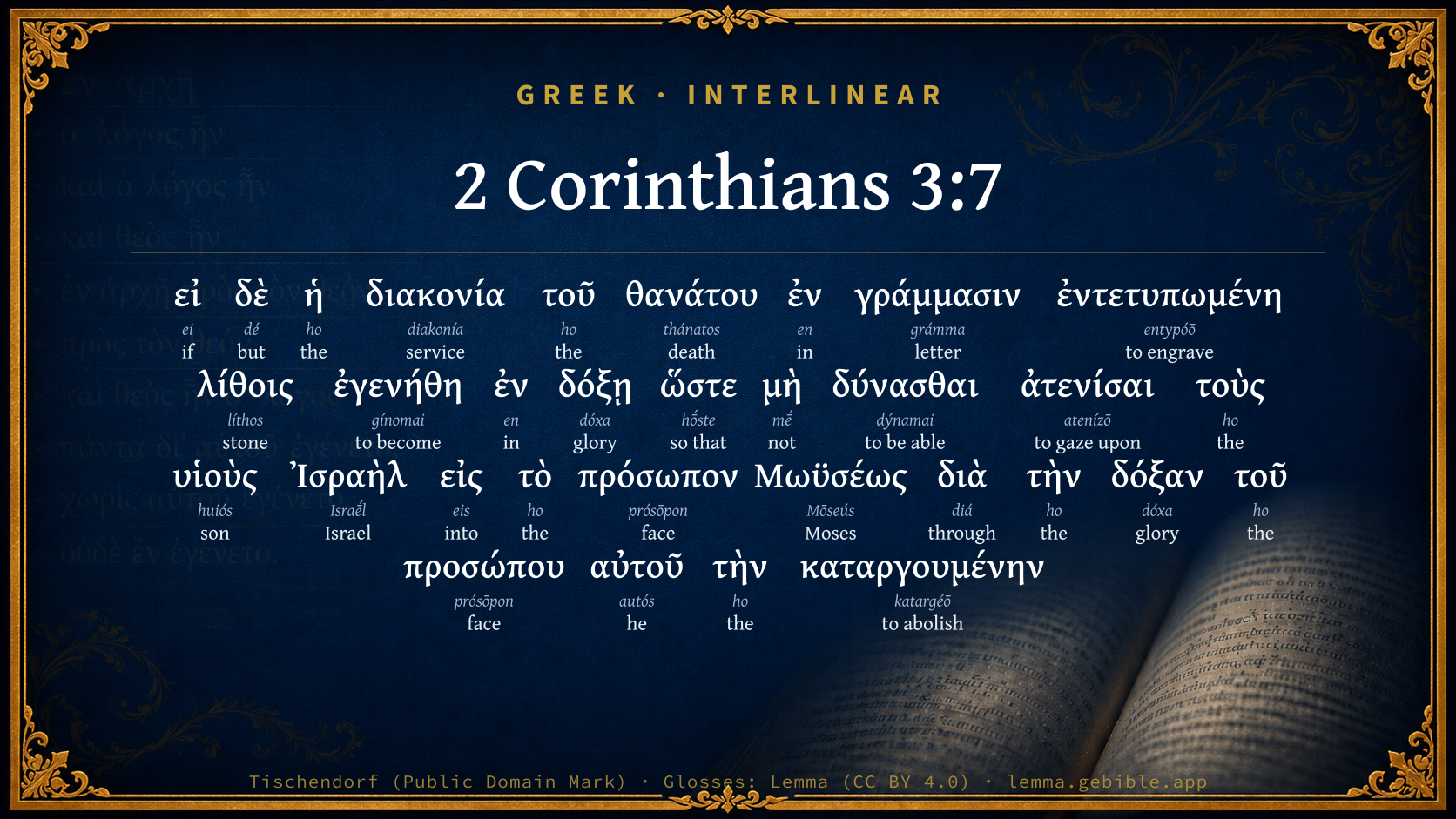
But if the service of death, written engraved on stones, came with glory, so that the children of Israel could not look steadfastly on the face of Moses for the glory of his face; which was passing away:
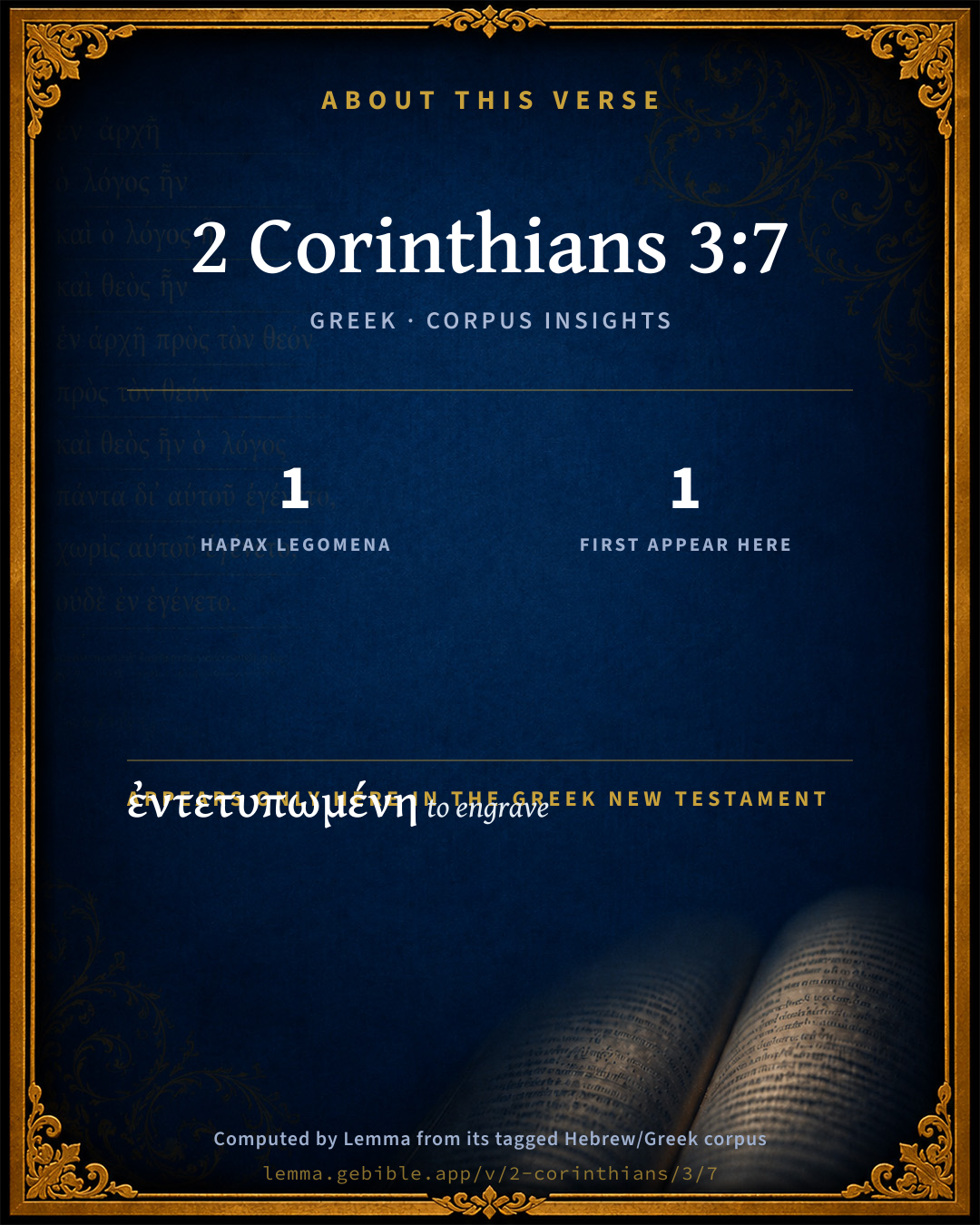
- 1 hapax legomenon — only here in the Greek New Testament
- 1 first appearance in the Greek New Testament
Download a study sheet
One document with this verse’s original text, its word-by-word gloss line, the meaning frame, cross-references with their text, attributed commentary, and full source and license credits — printable, and it pastes into notes with its structure intact.
This verse Autodidact and up
A passage Seminary Student
Up to 50 verses in one chapter. A passage sheet keeps up to 6 commentary sources and 12 cross-references per verse, in the order this page ranks them, and says so on the sheet whenever that leaves anything out. Ask for a single verse and you get the Autodidact verse sheet above.
Everything on this page stays free to read, with no account — the sheet is a download of what is already on screen, not access to it.
Compare translations 3
The same verse in 3 English versions, stacked beneath the original-language interlinear above. Click any original word for its lexicon entry.
Each is an independent rendering of the whole verse — the interlinear is not word-aligned to these translations.
Highlighted words mark where these versions differ — a whole-verse word diff, not a word-by-word alignment.
-
World English Bible Public Domain
But if the service of death, written engraved on stones, came with glory, so that the children of Israel could not look steadfastly on the face of Moses for the glory of his face; which was passing away:
-
King James Version Public Domain
But if the ministration of death, written and engraven in stones, was glorious, so that the children of Israel could not stedfastly behold the face of Moses for the glory of his countenance; which glory was to be done away:
-
unfoldingWord Literal Text CC BY-SA 4.0
Now if the ministry of this death—engraved in letters on stones—came in glory, so that the sons of Israel were not able to look intently at the face of Moses because of the fading glory of his face,
unfoldingWord Literal Text — © unfoldingWord, licensed CC BY-SA 4.0. Word-aligned USFM3 via Door43 (git.door43.org/unfoldingWord/en_ult).
Show all 19 translations
Every available English version of this verse, each an independent rendering of the whole verse.
-
World English Bible Public Domain
But if the service of death, written engraved on stones, came with glory, so that the children of Israel could not look steadfastly on the face of Moses for the glory of his face; which was passing away:
-
Berean Standard Bible Public Domain
Now if the ministry of death, which was engraved in letters on stone, came with such glory that the Israelites could not gaze at the face of Moses because of its fleeting glory,
-
Majority Standard Bible Public Domain
Now if the ministry of death, which was engraved in letters on stone, came with such glory that the Israelites could not gaze at the face of Moses because of its fleeting glory,
-
King James Version Public Domain
But if the ministration of death, written and engraven in stones, was glorious, so that the children of Israel could not stedfastly behold the face of Moses for the glory of his countenance; which glory was to be done away:
-
American Standard Version (1901) Public Domain
But if the ministration of death, written, `and' engraven on stones, came with glory, so that the children of Israel could not look stedfastly upon the face of Moses for the glory of his face; which `glory' was passing away:
-
Revised Version (1885) Public Domain
But if the ministration of death, written, and engraven on stones, came with glory, so that the children of Israel could not look stedfastly upon the face of Moses for the glory of his face; which glory was passing away:
-
Geneva Bible (1599) Public Domain
If then the ministration of death written with letters and ingrauen in stones, was glorious, so that the children of Israel coulde not beholde the face of Moses, for the glorie of his countenance (which glorie is done away.)
-
Douay-Rheims (1899) Public Domain
Now if the ministration of death, engraven with letters upon stones, was glorious; so that the children of Israel could not steadfastly behold the face of Moses, for the glory of his countenance, which is made void:
-
Young's Literal Translation Public Domain
and if the ministration of the death, in letters, engraved in stones, came in glory, so that the sons of Israel were not able to look stedfastly to the face of Moses, because of the glory of his face -- which was being made useless,
-
Literal Standard Version CC BY-SA 4.0
And if the ministry of death, in letters, engraved in stones, came in glory, so that the sons of Israel were not able to look steadfastly into the face of Moses, because of the glory of his face—which was being made useless,
-
Unlocked Literal Bible CC BY-SA 4.0
Now the service that produced death—engraved in letters on stones—came in such glory that the people of Israel could not look directly at Moses' face. This is because of the glory of his face, a glory that was fading.
-
unfoldingWord Literal Text CC BY-SA 4.0
Now if the ministry of this death—engraved in letters on stones—came in glory, so that the sons of Israel were not able to look intently at the face of Moses because of the fading glory of his face,
-
Darby Bible Public Domain
(But if the ministry of death, in letters, graven in stones, began with glory, so that the children of Israel could not fix their eyes on the face of Moses, on account of the glory of his face, [a glory] which is annulled;
-
World Messianic Bible Public Domain
But if the service of death, written engraved on stones, came with glory, so that the children of Israel could not look steadfastly on the face of Moses for the glory of his face, which was passing away,
-
Webster's Bible Public Domain
But if the ministration of death, written and engraven on stones, was glorious, so that the children of Israel could not steadfastly behold the face of Moses for the glory of his countenance; which glory was to be done away;
-
Free Bible Version CC BY-SA 4.0
However, the old way of relating to God, written in letters carved in stone, ended in death, even though it came with God's glory—so much so that the Israelites couldn't even bear to look at Moses' face because it shone so brightly, even though the glory was fading.
-
Bible in Basic English Public Domain
For if the operation of the law, giving death, recorded in letters on stone, came with glory, so that the eyes of the children of Israel had to be turned away from the face of Moses because of its glory, a glory which was only for a time:
-
Text-Critical English NT CC BY 4.0
Now if the ministry of death, which was engraved in letters on stone, came with glory, so that the sons of Israel could not gaze at the face of Moses because of its glory (a glory that was fading away),
-
Tyndale New Testament (1534) Public Domain
Yf the ministracion of deeth thorow the letters figured in stones was glorious so that the chyldren of Israel coulde not beholde the face of Moses for the glory of his countenauce (which glory neverthelesse is done awaye)
Literal Standard Version (2020), Covenant Press — licensed CC BY-SA 4.0. Text via the HelloAO Bible API (eBible.org). Unlocked Literal Bible (unfoldingWord) — licensed CC BY-SA 4.0. Text via the HelloAO Bible API (eBible.org). unfoldingWord Literal Text — © unfoldingWord, licensed CC BY-SA 4.0. Word-aligned USFM3 via Door43 (git.door43.org/unfoldingWord/en_ult). Free Bible Version, Dr. Jonathan Gallagher — licensed CC BY-SA 4.0. Text via the HelloAO Bible API (eBible.org).
Word by word
More ways to search: Search by grammar → Find every occurrence → Compare this word →
Practice this passage: Drill this verse → Learn its vocabulary →
- Appears 1× in the Greek New Testament
- First appears here
- Part of Speech
- Verb
- Tense
- Perfect
- Voice
- Passive
- Mood
- Participle
- Case
- Nominative
- Number
- Singular
- Gender
- Feminine
Full Thayer's Definition
- εἰ ei G1487 “if” Conditional
- δὲ dé G1161 “but” Conjunction
- ἡ ho G3588 “the” Article, Nominative, Singular, Feminine
- διακονία diakonía G1248 “service” Noun, Nominative, Singular, Feminine
- τοῦ ho G3588 “the” Article, Genitive, Singular, Masculine
- θανάτου thánatos G2288 “death” Noun, Genitive, Singular, Masculine
- ἐν en G1722 “in” Preposition
- γράμμασιν grámma G1121 “letter” Noun, Dative, Plural, Neuter
- ἐντετυπωμένη entypóō G1795 “to engrave” Verb, Perfect, Passive, Participle, Nominative, Singular, Feminine
- λίθοις líthos G3037 “stone” Noun, Dative, Plural, Masculine
- ἐγενήθη gínomai G1096 “to become” Verb, Aorist, Passive deponent, Indicative, 3rd person, Singular
- ἐν en G1722 “in” Preposition
- δόξῃ dóxa G1391 “glory” Noun, Dative, Singular, Feminine
- ὥστε hṓste G5620 “so that” Conjunction
- μὴ mḗ G3361 “not” Particle, Negative
- δύνασθαι dýnamai G1410 “to be able” Verb, Present, Middle or Passive deponent, Infinitive
- ἀτενίσαι atenízō G816 “to gaze upon” Verb, Aorist, Active, Infinitive
- τοὺς ho G3588 “the” Article, Accusative, Plural, Masculine
- υἱοὺς huiós G5207 “son” Noun, Accusative, Plural, Masculine
- Ἰσραὴλ Israḗl G2474 “Israel” Noun, Proper, indeclinable
- εἰς eis G1519 “into” Preposition
- τὸ ho G3588 “the” Article, Accusative, Singular, Neuter
- πρόσωπον prósōpon G4383 “face” Noun, Accusative, Singular, Neuter
- Μωϋσέως Mōseús G3475 “Moses” Noun, Genitive, Singular, Masculine
- διὰ diá G1223 “through” Preposition
- τὴν ho G3588 “the” Article, Accusative, Singular, Feminine
- δόξαν dóxa G1391 “glory” Noun, Accusative, Singular, Feminine
- τοῦ ho G3588 “the” Article, Genitive, Singular, Neuter
- προσώπου prósōpon G4383 “face” Noun, Genitive, Singular, Neuter
- αὐτοῦ autós G846 “he” Personal pronoun, Genitive, Singular, Masculine
- τὴν ho G3588 “the” Article, Accusative, Singular, Feminine
- καταργουμένην katargéō G2673 “to abolish” Verb, Present, Passive, Participle, Accusative, Singular, Feminine
About this verse
These counts appear in no published source. They are computed here, from the morphology-tagged text and Lemma’s own curated glosses. What Lemma adds →
- 32
- words
- 23
- distinct lemmas
- Pauline Epistles
- section
Notable vocabulary
1 hapax legomenon — a word that appears only here in the entire Greek New Testament:
- ἐντετυπωμένη to engrave G1795
First appearance in Scripture
This word makes its first canonical appearance in the Greek New Testament here:
- ἐντετυπωμένη to engrave G1795
Shared distinctive vocabulary
γράμμασιν letter G1121 occurs in 13 verses of the Greek New Testament. Also found in:
Cross-references
30Topical passages linked to 2 Corinthians 3:7 in the Treasury of Scripture Knowledge — connected by theme and wording, ordered by reader-vote popularity; previews shown in the World English Bible.
- 2 Corinthians 3:9–11 For if the service of condemnation has glory, the service of righteousness exceeds much more in glory.
- Exodus 31:18 He gave to Moses, when he finished speaking with him on Mount Sinai, the two tablets of the testimony, stone tablets, written with God's finger.
- Romans 10:4 For Christ is the fulfillment of the law for righteousness to everyone who believes.
- 1 Corinthians 13:10 but when that which is complete has come, then that which is partial will be done away with.
- Exodus 24:12 Yahweh said to Moses, "Come up to me on the mountain, and stay here, and I will give you the tables of stone with the law and the commands that I have written, that you may teach them."
- 2 Corinthians 3:3 being revealed that you are a letter of Christ, ministered by us, written not with ink, but with the Spirit of the living God; not in tablets of stone, but in tablets that are hearts of flesh.
- 2 Corinthians 3:6 who also made us sufficient as servants of a new covenant; not of the letter, but of the Spirit. For the letter kills, but the Spirit gives life.
- Deuteronomy 10:1–4 At that time Yahweh said to me, Hew you two tables of stone like the first, and come up to me onto the mountain, and make an ark of wood.
- Psalms 119:97 How love I your law! It is my meditation all day.
- Romans 4:15 For the law works wrath, for where there is no law, neither is there disobedience.
- 2 Corinthians 3:13–14 and not as Moses, who put a veil on his face, that the children of Israel wouldn't look steadfastly on the end of that which was passing away.
- Deuteronomy 9:9–11 When I was gone up onto the mountain to receive the tables of stone, even the tables of the covenant which Yahweh made with you, then I stayed on the mountain forty days and forty nights; I did neither eat bread nor drink water.
- Deuteronomy 9:15 So I turned and came down from the mountain, and the mountain was burning with fire: and the two tables of the covenant were in my two hands.
- Psalms 119:174 I have longed for your salvation, Yahweh. Your law is my delight.
- Luke 9:29–31 As he was praying, the appearance of his face was altered, and his clothing became white and dazzling.
- Acts 6:15 All who sat in the council, fastening their eyes on him, saw his face like it was the face of an angel.
- Romans 7:10 The commandment, which was for life, this I found to be for death;
- Genesis 3:21 Yahweh God made coats of skins for Adam and for his wife, and clothed them.
- Exodus 32:15–16 Moses turned, and went down from the mountain, with the two tablets of the testimony in his hand; tablets that were written on both their sides; on the one side and on the other they were written.
- Exodus 32:19 It happened, as soon as he came near to the camp, that he saw the calf and the dancing: and Moses' anger grew hot, and he threw the tablets out of his hands, and broke them beneath the mountain.
- Exodus 34:1 Yahweh said to Moses, "Chisel two stone tablets like the first: and I will write on the tablets the words that were on the first tablets, which you broke.
- Exodus 34:28–35 He was there with Yahweh forty days and forty nights; he neither ate bread, nor drank water. He wrote on the tablets the words of the covenant, the ten commandments.
- Romans 7:22 For I delight in God's law after the inward man,
- Deuteronomy 4:8 What great nation is there, that has statutes and ordinances so righteous as all this law, which I set before you this day?
- Deuteronomy 4:13 He declared to you his covenant, which he commanded you to perform, even the ten commandments; and he wrote them on two tables of stone.
- Deuteronomy 5:22 These words Yahweh spoke to all your assembly on the mountain out of the midst of the fire, of the cloud, and of the thick darkness, with a great voice: and he added no more. He wrote them on two tables of stone, and gave them to me.
- Nehemiah 9:13 You came down also on Mount Sinai, and spoke with them from heaven, and gave them right ordinances and true laws, good statutes and commandments,
- Psalms 19:7–8 Yahweh's law is perfect, restoring the soul. Yahweh's testimony is sure, making wise the simple.
- Romans 7:12–14 Therefore the law indeed is holy, and the commandment holy, and righteous, and good.
- Hebrews 9:4 having a golden altar of incense, and the ark of the covenant overlaid on all sides with gold, in which was a golden pot holding the manna, Aaron's rod that budded, and the tables of the covenant;
Cross-references courtesy of OpenBible.info (CC BY 4.0).
Lesson kit
Teaching starters — assembled from the data on this page, not authored interpretation. Every prompt links to the verse data it draws on. Edit before teaching.
2 Corinthians, in the Pauline Epistles, opens this verse with 32 words (23 distinct Greek lemmas). Its most distinctive word is entypóō (“to engrave”). A historical commentator’s framing appears above. Read the whole chapter for the surrounding context.
Discussion questions
- How does “to engrave” (entypóō) shape what this verse is saying?
- This verse holds 1 word here found nowhere else in the Greek New Testament. What might the rare word draw attention to?
- The word “to engrave” first appears here in Scripture. What is being introduced at this debut?
- Luke 16:6 shares the word «letter» with this verse. How do the two illuminate each other?
- “glory” occurs 2× in this one verse. What is the effect of the repetition?
- The translations on this page render this verse differently — a whole-verse word diff, not a word-by-word alignment. What might account for the different wordings?
- Reading how The Biblical Illustrator and Joseph Benson's Commentary read this verse, where do the two commentators agree and where do they part?
Things to notice
- 1 word in this verse appears nowhere else in the Greek New Testament.
- 1 word makes its first canonical appearance in Scripture here.
- These translations choose different wording for 30 words in this verse.
- “glory” occurs 2× in this single verse.
- 23 distinct Greek lemmas span 32 words in this verse.
Commentary
Notes on 2 Corinthians 3:7 from classic Christian and Jewish commentators (each source and its license shown beneath its notes). The classic Christian expositions comment on the surrounding passage and are grouped to its opening verse, so a note may address several verses; the Jewish commentaries on the Tanakh (Rashi and others) are per-verse, so they appear only where the commentator wrote on this verse.
Lemma curates 59 commentaries, every one of them public domain or Creative Commons licensed, each selected and text-cleaned for this edition rather than reprinted as found. About our sources →
The Biblical Illustrator
Joseph S. Exell
The Biblical Illustrator, edited by Joseph S. Exell (c. 1880s–1900s) — public domain. Text from a community e-Sword module.
Joseph Benson's Commentary
Joseph Benson's Commentary on the Old and New Testaments (1811–1818) — public domain. Text from a community e-Sword module.
Godbey's Commentary on the New Testament
William B. Godbey
William B. Godbey, Commentary on the New Testament (1896–1900) — public domain. Text from a community e-Sword module.
Tyndale Open Study Notes
Tyndale Open Resources
Tyndale Open Study Notes — © Tyndale Open Resources, licensed CC BY-SA 4.0. Text via the HelloAO Bible API.
Bengel's Gnomon
Johann Albrecht Bengel
Bengel's Gnomon of the New Testament — English translation (T&T Clark, Edinburgh, 1860) — public domain. Text from a community e-Sword module.
Meyer's Critical & Exegetical Commentary
Heinrich August Wilhelm Meyer
Meyer — Critical and Exegetical Commentary on the New Testament — English translation by Peter Christie, edited by Frederick Crombie (T&T Clark, 1880) — public domain. Text from a community e-Sword module.
Expositor's Greek Testament
ed. W. Robertson Nicoll
The Expositor's Greek Testament, edited by W. Robertson Nicoll (1897–1910) — public domain. Text from a community e-Sword module.
Geneva Bible (1599)
Geneva Bible translators
Geneva Bible (1599) marginal notes — public domain. Text via Bolls.life.
Jamieson, Fausset & Brown
Robert Jamieson, A. R. Fausset & David Brown
Jamieson, Fausset & Brown — Commentary Critical and Explanatory on the Whole Bible (1871) — public domain (CC PDM 1.0). Text via the HelloAO Bible API.
Adam Clarke's Commentary
Adam Clarke's Commentary on the Bible (1810–1826) — public domain. Text from a community e-Sword/MySword module.
John Calvin's Commentaries
John Calvin's Commentaries (1540-1563) — public domain. Text from the Calvin Translation Society English edition (1840s-50s) via the Christian Classics Ethereal Library (ccel.org). Calvin's coverage is partial (roughly two-thirds of the Bible); uncommented books and verses are honest gaps, never fabricated. The 19th-century editor's footnotes and remarks are omitted so the notes are faithfully Calvin's own voice.
Ellicott's Commentary for English Readers
A Bible Commentary for English Readers, edited by Charles John Ellicott (1878–1897) — public domain. Text from a community e-Sword module.
The Cambridge Bible for Schools and Colleges
gen. ed. J. J. S. Perowne
The Cambridge Bible for Schools and Colleges (gen. ed. J. J. S. Perowne; Cambridge University Press, 1878–1918) — public domain. Text from a community e-Sword module.
John Gill's Exposition
John Gill's Exposition of the Whole Bible (1746–1763) — public domain (CC PDM 1.0). Text via the HelloAO Bible API.
Trapp's Complete Commentary
John Trapp
John Trapp, A Commentary or Exposition upon All the Books of the Old and New Testament (1647–1656) — public domain. Text from a community e-Sword module.
Albert Barnes' Notes on the Bible
Albert Barnes' Notes on the Bible (1834–1885) — public domain. Text from a community e-Sword/MySword module.
Haydock's Catholic Bible Commentary
George Leo Haydock (1774–1849), Haydock's Catholic Family Bible and Commentary, 1859 edition — public domain. Excludes Psalms (Douay-Rheims chapter numbering differs from Protestant) and Deuterocanonical books (Catholic canon only).
Matthew Poole's English Annotations
Matthew Poole's English Annotations on the Holy Bible (1683–1685) — public domain. Text from a community e-Sword/MySword module.
Whedon's Commentary on the Bible
Daniel D. Whedon
Daniel D. Whedon (gen. ed.), Commentary on the Old and New Testaments (1874–1909) — public domain. Text from a community e-Sword module.
The Pulpit Commentary
The Pulpit Commentary (1880–1919), ed. H.D.M. Spence-Jones & Joseph S. Exell — public domain. Text from a community e-Sword module.
John Wesley's Explanatory Notes
John Wesley, Explanatory Notes Upon the Whole Bible (1754–1765) — public domain. Text via the GEBible commentary corpus.
Kretzmann's Popular Commentary
Paul E. Kretzmann
Paul E. Kretzmann, Popular Commentary of the Bible (1921–1924) — public domain. Text from a community e-Sword module.
Burkitt's Expository Notes on the New Testament
William Burkitt
William Burkitt's Expository Notes on the New Testament (1700–1703) — public domain. Text from a community e-Sword module.
McGarvey & Pendleton's Commentaries
J. W. McGarvey
J. W. McGarvey (with Philip Y. Pendleton), Commentaries on the New Testament (The Fourfold Gospel, 1914; Acts; and the epistles) — public domain. Text from a community e-Sword/MySword module.
The People's New Testament
B. W. Johnson
B. W. Johnson's The People's New Testament with Notes (1889–1891) — public domain. Electronic text from the Christian Classics Ethereal Library (CCEL) ThML edition.
unfoldingWord translationNotes
Door43 World Missions Community
unfoldingWord translationNotes — © Distant Shores Media and the Door43 World Missions Community, licensed CC BY-SA 4.0. Source: git.door43.org/Door43/en_tn.
Cambridge Greek Testament for Schools and Colleges
Cambridge Greek Testament for Schools and Colleges (Cambridge University Press, 1896; 21 vols, various authors incl. Carr, Maclear, Plummer, Farrar, Lumby, Moule, M. R. James, Simcox) — public domain. Text from a community e-Sword module.
Alford’s Greek Testament
Henry Alford
Henry Alford, The Greek Testament (1849–1861) — public domain. Text from a community e-Sword module.
International Critical Commentary
International Critical Commentary — older volumes (1896–1929), various authors — public domain. Text from a community e-Sword module.
Vincent's Word Studies in the New Testament
Marvin R. Vincent
Marvin R. Vincent, Word Studies in the New Testament (1887–1900) — public domain. Text from a community e-Sword/MySword module.