
Luke 14:27

Greek (Tischendorf 8th ed.) Luke 14:27 appears in the Greek New Testament. The text above is from the Tischendorf 8th edition. Each word links to its Strong’s number and a concise gloss. Click any word for its full Thayer’s Greek Lexicon entry.
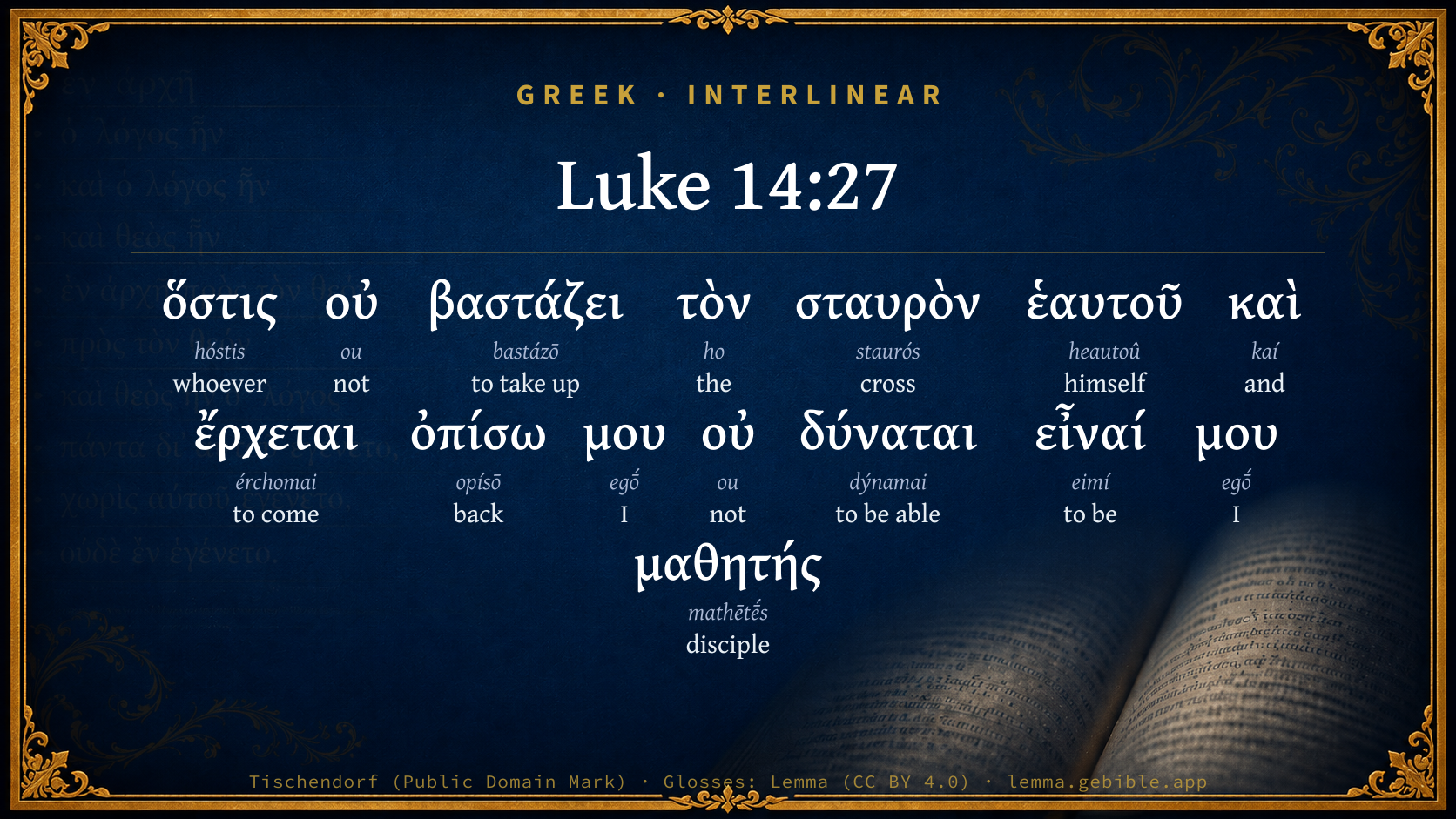
Download image
Cite this verse

Luke 14:27 (World English Bible). Public Domain. Lemma interlinear Bible study tool, https://lemma.gebible.app/v/luke/14/27.

Show BibTeX & RIS
BibTeX
RIS
English Translation
Whoever doesn't bear his own cross, and come after me, can't be my disciple.
World English Bible · Public Domain
Download a study sheet

One document with this verse’s original text, its word-by-word gloss line, the meaning frame, cross-references with their text, attributed commentary, and full source and license credits — printable, and it pastes into notes with its structure intact.

This verse Autodidact and up

Study sheet (.html) Plain text (.txt)

A passage Seminary Student

Up to 50 verses in one chapter. A passage sheet keeps up to 6 commentary sources and 12 cross-references per verse, in the order this page ranks them, and says so on the sheet whenever that leaves anything out. Ask for a single verse and you get the Autodidact verse sheet above.

Everything on this page stays free to read, with no account — the sheet is a download of what is already on screen, not access to it.

Want to remove ads? Support Godless Engineer
Compare translations 3

The same verse in 3 English versions, stacked beneath the original-language interlinear above. Click any original word for its lexicon entry.

Each is an independent rendering of the whole verse — the interlinear is not word-aligned to these translations.

Highlighted words mark where these versions differ — a whole-verse word diff, not a word-by-word alignment.

  • World English Bible Public Domain
    Whoever doesn't bear his own cross, and come after me, can't be my disciple.
  • King James Version Public Domain
    And whosoever doth not bear his cross, and come after me, cannot be my disciple.
  • unfoldingWord Literal Text CC BY-SA 4.0
    Whoever does not carry his cross and come after me is not able to be my disciple.

unfoldingWord Literal Text — © unfoldingWord, licensed CC BY-SA 4.0. Word-aligned USFM3 via Door43 (git.door43.org/unfoldingWord/en_ult).

Versions to compare (up to 4)

3 of 4 selected

Show all 19 translations

Every available English version of this verse, each an independent rendering of the whole verse.

  • World English Bible Public Domain
    Whoever doesn't bear his own cross, and come after me, can't be my disciple.
  • Berean Standard Bible Public Domain
    And whoever does not carry his cross and follow Me cannot be My disciple.
  • Majority Standard Bible Public Domain
    And whoever does not carry his cross and follow Me cannot be My disciple.
  • King James Version Public Domain
    And whosoever doth not bear his cross, and come after me, cannot be my disciple.
  • American Standard Version (1901) Public Domain
    Whosoever doth not bear his own cross, and come after me, cannot be my disciple.
  • Revised Version (1885) Public Domain
    Whosoever doth not bear his own cross, and come after me, cannot be my disciple.
  • Geneva Bible (1599) Public Domain
    And whosoeuer beareth not his crosse, and commeth after mee, can not bee my disciple.
  • Douay-Rheims (1899) Public Domain
    And whosoever doth not carry his cross and come after me, cannot be my disciple.
  • Young's Literal Translation Public Domain
    and whoever doth not bear his cross, and come after me, is not able to be my disciple.
  • Literal Standard Version CC BY-SA 4.0
    and whoever does not carry his cross, and come after Me, is not able to be My disciple.
  • Unlocked Literal Bible CC BY-SA 4.0
    Whoever does not carry his own cross and come after me cannot be my disciple.
  • unfoldingWord Literal Text CC BY-SA 4.0
    Whoever does not carry his cross and come after me is not able to be my disciple.
  • Darby Bible Public Domain
    and whoever does not carry his cross and come after me cannot be my disciple.
  • World Messianic Bible Public Domain
    Whoever doesn’t bear his own cross and come after me, can’t be my disciple.
  • Webster's Bible Public Domain
    And whoever doth not bear his cross, and come after me, cannot be my disciple.
  • Free Bible Version CC BY-SA 4.0
    If you don't carry your cross and follow me, you can't be my disciple.
  • Bible in Basic English Public Domain
    Whoever does not take up his cross and come after me may not be my disciple.
  • Text-Critical English NT CC BY 4.0
    And whoever does not bear his own cross and follow me cannot be my disciple.
  • Tyndale New Testament (1534) Public Domain
    And whosoever beare not his crosse and come after me cannot be my disciple.

Literal Standard Version (2020), Covenant Press — licensed CC BY-SA 4.0. Text via the HelloAO Bible API (eBible.org). Unlocked Literal Bible (unfoldingWord) — licensed CC BY-SA 4.0. Text via the HelloAO Bible API (eBible.org). unfoldingWord Literal Text — © unfoldingWord, licensed CC BY-SA 4.0. Word-aligned USFM3 via Door43 (git.door43.org/unfoldingWord/en_ult). Free Bible Version, Dr. Jonathan Gallagher — licensed CC BY-SA 4.0. Text via the HelloAO Bible API (eBible.org).

Word by word

More ways to search: Search by grammar → Find every occurrence → Compare this word →

Practice this passage: Drill this verse → Learn its vocabulary →

βαστάζει
bastázō
G941
“to take up”
Verb, Present, Active, Indicative, 3rd person, Singular
Part of Speech
Verb
Tense
Present
Voice
Active
Mood
Indicative
Person
3rd person
Number
Singular
Full Thayer's Definition

Origin: perhaps remotely derived from the base of G939 (through the idea of removal)

TDNT: 10:56,1

1. to take up with the hands 2. to take up in order to carry or bear, to put upon one's self (something) to be carried a. to bear what is burdensome 3. to bear, to carry a. to carry on one's person b. to sustain, i.e. uphold, support 4. to bear away, carry off
  1. ὅστις hóstis G3748 “whoever” Relative pronoun, Nominative, Singular, Masculine
  2. οὐ ou G3756 “not” Particle, Negative
  3. τὸν ho G3588 “the” Article, Accusative, Singular, Masculine
  4. σταυρὸν staurós G4716 “cross” Noun, Accusative, Singular, Masculine
  5. ἑαυτοῦ heautoû G1438 “himself” Reflexive pronoun, 3rd person, Genitive, Singular, Masculine
  6. καὶ kaí G2532 “and” Conjunction
  7. ἔρχεται érchomai G2064 “to come” Verb, Present, Middle or Passive deponent, Indicative, 3rd person, Singular
  8. ὀπίσω opísō G3694 “back” Adverb
  9. μου egṓ G1473 “I” Personal pronoun, 1st person, Genitive, Singular
  10. οὐ ou G3756 “not” Particle, Negative
  11. δύναται dýnamai G1410 “to be able” Verb, Present, Middle or Passive deponent, Indicative, 3rd person, Singular
  12. εἶναί eimí G1510 “to be” Verb, Present, Active, Infinitive
  13. μου egṓ G1473 “I” Personal pronoun, 1st person, Genitive, Singular
  14. μαθητής mathētḗs G3101 “disciple” Noun, Nominative, Singular, Masculine

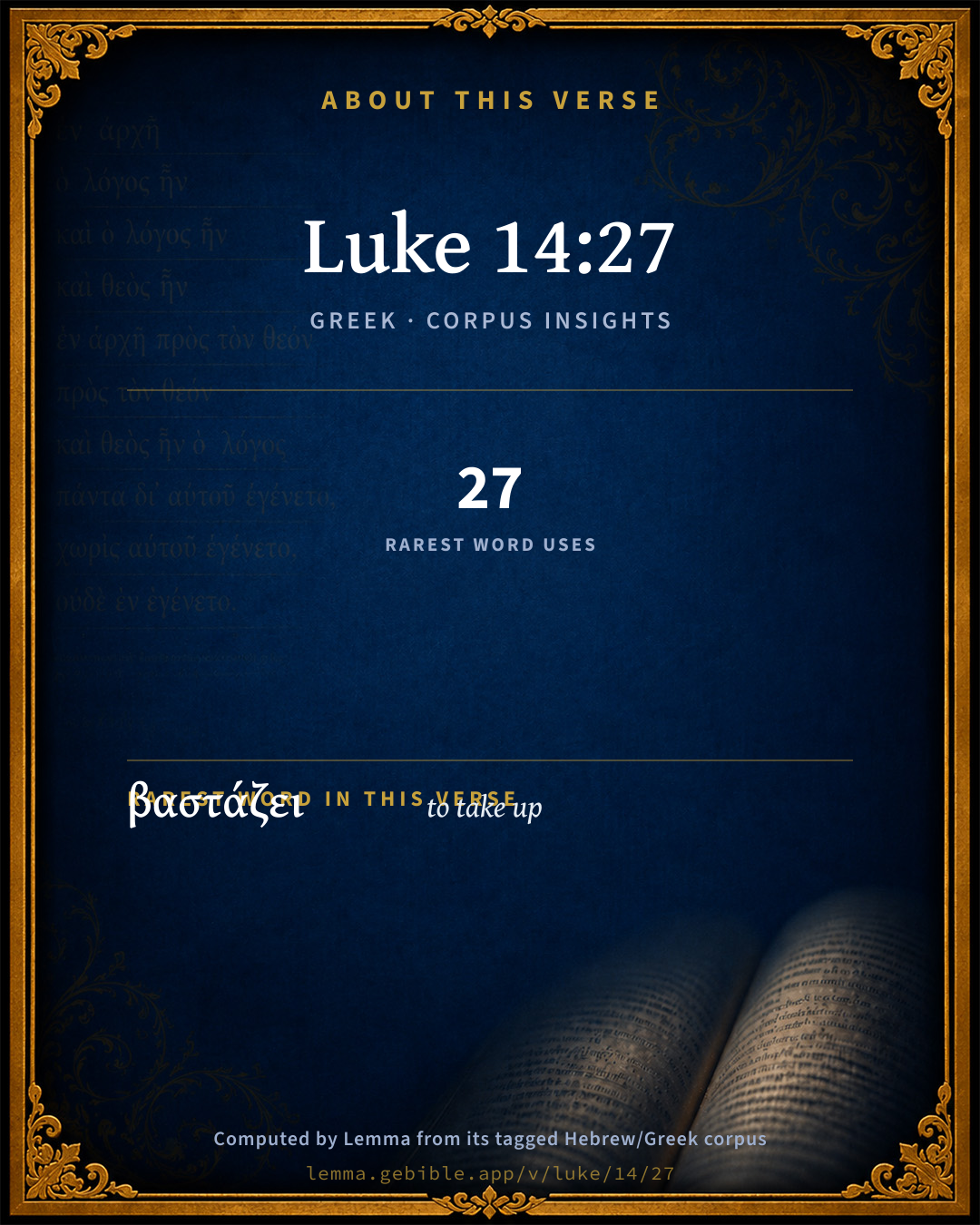
About this verse

These counts appear in no published source. They are computed here, from the morphology-tagged text and Lemma’s own curated glosses. What Lemma adds →

15
words
13
distinct lemmas
Gospels
section

Shared distinctive vocabulary

βαστάζει to take up G941 occurs in 27 verses of the Greek New Testament. Also found in:
Repetition

Words recur within this verse:

Cross-references

11

Topical passages linked to Luke 14:27 in the Treasury of Scripture Knowledge — connected by theme and wording, ordered by reader-vote popularity; previews shown in the World English Bible.

  • Matthew 10:38 He who doesn't take his cross and follow after me, isn't worthy of me.
  • Luke 9:23–25 He said to all, "If anyone desires to come after me, let him deny himself, take up his cross, and follow me.
  • Matthew 16:24–26 Then Jesus said to his disciples, "If anyone desires to come after me, let him deny himself, and take up his cross, and follow me.
  • Mark 10:21 Jesus looking at him loved him, and said to him, "One thing you lack. Go, sell whatever you have, and give to the poor, and you will have treasure in heaven; and come, follow me, taking up the cross."
  • Mark 8:34–37 He called the multitude to himself with his disciples, and said to them, "Whoever wants to come after me, let him deny himself, and take up his cross, and follow me.
  • Acts 14:22 confirming the souls of the disciples, exhorting them to continue in the faith, and that through many afflictions we must enter into the Kingdom of God.
  • 2 Timothy 3:12 Yes, and all who desire to live godly in Christ Jesus will suffer persecution.
  • Matthew 13:21 yet he has no root in himself, but endures for a while. When oppression or persecution arises because of the word, immediately he stumbles.
  • John 19:17 He went out, bearing his cross, to the place called "The Place of a Skull," which is called in Hebrew, "Golgotha,"
  • 2 Timothy 1:12 For this cause I suffer also these things. Yet I am not ashamed, for I know him whom I have believed, and I am persuaded that he is able to guard that which I have committed to him against that day.
  • Mark 15:21 They compelled one passing by, coming from the country, Simon of Cyrene, the father of Alexander and Rufus, to go with them, that he might bear his cross.

Cross-references courtesy of OpenBible.info (CC BY 4.0).

Commentary

Notes on Luke 14:27 from classic Christian and Jewish commentators (each source and its license shown beneath its notes). The classic Christian expositions comment on the surrounding passage and are grouped to its opening verse, so a note may address several verses; the Jewish commentaries on the Tanakh (Rashi and others) are per-verse, so they appear only where the commentator wrote on this verse.

Lemma curates 59 commentaries, every one of them public domain or Creative Commons licensed, each selected and text-cleaned for this edition rather than reprinted as found. About our sources →

The Biblical Illustrator

Joseph S. Exell

Luk_14:27

And whosoever doth not bear his cross, etc

On taking up the cross

Christiani sunt cruciani, says Luther, Christians are cross-bearers.

It is in their hearts to bear the cross, whatever it be, whensoever Christ shall require it; and they do actually bear it whenever they are called to it. They do not flinch from it, nor decline it, nor turn from it, by any indirect or unlawful course.

I. WHAT IS MEANT BY THE CROSS.

1. The cross includes loss and damage, the greatest losses as well as the least; the loss of all outward things, as well as the loss of any. When Christ was nailed to the cross, He was bereaved of all, and fastened to it naked; He had not so much as His garments left; they who brought Him to the cross divided these amongst them. He that is not willing to part with all, to follow Christ, when he cannot fully and faithfully follow Him without quitting all, he is not worthy of Him, unworthy the name of a Christian.

2. It speaks shame and reproach. It was serviie supplicium, a base ignominious suffering, to which none were exposed but the vilest of men. It was a suffering proper to slaves and fugitives; there was not the meanest freeman amongst the Romans but was above it. Hence shame and the cross are joined together (Heb_12:2). Hence that expression, bearing His reproach (Heb_13:13), i.e., bearing the cross. No coming to Christ but in this posture, when the Lord calls to it.

3. It imports pain and torture. The cross was a most grievous and painful suffering. Ausonius calls it paenae extremum, the extremity of torture. And Cicero, crudelissimum teterrimumque supplicium, the most cruel and horrid suffering. When Ignatius was going to be exposed to the fury of wild beasts for the name of Christ, he cries, Now I begin to be a disciple.

4. It imports death itself. The cross was ultimum supplicium, the last thing that could be suffered. Cruelty was herein terminated, and could go no further, at least to the sense of the sufferer. It was the worst kind of death.

II. WHAT IT IS TO BEAR THE CROSS.

1. You must make account of it. Calculate what it will cost you.

2. A resolution to bear the cross, whatever it be, how heavy, or grievous, or tedious soever it may prove; a firm, and hearty, and settled resolution to bear it, is a virtual bearing of it beforehand (verse 33).

3. You must be always ready for the cross, always preparing for it, whether it seem near, or whether it seem further off. One paraphraseth the words thus, Whosoever doth not come to Me with a preparation of mind to suffer anything rather than part with Me, he is not for My turn. This is to bear the cross daily, as Christ requires (Luk_9:1-62.). Though every day do not afford a cross, yet every day we bear the cross by daily preparing for it 1Co_15:31). Even when the cross seems far off, much more when it is in view, you must be preparing for it, if you be Christians indeed; and the Lord will take your readiness to bear it for a bearing of it, when He sees good to prevent it.

4. It speaks actual undergoing it when it is laid on us. But when the Lord brings it to us, we must actually take it up. He is no disciple for Christ that will not do it.

III. THE MANNER OF BEARING THE CROSS.

1. A Christian endeavours to bear the cross patiently. That while the cross oppresses his outward man, he may possess his soul in patience. Not the patience of the Stoics, a senseless stupidness; nor the patience of the heathen, a mere yielding to necessity; but a due sense of the pressure, with a quiet submission to the hand of God, whoever be the instrument, without murmuring, repining, disquietment, or despondency.

2. He endeavours to bear it cheerfully. That which is bearing the cross here is taking up the cross (chap. 9.). Christ bore His cross willingly; Simon of Cyrene was compelled to bear that cross. Christ would have us come after Him, bear it as He did. It should not be a forced, but a voluntary act.

3. He endeavours to bear it fruitfully. The cross is dry wood, and so was Aarons rod; but as that blossomed, so does this bring forth fruit, when improved (Heb_12:11). This puts the followers of Christ upon seeking the sweet fruits of peace and holiness in the bowels of devouring calamities; to get spiritual gain and advantage by outward loss; to grow richer unto God by worldly impoverishment; to converse more with God when separated from friends and relations; to value more the love of Christ when they smart by the worlds hatred; to partake more of holiness when he partakes less of the ease, peace, plenty of the world; to make use of the cross for the crucifying of the flesh; to make sin more hateful and dreadful, the conscience more tender, the world less tempting, more contemptible, grace more active and lively, the word more sweet and effectual, prayer more fervent and affectionate, the appearing of Christ more lovely and desirable, the conversation more heavenly. To hear the cross as a disciple of Christ, is to bring forth more fruit in bearing of it. (D. Clarkson, B. D.)

The Christians cross

I. THE CROSS IS ORDINARILY THE LOT OF CHRISTIANS. Persecution and troubles have always attended the people of God. And the reasons of it are evident.

1. The malice of Satan, who knowing himself to be cast off by God, he hates God with an implacable hatred; and since the Lord is above the reach of his malice, he falls upon those who are dearest to Him, the people of God.

2. The enmity of the world. The world would be sure to cross, to afflict and persecute what it hates; and the disciples of Christ are hated by the Joh_15:19). Not only that part of the world which evidently lies in wickedness, but the more refined part of it which dresseth up itself in a form of godliness. Those who have no more but the form, hate those that haw the power, because this is a real reproof and conviction of the vanity and insufficiency of outward forms, how specious soever; and that which detects them is hated by them (1Jn_5:19).

3. There is a necessity of the cross upon a manifold account.

(1) To distinguish true disciples from hypocrites and pretenders. When Christ may be professed and followed with ease, and safety, and credit, multitudes will follow Him, every man will profess Him whose hearts are not with Him. But when the cross comes, that makes a distinction.

(2) To try His disciples, that He may have an experiment of their affection and faithfulness to Him: Who is on my side? Who? says Jehu (2Ki_9:33). So says Christ, when He brings out the cross; let Me now see who is for Me, let Me see who it is that will bear the cross for Me.

(3) For the advantage of grace. A Christian is not complete unless he have on his whole armour; and it is the cross puts us upon putting of it on; it would lie rusting by us, if we were not roused to the use of it by the frequent approaches of the cross.

(4) To take us off from the world. The cross embitters the world to us, and confutes those vain conceits which make us fond of it. The vizard falls off by which it had deluded us, and now we may perceive what aa impostor it was, when, for all its fair promises, we meet with nothing but vanity, and enmity, and vexation, and hard usage. And will it not seem lovely? Or can we doat on it any longer? The cross lets us not only see, but feel what the world is.

(5) To tame the flesh, and keep it under, which otherwise would grow headstrong, and bear down all the restraints of grace, and hurry us into carnal excess--Every branch that beareth fruit He purgeth it (Joh_15:1-27.). He lops off the luxuriances of natural corruption. And how is this done? Why, a sharp cross will be effectual to do it, when the Lord takes it into His hand and useth it for this purpose!

(6) To endear heaven to us. The ark was more acceptable to Noahs dove when she found no rest to the soles of her feet on the face of the earth.

II. A CHRISTIAN CANNOT ORDINARILY AVOID THE CROSS WITHOUT SINNING AGAINST CHRIST.

III. HE THAT WILL ORDINARILY SIN AGAINST CHRIST TO AVOID THE CROSS, CANNOT BE A CHRISTIAN. This being proved, it will appear an evident truth, that he that doth not, will not, bear the cross, is not, cannot be a Christian. (D. Clarkson, B. D.)

The Biblical Illustrator, edited by Joseph S. Exell (c. 1880s–1900s) — public domain. Text from a community e-Sword module.

Tyndale Open Study Notes

Tyndale Open Resources

14:27 To carry your own cross is a picture of dying to self. The horizontal beam of the cross was carried by a condemned criminal headed for crucifixion.

Tyndale Open Study Notes — © Tyndale Open Resources, licensed CC BY-SA 4.0. Text via the HelloAO Bible API.

Bengel's Gnomon

Johann Albrecht Bengel

Luk 14:27. Καὶ) “whosoever doth not bear his cross,” and yet (not, and does not come) comes, and walks after me, as ye do, as though he was wishing to be my disciple. [But Engl. Ver. takes it in the way which Beng. rejects, “Whosoever doth not bear his cross and come after me,” etc.] Comp. note, Mat 16:24.[149]

[149] Ὀπίσω μου ἐλθεῖν, to come after Me, denotes mere status and profession: But ἀκολουθεῖν, to follow, denotes actual obedience.—E. and T.

Bengel's Gnomon of the New Testament — English translation (T&T Clark, Edinburgh, 1860) — public domain. Text from a community e-Sword module.

Meyer's Critical & Exegetical Commentary

Heinrich August Wilhelm Meyer

Luk_14:27. Comp. Mat_10:38; Mat_16:24; Mar_8:34; Mar_10:21; Luk_9:23. He who does not as the bearer of his own cross follow me, etc.

Meyer — Critical and Exegetical Commentary on the New Testament — English translation by Peter Christie, edited by Frederick Crombie (T&T Clark, 1880) — public domain. Text from a community e-Sword module.

Expositor's Greek Testament

ed. W. Robertson Nicoll

Luk 14:27 = Mat 10:38 , with the idea of ability substituted for the idea of worth.

The Expositor's Greek Testament, edited by W. Robertson Nicoll (1897–1910) — public domain. Text from a community e-Sword module.

Geneva Bible (1599)

Geneva Bible translators

The true followers of Christ must at once build and fight, and therefore be ready and prepared to suffer all kinds of miseries.

Geneva Bible (1599) marginal notes — public domain. Text via Bolls.life.

Adam Clarke's Commentary

Verse 27. Doth not bear his cross] See on Mt 10:38; Mt 16:24.

Adam Clarke's Commentary on the Bible (1810–1826) — public domain. Text from a community e-Sword/MySword module.

Ellicott's Commentary for English Readers

(27) Whosoever doth not bear his cross . . .—See Note on Mat_10:38. As now uttered, however, the words had a fresh significance as interpreted by what the disciples had heard from their Master’s lips between Peter’s confession and the Transfiguration (Luk_9:22-23). That “bearing of the cross” was becoming every day more clear and terrible in its growing nearness.

A Bible Commentary for English Readers, edited by Charles John Ellicott (1878–1897) — public domain. Text from a community e-Sword module.

The Cambridge Bible for Schools and Colleges

gen. ed. J. J. S. Perowne

27. doth not bear his cross] Not only must self be mortified, but even the worst sufferings endured, 1Th_3:4-5. The allusion to the cross must still have been mysterious to the hearers (Mat_10:38), the more so since they were dreaming of Messianic triumphs and festivities.

The Cambridge Bible for Schools and Colleges (gen. ed. J. J. S. Perowne; Cambridge University Press, 1878–1918) — public domain. Text from a community e-Sword module.

John Gill's Exposition

For which of you intending to build a tower,.... Taking up a profession of Christ and his Gospel, is like building a tower; which, as a tower, must be laid on a good foundation; not on carnal descent and parentage; nor on a sober and religious education; nor on a civil, moral life and conversation; nor on a bare knowledge of Gospel truths and a flash of affection for them, and the people of God; but upon Christ the sure foundation; and on principles of grace formed by his Spirit, in their hearts: and this, like a tower, is carried very high; not by professing high things, but by living on high amidst a profession; by having the affections set on things above; and by looking down with contempt on things below; and by looking to, and pressing after, the prize of the high calling of God in Christ: the profession of some persons is very low; it arises from low principles, and proceeds on low views, aims, and ends; but where it is right, and well founded, it is like a tower, firm and steady, and is a fortress and bulwark against apostacy. Now what person acting deliberately in such a case as this, and proceeding with intention and design,

sitteth not down first, and counteth the cost, whether he have sufficient to finish it? as every wise man would, who has any thoughts of building a tower, or any other edifice: and so such that have an intention to take up a profession of religion, should sit down and well consider of it; which does not imply, that persons should delay making a profession, on whom it is incumbent; but that this should be done with thoughtfulness, care, and prudence: it should be considered on what foundation a man is going to build: whether the work of grace is truly wrought upon his soul; what be the nature and use of Gospel ordinances; with what views he takes up a profession, and submits to ordinances; what the church and minister are, he intends to walk with; and what the charge and cost of a profession; for such a work is chargeable and costly, and should be thought of and considered, whether he is able to bear it: for he will be called to self-denial; and must expect to suffer the loss of the favour of carnal relations and friends; and to be exposed to the scorn and rage of the world; a cross must be took up and bore; and great grace and strength are requisite to all this.

John Gill's Exposition of the Whole Bible (1746–1763) — public domain (CC PDM 1.0). Text via the HelloAO Bible API.

Trapp's Complete Commentary

John Trapp

27 And whosoever doth not bear his cross, and come after me, cannot be my disciple.

Ver. 27. See Mat 10:38; Mat 16:24.

John Trapp, A Commentary or Exposition upon All the Books of the Old and New Testament (1647–1656) — public domain. Text from a community e-Sword module.

Whedon's Commentary on the Bible

Daniel D. Whedon

27. Bear his cross—See note on Mat_10:38.

Daniel D. Whedon (gen. ed.), Commentary on the Old and New Testaments (1874–1909) — public domain. Text from a community e-Sword module.

Cambridge Greek Testament for Schools and Colleges

27. οὐ βαστάζει τὸν σταυρὸν αὐτοῦ. Not only must self be mortified, but even the worst sufferings endured, 1Th 3:4-5. The allusion to the cross must still have been mysterious to the hearers (Mat 10:38), the more so since they were dreaming of Messianic triumphs and festivities.

Cambridge Greek Testament for Schools and Colleges (Cambridge University Press, 1896; 21 vols, various authors incl. Carr, Maclear, Plummer, Farrar, Lumby, Moule, M. R. James, Simcox) — public domain. Text from a community e-Sword module.

Alford’s Greek Testament

Henry Alford

27.] See Mat 10:37, Mat 10:38, and note. The remark there made of the strangeness of this sound of the Cross, still applies: our Lord had not yet announced his death by crucifixion.

μισεῖ] It is well to enquire what sense this word here bears. That no such thing as active hatred can be meant, is plain: our Lord himself is an example to the contrary, Joh 19:25-27: the hate is the general, not personal, feeling of alienation in the inmost heart,—so that this world’s relationships, as belonging to the state of things in this world, are not the home and rest of the heart. This is evident from the ἔτι τε κ. τ. ἑαυ. ψυχήν which follows. Let the hate begin here, and little explanation will be further wanted. This addition also shews that the saying was not meant only for those times, in which more perhaps of the disruption of earthly ties was required, but for all time: for ἡ ἑαυτοῦ ψυχή is equally dear to every man in every age. It hardly need be observed that this hate is not only consistent with, but absolutely necessary to the very highest kind of love. It is that element in love which makes a man a wise and Christian friend,—not for time only, but for eternity.

Beware of thinking, with Wordsw., that in εἶναί μου μαθητής, there is any emphasis on μου. Rather is it in the least emphatic place in the sentence, in order to throw all the stress on the verb εἶναι: cf. ἵνα γεμισθῇ μου ὁ οἶκος, ver. 23; καταφαγών σου τὸν βίον, ch. 15:30. In ver. 33, the collocation is different, and μου has a secondary emphasis. See remarks on this idea of Wordsworth’s, in note on Mat 16:18.

Henry Alford, The Greek Testament (1849–1861) — public domain. Text from a community e-Sword module.

International Critical Commentary

27. οὐ βαστάζει τὸν σταυρὸν ἑαυτοῦ. Comp. 9:23; Mat 10:38, Mat 10:16:24; Mar 8:34. Only here and Joh 19:17 is βαστάζειν used of the cross; here figuratively, there literally. “Carrying his own cross” would be a familiar picture to many of Christ’s hearers. Hundreds had been crucified in Galilee for rebellion under Judas the Gaulonite (a.d. 6). See Deissmann, Bible Studies, p. 102.

In Late Gk. βαστάζειν seems to be more common than φέρειν, when the carrying is figurative. LXX of 2Ki 18:14; Job 21:3. It is specially common in the later versions of Aq. Sym. and Theod. All three have it Isa 40:11, 66:12; Jer 10:5: and both Sym. and Theod. have it Pro 9:12, Isa 63:9. But in none of these places does it occur in LXX.

International Critical Commentary — older volumes (1896–1929), various authors — public domain. Text from a community e-Sword module.

Vincent's Word Studies in the New Testament

Marvin R. Vincent

His cross. More correctly, his own. An important charge. All must bear the cross, but not all the same cross : each one his own.

Marvin R. Vincent, Word Studies in the New Testament (1887–1900) — public domain. Text from a community e-Sword/MySword module.

Lesson kit

Teaching starters — assembled from the data on this page, not authored interpretation. Every prompt links to the verse data it draws on. Edit before teaching.

Luke, in the Gospels, opens this verse with 15 words (13 distinct Greek lemmas). Its most distinctive word is bastázō (“to take up”). A historical commentator’s framing appears above. Read the whole chapter for the surrounding context.

Discussion questions

  1. What does “to take up” (bastázō) contribute to the verse as a whole?
  2. How does Matthew 3:11, which shares the word «to take up», read alongside this verse?
  3. What does the repetition of “not” (2× in this one verse) do in this verse?
  4. These translations render this verse differently; the difference is in the English rendering, not the original. What questions does that raise?
  5. Compare how The Biblical Illustrator and Tyndale Open Study Notes read this verse. Where do they agree or differ?

Things to notice

Reading settings

Reading text

Shown beneath each verse's original-language words.

Old Testament
Old Testament edition

Read the OT as the Masoretic Hebrew (MT) or the Greek Septuagint (LXX).

English shown for the Greek Septuagint (in the Hebrew ↔ Greek comparison).

Comparing translations? Open the Compare panel on any verse page to stack up to four side by side.