

Ephesians 3:20
Greek (Tischendorf 8th ed.) Ephesians 3:20 appears in the Greek New Testament. The text above is from the Tischendorf 8th edition. Each word links to its Strong’s number and a concise gloss. Click any word for its full Thayer’s Greek Lexicon entry.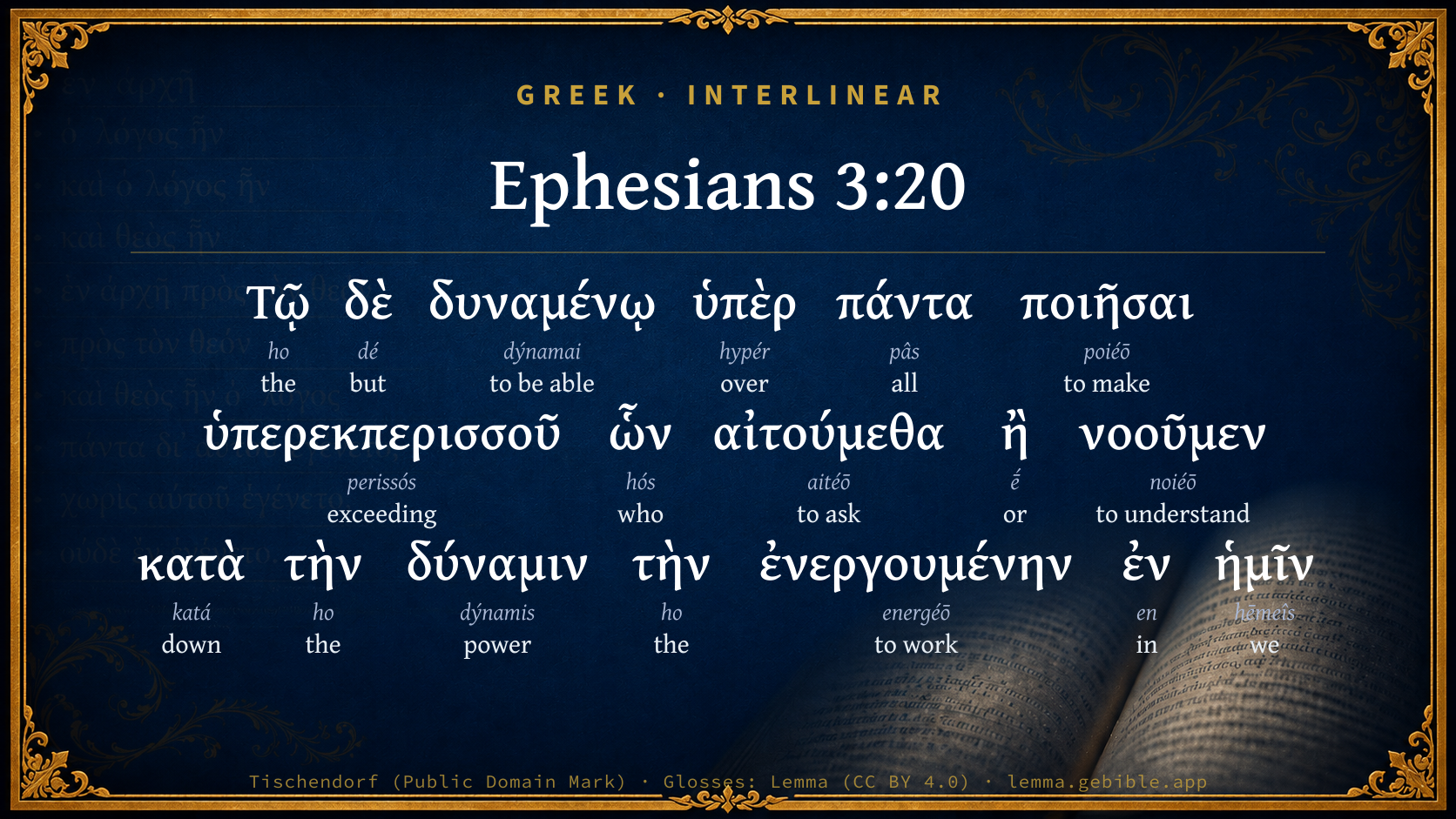
Now to him who is able to do exceedingly abundantly above all that we ask or think, according to the power that works in us,
Download a study sheet
One document with this verse’s original text, its word-by-word gloss line, the meaning frame, cross-references with their text, attributed commentary, and full source and license credits — printable, and it pastes into notes with its structure intact.
This verse Autodidact and up
A passage Seminary Student
Up to 50 verses in one chapter. A passage sheet keeps up to 6 commentary sources and 12 cross-references per verse, in the order this page ranks them, and says so on the sheet whenever that leaves anything out. Ask for a single verse and you get the Autodidact verse sheet above.
Everything on this page stays free to read, with no account — the sheet is a download of what is already on screen, not access to it.
Compare translations 3
The same verse in 3 English versions, stacked beneath the original-language interlinear above. Click any original word for its lexicon entry.
Each is an independent rendering of the whole verse — the interlinear is not word-aligned to these translations.
Highlighted words mark where these versions differ — a whole-verse word diff, not a word-by-word alignment.
-
World English Bible Public Domain
Now to him who is able to do exceedingly abundantly above all that we ask or think, according to the power that works in us,
-
King James Version Public Domain
Now unto him that is able to do exceeding abundantly above all that we ask or think, according to the power that worketh in us,
-
unfoldingWord Literal Text CC BY-SA 4.0
And to the one being able to do exceedingly abundantly above all that we ask or think, according to the power that is working in us,
unfoldingWord Literal Text — © unfoldingWord, licensed CC BY-SA 4.0. Word-aligned USFM3 via Door43 (git.door43.org/unfoldingWord/en_ult).
Show all 19 translations
Every available English version of this verse, each an independent rendering of the whole verse.
-
World English Bible Public Domain
Now to him who is able to do exceedingly abundantly above all that we ask or think, according to the power that works in us,
-
Berean Standard Bible Public Domain
Now to Him who is able to do immeasurably more than all we ask or imagine, according to His power that is at work within us,
-
Majority Standard Bible Public Domain
Now to Him who is able to do immeasurably more than all we ask or imagine, according to His power that is at work within us,
-
King James Version Public Domain
Now unto him that is able to do exceeding abundantly above all that we ask or think, according to the power that worketh in us,
-
American Standard Version (1901) Public Domain
Now unto him that is able to do exceeding abundantly above all that we ask or think, according to the power that worketh in us,
-
Revised Version (1885) Public Domain
Now unto him that is able to do exceeding abundantly above all that we ask or think, according to the power that worketh in us,
-
Geneva Bible (1599) Public Domain
Vnto him therefore that is able to do exceeding aboundantly aboue all that we aske or thinke, according to the power that worketh in vs,
-
Douay-Rheims (1899) Public Domain
Now to him who is able to do all things more abundantly than we desire or understand, according to the power that worketh in us;
-
Young's Literal Translation Public Domain
and to Him who is able above all things to do exceeding abundantly what we ask or think, according to the power that is working in us,
-
Literal Standard Version CC BY-SA 4.0
and to Him who is able to do exceedingly [and] abundantly above all things that we ask or think, according to the power that is working in us,
-
Unlocked Literal Bible CC BY-SA 4.0
Now to him who is able to do far beyond all that we ask or think, according to his power that works in us,
-
unfoldingWord Literal Text CC BY-SA 4.0
And to the one being able to do exceedingly abundantly above all that we ask or think, according to the power that is working in us,
-
Darby Bible Public Domain
But to him that is able to do far exceedingly above all which we ask or think, according to the power which works in us,
-
World Messianic Bible Public Domain
Now to him who is able to do exceedingly abundantly above all that we ask or think, according to the power that works in us,
-
Webster's Bible Public Domain
Now to him that is able to do exceeding abundantly above all that we ask or think, according to the power that worketh in us.
-
Free Bible Version CC BY-SA 4.0
Now may he who—through his power working in us—can do infinitely more than we ever ask for or even think about,
-
Bible in Basic English Public Domain
Now to him who is able to do in full measure more than all our desires or thoughts, through the power which is working in us,
-
Text-Critical English NT CC BY 4.0
Now to him who is able to do immeasurably more than all we could ask or imagine, according to the power at work within us—
-
Tyndale New Testament (1534) Public Domain
Vnto him that is able to do excedynge aboudantly above all that we axe or thynke accordynge to the power that worketh in vs
Literal Standard Version (2020), Covenant Press — licensed CC BY-SA 4.0. Text via the HelloAO Bible API (eBible.org). Unlocked Literal Bible (unfoldingWord) — licensed CC BY-SA 4.0. Text via the HelloAO Bible API (eBible.org). unfoldingWord Literal Text — © unfoldingWord, licensed CC BY-SA 4.0. Word-aligned USFM3 via Door43 (git.door43.org/unfoldingWord/en_ult). Free Bible Version, Dr. Jonathan Gallagher — licensed CC BY-SA 4.0. Text via the HelloAO Bible API (eBible.org).
Word by word
More ways to search: Search by grammar → Find every occurrence → Compare this word →
Practice this passage: Drill this verse → Learn its vocabulary →
- Appears 13× in the Greek New Testament
- First appears at Matthew 5:37
- Part of Speech
- Adverb
Full Thayer's Definition
- Τῷ ho G3588 “the” Article, Dative, Singular, Masculine
- δὲ dé G1161 “but” Conjunction
- δυναμένῳ dýnamai G1410 “to be able” Verb, Present, Middle or Passive deponent, Participle, Dative, Singular, Masculine
- ὑπὲρ hypér G5228 “over” Preposition
- πάντα pâs G3956 “all” Adjective, Accusative, Plural, Neuter
- ποιῆσαι poiéō G4160 “to make” Verb, Aorist, Active, Infinitive
- ὑπερεκπερισσοῦ perissós G4053 “exceeding” Adverb
- ὧν hós G3739 “who” Relative pronoun, Genitive, Plural, Neuter
- αἰτούμεθα aitéō G154 “to ask” Verb, Present, Middle, Indicative, 1st person, Plural
- ἢ ḗ G2228 “or” Particle
- νοοῦμεν noiéō G3539 “to understand” Verb, Present, Active, Indicative, 1st person, Plural
- κατὰ katá G2596 “down” Preposition
- τὴν ho G3588 “the” Article, Accusative, Singular, Feminine
- δύναμιν dýnamis G1411 “power” Noun, Accusative, Singular, Feminine
- τὴν ho G3588 “the” Article, Accusative, Singular, Feminine
- ἐνεργουμένην energéō G1754 “to work” Verb, Present, Middle, Participle, Accusative, Singular, Feminine
- ἐν en G1722 “in” Preposition
- ἡμῖν hēmeîs G2249 “we” Personal pronoun, 1st person, Dative, Plural
About this verse
These counts appear in no published source. They are computed here, from the morphology-tagged text and Lemma’s own curated glosses. What Lemma adds →
- 18
- words
- 16
- distinct lemmas
- Pauline Epistles
- section
Notable vocabulary
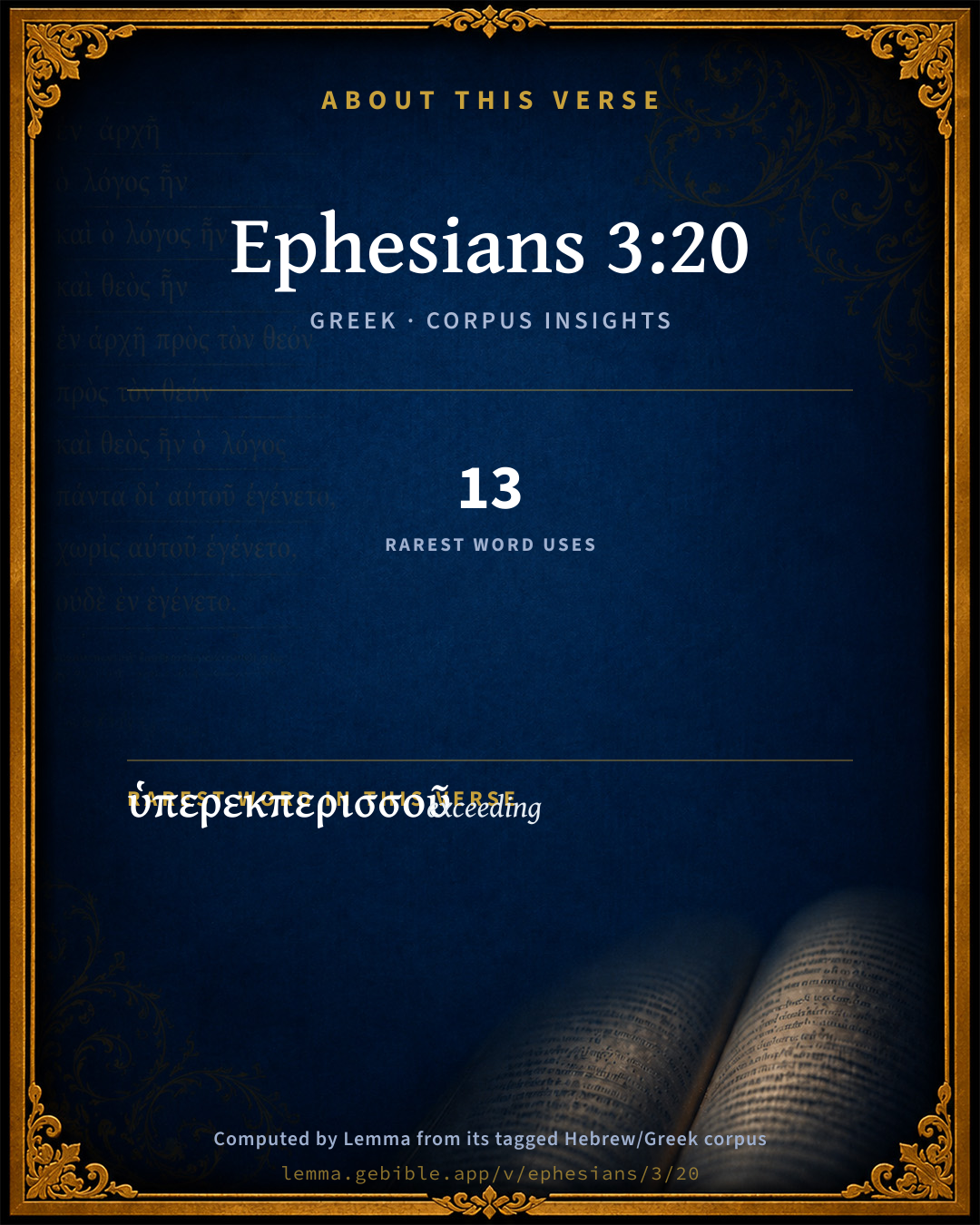
The rarest word here is ὑπερεκπερισσοῦ exceeding G4053 — appearing just 13 times in the whole Greek New Testament.
Shared distinctive vocabulary
ὑπερεκπερισσοῦ exceeding G4053 occurs in 12 verses of the Greek New Testament. Also found in:
Repetition
A word recurs within this verse:
- Τῷ the G3588 ×3
Cross-references
31Topical passages linked to Ephesians 3:20 in the Treasury of Scripture Knowledge — connected by theme and wording, ordered by reader-vote popularity; previews shown in the World English Bible.
- 2 Corinthians 9:8 And God is able to make all grace abound to you, that you, always having all sufficiency in everything, may abound to every good work.
- Romans 4:21 and being fully assured that what he had promised, he was able also to perform.
- Jeremiah 32:27 Behold, I am Yahweh, the God of all flesh: is there anything too hard for me?
- 1 Corinthians 2:9 But as it is written, "Things which an eye didn't see, and an ear didn't hear, Which didn't enter into the heart of man, These God has prepared for those who love him."
- Jude 1:24 Now to him who is able to keep them from stumbling, and to present you faultless before the presence of his glory in great joy,
- Ephesians 1:19 and what is the exceeding greatness of his power toward us who believe, according to that working of the strength of his might
- Jeremiah 32:17 Ah Lord Yahweh! behold, you have made the heavens and the earth by your great power and by your outstretched arm; there is nothing too hard for you,
- Hebrews 7:25 Therefore he is also able to save to the uttermost those who draw near to God through him, seeing he ever lives to make intercession for them.
- Psalms 36:8–9 They shall be abundantly satisfied with the abundance of your house. You will make them drink of the river of your pleasures.
- Ephesians 3:7 of which I was made a servant, according to the gift of that grace of God which was given me according to the working of his power.
- Romans 16:25
- Hebrews 13:20–21 Now may the God of peace, who brought again from the dead the great shepherd of the sheep with the blood of an eternal covenant, our Lord Jesus,
- 1 Kings 3:13 I have also given you that which you have not asked, both riches and honor, so that there shall not be any among the kings like you, all your days.
- John 10:29–30 My Father, who has given them to me, is greater than all. No one is able to snatch them out of my Father's hand.
- Genesis 17:1 When Abram was ninety-nine years old, Yahweh appeared to Abram, and said to him, "I am God Almighty. Walk before me, and be blameless.
- Daniel 3:17 If it be [so], our God whom we serve is able to deliver us from the burning fiery furnace; and he will deliver us out of your hand, O king.
- Colossians 1:29 for which I also labor, striving according to his working, which works in me mightily.
- John 10:10 The thief only comes to steal, kill, and destroy. I came that they may have life, and may have it abundantly.
- Exodus 34:6 Yahweh passed by before him, and proclaimed, "Yahweh! Yahweh, a merciful and gracious God, slow to anger, and abundant in loving kindness and truth,
- 2 Chronicles 25:9 Amaziah said to the man of God, But what shall we do for the hundred talents which I have given to the army of Israel? The man of God answered, Yahweh is able to give you much more than this.
- James 4:12 Only one is the lawgiver, who is able to save and to destroy. But who are you to judge another?
- Isaiah 55:7 let the wicked forsake his way, and the unrighteous man his thoughts; and let him return to Yahweh, and he will have mercy on him; and to our God, for he will abundantly pardon.
- Daniel 6:20 When he came near to the den to Daniel, he cried with a lamentable voice; the king spoke and said to Daniel, Daniel, servant of the living God, is your God, whom you serve continually, able to deliver you from the lions?
- 1 Timothy 1:14 The grace of our Lord abounded exceedingly with faith and love which is in Christ Jesus.
- Hebrews 11:19 accounting that God is able to raise up even from the dead. Figuratively speaking, he also did receive him back from the dead.
- 2 Peter 1:11 For thus will be richly supplied to you the entrance into the eternal Kingdom of our Lord and Savior, Jesus Christ.
- 2 Samuel 7:19 This was yet a small thing in your eyes, Lord Yahweh; but you have spoken also of your servant's house for a great while to come; and this [too] after the manner of men, Lord Yahweh!
- Isaiah 35:2 It shall blossom abundantly, and rejoice even with joy and singing; the glory of Lebanon shall be given to it, the excellency of Carmel and Sharon: they shall see the glory of Yahweh, the excellency of our God.
- Matthew 3:9 Don't think to yourselves, 'We have Abraham for our father,' for I tell you that God is able to raise up children to Abraham from these stones.
- Song of Solomon 5:1 I have come into my garden, my sister, my bride. I have gathered my myrrh with my spice; I have eaten my honeycomb with my honey; I have drunk my wine with my milk. Friends Eat, friends! Drink, yes, drink abundantly, beloved. Beloved
- Genesis 18:4 Now let a little water be fetched, wash your feet, and rest yourselves under the tree.
Cross-references courtesy of OpenBible.info (CC BY 4.0).
Lesson kit
Teaching starters — assembled from the data on this page, not authored interpretation. Every prompt links to the verse data it draws on. Edit before teaching.
Ephesians, in the Pauline Epistles, opens this verse with 18 words (16 distinct Greek lemmas). Its most distinctive word is perissós (“exceeding”). A historical commentator’s framing appears above. Read the whole chapter for the surrounding context.
Discussion questions
- The word perissós carries the sense “exceeding.” How does it shape the verse?
- How does Matthew 5:37, which shares the word «exceeding», read alongside this verse?
- What does the repetition of “the” (3× in this one verse) do in this verse?
- The translations on this page render this verse differently — a whole-verse word diff, not a word-by-word alignment. What might account for the different wordings?
- Compare how The Biblical Illustrator and Joseph Benson's Commentary read this verse. Where do they agree or differ?
Things to notice
- These translations choose different wording for 10 words in this verse.
- “the” occurs 3× in this single verse.
- 16 distinct Greek lemmas span 18 words in this verse.
Commentary
Notes on Ephesians 3:20 from classic Christian and Jewish commentators (each source and its license shown beneath its notes). The classic Christian expositions comment on the surrounding passage and are grouped to its opening verse, so a note may address several verses; the Jewish commentaries on the Tanakh (Rashi and others) are per-verse, so they appear only where the commentator wrote on this verse.
Lemma curates 59 commentaries, every one of them public domain or Creative Commons licensed, each selected and text-cleaned for this edition rather than reprinted as found. About our sources →
The Biblical Illustrator
Joseph S. Exell
The Biblical Illustrator, edited by Joseph S. Exell (c. 1880s–1900s) — public domain. Text from a community e-Sword module.
Joseph Benson's Commentary
Joseph Benson's Commentary on the Old and New Testaments (1811–1818) — public domain. Text from a community e-Sword module.
Whedon's Commentary on the Bible
Daniel D. Whedon
Daniel D. Whedon (gen. ed.), Commentary on the Old and New Testaments (1874–1909) — public domain. Text from a community e-Sword module.
Lange's Commentary on the Holy Scriptures
Lange's Commentary on the Holy Scriptures (Critical, Doctrinal, and Homiletical), ed. John Peter Lange, English translation edited by Philip Schaff (1864–1880) — public domain. Text from a community e-Sword module.
MacLaren's Expositions of Holy Scripture
Alexander MacLaren
Alexander MacLaren, Expositions of Holy Scripture (1904–1910) — public domain. Text from a community e-Sword module.
Tyndale Open Study Notes
Tyndale Open Resources
Tyndale Open Study Notes — © Tyndale Open Resources, licensed CC BY-SA 4.0. Text via the HelloAO Bible API.
Bengel's Gnomon
Johann Albrecht Bengel
Bengel's Gnomon of the New Testament — English translation (T&T Clark, Edinburgh, 1860) — public domain. Text from a community e-Sword module.
Meyer's Critical & Exegetical Commentary
Heinrich August Wilhelm Meyer
Meyer — Critical and Exegetical Commentary on the New Testament — English translation by Peter Christie, edited by Frederick Crombie (T&T Clark, 1880) — public domain. Text from a community e-Sword module.
Expositor's Greek Testament
ed. W. Robertson Nicoll
The Expositor's Greek Testament, edited by W. Robertson Nicoll (1897–1910) — public domain. Text from a community e-Sword module.
Hodge's Commentary on Romans, Ephesians & First Corinthians
Charles Hodge
Charles Hodge — Commentary on Romans (1835), First Corinthians (1857), and Ephesians (1856) — public domain. Text from a community e-Sword module.
Geneva Bible (1599)
Geneva Bible translators
Geneva Bible (1599) marginal notes — public domain. Text via Bolls.life.
Jamieson, Fausset & Brown
Robert Jamieson, A. R. Fausset & David Brown
Jamieson, Fausset & Brown — Commentary Critical and Explanatory on the Whole Bible (1871) — public domain (CC PDM 1.0). Text via the HelloAO Bible API.
Adam Clarke's Commentary
Adam Clarke's Commentary on the Bible (1810–1826) — public domain. Text from a community e-Sword/MySword module.
John Calvin's Commentaries
John Calvin's Commentaries (1540-1563) — public domain. Text from the Calvin Translation Society English edition (1840s-50s) via the Christian Classics Ethereal Library (ccel.org). Calvin's coverage is partial (roughly two-thirds of the Bible); uncommented books and verses are honest gaps, never fabricated. The 19th-century editor's footnotes and remarks are omitted so the notes are faithfully Calvin's own voice.
The Cambridge Bible for Schools and Colleges
gen. ed. J. J. S. Perowne
The Cambridge Bible for Schools and Colleges (gen. ed. J. J. S. Perowne; Cambridge University Press, 1878–1918) — public domain. Text from a community e-Sword module.
John Gill's Exposition
John Gill's Exposition of the Whole Bible (1746–1763) — public domain (CC PDM 1.0). Text via the HelloAO Bible API.
Trapp's Complete Commentary
John Trapp
John Trapp, A Commentary or Exposition upon All the Books of the Old and New Testament (1647–1656) — public domain. Text from a community e-Sword module.
Albert Barnes' Notes on the Bible
Albert Barnes' Notes on the Bible (1834–1885) — public domain. Text from a community e-Sword/MySword module.
Matthew Poole's English Annotations
Matthew Poole's English Annotations on the Holy Bible (1683–1685) — public domain. Text from a community e-Sword/MySword module.
The Pulpit Commentary
The Pulpit Commentary (1880–1919), ed. H.D.M. Spence-Jones & Joseph S. Exell — public domain. Text from a community e-Sword module.
John Wesley's Explanatory Notes
John Wesley, Explanatory Notes Upon the Whole Bible (1754–1765) — public domain. Text via the GEBible commentary corpus.
Kretzmann's Popular Commentary
Paul E. Kretzmann
Paul E. Kretzmann, Popular Commentary of the Bible (1921–1924) — public domain. Text from a community e-Sword module.
Burkitt's Expository Notes on the New Testament
William Burkitt
William Burkitt's Expository Notes on the New Testament (1700–1703) — public domain. Text from a community e-Sword module.
The People's New Testament
B. W. Johnson
B. W. Johnson's The People's New Testament with Notes (1889–1891) — public domain. Electronic text from the Christian Classics Ethereal Library (CCEL) ThML edition.
unfoldingWord translationNotes
Door43 World Missions Community
unfoldingWord translationNotes — © Distant Shores Media and the Door43 World Missions Community, licensed CC BY-SA 4.0. Source: git.door43.org/Door43/en_tn.
Cambridge Greek Testament for Schools and Colleges
Cambridge Greek Testament for Schools and Colleges (Cambridge University Press, 1896; 21 vols, various authors incl. Carr, Maclear, Plummer, Farrar, Lumby, Moule, M. R. James, Simcox) — public domain. Text from a community e-Sword module.
Alford’s Greek Testament
Henry Alford
Henry Alford, The Greek Testament (1849–1861) — public domain. Text from a community e-Sword module.
International Critical Commentary
International Critical Commentary — older volumes (1896–1929), various authors — public domain. Text from a community e-Sword module.
Vincent's Word Studies in the New Testament
Marvin R. Vincent
Marvin R. Vincent, Word Studies in the New Testament (1887–1900) — public domain. Text from a community e-Sword/MySword module.