
Acts 24:11

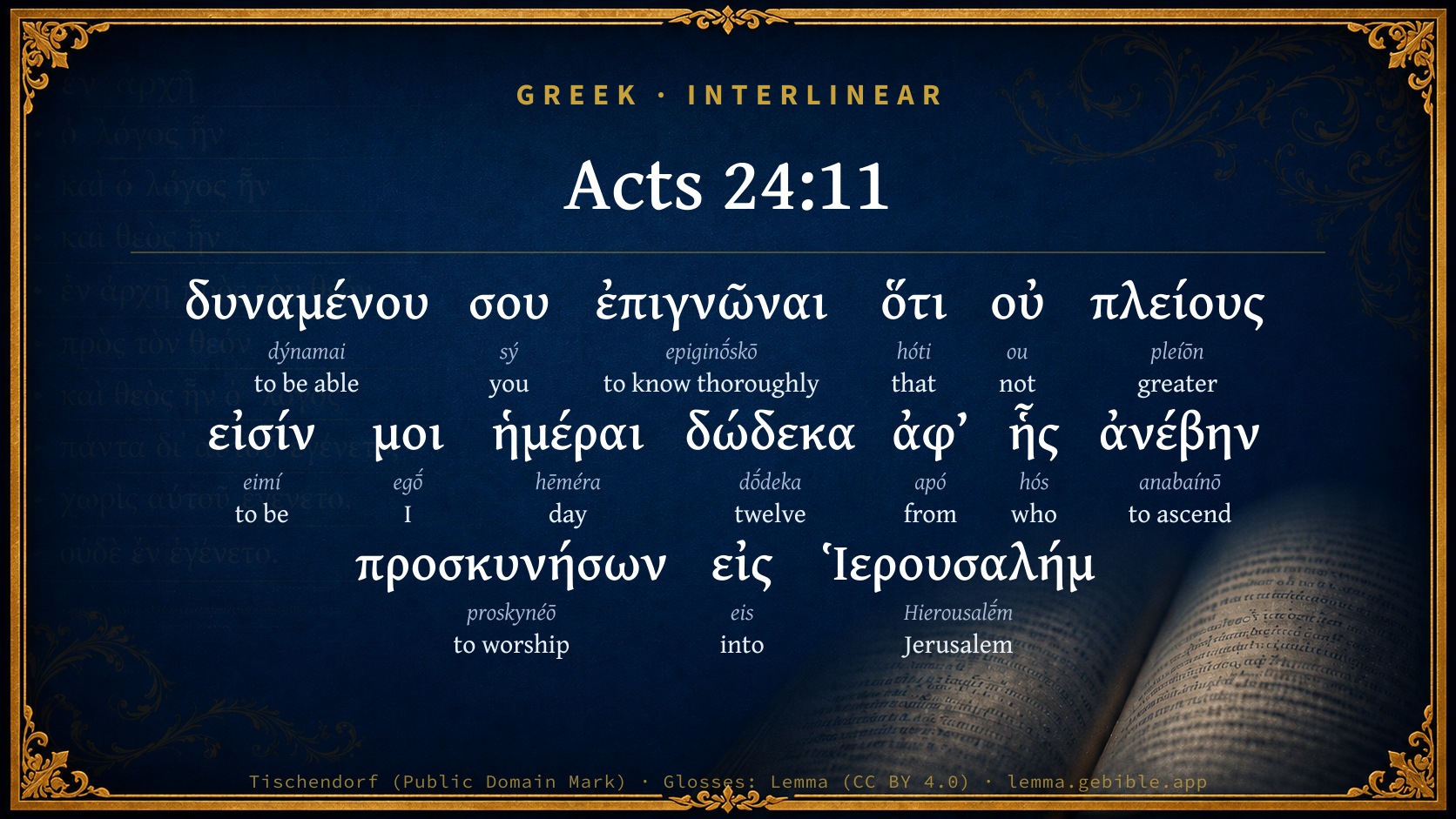
Greek (Tischendorf 8th ed.) Acts 24:11 appears in the Greek New Testament. The text above is from the Tischendorf 8th edition. Each word links to its Strong’s number and a concise gloss. Click any word for its full Thayer’s Greek Lexicon entry.
Download image
Cite this verse

Acts 24:11 (World English Bible). Public Domain. Lemma interlinear Bible study tool, https://lemma.gebible.app/v/acts/24/11.

Show BibTeX & RIS
BibTeX
RIS
English Translation
seeing that you can recognize that it is not more than twelve days since I went up to worship at Jerusalem.
World English Bible · Public Domain
Download a study sheet

One document with this verse’s original text, its word-by-word gloss line, the meaning frame, cross-references with their text, attributed commentary, and full source and license credits — printable, and it pastes into notes with its structure intact.

This verse Autodidact and up

Study sheet (.html) Plain text (.txt)

A passage Seminary Student

Up to 50 verses in one chapter. A passage sheet keeps up to 6 commentary sources and 12 cross-references per verse, in the order this page ranks them, and says so on the sheet whenever that leaves anything out. Ask for a single verse and you get the Autodidact verse sheet above.

Everything on this page stays free to read, with no account — the sheet is a download of what is already on screen, not access to it.

Want to remove ads? Support Godless Engineer
Compare translations 3

The same verse in 3 English versions, stacked beneath the original-language interlinear above. Click any original word for its lexicon entry.

Each is an independent rendering of the whole verse — the interlinear is not word-aligned to these translations.

Highlighted words mark where these versions differ — a whole-verse word diff, not a word-by-word alignment.

  • World English Bible Public Domain
    seeing that you can recognize that it is not more than twelve days since I went up to worship at Jerusalem.
  • King James Version Public Domain
    Because that thou mayest understand, that there are yet but twelve days since I went up to Jerusalem for to worship.
  • unfoldingWord Literal Text CC BY-SA 4.0
    you being able to learn that it is not more than 12 days for me from when I went up to Jerusalem to worship,

unfoldingWord Literal Text — © unfoldingWord, licensed CC BY-SA 4.0. Word-aligned USFM3 via Door43 (git.door43.org/unfoldingWord/en_ult).

Versions to compare (up to 4)

3 of 4 selected

Show all 19 translations

Every available English version of this verse, each an independent rendering of the whole verse.

  • World English Bible Public Domain
    seeing that you can recognize that it is not more than twelve days since I went up to worship at Jerusalem.
  • Berean Standard Bible Public Domain
    You can verify for yourself that no more than twelve days ago I went up to Jerusalem to worship.
  • Majority Standard Bible Public Domain
    You can verify for yourself that no more than twelve days ago I went up to worship in Jerusalem.
  • King James Version Public Domain
    Because that thou mayest understand, that there are yet but twelve days since I went up to Jerusalem for to worship.
  • American Standard Version (1901) Public Domain
    Seeing that thou canst take knowledge that it is not more than twelve days since I went up to worship at Jerusalem:
  • Revised Version (1885) Public Domain
    seeing that thou canst take knowledge, that it is not more than twelve days since I went up to worship at Jerusalem:
  • Geneva Bible (1599) Public Domain
    Seeing that thou mayest knowe, that there are but twelue dayes since I came vp to worship in Hierusalem.
  • Douay-Rheims (1899) Public Domain
    For thou mayest understand, that there are yet but twelve days, since I went up to adore in Jerusalem:
  • Young's Literal Translation Public Domain
    thou being able to know that it is not more than twelve days to me since I went up to worship in Jerusalem,
  • Literal Standard Version CC BY-SA 4.0
    you being able to know that it is not more than twelve days to me since I went up to worship in Jerusalem,
  • Unlocked Literal Bible CC BY-SA 4.0
    You will be able to find out that it has not been more than twelve days since I went up to worship in Jerusalem.
  • unfoldingWord Literal Text CC BY-SA 4.0
    you being able to learn that it is not more than 12 days for me from when I went up to Jerusalem to worship,
  • Darby Bible Public Domain
    As thou mayest know that there are not more than twelve days since I went up to worship at Jerusalem,
  • World Messianic Bible Public Domain
    seeing that you can verify that it is not more than twelve days since I went up to worship at Jerusalem.
  • Webster's Bible Public Domain
    That thou mayest understand, that there are yet but twelve days since I went up to Jerusalem to worship.
  • Free Bible Version CC BY-SA 4.0
    “You can easily verify that I arrived in Jerusalem to worship just twelve days ago.
  • Bible in Basic English Public Domain
    Seeing that you are able to make certain of the fact that it is not more than twelve days from the time when I came up to Jerusalem for worship;
  • Text-Critical English NT CC BY 4.0
    Yoʋ can ascertain that it has not been more than twelve days since I went up to worship in Jerusalem.
  • Tyndale New Testament (1534) Public Domain
    because that thou mayst knowe that there are yet.xii. dayes sence I went vp to Ierusalem for to praye

Literal Standard Version (2020), Covenant Press — licensed CC BY-SA 4.0. Text via the HelloAO Bible API (eBible.org). Unlocked Literal Bible (unfoldingWord) — licensed CC BY-SA 4.0. Text via the HelloAO Bible API (eBible.org). unfoldingWord Literal Text — © unfoldingWord, licensed CC BY-SA 4.0. Word-aligned USFM3 via Door43 (git.door43.org/unfoldingWord/en_ult). Free Bible Version, Dr. Jonathan Gallagher — licensed CC BY-SA 4.0. Text via the HelloAO Bible API (eBible.org).

Word by word

More ways to search: Search by grammar → Find every occurrence → Compare this word →

Practice this passage: Drill this verse → Learn its vocabulary →

ἐπιγνῶναι
epiginṓskō
G1921
“to know thoroughly”
Verb, Aorist, Active, Infinitive
Part of Speech
Verb
Tense
Aorist
Voice
Active
Mood
Infinitive
Full Thayer's Definition

Origin: from G1909 and G1097

TDNT: 12:29,1

1. to become thoroughly acquainted with, to know thoroughly a. to know accurately, know well 2. to know a. to recognise 1. by sight, hearing, of certain signs, to perceive who a person is b. to know i.e. to perceive c. to know i.e. to find out, ascertain d. to know i.e. to understand
  1. δυναμένου dýnamai G1410 “to be able” Verb, Present, Middle or Passive deponent, Participle, Genitive, Singular, Masculine
  2. σου sý G4771 “you” Personal pronoun, 2nd person, Genitive, Singular
  3. ὅτι hóti G3754 “that” Conjunction
  4. οὐ ou G3756 “not” Particle, Negative
  5. πλείους pleíōn G4119 “greater” Adjective, Nominative, Plural, Feminine, Comparative
  6. εἰσίν eimí G1510 “to be” Verb, Present, Active, Indicative, 3rd person, Plural
  7. μοι egṓ G1473 “I” Personal pronoun, 1st person, Dative, Singular
  8. ἡμέραι hēméra G2250 “day” Noun, Nominative, Plural, Feminine
  9. δώδεκα dṓdeka G1427 “twelve” Adjective, Numeral (indeclinable)
  10. ἀφ’ apó G575 “from” Preposition
  11. ἧς hós G3739 “who” Relative pronoun, Genitive, Singular, Feminine
  12. ἀνέβην anabaínō G305 “to ascend” Verb, Aorist, Active, Indicative, 1st person, Singular
  13. προσκυνήσων proskynéō G4352 “to worship” Verb, Future, Active, Participle, Nominative, Singular, Masculine
  14. εἰς eis G1519 “into” Preposition
  15. Ἱερουσαλήμ Hierousalḗm G2419 “Jerusalem” Noun, Proper, indeclinable

About this verse

These counts appear in no published source. They are computed here, from the morphology-tagged text and Lemma’s own curated glosses. What Lemma adds →

16
words
16
distinct lemmas
Acts
section

Shared distinctive vocabulary

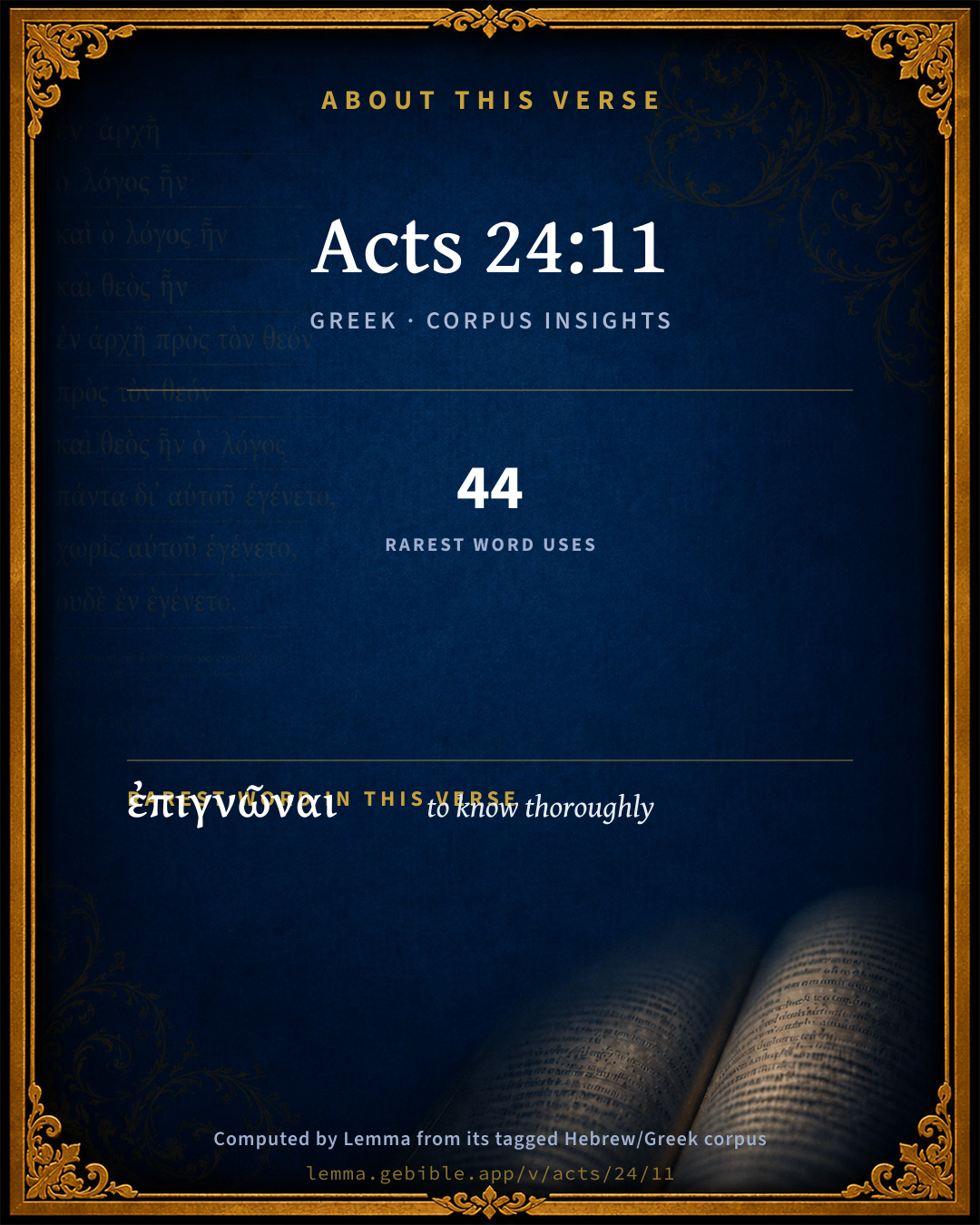
ἐπιγνῶναι to know thoroughly G1921 occurs in 40 verses of the Greek New Testament. Also found in:
Cross-references

8

Topical passages linked to Acts 24:11 in the Treasury of Scripture Knowledge — connected by theme and wording, ordered by reader-vote popularity; previews shown in the World English Bible.

  • Acts 24:1 After five days, the high priest, Ananias, came down with certain elders and an orator, one Tertullus. They informed the governor against Paul.
  • Acts 21:18 The day following, Paul went in with us to James; and all the elders were present.
  • Acts 21:26–27 Then Paul took the men, and the next day, purified himself and went with them into the temple, declaring the fulfillment of the days of purification, until the offering was offered for every one of them.
  • Acts 22:30 But on the next day, desiring to know the truth about why he was accused by the Jews, he freed him from the bonds, and commanded the chief priests and all the council to come together, and brought Paul down and set him before them.
  • Acts 23:11 The following night, the Lord stood by him, and said, "Cheer up, Paul, for as you have testified about me at Jerusalem, so you must testify also at Rome."
  • Acts 23:23 He called to himself two of the centurions, and said, "Prepare two hundred soldiers to go as far as Caesarea, with seventy horsemen, and two hundred men armed with spears, at the third hour of the night."
  • Acts 23:32–33 But on the next day they left the horsemen to go with him, and returned to the barracks.
  • Acts 24:17 Now after some years, I came to bring gifts for the needy to my nation, and offerings;

Cross-references courtesy of OpenBible.info (CC BY 4.0).

Commentary

Notes on Acts 24:11 from classic Christian and Jewish commentators (each source and its license shown beneath its notes). The classic Christian expositions comment on the surrounding passage and are grouped to its opening verse, so a note may address several verses; the Jewish commentaries on the Tanakh (Rashi and others) are per-verse, so they appear only where the commentator wrote on this verse.

Lemma curates 59 commentaries, every one of them public domain or Creative Commons licensed, each selected and text-cleaned for this edition rather than reprinted as found. About our sources →

Albert Barnes' Notes on the Bible

Because that thou mayest understand - Greek: “Thou being able to know.” That is, he could understand or know by taking the proper evidence. Paul does not mean to say that Felix could understand the case because he had been many years a judge of that nation. That fact would qualify him to judge correctly, or to understand the customs of the Jews. But the fact that he himself had been but twelve days in Jerusalem, and had been orderly and peaceable there, Felix could ascertain only by the proper testimony. The first part of Paul’s defense Act 24:11-13 consists in an express denial of what they alleged against him.

Are yet but twelve days - Beza reckons these twelve days in this manner: The first was that on which he came to Jerusalem, Act 21:15. The second he spent with James and the apostles, Act 21:18. Six days were spent in fulfilling his vow, Act 21:21, Act 21:26. On the ninth day the tumult arose, being the seventh day of his vow, and on this day he was rescued by Lysias, Act 21:27; Act 22:29. The tenth day he was before the Sanhedrin, Act 22:30; Act 23:10. On the eleventh the plot was laid to take his life, and on the same day, at evening, he was removed to Caesarea. The days on which he was confined at Caesarea are not enumerated, since his design in mentioning the number of days was to show the improbability that in that time he had been engaged in producing a tumult; and it would not be pretended that he had been so engaged while confined in a prison at Caesarea. The defense of Paul here is, that but twelve days elapsed from the time that he went to Jerusalem until he was put under the custody of Felix; and that during so short a time it was wholly improbable that he would have been able to excite sedition.

For to worship - This further shows that the design of Paul was not to produce sedition. He had gone up for the peaceful purpose of devotion, and not to produce riot and disorder. That this was his design in going to Jerusalem, or at least a part of his purpose, is indicated by the passage in Act 20:16. It should be observed, however, that our translation conveys an idea which is not necessarily in the Greek that this was the design of his going to Jerusalem. The original is, “Since I went up to Jerusalem worshipping” προσκυνήσων proskunēsōn; that is, he was actually engaged in devotion when the tumult arose. But his main design in going to Jerusalem was to convey to his suffering countrymen there the benefactions of the Gentile churches. See Act 24:17; Rom 15:25-26.

Albert Barnes' Notes on the Bible (1834–1885) — public domain. Text from a community e-Sword/MySword module.

Bengel's Gnomon

Johann Albrecht Bengel

Act 24:11. Δεκαδύο, twelve) Deducting the five days, of which Act 24:1 speaks, there were seven days: and concerning these seven see ch. Act 21:17-18; Act 21:26-27 (the seven days of purification were nearly ended ἔμελλον συντελεῖσθαι, when he was made prisoner), wherein the verb ἔμελλον should be attended to; and the sense is, When these things were being done, which Paul had taken in hand, Act 24:26: furthermore see ch. Act 22:30, Act 23:11-12; Act 23:32.—ἀνέβην I went up) from Cesarea. Felix might have understood or known (δυναμένου σου ἐπινιῶναι) the fact from the Cesareans.

Bengel's Gnomon of the New Testament — English translation (T&T Clark, Edinburgh, 1860) — public domain. Text from a community e-Sword module.

Meyer's Critical & Exegetical Commentary

Heinrich August Wilhelm Meyer

Act_24:11. Paul adds a more special reason subordinate to the general one (Act_24:10), for his εὐθυμότερον … ἀπολογοῦμαι. Since he had returned from abroad only twelve days ago, and accordingly the ground of facts on which they wished him condemned (τὸ ἱερὸν ἐπείρασε βεβηλῶσαι, comp. Act_21:28) was still quite new, the procurator, with his long judicial experience among the Jewish people, could the less avoid the most thorough examination of the matter.

οὐ πλείους … ἡμέραι δεκαδύο] without ἤ, which Elz. has as a gloss. See on Act_4:22.

ἀφʼ ἧς ἀνέβην] from the day on which (ἀΦʼ ἧς, sc. ἡμέρας, comp. on Act_1:2; Act_1:22) I had come up. This is the day of the accomplished ἀναβαίνειν, the day of the arrival, not of the departure from Caesarea (Wieseler). Comp. Act_11:2; Kühner, § 444; Winer, p. 258 [E. T. 343]. As to the reckoning of the twelve days, it is to be observed: (1) That by the present εἰσι the inclusion of the days already spent at Caesarea is imperatively required. Hence the assumption of Heinrichs, Hildebrand, and others is to be rejected as decidedly erroneous: Dies, quibus P. jam Caesareae fuerat, non numerantur; ibi enim (!!) in custodia tumultum movere non poterat (Kuinoel). (2) That οὐ πλείους εἰσι permits us to regard as the current day on which the discussion occurred, either the twelfth or the (not yet elapsed) thirteenth; as, however, Paul wished to express as short a period as possible, the latter view is to be preferred. There accordingly results the following calculation:

I.

Day of arrival in Jerusalem, Act_21:15-17.

II. Meeting with James, Act_21:18 ff. III. Undertaking of the Nazarite vow and offerings, Act_21:26. IV. V. The seven days time of offering broken off by the arrest, Act_21:27. VI. VII. Arrest of the apostle, Act_21:27 ff. VIII. Paul before the Sanhedrim, Act_22:30, Act_23:1-10. IX. Jewish conspiracy and its disclosure, Act_23:12 ff. On the same day Paul, before midnight, is brought away from Jerusalem, Act_23:23; Act_23:31. X. Μετὰ δὲ πέντε ἡμέρας κ.τ.λ., Act_24:1. XI. XII. XIII. The current day. It further serves to justify this calculation: (1) that it sufficiently agrees with the vague statement in Act_21:27 : ὡς δὲ ἔμελλον αἱ ἑπτὰ ἡμέραι συντελεῖσθαι, to place the arrest on the fifth day of that week; (2) that, as terminus a quo for μετὰ πέντε ἡμέρας, Act_24:1, the ninth day may not only be assumed generally (because the immediately preceding section of the narrative, Act_23:31 ff., commences with the departure of Paul from Jerusalem), but is also specially indicated by the connection, inasmuch as this μετὰ πέντε ἡμέρ. so corresponds to the τῇ δὲ ἐπαύριον, Act_23:32, that there is presented for both statements of time one and the same point of commencement, namely, the day on which the convoy (after nine in the evening) left Jerusalem. Anger (de temp. rat. p. 110) deviates from this reckoning in the two points, that he places as the first of the five days, Act_24:1, the day of the arrival at Caesarea; and he does not include at all in the reckoning the day on which Paul came to Jerusalem (because Paul reached it, perhaps, only after sunset). But the former is unnecessary (see above), and the latter would not only be at variance with Pauls own words, ἀφʼ ἧς ἀνέβην προσκυνήσ. ἐν Ἱερουσ., Act_24:11 (by which the day of arrival is included), but also would bring the reckoning of the apostle into contradiction with Act_21:17-18 (τῇ δὲ ἐπιούσῃ). Wieseler, p. 103 f., and on Gal. p. 588, has reckoned the days in an entirely different mannerbut in connection with his opinion (not to be approved) that the ἑπτὰ ἡμέπαι in Act_21:27 are to be understood of the Pentecostal weeknamely: two days for the journey to Jerusalem; the third day, interview with James; the fourth, his arrest in the temple (Pentecost); the fifth, the sitting of the Sanhedrim; the sixth, his removal to Caesarea; the seventh, his arrival there; the twelfth, the departure of Ananias from Jerusalem, Act_24:1; the thirteenth, the hearing before Felix.

προσκυνήσων] thus with quite an innocent and legally religious design.

εἰς Ἱερουσ.] (see the critical remarks), belongs to ἀνέβην.

Meyer — Critical and Exegetical Commentary on the New Testament — English translation by Peter Christie, edited by Frederick Crombie (T&T Clark, 1880) — public domain. Text from a community e-Sword module.

Expositor's Greek Testament

ed. W. Robertson Nicoll

Act 24:11 . δυν . σοῦ γνῶναι : “seeing that thou canst take knowledge” ( ἐπιγ .), R.V., the shortness of the time would enable Felix to gain accurate knowledge of the events which had transpired, and the Apostle may also imply that the time was too short for exciting a multitude to sedition. οὐ πλείους εἰσί μοι ἡμ . ἢ δεκαδύο : on οὐ πλείους see Act 24:1 and critical note. The number is evidently not a mere round number, as Overbeck thinks, but indicates that Paul laid stress upon the shortness of the period, and would not have included incomplete days in his reckoning. It is not necessary therefore to include the day of the arrival in Jerusalem ( ἀφʼ ἧς points to the day as something past, Bethge), or the day of the present trial; probably the arrival in Jerusalem was in the evening, as it is not until the next day that Paul seeks out James (Wendt). The first day of the twelve would therefore be the entry in to James, the second the commencement of the Nazirite vow, the sixth that of the apprehension of Paul towards the close of the seven days, Act 21:27 ; the seventh the day before the Sanhedrim, the eighth the information of the plot and (in the evening) Paul’s start for Cæsarea, the ninth the arrival in Cæsarea; and, reckoning from the ninth five days inclusively, the day of the speech of Tertullus before Felix would be the thirteenth day, i.e. , twelve full days; cf. Act 20:6 , where in the seven days are reckoned the day of arrival and the day of departure (Wendt, in loco ). Meyer on the other hand reckons the day of St. Paul’s arrival in Jerusalem as the first day, and the five days of Act 24:1 from his departure from Jerusalem for Cæsarea. For other modes of reckoning see Wendt’s note, Farrar, St. Paul , ii., 338, Alford, Rendall, and Lumby, in loco . Weiss points out that it is simplest to add the seven days of Act 21:27 and the five days of Act 24:1 , but we cannot by any means be sure that Act 21:27 implies a space of full seven days: “varie numerum computant; sed simplicissimum est sine dubio, e septem diebus, Act 21:27 , et quinque, Act 24:1 , eum colligere,” so Blass, but see his note on the passage. προσκυνήσων , cf. Act 20:16 , the purpose was in itself an answer to each accusation reverence not insurrection, conformity not heresy, worship not profanity. “ To worship I came , so far was I from raising sedition,” Chrys. There were other reasons no doubt for St. Paul’s journey, as he himself states, Act 24:17 , cf. Rom 15:25 , but he naturally places first the reason which would be a defence in the procurator’s eyes. Overbeck and Wendt contend that the statement is not genuine, and that it is placed by the author of Acts in St. Paul’s mouth, but see on the other hand Weiss, in loco . It seems quite captious to demand that Paul should explain to the procurator all the reasons for his journey, or that the fact that he came to worship should exclude the fact that he also came to offer alms.

The Expositor's Greek Testament, edited by W. Robertson Nicoll (1897–1910) — public domain. Text from a community e-Sword module.

Jamieson, Fausset & Brown

Robert Jamieson, A. R. Fausset & David Brown

thou mayest understand--canst easily learn.

that there are yet but twelve days since I went up to Jerusalem--namely, 1. The day of his arrival in Jerusalem (Act 21:15-17); 2. The interview with James (Act 21:18-26); 3. The assumption of the vow (Act 21:26); 4, 5, 6. Continuance of the vow, interrupted by the arrest (Act 21:27, &c.); 7. Arrest of Paul (Act 21:27); 8. Paul before the Sanhedrim (Act 22:30; Act 23:1-10); 9. Conspiracy of the Jews and defeat of it (Act 23:12-24), and despatch of Paul from Jerusalem on the evening of the same day (Act 23:23, Act 23:31); 10, 11, 12, 13. The remaining period referred to (Act 24:1) [MEYER]. This short period is mentioned to show how unlikely it was that he should have had time to do what was charged against him.

for to worship--a very different purpose from that imputed to him.

Jamieson, Fausset & Brown — Commentary Critical and Explanatory on the Whole Bible (1871) — public domain (CC PDM 1.0). Text via the HelloAO Bible API.

Adam Clarke's Commentary

Verse 11. There are yet but twelve days] This is his reply to their charge of sedition; the improbability of which is shown from the short time he had spent in Jerusalem, quite insufficient to organize a sedition of any kind; nor could a single proof be furnished that he had attempted to seduce any man, or unhinge any person from his allegiance by subtle disputations, either in the temple, the synagogues, or the city. So that this charge necessarily fell to the ground, self-confuted, unless they could bring substantial proof against him, which he challenges them to do.

Adam Clarke's Commentary on the Bible (1810–1826) — public domain. Text from a community e-Sword/MySword module.

John Calvin's Commentaries

11. To worship. First, it is certain that he came for other causes, and he will afterward confess that this was the chief, that he might bring alms for the sustentation of the brethren. But we may well excuse him, because it was not of necessity that he should give an account of his coming; only he meant, by the way, to excuse himself of corrupt religion. Wherefore, though he came to Jerusalem for some other cause, yet this is always true, that he came with no other mind, but to profess himself to be a worshipper of God, and to approve the holiness of the temple by his worshipping. The other question is more hard, how he saith that he came to worship, seeing the religion of the temple was already abolished, and all difference of the temple taken away? I answer in this place likewise, that though he do not make his purpose known, yet he doth not lie or dissemble. For the faithful servants of Christ were not forbidden to worship in the temple, so they did not tie holiness to the place, but did lift up pure hands freely without making choice of places (1 Timothy 2:8). It was lawful for Paul to enter into the temple after he was come to Jerusalem, that he might make his godliness known, and there to use the solemn rites of the worship of God, because he was void of superstition; so he did not offer any propitiatory sacrifices which were contrary to the gospel. Therefore religion did not compel him to come to Jerusalem according to the appointment of the law, as if the sanctuary were the face of God as in times past; yet he doth not abhor the external worship which was unto men a testimony of godliness.

John Calvin's Commentaries (1540-1563) — public domain. Text from the Calvin Translation Society English edition (1840s-50s) via the Christian Classics Ethereal Library (ccel.org). Calvin's coverage is partial (roughly two-thirds of the Bible); uncommented books and verses are honest gaps, never fabricated. The 19th-century editor's footnotes and remarks are omitted so the notes are faithfully Calvin's own voice.

Ellicott's Commentary for English Readers

(11) I went up to Jerusalem for to worship.—This was, by implication, St. Paul’s answer to the charge of the attempted profanation. One who had come to worship was not likely to be guilty of the crime alleged against him.

A Bible Commentary for English Readers, edited by Charles John Ellicott (1878–1897) — public domain. Text from a community e-Sword module.

The Cambridge Bible for Schools and Colleges

gen. ed. J. J. S. Perowne

11. because that thou mayest understand] Rev. Ver. taking a slightly different reading, “Seeing that thou canst take knowledge.” The Apostle means that it was easy to find evidence about all that had happened in such a short space of time. Beside which Felix’s knowledge of Jewish customs would tell him that this was just the time at which foreign Jews came to Jerusalem.

that there are yet but twelve days] The Rev. Ver. has the more modern English, which is also closer to the Greek, “that it is not more than twelve days.” The time may be accounted for thus: the day of St Paul’s arrival, the interview with James on the second day, five days may be given to the separate life in the temple during the vow, then the hearing before the council, next day the conspiracy, the tenth day St Paul reached Cæsarea, and on the thirteenth day (which leaves five days (Act_24:1), as Jews would reckon from the conspiracy to the hearing in Cæsarea) St Paul is before Felix. See Farrar’s St Paul, ii. 338 (note).

since I went up to Jerusalem for to worship] The Rev. Ver. gets rid of the antiquated English by rendering, “since I went up to worship at Jerusalem.” But the A. V. gives more of the emphasis which St Paul intended to lay on the object of his visit. He went on purpose to worship. Was it likely that he would try to profane the temple? And the verb which he uses expresses all the lowly adoration common among Orientals. The Apostle probably chose it for this reason. He would have Felix know that it was in a most reverent frame of mind that he came to the feast.

The Cambridge Bible for Schools and Colleges (gen. ed. J. J. S. Perowne; Cambridge University Press, 1878–1918) — public domain. Text from a community e-Sword module.

John Gill's Exposition

Because that thou mayest understand,.... By what Paul now asserted, and by the witnesses which he could produce to certify the truth of it:

that there are yet but twelve days since I went up to Jerusalem for to worship; that is, from the time that he went up from Caesarea to Jerusalem, to the present time, in which he stood before Felix, pleading his own cause; which may be reckoned, thus, he came in one day from Caesarea to Jerusalem, Act 21:16 the next day he visited James and the elders, Act 21:18 on the third day he purified himself in the temple, Act 21:26 where he was taken and used ill by the Jews; on the fourth day, he was brought before the sanhedrim, and defended himself, Act 22:30 on the fifth day forty Jews conspire to take away his life, Act 23:11, on the sixth day he came to Caesarea, being sent there by Lysias, Act 23:32 and five days after this, which make eleven, Ananias, and the elders, with Tertullus, came down to accuse him; and this day was the twelfth, on which his trial came on. And of these twelve days he was a prisoner nine, and therefore could not have done so much mischief, and stirred up so much sedition as was insinuated; and in opposition to the charge of profaning the temple, he observes that he came up to Jerusalem to "worship"; namely, at the feast of Pentecost.

John Gill's Exposition of the Whole Bible (1746–1763) — public domain (CC PDM 1.0). Text via the HelloAO Bible API.

Trapp's Complete Commentary

John Trapp

11 Because that thou mayest understand, that there are yet but twelve days since I went up to Jerusalem for to worship.

Ver. 11. There are yet but twelve days] And therefore in so short a time I could surely do no such great matters as they charge me with.

John Trapp, A Commentary or Exposition upon All the Books of the Old and New Testament (1647–1656) — public domain. Text from a community e-Sword module.

Haydock's Catholic Bible Commentary

Since I went up from Cæsarea to Jerusalem, not to profane the temple, or excite sedition, but to adore the one true God.

George Leo Haydock (1774–1849), Haydock's Catholic Family Bible and Commentary, 1859 edition — public domain. Excludes Psalms (Douay-Rheims chapter numbering differs from Protestant) and Deuterocanonical books (Catholic canon only).

Matthew Poole's English Annotations

That thou mayest understand, either by what thou hast heard already, or by what the witnesses, when examined, will declare.

There are yet but twelve days since I went up to Jerusalem; there were but twelve days since Paul’s coming to Jerusalem; seven of them he had spent there, until the time of his purification was accomplished; and the other five days he had been in custody, and at Caesarea: by which St. Paul proves how unlikely it was, that in so short a time he, being a stranger in those parts, should raise any tumults.

For to worship; he being so far from designing any mischief, that he only intended to worship God.

Matthew Poole's English Annotations on the Holy Bible (1683–1685) — public domain. Text from a community e-Sword/MySword module.

Whedon's Commentary on the Bible

Daniel D. Whedon

11. Because—On the first charge, namely, of SEDITION, Paul takes the twelve days of which the present witnesses could testify of their own knowledge, and declares what his conduct was. Because that depends on I do answer.

To Jerusalem… to worship—Positively Paul now states his conduct to be that of a loyal Jew going to the religious capital, and his object being to worship there at the great national festival of the Passover. Negatively, he goes on to deny anything seditious, whether in temple, in popular assembly in any of the many synagogues, or in the streets of the city.

Daniel D. Whedon (gen. ed.), Commentary on the Old and New Testaments (1874–1909) — public domain. Text from a community e-Sword module.

The Pulpit Commentary

Seeing that thou canst take knowledge for because that thou mayest understand, A.V. and T.R.; it is act more than for there are yet but, A.V.; I went up to worship at Jerusalem for I went up to Jerusalem for to worship, A.V. Twelve days. These days may be thus reckoned:

(1) arrival at Jerusalem; (Act_21:15)

(2) Visit to James and the ciders; (Act_21:18)

(3) first day of purification; (Act_21:26)

(4) second day of purification;

(5) the third day;

(6) the fourth day;

(7) the fifth day, when the tumult took place; (Act_21:27)

(8) Paul brought before the Sanhedrim;

(9) the conspiracy of the forty Jews, Paul leaves Jerusalem for Caesarea the first of the five days mentioned in Act_24:1;

(10) arrival of St. Paul" next day" at Caesarea, and lodged in the pretorium second of the five days; (Act_23:32, Act_23:35)

(11) Paul in Herod"s judgment hall third of the five days;

(12) ditto fourth of the five days;

(13) the current day, being also the fifth day of those mentioned in Act_24:1. The mention of the brief time of twelve days shows the narrow limitsof time within which the crime must have been committed, while the adroit mention of the purpose of his visit, to worship, would show how unlikely it was that he should have gone with any evil intent.

The Pulpit Commentary (1880–1919), ed. H.D.M. Spence-Jones & Joseph S. Exell — public domain. Text from a community e-Sword module.

McGarvey & Pendleton's Commentaries

J. W. McGarvey

See notes on verse 10

J. W. McGarvey (with Philip Y. Pendleton), Commentaries on the New Testament (The Fourfold Gospel, 1914; Acts; and the epistles) — public domain. Text from a community e-Sword/MySword module.

Cambridge Greek Testament for Schools and Colleges

11. ἤ before δώδεκα omitted with אABEHLP. Vulg. has ‘quam.’

11. δυναμένου σου ἐπιγνῶναι, seeing that thou art able to take knowledge. The Apostle refers to the acquaintance which Felix had gained of Jewish habits and customs and their festivals, and the manner of observance thereof. This knowledge would make him appreciate St Paul’s statement.

οὐ πλείους εἰσίν μοι ἡμέραι δώδεκα, it is not more than twelve days. The time may be accounted for thus: the day of St Paul’s arrival, the interview with James on the second day, five days may be given to the separate life in the Temple during the vow, then the hearing before the council, next day the conspiracy, the tenth day St Paul reached Cæsarea, and on the thirteenth day [which leaves five days (Act 24:1), as Jews would reckon from the conspiracy to the hearing in Cæsarea] St Paul is before Felix. See Farrar’s St Paul, II. 338 (note).

ἀφ’ ἧς ἀνέβην προσκυνήσων εἰς Ἰερουσαλήμ, since I went up to Jerusalem for to worship. The purpose of the Apostle was ‘to worship.’ Was it likely that he would try to profane the Temple? And προσκυνήσων expresses all the lowly adoration common among Orientals. The Apostle probably chose it for this reason. He would have Felix know that it was in a most reverent frame of mind that he came to the feast.

ἀφ’ ἧς (ἡμέρας) is the construction in full.

Cambridge Greek Testament for Schools and Colleges (Cambridge University Press, 1896; 21 vols, various authors incl. Carr, Maclear, Plummer, Farrar, Lumby, Moule, M. R. James, Simcox) — public domain. Text from a community e-Sword module.

Alford’s Greek Testament

Henry Alford

11. ἡμέραι δώδεκα] The point of this seems to be, that Felix having been so long time a judge among the Jews, must be well able to search into and adjudicate on an offence whose whole course was comprised within so short a period.

The twelve days may be thus made out: 1. his arrival in Jerusalem, ch. 21:15-17; 2. his interview with James, ib. 18 ff.; 3. his taking on him the vow, ib. 26; 3-7. the time of the vow, interrupted by—7. his apprehension, ch. 21:27; 8. his appearance before the Sanhedrim, ch. 22:30 ff.; 9. his departure from Jerusalem (at night); and so to the 13th, the day now current, which was the 5th inclusive from his leaving Jerusalem. This, which is also De Wette and Meyer’s arrangement, is far more natural than that of Kuin., Olsh., Heinr., &c., who suppose that the days which he had already spent at Cæsarea are not to be counted, because his raising disturbances while in custody was out of the question. The view advocated by Wieseler (Chron. der Apost.-gesch. pp. 103 ff.), that Paul was apprehended on the very day of his appearance with the men in the temple, I cannot but regard, notwithstanding his arguments in its favour, as inconsistent with the text of ch. 21:26, 27; as also his idea that the Apostle did not take the vow on himself: the expression σὺν αὐτοῖς ἁγνισθείς clearly negativing the latter supposition; and τῶν ἡμερῶν τοῦ ἁγνισμοῦ, ver. 26, being manifestly, unless to one warped by a hypothesis, identical with αἱ ἑπτὰ ἡμέραι of ver. 27. See note there. I mention this here, because these suppositions materially affect his arrangement of the twelve days, which he gives thus: 2nd, from Cæsarea to Jerusalem; 3rd, interview with James; 4th, (Pentecost) visit to the temple with the Nazarites, and apprehension; 5th, before the Sanhedrim; 6th, departure from Jerusalem; 7th, arrival in Cæsarea; then, five days from that (but see note on ver. 1), Ananias, &c., leave Jerusalem (but how does this appear from ver. 1? κατέβη must surely denote their arrival at Cæsarea, where the narrator, or, at all events, the locus of the history is); 13th, arrival of Ananias, &c., at Cæsarea, and hearing (improbable) of Paul. So that the above hypotheses are not the only reasons for rejecting Wieseler’s arrangement.

Henry Alford, The Greek Testament (1849–1861) — public domain. Text from a community e-Sword module.

Lesson kit

Teaching starters — assembled from the data on this page, not authored interpretation. Every prompt links to the verse data it draws on. Edit before teaching.

Acts, in the Acts, opens this verse with 16 words (16 distinct Greek lemmas). Its most distinctive word is epiginṓskō (“to know thoroughly”). A historical commentator’s framing appears above. Read the whole chapter for the surrounding context.

Discussion questions

  1. How does “to know thoroughly” (epiginṓskō) shape what this verse is saying?
  2. How does Matthew 7:16, which shares the word «to know thoroughly», read alongside this verse?
  3. The translations on this page render this verse differently — a whole-verse word diff, not a word-by-word alignment. What might account for the different wordings?
  4. Compare how Albert Barnes' Notes on the Bible and Bengel's Gnomon read this verse. Where do they agree or differ?

Things to notice

Reading settings

Reading text

Shown beneath each verse's original-language words.

Old Testament
Old Testament edition

Read the OT as the Masoretic Hebrew (MT) or the Greek Septuagint (LXX).

English shown for the Greek Septuagint (in the Hebrew ↔ Greek comparison).

Comparing translations? Open the Compare panel on any verse page to stack up to four side by side.