2 Corinthians 13:8

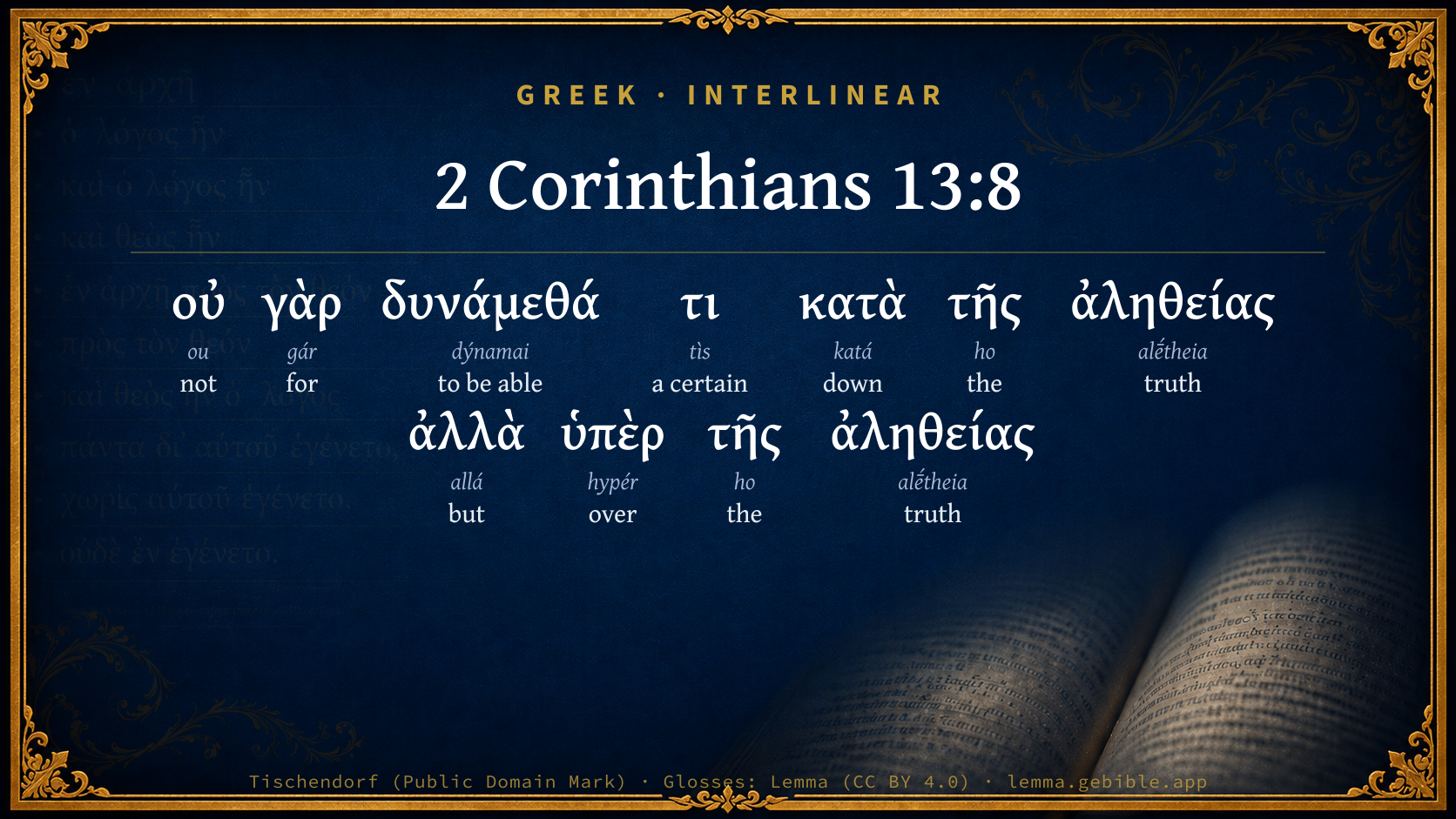
Greek (Tischendorf 8th ed.) 2 Corinthians 13:8 appears in the Greek New Testament. The text above is from the Tischendorf 8th edition. Each word links to its Strong’s number and a concise gloss. Click any word for its full Thayer’s Greek Lexicon entry.
Download image
Cite this verse

2 Corinthians 13:8 (World English Bible). Public Domain. Lemma interlinear Bible study tool, https://lemma.gebible.app/v/2-corinthians/13/8.

Show BibTeX & RIS
BibTeX
RIS
English Translation
For we can do nothing against the truth, but for the truth.
World English Bible · Public Domain
Download a study sheet

One document with this verse’s original text, its word-by-word gloss line, the meaning frame, cross-references with their text, attributed commentary, and full source and license credits — printable, and it pastes into notes with its structure intact.

This verse Autodidact and up

Study sheet (.html) Plain text (.txt)

A passage Seminary Student

Up to 50 verses in one chapter. A passage sheet keeps up to 6 commentary sources and 12 cross-references per verse, in the order this page ranks them, and says so on the sheet whenever that leaves anything out. Ask for a single verse and you get the Autodidact verse sheet above.

Everything on this page stays free to read, with no account — the sheet is a download of what is already on screen, not access to it.

Want to remove ads? Support Godless Engineer
Compare translations 3

The same verse in 3 English versions, stacked beneath the original-language interlinear above. Click any original word for its lexicon entry.

Each is an independent rendering of the whole verse — the interlinear is not word-aligned to these translations.

Highlighted words mark where these versions differ — a whole-verse word diff, not a word-by-word alignment.

  • World English Bible Public Domain
    For we can do nothing against the truth, but for the truth.
  • King James Version Public Domain
    For we can do nothing against the truth, but for the truth.
  • unfoldingWord Literal Text CC BY-SA 4.0
    For we are not able anything against the truth, but only on behalf of the truth.

unfoldingWord Literal Text — © unfoldingWord, licensed CC BY-SA 4.0. Word-aligned USFM3 via Door43 (git.door43.org/unfoldingWord/en_ult).

Versions to compare (up to 4)

3 of 4 selected

Show all 19 translations

Every available English version of this verse, each an independent rendering of the whole verse.

  • World English Bible Public Domain
    For we can do nothing against the truth, but for the truth.
  • Berean Standard Bible Public Domain
    For we cannot do anything against the truth, but only for the truth.
  • Majority Standard Bible Public Domain
    For we cannot do anything against the truth, but only for the truth.
  • King James Version Public Domain
    For we can do nothing against the truth, but for the truth.
  • American Standard Version (1901) Public Domain
    For we can do nothing against the truth, but for the truth.
  • Revised Version (1885) Public Domain
    For we can do nothing against the truth, but for the truth.
  • Geneva Bible (1599) Public Domain
    For wee can not doe any thing against the trueth, but for the trueth.
  • Douay-Rheims (1899) Public Domain
    For we can do nothing against the truth; but for the truth.
  • Young's Literal Translation Public Domain
    for we are not able to do anything against the truth, but for the truth;
  • Literal Standard Version CC BY-SA 4.0
    for we are not able to do anything against the truth, but for the truth;
  • Unlocked Literal Bible CC BY-SA 4.0
    For we are not able to do anything against the truth, but only for the truth.
  • unfoldingWord Literal Text CC BY-SA 4.0
    For we are not able anything against the truth, but only on behalf of the truth.
  • Darby Bible Public Domain
    For we can do nothing against the truth, but for the truth.
  • World Messianic Bible Public Domain
    For we can do nothing against the truth, but for the truth.
  • Webster's Bible Public Domain
    For we can do nothing against the truth, but for the truth.
  • Free Bible Version CC BY-SA 4.0
    We can't do anything against the truth, only for the truth.
  • Bible in Basic English Public Domain
    Because we are able to do nothing against what is true, but only for it.
  • Text-Critical English NT CC BY 4.0
    For we cannot do anything against the truth, but only for the truth.
  • Tyndale New Testament (1534) Public Domain
    We can do no thinge agaynst the trueth but for the trueth.

Literal Standard Version (2020), Covenant Press — licensed CC BY-SA 4.0. Text via the HelloAO Bible API (eBible.org). Unlocked Literal Bible (unfoldingWord) — licensed CC BY-SA 4.0. Text via the HelloAO Bible API (eBible.org). unfoldingWord Literal Text — © unfoldingWord, licensed CC BY-SA 4.0. Word-aligned USFM3 via Door43 (git.door43.org/unfoldingWord/en_ult). Free Bible Version, Dr. Jonathan Gallagher — licensed CC BY-SA 4.0. Text via the HelloAO Bible API (eBible.org).

Word by word

More ways to search: Search by grammar → Find every occurrence → Compare this word →

Practice this passage: Drill this verse → Learn its vocabulary →

ἀληθείας
alḗtheia
G225
“truth”
Noun, Genitive, Singular, Feminine
Part of Speech
Noun
Case
Genitive
Number
Singular
Gender
Feminine
Full Thayer's Definition

Origin: from G227

TDNT: 04:52,4

1. objectively a. what is true in any matter under consideration 1. truly, in truth, according to truth 2. of a truth, in reality, in fact, certainly b. what is true in things appertaining to God and the duties of man, moral and religious truth 1. in the greatest latitude 2. the true notions of God which are open to human reason without his supernatural intervention c. the truth as taught in the Christian religion, respecting God and the execution of his purposes through Christ, and respecting the duties of man, opposing alike to the superstitions of the Gentiles and the inventions of the Jews, and the corrupt opinions and precepts of false teachers even among Christians 2. subjectively a. truth as a personal excellence 1. that candour of mind which is free from affection, pretence, simulation, falsehood, deceit
  1. οὐ ou G3756 “not” Particle, Negative
  2. γὰρ gár G1063 “for” Conjunction
  3. δυνάμεθά dýnamai G1410 “to be able” Verb, Present, Middle or Passive deponent, Indicative, 1st person, Plural
  4. τι tìs G5100 “a certain” Indefinite pronoun, Accusative, Singular, Neuter
  5. κατὰ katá G2596 “down” Preposition
  6. τῆς ho G3588 “the” Article, Genitive, Singular, Feminine
  7. ἀλλὰ allá G235 “but” Conjunction
  8. ὑπὲρ hypér G5228 “over” Preposition
  9. τῆς ho G3588 “the” Article, Genitive, Singular, Feminine
  10. ἀληθείας alḗtheia G225 “truth” Noun, Genitive, Singular, Feminine

About this verse

These counts appear in no published source. They are computed here, from the morphology-tagged text and Lemma’s own curated glosses. What Lemma adds →

11
words
9
distinct lemmas
Pauline Epistles
section

Repetition

Words recur within this verse:

  • ἀληθείας truth G225 ×2
  • τῆς the G3588 ×2

Cross-references

18

Topical passages linked to 2 Corinthians 13:8 in the Treasury of Scripture Knowledge — connected by theme and wording, ordered by reader-vote popularity; previews shown in the World English Bible.

  • Proverbs 21:30 There is no wisdom nor understanding Nor counsel against Yahweh.
  • Mark 9:39 But Jesus said, "Don't forbid him, for there is no one who will do a mighty work in my name, and be able quickly to speak evil of me.
  • Acts 4:28–30 to do whatever your hand and your council foreordained to happen.
  • Numbers 16:28–35 Moses said, Hereby you shall know that Yahweh has sent me to do all these works; for [I have] not [done them] of my own mind.
  • Hebrews 2:3–4 how will we escape if we neglect so great a salvation-- which at the first having been spoken through the Lord, was confirmed to us by those who heard;
  • Acts 5:1–11 But a certain man named Ananias, with Sapphira, his wife, sold a possession,
  • 1 Timothy 1:20 of whom is Hymenaeus and Alexander; whom I delivered to Satan, that they might be taught not to blaspheme.
  • 2 Kings 2:23–25 He went up from there to Bethel; and as he was going up by the way, there came forth young lads out of the city, and mocked him, and said to him, Go up, you baldy; go up, you baldhead.
  • Proverbs 26:2 Like a fluttering sparrow, Like a darting swallow, So the undeserved curse doesn't come to rest.
  • Mark 16:17–19 These signs will accompany those who believe: in my name they will cast out demons; they will speak with new languages;
  • Luke 9:49–56 John answered, "Master, we saw someone casting out demons in your name, and we forbade him, because he doesn't follow with us."
  • Acts 13:3–12 Then, when they had fasted and prayed and laid their hands on them, they sent them away.
  • Acts 19:11–17 God worked special miracles by the hands of Paul,
  • 1 Corinthians 5:4–5 In the name of our Lord Jesus Christ, you being gathered together, and my spirit, with the power of our Lord Jesus Christ,
  • 2 Corinthians 10:8 For though I should boast somewhat abundantly concerning our authority, (which the Lord gave for building you up, and not for casting you down) I will not be disappointed,
  • 2 Corinthians 13:10 For this cause I write these things while absent, that I may not deal sharply when present, according to the authority which the Lord gave me for building up, and not for tearing down.
  • 1 Kings 22:28 Micaiah said, If you return at all in peace, Yahweh has not spoken by me. He said, Hear, you peoples, all of you.
  • 2 Kings 1:9–13 Then [the king] sent to him a captain of fifty with his fifty. He went up to him: and, behold, he was sitting on the top of the hill. He spoke to him, man of God, the king has said, Come down.

Cross-references courtesy of OpenBible.info (CC BY 4.0).

Commentary

Notes on 2 Corinthians 13:8 from classic Christian and Jewish commentators (each source and its license shown beneath its notes). The classic Christian expositions comment on the surrounding passage and are grouped to its opening verse, so a note may address several verses; the Jewish commentaries on the Tanakh (Rashi and others) are per-verse, so they appear only where the commentator wrote on this verse.

Lemma curates 59 commentaries, every one of them public domain or Creative Commons licensed, each selected and text-cleaned for this edition rather than reprinted as found. About our sources →

The Biblical Illustrator

Joseph S. Exell

2Co_13:8

We can do nothing against the truth, but for the truth.

The impotence of revolt against the truth

I. The futility of revolt against the truth.

1. There are two great truths against which the world has been in perpetual revolt.

(1) The moral truth of Gods government. This means that there is a living and a righteous God; that He will reward righteousness and punish evil. That is the sublime belief uttered in every page of the Bible. By that belief the noblest nations have lived, and the noblest periods of history been shaped. Denying that truth, the world becomes a fathomless and maddening problem. It becomes what Carlyle said the materialists made it, A mill without a miller, whose wheels turn endlessly in the tide of the ages, but without purpose or result. Such revolt is the madness of an empty pride, and is as futile as it is wicked.

(2) The spiritual truth of Gods government by Jesus Christ. Christ stands before men as the embodied holiness of God, and His law of life is the law by which human holiness is attained. Against that Divine Presence the world has been in perpetual revolt. The past sign of that revolt is Calvary; its present sign is the selfishness and un-Christliness of human life. But long since, on the steep stairs of sacrifice, Christ has ascended into universal supremacy. The Pharisees had hated Him living, and they feared Him dead. And so they came to Pilate, who said, Ye have a watch--set it; seal the tomb; make it as sure as ye can. How sure was that? Was it prophecy or irony which animated Pilates speech? The revolt against Him was futile then, and it is futile now. He being lifted up, is drawing all men unto Him. There are those who resist that infinite attraction. Some of you have done it. But again the voice of Paul speaks, and eighteen centuries have only added victorious confirmation to his words, We can do nothing against the truth.

2. But it may be said, where is the proof? One proof of truth, at least, is found in the eternity of its life. Error carries the seeds of its own death with it. It is error that changes; truth abides. The history of civilisation is a history of the slow but certain conquests of truth. There have been periods when the world has seemed to have fallen asleep. But at length from that vast slumbering host one man has seen a new light kindling in the far firmament. He has risen and announced his great discovery, and called on men to believe in it. Such men have always been disbelieved, persecuted. But time has tried them and the truth has proved itself truth by living and triumphing. Astrology and alchemy have perished, but astronomy and chemistry survive. The scientific heresies of one age have become the commonplaces of the next. Time has threshed out the wheat from the chaff, annihilating the false and keeping the eternal truths.

(1) One proof of the moral government of God is, that the centuries assert it. Think how many great monarchies have arisen and covered the world with empire, and where are they now? Did ever empire seem more likely to endure than the Roman? What does the philosophic historian say about France? France slit her own veins and let her own life-blood out on the day of St. Bartholomew, and has been perishing of exhaustion ever since. On all nations which have become corrupt, the same fate has fallen sooner or later. And what does all this mean, but that there is an avenging holiness in the world?

(2) And how is it that the spiritual empire of Jesus Christ has survived? The world has been leagued against it from the beginning. The key-note of revolt and hatred struck on Calvary has echoed through the ages. Yet the kingdom survives, and the fiery waves have fallen back quenched and impotent, and the wrath of man has passed like a waft of smoke. The Christ survives, and is the moral Emperor of the universe to-day. What does it all mean? It means that the kingdom of God in Christ is a fact, and cannot be destroyed. The whole rebellion of man against God is one wild spasm of despair; We can do nothing against the truth, but for the truth.

3. You can, of course, deny the truth and defy it. So, too, you may deny the law of gravitation, but if you defy it and leap from yonder steeple, there is one sure result--the law triumphs and the man is slain. You can deny the penalties of vice, but if you defy them the slow poison will eat the heart out notwithstanding. There are certain things which have long since been lifted out of the realm of speculation into certitude. Why is it no one doubts? It is because we have discovered certain laws of the universe which are subject to no caprice, open to no revisal. And so in the spiritual universe. When we see the same cause producing the same effect through the long course of various centuries, we know we have found a truth. And when we see through all the faded past of human history, Christs love inspiring love, and Christs light bestowing light, and Christs life imparting life, we know that we are dealing with an unchangeable force, and can forecast the spiritual future of the world with unerring accuracy.

II. The truth even prospers on opposition. But for the truth.

1. It has always been so in the day of persecution. The hurricane has carried the seed of truth afar; the fire has purged the hearts of men; the storm has destroyed the old building, only that it shall be replaced by a nobler and more stable structure. It is the very irony of victory! God indeed holds His enemies in derision when their best-planned revolt crowns His arms with new glory, and the very ingenuity of their hatred helps on His sovereign purpose.

2. But impotent as we are to assail the truth, we are all able to assist it. You cannot revoke the laws of science; they are the same to-day as when the dawn of the world broke: but they lurk in silence, and wait the approach of the intellect of man, and the demand of his noble curiosity. You can destroy none of these forces; but how much you can do for them! It is even so with the kingdom of Jesus Christ.

3. Let our hearts rejoice, then: Christs kingdom cannot be shaken. Think of the continuity of faith which has run through all the ages, of Christian saints in every century, and then ask: Is it possible that all these believed in vain? To-morrow the sceptic will propose his question; you propose yours, Is it probable that all the ages have been wrong, that at last Herbert Spencer and his little following should be right? I prefer to believe that vast anthem of certitude which rolls upward from the saintliest and noblest hearts of all the worlds great past: I know whom I have believed, etc. Conclusion: The text is a call

1. To loyal submission and noble service. Cease from a revolt which is impotent, enter into that allegiance with God from which shall issue peace and victory.

2. To increased faith in the victory of the kingdom of Christ. It has triumphed over greater odds than any now arrayed against it. Picture the young convert of Pauls day as he enters some great Pagan city. On every side he sees the pomp of martial power, the luxury of sensuous life. Vast temples rise, and there philosophers dispute. But to him, poor youth, all this seems strange, sad, hateful. Is it possible all this can be changed? But he turns aside into some lowly street, and amid the humblest people begins to preach that strange gospel of Jesus Christ. And in three centuries not a heathen temple is left in Rome.

3. To new and nobler enthusiasm for this kingdom. Enthusiasm is the true fire of manhood, and when that leaves a man, a church, a nation, its true glory is departed. We want the enthusiasm of that young minister who refused a hard and poor station, but that same night heard Bishop Simpson preach, and at last sprang to his feet and cried, Bishop, I will go anywhere for Christ now! We want the enthusiasm which shames men of their niggard gifts, and counts no box of frankincense too precious for that Head which bowed in death for us.

4. To new and nobler effort for this kingdom. Enthusiasm is much, but action is more. Fix it in your minds; you can help the truth. You, bright youth, with all the unused powers of heart and intellect; you, poor widow, with the few coppers in your worn purse; you, rich man, with your social position and wealth. If you have ever gazed upon the Matterhorn, you will have thought that if ever there was a type of majestic strength it is standing there. But ask science how the Matterhorn was made, and it will tell you how, ages upon ages since, there were drifting mica-flakes floating in an abysmal sea, and one by one they came together, and were beaten into hardness and consistence, and grew in bulk and steadfastness, until at last the waters rolled back, and there was uncovered that vast Alpine tower. And even so Christs kingdom is built up. Little by little, life by life, the kingdom grows. It is built up inch by inch, until at last it rises mighty, impregnable, and the gates of hell shall not prevail against it. Shall our lives be added, as living stones, to this growing grandeur? Shall they be fretted out in blind rebellion against this rock against which men are broken, and which when it falls crushes men to powder? For, or against? But before we answer, the decree is fixed: We can do nothing against the truth, but for the truth. (W. J. Dawson.)

The impotence of man in antagonism to the truth

Truth is reality--that which is; falsehood is non-entity--that which may seem to be but is not. We may illustrate Pauls maxim in reference to--

I. Human science.

1. In the region of the material, that which has been established is true, has being. To fight against it, to be frightened at it, is not rational, is not reverent. Unless you can disprove it, it is as much a part of the truth as anything else that God has done or spoken.

(1) There are those who cannot accept this. Investigation is viewed with suspicion. At the exact point where knowledge stood when they were in the cradle, there it must remain at least till they are in the grave.

(2) What calmness, what dignity, would it give to the Christian if he were to say, truth and the truth can never really be at variance. The God of the Bible is the God also of nature, and the one cannot contradict the other. Therefore I wait, rest, and trust.

(3) It is otherwise with human theories. They are not yet, and may never be parts of the truth. It is by no means true that men can do nothing against them, for they have been disproved and displaced all along the ages. But facts, once proved, are a part of the truth, and we can do nothing against that.

2. What can we do for it? We may help the onward march of truth by an attitude towards it of respect, interest, and gratitude. We can assure the toilers in the field of science that, so far from dreading and disparaging the results of their labour, we recognise in them fellow-workers in the cause of God and man. And of them the Christian asks for the truths sake--

(1) That science will worship while she explores.

(2) That she will exercise towards workers in other fields that forbearance and respectfulness which they manifest towards her; that she will never allow herself to speak as though there were no vast region within which telescope and microscope give no vision. Science is a fighter against the truth when she arrogates to herself the whole of it.

II. Life and conduct. There are such things as reality and unreality, truth and falsehood, in the realm of action. We speak, e.g., of a true man and a false man. Good itself is truth, in contrast with evil, which is always hollow and evanescent.

1. There are men who have thought, in this sense, to do something against the truth. Men have defied morality and hoped by the force of position, or genius, to put down virtue herself. Have they succeeded? Has not the judgment of the next generation, nay, even of their own, gone against them? In nothing has the application of the word truth to morals been more powerfully attested, than in the failure of these champions of a new licence, to move from its firm base by one hairs breadth the impregnable rock of the human instinct as to the virtuous and the vile. But for one man who attempts this audacious enterprise, tens of thousands have hoped to do something on a smaller scale. Then the appeal lies to all of us. And it is this--Did you find by sinning that you were able, practically, to do anything against the truth? Was it happiness while the sin reigned in you? No man grown to mans estate will feel the slightest disposition to gainsay the old utterance, There is no doubt on which side God is in the great world-wide and age-long war between vice and virtue.

2. We can do nothing against virtue. Can we do something for it? I address the young. It is comparatively little to see an old man, or a family man, or a clergyman, virtuous. It is expected of him. But who shall speak of the power for the truth which is yours? Just in proportion as the life is young, and the snares many, is the admiration if you stand steadfast. Then can you plead for truth against the lie, and be listened to. Then can you influence one or two of your nearest and dearest to walk with you in the way of purity and peace.

III. The gospel, which Paul had in his mind.

1. Many think or thought that they could do something against the gospel. Outspoken infidels and false brethren have tried to bring the faith of Christ into disrepute. Now and then they have even seemed, in some corner of the field, to have gained a victory. But look again, is the truth overborne? Is the gospel weaker to-day than it was five, ten, fifteen centuries afore-time? Were there ever more diligent students of the Bible, more earnest men of prayer, more holy lives, more Christian deaths than is this age? Are the impugners of the faith satisfied? Do you hear no laments over their own departed days of believing and worshipping--no envious lookings upon men that have hope and can give reason for it? We do not deny that it is in the power of any man to be an antagonist of the gospel. Any fool can parody verses of the Bible; can say smart things against creeds. And some of these things will stay by us, and make it harder to be good than it need have been. It is quite possible to make a believer into an infidel and have the misery of hearing, late on in life, that an associate of yours has lived without God and died without hope. Thus far can we go, and no further. But against the gospel you have no power.

2. Can we do nothing for it? The gospel seeks not yours but you. It does not want your help--it wants your happiness. Not till you have embraced it will it accept anything of you. But when this is done we can add one little chapter to its evidences and show, by our example, that its whole tendency is good. So, when the last day of life comes, your last breath shall be drawn, not in the disconsolate cry, O Galilean, Thou hast conquered! but in the confiding utterance, I know whom I have believed; Lord Jesus, receive my spirit. (Dean Vaughan.)

Christs truth uninjurable

The text may be taken--

1. As expressing the strong disposition of a truth loving man.

2. As a statement of a universal fact. The religion of Christ--

I. Is truth.

1. Religion is not to be understood either as theology, ecclesiasticism, or ritualities, but as those eternal principles that are hungered after and agree with the reason, intuitions, and wants of humanity.

2. The great cardinal principles of all the religions of the world are more or less identical with those of Christ. They all involve--

(1) Absolute dependence upon the Supreme Being.

(2) The obligation of the highest love and devotion to Him.

(3) The duty of exercising justice and beneficence towards men.

(4) The existence of a future state of retribution.

(5) The idea of mediation.

3. These principles are therefore the truth, the reality. Christ brought them out in His life and teaching in a form more perfect and powerful than they were ever brought forth before. He is their exponent, their incarnation, Hence Paul speaks of the truth that is in Jesus Christ. He says Himself, I am the truth.

II. Is indestructible.

1. Man can do much against the theology or theory of truth.

2. Man can do much against conventional manifestations of the truth. Christendom calls Christ Master and Lord, but many deny Him in their daily life.

3. Man can do much against its ecclesiastical representation.

4. But whilst man can do much against all these things he can do nothing against the truth. The truth that Christ taught and incarnated is independent of these. Conclusion: Whilst you can do nothing against the truth, remember that in opposing the truth you may do much against yourselves. (D. Thomas, D. D.)

The Biblical Illustrator, edited by Joseph S. Exell (c. 1880s–1900s) — public domain. Text from a community e-Sword module.

Bengel's Gnomon

Johann Albrecht Bengel

2Co 13:8. Δυνάμεθα, we are able) comp. the power which he claims, 2Co 13:10.—ἀληθείας, truth) Truth here denotes the exact authority to be exercised over the Corinthians.

Bengel's Gnomon of the New Testament — English translation (T&T Clark, Edinburgh, 1860) — public domain. Text from a community e-Sword module.

Meyer's Critical & Exegetical Commentary

Heinrich August Wilhelm Meyer

2Co_13:8. Reason assigned for the relation just expressed as aimed at by ἵνα ὑμεῖς τὸ καλὸν ποιῆτε, ἡμεῖς δὲ ὡς ἀδόκιμοι ὦμεν. That we really have this design, is based on the fact that we are not in a position to do anything against the truth, but for the truth. The ἀλήθεια is to be taken in the habitual sense of the N. T.: the truth κατʼ ἐξοχήν, the divine truth, i.e. the gospel; comp. 2Co_4:2, 2Co_6:7. If Paul, forsooth, had not had the design that the readers should do what is good, and he himself appear without punitive power and consequently as unattested, he would have counteracted the gospel, in so far as it aims at establishing Christian morality, requires penitence, announces forgiveness to the penitent, etc.; but he is not in a position to do so. To take ἀλήθεια, with Flatt and older expositors,[402] as moral truth (see on 1Co_5:8), uprightness, is a limitation of it, which the context all the less suggests, seeing that ἀλήθεια in the above sense embraces in it the moral element. The taking it in the judicial sense would be accordant with the context (ἵνα ἀληθῆ φέρωμεν τὴν ψῆφον, Theophylact, so Chrysostom, Theodoret, Grotius: quod rectum justumque est; Cornelius a Lapide, Bengel, de Wette: the true state in which the matter finds itself; so, too, Räbiger); yet, in that case, there would result an inappropriate contrast, since ὑπὲρ. τ. ἀλ. can only mean for the benefit of the truth, which presupposes a more comprehensive idea of ἀλήθ. (de Wette: to further the truth).

ἀλλʼ ὑπὲρ τ. ἀλ.] sc. δυνάμεθά τι, we are able to do something.

[402] So Photius in Oecumenius, p. 709 D: ἀλήσθειαν τὴν εὐσέβειαν καλεῖ ὡς νόθου ὄντος τοῦ δυσσεβοῦς βίου, and previously Pelagius: Innocentiae enim nostra sententia obesse non poterit; as also Erasmus, Mosheim, and others.

Meyer — Critical and Exegetical Commentary on the New Testament — English translation by Peter Christie, edited by Frederick Crombie (T&T Clark, 1880) — public domain. Text from a community e-Sword module.

Expositor's Greek Testament

ed. W. Robertson Nicoll

2Co 13:8 . οὐ γὰρ δυνάμ . κ . τ . λ .: for we can do nothing , exhibit no Apostolic power, against the truth, i.e. , against the facts of the case, but for the truth ( cf. 1Co 3:1 for the elliptical constr.). The principle here laid down is of far widen application than an accurate exegesis can assign to it in its context. It is a general principle, which Christian theology has not always sufficiently remembered, that to fight against truth, whether ethical or historical or scientific, is to fight against Him who is the Truth, and so is to court defeat. We can do nothing, even if we would, against the truth ( cf. 1Es 4:38 ).

The Expositor's Greek Testament, edited by W. Robertson Nicoll (1897–1910) — public domain. Text from a community e-Sword module.

Jamieson, Fausset & Brown

Robert Jamieson, A. R. Fausset & David Brown

Our apostolic power is given us that we may use it not against, but for the furtherance of, the truth. Where you are free from fault, there is no scope for its exercise: and this I desire. Far be it from me to use it against the innocent, merely in order to increase my own power (Co2 13:10).

Jamieson, Fausset & Brown — Commentary Critical and Explanatory on the Whole Bible (1871) — public domain (CC PDM 1.0). Text via the HelloAO Bible API.

Adam Clarke's Commentary

Verse 8. For we can do nothing against the truth, but for the truth.] As we are the apostles of God, we cannot bring to you any false doctrine; and, as we profess to be under the influence of God's Spirit, we cannot do any thing that is opposed to that truth, or which might be prejudicial to it. On the contrary, what we say and do is for that truth, to propagate and establish it. The Gospel of Jesus is truth; and my testimony concerning it is truth also. In my coming, and in my rod, you have nothing to fear, if you retain and abide in this truth.

Adam Clarke's Commentary on the Bible (1810–1826) — public domain. Text from a community e-Sword/MySword module.

John Calvin's Commentaries

8. For we can do nothing: That is — “I do not seek, or desire any other power, than what the Lord has conferred upon me, that I may promote the truth. To false Apostles it is all one, provided they have power; and they feel no concern to make use of their power for the promotion of what is good.” In short, he defends and maintains the honor of his ministry, in so far as it is connected with the truth of God. “What does it matter to me? For unless I have in view to promote the truth, all the power that I shall claim will be false and groundless. If, however, I lay out, whatever I have, for the promotion of the truth, I, in that case, do not consult my own interest. Now, when the authority of doctrine is safe, and truth is uninjured, I have what I desire. In contending, therefore, so keenly, I am not influenced by any exclusive regard for myself personally.” By this consideration, however, he intimates, that the man, who fights and labors for the truth alone will not take it amiss, should occasion require it, to be regarded in the judgment of men as a reprobate, provided this does not interfere with the glory of God, the edification of the Church, and the authority of sound doctrine.

This passage must be carefully observed, because it limits the power, which the Pastors of the Church should have, and fixes its proper bounds — that they be ministers of the truth. Papists loudly tell us, that it is said,

He that heareth you, heareth me; he that despiseth you, despiseth me, (Luke 10:16);

and likewise:

Obey them that are set over you, (Hebrews 13:17);

and under this pretext they take to themselves the utmost liberty, so as to usurp unbounded dominion, while they are, at the same time, the avowed and sworn enemies of the truth, and aim at its destruction by every means in their power. For exposing such impudence, this one statement of Paul will suffice — which declares, that they must themselves be in subjection to the truth.

John Calvin's Commentaries (1540-1563) — public domain. Text from the Calvin Translation Society English edition (1840s-50s) via the Christian Classics Ethereal Library (ccel.org). Calvin's coverage is partial (roughly two-thirds of the Bible); uncommented books and verses are honest gaps, never fabricated. The 19th-century editor's footnotes and remarks are omitted so the notes are faithfully Calvin's own voice.

Ellicott's Commentary for English Readers

(8) For we can do nothing against the truth.—Better, perhaps, we are powerless. Here, again, the meaning lies below the surface. The first impression which the words convey is that he is asserting his own thoroughness as a champion of the truth, so that it was a moral impossibility for him to do anything against it. The true sequence of thought, however, though it does not exclude that meaning, compels us to read much more between the lines. “Yes,” he says, “we are content to seem to fail, as regards the exercise of our apostolic power to chastise offenders; for the condition of that power is that it is never exercised against the truth, and therefore if you walk in the truth, there will be no opening for its exercise.” The feeling is analogous to that of Rom_9:3 : “I could wish myself accursed from Christ for my brethren’s sake;” perhaps also to that of the Baptist: “He must increase, but I must decrease” (Joh_3:30); perhaps, yet again, to that of the patriot dying with the prayer, “May my name be without honour if only my country may be saved.”

A Bible Commentary for English Readers, edited by Charles John Ellicott (1878–1897) — public domain. Text from a community e-Sword module.

The Cambridge Bible for Schools and Colleges

gen. ed. J. J. S. Perowne

8. For we can do nothing against the truth] The original carries on the idea of power of which St Paul has been speaking above. If we are endued with any power from on high, it is not that we may exercise it on our own behalf, and against the truth of God. We can but use it for the purpose for which it was given us, namely for the glory of God and the increase of His kingdom.

but for the truth] More literally, on behalf of the truth.

The Cambridge Bible for Schools and Colleges (gen. ed. J. J. S. Perowne; Cambridge University Press, 1878–1918) — public domain. Text from a community e-Sword module.

John Gill's Exposition

For we can do nothing against the truth,.... The apostles had no power, nor could they, nor did they desire to exercise any against such who received the truth of the Gospel in the love of it; who continued in it, walked in it, and held it fast; who worshipped God in Spirit and in truth, and who walked uprightly, and as became the truth; for as the law is not made for such persons, but the reverse, so the authority the apostles had received from Christ was not to be exercised upon such:

but for the truth: for the sake of defending the truth against those that dropped, denied, and opposed it; and for the honour of it, by chastising, correcting, reproving, censuring, and punishing such, who either contradicted it, or caused it to be blasphemed and spoken evil of.

John Gill's Exposition of the Whole Bible (1746–1763) — public domain (CC PDM 1.0). Text via the HelloAO Bible API.

Trapp's Complete Commentary

John Trapp

8 For we can do nothing against the truth, but for the truth.

Ver. 8. For we can do nothing] A temporary may so fall away, as to persecute the truth that he once professed, and the ministry that he once admired. Never falls a saint so far in his greatest relapses. Bishop Latimer tells of one, who fell away from the known truth, to mocking and scorning it; yet was afterwards touched in conscience for it. Beware of this sin, saith he; for I have known no more than this that repented. It is a very dangerous precipice. (Lat. Serm. before K. Edw.)

John Trapp, A Commentary or Exposition upon All the Books of the Old and New Testament (1647–1656) — public domain. Text from a community e-Sword module.

Albert Barnes' Notes on the Bible

For we - That is, we the apostles.

Can do nothing against the truth ... - That is, we who are under the influence of the Spirit of God; who have been commissioned by him as apostles, can do nothing that shall be against the great system of truth which we are appointed to promulgate and defend. You need, therefore, apprehend no partial or severe discipline from us; no unjust construction of your conduct. Our aim is to promote the truth, and to do what is right; and we cannot, therefore, by any regard to our own reputation, or to any personal advantage, do what is wrong, or countenance, or desire what is wrong in others. We must wish that which is right to be done by others, whatever may be the effect on us - whether we are regarded as apostles or deceivers. I suppose, therefore, that this verse is designed to qualify and confirm the sentiment in the previous verse, that Paul meant to do only right; that he wished all others to do right; and that whatever might be the effect on his own reputation, or however he might be regarded, he could not go against the great system of gospel truth which he preached, or even desire that others should ever do wrong, though it might in any way be for his advantage. It was a fixed principle with him to act only in accordance with truth; to do what was right.

Albert Barnes' Notes on the Bible (1834–1885) — public domain. Text from a community e-Sword/MySword module.

Matthew Poole's English Annotations

Truth in this place notes integrity of life and conversation; truth in action, opposed to hypocrisy, or scandalous living. He had before prayed, that they might do no evil; which if they did not, they need not fear his coming with a rod; for though he had a power from Christ to punish, yet he had no power to punish such as did well; his power was to be used for them, not against them. As the law was not made for the righteous, and the civil magistrate is not ordained of God for the terror of those that do well, but only of those that do evil; so neither did Christ ever ordain ecclesiastical censures for the punishment of good and holy men. And indeed here is the just boundary of all civil and ecclesiastical power; no magistrate or minister, acting as Christ’s servants, can (lawfully, or as by any commission from him) do any thing

against the truth, or those that own, defend, and practise it; the power with which they are trusted is for edification, not destruction.

Matthew Poole's English Annotations on the Holy Bible (1683–1685) — public domain. Text from a community e-Sword/MySword module.

Whedon's Commentary on the Bible

Daniel D. Whedon

8. For—Reason for this conclusion.

The truth—Equivalent to the faith in 2Co_13:5. If they are in the true faith his apostolic thunders cannot touch them. On the contrary, whatever the result may be as to his apostolic standing, he has no power but for the truth.

Daniel D. Whedon (gen. ed.), Commentary on the Old and New Testaments (1874–1909) — public domain. Text from a community e-Sword module.

The Pulpit Commentary

We can do nothing against the truth. I am powerless against anything which is true, real, sincere; I can exercise no power except in the cause of the truth. Be true to the gospel, and you will be mighty and I shall be powerless, and (as he proceeds to say) I shall rejoice at the result.

Invincible truth.

Paul boasted that he could do all things, i.e. through Christ who strengthened him. Let his adversaries rage and threaten, he had no fear. He would assert his authority, exercise his power, and reduce the proudest opponent to helplessness. For the truth"s sake, for the gospel, there was nothing which he was not able to achieve. But if those whom he chided should submit, should return to their fidelity, not to him only, but to the gospel, then he was powerless to harm them. Nay, in such a case he was with them, on their side. Such appears to be the explanation of this grand utterance occurring in this connection.

I THE POWERLESSNESS OF MAN WHEN IN OPPOSITION TO THE TRUTH OF GOD.

1. The avowed enemies of the truth have failed in their attacks upon it,whatever have been the resources upon which they have drawn, the arms upon which they have relied. Persecution has raged first against Christianity itself, and then against its purer representation in days of reformation. With what result? The blood of the martyrs has ever been the seed of the Church. "Truth, like a torch, the more it"s shook it shines.

2. The false, hypocritical friends of the truth have never succeeded inexterminating it. Their efforts have often been insidious, and have often corrupted and ensnared individuals and even societies. But the pure truth of God has survived, whilst these attempts have again and again been foiled.

II THE STRENGTH OF THOSE WHO WORK WITH AND FOR THE TRUTH OF GOD.

1. Their natural feebleness does not hinder the victory of the cause whichthey embrace. The ignorant, the poor, the young, the feeble, have done and are still doing great things for the gospel. As at first, so now, God chooses "the weak things of the world to confound the mighty,

2. The efficiency of the truth depends upon its Divine origin and source. "IfGod be for us, who can be against us?" Wherever God"s truth is proclaimed, there God"s Spirit works and God"s power is felt.

3. The efficiency of the truth lies in its harmony with the nature andconstitution of man. With the use of this divinely tempered implement the divinely prepared soil of humanity may be rendered fruitful in great results. Magna est veritas, et prevalebit. T.

The Pulpit Commentary (1880–1919), ed. H.D.M. Spence-Jones & Joseph S. Exell — public domain. Text from a community e-Sword module.

John Wesley's Explanatory Notes

For we can do nothing against the truth - Neither against that which is just and right, nor against those who walk according to the truth of the gospel.

John Wesley, Explanatory Notes Upon the Whole Bible (1754–1765) — public domain. Text via the GEBible commentary corpus.

Burkitt's Expository Notes on the New Testament

William Burkitt

The apostle having prayed that the Corinthians might be found doing no evil, in the former verse, and assuring them thereupon, that they would then be secure from his censures and chastisements, he assigns a reason here for that assurance given them; because, says he, We can do nothing against the truth; but for the truth: having our power given us only for edification, and not for destruction.

Considering the words, without respect to the coherence, observe, 1. A negative proposition, We can do nothing against the truth. Oh blessed impotency!

2. An affirmation, or positive assertion, but for the truth. Oh blessed ability? He was as strong as a giant for the truth, but as weak as an infant against it.

Learn, That sincere Christians in general, and the ministers of Christ in particular, cannot, dare not, will not do any thing against the truth, but for the truth:

They cannot, that is, they may not, they are restrained by an outward command from God, who is truth itself:

They cannot, that is, they will not, there is a restraint of an inward principle; neither the conviction of their understanding, the clearness of their judgments, nor the holiness of their hearts, will suffer them to oppose the truth.

Again, they cannot attempt it; or if they did, they can never effect it; they cannot do it safely, they cannot do it successfully. We can do nothing against the truth in a way of discouragement; nor nothing against it in a way of disparagement: But all our endeavours are for the truth; we embrace it in our judgment, we hide it in our hearts, and practise it in our lives. Whatever talent God entrusts any of his ministers with, whether of parts, power, or estate, it is an opportunity put into their hands of doing service for the truth, and, as such, to be accepted and improved.

William Burkitt's Expository Notes on the New Testament (1700–1703) — public domain. Text from a community e-Sword module.

McGarvey & Pendleton's Commentaries

J. W. McGarvey

For we can do nothing against the truth, but for the truth . [While hoping or expecting to be vindicated, his prayer is of a different sort. We pray, says he, that you may be kept from evil, and thus escape the discipline. We do not thus pray for the sake of approving ourselves by showing our power to restrain you from evil (and thus our approval would result from our prayer), but we thus pray because of our earnest desire for your righteousness. We would have you do that which is honorable, even though you thereby deprive us of the opportunity of vindicating ourself, so that we shall still be looked upon by you as untrustworthy, and not capable of enduring tests. Compare with the like unselfishness at Rom_9:3 . For our apostolic power is given to us to use, not against, but for, the truth. We are powerless against anything which is right and true. If ye, therefore, do the truth, you withdraw your demand for a test of us, and deprive us of this chance of vindicating ourselves by showing our power, and this we desire that you should do.]

J. W. McGarvey (with Philip Y. Pendleton), Commentaries on the New Testament (The Fourfold Gospel, 1914; Acts; and the epistles) — public domain. Text from a community e-Sword/MySword module.

Cambridge Greek Testament for Schools and Colleges

8. οὐ γὰρ δυνάμεθά τι. For we cannot do anything against the truth. ‘It is morally impossible for one in my position to wish that you should do evil, in order that he might prove that he had the ἐξουσία of Christ: that would be against the whole spirit of the Gospel.’ Chrysostom understands S. Paul to mean that if he were to sentence (1Co 5:5; 1Ti 1:20) the penitent, God would not allow the sentence to be executed. For τῆς ἀληθείας comp. 2Co 4:2; Gal 2:5; Gal 2:14.

ἀλλά. Understand δυνάμεθα.

Cambridge Greek Testament for Schools and Colleges (Cambridge University Press, 1896; 21 vols, various authors incl. Carr, Maclear, Plummer, Farrar, Lumby, Moule, M. R. James, Simcox) — public domain. Text from a community e-Sword module.

Alford’s Greek Testament

Henry Alford

8.] For we have no power against the truth (of the Gospel, as Meyer; not of the facts, as Chrys., al., and De Wette, which might suit κατὰ τῆς ἀλ., but comes in very lamely with ὑπὲρ τῆς ἀλ.—‘If you walk in the truth, we shall be at one with you and so have no opportunity of shewing our power’) but (only) on behalf of (in furtherance of the cause and spread of) the truth.

Henry Alford, The Greek Testament (1849–1861) — public domain. Text from a community e-Sword module.

International Critical Commentary

8. οὐ γὰρ δυνάμεθα. He does not mean that no one can be successful in opposing the truth; magna est veritas et praevalet; a principle which has no special point here. He means that it would be utterly at variance with his character to take sides against the truth. Such a thing is morally impossible for him. All his life through he has been an ardent supporter of what he believed to be true, and what, since he became illuminated as a chosen Apostle of Christ, he knows to be true. This he can continue to be, and will. To rejoice in iniquity, because it gives him an advantage, is impossible for him. He cannot desire that they should be found to be doing wrong, in order that he may be proved to be right.

International Critical Commentary — older volumes (1896–1929), various authors — public domain. Text from a community e-Sword module.

Vincent's Word Studies in the New Testament

Marvin R. Vincent

For we can do nothing against the truth. Your well doing is what we truly aim at. For, if we had any other aim, with a view to approving ourselves, we should fail, because we should be going in the face of the truth - the Gospel; and against that we are powerless. In that case we should be unapproved before God.

Marvin R. Vincent, Word Studies in the New Testament (1887–1900) — public domain. Text from a community e-Sword/MySword module.

Lesson kit

Teaching starters — assembled from the data on this page, not authored interpretation. Every prompt links to the verse data it draws on. Edit before teaching.

2 Corinthians, in the Pauline Epistles, opens this verse with 11 words (9 distinct Greek lemmas). Its most distinctive word is alḗtheia (“truth”). A historical commentator’s framing appears above. Read the whole chapter for the surrounding context.

Discussion questions

  1. How does “truth” (alḗtheia) shape what this verse is saying?
  2. Proverbs 21:30 shares this passage’s theme. How do the two illuminate each other?
  3. “truth” occurs 2× in this one verse. What is the effect of the repetition?
  4. These translations render this verse differently. What is at stake in choosing one wording over another?
  5. Reading how The Biblical Illustrator and Bengel's Gnomon read this verse, where do the two commentators agree and where do they part?

Things to notice

  • These translations choose different wording for 7 words in this verse.
  • “truth” occurs 2× in this single verse.
  • 9 distinct Greek lemmas span 11 words in this verse.

Reading settings

Reading text

Shown beneath each verse's original-language words.

Old Testament
Old Testament edition

Read the OT as the Masoretic Hebrew (MT) or the Greek Septuagint (LXX).

English shown for the Greek Septuagint (in the Hebrew ↔ Greek comparison).

Comparing translations? Open the Compare panel on any verse page to stack up to four side by side.