Revelation 15:8

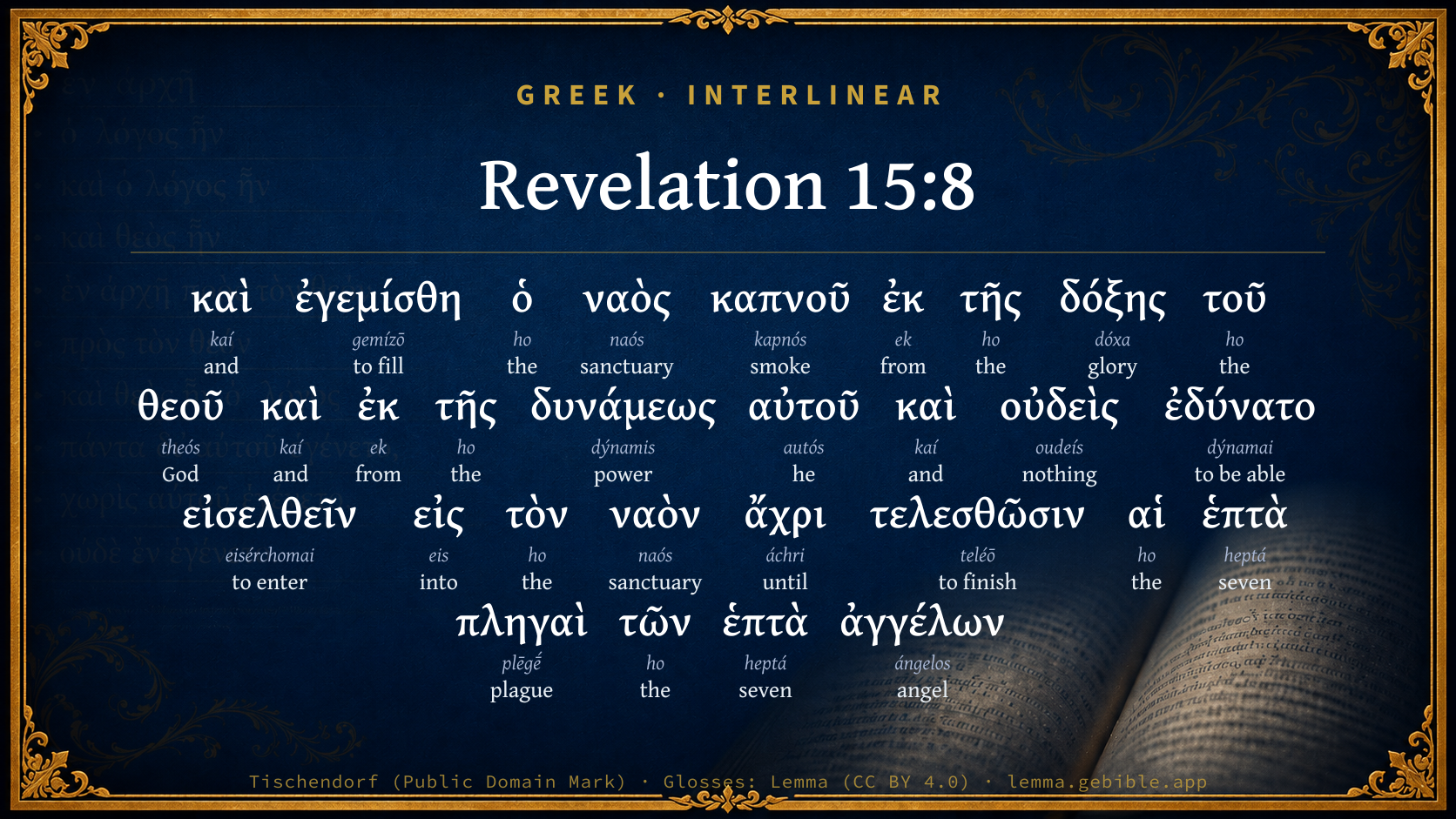
Greek (Tischendorf 8th ed.) Revelation 15:8 appears in the Greek New Testament. The text above is from the Tischendorf 8th edition. Each word links to its Strong’s number and a concise gloss. Click any word for its full Thayer’s Greek Lexicon entry.
Download image
Cite this verse

Revelation 15:8 (World English Bible). Public Domain. Lemma interlinear Bible study tool, https://lemma.gebible.app/v/revelation/15/8.

Show BibTeX & RIS
BibTeX
RIS
English Translation
The temple was filled with smoke from the glory of God, and from his power. No one was able to enter into the temple, until the seven plagues of the seven angels would be finished.
World English Bible · Public Domain
Download a study sheet

One document with this verse’s original text, its word-by-word gloss line, the meaning frame, cross-references with their text, attributed commentary, and full source and license credits — printable, and it pastes into notes with its structure intact.

This verse Autodidact and up

Study sheet (.html) Plain text (.txt)

A passage Seminary Student

Up to 50 verses in one chapter. A passage sheet keeps up to 6 commentary sources and 12 cross-references per verse, in the order this page ranks them, and says so on the sheet whenever that leaves anything out. Ask for a single verse and you get the Autodidact verse sheet above.

Everything on this page stays free to read, with no account — the sheet is a download of what is already on screen, not access to it.

Want to remove ads? Support Godless Engineer
Compare translations 3

The same verse in 3 English versions, stacked beneath the original-language interlinear above. Click any original word for its lexicon entry.

Each is an independent rendering of the whole verse — the interlinear is not word-aligned to these translations.

Highlighted words mark where these versions differ — a whole-verse word diff, not a word-by-word alignment.

  • World English Bible Public Domain
    The temple was filled with smoke from the glory of God, and from his power. No one was able to enter into the temple, until the seven plagues of the seven angels would be finished.
  • King James Version Public Domain
    And the temple was filled with smoke from the glory of God, and from his power; and no man was able to enter into the temple, till the seven plagues of the seven angels were fulfilled.
  • unfoldingWord Literal Text CC BY-SA 4.0
    And the temple was filled with smoke from the glory of God and from his power, and no one was able to enter into the temple until the seven plagues of the seven angels were completed.

unfoldingWord Literal Text — © unfoldingWord, licensed CC BY-SA 4.0. Word-aligned USFM3 via Door43 (git.door43.org/unfoldingWord/en_ult).

Versions to compare (up to 4)

3 of 4 selected

Show all 19 translations

Every available English version of this verse, each an independent rendering of the whole verse.

  • World English Bible Public Domain
    The temple was filled with smoke from the glory of God, and from his power. No one was able to enter into the temple, until the seven plagues of the seven angels would be finished.
  • Berean Standard Bible Public Domain
    And the temple was filled with smoke from the glory of God and from His power; and no one could enter the temple until the seven plagues of the seven angels were completed.
  • Majority Standard Bible Public Domain
    And the temple was filled with smoke from the glory of God and from His power; and no one could enter the temple until the seven plagues of the seven angels were completed.
  • King James Version Public Domain
    And the temple was filled with smoke from the glory of God, and from his power; and no man was able to enter into the temple, till the seven plagues of the seven angels were fulfilled.
  • American Standard Version (1901) Public Domain
    And the temple was filled with smoke from the glory of God, and from his power; and none was able to enter into the temple, till the seven plagues of the seven angels should be finished.
  • Revised Version (1885) Public Domain
    And the temple was filled with smoke from the glory of God, and from his power; and none was able to enter into the temple, till the seven plagues of the seven angels should be finished.
  • Geneva Bible (1599) Public Domain
    And the Temple was full of the smoke of the glory of God and of his power, and no man was able to enter into the Temple, till the seuen plagues of the seuen Angels were fulfilled.
  • Douay-Rheims (1899) Public Domain
    And the temple was filled with smoke from the majesty of God, and from his power; and no man was able to enter into the temple, till the seven plagues of the seven angels were fulfilled.
  • Young's Literal Translation Public Domain
    and filled was the sanctuary with smoke from the glory of God, and from His power, and no one was able to enter into the sanctuary till the seven plagues of the seven messengers may be finished.
  • Literal Standard Version CC BY-SA 4.0
    and the temple was filled with smoke from the glory of God, and from His power, and no one was able to enter into the temple until the seven plagues of the seven messengers may be completed.
  • Unlocked Literal Bible CC BY-SA 4.0
    The temple was filled with smoke from the glory of God and from his power. No one could enter it until the seven plagues of the seven angels were completed.
  • unfoldingWord Literal Text CC BY-SA 4.0
    And the temple was filled with smoke from the glory of God and from his power, and no one was able to enter into the temple until the seven plagues of the seven angels were completed.
  • Darby Bible Public Domain
    And the temple was filled with smoke from the glory of God and from his power: and no one could enter into the temple until the seven plagues of the seven angels were completed.
  • World Messianic Bible Public Domain
    The temple was filled with smoke from the glory of God and from his power. No one was able to enter into the temple until the seven plagues of the seven angels would be finished.
  • Webster's Bible Public Domain
    And the temple was filled with smoke from the glory of God, and from his power; and no man was able to enter into the temple, till the seven plagues of the seven angels were fulfilled.
  • Free Bible Version CC BY-SA 4.0
    The Temple was filled with smoke that came from the glory of God and from his power. Nobody was able to enter the Temple until the seven plagues that came from the seven angels were over.
  • Bible in Basic English Public Domain
    And the house of God was full of smoke from the glory of God, and from his power, and no one was able to go into the house of God, till the seven punishments of the seven angels were ended.
  • Text-Critical English NT CC BY 4.0
    And the temple was filled with the smoke from the glory of God and from his power, and no one could enter the temple until the seven plagues of the seven angels were completed.
  • Tyndale New Testament (1534) Public Domain
    And the temple was full of the smoke of the glory of God and of his power and no man was able to entre into the temple tyll the seven plages of the seven angels were fulfilled.

Literal Standard Version (2020), Covenant Press — licensed CC BY-SA 4.0. Text via the HelloAO Bible API (eBible.org). Unlocked Literal Bible (unfoldingWord) — licensed CC BY-SA 4.0. Text via the HelloAO Bible API (eBible.org). unfoldingWord Literal Text — © unfoldingWord, licensed CC BY-SA 4.0. Word-aligned USFM3 via Door43 (git.door43.org/unfoldingWord/en_ult). Free Bible Version, Dr. Jonathan Gallagher — licensed CC BY-SA 4.0. Text via the HelloAO Bible API (eBible.org).

Word by word

More ways to search: Search by grammar → Find every occurrence → Compare this word →

Practice this passage: Drill this verse → Learn its vocabulary →

ἐγεμίσθη
gemízō
G1072
“to fill”
Verb, Aorist, Passive, Indicative, 3rd person, Singular
Part of Speech
Verb
Tense
Aorist
Voice
Passive
Mood
Indicative
Person
3rd person
Number
Singular
Full Thayer's Definition

Origin: transitive from G1073

TDNT: None

1. to fill, fill full
  1. καὶ kaí G2532 “and” Conjunction
  2. ὁ ho G3588 “the” Article, Nominative, Singular, Masculine
  3. ναὸς naós G3485 “sanctuary” Noun, Nominative, Singular, Masculine
  4. καπνοῦ kapnós G2586 “smoke” Noun, Genitive, Singular, Masculine
  5. ἐκ ek G1537 “from” Preposition
  6. τῆς ho G3588 “the” Article, Genitive, Singular, Feminine
  7. δόξης dóxa G1391 “glory” Noun, Genitive, Singular, Feminine
  8. τοῦ ho G3588 “the” Article, Genitive, Singular, Masculine
  9. θεοῦ theós G2316 “God” Noun, Genitive, Singular, Masculine
  10. καὶ kaí G2532 “and” Conjunction
  11. ἐκ ek G1537 “from” Preposition
  12. τῆς ho G3588 “the” Article, Genitive, Singular, Feminine
  13. δυνάμεως dýnamis G1411 “power” Noun, Genitive, Singular, Feminine
  14. αὐτοῦ autós G846 “he” Personal pronoun, Genitive, Singular, Masculine
  15. καὶ kaí G2532 “and” Conjunction
  16. οὐδεὶς oudeís G3762 “nothing” Adjective, Nominative, Singular, Masculine, Negative
  17. ἐδύνατο dýnamai G1410 “to be able” Verb, Imperfect, Middle or Passive deponent, Indicative, 3rd person, Singular
  18. εἰσελθεῖν eisérchomai G1525 “to enter” Verb, Aorist, Active, Infinitive
  19. εἰς eis G1519 “into” Preposition
  20. τὸν ho G3588 “the” Article, Accusative, Singular, Masculine
  21. ναὸν naós G3485 “sanctuary” Noun, Accusative, Singular, Masculine
  22. ἄχρι áchri G891 “until” Adverb
  23. τελεσθῶσιν teléō G5055 “to finish” Verb, Aorist, Passive, Subjunctive, 3rd person, Plural
  24. αἱ ho G3588 “the” Article, Nominative, Plural, Feminine
  25. ἑπτὰ heptá G2033 “seven” Adjective, Numeral (indeclinable)
  26. πληγαὶ plēgḗ G4127 “plague” Noun, Nominative, Plural, Feminine
  27. τῶν ho G3588 “the” Article, Genitive, Plural, Masculine
  28. ἑπτὰ heptá G2033 “seven” Adjective, Numeral (indeclinable)
  29. ἀγγέλων ángelos G32 “angel” Noun, Genitive, Plural, Masculine

About this verse

These counts appear in no published source. They are computed here, from the morphology-tagged text and Lemma’s own curated glosses. What Lemma adds →

30
words
19
distinct lemmas
Revelation
section

Notable vocabulary

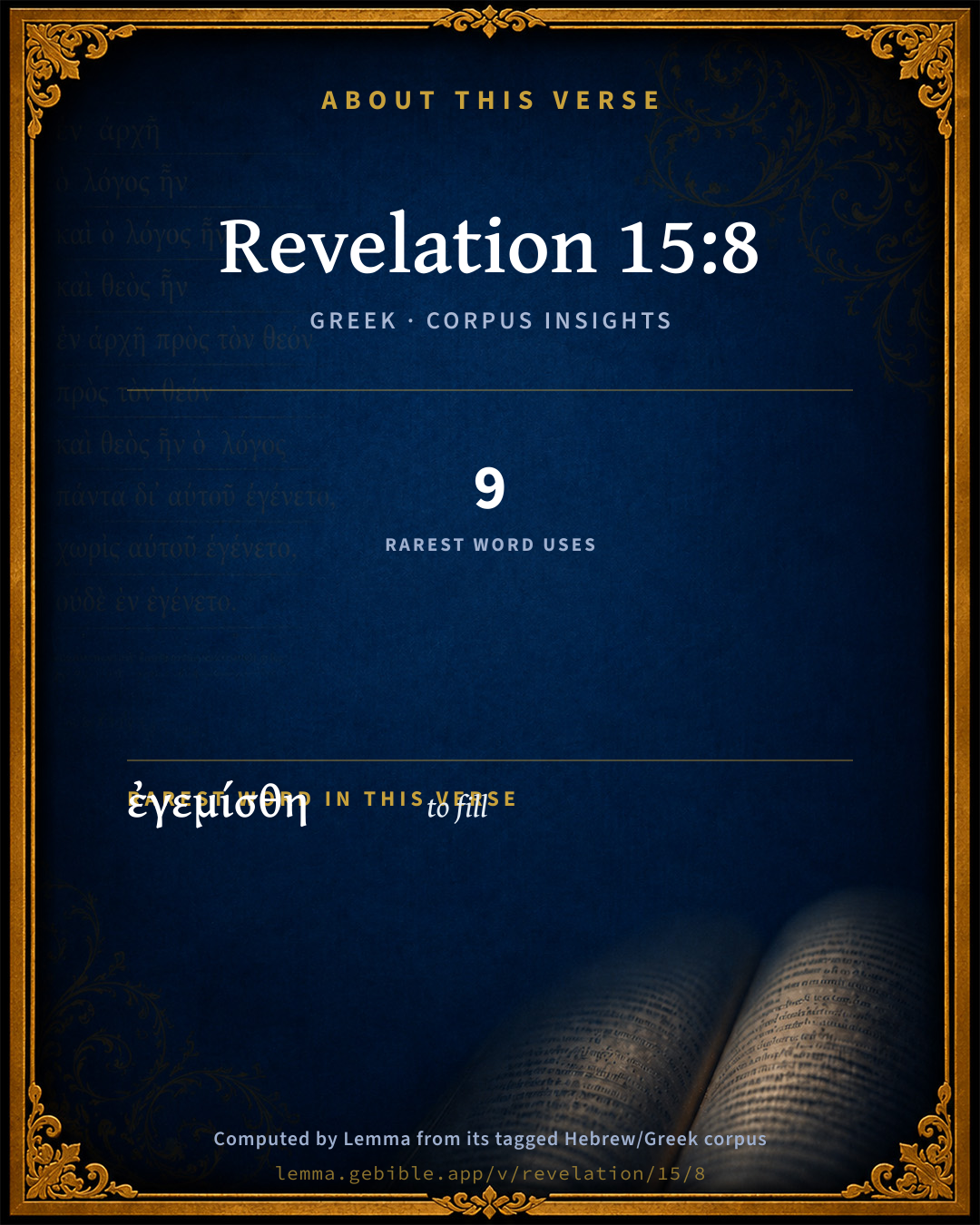
The rarest word here is ἐγεμίσθη to fill G1072 — appearing just 9 times in the whole Greek New Testament.

Shared distinctive vocabulary

ἐγεμίσθη to fill G1072 occurs in 8 verses of the Greek New Testament. Also found in:

Repetition

Words recur within this verse:

Cross-references

11

Topical passages linked to Revelation 15:8 in the Treasury of Scripture Knowledge — connected by theme and wording, ordered by reader-vote popularity; previews shown in the World English Bible.

  • Isaiah 6:4 The foundations of the thresholds shook at the voice of him who called, and the house was filled with smoke.
  • 1 Kings 8:10–11 It came to pass, when the priests were come out of the holy place, that the cloud filled the house of Yahweh,
  • Exodus 40:34–35 Then the cloud covered the tent of meeting, and the glory of Yahweh filled the tent.
  • 2 Chronicles 5:13–14 it happened, when the trumpeters and singers were as one, to make one sound to be heard in praising and thanking Yahweh; and when they lifted up their voice with the trumpets and cymbals and instruments of music, and praised Yahweh, [saying], For he is good; for his loving kindness endures forever; that then the house was filled with a cloud, even the house of Yahweh,
  • Psalms 29:9 Yahweh's voice makes the deer calve, And strips the forests bare. In his temple everything says, "Glory!"
  • 2 Thessalonians 1:9 who will pay the penalty: eternal destruction from the face of the Lord and from the glory of his might,
  • Revelation 15:1 I saw another great and marvelous sign in the sky: seven angels having the seven last plagues, for in them God's wrath is finished.
  • Psalms 18:8–14 Smoke went out of his nostrils. Consuming fire came out of his mouth. Coals were kindled by it.
  • Jeremiah 15:1 Then said Yahweh to me, Though Moses and Samuel stood before me, yet my mind would not be toward this people: cast them out of my sight, and let them go forth.
  • Lamentations 3:44 You have covered yourself with a cloud, so that no prayer can pass through.
  • Romans 11:33 Oh the depth of the riches both of the wisdom and the knowledge of God! How unsearchable are his judgments, and his ways past tracing out!

Cross-references courtesy of OpenBible.info (CC BY 4.0).

Commentary

Notes on Revelation 15:8 from classic Christian and Jewish commentators (each source and its license shown beneath its notes). The classic Christian expositions comment on the surrounding passage and are grouped to its opening verse, so a note may address several verses; the Jewish commentaries on the Tanakh (Rashi and others) are per-verse, so they appear only where the commentator wrote on this verse.

Lemma curates 59 commentaries, every one of them public domain or Creative Commons licensed, each selected and text-cleaned for this edition rather than reprinted as found. About our sources →

Joseph Benson's Commentary

Rev 15:8. And the temple was filled with smoke from the glory of God — In the same manner the tabernacle, when it was consecrated by Moses, and the temple, when it was dedicated by Solomon, were both filled with a cloud, and the glory of the Lord; which cloud of glory was the visible manifestation of God’s presence at both times, and a sign of God’s protection. But in the judgment of Korah, when the glory of the Lord appeared, he and his companions were swallowed up by the earth. So proper is the emblem of smoke from the glory of God, or from the cloud of glory, to express the execution of judgment, as well as to be a sign of favour. Both proceed from the power of God, and in both he is glorified. And no man — Not even those who ordinarily stood before God; was able to enter into the temple — As neither Moses could enter into the tabernacle, nor the priests into the temple, when the glory of the Lord filled those sacred places; a further proof of the majestic presence and extraordinary interposition of God in the execution of these judgments: till the seven plagues of the seven angels were fulfilled — Or were finished: till they had poured them out by the divine command.

Joseph Benson's Commentary on the Old and New Testaments (1811–1818) — public domain. Text from a community e-Sword module.

Whedon's Commentary on the Bible

Daniel D. Whedon

Depot of divine wrath upon Babylon—in Jerusalem temple, Rev_15:8.

8. Smoke from the glory—The glory was as a central fire-point, whence issued the smoke, or intense vapour, indicative of the actual divine PRESENCE.

And from his power—As if within this citadel of the Lord’s capital, namely, the Jerusalem temple, the concentrated omnipotence of Jehovah was gathered, charged with destructive judgment, ready to be discharged upon the devoted capital of Satan.

No man was able to enter—The divine Presence was so dense as to exclude all entrance; was too sacred for mortal approach; too fearful for mortal safety. So at the completion of the first tabernacle the glory of the Lord within excluded even Moses. Exo_40:34-35. So also at the completion of Solomon’s temple the priests were excluded by the filling glory. 1Ki_8:10-11.

Till… plagues… fulfilled—So that Jehovah himself, within the mystic Jerusalem temple, is the source whence Babylon’s destruction goes forth through the plagues of his ministers of justice. They are but the manifested forms of the secret, sacred, avenging power in the holy place. Until the retributions do their perfect work the central fire is burning in the temple, into which none may enter.

And now, from that awful Presence in the holy place, the commission of the seven angels is about to go forth. So the next words will declare.

Daniel D. Whedon (gen. ed.), Commentary on the Old and New Testaments (1874–1909) — public domain. Text from a community e-Sword module.

Tyndale Open Study Notes

Tyndale Open Resources

15:8 The Temple was filled with smoke as a symbol of God’s glory and power (Isa 6:4; see Exod 19:16-18; 40:34-35; 1 Kgs 8:10-13).

Tyndale Open Study Notes — © Tyndale Open Resources, licensed CC BY-SA 4.0. Text via the HelloAO Bible API.

Bengel's Gnomon

Johann Albrecht Bengel

Rev 15:8. Καπνοῦ, smoke) The covering of the Divine majesty.[176]

[176] οὐδεὶς, no one) not even the angels themselves, who were furnished with the vials.—V. g.

—εἰς τὸν ναὸν, into the temple) although it was opened, ver. 5. When the plagues are finished, approach to the temple is permitted.—V. g.

Bengel's Gnomon of the New Testament — English translation (T&T Clark, Edinburgh, 1860) — public domain. Text from a community e-Sword module.

Geneva Bible (1599)

Geneva Bible translators

None of those seven Angels might resume, till he had performed fully the charge committed unto him according to the decree of God.

Geneva Bible (1599) marginal notes — public domain. Text via Bolls.life.

Jamieson, Fausset & Brown

Robert Jamieson, A. R. Fausset & David Brown

temple . . . filled-- (Isa 6:4); compare Exo 40:34; Ch2 5:14, as to the earthly temple, of which this is the antitype.

the glory of God and . . . power--then fully manifested.

no man was able to enter . . . the temple--because of God's presence in His manifested glory and power during the execution of these judgments.

Next: Revelation Chapter 16

Jamieson, Fausset & Brown — Commentary Critical and Explanatory on the Whole Bible (1871) — public domain (CC PDM 1.0). Text via the HelloAO Bible API.

Adam Clarke's Commentary

Verse 8. The temple was filled with smoke] So was the tabernacle when consecrated by Moses, Ex 40:34-35, and the temple when consecrated by Solomon, 1Kgs 8:10-11; 2Ch 5:14. See Isa 6:4. This account seems at least partly copied from those above.

When the high priest entered into the holy of holies, and the ordinary priest into the holy place, they always carried with them a great deal of smoking incense, which filled those places with smoke and darkness, which prevented them from considering too attentively the parts and ornaments of those holy places, and thus served to produce an air of majesty in the temple, which none dared to approach without the deepest reverence. To this Calmet thinks the allusion may be here.

Adam Clarke's Commentary on the Bible (1810–1826) — public domain. Text from a community e-Sword/MySword module.

Ellicott's Commentary for English Readers

(8) And the temple . . .—Translate, And the temple (the same word—naos—is used as in Rev_11:1) was filled with smoke from the glory of God, and from his might; and no one was able to enter into the temple until the seven plagues of the seven angels should be finished. As in the wilderness (Exo_40:34-35), and as at the dedication of Solomon’s temple (1Ki_8:10-11), the tokens of God’s presence filled the temple, so it is now, but with a difference: it is smoke, not cloud, which is the symbol of God’s presence. But the vision which perhaps, under all circumstances, most nearly corresponds with the present is that of Isaiah (Isaiah 6); there the prophet beheld the vision of God. His train filled the temple, and the house was filled with smoke, and a message of judgment was given to the prophet; that message declared that the sin of the people had reached a climax: they had trifled with convictions, and henceforward the words of God’s servants would harden rather than awaken them. “Make the heart of this people fat, and make their ears heavy, and shut their eyes,” &c. (Isa_6:9-10), till the desolating judgments had fallen. The general drift of the present vision is similar; the days of warning are over: the plagues which now fall will fall on those who have trifled with convictions: the sanctuary which was opened as a refuge is now closed: none can enter till the plagues have descended. The time has come when the judgments of God fail to stir the conscience which has been deadened by sin; the day when the gracious influences towards repentance was felt has passed. The word that has been spoken is about to descend in judgment (Joh_7:48). “Who shall not pray, with an agony of earnestness, From hardness of heart and contempt of Thy word and commandment, good Lord, deliver us?” (Dr. Vaughan).

A Bible Commentary for English Readers, edited by Charles John Ellicott (1878–1897) — public domain. Text from a community e-Sword module.

The Cambridge Bible for Schools and Colleges

gen. ed. J. J. S. Perowne

8. smoke] Isa_6:4.

no man was able &c. Exo_40:35; 1Ki_8:11.

The Cambridge Bible for Schools and Colleges (gen. ed. J. J. S. Perowne; Cambridge University Press, 1878–1918) — public domain. Text from a community e-Sword module.

John Gill's Exposition

And the temple was filled with smoke,.... Not with the smoke of false doctrine and superstition; that comes out of the bottomless pit, this from God, Rev 9:2 and besides, Gospel churches will grow purer and purer, while the seven angels are pouring out the vials: but rather this may be understood of judicial blindness and hardness of heart, upon the antichristian party, which will come upon them from God in righteous judgment; so that they will not be reformed by the plagues, and vials of wrath, nor repent of their sins; but blaspheme God, who has power over the plagues, and so shall not be able to enter into the temple: or else this may design God's powerful and gracious presence in his church, in allusion to the cloud which filled the tabernacle, so that Moses could not enter; and which filled the temple, so that the priests could not minister, Exo 40:34 since this is said to be

from the glory of God, and from his power; whose presence is the glory in the midst of his church, and a covert, a protection and defence, to the saints, so that none can come into the temple to hurt them: see Isa 4:5 or rather this intends "the smoke of the anger of God", as the Ethiopic version renders it, and which is intolerable; and it may have respect not only to the wrath of God, which is insupportable, but to that great affliction which will befall the saints in those times, through the last struggle of the beast; called the earthquake, and the hour of temptation, and a time of trouble, as never the like was, and which will be shortened for the elect's sake:

and no man was able to enter into the temple till the seven plagues of the seven angels were fulfilled. None of the anti-Christian party will attempt to enter in, because of their blindness and obduracy; nor can they get in to do any mischief, because the glorious and powerful presence of God is a defence against them: and this may also have some respect to the darkness of God's judgments, which will not be clearly manifest until these seven plagues are accomplished; till that time God's judgments on antichrist will remain a great deep, and be unsearchable; there will be no entering into the temple, so as fully to understand them, which is meant by going into the sanctuary of God, Psa 73:17 and this makes the interpretation of the pouring out of these vials, in the next chapter, very difficult.

Next: Revelation Chapter 16

John Gill's Exposition of the Whole Bible (1746–1763) — public domain (CC PDM 1.0). Text via the HelloAO Bible API.

Trapp's Complete Commentary

John Trapp

8 And the temple was filled with smoke from the glory of God, and from his power; and no man was able to enter into the temple, till the seven plagues of the seven angels were fulfilled.

Ver. 8. And the temple was filled] This shows that God graciously approves and miraculously protects the reformed Churches. See Exo 40:34-35 1Ki 8:10. So he did the Hussites in Bohemia. All Germany was up in arms against them. Actum iam de Hussitis videbatur. Verum Germani, nondum viso hoste, Panico terrore perculsi, diffugerunt, saith the historian. And when things seemed to be in a desperate condition, the Germans, smitten with a panic terror, fled all away before they had looked the enemy in the face. How wonderfully is Geneva preserved in the midst of many mighty enemies! What should I speak of Rochelle relieved, and Leyden rescued, both from heaven! We of this nation have lately seen as much of God’s glory and power in our temple as ever did any.

Till the seven plagues] No Antichristian could understand the end of the seven plagues, till beaten into a better mind. Vexatio dat intellectum.

John Trapp, A Commentary or Exposition upon All the Books of the Old and New Testament (1647–1656) — public domain. Text from a community e-Sword module.

Albert Barnes' Notes on the Bible

And the temple was filled with smoke - The usual symbol of the divine presence in the temple. See the notes on Isa 4:5; Isa 6:4.

From the glory of God - From the manifestation of the divine majesty. That is, the smoke was the proper accompaniment of the Divine Being when appearing in majesty. So on Mount Sinai he is represented as appearing in this manner: “And mount Sinai was altogether on a smoke, because the Lord descended on it in fire: and the smoke thereof ascended as the smoke of a furnace, and the whole mount quaked greatly,” Exo 19:18. The purpose here seems to have been, partly to represent the smoke as the proper symbol of the divine presence, and partly to represent it as so filling the temple that no one could enter it until the seven plagues were fulfilled.

And from his power - Produced by his power; and the symbol of his power.

And no man was able to enter into the temple, till the seven plagues of the seven angels were fulfilled - Until those vials had been poured out, and all that was indicated by them was accomplished. The meaning here seems to be, that no one would be permitted to enter to make intercession - to turn away his wrath - to divert him from his purpose. That is, the purpose of punishment had been formed, and would certainly be executed. The agents or instrumentalities in this fearful work had been now sent forth, and they would by no means be recalled. The mercy-seat, in this respect, was inaccessible; the time of judgment on the great foe had come, and the destruction of the grand enemy of the church was certain. The point, therefore, at which this vision leaves us is, that where all the preparations are made for the infliction of the threatened punishment on the grand anti-Christian power which had so long stood up against the truth; where the agents had prepared to go forth; and where no intercession will ever avail to turn away the infliction of the divine wrath. The detail follows in the next chapter.

Albert Barnes' Notes on the Bible (1834–1885) — public domain. Text from a community e-Sword/MySword module.

Haydock's Catholic Bible Commentary

The temple was filled with smoke, &c., as in the time of Solomon. (2 Paralipomenon vii.) (Witham) --- The vials are given to the Angels by one of the four living creatures, that is, by a prophet, because at that time the effects had not happened, but were to happen in time to come, and are therefore announced by way of prophecy; and the temple was filled with smoke, manifesting first the majesty of God, and secondly his power. (Pastorini)

====================

George Leo Haydock (1774–1849), Haydock's Catholic Family Bible and Commentary, 1859 edition — public domain. Excludes Psalms (Douay-Rheims chapter numbering differs from Protestant) and Deuterocanonical books (Catholic canon only).

Matthew Poole's English Annotations

And the temple; that is, the church, as temple most ordinarily signifieth in this book.

Was filled with smoke: by smoke, doubtless, is meant confusions and troubles.

From the glory of God, and from his power; caused by God’s glorious manifestation of his power, in bringing antichrist to ruin, who had so twisted his interest with that of the civil magistracy in several kingdoms, that there was no rooting him out, without a terrible shaking of all those parts of the earth where he set his foot.

And no man was able to enter into the temple, till the seven plagues of the seven angels were fulfilled; so as no part of the church could be at rest until God had fulfilled his ruin by these plagues: nor must any quiet state of the church be expected, until this great work be effected.

Matthew Poole's English Annotations on the Holy Bible (1683–1685) — public domain. Text from a community e-Sword/MySword module.

The Pulpit Commentary

And the temple was filled with smoke from the glory of God, and from his power. The "smoke" suggests

(1) the cloud, or Shechiuah, the symbol of God"s presence and glory; (cf. Exo_16:10:24:16)

(2) the sign of God"s active operation; (Exo_19:18)

(3) the token of judgment and calamity. (Isa_14:31 Psa_18:8 Rev_14:11) All three significations receive their fulfilment in this place. And no man was able to enter into the temple, till the seven plagues of the seven angels were fulfilled; should be finished (Revised Version). Just as when God manifested his presence on Sinai the people were not allowed to approach, so here no one is allowed to approach the naov , the dwelling place of God, while he is manifesting his judgments. The description is intended to convey an impression of the awful sacredness of God"s presence. (For the explanation of the parts of this verse, see on previous verses)

The Pulpit Commentary (1880–1919), ed. H.D.M. Spence-Jones & Joseph S. Exell — public domain. Text from a community e-Sword module.

John Wesley's Explanatory Notes

And the temple was filled with smoke - The cloud of glory was the visible manifestation of God's presence in the tabernacle and temple. It was a sign of protection at erecting the tabernacle and at the dedication of the temple. But in the judgment of Korah the glory of the Lord appeared, when he and his companions were swallowed up by the earth. So proper is the emblem of smoke from the glory of God, or from the cloud of glory, to express the execution of judgment, as well as to be a sign of favour. Both proceed from the power of God, and in both he is glorified. And none - Not even of those who ordinarily stood before God. Could go into the temple - That is, into the inmost part of it. Till the seven plagues of the seven angels were fulfilled - Which did not take up a long time, like the seven trumpets, but swiftly followed each other.

John Wesley, Explanatory Notes Upon the Whole Bible (1754–1765) — public domain. Text via the GEBible commentary corpus.

Scofield Reference Notes

C. I. Scofield

angels

(See Scofield "Heb 1:4").

The Scofield Reference Bible (1917 edition), notes by C. I. Scofield — public domain. Text from a community e-Sword module.

The People's New Testament

B. W. Johnson

8. And the temple was filled with smoke … and none was able to enter into the temple until, etc. Does this mean that the heavens are shut against man during this period? Does it mean that no one can enter the true Church until the plagues are poured out? So some have mistakenly maintained. The doors of the kingdom were opened on Pentecost, and will never be closed until the marriage supper of the Lamb. The true meaning is plain. The place of intercession has just been seen. The seven wrath angels came forth. The smoke then fills the temple so that no one can approach the place of intercession. The Greek original says no one, instead of no man. It means that the Divine purpose is fixed; the wrath angels shall pour out their vials, there is no place longer given for intercession to prevent the just judgments of God. The time of intercession has passed by, and the time for judgment has come. “No one can enter the temple” to the tabernacle of testimony, the place of intercession, to avert these judgments “till the seven plagues of the seven angels were fulfilled.”

B. W. Johnson's The People's New Testament with Notes (1889–1891) — public domain. Electronic text from the Christian Classics Ethereal Library (CCEL) ThML edition.

Cambridge Greek Testament for Schools and Colleges

8. καπνοῦ. Isa 6:4.

οὐδεὶς ἐδύνατο. Exo 40:35; 1Ki 8:11.

Cambridge Greek Testament for Schools and Colleges (Cambridge University Press, 1896; 21 vols, various authors incl. Carr, Maclear, Plummer, Farrar, Lumby, Moule, M. R. James, Simcox) — public domain. Text from a community e-Sword module.

Vincent's Word Studies in the New Testament

Marvin R. Vincent

Smoke. Compare Exo 40:34; 1Ki 8:10; Psa 18:8; Isa 6:4; Eze 10:2 - 4.

None was able to enter. "God cannot be approached at the moment when He is revealing Himself in all the terrors of His indignation" (Milligan). See Exo 19:21.

Marvin R. Vincent, Word Studies in the New Testament (1887–1900) — public domain. Text from a community e-Sword/MySword module.

Lesson kit

Teaching starters — assembled from the data on this page, not authored interpretation. Every prompt links to the verse data it draws on. Edit before teaching.

Revelation, in the Revelation, opens this verse with 30 words (19 distinct Greek lemmas). Its most distinctive word is gemízō (“to fill”). A historical commentator’s framing appears above. Read the whole chapter for the surrounding context.

Discussion questions

  1. What does “to fill” (gemízō) contribute to the verse as a whole?
  2. How does Mark 4:37, which shares the word «to fill», read alongside this verse?
  3. What does the repetition of “sanctuary” (2× in this one verse) do in this verse?
  4. The translations on this page render this verse differently — a whole-verse word diff, not a word-by-word alignment. What might account for the different wordings?
  5. Compare how Joseph Benson's Commentary and Whedon's Commentary on the Bible read this verse. Where do they agree or differ?

Things to notice

  • These translations choose different wording for 8 words in this verse.
  • “sanctuary” occurs 2× in this single verse.
  • 19 distinct Greek lemmas span 30 words in this verse.

Reading settings

Reading text

Shown beneath each verse's original-language words.

Old Testament
Old Testament edition

Read the OT as the Masoretic Hebrew (MT) or the Greek Septuagint (LXX).

English shown for the Greek Septuagint (in the Hebrew ↔ Greek comparison).

Comparing translations? Open the Compare panel on any verse page to stack up to four side by side.