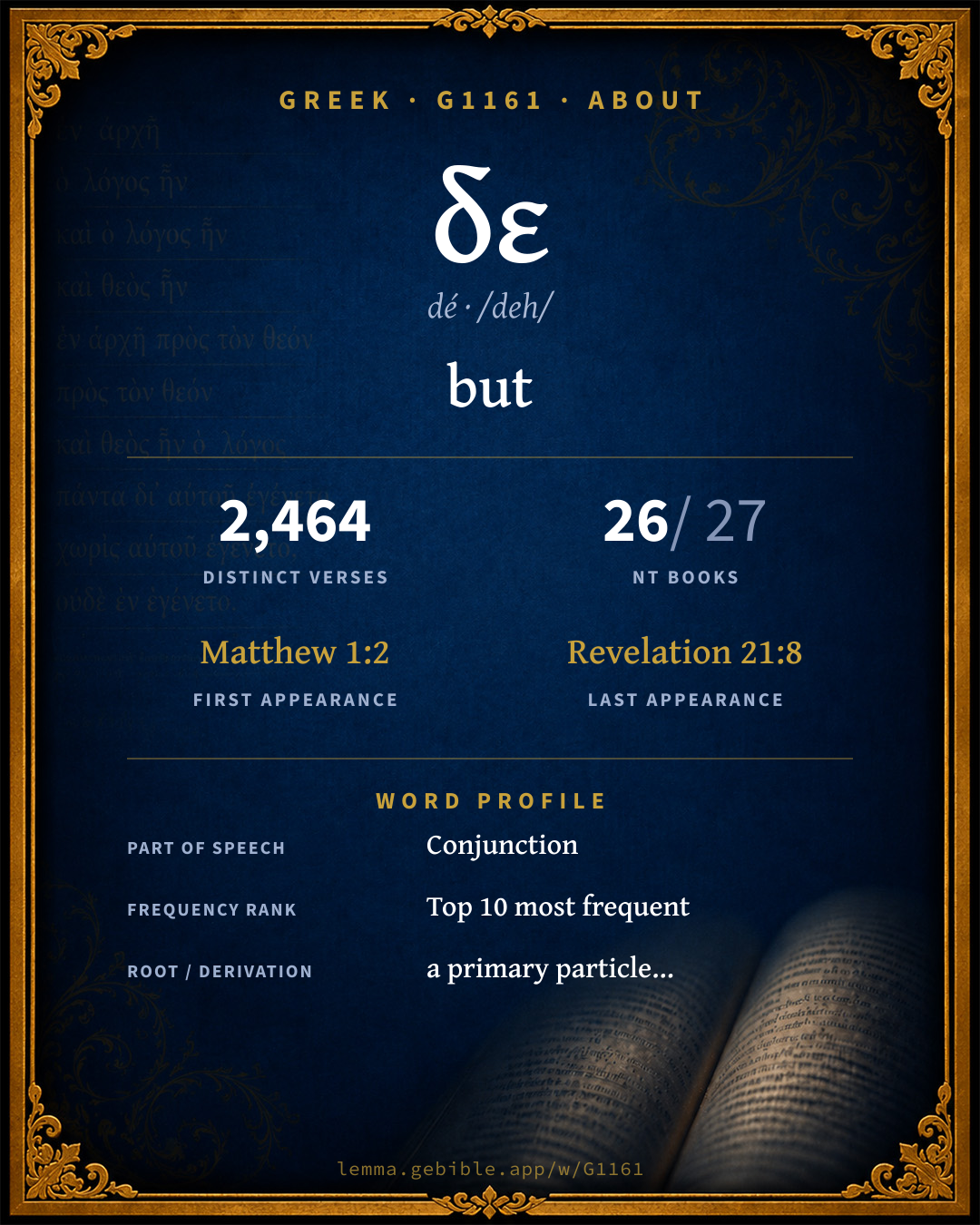
δέ
but
Full lexicon entry — Thayer's Greek Lexicon
From Thayer's Greek Lexicon
Where this word appears
Grammar key — what these labels mean
Part of speech
- Conjunction
- A joining word linking words or clauses.
Page 7 of 13 — showing verses 1,201–1,400 of 2,464 distinct verses where G1161 appears, across 26 books. Click any verse to open its interlinear word-by-word view. Verse text shown in the World English Bible for context — . Each verse’s Greek form is shown with its reference; the English is not keyword-highlighted, since the data carries no word-level English alignment. Use “Compare translations” on any verse to read it across multiple English versions. This concordance covers the Greek New Testament; Septuagint (Greek Old Testament) occurrences of this word are not indexed here.
John 192 verses
- John 15:19 δὲ conj If you were of the world, the world would love its own. But because you are not of the world, since I chose you out of the world, therefore the world hates you.
- John 15:22 δὲ conj If I had not come and spoken to them, they would not have had sin; but now they have no excuse for their sin.
- John 15:24 δὲ conj If I hadn't done among them the works which no one else did, they wouldn't have had sin. But now have they seen and also hated both me and my Father.
- John 15:27 δὲ conj You will also testify, because you have been with me from the beginning.
- John 16:4 δὲ conj But I have told you these things, so that when the time comes, you may remember that I told you about them. I didn't tell you these things from the beginning, because I was with you.
- John 16:5 δὲ conj But now I am going to him who sent me, and none of you asks me, 'Where are you going?'
- John 16:7 δὲ conj Nevertheless I tell you the truth: It is to your advantage that I go away, for if I don't go away, the Counselor won't come to you. But if I go, I will send him to you.
- John 16:10 δέ conj about righteousness, because I am going to my Father, and you won't see me any more;
- John 16:11 δὲ conj about judgment, because the prince of this world has been judged.
- John 16:13 δὲ conj However when he, the Spirit of truth, has come, he will guide you into all truth, for he will not speak from himself; but whatever he hears, he will speak. He will declare to you things that are coming.
- John 16:20 δὲ conj Most assuredly I tell you, that you will weep and lament, but the world will rejoice. You will be sorrowful, but your sorrow will be turned into joy.
- John 16:21 δὲ conj A woman, when she gives birth, has sorrow, because her time has come. But when she has delivered the child, she doesn't remember the anguish any more, for the joy that a human being is born into the world.
- John 16:22 δὲ conj Therefore you now have sorrow, but I will see you again, and your heart will rejoice, and no one will take your joy away from you.
- John 17:3 δέ conj This is eternal life, that they should know you, the only true God, and him whom you sent, Jesus Christ.
- John 17:13 δὲ conj But now I come to you, and I say these things in the world, that they may have my joy made full in themselves.
- John 17:20 δὲ conj Not for these only do I pray, but for those also who believe in me through their word,
- John 17:25 δέ conj Righteous Father, the world hasn't known you, but I knew you; and these knew that you sent me.
- John 18:2 δὲ conj Now Judas, who betrayed him, also knew the place, for Jesus often resorted there with his disciples.
- John 18:5 δὲ conj They answered him, "Jesus of Nazareth." Jesus said to them, "I AM." Judas also, who betrayed him, was standing with them.
- John 18:7 δὲ conj Again therefore he asked them, "Who are you looking for?" They said, "Jesus of Nazareth."
- John 18:10 δὲ conj Simon Peter therefore, having a sword, drew it, and struck the high priest's servant, and cut off his right ear. The servant's name was Malchus.
- John 18:14 δὲ conj Now it was Caiaphas who advised the Jews that it was expedient that one man should perish for the people.
- John 18:15 δὲ δὲ conj conj Simon Peter followed Jesus, as did another disciple. Now that disciple was known to the high priest, and entered in with Jesus into the court of the high priest;
- John 18:16 δὲ conj but Peter was standing at the door outside. So the other disciple, who was known to the high priest, went out and spoke to her who kept the door, and brought in Peter.
- John 18:18 δὲ δὲ conj conj Now the servants and the officers were standing there, having made a fire of coals, for it was cold. They were warming themselves. Peter was with them, standing and warming himself.
- John 18:22 δὲ conj When he had said this, one of the officers standing by slapped Jesus with his hand, saying, "Do you answer the high priest like that?"
- John 18:23 δὲ conj Jesus answered him, "If I have spoken evil, testify of the evil; but if well, why do you beat me?"
- John 18:25 δὲ conj Now Simon Peter was standing and warming himself. They said therefore to him, "You aren't also one of his disciples, are you?" He denied it, and said, "I am not."
- John 18:28 δὲ conj They led Jesus therefore from Caiaphas into the Praetorium. It was early, and they themselves didn't enter into the Praetorium, that they might not be defiled, but might eat the Passover.
- John 18:36 δὲ conj Jesus answered, "My Kingdom is not of this world. If my Kingdom were of this world, then my servants would fight, that I wouldn't be delivered to the Jews. But now my Kingdom is not from here."
- John 18:39 δὲ conj But you have a custom, that I should release someone to you at the Passover. Therefore do you want me to release to you the King of the Jews?"
- John 18:40 δὲ conj Then they all shouted again, saying, "Not this man, but Barabbas!" Now Barabbas was a robber.
- John 19:9 δὲ conj He entered into the Praetorium again, and said to Jesus, "Where are you from?" But Jesus gave him no answer.
- John 19:12 δὲ conj At this, Pilate was seeking to release him, but the Jews cried out, saying, "If you release this man, you aren't Caesar's friend! Everyone who makes himself a king speaks against Caesar!"
- John 19:13 δὲ conj When Pilate therefore heard these words, he brought Jesus out, and sat down on the judgment seat at a place called "The Pavement," but in Hebrew, "Gabbatha."
- John 19:14 δὲ conj Now it was the Preparation Day of the Passover, at about the sixth hour. He said to the Jews, "Behold, your King!"
- John 19:18 δὲ conj where they crucified him, and with him two others, on either side one, and Jesus in the middle.
- John 19:19 δὲ δὲ conj conj Pilate wrote a title also, and put it on the cross. There was written, "JESUS OF NAZARETH, THE KING OF THE JEWS."
- John 19:23 δὲ conj Then the soldiers, when they had crucified Jesus, took his garments and made four parts, to every soldier a part; and also the coat. Now the coat was without seam, woven from the top throughout.
- John 19:25 δὲ conj But there were standing by the cross of Jesus his mother, and his mother's sister, Mary the wife of Clopas, and Mary Magdalene.
- John 19:33 δὲ conj but when they came to Jesus, and saw that he was already dead, they didn't break his legs.
- John 19:38 δὲ δὲ conj conj After these things, Joseph of Arimathaea, being a disciple of Jesus, but secretly for fear of the Jews, asked of Pilate that he might take away Jesus' body. Pilate gave him permission. He came therefore and took away his body.
- John 19:39 δὲ conj Nicodemus, who at first came to Jesus by night, also came bringing a mixture of myrrh and aloes, about a hundred pounds.
- John 19:41 δὲ conj Now in the place where he was crucified there was a garden. In the garden a new tomb in which no man had ever yet been laid.
- John 20:1 δὲ conj Now on the first day of the week, Mary Magdalene went early, while it was still dark, to the tomb, and saw the stone taken away from the tomb.
- John 20:4 δὲ conj They both ran together. The other disciple outran Peter, and came to the tomb first.
- John 20:11 δὲ conj But Mary was standing outside at the tomb weeping. So, as she wept, she stooped and looked into the tomb,
- John 20:17 δὲ conj Jesus said to her, "Don't touch me, for I haven't yet ascended to my Father; but go to my brothers, and tell them, 'I am ascending to my Father and your Father, to my God and your God.'"
- John 20:24 δὲ conj But Thomas, one of the twelve, called Didymus, wasn't with them when Jesus came.
- John 20:25 δὲ conj The other disciples therefore said to him, "We have seen the Lord!" But he said to them, "Unless I see in his hands the print of the nails, and put my hand into his side, I will not believe."
- John 20:31 δὲ conj but these are written, that you may believe that Jesus is the Christ, the Son of God, and that believing you may have life in his name.
- John 21:1 δὲ conj After these things, Jesus revealed himself again to the disciples at the sea of Tiberias. He revealed himself this way.
- John 21:4 δὲ conj But when day had already come, Jesus stood on the beach, yet the disciples didn't know that it was Jesus.
- John 21:8 δὲ conj But the other disciples came in the little boat (for they were not far from the land, but about two hundred cubits away), dragging the net full of fish.
- John 21:12 δὲ conj Jesus said to them, "Come and eat breakfast." None of the disciples dared inquire of him, "Who are you?" knowing that it was the Lord.
- John 21:18 δὲ conj Most assuredly I tell you, when you were young, you dressed yourself, and walked where you wanted to. But when you are old, you will stretch out your hands, and another will dress you, and carry you where you don't want to go."
- John 21:19 δὲ conj Now he said this, signifying by what kind of death he would glorify God. When he had said this, he said to him, "Follow me."
- John 21:21 δὲ conj Peter seeing him, said to Jesus, "Lord, what about this man?"
Acts 491 verses
- Acts 1:5 δὲ conj For John indeed baptized in water, but you will be baptized in the Holy Spirit not many days from now."
- Acts 2:5 δὲ conj Now there were dwelling in Jerusalem Jews, devout men, from every nation under the sky.
- Acts 2:6 δὲ conj When this sound was heard, the multitude came together, and were bewildered, because everyone heard them speaking in his own language.
- Acts 2:7 δὲ conj They were all amazed and marveled, saying to one another, "Behold, aren't all these who speak Galileans?
- Acts 2:12 δὲ conj They were all amazed, and were perplexed, saying one to another, "What does this mean?"
- Acts 2:13 δὲ conj Others, mocking, said, "They are filled with new wine."
- Acts 2:14 δὲ conj But Peter, standing up with the eleven, lifted up his voice, and spoke out to them, "You men of Judea, and all you who dwell at Jerusalem, let this be known to you, and listen to my words.
- Acts 2:26 δὲ conj Therefore my heart was glad, and my tongue rejoiced. Moreover my flesh also will dwell in hope;
- Acts 2:34 δὲ conj For David didn't ascend into the heavens, but he says himself, 'The Lord said to my Lord, "Sit by my right hand,
- Acts 2:37 δὲ conj Now when they heard this, they were cut to the heart, and said to Peter and the rest of the apostles, "Brothers, what shall we do?"
- Acts 2:38 δὲ conj Peter said to them, "Repent, and be baptized, everyone of you, in the name of Jesus Christ for the forgiveness of sins, and you will receive the gift of the Holy Spirit.
- Acts 2:42 δὲ conj They continued steadfastly in the apostles' teaching and fellowship, in the breaking of bread, and prayer.
- Acts 2:43 δὲ δὲ conj conj Fear came on every soul, and many wonders and signs were done through the apostles.
- Acts 2:44 δὲ conj All who believed were together, and had all things in common.
- Acts 2:47 δὲ conj praising God, and having favor with all the people. The Lord added to the assembly day by day those who were being saved.
- Acts 3:1 δὲ conj Peter and John were going up into the temple at the hour of prayer, the ninth hour.
- Acts 3:4 δὲ conj Peter, fastening his eyes on him, with John, said, "Look at us."
- Acts 3:5 δὲ conj He listened to them, expecting to receive something from them.
- Acts 3:6 δὲ δὲ conj conj But Peter said, "Silver and gold have I none, but what I have, that I give you. In the name of Jesus Christ of Nazareth, get up and walk!"
- Acts 3:7 δὲ conj He took him by the right hand, and raised him up. Immediately his feet and his ankle bones received strength.
- Acts 3:10 δὲ conj They recognized him, that it was he who used to sit begging for gifts for the needy at the Beautiful Gate of the temple. They were filled with wonder and amazement at what had happened to him.
- Acts 3:11 δὲ conj As the lame man who was healed held on to Peter and John, all the people ran together to them in the porch that is called Solomon's, greatly wondering.
- Acts 3:12 δὲ conj When Peter saw it, he responded to the people, "You men of Israel, why do you marvel at this man? Why do you fasten your eyes on us, as though by our own power or godliness we had made him walk?
- Acts 3:14 δὲ conj But you denied the Holy and Righteous One, and asked for a murderer to be granted to you,
- Acts 3:15 δὲ conj and killed the Prince of life, whom God raised from the dead, to which we are witnesses.
- Acts 3:18 δὲ conj But the things which God announced by the mouth of all his prophets, that Christ should suffer, he thus fulfilled.
- Acts 3:23 δὲ conj It will be, that every soul that will not listen to that prophet will be utterly destroyed from among the people.'
- Acts 3:24 δὲ conj Yes, and all the prophets from Samuel and those who followed after, as many as have spoken, they also told of these days.
- Acts 4:1 δὲ conj As they spoke to the people, the priests and the captain of the temple and the Sadducees came to them,
- Acts 4:4 δὲ conj But many of those who heard the word believed, and the number of the men came to be about five thousand.
- Acts 4:5 δὲ conj It happened in the morning, that their rulers, elders, and scribes were gathered together in Jerusalem.
- Acts 4:13 δὲ conj Now when they saw the boldness of Peter and John, and had perceived that they were unlearned and ignorant men, they marveled. They recognized that they had been with Jesus.
- Acts 4:15 δὲ conj But when they had commanded them to go aside out of the council, they conferred among themselves,
- Acts 4:19 δὲ conj But Peter and John answered them, "Whether it is right in the sight of God to listen to you rather than to God, judge for yourselves,
- Acts 4:21 δὲ conj When they had further threatened them, they let them go, finding no way to punish them, because of the people; for everyone glorified God for that which was done.
- Acts 4:23 δὲ conj Being let go, they came to their own company, and reported all that the chief priests and the elders had said to them.
- Acts 4:24 δὲ conj When they heard it, they lifted up their voice to God with one accord, and said, "O Lord, you are God, who made the heaven, the earth, the sea, and all that is in them;
- Acts 4:32 δὲ conj The multitude of those who believed were of one heart and soul. Not one of them claimed that anything of the things which he possessed was his own, but they had all things in common.
- Acts 4:35 δὲ conj and laid them at the apostles' feet, and distribution was made to each, according as anyone had need.
- Acts 4:36 δὲ conj Joses, who by the apostles was surnamed Barnabas (which is, being interpreted, Son of Encouragement), a Levite, a man of Cyprus by race,
- Acts 5:1 δέ conj But a certain man named Ananias, with Sapphira, his wife, sold a possession,
- Acts 5:3 δὲ conj But Peter said, "Ananias, why has Satan filled your heart to lie to the Holy Spirit, and to keep back part of the price of the land?
- Acts 5:5 δὲ conj Ananias, hearing these words, fell down and died. Great fear came on all who heard these things.
- Acts 5:6 δὲ conj The young men arose and wrapped him up, and they carried him out and buried him.
- Acts 5:7 δὲ conj About three hours later, his wife, not knowing what had happened, came in.
- Acts 5:8 δὲ δὲ conj conj Peter answered her, "Tell me whether you sold the land for so much." She said, "Yes, for so much."
- Acts 5:9 δὲ conj But Peter asked her, "How is it that you have agreed together to tempt the Spirit of the Lord? Behold, the feet of those who have buried your husband are at the door, and they will carry you out."
- Acts 5:10 δὲ δὲ conj conj She fell down immediately at his feet, and died. The young men came in and found her dead, and they carried her out and buried her by her husband.
- Acts 5:12 δὲ conj By the hands of the apostles many signs and wonders were done among the people. They were all with one accord in Solomon's porch.
- Acts 5:13 δὲ conj None of the rest dared to join them, however the people honored them.
- Acts 5:14 δὲ conj More believers were added to the Lord, multitudes of both men and women.
- Acts 5:16 δὲ conj Multitudes also came together from the cities around Jerusalem, bringing sick people, and those who were tormented by unclean spirits: and they were all healed.
- Acts 5:17 δὲ conj But the high priest rose up, and all those who were with him (which is the sect of the Sadducees), and they were filled with jealousy,
- Acts 5:19 δὲ conj But an angel of the Lord opened the prison doors by night, and brought them out, and said,
- Acts 5:21 δὲ δὲ conj conj When they heard this, they entered into the temple about daybreak, and taught. But the high priest came, and those who were with him, and called the council together, and all the senate of the children of Israel, and sent to the prison to have them brought.
- Acts 5:22 δὲ δὲ conj conj But the officers who came didn't find them in the prison. They returned and reported,
- Acts 5:23 δὲ conj "We found the prison shut and locked, and the guards standing before the doors, but when we opened them, we found no one inside!"
- Acts 5:24 δὲ conj Now when the high priest, the captain of the temple, and the chief priests heard these words, they were very perplexed about them and what might become of this.
- Acts 5:25 δέ conj One came and told them, "Behold, the men whom you put in prison are in the temple, standing and teaching the people."
- Acts 5:27 δὲ conj When they had brought them, they set them before the council. The high priest questioned them,
- Acts 5:29 δὲ conj But Peter and the apostles answered, "We must obey God rather than men.
- Acts 5:33 δὲ conj But they, when they heard this, were cut to the heart, and determined to kill them.
- Acts 5:34 δέ conj But one stood up in the council, a Pharisee named Gamaliel, a teacher of the law, honored by all the people, and commanded to put the apostles out for a little while.
- Acts 5:39 δὲ conj But if it is of God, you will not be able to overthrow it, and you would be found even to be fighting against God!"
- Acts 5:40 δὲ conj They agreed with him. Summoning the apostles, they beat them and charged them not to speak in the name of Jesus, and let them go.
- Acts 6:1 δὲ conj Now in those days, when the number of the disciples was multiplying, a complaint arose from the Grecian Jews against the Hebrews because their widows were neglected in the daily service.
- Acts 6:2 δὲ conj The twelve summoned the multitude of the disciples and said, "It is not appropriate for us to forsake the word of God and serve tables.
- Acts 6:3 δέ conj Therefore select from among you, brothers, seven men of good report, full of the Holy Spirit and of wisdom, whom we may appoint over this business.
- Acts 6:4 δὲ conj But we will continue steadfastly in prayer and in the ministry of the word."
- Acts 6:8 δὲ conj Stephen, full of faith and power, performed great wonders and signs among the people.
- Acts 6:9 δέ conj But some of those who were of the synagogue called "The Libertines," and of the Cyrenians, of the Alexandrians, and of those of Cilicia and Asia arose, disputing with Stephen.
- Acts 7:1 δὲ conj The high priest said, "Are these things so?"
- Acts 7:2 δὲ conj He said, "Brothers and fathers, listen. The God of glory appeared to our father Abraham, when he was in Mesopotamia, before he lived in Haran,
- Acts 7:6 δὲ conj God spoke in this way: that his seed would live as aliens in a strange land, and that they would be enslaved and mistreated for four hundred years.
- Acts 7:11 δὲ conj Now a famine came over all the land of Egypt and Canaan, and great affliction. Our fathers found no food.
- Acts 7:12 δὲ conj But when Jacob heard that there was grain in Egypt, he sent out our fathers the first time.
- Acts 7:14 δὲ conj Joseph sent, and summoned Jacob, his father, and all his relatives, seventy-five souls.
- Acts 7:17 δὲ conj "But as the time of the promise came close which God had sworn to Abraham, the people grew and multiplied in Egypt,
- Acts 7:21 δὲ conj When he was thrown out, Pharaoh's daughter took him up, and reared him as her own son.
- Acts 7:22 δὲ conj Moses was instructed in all the wisdom of the Egyptians. He was mighty in his words and works.
- Acts 7:23 δὲ conj But when he was forty years old, it came into his heart to visit his brothers, the children of Israel.
- Acts 7:25 δὲ δὲ conj conj He supposed that his brothers understood that God, by his hand, was giving them deliverance; but they didn't understand.
- Acts 7:27 δὲ conj But he who did his neighbor wrong pushed him away, saying, 'Who made you a ruler and a judge over us?
- Acts 7:29 δὲ conj Moses fled at this saying, and became a stranger in the land of Midian, where he became the father of two sons.
- Acts 7:31 δὲ δὲ conj conj When Moses saw it, he wondered at the sight. As he came close to see, a voice of the Lord came to him,
- Acts 7:32 δὲ conj 'I am the God of your fathers, the God of Abraham, the God of Isaac, and the God of Jacob.' Moses trembled, and dared not look.
- Acts 7:33 δὲ conj The Lord said to him, 'Take your sandals off of your feet, for the place where you stand is holy ground.
- Acts 7:42 δὲ conj But God turned, and gave them up to serve the host of the sky, as it is written in the book of the prophets, 'Did you offer to me slain animals and sacrifices Forty years in the wilderness, O house of Israel?
- Acts 7:47 δὲ conj But Solomon built him a house.
- Acts 7:49 δὲ conj 'heaven is my throne, And the earth a footstool for my feet. What kind of house will you build me?' says the Lord; 'Or what is the place of my rest?
- Acts 7:54 δὲ conj Now when they heard these things, they were cut to the heart, and they gnashed at him with their teeth.
- Acts 7:55 δὲ conj But he, being full of the Holy Spirit, looked up steadfastly into heaven, and saw the glory of God, and Jesus standing on the right hand of God,
- Acts 7:57 δὲ conj But they cried out with a loud voice, and stopped their ears, and rushed at him with one accord.
- Acts 7:60 δὲ conj He kneeled down, and cried with a loud voice, "Lord, don't hold this sin against them!" When he had said this, he fell asleep.
- Acts 8:1 δὲ δὲ conj conj Saul was consenting to his death. A great persecution arose against the assembly which was in Jerusalem in that day. They were all scattered abroad throughout the regions of Judea and Samaria, except for the apostles.
- Acts 8:2 δὲ conj Devout men buried Stephen, and lamented greatly over him.
- Acts 8:3 δὲ conj But Saul ravaged the assembly, entering into every house, and dragged both men and women off to prison.
- Acts 8:5 δὲ conj Philip went down to the city of Samaria, and proclaimed to them the Christ.
- Acts 8:6 δὲ conj The multitudes listened with one accord to the things that were spoken by Philip, when they heard and saw the signs which he did.
- Acts 8:7 δὲ conj For unclean spirits came out of many of those who had them. They came out, crying with a loud voice. Many who had been paralyzed and lame were healed.
- Acts 8:8 δὲ conj There was great joy in that city.
- Acts 8:9 δέ conj But there was a certain man, Simon by name, who used to practice sorcery in the city, and amazed the people of Samaria, making himself out to be some great one,
- Acts 8:11 δὲ conj They listened to him, because for a long time he had amazed them with his sorceries.
- Acts 8:12 δὲ conj But when they believed Philip preaching good news concerning the Kingdom of God and the name of Jesus Christ, they were baptized, both men and women.
- Acts 8:13 δὲ conj Simon himself also believed. Being baptized, he continued with Philip. Seeing signs and great miracles occuring, he was amazed.
- Acts 8:14 δὲ conj Now when the apostles who were at Jerusalem heard that Samaria had received the word of God, they sent Peter and John to them,
- Acts 8:16 δὲ conj for as yet he had fallen on none of them. They had only been baptized in the name of Christ Jesus.
- Acts 8:18 δὲ conj Now when Simon saw that the Holy Spirit was given through the laying on of the apostles' hands, he offered them money,
- Acts 8:20 δὲ conj But Peter said to him, "May your silver perish with you, because you thought you could obtain the gift of God with money!
- Acts 8:24 δὲ conj Simon answered, "Pray for me to the Lord, that none of the things which you have spoken happen to me."
- Acts 8:26 δὲ conj But an angel of the Lord spoke to Philip, saying, "Arise, and go toward the south to the way that goes down from Jerusalem to Gaza. This is a desert."
- Acts 8:29 δὲ conj The Spirit said to Philip, "Go near, and join yourself to this chariot."
- Acts 8:30 δὲ conj Philip ran to him, and heard him reading Isaiah the prophet, and said, "Do you understand what you are reading?"
- Acts 8:31 δὲ conj He said, "How can I, unless someone explains it to me?" He begged Philip to come up and sit with him.
- Acts 8:32 δὲ conj Now the passage of the Scripture which he was reading was this, "He was led as a sheep to the slaughter. As a lamb before his shearer is silent, So he doesn't open his mouth.
- Acts 8:34 δὲ conj The eunuch answered Philip, "Who is the prophet talking about? About himself, or about someone else?"
- Acts 8:35 δὲ conj Philip opened his mouth, and beginning from this Scripture, preached to him Jesus.
- Acts 8:36 δὲ conj As they went on the way, they came to some water, and the eunuch said, "Behold, here is water. What is keeping me from being baptized?"
- Acts 8:39 δὲ conj When they came up out of the water, the Spirit of the Lord caught Philip away, and the eunuch didn't see him any more, for he went on his way rejoicing.
- Acts 8:40 δὲ conj But Philip was found at Azotus. Passing through, he preached the Gospel to all the cities, until he came to Caesarea.
- Acts 9:1 δὲ conj But Saul, still breathing threats and slaughter against the disciples of the Lord, went to the high priest,
- Acts 9:3 δὲ conj As he traveled, it happened that he got close to Damascus, and suddenly a light from the sky shone around him.
- Acts 9:5 δέ δέ conj conj He said, "Who are you, Lord?" The Lord said, "I am Jesus, whom you are persecuting.
- Acts 9:7 δὲ δὲ conj conj The men who traveled with him stood speechless, hearing the sound, but seeing no one.
- Acts 9:8 δὲ δὲ δὲ conj conj conj Saul arose from the ground, and when his eyes were opened, he saw no one. They led him by the hand, and brought him into Damascus.
- Acts 9:10 δέ δὲ conj conj Now there was a certain disciple at Damascus named Ananias. The Lord said to him in a vision, "Ananias!" He said, "Behold, it's me, Lord."
- Acts 9:11 δὲ conj The Lord said to him, "Arise, and go to the street which is called Straight, and inquire in the house of Judas for one named Saul, a man of Tarsus. For behold, he is praying,
- Acts 9:13 δὲ conj But Ananias answered, "Lord, I have heard from many about this man, how much evil he did to your saints at Jerusalem.
- Acts 9:15 δὲ conj But the Lord said to him, "Go your way, for he is my chosen vessel to bear my name before the nations and kings, and the children of Israel.
- Acts 9:17 δὲ conj Ananias departed, and entered into the house. Laying his hands on him, he said, "Brother Saul, the Lord, who appeared to you on the road by which you came, has sent me, that you may receive your sight, and be filled with the Holy Spirit."
- Acts 9:19 δὲ conj He took food and was strengthened. Saul stayed several days with the disciples who were at Damascus.
- Acts 9:21 δὲ conj All who heard him were amazed, and said, "Isn't this he who in Jerusalem made havoc of those who called on this name? And he had come here intending to bring them bound before the chief priests!"
- Acts 9:22 δὲ conj But Saul increased more in strength, and confounded the Jews who lived at Damascus, proving that this is the Christ.
- Acts 9:23 δὲ conj When many days were fulfilled, the Jews conspired together to kill him,
- Acts 9:24 δὲ δὲ conj conj but their plot became known to Saul. They watched the gates both day and night that they might kill him,
- Acts 9:25 δὲ conj but his disciples took him by night, and let him down through the wall, lowering him in a basket.
- Acts 9:26 δὲ conj When Saul had come to Jerusalem, he tried to join himself to the disciples; but they were all afraid of him, not believing that he was a disciple.
- Acts 9:27 δὲ conj But Barnabas took him, and brought him to the apostles, and declared to them how he had seen the Lord in the way, and that he had spoken to him, and how at Damascus he had preached boldly in the name of Jesus.
- Acts 9:29 δὲ conj preaching boldly in the name of the Lord. He spoke and disputed against the Grecian Jews, but they were seeking to kill him.
- Acts 9:30 δὲ conj When the brothers knew it, they brought him down to Caesarea, and sent him off to Tarsus.
- Acts 9:32 δὲ conj It happened, as Peter went throughout all those parts, he came down also to the saints who lived at Lydda.
- Acts 9:33 δὲ conj There he found a certain man named Aeneas, who had been bedridden for eight years, because he was paralyzed.
About this entry
At a glance — auto-summarized from this page’s data, not written by a person. Every figure links to its source below. This summary describes the numbers; it doesn’t interpret them.
δε — transliterated dé — is a Greek conjunction carrying the sense “but.” Its earliest occurrence is Matthew 1:2. It appears 2,464 verses across 26 books of the Greek New Testament, among its most common vocabulary. It shares a root with δη. Each statement above links to its evidence; the full detail follows below.
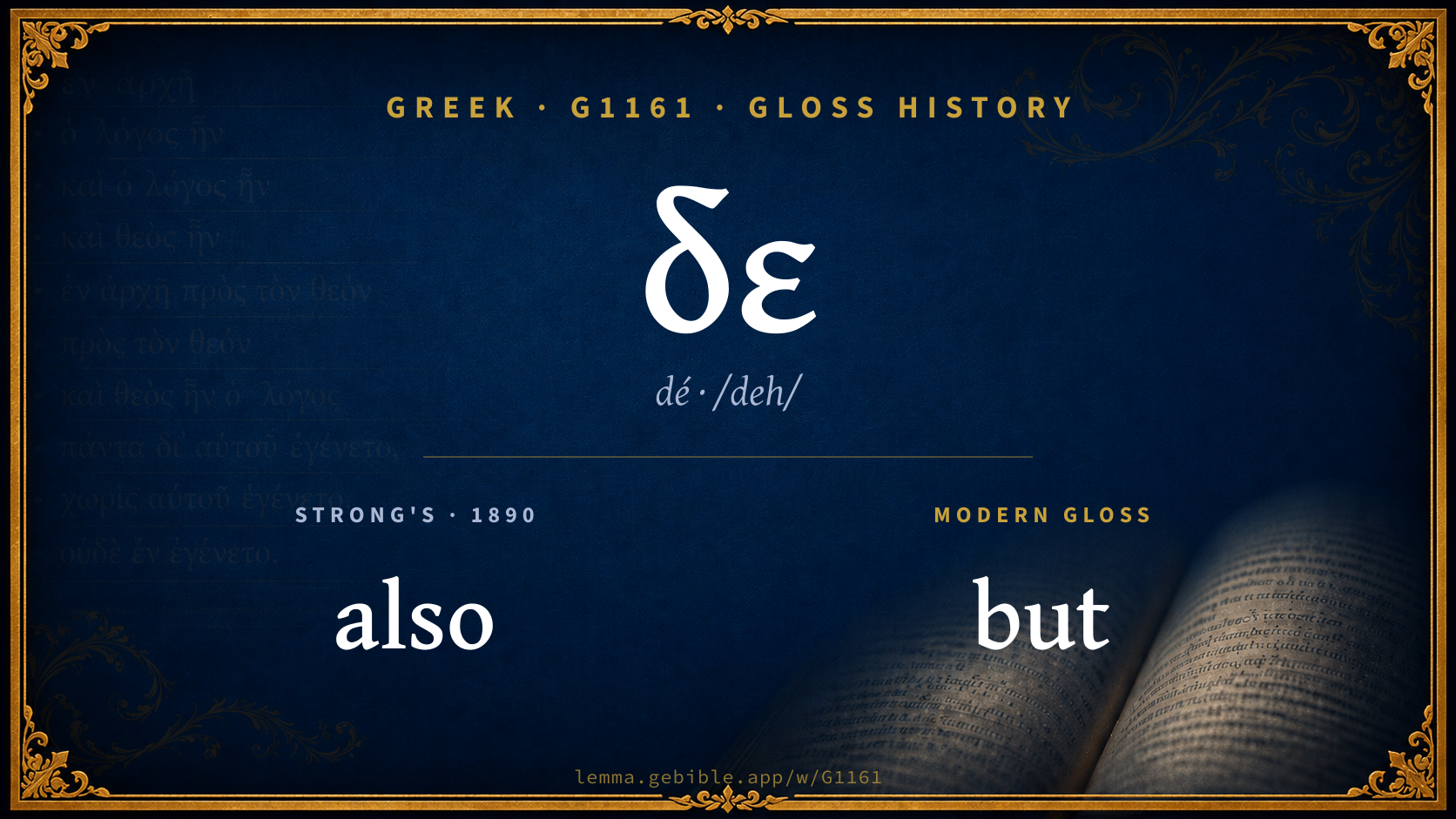
Gloss history
Strong's 1890 vs modern scholarship
About this word
Strong's G1161 catalogs a Greek word from the Greek New Testament.
These counts are not copied from any lexicon or concordance. They are computed here, from the morphology-tagged Greek New Testament. What Lemma adds →
- 2,464
- distinct verses
- The word appears in 2,464 distinct verses.
- 26 / 27
- NT books
- The word appears in 26 of 27 New Testament books.
- #4
- by frequency
- Top 10 most frequent Greek words (rank 4 of 5,347 Greek words by occurrence).
View all 2,464 occurrences in the concordance →
By section of the New Testament
By traditional corpus
Conventional, traditional groupings — biblical authorship is debated, so this is a traditional corpus grouping, not an authorship claim. Some books belong to more than one corpus (Luke is in both the Gospels and the Lukan corpus, and so on), so these shares overlap and need not total 100%. Each figure is a share of the word’s 2,464 distinct verses.
- Gospels 1,258 verses · 51%
- Lukan (Luke–Acts) 971 verses · 39%
- Pauline corpus 547 verses · 22%
- Johannine 211 verses · 9%
- General (Catholic) Epistles 93 verses · 4%
- Hebrews 68 verses · 3%
- Revelation 7 verses · 0%
How translations render this word
Counts come from each version’s own published word-to-Strong’s tagging or interlinear alignment — an approximate guide to how each version renders this word, not a word-level alignment the data otherwise carries. Because each total is that version’s own tagged count, the per-version totals vary from one another and need not match the appearance or distinct-verse counts above. These counts may also differ from a printed concordance because Lemma counts each distinctly tagged rendering and does not collapse phrase taggings into a single head-word total. This is a fixed set of word-tagged versions (KJV, ASV, BSB, ULT) and does not change with the reading translation you choose elsewhere. Each version’s license is shown beside its name below (and on Sources).
- King James Version: And 1,228×, But 929×, Now 166×
- American Standard Version: And 1,179×, But 999×, Now 171×
- Berean Standard Bible: But 784×, And 339×, Now 116×
- unfoldingWord Literal Text: But 1,407×, And 745×, Now 419×
King James Version Public Domain
Renders G1161 across 2,711 tagged occurrences — most commonly:
Plus other, less common renderings. Plus 42 renderings that appear only once — usually multi-word phrases or single function words the recovered tagging swept in, not distinct renderings. Not rendered by a distinct English word in 159 further occurrences.
American Standard Version Public Domain
Renders G1161 across 2,640 tagged occurrences — most commonly:
Plus other, less common renderings. Plus 75 renderings that appear only once — usually multi-word phrases or single function words the recovered tagging swept in, not distinct renderings. Not rendered by a distinct English word in 34 further occurrences.
Berean Standard Bible Public Domain
Renders G1161 across 1,643 tagged occurrences — most commonly:
Plus other, less common renderings. Plus 38 renderings that appear only once — usually multi-word phrases or single function words the recovered tagging swept in, not distinct renderings. Not rendered by a distinct English word in 1,112 further occurrences.
unfoldingWord Literal Text CC BY-SA 4.0
Renders G1161 across 2,802 tagged occurrences — most commonly:
Plus other, less common renderings. Plus 9 renderings that appear only once — usually multi-word phrases or single function words the recovered tagging swept in, not distinct renderings.
Senses in Thayer's
The 1 sense Thayer's distinguishes for this word, in lexicon order (not ranked by frequency or importance). The full entry — with sub-senses — is in the Lexicon Entry tab.
- but, moreover, and, etc.
Word origin
Origin: a primary particle (adversative or continuative)
A primary particle (adversative or continuative); but and etc. : - also and but moreover now [ often unexpressed in English ].
— Strong’s Exhaustive Concordance (1890), public domain.
Forms in the corpus
The 3 distinct written forms G1161 takes in the Greek New Testament, most frequent first — each parse links to that case’s occurrences in the concordance.
| Form | Parsing | Example | Uses |
|---|---|---|---|
| δὲ dè | Conjunction | Matthew 1:2 | 2,602 |
| δέ dé | Conjunction | Matthew 5:31 | 147 |
| δ’ d | Conjunction | Matthew 5:19 | 22 |
Same root — word family
Other Thayer's entries built from the same root as G1161, grouped by Strong’s listed origin. These share a root / origin per the lexicon — not necessarily a shared meaning. Each links to that word’s own entry.
Derived from this word
Compare all same-root words → They share a root, not necessarily a meaning.
Septuagint usage
The same Greek word δε appears 3,556 times in the Greek Old Testament (Septuagint), across 3,042 verses in 35 books.
- 3,556
- LXX occurrences
- Tagged occurrences of this Greek word in the Septuagint.
- 3,042
- verses
- Distinct Septuagint verses containing this word.
- 35 / 39
- OT books
- The word appears in 35 of the 39 Old Testament books.
Sample Septuagint occurrences
- Genesis 1:2 δέ
- Exodus 1:5 δέ
- Leviticus 1:9 δέ
- Numbers 1:47 δέ
- Deuteronomy 4:4 δέ
- Joshua 1:14 δέ
- Judges 1:11 δέ
- Ruth 1:14 δέ
- 1 Samuel 7:17 δέ
- 2 Samuel 3:30 δέ
- 1 Kings 1:17 δέ
- 2 Kings 3:15 δέ
Septuagint occurrences (same lexeme)
Every verse where the same Strong’s number (G1161) appears in the Greek Septuagint — showing the first 50 of 3,042. Verse text shown in the World English Bible for context; the Greek form is the matched word — the English is not keyword-highlighted.
- Genesis 1:2 δέ Now the earth was formless and empty. Darkness was on the surface of the deep. God's Spirit was hovering over the surface of the waters.
- Genesis 2:6 δέ but a mist went up from the earth, and watered the whole surface of the ground.
- Genesis 2:10 δέ A river went out of Eden to water the garden; and from there it was parted, and became four heads.
- Genesis 2:12 δέ and the gold of that land is good. There is aromatic resin and the onyx stone.
- Genesis 2:14 δέ The name of the third river is Hiddekel: this is the one which flows in front of Assyria. The fourth river is the Euphrates.
- Genesis 2:17 δέ but of the tree of the knowledge of good and evil, you shall not eat of it: for in the day that you eat of it you will surely die."
- Genesis 2:20 δέ The man gave names to all cattle, and to the birds of the sky, and to every animal of the field; but for man there was not found a helper suitable for him.
- Genesis 3:1 δέ Now the serpent was more subtle than any animal of the field which Yahweh God had made. He said to the woman, "Yes, has God said, 'You shall not eat of any tree of the garden?'"
- Genesis 3:3 δέ but of the fruit of the tree which is in the midst of the garden, God has said, 'You shall not eat of it, neither shall you touch it, lest you die.'"
- Genesis 3:17 δέ To Adam he said, "Because you have listened to your wife's voice, and have eaten of the tree, of which I commanded you, saying, 'You shall not eat of it,' cursed is the ground for your sake. In toil you will eat of it all the days of your life.
- Genesis 4:1 δέ The man knew Eve his wife. She conceived, and gave birth to Cain, and said, "I have gotten a man with Yahweh's help."
- Genesis 4:2 δέ Again she gave birth, to Cain's brother Abel. Abel was a keeper of sheep, but Cain was a tiller of the ground.
- Genesis 4:5 δέ but he didn't respect Cain and his offering. Cain was very angry, and the expression on his face fell.
- Genesis 4:7 δέ If you do well, will it not be lifted up? If you don't do well, sin crouches at the door. Its desire is for you, but you are to rule over it."
- Genesis 4:9 δέ Yahweh said to Cain, "Where is Abel, your brother?" He said, "I don't know. Am I my brother's keeper?"
- Genesis 4:16 δέ Cain went out from Yahweh's presence, and dwelt in the land of Nod, on the east of Eden.
- Genesis 4:18 δέ To Enoch was born Irad. Irad became the father of Mehujael. Mehujael became the father of Methushael. Methushael became the father of Lamech.
- Genesis 4:22 δέ Zillah also gave birth to Tubal Cain, the forger of every cutting instrument of brass and iron. Tubal Cain's sister was Naamah.
- Genesis 4:23 δέ Lamech said to his wives, "Adah and Zillah, Hear my voice, You wives of Lamech, listen to my speech, For I have slain a man for wounding me, A young man for bruising me.
- Genesis 4:24 δέ If Cain will be avenged seven times, Truly Lamech seventy-seven times."
- Genesis 4:25 δέ Adam knew his wife again. She gave birth to a son, and named him Seth. For, she said, "God has appointed me another child instead of Abel, for Cain killed him."
- Genesis 4:26 δέ There was also born a son to Seth, and he named him Enosh. Then men began to call on Yahweh's name.
- Genesis 5:3 δέ Adam lived one hundred thirty years, and became the father of a son in his own likeness, after his image, and named him Seth.
- Genesis 5:4 δέ The days of Adam after he became the father of Seth were eight hundred years, and he became the father of sons and daughters.
- Genesis 5:6 δέ Seth lived one hundred five years, and became the father of Enosh.
- Genesis 5:22 δέ Enoch walked with God after he became the father of Methuselah three hundred years, and became the father of sons and daughters.
- Genesis 6:2 δέ that God's sons saw that men's daughters were beautiful, and they took for themselves wives of all that they chose.
- Genesis 6:3 δέ Yahweh said, "My Spirit will not strive with man forever, because he also is flesh; yet will his days be one hundred twenty years."
- Genesis 6:4 δέ The Nephilim were in the earth in those days, and also after that, when God's sons came to men's daughters. They bore children to them: the same were the mighty men who were of old, men of renown.
- Genesis 6:5 δέ Yahweh saw that the wickedness of man was great in the earth, and that every imagination of the thoughts of his heart was only evil continually.
- Genesis 6:8 δέ But Noah found favor in Yahweh's eyes.
- Genesis 6:9 δέ This is the history of the generations of Noah. Noah was a righteous man, blameless among the people of his time. Noah walked with God.
- Genesis 6:10 δέ Noah became the father of three sons: Shem, Ham, and Japheth.
- Genesis 6:11 δέ The earth was corrupt before God, and the earth was filled with violence.
- Genesis 6:16 δέ You shall make a roof in the ark, and to a cubit shall you finish it upward. You shall set the door of the ark in the side of it. You shall make it with lower, second, and third levels.
- Genesis 6:17 δέ I, even, I do bring the flood of waters on this earth, to destroy all flesh having the breath of life from under the sky. Everything that is in the earth will die.
- Genesis 6:18 δέ But I will establish my covenant with you. You shall come into the ark, you, your sons, your wife, and your sons' wives with you.
- Genesis 6:21 δέ Take with you of all food that is eaten, and gather it to you; and it will be for food for you, and for them."
- Genesis 7:2 δέ You shall take seven pairs of every clean animal with you, the male and his female. Of the animals that are not clean, take two, the male and his female.
- Genesis 7:6 δέ Noah was six hundred years old when the flood of waters came on the earth.
- Genesis 7:7 δέ Noah went into the ark with his sons, his wife, and his sons' wives, because of the waters of the flood.
- Genesis 7:19 δέ The waters prevailed exceedingly on the earth. All the high mountains that were under the whole sky were covered.
- Genesis 8:5 δέ The waters receded continually until the tenth month. In the tenth month, on the first day of the month, the tops of the mountains were seen.
- Genesis 8:14 δέ In the second month, on the twenty-seventh day of the month, the earth was dry.
- Genesis 9:7 δέ Be fruitful, and multiply. Bring forth abundantly in the earth, and multiply in it."
- Genesis 9:18 δέ The sons of Noah who went forth from the ark were Shem, Ham, and Japheth. Ham is the father of Canaan.
- Genesis 9:24 δέ Noah awoke from his wine, and knew what his youngest son had done to him.
- Genesis 9:28 δέ Noah lived three hundred fifty years after the flood.
- Genesis 10:1 δέ Now this is the history of the generations of the sons of Noah and of Shem, Ham, and Japheth. Sons were born to them after the flood.
- Genesis 10:6 δέ The sons of Ham: Cush, Mizraim, Put, and Canaan.
These are occurrences of the same Greek lexeme (G1161) in the Septuagint — not a translation of any one Hebrew word. The store carries no word-level Hebrew↔Greek alignment, so no Hebrew original is asserted here. Counts come from the recovered LXX Strong's tagging — high-frequency vocabulary is well covered, while rare or late forms may be untagged — so they reflect tagged occurrences and may slightly undercount.