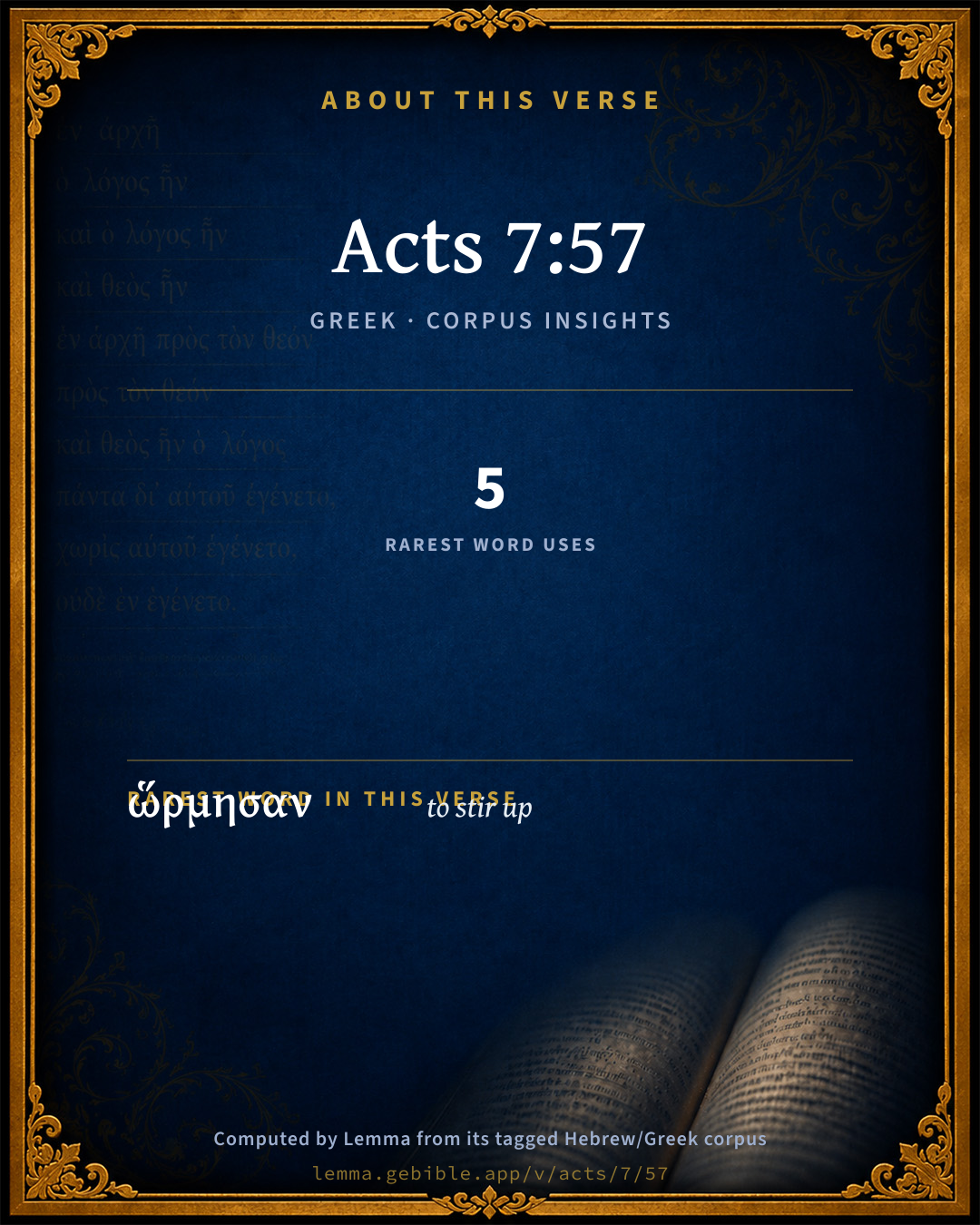
Acts 7:57

Greek (Tischendorf 8th ed.) Acts 7:57 appears in the Greek New Testament. The text above is from the Tischendorf 8th edition. Each word links to its Strong’s number and a concise gloss. Click any word for its full Thayer’s Greek Lexicon entry.
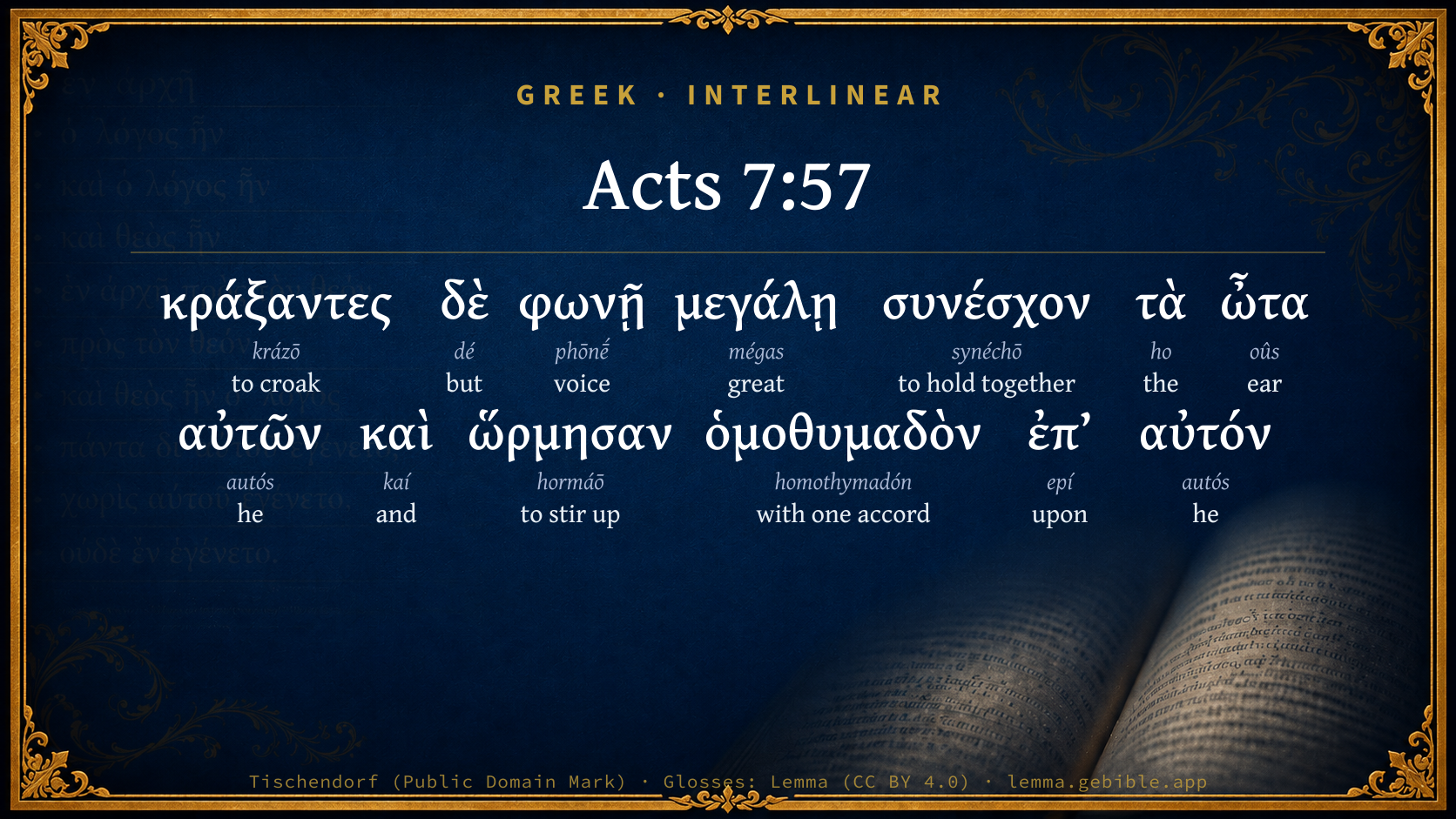
Download image
Cite this verse

Acts 7:57 (World English Bible). Public Domain. Lemma interlinear Bible study tool, https://lemma.gebible.app/v/acts/7/57.

Show BibTeX & RIS
BibTeX
RIS
English Translation
But they cried out with a loud voice, and stopped their ears, and rushed at him with one accord.
World English Bible · Public Domain
Download a study sheet

One document with this verse’s original text, its word-by-word gloss line, the meaning frame, cross-references with their text, attributed commentary, and full source and license credits — printable, and it pastes into notes with its structure intact.

This verse Autodidact and up

Study sheet (.html) Plain text (.txt)

A passage Seminary Student

Up to 50 verses in one chapter. A passage sheet keeps up to 6 commentary sources and 12 cross-references per verse, in the order this page ranks them, and says so on the sheet whenever that leaves anything out. Ask for a single verse and you get the Autodidact verse sheet above.

Everything on this page stays free to read, with no account — the sheet is a download of what is already on screen, not access to it.

Want to remove ads? Support Godless Engineer
Compare translations 3

The same verse in 3 English versions, stacked beneath the original-language interlinear above. Click any original word for its lexicon entry.

Each is an independent rendering of the whole verse — the interlinear is not word-aligned to these translations.

Highlighted words mark where these versions differ — a whole-verse word diff, not a word-by-word alignment.

  • World English Bible Public Domain
    But they cried out with a loud voice, and stopped their ears, and rushed at him with one accord.
  • King James Version Public Domain
    Then they cried out with a loud voice, and stopped their ears, and ran upon him with one accord,
  • unfoldingWord Literal Text CC BY-SA 4.0
    But shouting with a loud voice, they covered their ears and rushed at him unanimously.

unfoldingWord Literal Text — © unfoldingWord, licensed CC BY-SA 4.0. Word-aligned USFM3 via Door43 (git.door43.org/unfoldingWord/en_ult).

Versions to compare (up to 4)

3 of 4 selected

Show all 19 translations

Every available English version of this verse, each an independent rendering of the whole verse.

  • World English Bible Public Domain
    But they cried out with a loud voice, and stopped their ears, and rushed at him with one accord.
  • Berean Standard Bible Public Domain
    At this they covered their ears, cried out in a loud voice, and rushed together at him.
  • Majority Standard Bible Public Domain
    At this they covered their ears, cried out in a loud voice, and rushed together at him.
  • King James Version Public Domain
    Then they cried out with a loud voice, and stopped their ears, and ran upon him with one accord,
  • American Standard Version (1901) Public Domain
    But they cried out with a loud voice, and stopped their ears, and rushed upon him with one accord;
  • Revised Version (1885) Public Domain
    But they cried out with a loud voice, and stopped their ears, and rushed upon him with one accord;
  • Geneva Bible (1599) Public Domain
    Then they gaue a shoute with a loude voyce, and stopped their eares, and ranne vpon him violently all at once,
  • Douay-Rheims (1899) Public Domain
    And casting him forth without the city, they stoned him; and the witnesses laid down their garments at the feet of a young man, whose name was Saul.
  • Young's Literal Translation Public Domain
    And they, having cried out with a loud voice, stopped their ears, and did rush with one accord upon him,
  • Literal Standard Version CC BY-SA 4.0
    And they, having cried out with a loud voice, stopped their ears, and rushed with one accord on him,
  • Unlocked Literal Bible CC BY-SA 4.0
    At this the council members covered their ears, and shouting out with a loud voice, altogether they rushed at him.
  • unfoldingWord Literal Text CC BY-SA 4.0
    But shouting with a loud voice, they covered their ears and rushed at him unanimously.
  • Darby Bible Public Domain
    And they cried out with a loud voice, and held their ears, and rushed upon him with one accord;
  • World Messianic Bible Public Domain
    But they cried out with a loud voice and stopped their ears, then rushed at him with one accord.
  • Webster's Bible Public Domain
    Then they cried out with a loud voice, and stopped their ears, and ran upon him with one accord,
  • Free Bible Version CC BY-SA 4.0
    But they held their hands over their ears and shouted as loudly as they could. They rushed together at him,
  • Bible in Basic English Public Domain
    But with loud cries, and stopping their ears, they made an attack on him all together,
  • Text-Critical English NT CC BY 4.0
    But they cried out with a loud voice, stopped their ears, and rushed at him with one accord.
  • Tyndale New Testament (1534) Public Domain
    Then they gave a shute with a loude voyce and stopped their eares and ranne apon him all at once

Literal Standard Version (2020), Covenant Press — licensed CC BY-SA 4.0. Text via the HelloAO Bible API (eBible.org). Unlocked Literal Bible (unfoldingWord) — licensed CC BY-SA 4.0. Text via the HelloAO Bible API (eBible.org). unfoldingWord Literal Text — © unfoldingWord, licensed CC BY-SA 4.0. Word-aligned USFM3 via Door43 (git.door43.org/unfoldingWord/en_ult). Free Bible Version, Dr. Jonathan Gallagher — licensed CC BY-SA 4.0. Text via the HelloAO Bible API (eBible.org).

Word by word

More ways to search: Search by grammar → Find every occurrence → Compare this word →

Practice this passage: Drill this verse → Learn its vocabulary →

ὥρμησαν
hormáō
G3729
“to stir up”
Verb, Aorist, Active, Indicative, 3rd person, Plural
Part of Speech
Verb
Tense
Aorist
Voice
Active
Mood
Indicative
Person
3rd person
Number
Plural
Full Thayer's Definition

Origin: from G3730

TDNT: 12:47,7

1. to set in rapid motion, stir up, incite, urge on 2. to start forward impetuously, to rush
  1. κράξαντες krázō G2896 “to croak” Verb, Aorist, Active, Participle, Nominative, Plural, Masculine
  2. δὲ dé G1161 “but” Conjunction
  3. φωνῇ phōnḗ G5456 “voice” Noun, Dative, Singular, Feminine
  4. μεγάλῃ mégas G3173 “great” Adjective, Dative, Singular, Feminine
  5. συνέσχον synéchō G4912 “to hold together” Verb, Aorist, Active, Indicative, 3rd person, Plural
  6. τὰ ho G3588 “the” Article, Accusative, Plural, Neuter
  7. ὦτα oûs G3775 “ear” Noun, Accusative, Plural, Neuter
  8. αὐτῶν autós G846 “he” Personal pronoun, Genitive, Plural, Masculine
  9. καὶ kaí G2532 “and” Conjunction
  10. ὁμοθυμαδὸν homothymadón G3661 “with one accord” Adverb
  11. ἐπ’ epí G1909 “upon” Preposition
  12. αὐτόν autós G846 “he” Personal pronoun, Accusative, Singular, Masculine

About this verse

These counts appear in no published source. They are computed here, from the morphology-tagged text and Lemma’s own curated glosses. What Lemma adds →

13
words
12
distinct lemmas
Acts
section

Notable vocabulary

The rarest word here is ὥρμησαν to stir up G3729 — appearing just 5 times in the whole Greek New Testament.

Shared distinctive vocabulary

ὥρμησαν to stir up G3729 occurs in 5 verses of the Greek New Testament. Also found in:

Repetition

A word recurs within this verse:

  • αὐτῶν he G846 ×2

Cross-references

6

Topical passages linked to Acts 7:57 in the Treasury of Scripture Knowledge — connected by theme and wording, ordered by reader-vote popularity; previews shown in the World English Bible.

  • Zechariah 7:11 But they refused to listen, and turned their backs, and stopped their ears, that they might not hear.
  • Psalms 58:4 Their poison is like the poison of a snake; Like a deaf cobra that stops its ear,
  • Acts 23:27 "This man was seized by the Jews, and was about to be killed by them, when I came with the soldiers and rescued him, having learned that he was a Roman.
  • Proverbs 21:13 Whoever stops his ears at the cry of the poor, He will also cry out, but shall not be heard.
  • Acts 7:54 Now when they heard these things, they were cut to the heart, and they gnashed at him with their teeth.
  • Acts 21:27–31 When the seven days were almost completed, the Jews from Asia, when they saw him in the temple, stirred up all the multitude and laid hands on him,

Cross-references courtesy of OpenBible.info (CC BY 4.0).

Commentary

Notes on Acts 7:57 from classic Christian and Jewish commentators (each source and its license shown beneath its notes). The classic Christian expositions comment on the surrounding passage and are grouped to its opening verse, so a note may address several verses; the Jewish commentaries on the Tanakh (Rashi and others) are per-verse, so they appear only where the commentator wrote on this verse.

Lemma curates 59 commentaries, every one of them public domain or Creative Commons licensed, each selected and text-cleaned for this edition rather than reprinted as found. About our sources →

The Biblical Illustrator

Joseph S. Exell

Act_7:57-60

Then they cried with a loud voice, and stopped their ears, and ran upon him.

The first gospel martyr

I. The matter for which he died.

II. The Divine assistance which he experienced.

III. The composure with which he passed away. (J. A. Krummacher, D. D.)

The first Christian martyr

I. The call of Stephen was to martyrdom. Neither he nor the Church knew the honour which awaited him. Note--

1. That the humblest service leads to the highest.

2. How a man may enlarge a narrow sphere. We do not want so much men for large places as men to enlarge small places.

3. What God wanted of Stephen did not fully appear at the first. All that the Church could see was, that he had qualifications for a difficult trust. God bad a larger purpose. He wanted him, not to live, but to die.

4. That a mans greatest services may only begin when he is buried.

5. That no Divine cause hinges on a man. God always has another.

II. Stephen was called because he was full of the Holy Ghost. Through the Spirit he--

1. Had a message.

2. The power of a holy face. The baptism of the Spirit is an illumination. We have seen faces of men and women weal; and expressionless, dark and evil, through conversion glorified. The change at first is in softening, idealising. As it progresses, the peace of God is reflected in the features. In its completeness there is the manifestation of unearthly power.

3. He displayed the Divine union of severity and gentleness.

4. Had a vision.

5. Was sustained. He triumphed over pain.

III. The effects of the martyrdom.

1. On the world. He showed how a Christian could die. There had been deaths of disciples already, but they were shameful, dreadful: first Judas, then Ananias and his wife. But God now gave His people a grave to glory in.

2. On the Church (Act_7:1). A general persecution was let loose. The Christians met the storm as they had been instructed by Jesus; they fled from the city and were scattered, but wherever they went they preached. Thus a part of the Divine plan appeared. In all ages persecution has been one of the greatest providential agencies for the spread of the gospel.

3. On the apostles. It was a discipline only paralleled by that which followed the crucifixion; but through it they were to become better leaders, and God would take care of His Church. They met the trial nobly. They stayed at their posts. The influence of their constancy upon the Christians, and also upon their enemies, must have been very great.

4. Upon the devout Jews. The persecution tested them. At the peril of their lives they paid the murdered man the reverence of burial. So the death of Jesus brought out Nicodemus and Joseph of Arimathea.

5. On Saul. Upon him the impression was deep. His reference to the part he had had in the murder, when he was in his trance at Damascus, shows it. One of the goads against which, from that time, he kicked in vain, was then buried in his heart. The immediate result was to infuriate him. But he had received his death-wound. The cord of love held him. (Sermons by the Monday Club.)

The first martyrdom

Note--

I. Stephens faith. He did not say, All these things are against me; if Christ had designed to own my work, He would not thus have cut it short; if this be the manner in which Christs cause prospers below, how can I believe that He Himself lives and reigns above? Never was his faith so strong, or his vision so unclouded. While his enemies are rushing upon him he is rapt above earth and earthly things, and privileged to behold his beloved Master Himself standing at the right hand of God.

II. His hope. In the midst of the uproar of angry voices, and of the flight of stupefying, crushing stones, he is calling upon his Master, not as a mere expression of pain or disquietude or weakness; or as the ignorant ejaculations sometimes heard from a sinners deathbed, when for the first time the grasp of a mightier power is felt, which must be propitiated by abject invocation: not thus, but in the tone of one who knows whom he has believed.

III. His charity. As the mangled frame begins to totter to its dissolution, the dying martyr kneels. That posture with which we allow any little excuse to interfere, which many of us never practise even in Gods house, which few of us would practise in a season of pain or sickness, he deemed the fittest attitude even for a dying man: he would honour God with his body as well as with the spirit: and then he cries aloud, in the hearing of his enemies still thirsting for his blood, Lord, lay not this sin to their charge! He prays not, as some have done, that the murderers may find out their sin one day in punishment--not even that his blood may produce a speedy and an abundant harvest, but that that cruel deed may never be weighed in Gods balances against its perpetrators. Thus he prayed, and in one case at least we know that his prayer was heard and answered.

IV. His composure. He was laid to rest. He was lulled to slumber. The word itself is enough to take the sting from death. The ease of St. Stephen himself may assure us that no circumstances of death can prevent its being this to a Christian. It matters not whether the cause of death be disease or accident, the weapon of war or the stroke of the executioner. It matters not whether the scene of death be the house or the roadside, the field of battle or the desolate prison-house. There are three conditions of such a death. It must be--

1. A rest from labour. Blessed are the dead which die in the Lord, etc.

(1) An idle, desultory, self-indulgent life has earned no rest. Night may come to such a life, but not the sweet sleep of the healthily wearied labourer.

(2) Again, a rest from what labour? Not from common worldly occupations, such as have their reward (if anywhere) here, and have nothing stored up for them in the world unseen. He who would rest in Christ must first have wrought in Christ. It is Christs labourer, not the worlds, who, when he dies, falls asleep.

2. A rest with Christ. I have a desire to depart, and to be with Christ, which is far better. While we are at home in the body, we are absent from the Lord.

3. A rest unto rising. A sleep not to be again broken is death, not sleep. A sleep only to be broken by terrific Suffering is no sleep: it is a frightful dream, a horrible nightmare. Such is the death of the wicked. (Dean Vaughan.)

Stephens martyrdom

True Christian zeal will seek to do the highest work of which sanctified humanity is capable. Stephen is first heard of as a distributor of the alms of the Church to needy widows. Doubtless he used the office of a deacon well, and so purchased to himself a good degree. Although the onerous duty of serving tables might well have excused him from other service, we soon find him doing great wonders among the people; and not even content with that, we see him defending the faith against a synagogue of subtle philosophical deniers of the truth. He had a higher promotion yet--he gained the peerless dignity of martyrdom. Put a man without zeal into the front place, and he will gradually recede into his native insignificance, or only linger to be a nuisance; but put a man into the rear, if his soul be full of holy fire, you will soon hear of him. Observe

I. The power of the Holy Spirit as developed in Stephens death, in order that we may learn to rely upon that power. This power is seen in--

1. The fact that although surrounded by bitter enemies, and having no time for preparation, Stephens defence is wonderfully logical, clear, and forcible. This chapter does not read like an address delivered to a furious mob. He could not have delivered it with greater fearlessness had he been assured that they would thank him for the operation. To what do we trace this mouth and wisdom but to the Holy Spirit? The Holy Ghost exerts such a power over the human mind, that when it is His will, He can enable His servants to collect their scattered thoughts, and to speak with unwonted power. Moreover, the Lord can also touch the stammering tongue, and make it as eloquent as the tongue of Esaias. When we can study the Word, it is mere presumption to trust to the immediate inspiration of the moment; but if any one of you be called to speak for your Master when you can have had no preparation, you may confidently depend upon the Spirit of God to help. It is better to be taught of the Holy Spirit than to learn eloquence at the feet of masters of rhetoric. The Spirit of God needs to be honoured in the Church in this respect.

2. The manner and bearing of the martyr. He gazes steadfastly up into heaven. They may gnash their teeth, but they cannot disturb that settled gaze. What he beholds above makes him careless of the bloodthirsty foes below. The bearing of many of the martyrs has been singularly heroic. When the King of France told Bernard Palissy that, if he did not change his sentiments, he should be compelled to surrender him to the Inquisition, the brave potter said to the king, You say I shall be compelled, and yet you are a king; but I, though only a poor potter, cannot be compelled to do other than I think to be right. The potter was more royal than the king. Now if you and I desire to walk among the sons of men without pride, but yet with a bearing that is worthy of our calling and adoption, we must be trained by the Holy Ghost. Those men who go cap-in-hand to the world, asking leave to live, know nothing of the Holy Ghost.

3. His calm and happy spirit. It is a great thing for a Christian to keep himself quiet within when turmoil rules without. To be calm amid the bewildering cry, confident of victory--this is so hard that only the Divine Dove, the Comforter, can bring us from above the power to be so; but when once the art of being still is fully learned, what strength and bliss is in it!

4. His holy and forgiving temper. He knelt down, as if to make them see how he prayed, and then he prayed with a loud voice, that they might hear. Surely this is a work of the Holy Spirit indeed! We find it not altogether easy to live at peace with all men, but to die at peace with our murderers, what shall I say of it? The prayer we have just mentioned did not die in the air; it passed through the gate of pearl, and it obtained an answer in the conversion of Saul.

II. The source of richest comfort, with the hope that we may learn to look there. It was the end and aim of the Holy Spirit to make Stephen happy. How could this be done? By revealing to him the living and reigning Saviour at the right hand of God. If we have like precious faith with Stephen, since it is a great fact that Christ is there, there is no reason why oar faith should not see what Stephens faith saw. He saw--

1. That Jesus was alive. He was not serving a dead Christ; he was speaking for a Friend who still existed to hear his pleadings, and to accept his testimony. Stephen argued within himself, If Christ lives after crucifixion, why should not Stephen live, through Christ, after stoning?

2. That Jesus saw him and sympathised with him. Is not that the meaning of the attitude which the Lord assumed? The Man of Sorrows is alive, and sympathises with His people still. In all your affliction He is afflicted.

3. Jesus standing at the right hand of God. That was the point in dispute. The Jews said the Nazarene was an impostor. No, said Stephen, there He is. The people rage, the rulers take counsel together, but yonder is the King upon the holy hill of God; and to Stephens heart this was all he wished. I have known what it is to be brought so low in heart, that no promise of Gods Word gave me a ray of light, nor a gleam of comfort, and yet, so often as I have come across this text, Wherefore God also hath highly exalted Him, etc., I have always found a flood of joy bursting into my soul, for I have said, Well, it is of no consequence what may become of me so long as my Lord Jesus is exalted. Like the dying soldier in the hour of battle, who is cheered with the thought, The general is safe; the victory is on our side. I would like to put this telescope, then, to the eye of every sorrowing Christian. Your Saviour is exalted--

(1) To intercede for you.

(2) To prepare a place for you.

(3) As your representative. Because He lives, we shall live also.

III. The comfort itself. We do not find that the appearance of Jesus stopped the stones. That is the plan of the present dispensation. The Lord Jesus does not come to us to forbid our suffering, nor to remove our griefs, but He sustains us under them. My grace is sufficient for thee. How sweetly is Stephens triumph pictured in those last words, He fell asleep. This is the life of a Christian. When the world has been most in arms against a believer, it is wonderful how he has rested with perfect composure in the sight of his enemies. This shall be the death of the Christian. He shall shut his eyes to earth and open them to heaven. His body shall but sleep, to be awakened by the heavenly trumpeter. (C. H. Spurgeon.)

Stephens martyrdom

On reviewing the whole narrative we cannot fail to be struck with three things--

1. The professed patrons of religion engaged in banishing it from the world. The peculiar enormity of the crime is that it was done in the name of religion.

2. The most eminent future apostle accessory to the death of the most eminent disciple. This teaches us--

(1) How the conscience may be perverted. An action is not necessarily right because the author believes it to be so.

(2) How concealed the spirituality of the law may be from its most diligent student. Some knew its letter, but had not learned the alphabet of its spirit. The letter killeth.

(3) How sovereign and almighty is the grace of God. Christ selected Saul to become His apostle, and the martyrdom of Stephen was one of the causes of His conversion. He is able of stones to raise up children to Abraham.

3. The most useful man of his time allowed to be stoned out of the world as a blasphemer. Stephen appears in two opposite lights--as a victim and as a victor. Though crushed he yet conquered-illustrating the dark and bright sides of piety.

I. The dark side. Stephen dying under a shower of stones. The world has ever hated vital Christianity. Two causes led to this result--

1. He held convictions which clashed with the prejudices and worldly interests of his contemporaries.

2. He faithfully declared those convictions. Had he kept them to himself, compromised them, or toned them down to the corrupt spirit of his age, he would have avoided such an end as this.

II. The bright side. Piety looked upon from the worlds side is rather a miserable object--but not so when viewed from the spiritual side.

1. Stephen was in vital connection with God. He was filled with the Holy Ghost.

2. He had a glorious vision of heaven. Having God within him, everything was full of divinity.

3. His spirit was inspired with the sublimest magnanimity.

4. He had a delightful departure from the world.

(1) He commended his spirit to Christ. This prayer implies--

(a) Consciousness that he had a spirit.

(b) Belief that that spirit would survive his expiring body.

(c) Unbounded faith in Christ to take care of his spirit.

(2) He fell asleep. Implying--

(a) A welcome rest.

(b) An anticipated rising. (D. Thomas, D. D.)

The martyrdom of Stephen

I. What was the secret of his meekness and his bravery? There must have been some Divine bestowment. Was it, then, some miraculous gift reserved for some specially chosen man? The secret lies in the fact that he was full of faith and of the Holy Ghost. He did not leap into this character. There was no special charm by which these graced clustered round him: they were the gift of God to him as they are to us. The only difference between us and him is that he grasped the blessing with a holier boldness, and lived in a closer communion with God. It was not physical hardiness then. There are men whose bravery no one dare question, who have yet beer the veriest cowards in the face of moral duty, and vice versa. The Duke of Wellington once despatched two officers on a service of great hazard, and as they were riding the one turning to the other saw his lips quivering and his cheek blanched. Reining in his horse he said, Why, you are afraid. I am, was the answer; and if you were half as much afraid as I am, you would relinquish the duty altogether. Without wasting a word the officer galloped back and complained bitterly that he had been sent in the company of a coward. Off, sir, to your duty, was the dukes reply, or the coward will have done the business before you get there. And the great man was right. There was physical timidity, perhaps the result of a highly-wrought nervous organisation, but there was an imperial regard for duty which bore him above his fears to triumph. Yes; and Church history can tell us many a story of sufferings endured for Christ by delicate and high-born womanhood. Martyrs are what they are from the demonstration of the Spirit and power.

II. The lot of the Christian is ordinarily an inheritance of persecution. There was nothing in Stephens character to arouse hostility. But he was faithful, and his reproofs stung his adversaries to the quick; he was consistent, and his life was a perpetual rebuke to those who lived otherwise; he was unanswerable, and that was a crime too great to be forgiven.

1. Persecution has been the lot of the Church in all ages. The prophets were scoffed, and some of them were slain. Nearly all the apostles wove the martyrs amaranth into their crown of thorns. Rome pagan persecuted, so has Rome papal, and even churches of purer faith.

2. But apart from ecclesiasticism altogether they that will live godly must suffer persecution. The developments of the persecuting spirit are restrained by the advance of enlightenment, the decorums of society, the interlacings of interest, the silent unrecognised leaven of Christian faith; but depend upon it, if you are a Christian the world hates you and your practice still. The father may interpose to prevent his childs devotion, the husband withdraw his wifes privileges, or the custom may be withdrawn, the preferment withheld, the suspicion insinuated. There are a thousand ways by which the latent hate may be shown--in the shrug of the shoulder, the curl of the lip, the glance of the eye, the wave of the hand.

3. If you are persecuted take it as a proof of your legitimacy. I wonder almost whether the reason that there is so little persecution now is that there is so little faithfulness. Unfaithfulness to the Christian is like the Deluge to the world--a flood to drown it: persecution to the Christian spirit is like the Deluge to the ark--a flood to lift it nearer to heaven.

III. Strength and grace are always given most liberally where they are most needed. In the early part of Stephens life, when acting as deacon and evangelist, he had grace according to his day. When before the council the Spirit inspired his unpremeditated speech and gave him a vision of glory. And now amid the shower of stones he lay his head upon his Saviours bosom and went triumphant home. As thy days, so shall thy strength be. Have you not heard from the lips of the now glorified that the time of their fiercest trial was the time of their most glorious deliverance? Have you not listened sometimes in the death-chamber, and wondered at the disclosures of the realities of heaven?

IV. Death is not death to a believer. He fell asleep. When men sleep they usually surround themselves with the most favourable circumstances. They demand quiet, they exclude light and sound. Stephen fell in circumstances very different, but when God wills a man to sleep it does not matter how much noise there is around him. In sleep there is--

1. Repose.

2. Security. Men do not usually commit themselves to slumber without some prospect of safety; so there was security for Stephens body in the grave and his soul in paradise.

3. Restoration; for after the night comes the morning. (W. M. Punshon, LL. D.)

The death of Stephen

Observe--

I. The malignant excitement of the Jewish council. We are shocked at the wickedness of which the heart of man is capable. It has many manifestations; but in no case is it so strongly marked as in the contrasts presented in instances of religious persecution. On the one hand, there is everything to conciliate regard; and on the other, there are the worst of passions. But how is this to be accounted for? Enmity to the truth of God; and hatred to them who hold it. Yet, think not that this spirit is confined to ages of persecution. It exists in ages of professed liberality. Be faithful witnesses of the truth; and you will see the enmity, and often hear the growl of the savage within, though chained. Be faithful to yourselves; and you will often find when truth and its preachers press hard upon your errors, the inquiry rising, Hast thou found me, O mine enemy?

II. The attitude of the martyr.

1. The fact that he was full of the Holy Ghost intimates that he had in that moment a special visitation of Divine strength and comfort. How often does this appear in the Bible! Hence St. Paul remarks, We glory in tribulations also. When the three Hebrew children were cast alive into the burning fiery furnace, one like unto the Son of God appeared amongst them, so that not a hair of their heads was singed. When St. John was banished to the Isle of Patmos he was favoured with the presence of his glorified Lord and of the holy angels. All these facts are designed to teach us that the Lord is a very present help in the time of trouble.

2. The immediate effect of this visitation was, that he looked up stedfastly into heaven, a devout committal of his cause into a supreme hand. A man whose eye is fixed on heaven tramples equally underfoot the smiles and the frowns of earth. Here is no defiance, no retreating of man into himself in search of natural courage or other principles to sustain him. In Christian heroism man goes out of himself to a higher power, and becomes mighty through God.

III. The vision vouchsafed to him. How appropriate it was to the two great purposes which to him were so important in that hour!

1. To confirm his faith. Whether he had seen our Lord before does not appear; but he now saw Him in His glory. Here was faith rewarded and confirmed by the evidence of vision; just as all true faith shall finally be rewarded. For true faith fixes upon the reality of things. They exist, though the distance which separates time from eternity intervenes; and God does not work a miracle, as in the case of Stephen, to enable us to see. Still they are there, and the faith which the world despises shall be crowned with the glorious sight. Ah! how soon may God lift the veil and let the saint into the anticipated glories, and plunge the sinner into the forgotten horrors of eternity!

2. To inspire courage and comfort. It was a vision of Jesus--

(1) At the place of power and authority; everything below, therefore, was under His management and control. If the sovereign Lord permitted his enemies to destroy him, it was the part of the servant to bow. Still He is at the right hand of power, to control the rage of man, to choose the moment when His servant should thus glorify Him, to afford him almighty succour, to turn his death into a means of furthering His own eternal truth, and by opening His glory to receive his spirit.

(2) Standing and looking down upon him. How could he then faint? There was Christ tacitly exhorting him by His look, Be thou faithful unto death, etc. He looks upon us; let us take care that we sin not. He requires of us patiently to bear the cross, and to suffer with resignation. He will give us the help we need. Let us look to Him in habitual reverence and stedfast trust.

IV. His death It was a death of--

1. Prayer. He died calling upon God. No former grace was then sufficient, although important; for he knew how to call upon God. Let us now learn the habit of prayer. We shall need it to our last struggle.

2. Faith. Christ was recognised by the dying martyr, and into His hands the soul was commended.

3. Certainty. In the mind of Stephen there was no gloom as to the future. And now, O ye judges, said Socrates, ye are going to live, and I am going to die. Which of these is best, God knows; but I suppose no man does. I am going to take a leap in the dark! exclaimed an infidel in the prospect of dissolution. The despairing sinner trembles at the sight of the great gulf. It is your privilege to die like Stephen.

4. Charity. A soul ripe for heaven can have no resentments.

5. Peace. He fell asleep. (R. Watson.)

The death of Stephen

It is a glorious thing to be the first t achieve some great work--the first mariner to sail into an unknown sea, or the first soldier to mount the breach, and enter the beleaguered city--but nobler still to be the first to bear witness to a great truth, and to seal the testimony with ones blood. This honour was enjoyed by Stephen. In the story of his martyrdom we see--

I. A victim conquering. Stephens murderers seemed to get the victory, yet in reality they were vanquished. No wonder that their victim triumphed, for persecution is always a sign of weakness. Persecution is always an attempt to accomplish the impossible. It is an endeavour to effect spiritual ends by physical means. Not all the Acts of Parliament, decrees of magistrates, rage of princes in the world can crush the soul that is strengthened by the grace of God. The martyr triumphs over his foes.

II. A witness testifying. Stephens martyrdom was an argument for Christianity.

1. He bore testimony to the facts of the gospel story. What a convincing proof of the reality of these events!

2. He bore testimony to the power of the living Saviour. Nothing can inspire such enthusiasm and devotion as a person can excite.

III. A hero crowned.

1. A radiant vision. I see the heavens opened, and the Son of Man, etc. The spirit-world is nearer than we often think. If our powers were developed, what spiritual glories would flash upon us!

2. A celestial spirit. Lord, lay not this sin to their charge--the martyrs prayer for his murderers. How unlike the worlds spirit of revenge!

3. A profound peace. And when he had said this, he fell asleep. How striking the contrast between Stephens calmness and the fierce excitement of his persecutors! (T. W. Mays, M. A.)

The death of Stephen

Let us regard this as refuting some practical mistakes.

I. That character will save a man from harm. That would be so in certain conditions of society, but those conditions are not present in our life. Stephen was a man of blameless character, yet when he was called upon to make his defence, and had made it, his character went for nothing. The meanest criminal could not have received more malignant treatment. A bad world cannot tolerate good men. If we were better we should be the sooner got rid of. It is our gift of compromise that keeps us going.

II. That truth needs only to be heard in order to be recognised and accepted. But show where truth has ever been crowned readily. Truth spoken to the true will always be so received, but truth spoken to the false challenges a contest of strength.

III. That regularly constituted authorities must be right. You smile at the suggestion that one odd man can have the truth, and seventy regularly trained and constitutionally appointed men do not know the reality of the case in dispute. The Church must be right; we cannot allow ourselves to be bewildered and befooled by eccentric reformers and by individual assailants. All history reverses such opinions. The truth, it would seem, has always been with the one man. The moment another man joins him he is less than he was before. The sense of individual responsibility is almost lost. The Almighty seems to have elected the individual man, and through him to have spoken to the crowd or the race. But he has not Gods message simply because he happens to be one. You are not great because you are eccentric. You are not wise because you are solitary. But being called and inspired, having the assurance of the truth, and being prepared to establish that assurance by daily sacrifice, go forward, and at the last the vindication will come.

IV. That personal deliverance in trial is the only possible providence. That is the very idea that would recur to the simplest mind that could look at the case. It is the first rush at a popular riddle; but there is nothing in that answer. If that were Gods method there would never be any need of deliverance at all. There must be something grander than this. The miracle was wrought within. Lord, lay not this sin to their charge. Any miracle of merely personal deliverance set side by side with that miracle of grace would be an anti-climax and a pitiful commonplace. Any religion that will evoke such a spirit in its believers, and lead them under such circumstances to offer such prayers, needs no vindication of its divinity.

V. That life is limited by that which is open to the eyes of the body. It would have been a poor case for Stephen but for the invisible. If in this life only we have hope, we are of all men most miserable. Moses endured as seeing the invisible. Stephen said, I see heaven opened, etc. Blessed are the pore in heart, for they shall see God. In great dangers God shows us great sights. What did Elisha ask the Lord to do in the case of the young man who saw the gathering hosts surrounding his prophet master? Lord, open his eyes that he may see. That is all we want. The enemy is near: but the friend is nearer. Stephens spiritual faith made him forget that he had a body. Think of trusting his spirit to a God that had allowed his body to be killed! This is the sublimity of faith. When the spirit is inspired, when heaven is opened, when Christ rises to receive the guest, there is no flesh, there is no pain, there is no consciousness but in the presence of God, the absorption of the heart in the infinite love. When the heart seizes God as an inheritance it fears not them that kill the body. (J. Parker, D. D.)

Stephens death

I. Its general character.

1. It was in the midst of his service. He had been appointed an officer of the Church to see that the alms were distributed properly, and thereby he did most useful service, for it gave the apostles opportunity to give themselves wholly to their true work, and it is no small matter to be able to bear a burden for another if he is thereby set free for more eminent service than we could ourselves perform. The care which Stephen exercised over the poor tended also to prevent heartburning and division. Bat, not content with being a deacon, Stephen began to minister in holy things as a speaker of the Word with great power. He stands forth as quite a leading spirit; so much so, indeed, that the enemies of the gospel made him the object of their fiercest opposition. Stephen stood in the front rank of the Lords host, and yet he was taken away! A mystery, say some; A great privilege, say I. Is it not well to die in harness? Who wants to linger till he becomes a burden rather than a help?

2. In the prime of his usefulness. And is not this well? Well, first, that God should teach His people how much He can do by a man whom He chooses; well, next, that He should show them that He is not dependent upon any man. If our life can teach one lesson, and when that is taught, if our death can teach another, it is well to live and well to die. If God be glorified by our removal, is it not well?

3. It was painful, and attended with much that flesh and blood would dread. He died not surrounded by weeping friends, but by enemies who gnashed their teeth; no holy hymn made glad his death chamber, but the shouts and outcries of a maddened throng rang in his ears. For him no downy pillow, but the hard and cruel stones. Now this is all the more for our comfort, because if he died in joy and triumph, how much more may we hope to depart in peace!

4. It was calm, peaceful, confident, joyous. He never flinched while addressing that infuriated audience. He was as calm as the opened heaven above him, and continued so though they hurried him out of the city. He stood up and committed his soul to God with calmness, and when the first murderous stones felled him to the earth he rose to his knees, still not to ask for pity, but to plead with his Lord for mercy upon his assailants; then, closing his eyes, he fell asleep. Believe, then, O Christian, that if you abide in Christ, the like will be the case with you. We wept when we were born though all around us smiled; so shall we smile when we die while all around us weep. Why should we expect it to be otherwise? Stephens God is our God; the Holy Spirit dwells in us even as He did in him.

5. His mind was in a very elevated condition, Remark--

(1) His intense sympathy with God. All through that long speech of his you see that his soul is taken up with his God, and the treatment which he had received from Israel.

(2) His exclusive attachment to the spiritual. All ritualism was clean gone from him. I dare say at one time Stephen felt a great reverence for the temple; but Stephen says, Howbeit the Most High dwelleth not in temples made with hands. It is noteworthy how the saints, when they are near to die, make very little of what others make a great deal of. The peculiar form of worship and the little specialities of doctrines which he made much of, will seem little in comparison with the great spiritual essentials when the soul is approaching the presence chamber of the Eternal.

(3) His superiority to the fear of men. He looks like an immortal angel rather than a man condemned to die. The fitter we are for heaven the more we scorn all compromise, and feel that for truth, for God, for Christ, we must speak out, even if we die.

(4) His freedom from all cares. He was a deacon, but he does not say, What will those poor people do? What will the apostles do? He trusts the Church militant with her Captain; he is called to the Church triumphant. Why should it not be thus with us? Our Lord managed His Church well enough before we were born; He will not be at a loss because He has called us home.

(5) His triumphant death. His name was Stephanos, or crown, and truly that day he not only received a crown, but he became the crown of the Church as her first martyr.

II. Its most notable peculiarity. It was full of Jesus. Jesus was--

1. Seen--

(1) As the Son of Man. This is the only place in Scripture where Jesus is called the Son of Man by any one but Himself. At all times it is a gladsome sight to see the representative Man exalted to the throne of God, but it was peculiarly suitable for this occasion, for the Lord Himself had warned the present audience about the Son of Man sitting on the right hand of power.

(2) Standing--eager both to sustain and to receive him when the conflict was over.

(3) At the right hand of God, the place of love, power, and honour. Now, when we come to die, we may not, perhaps, expect with those eyes to see what Stephen saw, but faith has a grand realising power. So long as we are sure that Christ is at the right hand of God, it little matters.

2. Invoked. Dying Christians are not troubled with questions as to the Deity of Christ. Unitarianism may do to live with, but it will not do to die with. At such a time we need an Almighty Saviour.

(1) Stephen makes no mention of any other intercessor. The abomination of saint and angel worship had not been invented in his day.

(2) Neither do we find him saving a word as to his good works, and almsdeeds, and sermons, and miracles.

3. Trusted. Lord Jesus, receive my spirit.

4. Imitated, for the death of Stephen is a reproduction of the death of Jesus. Jesus died without the gate, praying, so did Stephen; Jesus died saying, Father, into Thy hands I commit My spirit; Stephen says, Lord Jesus, receive my spirit. Christ dies pleading for His murderers, so does Stephen. Now, if our death shall be a reproduction of the death of Jesus, why need we fear?

III. Its suggestion as to the kind of death which we may wisely desire. First, it is very desirable that our death should be--

1. Of a piece with our life. Stephen was full of faith and of the Holy Ghost in life, and so was he full of the Holy Ghost in death; Stephen was bold, brave, calm, and composed, in life, he is the same amid the falling stones. It is very sad when the reported account of a mans death does not fit in with his life. It is ill to die with a jerk, getting as it were upon another line of rails all on a sudden. It is better to glide from one degree of grace to another, and so to glory. Death may be the fringe or border of life, but it should he made out of the same piece. A life of clay is not to be joined to a death of gold.

2. The perfecting of our whole career, the putting of the cornerstone upon the edifice, so that when nothing else is wanted to complete he mans labours he falls asleep.

3. Useful. Augustine says, If Stephen had never prayed, Saul had never preached. (C. H. Spurgeon.)

Stephens death a witness to vital Christian truth

I. The character of Stephen; or what manner of man he was: full of the Holy Ghost. Now this Holy Spirit dwells in the heart of all the Israel of God (Joh_14:25-26). What can be plainer, than that here is a Person distinct from either the Father and the Son, but intimately connected with both? And that He is not a principle, but a person. In this view, the fruits of the Spirit are to be always distinguished from the Spirit itself; the gifts are not to be confounded with the Giver; the Spirit of faith will make a man die contentedly; the Spirit of purity will make him die composedly; the Spirit of truth will make him die consistently; the Spirit of comfort will make him die happily; the Spirit of might will make him die triumphantly.

II. His confidence; or what he did: He looked up stedfastly into heaven. Not only looked towards, but into, as one who had cast his anchor of hope within the veil, and knew, therefore, where again to find it.

1. He looked up, we cannot doubt, with longing desire to be there.

2. With great indifference to all things here below. We would not tolerate neglect of your proper concerns; but the hour cometh when the possession of the whole world, will be of no avail; when its opinions can no longer influence, when its interests can no longer bind, when its friendships can no longer profit, and when its pleasures can no longer charm. If, then, you cannot look up stedfastly into heaven for comfort, ah! you have nowhere else to look!

3. In prayer. Stephen knew that a martyrs grace was needful to a martyrs constancy. He prayed, therefore, for himself; but also for his murderers--Holy hands must be lifted up without wrath or doubting.

III. His vision and encouragement; or what he saw--

1. The glory of God, and Jesus. As the glory of God is seen most, resplendent in the face (or person) of Jesus Christ, this was most probably the view with which his soul was blest. Somewhat of this, too, Esaias saw when at the surpassing brightness even the seraphim did ceil their faces with their wings.

2. Jesus standing at the right hand of God, amidst His shining hosts, sovereign and supreme, arising in order to be the first to receive the dying martyrs spirit; standing, as a priest who standeth daily ministering, to offer up this sacrifice of a sweet-smelling savour; standing, as a judge of masteries at the end of the goal or conflict, to hail the triumph of the candidate, and Himself confer the victors crown!

IV. His avowal; or, what he said. Behold, I see the heavens opened, etc. Here, then, St. Stephen gives a testimony to--

1. The Trinity; for he himself was full of the Holy Ghent: he saw the glory of God the Father, and this manifested in Jesus standing at His right hand. He declared also--

2. Christs humanity--Son of Man. His faith and hope of admission into heaven: I see heaven opened. Can there be a doubt but that there is an open door, which no man can shut, proposed to us? When Thou hadst overcome the sharpness of death, Thou didst open the kingdom of heaven to all believers.

V. His adoration; or whom it was he worshipped. They stoned Stephen, invocating and saying, Lord Jesus, receive my spirit! Jesus, therefore, was the object of his adoration; He was the only God he invocated, and at his last extremity of suffering and distress--a period when, if ever, men pray with the utmost seriousness, and always to Him whom they conceive to be the mightiest to help. Nor is it an immaterial circumstance that this invocation was made at the very time when Stephen saw the glory of the Father, and was himself full of the Holy Ghost; so that neither ignorance nor inadvertency nor imperfection could occasion it. And as if conscious, too, that He who could succour could equally forgive, he prayed again to Christ--Lord, lay not this sin to their charge. (W. B. Williams, M. A.)

The massacre

Stephen had been preaching a rousing sermon, and the people could not stand it. They resolved to do as men sometimes would like to do in this day, if they dared, with some plain preacher of righteousness--kill him. I want to show you to-day five pictures. Stephen--

I. Gazing into heaven. Before you climb a ladder you want to know to what point the ladder reaches. And it was right that Stephen, within a few moments of heaven, should be gazing into it. We would all do well to be found in the same posture. There is enough in heaven to keep us gazing. The whole universe is Gods palace, but heaven is the gallery in which the chief glories are gathered. We have a great many friends there. As a man gets older, the number of his celestial acquaintances very rapidly multiplies. We have not had one glimpse of them since the night we kissed them good-bye and they went away; but still we stand gazing at heaven.

II. Looking upon Christ. How Christ looked in this world, how He looks in heaven, we cannot say. Painters have tried to imagine His features, and put them upon canvas; but we will have to wait until with our own eyes we see Him. And yet there is a way of seeing Him now, and unless you see Christ on earth, you will never see Him in heaven. Look! There He is. Behold the Lamb of God. Can you not see Him? Then pray to God to take the scales off your eyes. His voice comes down to you, saying, Look unto Me, all ye ends of the earth, and be ye saved. Proclamation of universal emancipation for all slaves, of universal amnesty for all rebels. Behold Him, little children, for if you live to threescore years and ten, you will see none so fair. Behold Him, ye aged ones, for He only can shine through the dimness of your failing eyesight. Behold Him, earth. Behold Him, heaven. What a moment when all the nations of the saved shall see Him!

III. Stoned. The world has always wanted to get rid of good men. Their very life is an assault upon wickedness. Out with Stephen through the gates of the city. Down with him over the precipices. Let every man come and drop a stone upon his head. But these men did not so much kill Stephen as they killed themselves. While these murderers are transfixed by the scorn of all good men, Stephen lives in the admiration of all Christendom. Show me any one who is doing all his duty to State or Church, and I will show you scores of men who utterly abhor him. If a steamer makes rapid progress through the waves, the water will boil and foam all round it. You may assault a good man, but you cannot kill him. On the day of his death, Stephen spoke before a few people of the Sanhedrin; this Sabbath morning he addresses all Christendom!

IV. Praying. His first thought was not how the stones hurt his head, nor what would become of his body. His first thought was about his spirit. Lord Jesus, receive my spirit. There is within you a soul. What direction will it take? What guide will escort it? What gate will open to receive it? Oh, this mysterious spirit i It has two wings, but it is in a cage now, but let the door of this cage open the least, and that soul is off. The lightnings are not swift enough to take up with it. And have you no anxiety about it? Thank God for the intimation of my text, that when we die Jesus takes us. In that hour it may be we shall be too feeble to say a long prayer, not even the Lords Prayer, for it has seven petitions. Perhaps we ms.y be too feeble to say the infant prayer our mothers taught us, but this prayer of Stephen is so short, concise, earnest, comprehensive, we surely will be able to say that.

V. Asleep. What a place to sleep in! Stephen had lived a very laborious life. But that is all over now. I have seen the sea driven with the hurricane until the tangled foam caught in the rigging, and wave rising above wave seemed as if about to storm the heavens, and then I have seen the tempest drop, and the waves crouch, and everything become smooth and burnished as though a camping place for the glories of heaven. So I have seen a man, whose life has been tossed and driven, coming down at last to an infinite calm, in which there was the hush of heavens lullaby. (T. De Witt Talmage, D. D.)

The Biblical Illustrator, edited by Joseph S. Exell (c. 1880s–1900s) — public domain. Text from a community e-Sword module.

Joseph Benson's Commentary

Act 7:57-59. Then they cried out with a loud voice — Being provoked to such a degree that they could not contain themselves, and meaning to drown the voice of Stephen; and stopped their ears — As if they could not bear to hear such blasphemy as they wished to have it thought he had spoken. And ran upon him — Greek, ωρμησαν, rushed on him with one accord, before any sentence was regularly passed; and cast — Greek, εκβαλοντες εξω της πολεως, casting him out of the city — It seems by a gate near the place where the sanhedrim sat; and as soon as they had got without the boundaries of that sacred place, of which they judged it would be a profanation to stain it with human blood, they stoned him — This, like the stoning of Paul at Lystra, seems to have been an act of popular fury, exceeding the power which the Jews regularly had; which, though it might have extended to passing a capital sentence, was certainly not sufficient for carrying it into execution, without the consent of the Romans. The Jews were more than once ready to stone Christ, not only when by their own confession they had not power to put any one to death, (Joh 18:31,) but when nothing had passed which had the shadow of a legal trial. How far they now might have formed those express notions of what the rabbis call the judgment of zeal, is not easy to say; but it is certain they acted on that principle, and as if they had thought every private Israelite had, like Phinehas, who is pleaded as an example of it, a right to put another to death on the spot, if he found him in a capital breach of the divine law; a notion, by the way, directly contrary to Deu 17:6, which required at least two witnesses in capital cases, where there was a legal process. And the two witnesses — Whose hands were first upon him to put him to death; laid down their clothes, &c. — In executions of this kind, it was usual for those who had borne witness against the criminal to cast the first stones at him; and for this purpose they were wont to put off their upper garments, and gave them to be kept by persons equally hearty in the prosecution with themselves; and on this occasion the witnesses laid their clothes at the feet of Saul, afterward called Paul, who, it seems, willingly took charge of them, to show how heartily he concurred with them in the execution. O Saul! wouldst thou have believed, if one had told thee, while thou wast urging on the cruel multitude, that the time would come when thou thyself shouldst be twice stoned in the same cause, and shouldst triumph in committing thy soul likewise to that Jesus whom thou wast now blaspheming? His dying prayer reached thee, as well as many others. And the martyr Stephen, and Saul the persecutor, (afterward his brother, both in faith and martyrdom,) are now joined in everlasting friendship, and dwell together in the happy company of those who have washed their robes, and made them white in the blood of the Lamb.

Joseph Benson's Commentary on the Old and New Testaments (1811–1818) — public domain. Text from a community e-Sword module.

Tyndale Open Study Notes

Tyndale Open Resources

7:57 they put their hands over their ears: They believed that the comparison of Jesus to the divine Son of Man (7:56) was horrible blasphemy.

Tyndale Open Study Notes — © Tyndale Open Resources, licensed CC BY-SA 4.0. Text via the HelloAO Bible API.

Bengel's Gnomon

Johann Albrecht Bengel

Act 7:57. Κράξαντες, having cried out) so as that they should not hear Stephen. The transition is easily made from words, threats, stripes, and imprisonment, to murder.—ὥρμησαν, rushed) before that the judges had given (got ready) their votes.

Bengel's Gnomon of the New Testament — English translation (T&T Clark, Edinburgh, 1860) — public domain. Text from a community e-Sword module.

Meyer's Critical & Exegetical Commentary

Heinrich August Wilhelm Meyer

Act_7:57-58. The tumult, now breaking out, is to be conceived as proceeding from the Sanhedrists, but also extending to all the others who were present (Act_6:12). To the latter pertains especially what is related from ὥρμησαν onward.

They stopped their ears, because they wished to hear nothing more of the blasphemous utterances.

ἐξω τῆς πόλεως] see Lev_24:14. Locus lapidationis erat extra urbem; omnes enim civitates, muris cinctae, paritatem habent ad castra Israelis. Gloss in Babyl. Sanhedr. f. 42. 2.

ἐλιθοβολοῦν] This is the fact generally stated. Then follows as a special circumstance, the activity of the witnesses in it. Observe that, as αὐτόν is not expressed with ἐλιθοβ.,[213] the preceding ἐπʼ αὐτόν is to be extended to it, and therefore to be mentally supplied. Comp. LXX. Exo_23:4-7.

οἱ μάρτυρες] The same who had testified at Act_6:13. A fragment of legality! for the witnesses against the condemned had, according to law, to cast the first stones at him, Deu_17:7; Sanhedr. vi. 4.

ἀπέθεντο τὰ ἱμάτια αὐτῶν] ὤστε εἶναι κοῦφοι καὶ ἀπαραπόδιστοι εἰς τὸ λιθοβολεῖν, Theophylact.

Σαύλου] So distinguished and zealous a disciple of the Phariseeswho, however, ought neither to have been converted into the notarial witness, nor even into the representative of the court conducting the trial (Sepp)was for such a service quite as ready (Act_22:20) as he was welcome. But if Saul had been married or already a young widower (Ewald), which does not follow from 1Co_7:7-8, Luke, who knew so exactly and had in view the circumstances of his life, would hardly have called him νεανίας, although this denotes a degree of age already higher than μειράκιον (Lobeck, ad Phryn. p. 213). Comp. Act_20:9, Act_23:17, also Act_5:10; Luk_7:14.

καὶ ἐλιθοβόλουν] not merely the witnesses, but generally. The repetition has a tragic effect, which is further strengthened by the appended contrast ἐπικαλ. κ.τ.λ. A want of clearness, occasioned by the use of two documents (Bleek), is not discernible.

The stoning, which as the punishment of blasphemy (Luk_24:16; Sanhedr. vii. 4) was inflicted on Stephen, seeing that no formal sentence preceded it, and that the execution had to be confirmed and carried out on the part of the Roman authorities[214] (see Joseph. Antt. xx. 9. 1, and on Joh_18:31), is to be regarded as an illegal act of the tumultuary outbreak. Similarly, the murder of James the Just, the Lords brother, took place at a later period. The less the limits of such an outbreak can be defined, and the more the calm historical course of the speech of Stephen makes it easy to understand that the Sanhedrists should have heard him quietly up to, but not beyond, the point of their being directly attacked (Act_7:51 ff), so much the less warrantable is it, with Baur and Zeller, to esteem nothing further as historical, than that Stephen fell as victim of a popular tumult suddenly arising on occasion of his lively public controversial discussions, without any proceedings in the Sanhedrim, which are assumed to be the work of the author.

[213] Which Bornemann has added, following D and vss.

[214] Ewald supposes that the Sanhedrim might have appealed to the permission granted to them by Pilate in Joh_18:31. But so much is not implied in Joh_18:31; see in loc. And John 18:57 sufficiently shows how far from calmly and legally matters proceeded at the execution.

Meyer — Critical and Exegetical Commentary on the New Testament — English translation by Peter Christie, edited by Frederick Crombie (T&T Clark, 1880) — public domain. Text from a community e-Sword module.

Expositor's Greek Testament

ed. W. Robertson Nicoll

Act 7:57 . κράξαντες : so as to silence him. συνέσχον τὰ ὦτα αὐτῶν : in order that the words which they regarded as so impious should not be heard, cf. Mat 26:65 . Blass compares the phrase LXX, Isa 52:15 , καὶ συνέξουσι βασιλεῖς τὸ στόμα αὐτῶν . ὥρμησαν … ἐπʼ αὐτόν , cf. 2Ma 10:16 , and in several places in 2 Macc. the verb is found with the same construction (although not quite in the same sense).

The Expositor's Greek Testament, edited by W. Robertson Nicoll (1897–1910) — public domain. Text from a community e-Sword module.

Geneva Bible (1599)

Geneva Bible translators

This was done in a rage and fury: for at that time the Jews could put no man to death by law, as they confess before Pilate, saying that it was not lawful for them to put any man to death, and therefore it is reported by Josephus, lib. 20, that Ananus a Sadducee slew James the brother of the Lord, and for so doing, was accused before Albinus the President of the country.

The zeal of hypocrites and superstitious people, breaketh out at length into most open madness.

Geneva Bible (1599) marginal notes — public domain. Text via Bolls.life.

Jamieson, Fausset & Brown

Robert Jamieson, A. R. Fausset & David Brown

Then they cried out . . . and ran upon him with one accord--To men of their mould and in their temper, Stephen's last seraphic words could but bring matters to extremities, though that only revealed the diabolical spirit which they breathed.

Jamieson, Fausset & Brown — Commentary Critical and Explanatory on the Whole Bible (1871) — public domain (CC PDM 1.0). Text via the HelloAO Bible API.

Adam Clarke's Commentary

Verse 57. They - stopped their ears] As a proof that he had uttered blasphemy, because he said, He saw Jesus standing at the right hand of God. This was a fearful proof against them; for if Jesus was at the right hand of God, then they had murdered an innocent person; and they must infer that God's justice must speedily avenge his death. They were determined not to suffer a man to live any longer who could say he saw the heavens opened and Jesus Christ standing at the right hand of God.

Adam Clarke's Commentary on the Bible (1810–1826) — public domain. Text from a community e-Sword/MySword module.

John Calvin's Commentaries

57. Crying with a loud voice. This was either a vain show of zeal, as hypocrites are almost always pricked forward with ambition to break out into immoderate heat; as Caiaphas when he heard Christ say thus, After this ye shall see the Son of man, etc., did rent his clothes in token of indignation, as if it were intolerable blasphemy; or else certainly the preaching of the glory of Christ was unto them such a torment, that they must needs burst through madness. And I am rather of this mind; for Luke saith afterward, that they were carried violently, as those men which have no hold of themselves use to leap out immoderately.

John Calvin's Commentaries (1540-1563) — public domain. Text from the Calvin Translation Society English edition (1840s-50s) via the Christian Classics Ethereal Library (ccel.org). Calvin's coverage is partial (roughly two-thirds of the Bible); uncommented books and verses are honest gaps, never fabricated. The 19th-century editor's footnotes and remarks are omitted so the notes are faithfully Calvin's own voice.

Ellicott's Commentary for English Readers

(57) Ran upon him with one accord.—The violence reported presents a singular contrast to the general observance of the forms of a fair trial in our Lord’s condemnation. Then, however, we must remember, the Roman procurator was present in Jerusalem. Now all restraint was removed, and fanaticism had full play. That neither office nor age was enough to guard, under such conditions, against shameful outrage has been seen even in the history of Christian assemblies, as, e.g., in that of the Robber Synod of Ephesus in A.D. 449. The caution in 1Ti_3:3, that a bishop should not be a striker, shows how near the danger was even in the apostolic age. The facts in this case seem to imply that the accusers, and perhaps also the excited crowd whom they represented, were present as listening to the speech, as well as the members of the Sanhedrin.

A Bible Commentary for English Readers, edited by Charles John Ellicott (1878–1897) — public domain. Text from a community e-Sword module.

The Cambridge Bible for Schools and Colleges

gen. ed. J. J. S. Perowne

57. Then they cried out] Better, But, &c.

and stopped their ears] Thus shewing that they merited the description given in Act_7:51. The verb signifies, to compress, to hold tight together. On the action thus described cp. T. B. Kethuboth 5 b, “Wherefore is the whole ear hard but the flap soft? That if any hear an unbecoming word he may press up the flap and shut his ear.”

and ran [rushed] upon him with one accord] As though he were one convicted of idolatry, in which case (Deu_13:9-10) “the hand of all the people” was to be upon the offender.

The Cambridge Bible for Schools and Colleges (gen. ed. J. J. S. Perowne; Cambridge University Press, 1878–1918) — public domain. Text from a community e-Sword module.

John Gill's Exposition

And they stoned Stephen, calling upon God,.... As he was praying, and putting up the following petition;

and saying, Lord Jesus receive my Spirit; from whence we learn, that the spirit or soul of man sleeps not, nor dies with the body, but remains after death; that Jesus Christ is a fit person to commit and commend the care of the soul unto immediately upon its separation; and that he must be truly and properly God; not only because he is equal to such a charge, which none but God is, but because divine worship and adoration are here given him. This is so glaring a proof of prayer being made unto him, that some Socinians, perceiving the force of it, would read the word Jesus in the genitive case, thus; "Lord of Jesus receive my Spirit": as if the prayer was made to the Father of Christ, when it is Jesus he saw standing at the right hand of God, whom he invokes, and who is so frequently called Lord Jesus; whereas the Father is never called the Lord of Jesus; and besides, these words are used in like manner in the vocative case, in Rev 22:20 to which may be added, that the Syriac version reads, "our Lord Jesus"; and the Ethiopic version, "my Lord Jesus".

John Gill's Exposition of the Whole Bible (1746–1763) — public domain (CC PDM 1.0). Text via the HelloAO Bible API.

Trapp's Complete Commentary

John Trapp

57 Then they cried out with a loud voice, and stopped their ears, and ran upon him with one accord,

Ver. 57. Ran upon him] Being acted and agitated by the devil, who had now wholly possessed them; so that they were even satanized, and transformed into so many breathing devils.

John Trapp, A Commentary or Exposition upon All the Books of the Old and New Testament (1647–1656) — public domain. Text from a community e-Sword module.

Albert Barnes' Notes on the Bible

Then they cried out - That is, probably, “the people,” not the members of the council It is evident he was put to death in a popular tumult. They had charged him with blasphemy; and they regarded what he had now said as full proof of it.

And stopped their ears - That they might hear no more blasphemy.

With one accord - In a tumult; unitedly.

Albert Barnes' Notes on the Bible (1834–1885) — public domain. Text from a community e-Sword/MySword module.

Matthew Poole's English Annotations

They cried out; the rabble, or multitude.

Stopped their ears; that they might show their great detestation of what was said, and might not contract any guilt from it.

And ran upon him with one accord: this violence and fury was both against the law of God and the law of the land; and the number of zealots (there were some amongst that people eminently so called) provoked the Romans to destroy both city and temple.

Matthew Poole's English Annotations on the Holy Bible (1683–1685) — public domain. Text from a community e-Sword/MySword module.

Whedon's Commentary on the Bible

Daniel D. Whedon

57. Cried… ran upon him—The succession of feeling through which they passed is curiously marked in the narrative. When first his face shone like an angel’s they were awed into quiet listening. As he lingered upon the honourable points of Jewish history their attention seems to have been rapt; but as the point of his argument was felt they began to manifest (Act_7:51) their unwilling ears and mental resistance. When he charged them with violation of the law (Act_7:53) they gnashed; but finally, when he claimed to station Jesus the Nazarene at the right hand of the Shekinah, they would stand it no longer. At such unheard-of blasphemy, stopping their ears and raising a howl, they rush, all at once, upon the victim.

This case may have begun with due judicial regularity; but it terminated in a scene of mob violence, paying some regard to the forms of law in the mode of execution. It is probable that the Sanhedrin possessed no power for capital punishment; but in those turbulent times daring acts of atrocity as deep as this were constantly occurring. Stoning to death was the Jewish punishment for blasphemy.

Daniel D. Whedon (gen. ed.), Commentary on the Old and New Testaments (1874–1909) — public domain. Text from a community e-Sword module.

The Pulpit Commentary

But for then, A.V.; rushed for ran, A.V. (wrmhsan).

The Pulpit Commentary (1880–1919), ed. H.D.M. Spence-Jones & Joseph S. Exell — public domain. Text from a community e-Sword module.

John Wesley's Explanatory Notes

They rushed upon him - Before any sentence passed.

John Wesley, Explanatory Notes Upon the Whole Bible (1754–1765) — public domain. Text via the GEBible commentary corpus.

Kretzmann's Popular Commentary

Paul E. Kretzmann

The stoning of Stephen:

v. 57. Then they cried out with a loud voice, and stopped their ears, and ran upon him with one accord,

v. 58. and cast him out of the city, and stoned him; and the witnesses laid down their clothes at a young man’s feet whose name was Saul.

v. 59. And they stoned Stephen, calling upon God and saying, Lord Jesus, receive my spirit.

v. 60. And he kneeled down, and cried with a loud voice, Lord, lay not this sin to their charge. And when he had said this, he fell asleep.

The last announcement of Stephen, concerning the vision which was granted to him, raised the anger of the judges to a perfect storm of fury. That this man should receive such bliss before their very eyes caused them to forget dignity, justice, humanity, all the virtues of which they usually made their boast. They cried out with a loud voice, in order to drown out any attempt of Stephen to make himself heard in the resulting din and confusion. They held their ears shut tightly lest another word from his hated lips find entrance there. They rushed upon him with one accord, like a maddened herd of cattle over which all control has been lost. They cast him forth out of the city and there stoned him. This proceeding did not have even a show of right. It was against all the rules of the Jewish criminal law, It can in no way even be called an execution; it can be described only by the word "murder," committed by an infuriated mob, in violation of all law. And yet the mob retained enough sanity to observe some forms of the Law, such as taking the prisoner out of the city and also requiring the witnesses to begin the stoning. It is expressly stated that the witnesses, in making ready for their murderous attack, laid down their outer clothes at the feet of a young man by the name of Saul. As for Stephen, he died the death of a true Christian martyr. While the stones were flying around him, and after he had been struck, he called loudly upon his Lord and God, in the person of Jesus, the Savior. His first prayer was that the Lord Jesus, the exalted Christ, would receive his spirit. And having thus committed his soul into the best safekeeping, he let his last sigh be an intercession for his murderers. Sinking down upon his knees, he cried out with a loud voice, which may, at least to one of those present, have sounded in his ears for years afterward: Lord, do not charge to them this sin. And then he calmly fell asleep in his Savior. Thus Stephen became the first martyr of the Christian Church. Since his time thousands of Christians have been martyred for the sake of the name of Jesus. And their death teaches a lesson, namely, that of cheerfully sacrificing temporal possessions and fortune for the sake of the Lord. In the end we gain everything that a reward of mercy can bestow upon us, heaven itself with all its glories. "Lastly, there is here a fine comfort that St. Stephen here sees the heavens standing open, and that he fell asleep. Here we should mark that our Lord God stands by us if we believe, and that death is not death to them that believe. Thus you have pictured here in this story the entire Gospel faith, love, cross, death, and life."

Summary

Stephen delivers an eloquent speech of defense, which angers the members of the Sanhedrin so that they cast him out of the city and stone him.

Paul E. Kretzmann, Popular Commentary of the Bible (1921–1924) — public domain. Text from a community e-Sword module.

McGarvey & Pendleton's Commentaries

J. W. McGarvey

See notes on verse 54

J. W. McGarvey (with Philip Y. Pendleton), Commentaries on the New Testament (The Fourfold Gospel, 1914; Acts; and the epistles) — public domain. Text from a community e-Sword/MySword module.

The People's New Testament

B. W. Johnson

57. Cried out with a loud voice. They cried, closed their ears to what they called blasphemy, then, in a tumult, without a vote on his guilt or innocence, rushed upon him to slay him, though yet uncondemned legally.

B. W. Johnson's The People's New Testament with Notes (1889–1891) — public domain. Electronic text from the Christian Classics Ethereal Library (CCEL) ThML edition.

unfoldingWord translationNotes

Door43 World Missions Community

covered their ears

"put their hands on their ears." They did this to show that they did not want to hear any more of what Stephen said. (See: Symbolic Action)

They dragged him out of the city

"They seized Stephen and forcefully took him out of the city"

outer clothing

These are cloaks or robes they would wear outside to stay warm, similar in function to a jacket or coat.

at the feet

"in front of." They were placed there so Saul could watch them.

a young man

Saul was probably around 30 years old at the time.

translationWords

council

stone

testimony

Paul

unfoldingWord translationNotes — © Distant Shores Media and the Door43 World Missions Community, licensed CC BY-SA 4.0. Source: git.door43.org/Door43/en_tn.

Cambridge Greek Testament for Schools and Colleges

57. κράξαντες δέ, but they cried out … and, &c.

συνέσχον τὰ ὦτα, stopped their ears, thus shewing that they merited the description given in Act 7:51. The verb signifies to compress, to hold tight together, and is often used in the LXX. of the shutting of heaven that there should be no rain. Cf. Deu 11:17; 1Ki 8:35, &c. On the action thus described cf. T. B. Kethuboth 5 b, ‘Wherefore is the whole ear hard but the flap soft? That if any hear an unbecoming word he may press up the flap and shut his ear.’

καὶ ὥρμησαν ὁμοθυμαδόν, and rushed with one accord. As though he had been one convicted of idolatry, in which case (Deu 13:9-10) ‘the hand of all the people’ was to be upon the offender.

Cambridge Greek Testament for Schools and Colleges (Cambridge University Press, 1896; 21 vols, various authors incl. Carr, Maclear, Plummer, Farrar, Lumby, Moule, M. R. James, Simcox) — public domain. Text from a community e-Sword module.

Vincent's Word Studies in the New Testament

Marvin R. Vincent

Stopped [συνεσχον] . Lit., held together.

Marvin R. Vincent, Word Studies in the New Testament (1887–1900) — public domain. Text from a community e-Sword/MySword module.

Lesson kit

Teaching starters — assembled from the data on this page, not authored interpretation. Every prompt links to the verse data it draws on. Edit before teaching.

Acts, in the Acts, opens this verse with 13 words (12 distinct Greek lemmas). Its most distinctive word is hormáō (“to stir up”). A historical commentator’s framing appears above. Read the whole chapter for the surrounding context.

Discussion questions

  1. How does “to stir up” (hormáō) shape what this verse is saying?
  2. Matthew 8:32 shares the word «to stir up» with this verse. How do the two illuminate each other?
  3. “he” occurs 2× in this one verse. What is the effect of the repetition?
  4. The translations on this page render this verse differently — a whole-verse word diff, not a word-by-word alignment. What might account for the different wordings?
  5. Reading how The Biblical Illustrator and Joseph Benson's Commentary read this verse, where do the two commentators agree and where do they part?

Things to notice

Reading settings

Reading text

Shown beneath each verse's original-language words.

Old Testament
Old Testament edition

Read the OT as the Masoretic Hebrew (MT) or the Greek Septuagint (LXX).

English shown for the Greek Septuagint (in the Hebrew ↔ Greek comparison).

Comparing translations? Open the Compare panel on any verse page to stack up to four side by side.