Acts 7:47

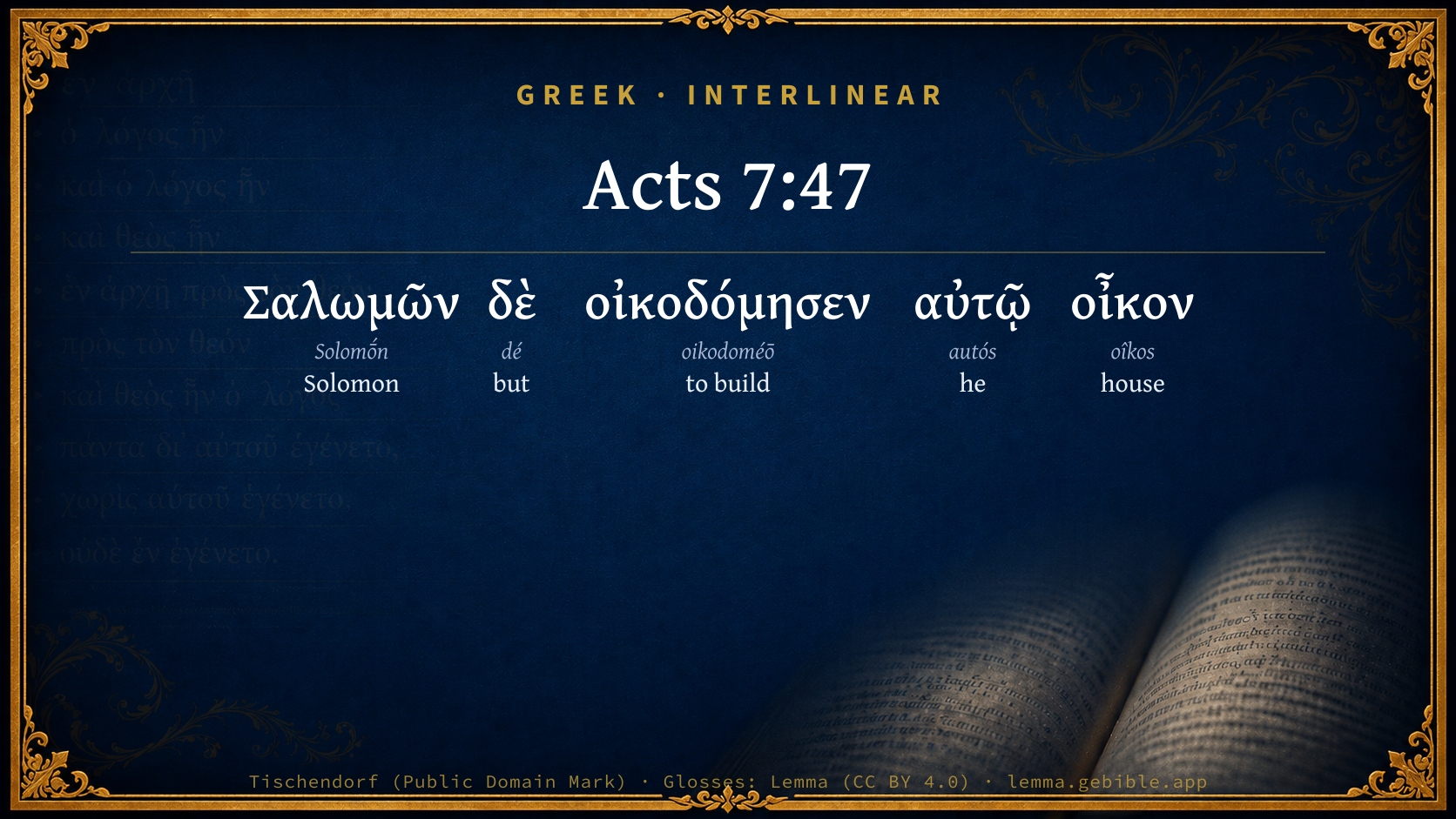
Greek (Tischendorf 8th ed.) Acts 7:47 appears in the Greek New Testament. The text above is from the Tischendorf 8th edition. Each word links to its Strong’s number and a concise gloss. Click any word for its full Thayer’s Greek Lexicon entry.
Download image
Cite this verse

Acts 7:47 (World English Bible). Public Domain. Lemma interlinear Bible study tool, https://lemma.gebible.app/v/acts/7/47.

Show BibTeX & RIS
BibTeX
RIS
English Translation
But Solomon built him a house.
World English Bible · Public Domain
Download a study sheet

One document with this verse’s original text, its word-by-word gloss line, the meaning frame, cross-references with their text, attributed commentary, and full source and license credits — printable, and it pastes into notes with its structure intact.

This verse Autodidact and up

Study sheet (.html) Plain text (.txt)

A passage Seminary Student

Up to 50 verses in one chapter. A passage sheet keeps up to 6 commentary sources and 12 cross-references per verse, in the order this page ranks them, and says so on the sheet whenever that leaves anything out. Ask for a single verse and you get the Autodidact verse sheet above.

Everything on this page stays free to read, with no account — the sheet is a download of what is already on screen, not access to it.

Want to remove ads? Support Godless Engineer
Compare translations 3

The same verse in 3 English versions, stacked beneath the original-language interlinear above. Click any original word for its lexicon entry.

Each is an independent rendering of the whole verse — the interlinear is not word-aligned to these translations.

Highlighted words mark where these versions differ — a whole-verse word diff, not a word-by-word alignment.

  • World English Bible Public Domain
    But Solomon built him a house.
  • King James Version Public Domain
    But Solomon built him an house.
  • unfoldingWord Literal Text CC BY-SA 4.0
    However, Solomon built the house for him.

unfoldingWord Literal Text — © unfoldingWord, licensed CC BY-SA 4.0. Word-aligned USFM3 via Door43 (git.door43.org/unfoldingWord/en_ult).

Versions to compare (up to 4)

3 of 4 selected

Show all 19 translations

Every available English version of this verse, each an independent rendering of the whole verse.

  • World English Bible Public Domain
    But Solomon built him a house.
  • Berean Standard Bible Public Domain
    But it was Solomon who built the house for Him.
  • Majority Standard Bible Public Domain
    But it was Solomon who built the house for Him.
  • King James Version Public Domain
    But Solomon built him an house.
  • American Standard Version (1901) Public Domain
    But Solomon built him a house.
  • Revised Version (1885) Public Domain
    But Solomon built him a house.
  • Geneva Bible (1599) Public Domain
    But Salomon built him an house.
  • Douay-Rheims (1899) Public Domain
    But Solomon built him a house.
  • Young's Literal Translation Public Domain
    and Solomon built Him an house.
  • Literal Standard Version CC BY-SA 4.0
    and Solomon built Him a house.
  • Unlocked Literal Bible CC BY-SA 4.0
    But it was Solomon who built the house for God.
  • unfoldingWord Literal Text CC BY-SA 4.0
    However, Solomon built the house for him.
  • Darby Bible Public Domain
    but Solomon built him a house.
  • World Messianic Bible Public Domain
    But Solomon built him a house.
  • Webster's Bible Public Domain
    But Solomon built him a house.
  • Free Bible Version CC BY-SA 4.0
    But it was Solomon who built a Temple for him.
  • Bible in Basic English Public Domain
    But Solomon was the builder of his house.
  • Text-Critical English NT CC BY 4.0
    But it was Solomon who built a house for him.
  • Tyndale New Testament (1534) Public Domain
    But Salomon bylt him an housse.

Literal Standard Version (2020), Covenant Press — licensed CC BY-SA 4.0. Text via the HelloAO Bible API (eBible.org). Unlocked Literal Bible (unfoldingWord) — licensed CC BY-SA 4.0. Text via the HelloAO Bible API (eBible.org). unfoldingWord Literal Text — © unfoldingWord, licensed CC BY-SA 4.0. Word-aligned USFM3 via Door43 (git.door43.org/unfoldingWord/en_ult). Free Bible Version, Dr. Jonathan Gallagher — licensed CC BY-SA 4.0. Text via the HelloAO Bible API (eBible.org).

Word by word

More ways to search: Search by grammar → Find every occurrence → Compare this word →

Practice this passage: Drill this verse → Learn its vocabulary →

About this verse

These counts appear in no published source. They are computed here, from the morphology-tagged text and Lemma’s own curated glosses. What Lemma adds →

5
words
5
distinct lemmas
Acts
section

Notable vocabulary

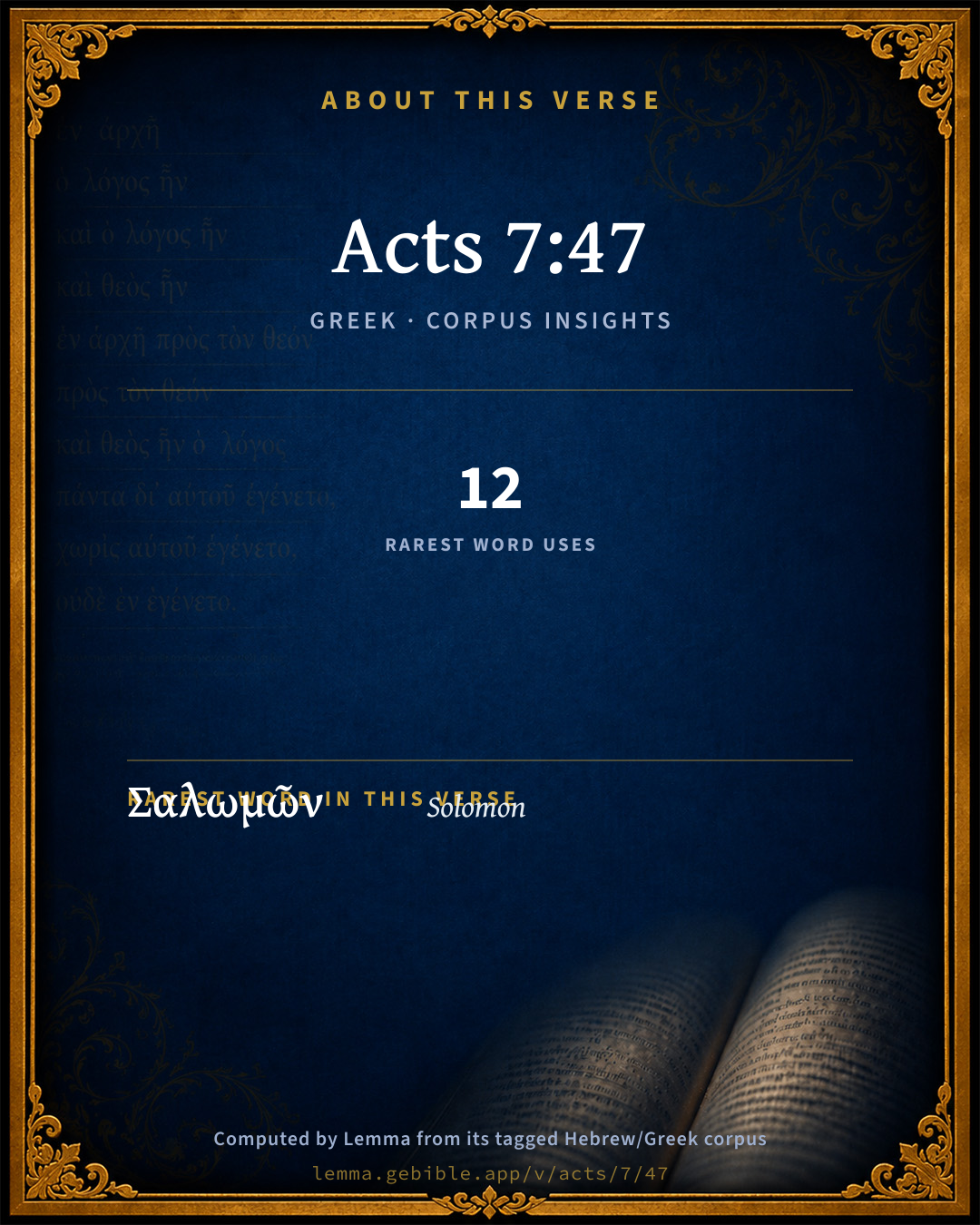
The rarest word here is Σαλωμῶν Solomon G4672 — appearing just 12 times in the whole Greek New Testament.

Shared distinctive vocabulary

Σαλωμῶν Solomon G4672 occurs in 10 verses of the Greek New Testament. Also found in:

Cross-references

9

Topical passages linked to Acts 7:47 in the Treasury of Scripture Knowledge — connected by theme and wording, ordered by reader-vote popularity; previews shown in the World English Bible.

  • 1 Kings 8:20 Yahweh has established his word that he spoke; for I am risen up in the room of David my father, and sit on the throne of Israel, as Yahweh promised, and have built the house for the name of Yahweh, the God of Israel.
  • 2 Samuel 7:13 He shall build a house for my name, and I will establish the throne of his kingdom forever.
  • 1 Kings 6:37–38 In the fourth year was the foundation of the house of Yahweh laid, in the month Ziv.
  • 1 Kings 5:1–6:2 Hiram king of Tyre sent his servants to Solomon; for he had heard that they had anointed him king in the room of his father: for Hiram was ever a lover of David.
  • 1 Kings 7:13–51 King Solomon sent and fetched Hiram out of Tyre.
  • 1 Chronicles 17:1 It happened, when David lived in his house, that David said to Nathan the prophet, Behold, I dwell in a house of cedar, but the ark of the covenant of Yahweh [dwells] under curtains.
  • 2 Chronicles 2:1–4 Now Solomon purposed to build a house for the name of Yahweh, and a house for his kingdom.
  • 2 Chronicles 3:1 Then Solomon began to build the house of Yahweh at Jerusalem on Mount Moriah, where [Yahweh] appeared to David his father, which he made ready in the place that David had appointed, in the threshing floor of Ornan the Jebusite.
  • Zechariah 6:12–13 and speak to him, saying, 'Thus says Yahweh of Hosts, "Behold, the man whose name is the Branch: and he shall grow up out of his place; and he shall build the temple of Yahweh;

Cross-references courtesy of OpenBible.info (CC BY 4.0).

Commentary

Notes on Acts 7:47 from classic Christian and Jewish commentators (each source and its license shown beneath its notes). The classic Christian expositions comment on the surrounding passage and are grouped to its opening verse, so a note may address several verses; the Jewish commentaries on the Tanakh (Rashi and others) are per-verse, so they appear only where the commentator wrote on this verse.

Lemma curates 59 commentaries, every one of them public domain or Creative Commons licensed, each selected and text-cleaned for this edition rather than reprinted as found. About our sources →

The Biblical Illustrator

Joseph S. Exell

Act_7:47-50

But Solomon built Him an house.

The temples of God

Scripture divides the Divine dispensations into the Patriarchal, the Jewish, and the Christian. We read of three creations, or three classes of heaven and earth. The first is physical creation: In the beginning God created the heaven and the earth. The second is Judaism. Yet once more I shake not the earth only, but also heaven. Evidently the heaven and earth there alluded to are the ecclesiastical and civil polity of the Jews. The third creation is Christianity: Behold I create a new heaven and a new earth; and the former one will not be remembered nor come into mind. I shall examine these three creations, with a view principally of pointing out the successive dwelling-places of God.

I. The first creation of nature. Heaven is My throne; and earth is My footstool. Hath not My hand made these things? Abraham reared altars and offered sacrifices in the open fields. He had the earth for a floor and the sky for a canopy. The universe is a temple. Many people, I am aware, convert it into a warehouse, or a den of thieves. Alas I where are the worshippers? Nature is exceedingly beautiful; but go where you will, the buyers and sellers and the exchangers of money are there before you. God is present in Nature. The ancients saw Him in everything and law in nothing; We moderns have swung to the other extreme. But the true Christian view is to perceive God in law and through law and above law. God still works in Nature, not capriciously but methodically. The roses of this year are the embodiment of His freshest ideas. The rose is not a part of God, but God is in it as the source of its vitality and the principle of its beauty; and as long as it is a living rose, God will be its God, for God is not the God of the dead but of the living. For God so clothes the grass of the field. The great heart of eternity may also be felt throbbing in the wild flowers along the hedgerows. This spring God is creating a new heaven and a new earth. The earth looks as new to-day as if she were born only yesterday. The curtain of heaven looks as blue and clean to day as if it came from the factory only this week. But however magnificent the ancient temple of nature, God expresses His dissatisfaction with it. Where is the place of My rest? Hath not My hand made these things? The first creation does not afford rest to the Almighty--it is only a preparation for a better creation to follow. Nature hides more glory than it reveals, and Gods noblest glory it cannot reveal at all. A second creation was needful.

II. The second creation or Judaism.

1. The first creation divides itself into two parts--matter and laws, substance and truths. But in the second creation God created only laws. He did not add to the matter, but He did add to the laws of the universe. The laws of Judaism again divide themselves into laws which are necessary and therefore eternal, and laws which are contingent and therefore temporary. The Lord delivered the Ten Commandments, those commandments are in a certain sense necessary and eternal. God did not make them--He only spoke them. But as for laws touching civil and ecclesiastical government, God made them. The splendid fabric of ritual with its tabernacle and sacrifice and priesthood was the creation of God--not of His arm like matter, but of His mind.

2. The second creation is therefore of an order superior to the first. Inasmuch as spirit is nobler than matter. It is more difficult to preserve a spirit than a planet in its right orbit. It is harder to keep the peace in the commonwealth of men than in the commonwealth of stars. In the first creation God was legislating for dead, inert matter; in Judaism He was legislating for free, living spirits. In every soul there is a heaven and an earth; aye, and if we do not mind there will be a hell there too. But originally there is a heaven--formed of love, imagination, and pure reason. There is an earth there also--the propensities which qualify man for social intercourse and worldly avocations. And to make laws for the heaven and earth of the spirit such as you find in the religious and in the civil code demanded more care and wisdom than to establish the earth and garnish the heavens.

3. As Judaism is thus an advance upon the system of nature, so God became more visibly and palpably present in the former than in the latter. He was pleased to concentrate the symbol of His presence in one special locality. Stephen speaks of God as the God of glory, referring probably to the Shekinah. God under the Old Testament was manifesting His presence in a cloud of dazzling light. The name therefore by which He was known was the Brilliant or Shining One. It was long supposed that God etymologically meant good. But further investigation seems to point out that the English God, the Latin Deus, the Greek Theos, the Welsh Duw--all come from an old Aryan root signifying to shine. Men thought of God, and to what could they compare Him? To nothing else than the shining splendour of the light. God is light. A kind of natural correspondence, therefore, subsisted between the Shekinah and God--the shining cloud and the shining One. During the Patriarchal dispensation the glory-cloud wandered up and down without a fixed habitation. But on the establishment of Judaism it found a convenient abode in Tabernacle of witness. But this tabernacle was small in size and mean in appearance; therefore David desired to build a temple, and what David conceived, Solomon was privileged to execute. So far progress marks the history of religion among the Jews. The Shekinah thenceforth dwelt in the Holy of Holies--a visible symbol of the invisible God.

4. In what then did the fault of the Jews consist? In supposing that the Divine presence was restricted to the temple, and that there could be no Divine worship unless connected with the Jewish ritual. The local and temporary character of Judaism they entirely overlooked, which character Stephen in his oration forcibly urges on their attention. As God was worshipped acceptably before the building of the temple, so will He be worshipped acceptably after its demolition. The temple, however spacious and costly, could not afford God a permanent and congenial rest. The hour cometh when ye shall worship the Father neither in this mountain nor yet at Jerusalem. God is a Spirit, and what satisfaction can He find in mountains of dust, and what rest can He find in bricks and mortar however skilfully put together? Not that we would disparage a material temple--the House of God demands our profoundest reverence. Keep thy foot when thou goes to the House of God. So long as God is pleased to dwell in it, it deserves our reverence; we drift, however, into error the moment we exalt the temple and its ritual above God Himself. Stephen therefore was not guilty of blasphemy. The temple on Moriah was only a stage in the onward march of the Divine economies.

III. The third creation or Christianity. Evidently Stephens argument does not properly conclude with Act_7:49 --he is only paving his way to make a transition to Christianity. Neither do the prophets words end there he points to a temple nobler and more spiritual and more pleasing unto God. To this man will I look, even to him that is poor and of a contrite spirit, and trembleth at My word. In these creations a certain gradation is observable, and corresponding with them, we read of three creative words. The first is the word Be in Genesis, corresponding with the material creation. The second is I am in Exodus, corresponding with the Jewish creation. The third is Immanuel, corresponding with the Christian creation. In the physical universe is seen the Word of His might; in the Jewish the Word of His oath; in the Christian the Word of His essence. Therefore, even that which was made glorious had no glory in this respect, by reason of the glory that excelleth. Truths are of two kinds as we have seen necessary and eternal, contingent and temporary. That one is the first figure in numeration is necessary--God could not create a figure less than one. But that the earth revolves round the sun in twelve months is not necessary, it might be fourteen months quite as well. Christianity is a system of new truths, of truths which have been made. The Incarnation was not a truth always; it was not a truth in the days of Adam, of Abraham, or of Moses. But it is a truth to-day, a truth however which has been made. And the truths God has made are in a sense more wonderful than the truths He has not made. But what is it that principally differentiates the new creation of Christianity from the two preceding? The words of the text answer--God dwelleth not in temples made with hands; hath not My hands made these things? We have here come upon a very important phrase--made with hands, which suggests to us its opposites not made with hands. They are the Scripture synonyms for the terms, natural and supernatural in modern theology. The first heaven and earth, and Solomons temple were made with hands; and therefore God declined to acknowledge them as the place of His rest. Christianity is described as a stone cut out of the mountain without hands, and is thereby elevated to the realm of the supernatural.

1. The body or rather the human nature of Jesus Christ was not made with hands (Heb_9:11). The human nature of Adam was, and so was the human nature of his posterity. But the human nature of the Saviour was radically different. It was not as the apostle explains--of this building, of this creation. Christ is in it, but not of it. He was not produced by the intervention of the established laws of the world; He was the supernatural effect of the supernatural operation of God. The Holy Ghost shall come upon thee, etc. That is, therefore, the reason why He is in a pre-eminent sense the temple of God. All the fulness of the Godhead dwelleth in Him bodily. It pleased the Father that in Him shall all fulness dwell. In Jesus Christ He finds a temple not made with hands, a temple therefore more akin to His own eternal nature, and in Him He deigns to dwell for ever. This is My beloved Son in whom I am well pleased.

2. The regenerate heart is not made with hands (Col_2:11). That to regenerate a man does not belong to the old system of things. No forces in the first universe, whether of mind or matter, can effect the spiritual renewal of our nature. And therefore is the second birth designated a new creation. The spiritual circumcision of the heart belongs emphatically to the realm of the supernatural. No amount of intellectual light or moral influence can effect it. The natural man is said not to understand the spiritual; and no wonder--they do not belong to the same universe. They may be living in the same house, attending the same church; but, after all, they are separated by the width of a whole creation. Know ye not that ye are the temples of God, etc. Will God of a truth dwell with man on the earth? Yea, answers St. Paul, He will not only dwell with man, He will also dwell in man on the earth. It has now been made clear to us that Gods proper temple is holy humanity, and under the Christian dispensation He has found the temple He so earnestly coveted. In the first creation we see me works of Nature; but God declares He cannot rest therein. In the temple of Solomon we see the works of art; but God again declares He cannot find in it the place of His rest. However magnificent, therefore, is the temple of Nature, God is not satisfied with it, for it is the work of His own hands. However splendid the temple of art, God is not satisfied with it, for it is the work of mans hands. But in Christianity--in Christ first, and in the Christian afterwards, He has a temple reared by His grace, a temple not made with hands, a temple in which He vouchsafes to dwell for ever. The temple of nature, the temple of art, the temple of grace, these three; but the greatest of these is the temple of grace. (J. Cynddylan Jones, D. D.)

The true temple of God

1. The visible not to be despised (verses 46, 47).

2. The invisible not to be forgotten (verses 48-50). (K. Gerok.)

Composition Of The Church

Gods Church is not built of--

I. Gold and silver, i.e., worldly might and splendour.

II. Wood And Stone, i.e., external customs and dead works.

III. Parchment or paper, i.e., confessions of faith and forms of government.

IV. But of living hearts.

1. Founded on Christ by faith.

2. United to one another in love.

3. Growing up to heavenly perfection in hope. (K. Gerok.)

Heaven is My throne, and earth is My footstool. What house will ye build Me?--

The universal nature of Christian worship

These words of Stephen have sometimes been quoted as if they sounded the death-knell of special places dedicated to the honour and glory of God, such as churches are. It is evident, however, that they have no such application. They sounded the death-knell of the exclusive privilege of one place, the temple, but they proclaimed the freedom which the Church has ever since claimed; and the Jewish Church of the dispersion, by the institution of synagogues, had led the way in claiming--teaching that whatever true hearts and true worshippers are found, there God reveals Himself. But we must bear in mind a distinction. Stephen and the apostles rejected the exclusive right of the temple as the one place of worship for the world. They asserted the right to establish special places of worship throughout the world. They rejected the exclusive claims of Jerusalem. But they did not reject the right, and the duty of Gods people, to assemble themselves as a collective body for public worship, and to realise Christs covenanted presence. This is an important limitation of St. Stephens statement. The great end of public worship is worship, not hearing, not edification even, though edification follows as a necessary result of such public worship when sincerely offered. The teaching of St. Stephen did not then apply to the erection of churches and buildings set apart for Gods service, or to the claim:made for public worship as an exercise with a peculiar Divine promise annexed. It simply protests against any attempt to localise the Divine presence to one special spot on earth, making it, and it alone, the centre of all religious interest. (G. T. Stokes, D. D.)

A transcendent existence

I. An omnipresent existence. One whose throne is heaven, whose footstool is earth, and to whom all places are alike. One who fills heaven and earth not merely with His influence, nor indeed, as the Pantheists teach, with His substance; but One who is everywhere as a Personality, free, conscious, active. All created existences are limited by the laws of space, and those that occupy the largest space are mere specks in immensity. Concerning the stupendous fact of Gods Omnipresence observe that it is--

1. Agreeable to reason, although incomprehensible. The denial of it would be a contradiction. A limited God would be no God.

2. Essential to worship.

(1) To its spirit. Worship implies mystery. Take away Gods incomprehensibility and you take away the power to evoke in the soul all the awe and wonder which enter into the very essence of worship.

(2) To its constancy. True worship is not an occasional service confined to times and places, but an abiding attitude of the soul. God is a Spirit, etc.

3. Promotive of holiness. Let men realise the constant presence of God, and how strongly will they feel restraint from sin and stimulus to virtue.

4. Assurative of retribution. Who can hide himself from the Lord? No sin escapes His notice. There is no escaping therefore from punishment. Whither shall I flee from Thy presence?

5. Illustrative of heaven. There is nothing local or formal in heavens worship. I saw no temple therein. Then He is felt to be everywhere, and is worshipped everywhere.

II. A Creative existence. Hath not My hand made, etc. Because He made all, He owns all. Creatorship implies sovereignty, almightiness, and proprietorship. (D. Thomas, D. D.)

What is the place of My rest.--

The place of Gods vest

I. God revealing Himself. By the aid of figures God discloses His spiritual character. Everywhere we see pictures, suggestions of the Divine. The boundary sky, with its serene height of blue; the midnight sky with its myriad worlds; mountains piercing the clouds or hanging in frowning precipice; great floods of water rolling in their ceaseless tides; all compel us to say, How marvellous are Thy works, etc.

1. Heaven is Gods throne. A star in the far depths attracted the attention of an observer. It seemed to be but a single star, but a powerful telescope resolved into two which were really distant from each other five hundred times the distant between our earth and the sun. Who can conceive of such sublime spaces. What must He be whose throne rises higher than these stars, whose canopy is gemmed by myriad suns.

2. Earth is Gods footstool. Here the microscope comes to our assistance. This great earth, with its millionfold objects seen and unseen, is but a resting-place for Gods foot.

II. God appealing to man to find Him rest. We should never have dared to represent God as seeking rest. The marvel of His condescension is that He is independent of His creatures, and yet seeks rest in them. If God were only wisdom or power then His rest might be found in the works of His hands. But every being seeks rest according to his character. The infinitely pure One can only find rest in holiness; the infinitely loving in love; the eternal Father in His children.

III. Man vainly offering God rest in things. The first shrine for human worship was the open firmament of heaven. It was the only worthy one. The only befitting walls were the distant horizon and the everlasting hills; the only suitable roof was the illimitable sky. Yet from the first, through sin, this temple proved too vast and glorious for man to use. So he planted groves to circle God to a space; and consecrated mountain peaks to fix God to a point; and built temples and churches to narrow the infinite to human grasp. Too often man has offered his temples as a sacrifice in the vain hope that, satisfied with them, God would cease to ask for holier things. And even now men think to offer God rest in the beauty of our churches and the charm of our services, and give Him things instead of persons. And yet even we men cannot be satisfied with things; how, then, can we expect God to be. Our hearts cannot rest in the artistic fittings of our dwellings, the creations of genius, or the associations of culture. We want love; we must have persons. We are the figures of the true. He, too, puts aside the things we offer Him, be they temple, or gold, or work, and pleads with us, My son give Me thy heart. If we respond then He will accept our things, and things alive with holy love may find for Him the rest He seeks. (R. Tuck, B. A.)

The Biblical Illustrator, edited by Joseph S. Exell (c. 1880s–1900s) — public domain. Text from a community e-Sword module.

Bengel's Gnomon

Johann Albrecht Bengel

Act 7:47. Σολομὼν, Solomon) So long was Israel without a temple.—οἶκον, a house) This is a humble (“tenue”) term, and one suited to this passage, instead of temple.

Bengel's Gnomon of the New Testament — English translation (T&T Clark, Edinburgh, 1860) — public domain. Text from a community e-Sword module.

Expositor's Greek Testament

ed. W. Robertson Nicoll

Act 7:47 . Σολομῶν , see above on Act 3:11 . δὲ : “But” or “And” δὲ , adversative as in A. and R.V., cf. 2Ch 6:7-9 , where Solomon is represented as claiming God’s promise that he should build the house afavour denied to his father David.

The Expositor's Greek Testament, edited by W. Robertson Nicoll (1897–1910) — public domain. Text from a community e-Sword module.

Geneva Bible (1599)

Geneva Bible translators

Solomon built a Temple, according to God’s commandment, but not with any such condition, that the Majesty of God should be enclosed therein.

Geneva Bible (1599) marginal notes — public domain. Text via Bolls.life.

John Calvin's Commentaries

47. Solomon built. Stephen seemeth to gird Solomon glancingly in this place, as if he did not regard the nature of God in building the temple; yet did he attempt that work not without the commandment of God. There was also a promise added, wherein God did testify that he would be present with his people there. I answer, that when Stephen denieth that God dwelleth in temples made with hands, that is not referred unto Solomon, who knew full well that God was to be sought in heaven, and that men’s minds must be lifted up thither by faith; which thing he uttered also in that solemn prayer which he made:

“The heaven of heavens do not contain thee, and how much less this house?” (1 Kings 8:23;)

but he reproveth the blockishness of the people, which abused the temple, as if it had had God tied to it; which appeareth more plainly by the testimony of Isaiah, (Isaiah 6:6,) which he citeth also; God, saith he, would have Solomon to build him a temple; but they were greatly deceived who thought that he was, as it were, included in such a building; as he complaineth by his prophet that the people do him injury, when as they imagine that he is tied to a place; but the prophet doth not for that cause only inveigh against the Jews, because they worshipped God superstitiously, thinking that his power was tied to the temple, but because they did esteem him according to their own affection, and, therefore, after that they had ended their sacrifices and external pomp, they imagined that he was pleased, and that they had brought him indebted to them. This was almost a common error in all ages; because men thought that cold ceremonies were sufficient enough for the worship of God. The reason is, because forasmuch as they are carnal, and wholly set upon the world, they imagine that God is like to them; therefore, to the end God may take from them this blockishness, he saith that he filleth all things.

John Calvin's Commentaries (1540-1563) — public domain. Text from the Calvin Translation Society English edition (1840s-50s) via the Christian Classics Ethereal Library (ccel.org). Calvin's coverage is partial (roughly two-thirds of the Bible); uncommented books and verses are honest gaps, never fabricated. The 19th-century editor's footnotes and remarks are omitted so the notes are faithfully Calvin's own voice.

John Gill's Exposition

But Solomon built him an house. Though David was so set upon it, and made such large provisions for it, he was not to be the man that should build it, he having been greatly concerned in wars, and in the effusion of blood; but Solomon his son, who enjoyed much peace, was the person designed for this work, and who did accomplish it; of which there is a large account in the Kg1 6:1.

.

Acts 7:48

act 7:48

act 7:48

act 7:48Howbeit the most High dwelleth not in temples made with hands,.... Such an one as Solomon's was; he did indeed dwell in his temple, but he was not confined to it, nor included in it, or circumscribed by it; and so much Solomon himself suggests, when he expresses his wonder at his dwelling on earth, seeing the heaven of heavens could not contain him, and still less the house which he had built, Kg1 8:27, "the most High", is one of the names of God, Gen 14:18 the Apostle Paul says the same of God as Stephen does here; Act 17:24 "as saith the prophet"; the prophet Isaiah, Isa 66:1.

John Gill's Exposition of the Whole Bible (1746–1763) — public domain (CC PDM 1.0). Text via the HelloAO Bible API.

Trapp's Complete Commentary

John Trapp

47 But Solomon built him an house.

Ver. 47. But Solomon built him a house] A stately house indeed, one of the seven wonders of the world (how basely soever Florus writeth of it, out of his deep and desperate hatred of that nation and their religion): far beyond that Ephesian temple of Diana, built all of cedar, in an apish imitation of it; or the Turks’ mosques, which yet are very magnificent; the Great Turk also never comes into them but (for reverence’ sake to his God) he lays aside all his state and attendance.

John Trapp, A Commentary or Exposition upon All the Books of the Old and New Testament (1647–1656) — public domain. Text from a community e-Sword module.

Albert Barnes' Notes on the Bible

But Solomon ... - Built the temple. David was not permitted to do it because he had been a man of war, 1Ch 22:8. He prepared the principal materials for the temple, but Solomon built it, 1 Chr. 22: Compare 1 Kings 6.

Albert Barnes' Notes on the Bible (1834–1885) — public domain. Text from a community e-Sword/MySword module.

Matthew Poole's English Annotations

1Ki 6:9; 2Ch 3:1,2. An house; a fixed and stable structure, not movable, as the tabernacle was.

Matthew Poole's English Annotations on the Holy Bible (1683–1685) — public domain. Text from a community e-Sword/MySword module.

Whedon's Commentary on the Bible

Daniel D. Whedon

47. But Solomon—Instead of David, to whom God did not permit the honour of building the temple.

Daniel D. Whedon (gen. ed.), Commentary on the Old and New Testaments (1874–1909) — public domain. Text from a community e-Sword module.

The Pulpit Commentary

A house for a house, A.V. The oikov (the house) of ver. 47, which Solomon built, seems to be almost in contrast with the skhnwma (the tabernacle).

The Pulpit Commentary (1880–1919), ed. H.D.M. Spence-Jones & Joseph S. Exell — public domain. Text from a community e-Sword module.

McGarvey & Pendleton's Commentaries

J. W. McGarvey

See notes on verse 44

J. W. McGarvey (with Philip Y. Pendleton), Commentaries on the New Testament (The Fourfold Gospel, 1914; Acts; and the epistles) — public domain. Text from a community e-Sword/MySword module.

unfoldingWord translationNotes

Door43 World Missions Community

General Information:

In verses 49 and 50, Stephen quotes from the prophet Isaiah. In the quotation, God is speaking about himself.

made with hands

The hand is a synecdoche for the whole person. AT: "made by people" (See: Synecdoche)

Heaven is my throne ... the earth is the footstool for my feet

The prophet is comparing the greatness of God's presence to how impossible it is for man to build a place for God to rest on earth since the whole earth is nothing but a place for God to rest his feet.

What kind of house can you build for me?

God asks this question to show how useless man's efforts are to take care of God. AT: "You can not build a house adequate enough for me!" (See: Rhetorical Question)

what is the place for my rest?

God asks this question to show man that he cannot provide God any rest. AT: "There is no place of rest good enough for me!" (See: Rhetorical Question)

Did my hand not make all these things?

God asks this question to show that man did not create anything. AT: "My hand made all these things!" (See: Rhetorical Question)

translationWords

Solomon

house

Most High

hand

prophet

heaven

throne

footstool

hand

unfoldingWord translationNotes — © Distant Shores Media and the Door43 World Missions Community, licensed CC BY-SA 4.0. Source: git.door43.org/Door43/en_tn.

Lesson kit

Teaching starters — assembled from the data on this page, not authored interpretation. Every prompt links to the verse data it draws on. Edit before teaching.

Acts, in the Acts, opens this verse with 5 words (5 distinct Greek lemmas). Its most distinctive word is Solomṓn (“Solomon”). A historical commentator’s framing appears above. Read the whole chapter for the surrounding context.

Discussion questions

  1. How does “Solomon” (Solomṓn) shape what this verse is saying?
  2. How does Matthew 1:6, which shares the word «Solomon», read alongside this verse?
  3. The translations on this page render this verse differently — a whole-verse word diff, not a word-by-word alignment. What might account for the different wordings?
  4. Compare how The Biblical Illustrator and Bengel's Gnomon read this verse. Where do they agree or differ?

Things to notice

Reading settings

Reading text

Shown beneath each verse's original-language words.

Old Testament
Old Testament edition

Read the OT as the Masoretic Hebrew (MT) or the Greek Septuagint (LXX).

English shown for the Greek Septuagint (in the Hebrew ↔ Greek comparison).

Comparing translations? Open the Compare panel on any verse page to stack up to four side by side.