Acts 9:22

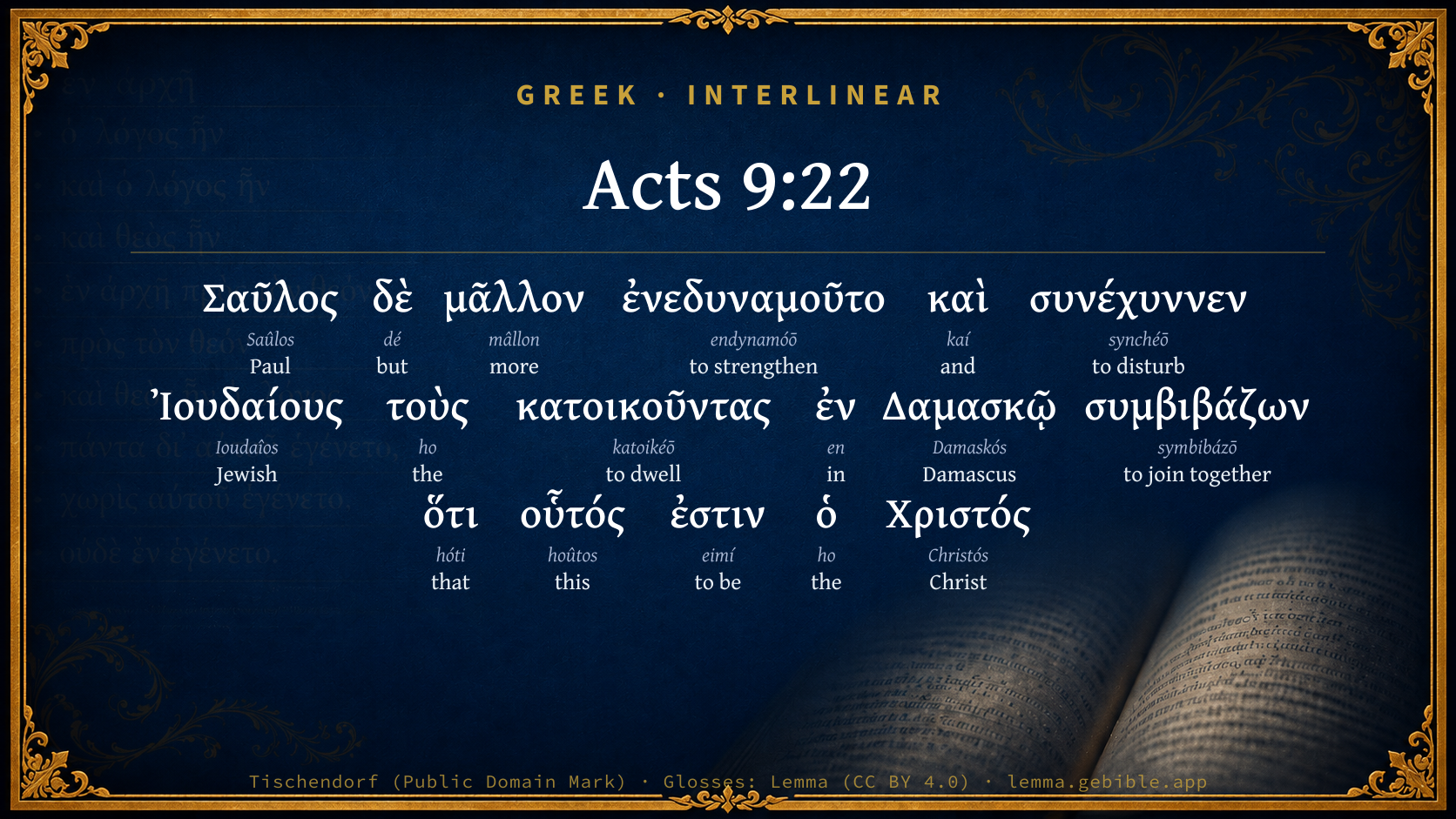
Greek (Tischendorf 8th ed.) Acts 9:22 appears in the Greek New Testament. The text above is from the Tischendorf 8th edition. Each word links to its Strong’s number and a concise gloss. Click any word for its full Thayer’s Greek Lexicon entry.
Download image
Cite this verse

Acts 9:22 (World English Bible). Public Domain. Lemma interlinear Bible study tool, https://lemma.gebible.app/v/acts/9/22.

Show BibTeX & RIS
BibTeX
RIS
English Translation
But Saul increased more in strength, and confounded the Jews who lived at Damascus, proving that this is the Christ.
World English Bible · Public Domain
Highlights
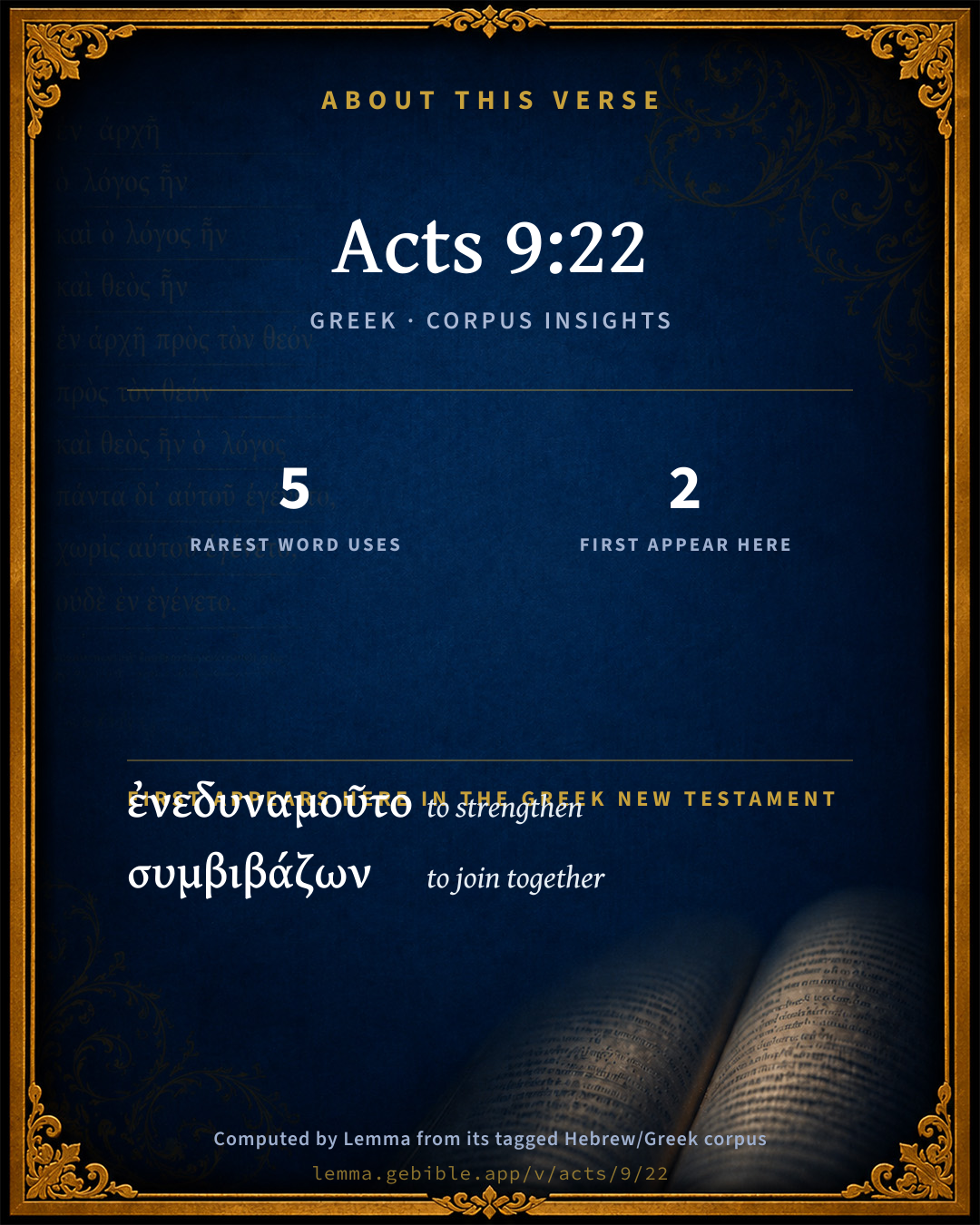
  • 2 first appearances in the Greek New Testament
Full analysis ↓
Download a study sheet

One document with this verse’s original text, its word-by-word gloss line, the meaning frame, cross-references with their text, attributed commentary, and full source and license credits — printable, and it pastes into notes with its structure intact.

This verse Autodidact and up

Study sheet (.html) Plain text (.txt)

A passage Seminary Student

Up to 50 verses in one chapter. A passage sheet keeps up to 6 commentary sources and 12 cross-references per verse, in the order this page ranks them, and says so on the sheet whenever that leaves anything out. Ask for a single verse and you get the Autodidact verse sheet above.

Everything on this page stays free to read, with no account — the sheet is a download of what is already on screen, not access to it.

Want to remove ads? Support Godless Engineer
Compare translations 3

The same verse in 3 English versions, stacked beneath the original-language interlinear above. Click any original word for its lexicon entry.

Each is an independent rendering of the whole verse — the interlinear is not word-aligned to these translations.

Highlighted words mark where these versions differ — a whole-verse word diff, not a word-by-word alignment.

  • World English Bible Public Domain
    But Saul increased more in strength, and confounded the Jews who lived at Damascus, proving that this is the Christ.
  • King James Version Public Domain
    But Saul increased the more in strength, and confounded the Jews which dwelt at Damascus, proving that this is very Christ.
  • unfoldingWord Literal Text CC BY-SA 4.0
    But Saul was becoming more powerful and stirring up the Jews living in Damascus, proving that Jesus is the Christ.

unfoldingWord Literal Text — © unfoldingWord, licensed CC BY-SA 4.0. Word-aligned USFM3 via Door43 (git.door43.org/unfoldingWord/en_ult).

Versions to compare (up to 4)

3 of 4 selected

Show all 19 translations

Every available English version of this verse, each an independent rendering of the whole verse.

  • World English Bible Public Domain
    But Saul increased more in strength, and confounded the Jews who lived at Damascus, proving that this is the Christ.
  • Berean Standard Bible Public Domain
    But Saul was empowered all the more, and he confounded the Jews living in Damascus by proving that Jesus is the Christ.
  • Majority Standard Bible Public Domain
    But Saul was empowered all the more, and he confounded the Jews living in Damascus by proving that Jesus is the Christ.
  • King James Version Public Domain
    But Saul increased the more in strength, and confounded the Jews which dwelt at Damascus, proving that this is very Christ.
  • American Standard Version (1901) Public Domain
    But Saul increased the more in strength, and confounded the Jews that dwelt at Damascus, proving that this is the Christ.
  • Revised Version (1885) Public Domain
    But Saul increased the more in strength, and confounded the Jews which dwelt at Damascus, proving that this is the Christ.
  • Geneva Bible (1599) Public Domain
    But Saul encreased the more in strength, and confounded the Iewes which dwelt at Damascus, confirming, that this was that Christ.
  • Douay-Rheims (1899) Public Domain
    But Saul increased much more in strength, and confounded the Jews who dwelt at Damascus, affirming that this is the Christ.
  • Young's Literal Translation Public Domain
    And Saul was still more strengthened, and he was confounding the Jews dwelling in Damascus, proving that this is the Christ.
  • Literal Standard Version CC BY-SA 4.0
    And Saul was still more strengthened, and he was confounding the Jews dwelling in Damascus, proving that this is the Christ.
  • Unlocked Literal Bible CC BY-SA 4.0
    But Saul became more and more powerful, and he was causing distress among the Jews who lived in Damascus by proving that Jesus is the Christ.
  • unfoldingWord Literal Text CC BY-SA 4.0
    But Saul was becoming more powerful and stirring up the Jews living in Damascus, proving that Jesus is the Christ.
  • Darby Bible Public Domain
    But Saul increased the more in power, and confounded the Jews who dwelt in Damascus, proving that this is the Christ.
  • World Messianic Bible Public Domain
    But Saul increased more in strength, and confounded the Jews who lived at Damascus, proving that this is the Messiah.
  • Webster's Bible Public Domain
    But Saul increased the more in strength, and confounded the Jews who dwelt at Damascus, proving that this is very Christ.
  • Free Bible Version CC BY-SA 4.0
    Saul grew more and more confident, proving Jesus was the Messiah so convincingly that the Jews who lived in Damascus could not refute him.
  • Bible in Basic English Public Domain
    But Saul went on increasing in power, and the Jews in Damascus were not able to give answers to the arguments by which he made it clear that Jesus was the Christ.
  • Text-Critical English NT CC BY 4.0
    But Saul grew stronger and kept confounding the Jews who dwelt in Damascus, proving that this man Jesus is the Christ.
  • Tyndale New Testament (1534) Public Domain
    But Saul encreased in stregth and confounded the Iewes which dwelte at Damasco affirminge that this was very Christ.

Literal Standard Version (2020), Covenant Press — licensed CC BY-SA 4.0. Text via the HelloAO Bible API (eBible.org). Unlocked Literal Bible (unfoldingWord) — licensed CC BY-SA 4.0. Text via the HelloAO Bible API (eBible.org). unfoldingWord Literal Text — © unfoldingWord, licensed CC BY-SA 4.0. Word-aligned USFM3 via Door43 (git.door43.org/unfoldingWord/en_ult). Free Bible Version, Dr. Jonathan Gallagher — licensed CC BY-SA 4.0. Text via the HelloAO Bible API (eBible.org).

Word by word

More ways to search: Search by grammar → Find every occurrence → Compare this word →

Practice this passage: Drill this verse → Learn its vocabulary →

συνέχυννεν
synchéō
G4797
“to disturb”
Verb, Imperfect, Active, Indicative, 3rd person, Singular
Part of Speech
Verb
Tense
Imperfect
Voice
Active
Mood
Indicative
Person
3rd person
Number
Singular
Full Thayer's Definition

Origin: from G4862 and cheo (to pour) or its alternate

TDNT: None

1. to pour together, commingle 2. to disturb the mind of one, to stir up to tumult or outbreak 3. to confound or bewilder
  1. Σαῦλος Saûlos G4569 “Paul” Noun, Nominative, Singular, Masculine
  2. δὲ dé G1161 “but” Conjunction
  3. μᾶλλον mâllon G3123 “more” Adverb
  4. ἐνεδυναμοῦτο endynamóō G1743 “to strengthen” Verb, Imperfect, Passive, Indicative, 3rd person, Singular
  5. καὶ kaí G2532 “and” Conjunction
  6. Ἰουδαίους Ioudaîos G2453 “Jewish” Adjective, Accusative, Plural, Masculine
  7. τοὺς ho G3588 “the” Article, Accusative, Plural, Masculine
  8. κατοικοῦντας katoikéō G2730 “to dwell” Verb, Present, Active, Participle, Accusative, Plural, Masculine
  9. ἐν en G1722 “in” Preposition
  10. Δαμασκῷ Damaskós G1154 “Damascus” Noun, Dative, Singular, Feminine
  11. συμβιβάζων symbibázō G4822 “to join together” Verb, Present, Active, Participle, Nominative, Singular, Masculine
  12. ὅτι hóti G3754 “that” Conjunction
  13. οὗτός hoûtos G3778 “this” Demonstrative pronoun, Nominative, Singular, Masculine
  14. ἐστιν eimí G1510 “to be” Verb, Present, Active, Indicative, 3rd person, Singular
  15. ὁ ho G3588 “the” Article, Nominative, Singular, Masculine
  16. Χριστός Christós G5547 “Christ” Noun, Nominative, Singular, Masculine

About this verse

These counts appear in no published source. They are computed here, from the morphology-tagged text and Lemma’s own curated glosses. What Lemma adds →

17
words
16
distinct lemmas
Acts
section

Notable vocabulary

The rarest word here is συνέχυννεν to disturb G4797 — appearing just 5 times in the whole Greek New Testament.

First appearance in Scripture

These words make their first canonical appearance in the Greek New Testament here:

  • ἐνεδυναμοῦτο to strengthen G1743
  • συμβιβάζων to join together G4822

Shared distinctive vocabulary

συνέχυννεν to disturb G4797 occurs in 5 verses of the Greek New Testament. Also found in:

Repetition

A word recurs within this verse:

  • τοὺς the G3588 ×2

Cross-references

14

Topical passages linked to Acts 9:22 in the Treasury of Scripture Knowledge — connected by theme and wording, ordered by reader-vote popularity; previews shown in the World English Bible.

  • Acts 18:5 But when Silas and Timothy came down from Macedonia, Paul was compelled by the Spirit, testifying to the Jews that Jesus was the Christ.
  • Isaiah 40:29 He gives power to the faint; and to him who has no might he increases strength.
  • Luke 21:15 for I will give you a mouth and wisdom which all your adversaries will not be able to withstand or to contradict.
  • Acts 18:27–28 When he had determined to pass over into Achaia, the brothers encouraged him, and wrote to the disciples to receive him. When he had come, he greatly helped those who had believed through grace;
  • 1 Corinthians 1:27 but God chose the foolish things of the world that he might put to shame those who are wise. God chose the weak things of the world, that he might put to shame the things that are strong;
  • Acts 6:9–10 But some of those who were of the synagogue called "The Libertines," and of the Cyrenians, of the Alexandrians, and of those of Cilicia and Asia arose, disputing with Stephen.
  • Acts 28:23 When they had appointed him a day, many people came to him at his lodging. He explained to them, testifying about the Kingdom of God, and persuading them concerning Jesus, both from the law of Moses and from the prophets, from morning until evening.
  • Philippians 4:13 I can do all things through Christ, who strengthens me.
  • Job 17:9 Yet shall the righteous hold on his way. He who has clean hands shall grow stronger and stronger.
  • Psalms 84:7 They go from strength to strength. Everyone of them appears before God in Zion.
  • Luke 24:44–45 He said to them, "This is what I told you, while I was still with you, that all things which are written in the law of Moses, the prophets, and the psalms, concerning me must be fulfilled."
  • Acts 17:3 explaining and demonstrating that the Christ had to suffer and rise again from the dead, and saying, "This Jesus, whom I proclaim to you, is the Christ."
  • Genesis 49:24 But his bow abode in strength, The arms of his hands were made strong, By the hands of the Mighty One of Jacob, (From there is the shepherd, the stone of Israel),
  • 2 Corinthians 12:9–10 He has said to me, "My grace is sufficient for you, for my power is made perfect in weakness." Most gladly therefore I will rather glory in my weaknesses, that the power of Christ may rest on me.

Cross-references courtesy of OpenBible.info (CC BY 4.0).

Commentary

Notes on Acts 9:22 from classic Christian and Jewish commentators (each source and its license shown beneath its notes). The classic Christian expositions comment on the surrounding passage and are grouped to its opening verse, so a note may address several verses; the Jewish commentaries on the Tanakh (Rashi and others) are per-verse, so they appear only where the commentator wrote on this verse.

Lemma curates 59 commentaries, every one of them public domain or Creative Commons licensed, each selected and text-cleaned for this edition rather than reprinted as found. About our sources →

Scofield Reference Notes

C. I. Scofield

But Saul

It seems probable that Act 9:22-25 refer to Paul’s labours in Damascus after his return from Arabia Gal 1:17.

The "many days" of verse Act 9:23 may represent the "three years" of Gal 1:18, which intervened between Paul’s return to Damascus and his visit to Peter.

The Scofield Reference Bible (1917 edition), notes by C. I. Scofield — public domain. Text from a community e-Sword module.

Tyndale Open Study Notes

Tyndale Open Resources

9:22-25 Despite the bewilderment of his hearers, Saul so compellingly presented the evidence for the claims of Jesus as Messiah that the non-believing Jews in Damascus found themselves unable to refute it. Apparently this went on for some time (see Gal 1:18), so some of the non-believing Jews launched a plot on his life, but he was spared when some believers let him down out of the city in a large basket. Paul recounts this incident in 2 Cor 11:32-33.

Tyndale Open Study Notes — © Tyndale Open Resources, licensed CC BY-SA 4.0. Text via the HelloAO Bible API.

Bengel's Gnomon

Johann Albrecht Bengel

Act 9:22. Συνέχυνε, he confounded) So that they contradicted themselves. The antithesis on the part of Saul is συμβιβάζων, confirming or proving assuredly. And yet he does not now fight against the Jews with those arms with which both himself had fought against believers, and with which he is now assailed by the Jews.

Bengel's Gnomon of the New Testament — English translation (T&T Clark, Edinburgh, 1860) — public domain. Text from a community e-Sword module.

Meyer's Critical & Exegetical Commentary

Heinrich August Wilhelm Meyer

Act_9:22-23. But Saul, in presence of such judgments, became strong in his new work all the more (Nägelsb. on the Iliad, p. 227, ed. 3).

συνέχυνε] made perplexed, put out of countenance, ἐπεστόμιζεν, οὐκ εἴα τι εἰπεῖν, Chrysostom. Comp. on Act_2:6. The form χύνω instead of χέω belongs to late Greek. Lobeck, ad Phryn. p. 726.

συμβιβάζ.] proving. Comp. 1Co_2:16; Schleusner, Thes. s.v.; Jamblich. 60.

ἐπληροῦντο, as in Act_7:23. ἱκαναί, as in Act_9:43; Act_18:18; Act_27:7, of a considerable time (Plat. Legg. p. 736 C), especially common with Luke.

Meyer — Critical and Exegetical Commentary on the New Testament — English translation by Peter Christie, edited by Frederick Crombie (T&T Clark, 1880) — public domain. Text from a community e-Sword module.

Expositor's Greek Testament

ed. W. Robertson Nicoll

Act 9:22 . ἐνεδυναμοῦτο : only used here by St. Luke, and elsewhere only by St. Paul (five or six times), and always of religious and spiritual strength; used also three times in the LXX; twice with reference to the power of the Spirit, Jdg 6:34 , 1Ch 12:18 ; in Psa 51:7 , perhaps the simple verb δυναμόω . συνέχυνε : “confounded,” so A. and R.V., or rather, “continued to confound,” imperfect active, cf. Act 2:6 , “were confounded.” passive, see also Act 19:32 , Act 21:31 (critical notes above): from συνχύννω ( συνχύνω ), nowhere used except in Acts, as above (see Moulton and Geden). συνχύννω : not found in classical Greek nor in LXX, a later form of συγχέω , συνχέω T. W. H. ( cf. ἐκχύννομαι from ἐκχέω , three times in Acts, also two or three times in Luke’s Gospel; in Matthew twice, in Mark once, also Rom 5:5 , Jud 1:11 ; not found in LXX, but see Theod., 2Sa 14:14 ); in Acts, Act 21:27 . συνέχεον from συνχέω (but see in loco ), Moulton and Geden. According to the best MS., Tisch., W.H [229] , read the double v , but elsewhere we have only one v , Winer-Schmiedel, p. 132, Blass, Gram. , p. 41. συμβιβάζων : only used by St. Luke and St. Paul, cf. Act 16:10 , Act 19:33 , see especially for this last passage, Grimm-Thayer, sub v., cf. 1Co 2:16 . In the LXX the word is used in the sense of teaching, instructing, Exo 4:12 ; Exo 4:15 ; Exo 18:16 , Isa 40:13 , etc., this usage is purely Biblical (in Attic Greek rather προσβ . in this sense): lit [230] , (1) to bring together; (2) then like συμβάλλω , to put together, to compare, to examine closely; (3) so to deduce, to prove; thus here the word may well imply that Saul compared Messianic passages of the O.T. with the events of the life of Jesus of Nazareth, and hence deduced the proof that He was the Christ, cf. παρατιθέμενος in Act 17:3 . So Theophylact explains διδάσκων καὶ ἑρμηνεύων out of the Scriptures which the Jews themselves knew.

[229] Westcott and Hort’s The New Testament in Greek: Critical Text and Notes.

[230] literal, literally.

The Expositor's Greek Testament, edited by W. Robertson Nicoll (1897–1910) — public domain. Text from a community e-Sword module.

Geneva Bible (1599)

Geneva Bible translators

By conferring places of the Scripture together, as cunning craftsman do, when they make up anything, they use to gather all parts together, to make them agree fitly one with another.

Paul striveth not with his own authority alone, but with the testimonies of the Prophets.

Geneva Bible (1599) marginal notes — public domain. Text via Bolls.life.

Adam Clarke's Commentary

Verse 22. Confounded the Jews] συνεχυνε, Overwhelmed them so with his arguments that they were obliged to blush for the weakness of their own cause.

Proving that this] ουτος, This person, viz. JESUS, is very Christ; εστιν ο χριστος, IS THE CHRIST, or Messiah. See Clarke on Ac 9:21.

Adam Clarke's Commentary on the Bible (1810–1826) — public domain. Text from a community e-Sword/MySword module.

John Calvin's Commentaries

22. And Saul waxed stronger. Luke doth not only in this place commend the bold zeal of Paul in confessing the faith of Christ, but also he telleth us that he had strong reasons to convince the Jews. He waxed strong, saith he, that is, he got the victory in disputation; his confession did carry with it great force and efficacy, because being furnished with testimonies of Scripture, and such other helps of the Holy Ghost, he did, as it were, tread all his adversaries under his feet. For the word confounded, which Luke useth, doth signify, that, forasmuch as Paul did urge them out of measure, they were so stricken that they could not tell where they were. The manner of the confounding is expressed, because Paul proved that Jesus was Christ. For the sense is this, that even when the Jews were most desirous to resist, they were overcome and confounded. So that Paul tried [found] by experience, that that was most true which he himself affirmeth, that the Scripture is profitable to convince, (2 Timothy 3:16.) Also, he performed that which he required elsewhere of a bishop and teacher, (Titus 1:7;) for he was armed with the word of God to maintain the truth. And Luke setteth down two things, that Paul so got the victory in disputing that he overthrew the Jews; and yet their stubbornness was not broken and tamed that they yielded to the truth, because their consciences rage nevertheless inwardly, and being thrown down from their false opinion, they do not submit themselves to Christ.

Whence had Paul this victory, save only because the Scripture was his sword? Therefore, so often as heretics stand up to resist the true faith, so often as wicked men endeavor to overthrow all godliness, so often as the ungodly do obstinately resist, let us remember that we must fet [seek] armor hence. Because the Papists find no weapons in Scripture, yea, because they see that it maketh quite against them, they fly into this miserable fortress that they must not dispute with heretics, and that there can no certain thing be set down out of Scripture. But if Satan himself be vanquished with the sword of the word, why shall it not be able to put heretics to flight? not that they will submit themselves, or make an end of murmuring, but because they shall lie overcome in themselves. And if so be it we covet to escape this trouble, let us raise no tumults against God, but let us, with a quiet and meek spirit, receive that peace which the Scripture offereth us.

John Calvin's Commentaries (1540-1563) — public domain. Text from the Calvin Translation Society English edition (1840s-50s) via the Christian Classics Ethereal Library (ccel.org). Calvin's coverage is partial (roughly two-thirds of the Bible); uncommented books and verses are honest gaps, never fabricated. The 19th-century editor's footnotes and remarks are omitted so the notes are faithfully Calvin's own voice.

Ellicott's Commentary for English Readers

(22) But Saul increased the more in strength.—The tense implies a continuous growth in power, obviously in the spiritual power which enabled the Apostle to carry on his work. A comparison of dates suggests the connection of this growth with the special vision of 2Co_12:8, when in answer to his prayer that the infirmity which he describes as “a thorn in his flesh, the minister of Satan to buffet him,” he received the comforting assurance from the Lord whom he served—“My strength is made perfect in weakness.” It is not without interest that in after years St. Paul once and again uses the same verb of himself—“I can do all things in Christ that strengthened me” (Php_4:13). It was Christ who “enabled him,” or, made him strong, for his ministry (1Ti_1:12); who “strengthened him” in the closing trials of his life (2Ti_4:17). By some commentators the words are connected with the journey to Arabia as following on his first appearance as a preacher in the synagogues; but see Note on the previous verse.

A Bible Commentary for English Readers, edited by Charles John Ellicott (1878–1897) — public domain. Text from a community e-Sword module.

The Cambridge Bible for Schools and Colleges

gen. ed. J. J. S. Perowne

22. But Saul increased the more in strength] i.e. he became more and more energetic in his labours and the Holy Ghost gave him more power. His fitness for the labour on which he was entering was very great. He possessed all the Jewish learning of a zealous pupil of Gamaliel, and now that he had seen Jesus in the glory of the Godhead, he could use his stores of learning for the support of the new teaching in such wise as to commend it to those Jews who were looking for the consolation of Israel. But these would naturally be the smallest portion of his hearers. The rest of the Jews were confounded. They heard their Scripture applied by a trained mind, and shewn to be applicable to the life of Jesus. They could not at this time make an attack on Saul, for they were paralysed by what they heard, and it was only when some time had elapsed that they resolved to continue in their rejection of Jesus, and then, at a later time, their persecution of Saul began.

proving that this is very [the] Christ] The word here rendered “proving” is used again in Act_16:10, and translated “assuredly gathering.” The idea conveyed by it is that of putting things side by side, and so making a comparison and forming a conclusion. Thus Saul, well equipped with a knowledge of the ancient Scriptures, set before his hearers a description of the Messiah as he is there portrayed, and relating the life history of Jesus, shewed them that in Him the Scriptures of the prophets had been fulfilled.

The Cambridge Bible for Schools and Colleges (gen. ed. J. J. S. Perowne; Cambridge University Press, 1878–1918) — public domain. Text from a community e-Sword module.

John Gill's Exposition

But Saul increased the more in strength,.... Not of body, but of mind; his gifts and graces, and spiritual light and knowledge increased; his abilities were greater; his fortitude of mind, boldness, and freedom of speech, every day increased: he got more, and new, and fresh arguments, by which he himself was confirmed, and he confirmed others in the truths of Christ. Some copies read, "he was more strengthened in the word"; either in the word of God, having a clearer understanding, and being more confirmed in the truth of it; or in speech, being more ready and powerful in speaking it.

And confounded the Jews which dwelt at Damascus; confuted them, and put them to silence, so that they had nothing to say for themselves, or against the truth:

proving that this is very Christ; by joining and knitting passages of Scripture in the Old Testament together, by producing and citing express testimonies from thence, and by comparing the prophecies and the characters of the Messiah in them, with Jesus of Nazareth, he proved to a demonstration that he must be the Messiah.

John Gill's Exposition of the Whole Bible (1746–1763) — public domain (CC PDM 1.0). Text via the HelloAO Bible API.

Trapp's Complete Commentary

John Trapp

22 But Saul increased the more in strength, and confounded the Jews which dwelt at Damascus, proving that this is very Christ.

Ver. 22. Proving that this, &c.] Συμβιβαζων. Proving it by comparing Scripture with Scripture, by laying one place to another, as joiners fit all the parts of their work together, that each part may perfectly agree with the other, Neh 8:8. The Levites read the law, and gave the sense, causing the people to understand the reading, debant intelligentiam per Scripturam ipsam: they gave understanding through the Scriptures themselves, so Tremellius rendereth it. Parallel texts, like glasses, set one against another, cast a mutual light. The lapidary brightens his hard diamond with the dust shaved from itself; so must we clear hard Scriptures.

John Trapp, A Commentary or Exposition upon All the Books of the Old and New Testament (1647–1656) — public domain. Text from a community e-Sword module.

Albert Barnes' Notes on the Bible

Increased the more in strength - His conviction of the truth of the Christian religion became stronger every day, and hence his moral strength or boldness increased.

And confounded - See Act 2:6. The word here means “confuted.” It means also occasionally “to produce a tumult or excitement,” Act 19:32; Act 21:31. Perhaps the idea of producing such a tumor is intended to be conveyed here. Paul confuted the Jews, and by so doing he was the occasion of their tumultuous proceedings, or he so enraged them as to lead to great agitation and excitement - a very common effect of close and conclusive argumentation.

Proving that this - This Jesus.

Is very Christ - Greek: that this is the Christ. The word “very” means here simply in the Greek: ὁ Χριστός ho Christos. It means that Paul showed by strong and satisfactory arguments that Jesus of Nazareth was the true Messiah. The arguments which he would use may be easily conceived, but the evangelist has not seen fit to record them.

Albert Barnes' Notes on the Bible (1834–1885) — public domain. Text from a community e-Sword/MySword module.

Matthew Poole's English Annotations

Increased the more in strength; true grace thrives by exercise and opposition: the word here used many take to be a metaphor from builders, who, in erecting their fabrics, fit one piece or part to another, and then bring them and join them together; thus St. Paul did, in bringing forth or quoting the promises in the Old Testament, and showing their exactly being fulfilled in the New Testament, or in the gospel of our Saviour Jesus Christ; and he spake with such an evidence and demonstration of the Spirit, that he did, as it were, constrain men to be of his opinion.

Proving that this is very Christ; which was the sum of the gospel.

Matthew Poole's English Annotations on the Holy Bible (1683–1685) — public domain. Text from a community e-Sword/MySword module.

Whedon's Commentary on the Bible

Daniel D. Whedon

22. The more in strength—All the arguments which Stephen and his friends had used (note Act_6:9) now, doubtless, came up to him with redoubled power, confirmed by his own recent experience.

This is very Christ—The very Messiah, predicted by prophets, and longed for by Israel. No wonder that he who thus used his spiritual strength increased the more in strength.

Confounded the Jews—But, alas! did not convince, or, at any rate, convert them.

Daniel D. Whedon (gen. ed.), Commentary on the Old and New Testaments (1874–1909) — public domain. Text from a community e-Sword module.

The Pulpit Commentary

The Christ for very Christ, A.V. The repetition of the phrase oti ou=tov ejstin (vers. 20 and 22) is remarkable. As already observed, it presupposes the mention of Jesus, of whom it is thus predicated that he is both "the Son of God" and "the Christ". (comp. Act_2:32, 36 4:11, etc.) Observe the incidental proof of the general expectation of the Jews that Christ should come in this description of the apostolic preaching as directed to the one point that Jesus of Nazareth was the Christ.

The Pulpit Commentary (1880–1919), ed. H.D.M. Spence-Jones & Joseph S. Exell — public domain. Text from a community e-Sword module.

McGarvey & Pendleton's Commentaries

J. W. McGarvey

See notes on verse 19

J. W. McGarvey (with Philip Y. Pendleton), Commentaries on the New Testament (The Fourfold Gospel, 1914; Acts; and the epistles) — public domain. Text from a community e-Sword/MySword module.

The People's New Testament

B. W. Johnson

22. Saul increased the more in strength. Grew continually in power to preach Christ.

B. W. Johnson's The People's New Testament with Notes (1889–1891) — public domain. Electronic text from the Christian Classics Ethereal Library (CCEL) ThML edition.

Cambridge Greek Testament for Schools and Colleges

22. Σαῦλος δὲ μᾶλλον ἐνεδυναμοῦτο, but Saul increased the more in strength, i.e. became more and more energetic in his labours, and the Holy Ghost gave him more power. His fitness for the labour on which he was entering was very great. He possessed all the Jewish learning of a zealous pupil of Gamaliel, and now that he had seen Jesus in the glory of the Godhead, he could use his stores of learning for the support of the new teaching in such wise as to commend it to those Jews who were looking for the consolation of Israel. But these would naturally be the smallest portion of his hearers. The rest of the Jews were confounded. They heard their Scripture applied by a trained mind, and shewn to be applicable to the life of Jesus. They could not at this time make an attack on Saul, for they were paralysed by what they heard, and it was only when some time had elapsed that they resolved to continue in their rejection of Jesus, and then, at a later time, their persecution of Saul began.

συμβιβάζων, proving. This word is used again Act 16:10 and translated there in A.V. ‘assuredly gathering.’ The idea conveyed by it is that of putting things side by Hide, and so making a comparison and forming a conclusion. Thus Saul, well equipped with a knowledge of the ancient Scriptures, set before his hearers a description of the Messiah as He is there portrayed, and relating the life history of Jesus, shewed them that in Him the Scriptures of the prophets had been fulfilled.

The word is used often in the LXX. of teaching and instructing. Thus Exo 18:16 καὶ συμβιβάζω αὐτοὺς τὰ προστάγματα θεοῦ, where the sentence relates to judging between one and another. Cf. also Deu 4:9.

Cambridge Greek Testament for Schools and Colleges (Cambridge University Press, 1896; 21 vols, various authors incl. Carr, Maclear, Plummer, Farrar, Lumby, Moule, M. R. James, Simcox) — public domain. Text from a community e-Sword module.

Alford’s Greek Testament

Henry Alford

22.] I regard the μᾶλλον ἐνεδυναμοῦτο, as the only words beneath which can lie concealed the journey to Arabia. Paul mentions this journey (Gal 1:17) with no obscure hint that to it was to be assigned the reception by him, in full measure, of the Gospel which he preached. And such a reception would certainly give rise to the great accession of power here recorded. I am the more disposed to allot that journey this place, from the following considerations. The omission of any mention of it here can arise only from one of two causes: (1) whether Paul himself were the source of the narrative, or some other narrator,—the intentional passing over of it, as belonging more to his personal history (which it was his express purpose to relate in Gal_1) than to that of his ministry: (2) on the supposition of Paul not having been the source of the narrative,—the narrator having not been aware of it. In either case, this expression seems to me one very likely to have been used:—(1) if the omission was intentional,—to record a remarkable accession of power to Saul’s ministry, without particularizing whence or how it came: (2) if it was unintentional,—as a simple record of that which was observed in him, but of which the source was to the narrator unknown.

συνέχυννεν] Chrysostom strikingly says, ἅτε νομομαθὴς ὢν ἐπεστόμιζεν αὐτοὺς καὶ οὐκ εἴα φθέγγεσθαι· ἐνόμισαν ἀπηλλάχθαι τῆς ἐν τοῖς τοιούτοις διαλέξεως ἀπαλλαγέντες Στεφάνου, καὶ Στεφάνου σφοδρότερον εὗρον ἕτερον. (Cramer’s Catena.)

Henry Alford, The Greek Testament (1849–1861) — public domain. Text from a community e-Sword module.

Vincent's Word Studies in the New Testament

Marvin R. Vincent

Confounded. See on ch. Act 2:6.

Proving [συμβιβαζων] . The verb means to bring or put together : hence to compare and examine, as evidence, and so to prove. Used in the literal and physical sense in Eph 4:16. In Col 2:2, of being knit together in love. In 1Co 2:16, of instructing, building up, by putting together. In this sense the word occurs in the Septuagint. See Lev 10:11; Jud 8:8.

The Christ. Note the article. Not a proper name, but an appellative. See on ver. 20.

Marvin R. Vincent, Word Studies in the New Testament (1887–1900) — public domain. Text from a community e-Sword/MySword module.

Lesson kit

Teaching starters — assembled from the data on this page, not authored interpretation. Every prompt links to the verse data it draws on. Edit before teaching.

Acts, in the Acts, opens this verse with 17 words (16 distinct Greek lemmas). Its most distinctive word is synchéō (“to disturb”). A historical commentator’s framing appears above. Read the whole chapter for the surrounding context.

Discussion questions

  1. What does “to disturb” (synchéō) contribute to the verse as a whole?
  2. 2 words here appear for the first time in Scripture. What is being introduced at this debut?
  3. Acts 2:6 shares the word «to disturb» with this verse. How do the two illuminate each other?
  4. “the” occurs 2× in this one verse. What is the effect of the repetition?
  5. These translations render this verse differently. What is at stake in choosing one wording over another?
  6. Reading how Scofield Reference Notes and Tyndale Open Study Notes read this verse, where do the two commentators agree and where do they part?

Things to notice

  • 2 words make their first canonical appearance in Scripture here.
  • These translations choose different wording for 14 words in this verse.
  • “the” occurs 2× in this single verse.
  • 16 distinct Greek lemmas span 17 words in this verse.

Reading settings

Reading text

Shown beneath each verse's original-language words.

Old Testament
Old Testament edition

Read the OT as the Masoretic Hebrew (MT) or the Greek Septuagint (LXX).

English shown for the Greek Septuagint (in the Hebrew ↔ Greek comparison).

Comparing translations? Open the Compare panel on any verse page to stack up to four side by side.