Acts 8:13

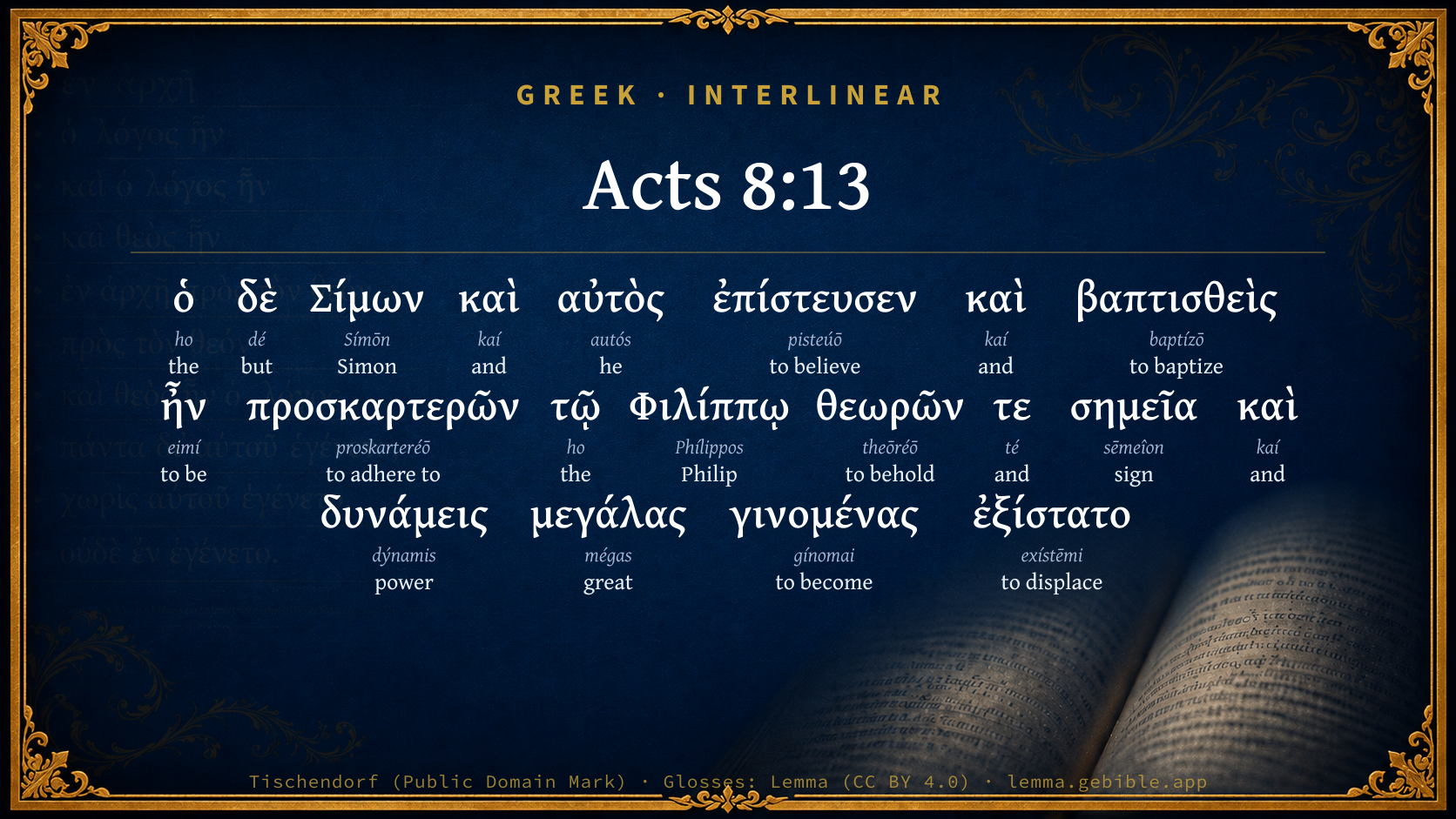
Greek (Tischendorf 8th ed.) Acts 8:13 appears in the Greek New Testament. The text above is from the Tischendorf 8th edition. Each word links to its Strong’s number and a concise gloss. Click any word for its full Thayer’s Greek Lexicon entry.
Download image
Cite this verse

Acts 8:13 (World English Bible). Public Domain. Lemma interlinear Bible study tool, https://lemma.gebible.app/v/acts/8/13.

Show BibTeX & RIS
BibTeX
RIS
English Translation
Simon himself also believed. Being baptized, he continued with Philip. Seeing signs and great miracles occuring, he was amazed.
World English Bible · Public Domain
Download a study sheet

One document with this verse’s original text, its word-by-word gloss line, the meaning frame, cross-references with their text, attributed commentary, and full source and license credits — printable, and it pastes into notes with its structure intact.

This verse Autodidact and up

Study sheet (.html) Plain text (.txt)

A passage Seminary Student

Up to 50 verses in one chapter. A passage sheet keeps up to 6 commentary sources and 12 cross-references per verse, in the order this page ranks them, and says so on the sheet whenever that leaves anything out. Ask for a single verse and you get the Autodidact verse sheet above.

Everything on this page stays free to read, with no account — the sheet is a download of what is already on screen, not access to it.

Want to remove ads? Support Godless Engineer
Compare translations 3

The same verse in 3 English versions, stacked beneath the original-language interlinear above. Click any original word for its lexicon entry.

Each is an independent rendering of the whole verse — the interlinear is not word-aligned to these translations.

Highlighted words mark where these versions differ — a whole-verse word diff, not a word-by-word alignment.

  • World English Bible Public Domain
    Simon himself also believed. Being baptized, he continued with Philip. Seeing signs and great miracles occuring, he was amazed.
  • King James Version Public Domain
    Then Simon himself believed also: and when he was baptized, he continued with Philip, and wondered, beholding the miracles and signs which were done.
  • unfoldingWord Literal Text CC BY-SA 4.0
    And Simon himself also believed and, having been baptized, he was continuing with Philip. And seeing great signs and works happening, he marveled.

unfoldingWord Literal Text — © unfoldingWord, licensed CC BY-SA 4.0. Word-aligned USFM3 via Door43 (git.door43.org/unfoldingWord/en_ult).

Versions to compare (up to 4)

3 of 4 selected

Show all 19 translations

Every available English version of this verse, each an independent rendering of the whole verse.

  • World English Bible Public Domain
    Simon himself also believed. Being baptized, he continued with Philip. Seeing signs and great miracles occuring, he was amazed.
  • Berean Standard Bible Public Domain
    Even Simon himself believed and was baptized. He followed Philip closely and was astounded by the great signs and miracles he observed.
  • Majority Standard Bible Public Domain
    Even Simon himself believed and was baptized. He followed Philip closely and was astounded by the miracles and signs he observed.
  • King James Version Public Domain
    Then Simon himself believed also: and when he was baptized, he continued with Philip, and wondered, beholding the miracles and signs which were done.
  • American Standard Version (1901) Public Domain
    And Simon also himself believed: and being baptized, he continued with Philip; and beholding signs and great miracles wrought, he was amazed.
  • Revised Version (1885) Public Domain
    And Simon also himself believed: and being baptized, he continued with Philip; and beholding signs and great miracles wrought, he was amazed.
  • Geneva Bible (1599) Public Domain
    Then Simon himselfe beleeued also and was baptized, and continued with Philippe, and wondred, when he sawe the signes and great miracles which were done.
  • Douay-Rheims (1899) Public Domain
    Then Simon himself believed also; and being baptized, he adhered to Philip. And being astonished, wondered to see the signs and exceeding great miracles which were done.
  • Young's Literal Translation Public Domain
    and Simon also himself did believe, and, having been baptized, he was continuing with Philip, beholding also signs and mighty acts being done, he was amazed.
  • Literal Standard Version CC BY-SA 4.0
    and Simon himself also believed, and having been immersed, he was continuing with Philip, beholding also signs and mighty acts being done, he was amazed.
  • Unlocked Literal Bible CC BY-SA 4.0
    Even Simon himself believed, and after he was baptized he stayed with Philip constantly. When he saw signs and mighty deeds taking place, he was amazed.
  • unfoldingWord Literal Text CC BY-SA 4.0
    And Simon himself also believed and, having been baptized, he was continuing with Philip. And seeing great signs and works happening, he marveled.
  • Darby Bible Public Domain
    And Simon also himself believed; and, having been baptised, continued constantly with Philip; and, beholding the signs and great works of power which took place, was astonished.
  • World Messianic Bible Public Domain
    Simon himself also believed. Being immersed, he continued with Philip. Seeing signs and great miracles occurring, he was amazed.
  • Webster's Bible Public Domain
    Then Simon himself believed also: and when he was baptized, he continued with Philip, and wondered, beholding the miracles and signs which were done.
  • Free Bible Version CC BY-SA 4.0
    Simon too believed and was baptized. He accompanied Philip, amazed at the miraculous signs and wonders he saw.
  • Bible in Basic English Public Domain
    And Simon himself had faith and, having had baptism, he went with Philip and, seeing the signs and the great wonders which he did, he was full of surprise.
  • Text-Critical English NT CC BY 4.0
    Even Simon himself believed. After he was baptized, he kept close company with Philip and was amazed as he saw miracles and signs taking place.
  • Tyndale New Testament (1534) Public Domain
    Then Simon him selfe beleved also and was baptised and cotinued with Phillip and wondered beholdynge the miracles and signes which were shewed.

Literal Standard Version (2020), Covenant Press — licensed CC BY-SA 4.0. Text via the HelloAO Bible API (eBible.org). Unlocked Literal Bible (unfoldingWord) — licensed CC BY-SA 4.0. Text via the HelloAO Bible API (eBible.org). unfoldingWord Literal Text — © unfoldingWord, licensed CC BY-SA 4.0. Word-aligned USFM3 via Door43 (git.door43.org/unfoldingWord/en_ult). Free Bible Version, Dr. Jonathan Gallagher — licensed CC BY-SA 4.0. Text via the HelloAO Bible API (eBible.org).

Word by word

More ways to search: Search by grammar → Find every occurrence → Compare this word →

Practice this passage: Drill this verse → Learn its vocabulary →

προσκαρτερῶν
proskarteréō
G4342
“to adhere to”
Verb, Present, Active, Participle, Nominative, Singular, Masculine
Part of Speech
Verb
Tense
Present
Voice
Active
Mood
Participle
Case
Nominative
Number
Singular
Gender
Masculine
Full Thayer's Definition

Origin: from G4314 and G2594

TDNT: 13:18,4

1. to adhere to one, be his adherent, to be devoted or constant to one 2. to be steadfastly attentive unto, to give unremitting care to a thing 3. to continue all the time in a place 4. to persevere and not to faint 5. to show one's self courageous for 6. to be in constant readiness for one, wait on constantly
  1. ὁ ho G3588 “the” Article, Nominative, Singular, Masculine
  2. δὲ dé G1161 “but” Conjunction
  3. Σίμων Símōn G4613 “Simon” Noun, Nominative, Singular, Masculine
  4. καὶ kaí G2532 “and” Conjunction
  5. αὐτὸς autós G846 “he” Personal pronoun, Nominative, Singular, Masculine
  6. ἐπίστευσεν pisteúō G4100 “to believe” Verb, Aorist, Active, Indicative, 3rd person, Singular
  7. καὶ kaí G2532 “and” Conjunction
  8. βαπτισθεὶς baptízō G907 “to baptize” Verb, Aorist, Passive, Participle, Nominative, Singular, Masculine
  9. ἦν eimí G1510 “to be” Verb, Imperfect, Active, Indicative, 3rd person, Singular
  10. τῷ ho G3588 “the” Article, Dative, Singular, Masculine
  11. Φιλίππῳ Phílippos G5376 “Philip” Noun, Dative, Singular, Masculine
  12. θεωρῶν theōréō G2334 “to behold” Verb, Present, Active, Participle, Nominative, Singular, Masculine
  13. τε té G5037 “and” Particle
  14. σημεῖα sēmeîon G4592 “sign” Noun, Accusative, Plural, Neuter
  15. καὶ kaí G2532 “and” Conjunction
  16. δυνάμεις dýnamis G1411 “power” Noun, Accusative, Plural, Feminine
  17. μεγάλας mégas G3173 “great” Adjective, Accusative, Plural, Feminine
  18. γινομένας gínomai G1096 “to become” Verb, Present, Middle or Passive deponent, Participle, Accusative, Plural, Feminine
  19. ἐξίστατο exístēmi G1839 “to displace” Verb, Imperfect, Middle, Indicative, 3rd person, Singular

About this verse

These counts appear in no published source. They are computed here, from the morphology-tagged text and Lemma’s own curated glosses. What Lemma adds →

20
words
17
distinct lemmas
Acts
section

Notable vocabulary

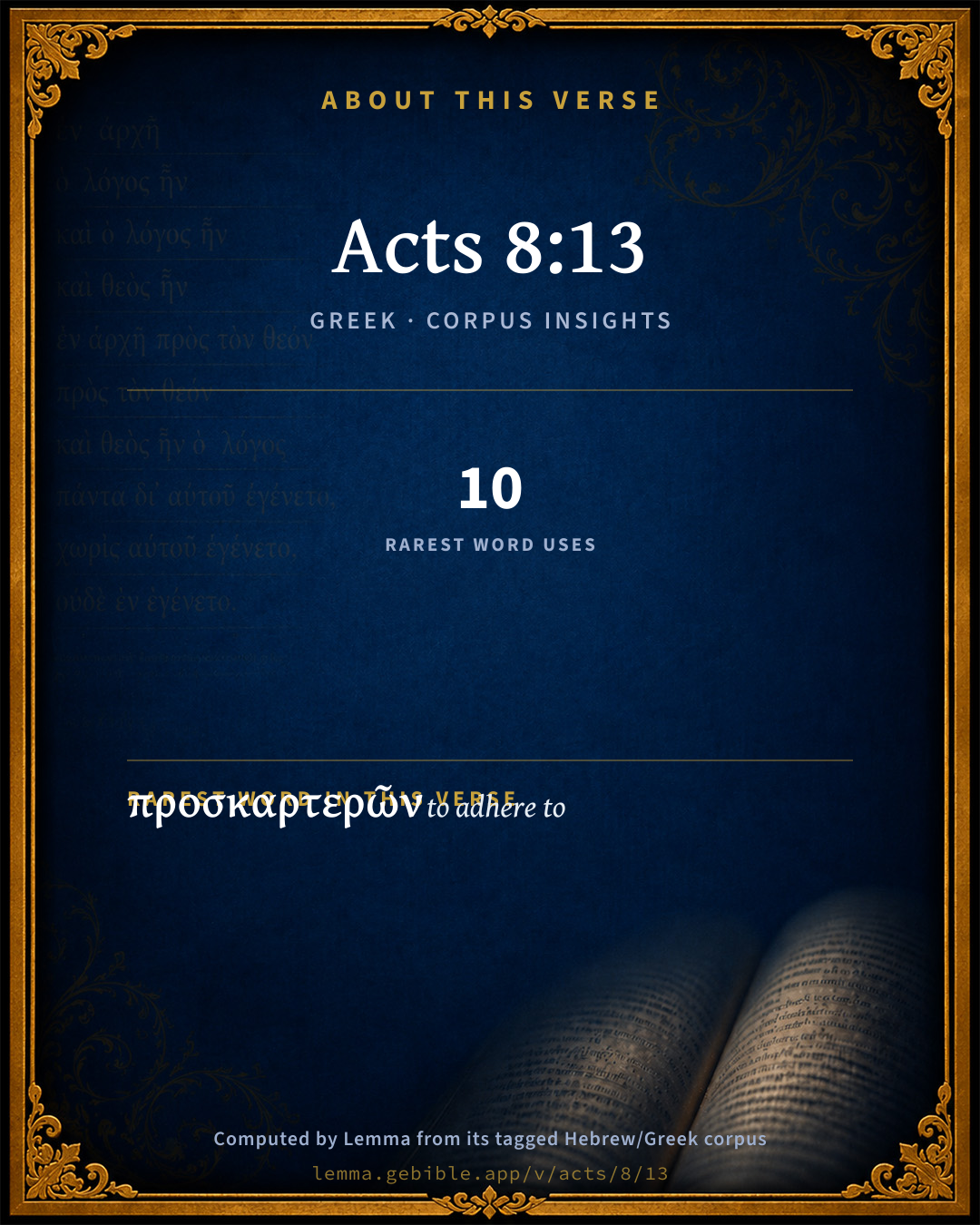
The rarest word here is προσκαρτερῶν to adhere to G4342 — appearing just 10 times in the whole Greek New Testament.

Shared distinctive vocabulary

προσκαρτερῶν to adhere to G4342 occurs in 10 verses of the Greek New Testament. Also found in:

Repetition

Words recur within this verse:

Cross-references

15

Topical passages linked to Acts 8:13 in the Treasury of Scripture Knowledge — connected by theme and wording, ordered by reader-vote popularity; previews shown in the World English Bible.

  • John 5:20 For the Father has affection for the Son, and shows him all things that he himself does. He will show him greater works than these, that you may marvel.
  • Acts 8:6–7 The multitudes listened with one accord to the things that were spoken by Philip, when they heard and saw the signs which he did.
  • Acts 19:11 God worked special miracles by the hands of Paul,
  • John 8:30–31 As he spoke these things, many believed in him.
  • Psalms 106:12–13 Then they believed his words. They sang his praise.
  • Mark 16:17 These signs will accompany those who believe: in my name they will cast out demons; they will speak with new languages;
  • Luke 8:13 Those on the rock are they who, when they hear, receive the word with joy; but these have no root, who believe for a while, then fall away in time of temptation.
  • John 2:23–25 Now when he was in Jerusalem at the Passover, during the feast, many believed in his name, observing his signs which he did.
  • John 7:21 Jesus answered them, "I did one work, and you all marvel because of it.
  • Acts 13:44 The next Sabbath almost the whole city was gathered together to hear the word of God.
  • James 2:19–26 You believe that God is one. You do well. The demons also believe, and shudder.
  • Psalms 78:35–37 They remembered that God was their rock, The Most High God their redeemer.
  • Habakkuk 1:5 "Look among the nations, watch, and wonder marvelously; for I am working a work in your days, which you will not believe though it is told you.
  • Acts 3:10 They recognized him, that it was he who used to sit begging for gifts for the needy at the Beautiful Gate of the temple. They were filled with wonder and amazement at what had happened to him.
  • Acts 8:21 You have neither part nor lot in this matter, for your heart isn't right before God.

Cross-references courtesy of OpenBible.info (CC BY 4.0).

Commentary

Notes on Acts 8:13 from classic Christian and Jewish commentators (each source and its license shown beneath its notes). The classic Christian expositions comment on the surrounding passage and are grouped to its opening verse, so a note may address several verses; the Jewish commentaries on the Tanakh (Rashi and others) are per-verse, so they appear only where the commentator wrote on this verse.

Lemma curates 59 commentaries, every one of them public domain or Creative Commons licensed, each selected and text-cleaned for this edition rather than reprinted as found. About our sources →

John Calvin's Commentaries

13. Simon also himself. He which had besotted the whole city with his witchery receiveth the truth together with others. He which had boasted himself to be the principal power of God submitteth himself to God, [Christ; ] though he were brought to the knowledge of the gospel, not so much for his own sake alone, as for the whole country’s sake, that that offense might be taken out of the way which might have hindered the unskillful. And to this end tendeth that which Luke setteth down afterward, that he wondered at the signs. For God meant to triumph over this man, whom the Samaritans counted a petit God; which cometh to pass whilst he is enforced to give glory to the true miracles, after that his vain boasting is taken away. And yet he giveth not himself over sincerely to Christ; for then his ambition, and that wicked and profane account which he made of the gifts of God, should not break out. And yet I am not of their mind who think that he made only a semblance of faith, seeing he did not believe. Luke saith plainly that he believed, and the reason is added, Because he was touched with wondering. How, then, doth he shortly after betray himself to be but a hypocrite? I answer, That there is some mean between faith and mere dissimulation. The Epicures [Epicureans] and Lucianists do profess that they believe, whereas notwithstanding they laugh inwardly, whereas the hope of eternal life is unto them a vain thing; finally, whereas they have no more godliness than dogs or swine.

But there be many who howsoever they be not regenerate with the Spirit of adoption, and do not addict themselves unto God with the true affection of the heart, being overcome with the power of the Word, do not only confess that that is true which is taught, but are also touched with some fear of God, so that they receive doctrine; for they conceive that God must be heard; that he is both the author and also the judge of the world. Therefore, they make no semblance of faith before men, which is none, but they think that they believe. And this faith continueth only for a time, whereof Christ speaketh in Mark, (Mark 4; Luke 8:13;) to wit, when the seed of the Word conceived in the mind is, notwithstanding, choked forthwith with divers cares of the world, or with wicked affections, so that it never cometh to any ripeness; yea, rather, it groweth out of kind unto unprofitable corn nothing worth. Such, therefore, was Simon’s faith; he perceiveth that the doctrine of the gospel is true, and he is enforced to receive the same with the feeling of his conscience; but the groundwork is wanting; that is, the denial of himself. Whereupon it followed that his mind was enwrapped in dissimulation, which he uttereth forthwith. But let us know that his hypocrisy was such as he deceived himself in; and not that gross hypocrisy whereof Epicures and such like make boast; because they dare not confess the contempt of God.

He was baptized. It appeareth plainly, by this example of Simon that all men have not that grace given them in baptism, which grace is there figured. The opinion of the Papists is this, That unless mortal sin be the cause of let, all men receive the truth and effect with the signs. So that they attribute unto the sacraments magical force, as if they did profit without faith, But let us know that the Lord offereth to us by the sacraments, whatsoever the annexed promises do sound; and that they are not offered in vain, so that being directed unto Christ by faith, we set [seek] from him whatsoever the sacraments do promise. And although the receiving of baptism did profit him nothing then, yet if conversion followed afterward, as some men suppose, the profit was not extinguished nor abolished. For it cometh to pass oftentimes that the Spirit of God worketh afterward after a long time, that the sacraments may begin to show forth their force.

Did cleave to Philip. Whereas Philip admitted him into his company, it appeareth thereby how hard a matter it is to know hypocrites. And this is a trial of our patience. So Demas was a companion of Paul for a time; afterward he became an unfaithful revolt (2 Timothy 4:10,) Finally, we cannot escape this evil, but that wicked men and deceitful will sometimes join themselves unto us; and if at any time the wicked creep craftily into our company, proud censors burden us unjustly, as if we were to answer for their misdeeds. Though we must take heed of facility, which causeth the gospel to be slandered oftentimes, and we must be so much the more vigilant, that we admit none without great choice, forasmuch as we hear that great men have been deceived. He saith that he was made astonied with the greatness of the signs; that we may know that that great power, whereof he boasted, was nothing else but juggling and smokes. And Luke speaketh not in this place of any plain wondering, but of a damp or trance which causeth a man to forget what he doth.

John Calvin's Commentaries (1540-1563) — public domain. Text from the Calvin Translation Society English edition (1840s-50s) via the Christian Classics Ethereal Library (ccel.org). Calvin's coverage is partial (roughly two-thirds of the Bible); uncommented books and verses are honest gaps, never fabricated. The 19th-century editor's footnotes and remarks are omitted so the notes are faithfully Calvin's own voice.

Bengel's Gnomon

Johann Albrecht Bengel

Act 8:13. Ἐπίστευσε, believed) Perceived, that the power of GOD is not in himself, but is in Philip. It was easier to Simon than to the Samaritans to take up faith; for he felt a power superior to his own. He did not, however, attain to a faith full, justifying, purifying the heart, saving: he had a specious appearance of having reached it, until he betrayed himself in a different character.—βαπτισθεὶς, having been baptized) Hence, by a comparison with Act 8:22 [where baptism over again is not enjoined], it is evident that baptism is not to be repeated in the case of hypocrites and those who have relapsed.—σημεῖα, καὶ δυνάμεις μεγάλας, γινόμενα) The epithet of greatness (μεγάλας) is more appropriate to δυνάμεις, and the participle γινόμενα is more suited to σημεῖα, which move men to faith [therefore γινόμενα agrees with σημεῖα, not with δυνάμεις]. A similar variety (change in the gender) also occurs Eph 2:1, etc., τοῖς παραπτώμασι καὶ ταῖς ἁμαρτίαις· ἐν αἷς—ἐν οἷς, κ.τ.λ. Some have made a change in the μεγάλας; others, in the γινόμενα.[56]

[56] ABC (which omits however γινόμενας) Dd Vulg. Syr. Memph. and Theb. read σημεῖα καὶ δυνάμεις μεγάλας γινόμενας: and so Lachm. Ee read δυνάμεις καὶ σημεῖα (σημια) μέγαλα γινόμενα: so Tisch., but omitting μέγαλα, without any of the oldest authorities.—E. and T.

Bengel's Gnomon of the New Testament — English translation (T&T Clark, Edinburgh, 1860) — public domain. Text from a community e-Sword module.

Meyer's Critical & Exegetical Commentary

Heinrich August Wilhelm Meyer

Act_8:13.Ἐπίστευσε] also on his part (κ. αὐτός), like the other Samaritans, he became believing, namely, likewise τῷ Φιλίππῳ εὐαγγελιζομένῳ κ.τ.λ. Entirely at variance with the text is the opinion (Grotius, Clericus, Rosenmüller, Kuinoel) that Simon regarded Jesus only as a great magician and worker of miracles, and not as the Messiah, and only to this extent believed on Him. He was, by the preaching and miracles of Philip, actually moved to faith in Jesus as the Messiah. Yet this faith of his was only historical and intellectual, without having as its result a change of the inner life;[222] hence he was soon afterwards capable of what is related in vv.18, 19. The real ΜΕΤΆΝΟΙΑ is not excited in him, even at Act_8:24. Cyril aptly remarks: ἘΒΑΠΤΊΣΘΗ, ἈΛΛʼ ΟὐΚ ἘΦΩΤΊΣΘΗ.

ἘΞΊΣΤΑΤΟ] he, who had formerly been himself ἘΞΙΣΤῶΝ ΤῸ ἜΘΝΟς!

[222] Bengel well remarks: Agnovit, virtutem Dei non esse in se, sed in Philippo.… Non tamen pertigit ad fidem plenam, justificantem, cor purificantem, salvantem, tametsi ad eam pervenisse speciose videretur, donec se aliter prodidit.

Meyer — Critical and Exegetical Commentary on the New Testament — English translation by Peter Christie, edited by Frederick Crombie (T&T Clark, 1880) — public domain. Text from a community e-Sword module.

Expositor's Greek Testament

ed. W. Robertson Nicoll

Act 8:13 . καὶ αὐτὸς : characteristic of St. Luke, see Friedrich, Das Lucasevangelium , p. 37. βαπτισθεὶς ἐβαπτίσθη ἀλλʼ οὐκ ἐφωτίσθη (St. Cyril). ἦν προσκαρτερῶν : on ἦν with a participle as characteristic of St. Luke see on Act 1:10 , and Friedrich, u. s. , p. 12; on προσκαρτ . see on Act 1:14 . Here with dative of the person ( cf. Act 10:7 ); the whole expression shows how assiduously Simon attached himself to Philip. θεωρῶν : the faith of Simon rested on the outward miracles and signs, a faith which ended in amazement, ἐξίστατο but it was no permanent abiding faith, just as the amazement which he had himself inspired in others gave way before a higher and more convincing belief. The expression δυνάμεις μεγάλας may have been purposely chosen; hitherto men had seen in Simon, and he himself had claimed to be, ἡ δύν . ἡ μεγάλη (Weiss). ἐξίστατο : “Simon qui alios obstupefaciebat, jam ipse obstupescit,” Wetstein. ἐξίσταμαι , intransitive, Blass, Grammatik , p. 49. Irenæus speaks of him as one who pretended faith, Act 1:23 (so too St. Cyril, St. Chrysostom, St. Jerome, St. Ambrose): he may have believed in the Messianic dignity of Christ, and in His Death and Resurrection, constrained by the miracles which Philip wrought in attestation of his preaching, but it was a belief about the facts, and not a belief in Him whom the facts made known, a belief in the power of the new faith, but not an acceptance of its holiness , Act 8:18 (see further, Rendall’s note in loco , and on the Baptism of Simon, “Baptism,” in Hastings’ B.D.).

The Expositor's Greek Testament, edited by W. Robertson Nicoll (1897–1910) — public domain. Text from a community e-Sword module.

Geneva Bible (1599)

Geneva Bible translators

The wicked and the very reprobate are constrained oftentimes to taste of the good gift of God, but they cast it up again forthwith.

Geneva Bible (1599) marginal notes — public domain. Text via Bolls.life.

Jamieson, Fausset & Brown

Robert Jamieson, A. R. Fausset & David Brown

Then Simon himself believed also--Left without followers, he thinks it best to join the man who had fairly outstripped him, not without a touch of real conviction.

and . . . was baptized--What a light does this throw on what is called Baptismal Regeneration!

he continued with Philip--"was in constant attendance upon" him.

Jamieson, Fausset & Brown — Commentary Critical and Explanatory on the Whole Bible (1871) — public domain (CC PDM 1.0). Text via the HelloAO Bible API.

Adam Clarke's Commentary

Verse 13. Simon himself believed also] He was struck with the doctrine and miracles of Philip-he saw that these were real; he knew his own to be fictitious. He believed therefore that Jesus was the Messiah, and was in consequence baptized.

Continued with Philip, and wondered] εξιστατο, He was as much astonished and confounded at the miracles of Philip as the people of Samaria were at his legerdemain. It is worthy of remark that εξιστατο comes from the same root, εξιστημι, as the word εξιστων, in Ac 8:9, and, if our translation bewitched be proper there, it should be retained here; and then we should read, Then Simon himself believed and was baptized, and continued with Philip, being BEWITCHED, beholding the miracles and signs which were done. We may see, from this circumstance, how improper the term bewitched is, in the 9th and 11th verses. Acts 8:9; Acts 8:11

Adam Clarke's Commentary on the Bible (1810–1826) — public domain. Text from a community e-Sword/MySword module.

Ellicott's Commentary for English Readers

(13) Then Simon himself believed also.—Endless questions have been raised as to the nature of such a faith, and the effect of such a baptism. It is probable enough that he was impressed by the signs that Philip wrought; that he felt himself in the presence of a Power above his own; that he accepted Philip’s statements as to the death and resurrection of the Christ. It was such a faith as that of which St. James speaks (Jas_2:14; Jas_2:19). If we are to use the definite language of theological science, it would be true to say that he had the fides informis, faith not preceded by repentance and not perfected by love. And baptism, in such a case, the expressed or implied conditions being absent, brought with it no new birth to a higher life. He remained still “in the gall of bitterness and the bond of iniquity” (Act_8:23). But even for him it bore its witness of the readiness of God to forgive and to regenerate. The subsequent fulfilment of the conditions which were then absent would have quickened the potential into an actual grace, and no second baptism would have been needed to supplement the shortcomings of the first. Peter calls on him (Act_8:22) to repent and pray for forgiveness. He does not tell him that he must be baptised again.

And wondered.—The verb is the same as that rendered “bewitched” in Act_8:9; Act_8:11. The tables were turned. The magician yielded to a spell mightier than his own, and was, in his turn, as one beside himself with amazement. The difference between Simon and the believing Samaritans is, in this matter, suggestive. His faith rested on outward miracles. With them the miracles did but serve to confirm a faith which rested on the “prophetic word” as spoken by the Son of Man (Joh_4:42).

A Bible Commentary for English Readers, edited by Charles John Ellicott (1878–1897) — public domain. Text from a community e-Sword module.

The Cambridge Bible for Schools and Colleges

gen. ed. J. J. S. Perowne

13. Then [And] Simon himself believed also] We can see from the history which follows that the belief here described was of a very imperfect nature. It perhaps amounted to no more than the conviction that in Philip was some power greater than his own. We have an example of a like imperfect belief described in like words in St John’s Gospel (Act_8:31), “Then said Jesus to those Jews which believed on him,” and all that follows in the chapter shews that the belief which they professed was not enough to prevent them from plotting for Christ’s death.

and when he was baptized, he continued with Philips and wondered [was amazed] St Luke’s words imply that Simon was only wonder-struck at the sight of the works wrought by Philip, just as his own works had made the Samaritans to wonder.

beholding the miracles and signs which were done] Better, beholding the signs and great miracles wrought. There is apparently a distinction intended by St Luke between the belief of the Samaritans and that of Simon. When they believed, it was the preaching and the glad tidings to which they most gave heed, but the verb used in this verse seems to paint Simon as one who gazed with wonder only on a sight which was beyond him to explain.

The Cambridge Bible for Schools and Colleges (gen. ed. J. J. S. Perowne; Cambridge University Press, 1878–1918) — public domain. Text from a community e-Sword module.

John Gill's Exposition

Now when the apostles which were at Jerusalem,.... Not that there were some at Jerusalem, and some elsewhere; for they all tarried at Jerusalem, when the rest of the ministers of the word were scattered abroad; though it is possible, that by this time, some of them might have departed from hence; but it seems more probable, that they were as yet all here: these

heard that Samaria had received the word of God; that is, they heard that the Samaritans, who only received the five books of Moses, and that not the Hebrew, but their own copy of them, now received not only the whole Bible, but the Gospel of Christ, as preached by Philip; which they might hear by a letter, or messengers sent from Philip to them, to acquaint them with the success of the Gospel; or from some persons, who had been in those parts: upon which

they sent unto them Peter and John: who were not only fellow apostles, but very familiar and intimate companions; these they sent to confirm the doctrine of Philip, and establish the young converts in it, and to form them into a Gospel church state, and ordain ministers over them.

John Gill's Exposition of the Whole Bible (1746–1763) — public domain (CC PDM 1.0). Text via the HelloAO Bible API.

Trapp's Complete Commentary

John Trapp

13 Then Simon himself believed also: and when he was baptized, he continued with Philip, and wondered, beholding the miracles and signs which were done.

Ver. 13. Simon himself believed] As the devils also believe, with a historical faith, a mere flash, which therefore soon came to nothing.

And when he was baptized] Pity that that fair water was spilt upon so foul a face. But circumcision avails nothing without faith that works by love. Unregenerate Israel is to God as Ethiopia, Amo 9:7. Baptism to such is not God’s mark, but the devil’s brand.

John Trapp, A Commentary or Exposition upon All the Books of the Old and New Testament (1647–1656) — public domain. Text from a community e-Sword module.

Albert Barnes' Notes on the Bible

Then Simon himself believed also - That is, he believed that Jesus had performed miracles, and was raised from the dead, etc. All this he could believe in entire consistency with his own notions of the power of magic; and all that the connection requires us to suppose is that he believed this Jesus had the power of working miracles; and as he purposed to turn this to his own account, he was willing to profess himself to be his follower. It might have injured his popularity, moreover, if he had taken a stand in opposition when so many were professing to become Christians. People often profess religion because, if they do not, they fear that they will lose their influence, and be left with the ungodly. That Simon was not a real Christian is apparent from the whole narrative, Act 8:18, Act 8:21-23.

And when he was baptized - He was admitted to a “profession” of religion in the same way as others. Philip did not pretend to know the heart; and Simon was admitted because he “professed” his belief. This is all the evidence that ministers of the gospel can now have, and it is no wonder that they, as well Philip, are often deceived. The reasons which influenced Simon to make a profession of religion seem to have been these:

An impression that Christianity was “true.” He seems to have been convinced of this by the miracles of Philip.

(2)The fact that many others were becoming Christians; and “he” went in with the multitude. This is often the case in revivals of religion.

(3)He was willing to make use of Christianity to advance his own power, influence, and popularity - a thing which multitudes of men of the same mind with Simon Magus have been willing since to do.

He continued ... - It was customary and natural for the disciples to remain with their teachers. See Act 2:42.

And wondered - This is the same word that is translated “bewitched” in Act 8:9, Act 8:11. It means that he was amazed that Philip could “really” perform so much greater miracles than “he” had even pretended to. Hypocrites will sometimes be greatly attentive to the external duties of religion, and will be greatly surprised at what is done by God for the salvation of sinners.

Miracles and signs - Greek: signs and great powers, or great miracles. That is, so much greater than he pretended to be able to perform.

Albert Barnes' Notes on the Bible (1834–1885) — public domain. Text from a community e-Sword/MySword module.

Haydock's Catholic Bible Commentary

Simon himself believed. That is, pretended to believe, that he might obtain the power of speaking in tongues, and working miracles, which was frequently imparted to the faithful at baptism. (Menochius) --- He was filled with pride and presumption, says St. Augustine. He wished to imitate the prodigies of the apostles, but loved not their justice, nor the truth they preached. He entered into the Church, and desired baptism, not to obtain the grace of justification, but to have an occasion of extolling himself. He wished to walk in wonders above himself. (In Psalm cxxx.)

George Leo Haydock (1774–1849), Haydock's Catholic Family Bible and Commentary, 1859 edition — public domain. Excludes Psalms (Douay-Rheims chapter numbering differs from Protestant) and Deuterocanonical books (Catholic canon only).

Matthew Poole's English Annotations

Simon himself believed; Simon believed with an historical faith, that it was indeed true, that our Saviour had done miracles, and did rise from the dead, but his faith, to be sure, was dead all the while; neither did he believe with his heart, or purpose to live according to the law of Christ, which is the life of faith.

He continued with Philip; kept him constantly company, and was amongst the forwardest of the professors of Christ’s faith.

And wondered, beholding the miracles and signs which were done; thus the magicians of Egypt were brought to acknowledge the finger of God, Exo 8:19, although their hearts were hardened.

Matthew Poole's English Annotations on the Holy Bible (1683–1685) — public domain. Text from a community e-Sword/MySword module.

The Pulpit Commentary

And for then, A.V.; also himself believed for himself believed also, A.V.; being baptized for when he was baptized, A.V.; beholding signs and great miracles wrought, he was amazed for wondered, beholding the miracles and signs which were done. Contained with (h proskarterwn) see Act_1:14 Act_3:4-6 Act_6:4 Act_10:7. St. Paul uses the word in Rom_12:12 Rom_13:6; Col_4:2; and the substantive formed from it (proskarte) once, Eph_6:18. Elsewhere in the New Testament it occurs only in Mar_3:9. But it is found in Hist. of. Sus. 6. Amazed (see note on ver. 9). In Simon we have the first example of one who, having been baptized into Jesus Christ, lived to disgrace and corrupt the faith which he professed. He was an instance of the tares sown among the wheat, and of the seed which sprang up quickly being as quickly destroyed. He is an instance also of the truth of our Lord"s raying, "Ye cannot serve God and mammon."

The Pulpit Commentary (1880–1919), ed. H.D.M. Spence-Jones & Joseph S. Exell — public domain. Text from a community e-Sword module.

John Wesley's Explanatory Notes

And Simon believed - That is, was convinced of the truth.

John Wesley, Explanatory Notes Upon the Whole Bible (1754–1765) — public domain. Text via the GEBible commentary corpus.

McGarvey & Pendleton's Commentaries

J. W. McGarvey

See notes on verse 6

J. W. McGarvey (with Philip Y. Pendleton), Commentaries on the New Testament (The Fourfold Gospel, 1914; Acts; and the epistles) — public domain. Text from a community e-Sword/MySword module.

The People's New Testament

B. W. Johnson

13. Then Simon himself believed also. There has been much needless discussion whether Simon was sincere. It would never have been doubted had we not been told that later he fell into sin. It is best to take the Scripture in its manifest sense. He became a believer like the rest. He was baptized like the rest; then, like many others, at a later period, under temptation, he fell into sin. It is impossible to believe that a man of his power and influence in Samaria would have yielded outwardly to the gospel and shown the deference he manifested to Philip unless he was at the time sincere. But he was of the class described by the Savior when the seed of the sower fell among among thorns.

B. W. Johnson's The People's New Testament with Notes (1889–1891) — public domain. Electronic text from the Christian Classics Ethereal Library (CCEL) ThML edition.

Cambridge Greek Testament for Schools and Colleges

13. ὁ δὲ Σίμων … ἐπίστευσεν, and Simon himself believed also. We can see from the history which follows that the belief here described was of a very imperfect nature. It perhaps amounted to no more than the conviction that in Philip was some power greater than his own. We have an example of a like imperfect belief described in like words in St John’s Gospel (Act 8:31), ‘then said Jesus to those Jews which believed on Him,’ and all that follows in the chapter shews that the belief which they professed was not enough to prevent them from plotting for Christ’s death.

καὶ βαπτισθείς, and when he was baptized. Chrysostom (Hom. XVIII. in Act.) asks why it came to pass that such a man was admitted to baptism, and answers the question ὥσπερ καὶ τὸν Ἰούδαν ὁ Χριστὸς ἐξελέξατο. But St Luke’s language here (ἐξίστατο) implies that Simon was possessed with the same feeling towards Philip which the people of Samaria had towards himself.

θεωρῶν τε κ.τ.λ., beholding the signs and great miracles wrought. There is apparently a distinction intended by St Luke between the belief of the Samaritans and that of Simon. When they believed (Act 8:12) it was the preaching and the glad tidings to which they most gave heed, but the verb used in this verse (θεωρῶν) seems to paint Simon as one who gazed with wonder only on a sight which was beyond him to explain.

Cambridge Greek Testament for Schools and Colleges (Cambridge University Press, 1896; 21 vols, various authors incl. Carr, Maclear, Plummer, Farrar, Lumby, Moule, M. R. James, Simcox) — public domain. Text from a community e-Sword module.

Alford’s Greek Testament

Henry Alford

13.] ‘Simon saw his followers dropping off, and was himself astounded at the miracles wrought by Philip: he therefore thought it best himself also to acknowledge this superior power. He attached himself to Philip, and was baptized like the rest: but we are not, as the sequel shews, to understand that the preaching of the Gospel had made any impression on his heart, but that he accounted for what he saw in his own fashion. He was convinced, from the works which Philip did, that he was in league with some powerful spirit: he viewed baptism as the initiation into communion with that spirit, and expected that he should be able to make use of the higher power thus gained for his own purposes, and unite this new magical power to his own. All were baptized who professed belief in Jesus as the Messiah: there was therefore no reason for rejecting Simon, considering besides, that from the nature of the case he would for the time have given up his magical practices.’ Neander, Pfl. u. Leit. p. 102.

‘Hoc Simonis exemplo clare patet, non conferri omnibus indifferenter in Baptismo gratiam, quæ illic figuratur. Papistarum dogma est, Nisi quis ponat obicem peccati mortalis, omnes cum signis recipere veritatem et effectum. Ita magicam vim tribuunt Sacramentis, quasi absque fide prosint. Nos autem sciamus offerri nobis a Domino per Sacramenta quicquid sonant annexæ promissiones, et non frustra nec inaniter offerri, modo fide ad Christum directi ab ipso petamus quicquid Sacramenta promittunt. Quamvis autem nihil illi tunc profuerit Baptismi receptio, si tamen conversio postea secuta est, ut nonnulli conjiciunt, non extincta fuit nec abolita utilitas. Sæpe enim fit, ut post longum tempus demum operetur Spiritus Dei, quo efficaciam suam Sacramenta proferre incipiant.’ Calvin in loc.

Henry Alford, The Greek Testament (1849–1861) — public domain. Text from a community e-Sword module.

Vincent's Word Studies in the New Testament

Marvin R. Vincent

Continued with. See on ch. Act 1:14.

Miracles and signs [σημεια και δυναμεις] . Lit., signs and powers. See on Mt 11:20; Act 2:22.

Which were done [γινομεας] . The present participle. Lit., are coming to pass.

He was amazed. After having amazed the people by his tricks. See ver. 9. The same word is employed.

Marvin R. Vincent, Word Studies in the New Testament (1887–1900) — public domain. Text from a community e-Sword/MySword module.

Lesson kit

Teaching starters — assembled from the data on this page, not authored interpretation. Every prompt links to the verse data it draws on. Edit before teaching.

Acts, in the Acts, opens this verse with 20 words (17 distinct Greek lemmas). Its most distinctive word is proskarteréō (“to adhere to”). A historical commentator’s framing appears above. Read the whole chapter for the surrounding context.

Discussion questions

  1. How does “to adhere to” (proskarteréō) shape what this verse is saying?
  2. How does Mark 3:9, which shares the word «to adhere to», read alongside this verse?
  3. What does the repetition of “and” (3× in this one verse) do in this verse?
  4. These translations render this verse differently. What is at stake in choosing one wording over another?
  5. Compare how John Calvin's Commentaries and Bengel's Gnomon read this verse. Where do they agree or differ?

Things to notice

Reading settings

Reading text

Shown beneath each verse's original-language words.

Old Testament
Old Testament edition

Read the OT as the Masoretic Hebrew (MT) or the Greek Septuagint (LXX).

English shown for the Greek Septuagint (in the Hebrew ↔ Greek comparison).

Comparing translations? Open the Compare panel on any verse page to stack up to four side by side.