Acts 2:47

Greek (Tischendorf 8th ed.) Acts 2:47 appears in the Greek New Testament. The text above is from the Tischendorf 8th edition. Each word links to its Strong’s number and a concise gloss. Click any word for its full Thayer’s Greek Lexicon entry.
Download image
Cite this verse

Acts 2:47 (World English Bible). Public Domain. Lemma interlinear Bible study tool, https://lemma.gebible.app/v/acts/2/47.

Show BibTeX & RIS
BibTeX
RIS
English Translation
praising God, and having favor with all the people. The Lord added to the assembly day by day those who were being saved.
World English Bible · Public Domain
Download a study sheet

One document with this verse’s original text, its word-by-word gloss line, the meaning frame, cross-references with their text, attributed commentary, and full source and license credits — printable, and it pastes into notes with its structure intact.

This verse Autodidact and up

Study sheet (.html) Plain text (.txt)

A passage Seminary Student

Up to 50 verses in one chapter. A passage sheet keeps up to 6 commentary sources and 12 cross-references per verse, in the order this page ranks them, and says so on the sheet whenever that leaves anything out. Ask for a single verse and you get the Autodidact verse sheet above.

Everything on this page stays free to read, with no account — the sheet is a download of what is already on screen, not access to it.

Want to remove ads? Support Godless Engineer
Compare translations 3

The same verse in 3 English versions, stacked beneath the original-language interlinear above. Click any original word for its lexicon entry.

Each is an independent rendering of the whole verse — the interlinear is not word-aligned to these translations.

Highlighted words mark where these versions differ — a whole-verse word diff, not a word-by-word alignment.

  • World English Bible Public Domain
    praising God, and having favor with all the people. The Lord added to the assembly day by day those who were being saved.
  • King James Version Public Domain
    Praising God, and having favour with all the people. And the Lord added to the church daily such as should be saved.
  • unfoldingWord Literal Text CC BY-SA 4.0
    praising God and having favor with the whole people, and each day the Lord was adding the ones being saved to the same.

unfoldingWord Literal Text — © unfoldingWord, licensed CC BY-SA 4.0. Word-aligned USFM3 via Door43 (git.door43.org/unfoldingWord/en_ult).

Versions to compare (up to 4)

3 of 4 selected

Show all 19 translations

Every available English version of this verse, each an independent rendering of the whole verse.

  • World English Bible Public Domain
    praising God, and having favor with all the people. The Lord added to the assembly day by day those who were being saved.
  • Berean Standard Bible Public Domain
    praising God and enjoying the favor of all the people. And the Lord added to their number daily those who were being saved.
  • Majority Standard Bible Public Domain
    praising God and enjoying the favor of all the people. And the Lord added to the church daily those who were being saved.
  • King James Version Public Domain
    Praising God, and having favour with all the people. And the Lord added to the church daily such as should be saved.
  • American Standard Version (1901) Public Domain
    praising God, and having favor with all the people. And the Lord added to them day by day those that were saved.
  • Revised Version (1885) Public Domain
    praising God, and having favour with all the people. And the Lord added to them day by day those that were being saved.
  • Geneva Bible (1599) Public Domain
    Praysing God, and had fauour with all the people: and the Lord added to the Church from day to day, such as should be saued.
  • Douay-Rheims (1899) Public Domain
    Praising God, and having favour with all the people. And the Lord increased daily together such as should be saved.
  • Young's Literal Translation Public Domain
    praising God, and having favour with all the people, and the Lord was adding those being saved every day to the assembly.
  • Literal Standard Version CC BY-SA 4.0
    praising God, and having favor with all the people, and the LORD was adding those being saved every day to the Assembly.
  • Unlocked Literal Bible CC BY-SA 4.0
    praising God and having favor with all the people, and every day the Lord added to their number those who were being saved.
  • unfoldingWord Literal Text CC BY-SA 4.0
    praising God and having favor with the whole people, and each day the Lord was adding the ones being saved to the same.
  • Darby Bible Public Domain
    praising God, and having favour with all the people; and the Lord added [to the assembly] daily those that were to be saved.
  • World Messianic Bible Public Domain
    praising God and having favor with all the people. The Lord added to the assembly day by day those who were being saved.
  • Webster's Bible Public Domain
    Praising God, and having favor with all the people. And the Lord added to the church daily such as should be saved.
  • Free Bible Version CC BY-SA 4.0
    Every day the Lord added to their number those who were being saved.
  • Bible in Basic English Public Domain
    Giving praise to God, and having the approval of all the people; and every day the number of those who had salvation was increased by the Lord.
  • Text-Critical English NT CC BY 4.0
    praising God and enjoying the favor of all the people. And the Lord added to the church daily those who were being saved.
  • Tyndale New Testament (1534) Public Domain
    praysinge God and had faveour with all the people. And the Lorde added to the congregacion dayly soche as shuld be saved.

Literal Standard Version (2020), Covenant Press — licensed CC BY-SA 4.0. Text via the HelloAO Bible API (eBible.org). Unlocked Literal Bible (unfoldingWord) — licensed CC BY-SA 4.0. Text via the HelloAO Bible API (eBible.org). unfoldingWord Literal Text — © unfoldingWord, licensed CC BY-SA 4.0. Word-aligned USFM3 via Door43 (git.door43.org/unfoldingWord/en_ult). Free Bible Version, Dr. Jonathan Gallagher — licensed CC BY-SA 4.0. Text via the HelloAO Bible API (eBible.org).

Word by word

More ways to search: Search by grammar → Find every occurrence → Compare this word →

Practice this passage: Drill this verse → Learn its vocabulary →

αἰνοῦντες
ainéō
G134
“to praise”
Verb, Present, Active, Participle, Nominative, Plural, Masculine
Part of Speech
Verb
Tense
Present
Voice
Active
Mood
Participle
Case
Nominative
Number
Plural
Gender
Masculine
Full Thayer's Definition

Origin: from G136

TDNT: 03:57,3

1. to praise, extol, to sing praises in honour to God 2. to allow, recommend 3. to promise or vow
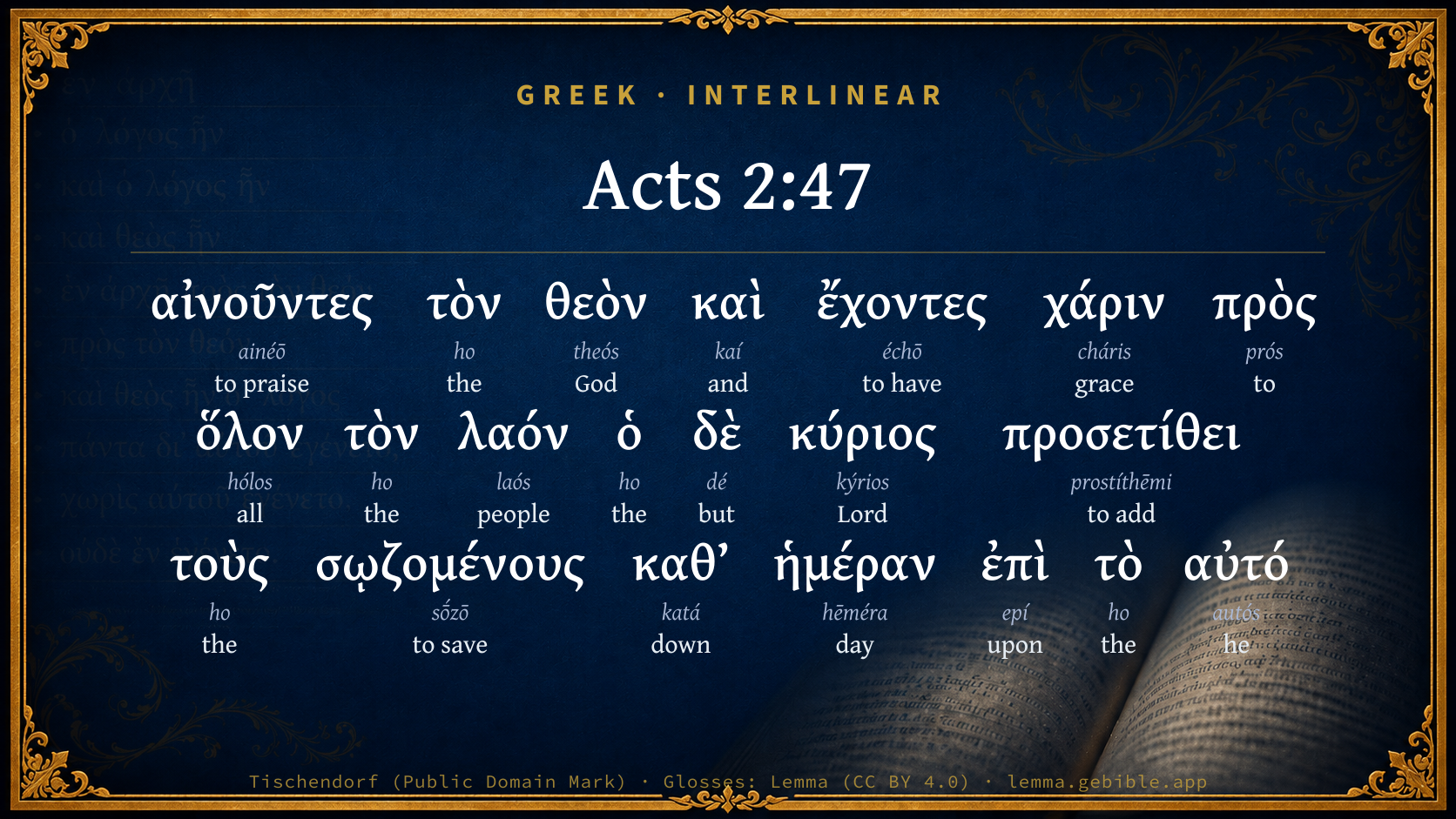
  1. τὸν ho G3588 “the” Article, Accusative, Singular, Masculine
  2. θεὸν theós G2316 “God” Noun, Accusative, Singular, Masculine
  3. καὶ kaí G2532 “and” Conjunction
  4. ἔχοντες échō G2192 “to have” Verb, Present, Active, Participle, Nominative, Plural, Masculine
  5. χάριν cháris G5485 “grace” Noun, Accusative, Singular, Feminine
  6. πρὸς prós G4314 “to” Preposition
  7. ὅλον hólos G3650 “all” Adjective, Accusative, Singular, Masculine
  8. τὸν ho G3588 “the” Article, Accusative, Singular, Masculine
  9. λαόν laós G2992 “people” Noun, Accusative, Singular, Masculine
  10. ὁ ho G3588 “the” Article, Nominative, Singular, Masculine
  11. δὲ dé G1161 “but” Conjunction
  12. κύριος kýrios G2962 “Lord” Noun, Nominative, Singular, Masculine
  13. προσετίθει prostíthēmi G4369 “to add” Verb, Imperfect, Active, Indicative, 3rd person, Singular
  14. τοὺς ho G3588 “the” Article, Accusative, Plural, Masculine
  15. σῳζομένους sṓzō G4982 “to save” Verb, Present, Passive, Participle, Accusative, Plural, Masculine
  16. καθ’ katá G2596 “down” Preposition
  17. ἡμέραν hēméra G2250 “day” Noun, Accusative, Singular, Feminine
  18. ἐπὶ epí G1909 “upon” Preposition
  19. τὸ ho G3588 “the” Article, Accusative, Singular, Neuter
  20. αὐτό autós G846 “he” Personal pronoun, Accusative, Singular, Neuter

About this verse

These counts appear in no published source. They are computed here, from the morphology-tagged text and Lemma’s own curated glosses. What Lemma adds →

21
words
17
distinct lemmas
Acts
section

Notable vocabulary

The rarest word here is αἰνοῦντες to praise G134 — appearing just 9 times in the whole Greek New Testament.

Shared distinctive vocabulary

αἰνοῦντες to praise G134 occurs in 9 verses of the Greek New Testament. Also found in:

Repetition

A word recurs within this verse:

Cross-references

16

Topical passages linked to Acts 2:47 in the Treasury of Scripture Knowledge — connected by theme and wording, ordered by reader-vote popularity; previews shown in the World English Bible.

  • Acts 16:5 So the assemblies were strengthened in the faith, and increased in number daily.
  • Acts 5:13–14 None of the rest dared to join them, however the people honored them.
  • Acts 2:41 Then those who gladly received his word were baptized. There were added that day about three thousand souls.
  • Acts 2:39 For to you is the promise, and to your children, and to all who are far off, even as many as the Lord our God will call to himself."
  • 1 Corinthians 1:18 For the word of the cross is foolishness to those who are dying, but to us who are saved it is the power of God.
  • Romans 14:18 For he who serves Christ in these things is acceptable to God and approved by men.
  • Acts 11:24 For he was a good man, and full of the Holy Spirit and of faith, and many people were added to the Lord.
  • Acts 13:48 As the Gentiles heard this, they were glad, and glorified the word of God. As many as were appointed to eternal life believed.
  • Titus 3:4–5 But when the kindness of God our Savior and his love toward mankind appeared,
  • Romans 8:30 Whom he predestined, those he also called. Whom he called, those he also justified. Whom he justified, those he also glorified.
  • Romans 11:5–7 Even so then at this present time also there is a remnant according to the election of grace.
  • Luke 2:52 And Jesus increased in wisdom and stature, and in favor with God and men.
  • Acts 4:21 When they had further threatened them, they let them go, finding no way to punish them, because of the people; for everyone glorified God for that which was done.
  • Romans 9:27 Isaiah cries concerning Israel, "If the number of the children of Israel are as the sand of the sea, It is the remnant who will be saved;
  • Luke 19:48 They couldn't find what they might do, for all the people hung on to every word that he said.
  • Acts 4:33 With great power, the apostles gave their testimony of the resurrection of the Lord Jesus. Great grace was on them all.

Cross-references courtesy of OpenBible.info (CC BY 4.0).

Commentary

Notes on Acts 2:47 from classic Christian and Jewish commentators (each source and its license shown beneath its notes). The classic Christian expositions comment on the surrounding passage and are grouped to its opening verse, so a note may address several verses; the Jewish commentaries on the Tanakh (Rashi and others) are per-verse, so they appear only where the commentator wrote on this verse.

Lemma curates 59 commentaries, every one of them public domain or Creative Commons licensed, each selected and text-cleaned for this edition rather than reprinted as found. About our sources →

The Biblical Illustrator

Joseph S. Exell

Act_2:47

Praising God, and having favour with all the people.

At once godly and popular

I. Piety. Praising God. Behold the natural history of regeneration. Those who are bought with a price are constrained to glorify God. Thanksgiving is a constituent element of prayer without which it is ineffectual. In the case of these converts as in the case of Israel redeemed from Egypt it was spontaneous, and could not be restrained. The gratitude that comes through prompting is not gratitude.

II. Popularity. Having favour, etc. In the first stage of their progress these converts were not persecuted. Two opposite experiences alternate in the history of the Church: sometimes the world admires and sometimes reviles. This is necessary. If godliness were always to obtain the favour of the world, counterfeits would spring up; if it were always to bring down the worlds enmity, the spark of Divine truth in humanity would be quenched. God holds the balance, and permits as much of the wrath of man as suffices to praise Himself and purge the Church, and then He restrains the remainder. This method, as exemplified in history, we see to be the best. When a spark is imbedded in the flax, and it begins to smoke, a blast would blow it out, and therefore the blast is restrained. But after the fire has fairly caught, the blast will spread the flame, and therefore it is permitted to blow.

III. Increase.

1. The Lord added them, and yet they added themselves. The Good Shepherd carried the sheep home, but the prodigal walked home. The two are one showing the Divine and human sides of the same transaction. At one place the saved are Whosoever shall call on the name of the Lord, at another they are As many as the Lord shall call. When I know myself to be like a withered leaf that flows to a sea of perdition, it is sweet to think that help is laid on One that is mighty, and to hope that the Lord adds me to His Church. My comfort arises from the fact not that I hold Him, but that He holds me. But woe to the man who with no liking for Gods presence or the company of His people dares to comfort himself that he has no power till God puts forth His strength. The Lord is now ready to do it, if you are willing that it should be done.

2. Every day some were added. There is no blank in the birth registers of Gods family. The Lambs Book of Life has a page for every day, and names on every page, although some pages are more crowded than others.

3. He added the saved to the Church: added them in the act of saving, saved in the act of adding. He does not add a withered branch to the vine; but in the act of inserting it makes the withered branch live. When pure water is drawn from the salt sea, it is added to the clouds in heaven. It is thus that the Lord adds the saved to the Church, winning them from a sea of wickedness and leaving their bitterness behind. (W. Arnot, D. D.)

And the Lord added to the Church such as should be saved.--

The relation of the Church to the individual

I. It seems almost inevitable that all believing men will as a matter of course associate themselves with the Church.

1. This is prompted by the very nature and fitness of things.

(1) It is the moral duty of every individual to give society an account of his convictions. No man is perfectly sincere to his fellows except as his whole life--his thoughts as well as his conduct--is open to their inspection. Respect for his fellow-men, himself and his God alike demand this. Therefore not to do this in matters of religious conviction is to withhold from society that to which it has a moral claim, for religious belief lies at the foundation of all moral conduct; and therefore of all social confidence. To profess to belong to society, and yet conceal our religious principles is a moral fraud.

(2) An evasion of religious profession does as much wrong to the spiritual life of the believer as it does to the community. He does as much violence to his spiritual nature as he would to his social nature were he to become a recluse. Such separation renders the development of ones entire nature impossible--social instincts, sympathies and capabilities. And just as the domestic feeling finds development in the family, the mercantile in the company, the political in the club, so the religious feeling finds its proper development in the Church. Standing aloof, therefore, our personal piety must suffer, wanting that mutual encouragement and help that it requires. For the Church is the garden of the Lord--the place of rapid and healthy growth. They that be planted in the house of the Lord, etc. Standing aloof from our fellow Christians, moreover, there is a large class of holy and beautiful feelings that are never called into exercise. It is as if the members of a family were to live separate--the tie of relationship would be the same, and the affection might be in their hearts, but it would find but imperfect expression in the life.

(3) Church association is, moreover, needful for the advantageous application of spiritual power. The units are added into one sum; the drops collected into one stream; the strands twisted into one cable; the parts fitly framed together into one potent engine. What separated believers cannot do the Church easily can. For other purposes, the advancement of literature, science, commerce, etc., men spontaneously unite, and so should believers in the work of God. For each Christian to do what is right in his own eyes is as if soldiers were to disperse themselves through a country for the purpose of subduing it.

(4) One prime part of the practical expression of religious principle is in public worship. God will have His people render Him sanctuary service--the chief way in which the profession of Christ is to be made. We might be pious without it, but our piety would be to ourselves, not to the world.

2. This natural necessity of the Church is further insisted upon in the New Testament. The injunctions of Christ and His apostles are not mere arbitrary directions, but recognitions of our spiritual nature. We have passages--

(1) Recognising the Church as a legitimate fact. Tell it to the Church, They assembled with the Church, etc.

(2) Of injunction, expostulation and promise. Not forsaking the assembling of ourselves, These be they who separate themselves, Where two or three are gathered in My name.

(3) Where the necessity of professing Christ (of which Church membership is the chief way) is insisted on. We are to come out and be separate, to confess the name of the Lord Jesus. So imperative was this that the early Christians submitted to persecution for the maintenance of it. Half the martyrdoms of the Church might have been avoided had Christians been content with an isolated religion. And the great solicitude of the apostle in writing to persecuted believers is that they should hold fast their profession without wavering.

II. What does the Church require of the individual as a condition of its communion? Verse 42 embodies the natural principles of associated Christian life, and St. Luke distinctly traces the passage of the individual to the social Christian life. Membership with Christ first, then membership with His Church. All social life is made up of individual lives--each member enters as an individual not to receive life from it, but to add life to it. The spiritual life of the Church, therefore, is the sum of individual lives. In none of our relationships can we lose our individuality. As individuals we are born, live, die, and give account of ourselves to God. Of the individual, therefore, the Church may require--

1. Moral conversion. A purely spiritual society can admit none but spiritual members; and can include none that are unregenerate. Of course the Church has not omniscience, but it is bound to exercise the most vigilant jealousy. And it cannot receive a more deadly injury than an unsanctified member. A society is worth no more than it possesses of the quality for which it exists. A scientific society, whatever other qualities its members may have, is worth no more, as such, than it has science. And so the Church is worth no more than the spiritual life that is in it. Wealth, intellect, energy, are of incalculable value, if their possessor bring spiritual life also, but they are a curse if he do not. Hence the Church is invested with the power of discipline, like all social bodies, and therefore St. Paul censured the Corinthian Church for not excommunicating the incestuous person. Christian churches must be churches of Christians.

2. Intellectual agreement with its distinctive ecclesiastical principles. An Episcopalian, e.g., cannot and ought not to be allowed to take part in a Congregational administration. His membership would involve either a tacit denial of principle on his part or an exposure to constant embarrassment on the part of the Church. While we welcome him to all our spiritual privileges, we must deny him participation in our government.

3. Active and cordial co-operation in religious functions--participation in worship, communion and service. Every member, therefore, enters into a moral contract with the Church, and as far as he holds aloof is as dishonest as a mercantile servant who absents himself from his occupation. Of course we claim no legal hold, and can use no compulsion, and would not if we could. But these are the lowest constraints, and Christianity refuses to employ them. But if you will not discharge its duties the Church has a right to ask you to withdraw from a fellowship to whose enjoyment and efficacy you add nothing.

III. The claim of the individual in the Church. He may expect not the extinction on the part of its members of social rank, nor the sacrifice of individual claims. Membership warrants no rude familiarity, establishes no social equality. But Church members, though not one in rank or wealth, are yet one in Christ, and each in his spiritual and temporal need may expect such help as Christian brotherhood may prompt in his sorrows, brotherly interest and sympathy; in his assaults or perils, brotherly assistance and rescue; all that is involved in the great law, that we love one another. (H. Allon, D. D.)

Graduality and divinity of human salvation

Dean Alfords version of the words is, The Lord added to their number day by day them that were in the way of salvation. Dr. Samuel Davidsons version we think better: The Lord was adding to the Church daily those who were being saved. The authors of the New Testament Revised Version have adopted Dr. Samuel Davidsons translation, and read, the Lord added to them day by day those that were being saved. Not those that had been saved, or those who would be saved, but those who were being saved. The words in their connection teach two great facts in relation to mans salvation.

I. It is gradual in its process. The popular impression is that this great event is instantaneous. But the nature of the work and the testimony of the Scriptures give no sanction to such an impression. Consider--

1. The nature of the work. Salvation may be said to involve a twofold change.

(1) A change in condition. The soul is represented as lost, it has lost its normal condition and its original character. We say that a thing is lost when it has failed to realise the object for which it was produced. Thus a chronometer is lost when it becomes incapable of keeping time; a vessel is lost when it is unfit any more to plough the ocean; a family portrait is lost when all the lineaments are so discoloured or defaced as to be incapable of giving any faithful idea of the subject. In this sense the soul is lost; it does not answer the end of its existence. It involves--

(2) A change in character. We often say of a man when his character is gone that he is lost. Whether you consider salvation as consisting in the restoration of a lost condition, or a lost character, graduality is implied. The chronometer cannot be restored at once, nor can the unseaworthy vessel be repaired at once. Skilful and persistent effort in all cases of restoration is required. It is so with the soul. The rebellious does not become obedient at once, the malign benevolent at once, the selfish generous at once. The same in relation to character. Character is not something formed at once. Character is made up of habits, and habits are made up of numerously repeated actions. Consider--

2. The testimony of the Scriptures. Now is our salvation nearer than when we believed. With the mouth confession is made unto salvation. Work out your salvation with fear and trembling. Kept through faith unto salvation. Receiving the end of your faith, even the salvation of your souls. He that shall endure to the end shall be saved. The various figures employed to represent the Christian life indicate the same graduality. It is a building, a planting, a race, a fight, etc.

II. It is effected by God through the instrumentality of preaching. It is said, The Lord added. He did it, but how? Everywhere in nature He works by means. This is the means by which God effects human salvation. Christ is the Gospel, and the gospel preached is Christ exhibited. Conclusion:

1. Infer not from this that salvation does not imply a crisis. There is a point when everything begins. There is a point when the dead seed receives the first touch of life. The heavy clouds charged with electricity reach a point when they flash into flame and break into thunder. There is a point in disease when it either becomes incurable or yields to a restorative touch, and we say the disease has taken a turn. It is so with the salvation of the soul. Conversion is a turn. But the mere turn is not salvation; the starting point is not the goal; incipient germination is not fruitage. The mariner may turn his barque from the direction of a northern port to a southern port, and yet the southern port he may never reach.

2. Infer not from this that other elements apart from the gospel may not contribute to human salvation. Wholesome literature, philosophic truths, scientific facts, and rational speculations we disparage not these, they may render important service, but they cannot do the work of the gospel, they cannot save souls. Put the best seed into the best soil, let the choicest showers come down upon it, and the most genial airs breathe about it. It will never spring to life without something else, they are useless without the sun. Add to them the sun, and the work is done. Add to all the elements of nature the sun, and it will start majestic forests on the barren hills. So with the gospel. Add to all other truths, natural and moral, the gospel, and they will render service, but not otherwise. (D. Thomas, D. D.)

Additions to the Church

I. What about them?

1. It was the custom in the earliest times for persons who had been converted to Christ to join themselves with the Church. From that fact, I feel persuaded that--

(1) They did not conceal their convictions. It is a strong temptation with many to say, I have believed in Jesus, but that is a matter between God and my own soul. Can I not go quietly to heaven and be a Nicodemus, or a Joseph of Arimathea? Yes; but that is a different thing from being cowardly and ashamed of Christ. We shall not object to your being a Nicodemus if you will carry spices to the grave of Jesus, or beg His body. Neither of these two brethren were cowardly after the Cross had been set up, nor ashamed to identify themselves with Christ crucified. Follow them, not in the infancy of their love, but in its maturer days. The promise of the gospel is He that with his heart believeth, and with his mouth maketh confession of Him, shall be saved.

(2) They did not try to go to heaven alone. There has been a great deal said about being simply a Christian and not joining any particular church. But these people joined the Church at once. I daresay that, had they criticised the Church, they would have found faults in her, certainly within a few weeks great faults had to be remedied; but these converts felt that the society at Jerusalem was the Church of Christ, and, therefore, they joined it. If you wait for a perfect Church, you must wait until you get to heaven; and even if you could find one they would not admit you, for you are not perfect yourself. Find out those people who are nearest to the Scriptures, and then cast in your lot with them. If it would be right for you to remain out of Church fellowship, it must be right for every other believer, and then there would be no visible Church at all.

2. The persons who were received at Pentecost were added to the Church by the Lord. Does anybody else ever add to the Church? Oh, yes, the devil. Who was it that added Judas, and Ananias and Sapphira, and Simon Magus, and Demas? Who was it that stole forth by night and sowed tares among the wheat? Moreover, the Church itself cannot avoid adding some who should not be received. Mr. Hill met a man who hiccuped up to him and said, How do you do, Mr. Hill? I am one of your converts. Yes, said Rowland, I should say you are, but you are none of Gods, or else you would not be drunk. Converts of that sort are far too numerous--converts of the preacher, of friends, or of a certain fashion of making profession, but not true-born children of the Lord.

3. Additions to the Church of a right kind are described as those who were being saved. Those in whom the work of salvation is really begun are the proper candidates, and these are spoken of in verse 44 as believers. So let the question go round--Am I saved? Have I believed in Jesus? If I have, the process of salvation within me is going on, I am being delivered from the reigning power of sin each day; I am being kept by the power of God through faith unto salvation, and I shall be kept and presented at last spotless before the presence of God with exceeding joy. We set the door wide open to all who are saved, however little their faith may be.

4. Such were really added. I am afraid certain persons names are added, but not themselves. They are added like figures on a slate, but they do not augment our strength. If you want to add to a tree you cannot take a dead bough and tie it on; that is not adding to it, but incumbering it. To add to a tree there must be grafting done. A true Church is a living thing, and only living men and women are fit to be grafted into it, and the grafting must be made by the Lord. Some members are only tied on to the Church, and they are neither use nor ornament. When I see disunion and disaffection among: Church members, I can well understand that the Lord never added them; but it would be a great mercy to the Church if the Lord would take them away.

5. There were additions to the Church every day. Some churches, if they have an addition once in twelve months make as much noise over that one as a hen does when she has laid an egg. Now, in the early Church they would not have been contented with that.

II. Under what conditions may we expect them on a large scale? Turn to the chapter and we shall have our answer. We may expect additions to every church of God on a large scale--

1. When she has a Holy Ghost ministry. Peter was no doubt a man of considerable natural abilities, and just such a man as would have power over his fellow-men; but for all this Peter had never seen three thousand persons converted until he had been baptized with the Holy Ghost. I fear that many churches would not be content with a ministry whose power would lie solely in the Holy Spirit. They judge a minister by his style, or culture. The jingle of rhetoric has more attraction for them than the certain sound of the trumpets of the sanctuary. A Holy Ghost ministry, if Peter be the model, is one which is bold, clear, telling, persuasive, and chooses Jesus for its main theme. He did not speak to them about modern science and the ways of twisting Scripture into agreement with it. He cared nothing for Rabbis or philosophers; but he went right on setting forth Christ crucified and Christ risen. When he had preached Christ, he made a pointed personal appeal to them and said, Repent and be baptized, every one of you. That was the sort of sermon which God blesses.

2. When she is a Holy Ghost Church--a church baptized into His power, and this will be known by being,--

(1) Steadfast in the apostles doctrine, etc. (verse 42).

(2) United. The Sacred Dove takes His flight when strife comes in.

(3) Generous. I do not believe the Lord will ever bless a stingy church. There are churches where more is paid per annum for cleaning the shoes of the worshippers than for the cause of Christ; and where this is the case no great good will be done.

(4) Ready to make home a holy place. The converts did not think that religion was meant only for Sundays, and for what men now-a-days call the House of God. Their own houses were houses of God, and their own meals were so mixed and mingled with the Lords supper that to this day the most cautious student of the Bible cannot tell when they left off eating their common meals, and when they began eating the supper of the Lord. No house beneath the sky is more holy than the place where a Christian lives, and there is no worship more heavenly than that which is presented by holy families. To sacrifice home worship to public worship is a most evil course of action. Every truly Christian household is a church, and as such it is competent for the discharge of any function of Divine worship. Are we not all priests?

(5) Devout. They did not forget any part of the Lords will.

(6) Joyful.

(7) Grateful.

III. What responsibilities do they bring to us? It is our duty--

1. To welcome them heartily.

2. After welcoming them we must watch over them. Of course no pastor is equal to this alone. Let the watching be done by the officers of the church first, and then by every individual.

3. Setting them a good example.

4. Giving them work to do. (C. H. Spurgeon.)

The saved added to the Church

I. What is meant by the church? The English is from the Greek kuriake; but the word here is ecclesia used in the New Testament sometimes for--

1. The place where the disciples met to worship God (1Co_11:22).

2. The assembly met together to worship God. Any particular congregation of saints (Col_4:15; Rom_16:3; Rom_16:5; 1Co_16:19). If the apostle had meant their private family he would have expressed it so (Rom_16:10-15; 2Ti_4:19). He means therefore the congregation usually met in some part of their house consecrated to the service of God.

3. The whole body of saints in any city or country a church: as the Church at Jerusalem (Act_8:1); Antioch (Act_13:1); Caesarea (Act_18:22); Thessalonians (2Th_1:1).

4. The body collective of all Christians in the world whereof Christ is Head (Col_1:18; Eph_1:22-23; Eph_5:23; Eph_5:25). Thus Christ uses the word (Mat_16:18), and thus it is understood in the Creed and in the text.

II. What are the properties of this Church. It is--

1. One

(1) As having one Head and built on one Foundation (1Co_3:11; Eph_2:19-20).

(2) As agreeing in one faith (Eph_4:5).

(3) As led by one Spirit (Eph_4:3-4).

2. Holy.

(1) Negatively.

(a) Not as though there were no unholy persons in it, for Christ compares it to a floor, wheat and chaff (Mat_3:12); a field, good seed and tares (Mat_13:24-25; a casting-net, good and bad fishes (Mat_13:47-48); a house, vessels of honour and dishonour (2Ti_2:20).

(b) Not as if any were perfectly holy in this world (1Jn_1:8).

(2) Positively. The Church is holy because--

(a) It calls men to holiness (2Ti_1:9).

(b) It engages men to holiness (2Ti_2:19).

(c) In it many are sincerely holy (Tit_2:14).

(d) It brings them to a perfect holiness hereafter, when the Church will be all holy (Eph_5:26-27).

3. Universal: as--

(1) Spread over all places and ages (Mat_28:19; Mar_16:15; Rev_5:9).

(2) Teaching all necessary truths (Joh_16:13).

(3). Enjoining universal obedience, and the exercise of all graces (1Pe_1:15).

III. Such as are saved are brought into the Church by God.

1. The Lord brings or adds them to the Church (Joh_6:44; Act_16:14).

2. They that are saved are thus brought by the Lord into the Church (Act_4:12; Act_16:31).

Use 1. Thank God for being brought into the Church (Mat_11:25).

2. Continue in the Church and live up to its doctrine and discipline (Mat_5:16; 1Pe_2:12). Unless ye do this, it will avail you nothing. If you do you will get to the Church triumphant (Heb_12:22). (Bp. Beveridge.)

A pure Church an increasing Church

The principal alterations in the Revised Version are the omission of the Church, and the substitution of were being saved. The former suggests that at this period the name of the Church had not yet been definitely attached to the infant community, and that the word afterwards crept into the text at a time when ecclesiasticism had become a great deal stronger than it was at the date of the writing of the Acts. The second suggests that salvation is a process going on all through the course of a Christian mans life. Notice--

I. The profound conception which the writer had of the present action of the ascended Christ. The Lord added, etc.

1. Then the living, ascended Christ was present in, and working with, that little community of believing souls. And the thought of a present Saviour, the life-blood of the Church, and the spring of all its action, runs through the whole of this book. The keynote of it is struck in verse 1, which implies that the Acts is the second treatise, which tells all that Jesus continued to do and teach. It is He, e.g., that sends down the Spirit; whom the dying martyr sees ready to help; who appears to the persecutor on the road to Damascus; who sends Paul to preach in Europe; who stands by the apostle in a vision, and bids him be of good cheer, and go forth upon his work. Thus, at every crisis it is the Lord who is revealed as the ascended but yet ever-present Guide, Protector, anti Rewarder of them that put their trust in Him. So here it is He that adds to the Church.

2. Modern Christianity has far too much lost the vivid impression of this present Christ. We cannot think too much of that Cross by which He has laid the foundation for the salvation of the world; but we may easily so fix our thoughts upon that work which He completed when he said, It is finished! as to forget the continual work which will never be finished until Hie Church is perfected, and the world is redeemed.

3. Notice, the specific action which is here ascribed to Him. He adds to the Church, not we, not our preaching, our fervour, our efforts; these may be the weapons in His hands, bat the hand that wields the weapon gives it all its power.

4. It is His will, His ideal of a Christian Church, that continuously it should be gathering into its fellowship those that are being saved. Does our reality correspond to Christs ideal? If it is not, wherefore?

II. Let us see if we can find an answer. Notice how emphatically there is brought out here the attractive power of an earnest and pure church.

1. My text is the end of a sentence. What is the beginning? All that believed were together, etc. Suppose this Church bore stamped upon it, plain and deep as the broad arrow of the king, those characteristics--fraternal unity, unselfish unworldliness, unbroken devotion, gladness, and transparent simplicity of life and heart--do you not think that the Lord would add to you daily such as should be saved? Wherever men are held together by a living Christ, and manifest in their lives the features of that Christ, there will be drawn to them--by the gravitation which is natural in the supernatural realm--souls that have been touched by the grace of the Lord, and souls to whom that grace has been brought the nearer by looking upon them. Wheresoever there is inward vigour of life there will be outward growth. Historically, it has always been the case that in Gods Church seasons of expansion have followed upon seasons of deepened spiritual life on the part of His people.

2. And just in like manner as such a community will draw to it men who are like-minded, so it will repel from it all formalists. And I come to you with this appeal: Do you see to it that this community be such as that half-dead Christians will never think of coming near us, and those whose religion is tepid will be repelled from us, but they who love the Lord Jesus Christ with earnest devotion shall recognise in us men like-minded, and from whom they may draw help.

3. Now, if all this be true, it is possible for worldly and stagnant communities to thwart Christs purpose. It is a solemn thing to feel that we may clog Christs chariot-wheels, that there maybe so little spiritual life in us, that He dare not entrust us with the responsibility of guarding and keeping the young converts whom He loves and tends. Depend upon it that, far more than my preaching, your lives will determine the expansion of this Church. And if my preaching is pulling one way and your lives the other, and I have half an hour a week for talk and you have seven days for contradictory life, which of the two do you think is likely to win in the tug? And remember that just as a bit of sealing-wax, if you rub it on your sleeve and so warm it, develops an attractive power, the Church which is warmed will draw many to itself.

III. The definition given here of the class of persons gathered into the community.

1. In the New Testament salvation is represented--

(1) As past, in so far as the first exercise of faith in Jesus Christ the whole subsequent development is involved, and the process of salvation has its beginning then, when a man turns to God.

(2) As present, in so far as the joy of deliverance from evil and possession of good, which is God, is realised day by day.

(3) As future, in so far as all the imperfect possession of salvation prophesies its perfecting in heaven. But all these three points of view may be merged into this one of my text, which speaks of every saint on earth, from the infantile to the most mature, as standing in the same row, though at different points; walking on the same road, though advanced different distances; all participant of the same process of being saved.

2. The Christian salvation, then, is a process begun at conversion, carried on progressively through the life, and reaching its climax in another state. Day by day, through the spring and the early summer, the sun is longer in the sky, and rises higher in the heavens. And the path of the Christian is as the shining light. Last years greenwood is this years hardwood; and the Christian, in like manner, has to grow in the grace and knowledge of the Lord and Saviour. So these progressively and, therefore, as yet imperfectly saved people, were gathered into the Church.

3. Now if that be the description of the kind of folk that come into a Christian Church, the duties of that Church are very plainly marked--

(1) To see that the community help the growth of its members. There are Christian Churches into which, if a young plant is brought, it is pretty sure to be killed. The temperature is so low that the tender shoots are burned as with frost, and die. I have seen people coming all full of fervour and of faith, into Christian congregations, and finding that the average round about them was so much lower than their own, they have cooled down after a bit to the fashionable temperature, and grown indifferent like their brethren.

(2) And if any hold aloof from Christian fellowship for more or less sufficient reasons, let me press upon them, that if they are conscious of however imperfect a possession of that incipient salvation, their place is thereby determined, and they are doing wrong if they do not connect themselves with some Christian communion, and stand forth as members of Christs Church. Conclusion: Salvation is a process. The opposite thing is a process too. The preaching of the Cross is to them who are in the act of perishing, foolishness; unto us who are being saved, it is the power of God. These two processes start, as it were, from the same point, one by slow degrees and almost imperceptible motion, rising higher and higher, the other by slow degrees and almost unconscious descent, sliding steadily and fatally downward ever further and further. And in each of us one or other of these processes is going on. Either you are slowly rising or you are slipping down. No man becomes a devil all at once, and no man becomes an angel all at once. Trust yourself to Christ, and He will lift you to Himself; turn your back upon Him, and you will settle down, down, down, until you are lost for ever. (A. Maclaren, D. D)

Church membership not the measure of Christianity

It is a joy to me to know that the Christians within the communion of this church are not all the Christians to be found in the congregation. We are richer than we appear to be. Here are growing pear-trees, apple-trees, cherry-trees, and shrubs, and blossoming vines, and flowers of every hue and odour; but I am glad that some seeds have blown over the wall, and that fruit-trees and flowers most pleasant to the eye are springing up there also. And though I wish they were within the enclosure, where the boar out of the wood could not waste them, and the wild beast of the field devour them, yet I love them, and am glad to see them growing there. (H. W. Beecher.)

Church membership does not ensure final salvation

Many men seem to think that religion consists of buying a ticket at the little ticket-office of conversion. They conclude that they will make the voyage to heaven. They understand that a man must be convicted and converted, and join the Church; and, when they have done that, they think they have a ticket, which, under ordinary circumstances, will carry them through. Their salvation is not altogether sure. A man may be cast away upon a voyage. But still they say, I have got my ticket, and, if no accident occur, it will carry me to my destination safely; and all I have to do is to have patience and faith. And they are like a man that is riding in the cars, who, every time the conductor comes around, shows his ticket. They say, I was awakened, I saw that I was a sinner, and trusted my soul in the hands of Christ. Yes: you have trusted it there, and there you have left it ever since you were converted. Are there not hundreds and thousands who are living in just the same way? (H. W. Beecher.)

Success

I. Divine in its source. The Lord.

1. It was instrumentally Divine. Through the labours of the good.

2. It was voluntarily Divine. Omnipotence did not coerce.

3. It was beneficently Divine. None deserved to be influenced.

4. It was impartially Divine. No respect of persons.

5. It was unostentatiously Divine. The virtual energy and blessing came from the Lord, but He was hidden in the instrument:

6. It was mediatorially Divine. The Lord--Christ, operating not as Creator, but Redeemer.

II. Social in its form. To the Church. This implies--

1. Separation from the world. New maxims, motives, aspirations, activities.

2. Public profession of attachment to Christ.

3. Supreme sympathy with, and love to, the associated friends of the Saviour. Like draws to like.

4. Co-operation with advocates of organized Christianity.

III. Constant in its occurrence. Daily.

1. Repeatedness.

2. Gradualness.

3. Continuity.

4. Accumulativeness. Each day added to the advance of the others.

IV. Redemptive in its blessings. Such as should be saved.

1. Saved from sin and its contaminations.

2. Saved by the Spirit through the blood of Christ.

3. Saved for a life of holiness and usefulness.

4. Saved unto eternal gains. Rest, victory, purity, fellowship, happiness. (B. D. Johns.)

Church membership: its importance

An old sea-captain was riding in the cars towards Philadelphia, and a young man sat down beside him. He said, Young man, where are you going? I am going to Philadelphia to live, replied the young man. Have you letters of introduction? asked the old captain. Yes, said the young man, and he pulled some of them out. Well, said the old sea-captain, havent you a church certificate Oh, yes, replied the young man, I didnt suppose you would want to look at that. Yes, said the sea-captain, I want to see that. As soon as you get to Philadelphia, present that to some Christian Church. I am an old sailor, and I have been up and down in the world, and its my rule, as soon as I get into port, to fasten my ship fore and aft to the wharf, although it may cost a little wharfage, rather than have my ship out in the stream, floating hither and thither with the tide. (T. De Witt Talmage, D. D.)

.

Converts should join the Church

At first Oliver Cromwells Ironsides were dressed anyhow and everyhow; but in the melee with the Cavaliers it some-times happened that an Ironside was struck down by mistake by the sword of one of his own brethren, and so the general said, You wear red coats, all of you. We must know our own men from the enemy. What Cromwell said he meant, and they had to come in their red coats, for it was found essential in warfare that men should be known by some kind of regimental. Now, you that are Christs, do not go about as if you were ashamed of His Majestys service. Put on your red coats: I mean come out as acknowledged Christians. Unite with a body of Christian people, and be distinctly known to be Christs. (C. H. Spurgeon.)

Church membership: its value to the young

Griffith John, the celebrated missionary to China, was admitted to Church-membership at the exceedingly early age of eight. His testimony is, Had I not taken that step then, I doubt whether I should ever have been a missionary, if a member of a Christian Church at all. (J. Morley Wright.)

Church members: wrong and right sort of

Now, many people go to church as a rich man goes to an hotel. He has his big boxes, his trunks, his wife, his children, and plenty of money, and he wants to find commodious apartments. Many people think that if they have clothes, and a good supply of money, and are well-appearing and good-paying boarders in the hotel of the Church, they are just the kind that we want. We do not want any such folks. We have too many of them already! This, in respect to a mans qualifications for entering the Church, falsifies the fundamental idea of Christianity; for we look upon men, and know that they are fallible, imperfect, and that by the force of evil passions from within, and the pressure of temptations from without, imperfection has wrought itself into sins in innumerable instances. (H. W. Beecher.)

.

The Biblical Illustrator, edited by Joseph S. Exell (c. 1880s–1900s) — public domain. Text from a community e-Sword module.

MacLaren's Expositions of Holy Scripture

Alexander MacLaren

Acts

PETER’S FIRST SERMON

A PURE CHURCH AN INCREASING CHURCH

Act 2:47.

‘And the Lord added to them day by day those that were being saved.’-{R. V.} You observe that the principal alterations of these words in the Revised Version are two: the one the omission of ‘the church,’ the other the substitution of ‘were being saved’ for ‘such as should be saved.’ The former of these changes has an interest as suggesting that at the early period referred to the name of ‘the church’ had not yet been definitely attached to the infant community, and that the word afterwards crept into the text at a time when ecclesiasticism had become a great deal stronger than it was at the date of the writing of the Acts of the Apostles. The second of the changes is of more importance. The Authorised Version’s rendering suggests that salvation is a future thing, which in one aspect is partially true. The Revised Version, which is also by far the more literally accurate, suggests the other idea, that salvation is a process going on all through the course of a Christian man’s life. And that carries very large and important lessons.

I. I ask you to notice here, first, the profound conception which the writer had of the present action of the ascended Christ. ‘The Lord added to them day by day those that were being saved.’

Then Christ {for it is He that is here spoken of as the Lord}, the living, ascended Christ, was present in, and working with, that little community of believing souls. You will find that the thought of a present Saviour, who is the life-blood of the Church on earth, and the spring of action for all good that is done in it and by it, runs through the whole of this Book of the Acts of the Apostles. The keynote is struck in its first verses: ‘The former treatise have I made, O Theophilus, of all that Jesus began to do and to teach, until the day in which He was taken up.’ That is the description of Luke’s Gospel, and it implies that the Acts of the Apostles is the second treatise, which tells all that Jesus continued to do and teach after that He was taken up. So the Lord, the ascended Christ, is the true theme and hero of this book. It is He, for instance, who sends down the Spirit on the Day of Pentecost. It is He whom the dying martyr sees ‘standing at the right hand of God,’ ready to help. It is He who appears to the persecutor on the road to Damascus. It is He who sends Paul and his company to preach in Europe. It is He who opens hearts for the reception of their message. It is He who stands by the Apostle in a vision, and bids him ‘be of good cheer,’ and go forth upon his work. Thus, at every crisis in the history of the Church, it is the Lord-that is to say, Christ Himself-who is revealed as working in them and for them, the ascended but yet eve-present Guide, Counsellor, Inspirer, Protector, and Rewarder of them that put their trust in Him. So here it is He that ‘adds to the Church daily them that were being saved.’

I believe, dear brethren, that modern Christianity has far too much lost the vivid impression of this present Christ as actually dwelling and working among us. What is good in us and what is bad in us conspire to make us think more of the past work of an ascended Christ than of the present work of an indwelling Christ. We cannot think too much of that Cross by which He has laid the foundation for the salvation and reconciliation of all the world; but we may easily think too exclusively of it, and so fix our thoughts upon that work which He completed when on Calvary He said, ‘It is finished!’ as to forget the continual work which will never be finished until His Church is perfected, and the world is redeemed. If we are a Church of Christ at all, we have Christ in very deed among us, and working through us and on us. And unless we have, in no mystical and unreal and metaphorical sense, but in the simplest and yet grandest prose reality, that living Saviour here in our hearts and in our fellowship, better that these walls were levelled with the ground, and this congregation scattered to the four winds of heaven. The present Christ is the life of His Church.

Notice, and that but for a moment, for I shall have to deal with it more especially at another part of this discourse,-the specific action which is here ascribed to Him. He adds to the Church, not we, not our preaching, not our eloquence, our fervour, our efforts. These may be the weapons in His hands, but the hand that wields the weapon gives it all its power to wound and to heal, and it is Christ Himself who, by His present energy, is here represented as being the Agent of all the good that is done by any Christian community, and the Builder-up of His Churches, in numbers and in power.

It is His will for, His ideal of, a Christian Church, that continuously it should be gathering into its fellowship those that are being saved. That is His meaning in the establishment of His Church upon earth, and that is His will concerning it and concerning us, and the question should press on every society of Christians: Does our reality correspond to Christ’s ideal? Are we, as a portion of His great heritage, being continually replenished by souls that come to tell what God has done for them? Is there an unbroken flow of such into what we call our communion? I speak to you members of this church, and I ask you to ponder the question,-Is it so? and the other question, If it is not so, wherefore? ‘The Lord added daily,’- why does not the Lord add daily to us?

II. Let us go to the second part of this text, and see if we can find an answer. Notice how emphatically there is brought out here the attractive power of an earnest and pure Church.

My text is the end of a sentence. What is the beginning of the sentence? Listen,-’All that believed were together, and had all things common; and sold their possessions and goods, and parted them to all men, as every man had need. And they, continuing daily with one accord in the Temple, and breaking bread from house to house, did eat their meat with gladness and singleness of heart, praising God, and having favour with all the people. And the Lord added.’ Yes; of course. Suppose you were like these people. Suppose this church and congregation bore stamped upon it, plain and deep as the broad arrow of the king, these characteristics-manifest fraternal unity, plain unselfish unworldliness, habitual unbroken devotion, gladness which had in it the solemnity of Heaven, and a transparent simplicity of life and heart, which knew nothing of by-ends and shabby, personal motives or distracting duplicity of purpose-do you not think that the Lord would add to you daily such as should be saved? Or, to put it into other words, wherever there is a little knot of men obviously held together by a living Christ, and obviously manifesting in their lives and characters the likeness of that Christ transforming and glorifying them, there will be drawn to them-by natural gravitation, I was going to say, but we may more correctly say, by the gravitation which is natural in the supernatural realm-souls that have been touched by the grace of the Lord, and souls to whom that grace has been brought the nearer by looking upon them. Wherever there is inward vigour of life there will be outward growth; and the Church which is pure, earnest, living will be a Church which spreads and increases.

Historically, it has always been the case that in God’s Church seasons of expansion have followed upon seasons of deepened spiritual life on the part of His people. And the only kind of growth which is wholesome, and to be desired in a Christian community, is growth as a consequence of the revived religiousness of the individuals who make up the community.

And just in like manner as such a community will draw to it men who are like-minded, so it will repel from it all the formalist people. There are congregations that have the stamp of worldliness so deep upon them that any persons who want to be burdened with as little religion as may be respectable will find themselves at home there. And I come to you Christian people here, for whose Christian character I am in some sense and to some degree responsible, with this appeal: Do you see to it that, so far as your influence extends, this community of ours be such as that half-dead Christians will never think of coming near us, and those whose religion is tepid will be repelled from us, but that they who love the Lord Jesus Christ with earnest devotion and lofty consecration, and seek to live unworldly and saint-like lives, shall recognise in us men lik-minded, and from whom they may draw help. I beseech you-if you will not misunderstand the expression-make your communion such that it will repel as well as attract; and that people will find nothing here to draw them to an easy religion of words and formalism, beneath which all vermin of worldliness and selfishness may lurk, but will recognise in us a church of men and women who are bent upon holiness, and longing for more and more conformity to the divine Master.

Now, if all this be true, it is possible for worldly and stagnant communities calling themselves ‘Churches’ to thwart Christ’s purpose, and to make it both impossible and undesirable that He should add to them souls for whom He has died. It is a solemn thing to feel that we may clog Christ’s chariot-wheels, that there may be so little spiritual life in us, as a congregation, that, if I may so say, He dare not intrust us with the responsibility of guarding and keeping the young converts whom He loves and tends. We may not be fit to be trusted with them, and that may be why we do not get them. It may not be good for them that they should be dropped into the refrigerating atmosphere of such a church, and that may be why they do not come.

Depend upon it, brethren, that, far more than my preaching, your lives will determine the expansion of this church of ours. And if my preaching is pulling one way and your lives the other, and I have half an hour a week for talk and you have seven days for contradictory life, which of the two do you think is likely to win in the tug? I beseech you, take the words that I am now trying to speak, to yourselves. Do not pass them to the man in the next pew and think how well they fit him, but accept them as needed by you. And remember, that just as a bit of sealing-wax, if you rub it on your sleeve and so warm it, develops an attractive power, the Church which is warmed will draw many to itself. If the earlier words of this context apply to any Christian community, then certainly its blessed promise too will apply to it, and to such a church the Lord will ‘add day by day them that are being saved.’

III. And now, lastly, observe the definition given here of the class of persons gathered into the community.

I have already observed, in the earlier portion of this discourse, that here we have salvation represented as a process, a progressive thing which runs on all through life. In the New Testament there are various points of view from which that great idea of salvation is represented. It is sometimes spoken of as past, in so far as in the definite act of conversion and the first exercise of faith in Jesus Christ the whole subsequent evolution and development are involved, and the process of salvation has its beginning then, when a man turns to God. It is sometimes spoken of as present, in so far as the joy of deliverance from evil and possession of good, which is God, is realised day by day. It is sometimes spoken of as future, in so far as all the imperfect possession and pre-libations of salvation which we taste here on earth prophesy and point onwards to their own perfecting in the climax of heaven. But all these three points of view, past, present, and future, may be merged into this one of my text, which speaks of every saint on earth, from the infantile to the most mature, as standing in the same row, though at different points; walking on the same road, though advanced different distances; all participant of the same process of ‘being saved.’

Through all life the deliverance goes on, the deliverance from sin, the deliverance from wrath. The Christian salvation, then, according to the teaching of this emphatic phrase, is a process begun at conversion, carried on progressively through the life, and reaching its climax in another state. Day by day, through the spring and the early summer, the sun shines longer in the sky, and rises higher in the heavens; and the path of the Christian is as the shining light. Last year’s greenwood is this year’s hardwood; and the Christian, in like manner, has to ‘grow in the grace and knowledge of the Lord and Saviour.’ So these progressively, and, therefore, as yet imperfectly, saved people, were gathered into the Church.

Now I have but two things to say about that. If that be the description of the kind of folk that come into a Christian Church, the duties of that Church are very plainly marked. And the first great one is to see to it that the community help the growth of its members. There are Christian Churches-I do not say whether ours is one of them or not-into which, if a young plant is brought, it is pretty sure to be killed. The temperature is so low that the tender shoots are nipped as with frost, and die. I have seen people, coming all full of fervour and of faith, into Christian congregations, and finding that the average round them was so much lower than their own, that they have cooled down after a time to the fashionable temperature, and grown indifferent like their brethren. Let us, dear friends, remember that a Christian Church is a nursery of imperfect Christians, and, for ourselves and for one another, try to make our communion such as shall help shy and tender graces to unfold themselves, and woo out, by the encouragement of example, the lowest and the least perfect to lofty holiness and consecration like the Master’s.

And if I am speaking to any in this congregation who hold aloof from Christian fellowship for more or less sufficient reasons, let me press upon them, in one word, that if they are conscious of a possession, however imperfect, of that incipient salvation, their place is thereby determined, and they are doing wrong if they do not connect themselves with some Christian Communion, and stand forth as members of Christ’s Church.

And now one last word. I have tried to show you that salvation, in the New Testament, is regarded as a process. The opposite thing is a process too. There is a very awful contrast in one of Paul’s Epistles. ‘The preaching of the Cross is to them who are in the act of perishing foolishness; unto us who are being saved, it is the power of God.’ These two processes start, as it were, from the same point, one by slow degrees and almost imperceptible motion, rising higher and higher, the other, by slow degrees and almost unconscious descent, sliding steadily and fatally downward ever further and further. And my point now is that in each of us one or other of these processes is going on. Either you are slowly rising or you are slipping down. Either a larger measure of the life of Christ, which is salvation, is passing into your hearts, or bit by bit you are dying like some man with creeping paralysis that begins at the extremities, and with fell, silent, inexorable footstep, advances further and further towards the citadel of the heart, where it lays its icy hand at last, and the man is dead. You are either ‘being saved’ or you are ‘perishing.’ No man becomes a devil all at once, and no man becomes an angel all at once. Trust yourself to Christ, and He will lift you to Himself; turn your back upon Him, as some of you are doing, and you will settle down, down, down in the muck and the mire of your own sensuality and selfishness, until at last the foul ooze spreads over your head, and you are lost in the bog for ever.

Alexander MacLaren, Expositions of Holy Scripture (1904–1910) — public domain. Text from a community e-Sword module.

Bengel's Gnomon

Johann Albrecht Bengel

Act 2:47. Χάριν, grace, i.e. favour) They find this who praise God.—ὁ δὲ Κύριος, moreover the Lord) Jesus.—τοὺς) An emphatic article: There was no day without such being added who were being saved.—τῇ ἐκκλησίᾳ) This, as it seems, is a gloss of Chrysostom, which has been propagated by the Syriac version and others. The words are not in the older authorities.[24] [The company of believers receives a variety of appellations, until, having obtained its own regular constitution, it at last receives the name of the Church (an argument against the genuineness of τῇ ἐκκλησίᾳ here).—Not. Crit.]

[24] Hence also in this passage the decision of the larger Ed., which had judged the omission of the words τῇ ἐκκλησίᾳ not to be approved of, is corrected. The margin of Ed. 2 has left the decision to the reader: but the Germ. Vers. follows this after-decision of the Gnomon.—E. B.

The words are omitted in ABC Vulg. Memph. and Theb.: and so Lachm. But Ee and Rec. Text insert them: so also Dd and Syr. ἐν τῇ ἐκκλησίᾳ: so Tisch.—E. and T.

Bengel's Gnomon of the New Testament — English translation (T&T Clark, Edinburgh, 1860) — public domain. Text from a community e-Sword module.

Meyer's Critical & Exegetical Commentary

Heinrich August Wilhelm Meyer

Act_2:47. Αἰνοῦντες τ. Θεόν] is not to be restricted to giving thanks at meals, but gives prominence generally to the whole religious frame of spirit; which expressed itself in the praises of God (comp. de Wette). This is clearly evident from the second clause of the sentence, καὶ ἔχοντες … λαόν, referring likewise to their relation in general. That piety praising God, namely, and this possession of the general favour of the people, formed together the happy accompanying circumstances, under which they partook of their bodily sustenance with gladness and simple heart.

πρὸς ὅλ. τ. λαόν] possessing favour (on account of their pious conduct) in their relation to the whole people.[142] Comp. Rom_5:1.

ὁ κύριος] i.e. Christ, as the exalted Ruler of His church.

τούς σωζομένους] those who were being saved, i.e. those who (by their very accession to the church) became saved from eternal perdition so as to partake in the Messianic kingdom, Comp. Act_2:40.

[142] To refer this remark, on account of the later persecution, to the idealizing tendency and to legendary embellishment (Baur), is a very rash course, as between this time and the commencement of persecution a considerable period intervenes, and the popular humour, particularly in times of fresh excitement, is so changeable. Schwanbeck also, p. 45, denies the correctness of the representation, which he reckons among the peculiarities of the Petrine portion of the book.

Meyer — Critical and Exegetical Commentary on the New Testament — English translation by Peter Christie, edited by Frederick Crombie (T&T Clark, 1880) — public domain. Text from a community e-Sword module.

Expositor's Greek Testament

ed. W. Robertson Nicoll

Act 2:47 . αἰνοῦντες τὸν Θεὸν : a favourite expression with St. Luke, cf. Gospel Act 2:13 ; Act 2:20 , Act 19:37 , Act 3:8-9 , elsewhere only in Rom 15:11 (a quotation), and Rev 19:5 , with dative of person, W.H [135] The praise refers not merely to their thanksgivings at meals, but is characteristic of their whole devotional life both in public and private; and their life of worship and praise, combined with their liberality and their simplicity of life, helped to secure for them the result given in the following words, and an unmolested hearing in the Temple “Hunc inveniunt (favorem) qui Deum laudant” Bengel. αἰνέω is very frequent in the LXX, and nearly always of the praise of God, but cf. Gen 49:8 , Pro 31:28 ; Pro 31:30-31 , Sir 44:1 , etc. ἔχοντες χάριν : if the life of the Church at this stage has been compared with that of her divine Master, inasmuch as it increased in wisdom and stature, another point of likeness may be found in the fact that the Church, like Christ, was in favour with God and man. χάριν : very frequent in St. Luke’s Gospel and the Acts (Friedrich), only three times in the Gospel of St. John, and not at all in St. Matthew or St. Mark. In the O.T. it is often used of finding favour in the sight of God, and in the N.T. in a similar sense, cf. Luk 1:30 , Act 7:46 . It is also used in the O.T. of favour, kindness, goodwill, especially from a superior to an inferior (Gen 18:3 ; Gen 32:5 , etc.), so too in the N.T., here, and in Act 7:10 . See further note on Act 14:3 . In Luke’s Gospel eight times, in Acts seventeen times. See also Plummer’s full note on Luk 4:22 , Sanday and Headlam’s Romans , p. 10, and Grimm-Thayer, sub v. Rendall would render “giving Him thanks before all the people,” and he refers to the fact that the phrase is always so rendered elsewhere (though once wrongly translated, Heb 12:28 ). But the phrase is also found in LXX, Exo 33:12 , Est 6:5Est 6:5 (see also Wetstein, in loco ) in the sense first mentioned. ὁ δὲ κύριος προσετίθει , i.e. , the Lord Christ, cf. Act 2:36 (as Holtzmann, Wendt, Weiss, amongst others). The pure and simple life of the disciples doubtless commended them to the people, and made it easier for them to gain confidence, and so converts, but the growth of the Church, St. Luke reminds us, was not the work of any human agency or attractiveness. τοὺς σωζομένους : naturally connected with the prophecy in Act 2:21 ( cf. Act 5:40 ), so that the work of salvation there attributed to Jehovah by the Old Testament Prophet is here the work of Christ the inference is again plain with regard to our Lord’s divinity. The expression is rightly translated in R.V. (so too in 1Co 1:18 , 2Co 2:15 . See Burton, Moods and Tenses in N. T. Greek , pp. 57, 58). It has nothing to do, as Wetstein well remarks, with the secret counsels of God, but relates to those who were obeying St. Peter’s command in Act 2:40 . An apt parallel is given by Mr. Page from Thuc., vii., 44.

[135] Westcott and Hort’s The New Testament in Greek: Critical Text and Notes.

Gift of Tongues , Act 2:4 . λαλεῖν ἑτέραις γλώσσαις . There can be no doubt that St. Luke’s phrase ( cf. γλώσσαις καιναῖς , Mar 16:17 , W.H [136] , margin, not text), taken with the context, distinctly asserts that the Apostles, if not the whole Christian assembly (St. Chrysostom, St. Jerome, St. Augustine, including the hundred-and-twenty), received the power of speaking in foreign languages, and that some of their hearers at all events understood them, Act 2:8 ; Act 2:11 ( ἡμετέραις ). (On the phrase as distinguished from those used elsewhere in Acts and in 1 Cor., see Grimm-Thayer, sub v. , γλῶττα 2, and Blass, Acta Apost. , p. 50, “ γλῶττα etiam ap. att. per se est lingua peregrina vel potius vocabulum peregrinum”.) Wendt and Matthias, who have recently given us a lengthy account of the events of the first Christian Pentecost, both hold that this speaking with tongues is introduced by St. Luke himself, and that it is a legendary embellishment from his hand of what actually took place; the speaking with tongues at Pentecost was simply identical with the same phenomenon described elsewhere in Act 10:46 , Act 19:6 , and in 1Co 12:14 . This is plain from St. Peter’s own words in Act 11:15 ; Act 11:17 ; so in Act 19:6 , the speaking with tongues is the immediate result of the outpouring of the Spirit. So too Wendt lays stress upon the fact that St. Paul says λαλεῖν γλώσσαις or γλώσση , but not λαλ . ἑτέρ . γλ . The former was evidently the original mode of describing the phenomenon, to which Luke recurs in his own description in Act 10:46 and Act 19:6 , whereas in the passage before us his language represents the miraculous enhancement of the events of Pentecost. M’Giffert, in the same way, thinks that the writer of Acts, far removed moved from the events, could hardly avoid investing even the common phenomena of the Glossolalia with marvel and mystery. Wendt however admits that this embellishment was already accomplished by Christian tradition before Luke. But if St. Luke must have had every means of knowing from St. Paul the character of the speaking with tongues at Corinth, it does not seem unfair to maintain that he also had means of knowing from the old Palestinian Christians, who had been in union with the Church at Jerusalem from the beginning, e.g. , from a John Mark, or a Mnason ( ἀρχαῖος μαθητής , Act 21:16 ), the exact facts connected with the great outpouring of the Spirit on the day of Pentecost (Schmid, Biblische Theologie , pp. 278, 279). But it is further to be noted that Wendt by no means denies that there was a miraculous element, as shown in the outpouring of the Spirit, in the events of the Pentecostal Feast, but that he also considers it quite unlikely that Luke’s introduction of a still further miraculous element was prompted by a symbolising tendency, a desire to draw a parallel between the Christian Pentecost and the miraculous delivery of the Law, according to the Jewish tradition that the one voice which proceeded from Sinai divided into seventy tongues, and was heard by the seventy nations of the world, each in their mother tongue (so Zeller, Pfleiderer, Hilgenfeld, Spitta, Jüngst and Matthias, and so apparently Clemen in his “Speaking with Tongues,” Expository Times , p. 345, 1899). But in the first place there is no convincing evidence at the early date of the Christian Pentecost of any connection in Jewish tradition between the Feast of Pentecost and the giving of the Law on Sinai ( cf. Schmid, Biblische Theologie , p. 286; Hamburger, Real-Encyclopädie des Judentums , i., 7, 1057, and Holtzmann, Apostelgeschichte , p. 330), and it is significant that neither Philo nor Josephus make any reference to any such connection; and in the next place it is strange, as Wendt himself points out, that if Luke had started with the idea of the importance of any such symbolism, no reference should be made to it in the subsequent address of Peter, whereas even in the catalogue of the nations there is no reference of any kind to the number seventy; the number actually given, Act 2:9 ; Act 2:11 , might rather justify the farfetched notice of Holtzmann ( u. s. , p. 331), that a reference is meant to the sixteen grandsons of Noah, Gen 10:1-2 ; Gen 10:6 ; Gen 10:21 . Certainly Heb 2:2-4 cannot, as Schmid well points out against Holtzmann, lead to any such connection of ideas as the μερισμοὶ πνεύμ . ἁγ . are evidently the distribution of the gifts of the Spirit. We may readily admit that the miracle on the birthday of the Christian Church was meant to foreshadow the universal progress of the new faith, and its message for all mankind without distinction of nation, position, or age. But even if the Jewish tradition referred to above was in existence at this early date, we have still to consider whether the narrative in Acts could possibly be a copy of it, or dependent upon it. According to the tradition, a voice was to be expected from Heaven which would be understood by different men in their mother tongues, but in our narrative the Apostles themselves speak after the manner of men in these tongues. For to suppose that the Apostles all spoke one and the same language, but that the hearers were enabled to understand these utterances, each in his own language, is not only to do violence to the narrative, but simply to substitute one miraculous incident for another. Nor again, as Wendt further admits, is there any real ground for seeing in the miraculous event under consideration a cancelling of the confusion of tongues at Babel which resulted from rebellion against God, for the narrative does not contain any trace of the conception of a unity of language to which the Jewish idea appears to have tended as a contrast to the confusion of Babel (Test. xii., Patr., Jud. , xxv). The unity is not one of uniformity of speech but of oneness of Spirit and in the Spirit. At the same time there was a peculiar fitness in the fact that the first and most abundant bestowal of this divine gift should be given at a Feast which was marked above all others by the presence of strangers from distant lands, that a sign should thus be given to them that believed not, and that the firstfruits of a Gentile harvest should be offered by the Spirit to the Father (Iren., Adv. Haer , iii., 17), an assurance to the Apostles of the greatness and universality of the message which they were commissioned to deliver. But there is no reason to suppose that this power Of speaking in foreign languages was a permanent gift. In the first place the Greek language was known throughout the Roman Empire, and in the next place Act 14:11 (see in loco ) seems to forbid any such view. The speaking with tongues in Act 2 and in other passages of the N.T. may be classed as identical in so far as each was the effect of the divine Πνεῦμα , each a miraculous spiritual gift, marking a new epoch of spiritual life. But in Acts we have what we have not elsewhere the speaking in foreign tongues this was not the case in Corinth; there the speaking with tongues was absolutely unintelligible, it could not be understood without an interpreter, i.e. , without another gift of the divine Spirit, viz. , interpretation, 1Co 12:10 ; 1Co 12:30 (the word unknown inserted in A.V. in 1Co 14 is unfortunate), and the fact that the Apostle compares the speaking with tongues to a speaking in foreign languages shows that the former was itself no speaking in foreign tongues, since two identical things do not admit of comparison (Schmid, u. s. , pp. 288, 289).

[136] Westcott and Hort’s The New Testament in Greek: Critical Text and Notes.

Peter might well express his belief that Cornelius and those who spoke with tongues had also received the Holy Ghost, cf. Act 10:44 , Act 11:17 ; Act 11:24 , in loco ; but it does not follow that the gift bestowed upon them was identical with that bestowed at Pentecost there were diversities of gifts from the bounty of the One Spirit. Felten, Apostelgeschichte , p. 78; Evans in Speaker’s Commentary on 1 Cor. , p. 334; Plumptre, B.D. 1 “Tongues, Gift of”; Weizsäcker, Apostolic Age , ii., pp. 272, 273, E.T., and Feine, Eine Vorkanonische Ueberlieferung des Lukas , n., p. 167; Zöckler, Apostelgeschichte , p. 177; Page, Acts of the Apostles , note on chap. Act 2:4 ; and A. Wright, Some N. T. Problems , p. 277 ff.

The objection urged at length by Wendt and Spitta that foreign languages could not have been spoken, since in that case there was no occasion to accuse the Apostles of drunkenness, but that ecstatic incoherent utterances of devotion and praise might well have seemed to the hearers sounds produced by revelry or madness ( cf. 1Co 14:23 ), is easily met by noting that the utterances were not received with mockery by all but only by some, the word ἕτεροι apparently denoting quite a different class of hearers, who may have been unacquainted with the language spoken, and hence regarded the words as an unintelligible jargon.

Spitta attempts to break up Act 2:1-13 into two sources, 1 a , 4, 12, 13, belonging to A, and simply referring to a Glossolalia like that at Corinth, whilst the other verses are assigned to [137] and the Redactor, and contain a narrative which could only have been derived from the Jewish tradition mentioned above, and introducing the notion of foreign tongues at a date when the Glossolalia had ceased to exist, and so to be understood. Spitta refers συμπληροῦσθαι Act 2:1 to the filling up of the number of the Apostles in chap. 1, so that his source A begins καὶ ἐν τῷ συμπλ .… ἐπλήσθησαν πάντες π . ἁγ ., Apostelgeschichte , p. 52. It is not surprising that Hilgenfeld should speak of the narrative as one which cannot be thus divided, upon which as he says Spitta has in vain essayed his artificial analysis.

[137] Codex Vaticanus (sæc. iv.), published in photographic facsimile in 1889 under the care of the Abbate Cozza-Luzi.

Community of Goods . The key to the two passages, Act 2:42 ff. and Act 4:32 ff., is to be found in the expression in which they both agree, occurring in Act 2:45 and Act 4:35 , καθότι ἄν τις χρείαν εἶχεν . Such expressions indicate, as we have seen, not reckless but judicious charity (see also Ramsay, St. Paul , etc., p. 373, and reading in , Act 2:45 ); they show wise management, as in early days St. Chrysostom noted in commenting on the words, so that the Christians did not act recklessly like many philosophers among the Greeks, of whom some gave up their lands, others cast great quantities of money into the sea, which was no contempt of riches, but only folly and madness ( Hom. , vii.). Not that St. Luke’s glowing and repeated description (on St. Luke’s way of sometimes repeating himself as here, see Harris, Four Lectures on the Western Text , p. 85) is to be confined to the exercise of mere almsgiving on the part of the Church. Both those who had, and those who had not, were alike the inheritors of a kingdom which could only be entered by the poor in spirit, alike members of a family and a household in which there was one Master, even Christ, in Whose Name all who believed were brethren. In this poverty of spirit, in this sense of brotherhood, “the poor man knew no shame, the rich no haughtiness” (Chrys.).

But whilst men were called upon to give ungrudgingly, they were not called upon to give of necessity: what each one had was still his own, τὰ ὑπάρχοντα αὐτῷ , Act 4:32 , although not even one ( οὐδὲ εῖς ) of them reckoned it so; the daily ministration in Act 6:1 seems to show that no equal division of property amongst all was intended; the act of Barnabas was apparently one of charity rather than of communism, for nothing is said of an absolute surrender of all that he had; the act of Ananias and Sapphira was entirely voluntary, although it presented itself almost as a duty (Ramsay, u. s. ); Mark’s mother still retains her home at Jerusalem, Act 12:12 , and it would seem that Mnason too had a dwelling there (see on Act 21:16 ). At Joppa, Act 9:36 ; Act 9:39 , and at Antioch, Act 11:29 , there was evidently no absolute equality of earthly possessions Tabitha helps the poor out of her own resources, and every man as he prospered sent his contributions to the Church at Jerusalem.

It is sometimes urged that this enthusiasm of charity and of the spirit ( ἐνθουσιασμός , as Blass calls it), which filled at all events the Church at Jerusalem, was due to the expectation of Christ’s immediate return, and that in the light of that event men regarded lands and possessions as of no account, even if ordinary daily work was not neglected (O. Holtzmann, Neutest. Zeitgeschichte , p. 233). But it is strange that if this is the true account of the action of the Church at Jerusalem, a similar mode of life and charity should not have found place in other Churches, e.g. , in the Church at Thessalonica, where the belief in Christ’s speedy return was so overwhelmingly felt (Felten). No picture could be more extraordinary than that drawn by O. Holtzmann of the Christian Church at Jerusalem, driven by the voice of Christian prophets to enjoin an absolutely compulsory community of goods in expectation of the nearness of the Parousia, and of Ananias and Sapphira as the victims of this tyrannical product of fanaticism and overwrought excitement. It is a relief to turn from such a strange perversion of the narrative to the enthusiastic language in which, whilst insisting on its idealising tendency, Renan and Pfleiderer alike have recognised the beauty of St. Luke’s picture, and of the social transformation which was destined to renew the face of the earth, which found its pattern of serving and patient love in Jesus the Friend of the poor, whose brotherhood opened a place of refuge for the oppressed, the destitute, the weak, who enjoyed in the mutual love of their fellows a foretaste of the future kingdom in which God Himself will wipe all tears from their eyes. Whatever qualifications must be made in accepting the whole description given us by Renan and Pfleiderer, they were at least right in recognising the important factor of the Person of Jesus, and the probability that during His lifetime He had Himself laid the foundations of the social movement which so soon ennobled and blessed His Church. It is far more credible that the disciples should have continued the common life in which they had lived with their Master than that they should have derived a social system from the institutions of the Essenes. There is no proof of any historical connection between this sect and the Apostolic Church, nor can we say that the high moral standard and mode of common life adopted by the Essenes, although in some respects analogous to their own, had any direct influence on the followers of Christ. Moreover, with points of comparison, there were also points of contrast. St. Luke’s notice, Act 2:46 , that the believers continued steadfastly in the Temple, stands out in contrast to the perpetual absence of the Essenes from the Temple, to which they sent their gifts (Jos., Ant. , xviii. 2, 5); the common meals of the Essene brotherhood naturally present a likeness to St. Luke’s description of the early Christian Church, but whilst the Essenes dined together, owing to their scrupulosity in avoiding all food except what was ceremonially pure, the Christians saw in every poor man who partook of their common meal the real Presence of their Lord. Of all contemporary sects it may no doubt be said that the Christian society resembled most nearly the Essenes, but with this admission Weizsäcker well adds: “The Essenes, through their binding rules and their suppression of individualism, were, from their very nature, an order of limited extent. In the new Society the moral obligation of liberty reigned, and disclosed an unlimited future,” Apostolic Age , i., 58 (E.T.). It is often supposed that the after-poverty of the Church in Jerusalem, Rom 15:26 , Gal 2:10 , etc., was the result of this first enthusiasm of love and charity, and that the failure of a community of goods in the mother city prevented its introduction elsewhere. But not only is the above view of the “communism” of the early Christians adverse to this supposition, but there were doubtless many causes at work which may account for the poverty of the Saints in Jerusalem, cf. Rendall, Expositor , Nov., 1893, p. 322. The collection for the Saints, which occupies such a prominent place in St. Paul’s life and words, may not have been undertaken for any exceptional distress as in the earlier case of the famine in Judæa, Act 11:26 , but we cannot say how severely the effects of the famine may have affected the fortunes of the Jerusalem Christians. We must too take into account the persecution of the Christians by their rich neighbours; the wealthy Sadducees were their avowed opponents. From the first it was likely that the large majority of the Christians in Jerusalem would possess little of this world’s goods, and the constant increase in the number of the disciples would have added to the difficulty of maintaining the disproportionate number of poor. But we cannot shut our eyes to the fact that there was another and a fatal cause at work love itself had grown cold the picture drawn by St. James in his Epistle is painfully at variance with the golden days which he had himself seen, when bitter jealousy and faction were unknown, for all were of one heart and one soul, Zahn, Skizzen aus dem Leben der alten Kirche , p. 39 ff.; Zöckler, u.s. , pp. 191, 192; Wendt, in loco ; M‘Giffert, Apostolic Age , p. 67; Conybeare, “Essenes,” Hastings’ B.D.; Kaufmann, Socialism and Communism , p. 5 ff.

The Expositor's Greek Testament, edited by W. Robertson Nicoll (1897–1910) — public domain. Text from a community e-Sword module.

Vincent's Word Studies in the New Testament

Marvin R. Vincent

Added [προσετιθει] . Imperfect : kept adding.

Such as should be saved [τους σωζομενους] . Lit., as Rev., those that were being saved. The rendering of the A. V. would require the verb to be in the future, whereas it is the present participle. Compare 1Co 1:18. Salvation is a thing of the present, as well as of the past and future. The verb is used in all these senses in the New Testament. Thus, we were saved (not are, as A. V.), Rom 8:24; shall or shalt be saved, Rom 10:9, 13; ye are being saved, 1Co 14:2. "Godliness, righteousness, is life, is salvation. And it is hardly necessary to say that the divorce of morality and religion must be fostered and encouraged by failing to note this, and so laying the whole stress either on the past or on the future - on the first call, or on the final change. It is, therefore, important that the idea of salvation as a rescue from sin, through the knowledge of God in Christ, and therefore a progressive condition, a present state, should not be obscured, and we can but regret such a translation as Act 2:47, 'The Lord added to the church daily such as should be saved, ' where the Greek implies a different idea" (Lightfoot, " on a Fresh Revision of the New Testament ").

To the church. See on Mt 16:18.

Marvin R. Vincent, Word Studies in the New Testament (1887–1900) — public domain. Text from a community e-Sword/MySword module.

Jamieson, Fausset & Brown

Robert Jamieson, A. R. Fausset & David Brown

Praising God--"Go thy way, eat thy bread with joy, and drink thy wine with a merry heart, for God now accepteth thy works" (Ecc 9:7, also see on Act 8:39).

having favour with all the people--commending themselves by their lovely demeanor to the admiration of all who observed them.

And the Lord--that is, JESUS, as the glorified Head and Ruler of the Church.

added--kept adding; that is, to the visible community of believers, though the words "to the Church" are wanting in the most ancient manuscripts.

such as should be saved--rather, "the saved," or "those who were being saved." "The young Church had but few peculiarities in its outward form, or even in its doctrine: the single discriminating principle of its few members was that they all recognized the crucified Jesus of Nazareth as the Messiah. This confession would have been a thing of no importance, if it had only presented itself as a naked declaration, and would never in such a case have been able to form a community that would spread itself over the whole Roman empire. It acquired its value only through the power of the Holy Ghost, passing from the apostles as they preached to the hearers; for He brought the confession from the very hearts of men (Co1 12:3), and like a burning flame made their souls glow with love. By the power of this Spirit, therefore, we behold the first Christians not only in a state of active fellowship, but also internally changed: the narrow views of the natural man are broken through; they have their possessions in common, and they regard themselves as one family" [OLSHAUSEN].

Next: Acts Chapter 3

Jamieson, Fausset & Brown — Commentary Critical and Explanatory on the Whole Bible (1871) — public domain (CC PDM 1.0). Text via the HelloAO Bible API.

Adam Clarke's Commentary

Verse 47. Praising God] As the fountain whence they had derived all their spiritual and temporal blessings; seeing him in all things, and magnifying the work of his mercy.

Having favour with all the people.] Every honest, upright Jew would naturally esteem these for the simplicity, purity, and charity of their lives. The scandal of the cross had not yet commenced; for, though they had put Jesus Christ to death, they had not get entered into a systematic opposition to the doctrines he taught.

And the Lord added to the Church daily such as should be saved.] Though many approved of the life and manners of these primitive Christians, yet they did not become members of this holy Church; God permitting none to be added to it, but τους σωζομενους, those who were saved from their sins and prejudices. The Church of Christ was made up of saints; sinners ware not permitted to incorporate themselves with it.

One MS. and the Armenian version, instead of τους σωζομενους, the saved, have τοις σωζομενοις, to them who were saved; reading the verse thus: And the Lord added daily to those who were saved. He united those who were daily converted under the preaching of the apostles to those who had already been converted. And thus every lost sheep that was found was brought to the flock, that, under the direction of the great Master Shepherd, they might go out and in, and find pasture. The words, to the Church, τη εκκλησια, are omitted by BC, Coptic, Sahidic, AEthiopic, Armenian, and Vulgate; and several add the words επι το αυτο, at that tine, (which begin the first verse of the next chapter) to the conclusion of this. My old MS. English Bible reads the verse thus: For so the Lord encresed hem that weren maad saaf, eche day, into the same thing. Nearly the same rendering as that in Wiclif. Our translation of τους σωζομενους, such as should be saved is improper and insupportable. The original means simply and solely those who were then saved; those who were redeemed from their sins and baptized into the faith of Jesus Christ. The same as those whom St. Paul addressed, Eph 2:8: By grace ye are saved, εστε σεσωσμενοι; or, ye are those who have been saved by grace. So in Tit 3:5: According to his mercy he saved us, εσωσεν ημας, by the washing of regeneration. And in 1Co 1:18, we have the words τοις σωζομενοις, them who are saved, to express those who had received the Christian faith; in opposition to τοις απολλυμενοις, to those who are lost, namely the Jews, who obstinately refused to receive salvation on the terms of the Gospel, the only way in which they could be saved; for it was by embracing the Gospel of Christ that they were put in a state of salvation; and, by the grace it imparted, actually saved from the power, guilt, and dominion of sin. See 1Co 15:2: I made known unto you, brethren, the Gospel which I preached unto you, which ye have received, and in which ye stand; and BY WHICH YE ARE SAVED, δι' οὑ και σωζεσθε. Our translation, which indeed existed long before our present authorized version, as may be seen in Cardmarden's Bible, 1566, Beck's Bible, 1549, and Tindall's Testament, printed by Will. Tylle, in 1548, is bad in itself; but it has been rendered worse by the comments put on it, viz. that those whom God adds to the Church shall necessarily and unavoidably be eternally saved; whereas no such thing is hinted by the original text, be the doctrine of the indefectibility of the saints true or false-which shall be examined in its proper place.

ON that awful subject, the foreknowledge of God, something has already been spoken: see Ac 2:23. Though it is a subject which no finite nature can comprehend, yet it is possible so to understand what relates to us in it as to avoid those rocks of presumption and despondency on which multitudes have been shipwrecked. The foreknowledge of God is never spoken of in reference to himself, but in reference to us: in him properly there is neither foreknowledge nor afterknowledge. Omniscience, or the power to know all things, is an attribute of God, and exists in him as omnipotence, or the power to do all things. He can do whatsoever he will; and he does whatsoever is fit or proper to be done. God cannot have foreknowledge, strictly speaking, because this would suppose that there was something coming, in what we call futurity, which had not yet arrived at the presence of the Deity. Neither can he have any afterknowledge, strictly speaking, for this would suppose that something that had taken place, in what we call pretereity, or past time, had now got beyond the presence of the Deity. As God exists in all that can be called eternity, so he is equally every where: nothing can be future to him, because he lives in all futurity; nothing can be past to him, because he equally exists in all past time; futurity and pretereity are relative terms to us; but they can have no relation to that God who dwells in every point of eternity; with whom all that is past, and all that is present, and all that is future to man, exists in one infinite, indivisible, and eternal NOW. As God's omnipotence implies his power to do all things, so God's omniscience implies his power to know all things; but we must take heed that we meddle not with the infinite free agency of this Eternal Being. Though God can do all thinks, he does not all things. Infinite judgment directs the operations of his power, so that though he can, yet he does not do all things, but only such things as are proper to be done. In what is called illimitable space, he can make millions of millions of systems; but he does not see proper to do this. He can destroy the solar system, but he does not do it: he can fashion and order, in endless variety, all the different beings which now exist, whether material, animal, or intellectual; but he does not do this, because he does not see it proper to be done. Therefore it does not follow that, because God can do all things, therefore he must do all things. God is omniscient, and can know all things; but does it follow from this that he must know all things? Is he not as free in the volitions of his wisdom, as he is in the volitions of his power? The contingent as absolute, or the absolute as contingent? God has ordained some things as absolutely certain; these he knows as absolutely certain. He has ordained other things as contingent; these he knows as contingent. It would be absurd to say that he foreknows a thing as only contingent which he has made absolutely certain. And it would be as absurd to say that he foreknows a thing to be absolutely certain which in his own eternal counsel he has made contingent. By absolutely certain, I mean a thing which must be, in that order, time, place, and form in which Divine wisdom has ordained it to be; and that it can be no otherwise than this infinite counsel has ordained. By contingent, I mean such things as the infinite wisdom of God has thought proper to poise on the possibility of being or not being, leaving it to the will of intelligent beings to turn the scale. Or, contingencies are such possibilities, amid the succession of events, as the infinite wisdom of God has left to the will of intelligent beings to determine whether any such event shall take place or not. To deny this would involve the most palpable contradictions, and the most monstrous absurdities. If there be no such things as contingencies in the world, then every thing is fixed and determined by an unalterable decree and purpose of God; and not only all free agency is destroyed, but all agency of every kind, except that of the Creator himself; for on this ground God is the only operator, either in time or eternity: all created beings are only instruments, and do nothing but as impelled and acted upon by this almighty and sole Agent. Consequently, every act is his own; for if he have purposed them all as absolutely certain, having nothing contingent in them, then he has ordained them to be so; and if no contingency, then no free agency, and God alone is the sole actor. Hence the blasphemous, though, from the premises, fair conclusion, that God is the author of all the evil and sin that are in the world; and hence follows that absurdity, that, as God can do nothing that is wrong, WHATEVER IS, is RIGHT. Sin is no more sin; a vicious human action is no crime, if God have decreed it, and by his foreknowledge and will impelled the creature to act it. On this ground there can be no punishment for delinquencies; for if every thing be done as God has predetermined, and his determinations must necessarily be all right, then neither the instrument nor the agent has done wrong. Thus all vice and virtue, praise and blame, merit and demerit, guilt and innocence, are at once confounded, and all distinctions of this kind confounded with them. Now, allowing the doctrine of the contingency of human actions, (and it must be allowed in order to shun the above absurdities and blasphemies,) then we see every intelligent creature accountable for its own works, and for the use it makes of the power with which God has endued it; and, to grant all this consistently, we must also grant that God foresees nothing as absolutely and inevitably certain which he has made contingent; and, because he has designed it to be contingent, therefore he cannot know it as absolutely and inevitably certain. I conclude that God, although omniscient, is not obliged, in consequence of this, to know all that he can know; no more than he is obliged, because he is omnipotent, to do all that he can do.

How many, by confounding the self and free agency of God with a sort of continual impulsive necessity, have raised that necessity into an all-commanding and overruling energy, to which God himself is made subject! Very properly did Milton set his damned spirits about such work as this, and has made it a part of their endless punishment: -

Others apart sat on a hill retired,

In thoughts more elevate; and reasoned high

Of providence, foreknowledge, will, and fate;

Fixed fate, free-will, foreknowledge absolute,

And found no end, in wand'ring mazes lost.

PARAD. LOST, b. ii. l. 557.

Among some exceptionable expressions, the following are also good thoughts on the flee agency and fall of man:-

___________ I made him just and right,

Sufficient to have stood, though free to fall.

Not free, what proof could they have given sincere

Of true allegiance, constant faith or love,

When only what they needs must do appeared,

Not what they would? What praise could they receive?.

Useless and vain, of freedom both despoiled,

Made passive, both had served NECESSITY,

Not ME. ________

So without least impulse or shadow of fate,

Or aught by me immutably foreseen,

They trespass, authors to themselves in all

Both what they judge, and what they choose, for so

I formed them free, and free they must remain

Till they enthrall themselves: I else must change

Their nature, and revoke the high decree

Unchangeable, eternal, which ordained

Their freedom; they themselves ordained their fall.

Ibid, b. iii. l. 98, 103, 120.

I shall conclude these observations with a short extract from Mr. Bird's Conferences, where, in answer to the objection, "If many things fall out contingently, or as it were by accident, God's foreknowledge of them can be but contingent, dependent on man's free will," he observes: "It is one thing to know that a thing will be done necessarily; and another, to know necessarily that a thing will be done. God doth necessarily foreknow all that will be done; but he doth not know that those things which shall be done voluntarily will be done necessarily: he knoweth that they will be done; but he knoweth withal that they might have fallen out otherwise, for aught he had ordered to the contrary. So likewise God knew that Adam would fall; and get he knew that he would not fall necessarily, for it was possible for him not to have fallen. And as touching God's preordination going before his prescience as the cause of all events this would be to make God the author of all the sin in the world; his knowledge comprehending that as well as other things. God indeed foreknoweth all things, because they will be done; but things are not (therefore) done, because he foreknoweth them. It is impossible that any man, by his voluntary manner of working, should elude God's foresight; but then this foresight doth not necessitate the will, for this were to take it wholly away. For as the knowledge of things present imports no necessity on that which is done, so the foreknowledge of things future lays no necessity on that which shall be; because whosoever knows and sees things, he knows and sees them as they are, and not as they are not; so that God's knowledge doth not confound things, but reaches to all events, not only which come to pass, but as they come to pass, whether contingency or necessarily. As, for example, when you see a man walking upon the earth, and at the very same instant the sun shining in the heavens, do you not see the first as voluntary, and the second as natural? And though at the instant you see both done, there is a necessity that they be done, (or else you could not see them at all,) yet there was a necessity of one only before they were done, (namely, the sun's shining in the heavens,) but none at all of the other, (viz. the man's walking upon the earth.) The sun could not but shine, as being a natural agent; the man might not have walked, as being a voluntary one." This is a good argument; but I prefer that which states the knowledge of God to be absolutely free, without the contradictions which are mentioned above. "But you deny the omniscience of God."-No, no more than I deny his omnipotence, and you know I do not, though you have asserted the contrary. But take heed how you speak about this infinitely free agent: if you will contradict, take heed that you do not blaspheme. I ask some simple questions on the subject of God's knowledge and power: if you know these things better than your neighbour, be thankful, be humble, and pray to God to give you amiable tempers; for the wrath of man worketh not the righteousness of God. May he be merciful to thee and me!

Adam Clarke's Commentary on the Bible (1810–1826) — public domain. Text from a community e-Sword/MySword module.

John Calvin's Commentaries

47. Having favor. This is the fruit of an innocent life, to find favor even amongst strangers. And yet we need not to doubt of this, but that they were hated of many. But although he speak generally of the people, yet he meaneth that part alone which was sound, neither yet infected with any poison of hatred; he signifieth briefly, that the faithful did so behave themselves, that the people did full well like of them for their innocency of life.

The Lord added daily. He showeth in these words that their diligence was not without profit; they studied so much as in them lay to gather into the Lord’s sheepfold those which wandered and went astray. He saith that their labor bestowed herein was not lost; because the Lord did increase his Church daily. And surely, whereas the Church is rather diminished than increased, that is to be imputed to our slothfulness, or rather forwardness. And although they did all of them stoutly labor to increase the kingdom of Christ, yet Luke ascribeth this honor to God alone, that he brought strangers into the Church. And surely this is his own proper work. For the ministers do no good by planting or watering, unless he make their labor effectual by the power of his Spirit, (1 Corinthians 3.) Furthermore, we must note that he saith, that those were gathered unto the Church which should be saved. For he teacheth that this is the means to attain salvation, if we be incorporate into the Church. For like as there is no remission of sins, so neither is there any hope of salvation. Furthermore, this is an excellent comfort for all the godly, that they were received into the Church that they might be saved; as the Gospel is called the power of God unto salvation to all that believe, (Romans 1:16.) Now, forasmuch as God doth gather only a part, or a certain number, this grace is restrained unto election, that it may be the first cause of our salvation.

John Calvin's Commentaries (1540-1563) — public domain. Text from the Calvin Translation Society English edition (1840s-50s) via the Christian Classics Ethereal Library (ccel.org). Calvin's coverage is partial (roughly two-thirds of the Bible); uncommented books and verses are honest gaps, never fabricated. The 19th-century editor's footnotes and remarks are omitted so the notes are faithfully Calvin's own voice.

Ellicott's Commentary for English Readers

(47) Having favour with all the people.—The new life of the Apostles, in part probably their liberal almsgiving, had revived the early popularity of their Master with the common people. The Sadducean priests were, probably, the only section that looked on them with a malignant fear.

The Lord added to the church daily such as should be saved.—Many of the better MSS. omit the words “to the Church,” and connect “together,” which in the Greek is the first word in Act_3:1, with this verse—The Lord added together . . . The verb “added” is in the tense which, like the adverb “daily,” implies a continually recurring act. “The Lord” is probably used here, as in Act_2:39, in its generic Old Testament sense, rather than as definitely applied to Christ. For “such as should be saved”—a meaning which the present participle passive cannot possibly have—read, those that were in the way of salvation; literally, those that were being saved, as in 1Co_1:18; 2Co_2:15. The verse takes its place among the few passages in which the translators have, perhaps, been influenced by a Calvinistic bias; Heb_10:38, “if any man draw back,” instead of “if he draw back,” being another. It should, however, be stated in fairness that all the versions from Tyndale onward, including the Rhemish, give the same rendering. Wiclif alone gives nearly the true meaning, “them that were made safe.”

A Bible Commentary for English Readers, edited by Charles John Ellicott (1878–1897) — public domain. Text from a community e-Sword module.

The Cambridge Bible for Schools and Colleges

gen. ed. J. J. S. Perowne

47. praising God] because their hearts were full of thankfulness for the knowledge of Jesus as His Christ.

having favour with all the people] As it was said of Christ, “the common people heard Him gladly” (Mar_12:37), so it seems to have been with His Apostles. The first attack made on them is (Act_4:1) by the priests, the captain of the Temple and the Sadducees.

And the Lord added to the church daily such as should be saved] The oldest MSS. agree in omitting to the church, and the literal rendering of the most authoritative text is, And the Lord added day by day together such as were in the way of salvation, i.e. brought into the communion “such as” (literally) “were being saved,” the work of whose salvation was begun but needed perseverance; who had set foot on the way and were heirs through hope of ultimate salvation. By this rendering the Greek words ἐπὶ τὸ αὐτό = to the same place, together, which in the Rec. Text are at the beginning of chapter 3, are taken into this verse in accordance with the authority of the oldest MSS.

The Cambridge Bible for Schools and Colleges (gen. ed. J. J. S. Perowne; Cambridge University Press, 1878–1918) — public domain. Text from a community e-Sword module.

Trapp's Complete Commentary

John Trapp

47 Praising God, and having favour with all the people. And the Lord added to the church daily such as should be saved.

Ver. 47. Such as should be saved] Heirs of the kingdom, Jas 2:5. Heads destinated to the diadem, saith Tertullian.

John Trapp, A Commentary or Exposition upon All the Books of the Old and New Testament (1647–1656) — public domain. Text from a community e-Sword module.

Albert Barnes' Notes on the Bible

Praising God - See Luk 24:53.

And having favour - See Luk 2:52.

With all the people - That is, with the great mass of the people; with the people generally. It does not mean that all the people had become reconciled to Christianity; but their humble, serious, and devoted lives won the favor of the great mass of the community, and silenced opposition and cavil. This was a remarkable effect, but God has power to silence opposition; and there it nothing so well suited to do this as the humble and consistent lives of his friends.

And the Lord added - See Act 5:14; Act 11:24, etc. It was the Lord who did this. There was no power in man to do it; and the Christian loves to trace all increase of the church to the grace of God.

Added - Caused, or inclined them to be joined to the church.

The church - To the assembly of the followers of Christ - τῇ ἐκκλησίᾳ tē ekklēsia. The word rendered “church” properly means “those who are called out,” and is applied to Christians as being called out, or separated from the world. It is used only three times in the gospels, Mat 16:18; Mat 18:17, twice. It occurs frequently in other parts of the New Testament, and usually as applied to the followers of Christ. Compare Act 5:11; Act 7:38; Act 8:1, Act 8:3; Act 9:31; Act 11:22, Act 11:26; Act 12:1, Act 12:5, etc. It is used in Classic writers to denote “an assembly” of any kind, and is twice thus used in the New Testament Act 19:39, Act 19:41, where it is translated “assembly.”

Such as should be saved - This whole phrase is a translation of a participle - τοὺς σωζομένους tous sōzomenous. It does not express any purpose that they should be saved, but simply the fact that they were those who would be, or who were about to be saved. It is clear, however, from this expression, that those who became members of the church were those who continued to adorn their profession, or who gave proof that they were sincere Christians. It is implied here, also, that those who are to be saved will join themselves to the church of God. This is everywhere required; and it constitutes one evidence of piety when they are willing to face the world, and give themselves at once to the service of the Lord Jesus. Two remarks may be made on the last verse of this chapter; one is, that the effect of a consistent Christian life will be to command the respect of the world; and the other is, that the effect will be continually to increase the number of those who shall be saved. In this case they were daily added to it; the church was constantly increasing; and the same result may be expected in all cases where there is similar zeal, self-denial, consistency, and prayer.

We have now contemplated the foundation of the Christian church and the first glorious revival of religion. This chapter deserves to be profoundly studied by all ministers of the gospel, as well as by all who pray for the prosperity of the kingdom of God. It should excite our fervent gratitude that God has left this record of the first great work of grace, and our earnest prayers that He would multiply and extend such scenes until the earth shall be filled with His glory.

Albert Barnes' Notes on the Bible (1834–1885) — public domain. Text from a community e-Sword/MySword module.

Haydock's Catholic Bible Commentary

More and more he added daily to the Church, as it is clearly expressed in the Greek, prosetithei te ekklesia, that we may see the visible propagation and increase of the same. We may here, and throughout the whole book, observe a visible society of men joined in Christ, which visible society may be traced through ecclesiastical history, down to our days, and which will continue, in virtue of Christ’s promise, to the end of time, as the point of union, by which the true disciples of Jesus Christ are to be connected together in one body, and one spirit; "one Lord, one faith, one baptism." (Ephesians iv. 5.) This book can shew the true Church ever visible, and ever speaking with authority to all that do not willingly shut their eyes, as plainly as the gospel doth shew the true Christ. "Every where the Church proclaims the truth; she is the candlestick, with the seven lamps (Exodus xxv.); bearing the light of Christ, Greek: eptamukos," says St. Irenæus; which light nothing can obscure. Hence St. John Chrysostom says, "sooner shall the sun be extinguished, than the Church be obscured;" Greek: eukolioteron ton elion sbesthenai, e ten ekklesian aphanisthenai.

George Leo Haydock (1774–1849), Haydock's Catholic Family Bible and Commentary, 1859 edition — public domain. Excludes Psalms (Douay-Rheims chapter numbering differs from Protestant) and Deuterocanonical books (Catholic canon only).

Matthew Poole's English Annotations

Praising God; acknowledging him who teacheth one to want, and another to abound.

Having favour with all the people; that is, generally to be understood, amongst them that continued yet without the pale of the church; the goodness, meekness, and patience of the apostles, and the rest of the believers, did wonderfully prevail to beget a good opinion of them.

The Lord added to the church; salvation is (to be sure) only from the Lord; not Peter’s sermons, no, nor the miracles of fiery cloven tongues, and the rushing mighty wind, could have converted any, but Δει τι ενδον, that which was signified there, viz. the powerful operation of the Spirit of God in their hearts.

Matthew Poole's English Annotations on the Holy Bible (1683–1685) — public domain. Text from a community e-Sword/MySword module.

Whedon's Commentary on the Bible

Daniel D. Whedon

47. Favour with all—Not being considered apostates, their piety seemed to excuse their slight heresy, and their lovingness won love.

Such as should be saved—A prolix and excuseless mistranslation of a Greek participle signifying the saved, or, those being saved, that is, with a present salvation from sin and guilt. (See note on Act_2:40.) Peter had exhorted them to be saved and they did become saved. And so the Lord added daily the saved to the Church.

Daniel D. Whedon (gen. ed.), Commentary on the Old and New Testaments (1874–1909) — public domain. Text from a community e-Sword module.

The Pulpit Commentary

To them day by day for to the Church daily, A.V. and T.R.; those that were being sated for such as should be saved, A.V. Added to them day by day. The R.V. has instead of th ejkklhsia the words ejpi to, which in Act_2:1 are properly rendered "in one place," but do not seem to be rendered at all in the R.V of this verse. In fact, they have no sense unless you construe them with tounouv, "those who escaped to the same place," i.e. to the Church. But it seems most probable that the words ejpi to do really belong to Act_3:1, where they are found in the T.R. If th ejkklhsi does not properly belong to the text (it is wanting in A, B, C, a, and many versions), then prosetiqei must be taken absolutely, as proseteqhsan is in ver. 41, the Church, or the disciples, being understood. Those that were being saved. The exhortation in ver. 40 was "Save yourselves from this crooked generation." Those who were added to the Church were those who complied with the exhortation, and escaped from complicity with their unbelieving countrymen. They were the remnant that escaped. (See the use of oiJ swzomenoi in the LXX, (2Ch_20:25, etc. and see Mar_16:16)

God"s work amongst men.

the Lord added," etc. Difficulty of reading history, especially Christian history, without reading into it our own prejudices and opinions. Infancy of the Church an important study; but as an adult often misunderstands a child, so we must beware of misconstruction of the simple facts. Yet a great good in getting as near as possible to the purity and unsophisticated artlessness of the primitive Church; a fresher, sweeter, more beautiful life. Connect this last verse of the chapter with what goes before. It is all a testimony to the Lord and his work. The prejudice against the supernatural is best overcome by pointing to the facts of Christian history and life. How could the Church have conquered the world unless the Divine had been manifested specially in the human? The few verses which describe the immediate sequel of the day of Pentecost like an open door into the new temple, which should take the place of the old. The disciples clung to the building in Jerusalem, but they themselves were the prophecy of a higher, spiritual edifice which should be filled with a greater glory.

I SALVATION A FACT. "Be saved," or "those being saved.

1. The rescue. Salvation from self as sinful, condemned, corrupt, dying; from the untoward generation," i.e. from the world from the sinful life and habits. If the message was understood in Jerusalem, so everywhere. Salvation is coming out of the old world into the new.

2. The gracious reception and pledged security. Saved like the furtive passing through the gate of the fortress. Necessity that there should be a separation unto Christ. The baptism was a confession by the mouth "unto salvation," i.e. unto safety within the fold. Not that the fold is itself equivalent to salvation, but it is the pledge of Divine grace. The presence and operation of the Holy Spirit set the promises of God clearly before men"s eyes. They were invited to put themselves into the embrace of Divine power. So still, men are scarcely safe when they despise the fold of Christ.

II SPIRITUAL WORK THE HOPE OF THE WORLD. "The Lord added to the Church" (or "to them," Revised Version). Divine in its origin, the grain of mustard seed has never ceased to grow must spread to the ends of the earth. The difference between Church life and ecclesiastical assumptions. The true Church neither a mere assembly nor association, but a Divine fact the body of Christ. The Name of Christ the rallying-point, the presence and authority of Christ the power. There was confession open, public, decided; there was fellowship true brotherly love; there was apostolic doctrine and order not formalism, but living obedience to the laws of Christ. Sentiment and ceremony not to be substituted for practical religion. The community was not communistic. It was not a revolt against laws nor an experiment in politics; it was a simple method of expressing the sense of separation from the world. The believers must be provided for at any sacrifice, that they may continue faithful to Christ. It was not for the sake of abolishing distinctions, but of substituting the spiritual distinction for the falsehood of the world. In Christ Jesus there is neither high nor low, rich nor poor; all are one in him. The true remedy against mammon-worship, with all its crowd of evils, is to set human life on the spiritual basis. "Seek first the kingdom of God," etc. The renovation of the world wilt be by the increase of the Church.

III THE OPEN SECRET OF CHRISTIANITY the mingling together of Divine power and human agency. Incarnation begins the Gospels, the day of Pentecost the Acts. The Lord must add to the Church. The Church must confess its own insufficiency, and seek the Lord. "Day by day" the addition was made, day by day the blessing falls. Ask for it, individually and in fellowship. R.

The Pulpit Commentary (1880–1919), ed. H.D.M. Spence-Jones & Joseph S. Exell — public domain. Text from a community e-Sword module.

John Wesley's Explanatory Notes

The Lord added daily such as were saved - From their sins: from the guilt and power of them.

John Wesley, Explanatory Notes Upon the Whole Bible (1754–1765) — public domain. Text via the GEBible commentary corpus.

Scofield Reference Notes

C. I. Scofield

saved

(See Scofield "Rom 1:16").

The Scofield Reference Bible (1917 edition), notes by C. I. Scofield — public domain. Text from a community e-Sword module.

Godbey's Commentary on the New Testament

William B. Godbey

CHURCH-JOINING

47. “And the Lord was adding daily unto them those being saved.” You all see the R. V., in harmony with the Greek, leaves church out of this passage. Doubtless the word was added by some of the ecclesiastical conservators of the Dark Ages. A considerable amount of the interpolations which have been added during the intervening centuries have an ecclesiastical signification, plainly illustrating the indisputable fact that they were put in by the clergy to augment and sustain their authority. The Greek Testament gives not a solitary instance of the modern church-joining. It simply says, “The Lord added unto them,” i. e., unto the apostles, the visible representatives of God’s spiritual kingdom, without the slightest intimation of church-joining. “Such as should be saved,” in E. V., is incorrect. The true reading is, “Those being saved,” i. e., the people who are in the process of salvation, the Holy Ghost having them in hand and moving forward His work of their personal salvation. Regeneration is primary salvation; sanctification is full salvation; while glorification [which is reached in two ways, i. e., transfiguration and resurrection] is final salvation, hence no one is saved in a final sense till soul and body are both glorified and reunited. Then probation is forever ended and we are finally and eternally saved, even from the liability of falling, as some of the angels did while they were on probation; as we will not be on probation when we go to heaven, having passed through our probation here, never to be again tried. Modern church joining, as preaching from the popular pulpit, is not only utterly unscriptural, but an awfully dangerous heresy. It leads people to believe that they get into the Church of God in that way, and that when they join the Church they actually have entered the Church of God, which is utterly untrue. The Church of God, in the language of the Holy Ghost in the New Testament, is called Ecclesia. It is from ek, “out,” and kaleoo, “call.” The Holy Ghost is the only Caller, however. He may use a human being to call you out of this world, which “all lieth in the wicked one,” i. e., the devil (1Jn 4:19). Therefore, when you respond to the call of the Holy Ghost and leave the world, identifying yourself with God, you then and there enter and become a member of the divine Ecclesia, which is the only Church of God in all the world. The Church of God is identical with God’s family. Just as your children are all born into your family, and not joined in, hence a genuine regeneration wrought by the Holy Ghost makes you a member of God’s Church without ever giving your hand to the preacher or receiving water baptism. It is certainly your privilege, and may prove a means of grace, to identify yourself with a visible organization of God’s people; but such a transaction has nothing to do with making you a member of God’s Church. He Himself attends to that when He regenerates your soul. It is a deplorable fact that the popular mind in modern times has been literally hallucinated by the heresy of church joining. Multiplied millions are thus deluded with the idea that they are members of God’s Church when they are simply members of a human organization, which in countless instances has no record in the Lamb’s Book of Life. What is the visible Church? It is the material bodies of the children of God on the earth. Do you believe in church organization? Certainly. God is a great organizer. He organizes everything in the universe. When regenerated people are properly officered, so as to be fully efficient in the illumination and evangelization of the world, they constitute a well organized church. What are the officers of the Church of Christ? The bishop, having charge of the spiritual interest; the deacon, having charge of the temporal interest, and the eldership, comprised of persons possessing spiritual seniority, having charge of the general interest, and all to be filled with the Holy Ghost and invested with the spiritual gifts (1Co 12:8-11) necessary to qualify them for the duties of their offices. How shall we find these officers? The Holy Ghost knows them all. If we will be true to Him and of one accord on our knees, He will point them out to us in due time. (See Vol. 3, on Pastoral Epistles.) God help us all to see this fatal heresy of modern church-joining. Millions of people join a popular church and take a false comfort, believing they are in the Church of God. While we have no criticism for the enrollment of names for the convenience of the deacon or bishop (pastor), we do deplore the emphasis which is laid on it and the importance attached to it, causing millions of people to rest in carnal security, vainly congratulating themselves that they are in the Church of God, when they are not within a million of miles of it. The emphasis should be laid on the spiritual birth, which alone and of itself brings you into the Church of God; while sanctification confers on you full rights and privileges as a bona fide member, making you eligible to the offices of the Church. I joined the Methodist Church before I was converted, and the devil strove hard to acquiesce me and to get me to depend on that membership. Fortunately, grace prevailed and I got powerfully converted out in the woods all alone. Then and there, in the absence of every human being, I entered the Church of the First-born. The roll is not kept on the register of a popular church, but in the Lamb’s Book of Life. Good Lord deliver you from the silly superstition that men or devils can turn you out of a church! The only way to do that will be to steal Jacob’s ladder, climb up to heaven, purloin the Lamb’s Book of Life and cancel your name from its shining columns. Good Lord, give sense as well as religion, so we will not be bamboozled by Satan’s demagogues calling themselves preachers. Remember, all who leave this world members of the Church of God are sure of heaven, and none others. So you must hurry up and settle this problem of your church membership. If you belong to the grandest church in America, and are not truly regenerated and sanctified, instead of going to heaven when you die, devils will drag you into hell. Can regenerated people go to hell? No. Though regeneration of itself, without a preacher, a drop of water or an official board, makes you a bona fide member of God’s Church, yet it only adapts you to a state of probation which is confined to this world. “Without the sanctification no one can see the Lord” (R. V., Heb 12:14). You can not keep regenerated unless you seek holiness according to your light. In case of delinquency, you forfeit regeneration and fall into a backslider’s hell. If, seeking holiness according to your light, you have not received entire sanctification till God calls you away, He, in mercy, takes the will for the deed. Like the infant, you pass out under the blood, which cleanses you from all unrighteousness, giving you the full benefits of the atonement. As the old theologians say, you are sanctified “in articulo mortis,” i. e., “in the article of death.” Thus, while regeneration makes you a bona fide member of the Church on earth, it does not qualify you for the heavenly state; since membership in the Church militant is compatible with the depravity incurred by the Fall (which, even in regeneration, is kept subjugated): the heavenly state requires entire sanctification (Heb 12:14). Hence, regeneration constitutes you a bona fide member (not an officer) of the Church militant on earth; while entire sanctification alone qualifies you for membership in the Church triumphant in heaven. Water baptism, eucharist and church register are simple visible signs of your membership in the family of God. The signs are all right in their place, but in no way essential to the reality, which frequently exists in blessed reality without them.

William B. Godbey, Commentary on the New Testament (1896–1900) — public domain. Text from a community e-Sword module.

McGarvey & Pendleton's Commentaries

J. W. McGarvey

See notes on verse 46

J. W. McGarvey (with Philip Y. Pendleton), Commentaries on the New Testament (The Fourfold Gospel, 1914; Acts; and the epistles) — public domain. Text from a community e-Sword/MySword module.

The People's New Testament

B. W. Johnson

47. The Lord added to the church. This is the first time the church is named as existing. It had been founded on Pentecost. Such as should be saved. “Those being saved” (Revised Version). Those being saved on the conditions that the Gospel imposes the Lord added to his church.

B. W. Johnson's The People's New Testament with Notes (1889–1891) — public domain. Electronic text from the Christian Classics Ethereal Library (CCEL) ThML edition.

Cambridge Greek Testament for Schools and Colleges

47. Omit τῇ ἐκκλησίᾳ, and add from the commencement of the next chapter ἐπὶ τὸ σὐτό after ἡμέραν, so that chap. 3 will begin Πέτρος δέ. This reading is given by אABCG and is confirmed by the Vulg. and many other versions.

47. χάριν, favour. As it was said of Christ, ‘The common people heard Him gladly’ (Mar 12:37), so it seems to have been with the Apostles. The first attack made on them is (Act 4:1) by the priests, the Captain of the Temple, and the Sadducees.

τοὺς σωζομένους. For this use of the present participle in relation to a work or condition begun, but only as yet in progress and not complete, cf. LXX. Jdg 13:8 (Manoah’s question to the angel), τί ποιήσωμεν τῷ παιδίῳ τικτομένῳ; The child spoken of is not born, but will be, for God has promised it. So here the men were put into the way of salvation, but not yet saved, though made through hope to be heirs of salvation. The rendering of the text is, and the Lord added day by day together such as were in the way of salvation.

Cambridge Greek Testament for Schools and Colleges (Cambridge University Press, 1896; 21 vols, various authors incl. Carr, Maclear, Plummer, Farrar, Lumby, Moule, M. R. James, Simcox) — public domain. Text from a community e-Sword module.

Alford’s Greek Testament

Henry Alford

47.] αἰνοῦντες τ. θ. does not seem only to refer to giving thanks at their partaking of food, but to their general manner of conversation, including the recurrence of special ejaculations and songs of praise by the influence of the Spirit.

τοὺς σωζομένους] those who were in the way of salvation: compare σώθητε, ver. 40: those who were being saved. Nothing is implied by this word, to answer one way or the other the question, whether all these were finally saved. It is only asserted, that they were in the way of salvation when they were added to the Christian assembly. Doubtless, some of them might have been of the class alluded to Heb 10:26-29: at least there is nothing in this word to preclude it.

Correct criticism, as well as external evidence, requires that the words ἐν τῇ ἐκκλησίᾳ or τῇ ἐκκλησίᾳ should be rejected, as having been an explanatory gloss, (‘est hæc Chrysostomi, ut videtur, glossa, per Syrum et alios propagata;’ Bengel,) and ἐπὶ τὸ αὐτό brought back to its place and the meaning which it bears in this passage (see ver. 44), viz. together, in the sense of making up one sum, one body assembled in one place. Meyer attributes the separation of ἐπὶ τὸ αὐτό from Πέτρος to an ecclesiastical portion having begun ἐν ταῖς ἡμέραις ταύταις Π. κ. Ἰω. as D. De Wette asks, why should those words have been inserted at the beginning of a portion? Perhaps in accordance with a not uncommon practice of opening an ecclesiastical lection with such a phrase. Or possibly, I might suggest, as a mistaken interpretation of ἐπὶ τὸ αὐτό, which was not understood. Then when ἐπ. τ. αὐ. became joined to Πέτρος, τῇ ἐκκλ. would naturally be supplied after προσετίθει.

Henry Alford, The Greek Testament (1849–1861) — public domain. Text from a community e-Sword module.

Lesson kit

Teaching starters — assembled from the data on this page, not authored interpretation. Every prompt links to the verse data it draws on. Edit before teaching.

Acts, in the Acts, opens this verse with 21 words (17 distinct Greek lemmas). Its most distinctive word is ainéō (“to praise”). A historical commentator’s framing appears above. Read the whole chapter for the surrounding context.

Discussion questions

  1. What does “to praise” (ainéō) contribute to the verse as a whole?
  2. Luke 2:13 shares the word «to praise» with this verse. How do the two illuminate each other?
  3. “the” occurs 5× in this one verse. What is the effect of the repetition?
  4. These translations render this verse differently; the difference is in the English rendering, not the original. What questions does that raise?
  5. Reading how The Biblical Illustrator and MacLaren's Expositions of Holy Scripture read this verse, where do the two commentators agree and where do they part?

Things to notice

Reading settings

Reading text

Shown beneath each verse's original-language words.

Old Testament
Old Testament edition

Read the OT as the Masoretic Hebrew (MT) or the Greek Septuagint (LXX).

English shown for the Greek Septuagint (in the Hebrew ↔ Greek comparison).

Comparing translations? Open the Compare panel on any verse page to stack up to four side by side.