Acts 7:60

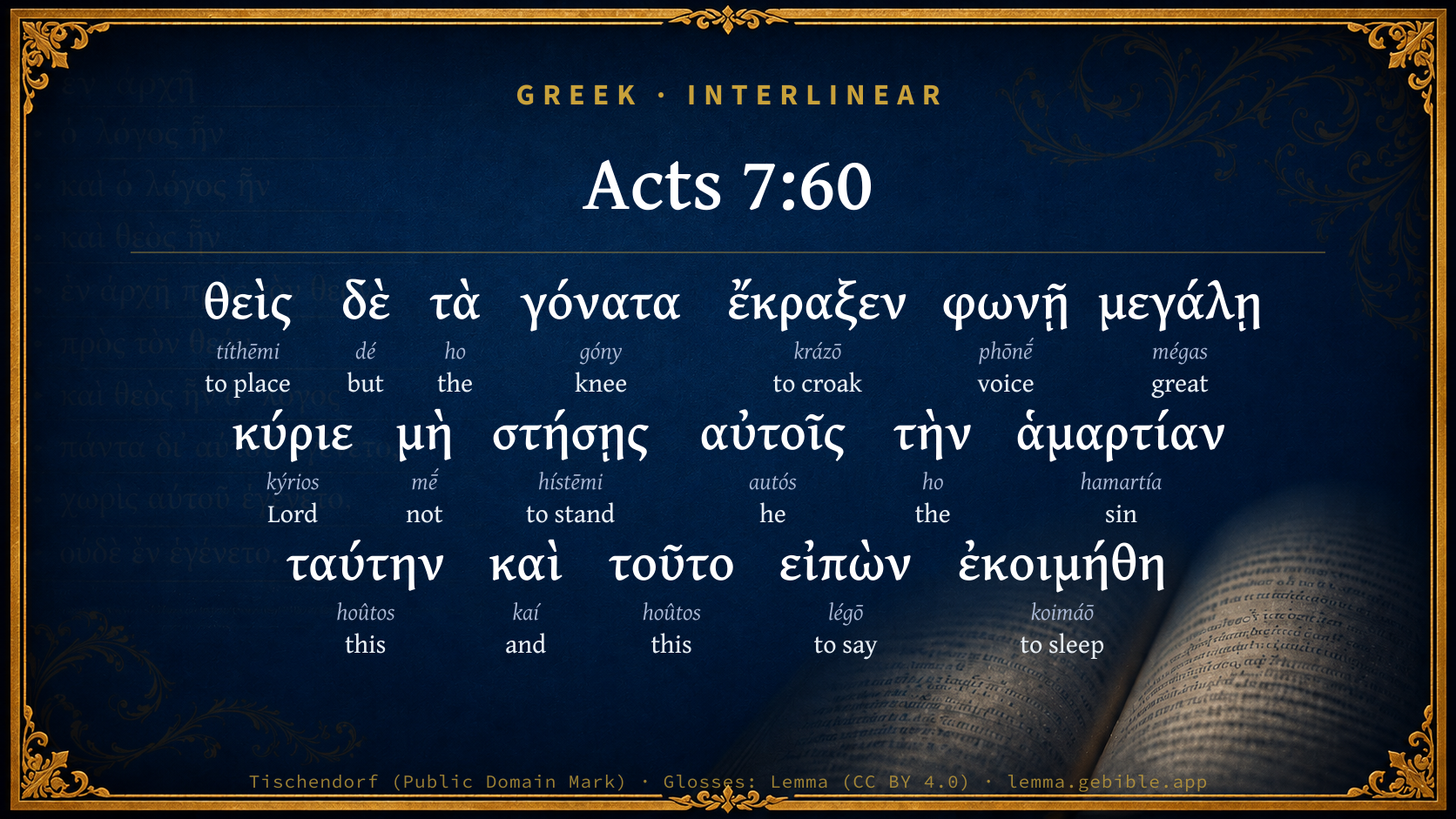
Greek (Tischendorf 8th ed.) Acts 7:60 appears in the Greek New Testament. The text above is from the Tischendorf 8th edition. Each word links to its Strong’s number and a concise gloss. Click any word for its full Thayer’s Greek Lexicon entry.
Download image
Cite this verse

Acts 7:60 (World English Bible). Public Domain. Lemma interlinear Bible study tool, https://lemma.gebible.app/v/acts/7/60.

Show BibTeX & RIS
BibTeX
RIS
English Translation
He kneeled down, and cried with a loud voice, "Lord, don't hold this sin against them!" When he had said this, he fell asleep.
World English Bible · Public Domain
Download a study sheet

One document with this verse’s original text, its word-by-word gloss line, the meaning frame, cross-references with their text, attributed commentary, and full source and license credits — printable, and it pastes into notes with its structure intact.

This verse Autodidact and up

Study sheet (.html) Plain text (.txt)

A passage Seminary Student

Up to 50 verses in one chapter. A passage sheet keeps up to 6 commentary sources and 12 cross-references per verse, in the order this page ranks them, and says so on the sheet whenever that leaves anything out. Ask for a single verse and you get the Autodidact verse sheet above.

Everything on this page stays free to read, with no account — the sheet is a download of what is already on screen, not access to it.

Want to remove ads? Support Godless Engineer
Compare translations 3

The same verse in 3 English versions, stacked beneath the original-language interlinear above. Click any original word for its lexicon entry.

Each is an independent rendering of the whole verse — the interlinear is not word-aligned to these translations.

Highlighted words mark where these versions differ — a whole-verse word diff, not a word-by-word alignment.

  • World English Bible Public Domain
    He kneeled down, and cried with a loud voice, "Lord, don't hold this sin against them!" When he had said this, he fell asleep.
  • King James Version Public Domain
    And he kneeled down, and cried with a loud voice, Lord, lay not this sin to their charge. And when he had said this, he fell asleep.
  • unfoldingWord Literal Text CC BY-SA 4.0
    But having put down knees, he cried out with a loud voice, “Lord, do not hold this sin against them.” And having said this, he fell asleep.

unfoldingWord Literal Text — © unfoldingWord, licensed CC BY-SA 4.0. Word-aligned USFM3 via Door43 (git.door43.org/unfoldingWord/en_ult).

Versions to compare (up to 4)

3 of 4 selected

Show all 18 translations

Every available English version of this verse, each an independent rendering of the whole verse.

  • World English Bible Public Domain
    He kneeled down, and cried with a loud voice, "Lord, don't hold this sin against them!" When he had said this, he fell asleep.
  • Berean Standard Bible Public Domain
    Falling on his knees, he cried out in a loud voice, “Lord, do not hold this sin against them.” And when he had said this, he fell asleep.
  • Majority Standard Bible Public Domain
    Falling on his knees, he cried out in a loud voice, “Lord, do not hold this sin against them.” And when he had said this, he fell asleep.
  • King James Version Public Domain
    And he kneeled down, and cried with a loud voice, Lord, lay not this sin to their charge. And when he had said this, he fell asleep.
  • American Standard Version (1901) Public Domain
    And he kneeled down, and cried with a loud voice, Lord, lay not this sin to their charge. And when he had said this, he fell asleep.
  • Revised Version (1885) Public Domain
    And he kneeled down, and cried with a loud voice, Lord, lay not this sin to their charge. And when he had said this, he fell asleep.
  • Geneva Bible (1599) Public Domain
    And he kneeled downe, and cried with a loude voyce, Lord, laye not this sinne to their charge. And when he had thus spoken, he slept.
  • Young's Literal Translation Public Domain
    and having bowed the knees, he cried with a loud voice, `Lord, mayest thou not lay to them this sin;' and this having said, he fell asleep.
  • Literal Standard Version CC BY-SA 4.0
    and having bowed the knees, he cried with a loud voice, “LORD, may You not lay to them this sin”; and having said this, he fell asleep.
  • Unlocked Literal Bible CC BY-SA 4.0
    He knelt down and called out with a loud voice, “Lord, do not hold this sin against them.” When he had said this, he fell asleep.
  • unfoldingWord Literal Text CC BY-SA 4.0
    But having put down knees, he cried out with a loud voice, “Lord, do not hold this sin against them.” And having said this, he fell asleep.
  • Darby Bible Public Domain
    And kneeling down, he cried with a loud voice, Lord, lay not this sin to their charge. And having said this, he fell asleep.
  • World Messianic Bible Public Domain
    He kneeled down and cried with a loud voice, “Lord, don’t hold this sin against them!” When he had said this, he fell asleep.
  • Webster's Bible Public Domain
    And he kneeled down and cried with a loud voice, Lord, lay not this sin to their charge. And when he had said this, he fell asleep.
  • Free Bible Version CC BY-SA 4.0
    He kneeled down, calling out, “Lord, please don't hold this sin against them!” And after he said this, he died.
  • Bible in Basic English Public Domain
    And going down on his knees, he said in a loud voice, Lord, do not make them responsible for this sin. And when he had said this, he went to his rest.
  • Text-Critical English NT CC BY 4.0
    Then he fell to his knees and cried out with a loud voice, “Lord, do not hold this sin against them!” After saying this, he fell asleep.
  • Tyndale New Testament (1534) Public Domain
    And he kneled doune and cryed with a loude voyce: Lorde laye not this synne to their charge. And when he had thus spoken he fell a slepe.

Literal Standard Version (2020), Covenant Press — licensed CC BY-SA 4.0. Text via the HelloAO Bible API (eBible.org). Unlocked Literal Bible (unfoldingWord) — licensed CC BY-SA 4.0. Text via the HelloAO Bible API (eBible.org). unfoldingWord Literal Text — © unfoldingWord, licensed CC BY-SA 4.0. Word-aligned USFM3 via Door43 (git.door43.org/unfoldingWord/en_ult). Free Bible Version, Dr. Jonathan Gallagher — licensed CC BY-SA 4.0. Text via the HelloAO Bible API (eBible.org).

Word by word

More ways to search: Search by grammar → Find every occurrence → Compare this word →

Practice this passage: Drill this verse → Learn its vocabulary →

γόνατα
góny
G1119
“knee”
Noun, Accusative, Plural, Neuter
Part of Speech
Noun
Case
Accusative
Number
Plural
Gender
Neuter
Full Thayer's Definition

Origin: of uncertain affinity

TDNT: 13:18,1

1. the knee, to kneel down
  1. θεὶς títhēmi G5087 “to place” Verb, Aorist, Active, Participle, Nominative, Singular, Masculine
  2. δὲ dé G1161 “but” Conjunction
  3. τὰ ho G3588 “the” Article, Accusative, Plural, Neuter
  4. ἔκραξεν krázō G2896 “to croak” Verb, Aorist, Active, Indicative, 3rd person, Singular
  5. φωνῇ phōnḗ G5456 “voice” Noun, Dative, Singular, Feminine
  6. μεγάλῃ mégas G3173 “great” Adjective, Dative, Singular, Feminine
  7. κύριε kýrios G2962 “Lord” Noun, Vocative, Singular, Masculine
  8. μὴ mḗ G3361 “not” Particle, Negative
  9. στήσῃς hístēmi G2476 “to stand” Verb, Aorist, Active, Subjunctive, 2nd person, Singular
  10. αὐτοῖς autós G846 “he” Personal pronoun, Dative, Plural, Masculine
  11. τὴν ho G3588 “the” Article, Accusative, Singular, Feminine
  12. ἁμαρτίαν hamartía G266 “sin” Noun, Accusative, Singular, Feminine
  13. ταύτην hoûtos G3778 “this” Demonstrative pronoun, Accusative, Singular, Feminine
  14. καὶ kaí G2532 “and” Conjunction
  15. τοῦτο hoûtos G3778 “this” Demonstrative pronoun, Accusative, Singular, Neuter
  16. εἰπὼν légō G3004 “to say” Verb, Aorist, Active, Participle, Nominative, Singular, Masculine
  17. ἐκοιμήθη koimáō G2837 “to sleep” Verb, Aorist, Passive, Indicative, 3rd person, Singular

About this verse

These counts appear in no published source. They are computed here, from the morphology-tagged text and Lemma’s own curated glosses. What Lemma adds →

18
words
16
distinct lemmas
Acts
section

Notable vocabulary

The rarest word here is γόνατα knee G1119 — appearing just 12 times in the whole Greek New Testament.

Shared distinctive vocabulary

γόνατα knee G1119 occurs in 12 verses of the Greek New Testament. Also found in:

Repetition

Words recur within this verse:

Cross-references

19

Topical passages linked to Acts 7:60 in the Treasury of Scripture Knowledge — connected by theme and wording, ordered by reader-vote popularity; previews shown in the World English Bible.

  • Matthew 5:44 But I tell you, love your enemies, bless those who curse you, do good to those who hate you, and pray for those who mistreat you and persecute you,
  • Luke 23:34 Jesus said, "Father, forgive them, for they don't know what they are doing." Dividing his garments among them, they cast lots.
  • 1 Corinthians 15:20 But now Christ has been raised from the dead. He became the first fruits of those who are asleep.
  • Romans 12:14–21 Bless those who persecute you; bless, and don't curse.
  • 1 Thessalonians 4:13–14 But we don't want you to be ignorant, brothers, concerning those who have fallen asleep, so that you don't grieve like the rest, who have no hope.
  • Luke 6:28 bless those who curse you, and pray for those who mistreat you.
  • Acts 9:40 Peter put them all out, and kneeled down and prayed. Turning to the body, he said, "Tabitha, get up!" She opened her eyes, and when she saw Peter, she sat up.
  • Acts 20:36 When he had spoken these things, he knelt down and prayed with them all.
  • Luke 22:41 He was withdrawn from them about a stone's throw, and he knelt down and prayed,
  • Acts 13:36 For David, after he had in his own generation served the counsel of God, fell asleep, and was laid with his fathers, and saw decay.
  • Acts 21:5 When it happened that we had accomplished the days, we departed and went on our journey. They all, with wives and children, brought us on our way until we were out of the city. Kneeling down on the beach, we prayed.
  • 1 Corinthians 15:18 Then they also who are fallen asleep in Christ have perished.
  • Daniel 6:10 When Daniel knew that the writing was signed, he went into his house (now his windows were open in his chamber toward Jerusalem) and he kneeled on his knees three times a day, and prayed, and gave thanks before his God, as he did before.
  • Matthew 27:52 The tombs were opened, and many bodies of the saints who had fallen asleep were raised;
  • 1 Corinthians 15:6 Then he appeared to over five hundred brothers at once, most of whom remain until now, but some have also fallen asleep.
  • 1 Thessalonians 5:10 who died for us, that, whether we wake or sleep, we should live together with him.
  • Ezra 9:5 At the evening offering I arose up from my humiliation, even with my garment and my robe torn; and I fell on my knees, and spread out my hands to Yahweh my God;
  • 1 Corinthians 11:30 For this cause many among you are weak and sickly, and not a few sleep.
  • 1 Corinthians 15:51 Behold, I tell you a mystery. We will not all sleep, but we will all be changed,

Cross-references courtesy of OpenBible.info (CC BY 4.0).

Commentary

Notes on Acts 7:60 from classic Christian and Jewish commentators (each source and its license shown beneath its notes). The classic Christian expositions comment on the surrounding passage and are grouped to its opening verse, so a note may address several verses; the Jewish commentaries on the Tanakh (Rashi and others) are per-verse, so they appear only where the commentator wrote on this verse.

Lemma curates 59 commentaries, every one of them public domain or Creative Commons licensed, each selected and text-cleaned for this edition rather than reprinted as found. About our sources →

The Biblical Illustrator

Joseph S. Exell

Act_7:60

And he kneeled down, and cried with a loud voice.

The best testament of a Christian

To commend--

1. His soul to heaven.

2. His body to the earth.

3. His friends to the Divine protection.

4. His enemies to the Divine compassion. (Starke.)

The power of Christ in believers

I. He strengthens them to boldness in confessing, the power of which their enemies cannot resist.

II. He adorns them with purity of conduct, which the tongues of blasphemers cannot stain.

III. He fills them with a tenderness of love, which prays for their bitterest enemies.

IV. He sweetens their dying with a blessed insight into His eternal glory. (Leonhard.)

Stephens three crowns

I. The fair crown of grace, with which the Lord adorned him in life and death.

II. The bloody crown of thorns, which he wore after his Saviour in suffering and death.

III. The heavenly crown of glory, which was reserved in eternity for the faithful martyr. (K. Gerok.)

The victory of dying Stephen

I. He triumphs over the murderous cry of a hostile world by a look of faith to heaven.

II. He overcomes the sharpness of death by a child-like surrender of his spirit into the arms of Jesus.

III. He triumphs over flesh and blood by a priestly petition for his murderers. (K. Gerok.)

The Cross of Christ reflected in Stephen, living and dying

I. The shame of the cross.

1. Before the same council.

2. The like false accusations.

3. A similar thrusting out of the city.

4. The like unrighteous doom.

II. The glory of the cross, displayed--

1. In courageous defence.

2. In patient meekness.

3. In love, blessing its enemies--Jesus first and Stephens last dying words.

4. In a blessed hope of heaven. (K. Gerok.)

Lord, lay not this sin to their charge.--

The request of Stephen

The request--

1. Of one dying.

2. Of a soul that entirely forgets itself.

3. Of a man who is striving after nothing but the kingdom of God. (Schleiermacher.)

The magnanimity of the Christian spirit

This is shown by--

1. The victories it achieves over the corrupt affections of the human heart.

2. Its superiority to the principles, spirit, and practices of the world.

3. Its fortitude under the infliction of unprovoked injuries.

4. The support and consolation which it gives in seasons of pain and sorrow, and the victory it achieves over the king of terrors.

5. The benevolence and grandeur of its purposes, and the labours and sufferings which it prompts in the execution of them. (G. N. Judd, D. D.)

Forgiveness: its nature

A forgiving spirit is a noble, generous Christian virtue. It takes its rise in that love of God and man which is the fruit of the Spirit and the fulfilling of the law; it is made up of love and forbearance, united with the tenderness of compassion towards those who have injured us, and fortified by some just sense of our own sinfulness and need of forgiveness from God. In the full sense of the thing itself, it consists of the inward spirit of forgiveness and the outward act of reconciliation. It belongs to the heart, just as every other grace has its seat in the inner man. In this view of it, it is the opposite of revenge, which angrily seeks redress for injuries by inflicting injuries in return. It is the inward exercise of kindness and good-will toward our enemies. (G. Thring, D. D.)

Forgiveness: its rarity in heathendom

Of forgiveness, we cannot certainly say that it was unknown to the ancients; under certain conditions, no doubt, it was very common among them. In family life, in which all the germs of Christian virtue are to be found, it was undoubtedly common. Undoubtedly friends fell out and were reconciled in antiquity, as amongst ourselves. But where the only relation between the two parties was that of injurer and injured, and the only claim of the offender to forgiveness was that he was a human being, then forgiveness seems not only not to have been practised, but not to have been approved. People not only did not forgive their enemies, but did not wish to do so, nor think better of themselves for having done so. That man considered himself fortunate who on his death-bed could say that no one had done more good to his friends or more mischief to his enemies. The Roman Triumph, with its naked ostentation of revenge, fairly represents the common feeling of the ancients. Nevertheless, forgiveness of enemies was not unknown. They could conceive it, and feel that there was a Divine beauty in it; but it seemed to them more than could be expected of human nature--almost superhuman. (Ecce. Homo.)

Forgiveness: its nobility

Generous and magnanimous minds are readiest to forgive; and it is a weakness and impotency of mind to be unable to forgive. (Lord Bacon.)

Forgiveness: a sign of a noble nature

The brave only know how to forgive; it is the most refined and generous pitch of virtue human nature can arrive at. Cowards have done good and kind actions; cowards have fought and even conquered; but a coward never forgave: it is not in his nature; the power of doing it flows only from a strength and greatness of soul, conscious of its own force and security, and above the little temptations of resenting every fruitless attempt to interrupt its happiness. (Laurence Sterne.)

Forgiveness: the mark of a Christian

As a seal leaves a mark of itself in the wax, whereby it is known; so it is with every one who has a readiness to forgive others: for by it the Christian may know that God hath sealed the forgiveness of his sins upon his heart. (Cawdray.)

Forgiveness: the power of Christ necessary to

What can Jesus Christ do for you now? said an inhuman slave-master, when in the act of applying the lacerating whip to an already half-murdered slave. Him teach, me to forgive you, massa, was his reply. (Phillips.)

And when he had said this, he fell asleep.--

Stephens sleep

I. Every man is bound to do something before he die.

1. Every man is bound to be something, to take some calling upon him. We begin with our beginning, our birth. Man is born to labour (Job_5:7; Hebrews). Howsoever honourable his station is, he is bound to do his days work in the day, the duties of the place in the place. How far is he from doing so who never so much as considers why he was sent into this world, and in spite of all that God has done for him, and taught him in creation and redemption! Such a man passes through life as an ignis fatuus, which gives no light, and signifies nothing. He passes out of the world as a body out of a bath, when the water may be the fouler, but otherwise retains no impression; so the world may be the worse for his having lived in it, or else retains no mark of his having been here. When God placed Adam in the world He enjoined him to fill, subdue, and rule it; when God placed His children in the land of promise He enjoined them to fight against idolatry--to everybody some task for His glory. God made every man something, but many make the best of things, man, nothing. He that qualifies himself for nothing does so; he whom we can call nothing is nothing. Gods own name is I am--Being, and nothing is so contrary to God as to be nothing. Be something or else thou canst do nothing, and till thou hast done something thou canst not sleep Stephans sleep.

2. Every man is bound to do seriously, sedulously, and sincerely the duties of his calling. He that stands in a place and does not the duties of that place is a statue, and a statue without an inscription. The duty in the text is speaking, When he had said, a duty devolving upon ministers and magistrates, and unless they speak, and speak to purpose, they cannot sleep Stephens sleep. But as in creation God does as well as says, so we must not only speak, but act. Therefore do not complain that God exacts the duties of thy place, and say not of it that it is good for nothing, for it is good for this that when thou hast discharged its duties thou mayest sleep Stephens sleep.

3. The better to perform those duties every one shall do well to propose to himself some example to imitate in that calling, It was the counsel of that great little philosopher, Epictetus, whensoever thou undertakest any action to consider what a Socrates or a Plato would do in that case, and to do conformably to that. Here is an example which suits everybody.

(1) Note this name, Stephen, a crown--the reward of faithfulness. Our names are debts; every man owes the world the signification of his name, and every additional name of honour or office lays a new obligation on him; and his first name, his Christian name above all. The duties of a Christianity must weigh down the duties of all other plans.

(2) He became a disciple early, and therefore takes rank even before Paul.

(3) He made his ambition only to serve Christ, and not in a high place, but as a deacon.

(4) But Stephens exemplariness consists not so much in what he did as in what he suffered. He cheerfully laid down his life for Christs sake. To suffer for God is the greatest thing in the world, except Gods sufferings for man. The latter was the nadir of Gods humiliation, the former is the zenith of mans exaltation. Nor is it needful to suffer death to imitate Stephen. Every man who suffers injuries without resentment, who resists temptations from power or pleasure, who cheerfully bears Gods crosses, is a true copy of Stephen.

(5) Christ was his and our supreme pattern, as we see conspicuously here.

II. To that man who hath done those things which the duties of his calling bind him to, death is but a sleep. There are two classes of men, those who die in the bath of a peaceable, and those who die upon the wreck of a distracted conscience--and the lives of each are correspondent to, and lead up to their death.

1. The death of the wicked is not a sleep.

(1) It is bloody conflict and no victory.

(2) It is a tempestuous sea and no harbour.

(3) A slippery height and no footing.

(4) a desperate fall and no bottom.

2. The death of the righteous is a sleep. They do not only go to heaven by death, but heaven comes to them in death; their very manner of dying is an inchoative act of their glorified state: therefore it is not called a dying, but a sleeping, which intimates two blessings--

(1) Present rest. Now men sleep not well fasting; nor does a fasting conscience, a conscience that is not nourished with a testimony of having done well, come to this sleep. The sleep of a labouring man is sweet, and to him that laboureth in his calling this sleep of death is welcome (Pro_3:24; Psa_4:8).

(2) Future waking is the resurrection (1Th_4:14). They shall awake as Jacob did, and say as he said, Surely the Lord is in this place, and this is none other than the house of God and the gate of heaven. (J. Donne, D. D.)

The death of Stephen

I. In Stephen we have a pattern of faith. He knew and was persuaded that his gracious Redeemer reigned on high, that He was not unmindful of His followers on earth, and would keep that which was committed to Him till the day of His appearance. Depending on this hope, he died with a composure and magnanimity which religion alone can produce.

II. In Stephen we have an example of unshaken constancy in obedience to God. When he was chosen a deacon to assist the apostles in managing the concerns of the Church, he had a high character for piety, integrity, and wisdom. Nor did he ever afterwards do anything to forfeit that character. On the contrary, the more he was tried, the more his virtues shone forth. Let his unshaken constancy be a pattern to us. Religion does not consist of fits and starts of devotion, of resolutions that are quickly made and as quickly abandoned, of that wavering and inconsistent conduct which always indicates unsoundness in the faith. It is a steady principle abiding in the heart and influencing the conduct.

III. In Stephen we have a pattern of pious resignation. No complaining words proceeded from his lips. He discovered no distrust of the power, or the love of his Saviour. We may not have trials to endure, like Stephen, but we are placed in a situation which will afford ample scope for the exercise of resignation. We are subject to sickness, losses, and disappointments, together with innumerable vexatious circumstances, which we cannot prevent. We should ever remember that God is the sovereign disposer of all events; that He has a right to place us in what station, and expose us to what sufferings He pleases. But though the sovereignity of God over His creatures be absolute, yet we know that He doth not afflict willingly, nor grieve the children of men. These very sufferings may be the means of our salvation. Such considerations will prevent murmuring, and dispose us to a calm acquiescence in the appointments of Providence. This pious principle will diffuse its benign influence over the whole soul. It will soothe our sorrows, overcome our angry passions, and sweeten the bitter cup of life. The God whom we serve will grant us support and consolation here, and bestow upon us unspeakable happiness hereafter.

V. In Stephen we have a pattern of forgiveness. If we examine the history of the world, we shall find that many of the evils which from age to age have afflicted mankind, have arisen from a revengeful and unforgiving spirit. In ancient times this spirit, exerting itself without control, diffused over every land its baneful influence, producing contention and strife and every evil work. This spirit, so adverse to human improvement, our Saviour set Himself upon all occasions to correct and to subdue. He inculcated brotherly love to an extent till then altogether unknown. Love your enemies, etc., If we forgive not our brethren their offences, neither will God forgive us our offences. This consideration should lead us earnestly to cultivate a meek and forgiving spirit. In this spirit there is a dignity, a magnanimity, an excellence, which the sons of dissipation and the votaries of pleasure may envy and ridicule, but which the Christian, who aspires to the inheritance of the blessed, will cherish as one of the highest attainments that can adorn his character. And while he does so, every revengeful principle will die in his breast. He will be at peace with all mankind, and the peace of God which passeth all understanding will keep his heart and mind through Christ Jesus. (John Ramsay, M. A.)

Death to the believer: what

I. What death is to the believer.

1. A sleep. The expression conveys a sweet idea of placidity and calmness. The day of life declines; the shadows of its evening fall around; wearied and exhausted nature needs repose; its strength is weakness, yea, it may be labour and sorrow, and in the appointed moment the believer falls asleep.

2. Nor is it a troublous rest: it is a peaceful sleep. Mark the perfect man … for the end of that man is peace. The stroke of death--the pain of dissolution, is, as it were, but the kind alarm which leads a child of God to shelter himself more closely in the bosom of Gods paternal love. Since the Redeemer died, death has been abolished in its penal terror. By descending, too, into the grave, He has dispelled the graves dark horrors, and sanctified the resting-place of His dear and believing people. The grave, therefore, is now no more than the bed where the mortal remains of the believer rest in peaceful hope.

3. A sleep from which he shall awake. Them that sleep in Jesus will God bring with Him to reward them. The night of the grave will pass away; the morning of the resurrection-day will dawn, and the dead in Christ shall rise first. Nothing shall resist the voice which will say, Come forth.

4. A sleep into which, when once awakened, he will fall again no more. Death hath no more dominion over Christ: death shall have no more dominion over one that believes and loves and serves Him, and is risen together with Him. As surely as He that was dead, is alive again and liveth for evermore, so surely shall the believer rise to live for ever. In the new heavens and the new earth there shall be no more death. The purified and ennobled powers of a glorified saint, will be too vigorous ever to need repose again. No second death awaits the believer. The gift of God is eternal life; whoso liveth and believeth in Him shall never die. Thus the righteous hath hope in his death.

II. Whence it is he dies so calmly. Simply because he is a believer. By faith he becomes interested in all the benefits which result from the meritorious cross and passion of Jesus Christ. Like the martyr Stephen, the believer--

1. Partakes of the Holy Ghost.

2. Sees Jesus standing on Gods right hand--not indeed as Stephen visibly, but by faith. And where He is those who believe on Him may be also. In a persuasion of this sweet truth, the believer may smile in death.

3. Has a Friend, to whose care he may commit his departing spirit. Unspeakably precious is this privilege. Our earthly friends may go with us, in their kind solicitude, to the verge of death; but there the dearest ties must be severed, and a last adieu be bidden. One there is, however, that can be with us in the shadowy vale, support and cheer us through it, and while our mortal eyes are closing on all terrestrial objects, He can give to our faith such brightening views of celestial glory as will enrapture our departing spirits, and fill them with desire to wing their upward flight. As amidst the oceans billows the shipwrecked mariner will cling with increasing tenacity to the floating plank, so amidst the agonies of death the believer lays a firmer and still stronger hold upon the hope of life in Christ. He sees his Lord above him: and whilst he hears the gracious words, Fear not, for I am with thee, Receive my spirit, may he cry; and very gracious will the Lord be to him at the voice of his prayer. So the Lord giveth His beloved sleep; and hence it is the believer dies so calmly.

In conclusion let me exhort you--

1. To awake from the slumbers of sin. How many, alas! are there dead in trespasses and sins! While they continue so, they cannot possibly sleep in Jesus or die in the Lord. Do not be saying in your heart, A little more sleep, a little more slumber, a little more folding of the hands to sleep. Take care lest your sleep in the death of sin be perpetuated till you sleep in the death of nature. Take care lest when many of them who sleep in the dust of the earth shall awake, you rise--not to shine as the firmament and as the stars for ever and ever, but to shame and everlasting contempt.

2. To believe on the Lord Jesus Christ. Without Him, to die peacefully, in the Scripture sense of the word, would be impossible.

3. To do immediately what you purpose doing. Now is the day of salvation. (W. Mudge, B. A.)

Death a sleep

Sleep is not unfrequently used by ancient heathen writers for the same general purpose of denoting the termination of human life. The still, quiescent state into which man passes when he sinks into repose is no unapt image of what takes place in appearance when man expires, more especially if under circumstances of gentle dissolution. It was only in such circumstances that the metaphor would have been deemed appropriate by a heathen, and would not probably have been used in a case like the present. To one, however, who, like the author of this history, regarded the present life as introductory to a better world, and who held the doctrine of the resurrection, death under whatever circumstances was regarded as being merely a sleep. This language suggests two ideas.

I. The state of the grave is not permanent: it is a sleep.

1. Sleep is not the extinction, but a suspension, of the faculties, and extends only to the body. The mind continues its activity, and when we awake the two continue as before to act together. Death is not the final end of man. The stroke which consigns the body to the grave does not destroy the active, functions of the soul. It still subsists in a state of consciousness, and at the resurrection it will be again united to its corporeal companion. He whom Stephen saw standing on Gods right hand had formerly suffered the pangs of dissolution.

2. On the subject of the resurrection many difficulties have been proposed and questions started, and some have taxed ingenuity in framing answers. But, perhaps the best answer is a short and simple one--the resurrection is an act of Omnipotence. If this is admitted, to speculate on the supposed obstacles to its accomplishment is useless. Is anything impossible with God? But independently of Divine revelation, there are many presumptions of the resurrection. Inanimate nature undergoes an annual death and resurrection. But however striking vegetable analogies are, they afford a far less satisfactory presumption of immortality than that which is derived from contemplating the sufferings of good men, and to which even their virtues in some cases contribute. Can it be that the man, like Stephen, shall have no other recompense for his virtues but pain and torture; while ease, affluence, and secular honours shall be the lot of those who have been his tormentors?

II. The state of the grave will, to the Christian, be in its consequences improving. It is a sleep.

1. All have experienced the feeling induced after a day of severe exertion. Both body and mind are jaded. You know likewise what in health are the feelings after a night of sound repose; you rise invigorated, and are in some respects new men. In this the resemblance holds between sleep and death. In advanced age the mind and the body equally exhibit symptoms of decay; and disease, at any period of life, will soon produce in both mind and body the effects which are produced by age. When they are reunited, after the body has been raised from the grave, we shall be free from former imperfections, and those numerous sufferings which are connected with the body will he no more known. It must be obvious, however, from this statement, that the analogy in this case is in some respects far less perfect than in the former. In awaking after the slumbers of the night, though invigorated in comparison of what we were at the time when, through the exhaustion of nature, sleep became necessary, there is no alteration in our general condition. It is otherwise after the repose of the grave. On the morning of the resurrection we will not only be different from what we were at the time when natural decay or disease brought on dissolution, but different from what we ever have been.

2. To render a future life an object of desire, it is necessary that it should be an improvement on the present. Take away from the enjoyments of this life the pleasure connected with the hopes of another, and a good man would have little inducement to resume it. If the feelings of the worldly man were analysed, it would perhaps be found that even in his case, at every period of life, it is the hope of something better that is his chief support. Much more is hope the principle of a Christian--a hope which is not restricted to the expectation merely of another life, but includes in that other the expectation of a better. In the Christian this hope will not be disappointed. Of this highly consolatory doctrine Stephen had an ocular demonstration. In what Jesus now is, Stephen saw what His followers shall be. (R. Brodie, A. M.)

Death a sleep

When a person is asleep what is it that rests? It is simply the muscles and the nerves and the weary limbs. The heart goes on beating, the lungs respiring and expiring; and what is remarkable in sleep, the soul never sleeps at all It seems that when one is asleep the soul often travels to far distant lands, or sails upon the bosom of the deep, amid the blue hills and green glens of other parts of the land; exploring, thinking, searching, studying. The soul is never literally dead (though it may forget) to every thought and object, to all that enters by the avenues of the senses. If sleep be the metaphor of death, it does not prove that the soul is insensible, but only that the body, the outward garment only, having been worn and wasted in the wear and toil of this present life, is folded up and laid aside in that wardrobe--the grave--a grave as truly in the keeping of the Son of God as are the angels in glory. (J. Cumming, D. D.)

Death a sleep

You cannot find in the New Testament any of those hateful representations of dying which men have invented, by which death is portrayed as a ghastly skeleton with a scythe, or something equally revolting. The figures by which death is represented in the New Testament are very different. One is that of falling asleep in Jesus. When a little child has played all day long, and become tired out, and the twilight has sent it in weariness to its mothers knee, where it thinks it has come for more excitement, then, almost in the midst of its frolicking, and not knowing what influence is creeping over it, it falls back in the mothers arms, and nestles close to the sweetest and softest couch that ever cheek:pressed, and, with lengthening breath, sleeps; and she smiles and is glad, and sits humming unheard joy over its head. So we fall asleep in Jesus. We have played long enough at the games of life, and at last we feel the approach of death. We are tired out, and we lay our head back on the bosom of Christ and quietly fall asleep. (H. W. Beecher.)

The sleep of death

Asleep amid a storm! He felt asleep--not, he died, or he breathed his last, but he fell asleep. Death is but a sleep; we need no more shrink from dying than from our nightly beds; we may lie down to die with just as sure a hope of rising; we may look forward to it as the release from all the cares, all the work of life. Moses of old had been warned of the time when he should sleep with his fathers (Deu_31:16). The wise man talks of Samuels long sleep (Ecc_5:12). David, we read, fell on sleep (Act_13:36). Monarch after monarch is laid in his tomb, by the sacred writer, with the short epitaph, that he slept with his fathers. Daniel prophesies of the time, when those who sleep in the dust of the earth shall awake (Dan_12:2). Amid the convulsions by which Nature testified her horror at the dread hour of the Passion, the graves were opened, and many bodies of the saints which slept arose (Mat_27:52). So St. Paul (1Co_15:18; 1Co_15:20; 1Th_4:13-14). Such a faith speaks still upon the walls of the ancient cemeteries in the catacombs of Rome, where to this day the simple inscriptions are preserved, by which faith and affection marked the remains of their lost, in the first and second centuries after Christ. On one we read two words, Victoria sleeps--or, Saturninus sleeps in peace.--Zoticus is laid here to sleep.--Domitian, artless soul, sleeps in peace.--Antonia, sweet soul, in peace. May God refresh her.--Arethusa sleeps in God.--He sleeps, but lives.--Laurinia, sweeter than honey, rests in peace.--On the 5th of November was placed here to sleep, Gregory, friend of all, the enemy of none.--Or, with a studied conciseness, Clementia, tortured, dead, sleeps; will rise again. Faith loved to dwell upon an image which represented so sweetly her hope in dying. But reason here comes in aid of Faith; and the more closely we look into the nature of sleep and of death, the more exact is the resemblance we shall discern.

1. Sleep, first of all, is a mystery to us. What wonder death should be? Sleep is one of the greatest mysteries of our existence here, so mysterious that were it not so familiar to us, we should every day be wondering about it, that out of the short life God has given us for our probation, full one-third should be spent in a state of inaction, when we can do neither good nor bad. Even so shall we lie inactive in our graves. Is it a mystery, again, how we die? And who can understand how we fall asleep? It comes upon us, we know not how. We cannot recollect it afterwards. Our consciousness dissolves, and we are asleep. And so it may be at death. We lie uneasily on our bed; we try to die: on a moment the last tie is loosed; and, we know not how, we are away. Sleep soothes every pain, forgets every care; angry tempers, disappointments, want, unkindness, all the miseries of life are left behind in a moment. And so it will be at death. A parting struggle or two, one last breath, and there is neither sorrow nor sighing, neither any more pain, for the former things are passed away.

2. The hours of sleep level all the inequalities of life, and make the poor man as happy as the king (Job_3:17-19).

3. Sleep unlooses all the ties of life, and death breaks them. In sleep the soul is disengaged from the trammels of the body; and thus we may form a conjecture how it will exist separately from it hereafter. We lie asleep, the eyes are closed, the ears are deaf, the hands lie uselessly by our side; but the mind is busily at work, and revolves within itself all those images which have been conveyed into it in our waking hours. We can so, I say, guess how, amid the darkness and silence of the grave, the soul will be able to rehearse to itself all the experience of life; and with the avenue of the senses then cut off, will have material enough within itself for incessant activity and thought.

4. Sleep, instead of contracting the powers of the mind, gives keenness to the memory, and wings to the imagination. And will not this again help us to understand how, when we have left this material world behind us, and the sheath of the body no longer encases the soul and dulls her edge, that the emancipated spirit then will be able at a glance to recall with the exactest truth the entire history of life? And when we read of the books being opened, and the judgment set, and the dead, both small and great, being judged out of the things that were written in the books; what else may be intended here, than this book of memory and conscience, with every old impression revived afresh, so that the sinner sees all his sins before his face, and goes away to his own place, speechless and without appeal, self-condemned? In sleep the mind is emancipated from the restrictions of bodily life, and the limitation of time and space. A succession of images crowd into the minds and we live a life long in a night. This is a sort of foretaste of the freedom from material ties, which the disembodied spirit shall enjoy.

5. It is in the time of sleep, again, that the soul, half-loosened from the body, is most open to communications from the unseen world (Job_33:15-16). It was in the hour of sleep, in a vision by night, that the angel appeared to Mary, and to Joseph and to Daniel. The spirits of another world may have peculiar access to our souls when we are disengaged from this; and those that sleep in Jesus may so enjoy unrestrained communion with the innumerable company of angels. And the Father of the spirits of all flesh may thus be instructing and preparing them for His glorious kingdom. This long sleep of peace may thus be as needful for the expansion and perfection of our nature, as our nightly slumber is for the growth of our present frame, and for the refreshment of soul and body. Morning after morning now we each may thank our Maker, I beheld and awaked, my sleep was sweet; unto me; and every such arising we may hail as an omen of the day, when our eyes shall be opened to behold Gods presence in righteousness, when we shall wake up after Christs likeness, and be satisfied with it. Such a waking, who will not look up and hope after? Such a sleep, who need mistrust or fear? And would we know how we may so sleep with God? A quiet conscience gives the sweetest sleep. Night after night, let us take a closer and closer view of death, and then we shall not start from it when it comes. We shall lie down at last and be glad of it, just as we are glad to fall asleep. (C. F. Secretan, M. A.)

The blood of the martyrs the seed of the Church

Stephen was dead, and it might well have seemed that all the truth which was to be the glory and the thought of Christianity had died with him. But the deliverance of the Gentiles, and their free redemption by the blood of Christ, were truths too glorious to be quenched. The truth may be suppressed for a time, but it always starts up from its apparent grave. Fra Dolcino was torn to pieces, and Savonarola and Huss were burnt, but the Reformation was not prevented. Stephen sank in blood, but his place was taken by the young man who stood by to incite the murderers. Four years after Jesus had died on the Cross Stephen was stoned for being His disciple; thirty years after the death of Stephen his deadliest opponent died also for the same holy faith. (Archdeacon Farrar.)

.

The Biblical Illustrator, edited by Joseph S. Exell (c. 1880s–1900s) — public domain. Text from a community e-Sword module.

Burkitt's Expository Notes on the New Testament

William Burkitt

We had St. Stephen’s prayer in the foregoing verse for himself: here in this verse he prays for his murderers.

Here note, 1. His pious charity in forgiving his enemies, and praying for them, that God would forgive them also; Lord, lay not this sin to their charge; How doth this holy martyr imitate his dying Saviour? Father, forgive them Luk 23:34.

Note, 2. His regular charity: his charity began at home; he prays first for himself, then for his murderers; first, Lord Jesus, receive my spirit; next, Lord, lay not this sin to their charge.

Where remark, That Christ prayed first for his enemies, then for himself, Father forgive them: Father, into thy hands I commit my spirit Luk 23:35-36; but St. Stephen intercedes first for himself. The reason of the difference is this, Christ needed no prayer for himself, but Stephen did: We are to love our enemies as ourselves; but Christ loved his enemies above himself, and better than himself. Christ’s love to his enemies was the copy and pattern, St. Stephen’s but the transcript.

Note, 3. His holy fervency in prayer: he cried out with a loud voice, endeavouring by the cry of his prayers to drown the noise of the stones which rattled about his ears, and to divert that shower of vengeance form them, which their shower of stones upon him deservedly called for from heaven.

Note, 4. The holy martyr prayed for himself standing, but for his enemies kneeling. Act 7:59. He stood when he said, Lord Jesus, receive my spirit; but Act 7:60 when he said, Lord, lay not this sin to their charge, he kneeled down and cried. He was more importunate for his enemies, than he was for himself. How near did St. Stephen, the first martyr, come to his blessed Master Jesus Christ, in praying for his enemies?

Note, 5. The success and benefit of his prayer: God heard and answered Stephen’s prayer in Paul’s conversion, recorded in the ninth chapter. Si Stephanus no orasset, Ecclesia Paulum non habuisset, saith one of the ancients; "Saul’s conversion was owing to St. Stephen’s intercession."

Note, 6. The holy man’s exit and happy conclusion. He fell asleep.

Where note, 1. The thing recorded of him is his death.

2. The metaphor which his death is set out by, and clothed with, and that is sleep.

3. The circumstance of time when he fell asleep, namely, after he had served Christ, and suffered for him.

Learn thence, That is is a blessed thing when death calls us off the stage of this world, after a life of service and suffering: When he had so said, he fell asleep.

Happy is that Christian who falls asleep with his Lord’s work in his hand.

William Burkitt's Expository Notes on the New Testament (1700–1703) — public domain. Text from a community e-Sword module.

Expositor's Greek Testament

ed. W. Robertson Nicoll

Act 7:60 . θεὶς δὲ τὰ γόνατα : a phrase not used in classical writers, but Blass compares Ovid, Fasti , ii., 438; five times in St. Luke’s writings, Luk 22:41 , Act 9:40 ; Act 20:36 ; Act 21:5 ; only once elsewhere in N.T., Mar 15:19 . The attitude of kneeling in prayer would no doubt commend itself to the early believers from the example of their Lord. Standing would seem to have been the more common attitude among the Jews, but cf . instances in the O.T. of kneeling in prayer, LXX, 1Ki 8:54 , Ezr 9:5 , Dan 6:10 , and also the expression used twice by St. Paul, κάμπτειν τὰ γόνατα , 1Ch 29:20 , 1Es 8:73 , Isa 45:23 , etc., Eph 3:14 , and Phi 2:10 (Rom 11:4 ; Rom 14:11 ). See Friedrich, Das Lucasevangelium , p. 42. φωνῇ μεγάλῃ , cf. Luk 23:46 . The last final effort of the strong love which showed itself also in the martyr’s bended knees (see Wendt, in loco ), Eusebius, H. E ., v., 2, tells us how the martyrs of Vienne and Lyons took up St. Stephen’s words in their own prayer for their persecutors ( cf. the famous instance of the last words of Sir Thomas More before his judges, and Dante, Purgatorio , xv., 106 ff., on the dying Stephen): μὴ στήσῃς αὐτοῖς τὴν ἁμαρτίαν ταύτην : the negative expression best corresponds to the positive ἀφιέναι τὴν ἁμαρτίαν (Wendt), cf. 1Ma 13:38-39 ; 1Ma 15:5 ; 1Ma 15:8 , where the contrast marked between ἱστάναι and ἀφιέναι seems to favour this explanation. Blass takes it as marking a contrast like that between ἱστάναι and ἀναιρεῖν , cf. Heb 10:9 . Weiss lays stress upon ταύτην , and regards the prayer as asking that their present sin might not be weighed out to them in an equivalent punishment, cf. Grotius on the Hebrew שָׁקַל , 1Ki 20:39 , whilst De Wette (so Felten) takes it as simply “reckon it not,” i.e. , “weigh it not,” cf. Zec 11:12 . Schöttgen sees a reference to the Rabbinical notion “si quis bonum aut malum opus facit, hoc sequitur eum, et stat juxta eum in mundo futuro,” Rev 14:13 , and cf. a similar view quoted by Farrar, St. Paul , i., 167. Rendall regards it as a judicial term, as if Stephen appealed to Christ as Judge not to impute their sin to the murderers in condemnation (Rom 10:3 ). The words of St. Stephen again recall the words of his Master, Luk 23:34 , words which (Eusebius, H. E., cf. ii., 20) also formed the dying prayer of James, “the Lord’s brother”. In James as in Stephen we may see how the true Christian character, whilst expressing itself in righteous indignation against hypocrisy and wrong, never failed to exhibit as its counterpart the meekness and gentleness of Christ. ἐκοιμήθη ( cf. 1Co 15:18 ), a picture-word of rest and calmness which stands in dramatic contrast to the rage and violence of the scene. The word is used of death both in LXX and in classical Greek, cf., e.g. , Isa 14:8 ; Isa 14:18 ; Isa 43:17 , 1Ki 11:43 , 2Ma 12:45 , etc.; Homer, Il. , xi., 241; Soph., Elect. , 509. Blass well says of this word, “sed nullo loco æque mirandum,” and describes the reference in Homer, κοιμήσατο χάλκεον ὕπνον , as “et simile et dissimile”: Christians sleep in death, but no “brazen sleep”; they sleep ἐν Χριστῷ ; simple words which formed the epitaph on many a Christian grave in Him, Who is Himself “the Resurrection and the Life”. Page notes the cadence of the word expressing rest and repose, cf. Farrar, St. Paul , i., 167, note, and ἀκωλύτως , Act 28:31 .

St. Stephen’s Speech . Many and varied explanations have been given of the drift and purpose of St. Stephen’s address. But the various explanations need not be mutually exclusive, and St. Stephen, like a wise scribe instructed unto the kingdom, might well bring out of his treasury things new and old. It is often said, e.g. , that the address is no reply to the charges alleged, that it would be more intelligible how the charges were framed from a perversion of the speech, than how the speech could be framed out of the charges; whilst, on the other hand, it is possible to see from the opening to the closing words an implicit repudiation of the charges of blasphemy against God and contempt of the law. The speech opens with a declaration of the divine majesty of Jehovah; it closes with a reference to the divine sanction of the law, and with the condemnation of those who had not kept it. This implicit repudiation by Stephen of the charges brought against him is also contained in St. Chrysostom’s view of the purpose of the martyr, viz. , that he designed to show that the covenant and promises were before the law, and sacrifice and the law before the temple. This view, which was adopted by Grotius and Calvin, is in some degree retained by Wendt (so also Felten), who sums up the chief aim of the speech as a demonstration that the presence of God is not confined to the holy place, the temple, but that long before the temple was built, and before the people had settled in the promised land, God had given to the fathers a share in the proofs of this revelation, and that too in strange countries (although there is no reason to suppose that Stephen went so far as to contend that Jew and Gentile were on a precisely equal footing). But Wendt is conscious that this view does not account for the whole of the speech, and that it does not explain the prominence given in it to the obstinacy of Israel against the revelation of God vouchsafed to Moses, with which the counter accusation against Stephen is so closely connected (see Spitta’s severe criticism, Apostelgeschichte , pp. 111, 112, and Weizsäcker’s evident failure to maintain the position that the climax of the whole address is to be found in the declaration about Solomon’s temple, which he is obliged to explain as a later thought belonging to a later time, Apostolic Age , i., pp. 68 71, E.T.). Thus in his last edition, p. 151 (1899), he points out that in section Act 7:35-43 , as also in Act 7:25 ; Act 7:27 , the obstinacy of the people against Moses, sent to be their deliverer, is evidently compared with their obstinacy in rejecting Jesus as the Messiah, and in Act 7:51-53 the murder of Jesus is condemned as a fresh proof of the opposition of the people to God’s revelation to them: here is a point of view which in Wendt’s judgment evidently had a share in the composition of the address. Wendt urges his view against the older one of Meyer and to some extent at all events that of Baur, Zeller and Overbeck, that the central point of the speech is to be found in Act 7:51 , to which the whole preceding sketch of the history of the people led up: however great had been the benefits bestowed by God upon His people, on their part there had been from the beginning nothing in return but a corresponding thanklessness and resistance to this purpose. McGiffert, Apostolic Age , pp. 87, 88, also recognises that the theme of the address is to be found in Act 7:51-53 , but he also admits the double purpose of St. Stephen, viz. , not only to show (as Meyer and others) that at all stages of their history Israel had been stiffnecked and disobedient, but also (as Wendt) to draw a parallel between their conduct and the treatment of Jesus by those whom he is addressing.

This leads us to a consideration of the view of Spitta as to the main purpose of St. Stephen’s speech. Whatever may be thought of its merits, it gives a unity to the speech which is wanting in many earlier and more recent expositions of it, as Hilgenfeld recognises, although he himself holds a different view, and one essentially similar to that of Baur. According to Spitta, in Act 7:2-16 we have an introduction to the chief section of the address which begins with Act 7:17 , καθὼς δὲ ἤγγιζεν ὁ χρόνος τῆς ἐπαγ . Moses, Act 7:20 , was the person through whom God would save His people, and lead them to His true service in the promised land, Act 7:7 ; Act 7:35 ; Act 7:38 ; Act 7:44 . If we ask why Moses occupies this important place in the speech, the answer is found in Act 7:37 , which forms the central point of the description of Moses, and divides it into two parts (a verse in which Clemen and Hilgenfeld can only see an interpolation of a redactor, and in which Weiss finds something suspicious, see Zöckler’s note, in loco ). In the first part, 17 36, we are told how Moses by divine and miraculous guidance grows up to be the deliverer of Israel. But when he would commence his work of deliverance his brethren will not understand his aim and reject him, 23 28. In the wilderness he receives a fresh commission from God to undertake the delivery of the people, 29 34. But this Moses ( οὗτος ) who was thus repulsed God had sent to be a ruler and deliverer this man was he who led these people forth and it was this Moses who said to the children: “A prophet” etc., Act 7:37 . Why is this prophecy introduced except to support the inference that as Moses, a type of the Messiah, was thus repulsed, and afterwards raised to be a ruler and deliverer, so must, according to Moses’ own words, the Messiah of Israel be first rejected by His people? In the next division, Act 7:38-50 , the same parallel is again instituted between Moses and the Messiah. The former had delivered a law which consisted of “living oracles,” but instead of receiving it, Israel had given themselves up to the worship of idols, 35 43; instead of establishing a worship well-pleasing to God, those who came after Moses, not content with the tabernacle, which was not confined to one place, and which represented the heavenly archetype, had built a temple which called forth the cutting words of the prophet, 47 50. In his explanation of these last verses there lies at least one weakness of Spitta’s explanation, for he does not seem in his disapproval of the temple to allow that it had even a relative value, and that Solomon was well aware that God did not dwell only in temples made with hands. But Spitta’s main point is to trace again a connection with the verse which forms his centre, Act 7:37 (Deu 18:15 ). As Moses in vain communicated a spiritual law and a corresponding worship to a people whose heart turned after idols and the service of a temple, so the Messiah must also experience that the carnal mind of the people would oppose His revelation of the divine will in relation to a rightful service. Thus the whole speech becomes a proof of the Messiahship of Jesus as against those who appealed to the authority of Moses, and saw in Jesus a twofold cause of offence: (1) that He was rejected by His people and crucified; (2) that He had treated with impiety that which they held most sacred the law and the temple.

In all this Spitta sees no direct answer to the false witnesses; but the speech, he maintains, is much rather an answer to the two causes of offence which must have been discussed in every synagogue, and which the infant Church must have been obliged to face from the first, especially as it took its stand upon the proof that Jesus was the Christ. Stephen in his disputations, Act 6:9 , must have often faced opponents who thus sought to invalidate the Messianic claims of Jesus; what more natural than that he should now repeat before the whole assembly the proofs which he had before given in the synagogue, where no one could resist the spirit and the wisdom with which he spake? In this way Spitta maintains that the charges in Act 7:52-53 occupy their proper place; the Jews had rejected the prophets Moses and his successors finally they rejected the Messiah, whom the prophets had foretold ( Apostelgeschichte , p. 105 ff.). Whatever strictures we may be inclined to pass upon Spitta (see, e.g. , Wendt in new edition, 1899, pp. 150, 151), it is not unlikely that he has at all events grasped what others have failed to see, viz. , that in the nature of the case, Stephen in his ἀπολογία , or counter-accusation whichever it was could not have been unmindful of the Prophet like unto Moses, whom Moses had foretold: his dying prayer revealed the Name, not uttered in the speech, which was enshrined in his inmost heart; Jesus was the Christ He came οὐ καταλῦσαι ἀλλὰ πληρῶσαι , whether that fulfilment was made by a spiritual temple or a spiritual law. In thus keeping the thought of Jesus of Nazareth prominent throughout the speech, whilst not actually uttering His Name, in thus comparing Moses and Christ, Stephen was answering the charges made against him. “This Nazarene” (so it was said in the charge made against Stephen) “would destroy this place and change the customs,” etc. the prophet Moses had given the people living oracles, not a law which should stifle the spirit in the letter; the prophet Isaiah had spoken of a presence of God far transcending that which filled any earthly temple; and if these prophets had pointed on to the Messiah, and if the Nazarene were indeed the Christ thus foretold, what wonder that He should reveal a commandment unto life, and a worship of the Father in spirit and in truth? Nor must it be forgotten that if Stephen was interrupted before his speech was concluded, he may well have intended to drive home more closely the manifest fulfilment in Christ of the deliverance dimly foreshadowed in the work of Moses and in the freedom from Egyptian bondage. This was the true parallel between Moses and the Messiah on which the Rabbis were wont to dwell. Thus the Messiah, in comparison with Moses, was the second, but in comparison with all others the great, deliverer; as Moses led Israel out of Egypt, so would the Messiah accomplish the final deliverance, and restore Israel to their own land (Weber, Jüdische Theologie , pp. 359, 364 (1897)). It is to be observed that Spitta warmly supports the historical character of the speech, which he ascribes without interpolations to his source A, although in Act 7:55-60 he refers some “insertions” to B. His criticism as against the tendency critics, especially Overbeck, is well worth consulting (pp. 110 123), and he quotes with approval the judgment of Gfrörer “I consider this speech unreservedly as the oldest monument of Gospel history”. So too Clemen, pp. 97, 288, allows that the speech is essentially derived, with the exception of Act 7:37 , as also the whole chapter with the exception of Act 7:60 , from an old written source, H.H., Historia Hellenistarum; and amongst more recent writers, McGiffert holds that whilst many maintain that the author of the Acts composed the speech and put it into the mouth of Stephen, its contents are against such a supposition, and that Luke undoubtedly got the substance of the discourse from an early source, and reproduced it with approximate accuracy (p. 89 and note). So Weiss refers the speech to his Jewish-Christian source, and refuses to admit that with its profound knowledge of the O.T. it could have been composed by the author of the book. The attempt of Feine (so also Holtzmann and Jüngst) to split up the speech into two distinct parts is based upon the idea that in one part an answer is made to the charge that Stephen had spoken against God, and that the other part contains an answer to the charge that he had spoken against the temple. The first part is contained in Act 7:2-21 ; Act 7:29-34 ; Act 7:44-50 , and the second part in Act 7:22-28 ; Act 7:35-43 ; Act 7:51-53 . The latter sections are taken from Feine’s Jerusalem source; they are then added to those which belong to a new source, and finally combined by the canonical Luke. Hilgenfeld may well ask how it is possible to break up in this manner the narrative part of the speech relating to Moses, so as to regard Act 7:22-28 as a section atien from what precedes and what follows! (see especially Hilgenfeld’s criticism on Feine, Zeitschrift für wissenschaft. Theol. , p. 396 (1895) and Knabenbauer, p. 120); on the truthful record of the speech see Lightfoot’s striking remarks “Acts,” B.D. 2 , i., p. 33. Whatever may be said as to the various difficulties which the speech contains, two things are apparent: (1) that these difficulties do not touch the main drift of the argument; (2) that the fact of their presence, where their removal was easy, bears witness to the accuracy of the report.

The Expositor's Greek Testament, edited by W. Robertson Nicoll (1897–1910) — public domain. Text from a community e-Sword module.

Geneva Bible (1599)

Geneva Bible translators

The word which he useth here noteth out such a kind of imputing or laying to one’s charge, as remaineth firm, and steady forever, never to be remitted.

Faith and charity never forsake the true servants of God, even to the last breath.

See 1 Thess. 4:13.

Geneva Bible (1599) marginal notes — public domain. Text via Bolls.life.

Jamieson, Fausset & Brown

Robert Jamieson, A. R. Fausset & David Brown

cried with a loud voice--with something of the gathered energy of his dying Lord (see on Joh 19:16-30).

Lord--that is, JESUS, beyond doubt, whom he had just before addressed as Lord.

lay not this sin to their charge--Comparing this with nearly the same prayer of his dying Lord, it will be seen how very richly this martyr of Jesus had drunk into his Master's spirit, in its divinest form.

he fell asleep--never said of the death of Christ. (See on Th1 4:14). How bright the record of this first martyrdom for Christ, amidst all the darkness of its perpetrators; and how many have been cheered by it to like faithfulness even unto death!

Next: Acts Chapter 8

Jamieson, Fausset & Brown — Commentary Critical and Explanatory on the Whole Bible (1871) — public domain (CC PDM 1.0). Text via the HelloAO Bible API.

Adam Clarke's Commentary

Verse 60. He kneeled down] That he might die as the subject of his heavenly MASTER-acting and suffering in the deepest submission to his Divine will and permissive providence; and, at the same time, showing the genuine nature of the religion of his Lord, in pouring out his prayers with his blood in behalf of his murderers!

Lay not this sin to their charge.] That is, do not impute it to them so as to exact punishment. How much did the servant resemble his Lord, Father, forgive them, for they know not what they do! This was the cry of our Lord in behalf of his murderers; and the disciple, closely copying his Master, in the same spirit, and with the same meaning, varies the expression, crying with a loud voice, Lord, lay not this sin to their charge! What an extent of benevolence! And in what a beautiful light does this place the spirit of the Christian religion! Christ had given what some have supposed to be an impossible command; Love your enemies; pray for them that despitefully use and persecute you. And Stephen shows here, in his own person, how practicable the grace of his Master had made this sublime precept.

He fell asleep.] This was a common expression among the Jews to signify death, and especially the death of good men. But this sleep is, properly speaking, not attributable to the soul, but to the body; for he had commended his spirit to the Lord Jesus, while his body was overwhelmed with the shower of stones cast on him by the mob.

After the word εκοιμηθη, fell asleep, one MS. adds, εν ειρηνη, in peace; and the Vulgate has, in Domino, in the Lord. Both these readings are true, as to the state of St. Stephen; but I believe neither of them was written by St. Luke.

The first clause of the next chapter should come in here, And Saul was consenting unto his death: never was there a worse division than that which separated it from the end of this chapter: this should be immediately altered, and the amputated member restored to the body to which it belongs.

1. THOUGH I have spoken pretty much at large on the punishment of stoning among the Jews, in Clarke's note on "Le 24:23", yet, as the following extracts will serve to bring the subject more fully into view, in reference to the case of St. Stephen, the reader will not be displeased to find them here.

Dr. Lightfoot sums up the evidence he has collected on this subject, in the following particulars:-

"I. The place of stoning was without the sanhedrin, according as it is said, bring forth him that hath cursed without the camp, Le 24:14. It is a tradition, the place of stoning was without three camps. The gloss tells us that the court was the camp of the Divine Presence; the mountain of the temple, the camp of the Levites; and Jerusalem, the camp of Israel. Now, in every sanhedrin, in whatever city, the place of stoning was without the city, as it was at Jerusalem.

We are told the reason by the Gemarists, why the place of stoning was without the sanhedrin, and again without three camps: viz. If the Sanhedrin go forth and sit without the three camps, they make the place for stoning also distant from the sanhedrin, partly lest the sanhedrin should seem to kill the man; partly, that by the distance of the place there may be a little stop and space of time before the criminal come to the place of execution, if peradventure any one might offer some testimony that might make for him; for in the expectation of some such thing:-

"II. There stood one at the door of the sanhedrin having a handkerchief in his hand, and a horse at such a distance as it was only within sight. If any one therefore say, I have something to offer in behalf of the condemned person, he waves the handkerchief, and the horseman rides and calls back the people. Nay, if the man himself say, I have something to offer in my own defence, they bring him back four or five times one after another, if it be any thing of moment that he hath to say." I doubt they hardly dealt so gently with the innocent Stephen.

"III. If no testimony arise that makes any thing for him, then they go on to stoning him: the crier proclaiming before him, 'N. the son of N. comes forth to be stoned for such or such a crime. N. and N. are the witnesses against him; if any one have any thing to testify in his behalf, let him come forth and give his evidence.'

"IV. When they come within ten cubits of the place where he must be stoned, they exhort him to confess, for so it is the custom for the malefactor to confess, because every one that confesseth hath his part in the world to come, as we find in the instance of Achan, c.

"V. When they come within four cubits of the place, they strip off his clothes, and make him naked.

"VI. The place of execution was twice a man's height. One of the witnesses throws him down upon his loins if he roll on his breast, they turn him on his loins again. If he die so, well. If not, then the other witness takes up a stone, and lays it upon his heart. If he die so, well. If not, he is stoned by all Israel.

"VII. All that are stoned, are handed also, c." These things I thought fit to transcribe the more largely, that the reader may compare this present action with this rule and common usage of doing it.

"1. It may be questioned for what crime this person was condemned to die? You will say for blasphemy for the have heard him speak blasphemous words against Moses and against God. But no one is condemned as a blasphemer, unless for abusing the sacred name with four letters, viz. יהוה YeHoVaH. Hence it is that although they oftentimes accused our Saviour as a blasphemer, yet he was not condemned for this, but because he used witchcraft and deceived Israel, and seduced them into apostasy. And those are reckoned among persons that are to be stoned: He that evilly persuades and he that draws into apostasy; and he that is a conjuror.

"2. It may farther be questioned whether our blessed martyr was condemned by any formal sentence of the sanhedrin, or hurried in a tumultuary manner by the people; and so murdered: it seems to be the latter."

2. The defense of Stephen against the charges produced by his accusers must be considered as being indirect; as they had a show of truth for the ground of their accusations, it would have been improper at once to have roundly denied the charge. There is no doubt that Stephen had asserted and proved JESUS to be the Christ or MESSIAH; and that the whole nation should consider him as such, receive his doctrine, obey him, or expose themselves to the terrible sentence denounced in the prophecy of Moses: Whosoever will not hearken unto my words, which he shall speak in my name, I will require it of him, De 18:19; for they well knew that this word implied that Divine judgments should inevitably fall upon them. To make proper way for this conclusion, Stephen enters into a detail of their history, showing that, from the beginning, God had in view the dispensation which was now opening, and that his designs were uniformly opposed by their impious forefathers. That, notwithstanding all this, God carried on his work:

First, by revealing his will to ABRAHAM, and giving him the rite of circumcision, which was to be preserved among his descendants.

Secondly, to MOSES and AARON in Egypt.

Thirdly, to the whole congregation of Israel at Mount Sinai, and variously in the wilderness.

Fourthly, by instituting the tabernacle worship, which was completed in the promised land, and continued till the days of Solomon, when the temple was builded, and the worship of God became fixed.

Fifthly, by the long race of prophets raised up under that temple, who had been all variously persecuted by their forefathers, who departed from the true worship, and frequently became idolatrous; in consequence of which God gave them up into the hands of their enemies, and they were carried into captivity.

How far St. Stephen would have proceeded, or to what issue he would have brought his discourse, we can only conjecture, as the fury of his persecutors did not permit him to come to a conclusion. But this they saw most clearly, that, from his statement, they could expect no mercy at the hand of God, if they persisted in their opposition to Jesus of Nazareth, and that their temple and political existence must fall a sacrifice to their persevering obstinacy. Their guilt stung them to the heart, and they were determined rather to vent their insupportable feelings by hostile and murderous acts, than in penitential sorrow and supplication for mercy. The issue was the martyrdom of Stephen; a man of whom the sacred writings give the highest character, and a man who illustrated that character in every part of his conduct. Stephen is generally called the proto-martyr, i.e. the FIRST martyr or witness, as the word μαρτυρ implies; the person who, at the evident risk and ultimate loss of his life, bears testimony to TRUTH. This honour, however, may be fairly contested, and the palm at least divided between him and John the Baptist. The martyrdom of Stephen, and the spirit in which he suffered, have been an honour to the cause for which he cheerfully gave up his life, for eighteen hundred years. While Christianity endures, (and it will endure till time is swallowed up in eternity,) the martyrdom of Stephen will be the model, as it has been, for all martyrs, and a cause of triumph to the Church of God.

3. I cannot close these observations without making one remark on his prayer for his murderers. Though this shows most forcibly the amiable, forgiving spirit of the martyr, yet we must not forget that this, and all the excellent qualities with which the mind of this blessed man was endued, proceeded from that HOLY GHOST of whose influences his mind was full. The prayer therefore shows most powerfully the matchless benevolence of GOD. Even these most unprincipled, most impious, and most brutal of all murderers, were not out of the reach of HIS mercy! His Spirit influenced the heart of this martyr to pray for his destroyers; and could such prayers fail? No: Saul of Tarsus, in all probability was the first fruits of them. St. Augustine has properly remarked, Si Stephanus non orasset, ecclesia Paulum non haberet. If Stephen had not prayed, the Church of Christ could not have numbered among her saints the apostle of the Gentiles. Let this example teach us at once the spirit that becomes a disciple of Christ, the efficacy of prayer, and the unbounded philanthropy of God.

Adam Clarke's Commentary on the Bible (1810–1826) — public domain. Text from a community e-Sword/MySword module.

John Calvin's Commentaries

60. Kneeling down, he cried. This is the other part of his prayer, wherein he joineth the love of men with faith in Christ; and surely if we desire to be gathered to Christ for our salvation, we must put on this affection. Whereas Stephen prayeth for his enemies, and those most deadly, and even in the very instant when their cruelty might provoke him unto desire of revenge, he declareth sufficiently what affection he beareth toward all other men.

And we know that we are all commanded to do the same which Stephen did; but because there is nothing more hard than so to forgive injuries, that we will wish well to those who would have us undone, (Matthew 5:43, 44;) therefore we must always set Stephen before our eyes for an example. He crieth indeed with a loud voice, but he maketh show of nothing before men which was not spoken sincerely and from the heart, as God himself doth witness. Yet he crieth aloud, that he may omit nothing which might serve to assuage the cruelty of the enemies. The fruit appeared not forthwith, yet undoubtedly he prayed not in vain; and Paul is unto us a sufficient testimony that this sin was not laid to all their charges. I will not say as Augustine, that unless Stephen had prayed the Church should not have had Paul; for this is somewhat hard; only I say this, that whereas God pardoned Paul, it appeareth thereby that Stephen’s prayer was not in vain. Here ariseth a question, how Stephen prayeth for those which he said of late did resist the Holy Ghost; but this seemeth to be the sin against the Spirit which shall never be forgiven? We may easily answer, that that is pronounced generally of all which belongeth to many everywhere; therefore, he called not the body of the people rebellious in such sort that he exempted none. Again, I have declared before what manner of resisting he condemned in that place; for it followeth not by and by, that they sin against the Holy Ghost who resist him for a time. When he prayeth that God will not lay the sin to their charge, his meaning is, that the guiltiness may not remain in them.

And when he had said thus, he fell on sleep. This was added, that we may know that these words were uttered even when he was ready to yield up the ghost, which is a token of wonderful constancy; also this word sleep noteth a meek kind of death. Now, because he made this prayer when he was at the point of death, he was not moved with any hope of obtaining pardon, to be so careful to appease his enemies, but only that they might repent. When this word sleep is taken in the Scripture for to die, it must be referred unto the body, lest any man imagine foolishly with unlearned men, that the souls do also sleep.

John Calvin's Commentaries (1540-1563) — public domain. Text from the Calvin Translation Society English edition (1840s-50s) via the Christian Classics Ethereal Library (ccel.org). Calvin's coverage is partial (roughly two-thirds of the Bible); uncommented books and verses are honest gaps, never fabricated. The 19th-century editor's footnotes and remarks are omitted so the notes are faithfully Calvin's own voice.

Ellicott's Commentary for English Readers

(60) Lord, lay not this sin to their charge.—Here again we cannot help finding proof, not only that the mind of Stephen was after the mind of Christ, but that the narrative of the Crucifixion, as recorded by St. Luke, was, in some measure, known to him. The resemblance to the prayer of Christ, “Father, forgive them, for they know not what they do” (Luk_23:34), could hardly have been accidental. We may well think of the prayer as having for its chief object him who was the foremost of the accusers. The old words of Augustine (Serm. 314-318), that we owe the conversion of Saul to the prayers of Stephen, may be accepted as the expression of a great spiritual fact. This prayer, like that which preceded it, was addressed, it will be noted, to the Lord Jesus.

He fell asleep.—The thought and the phrase were not altogether new. (Comp. Joh_11:11, and Note.) Even a heathen poet had said of one who died the death of the righteous—

“When good men die, it is not death, but sleep.”

—Callimachus, Epig. 10.

A Bible Commentary for English Readers, edited by Charles John Ellicott (1878–1897) — public domain. Text from a community e-Sword module.

The Cambridge Bible for Schools and Colleges

gen. ed. J. J. S. Perowne

60. And he kneeled down] in prayer, probably before the stoning had commenced.

Lord, lay not this sin to their charge] i.e. Reckon it not against them. The original word is the same as in Rom_10:3, “going about to establish their own righteousness,” as it were to shew a reckoning in their favour. It is to be observed that both the prayers of Stephen are addressed to Jesus as God. The tone of both cannot but bring to the memory the words of Jesus addressed to the Father in His agony, “Into thy hands I commend my spirit” (Luk_23:46), and “Father, forgive them, for they know not what they do” (Luk_23:34). As Christ had died, so did His servant learn to die.

And when he had said this, he fell asleep] The last verb is the same which is used (Mat_27:52) of “the saints which slept” and arose at the crucifixion of Jesus.

The Cambridge Bible for Schools and Colleges (gen. ed. J. J. S. Perowne; Cambridge University Press, 1878–1918) — public domain. Text from a community e-Sword module.

Albert Barnes' Notes on the Bible

And he kneeled down - This seems to have been a “voluntary” kneeling; a placing himself in this position for the purpose of “prayer,” choosing to die in this attitude.

Lord - That is, Lord Jesus. See the notes on Act 1:24.

Lay not ... - Forgive them. This passage strikingly resembles the dying prayer of the Lord Jesus, Luk 23:34. Nothing but the Christian religion will enable a man to utter such sentiments in his dying moments.

He fell asleep - This is the usual mode of describing the death of saints in the Bible. It is an expression indicating:

The “peacefulness” of their death, compared with the alarm of sinners; The hope of a resurrection; as we retire to sleep with the hope of again awaking to the duties and enjoyments of life. See Joh 11:11-12; 1Co 11:30; 1Co 15:51; 1Th 4:14; 1Th 5:10; Mat 9:24.

In view of the death of this first Christian martyr, we may remark:

(1) That it is right to address to the Lord Jesus the language of prayer.

(2) It is especially proper to do it in afflictions, and in the prospect of death, Heb 4:15.

(3) Sustaining grace will be derived in trials chiefly from a view of the Lord Jesus. If we can look to him as our Saviour; see him to be exalted to deliver us; and truly commit our souls to him, we shall find the grace which we need in our afflictions.

(4) We should have such confidence in him as to enable us to commit ourselves to him at any time. To do this, we should live a life of faith. In health, and youth, and strength, we should seek him as our first and best friend.

(5) While we are in health we should prepare to die. What an unfit place for preparation for death would have been the situation of Stephen! How impossible then would it have been to have made preparation! Yet the dying bed is often a place as unfit to prepare as were the circumstances of Stephen. When racked with pain; when faint and feeble; when the mind is indisposed to thought, or when it raves in the wildness of delirium, what an unfit place is this to prepare to die! I have seen many dying beds; I have seen many persons in all stages of their last sickness; but never have I yet seen a dying bed which seemed to me to be a proper place to make preparation for eternity.

(6) How peaceful and calm is a death like that of Stephen, when compared with the alarms and anguish of a sinner! One moment of such peace in that trying time is better than all the pleasures and honors which the world can bestow; and to obtain such peace then, the dying sinner would be willing to give all the wealth of the Indies, and all the crowns of the earth. So may I die and so may all my readers - enabled, like this dying martyr, to commit my departing spirit to the sure keeping of the great Redeemer! When we take a parting view of the world; when our eyes shall be turned for the last time to take a look of friends and relatives; when the darkness of death shall begin to come around us, then may we be enabled to cast the eye of faith to the heavens, and say, “Lord Jesus, receive our spirits.” Thus, may we fall asleep, peaceful in death, in the hope of the resurrection of the just.

Albert Barnes' Notes on the Bible (1834–1885) — public domain. Text from a community e-Sword/MySword module.

Matthew Poole's English Annotations

He kneeled down; a posture used in most earnest prayers; and if so, he prayed at least as earnestly for his enemies as for himself, he praying for them kneeling, and for himself standing.

Lay not this sin to their charge; do not weigh it, reckon or impute it, that it may not remain against them, to hinder their conversion. This our Saviour commanded, Mat 5:44, this he practised, Luk 23:34 and whosoever can thus pray for his enemies, and do good for evil, hath a great evidence that the Spirit of Christ is in him.

He fell asleep; he died; his death being thus expressed, in that,

1. He died quietly, as one fallen into a sleep.

2. Because of his certain hope of the resurrection.

3. As easily to be raised again by Christ, as one that sleeps is to be awaked by us.

4. It is an ordinary Hebraism to express death by sleep; which made St. Luke use it amongst them, with whom it was frequently thus expressed.

Matthew Poole's English Annotations on the Holy Bible (1683–1685) — public domain. Text from a community e-Sword/MySword module.

Whedon's Commentary on the Bible

Daniel D. Whedon

60. With a loud voice—Literally, with a great voice; just as (Act_7:57) they had shouted with a great voice. The clear prayer of the martyr now outrings the loud curse of his murderers.

Lay not… their charge— Beneath the gazing eye of his Lord and Master the confessor utters the same prayer as was uttered from the cross, for mercy, upon his destroyers. This was a new spirit and a new prayer in this dark world. Well did he show that his words of rebuke were not words of hate, but uttered by loving lips.

Fell asleep—Tranquil as a pure calm in the midst of a great storm.

Thus triumphantly fell the first of “the glorious army of martyrs,” presenting a model example for the whole illustrious line. It is one of the most beautiful, if not most truthful, of legends, that the blessed mother of Jesus, standing upon a rock on the other side of the valley, watched with solemn interest the issues of the bloody scene.

Daniel D. Whedon (gen. ed.), Commentary on the Old and New Testaments (1874–1909) — public domain. Text from a community e-Sword module.

The Pulpit Commentary

Cried with a loud voice. Compare again Luk_23:46, and with Stephen"s prayer, Lord, lay not this sin to their charge, compare Luk_23:34. He fell asleep. Blessed rest after life"s toilsome day! Blessed contrast with the tumult of passion and violence which brought him down to the grave! How near, too, in his dying was that likeness to his Lord advanced, which shall be perfected at his appearing! (1Jn_3:1) "Blessed are the dead which die in the Lord,... that they may rest from their labors, and their works do follow them." St. Augustine ("Sermons in Festo Sti. Stephani;" Conybeare and Howson, vol. 1. p. 82) attributes Saul"s conversion to the prayer of Stephen: "Si Stephanus non orasset, Ecclesia Paulum non haberet."

The Pulpit Commentary (1880–1919), ed. H.D.M. Spence-Jones & Joseph S. Exell — public domain. Text from a community e-Sword module.

Scofield Reference Notes

C. I. Scofield

sin

Sin. (See Scofield "Rom 3:23").

The Scofield Reference Bible (1917 edition), notes by C. I. Scofield — public domain. Text from a community e-Sword module.

Godbey's Commentary on the New Testament

William B. Godbey

60. “And putting down his knees he cried with a great voice, O Lord, charge not this sin to them.” Here we see that Stephen knelt among the stony shower and prayed for the preachers and church officers who killed him, thus illustrating the normal posture of prayer, i. e., on the knees. Heathens, Mohammedans and Roman Catholics all kneel It is awfully chilling and discouraging to see great Protestant congregations sitting up during prayers. I know nothing about such religion; the first touch of conviction I received from God brought me to my knees, and I have stayed there. They are the hardest part of my body. I realize no inconvenience in remaining on my knees while the hours glide away. The proud Protestant congregations should be rebuked by the poor Pagans, Moslems, and Romanists, all kneeling [though I fear in most cases actually worshipping devils], while they sit up during prayers. If the crowd is too dense to kneel, you certainly can get down some way and join in the prayer to God. Standing is a much more adoratory posture than sitting, and should be adopted when kneeling is impracticable. No wonder the Holy Ghost has forsaken the churches, when they throw into His face the wholesale insult of keeping their seats, gazing about and looking up like ducks at the rain during prayer. Kneeling or prostration is the Bible posture of worship. Here we see the spirit of true saintship manifested by Stephen, not only in forgiving, but praying for them with his dying breath. “And saying this, he fell asleep.” Our Savior said of Lazarus: “He is not dead, but sleepeth, and I go to awaken him.” From these Scriptures we find that the inspired phraseology as applied to God’s saints is not death, but sleep, clearly and conclusively revelatory of the fact that even the bodies of God’s children shall never die. Hence we should not talk about dying, but going to sleep in Jesus in case that He tarrieth. The Bible clearly reveals the significant fact that the body is as immortal as the soul, and will never die. If He tarrieth, my body, which, even now at the age of sixty-five, needs nearly twice the sleep requisite for nervous vigor twenty years ago [this the normal effect of mental and spiritual labor], will ere long become so sleepy that it will lie down in the grave and sleep so soundly that nothing but the archangel’s trumpet and the resurrection earthquakes can awaken it. Even bears, reptiles and many other animals go to sleep when winter comes on, and wake no more till spring, thus symbolizing the sleep of the body throughout the winter of death and the glorious waking on the resurrection morn. Hence it is impertinent to record the death of God’s saints. Under the glorious light of the gospel dispensation it is proper to say, as in case of Stephen, “they fell asleep.” If He tarrieth, soon the holiness papers will report that the author of these pages is dead. Reader, please correct the mistake. Even now I have in my soul the resurrection power, destined to reach this frail body, investing it with immortality. Hence if He tarrieth, I will soon like Stephen fall asleep in Jesus, enjoying a short though delectable nap on the bosom of Mother Earth, awaiting the resurrection trump which will awaken me from my slumber.

William B. Godbey, Commentary on the New Testament (1896–1900) — public domain. Text from a community e-Sword module.

McGarvey & Pendleton's Commentaries

J. W. McGarvey

See notes on verse 54

J. W. McGarvey (with Philip Y. Pendleton), Commentaries on the New Testament (The Fourfold Gospel, 1914; Acts; and the epistles) — public domain. Text from a community e-Sword/MySword module.

Cambridge Greek Testament for Schools and Colleges

60. θεὶς δὲ τὰ γόνατα, and kneeling down: to pray, probably before the stoning commenced. This shews that the proceeding of the people was somewhat deliberate, and not a mere act of mob violence.

τιθέναι τὰ γόνατα is common in N.T., but is not classical, nor found in the LXX., where κάμπτειν is the usual verb. On Stephen’s kneeling Chrysostom remarks ὅθεν θεῖος αὐτοῦ καὶ ὁ θάνατος γέγονεν.

μὴ στήσῃς αὐτοῖς, lay not to their charge. More literally, ‘set it not down against them.’ The verb is the same as in LXX. Zec 11:12, καὶ ἔστησαν τὸν μισθόν μου τριάκοντα ἀργυροῦς, ‘and they weighed (or set) as my price thirty silverlings,’ from which sense the text may be explained = ‘charge it not upon them.’

It is to be observed that both the prayers of Stephen are addressed to Jesus as God. The tone of both cannot but bring to the memory the words of Jesus addressed to the Father in His agony, ‘Into thy hands I commend My spirit’ (Luk 23:46) and ‘Father, forgive them, for they know not what they do’ (Luk 23:34). As Christ had died, so did His servant learn to die.

ἐκοιμήθη, he fell asleep. The verb is common in the LXX. in the phrase ἐκοιμήθη μετὰ τῶν πατέρων αὐτοῦ, of the kings when they die. It is also used (Mat 27:52) of ‘the saints which slept’ and arose after the Crucifixion. How far its use in the Old Test. Scriptures implies a belief in an awakening is not easy to decide, for the word is used of death in the classical writers. Cf. Soph. Electra 509.

Act 8:1. συνευδοκῶν, consenting, i.e. approving of all that was done. The verb is found 1Ma 1:57, εἴ τις συνευδόκει τῷ νόμῳ, of assenting or approving of a law; and 2Ma 11:35, καὶ ἡμεῖς συνευδοκοῦμεν, ‘therewith we also are well pleased.’ The word implies entire approbation. So Luk 11:48, συνευδοκεῖτε, ‘ye allow (i.e. praise and approve of) the deeds of your fathers.’ St Paul also says of himself (Act 22:20), ‘when the blood of Thy martyr Stephen was shed I also was standing by and consenting (συνευδοκῶν) unto his death.’

Cambridge Greek Testament for Schools and Colleges (Cambridge University Press, 1896; 21 vols, various authors incl. Carr, Maclear, Plummer, Farrar, Lumby, Moule, M. R. James, Simcox) — public domain. Text from a community e-Sword module.

Alford’s Greek Testament

Henry Alford

60.] The more accurate philological Commentators, De Wette and Meyer, deny that στήσῃς here can, as ordinarily explained, refer to weighing (reff. Matt.; Jer_39 (32) 10), since not the sin, but the punishment, would be the thing weighed out,—and it would be harsh to take the one for the other, in a sentence of this kind. Meyer would understand ἱστάναι as opposed to ἀφιέναι, τὴν ἁμαρτίαν, ‘Fix not this sin upon them:’ but De Wette, as seems to me more probably, renders it Reckon not this sin to them (‘lay not this sin to their charge,’ E. V.), supporting this by Rom 10:3.

This again was somewhat similar (though not exactly, see note there) to our Lord’s prayer, Luk 23:34.

ἐκοιμήθη] Not a Christian expression only: Wetstein, on Mat 27:52, cites Jewish examples: and we have in the Anthology, iii. 1. 10, τῇδε Σάων ὁ Δίωνος Ἀκάνθιος ἱερὸν ὕπνον | κοιμᾶται· θνήσκειν μὴ λέγε τοὺς ἀγαθούς. But it became the usual Christian term for death. Its use here, when the circumstances, and the actors in them, are remembered, is singularly touching, from the contrast.

Henry Alford, The Greek Testament (1849–1861) — public domain. Text from a community e-Sword module.

Vincent's Word Studies in the New Testament

Marvin R. Vincent

Lay not this sin to their charge [μη στησης αυτοις την αμαρτιαν ταυτην] . Lit., fix not this sin upon them.

He fell asleep [εκοιμηθη] . Marking his calm and peaceful death. Though the pagan authors sometimes used sleep to signify death, it was only as a poetic figure. When Christ, on the other hand, said, "Our friend Lazarus sleepeth [κεκοιμηται] ," he used the word, not as a figure, but as the expression of a fact. In that mystery of death, in which the pagan saw only nothingness, Jesus saw continued life, rest, waking - the elements which enter into sleep. And thus, in Christian speech and thought, as the doctrine of the resurrection struck its roots deeper, the word dead, with its hopeless finality, gave place to the more gracious and hopeful word sleep. The pagan burying place carried in its name no suggestion of hope or comfort. It was a burying - place, a hiding - place, a monumentum, a mere memorial of something gone; a columbarium, or dove - cot, with its little pigeon - holes for cinerary urns; but the Christian thought of death as sleep, brought with it into Christian speech the kindred thought of a chamber of rest, and embodied it in the word cemetery [κοιμητηριον] - the place to lie down to sleep.

Marvin R. Vincent, Word Studies in the New Testament (1887–1900) — public domain. Text from a community e-Sword/MySword module.

Lesson kit

Teaching starters — assembled from the data on this page, not authored interpretation. Every prompt links to the verse data it draws on. Edit before teaching.

Acts, in the Acts, opens this verse with 18 words (16 distinct Greek lemmas). Its most distinctive word is góny (“knee”). A historical commentator’s framing appears above. Read the whole chapter for the surrounding context.

Discussion questions

  1. The word góny carries the sense “knee.” How does it shape the verse?
  2. Mark 15:19 shares the word «knee» with this verse. How do the two illuminate each other?
  3. “the” occurs 2× in this one verse. What is the effect of the repetition?
  4. The translations on this page render this verse differently — a whole-verse word diff, not a word-by-word alignment. What might account for the different wordings?
  5. Reading how The Biblical Illustrator and Burkitt's Expository Notes on the New Testament read this verse, where do the two commentators agree and where do they part?

Things to notice

Reading settings

Reading text

Shown beneath each verse's original-language words.

Old Testament
Old Testament edition

Read the OT as the Masoretic Hebrew (MT) or the Greek Septuagint (LXX).

English shown for the Greek Septuagint (in the Hebrew ↔ Greek comparison).

Comparing translations? Open the Compare panel on any verse page to stack up to four side by side.