Acts 6:4

Greek (Tischendorf 8th ed.) Acts 6:4 appears in the Greek New Testament. The text above is from the Tischendorf 8th edition. Each word links to its Strong’s number and a concise gloss. Click any word for its full Thayer’s Greek Lexicon entry.
Download image
Cite this verse

Acts 6:4 (World English Bible). Public Domain. Lemma interlinear Bible study tool, https://lemma.gebible.app/v/acts/6/4.

Show BibTeX & RIS
BibTeX
RIS
English Translation
But we will continue steadfastly in prayer and in the ministry of the word."
World English Bible · Public Domain
Download a study sheet

One document with this verse’s original text, its word-by-word gloss line, the meaning frame, cross-references with their text, attributed commentary, and full source and license credits — printable, and it pastes into notes with its structure intact.

This verse Autodidact and up

Study sheet (.html) Plain text (.txt)

A passage Seminary Student

Up to 50 verses in one chapter. A passage sheet keeps up to 6 commentary sources and 12 cross-references per verse, in the order this page ranks them, and says so on the sheet whenever that leaves anything out. Ask for a single verse and you get the Autodidact verse sheet above.

Everything on this page stays free to read, with no account — the sheet is a download of what is already on screen, not access to it.

Want to remove ads? Support Godless Engineer
Compare translations 3

The same verse in 3 English versions, stacked beneath the original-language interlinear above. Click any original word for its lexicon entry.

Each is an independent rendering of the whole verse — the interlinear is not word-aligned to these translations.

Highlighted words mark where these versions differ — a whole-verse word diff, not a word-by-word alignment.

  • World English Bible Public Domain
    But we will continue steadfastly in prayer and in the ministry of the word."
  • King James Version Public Domain
    But we will give ourselves continually to prayer, and to the ministry of the word.
  • unfoldingWord Literal Text CC BY-SA 4.0
    But we will continue in prayer and in the ministry of the word.”

unfoldingWord Literal Text — © unfoldingWord, licensed CC BY-SA 4.0. Word-aligned USFM3 via Door43 (git.door43.org/unfoldingWord/en_ult).

Versions to compare (up to 4)

3 of 4 selected

Show all 19 translations

Every available English version of this verse, each an independent rendering of the whole verse.

  • World English Bible Public Domain
    But we will continue steadfastly in prayer and in the ministry of the word."
  • Berean Standard Bible Public Domain
    and will devote ourselves to prayer and to the ministry of the word.”
  • Majority Standard Bible Public Domain
    and will devote ourselves to prayer and to the ministry of the word.”
  • King James Version Public Domain
    But we will give ourselves continually to prayer, and to the ministry of the word.
  • American Standard Version (1901) Public Domain
    But we will continue stedfastly in prayer, and in the ministry of the word.
  • Revised Version (1885) Public Domain
    But we will continue stedfastly in prayer, and in the ministry of the word.
  • Geneva Bible (1599) Public Domain
    And we will giue our selues continually to prayer, and to the ministration of the worde.
  • Douay-Rheims (1899) Public Domain
    But we will give ourselves continually to prayer, and to the ministry of the word.
  • Young's Literal Translation Public Domain
    and we to prayer, and to the ministration of the word, will give ourselves continually.'
  • Literal Standard Version CC BY-SA 4.0
    and we to prayer, and to the ministry of the word, will give ourselves continually.”
  • Unlocked Literal Bible CC BY-SA 4.0
    As for us, we will always continue in prayer and in the ministry of the word.”
  • unfoldingWord Literal Text CC BY-SA 4.0
    But we will continue in prayer and in the ministry of the word.”
  • Darby Bible Public Domain
    but *we* will give ourselves up to prayer and the ministry of the word.
  • World Messianic Bible Public Domain
    But we will continue steadfastly in prayer and in the ministry of the word.”
  • Webster's Bible Public Domain
    But we will give ourselves continually to prayer, and to the ministry of the word.
  • Free Bible Version CC BY-SA 4.0
    We ourselves will give our full attention to prayer and the ministry of spreading the word.”
  • Bible in Basic English Public Domain
    Then we will give all our time to prayer and the teaching of the word.
  • Text-Critical English NT CC BY 4.0
    But we will devote ourselves to prayer and to the ministry of the word.”
  • Tyndale New Testament (1534) Public Domain
    But we will geve oure selves cotinually to prayer and to the ministracion of the worde.

Literal Standard Version (2020), Covenant Press — licensed CC BY-SA 4.0. Text via the HelloAO Bible API (eBible.org). Unlocked Literal Bible (unfoldingWord) — licensed CC BY-SA 4.0. Text via the HelloAO Bible API (eBible.org). unfoldingWord Literal Text — © unfoldingWord, licensed CC BY-SA 4.0. Word-aligned USFM3 via Door43 (git.door43.org/unfoldingWord/en_ult). Free Bible Version, Dr. Jonathan Gallagher — licensed CC BY-SA 4.0. Text via the HelloAO Bible API (eBible.org).

Word by word

More ways to search: Search by grammar → Find every occurrence → Compare this word →

Practice this passage: Drill this verse → Learn its vocabulary →

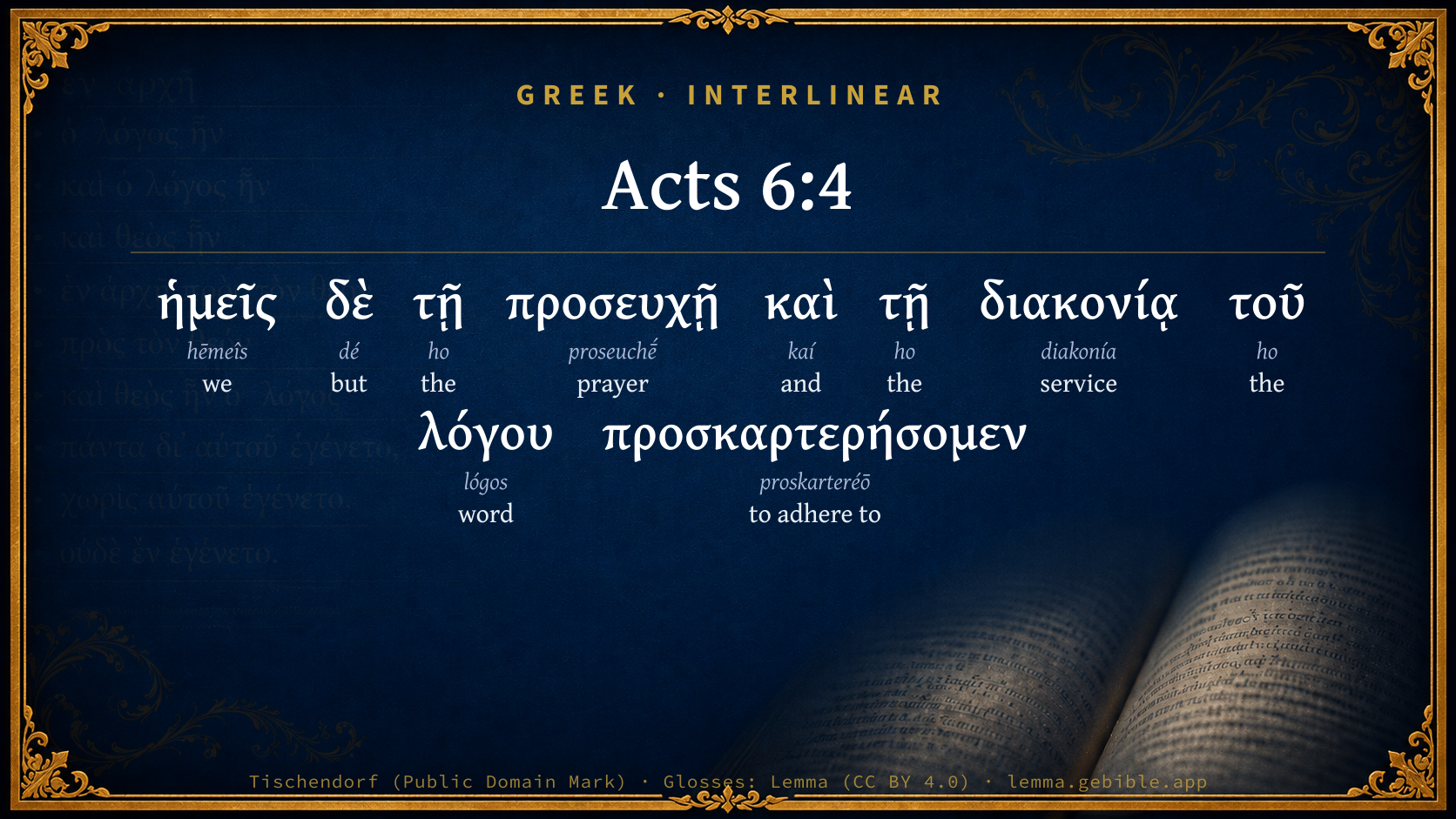
προσκαρτερήσομεν
proskarteréō
G4342
“to adhere to”
Verb, Future, Active, Indicative, 1st person, Plural
Part of Speech
Verb
Tense
Future
Voice
Active
Mood
Indicative
Person
1st person
Number
Plural
Full Thayer's Definition

Origin: from G4314 and G2594

TDNT: 13:18,4

1. to adhere to one, be his adherent, to be devoted or constant to one 2. to be steadfastly attentive unto, to give unremitting care to a thing 3. to continue all the time in a place 4. to persevere and not to faint 5. to show one's self courageous for 6. to be in constant readiness for one, wait on constantly
  1. ἡμεῖς hēmeîs G2249 “we” Personal pronoun, 1st person, Nominative, Plural
  2. δὲ dé G1161 “but” Conjunction
  3. τῇ ho G3588 “the” Article, Dative, Singular, Feminine
  4. προσευχῇ proseuchḗ G4335 “prayer” Noun, Dative, Singular, Feminine
  5. καὶ kaí G2532 “and” Conjunction
  6. τῇ ho G3588 “the” Article, Dative, Singular, Feminine
  7. διακονίᾳ diakonía G1248 “service” Noun, Dative, Singular, Feminine
  8. τοῦ ho G3588 “the” Article, Genitive, Singular, Masculine
  9. λόγου lógos G3056 “word” Noun, Genitive, Singular, Masculine

About this verse

These counts appear in no published source. They are computed here, from the morphology-tagged text and Lemma’s own curated glosses. What Lemma adds →

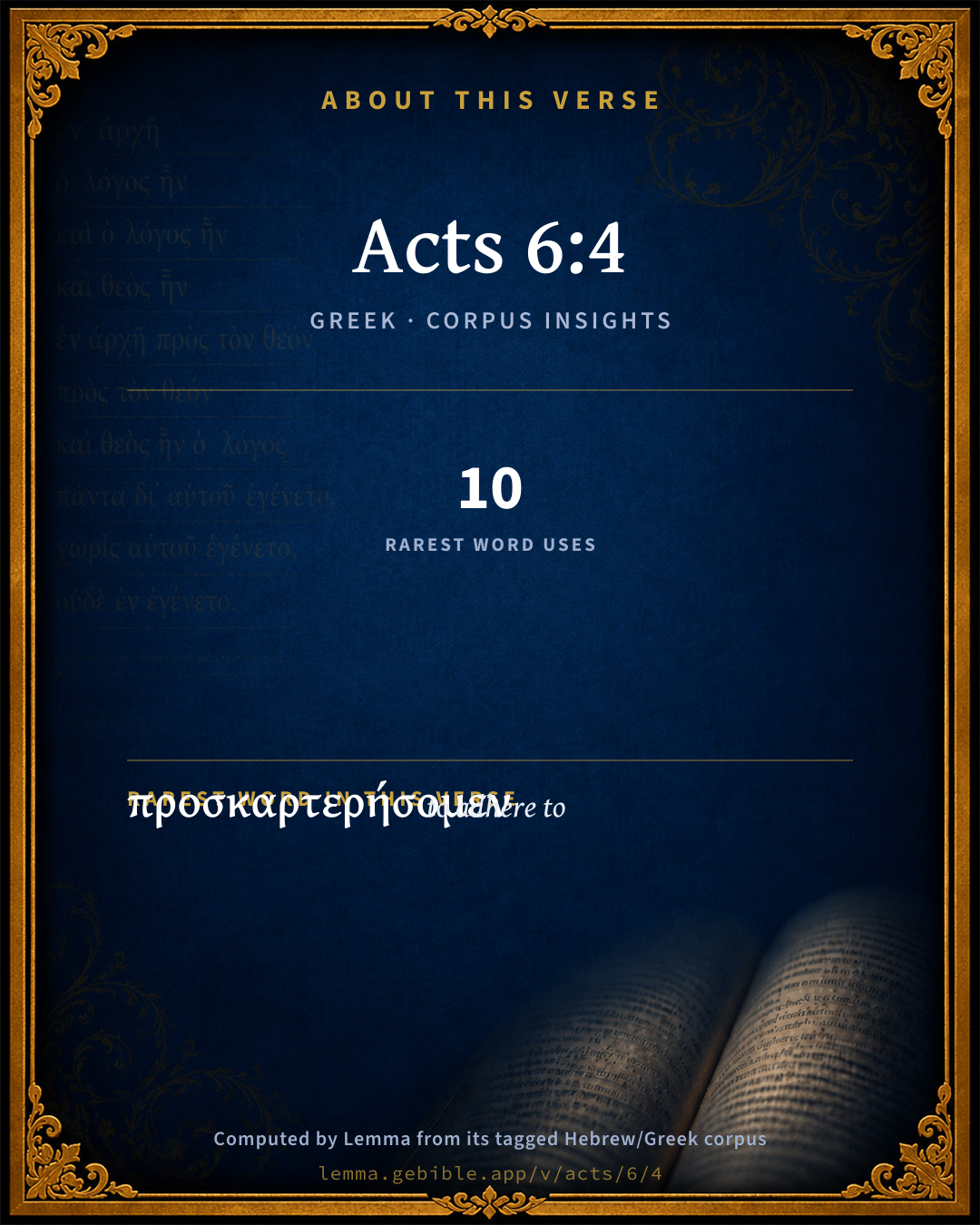
10
words
8
distinct lemmas
Acts
section

Notable vocabulary

The rarest word here is προσκαρτερήσομεν to adhere to G4342 — appearing just 10 times in the whole Greek New Testament.

Shared distinctive vocabulary

προσκαρτερήσομεν to adhere to G4342 occurs in 10 verses of the Greek New Testament. Also found in:

Repetition

A word recurs within this verse:

Cross-references

17

Topical passages linked to Acts 6:4 in the Treasury of Scripture Knowledge — connected by theme and wording, ordered by reader-vote popularity; previews shown in the World English Bible.

  • Acts 1:14 All these with one accord continued steadfastly in prayer and supplication, along with the women, and Mary the mother of Jesus, and with his brothers.
  • 1 Timothy 4:13–16 Until I come, pay attention to reading, to exhortation, and to teaching.
  • Philippians 1:9–11 This I pray, that your love may abound yet more and more in knowledge and all discernment;
  • Acts 2:42 They continued steadfastly in the apostles' teaching and fellowship, in the breaking of bread, and prayer.
  • 2 Timothy 4:2 preach the word; be urgent in season and out of season; reprove, rebuke, and exhort, with all patience and teaching.
  • Acts 13:2–3 As they served the Lord and fasted, the Holy Spirit said, "Separate Barnabas and Saul for me, for the work to which I have called them."
  • Romans 1:9 For God is my witness, whom I serve in my spirit in the Gospel of his Son, how unceasingly I make mention of you always in my prayers,
  • Ephesians 3:14–21 For this cause, I bow my knees to the Father of our Lord Jesus Christ,
  • Colossians 1:9–13 For this cause, we also, since the day we heard this, don't cease praying and making requests for you, that you may be filled with the knowledge of his will in all spiritual wisdom and understanding,
  • Acts 20:19–31 serving the Lord with all humility, with many tears, and with trials which happened to me by the plots of the Jews;
  • Romans 12:6–8 Having gifts differing according to the grace that was given to us, if prophecy, let us prophesy according to the proportion of our faith;
  • 1 Corinthians 9:16 For if I preach the Gospel, I have nothing to boast about; for necessity is laid on me; but woe is to me, if I don't preach the Gospel.
  • Ephesians 1:15–17 For this cause I also, having heard of the faith in the Lord Jesus which is among you, and the love which you have toward all the saints,
  • Philippians 1:4 always in every request of mine on behalf of you all making my requests with joy,
  • Colossians 2:1 For I desire to have you know how greatly I struggle for you, and for those at Laodicea, and for as many as have not seen my face in the flesh;
  • Colossians 4:17 Tell Archippus, "Take heed to the ministry which you have received in the Lord, that you fulfill it."
  • Colossians 4:12 Epaphras, who is one of you, a servant of Christ, salutes you, always striving for you in his prayers, that you may stand perfect and complete in all the will of God.

Cross-references courtesy of OpenBible.info (CC BY 4.0).

Commentary

Notes on Acts 6:4 from classic Christian and Jewish commentators (each source and its license shown beneath its notes). The classic Christian expositions comment on the surrounding passage and are grouped to its opening verse, so a note may address several verses; the Jewish commentaries on the Tanakh (Rashi and others) are per-verse, so they appear only where the commentator wrote on this verse.

Lemma curates 59 commentaries, every one of them public domain or Creative Commons licensed, each selected and text-cleaned for this edition rather than reprinted as found. About our sources →

Adam Clarke's Commentary

Verse 4. We will give ourselves continually to prayer] προσκαρτερησομεν,, We will steadfastly and invariably attend, we will carefully keep our hearts to this work. The word is very emphatic.

To prayer. - See this defined, Mt 6:5. Even apostles could not live without prayer; they had no independent graces; what they had could not be retained without an increase; and for this increase they must make prayer and supplication, depending continually on their God.

Ministry of the word.] διακονιατουλογου, The deaconship of the word. The continual proclamation of the Gospel of their Lord; and, to make this effectual to the souls of the hearers, they must continue in prayer: a minister who does not pray much, studies in vain.

The office of deacon, διακονος, came to the Christian from the Jewish Church. Every synagogue had at least three deacons, which were called פרנסים parnasim, from פרנס parnes, to feed, nourish, support, govern. The פרנס parnas, or deacon, was a sort of judge in the synagogue; and, in each, doctrine and wisdom were required, that they might be able to discern and give right judgment in things both sacred and civil. The חזן chazan, and שמש shamash, were also a sort of deacons. The first was the priest's deputy; and the last was, in some cases, the deputy of this deputy, or the sub-deacon. In the New Testament the apostles are called deacons, 2Co 6:4; Eph 3:7; Col 1:23: see also 2Co 11:15. Christ himself, the Shepherd and Bishop of souls, is called the deacon of the circumcision, λεγω δε Χριστον Ιησουν διακονον γεγενησθαι περιτομης, Ro 15:8. As the word implies to minister or serve, it was variously applied, and pointed out all those who were employed in helping the bodies or souls of men; whether apostles, bishops, or those whom we call deacons. Some remark that there were two orders of deacons:

1. διακονοι της τραπιζης, deacons of the TABLE, whose business it was to take care of the alms collected in the Church, and distribute them among the poor, widows, c.

2. διακονοι του λογου, deacons of the WORD, whose business it was to preach, and variously instruct the people. It seems that after the persecution raised against the apostolic Church, in consequence of which they became dispersed, the deaconship of tables ceased, as did also the community of goods and Philip, who was one of these deacons, who at first served tables, betook himself entirely to preaching of the word: see Ac 8:4, c.

In the primitive Church, it is sufficiently evident that the deacons gave the bread and wine in the Eucharist to the believers in the Church, and carried it to those who were absent, Just. Mar. Apol. ii. p. 162 they also preached, and in some cases administered baptism. See Suicer on the words διακονος κηρυσσω, and βαπτισμα. But it appears they did the two last by the special authority of the bishop. In the ancient Roman Church, and in the Romish Church, the number of seven deacons, in imitation of those appointed by the apostles, was kept up; and in the council of Neocaesarea it was decreed that this number should never be exceeded, even in the largest cities: vide Concil. Neocaesar. Canon. xiv. other Churches varied this number; and the Church of Constantinople had not less than one hundred. Deacons were ordained by the bishops, by imposition of hands. None was ordained deacon till he was twenty-five years of age, and we find that it was lawful for them to have wives. See Suicer under the word διακονος, and See Clarke on Mt 20:26.

In the Church of England, (the purest and nearest to the apostolical model in doctrine and discipline of all national Churches,) a deacon receives ordination by the imposition of the hands of a bishop, in consequence of which he can preach, assist in the sacrament of the Lord's Supper, and in general perform any sacred office, except consecrating the elements, and pronouncing the absolution. No person in this Church can be ordained deacon till he be twenty-three years of age, unless by dispensation from the Abp. of Canterbury. There were deaconesses, both in the apostolic and primitive Church, who had principally the care of the women, and visited and ministered to them in those circumstances in which it would have been improper for a deacon to attend. They also assisted in preparing the female candidates for baptism.

At present, the office for which the seven deacons were appointed is, in the Church of England, filled by the churchwardens and overseers of the poor; in other Churches and religious societies, by elders, stewards, &c., chosen by the people, and appointed by the minister.

Adam Clarke's Commentary on the Bible (1810–1826) — public domain. Text from a community e-Sword/MySword module.

Bengel's Gnomon

Johann Albrecht Bengel

Act 6:4. Τῇ προσευχῇ καὶ τῇ διακονίᾳ τοῦ λόγου, to prayer and the ministry of the word) Prayer takes precedency of the ministry of the word.—προσκαρτερήσομεν, we will give ourselves continually to) We will make these our sole pursuit. These are most noble functions, which no bishop can delegate to another, as though he himself were intent on more important matters.

Bengel's Gnomon of the New Testament — English translation (T&T Clark, Edinburgh, 1860) — public domain. Text from a community e-Sword module.

Expositor's Greek Testament

ed. W. Robertson Nicoll

Act 6:4 . ἡμεῖς δὲ : in marked contrast to the service of tables, etc., but still every work in the Church, whether high or low, was a διακονία . τῇ διακ . τοῦ λ ., see above. προσκαρτερήσομεν , “will continue steadfastly,” R.V., see above on Act 1:14 . τῇ προσ ., “the prayer” (Hort); the article seems to imply not only private prayer and intercession, but the public prayer of the Church.

The Expositor's Greek Testament, edited by W. Robertson Nicoll (1897–1910) — public domain. Text from a community e-Sword module.

Jamieson, Fausset & Brown

Robert Jamieson, A. R. Fausset & David Brown

we will give ourselves to prayer--public prayer, as along with preaching their great work.

Jamieson, Fausset & Brown — Commentary Critical and Explanatory on the Whole Bible (1871) — public domain (CC PDM 1.0). Text via the HelloAO Bible API.

John Calvin's Commentaries

4. And we will give ourselves unto prayer. They show again that they have too much business otherwise, wherein they may exercise themselves during their whole life. For the old proverb agreeth hereunto very fitly, which was used sometimes in the solemn rites, do this. Therefore, they use the word [προσκαρτερησαι] which signifieth to be, as it were, fastened and tied to anything. Therefore, pastors must not think that they have so done their duty that they need to do no more when they have daily spent some time in teaching. There is another manner of study, another manner of zeal, another manner of continuance required, that they may indeed boast that they are wholly given to that thing. They adjoin thereunto prayer, not that they alone ought to pray, (for that is an exercise common to all the godly,) but because they have peculiar causes to pray above all others. There is no man which ought not to be careful for the common salvation of the Church. How much more, then, ought the pastor, who hath that function enjoined him by name to labor carefully [anxiously] for it? So Moses did indeed exhort others unto prayer, but he went before them as the ringleader (Exodus 17:11.) And it is not without cause that Paul doth so often make mention of his prayers, (Romans 1:10.) Again, we must always remember that, that we shall lose all our labor bestowed upon plowing, sowing, and watering, unless the increase come from heaven, (1 Corinthians 3:7.) Therefore, it shall not suffice to take great pains in teaching, unless we require the blessing at the hands of the Lord, that our labor may not be in vain and unfruitful. Hereby it appeareth that the exercise of prayer is not in vain commended unto the ministers of the word.

John Calvin's Commentaries (1540-1563) — public domain. Text from the Calvin Translation Society English edition (1840s-50s) via the Christian Classics Ethereal Library (ccel.org). Calvin's coverage is partial (roughly two-thirds of the Bible); uncommented books and verses are honest gaps, never fabricated. The 19th-century editor's footnotes and remarks are omitted so the notes are faithfully Calvin's own voice.

Ellicott's Commentary for English Readers

(4) We will give ourselves continually to prayer, and to the ministry of the word.—Literally, We will persevere in . . . These formed the true work of the Apostles, as afterwards of the bishops or elders of the Church. “Prayer” includes the public worship of the Church in all its various developments, as well as private prayer and intercession; the “ministry of the word,” all forms of teaching.

It is to be noted that the men thus appointed are never called “deacons” in the New Testament. When they are referred to again it is as “the Seven” (Act_21:8), as though they were a distinct and peculiar body. Their functions were, of course, in some degree, analogous to those of the “deacons” of the Pastoral Epistles and the later organisation of the Church; but these, as we have seen, had their prototypes in the “young men,” as contrasted with “elders,” in Act_5:6; Act_5:10; and the Seven were probably appointed, so to speak, as archdeacons, to superintend and guide them. In some churches, as at Rome, the number of deacons was fixed at seven, in conformity with this precedent (so also at the Council of Neo-Cæsarea, Can. 14, A.D. 314), and they were considered, when the bishop came to be distinguished from the elders, as acting more immediately under the direction of the former, helping him in the details of his office.

A Bible Commentary for English Readers, edited by Charles John Ellicott (1878–1897) — public domain. Text from a community e-Sword module.

The Cambridge Bible for Schools and Colleges

gen. ed. J. J. S. Perowne

4. But we will give ourselves continually] The Greek word is used several times in describing the earnest conduct of the disciples. Thus (Act_1:14) “these all continued with one accord in prayer,” and (Act_2:42) “they continued stedfastly in the Apostles’ doctrine.” So Act_2:46, and St Paul employs it (Rom_12:12), “continuing instant in prayer.”

to prayer, and to the ministry of the word] Which explains what is meant by “leave the word of God” in Act_6:2. Here again we have the word diakonia to describe the Apostle’s duty of preaching and teaching. Each office was, if duly performed, a part of the service which was laid upon the whole Church. Cp. Milton, Sonnet xix. “They also serve who only stand and wait.”

The Cambridge Bible for Schools and Colleges (gen. ed. J. J. S. Perowne; Cambridge University Press, 1878–1918) — public domain. Text from a community e-Sword module.

John Gill's Exposition

But we will give ourselves continually to prayer,.... Both in private for themselves, and the church; and in the houses and families of the saints, with the sick and distressed;. and in public, in the temple, or in whatsoever place they met for public worship:

and to the ministry of the word; the preaching of the Gospel, to which prayer is absolutely prerequisite, and with which it is always to be joined. These two, prayer and preaching, are the principal employment of a Gospel minister, and are what he ought to be concerned in, not only now and then, but what he should give himself up unto wholly, that his profiting might appear; and what he should be continually exercised and employed in: and if parting with that branch of the ministerial function, the care of the secular affairs of the church, and of the poor of it, was necessary in the apostles, that they might be more at leisure to attend to the more important and useful duties of prayer and preaching; it therefore seems necessary that those who are called to labour in the word and doctrine, if possible, should be exempt from all worldly business and employment; that of the ministry being sufficient to engross all a man's time and thoughts.

John Gill's Exposition of the Whole Bible (1746–1763) — public domain (CC PDM 1.0). Text via the HelloAO Bible API.

Trapp's Complete Commentary

John Trapp

4 But we will give ourselves continually to prayer, and to the ministry of the word.

Ver. 4. To prayer, and to the ministry] Between these two they divided their time. An argument of their integrity in the ministry. If we were to preach only, saith the apostle, we could then wait upon tables; but the one half of our time is to be taken up in prayer, the other in preaching. So the priests of old: "They shall teach Jacob thy judgments," saith Moses, "they shall also put incense before thee," Deu 33:10. So Paul begins, continues, and endeth his epistles with prayer. So Luther professeth that he profited more in the knowledge of the Scriptures by prayer in a short space, than by study in a longer; as John by weeping got the sealed book opened.

John Trapp, A Commentary or Exposition upon All the Books of the Old and New Testament (1647–1656) — public domain. Text from a community e-Sword module.

Albert Barnes' Notes on the Bible

But we will give ourselves continually - The original expression used here denotes “intense and persevering” application to a thing, or unwearied effort in it. See the notes on Act 1:14. It means that the apostles designed to make this their constant and main object, undistracted by the cares of life, and even by attention to the temporal needs of the church.

To prayer - Whether this means “private” or “public” prayer cannot be certainly determined. The passage, however, would rather incline us to suppose that the “latter” was meant, as it is immediately connected with preaching. If so, then the phrase denotes that they would give themselves to the duties of their office, one part of which was public prayer, and another preaching. Still it is to be believed that the apostles felt the need of secret prayer, and practiced it, as preparatory to their public preaching.

And to the ministry of the word - To preaching the gospel, or communicating the message of eternal life to the world. The word “ministry” διακονία diakonia properly denotes the employment of a “servant,” and is given to the preachers of the gospel because they are employed in this as the “servants” of God and of the church. We have here a view of what the apostles thought to be the proper work of the ministry. They were set apart to this work. It was their main, their only employment. To this their lives were to be devoted, and both by their example and their writings they have shown that it was on this principle they acted. Compare 1Ti 4:15-16; 2Ti 4:2. It follows also that if their time and talents were to be wholly devoted to this work, it was reasonable that they should receive competent support from the churches, and this reasonable claim is often urged. See the 1Co 9:7-14 notes; Gal 6:6 note.

Albert Barnes' Notes on the Bible (1834–1885) — public domain. Text from a community e-Sword/MySword module.

Matthew Poole's English Annotations

We will give ourselves continually; we will stick close, and with perseverance, to this work.

To prayer, and to the ministry of the word; the two great employs of a minister of Jesus Christ; to pray unto God for the people, and to speak unto the people from the Lord: these, though great businesses, they durst not delegate from themselves unto others to perform for them.

Matthew Poole's English Annotations on the Holy Bible (1683–1685) — public domain. Text from a community e-Sword/MySword module.

Whedon's Commentary on the Bible

Daniel D. Whedon

4. Give ourselves… continually—Προσκαρτερησομεν. We will persevere in, or continue in; constantly, yet not exclusively. Their spiritual office exempted them from official attention to temporal charities, but was no cessation from spontaneous alms. As Christ was, at first, divine Apostle, (Heb_3:1,) and contained within himself all authority, so his apostles were the source whence all church-official grades are derived. As Dr. Schaff well says, (“Apostolic History,” 499:) The higher (the apostolate) “includes the lower, not the reverse.” “The apostles were at the same time prophets, evangelists, pastors, and teachers, and at first had charge even of the business of the deacons, Act_4:35; Act_4:37; Act_6:2.” What was peculiar to the apostles alone left the earth with them; but all other ministries are carved out of what was transmissible in them, and all true ministers are successors of the apostles.

Prayer… ministry of the word— These every minister inherits as his blessed perquisite and privilege from the apostles. In the divine establishment of the Church the “ministry of the word” is a permanent institution. “Go into all the world and preach the Gospel to every creature” is the command, followed by the promise of Christ’s presence “until the end of the world.” So that preaching and preacher stand while the world stands. It is by the foolishness of preaching the world is to be saved. And such a preacher is divinely “called” to his work. That call by the moving of the Holy Ghost is manifested to his own soul by an impressive sense of duty, an assuring testimony to the soul from God upon prayerful inquiry, and a deep love and attraction for the blessed work of gaining souls for Christ and heaven. Without such a “call” no man should ever enter the ministry of reconciliation.

We do not say that a man may not, by the same Spirit and in a similar way be “called” to some other “calling,” as to be a physician or a mechanic. Did men consult the divine will in a profounder spirit of devotion the divine “call” would be oftener recognized. But if the call and the Spirit may be much the same, the destination to which the call directs is profoundly different. Medicine is not a spiritual institution; it has not the direct notice of revelation; it forms no part of a divinely established Church; and the divine call directs a man to it as to a secularity. But the minister is divinely called to a divinely constituted work, office, responsibility, danger, and dignity. And we may add that such a call may be outlived and forfeited. Many a minister gives evidence, by the loss of the true spirit of a minister, that he has lost his call as a minister.

Daniel D. Whedon (gen. ed.), Commentary on the Old and New Testaments (1874–1909) — public domain. Text from a community e-Sword module.

The Pulpit Commentary

Continue steadfastly in for give ourselves continually to, A.V.; in (the ministry) for to, A.V. Steadfastly. The verb proskarterew is of frequent use in the Acts. (see Act_1:14 Act_2:42 Act_5:4-6 Act_8:13 Act_10:7; see also Col_4:2) It is used of persons and things to which any one adheres closely and perseveringly, which are put in the dative case, as here. But sometimes it has the prepositions ejn or eijv after it, as in Act_5:4-6; Hist. of Susann. 7; Rom_13:6.

An earnest ministry the greatest need and blessing of the Church.

"But we will give ourselves," etc.

I FUNCTIONAL, FAITHFULNESS. "Each in his office wait.

1. Apostles held an exceptional position, but in all main respects examples of singleness of mind and wisdom.

2. Distinguish between faithfulness in office and officialism. Special gifts adapted to special work; should be stirred up.

3. The hope of the Church is in the spirituality of its ministers. If they lower the conception of their office and regard themselves as mere popular leaders, they let in a flood of evils both into the pulpit and into the Church.

II The WORLD"S CONVERSION IN THE HANDS OF GOD"S PEOPLE. The chief agency prayer and the ministry of the Word. Charity secondary, not primary. Philanthropy is not a substitute for Christianity. The apostles put their own office as preachers before that of the deacons. In these times a temptation to put the "tables," the bodily necessities, before the spiritual wants. We must wait for results, but Christ understood the work of his Church. Stand by the apostolic method, and the end will vindicate it. The world must be changed by spiritual forces. The Church must use all the material and social advantages supplied, but not as though they were sufficient by themselves; By my Spirit, saith the Lord. R.

The work of the ministry.

In no age of the Church has it been more necessary than it is in this to exalt the ministry of the Church, to secure its freedom from secular cares, and to culture its spiritual life and efficiency. Thousands of Christian clergy long to be able to say the words of our text, and hopelessly repeat after Dr. Chalmers, "I am bustled out of my spirituality." We may help to a better understanding of the work of the ministry if we consider

I ITS PRIVATE AND PREPARATORY FEATURES. "Give ourselves continually to prayer." The term "prayer," as here used, is a comprehensive one, and includes all that belongs to private piety and soul-culture, the nourishing of the Christian vitality, and enriching of the personal spiritual stores of thought, feeling, and truth. Ministers know, by a constant experience, how immediately their pleasure and their power in their work depend on their personal spiritual conditions. The soul must be full of God that is to speak well for God; and Christian congregations should take it upon them, as a burden of duty, to free their pastors from care, both in his family and in the temporal matters of the Church, so that he may "give himself unto prayer." Prayer may here be taken to include:

1. Self-culture the full mastery of a man"s own disposition and habits.

2. Mental culture a sufficient training of the intellectual powers to ensure full and wise teaching of the people.

3. Scripture-culture adequate acquaintance with the actual contents of God"s revealed Word, and quickness of spiritual insight into its deeper meanings, suggestions, and mysteries.

4. Soul-culture that kind of sympathetic, persuasive force which seems to bring God near to man, in us, and man near to God, through us; the kind of power that only comes to us through prayer and fasting." These things are the absolute essentials of true and successful ministerial work today. The men of prayer are the men of power.

II ITS PUBLIC AND OFFICIAL FEATURES. "The ministry of the Word," or the service of the revealed Word. This may be set in two forms.

1. The ministry of the Scriptures; not merely in their contents, but in their applications, their examples, warnings, counsels, comfortings, etc. "Our ministers are the teachers of a Book, and each has more than a lifetime full of labor if he sets his heart upon declaring the whole revealed counsel of God.

2. The ministry of the Christ, as the very essence of the Scriptures. In this bringing out the special redemptive features of the Divine relation, and claiming personal surrender to, personal obedience to, and personal homage to, the risen, glorified, and reigning Lord. "The testimony of Jesus is the spirit of prophecy." It may be further pressed that:

(1) The Word, or message of salvation, needs a human ministry; "by the foolishness of preaching God would save them that believe.

(2) That it also needs the entire devotion of men"s time and talents and influence. If apostles needed to step aside from common cares to keep their efficiency for spiritual work, much more do the modern clergy in this busy and anxious age. It should seriously be considered how far the modern ministry has become weakened, especially in spiritual power and prophet-like energy, by becoming crowded with worldly cares, so that private soul-culture is neglected and prayer-preparations are crowded out. Only from the "secret place of the Most High" can Christian teachers come forth in power. While they are musing the fire burns;" and then they can "speak with their tongues. R.T.

The Pulpit Commentary (1880–1919), ed. H.D.M. Spence-Jones & Joseph S. Exell — public domain. Text from a community e-Sword module.

John Wesley's Explanatory Notes

We will constantly attend to prayer, and to the ministry of the word - This is doubtless the proper business of a Christian bishop: to speak to God in prayer; to men in preaching his word, as an ambassador for Christ.

John Wesley, Explanatory Notes Upon the Whole Bible (1754–1765) — public domain. Text via the GEBible commentary corpus.

McGarvey & Pendleton's Commentaries

J. W. McGarvey

See notes on verse 2

J. W. McGarvey (with Philip Y. Pendleton), Commentaries on the New Testament (The Fourfold Gospel, 1914; Acts; and the epistles) — public domain. Text from a community e-Sword/MySword module.

The People's New Testament

B. W. Johnson

4. We will give ourselves continually to prayer, etc. Observe that the apostles regard prayer of equal importance with preaching. Every preacher ought to heed this.

B. W. Johnson's The People's New Testament with Notes (1889–1891) — public domain. Electronic text from the Christian Classics Ethereal Library (CCEL) ThML edition.

Cambridge Greek Testament for Schools and Colleges

4. προσκαρτερήσομεν, we will give ourselves continually. The word is of frequent use to describe the earnest, stedfast character of the early disciples. Thus Act 1:14 of their continuance in prayer; Act 2:42 of continuing stedfastly in the Apostles’ doctrine. Cf. also Act 2:46 and Rom 12:12.

Cambridge Greek Testament for Schools and Colleges (Cambridge University Press, 1896; 21 vols, various authors incl. Carr, Maclear, Plummer, Farrar, Lumby, Moule, M. R. James, Simcox) — public domain. Text from a community e-Sword module.

Alford’s Greek Testament

Henry Alford

4.] τ. διακονίᾳ τ. λόγου, in opposition to the διακονία τραπεζῶν. ‘Hæ partes sunt nobilissimæ, quas nemo episcopus alteri, quasi ipse majoribus rebus intentus, delegare potest.’ Bengel. ‘Hinc apparet non frustra precandi studium commendari verbi ministris.’ Calvin.

Henry Alford, The Greek Testament (1849–1861) — public domain. Text from a community e-Sword module.

Vincent's Word Studies in the New Testament

Marvin R. Vincent

We will give ourselves continually [προσκαρτερησομεν] . See on ch. Act 1:14. Rev., continue steadfastly.

Marvin R. Vincent, Word Studies in the New Testament (1887–1900) — public domain. Text from a community e-Sword/MySword module.

Lesson kit

Teaching starters — assembled from the data on this page, not authored interpretation. Every prompt links to the verse data it draws on. Edit before teaching.

Acts, in the Acts, opens this verse with 10 words (8 distinct Greek lemmas). Its most distinctive word is proskarteréō (“to adhere to”). A historical commentator’s framing appears above. Read the whole chapter for the surrounding context.

Discussion questions

  1. The word proskarteréō carries the sense “to adhere to.” How does it shape the verse?
  2. How does Mark 3:9, which shares the word «to adhere to», read alongside this verse?
  3. What does the repetition of “the” (3× in this one verse) do in this verse?
  4. These translations render this verse differently; the difference is in the English rendering, not the original. What questions does that raise?
  5. Compare how Adam Clarke's Commentary and Bengel's Gnomon read this verse. Where do they agree or differ?

Things to notice

  • These translations choose different wording for 5 words in this verse.
  • “the” occurs 3× in this single verse.
  • 8 distinct Greek lemmas span 10 words in this verse.

Reading settings

Reading text

Shown beneath each verse's original-language words.

Old Testament
Old Testament edition

Read the OT as the Masoretic Hebrew (MT) or the Greek Septuagint (LXX).

English shown for the Greek Septuagint (in the Hebrew ↔ Greek comparison).

Comparing translations? Open the Compare panel on any verse page to stack up to four side by side.