John 21:19

Greek (Tischendorf 8th ed.) John 21:19 appears in the Greek New Testament. The text above is from the Tischendorf 8th edition. Each word links to its Strong’s number and a concise gloss. Click any word for its full Thayer’s Greek Lexicon entry.
Download image
Cite this verse

John 21:19 (World English Bible). Public Domain. Lemma interlinear Bible study tool, https://lemma.gebible.app/v/john/21/19.

Show BibTeX & RIS
BibTeX
RIS
English Translation
Now he said this, signifying by what kind of death he would glorify God. When he had said this, he said to him, "Follow me."
World English Bible · Public Domain
Download a study sheet

One document with this verse’s original text, its word-by-word gloss line, the meaning frame, cross-references with their text, attributed commentary, and full source and license credits — printable, and it pastes into notes with its structure intact.

This verse Autodidact and up

Study sheet (.html) Plain text (.txt)

A passage Seminary Student

Up to 50 verses in one chapter. A passage sheet keeps up to 6 commentary sources and 12 cross-references per verse, in the order this page ranks them, and says so on the sheet whenever that leaves anything out. Ask for a single verse and you get the Autodidact verse sheet above.

Everything on this page stays free to read, with no account — the sheet is a download of what is already on screen, not access to it.

Want to remove ads? Support Godless Engineer
Compare translations 3

The same verse in 3 English versions, stacked beneath the original-language interlinear above. Click any original word for its lexicon entry.

Each is an independent rendering of the whole verse — the interlinear is not word-aligned to these translations.

Highlighted words mark where these versions differ — a whole-verse word diff, not a word-by-word alignment.

  • World English Bible Public Domain
    Now he said this, signifying by what kind of death he would glorify God. When he had said this, he said to him, "Follow me."
  • King James Version Public Domain
    This spake he, signifying by what death he should glorify God. And when he had spoken this, he saith unto him, Follow me.
  • unfoldingWord Literal Text CC BY-SA 4.0
    Now he said this, indicating with what manner of death he will glorify God. And having said this, he says to him, “Follow me.”

unfoldingWord Literal Text — © unfoldingWord, licensed CC BY-SA 4.0. Word-aligned USFM3 via Door43 (git.door43.org/unfoldingWord/en_ult).

Versions to compare (up to 4)

3 of 4 selected

Show all 19 translations

Every available English version of this verse, each an independent rendering of the whole verse.

  • World English Bible Public Domain
    Now he said this, signifying by what kind of death he would glorify God. When he had said this, he said to him, "Follow me."
  • Berean Standard Bible Public Domain
    Jesus said this to indicate the kind of death by which Peter would glorify God. And after He had said this, He told him, “Follow Me.”
  • Majority Standard Bible Public Domain
    Jesus said this to indicate the kind of death by which Peter would glorify God. And after He had said this, He told him, “Follow Me.”
  • King James Version Public Domain
    This spake he, signifying by what death he should glorify God. And when he had spoken this, he saith unto him, Follow me.
  • American Standard Version (1901) Public Domain
    Now this he spake, signifying by what manner of death he should glorify God. And when he had spoken this, he saith unto him, Follow me.
  • Revised Version (1885) Public Domain
    Now this he spake, signifying by what manner of death he should glorify God. And when he had spoken this, he saith unto him, Follow me.
  • Geneva Bible (1599) Public Domain
    And this spake he signifying by what death he shoulde glorifie God. And when he had said this, he said to him, Folowe me.
  • Douay-Rheims (1899) Public Domain
    And this he said, signifying by what death he should glorify God. And when he had said this, he saith to him: Follow me.
  • Young's Literal Translation Public Domain
    and this he said, signifying by what death he shall glorify God; and having said this, he saith to him, `Be following me.'
  • Literal Standard Version CC BY-SA 4.0
    and this He said, signifying by what death he will glorify God; and having said this, He says to him, “Follow Me.”
  • Unlocked Literal Bible CC BY-SA 4.0
    Now Jesus said this in order to indicate with what kind of death Peter would glorify God. After he had said this, he said to Peter, “Follow me.”
  • unfoldingWord Literal Text CC BY-SA 4.0
    Now he said this, indicating with what manner of death he will glorify God. And having said this, he says to him, “Follow me.”
  • Darby Bible Public Domain
    But he said this signifying by what death he should glorify God. And having said this, he says to him, Follow me.
  • World Messianic Bible Public Domain
    Now he said this, signifying by what kind of death he would glorify God. When he had said this, he said to him, “Follow me.”
  • Webster's Bible Public Domain
    This he spoke, signifying by what death he should glorify God. And when he had spoken this, he saith to him, Follow me.
  • Free Bible Version CC BY-SA 4.0
    Jesus said this to explain the kind of death by which he would glorify God. Then he said to Peter, “Follow me.”
  • Bible in Basic English Public Domain
    Now this he said, pointing out the sort of death by which he would give God glory. And after saying this, he said to him, Come after me.
  • Text-Critical English NT CC BY 4.0
    (He said this to indicate the kind of death by which Peter would glorify God.) After saying this, he said to Peter, “Follow me.”
  • Tyndale New Testament (1534) Public Domain
    That spake he signifyinge by what deeth he shuld glorify God. And when he had sayde thus he sayd to him folowe me.

Literal Standard Version (2020), Covenant Press — licensed CC BY-SA 4.0. Text via the HelloAO Bible API (eBible.org). Unlocked Literal Bible (unfoldingWord) — licensed CC BY-SA 4.0. Text via the HelloAO Bible API (eBible.org). unfoldingWord Literal Text — © unfoldingWord, licensed CC BY-SA 4.0. Word-aligned USFM3 via Door43 (git.door43.org/unfoldingWord/en_ult). Free Bible Version, Dr. Jonathan Gallagher — licensed CC BY-SA 4.0. Text via the HelloAO Bible API (eBible.org).

Word by word

More ways to search: Search by grammar → Find every occurrence → Compare this word →

Practice this passage: Drill this verse → Learn its vocabulary →

σημαίνων
sēmaínō
G4591
“to signify”
Verb, Present, Active, Participle, Nominative, Singular, Masculine
Part of Speech
Verb
Tense
Present
Voice
Active
Mood
Participle
Case
Nominative
Number
Singular
Gender
Masculine
Full Thayer's Definition

Origin: from sema (a mark, of uncertain derivation)

TDNT: 11:22,1

1. to give a sign, to signify, indicate 2. to make known
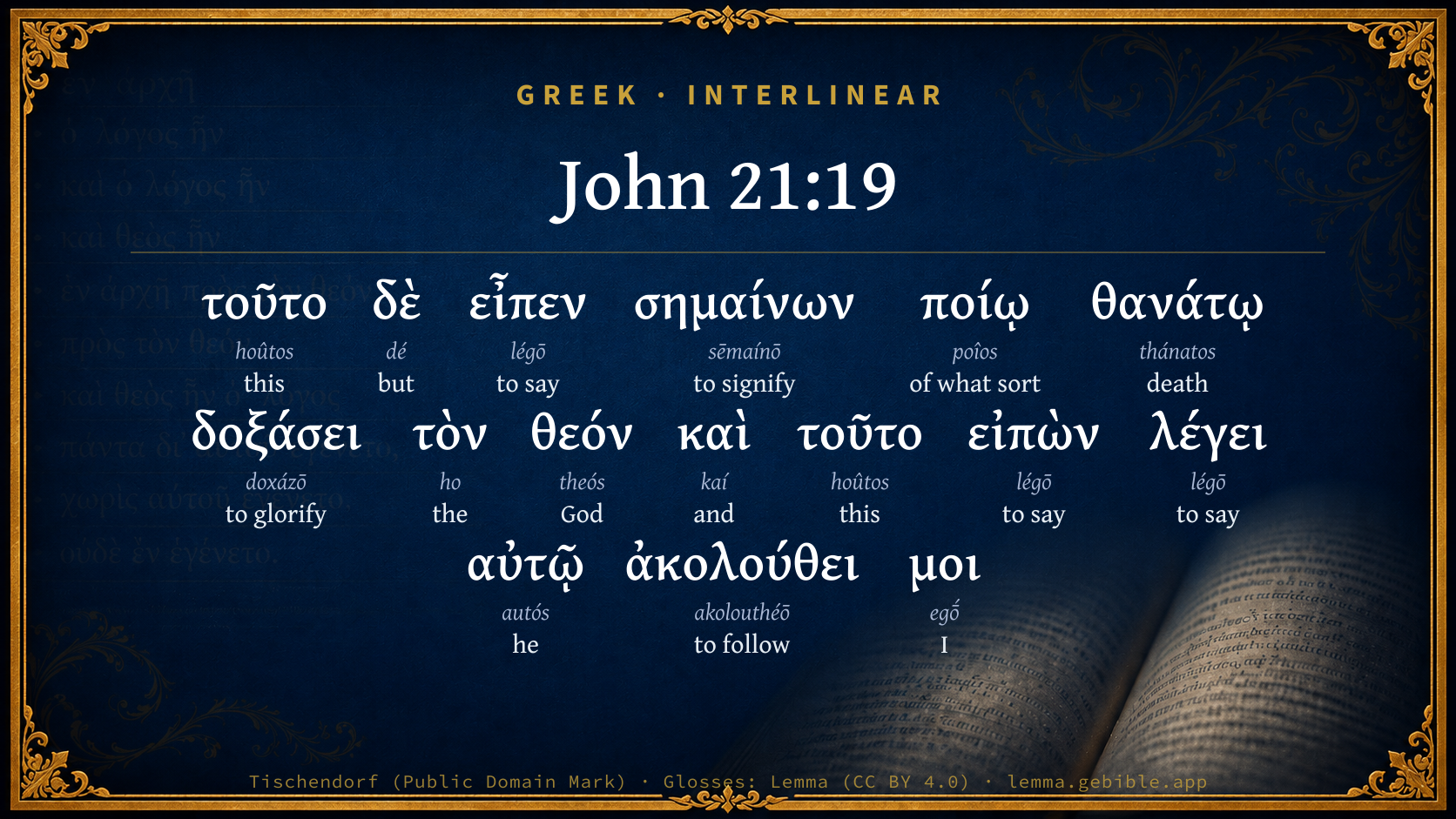
  1. τοῦτο hoûtos G3778 “this” Demonstrative pronoun, Accusative, Singular, Neuter
  2. δὲ dé G1161 “but” Conjunction
  3. εἶπεν légō G3004 “to say” Verb, Aorist, Active, Indicative, 3rd person, Singular
  4. ποίῳ poîos G4169 “of what sort” Interrogative pronoun, Dative, Singular, Masculine
  5. θανάτῳ thánatos G2288 “death” Noun, Dative, Singular, Masculine
  6. δοξάσει doxázō G1392 “to glorify” Verb, Future, Active, Indicative, 3rd person, Singular
  7. τὸν ho G3588 “the” Article, Accusative, Singular, Masculine
  8. θεόν theós G2316 “God” Noun, Accusative, Singular, Masculine
  9. καὶ kaí G2532 “and” Conjunction
  10. τοῦτο hoûtos G3778 “this” Demonstrative pronoun, Accusative, Singular, Neuter
  11. εἰπὼν légō G3004 “to say” Verb, Aorist, Active, Participle, Nominative, Singular, Masculine
  12. λέγει légō G3004 “to say” Verb, Present, Active, Indicative, 3rd person, Singular
  13. αὐτῷ autós G846 “he” Personal pronoun, Dative, Singular, Masculine
  14. ἀκολούθει akolouthéō G190 “to follow” Verb, Present, Active, Imperative, 2nd person, Singular
  15. μοι egṓ G1473 “I” Personal pronoun, 1st person, Dative, Singular

About this verse

These counts appear in no published source. They are computed here, from the morphology-tagged text and Lemma’s own curated glosses. What Lemma adds →

16
words
13
distinct lemmas
Gospels
section

Notable vocabulary

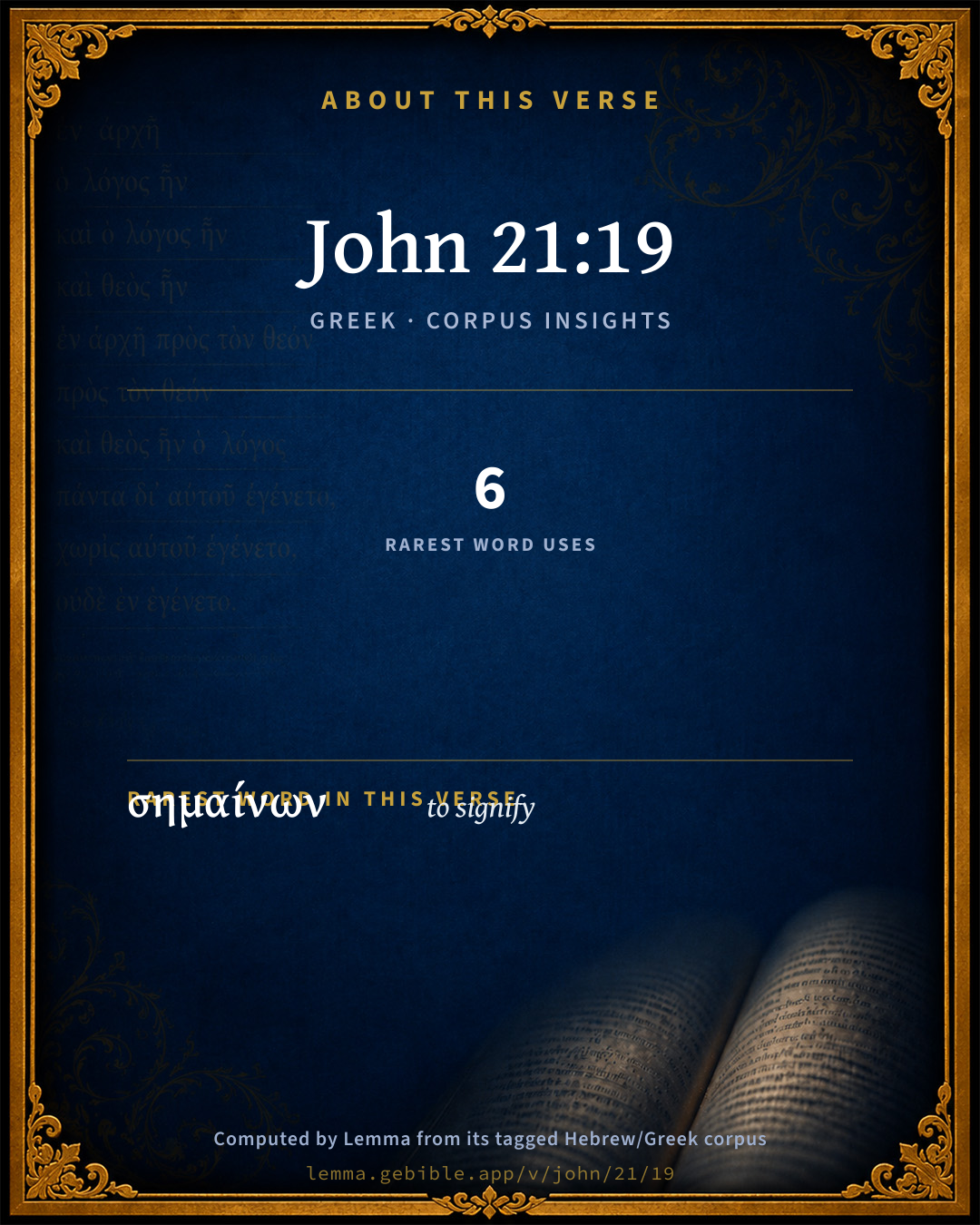
The rarest word here is σημαίνων to signify G4591 — appearing just 6 times in the whole Greek New Testament.

Shared distinctive vocabulary

σημαίνων to signify G4591 occurs in 6 verses of the Greek New Testament. Also found in:

Repetition

Words recur within this verse:

  • εἶπεν to say G3004 ×3
  • τοῦτο this G3778 ×2

Cross-references

15

Topical passages linked to John 21:19 in the Treasury of Scripture Knowledge — connected by theme and wording, ordered by reader-vote popularity; previews shown in the World English Bible.

  • 2 Peter 1:14 knowing that the putting off of my tent comes swiftly, even as our Lord Jesus Christ made clear to me.
  • John 21:22 Jesus said to him, "If I desire that he stay until I come, what is that to you? You follow me."
  • Matthew 10:38 He who doesn't take his cross and follow after me, isn't worthy of me.
  • Philippians 1:20 according to my earnest expectation and hope, that I will in no way be disappointed, but with all boldness, as always, now also Christ will be magnified in my body, whether by life, or by death.
  • 1 Samuel 12:20 Samuel said to the people, "Don't be afraid; you have indeed done all this evil; yet don't turn aside from following Yahweh, but serve Yahweh with all your heart:
  • Mark 8:33–38 But he, turning around, and seeing his disciples, rebuked Peter, and said, "Get behind me, Satan! For you have in mind not the things of God, but the things of men."
  • John 13:36–37 Simon Peter said to him, "Lord, where are you going?" Jesus answered, "Where I am going, you can't follow now, but you will follow afterwards."
  • Numbers 14:24 but my servant Caleb, because he had another spirit with him, and has followed me fully, him will I bring into the land into which he went; and his seed shall possess it.
  • Matthew 16:21–25 From that time, Jesus began to show his disciples that he must go to Jerusalem and suffer many things from the elders, chief priests, and scribes, and be killed, and the third day be raised up.
  • Matthew 19:28 Jesus said to them, "Most assuredly I tell you that you who have followed me, in the regeneration when the Son of Man will sit on the throne of his glory, you also will sit on twelve thrones, judging the twelve tribes of Israel.
  • Luke 9:22–26 saying, "The Son of Man must suffer many things, and be rejected by the elders, chief priests, and scribes, and be killed, and the third day be raised up."
  • John 12:26 If anyone serves me, let him follow me. Where I am, there will my servant also be. If anyone serves me, the Father will honor him.
  • John 12:33 But he said this, signifying by what kind of death he should die.
  • John 18:32 that the word of Jesus might be fulfilled, which he spoke, signifying by what kind of death he should die.
  • 1 Peter 4:11–14 If any man speaks, let it be as it were oracles of God. If any man serves, let it be as of the strength which God supplies, that in all things God may be glorified through Jesus Christ, to whom belong the glory and the dominion forever and ever. Amen.

Cross-references courtesy of OpenBible.info (CC BY 4.0).

Commentary

Notes on John 21:19 from classic Christian and Jewish commentators (each source and its license shown beneath its notes). The classic Christian expositions comment on the surrounding passage and are grouped to its opening verse, so a note may address several verses; the Jewish commentaries on the Tanakh (Rashi and others) are per-verse, so they appear only where the commentator wrote on this verse.

Lemma curates 59 commentaries, every one of them public domain or Creative Commons licensed, each selected and text-cleaned for this edition rather than reprinted as found. About our sources →

Tyndale Open Study Notes

Tyndale Open Resources

21:19 The rest of Peter’s life was a ministry tending the flock of God, and his martyrdom was a kind of death that glorifies God. • Follow me: This might require suffering and death (see 13:16; 15:18-21).

Tyndale Open Study Notes — © Tyndale Open Resources, licensed CC BY-SA 4.0. Text via the HelloAO Bible API.

Bengel's Gnomon

Johann Albrecht Bengel

Joh 21:19. Σημαίνων, signifying) Such predictions are sometimes vouchsafed to those who excel in love and faithfulness.—ποίῳ, by what kind of death) John wrote his gospel before the death of Peter: and the event, in a few years after, corresponded to the prediction of the Lord recorded by John. Comp. ch. Joh 12:33 [referring to His own death].—δοξάσει, he was about to glorify) It is chiefly by suffering, not merely by doing, that the saints glorify God.—λέγει, He saith) forthwith.—ἀκολούθει μοι, follow Me) apart, by thyself: so as to hear what I have to do with thee alone; as also, that thou mayest undergo the suffering of the cross, Joh 21:18; Joh 21:22, ch. Joh 13:36. [This saying of the Lord, throughout the whole career of Peter’s life, secured his alacrity in following Christ.—V. g.] This following implied not so much the similarity of Peter’s death by the cross to that of Christ, which had already been intimated, as the fact of the death of Peter being separated from that of the Lord by a not exceedingly long interval, when compared with the lengthened stay of John. For there follows, What is that to thee? He had first of all said to the disciples, Follow Me (ch. Joh 1:43). The continuation of the beginning crowns the completion of Christianity.[409] This especially was the mind of Ignatius, to follow so as to attain to Christ.

[409] i.e. To follow Christ on to the last, as it is the first step, so it is the crowning of a disciple’s Christianity.—E. and T.

Bengel's Gnomon of the New Testament — English translation (T&T Clark, Edinburgh, 1860) — public domain. Text from a community e-Sword module.

Meyer's Critical & Exegetical Commentary

Heinrich August Wilhelm Meyer

Joh_21:19. A comment, quite of Johannean stamp, on the remarkable saying. Comp. Joh_18:32, also Joh_12:33.

ποίῳ θανάτῳ] i.e. by what manner of death, namely, by the death of martyrdom, for which Peter, bound round with fetters, was conveyed to the place of execution. John, who wrote long after the death of Peter, presupposes the details as well known, as also Clem. Cor. I. 5. Peter was crucified, as tradition, from the time of Tertullian, Scorp. 15,[288] de praeser. 35, and Origen in Eusebius, credibly relates; the reader had therefore to take this special element of the ποιότης of the execution from history, as the fulfilment of the less definite word of prophecy, in addition to, but not to derive it from, the words of Christ themselves.

δοξάσει τ. θεόν] For such a death tended to the glorifying of God, in whose service he suffered for the revelation of His counsel and for the victory of His work (comp. Joh_17:4; Joh_17:6); hence δοξάζειν τ. θεόν became magnificus martyrii titulus, Grotius. See Suicer, Thes. I. p. 949. Comp. also Php_1:20; 1Pe_4:16; Act_5:41.

ἀκολούθει μοι] On the announcement of the martyrdom which is destined for Peter in his old age, there now follows, after a pause, the summons thereto, and that in the significant form: follow me! Comp. Joh_13:36; Mat_10:38; Mat_16:24. This, then, refers, according to the context, to the following of Christ in the like death that He had died, i.e. in the death of martyrdom, which Peter is to undergo. Luther: give thyself willingly to death. Too special is the interpretation which refers it to the death of the cross, since this was not expressly characterized in Joh_21:18 (against Euth. Zigabenus and many others). Quite in opposition to the context, however (see also Joh_21:22), others, after Chrysostom and Theophylact, have referred it to the appointment to be oecumenical bishop. The reference to the guidance of the church is by no means to be connected with that to the death of martyrdom (Ewald, Jahrb. III. p. 171), since ἀκολ. is the opposite of μένειν, Joh_21:22. Others, again, have divested the words of all significance: Jesus had something particular to speak of with Peter, and hence summoned him to go with Him. In this way Kuinoel, Paulus, and even Tholuck and Schleiermacher, whilst Grotius, Bengel, Luthardt, Lange, Hengstenberg, Brückner, Baeumlein, Godet attempt to melt away the proper and symbolical meaning.

[288] Tunc Petrus ab altero cingitur, cum cruci adstringitur.

Meyer — Critical and Exegetical Commentary on the New Testament — English translation by Peter Christie, edited by Frederick Crombie (T&T Clark, 1880) — public domain. Text from a community e-Sword module.

Geneva Bible (1599)

Geneva Bible translators

That is, that Peter should die by a violent death.

Geneva Bible (1599) marginal notes — public domain. Text via Bolls.life.

Jamieson, Fausset & Brown

Robert Jamieson, A. R. Fausset & David Brown

This spake he, signifying by what death he should glorify God--not, therefore, a mere prediction of the manner of his death, but of the honor to be conferred upon him by dying for his Master. And, indeed, beyond doubt, this prediction was intended to follow up his triple restoration:--"Yes, Simon, thou shall not only feed My lambs, and feed My sheep, but after a long career of such service, shalt be counted worthy to die for the name of the Lord Jesus."

And when he had spoken this, he saith unto him, Follow me--By thus connecting the utterance of this prediction with the invitation to follow Him, the Evangelist would indicate the deeper sense in which the call was understood, not merely to go along with Him at that moment, but to come after Him, "taking up his cross."

Jamieson, Fausset & Brown — Commentary Critical and Explanatory on the Whole Bible (1871) — public domain (CC PDM 1.0). Text via the HelloAO Bible API.

Adam Clarke's Commentary

Verse 19. Should glorify God.] Ancient writers state that, about thirty-four years after this, Peter was crucified; and that he deemed it so glorious a thing to die for Christ that he begged to be crucified with his head downwards, not considering himself worthy to die in the same posture in which his Lord did. So Eusebius, Prudentius, Chrysostom, and Augustin. See Calmet.

Follow me.] Whether our Lord meant by these words that Peter was to walk with him a little way for a private interview, or whether he meant that he was to imitate his example, or be conformed to him in the manner of his death, is very uncertain.

Adam Clarke's Commentary on the Bible (1810–1826) — public domain. Text from a community e-Sword/MySword module.

John Calvin's Commentaries

19. Signifying by what death he should glorify God. This circumlocution is highly emphatic; for though the end held out to all believers ought to be, to glorify God both by their life and by their death, yet John intended to employ a remarkable commendation for adorning the death of those who, by their blood, seal the Gospel of Christ and glorify his name, as Paul teaches us, (Philippians 1:20.) It is now our duty to reap the fruit which the death of Peter has yielded; for it ought to be imputed to our indolence, if our faith be not confirmed by it, and if we do not keep the same object in view, that the glory of God may be displayed by us. If the Papists had considered this end in the death of the martyrs, that sacrilegious and detestable invention would never have entered into their minds, that their death contributes to appease the wrath of God, and to pay the ransom for our sins.

And when he had said this. Christ here explains what was the design of that prediction of a violent death. It was, that Peter might be prepared to endure it; as if he had said, “Since you must endure death by my example, follow your leader.” Again, that Peter may the more willingly obey God who calls him to the cross, Christ offers himself as a leader; for this is not a general exhortation by which he invites him to imitate himself, but he speaks only of the kind of death. Now, this single consideration greatly soothes all the bitterness that is in death, when the Son of God presents himself before our eyes with his blessed resurrection, which is our triumph over death.

John Calvin's Commentaries (1540-1563) — public domain. Text from the Calvin Translation Society English edition (1840s-50s) via the Christian Classics Ethereal Library (ccel.org). Calvin's coverage is partial (roughly two-thirds of the Bible); uncommented books and verses are honest gaps, never fabricated. The 19th-century editor's footnotes and remarks are omitted so the notes are faithfully Calvin's own voice.

Ellicott's Commentary for English Readers

(19) This spake he, signifying by what death he should glorify God.—These words are a comment by the writer, and quite in St. John’s style. (Comp. Joh_2:21; Joh_6:6; Joh_7:39; Joh_12:33.)

“By what death,” or, more exactly, by what manner of death (comp. Joh_12:33; Joh_18:32), indicates generally the martyrdom of Peter as distinct from a natural death, without special reference to the crucifixion. (See Note on last verse.)

For the phrase “glorify God,” comp. Joh_13:31; Joh_17:1; and see also Php_1:20; 1Pe_4:16. From its occurrence here in connection with St. Peter, it passed into the common language of the Church for the death of martyrs.

Follow me.—It may be, and the next verse makes it probable, that our Lord withdrew from the circle of the disciples, and by some movement or gesture signified to Peter that he should follow Him; but these words must have had for the Apostle a much fuller meaning. By the side of that lake he had first heard the command “Follow Me” (Mat_4:19); when sent forth on his apostleship, he had been taught that to follow Christ meant to take up the cross (Mat_10:38); it was his words which drew from Christ the utterance, “If any man will come after Me, let him deny himself, and take up his cross and follow Me” (Mat_16:23); to his question at the Last Supper came the answer, “Whither I go, thou canst not follow Me now; but thou shalt follow Me afterwards” (Joh_13:36); and now the command has come again with the prophecy of martyrdom, and it must have carried to his mind the thought that he was to follow the Lord in suffering and death itself, and through the dark path which He had trodden was to follow Him to the Father’s home.

A Bible Commentary for English Readers, edited by Charles John Ellicott (1878–1897) — public domain. Text from a community e-Sword module.

The Cambridge Bible for Schools and Colleges

gen. ed. J. J. S. Perowne

19. This spake he] Now this He spake.

signifying by what death] Signifying by what manner of death. This comment is quite in S. John’s style (comp. Joh_12:33, Joh_18:32) [14]. It will depend on the interpretation of Joh_21:18 whether we understand this to mean crucifixion or simply martyrdom. That S. Peter was crucified at Rome rests on sufficient evidence, beginning with Tertullian (Scorp. xv.), and that he requested to be crucified head downwards is stated by Eusebius (H. E. iii. i. 2) on the authority of Origen.

he should glorify] Literally, he shall glorify.

Follow me] Perhaps the literal meaning is not altogether to be excluded; and it appears from S. Peter’s ‘turning about’ (Joh_21:20), that he understood the words literally and began to follow. But no doubt this command here, as elsewhere in the Gospels, is to be understood figuratively, the precise shade of meaning being determined by the context. Comp. Joh_1:43; Mat_8:22; Mat_9:9; Mat_19:21. In the present case there is probably a reference to Joh_13:36-37; and the ‘following’ includes following to a martyr’s death, and possibly the precise death of crucifixion.

The Cambridge Bible for Schools and Colleges (gen. ed. J. J. S. Perowne; Cambridge University Press, 1878–1918) — public domain. Text from a community e-Sword module.

John Gill's Exposition

This spake he,.... These are the words of the evangelist, explaining the meaning of Christ in like manner, as in Joh 12:33

signifying by what death he should glorify God; for by the above words Christ not only intimated that Peter should die, not a natural, but a violent death, or that he should die a martyr in his cause, but the very kind of death he should die, namely, by crucifixion; and that Peter was crucified at Rome, ecclesiastical history confirms (f), when Christ was magnified, and God was glorified by his zeal and courage, faith and patience, constancy and perseverance to the end:

and when he had spoken this: concerning the usage and treatment he should meet with, the sufferings he should undergo, and death he should die for his sake, for the present trial of him:

he saith unto him, follow me: which may be understood literally, Jesus now rising up, and ordering him to come after him; and yet as a sign of his following him, in a spiritual sense, exercising every grace upon him, discharging every duty towards him, faithfully and constantly performing his work and office, as an apostle and preacher of the Gospel, in which he had now reinstated and confirmed him, and patiently bearing and suffering all kind of reproach, persecution, and death, for his name's sake.

(f) Euseb. Eccl. Hist. l. 2. c 25.

John Gill's Exposition of the Whole Bible (1746–1763) — public domain (CC PDM 1.0). Text via the HelloAO Bible API.

Trapp's Complete Commentary

John Trapp

19 This spake he, signifying by what death he should glorify God. And when he had spoken this, he saith unto him, Follow me.

Ver. 19. By what death he should glorify God] Martyrdom is the lowest subjection that can be to God, but the highest honour. Vere magnus est Deus Christianorum; The God of the Christians is a great God indeed, said one Calocerius, a heathen, beholding the patient sufferings of the primitive martyrs. Justin Martyr confesseth of himself, that seeing the piety of Christians in their lives and their patience in death, he gathered that that was the truth that they so constantly professed and sealed up with their blood. And of one Adrianus it is reported, that seeing the martyrs suffer such grievous things, he asked the cause; one of them named that text, "Eye hath not seen, nor ear heard," &c. The naming of which words and seeing of such sufferings, so converted him, that afterwards he became a martyr. To account Christ precious as a tree of life, though we be fastened to him as to a stake to be burned at, this is the greatest honour we can do him upon earth. This is to magnify Christ as Paul did, Php 1:20; to follow Christ close at heels, as Peter did here, who also had the manner of his death foretold him, 2Pe 1:14. As had likewise Bishop Hooper, when he had given him for his arms, a lamb in a fiery bush, and the sunbeams from heaven descending down upon the lamb, rightly purporting by what death he should glorify God.

John Trapp, A Commentary or Exposition upon All the Books of the Old and New Testament (1647–1656) — public domain. Text from a community e-Sword module.

Albert Barnes' Notes on the Bible

By what death ... - In these words two things are implied:

1.That Peter would die a violent death; and,

2.That his death would be such as to honor God.

The ancients say that Peter was crucified at Rome, about 34 years after this, with his head downward. Clemens says that he was led to the crucifixion with his wife, and sustained her in her sufferings by exhorting her to remember the example of her Lord. He also adds that he died, not as the philosophers did, but with a firm hope of heaven, and patiently endured the pangs of the cross (Strom. vii.). This declaration of the Saviour was doubtless continually before the mind of Peter, and to the hour of his death he maintained the utmost constancy and fidelity in his cause, thus justifying the appellation which the Lord Jesus gave him - a rock.

Albert Barnes' Notes on the Bible (1834–1885) — public domain. Text from a community e-Sword/MySword module.

Whedon's Commentary on the Bible

Daniel D. Whedon

19. Glorify God—That God should receive glory in the martyr’s death was a new thought, unknown to heathenism. Fo

llow me—Our Lord, we now suppose, rose from the meal and prepares for his disappearing. He moves from the company and bids Peter follow him. As Peter rises to follow, John, with deep interest, but half unconsciousness, rises to follow also. This command to Peter to follow him required a bodily following; but it also symbolized that following in future destiny by which Peter should tread the path through martyrdom to heaven. This will soon appear as we advance.

Daniel D. Whedon (gen. ed.), Commentary on the Old and New Testaments (1874–1909) — public domain. Text from a community e-Sword module.

The Pulpit Commentary

This he said, adds the evangelist, signifying by what manner of death, not necessarily crucifixion (Godet), but that violent and martyr-death to which the prince of the apostles was called. How many anticipations, partial beginnings, of the final scene must Peter have passed through before, in utter human helplessness, but in Divine, supernatural strength, he stretched out his hands, allowed another to gird him, prepare him for the day"s work, and carry him whither all his nature would shrink to go! There is no other hint whatever of literal crucifixion than this phrase of "stretching out the hand," which is nowhere else applied to the peculiar method in which the crucified ones suffered. Doubtless the transposition of the two phrases must not be pressed too much, since the stretching of the arms might possibly bear the literal interpretation of the action which was forced upon the victim, and the subsequent "girding" refer to the subligaculum, by which he was fastened to the instrument of torture; while the "being carried whither he would not" might, though by some forcing of the phrase, be supposed, though enigmatically and obscurely, to refer to the uplifting of the cross with its living burden. The phrase, "signifying by what manner of death he should glorify God," is peculiarly Johannine. (Joh_12:33 Joh_18:32) This sublime term for the suffering of the great saints, taken from the light which the Lord"s agony had cast upon holy death, became a permanent Christian idea (Suicer, "Thes.," 1:949). When John wrote, the fact of Peter"s death must have been well known throughout the Church. There is every probability that he had long since been crucified, and the solemnity of the utterance was augmented and pointed by the well-known manner of the death of the illustrious apostle. This was, however, by no means the only meaning that naturally flows out of the warning; nor is Peter"s experience the only illustration that it bears. And when he had spoken this, Jesus saith to him, Follow me. There may have been a primary interpretation derived from Christ"s removal to a distance from the rest of the disciples, and the intention of conferring upon Peter there and then, special and further instructions. But from the context, in which the contrasts of life, character, and service are conspicuous, it would seem impossible (Meyer) so to restrict the meaning, as Tholuck and others do. The command is the concentration into one burning utterance of all that is meant by Christian life that coming into relation with the living Lord, that imitation of his principle of action, which, as St. Paul in Philippians it. has shown, was capable of imitation in the narrower and smaller circle of our human experience. If it be rational for the Lord to have said, "Be ye perfect, as your Father in heaven is perfect," and for Paul to have pressed upon his converts, "Be ye followers of God, as dear children;" "Be ye followers of me, as I am of Christ, then the Lord gathered all the rules of conduct which were involved in his previous discourses into one word, when he laid upon the man who should be a fisher of souls, a feeder of lambs, a shepherd of sheep, a feeder of the little sheep of the flock, the comprehensive duty, "Follow me." Those interpretations which make the words mean "Follow me as universal bishop and pastor," as that of Chrysostom does, are incompatible with the narrative; or if we suppose them to signify, "Follow me into the invisible world," or "Imitate me in my martyrdom," this would be unpractical, and by no means in obvious harmony with the kind of injunctions just given. We give the passage from James Innes" translation of Aug., "Tr.," 123:4, which Westcott justly implies is beyond translation: "Such was the end reached by that denier and lover; elated by his presumption, prostrated by his denial, cleansed by his weeping, approved by his confession, crowned by his suffering, this was the end he reached: to die with a perfected love for the Name of him with whom, by a perverted forwardness, he had promised to die. He would do, when strengthened by Christ"s resurrection, what in his weaknesss he had promised prematurely. The needful order was that Christ should first die for Peter"s salvation, and then that Peter should die for the preaching of Christ." Our Lord, when appealed to with reference to John, does not merely repeat the injunction, "Follow me," but forces upon Peter the original summons. This undoubtedly gives a solemnity and specialty to the work of Peter, to which the subsequent career of John was not an exact parallel. It cannot be said that our Lord in any sense forbids John to follow him, but says that, though John may abide, may rest, may meditate, may see visions and dream dreams, until he the Lord should come, that would in no respect alter the direct advice given to Peter. On referring to the earliest scene described in this Gospel between Jesus and his disciples, we find that "Follow me" was addressed to Philip, Moreover, Andrew and John were, on their first introduction to Jesus as "the Lamb of God," already (akolouyountav) "following him," and they were even then asking for power or permission to "abide" (menein) with him. But Peter was not then told to "follow him," but was simply invested with the great name of Cephas. (Joh_1:42) These details are obviously supplemented by those before us. The entire phraseology is borrowed from the earlier narrative. The true solution of the problem of the paragraph is that John had followed the Master from the first, and clung to him (emeine), abode with him, from those early days till the moment at which these memorable words were uttered. In the journeys to Jerusalem, at the interview with Nicodemus, in Samaria, at the pool of Bethesda, in the hall of the high priest, and in Pilate"s Praetorium, at the upper chamber, and in the garden, to the cross, and to the grave of Joseph, the beloved disciple had "followed" his Master. Peter"s devotion was intense and at times passionate, but it was marked with a striking disposition, from first to last, to lead as well as "follow," to advise as well as to be guided, to stretch forth his hands, and to gird himself for his own enterprises. But with all his extraordinary peculiarities, he had never really broken the bond or relinquished his faith; and now the Lord in one word corrects every one of his failings anew, and institutes him into his sublime mission by the call, "Follow me." But even yet, Peter"s extraordinary characteristic, to guide rather than to follow, leads him once more to lake the initiative. For whatever gesture it was that our Lord made, which induced Peter to think of immediate action, we cannot say; but it would seem that, even before he began to follow, he gave another intensely vivid characterization of himself.

God glorified in death.

There is something startling in this language of our Lord. God is the Giver of life; and death, according to the scriptural teaching, comes by sin. In life God is glorified. Yet, as Christianity transmutes dross into gold, it is credible that even death may tend to the Divine glory. In the case of Christians we can indeed see how this should be so.

I THE CHRISTIAN, IN ORDER TO GLORIFY GOD IN DEATH, MUST FIRST GLORIFY HIM IN LIFE. Such was conspicuously the case with Peter, with regard to whom this language was first employed. Active energies were consecrated to no personal end of self advancement, but to the highest end of life. Similarly with every Christian, however lowly his position and however brief his career. The end crowns the work. He who lives well, dies well.

II GOD MAY BE GLORIFIED BY THE CHRISTIAN"S DEATH, WHETHER THAT DEATH BE NATURAL OR VIOLENT. In the case of Peter, the language of Jesus evidently pointed to crucifixion as the mode of that apostle"s end. And in the early age of Christianity there were evident reasons why many should be permitted to seal their testimony by their blood. But then and always the highest purposes may be secured by whatever mode of dissolution Divine providence allows. And a peaceful decease, though it may be less impressive upon men, may be equally acceptable to God, and perhaps even equally serviceable to survivors, as a triumphant martyrdom.

III THE SPIRIT IN WHICH DEATH IS MET BY CHRISTIANS IS GLORIFYING TO GOD. This is emphatically the spirit of submission.

Since men naturally shrink from dissolution, a principle of especial power is needed in order to overcome this tendency. On the part of some dying Christians there is something more than patient acquiescence; there is joy and even ecstasy in the prospect of being with Christ, which is far better. But even where such experience is wanting, there may be the manifestation of a truly submissive spirit. God is glorified in the patience of the saints.

IV GOD IS GLORIFIED BY THE RESULTS WHICH THE CHRISTIAN"S DEATH PRODUCES UPON SURVIVORS. The consequences which flowed from the early martyrdoms have been generally acknowledged. It is proverbial that "the blood of the martyrs is the seed of the Church." Even persecutors have been touched by the exhibition of constancy, fortitude, and expectation of glory which they have witnessed on the part of sufferers. And in how many instances have children traced their new and holier life to the dying confession and victory of their Christian parents! Christ"s death was the life of the world; and the death of his followers is ever fruitful of spiritual and immortal good. T.

The Pulpit Commentary (1880–1919), ed. H.D.M. Spence-Jones & Joseph S. Exell — public domain. Text from a community e-Sword module.

John Wesley's Explanatory Notes

By what death he should glorify God - It is not only by acting, but chiefly by suffering, that the saints glorify God. Follow me - Showing hereby likewise what death he should die.

John Wesley, Explanatory Notes Upon the Whole Bible (1754–1765) — public domain. Text via the GEBible commentary corpus.

The People's New Testament

B. W. Johnson

19. By what death he should glorify God. These two verses can only be understood as declaring that Peter should die the death of a martyr. John wrote after Peter's death, and may be understood as affirming that he did thus “glorify God.” The universal testimony of the ancient Church is that he did thus die. It is asserted that Peter was crucified, a fact that is probable, as he was not a Roman citizen. Follow me. He had once forsaken Christ through fear of death. Now, with a prospect of violent death before him, he is bidden to resume the Master's work and to follow him. He did this, from this time, faithfully.

B. W. Johnson's The People's New Testament with Notes (1889–1891) — public domain. Electronic text from the Christian Classics Ethereal Library (CCEL) ThML edition.

unfoldingWord translationNotes

Door43 World Missions Community

Now

John uses this word to show he is giving background information before he continues the story. (See: Background Information)

to indicate with what kind of death Peter would glorify God

Here John implies that Peter would die on a cross. AT: "to indicate that Peter would die on a cross to honor God" (See: Assumed Knowledge and Implicit Information)

Follow me

Here the word "follow" means "to be a disciple." AT: "Keep on being my disciple" (See: Assumed Knowledge and Implicit Information)

translationWords

die

Peter

glory

God

unfoldingWord translationNotes — © Distant Shores Media and the Door43 World Missions Community, licensed CC BY-SA 4.0. Source: git.door43.org/Door43/en_tn.

Cambridge Greek Testament for Schools and Colleges

19. ποίῳ θανάτῳ. By what manner of death. This comment is quite in S. John’s style: comp. Joh 12:33, Joh 18:32 [22]. It will depend on the interpretation of Joh 21:18 whether we understand this to mean crucifixion or simply martyrdom. That S. Peter was crucified at Rome rests on sufficient evidence, beginning with Tertullian (Scorp. 15); and that he requested to be crucified head downwards is stated by Eusebius (H. E. III. i. 2) on the authority of Origen.

ἀκολούθει μοι. Certainly the literal meaning cannot be excluded. It is plain from ἐπιστραφείς that S. Peter understood the command literally, and began to follow, then turned and saw S. John following. The correspondence between ἀκολούθει and ἀκολουθοῦντα cannot be fortuitous. But the act is another instance of the symbolism which runs through the whole of this Gospel [23]: comp. Joh 3:1, Joh 10:22, Joh 13:30, Joh 18:1. Thus the command is also to be understood, as elsewhere in the Gospels, figuratively, the precise shade of meaning being determined by the context: comp. Joh 1:43; Mat 8:22; Mat 9:9; Mat 19:21. Here there is probably a reference to ἀκολουθήσεις δὲ ὕστερον (Joh 13:36); and ἀκολουθεῖν includes following to a martyr’s death, and perhaps death by crucifixion.

Cambridge Greek Testament for Schools and Colleges (Cambridge University Press, 1896; 21 vols, various authors incl. Carr, Maclear, Plummer, Farrar, Lumby, Moule, M. R. James, Simcox) — public domain. Text from a community e-Sword module.

Alford’s Greek Testament

Henry Alford

19.] This remark is entirely in John’s manner, see ch. 2:21; 6:6; 7:39; 12:33; as may be also the δοξάζειν τ. θ. used of such a death, see ch. 13:31 f.; 17:1.

ἀκολούθει μοι] Not to be understood I think of any present gesture of the Lord calling Peter aside;—but, from the next verse, followed perhaps by a motion of Peter towards Him, in which John joined. The words seem to be a plain reference to ch. 13:36;—and the following,—a following through the Cross to glory: see Mat 16:24: Mar 10:21. Now, however, ἄρας τὸν σταυρόν is omitted. He had made this so plain, that it needed not expressing. There was also a forcible reminding Peter of the first time when he had heard this command on the same shore, Mat 4:19.

Henry Alford, The Greek Testament (1849–1861) — public domain. Text from a community e-Sword module.

Vincent's Word Studies in the New Testament

Marvin R. Vincent

By what death [ποιω] . Properly, by what manner of death. So Rev.

Marvin R. Vincent, Word Studies in the New Testament (1887–1900) — public domain. Text from a community e-Sword/MySword module.

Lesson kit

Teaching starters — assembled from the data on this page, not authored interpretation. Every prompt links to the verse data it draws on. Edit before teaching.

John, in the Gospels, opens this verse with 16 words (13 distinct Greek lemmas). Its most distinctive word is sēmaínō (“to signify”). A historical commentator’s framing appears above. Read the whole chapter for the surrounding context.

Discussion questions

  1. How does “to signify” (sēmaínō) shape what this verse is saying?
  2. John 12:33 shares the word «to signify» with this verse. How do the two illuminate each other?
  3. “to say” occurs 3× in this one verse. What is the effect of the repetition?
  4. These translations render this verse differently. What is at stake in choosing one wording over another?
  5. Reading how Tyndale Open Study Notes and Bengel's Gnomon read this verse, where do the two commentators agree and where do they part?

Things to notice

Reading settings

Reading text

Shown beneath each verse's original-language words.

Old Testament
Old Testament edition

Read the OT as the Masoretic Hebrew (MT) or the Greek Septuagint (LXX).

English shown for the Greek Septuagint (in the Hebrew ↔ Greek comparison).

Comparing translations? Open the Compare panel on any verse page to stack up to four side by side.