
Acts 8:2

Greek (Tischendorf 8th ed.) Acts 8:2 appears in the Greek New Testament. The text above is from the Tischendorf 8th edition. Each word links to its Strong’s number and a concise gloss. Click any word for its full Thayer’s Greek Lexicon entry.
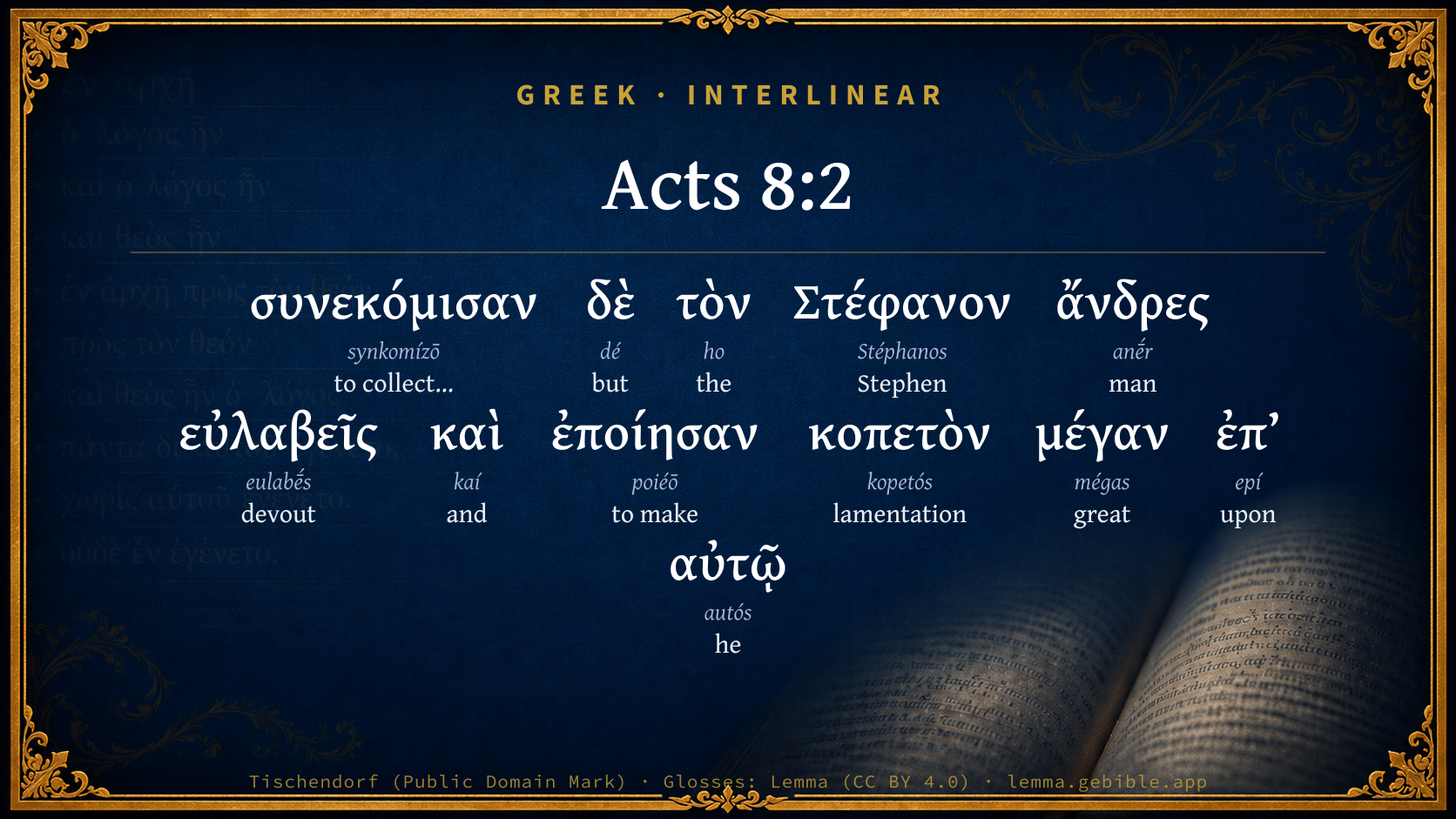
Download image
Cite this verse

Acts 8:2 (World English Bible). Public Domain. Lemma interlinear Bible study tool, https://lemma.gebible.app/v/acts/8/2.

Show BibTeX & RIS
BibTeX
RIS
English Translation
Devout men buried Stephen, and lamented greatly over him.
World English Bible · Public Domain
Highlights
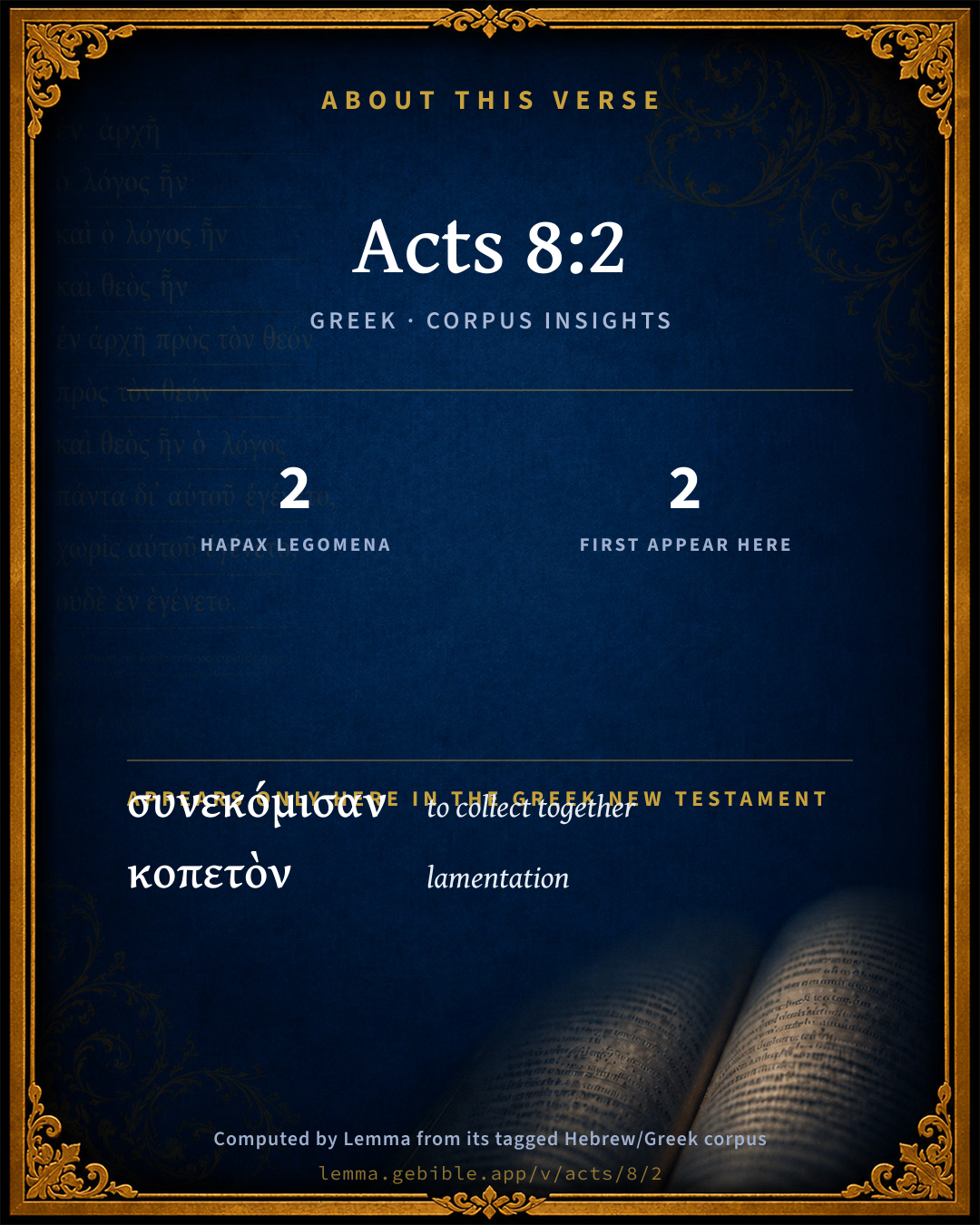
  • 2 hapax legomena — only here in the Greek New Testament
  • 2 first appearances in the Greek New Testament
Full analysis ↓
Download a study sheet

One document with this verse’s original text, its word-by-word gloss line, the meaning frame, cross-references with their text, attributed commentary, and full source and license credits — printable, and it pastes into notes with its structure intact.

This verse Autodidact and up

Study sheet (.html) Plain text (.txt)

A passage Seminary Student

Up to 50 verses in one chapter. A passage sheet keeps up to 6 commentary sources and 12 cross-references per verse, in the order this page ranks them, and says so on the sheet whenever that leaves anything out. Ask for a single verse and you get the Autodidact verse sheet above.

Everything on this page stays free to read, with no account — the sheet is a download of what is already on screen, not access to it.

Want to remove ads? Support Godless Engineer
Compare translations 3

The same verse in 3 English versions, stacked beneath the original-language interlinear above. Click any original word for its lexicon entry.

Each is an independent rendering of the whole verse — the interlinear is not word-aligned to these translations.

Highlighted words mark where these versions differ — a whole-verse word diff, not a word-by-word alignment.

  • World English Bible Public Domain
    Devout men buried Stephen, and lamented greatly over him.
  • King James Version Public Domain
    And devout men carried Stephen to his burial, and made great lamentation over him.
  • unfoldingWord Literal Text CC BY-SA 4.0
    And devout men carried away Stephen and made great lamentation over him.

unfoldingWord Literal Text — © unfoldingWord, licensed CC BY-SA 4.0. Word-aligned USFM3 via Door43 (git.door43.org/unfoldingWord/en_ult).

Versions to compare (up to 4)

3 of 4 selected

Show all 19 translations

Every available English version of this verse, each an independent rendering of the whole verse.

  • World English Bible Public Domain
    Devout men buried Stephen, and lamented greatly over him.
  • Berean Standard Bible Public Domain
    God-fearing men buried Stephen and mourned deeply over him.
  • Majority Standard Bible Public Domain
    God-fearing men buried Stephen and mourned deeply over him.
  • King James Version Public Domain
    And devout men carried Stephen to his burial, and made great lamentation over him.
  • American Standard Version (1901) Public Domain
    And devout men buried Stephen, and made great lamentation over him.
  • Revised Version (1885) Public Domain
    And devout men buried Stephen, and made great lamentation over him.
  • Geneva Bible (1599) Public Domain
    Then certaine men fearing God, caried Steuen amongs them, to be buried, and made great lamentation for him.
  • Douay-Rheims (1899) Public Domain
    And devout men took order for Stephen's funeral, and made great mourning over him.
  • Young's Literal Translation Public Domain
    and devout men carried away Stephen, and made great lamentation over him;
  • Literal Standard Version CC BY-SA 4.0
    and devout men carried Stephen away, and made great lamentation over him;
  • Unlocked Literal Bible CC BY-SA 4.0
    Devout men buried Stephen and made great lamentation over him.
  • unfoldingWord Literal Text CC BY-SA 4.0
    And devout men carried away Stephen and made great lamentation over him.
  • Darby Bible Public Domain
    And pious men buried Stephen and made great lamentation over him.
  • World Messianic Bible Public Domain
    Devout men buried Stephen and lamented greatly over him.
  • Webster's Bible Public Domain
    And devout men carried Stephen to his burial, and made great lamentation over him.
  • Free Bible Version CC BY-SA 4.0
    (Some faithful followers of God buried Stephen, with great mourning.)
  • Bible in Basic English Public Domain
    And God-fearing men put Stephen's body in its last resting-place, making great weeping over him.
  • Text-Critical English NT CC BY 4.0
    Devout men carried Stephen away for burial and made great lamentation over him.
  • Tyndale New Testament (1534) Public Domain
    Then devout men dressed Steven and made great lamentacion over him.

Literal Standard Version (2020), Covenant Press — licensed CC BY-SA 4.0. Text via the HelloAO Bible API (eBible.org). Unlocked Literal Bible (unfoldingWord) — licensed CC BY-SA 4.0. Text via the HelloAO Bible API (eBible.org). unfoldingWord Literal Text — © unfoldingWord, licensed CC BY-SA 4.0. Word-aligned USFM3 via Door43 (git.door43.org/unfoldingWord/en_ult). Free Bible Version, Dr. Jonathan Gallagher — licensed CC BY-SA 4.0. Text via the HelloAO Bible API (eBible.org).

Word by word

More ways to search: Search by grammar → Find every occurrence → Compare this word →

Practice this passage: Drill this verse → Learn its vocabulary →

συνεκόμισαν
synkomízō
G4792
“to collect together”
Verb, Aorist, Active, Indicative, 3rd person, Plural
Part of Speech
Verb
Tense
Aorist
Voice
Active
Mood
Indicative
Person
3rd person
Number
Plural
Full Thayer's Definition

Origin: from G4862 and G2865

TDNT: None

1. to carry or bring together, to collect a. to house crops, gather into granaries 2. to carry with others, help in carrying out, the dead to be buried or burned a. to bury
  1. δὲ dé G1161 “but” Conjunction
  2. τὸν ho G3588 “the” Article, Accusative, Singular, Masculine
  3. Στέφανον Stéphanos G4736 “Stephen” Noun, Accusative, Singular, Masculine
  4. ἄνδρες anḗr G435 “man” Noun, Nominative, Plural, Masculine
  5. εὐλαβεῖς eulabḗs G2126 “devout” Adjective, Nominative, Plural, Masculine
  6. καὶ kaí G2532 “and” Conjunction
  7. ἐποίησαν poiéō G4160 “to make” Verb, Aorist, Active, Indicative, 3rd person, Plural
  8. κοπετὸν kopetós G2870 “lamentation” Noun, Accusative, Singular, Masculine
  9. μέγαν mégas G3173 “great” Adjective, Accusative, Singular, Masculine
  10. ἐπ’ epí G1909 “upon” Preposition
  11. αὐτῷ autós G846 “he” Personal pronoun, Dative, Singular, Masculine

About this verse

These counts appear in no published source. They are computed here, from the morphology-tagged text and Lemma’s own curated glosses. What Lemma adds →

12
words
12
distinct lemmas
Acts
section

Notable vocabulary

2 hapax legomena — words that appear only here in the entire Greek New Testament:

  • συνεκόμισαν to collect together G4792
  • κοπετὸν lamentation G2870

First appearance in Scripture

These words make their first canonical appearance in the Greek New Testament here:

  • συνεκόμισαν to collect together G4792
  • κοπετὸν lamentation G2870

Shared distinctive vocabulary

εὐλαβεῖς devout G2126 occurs in 4 verses of the Greek New Testament. Also found in:
Cross-references

15

Topical passages linked to Acts 8:2 in the Treasury of Scripture Knowledge — connected by theme and wording, ordered by reader-vote popularity; previews shown in the World English Bible.

  • Genesis 50:10–11 They came to the threshing floor of Atad, which is beyond the Jordan, and there they lamented with a very great and sore lamentation. He mourned for his father seven days.
  • Genesis 23:2 Sarah died in Kiriath Arba (the same is Hebron), in the land of Canaan. Abraham came to mourn for Sarah, and to weep for her.
  • Numbers 20:29 When all the congregation saw that Aaron was dead, they wept for Aaron thirty days, even all the house of Israel.
  • Deuteronomy 34:8 The children of Israel wept for Moses in the plains of Moab thirty days: so the days of weeping in the mourning for Moses were ended.
  • 1 Samuel 28:3 Now Samuel was dead, and all Israel had lamented him, and buried him in Ramah, even in his own city. Saul had put away those who had familiar spirits, and the wizards, out of the land.
  • 2 Samuel 3:31 David said to Joab, and to all the people who were with him, Tear your clothes, and gird you with sackcloth, and mourn before Abner. King David followed the bier.
  • 2 Chronicles 32:33 Hezekiah slept with his fathers, and they buried him in the ascent of the tombs of the sons of David: and all Judah and the inhabitants of Jerusalem did him honor at his death. Manasseh his son reigned in his place.
  • 2 Chronicles 35:25 Jeremiah lamented for Josiah: and all the singing men and singing women spoke of Josiah in their lamentations to this day; and they made them an ordinance in Israel: and, behold, they are written in the lamentations.
  • Isaiah 57:1–2 The righteous perishes, and no man lays it to heart; and merciful men are taken away, none considering that the righteous is taken away from the evil [to come].
  • Jeremiah 22:10 Don't you weep for the dead, neither bemoan him; but weep sore for him who goes away; for he shall return no more, nor see his native country.
  • Jeremiah 22:18 Therefore thus says Yahweh concerning Jehoiakim the son of Josiah, king of Judah: they shall not lament for him, [saying], Ah my brother! or, Ah sister! They shall not lament for him, [saying] Ah lord! or, Ah his glory!
  • Luke 2:25 Behold, there was a man in Jerusalem whose name was Simeon. This man was righteous and devout, looking for the consolation of Israel, and the Holy Spirit was on him.
  • John 11:31–35 Then the Jews who were with her in the house, and were consoling her, when they saw Mary, that she rose up quickly and went out, followed her, saying, "She is going to the tomb to weep there."
  • Acts 2:5 Now there were dwelling in Jerusalem Jews, devout men, from every nation under the sky.
  • Acts 10:2 a devout man, and one who feared God with all his house, who gave gifts for the needy generously to the people, and always prayed to God.

Cross-references courtesy of OpenBible.info (CC BY 4.0).

Commentary

Notes on Acts 8:2 from classic Christian and Jewish commentators (each source and its license shown beneath its notes). The classic Christian expositions comment on the surrounding passage and are grouped to its opening verse, so a note may address several verses; the Jewish commentaries on the Tanakh (Rashi and others) are per-verse, so they appear only where the commentator wrote on this verse.

Lemma curates 59 commentaries, every one of them public domain or Creative Commons licensed, each selected and text-cleaned for this edition rather than reprinted as found. About our sources →

The Biblical Illustrator

Joseph S. Exell

Act_8:2

And devout men carried Stephen to his burial.

The burial of Stephen

I. The devout men exemplified--

1. The constancy of Christian friendship. They did not need the sound of his voice and the echo of his steps to remind them of the duties they owed to him. The friendships induced by Christianity are the firmest and most enduring. Our friend may be no longer on earth, but he lives with Christ and so is still ours.

2. The heroism of Christian friendship. These men were in danger of sharing their friends fate. They might have said, What is the use of risking that now Stephen is dead? But the instinct of friendship was stronger than the fear of danger, and they went forth confessing that they were followers of Him in whose name Stephen had died. Christian friendship is not influenced by selfish considerations.

3. The practical kindness of Christian friendship. A saint who dies in the midst of saints is sure to have a loving burial. He may be poor, but his claims will not be unheeded.

II. The causes of their lamentation.

1. Their own personal loss. One dear to them had been taken away. Our religion does not chide the tears of the bereaved. Jesus wept, and manifested a tender feeling for the hearts of others when He said, Woman, why weepest thou?

2. The Churchs loss. Stephen seemed to be needed more than ever. Saul was becoming a terrible opponent, and there was no Stephen to answer him. A pillar strong with truth, and beautiful with love, was overturned when it was wanted to sustain the temple of God. A standard bearer had fallen when foes were gathering thickly about the camp. A shepherd was taken away when the flock was likely to be scattered.

3. The worlds loss. The world could not understand this. It was nothing to the soldier, the merchant, the priest; but it was a far greater calamity than if Caesar had fallen from his throne.

III. The alleviating circumstances. There was no need for the lamentation as far as Stephen was concerned.

1. A little before he died he had a vision of Christ.

2. He died in the calm assurance of a life to come.

3. He died in love and charity with all men. (J. Marratt.)

The burial of Stephen

The action of these devout men--

I. Expresses affectionate sorrow for their departed friend. The religion of Christ does not destroy our feelings as men. It makes the already gentle and loving heart more loving and gentle still, and fills the stern, the frozen breast, with warm and generous feeling. What a change it wrought in that young man, at whose feet Stephens murderers laid their clothes! The devout men were not yielding to unmanly or unchristian emotions. The religion of Jesus would moderate their grief, but it would not restrain their tears. Jesus Himself wept at the grave of a friend. And Stephen had been their friend.

II. Implies that their sorrow would be chastened by submission to the will of God. They knew who had said, The hour cometh, that whosoever killeth you, will think that he doeth God service. They also knew who had said, whilst Himself drinking a cup far more bitter than Stephens, O My Father, if this cup may not pass from Me, except I drink it, Thy will be done. And did they not know that that sufferer had left His disciples an example that they should tread in His steps? and that now He was Lord of all, and could dash His enemies in places, like a potters vessel? And therefore these devout men would in submission say, amid all their tears, It is the Lord, let Him do what seemeth Him good. The Lord gave--the Lord hath taken away: blessed be the name of the Lord.

III. Infers that they would be influenced by kindest sympathy towards Stephens surviving relations. What was their loss compared with the loss sustained by such? The loss of a friend is not so great as the loss of a son--the loss of a father--the loss of a husband. To such the loss would be irreparable, or could only be made up by Him who is better than ten thousand sons, and who has said, Leave thy fatherless children unto Me, I will provide, and let thy widows trust in Me. And would not these devout men sympathise with the widow and the orphan and the mother who had lost such a relative as Stephen? Pure religion and undefiled before God and the Father is this, to visit the fatherless and widows in their affliction.

IV. Leads us to suppose that they could not allow such an occasion to pass away without earnest prayer that this bereavement which the Church had sustained might be sanctified to the churchs interests. The burden of their prayer would probably be, Help, Lord, for the godly man ceaseth, etc. Who can tell what influence they had in the calling of Saul of Tarsus? Would they not also pray, Lord, teach us to cease from man whose breath is in his nostrils, and trust alone in Thee? And would not these prayers be blended with thanksgivings for the grace given to their departed brother?

V. Suggests the hope of a blessed reunion with their departed friend at the resurrection of the just. They sorrowed not as men without hope. They knew their brother had fallen asleep in Jesus; and surely they believed that them who sleep in Jesus will God bring with Him.

VI. Would there not be renewed consecration to the service of God? The storm of persecution raged, and they were scattered by its violence--but not as flock that has lost or left the shepherd. No; rather scattered as rays of light, to become the lights of the world, to be as flames of fire in the service of the Saviour (Act_8:4). And He that gave the word went with them, giving effect to the Word of His grace, so that the Word of the Lord had free course, and was glorified. So it ought ever to be. The work of the Lord must be done. It will be done, whether by us or not; but if not, we gain no reward. Work while it is called to-day--the night cometh in which no man can work. (P. C. Horton.)

Stephens funeral

I. A very select funeral.

1. Pre-eminently select. Devout men--not rich, learned, or titled, but good men; those who discharged thoroughly, from the purest motives, all the duties of life.

(1) Virtuous, or true to themselves.

(2) Philanthropic, or true to their fellow-men.

(3) Godly, or true to the Most High. Christians--men of the highest type.

2. Suitably select. The good burying the good. The pious should care for each other to the last.

3. Wholly select. Occasionally funerals are very mixed. Some attend because the dead man had been a good customer; some because they were neighbours; some because of a necessary family connection; some as an expression of readiness to put the deceased out of the way; some from a denominational bias. Stephens funeral was unmixed--composed of sincere and practical lovers of God and man. Perhaps heavens inhabitants streamed to the balconies of the celestial city and gazed with wonder at the novel sight.

II. A very sad funeral.

1. There have been many non-attendant burials, not an individual present to grieve.

2. There have been largely attended funerals, but the signs of regret were correspondingly small; more talk than tears.

3. Stephens funeral was attended by men of sense and sanctity, who rent the air with the cries of their broken hearts.

(1) Their sadness was an expression of homage to the excellencies of the departed.

(a) To great religious intelligence.

(b) To moral and religious character. The gospel lived in him, and he in it.

(c) To usefulness.

(2) An expression of sympathy with the sufferings of the departed. It was the loss of--

(1) A leading man.

(2) In a sudden manner.

(3) By cruel treatment.

(4) When he was most needed. (B. D. Johns.)

The lamentation at Stephens funeral

This was something more than a conventional funeral. The people among whom it occurred were given to burial rites of elaborate and studied ceremonial. Like all orientalists, their mourning was chiefly marked by a painstaking and intentional publicity. With them grief for the dead meant baring and beating the breast, sprinkling or sitting in ashes, songs of lamentation, and the employment of mourning women. And so, when the martyred Stephen is buried, the customs are not changed. True, he was not merely a flew, but a Christian; yet the infant Church still clung to the cherished ceremonies of the elder, and what was usual was followed here. It was indeed the hatred and vindictiveness of Judaism which had slain this godly man, yet, when he is dead, the manner of his burial is the usage of Judaism itself. To have changed it would have been to have surrendered his claim as a veritable and loyal Israelite; and doubtless, also, to have grieved and wounded his surviving relatives. All the more because his death had been so cruel and distressing, would they have his burial decent and reverent and painstaking; even as when the nation buries some honoured soldier she surrounds his funeral cortege with every element of pomp and state and ceremony, as though she would atone for the hardships of his bitter and lonely end upon the field of battle by utmost tenderness and reverence in dealing with his lifeless body. And thus it was with the bruised and mangled form of Stephen. The funeral order of his race was carefully observed. But there was this difference--and it comes out with a singular and touching significance in two Greek words, used here only in all the New Testament: the mourning at Stephens funeral was the mourning of unaffected feeling, and the attendants who followed him to his grave were not hired mutes nor paid mourners, but grief-stricken and godly men. This scene suggests the thought of the difference that there is in funerals. The Church has one common ritual for all her baptized dead. She does not attempt to discriminate either in her customs or her utterances. She is not a judge with such infallible insight that she can weigh character and prophesy of destiny. Most wisely, therefore, does she use one common office for all her dead, leaving scarce any discretion to her ministry, and uttering one uniform voice to her people. Her language is general, not specific. She writes as Inspiration has written before her, Blessed are the dead who die in the Lord, but she utters no verdict of application in connection with their use. She speaks words of Christian hope; but they are coupled with the Scriptural conditions of all Christian hope. In a word, her language is that of Christian faith and trust; and while it is utterly devoid of any specific application of its very general terms, we feel that its tone is only what the tone of anything save a heathen burial ought to be. And yet, when we come to use it, we recognise what a really tremendous difference there may be in even the Churchs funerals. As with Stephens burial by the elder Church, there are the same preliminaries, the same customs, the same words, and yet, as there, there may be the widest and most radical difference in what those words and customs express. Have we not all witnessed funerals where even the sublime ritual of the Church seemed powerless to touch the heart or lift the thoughts? With utmost charity, with every willingness to leave the vanished life in the hands of a Love at once deeper and wiser than ours, we cannot bind that life and the Churchs tones together. Somehow, they do not fit into, and form a part of, each other. Verily, Blessed are the dead who die in the Lord; for they rest from their labours. But if they have not lived in the Lord, nor laboured for Him--we may say these questions are useless; but we cannot help asking them. On the other hand, there are other funerals where we use precisely the same ritual; where there is no diversity in usage or custom from what is wonted, unless in the direction of greater simplicity; where merely the Churchs appointed words are said, and no others, and yet where the emotions of our own hearts and the very atmosphere of the whole occasion are utterly and wholly different. There is a deep and widespread sorrow, but it is a grief gilded with light. We listen to the words of inspired hope and promise, and, as we lift our eyes from the bier before us, lo! the clouds are parted, and we see how, to a Christian, the grave is only a low-brewed portal, through which, bending as he passes, he emerges into larger life and freer. (Bp. H. C. Potter.)

The Biblical Illustrator, edited by Joseph S. Exell (c. 1880s–1900s) — public domain. Text from a community e-Sword module.

Bengel's Gnomon

Johann Albrecht Bengel

Act 8:2. Συνεκόμισαν, attended to the burial of) A holy office. Comp. ch. Act 9:37 (Tabitha or Dorcas).—εὐλαβεῖς, devout) who feared GOD more than men, although those men were persecutors.

Bengel's Gnomon of the New Testament — English translation (T&T Clark, Edinburgh, 1860) — public domain. Text from a community e-Sword module.

Meyer's Critical & Exegetical Commentary

Heinrich August Wilhelm Meyer

Act_8:2-3. The connection of Act_8:1-3 depends on the double contrast, that in spite of the outbreak of persecution which took place on that day, the dead body of the martyr was nevertheless honoured by pious Jews; and that on the other hand, the persecuting zeal of Saul stood in stern opposition thereto. On that day arose a great persecution (Act_8:1). This, however, prevented not pious men from burying and lamenting Stephen (Act_8:2); but Saul laid waste, in that persecution which arose, the church (of Jerusalem, Act_8:3). The common opinion is accordingly erroneous, that there prevails here a lack of connection (Act_8:2 is a supplementary addition, according to de Wette), which is either (Olshausen, Bleek) to be explained by the insertion of extracts from different sources, or (Ziegler in Gablers Journ.f. theol. Lit., I. p. 155) betokens that ἐγένετο δὲ … ἀποστόλων is an interpolation, or (Heinrichs, Kuinoel) at least makes it necessary to hold these words as transposed, so that they had originally stood after Act_8:2.[218]

συγκομίζειν] to carry together, then, used of the dead who are carried to the other dead bodies at the burial-place, and generally: to bury. Soph. Aj. 1048; Plut. Sull. 38. According to the Scholiast on Soph. l.c. and Phavorinus, the expression is derived from gathering the fruits of harvest. Comp. Job_5:26.

The ἄνδρες εὐλαβεῖς are not (in opposition to Heinrichs and Ewald) Christians, but, as the connection requires, religious Jews who, in their pious conscientiousness (comp. Act_2:5), and with a secret inclination to Christianity (comp. Joseph of Arimathea and Nicodemus), had the courage to honour the innocence of him who had been stoned. Christians would probably have been prevented from doing so, and Luke would have designated them more distinctly.

κοπετός: θρῆνος μετὰ ψοφοῦ χειρῶν, Hesychius. See Gen_50:10; 1Ma_2:70; Nicarch. 30; Plut. Fab. 17; Heyne, Obss. in Tibull. p. 71.

ἐλυμαίνετο] he laid waste, comp. Act_9:21; Gal_1:13. The following sentence informs us how he proceeded in doing so; therefore a colon is to be placed after τ. ἐκκλ.

κατὰ τοὺς οἰκ. εἰσπορ.] entering by houses (house by house, Mat_24:7; Winer, p. 374 [E. T. 500]).

σύρων] dragging. See Tittmann, Synon. N. T. p. 57 f., and Wetstein. Comp. Act_14:19, Act_17:3. Arrian. Epict. 1:29.

[218] According to Schwanbeck, p. 325, ver. 1 is to be regarded as an insertion from the biography of Peter.

Meyer — Critical and Exegetical Commentary on the New Testament — English translation by Peter Christie, edited by Frederick Crombie (T&T Clark, 1880) — public domain. Text from a community e-Sword module.

Expositor's Greek Testament

ed. W. Robertson Nicoll

Act 8:2 . Spitta connects Act 8:2 with Act 11:19-21 , and all the intermediate section, Act 8:5 to Act 11:19 ; forms part of his source (so also Sorof, Clemen, who joins his H.H., Act 8:1 to Act 11:19 ; but on the other hand see Hilgenfeld, Zeitschrift für wissenschaft. Theol. , p. 501 (1895), and Jüngst, Apostelgeschichte , p. 79). According to Spitta the whole narrative of Philip’s ministry in 8 ought not to be connected so closely with the death of Stephen, but should fall after Act 9:31 . The only reason for its earlier insertion is the desire to connect the second deacon with the first (but Hilgenfeld, u. s. , pp. 413, 414 (1895), as against both Spitta and Clemen, regards the account of Philip and that of Stephen as inseparable). Spitta strongly maintains that Philip the Apostle, and not the deacon, is meant; and if this be so, he would no doubt help us to answer the objection that in Act 8:14-17 , and indeed in the whole section 9 24 we have an addition of the sub-Apostolic age inserted to show that the Apostles alone could bestow the Holy Spirit. But it cannot be said that Spitta’s attempt at the identification of Philip in 8 with the Apostle is in any way convincing, see, e.g. , Zöckler, Apostelgeschichte , p. 212; Hilgenfeld, u. s. , p. 416 (note), and Jüngst, u. s. , p. 81. Feine’s objection to Act 8:14-17 leads him, whilst he admits that the meeting with Simon Magus is historical, to regard the conversion of the sorcerer as doubtful, because the whole passage presupposes (Act 8:18-24 ) that the laying on of the Apostles’ hands bestowed the Spirit; so Clemen refers the whole representation in its present form of the communication of the Spirit, not through Baptism, but through the laying on of the Apostles’ hands, to his Redactor Antijudaicus ( cf. Act 19:6 ), and to the same hand he attributes the πλὴν τῶν ἀποστόλων , Act 8:1 , and cf. Act 8:25 , introduced for the purpose of showing that the Apostles Peter and John sanctioned the Samaritan mission from the central home of the Christian Church. συνεκόμισαν : in its primary sense the verb means to carry or bring together, of harvest; to gather in, to house it; so also in LXX, Job 5:26 ; in a secondary sense, to help in burying; so Soph., Ajax , 1048; Plut., Sull. , 38. The meaning is not “carried to his burial,” as in A.V., but rather as R.V., “buried,” for, although the Greek is properly “joined in carrying,” the word includes the whole ceremony of burial it is used only here in the N.T., and in LXX only in l. c. εὐλαβεῖς : only found in St. Luke in N.T., and used by him four times, once in Luk 2:25 , and in Act 2:5 ; Act 22:12 ( εὐσεβής , T.R.). The primary thought underlying the word is that of one who handles carefully and cautiously, and so it bears the meaning of cautious, circumspect. Although εὐλάβεια and εὐλαβεῖσθαι are both used in the sense of caution and reverence towards the gods in classical Greek, the adjective is never expressly so used. But Plato connects it closely with δίκαιος ( cf. Luk 2:25 ), Polit. 311 A and 311 [214] (so εὐσεβῶς and εὐλαβῶς are used together by Demosthenes). In the LXX all three words are found to express reverent fear of, or piety towards, God; εὐλαβεῖσθαι , frequently, εὐλάβεια in Pro 28:14 , where σκληρὸς τὴν καρδίαν in the second part of the verse seems to point to the religious character of the εὐλαβ ., whilst εὐλαβής is found in Mic 7:2 as a rendering of חסיד ( cf. Psalms of Solomon , p. 36, Ryle and James’ edition); cf. also Sir 11:17 (but see for both passages, Hatch and Redpath); in Lev 15:31 we find the word εὐλαβεῖς ποιήσετε τοὺς υἱοὺς Ἰ . ἀπὸ τῶν ἀκαθαρσιῶν αὐτῶν , נָוַר hi. The adverb εὐλαβῶς is found once, 2Ma 6:11 . St. Luke uses the word chiefly at all events of O.T. piety. In Luk 2:45 it is used of Simeon, in Act 2:5 of the Jews who came up to worship at the feasts in Jerusalem, and in Act 22:12 , although Ananias was a Christian, yet the qualifying words εὐλ . κατὰ τὸν νόμον point again to a devout observance of the Jewish law. Trench, N. T. Synonyms , i., pp. 38, 198 ff.; Westcott, Hebrews , on Act 5:7 ; Grimm-Thayer, sub v ., and sub v . δειλία . ἄνδρες εὐλ .: much discussion has arisen as to whether they were Jews or Christians. They may have been Christians who like the Apostles themselves were still Jews, attending the temple services and hours of prayer, some of whom were doubtless left in the city. But these would have been described more probably as ἀδελφοί or μαθηταί (so Felten, Page, Hackett). Or they may have been devout Jews like Nicodemus, or Joseph of Arimathea, who would show their respect for Stephen, as Nicodemus and Joseph for Jesus (so Holtzmann, Zöckler). Wetstein (so too Renan and Blass) explains of Gentile proselytes, men like Cornelius, who rendered the last offices to Stephen out of natural respect for the dead, and who stood outside the jurisdiction of the Sanhedrim, so that the funeral rites need not have been performed in secret. But St. Luke as a rule uses other words to denote Gentile proselytes, and the Sanhedrim would probably not have interfered with the burial, not only on account of the known Jewish care for the dead, but also because devout Jews would not have been obnoxious in their eyes to the charges brought against Stephen, Act 6:14 (so Nösgen). The word might therefore include both devout Jews and Jewish Christians who joined together in burying Stephen. κοπετὸν μέγαν , from κόπτω , κόπτομαι , cf. planctus from plango , to beat the breast or head in lamentation. Not used elsewhere in N.T., but frequent in LXX; cf., e.g. , Gen 1:10 , 1Ma 2:70 ; 1Ma 4:39 ; 1Ma 9:20 ; 1Ma 13:26 , for the same allocation as here, and for ποιῆσαι κοπετόν , Jer 6:26 , Mic 1:8 , and cf. also Zec 12:10 . In classical Greek κομμός is found, but see Plut., Fab. , 17, and Kennedy, Sources of N. T. Greek , p. 74, for reference to the comic poet Eupolis ( cf. also Blass), and Grimm-Thayer, sub v. For the Jewish customs of mourning cf. Mat 9:23 , Hamburger, Real-Encyclopädie des Judentums , i., 7, 996, “Trauer”; Edersheim, Jesus the Messiah , i., p. 616, and Sketches of Jewish Social Life , p. 172 ff. If the mourners included Jews as well as Jewish Christians, it may well have been that the lamentation was not only a token of sorrow and respect, but also in the nature of a protest on the part of the more moderate section of the Pharisees (see also Trench’s remarks, u. s. , p. 198). According to the tradition accepted by St. Augustine, it is said that both Gamaliel and Nicodemus took part in the burial of Stephen, and were afterwards laid in the same grave (Felten, Apostelgeschichte , p. 167, and Plumptre in loco ).

[214] Codex Vaticanus (sæc. iv.), published in photographic facsimile in 1889 under the care of the Abbate Cozza-Luzi.

The Expositor's Greek Testament, edited by W. Robertson Nicoll (1897–1910) — public domain. Text from a community e-Sword module.

Geneva Bible (1599)

Geneva Bible translators

The godly mourn for Stephen after his death, and bury him, showing therein an example of singular faith and charity: but no man prayeth to him.

Amongst all the duties of charity which the godly use, there is no mention made of shrining up of relics.

Geneva Bible (1599) marginal notes — public domain. Text via Bolls.life.

Jamieson, Fausset & Brown

Robert Jamieson, A. R. Fausset & David Brown

and devout men--pious Jews, probably, impressed with admiration for Stephen and secretly inclined to Christianity, but not yet openly declared.

Jamieson, Fausset & Brown — Commentary Critical and Explanatory on the Whole Bible (1871) — public domain (CC PDM 1.0). Text via the HelloAO Bible API.

Adam Clarke's Commentary

Verse 2. Devout men carried Stephen to his burial] The Greek word, συνεκομισαν, signifies not only to carry, or rather to gather up, but also to do every thing necessary for the interment of the dead. Among the Jews, and indeed among most nations of the earth, it was esteemed a work of piety, charity, and mercy, to bury the dead. The Jews did not bury those who were condemned by the Sanhedrin in the burying place of the fathers, as they would not bury the guilty with the innocent; and they had a separate place for those who were stoned, and for those that were burnt. According to the Tract Sanh. fol. 45, 46, the stone wherewith any one was stoned, the post on which he was hanged, the sword by which he was beheaded, and the cord by which he was strangled, were buried in the same place with the bodies of the executed persons. As these persons died under the curse of the law, the instruments by which they were put to death were considered as unclean and accursed, and therefore buried with their bodies. Among the ancients, whatever was grateful or useful to a person in life was ordinarily buried with him; thus the sword, spear, shield, c., of the soldier were put in the same grave the faithful dog of the hunter, c., c. And on this principle the wife of a Brahman burns with the body of her deceased husband.

Made great lamentation over him.] This was never done over any condemned by the Sanhedrin-they only bemoaned such privately this great lamentation over Stephen, if the same custom then prevailed as afterwards, is a proof that Stephen was not condemned by the Sanhedrin he probably fell a sacrifice to the fury of the bigoted incensed mob, the Sanhedrin not interfering to prevent the illegal execution.

Adam Clarke's Commentary on the Bible (1810–1826) — public domain. Text from a community e-Sword/MySword module.

John Calvin's Commentaries

2. They dressed Stephen. Luke showeth, that even in the heat of persecution the godly were not discouraged, but being always zealous, they did those duties which did belong to godliness. Burial seemeth to be a matter of small importance; rather than they will foreslow [neglect] the same, they bring themselves in no small hazard of life. And as the circumstance of time doth declare, that they contemned death valiantly, so again, we gather thereby that they were careful to do this thing not without great and urgent cause. For this served greatly to exercise their faith, that the body of the holy martyr should not be left to the wild beasts, in whom Christ had triumphed nobly according to the glory of his gospel. Neither could they live to Christ, unless they were ready to be gathered unto Stephen into the society of death. Therefore the care they had to bury the martyr was unto them a meditation unto invincible constancy of professing the faith. Therefore they sought not in a superfluous matter, with an unadvised zeal, to provoke their adversaries. Although that general reason, which ought always and every where to be of force amongst the godly, was undoubtedly of great weight with them. For the rite of burying doth appertain unto the hope of the resurrection, as it was ordained by God since the beginning of the world to this end.

Wherefore, this was always counted cruel barbarism to suffer bodies to lie unburied willingly. Profane men did not know why they should account the rite of burial so holy; but we are not ignorant of the end thereof, to wit, that those which remain alive may know that the bodies are committed to the earth as to a prison, until they be raised up thence. Whereby it appeareth that this duty is profitable rather for those which are alive than those which are dead. Although it is also a point of our humanity to give due honor to those bodies to which we know blessed immortality to be promised.

They made great lamentation. Luke doth also commend their profession of godliness and faith in their lamentation. For a doleful and unprosperous end causeth men, for the most part, to forsake those causes wherein they were delighted before. But, on the other side, these men declare by their mourning, that they are no whit terrified with the death of Stephen from standing stoutly in the approbation of their cause; considering therewithal what great loss God’s Church suffered by the death of one man. And we must reject that foolish philosophy which willeth all men to be altogether blockish that they may be wise. It must needs be that the Stoics were void of common sense who would have a man to be without all affection. Certain mad fellows would gladly bring in the same dotings into the Church at this day, and yet, notwithstanding, although they require an heart of iron of other men, there is nothing softer or more effeminate than they. They cannot abide that other men should shed one tear; if anything fall out otherwise than they would wish, they make no end of mourning. God doth thus punish their arrogancy jestingly, (that I may so term it,) seeing that he setteth them to be laughed at even by boys. But let us know that those affections which God hath given to man’s nature are, of themselves, no more corrupt than the author himself; but that they are first to be esteemed according to the cause; secondly, if they keep a mean and moderation. Surely that man which denieth that we ought to rejoice over the gifts of God is more like a block than a man; therefore, we may no less lawfully sorrow when they be taken away. And lest I pass the compass of this present place, Paul doth not altogether forbid men mourning, when any of their friends are taken away by death, but he would have a difference between them and the unbelievers; because hope ought to be to them a comfort and a remedy against impatience. For the beginning of death caused us to sorrow for good causes; but because we know that we have life restored to us in Christ, we have that which is sufficient to appease our sorrow. In like sort, when we are sorry that the Church is deprived of rare and excellent men, there is good cause of sorrow; only we must seek such comfort as may correct excess.

John Calvin's Commentaries (1540-1563) — public domain. Text from the Calvin Translation Society English edition (1840s-50s) via the Christian Classics Ethereal Library (ccel.org). Calvin's coverage is partial (roughly two-thirds of the Bible); uncommented books and verses are honest gaps, never fabricated. The 19th-century editor's footnotes and remarks are omitted so the notes are faithfully Calvin's own voice.

Ellicott's Commentary for English Readers

(2) And devout men carried Stephen to his burial.—It has sometimes been asserted, as e.g. by Renan (Les Apôtres, p. 145), that these were proselytes. St. Luke, however, always uses a different word to describe that class (comp. Act_13:43; Act_13:50; Act_16:14; Act_17:4; Act_17:17), and the word used here is applied by him to Simeon (Luk_2:25), to the multitude of Jews present on the day of Pentecost (Act_2:5), to Ananias as devout according to the Law (Act_22:12). This notion must accordingly be rejected as against evidence. On the other hand, had they been members of the Church they would naturally, though perhaps not necessarily, have been described as “brethren” or “disciples.” We are left therefore to the conclusion that they were Jews who had been kindled into admiration and half-conviction by the calm heroism of the martyr, and who, without committing themselves to more than that admiration, acted in his case as Nicodemus and Joseph of Arimathæa had acted after the Crucifixion. They would show honour to the memory of the dead, though they had not had the courage to defend the preacher of the truth while he was yet with them. In the legend or tradition as to the death of Stephen, reported and accepted by Augustine (De Civ: Dei. xvii. 8; Serm. 318, 319; Tract. In Joann., 120), Gamaliel and Nicodemus are named as actually taking part in the entombment, and as afterwards laid in the same sepulchre, on which his name appeared in Aramaic characters as Chaliel (= garland), the equivalent in that language of the Greek Stephanos. The translation of the martyr’s relics to Ancona, Minorca, and to Uzalis, and other towns in Africa, made a deep impression on Augustine, and gave occasion to some of his most eloquent sermons. Oratories were dedicated to his memory, and miraculous cures effected by prayers addressed to him. (See Butler’s Lives of the Saints, Aug. 3rd.)

And made great lamentation over him.—The act was every way significant. Commonly, one who had been stoned to death on the charge of blasphemy would have had no funereal honours. He would have been buried “with the burial of an ass” (Jer_22:19). The public lamentation on the part of men conspicuous for their devout zeal for the Law, was therefore of the nature of a protest, probably on the part of the more moderate section of the Pharisees, such as Joseph, Nicodemus, and Gamaliel, against what would seem to them the unnatural coalition between the Sadducean priesthood and the ultra-zealot section of their own party.

A Bible Commentary for English Readers, edited by Charles John Ellicott (1878–1897) — public domain. Text from a community e-Sword module.

The Cambridge Bible for Schools and Colleges

gen. ed. J. J. S. Perowne

2. And devout men carried Stephen to his burial] On devout, see Act_2:5 note.

The verb often means “to prepare a dead body for burial,” but in Thuc. vi. 72 it is found exactly as used here.

The Jews paid great attention to funeral rites. Cp. Midrash Rabbah on Gen_47:29 (par. 96), “Deal kindly and truly with me,” literally, “Do with me kindness and truth.” Is there then a kindness of falsehood, that he says, kindness and truth? How is this? There is a common proverb which says, “Is the son of thy friend dead?” Put on the load (i.e. bear the burden with him). Is thy friend himself dead? Put off the load (his survivors will not requite you for your sympathy). Therefore he says to him, “If thou wilt do me a kindness after my death, that is a kindness of truth.” And in all Ashkenazic prayer-books it is said: “These are the works of which a man reaps the interest in this world, and the capital endures in the world to come; the honouring of father and mother, the doing of acts of mercy, … the bearing forth the dead, the reconciliation of a man to his neighbour, but the study of the Torah is above them all.” Cp. Mishna Peah i. 1 for a part of this.

and made great lamentation over him] The word expresses the beating on the breast which is one of the outward expressions of great sorrow. The Hebrew word for mourning (Gen_23:2; 2Sa_3:31, &c.) has the same sense. It must have needed no little courage at such a time to perform the funeral rites for one who had fallen as Stephen had, by the fury of the whole people.

The Cambridge Bible for Schools and Colleges (gen. ed. J. J. S. Perowne; Cambridge University Press, 1878–1918) — public domain. Text from a community e-Sword module.

John Gill's Exposition

And devout men carried Stephen to his burial,.... These men were not Jewish proselytes, but members of the Christian church; who were eminent for their religion and piety, and who had courage enough, amidst this persecution, to show a respect to the dead body of this holy martyr; which they took from under the stones, washed it, and wound it up in linen clothes, and put it into a coffin, or on a bier: they did everything preparatory to the funeral, which, is chiefly designed by the word here used, rather than the carrying of him out to his grave; though this also they did, and buried him: and to bear a corpse and follow it to the grave, and bury it, were with the Jews (x) reckoned among acts of kindness, mercy, and piety, and which would not fail of a reward; they have a saying (y), that

"he that mourns, they shall mourn for him; and he that buries, they shalt bury him and he that lifts up (his voice in weeping lamentation), they shall lift up for him; he that accompanies (a dead corpse), they shall accompany him; he that "carries", they shall carry him;''

as these devout men did, who would not suffer Stephen to be buried in the common burying place of malefactors, but interred him elsewhere, in a more decent manner: but whether they had leave from the sanhedrim so to do, or whether they did this of themselves, is not certain; if the latter, which seems most likely, it is an instance of great boldness and resolution, and especially at this time; for

"they did not bury one that was stoned in the sepulchres of his fathers, but there were two burying places appointed by the sanhedrim, one for those that are stoned and burnt, and another for those that are slain with the sword and strangled (z).''

So that, they acted contrary to the Jewish canon, as they also did in what follows:

and made great lamentation over him; though they did not sorrow as those without hope, yet they did not put on a stoical apathy; but as men sensible of the loss the church of Christ had sustained, by the death of a person so eminent for his gifts and grace, they mourned over him in a becoming manner: in this they went contrary to the Jewish rule, which forbids lamentation for those that died as malefactors, and runs thus (a).

"they do not mourn, but they grieve; for grief is only in the heart;''

their reason for this was, as the commentators say (b), because they thought that

"their disgrace was an atonement for their sin:''

but these devout men knew that Stephen needed no such atonement, and that his sins were atoned for another way: otherwise the Jews looked upon mourning for the dead to be to the honour of him; hence they say (c), that mourning

"is the glory of the dead--whoever is backward to the mourning of a wise man shall not prolong his days; and whoever is sluggish in mourning for a good man, ought to be buried alive; and whoever causes tears to descend for a good man, lo, his reward is reserved for him with the holy blessed God.''

(x) Maimon. & Bartenora in Misn. Peah, c. 1. sect. 1. (y) T. Bab. Cetubot, fol. 72. 1. & Moed Katon, fol. 28. 2. (z) Misn. Sanhedrin, c. 6. sect. 5. (a) Misn. Sanhedrin, sect. 6. (b) Jarchi & Bartenora in ib. (c) Maimon. Hilch. Ebel, c. 12. sect. 1, 2.

John Gill's Exposition of the Whole Bible (1746–1763) — public domain (CC PDM 1.0). Text via the HelloAO Bible API.

Trapp's Complete Commentary

John Trapp

2 And devout men carried Stephen to his burial, and made great lamentation over him.

Ver. 2. Carried Stephen] συνεκομισαν, On their shoulders, lamenting, with knocking their breasts, &c., as the word κοπετον imports: no whit afraid of those mad murderers. So the primitive Christians would not be kept from visiting the confessors in prison, Tamet si multis terroribus minis, et periculis interdictum erat, as Chrysostom witnesseth in his oration of the two martyrs. So certain good people took up and buried the bodies of Ursula and Mary, two noble virgins, burnt at Delden in Lower Germany, which the executioner could in no wise consume with fire, but left them lying on the ground. And the like is reported touching the hearts of Zuinglius and Cranmer.

John Trapp, A Commentary or Exposition upon All the Books of the Old and New Testament (1647–1656) — public domain. Text from a community e-Sword module.

Albert Barnes' Notes on the Bible

And devout men - Religious men. The word used here does not imply of necessity that they were Christians. There might have been Jews who did not approve of the popular tumult, and the murder of Stephen, who gave him a decent burial. Joseph of Arimathea, and Nicodemus, both Jews, thus gave to the Lord Jesus a decent burial, Joh 19:38-39.

Carried Stephen - The word translated “carried” means properly to “collect,” as fruits, etc. Then it is applied to all the preparations necessary for fitting a dead body for burial, as “collecting,” or confining it by bandages, with spices, etc.

And made great lamentation - This was usual among the Jews at a funeral. See the notes on Mat 9:23.

Albert Barnes' Notes on the Bible (1834–1885) — public domain. Text from a community e-Sword/MySword module.

Haydock's Catholic Bible Commentary

Took care. In an ancient work, which give the history of the finding of St. Stephen’s body, generally considered authentic, and printed at the end of the 7th volume of St. Augustine’s works, we find the following account. "Stephen having been stoned without the northern gate, lay there without burial one day and a night, according to the order of the Jewish rulers, that his body might become a prey to birds and beasts, but God did not suffer either to touch it." --- "Then I, Gamaliel, compassionating these servants of Jesus Christ, and desiring to have some share in the faith and religion of this holy man, sent among the Jews some Christians who feared God, dwelling at Jerusalem, to take away privately the body, and bring it in my chariot to my country house, where it was deposited in my tomb towards the east, and we mourned over it for forty days," &c. It is an injury to pray for a martyr, who ought to assist us by his prayers. (St. Augustine, Serm. xvii.) --- We see great devotion used in burying his body, and four centuries afterwards, at the finding and translating thereof. Very many miracles were performed on that occasion, as St. Augustine witnesses in his work de Civitate Dei, lib. xxii. chap. 8, and Serm. de S. Steph. T. viii.

George Leo Haydock (1774–1849), Haydock's Catholic Family Bible and Commentary, 1859 edition — public domain. Excludes Psalms (Douay-Rheims chapter numbering differs from Protestant) and Deuterocanonical books (Catholic canon only).

Matthew Poole's English Annotations

It was an argument that they were devout (religious) indeed, that they durst, amongst such a multitude of persecutors and furious zealots, own their esteem for St. Stephen. It was piacular amongst the Jews, to touch the dead corpse of such a one as was put to death for blasphemy; and these perform such funeral rites for him, as were used for such only as were of note and eminency.

Made great lamentation over him; as the Jews were wont to do at the funeral especially of eminent persons: thus it was done at Jacob’s interment, Gen 50:10; and thus had been done more lately at Lazarus’s funeral, Joh 11:1-44, even by our Saviour himself, Act 8:35; which lamentation was the greater, because of the church’s loss at such a time.

Matthew Poole's English Annotations on the Holy Bible (1683–1685) — public domain. Text from a community e-Sword/MySword module.

The Pulpit Commentary

Buried for carried to his burial (the last three words in italics), A.V. Devout men; ajndrev aujlabeiv. This word is applied to Simeon, (Luk_2:25) and to the Jews who were assembled at Jerusalem on the day of Pentecost, (Act_2:5) and, according to the R.T., to Ananias; (Act_22:12) but occurs nowhere else in the New Testament. It is not certain, therefore, that these men were Christians, though they might be. If not, they were pious Jews, men who feared God, and still loved Stephen as being himself a devout Jew though he was a disciple. Buried. Sugkomizw occurs only here in the New Testament; but its common use for carrying corn to a barn or granary seems to indicate that "carrying to his burial" of the A.V is the most exact rendering. The word is said also to be applied to the acts preparatory to burial closing the eyes, washing, anointing the body, and so on; but this meaning is less certain than that of "carrying.

The grave beside the Church.

"And devout men carded Stephen," etc.

I Death the EXALTATION of Christian character. Devout men carried him. Their hope was the rainbow on the cloud of lamentation. The fellowship of Church life helps us to appreciate excellence. The greatest and best testimony when devout men feel the loss.

II THE CONTRAST between the grave of the good man fallen asleep in Jesus and laid to rest by the hands of lamenting brethren, and the grave of:

1. The worldling.

2. The infidel.

3. The doubter.

4. The backslider.

5. The isolated and unbrotherly Christian, who has not lived in the hearts of devout men. Try to live so that you will be lamented when you die.

III THE EFFECT on the world of a great Christian life. "He being dead yet speaketh." President Garfield. Great lamentation is often great proclamation of truth. The cross. The Book of Martyrs. R.

The Pulpit Commentary (1880–1919), ed. H.D.M. Spence-Jones & Joseph S. Exell — public domain. Text from a community e-Sword module.

John Wesley's Explanatory Notes

Devout men - Who feared God more than persecution. And yet were they not of little faith? Else they would not have made so great lamentation.

John Wesley, Explanatory Notes Upon the Whole Bible (1754–1765) — public domain. Text via the GEBible commentary corpus.

Burkitt's Expository Notes on the New Testament

William Burkitt

Observe here, 1. Though St. Stephen was stoned to death by his bloody persecutors, yet are they not so inhuman as to deny him burial; it is a mercy to have a grave, and a decent burial is a blessing: The body is the garment of the soul; we lay up this garment in the wardrobe of the grave, with assurance that we shall put it on again (when made spiritual and incorruptible) in the morning of the resurrection, and wear it to all eternity.

Observe, 2. The persons described who carried Stephen to the bed of the grave; devout men; That is, truly religious men, men of eminent piety and holy courage also; Devout men carried Stephen to his burial. A noble instance of a generous and Christian courage, that they durst, among such a multitude of persecutors and furious zealots, own their esteem of, and pay their last respects unto, the name and memory of the holy martyr.

Observe, 3. The doleful solemnity of his funeral, They made great lamentation over him; and reason enough there was for it, because of the church’s great loss at that time. When any of the ministers of God are snatched away by death, especially by a violent death, from the service of the church, there is just cause for great and solemn lamentation: Devout men carried Stephen to his burial, and made great lamentation over him.

William Burkitt's Expository Notes on the New Testament (1700–1703) — public domain. Text from a community e-Sword module.

McGarvey & Pendleton's Commentaries

J. W. McGarvey

See notes on verse 1

J. W. McGarvey (with Philip Y. Pendleton), Commentaries on the New Testament (The Fourfold Gospel, 1914; Acts; and the epistles) — public domain. Text from a community e-Sword/MySword module.

The People's New Testament

B. W. Johnson

2. Devout men carried Stephen to his burial. Not disciples, but pious Jews, deeply impressed by the gospel, but not yet brought to its acceptance. They were “devout” like Cornelius the Gentile before his conversion. Made great lamentation over him. They made their protest against the deed by a public funeral with all the usual Jewish demonstrations of mourning.

B. W. Johnson's The People's New Testament with Notes (1889–1891) — public domain. Electronic text from the Christian Classics Ethereal Library (CCEL) ThML edition.

Cambridge Greek Testament for Schools and Colleges

2. ἐποίησαν with אABCD.

2. συνεκόμισαν, they carried to burial. The verb is found in classical Greek for ‘to help in burying,’ cf. Soph. Ajax, 1048 τόνδε τὸν νεκρὸν … μὴ συγκομίζειν; also Thuc. VI. 71 συγκομίσαντες δὲ τοὺς ἐαυτῶν νεκρούς, ‘having carried forth their own dead,’ where the corpses however were to be burned not buried.

The Jews paid great attention to funeral rites. Cp. Midrash Rabbah on Gen 47:29 (par. 96), ‘Deal kindly and truly with me,’ literally, ‘Do with me kindness and truth.’ “Is there then a kindness of falsehood, that he says, kindness and truth? How is this? There is a common proverb which says, ‘Is the son of thy friend dead?’ Put on the load (i.e. bear the burden with him). Is thy friend himself dead? Put off the load (his survivors will not requite you for your sympathy). Therefore he says to him, ‘If thou wilt do me a kindness after my death, that is a kindness of truth.’ And in all Ashkenazic prayer-books it is said: ‘These are the works of which a man reaps the interest in this world, and the capital endures in the world to come: the honouring of father and mother, the doing of acts of mercy, … the bearing forth the dead, the reconciliation of a man to his neighbour, but the study of the Torah is above them all.’ ” Cp. Mishna Peah I. 1.

εὐλαβεῖς, devout. See note on Act 2:5.

καὶ ἐποίησαν κοπετὸν μέγαν, and made great lamentation. κοπετός is not a classical word but is frequent in the LXX., most generally with the cognate verb, as κόπτεσθαι κοπετόν Gen 1:10; Zec 12:10; 1Ma 2:70, &c. But ποιῆσαι’ κοπετόν occurs Jer 6:26; Mic 1:8. The word signifies the beating on the breast which is one of the outward expressions of great sorrow. The Hebrew word for mourning (Gen 23:2; 2Sa 3:31 &c.) has the same sense. It must have needed no little courage at such a time to perform the funeral rites for one who had fallen as Stephen had, by the fury of the whole people.

Cambridge Greek Testament for Schools and Colleges (Cambridge University Press, 1896; 21 vols, various authors incl. Carr, Maclear, Plummer, Farrar, Lumby, Moule, M. R. James, Simcox) — public domain. Text from a community e-Sword module.

Alford’s Greek Testament

Henry Alford

2. ἄνδρ. εὐλαβεῖς] Whether Jews or Christians is not certain. Ananias is so called, ch. 22:12 (not in rec), and he was a Christian. At all events, there is no contrast implied in the δέ (as Mey.), ‘Yet, notwithstanding the persecution and dispersion, pious men were found who, &c.:’ the δέ is merely the transitional particle,—and, so far from its being any unusual thing to bury an executed person, it was commanded among the Jews. Olshausen thinks that, if they had been Christians, the term ἀδελφοί would have been used: but this does not seem by any means certain: we can hardly reason so minutely from the diction of one section in the narrative to that of another, especially in the case of a section so distinct and peculiar as this one. (Besides, ἀδελφοί in this sense does not occur till ch. 9:30: see reff. there.) Probably they were pious Jews, not yet converts, but hearers and admirers of Stephen.

Henry Alford, The Greek Testament (1849–1861) — public domain. Text from a community e-Sword module.

Vincent's Word Studies in the New Testament

Marvin R. Vincent

Devout. See on Luk 2:25.

Carried to his burial [συνεκομισαν] . Only here in New Testament. Lit., to carry together; hence, either to assist in burying or, better, to bring the dead to the company [συν] of the other dead. The word is used of bringing in harvest.

Stephen [στεφανον] . Meaning crown. He was the first who received the martyr's crown.

Lamentation [κοπετον] . Lit., beating (of the breast). Only here in New Testament.

Marvin R. Vincent, Word Studies in the New Testament (1887–1900) — public domain. Text from a community e-Sword/MySword module.

Lesson kit

Teaching starters — assembled from the data on this page, not authored interpretation. Every prompt links to the verse data it draws on. Edit before teaching.

Acts, in the Acts, opens this verse with 12 words (12 distinct Greek lemmas). Its most distinctive word is synkomízō (“to collect together”). A historical commentator’s framing appears above. Read the whole chapter for the surrounding context.

Discussion questions

  1. How does “to collect together” (synkomízō) shape what this verse is saying?
  2. 2 words here appear nowhere else in the Greek New Testament. Why might the author reach for such rare wording?
  3. 2 words make their first appearance in Scripture here. What does this debut establish?
  4. How does Luke 2:25, which shares the word «devout», read alongside this verse?
  5. The translations on this page render this verse differently — a whole-verse word diff, not a word-by-word alignment. What might account for the different wordings?
  6. Compare how The Biblical Illustrator and Bengel's Gnomon read this verse. Where do they agree or differ?

Things to notice

  • 2 words in this verse appear nowhere else in the Greek New Testament.
  • 2 words make their first canonical appearance in Scripture here.
  • These translations choose different wording for 9 words in this verse.
  • 12 distinct Greek lemmas span 12 words in this verse.

Reading settings

Reading text

Shown beneath each verse's original-language words.

Old Testament
Old Testament edition

Read the OT as the Masoretic Hebrew (MT) or the Greek Septuagint (LXX).

English shown for the Greek Septuagint (in the Hebrew ↔ Greek comparison).

Comparing translations? Open the Compare panel on any verse page to stack up to four side by side.