Acts 2:12

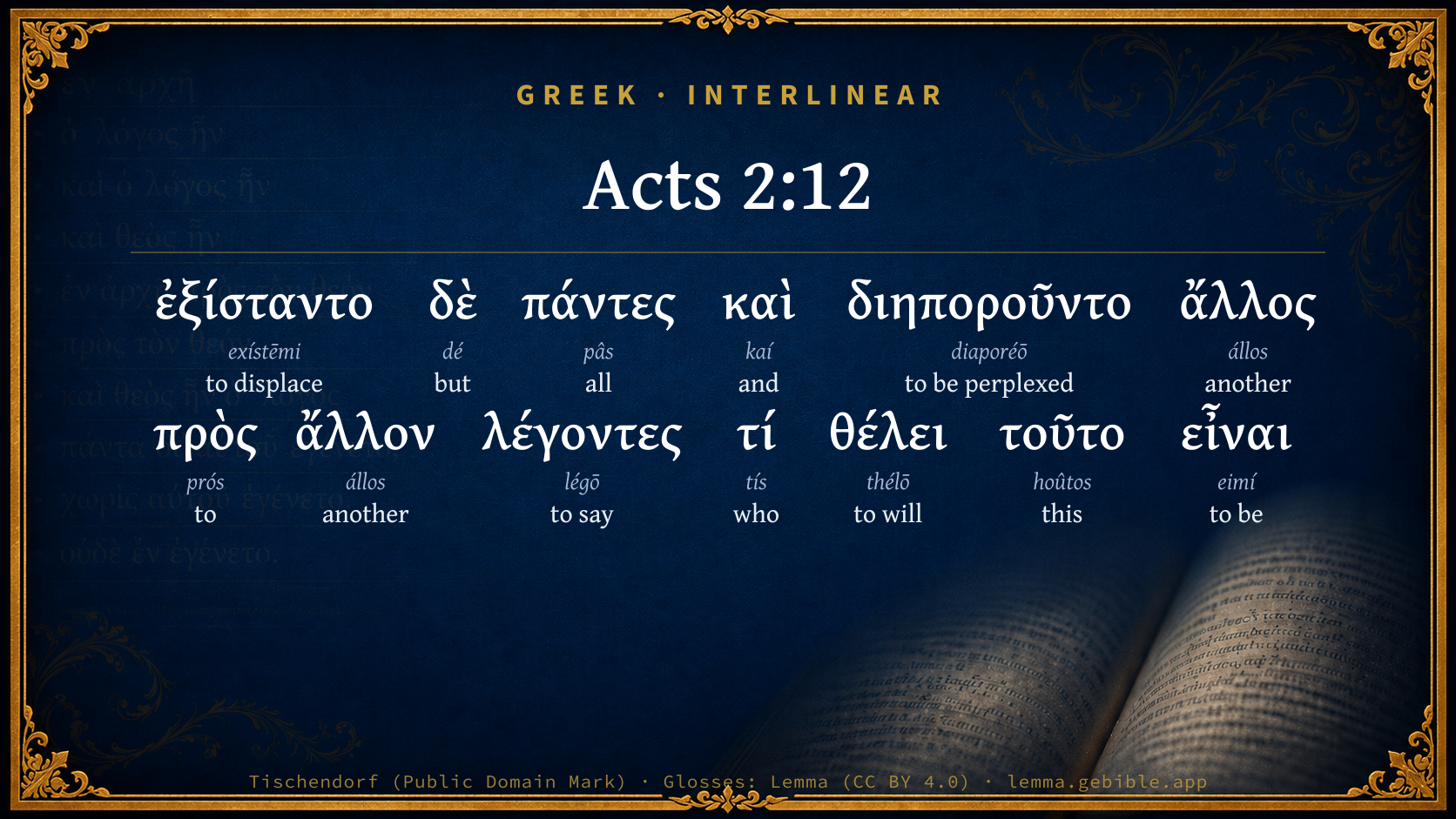
Greek (Tischendorf 8th ed.) Acts 2:12 appears in the Greek New Testament. The text above is from the Tischendorf 8th edition. Each word links to its Strong’s number and a concise gloss. Click any word for its full Thayer’s Greek Lexicon entry.
Download image
Cite this verse

Acts 2:12 (World English Bible). Public Domain. Lemma interlinear Bible study tool, https://lemma.gebible.app/v/acts/2/12.

Show BibTeX & RIS
BibTeX
RIS
English Translation
They were all amazed, and were perplexed, saying one to another, "What does this mean?"
World English Bible · Public Domain
Download a study sheet

One document with this verse’s original text, its word-by-word gloss line, the meaning frame, cross-references with their text, attributed commentary, and full source and license credits — printable, and it pastes into notes with its structure intact.

This verse Autodidact and up

Study sheet (.html) Plain text (.txt)

A passage Seminary Student

Up to 50 verses in one chapter. A passage sheet keeps up to 6 commentary sources and 12 cross-references per verse, in the order this page ranks them, and says so on the sheet whenever that leaves anything out. Ask for a single verse and you get the Autodidact verse sheet above.

Everything on this page stays free to read, with no account — the sheet is a download of what is already on screen, not access to it.

Want to remove ads? Support Godless Engineer
Compare translations 3

The same verse in 3 English versions, stacked beneath the original-language interlinear above. Click any original word for its lexicon entry.

Each is an independent rendering of the whole verse — the interlinear is not word-aligned to these translations.

Highlighted words mark where these versions differ — a whole-verse word diff, not a word-by-word alignment.

  • World English Bible Public Domain
    They were all amazed, and were perplexed, saying one to another, "What does this mean?"
  • King James Version Public Domain
    And they were all amazed, and were in doubt, saying one to another, What meaneth this?
  • unfoldingWord Literal Text CC BY-SA 4.0
    So they were all amazed and were perplexed, saying one to another, “What does this want to be?”

unfoldingWord Literal Text — © unfoldingWord, licensed CC BY-SA 4.0. Word-aligned USFM3 via Door43 (git.door43.org/unfoldingWord/en_ult).

Versions to compare (up to 4)

3 of 4 selected

Show all 19 translations

Every available English version of this verse, each an independent rendering of the whole verse.

  • World English Bible Public Domain
    They were all amazed, and were perplexed, saying one to another, "What does this mean?"
  • Berean Standard Bible Public Domain
    Astounded and perplexed, they asked one another, “What does this mean?”
  • Majority Standard Bible Public Domain
    Astounded and perplexed, they asked one another, “What does this mean?”
  • King James Version Public Domain
    And they were all amazed, and were in doubt, saying one to another, What meaneth this?
  • American Standard Version (1901) Public Domain
    And they were all amazed, and were perplexed, saying one to another, What meaneth this?
  • Revised Version (1885) Public Domain
    And they were all amazed, and were perplexed, saying one to another, What meaneth this?
  • Geneva Bible (1599) Public Domain
    They were all then amased, and douted, saying one to another, What may this be?
  • Douay-Rheims (1899) Public Domain
    And they were all astonished, and wondered, saying one to another: What meaneth this?
  • Young's Literal Translation Public Domain
    And they were all amazed, and were in doubt, saying one unto another, `What would this wish to be?'
  • Literal Standard Version CC BY-SA 4.0
    And they were all amazed, and were in doubt, saying to one another, “What would this wish to be?”
  • Unlocked Literal Bible CC BY-SA 4.0
    They were all amazed and perplexed; they said to one another, “What does this mean?”
  • unfoldingWord Literal Text CC BY-SA 4.0
    So they were all amazed and were perplexed, saying one to another, “What does this want to be?”
  • Darby Bible Public Domain
    And they were all amazed and in perplexity, saying one to another, What would this mean?
  • World Messianic Bible Public Domain
    They were all amazed and were perplexed, saying to one another, “What does this mean?”
  • Webster's Bible Public Domain
    And they were all amazed, and were in doubt, saying one to another, What meaneth this?
  • Free Bible Version CC BY-SA 4.0
    They were all amazed and confused. “What does this mean?” they asked each other.
  • Bible in Basic English Public Domain
    And they were all surprised and in doubt saying to one another, What is the reason of this?
  • Text-Critical English NT CC BY 4.0
    And they were all amazed and greatly perplexed, saying to one another, “What could this mean?”
  • Tyndale New Testament (1534) Public Domain
    They were all amased and wondred sayinge one to another: what meaneth this?

Literal Standard Version (2020), Covenant Press — licensed CC BY-SA 4.0. Text via the HelloAO Bible API (eBible.org). Unlocked Literal Bible (unfoldingWord) — licensed CC BY-SA 4.0. Text via the HelloAO Bible API (eBible.org). unfoldingWord Literal Text — © unfoldingWord, licensed CC BY-SA 4.0. Word-aligned USFM3 via Door43 (git.door43.org/unfoldingWord/en_ult). Free Bible Version, Dr. Jonathan Gallagher — licensed CC BY-SA 4.0. Text via the HelloAO Bible API (eBible.org).

Word by word

More ways to search: Search by grammar → Find every occurrence → Compare this word →

Practice this passage: Drill this verse → Learn its vocabulary →

διηποροῦντο
diaporéō
G1280
“to be perplexed”
Verb, Imperfect, Middle, Indicative, 3rd person, Plural
Part of Speech
Verb
Tense
Imperfect
Voice
Middle
Mood
Indicative
Person
3rd person
Number
Plural
Full Thayer's Definition

Origin: from G1223 and G639

TDNT: None

1. to be entirely at loss, to be in perplexity
  1. ἐξίσταντο exístēmi G1839 “to displace” Verb, Imperfect, Middle, Indicative, 3rd person, Plural
  2. δὲ dé G1161 “but” Conjunction
  3. πάντες pâs G3956 “all” Adjective, Nominative, Plural, Masculine
  4. καὶ kaí G2532 “and” Conjunction
  5. ἄλλος állos G243 “another” Adjective, Nominative, Singular, Masculine
  6. πρὸς prós G4314 “to” Preposition
  7. ἄλλον állos G243 “another” Adjective, Accusative, Singular, Masculine
  8. λέγοντες légō G3004 “to say” Verb, Present, Active, Participle, Nominative, Plural, Masculine
  9. τί tís G5101 “who” Interrogative pronoun, Nominative, Singular, Neuter
  10. θέλει thélō G2309 “to will” Verb, Present, Active, Indicative, 3rd person, Singular
  11. τοῦτο hoûtos G3778 “this” Demonstrative pronoun, Accusative, Singular, Neuter
  12. εἶναι eimí G1510 “to be” Verb, Present, Active, Infinitive

About this verse

These counts appear in no published source. They are computed here, from the morphology-tagged text and Lemma’s own curated glosses. What Lemma adds →

13
words
12
distinct lemmas
Acts
section

Notable vocabulary

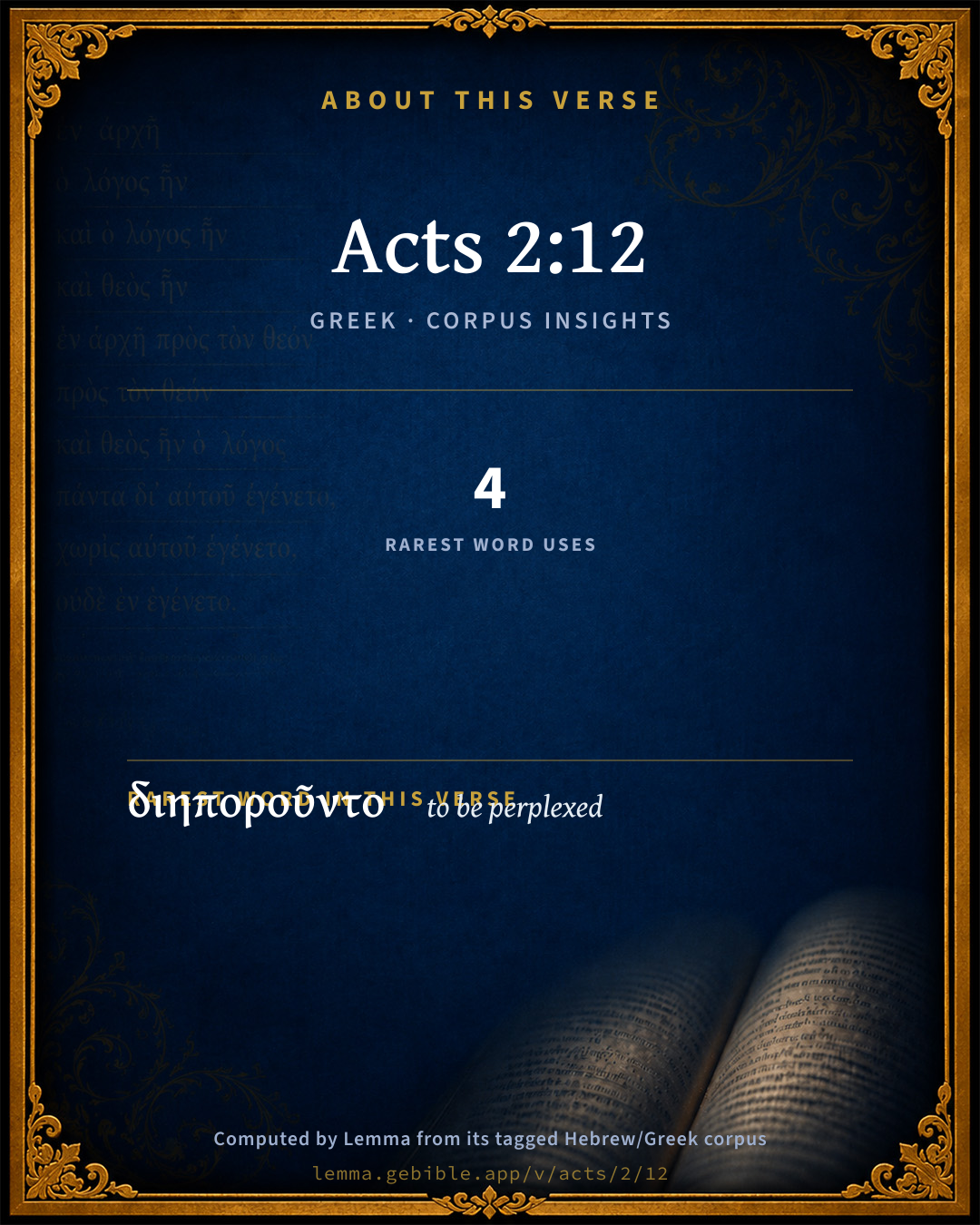
The rarest word here is διηποροῦντο to be perplexed G1280 — appearing just 4 times in the whole Greek New Testament.

Shared distinctive vocabulary

διηποροῦντο to be perplexed G1280 occurs in 4 verses of the Greek New Testament. Also found in:

Repetition

A word recurs within this verse:

  • ἄλλος another G243 ×2

Cross-references

5

Topical passages linked to Acts 2:12 in the Treasury of Scripture Knowledge — connected by theme and wording, ordered by reader-vote popularity; previews shown in the World English Bible.

  • Luke 15:26 He called one of the servants to him, and asked what was going on.
  • Luke 18:36 Hearing a multitude going by, he asked what this meant.
  • Acts 17:20 For you bring certain strange things to our ears. We want to know therefore what these things mean."
  • Acts 2:7 They were all amazed and marveled, saying to one another, "Behold, aren't all these who speak Galileans?
  • Acts 10:17 Now while Peter was very perplexed in himself what the vision which he had seen might mean, behold, the men who were sent by Cornelius, having made inquiry for Simon's house, stood before the gate,

Cross-references courtesy of OpenBible.info (CC BY 4.0).

Commentary

Notes on Acts 2:12 from classic Christian and Jewish commentators (each source and its license shown beneath its notes). The classic Christian expositions comment on the surrounding passage and are grouped to its opening verse, so a note may address several verses; the Jewish commentaries on the Tanakh (Rashi and others) are per-verse, so they appear only where the commentator wrote on this verse.

Lemma curates 59 commentaries, every one of them public domain or Creative Commons licensed, each selected and text-cleaned for this edition rather than reprinted as found. About our sources →

The Biblical Illustrator

Joseph S. Exell

Act_2:12-13

And they were all amazed.

--

Whit Sunday, or what our Churches need

Notice--

I. Three things immediately preceding the outpouring of the Spirit--things which if not the direct cause of a revival, always herald it--the shadows cast by the coming blessing.

1. A complete congregation. They were all in one place. No absentees. This betokened earnestness, for it was in fact an early Sunday morning prayer-meeting with every one present. Always before a great blessing there will be a revived interest in sanctuary services. The half truth, I can worship God as well at home (which is a lie when the man is able to come to the sanctuary and does not) will not be heard. Indifference to public worship is a fatal sign. Things that would never be permitted to interfere with business or pleasure are reckoned sufficient to warrant staying at home to-day. You found eleven oclock this morning too early to come to worship, but I will guarantee you catch the eight oclock excursion train to-morrow morning.

2. A congregation one in desire and motive; With one accord. No two motives had drawn them. They came to receive the promised blessing. Is not the want of this spirit of accord the weakness of the Churches of the present day? Unbelief is not the only thing that keeps Christ from doing many mighty works. It might with equal truth be said of many a Church: He did not many mighty works there because of their squabbling, petty, selfish spirit. There are men who will be nothing unless they are everything, and will without compunction sacrifice a whole Churchs prosperity upon the wretched little altar of their own unsanctified ambition. Instead of all being baptized into one spirit, it looks more as if every one had been baptized into a different spirit and every spirit an evil one. But when all differences become drowned in one overwhelming passion of saving souls, then let the Church lift up her head, for the day of her revival draweth nigh.

3. A congregation steeped in the spirit of prayer. They had a ten days prayer-meeting. Do you wonder they had a Whit Sunday? I should have wondered if they had not. The general prayerlessness of the Church is simply deplorable. Here and there the hundreds come to prayer. But take the general run of prayer-meetings. It is not an uncommon thing for Churches to have to give them up because so few come. Whilst all this is so it is of no use talking about having a revival.

II. The blessing itself.

1. It came at an appointed time. When the day of Pentecost was fully come. God has a time for everything. The disciples doubtless expected the blessing sooner. They had to learn that there is a sovereignty in revivals. Man has no power to command one. He can but cry and wait. Over one Church a cloud of blessing hangs, continually letting fall showers of refreshment. Beneath its influence all is verdant, fresh and lovely. But yonder is another Church the very contrast to this. The heavens above it seem as brass. The piety of its members seems to lack freshness and their leaf withers. Converts are almost unknown. Let not those Churches that have the blessing despise those that lack it. The only difference is that the time to favour them has come and the time to favour the others shall come.

2. It came suddenly and in a moment. Revivals very often do. With mans work the process as well as the result is visible. Is a temple to be built, the plans are exhibited, the foundations dug out, the scaffolding reared, and for months the chipping of the chisel and the clicking of the trowel are heard. God can build His temple in a night, and like Solomons, no sound of tool be heard. At any moment, without any previous warning, the revival may come.

3. It spread far and wide. From the upper room it soon flew along the streets of Jerusalem like an electric current. There is no telling where the influence of a revival in a Church may spread. It creeps into homes shut against the tract distributor. It glides into darkest places of vice. A revived Church will be certain to draw the multitude together. This is the secret of getting at the masses.

III. The question of our text. What meaneth this? Why, it means--

1. That Christ is ascended, and has received gifts for men. An ascended, glorified Christ warrants the Church in expecting any measure of blessing, any number of conversions. What meaneth this?

2. That all instrumentality is nothing without the Holy Ghost, but that the meanest instrumentality with the Spirit is mighty enough to accomplish anything. Alas, what an amount of powerless machinery we have in the so-called religious world, because it has no unction, because it is the work of man, not the working of God through the man, because it is dry and official. Instrumentality is almost worshipped, whilst the Holy Ghost is well-nigh ignored.

3. That God is pleased to work on the world through the Church. Far be it from us to call in question the good that has been accomplished by many of our societies, but we believe that half of them could be spared with ease did a greater unction but rest upon the Church.

4. That these are the seasons Gods Church is to seek at His hands. I will close with an illustration. Once upon the sea-shore, watching the getting off of a fishing smack, I saw in it a union of work and dependence that charmed me. The fishermen brought the craft clown the beach as far as they could and then left her awhile until the tide, which was flowing, neared her. Meantime two anchors had been cast out to sea, from which were ropes to a windlass in the centre of the vessel. Soon the surf (for the sea was fresh) began to run round her as she lay a dead weight upon the shore. Then the waves began to curl over and break upon her side. The men at the windlass took a turn and made the rope fast. And now every moment the tide had more power over her. She was never still. Twenty times did I say now she is off; and twenty times did she settle down again upon the shore, and twenty times did the men at the windlass put on the strain. At last one wave swept higher than any before; she shook--rose--glided down towards the deep--the men turning the handle of the windlass quickly as possible. A wave she met threatened to sweep her back upon the shore, but the anchors held her, and right through the surf the men wound her, and half an hour after she was flying away before the breeze, a very contrast to the dead weight she looked upon the beach. That vessel is the Church. The Holy Ghost is the tide. The ropes and the windlass are human agencies only to be used in dependence on the tide. The tide is coming in. The Church feels its power. She moves--she rises. Oh God send the billow that shall float her now, and send her careering on her course, with the breeze of the Spirit. (A. G. Brown.)

The multitude in amazement

I. A multitude gathered from all parts of the world.

II. A multitude gathered for religious purposes. They had come to the feast of Pentecost.

III. A multitude astonished by a miracle. The subject was one, the languages many. So--

1. In the gospel we have proof that by the foolishness of preaching God confounds the wisdom of the world.

2. Note the wonderful adaptation of the gospel to the entire world. It appeals to all natures and dispositions, and equally meets the wants of all.

IV. A multitude variously affected. All were amazed. Some inquired, some mocked. Some said (probably the devout men mentioned in Act_2:5), What meaneth this? This language betokened a desire to learn. Others (Act_2:13) said, They are full of new wine; regarding the religion of Jesus Christ as fanaticism. How does the gospel affect us? (F. Wagstaff.)

A miracle the object of derision

Of all the expressions of our distaste, a scoff is the worst. Admonition may be physic, a reproof balm, a blow ointment; but derision is as poison and a sword. It was the height of Jobs complaint that persons made jests on him; and it was the depth of Samsons calamity (Jdg_16:25). That which raises our anger presents some magnitude to our eyes; but that which we scorn is less than nothing. But now everything is not always as it appears, especially to the eye of the scoffer; for here we see things of excellency may be submitted to jests. Note

I.

the object of their derision. A. miracle. In every miracle there is the thing done, which must transcend the course of nature, and the end, which is also supernatural. In respect of the power of God there is no miracle; but in His goodness He was pleased to work wonders, not for show, but for our instruction. And as He had borne witness to His Son by miracles, so doth He here to the Holy Ghost. This was the end of this miraculous operation.

II. The persons.

1. What entertainment finds the miracle? What welcome hath the Holy Ghost? No other than what befals all extraordinary events. Every man lays hold of it and shapes it in such a form as he may please. To some it is a matter of wonder; to others, of mirth.

2. We should account it a strange stupidity in any one not to be more affected at the sight of the sun than of a taper, and to esteem the great palace of heaven but as a furnace. But when God stretcheth forth His hands to produce effects which follow not the force of secondary causes, then, not to put-on wonder, not to conclude that it is for some great end, is not folly, but infidelity, the daughter of malice and envy and affected ignorance.

3. Miracles are signs; and if they signify nothing it is evident that a stubborn heart and froward mind will not understand the meaning of them. And then what are miracles but trifles, matter of scoff and derision? Jesus of Nazareth, a man approved of God by miracles (verse 22), a juggler; a voice from heaven, but thunder; to make the blind to see, etc., witchcraft; to be full of the Spirit, to be full of drink. When Julian had read a Defence of Christianity, he remarked, I have read, understood, and condemned it. To which St. Basil replied, Had you understood it, you would never have condemned it. The same befalls men prepossessed and too far engaged in the world, and the fathers reply will reach home to them.

4. To this day our behaviour is little better than mocking. Our lust, which waits for the twilight, mocks at Gods Omniscience (Psa_73:11); our distrust argues against His power (Psa_78:20; 2Ki_8:2); our impatience questions His truth; and those who acknowledge Him to be the Giver of life, have confined His goodness to a few. His mercy triumpheth over His justice; yet Novatian made every fall as low as hell: and what is despair but a mocking of Gods mercy?

5. The ground of all is infidelity, the proper issue of obstinate and wilful ignorance. Plato well observeth, that none can taste and judge of that sweetness which truth affords but the philosopher, because they want that instrument of judgment which he useth; and that cannot be applied by covetousness, ambition, and lust; the philosophers instrument is reason. So in Divine mysteries and miracles, we cannot reach the meaning of them without a humble, pure, and free spirit, the best instrument of a Christian.

6. Indeed, reason might have taught these men that this was a miracle. For rude and illiterate men to speak on a sudden all languages, was more than all the linguists in the world could teach. And from no other principle arose the question of verse 12. But, to read the riddle, we must plough with another heifer than reason (Jdg_14:18). To dive into the sense of the miracle can proceed from no other Spirit than that whose miracle it was, even Him wire enlightens them that sit in darkness, and who makes the humble and docile soul both His school and His scholar. Reason is a light, but obnoxious to fogs and mists, till this great light dispel and scatter them. Julian was a man as well furnished as any; yet he wounded religion more with his scoffs than with his sword. When he had received his deaths wound, he confessed it came from the power of Christ, in a phrase of scorn, The day is Thine, O Galilean! Indeed the greatest scoffers have been for the most part eminent in natural abilities, whose reason, notwithstanding, could not show them their own fluctuations, the storms and tempest of their souls, she being eclipsed with her own beams.

III. The scoff itself.

1. It was not only a scoff, but an accusation, and there be divers reasons which make men accusers, ambition, hatred, hope of reward. Ecumenius tells us it was here that perverseness which indifferently passeth censure upon any cause, or no cause at all. And this is bred by opinion, and not by truth. If they understood not what the apostles spake, how could they say they were drunk? and if they did understand, why did they scoff? They were men settled in the very dregs of error and malice; and, having taken up an opinion, they would not let it go, no not at the sight of a miracle.

2. But yet though there were no reason nor probability to justify their scoff, some show there was to countenance it. The apostles, after this gift of tongues, talked much: they were full indeed with the wine of the New Testament; and, as drunken men, they were merry and cheerful; they publish secrets, they fear no face, regard no power, regard not themselves.

3. This hath always been, and to this day is, the great error of the world--to make shadows substances, similitudes indentities, the faintest representations truth (1Sa_1:13-14; 2Sa_6:20; Mar_3:21). Upon this ground faith is called presumption because it is like it; Christianity is called madness; for when we mortify the flesh, and estrange ourselves from the world, most that behold us think us not well in our wits. At this day true devotion goes for fancy, reverence for superstition, bowing for idolatry. Our Saviours counsel is, Judge not according to the appearance (Joh_7:24). For how easy is it to paint and present things as we please! Many times an evil eye makes an evil face, puts horror upon religion itself, and, where devotion shines out in the full beauty of holiness, draws a Pope or a devil. As charity covers a multitude of sins (Jam_5:20), so doth malice cover a multitude of virtues with the black mantle of vice. (A. Farindon, D. D.)

What meaneth this? (text and verse 37).--

Two great questions

These questions are the outcome of two widely different but intimately associated states of experience--the one intellectual, the other moral. The first is an inquiry of the mind in the face of a problem which unassisted it cannot solve; the second is an inquisition of the soul in the presence of a danger from which unaided it cannot flee. An extraordinary event had taken place at which the perplexed beholders exclaimed What meaneth this? When the reply came it was found to involve such tremendous issues that they cried in despair What shall we do?

I. What meaneth this? The inquiry was--

1. Natural. The mind instinctively rebels against the unexplained. It was made for and is fed by knowledge. Just as the animal instincts are urged by thirst and hunger to search for food and drink, so the intellect is stimulated by a sense of void to inquire for the knowledge that will fill and satisfy it. These men were confronted by a mysterious fact, and were troubled in mind until it was accounted for.

2. Right. The liberty to inquire is one of the inalienable, inborn, and crown rights of humanity. That it may exercise this function, God has endowed it with the requisite faculties. The hunger of the mind for knowledge is a stamp of its Divine original, and a prophecy of its immortality. Inquiry makes all the difference between savagedom and civilisation, between weakness and strength. The feeble and superstitious shun it, and perish in darkness; the strong and wise welcome it and are rewarded by the light. We must carefully distinguish, however--

(1) between aimless inquiry, i.e., curiosity, and the search for true wisdom, and

(2) between legitimate and illegitimate inquiry. The secret things belong unto God. The present inquiry was in many respects legitimate and commendable.

3. Was addressed to the wrong persons with unsatisfactory results. Twice, we are told, they questioned one to another. They were prevented by a too hasty generalisation and by prejudice from asking those on whom these wonders were wrought what they meant.

(1) It was enough for strangers to know that they were Galileans, a name which embodied all that was ignorant and vile.

(2) The dwellers at Jerusalem would recognise them as the fanatical followers of one who was set down as a man gluttonous and winebibber. These manifestations, therefore, were treated as the ravings of men excited with enthusiasm or with drink. But Galileans as they were, drunk or mad as they considered, there was the phenomenon. They could not account for it, but they felt it must be accounted for. And instead of asking those from whom only a reply could be obtained, they engaged in a fruitless inquiry among themselves. How like modern scepticism!

4. Suggests an important line of argument in favour of Christianity. There are certain facts equally inexplicable to the human mind to-day. We do not see cloven tongues, etc., but we are witnesses of events even more wonderful.

(1) The conversion of infidels. Lord Lyttleton, Gilbert West, and some within personal knowledge.

(2) The conversion of men immoral and profane. Bunyan and John Newton, etc.

(3) The conversion of men of merely moral habits. John Wesley and William Wilberforce. Each case forces the question upon us. They are not isolated but common occurrences. How are they to be accounted for? On the score of weakness, wrought upon by terror or excitement, or on the score of ignorance? The known character of these men forbid these explanations. These wonders should set us inquiring, and the inquiry is as natural and proper in the one case as in the other, and furthermore by inquiring matters will be disclosed that seriously concern us all.

II. What shall we do? Although not invited Peter undertook to reply to the first question. The general explanation was verses 14-21; the particular application verses 22-36. So with the modern facts adduced. Does this explanation satisfy? Is this explanation taken home? Then both will now as of old lead to the second question. This inquiry--

1. Expressed a sense of utter helplessness. What shall we do? These men were convinced of the crime and mistake of a whole life, and of the human impossibility of rectification.

2. Was to the point, What shall we do? Not like the other question theoretical, but practical. They felt that they were in an unsatisfactory state, and that something must be done. What?

3. Was, like the first inquiry, answered.

(1) Repent. Change your mind, forsake your sins.

(2) Be baptized in the name of the Lord Jesus; implying faith, union with the Church and public profession. Conclusion: Both inquiries were at length crowned with blessed results. Three thousand received forgiveness for the past, comfort for the present, hope for the future (verses 38-47). (J. W. Burn.)

The Biblical Illustrator, edited by Joseph S. Exell (c. 1880s–1900s) — public domain. Text from a community e-Sword module.

Whedon's Commentary on the Bible

Daniel D. Whedon

I. Peter’s first answer to the question of Act_2:12-21.

This is the predicted inauguration of the Church of the Spirit, Act_2:16-18; by wonderful omens is heralded this notable day, Act_2:19-21.

Peter is now not only an expounder of prophecy, but an empowered and inspired prophet. His comment, and even his variations, are of an equal authority with the original text.

Daniel D. Whedon (gen. ed.), Commentary on the Old and New Testaments (1874–1909) — public domain. Text from a community e-Sword module.

Bengel's Gnomon

Johann Albrecht Bengel

Act 2:12. Πάντες, all) viz. the “devout men,” Act 2:5; as opposed to the ‘mockers’ in the following verse.

Bengel's Gnomon of the New Testament — English translation (T&T Clark, Edinburgh, 1860) — public domain. Text from a community e-Sword module.

Meyer's Critical & Exegetical Commentary

Heinrich August Wilhelm Meyer

Act_2:12-13. Διηπόρ.] see on Luk_9:7.

τί ἂν θέλοι τοῦτο εἶναι;] The optative with ἄν, in order to denote the hypothetically conceived possibility: What might this possibly wish to be? i.e. What mightif this speaking in our native languages, this strange phenomenon, is designed to have any meaningbe to be thought of as that meaning? Comp. Act_17:18; Herm. ad Viger. p. 729; Bernhardy, p. 410 f. On the distinction of the sense without ἂν, see Kühner, ad Xen. Anab. v. 7. 33. Comp. also Maetzner, ad Antiph. p. 130. On θέλειν of impersonal things, see Wetstein and Stallbaum, ad Plat. Rep. p. 370 B.

ἕτεροι] another class of judges, consequently none of the impartial, of whom there was mention in Act_2:7-12, but hostile persons (in part, doubtless, of the hierarchical party) who drew from the well-known freer mode of life of Jesus and His disciples a judgment similar to Luk_7:34, and decided against the disciples.

διαχλευάζοντες] mocking; a stronger expression than the simple verb, Dem. 1221. 26; Plat. Ax. p. 364 B; Polyb. xvii. 4. 4, xxxix. 2. 13; used absolutely also, Polyb. xxx. 13. 12. The scoffers explain the enthusiasm of the speakers, which struck them as eccentric, and the use of foreign languages instead of the Galilean, as the effect of drunken excitement. Without disturbing themselves whence this foreign speaking (according to the historical position of the matter: this speaking with tongues) had come and become possible to the Galileans, they are arrested only by the strangeness of the phenomenon as it struck the senses, and, in accordance with their own vulgarity, impute it to the having taken too much wine. Comp. 1Co_14:23. The contents of the speaking (van Hengel) would not, apart from that form of utterance as if drunk with the Spirit, have given ground for so frivolous an opinion, but would rather have checked it. The judgment of Festus concerning Paul (Act_26:24) is based on an essentially different situation.

γλεύκους] γλεῦκος τὸ ἀπόσταγμα τῆς σταφυλῆς πρὶν πατηθῇ, Hesychius. Job_32:19; Lucian. Ep. Sat. 22, Philops. 39. 65; Nic. Al. 184. 299. Comp. γλευκοπότης, Leon. Tar. 18; Apollonid. 10.

Meyer — Critical and Exegetical Commentary on the New Testament — English translation by Peter Christie, edited by Frederick Crombie (T&T Clark, 1880) — public domain. Text from a community e-Sword module.

Expositor's Greek Testament

ed. W. Robertson Nicoll

Act 2:12 . διηπόρουν : not found in LXX (only in Psa 76:5 , and Dan 2:3 , Symmachus), and peculiar to St. Luke in the N.T., once in his Gospel, Luk 9:7 (Luk 24:4 ἀπορεῖσθαι , W.H [122] and R.V.), and three times in Acts, cf. Act 5:24 ; Act 10:17 . διηποροῦντο in R.V. “were perplexed”; A. V. “were in doubt,” although in Luk 24:4 this or a similar word is rendered as in R.V., “were (much) perplexed”. The Greek conveys the thought of utter uncertainty what to think, rather than doubt as to which opinion of several is right (Humphry). The word no doubt is frequently found in classical writers, and is found also in Philo (not in Josephus), but it may be worth noting that ἀπορία , εὐπορία , διαπορεῖν , εὐπορεῖν are all peculiar to St. Luke, and were terms constantly employed by medical writers (Hobart, Medical Language , etc., p. 163). τί ἂν θέλοι τοῦτο εἶναι θέλω was constantly used in this sense in classical writers, see instances in Wetstein. On the popular use of θέλω instead of βούλομαι in later Greek, cf. Blass, Acta Apostolorum , p. 15. Blass points out that St. Luke’s employment of βούλομαι is characteristic of his culture, although it must be remembered that the Evangelist uses θέλω (as here) very frequently.

[122] Westcott and Hort’s The New Testament in Greek: Critical Text and Notes.

The Expositor's Greek Testament, edited by W. Robertson Nicoll (1897–1910) — public domain. Text from a community e-Sword module.

Geneva Bible (1599)

Geneva Bible translators

God’s word pierceth some so, that it driveth them to seek out the truth, and it doth so choke others, that it forceth them to be witnesses of their own impudency.

Geneva Bible (1599) marginal notes — public domain. Text via Bolls.life.

John Calvin's Commentaries

12. Others mocking Hereby it appeareth how monstrous as well the sluggishness, as also the ungodliness of men is, when Satan hath taken away their mind. If God should openly (and visibly) descend from heaven, his majesty could scarce more manifestly appear than in this miracle. Whosoever hath any drop of sound understanding in him must needs be stricken with the only hearing of it. How beastly, then, are those men who see it with their eyes, and yet scoff, and go about with their jests to mock the power of God? But the matter is so. There is nothing so wonderful which those men do not turn to a jest who are touched with no care of God; because they do, even upon set purposes, harden themselves in their ignorance in things most plain. And it is a just punishment of God, which he bringeth upon such pride, to deliver them to Satan, to be driven headlong into blind fury. Wherefore, there is no cause why we should marvel that there be so many at this day so blind in so great light, if they be so deaf when such manifest doctrine is delivered, yea, if they wantonly refuse salvation when it is offered unto them. For if the wonderful and strange works of God, wherein he doth wonderfully set forth his power, be subject to the mockery of men, what shall become of doctrine, which they think tasteth of nothing but of that which is common? Although Luke doth signify unto us that they were not of the worst sort, or altogether past hope, which did laugh (and mock;) but he meant rather to declare how the common sort was affected when they saw this miracle. And truly it hath been always so in the world, for very few have been touched with the true feeling of God as often as he hath revealed himself. Neither is it any marvel; for religion is a rare virtue, and a virtue which few men have; which is, indeed, the beginning of understanding. Nevertheless, howsoever the more part of men, through a certain hard stiff-neckedness, doth reject the consideration of the works of God, yet are they never without fruit, as we may see in this history.

John Calvin's Commentaries (1540-1563) — public domain. Text from the Calvin Translation Society English edition (1840s-50s) via the Christian Classics Ethereal Library (ccel.org). Calvin's coverage is partial (roughly two-thirds of the Bible); uncommented books and verses are honest gaps, never fabricated. The 19th-century editor's footnotes and remarks are omitted so the notes are faithfully Calvin's own voice.

Ellicott's Commentary for English Readers

(12) They were all amazed, and were in doubt.—The last word is somewhat stronger in the Greek: “were much perplexed,” as in Luk_24:4. No New Testament writer uses it except St. Luke.

What meaneth this?—Better, What may this mean? The same phrase occurs in Act_17:18.

A Bible Commentary for English Readers, edited by Charles John Ellicott (1878–1897) — public domain. Text from a community e-Sword module.

The Cambridge Bible for Schools and Colleges

gen. ed. J. J. S. Perowne

12. they were all amazed, and were in doubt] Rather, and were perplexed. The original means they did not know what to make of what they saw and heard. They had no doubt of the facts, for their ears bore testimony that in their own various mother-tongues the great works of God were being published, and they had just said so.

The Cambridge Bible for Schools and Colleges (gen. ed. J. J. S. Perowne; Cambridge University Press, 1878–1918) — public domain. Text from a community e-Sword module.

John Gill's Exposition

And they were all amazed,.... That is, all these devout men, Jews and proselytes, which came from other nations before mentioned:

and were in doubt; not whether the apostles spoke in various languages, nor about the sense of their words; for they not only heard them with their ears, and were assured of the facts, but they seem also to understand what was said, since they call the things delivered, the great or wonderful things of God; but they were at a loss in their minds what should be the cause of this, or the reason of such a dispensation,

saying, one to another, what meaneth this? from whence is it? what is the design of it? or what the end to be answered by it? or what will follow upon it? surely something considerable.

John Gill's Exposition of the Whole Bible (1746–1763) — public domain (CC PDM 1.0). Text via the HelloAO Bible API.

Trapp's Complete Commentary

John Trapp

11 Cretes and Arabians, we do hear them speak in our tongues the wonderful works of God.

12 And they were all amazed, and were in doubt, saying one to another, What meaneth this?

Ver. 12. The wonderful works] The magnifical, majestical things of God; they praised him according to his excellent greatness, Psa 150:2.

What meaneth this?] Gr. "What will this be, or come to?" {a} And here began their conversion. Let none "despise the day of small things," Zec 4:10: God put little thoughts into Ahasuerus’s head, but for great purposes, Ezr 6:1. The word falls often upon men’s ears, "as the sound of many waters" at first, working wonder only. Next "as the voice of thunder," working fear also, as it did on these here, Act 2:37. Lastly, as the harmony of harpers, filling the heart with peace and joy through believing, as one observeth from Rev 14:1-5

{a} τι αν θελοι τουτο ειναι

John Trapp, A Commentary or Exposition upon All the Books of the Old and New Testament (1647–1656) — public domain. Text from a community e-Sword module.

Albert Barnes' Notes on the Bible

Were in doubt - This expression, διηπόρουν diēporoun, denotes “a state of hesitancy or anxiety about an event.” It is applied to those who are traveling, and are ignorant of the way, or who hesitate about the road. They were all astonished at this; they did not know how to understand it or explain it, until some of them supposed that it was merely the effect of new wine.

Albert Barnes' Notes on the Bible (1834–1885) — public domain. Text from a community e-Sword/MySword module.

Matthew Poole's English Annotations

They were all amazed; so Act 2:7; εξισταντο, they were as in an ecstasy, (the object was too strong for the faculty), they could not fathom the cause or reason of these wonderful things; and therefore they desire one of another to be resolved concerning them.

Matthew Poole's English Annotations on the Holy Bible (1683–1685) — public domain. Text from a community e-Sword/MySword module.

The Pulpit Commentary

Perplexed for in doubt, A.V. and T.R.

The Pulpit Commentary (1880–1919), ed. H.D.M. Spence-Jones & Joseph S. Exell — public domain. Text from a community e-Sword module.

John Wesley's Explanatory Notes

They were all amazed - All the devout men.

John Wesley, Explanatory Notes Upon the Whole Bible (1754–1765) — public domain. Text via the GEBible commentary corpus.

McGarvey & Pendleton's Commentaries

J. W. McGarvey

See notes on verse 6

J. W. McGarvey (with Philip Y. Pendleton), Commentaries on the New Testament (The Fourfold Gospel, 1914; Acts; and the epistles) — public domain. Text from a community e-Sword/MySword module.

unfoldingWord translationNotes

Door43 World Missions Community

amazed and perplexed

These two words share similar meanings. Together they emphasize that the people could not understand what was happening. AT: "surprised and confused" (See: Doublet)

They are full of new wine

Some people accuse the believers of having drunk too much wine. AT: "They are drunk" (See: Idiom)

new wine

This refers to wine that is in the process of fermentation.

translationWords

amazed

mock

wine

unfoldingWord translationNotes — © Distant Shores Media and the Door43 World Missions Community, licensed CC BY-SA 4.0. Source: git.door43.org/Door43/en_tn.

Cambridge Greek Testament for Schools and Colleges

12. τί θέλει with ABCD. Vulg. has ‘quidnam vult.’ א reads τί θέλοι without ἄν, which seems to confirm the correctness of the other uncials, θέλοι being only a slip of the scribe for θέλει.

12. διηποροῦντο, were perplexed. They were in no doubt about the facts. Their eyes and ears were trusty witnesses. But they were at a loss how to account for what they heard and saw.

Cambridge Greek Testament for Schools and Colleges (Cambridge University Press, 1896; 21 vols, various authors incl. Carr, Maclear, Plummer, Farrar, Lumby, Moule, M. R. James, Simcox) — public domain. Text from a community e-Sword module.

Vincent's Word Studies in the New Testament

Marvin R. Vincent

Were in doubt [διηπορουν] . Used by Luke only. See on Luk 9:7. Better, as Rev., perplexed.

Marvin R. Vincent, Word Studies in the New Testament (1887–1900) — public domain. Text from a community e-Sword/MySword module.

Lesson kit

Teaching starters — assembled from the data on this page, not authored interpretation. Every prompt links to the verse data it draws on. Edit before teaching.

Acts, in the Acts, opens this verse with 13 words (12 distinct Greek lemmas). Its most distinctive word is diaporéō (“to be perplexed”). A historical commentator’s framing appears above. Read the whole chapter for the surrounding context.

Discussion questions

  1. The word diaporéō carries the sense “to be perplexed.” How does it shape the verse?
  2. Luke 9:7 shares the word «to be perplexed» with this verse. How do the two illuminate each other?
  3. “another” occurs 2× in this one verse. What is the effect of the repetition?
  4. These translations render this verse differently; the difference is in the English rendering, not the original. What questions does that raise?
  5. Reading how The Biblical Illustrator and Whedon's Commentary on the Bible read this verse, where do the two commentators agree and where do they part?

Things to notice

  • These translations choose different wording for 6 words in this verse.
  • “another” occurs 2× in this single verse.
  • 12 distinct Greek lemmas span 13 words in this verse.

Reading settings

Reading text

Shown beneath each verse's original-language words.

Old Testament
Old Testament edition

Read the OT as the Masoretic Hebrew (MT) or the Greek Septuagint (LXX).

English shown for the Greek Septuagint (in the Hebrew ↔ Greek comparison).

Comparing translations? Open the Compare panel on any verse page to stack up to four side by side.