Acts 6:2

Greek (Tischendorf 8th ed.) Acts 6:2 appears in the Greek New Testament. The text above is from the Tischendorf 8th edition. Each word links to its Strong’s number and a concise gloss. Click any word for its full Thayer’s Greek Lexicon entry.
Download image
Cite this verse

Acts 6:2 (World English Bible). Public Domain. Lemma interlinear Bible study tool, https://lemma.gebible.app/v/acts/6/2.

Show BibTeX & RIS
BibTeX
RIS
English Translation
The twelve summoned the multitude of the disciples and said, "It is not appropriate for us to forsake the word of God and serve tables.
World English Bible · Public Domain
Download a study sheet

One document with this verse’s original text, its word-by-word gloss line, the meaning frame, cross-references with their text, attributed commentary, and full source and license credits — printable, and it pastes into notes with its structure intact.

This verse Autodidact and up

Study sheet (.html) Plain text (.txt)

A passage Seminary Student

Up to 50 verses in one chapter. A passage sheet keeps up to 6 commentary sources and 12 cross-references per verse, in the order this page ranks them, and says so on the sheet whenever that leaves anything out. Ask for a single verse and you get the Autodidact verse sheet above.

Everything on this page stays free to read, with no account — the sheet is a download of what is already on screen, not access to it.

Want to remove ads? Support Godless Engineer
Compare translations 3

The same verse in 3 English versions, stacked beneath the original-language interlinear above. Click any original word for its lexicon entry.

Each is an independent rendering of the whole verse — the interlinear is not word-aligned to these translations.

Highlighted words mark where these versions differ — a whole-verse word diff, not a word-by-word alignment.

  • World English Bible Public Domain
    The twelve summoned the multitude of the disciples and said, "It is not appropriate for us to forsake the word of God and serve tables.
  • King James Version Public Domain
    Then the twelve called the multitude of the disciples unto them, and said, It is not reason that we should leave the word of God, and serve tables.
  • unfoldingWord Literal Text CC BY-SA 4.0
    So summoning the multitude of the disciples, the Twelve said, “It is not acceptable for us to leave behind the word of God to serve tables.

unfoldingWord Literal Text — © unfoldingWord, licensed CC BY-SA 4.0. Word-aligned USFM3 via Door43 (git.door43.org/unfoldingWord/en_ult).

Versions to compare (up to 4)

3 of 4 selected

Show all 19 translations

Every available English version of this verse, each an independent rendering of the whole verse.

  • World English Bible Public Domain
    The twelve summoned the multitude of the disciples and said, "It is not appropriate for us to forsake the word of God and serve tables.
  • Berean Standard Bible Public Domain
    So the Twelve summoned all the disciples and said, “It is unacceptable for us to neglect the word of God in order to wait on tables.
  • Majority Standard Bible Public Domain
    So the Twelve summoned all the disciples and said, “It is unacceptable for us to neglect the word of God in order to wait on tables.
  • King James Version Public Domain
    Then the twelve called the multitude of the disciples unto them, and said, It is not reason that we should leave the word of God, and serve tables.
  • American Standard Version (1901) Public Domain
    And the twelve called the multitude of the disciples unto them, and said, It is not fit that we should forsake the word of God, and serve tables.
  • Revised Version (1885) Public Domain
    And the twelve called the multitude of the disciples unto them, and said, It is not fit that we should forsake the word of God, and serve tables.
  • Geneva Bible (1599) Public Domain
    Then the twelue called the multitude of the disciples together, and sayd, It is not meete that we should leaue the worde of God to serue the tables.
  • Douay-Rheims (1899) Public Domain
    Then the twelve calling together the multitude of the disciples, said: It is not reason that we should leave the word of God, and serve tables.
  • Young's Literal Translation Public Domain
    and the twelve, having called near the multitude of the disciples, said, `It is not pleasing that we, having left the word of God, do minister at tables;
  • Literal Standard Version CC BY-SA 4.0
    and the Twelve, having called near the multitude of the disciples, said, “It is not pleasing that we, having left the word of God, minister at tables;
  • Unlocked Literal Bible CC BY-SA 4.0
    The twelve called the multitude of the disciples to them and said, “It is not right for us to give up the word of God in order to serve tables.
  • unfoldingWord Literal Text CC BY-SA 4.0
    So summoning the multitude of the disciples, the Twelve said, “It is not acceptable for us to leave behind the word of God to serve tables.
  • Darby Bible Public Domain
    And the twelve, having called the multitude of the disciples to [them], said, It is not right that we, leaving the word of God, should serve tables.
  • World Messianic Bible Public Domain
    The twelve summoned the multitude of the disciples and said, “It is not appropriate for us to forsake the word of God and serve tables.
  • Webster's Bible Public Domain
    Then the twelve called the multitude of the disciples, and said, It is not reason that we should leave the word of God, and serve tables.
  • Free Bible Version CC BY-SA 4.0
    The twelve apostles called all the believers together, and told them, “It's not appropriate for us to give up spreading the word of God so we can wait at tables.
  • Bible in Basic English Public Domain
    And the Apostles sent for all the disciples and said, It is not right for us to give up preaching the word of God in order to make distribution of food.
  • Text-Critical English NT CC BY 4.0
    So the twelve called the multitude of the disciples together and said, “It is not proper for us to neglect the word of God to wait on tables.
  • Tyndale New Testament (1534) Public Domain
    Then the twelve called the multitude of the disciples to gether and sayde: it is not mete that we shuld leave the worde of God and serve at the tables.

Literal Standard Version (2020), Covenant Press — licensed CC BY-SA 4.0. Text via the HelloAO Bible API (eBible.org). Unlocked Literal Bible (unfoldingWord) — licensed CC BY-SA 4.0. Text via the HelloAO Bible API (eBible.org). unfoldingWord Literal Text — © unfoldingWord, licensed CC BY-SA 4.0. Word-aligned USFM3 via Door43 (git.door43.org/unfoldingWord/en_ult). Free Bible Version, Dr. Jonathan Gallagher — licensed CC BY-SA 4.0. Text via the HelloAO Bible API (eBible.org).

Word by word

More ways to search: Search by grammar → Find every occurrence → Compare this word →

Practice this passage: Drill this verse → Learn its vocabulary →

ἀρεστόν
arestós
G701
“pleasing”
Adjective, Nominative, Singular, Neuter
Part of Speech
Adjective
Case
Nominative
Number
Singular
Gender
Neuter
Full Thayer's Definition

Origin: from G700

TDNT: 08:36,8

1. pleasing, agreeable
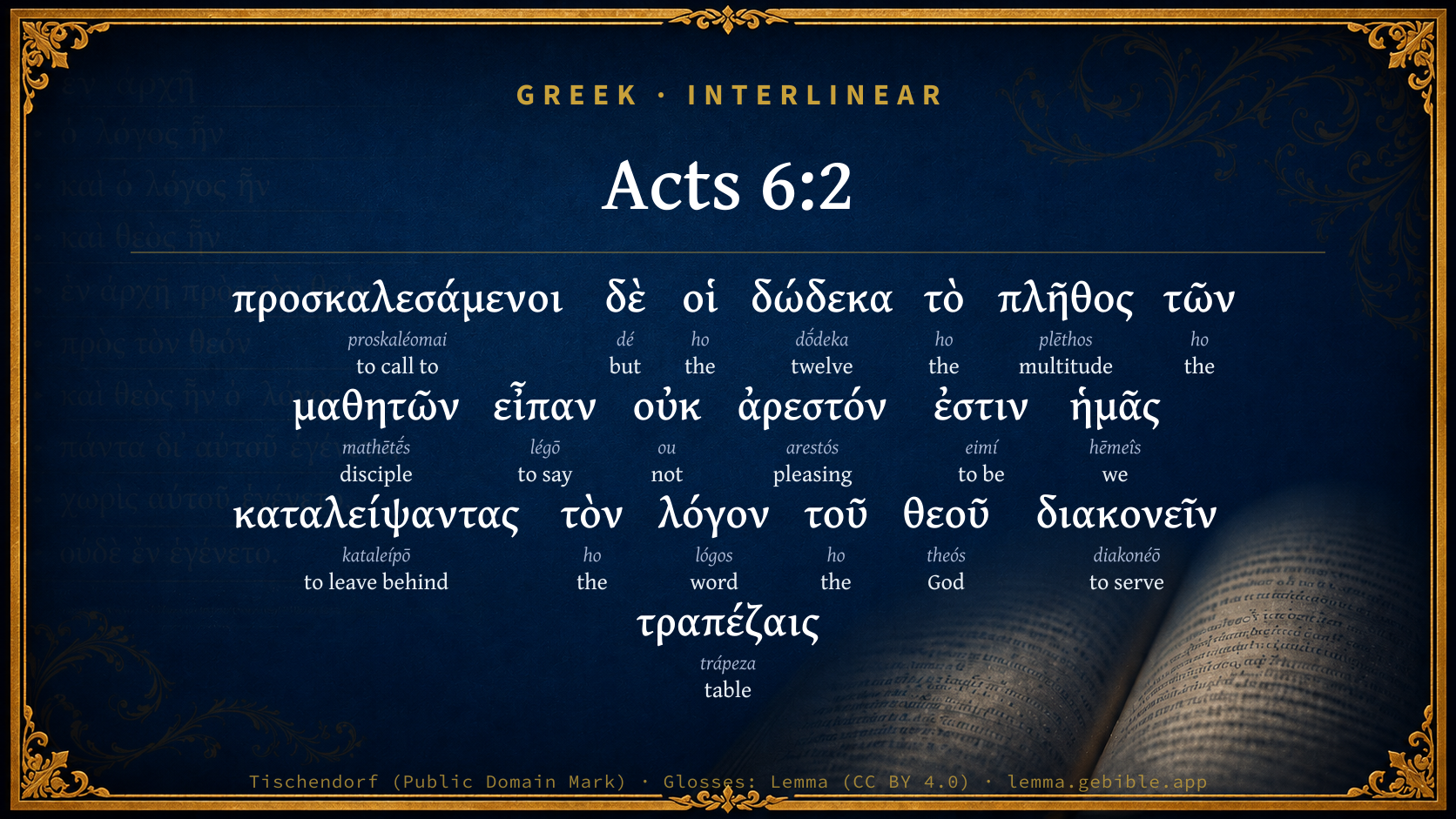
  1. προσκαλεσάμενοι proskaléomai G4341 “to call to” Verb, Aorist, Middle deponent, Participle, Nominative, Plural, Masculine
  2. δὲ dé G1161 “but” Conjunction
  3. οἱ ho G3588 “the” Article, Nominative, Plural, Masculine
  4. δώδεκα dṓdeka G1427 “twelve” Adjective, Numeral (indeclinable)
  5. τὸ ho G3588 “the” Article, Accusative, Singular, Neuter
  6. πλῆθος plēthos G4128 “multitude” Noun, Accusative, Singular, Neuter
  7. τῶν ho G3588 “the” Article, Genitive, Plural, Masculine
  8. μαθητῶν mathētḗs G3101 “disciple” Noun, Genitive, Plural, Masculine
  9. εἶπαν légō G3004 “to say” Verb, Aorist, Active, Indicative, 3rd person, Plural
  10. οὐκ ou G3756 “not” Particle, Negative
  11. ἐστιν eimí G1510 “to be” Verb, Present, Active, Indicative, 3rd person, Singular
  12. ἡμᾶς hēmeîs G2249 “we” Personal pronoun, 1st person, Accusative, Plural
  13. καταλείψαντας kataleípō G2641 “to leave behind” Verb, Aorist, Active, Participle, Accusative, Plural, Masculine
  14. τὸν ho G3588 “the” Article, Accusative, Singular, Masculine
  15. λόγον lógos G3056 “word” Noun, Accusative, Singular, Masculine
  16. τοῦ ho G3588 “the” Article, Genitive, Singular, Masculine
  17. θεοῦ theós G2316 “God” Noun, Genitive, Singular, Masculine
  18. διακονεῖν diakonéō G1247 “to serve” Verb, Present, Active, Infinitive
  19. τραπέζαις trápeza G5132 “table” Noun, Dative, Plural, Feminine

About this verse

These counts appear in no published source. They are computed here, from the morphology-tagged text and Lemma’s own curated glosses. What Lemma adds →

20
words
16
distinct lemmas
Acts
section

Notable vocabulary

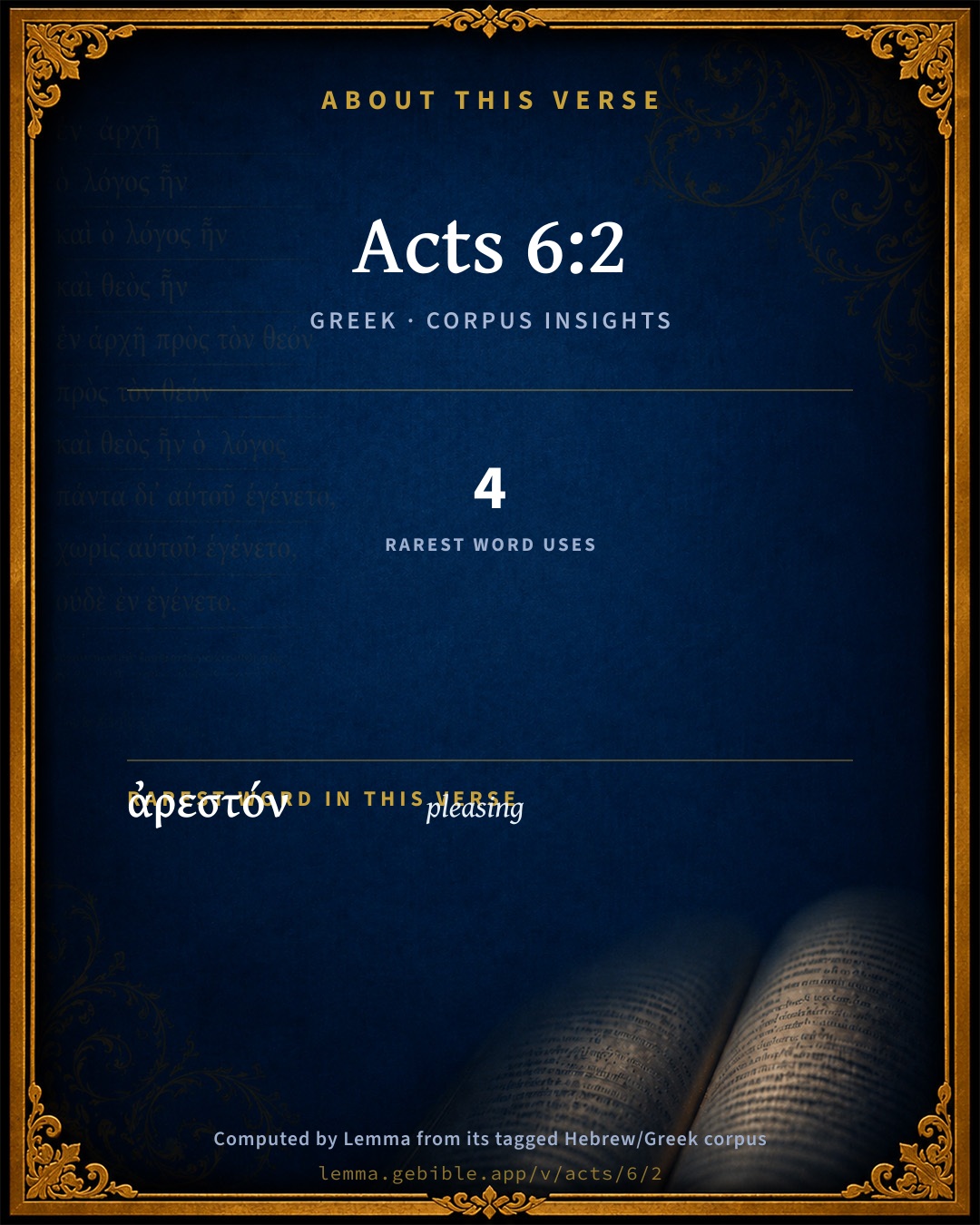
The rarest word here is ἀρεστόν pleasing G701 — appearing just 4 times in the whole Greek New Testament.

Shared distinctive vocabulary

ἀρεστόν pleasing G701 occurs in 4 verses of the Greek New Testament. Also found in:

Repetition

A word recurs within this verse:

Cross-references

8

Topical passages linked to Acts 6:2 in the Treasury of Scripture Knowledge — connected by theme and wording, ordered by reader-vote popularity; previews shown in the World English Bible.

  • Deuteronomy 1:9–14 I spoke to you at that time, saying, I am not able to bear you myself alone:
  • Exodus 18:17–26 Moses' father-in-law said to him, "The thing that you do is not good.
  • 2 Timothy 2:4 No soldier on service entangles himself in the affairs of life, that he may please him who enrolled him as a soldier.
  • Nehemiah 6:3 I sent messengers to them, saying, I am doing a great work, so that I can't come down: why should the work cease, while I leave it, and come down to you?
  • Numbers 11:11–13 Moses said to Yahweh, Why have you dealt ill with your servant? and why haven't I found favor in your sight, that you lay the burden of all this people on me?
  • Acts 4:19 But Peter and John answered them, "Whether it is right in the sight of God to listen to you rather than to God, judge for yourselves,
  • Acts 21:22 What then? The assembly must certainly meet, for they will hear that you have come.
  • Acts 25:27 For it seems to me unreasonable, in sending a prisoner, not to also specify the charges against him."

Cross-references courtesy of OpenBible.info (CC BY 4.0).

Commentary

Notes on Acts 6:2 from classic Christian and Jewish commentators (each source and its license shown beneath its notes). The classic Christian expositions comment on the surrounding passage and are grouped to its opening verse, so a note may address several verses; the Jewish commentaries on the Tanakh (Rashi and others) are per-verse, so they appear only where the commentator wrote on this verse.

Lemma curates 59 commentaries, every one of them public domain or Creative Commons licensed, each selected and text-cleaned for this edition rather than reprinted as found. About our sources →

Joseph Benson's Commentary

Act 6:2-4. Then the twelve — For such was now again their number, Matthias having supplied the place of Judas; called the multitude of the disciples unto them — Not the rest of the one hundred and twenty merely, but the whole body of Christian converts, they being the persons to whom satisfaction was then due. See Whitby. It was of great importance that the apostles should immediately take measures to suppress these rising murmurs and discontents; for had they been suffered to remain and take root, they might have produced dangerous disputes and divisions, and have involved the apostles themselves in suspicion and censure. It is not reason — Ουκ αρεστον εστιν, it is not right, proper, or, pleasing; namely, to God; that we — Who have an office to discharge of so much greater weight and consequence; should leave the word of God — Should be less frequently employed in dispensing it; and serve tables — Attend to the distribution of money to relieve the wants of the poor; and yet this we must do, in order to prevent these complaints, unless some further measures be taken by common consent. Wherefore, brethren — As you see how inconvenient it would be to suffer this care to lie upon us, and how inevitably it would render us incapable of attending to the proper duties of our office; look ye out among you seven men — A number sufficient for the present; of honest report — That there may be no room to suspect them of partiality and injustice; full of the Holy Ghost and wisdom — For it is not a light matter to dispense even the temporal goods of the church. To do even this well, a large measure both of the gifts and grace of God is requisite. Whom we may appoint over this business — It would have been happy for the church, had its ordinary ministers, in every age, taken the same care to act in concert with the people committed to their charge, which the apostles themselves, extraordinary as their office was, did on this and other occasions. It may be proper to observe here, that in the first church, the primary business of apostles, evangelists, and elders, was to preach the word of God; the secondary, to take a kind of paternal care (the church being then like a family) for the support especially of the poor, the strangers, and the widows. Afterward, as here, the deacons were constituted for this latter business. And whatever time they had to spare from this, they employed in works of spiritual mercy. But their proper office was to take care of the poor. And when some of them afterward preached the gospel, they did this, not by virtue of their deaconship, but of another commission, that of evangelists, which they probably received, not before, but after they were appointed deacons. And it is not unlikely that others were chosen deacons, or stewards, in their room, when any of these commenced evangelists. But we — Being thus freed from this great encumbrance; will give ourselves continually — Will dedicate our whole time; to prayer, and to the ministry of the word — Which is our grand business, and which we would be glad to prosecute without interruption. It is, doubtless, still the proper business of a Christian minister, whether termed a pastor, elder, or bishop, to speak to God in prayer; and to men in preaching his word, as an ambassador for Christ.

Joseph Benson's Commentary on the Old and New Testaments (1811–1818) — public domain. Text from a community e-Sword module.

Tyndale Open Study Notes

Tyndale Open Resources

6:2-6 Wisely, the apostles called a meeting of all the believers to address the dispute. They recognized the seriousness of the problem, as well as their own priority of teaching the word of God. The solution was to select wise and Spirit-filled men to oversee the food distribution. The community accepted the apostles’ solution and chose good leaders from the ranks of the Greek-speaking believers (all of their names are Greek). These seven devoted themselves to this special ministry, allowing the apostles to spend their time in prayer and teaching the word. • These seven men are sometimes called the first deacons because of the similarity of their role to the office of deacon (see 1 Tim 3:8-13). Although the Greek term translated “deacon” (Greek diakonos, “servant”) is not used here, a related Greek word is translated running a food program (6:2; Greek diakonein, “to serve”).

Tyndale Open Study Notes — © Tyndale Open Resources, licensed CC BY-SA 4.0. Text via the HelloAO Bible API.

Bengel's Gnomon

Johann Albrecht Bengel

Act 6:2. Ἡμᾶς, that we) the apostles.—καταλείψαντας, having left) They were not able at once to attend to both: for which reason they sustain that function which is the more noble. It is dangerous to leave those duties which have been especially entrusted to us. This often happens whilst we are unconscious of it. The bishops have put far away from them this principle, since they have become so involved in worldly things, that spiritual things, excepting the solemn outward pageant, are almost entirely swallowed up in their princely function.—διακονεῖν τραπέζαις, to minister to tables) The phrase expresses the doing of something unworthy of their office. The antithesis is the ministry of the word, Act 6:4. What were the functions of the deacons in the primitive Church, is a subject of copious disquisition: but the matter may be comprised in a few words. It was the especial duty of the bishops, apostles, evangelists, etc., to preach the word of GOD; it was their secondary duty to have a kind of fatherly care (for the Church was, at the beginning, like a family) of the sustenance, particularly of the poor, of strangers, of widows, etc. But the deacons, of both sexes, were appointed strictly to have the same care of the sustenance of the brethren: and in that department they felt it necessary to bestow very much exertion on the church of Jerusalem; in other places, more or less care as circumstances suggested; whatever exertions they could make, after their principal duty was attended to, they devoted to the preaching of the word.

Bengel's Gnomon of the New Testament — English translation (T&T Clark, Edinburgh, 1860) — public domain. Text from a community e-Sword module.

Meyer's Critical & Exegetical Commentary

Heinrich August Wilhelm Meyer

Act_6:2. Τὸ πλῆθος τῶν μαθητῶν] the mass of the disciples; i.e. the Christian multitude in general, not merely individuals, or a mere committee of the church. Comp. Act_4:32. It is quite as arbitrary to understand, with Lightfoot, only the 120 persons mentioned in Act_1:15, as, with Mosheim and Kuinoel, to suppose that the church of Jerusalem was divided into seven classes, which assembled in seven different places, and had each selected from their midst an almoner. As the place of meeting is not named, it is an over-hasty conclusion that the whole church could not have assembled all at once.

οὐκ ἀρεστόν ἐστιν] non placet, Act_12:3; Joh_8:29; Herod. i. 119; Plato, Def. p. 415 A. The Vulgate, Beza, Calvin, Piscator, Casaubon, Kuinoel, incorrectly render: non aequum est, which the word never means, not even in the LXX. It pleased not the apostles to leave the doctrine of God (its proclamation), just because the fulfilment of the proper duty of their calling pleased them.

καταλείψ.] A strong expression under a vivid sense of the disturbing element (to leave in the lurch). On the form, see Lobeck, ad Phryn. p. 713 ff.

διακονεῖν τραπέζαις] to serve tables, i.e. to be the regulators, overseers, and dispensers in reference to food. The expression, which contains the more precise definition for τῇ διακονίᾳ of Act_6:1, betrays indignitatem aliquam (Bengel).

The reference which others have partly combined with this, partly assumed alone, of τράπεζα to the money-changers table, Mat_21:12, Luk_19:23 (pecunia in usum pauperum collecta et iis distribuenda, Kuinoel), is excluded, in the absence of any other indication in the text, by the διακονεῖν used statedly of the ministration of food (Wetst. ad Mat_4:11). Moreover, the designation of the matter, as if it were a banking business, would not even be suitable. The apostles would neither be τραπεζοκόμοι nor τραπεζοποιοί (Athen. IV. p. 170). They may hitherto in the management of this business have made use, without fixed plan, of the assistance of others, by whose fault, perhaps, the murmuring of the Hellenists was occasioned.

Meyer — Critical and Exegetical Commentary on the New Testament — English translation by Peter Christie, edited by Frederick Crombie (T&T Clark, 1880) — public domain. Text from a community e-Sword module.

Expositor's Greek Testament

ed. W. Robertson Nicoll

Act 6:2 . προσκαλεσάμενοι δὲ οἱ δώδεκα : whatever may have been the irritation caused by the pride or neglect of the Hebrews, the Apostles recognised that there was ground for complaint, and thus showed not only their practical capacities, but also their freedom from any partiality. οἱ δώδ .: only here in Acts, but cf. 1Co 15:5 , where St. Paul uses the title as if it were well and widely known, and required no explanation from him. It is found six times in St. Luke’s Gospel, and no less than ten in St. Mark’s. See also above Act 1:26 , Act 2:14 . τὸ πλῆθος = the whole Church, not the hundred-and-twenty, as J. Lightfoot. The expression is a general one, and need not imply that every single member of the Church obeyed the summons. For the word πλῆθος and the illustration of its use in religious communities on the papyri by Deissmann, see p. 73. The passage has been quoted in support of the democratic constitution of the Apostolic Church, but the whole context shows that the government really lay with the Apostles. The Church as a whole is under their direction and counsel, and the Apostles alone determine what qualification those chosen should possess, the Apostles alone lay hands upon them after prayer: “The hand of man is laid upon the person, but the whole work is of God, and it is His hand which toucheth the head of the one ordained, if he be duly ordained” (Chrys., Hom. , xiv.). The dignity of the Apostles, and their authority as leaders of the Church and ordainers of the Seven, is fully recognised by Feine, but he considers that their position is so altered, and the organisation of the Church so much more developed, that another source and not the Jerusalem Quellen-schrift must be supposed; but if, as Feine allows, such passages as Act 4:34 , Act 5:2 , belong to the Jerusalem source, it would appear that the authority of the Apostles in the passage before us was a very plain and natural development. καταλείψαντας : on the formation of the first aorist see Blass, Grammatik , p. 43, and also Deissmann, Neue Bibelstudien , p. 18; Winer-Schmiedel, p. 109. διακονεῖν τραπέζαις : there seems to be an intentional antithesis between these words and τῇ διακονίᾳ τοῦ λόγου in Act 6:3 . The Twelve do not object to the work of ministering, but only to the neglect of ministering to the higher sustenance for the sake of the lower (Hort, Ecclesia , p. 206); thus Bengel speaks of the expression as used with indignation, “Antitheton, ministerium verbi ”. διακονία and διακονεῖν are used for ministrations to man, although more usually of man to God; cf. Act 19:22 , of service to St. Paul, διακονία , Act 11:29 ; Act 12:25 , of service to the brethren of Judæa in the famine, Rom 15:25 ; Rom 15:31 , 2Co 8:4 ; 2Co 9:1 ; 2Co 9:12-13 , of the Gentile collections for the same purpose, so too probably in Rom 16:1 of the service rendered by Stephanas to travelling Christians, cf. Heb 6:10 , and its use of the verb in the Gospels of ministering to our Lord’s earthly wants, Luk 8:3 ; Luk 10:40 (both noun and verb), Joh 12:2 ; cf. also Luk 12:37 ; Luk 22:27 , Mat 4:11 , Luk 4:39 ; see further on the use of the word in classical Greek, Hort, Ecclesia , p. 203. The word had a high dignity conferred upon it when, in contrast to the contemptuous associations which surrounded it for the most part in Greek society, Epictetus remarks that it is man’s true honour to be a διάκονος of God ( Diss. , iii., 22, 69; 24, 65; iv. 7, 20; cf. iii. 26, 28), and a dignity immeasurably higher still, when the Son of Man could speak of Himself as in Mat 20:28 , Mar 10:45 ; cf. Luk 22:27 . “Every clergyman begins as a deacon. This is right. But he never ceases to be a deacon. The priest is a deacon still. The bishop is a deacon still. Christ came as a deacon, lived as a deacon, died as a deacon: μὴ διακονηθῆναι , ἀλλὰ διακονῆσαι ” (Lightfoot, Ordination Sermons , p. 115). In the LXX the verb does not occur at all, but διάκονος is used four times in Est 1:10 ; Est 2:2 ; Est 6:3 ; Est 6:5 , of the king’s chamberlains and of the servants that ministered to him, and once in 4Ma 9:17 ; διακονία is also found in two of the passages in Esther just quoted, Act 6:3 ; Act 6:5 , where in A we read οἱ ἐκ τῆς διακοίας (BS διάκονοι ), and once in 1Ma 11:58 , of the service of gold sent by Jonathan to Antiochus. What is meant by the expression here? does it refer to distribution of money or in kind? The word in itself might include either, but if we were to limit διακονία to alms, yet the use of the word remarked upon above renders the service higher than that of ordinary relief: “ ministration ” says St. Chrysostom (although he takes it of alms, Hom. , 15), “extolling by this at once the doers and those to whom it was done”. But τραπέζαις presents a further difficulty; does it refer to the tables of exchange for money, a rendering which claims support from Mat 21:12 ; Mat 25:27 , Luk 19:23 , Joh 2:15 , or to tables for food, Luk 16:21 ; Luk 22:21 ; Luk 22:30 ? Possibly the use of the word in some passages in the N.T., and also the fact that the διακονία was καθημερινή , may indicate the latter, and the phrase may refer to the actual serving and superintending at the tables at which the poor sat, or at all events to the supplying in a general way those things which were necessary for their bodily sustenance. Zöckler, Apostelgeschichte (second edition), refers the word to the ministration of the gifts of love offered at the Eucharist in the various Christian houses (so Scaliger understood the expression of the Agapæ). Mr. Humphry reminds us that the words were quoted by Latimer (1548) in a sermon against some bishops of his time who were comptrollers of the mint.

The Expositor's Greek Testament, edited by W. Robertson Nicoll (1897–1910) — public domain. Text from a community e-Sword module.

Geneva Bible (1599)

Geneva Bible translators

It is such a matter, as we may in no wise accept of it.

Banquets though by the name of tables, other offices are also meant, which are annexed to it, such as pertain to the care of the poor.

The office of preaching the word and dispensing the goods of the Church, are different one from another, and not rashly to be joined together, as the Apostles do here institute: And the Apostles do not choose so much as the Deacons without the consent of the Church.

Geneva Bible (1599) marginal notes — public domain. Text via Bolls.life.

Jamieson, Fausset & Brown

Robert Jamieson, A. R. Fausset & David Brown

the multitude--the general body of the disciples.

It is not reason--The word expresses dislike; that is "We cannot submit."

to leave the word of God--to have our time and attention withdrawn from preaching; which, it thus appears, they regarded as their primary duty.

to serve tables--oversee the distribution of provisions.

Jamieson, Fausset & Brown — Commentary Critical and Explanatory on the Whole Bible (1871) — public domain (CC PDM 1.0). Text via the HelloAO Bible API.

Adam Clarke's Commentary

Verse 2. It is not reason] ουκ αρεστον εστι, it is not pleasing, proper, or fitting, that we should leave the word of God, that we should give up ourselves, or confide to others, the doctrine of salvation which God has commanded us to preach unto the people.

And serve tables.] Become providers of daily bread for your widows and poor: others can do this, to whom our important office is not intrusted.

Adam Clarke's Commentary on the Bible (1810–1826) — public domain. Text from a community e-Sword/MySword module.

John Calvin's Commentaries

2. The twelve having the multitude called unto them It is a point [proof] of patience and meekness that the apostles are no more moved. It is a point of prudence and godly carefulness, in that they prevent the evil which began to arise, without deferring the remedy. For after that every dissension and division hath gathered strength, it is a wound hard to be cured. By this assembly it appeareth that the Church was governed by order and reason, so that the apostles had the chiefest authority, and that they did impart their counsels and purposes unto the people. Again, we must note that the faithful, or Christians, are in this place called disciples, in whom that of Isaiah must be fulfilled, “That they were all taught of God.” And again, that of Jeremiah, “They shall all know God, from the least to the greatest.”

It pleaseth not. It is in Greek [ουκ αρεστον] By which word, the Grecians do now express every opinion or decree which is better than another, or which is to be preferred as being better. I do rather think that the apostles declare what is profitable, than simply what they have decreed. But if it be not expedient for them to meddle with this business, they seem [now] to acknowledge some fault in that they ministered hitherto. And surely that is true, that use is the father of wisdom. Wherefore there shall be no absurdity if we shall say, that the apostles desire of the Church to be unburdened of that function, after that they have tried [experienced] that it is not meet for them. But if there were any fault, it ought rather to be ascribed unto necessity than unto them; for they took not this burthen upon them greedily, but seeing there was no other way as yet, they had better burthen themselves out of measure than that the poor should be forslowed. And when as they say that it is not meet that they should be occupied in providing for the poor, their meaning is, that are unable to endure both burthens, so that they must needs let the one alone. For it is as if they should say, If thou wilt enjoy our ministry in the preaching of the gospel, deliver us from the charge of the poor, because we are not able to do both. But this seemeth to be spoken out of season by them, because they had not left the charge of teaching before, although they had the oversight of the alms. I answer, forasmuch as the administration was confused, they were so enwrapped, that they could not wholly attend upon doctrine as was meet. Therefore, they refuse that function which draweth them away from the free and perfect charge of teaching. Notwithstanding, we may not think that they had quite cast away all care of the poor, but that they did only seek somewhat to be lightened and eased, that they might attend upon their office. And, in the mean season, they declare that the ministry of the word is so painful that it requireth a whole man, neither will it suffer him to be occupied about any other business; which, if it had been well considered, there had been a far other order taken in the Church.

The Popish bishops did suck up great riches under color of the ministration or deaconship; nevertheless, they entangled themselves in divers businesses, which they were scarce able to overcome, though every one of them had had ten heads. Notwithstanding, such is their wickedness, that they say that there can be no church unless it be drowned in this depth; neither do they cease to brag and boast that they are the successors of the apostles, whereas there is nothing which appeareth to be more contrary. They were careful for this, that they might not be occupied about serving of tables, and so be compelled to leave their own banquets. For whosoever is careful for his own table, he taketh leave to be vacant from other men’s tables.

But omitting these things, let us mark this sentence. We know what a holy thing it is to be careful for the poor. Therefore, forasmuch as the apostles prefer the preaching of the gospel before if we gather thereby that no obedience is more acceptable to God. Notwithstanding, the hardness is also declared, when as they say that they cannot discharge both these duties. Surely we are not better than they. Therefore, let every one of us that is called unto the function of teaching addict himself wholly to order this his estate well. For we are inclined to nothing more than to fall to slothfulness. Again, the flesh ministereth goodly cloaks and colors, so that those men cannot see by and by that they are led away from their calling which enwrap themselves in strange business. Wherefore, to the end ministers may prick forward themselves to do their duty, let them remember this saying of the apostles oftentimes, wherein they declare that, forasmuch as they are called unto the function of teaching, they must not any longer take charge of the poor. Therefore, what excuses have profane affairs (taken in hand even for some private gain) where that is set aside, which is otherwise accounted no small part of the worship of God.

John Calvin's Commentaries (1540-1563) — public domain. Text from the Calvin Translation Society English edition (1840s-50s) via the Christian Classics Ethereal Library (ccel.org). Calvin's coverage is partial (roughly two-thirds of the Bible); uncommented books and verses are honest gaps, never fabricated. The 19th-century editor's footnotes and remarks are omitted so the notes are faithfully Calvin's own voice.

Ellicott's Commentary for English Readers

(2) Then the twelve called the multitude of the disciples.—The Apostles meet the crisis with singular tact and moderation. They do not resent the suspicion; they are not careful to vindicate themselves against it. They remembered, it may be, the precedent presented by the life of Moses (Exo_18:25), and they act, as he had acted, by delegating part of their authority to others. The collective action of the multitude is strikingly in harmony with the Greek ideas attached to the word Ecclesia, as the assembly in which every citizen might take his share. Representative government might come as a necessity of later times; as yet, every member of the congregation, every citizen of the new polity, was invited, as having a right to vote.

It is not reason.—Literally, It is not pleasing, as in Act_12:3. The word implies that they had undertaken a burdensome duty, not for their own pleasure, because they liked it, but for the good of the community.

And serve tables.—The word was used for the “tables” of money-changers, as in Mat_21:12, Joh_2:15, and was, therefore, equally appropriate whether we think of the relief as being given in money or in kind.

A Bible Commentary for English Readers, edited by Charles John Ellicott (1878–1897) — public domain. Text from a community e-Sword module.

The Cambridge Bible for Schools and Colleges

gen. ed. J. J. S. Perowne

2. Then the twelve called the multitude of the disciples unto them] They found that there was cause for the complaint, and at once prepared to provide a remedy. By “the multitude of the disciples” we are not to suppose that an attempt was made to gather every one who in Jerusalem called himself a Christian, but that a large and special meeting was convened, before which the Apostles laid their plan. The funds had been given by various persons, and were for the common relief; it was therefore fit that a change in the distributors should be considered in common.

and said, It is not reason] The word properly means pleasing, and the idea meant to be conveyed is that it was not meet that the Apostles should leave the higher functions to which they had been specially appointed, and spend their whole time in the business duties to which the present emergency had given rise.

that we should leave the word of God, and serve tables] Better, “forsake the word.” The verb in the original is a strong form, and indicates that the whole time of the twelve was being spent on this disbursement.

By tables is meant the bench or counter at which the money was distributed. Both in Hebrew and Greek bankers are “tablers.” Cf. “the tables of the moneychangers” (Mat_21:12).

The word for serve is diakonein, akin to the noun in the previous verse.

The Cambridge Bible for Schools and Colleges (gen. ed. J. J. S. Perowne; Cambridge University Press, 1878–1918) — public domain. Text from a community e-Sword module.

John Gill's Exposition

Then the twelve,.... The twelve apostles, as the Syriac version reads; for their number was now complete, Matthias being chosen in the room of Judas: these being informed of the murmur there was between the two sorts of believers, the Hebrew and thc Hellenistic Jews,

called the multitude of the disciples unto them; either the hundred and twenty, the original members of the church, which first formed it, and on whom the Holy Ghost descended on the day of Pentecost; or rather the whole body of the church: for what the apostles had to say concerned them all; and they all had an equal right to chose their officers, that should minister unto them; and when they were convened together, they addressed them after this manner:

and said, it is not reason; or "it is not pleasing", neither to God, nor to us; so the Arabic version reads, "this does not please us"; nor could it be pleasing to the church itself:

that we should leave the word of God the study of the word, meditation upon it, and preaching it: not that they did relinquish either of these; but they were sometimes obliged to omit them, or not so frequently attend them; the care of the poor taking up more of their time, than the work of the ministry, or preaching of the Gospel would admit of; and therefore thought it not so right and proper, or so acceptable a thing to God and man, that they should in the least neglect a work of so great importance to the souls of men, and cause it to give way to that which only regarded their bodies:

and serve tables; the tables of the poor, collect for them, inspect into their several cases, and circumstances, and distribute accordingly to them; which required a good deal of time, care, thought, and circumspection, especially in such a church, where the numbers were so large. From hence we learn what is the business of deacons, who were afterwards appointed to take this part of the apostles' work off of their hands, and attend to it; which is to serve tables: the table of the Lord, by providing the bread and wine for it; receiving both from the minister, when blessed, and distributing them to the members; and collecting from them for the poor, and the defraying the charge; and observing what members are missing at the ordinance, whom they are to admonish; and if their admonitions are not regarded, to report it to the church: and they are likewise to serve the minister's table, by taking care that he has a sufficient competency for his support; and it belongs to them to stir up the members of the church to their duty in communicating to him; and what they receive of them, they are to apply to his use: and also, they are to serve the poor's table; to whom they are to distribute of the church's stock, with all impartiality, simplicity, cheerfulness, and sympathy.

John Gill's Exposition of the Whole Bible (1746–1763) — public domain (CC PDM 1.0). Text via the HelloAO Bible API.

Trapp's Complete Commentary

John Trapp

2 Then the twelve called the multitude of the disciples unto them, and said, It is not reason that we should leave the word of God, and serve tables.

Ver. 2. It is not reason] αρεστον, an arrest or order, saith Erasmus; a plea, judgment, or sentence, saith Budaeus.

Serve tables] And do other such offices for the relief of the poor. Bishop Hooper is famous for his board of beggars, who till they were served every day with whole and wholesome meats, he would not himself sit down to dinner. Laudent te esurientium viscera, non ructantium opulenta convivia, said Jerome to Demetrius, "Charity is better than courtesy."

John Trapp, A Commentary or Exposition upon All the Books of the Old and New Testament (1647–1656) — public domain. Text from a community e-Sword module.

Albert Barnes' Notes on the Bible

Then the twelve - That is, the apostles. Matthias had been added to them after the apostasy of Judas, which had completed the original number.

The multitude of the disciples - It is not necessary to suppose that all the disciples were convened, which amounted to many thousands, but that the business was laid before a large number; or perhaps “the multitude” here means those merely who were more particularly interested in the matter, and who had been engaged in the complaint.

It is not reason - The original words used here properly denote “it is not pleasing or agreeable”; but the meaning evidently is, it is not “suitable” or “proper.” It would be a departure from the design of their appointment, which was to preach the gospel, and not to attend to the pecuniary affairs of the church.

Leave the word of God - That we should neglect or abandon the preaching of the gospel so much as would be necessary if we attended personally to the distribution of the alms of the church. The “gospel” is here called the “Word of God,” because it is his message; it is what he has spoken, or which he has commanded to be proclaimed to people.

Serve tables - This expression properly denotes “to take care of, or provide for the table, or for the daily needs of a family.” It is an expression that properly applies to a steward or a servant. The word “tables” is, however, sometimes used with reference to “money,” as being the place where money was kept for the purpose of “exchange, etc.,” Mat 21:12; Mat 25:27. Here the expression means, therefore, to attend to the pecuniary transactions of the church, and to make the proper distribution for the needs of the poor.

Albert Barnes' Notes on the Bible (1834–1885) — public domain. Text from a community e-Sword/MySword module.

Haydock's Catholic Bible Commentary

And serve tables. The apostles did not judge it proper for them to be so much employed in managing that common stock, out of which every one, as they stood in need, were supplied, as to meat, and all other necessities: this took up too much of their time, which might be better employed in preaching, &c. (Witham) --- Word of God. The most essential duty of an apostle and bishop, is to announce the word of God. St. Paul would not even baptize, lest it should be a prejudice to the performance of this great duty, for which he had been sent. Many think, that this ministry of the tables, here signifies, not only the distribution of corporal nourishment, but the dispensing of the holy Eucharist. As sacred and divine as was this latter duty, the apostles preferred before it, their obligation of preaching. (Calmet)

George Leo Haydock (1774–1849), Haydock's Catholic Family Bible and Commentary, 1859 edition — public domain. Excludes Psalms (Douay-Rheims chapter numbering differs from Protestant) and Deuterocanonical books (Catholic canon only).

Matthew Poole's English Annotations

The twelve; for such was their number now again, Matthias having supplied the place of Judas; this is that blessed number, or the root of it, which God hath so much magnified.

The word of God; preaching of the word, and other duties belonging to it.

Serve tables; either providing for the agapae and love feasts, or distributing to the necessities whereby they might be fed, and their tables provided.

Matthew Poole's English Annotations on the Holy Bible (1683–1685) — public domain. Text from a community e-Sword/MySword module.

Whedon's Commentary on the Bible

Daniel D. Whedon

2. Then the twelve—This is the first recorded movement for forming a Church economy; we can hardly say government. Beyond the appointment of his twelve, Christ had left no draft of a constitution for his Church.

There is clearly no connection between this seven and the seventy deacons sent forth by our Lord, nor any certain connection between them and the deacons of the Epistles or of subsequent ecclesiastical history. The whole movement of their election is a measure of immediate expediency, suggested by an incidental want, adopted without any claim or consciousness of special inspiration, and without the least apparent thought that they are adopting a permanent order for the universal Church, without which a complete and valid Church cannot exist. The whole act suggests the doctrine that any Church is endowed by the great Head of the Church with the right of shaping itself into any organic form most conducive to its great mission of salvation. (See note on Act_13:3.)

Called the multitude—The apostolic mind originates the new idea, but the body of the Church alone can give it reality. The thought moves in the brain, but the energetic and active soul lives in the whole body.

Serve tables—The Greek word τραπεζα may signify either a money table or a meal table indifferently, (Mat_16:27, Act_16:34, and also Mat_21:12, and Luk_19:23,) and perhaps includes both here.

This deaconship was certainly not a merely pecuniary office, a mere agency to apply the moneys laid at the apostles’ feet. In all probability the seven, with the funds, supplied the ministrations of the daily table-provisions where the oversights took place.

Daniel D. Whedon (gen. ed.), Commentary on the Old and New Testaments (1874–1909) — public domain. Text from a community e-Sword module.

The Pulpit Commentary

And for then, A.V.; fit for reasons, A.V.; forsake for leave, A.V. It is not fit; literally, pleasing; ajreston is often the rendering of bwOf in the LXX; e.g. Gen_16:6; Deu_12:28 in Exo_15:26, Deu_6:18, etc., it stands for rv; y; that which is right. Serve tables. The English reader should remember that the "ministration" of ver. 1, the "serve" of this verse, and the "deacon" which was the name of the new officers, are all forms of the same Greek word (diakonia diakonein diakonov). In ver. 4 "the ministry of the Word" is opposed to "the daily ministration" of meat. The passage gives a necessary warning to the ministers of God"s Word not to spend too much time and strength upon any secular work, even though it be a work of charity. They must give themselves to the Word of God and to prayer. There are Christian laity to serve tables.

The Pulpit Commentary (1880–1919), ed. H.D.M. Spence-Jones & Joseph S. Exell — public domain. Text from a community e-Sword module.

John Wesley's Explanatory Notes

It is not right that we should leave the word of God and serve tables - In the first Church, the primary business of apostles, evangelists, and bishops, was to preach the word of God; the secondary, to take a kind of paternal care (the Church being then like a family,) for the food, especially of the poor, the strangers, and the widows. Afterward, the deacons of both sexes were constituted for this latter business. And whatever time they had to spare from this, they employed in works of spiritual mercy. But their proper office was, to take care of the poor. And when some of them afterward preached the Gospel, they did this not by virtue of their deaconship, but of another commission, that of evangelists, which they probably received, not before, but after they were appointed deacons. And it is not unlikely that others were chosen deacons, or stewards, in their room, when any of these commenced evangelists.

John Wesley, Explanatory Notes Upon the Whole Bible (1754–1765) — public domain. Text via the GEBible commentary corpus.

Godbey's Commentary on the New Testament

William B. Godbey

THE DEACONATE

2-5. God is a great Organizer. Hence He has given the New Testament Church a simple, perfect and beautiful organization. The bishop is the leader of the holiness band [for such were all of the Apostolic churches], while the deacon has charge of all the temporal interests of the church in every respect, and the eldership, originally in Israel consisting of seventy, instituted by Jethro, the father-in-law of Moses, when he visited the children of Israel in the wilderness, and transferred by the apostles into the Christian dispensation. Spiritual seniority constitutes the basis of the New Testament eldership, which is a judicatory body having charge of the general interest of the church. Hence the church is not a democracy, but has an organized government. The deaconate is prominent among the Baptists, who give that office its Scriptural attitude. If they would only adhere to first principles and invest none with the deaconate unless they are “full of the Holy Ghost and wisdom,” Act 6:3. The Presbyterians give prominence to the eldership, honoring the New Testament in that office. If they would only see that none serve as elders except those who are filled with the Holy Ghost. If the Holiness Movement does not glorify God by coming back to first principles, and revealing to the world New Testament simplicity, she will forfeit her crown, and God will give it to another. This we can not afford to do. As it is very doubtful whether any of the great reformations have ever reached primary truth and institutionality since the Constantinian apostasy, it becomes the more imperative that we divest ourselves of every weight and run for the prize set before us. How strange that every church in Christendom does not gladly drop all of her human inventions and come back to first principles! since an awful woe is pronounced against both addition and subtraction. The popular churches are burdened to death with institutions of their own creation, alien from the Bible, and, in many cases, antagonistical to it. These grieve the Holy Spirit away and turn them over to the enemy. The New Testament is plain on all doctrines and institutions.

We need nothing else. Human creeds and institutions divide the people of God, build up warring sects, grieve the Holy Spirit, alienate the people from God, and do a world of mischief, which the Judgment Day can alone reveal. So long as the apostolic church professed and preached entire sanctification she had neither creeds nor schisms. There are always green pastures somewhere in the Church of God, whither the sheep may go, eat and be filled and lie down by the still waters. Human creeds and institutions are the devil’s fences dividing up Emmanuel’s laud, shutting up many poor sheep in dry and desolate pastures, where they starve to death in piles. God has raised up the Holiness Movement to knock down the devil’s fences and lead all of the sheep to the green pastures and still waters, where they may prosper and glorify God.

William B. Godbey, Commentary on the New Testament (1896–1900) — public domain. Text from a community e-Sword module.

McGarvey & Pendleton's Commentaries

J. W. McGarvey

2-4. This unforeseen circumstances suggested to the apostles the propriety of insinuating a new office in the Church. Though the Holy Spirit was given to guide them into all the truth, its additional instruction was given only as circumstances required. They were not theorists, with a constitution and by-laws drawn up in advance, to which, under all circumstances, the Church must conform; but they allowed the condition of the congregation, from time to time, to dictate the provisions which should be made, and therefore the provisions which were made precisely such as were needed. Hitherto the Church had been without an officer of any kind, except the apostles; for the supposition advanced by some writers, that the young men, oi neoteroi, who buried Ananias and Sapphira, were regularly-appointed officers, is without foundation, except in the analogy of later and unscriptural organizations. Seeing, then, that the Church in Jerusalem existed for a time under the control of the apostles alone, it follows that a Church may now exist under the written teaching alone of the same apostles. But seeing, further, that when circumstances required it, other officials were appointed, it follows that all Churches among whom similar wants arise should provide themselves in the same way. All Churches, however, will inevitably find need for such officers as the New Testament authorizes; hence they should procure them without unnecessary delay.

When the murmuring came to the ears of the apostles they acted promptly. (2) " Then the twelve called the multitude of the disciples to them and said, It is not well that we should leave the word of God and serve tables. (3) Therefore, brethren, look out among you seven men of good repute, full of the Holy Spirit and wisdom, whom we may appoint over this business. (4) But we ourselves will continue in prayer and the ministry of the word. " The alternative with the apostles was to "leave," in some degree, "the word of God," and serve the tables satisfactorily, or turn this business over to other hands, and "continue in prayer and the ministry of the word" as uninterruptedly as before. They showed their superior regard for the latter ministry by choosing the latter course.

It seemed good to the Holy Spirit and the apostles that the whole "multitude of the disciples" should take part in the selection of these officers. No ingenuity of argument can evade the conclusion that this gives the authority of apostolic precedent for the popular election of officers of the Church. The multitude were limited, however, by apostolic authority, to the choice of men of a certain description. They must be men of "good repute;" not merely good men, but men whose goodness was accredited among the brethren.

They must also be men who were "full of the Holy Spirit." Whether this means that they must be possessed of miraculous powers, or merely that they must exhibit abundantly the fruits of the Spirit, it is difficult to determine. The circumstances, that up to this time no miracles had been wrought, so far as we know, by any of the apostles, and that, immediately after the appointment of the seven, Stephen appears "doing great wonders and miracles among the people," seem to indicate that they were merely full of the Holy Spirit in the ordinary way, but received miraculous powers when the hands of the apostles were laid upon them. On the other hand, the expression, "full of the Holy Spirit," generally means possessed of the miraculous powers of the Spirit. Whatever may be the decision of this question, it is certain that when a disciple was "full of the Spirit" in either sense, the religious sentiments were in lively exercise, and this is all that can be required in a candidate for the same office at the present day.

The office which the apostles are about to institute and fill is easily identified with that of the deacon as described in the third chapter of First Timothy . The seven are not styled diakonoi, deacons, but they were selected to attend to the daily diakonia, ( verse 1 ) and their service is expressed by the verb diakoneo, ( verse 2 ) the same which expresses the duty of deacons in 1 Tim 3:10-13 . The chief duty for which they were appointed, was " to serve tables, " diakonein trapezais; yet this duty need not prevent them from discharging any other functions for which they were qualified, and for which they could find time. God exacts the employment of every talent that is committed to us, and has appointed no work to be done which is too holy for the humblest disciple. We therefore find one of the seven deacons soon after in the front rank of the defenders of the faith; while another, after the dispersion of the Church, preaches in Samaria, and immerses both the Samaritans and the Ethiopian nobleman. Those who deny to deacons, at the present day, the same privileges, impose a restriction which is in direct conflict with the word of God. As to the title evangelist, afterward applied to Philip, see the "Commentary on Acts," xxi. 8.

J. W. McGarvey (with Philip Y. Pendleton), Commentaries on the New Testament (The Fourfold Gospel, 1914; Acts; and the epistles) — public domain. Text from a community e-Sword/MySword module.

The People's New Testament

B. W. Johnson

2. The twelve. This language shows beyond doubt that Matthias was recognized as an apostle. Called the multitude. The masses of the church. And said. That it was not proper that the apostles should give their time to these matters instead of preaching. And serve tables. To look after the distribution of food.

B. W. Johnson's The People's New Testament with Notes (1889–1891) — public domain. Electronic text from the Christian Classics Ethereal Library (CCEL) ThML edition.

unfoldingWord translationNotes

Door43 World Missions Community

General Information:

Here the word "you" refers to the believers. (See: Forms of You)

General Information:

The words "us" and "we" here refer to the 12 apostles. Where applicable, use the exclusive form in your language. (See: Exclusive and Inclusive "We")

The twelve

This refers to the eleven apostles plus Matthias, who was selected in Acts 1:26.

the multitude of the disciples

"all of the disciples" or "all the believers"

give up the word of God

This is an exaggeration in order to emphasize the importance of their task of teaching the word of God. AT: "stop preaching and teaching the word of God" (See: Hyperbole and Generalization)

serve tables

This is a phrase meaning to serve food to the people. (See: Metonymy)

men of good reputation, full of the Spirit and of wisdom

Possible meanings are 1) the men have three qualities—a good reputation, being full of the Spirit, and being full of wisdom or 2) the men have a reputation for two qualities—being full of the Spirit, and being full of wisdom .

men of good reputation

"men that people know are good" or "men whom people trust"

over this business

"to be responsible to do this task"

the ministry of the word

It may be helpful to add more information. AT: "the ministry of teaching and preaching the message" (See: Ellipsis)

translationWords

the twelve

disciple

word of God

servant

brother

good

Holy Spirit

wise

appoint

pray

to minister

unfoldingWord translationNotes — © Distant Shores Media and the Door43 World Missions Community, licensed CC BY-SA 4.0. Source: git.door43.org/Door43/en_tn.

Cambridge Greek Testament for Schools and Colleges

2. οἱ δώδεκα, the Twelve. They had found that there was cause for the complaint, and at once set about providing a remedy.

τὸ πλῆθος τῶν μαθητῶν. We are not from this to suppose that an attempt was made to gather every one who in Jerusalem called himself a Christian, but that a large and special meeting was convened, before which the Apostles laid their plan. The funds had been given by various persons, and were for the common relief; it was therefore fit that a change in the distributors should be considered in common.

οὐκ ἀρεστόν ἐστιν. Render, it is not pleasing (or fit). ‘Non est æquum,’ Vulg. The duties were not properly distributed. Those were now engrossed in business duties who alone could be the true exponents of Christ’s life and teaching.

καταλείψαντας κ.τ.λ., that we should forsake the Word of God. The verb is a strong one, and implies that the whole time of the Twelve was being consumed by these cares for the temporal wants of the brethren.

διακονεῖν τραπέζαις, to serve tables, means to preside at the bench or counter where the money was distributed. Cf. the τράπεζαι of the money-changers (Mat 21:12), who are themselves called τραπεζίται (Mat 25:27).

διακονεῖν is to discharge the διακονία mentioned in Act 6:1.

Cambridge Greek Testament for Schools and Colleges (Cambridge University Press, 1896; 21 vols, various authors incl. Carr, Maclear, Plummer, Farrar, Lumby, Moule, M. R. James, Simcox) — public domain. Text from a community e-Sword module.

Alford’s Greek Testament

Henry Alford

2.] τὸ πλῆθος τ. μ.,—‘the whole number of disciples in Jerusalem:’ summoning a general meeting of the church. How many they were in number at the time, is not said. Clearly the 120 names of ch. 1:15, cannot (Lightf.) be meant.

οὐκ ἀρεστόν ἐστιν] ‘non placet:’ it is not our pleasure: not ‘non æquum est,’ as Beza, Calv., Kuin., and others (and E. V.), defending this rendering by ἀρεστόν being used in the LXX for the Heb. טוֹב: but even there it never signifies good or right absolutely, but is used subjectively, with בְּעֵינָיִךְ, ‘in thine eyes:’ see Gen 16:6, ὡς ἄν σοι ἀρεστὸν ᾖ: also Deu 12:28, τὸ ἀρεστὸν … ἐναντίον κυρίου τ. θεοῦ σου.

καταλείψαντας] For to this it would come, if the Apostles were to enquire into, and do justice in, every case of asserted neglect.

διακονεῖν τραπέζαις] It is a question whether this expression import the service of distributing money (see reff. and Luk 19:23 al.)—or that of apportioning the daily public meals. The latter seems to me most probable, both on account of the καθημερινή above, and of the usage of διακονεῖν (see reff.). That both kinds of tables may be meant, is possible: but hardly probable.

Henry Alford, The Greek Testament (1849–1861) — public domain. Text from a community e-Sword module.

Vincent's Word Studies in the New Testament

Marvin R. Vincent

Reason [αρεστον] . Lit., pleasing or agreeable.

Leave [καταλειψαντας] . Rather forsake or abandon : leave in the lurch. Serve tables. Superintend the distribution of food.

Marvin R. Vincent, Word Studies in the New Testament (1887–1900) — public domain. Text from a community e-Sword/MySword module.

Lesson kit

Teaching starters — assembled from the data on this page, not authored interpretation. Every prompt links to the verse data it draws on. Edit before teaching.

Acts, in the Acts, opens this verse with 20 words (16 distinct Greek lemmas). Its most distinctive word is arestós (“pleasing”). A historical commentator’s framing appears above. Read the whole chapter for the surrounding context.

Discussion questions

  1. The word arestós carries the sense “pleasing.” How does it shape the verse?
  2. How does John 8:29, which shares the word «pleasing», read alongside this verse?
  3. What does the repetition of “the” (5× in this one verse) do in this verse?
  4. These translations render this verse differently. What is at stake in choosing one wording over another?
  5. Compare how Joseph Benson's Commentary and Tyndale Open Study Notes read this verse. Where do they agree or differ?

Things to notice

Reading settings

Reading text

Shown beneath each verse's original-language words.

Old Testament
Old Testament edition

Read the OT as the Masoretic Hebrew (MT) or the Greek Septuagint (LXX).

English shown for the Greek Septuagint (in the Hebrew ↔ Greek comparison).

Comparing translations? Open the Compare panel on any verse page to stack up to four side by side.